
Introduction:
Definitions, Hypotheses, and Lemmas
Definitions
Newton began On Motion with three definitions: centripetal force, innate force, and resistance. The list of definitions and the details of their descriptions were greatly enlarged in subsequent versions of the work, but in this first text they were set out very simply and compactly.
Definition 1. I call centripetal the force by which a body is impelled or attracted toward some point which is regarded as the center .
Definition 1 contains the first use of the term "centripetal" (center-seeking), which Newton coined as a complement to the term "centrifugal" (center-fleeing) that Huygens had employed in his writings.[13] The term signaled a major clarification of Newton's analysis of dynamics as found in the demonstrations of circular motion in the Waste Book (1665) and On Circular Motion (pre-1669) that were discussed in chapter 3. In those works, Newton, consistent with Descartes, refers to an outward endeavor, and in On Motion Newton, consistent with Hooke, does not mention an outward endeavor. Newton's rejection of both Cartesian perspective and terminology is not a change in Newton's method of demonstration, however. In both the early work and this later tract Newton employs the parabolic approximation in which the force is directly proportional to the radial displacement and inversely proportional to the square of the time. Moreover, Newton continued to employ the term "centrifugal" in other contexts, well after the writing of this work.[14]
Definition 2. Moreover, [I call ] the force of a body, [the force ] innate in a body, that by which it endeavors to persevere in its own motion along a straight line .
In Newton's analysis, the use of the "force innate in a body" most closely conforms to the contemporary use of the "magnitude of the linear momentum." Therefore, Newton's use of the word "force" in this context is at variance with modern usage, which reserves the term "force" for the "time rate of change of the linear momentum." Regardless of his choice of term, he uses "innate force" in a manner consistent with modern analysis.
Definition 3. And [I call ] resistance the force which comes from a regularly impeding medium .
The topic of motion in a resistive medium will not be included in the material covered in this study.
Hypotheses
Newton provided four hypotheses: the first sets out assumptions concerning resistance to motion; the second describes force-free motion; the third states the parallelogram rule for the addition of displacements produced by separate forces; and the fourth expresses a version of Galileo's time-squared dependence of linear displacement under a constant force.
Hypothesis 1. In the next nine propositions the resistance is zero; in those propositions following, the resistance is conjointly as the speed of the body and the density of the medium .
As noted, the first nine propositions consist of four theorems and five problems, all of which are concerned with ideal motion in the absence of resistance. The final two propositions (Problems 5 and 6) treat motion in a resistive medium.
Hypothesis 2. Every body by its innate force alone progresses uniformly along a straight line to infinity unless something impedes it from outside .
Following Descartes, Newton states that motion free from an external force (i.e., motion subject only to "innate force") takes place at a uniform rate along an infinite straight line. An enlarged version of this statement appears as the first law of motion in the Principia .[15]
Hypothesis 3. A body, in a given time, with forces having been conjoined, is carried to the place where it is carried by separated forces in successively equal times .
This rule for the combination of displacements as a measure of forces was implicit in Newton's pre-1665 analysis of circular motion but is made explicit here. Although Newton gives it as a hypothesis in On Motion , in the first revision of the tract Newton adds a demonstration and promotes the hypothesis to the status of a lemma.[16]
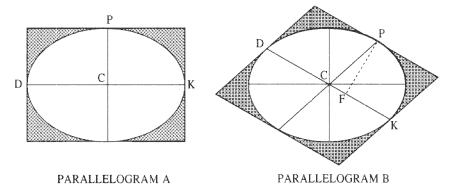
Figure 4.1
The area of parallelogram A is equal to the area of parallelogram B (Proposition 31,
Book 7, of the Conics of Apollonius of Perga).
Hypothesis 4. The space which a body, with some centripetal force impelling it, describes at the very beginning of its motion, is in the doubled ratio of the time .
This relationship is critical to all of Newton's analysis of action under a continuous centripetal force. It is the very core of his analysis; yet it is given here very simply and with little explanation. This hypothesis will be revised by the addition of a demonstration, and it also will be promoted to the status of a lemma.
Lemmas
Lemma 1. All parallelograms described around a given ellipse are equal to each other. This is established from the Conics.
This lemma is demonstrated in Book 7, Proposition 31 in the Conics of Apollonius of Perga (c. 262–c. 200 B.C. ); see figure 4.1.[17] The area of the circumscribed parallelogram A is 2PC × DK , and it is equal to the area of the circumscribed parallelogram B , which is 2PF × DK . It is important to note in parallelogram B that PF is the normal to DK , while in parallelogram A that PC is the normal to DK . The sides of parallelogram B are tangent to the ellipse at points P and D , where DK is constructed parallel to the line tangent at point P . This relationship will appear as Lemma 12 in the Principia , where it is employed in the solution of the direct Kepler problem.
Lemma 2. Quantities proportional to their differences are continuously proportional. Set A: (A – B) = B: (B – C) = C: (C – D) = . . . and by dividing there will be produced A:B = B:C = C:D = . . .
This lemma has application only to motion in a resistive medium, a topic which does not appear in the first three sections of Book One of the Principia .
Following the completion of the draft of On Motion of Bodies in Orbit (or simply On Motion ) that was sent to Halley, and hence to the Royal Society, Newton produced a slightly enlarged version of the tract, entitled On the Motion of Spherical Bodies in Fluids .[18] The body of the tract, which supplied the method and solutions to the direct problem in nonresisting media, was essentially unchanged from the first draft (except for the addition of a paragraph at the end of the scholium to Theorem 4). Newton did expand, however, the rather sparse statement of the fundamental hypotheses that was just discussed.
Hypothesis 3 Becomes Lemma 1
Hypothesis 3. A body, in a given time, with forces having been conjoined, is carried to the place where it is carried by separated forces in successively equal times .
Hypothesis 3 of the first draft of On Motion now appears as Lemma 1 in the second draft. The initial statement is slightly revised, and Newton appends a detailed demonstration. An earlier version of this parallelogram rule was discussed in chapter 3 during the analysis of uniform circular motion. It is important to note that the measure of a force is the displacement it produces in a given time, and it is the displacements that are combined when the "forces are conjoined."
Lemma 1. A body, with forces having been conjoined, describes the diagonal of a parallelogram in the same time as it describes the sides, with [forces ] having been separated .
If a body in a given time were to be carried from A to B by the action of the force M alone and from A to C by the force N alone , [then ] complete the parallelogram ABDC, and it will be carried in the same time from A to D by both forces . [See fig. 4.2.]
For since force N acts along the line AC parallel to BD, by Law 2 this force [N] will do nothing to change the speed of [the body's ] approaching the line BD, impressed by the other force [M]. The body will therefore approach the line BD in the same time whether the force AC [N] is impressed or not; and so at the end of that time it will be found somewhere on the line BD. By the same reasoning it will at the end of the same time be found somewhere on the line CD, and consequently must be found at the meeting D of both lines .
Newton applied the parallelogram rule implicitly in all his dynamics. He does not, however, give an explicit formal defense of the application of this lemma to the polygonal and parabolic approximations, either in this tract or in the first edition of the Principia . Only in the revised editions of the Principia does he offer an explicit demonstration of its application.[19]
Figure 4.3 displays the situation to which the parallelogram rule is applied in the format of the polygonal approximation in Theorem 1 (to follow). A body moves with uniform rectilinear motion from point A to point
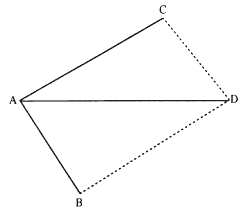
Figure 4.2
Based on Newton's drawing for the
demonstration of Lemma 1.
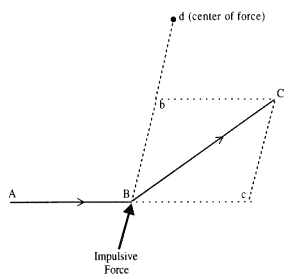
Figure 4.3
The parallelogram rule as applied to the polygonal
approximation. In a given time, Bc is the displacement
due to the initial "innate force," Bb is the displacement
due to the impulsive force, and BC is the resultant
displacement.
B in a given time DT . At point B an impulsive centripetal force, directed toward the center of force at point d , acts for a vanishingly small time dt on the body. The body then moves with uniform rectilinear motion from point B to point C in the given time DT . If the impulsive force had not acted at point B , then the body would have moved with uniform rectilinear motion from point B to point c in the time DT under the action of only its initial motion. If the body had been at rest at point B , then it would have moved with uniform rectilinear motion from point B to point b in the time DT under the action of only the motion produced by the impulsive force. (Note that the displacement Bb must be in the direction of the line of action of the impulsive centripetal force.) The composite uniform motion from point B to point C is along the diagonal of the parallelogram formed by the initial motion Bc (or bC ) and the added motion Bb (or cC ). Thus, a body is carried in a given time [DT ] by combined forces [the initial "force of the body's motion" plus the "change in the body's motion" due to the impulse] to the place [B ®C ] where it is carried by separated forces [B®c by the initial motion and B®b by the impulsive motion] in successively equal times [DT ].
If the force is continuous rather than impulsive, then the curve is also continuous rather than polygonal. For a continuous force the body moves along the curved path between the points B and C , and Newton considers a situation in which the point C approaches very closely to the point B . Thus, the interval of time is extremely small, and the force can be assumed to be constant over that interval. Galileo has demonstrated that ideal projectile motion under a constant force is parabolic, and hence the element of arc BC is approximated by a parabolic element (i.e., the parabolic approximation discussed in chapters 1 and 2). The displacement BC of any future point C on the elemental parabolic arc can be found by using the parallelogram rule to combine the displacement BC due to the initial tangential velocity with the deviation Bb due to the constant force. Thus, this rule is applied to both impulsive and continuous forces in a consistent manner.