
Clan Recruitment and Alignment
Clan membership was a prerequisite for permanent residence among Rembau Malays during the nineteenth century (Newbold 1839, 2 : 123; Parr and Mackray 1910, 5, 26). A widely known saying sums up the issue: "The stranger seeks a place [or clan] as the boat requires anchorage" (dagang bertepatan, perahu bertambatan ) (cf. Hale 1898, 53–54; Parr and Mackray 1910, 99). The notion of anchorage or mooring is especially relevant here, since at the most fundamental level this is what clanship—and kinship more generally—was all about. The same could be said of adat, for just as kin and social relations ordered in accordance with adat presupposed affiliation with a clan, so too did the corpus of symbols and idioms defined in relation to adat provide models for behavior in virtually all domains of existence. This latter theme is expressed succinctly in another customary saying frequently encountered in both the literature (e.g., Parr and Mackray 1910, 146; Caldecott 1918, 24–25) and present-day villages: "The living are moored and guided in all their actions by adat, just as the
dead are surrounded and held in place by the earth of the grave" (hidup di kandung adat, mati di kandung tanah ).
Since we are dealing with clans constructed on a model of matrilineal descent, the principal links implicated in recruitment should have been confined, in theory as well as practice, to those between mothers and their children. Yet in fact, recruitment often proceeded via other kin ties, and occasionally even embraced strangers.
Contemporary elders' delineation of recruitment policies of the precolonial era suggest that residential, defense, and other essentially political considerations could override those based on matrifiliation (even though an all-encompassing matrilineal ideology served in the long run to reorder and contain all such "ground-level noise"). One should bear in mind that the centuries preceding British colonial rule witnessed considerable movement of population throughout Negeri Sembilan, and in other areas of the Malayo-Indonesian world where local groups found themselves affected by the shifting political fortunes of regionally dominant powers, be they Johorese, Buginese, Acehnese, Minangkabau, or European (Newbold 1839, 2 : 32, 36, 117, 165–166; O'Brien 1884, 342; JAR 1892, 1, 9; Wilkinson [1911] 1971, 309; Gullick 1958, 29; Andaya 1971). In the case at hand, then, it was not inconceivable for individuals or entire communities to choose or find themselves forced by feuding or warfare to resettle within another clan's territorial domain. In some such situations, peaceful resettlement hinged on successful negotiations with the leaders of established communities, who might agree to accept the newcomers into a local clan in exchange for pledges of loyalty and support (Parr and Mackray 1910, 5–6). Additionally, it appears to have been necessary for an outsider to find an older woman of the host community willing to stand as his or her adoptive mother, thus maintaining at least the fiction of recruitment via matrifiliation (DeMoubray 1931, 176, 178–179). When a married couple sought to affiliate themselves in this way, one adoptive mother would suffice for the two of them and would likely define only the woman as her adoptee; the man would then be ascribed the status of son-in-law and in-marrying male rather than enate (DeMoubray 1931, 178–179). The basic structure of filiation and descent was thus reproduced inasmuch as the adopted daughter and all children born to her would share the same descent affiliation as the adoptive mother.
Also important is that emigration from the Minangkabau area, as well
as from Aceh, Jambi, and southern Thailand, continued over many centuries, as did overland migration from the neighboring regions of Sungei Ujong, Malacca, and Pahang. Given the military and other advantages of augmenting one's clan through the adoption of new members, together with the absence of unilineal descent reckoning among many of the so-journers, it became necessary, or at least highly advantageous and convenient, to group individuals into Rembau clans on the basis of regional or ethnic origins (Newbold 1839, 2 : 123; Parr and Mackray 1910, 5; Wilkinson [1911] 1971, 315–316; de Josselin de Jong 1951, 138). There is no way of ascertaining dates for the emergence and spread of this classificatory scheme, though village elders in Bogang assert that its appearance coincided with one of the earliest waves of emigration from Sumatra. Be that as it may, persons from the Payah Kumboh region of Minangkabau, for example, whether or not related to one another or in any way associated with the descent group of that name in their homeland, were deemed to be members of Rembau's Payah Kumboh clan. Those claiming other than Minangkabau ancestry were classified in similar fashion; Malaccans, Acehnese, and Buginese, for instance, each tended toward affiliation with particular clans, some of which continue to bear names denoting these settlers' non-Minangkabau origins (such as Anak Melaka, Anak Aceh). It is especially significant in this regard that Hervey's (1884, 259) enumeration of Rembau's principal descent units includes separate entries for the "nationality" of each clan.
The larger issue here is that relationships among clan mates, including persons recognized as having territorially or ethnically diverse origins, were both cloaked in and partially informed by the symbols, idioms, and constraints associated with common matrilineal ancestry (Parr and Mackray 1910, 5–6, 113). This entailed shared responsibilities toward the clan's estate of residential and agricultural acreage, unexploited tracts of forest lands, and, in some cases, political titles, particularly since the bestowal of rights guaranteeing eventual access to these estates typically accompanied most modes of recruitment to the clan. The activation of such shared rights over land served as a critical material referent of matrilineal kinship, and classificatory siblingship more specifically, regardless of whether the bonds in question were biologically grounded or simply imputed on the assumption or fiction of common descent from the same ancestral set of female siblings. Joint claims to an estate vested in a localized clan or lineage
undoubtedly fostered genealogical revision to ensure matrilineal consistency among individuals unable to demonstrate shared descent through the female line. Indeed, even today, if villagers are at a loss to explain the details of kin connections among individuals classed as collateral relatives within the matriline, they frequently invoke shared property rights as evidence, or at least a good indication, of common matrilineal ancestry. This suggests that genealogical connections were not the sole, or even the most important, criteria of relatedness among persons of the same clan.
It remains to consider certain aspects of clan affiliation via formal adoption in order to underscore that the enatic ties so created were conceptualized primarily in terms of siblingship rather than descent. The distinction merits emphasis in light of the more general point that constructs of siblingship seem always to have been hegemonic in defining both relatedness within and links among descent units of various degrees of inclusiveness.
Throughout the nineteenth century, a female of any age could obtain formal affiliation with a clan other than that with which she stood associated by birth.[9] This might occur in the case of a relatively poor individual seeking to attain access to productive acreage vested in a daughterless old woman of another local clan, and would typically involve assuming responsibilities for the adoptive mother's welfare in exchange for rights of proprietorship over her lands and house. (Adoption of this nature bears certain structural similarities to the other instances of formal adoption referred to earlier, but we are dealing here with isolated cases involving individual adopted children rather than entire households or larger groupings seeking acceptance within an established community. All such adoptions are also to be distinguished from informal transfers of children, which at present usually occur among women belonging to the same lineage or lineage branch; see chapter 6.) Reaffiliation presupposed public proceedings in the form of ritual animal slaughter and feasting, symbolizing the severance of the adopted person's links with her original enates on the one hand and the creation of new ties of enation on the other (Parr and Mackray 1910, 27; Taylor [1929] 1970, 139–141; DeMoubray 1931, 182–188). Analogous proceedings could also effect formal reaffiliation at the level of lineage. All such phenomena are designated as kadimkan (or berkadim ), a term denoting the process of becoming siblings—in particular sisters—and clearly suggesting a cultural emphasis on (enatic) siblingship rather than common descent (cf. Lewis 1962, 137–188). This is
wholly consistent with the conceptualization of relations among persons affiliated, by whatever means, with the same descent unit, be it a dispersed or localized clan, a lineage, or some less-inclusive segment, for such individuals think of their relatedness primarily in terms of siblingship.
Constructs of siblingship also provided the dominant idioms in terms of which clans and less-encompassing components thereof were held to be related to units of like order. This can be seen from mythic accounts of the scheme of clan ranking, which is evident in Rembau by the early 1800s (see Newbold 1839, 2 : 121–123; Hervey 1884, 259), although it is probably of much greater antiquity.
Local myths do not mention a Minangkabau clan hierarchy prior to or at the time of the first immigrant settlers' arrival in Rembau, but a system of clan ranking did eventually emerge, presumably during the earliest decades of foreign occupation (see table 1). This scheme of ranking had its mythical origins in the aforementioned union of a Minangkabau chief, To Lela Balang, and a Jakun woman, To Bungkal, which ultimately gave rise to three daughters and a son known as Seri Rama. This son, basing his claims on ties of matrilateral filiation with To Bungkal, whose tribesmen
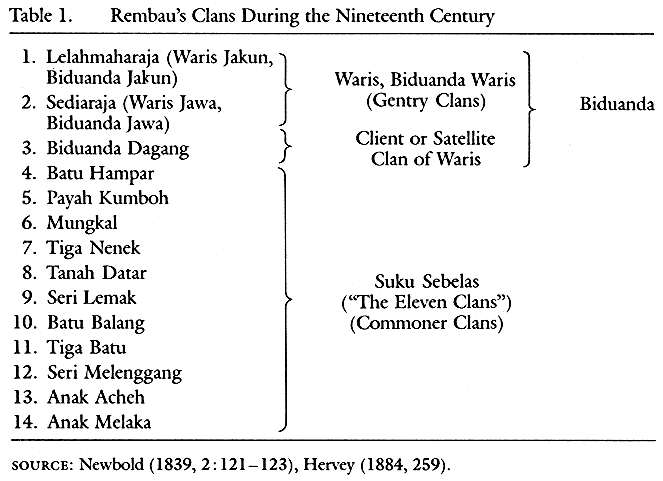
were the original "heirs to the soil" (waris ), emerged as the acknowledged head of a newly constituted gentry clan, thereafter styled Waris Jakun. Some myths suggest as well that Seri Rama became the first territorial chief and Supreme Law Giver, or Undang , of Rembau,[10] and that his candidacy for the office and his title—Dato Lelahmaharaja—were approved by the Sultan of Malacca (Parr and Mackray 1910, 4). Whether or not this is true, the designation Lelahmaharaja has long stood as a common synonym for the clan first known as Waris Jakun (Hervey 1884, 243; Lister 1887, 47).
The only other clan claiming the prerogatives and status of gentry traces its origin to To Laut Dalam, a contemporary and a "chiefly brother" of To Lela Balang, and quite possibly his patrilateral half-brother by virtue of a common father (or other male ancestor) and different mothers (from separate Minangkabau clans).[11] To Laut Dalam had once been married to a woman who bore him four daughters (the eldest of whom, Siti Hawa, married the chief Seri Rama); but as she hailed from Java, none of their children could claim matrilineal ties with the aboriginal Jakun, the group that, through descent, gave the Lelahmaharaja clan the status of "heirs to the soil." Nonetheless, To Laut Dalam's apparent envy over his "chiefly brother"'s success in gaining political recognition and privileges for his son motivated him to persuade the Sultan of Malacca to agree to a provision whereby the office of Undang would rotate between his "chiefly brother"'s descendants and his own. To Laut Dalam and his progeny thus assume prominence as the effective origin of the gentry clan known from that time on as Waris Jawa (the latter being the local term for Java and Javanese) or, alternatively, as Sediaraja, from the title granted to the first Undang chosen from their clan, the son of Siti Hawa and Seri Rama (Parr and Mackray 1910, 4–5; cf. Hervey 1884, 252).
Referred to collectively as Biduanda Waris or simply Waris, the Lelahmaharaja and Sediaraja clans together occupied the highest rung of Rembau's clan hierarchy (Newbold 1839, 2 : 120–123). They are currently held to be related as (or like) siblings (adik-beradik ), and presumably always were, despite the profound ethnic differences between their respective apical ancestresses and their wholly disparate enatic origins. Interestingly, the generalized siblingship linking the two clans is most emphatically maintained in Bogang culture, even though the mythic texts I encountered in the field do not widely recognize the tie of "chiefly siblingship" as the initial genea-
logically framed bond between these two clans. Rather, the construction of this linkage in terms of siblingship testifies to the continuity of a pervasive tendency to define individuals and social units as related like (or as) siblings whenever they share equivalent, parallel, or essentially complementary rights, obligations, or experiences with respect to the same political office, territorial domain, or other mediating element (cf. Kelly 1977; Marshall 1981a; Smith 1983).
The sibling equivalence of these two clans was manifest in the fact that neither of them could exercise any appreciable precedence over the other as regards political authority or other privileges (Parr and Mackray 1910, 5). For instance, rights to the office of Undang rotated in theory between them, with each alternately providing a candidate for the position (Newbold 1839, 2 : 119–120; CRACNS 1874, 12; Hervey 1884, 242; Lister 1887, 47; Parr and Mackray 1910, 48–49). Additionally, the marriage payments due their women were equivalent in value, and higher than those received by women of all other clans (Parr and Mackray 1910, 52); and intermarriage between the two groups seems to have been the ideal, as would be expected in light of analytically distinct, though mutually reinforcing, considerations of status endogamy.
The siblingship that united the two gentry units was also exclusivistic, for it linked only them; other clans were therefore defined as nonsiblings in relation to gentry clans, or in any event "much less like siblings."[12] This disjunction has long been realized in the gentry clans' sanctified monopoly on furnishing candidates for offices whose jural domains were of districtwide significance, as in the four posts comprising the Undang's Privy Council (Orang Besar Undang ) (Parr and Mackray 1910, 29) and of course the position of Undang itself. Members of these two clans also enjoyed the right to demand higher retributions for the murder of their kin (Hale 1898, 59; Parr and Mackray 1910, 52; cf. Newbold 1839, 2 : 123), although most of their other privileges surfaced only in ritual contexts.
In accordance with a rationale phrased largely in terms of historical precedence, or "origin point" (asal-usul ), Rembau's nongentry clans were ascribed commoner status, for according to most mythical explications of clan ranking, their forefathers were not the leaders, and in some cases were not even members, of the original expedition to Rembau. Consequently, permission to clear land, set up villages, and wield legitimate political
power derived neither from the autochthonous aborigines nor from the Sultan of Malacca. Instead, these privileges were granted them—in exchange for token payments, or the promise of such—by the representatives of the Lelahmaharaja and Sediaraja clans, who thus stood, if only on that account, as their benefactors (Hale 1898, 53; Parr and Mackray 1910, 108–109; cf. Lister 1887, 39; Lister 1890, 304). This patronage relationship appears to have been most explicit in the case of the Biduanda Dagang clan, which contemporary villagers regard as the lowest-ranked of all Rembau descent units. Persons affiliated with this clan are held to be descendants of the most recent arrivals in Rembau, many of whom fled their homelands as a result of famine or warfare or were simply itinerants or foreigners (as suggested by the term dagang ; cf. Parr and Mackray 1910, 72). In some instances the ancestors of contemporary Biduanda Dagang were slaves (hamba ),[13] having been purchased in Mecca by Rembau Undang or else acquired through military victories. Whatever their geographic and social origins, those who attained Biduanda Dagang standing in the past purportedly did so thanks to the benevolence of Lelahmaharaja and Sediaraja leaders, who agreed not only to accept their presence in or near their own settlements but also to extend them protection and clan representation, as well as a number of less-prestigious political titles.
For such reasons the Biduanda Dagang clan seems always to have had a unique and structurally ambiguous relationship vis-à-vis the Lelahmaharaja and Sediaraja clans. All three clans, after all, could be referred to by the shorthand gloss Biduanda, and, as noted, all three owed their allegiance to the same clan chief. And yet in terms of manifold expressions of power, status, and genealogical purity, Lelahmaharaja and Sediaraja occupied the uppermost niche of the clan hierarchy, whereas Biduanda Dagang fell at the other extreme of the continuum. Even at present, those identified as Biduanda Dagang continue to bear the burden of an ancestral stigma, as reflected in gentry reluctance to seek them out as potential marriage partners and in occasional references to their tainted pedigrees.
Not much is known about the nineteenth-century construction of linkages among commoner clans. Information collected around the turn of the century, however, reveals that the members of certain of these descent units could not intermarry because of ties of patrilateral half-siblingship between their apical ancestors (Parr and Mackray 1910, 77; see also chap-
ter 2).[14] This suggests a recognition of brotherhood that was altogether separate from enatic calculations of relatedness; it also lends further testimony to the relevance of siblingship as a connective, and potentially disjunctive, principle at the clan level.