
The Theater of the People
The mass-theater debate touched on ambiguities of great consequence after the Revolution. The belief that spectacles embodied the spirit of socialist revolution was common, but its roots were tangled. Some, following Wagner, felt that mass drama would, like the Greek drama, express the nation's unified will; others considered it an instrument of political struggle. When the October Revolution placed a party claiming to represent the working class in power, the leaders faced a dilemma: Should mass theater represent the workers in power or the people struggling for expression? Lunacharsky, representing the state, assumed optimistically that both interests could be served.[32] Rolland, whose Le théâtre du peuple had influenced his friend Lunacharsky, saw people's theater as an educator.[33] Its task in a bourgeois society was to agitate against the status quo; under socialism, it would introduce workers to progressive culture. Rolland considered people's theater inherently progressive: popular fêtes had furthered the French Revolution; the popular theaters of Maurice Pottecher and Louis Lumet were tools of democratic mobilization; the Swiss popular theater instilled democratic virtues. It would be equally progressive under socialism.
Though innocent sounding, such assumptions raised two issues central to Bolshevism: relations between activist intellectuals and the laboring classes they claimed to serve; and the primacy of politics over culture in party activity. Items of hot debate after the failed revolution of 1905, they had split the party and would always lurk behind the mass-
theater discussion. Lenin and his followers, who formed the core of the party, did not entirely trust the popular classes to act in their own interests. Lenin molded the party as a vanguard and considered its first task revolution. Socialist culture was a dream of the future, a task of secondary import during the initial phase of political struggle. Lenin's opponent in the debate was Bogdanov, a fellow exile whose faction felt that socialist society was unthinkable without socialist culture. Bogdanov stressed the vanguard's duty to nurture a socialist consciousness in the working class, which would allow it to realize its own power and form a new worker state. Bogdanov did not deny the utility of political organization, nor did he neglect the role of educated activists; his merit was in balancing this side of the revolutionary equation with popular initiative and cultural consciousness.
In early October 1917, the Provisional Government's dying days, Bogdanov and other culturalists (including Lunacharsky) founded Proletkult, an organization devoted to working-class culture. Born under a bourgeois government, Proletkult kept its autonomy from the state after the Bolshevik coup.[34] The Proletkult board pursued the dogma that socialist culture would be proletarian and collective. Theater, an inherently collective art, was at the cutting edge of its work, and Proletkult clubs throughout Russia searched for a mass theater to express the needs of the working class. Its most ardent adherent was Platon Kerzhentsev. A Bolshevik from 1904 and leader of the Proletkult Theater Section, he had studied mass theater in English-speaking countries and Europe in his years of exile.
Though collective proletarian spectacles were unknown, mass spectacles had been popular in the West before the First World War, and Kerzhentsev was familiar with them. There were two traditions in Europe and the United States. The first was a revival of Greek outdoor drama, part of a general neoclassicism.[35] In California, for instance, Isadora Duncan was reviving Hellenic dance; the Bohemian Club was founded in the woods near San Francisco; and Pasadena instituted the Rose Festival, which back then featured not football but chariot races. The movement placed faith in the tonic of the open air. Outdoor theater was healthier physically and socially; its audience could commune with art and nature, undivided by the architecture of aristocratic and bourgeois theater. Russians carried the faith in open air into their revolution and held to it despite a climate less benevolent than that of Athens or San Francisco.[36]
The eastern seaboard of the United States was the site of mass specta-
cles more directly presaging those of the Russians. The tradition exemplified by Percy MacKaye (author of The Civic Theatre ) was of a more rationalist bent than that of the West Coast, which satisfied the Russians' didactic urge. As the title of MacKaye's book suggests, it was a civic theater, based on the reintegration of art into the life of the democratic community.[37] Before the war, MacKaye and his associates organized a number of "civic masques," or historical re-creations: in 1914, for instance, the 150th anniversary of the founding of St. Louis was marked by a pageant in which much of the city participated. The participation of the people, who normally avoided theater and acting, was essential, for the goal of civic theater was "the conscious awakening of a people to self-government in the activities of its leisure."[38] Such participation was an expression of democracy, and though MacKaye's bourgeois democracy was alien to the Russians, both considered mass spectacles an antidote to capitalism.[39]
Kerzhentsev was an eclectic, borrowing from Wagner and Bogdanov, but he was close to MacKaye's practicality. In a series of works published in 1918, Kerzhentsev established the theoretical and practical foundations for much of Proletkult's theater work.[40] (Figure 4 shows the cover for his most famous book.) Like other Proletkult theoreticians, Kerzhentsev treated art from the viewpoint of performance and insisted that people's theater be not a theater for the people but a "'theater of the people,' i.e. based on the creative work of the lower classes."[41] It would "start from a desire to facilitate the full artistic expression of the proletariat's 'I' in harmonious collective theatrical creativity."[42] Naturally, creativity would not be matched by virtuosity, but, as Kerzhentsev pointed out, "the task of the proletarian theater is not to produce good professional actors who will successfully perform the plays of a socialist repertory, but to give an outlet to the creative artistic instinct of the broad masses"[43] The instinct grew from a broader creative urge called samodeiatel'nost' (MacKaye's self-government ).[44] Mass spectacles fit the twin demands for self-government and collectivity, and offered an aesthetic equivalent to the revolution in politics.
Many Bolsheviks, Lenin in particular, were distressed by Proletkult's flair for independence. Organizers of official celebrations did their utmost to keep Proletkult away. Yet in the early years of the Revolution, there was often no alternative. On May Day 1918 most theaters could not respond to the holiday appropriately. Private theaters were not yet under state control; public theaters—that is, the former imperial theaters—had only reluctantly acquiesced to new administrations. The
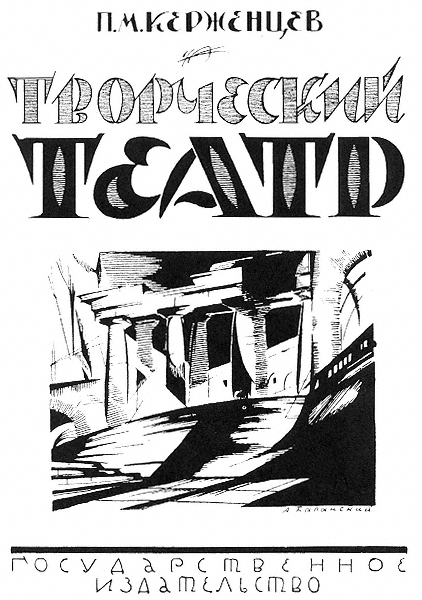
Figure 4.
Cover of Kerzhentsev's Creative Theater
(P. Kerzhentsev, Tvorcheskii teatr, Moscow, 1923).
only theater in Petrograd with both a stage and an enthusiasm for the Revolution belonged to Proletkult. In the spring of 1918, state expropriation had brought the columned Assembly of Nobles into Proletkult hands, and a ceremonial opening of the oxymoronic Proletkult Palace was scheduled for May Day.
The evening was graced by the work of the new theater studio, 200 students of both sexes led by Pavel Bessalko, Mgebrov, and Victoria Chekan. Bessalko was a "proletarian poet," a writer of verse on the proletariat and its revolution. He was a graduate of the Paris exile, where he had met the other future founders of Proletkult: Bogdanov, Lunacharsky, Pavel Lebedev-Poliansky, and Fedor Kalinin. Mgebrov and Chekan came to Proletkult from different backgrounds. Mgebrov, a graduate of the tsarist Military Cadet School, was a talented and nomadic actor. Early in the century, he wandered from the Moscow Art Theater to the Theater of Vera Komissarzhevskaia and then, in 1911, to Evreinov's Ancient Theater, where he met Chekan. A cycle of seventeenth-century Spanish dramas was produced that year, and Chekan played Laurencia in Lope de Vega's Fuente ovejuna . She played the peasant girl with a remarkable vitality—her trademark—and years later Mgebrov would remember her "possessing a rare, completely Spanish temperament. . . . Some nights she tossed people about the stage like balls, so they fell into the orchestra pit and broke the musicians' instruments. And yet she was a frail woman."[45] Like Chekan, Mgebrov favored a romantic idealism that flourished during the Revolution. A beloved role was the hero of Pedro Calderón's The Purgatory of St. Patrick . His gaunt features and pathetic declamation lent themselves to the role of prophet (like Tiresias) or martyr; the die-hard typecasters Meyerhold and Eisenstein found him ideal for the roles of the Prophet in Emile Verhaeren's Les aubes (Meyerhold's 1920 reworking) and Archbishop Pimen in Eisenstein's Aleksandr Nevsky .
Mgebrov and Chekan left professional theater in the spring of 1917 to direct an after-hours theater in Petrograd's Baltic Factory. They were designated delegates by their club when Proletkult was organized in October, and when the Petrograd branch opened in March 1918, they became theater instructors at Lunacharsky's insistence.[46] Mgebrov's enthusiasm for the February Revolution—he had organized the Liberty Bond Festival—was not held against him, and he transferred his faith to the new revolution. Mgebrov, like Wagner, saw revolution less as a political than as a spiritual movement and felt the "rise of creative
powers hidden in man's collective consciousness from ancient times."[47] With many Proletkult leaders, he shared a style: cosmic and ecstatic.
Although most of the students shared his enthusiasm, none had stage experience; given a month to mount a program, Mgebrov wisely started with the basics. He rejected the standard repertory because few authors spoke sympathetically of workers' lives. As Kerzhentsev said: "The repertory situation is abominable. European literature has in essence no repertory for the proletarian theater. The number of authors and works that reflect the aspirations and spiritual needs of the proletariat is extraordinarily thin. Socialist plays can be counted not by the tens, but by the ones. And the majority of those are not on a high artistic level."[48]
Even they were beyond the range of Mgebrov's students, who were amateurs and more amateur than most. Rather than a script they used something called instsenirovka, a calque of the German inszenierung: an adaptation of nondramatic material, usually prose, to the stage. The trick was not new; the Moscow Art Theater had used it in the 1910s, when Chekhov was no longer around, and two of its adaptations, Dickens's The Cricket on the Hearth and Dostoevsky's The Possessed, were great successes. When scripts are not available, adaptation becomes a useful approach. The technique would help later festival directors transform the Revolution itself into theater. Proletkult chose the verse of Aleksei Gastev, a leading proletarian poet, for dramatic material. Gastev's recently published Poetry of the Workers' Hammer was enjoying great popularity. Although the poetry in many respects was original, the influence of Walt Whitman was evident in the powerful rhythm, propelling lines across the page, and in the imagery of cosmic harmony. In fact, Mgebrov's next project was Whitman. Both poets profited from declamation.
None of the young students was trained to read verse, which prompted a decision that the reading be collective.[49] The motive was purely practical, but the result was lauded by Proletkult theorists. Collective declamation was just reaching the apex of popularity; a Professor Serezhnikov would soon found the Proletarian Studio of Declamation.[50] Collective declamation was simple; it allowed many students to participate and gave them a first taste of art, an experience that, judging by the proliferation of studios in the next five years, did not go to waste.
The May Day 1918 production of Gastev's We Grow Out of Iron provides an illustration of the Proletkult method. The mise en scène bore a striking resemblance to the new Proletkult emblem unveiled for that
morning's procession. As the curtain rose, "wheels, gears and flywheels began to spin, and from this primeval chaos rose the symbolic figure of a worker representing the full significance of the collective and the power based on overcoming the elements through the will to freedom. The bared muscles of arms, an intent pose, a sickle, a hammer and anvil, a hammer stroke frozen in mid-air . . . all this at the same time animated by a truly fiery inspiration and, most important, love and faith."[51]
Mgebrov sought harmony; he chose Gastev's poem to "confirm the full, absolutely harmonic mastery of life by the human collective, and see the possibility of such mastery in continuity of motion."[52] Rhythm provided the unifying impulse. Lines were broken up into phrases, words, and syllables, then distributed among the chorus. As the reading progressed, individual recitations were united into a single ecstatic chorus. In Mgebrov's words:
Suddenly the whistles began . . . At first separate figures of girls and workers rose to its summons as if against a background of dawn and the rising sun. They began with a joyous exchange of shouts that merged with the call of the factory whistles. Then voices, source unknown, responded to a singing and ringing summons drawing nearer and nearer. The summons swelled and hundreds of voices merged into it. With each addition they became more intoxicated. In the end, united, they were no longer distinct from each other and merged into a song created by a single impulse.[53]
The audience received the reading enthusiastically. Some reviewers and all of Proletkult's future critics measured it against the pretension of Proletkult's leaders (Bessalko among them) that they were creating a new culture. By that standard it was a failure. But there is no reason to burden the students with the pretensions of others; they were amateurs, and applying professional standards to them would be unfair. In professional theater only the show, the finished product presented to an audience of strangers, is important; for amateurs, who usually perform for an audience of like people, production is important as a process of participation and education. Something similar should be kept in mind with festivals, which are created for both the spectator and the participant, who are not wholly differentiated. The Proletkult performance belonged more to festivity than to the theater; it was a ritual celebration—stylized, measured, a canvas of ideas and not details. It was a proletarian show for a worker audience. Its peculiar stylistics were absorbed by future festival spectacles.