
Vocational Education Ascendant
During much of this period, Leningrad politicians gave more vigorous and consistent official public support for vocational education programs than national leaders did.[35] In fact, many Leningrad leaders came to view vocational education, which offered job skills such as welding, drafting, and bookkeeping, as preferable to traditional academic education oriented toward general introductory training in the humanities and natural sciences.[36] As a result of such policy preferences, Leningrad vocational education programs have outpaced similar curricula elsewhere in the Soviet Union in (1) the speed with which
new professional-technical schools have been established, (2) the pressure on parents and pupils alike to channel career aspirations into polytechnical professions, (3) the linkages created between professional-technical schools and future employment sites, and (4) the number of students enrolled in vocational programs. By the early 1980s, the Leningrad party organization viewed the vocational school as the city's central institution for secondary-level education.[37] In 1984, this distinct emphasis on vocational training over traditional academic secondary education that was expressed so clearly in Leningrad came to serve as a model for national educational reforms of that year.[38] The possible retreat from the 1984 reforms under discussion as this volume goes to press in no way negates the impact of the Leningrad experience on previous policy decisions.
In a pattern that is repeated throughout our various policy studies, scientific research institutions played a critical role in the development of a distinctive Leningrad approach to primary, secondary, and post-secondary adult vocational education. In 1960, the Moscow-based USSR Academy of Pedagogical Sciences opened its Scientific Research Institute of General Adult Education in Leningrad (see Chart 5).[39] The new institute immediately began research on professional training for adults, quickly establishing its reputation as the Soviet Union's premier center for the study of advanced vocational education. Three years later, the State Committee for Professional and Technical Education created its own research institute to examine secondary vocational education.[40] This committee, like the Academy of Pedagogical Sciences before it, chose Leningrad as the site for its All-Union Scientific Research Institute of Professional-Technical Education.
Little is known about the decisions leading to the placement of both research centers in Leningrad. Undoubtedly, many factors influenced the final determination, one of which must have been the intense interest of the city's party leaders in vocational education. Whatever the reason for the final choice, making Leningrad the home of two of the USSR's leading research institutions that were perfecting professional training techniques gave Leningrad's leaders access to a powerful resource for restructuring local education. By the mid-1970s, both institutions employed a combined total of more than 300 researchers. Moreover, the All-Union Scientific Research Institute of Professional-Technical Education also housed the Soviet Union's leading research library on vocational education. In any event, installation of both centers in Leningrad clearly reflected the local interest in vocational education by providing invaluable technical support for local politicians and also reinforced local efforts to expand vocational education.[41]
In moving to implement their programs at the secondary-school level, Leningrad educators did not stop at scientific research. By 1965, already 82 professional-technical schools had opened their doors to
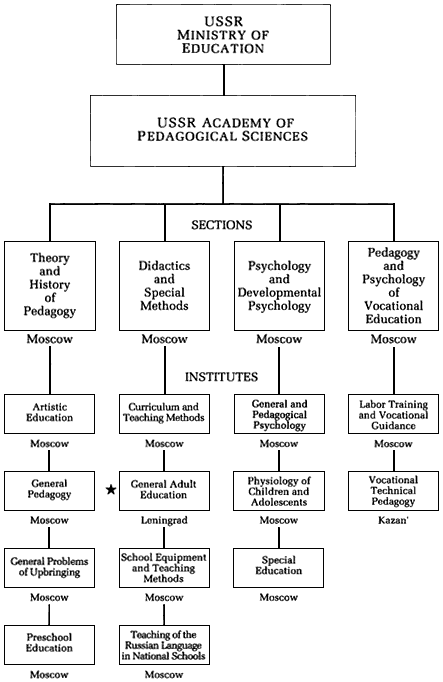
Chart 5.
Structure of the USSR Academy of Pedagogical Sciences.
more than 35,000 Leningrad students. Over the next 15 years, the number of schools grew by 75 percent, and the number of students attending those schools increased by 158 percent.[42] It took more than voluntarism on the part of parents and students to achieve this expansion of Leningrad's vocational education programs. Considerable pressure—both positive reinforcement and negative coercion—has been applied to Leningrad children and parents alike.
On the positive side, massive youth rallies—like that held at the mammoth Lenin sports-concert complex in October 1982—brought together thousands of local youth to hear city politicians extol the virtues of vocational education.[43] Exhortations like this were and are repeated frequently, and the goal of fostering a "healthy relationship to labor" among area youth has become a constant theme in the public addresses of leading Leningrad political figures.[44] Moreover, negative pressure has also been employed, as Leningrad students have been systematically discouraged from pursuing academic educational goals. For example, on the eve of the 1983 citywide admissions tests to Leningrad institutions of higher learning, a front-page feature article in the city's leading daily newspaper, Leningradskaia pravda , informed applicants that a vast majority of those seeking admission to institutions of higher learning would fail their examinations.[45] Therefore, the article continued, applicants would be well advised to consider career and educational opportunities that were more readily available through vocational institutions.
Some Leningraders complain privately and with considerable passion that many parents were compelled to send their children to vocational schools upon completion of the standard eight-year general school curriculum, thereby foreclosing numerous career opportunities and ruining lives in a society where a degree from an institution of higher education is a ticket to success. For horrified parents, enrollment of their children in vocational programs precluded receipt of a full general secondary-school degree, thereby eliminating chances for post-secondary education and access to prestigious managerial and academic posts. Vocational education became synonymous in many Leningrad households with the closing down of opportunities for social advancement.
Although we have no direct published evidence of overt coercion by Leningrad educational or political officials, in June 1981 the address of regional party First Secretary Grigorii Romanov to the twenty-fifth regional party conference stopped just short of openly advocating coercion to increase vocational-school enrollment.[46] In that hard-hitting speech, the first secretary noted with considerable satisfaction that graduates of professional-technical schools accounted for more than half of the workforce of all local labor collectives. "It is the task of party
organizations and pedagogical collectives," Romanov exclaimed, "to persistently inculcate in students the ability to find their bearings in present-day production."[47] Left unstated, though implied throughout, is a suggestion that such goals can and will be achieved through the forcible enrollment of Leningrad teenagers into vocational education programs.
Whether furthered by coercion or encouragement, Leningrad vocational programs have produced a generation of highly skilled workers. The key to this accomplishment is to be found in the relationship be-tween vocational schools and future potential employers. During the 1970s, vocational programs in Leningrad and elsewhere in the Soviet Union have become more tightly linked to individual factories.[48] By 1980, students enrolled at Leningrad's professional-technical schools received free room and board, as well as a daily wage based on effort on a factory production line.[49]
At one vocational school (no. 105) third-year students were fully integrated with work brigades of the Main Leningrad Construction Administration—Glavleningradstroi.[50]Leningradskaia pravda's educational correspondent reported that such relationships between future employment sites and vocational schools are pivotal to the success of vocational programs, even at such relatively new schools as the three-year-old vocational school no. 137.[51] Elsewhere, in discussing the connections between school no. 147 and the Skorokhod Association, as well as school no. 6 and the Izhorsk Factory Association, the city's morning paper reported that although students frequently have slightly lower production norms than full-time workers, the gap gradually narrows as a student moves toward graduation.[52] This report concluded that vocational students are able to move directly onto the production line precisely because they have become accustomed to the rhythm of industrial labor. It concluded that such accommodation results from the direct relationship of successful vocational schools, such as nos. 147 and 6, with factories, such as Skorokhod and Izhorsk.
Thus far we have seen that Leningrad vocational education programs outpaced similar curricula elsewhere in the Soviet Union in the speed with which schools were established, the pressure brought to bear upon parents and pupils alike to channel career aspirations into industrial professions, and the linkages established between schools and future employment sites. Perhaps most important of all, Leningrad remains noteworthy in the proportion of students enrolled in vocational education programs, particularly at the secondary level. By 1984, approximately 40 percent of all Leningrad secondary-school students completing eight-year general-school programs entered professional-technical schools, a rate of entry that remains unsurpassed elsewhere in the Soviet Union.[53] In all, at that time, 211 city and regional voca-
tional schools were offering training in over 300 industrial specialties and trades.[54] These educational patterns in Leningrad were serving as a model to be emulated throughout the nation.