
2—
X Rays the Berkeley Way
Sloan's Tube
While Lawrence was moving into his new domain, an old friend, Joseph Boyce from Chicago, came to see what sort of physics went on in California. He reported his findings to Cockcroft. The work of C.C. Lauritsen and C.D. Anderson at Caltech, he said, was something in its way; "but the place on the Coast where things are really going on is Berkeley." Lawrence had in mind or hand no fewer than six different machines for throwing atomic projectiles. "On paper this sounds like a wild damn fool program,
[38] A.F. Hockenblamer to Leuschner, 18 Sep 1931 (25/1).
[39] Lawrence to Poillon, 27 Nov 1931 (46/25R); to Cottrell, 7 Dec 1931 (5/3). Cf. Lawrence to J.E. Henderson, 14 Apr 1933 (9/5), giving $7,000 for the cost of refurbishing and setting up the magnet.
but Lawrence is a very able director, has many graduate students, adequate financial backing, and in his work so far with protons and mercury ions has achieved sufficient success to justify great confidence in his future." Boyce itemized Lawrence's armamentarium: the second and third cyclotrons, the mercury-ion linac, a larger linac for protons, a Van de Graaff, and what Boyce misidentified as a Tesla coil. It is with this last apparatus, which Ralph Fowler of Cambridge thought the most interesting new apparatus at Berkeley, that we are now concerned.[40]
After the 30-stage mercury linac opened fire in the fall of 1931, Lawrence put Sloan to work on a resonant transformer as an alternative to the cyclotron for producing fast protons. The general idea of this apparatus appears from figure 3.2, which represents Sloan's final design. The secondary coil supports the water-cooled secondary tube. When the tube goes strongly negative, protons rush into it from the grounded ion source; they emerge half a cycle later, when the now positive tube drives them into the bombarding chamber. The protons in effect fall twice through the high potential of the secondary (800 kV in this design). When the device was designed, Livingston had not yet reached 1 MeV; Sloan's scheme promised to do so and, what was extremely important, to give a beam far more intense than could be expected from the cyclotron.[41]
Two features of the design in figure 3.2 distinguish it sharply from the Tesla coil used by Tuve's group. First, the secondary is part of a single oscillating circuit rather than a separately tuned one. The advantage of the design is efficiency, bought at the expense of high-power radio engineering, in which Sloan had the advice of Fuller. The second distinctive feature is that the heavy copper secondary coil is in effect an antenna placed inside the evacuated acceleration chamber and supported at a voltage node from the copper roof of the internal tank wall: the all-metallic connection obviated the need for insulation, the failure of which
[40] Boyce to Cockcroft, 8 Jan 1932 (CKFT, 20/4); Fowler to Rutherford, 15 Jan [1933] (ER).
[41] Sloan and Lawrence, PR, 38 (1931), 2022, in Livingston, Development , 152; Sloan, PR, 47 (1935), 71; Lawrence to Cottrell, 7 Dec 1931 (5/3).
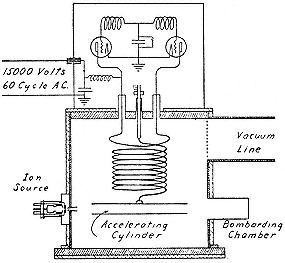
Fig. 3.2
Sloan's resonance transformer for doubling the
energy of positive ions. Sloan, PR, 47 (1935), 67.
haunted the usual methods of producing and holding high voltages.[42]
In November, having planned a tube that incorporated the entire oscillating system in the vacuum to eliminate corona discharge, Sloan turned to something that would make a better Christmas present for Lawrence and Cottrell. This was "a helluva x-ray outfit," with an intense beam at 100 kV, which, in Lawrence's opinion, could easily be hardened tenfold. "I feel quite sure [he wrote Cottrell in December] that ere long we will be producing million volt x rays."[43] Lawrence was right in fact but wrong in timing. It took two years of hard work to develop the generator of figure 3.3 into a plant that could be operated continuously at 800 kV.
Sloan's invention opened a new set of technical challenges and financial opportunities for the Laboratory. It promised to give the
[42] Sloan, PR, 47 (1935), 62–6. The oscillator worked at 6 MHz.
[43] Lawrence to Lauritsen, 10 Nov 1931 (10/36), to Cooksey, 1 Dec 1931 (4/19), quote, and to Cottrell, 7 Dec 1931 (5/3).
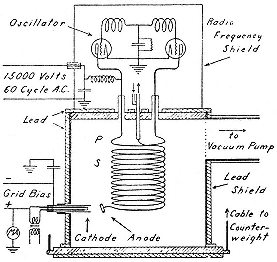
Fig. 3.3
Sloan's x-ray generator. The high-energy x rays
arise at the anode attached to the secondary when
it stops electrons from the cathode. Sloan,
PR, 47 (1935), 65.
same sort of beam that Lauritsen obtained from his huge installation, but at a fraction of the cost. It gave a beam with over three times the energy of the output of the largest x-ray plants in use in hospitals with about the same demands on space and power (about 200 kW). And it marked the beginnings of interdisciplinary work at the Laboratory. To proceed, however, it was necessary to raise the amounts necessary to harden Sloan's hundred-thousand volt rays to Lawrence's canonical million.
Lawrence turned to the Research Corporation with the tactics it had taught him. "I know that the General Electric Company would be only too glad to get behind the project because it has immediate commercial possibility, but, of course, I hope this can be avoided." He thought $500 or $1,000 would bring the matter well forward.[44] Sloan's personal needs were covered by his fellowship, which GE renewed. Lawrence longed to proceed; Sloan had no desire to study for his exams; the work stalled for want of a
[44] Lawrence to Cottrell, 7 Dec 1931 (5/3), quote; to W.W. Buffum, 21 Jan 1932 (46/15R).
$400 pump and a little something for contingencies. Vacation was coming, freeing Sloan from his already minimal studies; perhaps, at the end of the summer, he would have a commercially viable machine. And perhaps not. If not, Lawrence held out, Sloan might be able to generate million-volt x rays another way, by bombarding light elements with the intense ion beam from the x-ray machine when adapted to accelerate protons. "This is a possibility that may turn out to be much more important than the production of x rays by electrons. . . . The medical applications of these latter considerations are certainly of considerable importance." Poillon returned a check for $500.[45]
During July 1932 Sloan succeeded in producing plenty of hard x rays without the intervention of protons, x rays powerful enough to penetrate a centimeter of lead or half an inch of steel. Birge, now department chairman, esteemed Sloan's tube "the most important of the discoveries of the radiation laboratory," not excluding the cyclotron; he recognized it as "mainly a commercial proposition;" and he worried that it would result in a "patent war or something with G.E."[46] The University announced Sloan's success to the national press and a mixed pilgrimage of humanitarians and promoters trekked to Berkeley. GE's San Francisco representative came right over and declared that the tube had "very great commercial value, not only for medical work but for the examination of steel welds." The home office quickly confirmed his interest.[47] Meanwhile the chief engineer of the Kelley-Koett Company, a major constructor of x-ray apparatus in the Midwest, put in an appearance. He was followed by a representative of Westinghouse, then entering the x-ray business in
[45] Lawrence to Coffin Foundation, 25 Feb 1930 and 24 Feb 1931, and to dean, Graduate Division, 16 Nov 1933 (16/27); Lawrence to Poillon, 12 Apr 1932, and to Buffum, 15 Apr 1932 (quote), and Poillon to Leuschner, 20 Apr 1932 (15/16). Cf. Lawrence and Livingston, PR, 40 (1932), 20, in Livingston, Development , 119 (Feb 1932): "The development of an intense artificial source of gamma radiation . . . would be of considerable value for nuclear studies."
[46] Birge to H. Sponer, 8 Oct 1932, and to Jenkins, 18 Sep 1932 (Birge P, 33).
[47] Lawrence to Poillon, 4 Aug 1932 (15/16); "Safer x rays," New York Herald Tribune , 2 Aug 1932, 10 (7/11); Coolidge to Lawrence, 24 Aug 1932 (7/28). Coolidge did not understand at first how much Sloan's design differed from his spark coil and from Tesla's coil; Lawrence to Coolidge, 6 Oct and 4 Nov 1932 (7/28).
search of a market for its power tubes, by the officer in charge of x-ray work in army hospitals, and by the roentgenologist at the University hospital in San Francisco, Robert Stone, who crossed the Bay, saw Sloan's rays burn through steel, and desired to use them on his patients.[48]
Sloan, J.J. Livingood (a postdoc from Princeton "very anxious to get into [the] nuclear racket," for whose services Lawrence paid nothing), and others improved the apparatus of figure 3.3 until it gave out rays of perhaps 700 kV. Then Lawrence, like the ingénue in The Importance of Being Earnest , outdid his wooers; he advised Poillon to rush commercialization by engineering the tubes in the Research Corporation's laboratories even while Sloan and his unpaid helpers continued development at Berkeley. "Not only do I feel that the method is superior for the production of radiations above a half million volts, but also I am inclined to think that very inexpensive outfits can be manufactured for the production of radiation in the region of 200 or 300 kilovolts. I am told that there is a very big market for such deep therapy outfits."[49]
Hospitalization
Two major research hospitals decided to try what Sloan's tube could do. The first commission came from Francis Carter Wood, the director of the Institute of Cancer Research of Columbia University, who had encouraged Lauritsen's work and knew of Berkeley's alternative through Buffum. The Chemical Foundation dispatched its physicist, Frank M. Exner, to help Sloan build an improved machine, for which Wood's Institute would pay $5,725 from a fund given by Charles Crocker, the son of one of California's railroad barons. How improved? Lawrence told Exner he wanted to push to a million volts; Exner told Wood, and Wood objected. His institute had long experience treating cancer with the gamma rays of radium, at 2 MeV, and they had not "done any miracles." Lawrence thought about it from the "physical point of view" (and also as an entrepreneur with a balky
[48] Lawrence to Poillon, 4 Aug 1932 (15/16), and to Buffum, 25 Aug 1932 (3/38); "Harold" to Tuve, 5 Jan 1931 (MAT, 3), re Westinghouse.
[49] Lawrence to Poillon, 4 Aug 1932 (15/16) and 18 Aug 1932 (RC); Boyce to Lawrence, 27 Jan, and reply, 9 Feb 1932 (12/11), re Livingood.
client) and agreed. "There is not much point in x rays above a half a million volts for therapy purposes."[50] But the Sloan tube was to be developed for the art, as well as for medicine and patents, and also to support life in the Laboratory. Livingston, having graduated, needed a job to sustain him for his essential work on the cyclotron. Lawrence looked everywhere and found nothing. The obvious solution to all difficulties would be to employ Livingston part-time on x-ray money. The goal would stay a million volts.
Everything fell into place with the commissioning of a millionvolt plant by the University's Medical School. The initiative came from Stone and the money—some $12,000 for plant and installation—from William H. Crocker, brother to Columbia's patron and a regent of the University. Livingston became to Stone's machine what Exner was to Wood's. Therefore he was expected—so flimsy were the professional qualifications of radiologists then—to run it as well as to make it. His relevant training consisted of two weeks with Lauritsen to learn technique. He then set dosages for the human guinea pigs at the University hospital.[51]
The estimated costs of the twin Crocker machines included no profit, overhead, or salaries. Their 20-kW Federal power oscillators cost $300 each, after a 20 percent discount, and each machine needed four, or, in the new design, six. Economy was necessary. Sloan salvaged a ton of lead plates from old storage batteries, melted them down, and remolded them into shielding blocks. Safety demanded an additional 6,000 pounds of lead, which Lawrence begged as an additional loan from the American Smelting and Refining Company. Efficiency required an instrument maker, whose salary had to be found. To begin development of the hospital machines, Lawrence needed $4,000 immediately, or so he told the Chemical Foundation. His reckoning omitted the salaries of Sloan and Livingood.[52]
[50] Wood to Lawrence, 29 Aug 1932, and Lawrence to Wood, 3 Sep 1932 (9/21); Lawrence to Exner, 19 Aug 1932 (9/21); infra, §8.3.
[51] Lawrence to Buffum, 25 Aug 1932 (3/38), to Stone, 20 Sep 1932 (16/28), to Henderson, 7 Jan 1933 (9/6), and to Cooksey, 1 Jan 1934 (4/19); W.H. Crocker to Sproul, 11 Jan 1933 (UCPF, 337/366).
[52] Lawrence to Federal Telegraph Company, 8 Sep 1932, and reply, 15 Sep 1932 (7/10); Lawrence to Buffum, 25 Aug 1932 (3/38); to Wood, 3 Sep 1932 and 10 Jan 1933 (9/21); to Boyce, re Livingood, 1 Oct 1932 (3/8).
By December 1932 the prototype hospital machine was working beautifully. It could perform briefly at over a million volts, and at 750 kV gave out 14 milliamps so steadily as to melt its water-cooled copper target. It far exceeded their fondest hopes, Lawrence told Wood, being much superior to Coolidge's cascaded tubes or Lauritsen's set of gas-pump cylinders, and, moreover, compact and inexpensive, like the first cyclotron. It was a light that could not be hidden, the equivalent of half the world's supply of radium. "Though we have most of the tube plastered with lead (7,000 pounds in all), we see x rays almost everywhere in the lab with a fluoroscope." "There is no question now [December 1932] but that we have the most powerful x ray tube in the world and that our outfit is incomparably superior to any other, and promises to revolutionize x ray technology. I say this unqualifiedly."[53]
This last disclosure was directed to Poillon, who was trying to patent Sloan's invention when he received it. Poillon had not looked upon the work at Berkeley with unmixed satisfaction. It was the old problem with academics: they innovated, jerry-rigged, experimented, always improving and refining, indifferent to the business side of things. "I have told Sloan and Lawrence [Poillon complained to his patent lawyer] that we wanted this device brought to a certain state of perfection at Berkeley, where it could be engineered for production. They seem to be very anxious to get somebody else to do that secondary step. . . . This of course does not suit our book and I have warned them about directing the attention of others to it lest the others start the development and the patent situation becomes very cloudy." Poillon tried to silence the publicity that the commissioning of the hospital plants had generated.[54]
Poillon's impatience did not deflect Lawrence. Having done the physics, if not the engineering, of million-volt x rays, the Laboratory proposed to replace the heart of the machine, the expensive commercial oscillator, with cheaper devices of its own manufacture. That required patience from Stone and Exner and
[53] Lawrence, "A brief summary of the work of the Radiation Laboratory," attached to Lawrence to Poillon, 5 Jan 1933 (15/16A); quotes from, resp., Lawrence to Cooksey, 11 Dec 1932 (4/19), and to Poillon, 13 Dec 1932 (15/16).
[54] Poillon to A.P. Knight, 11 Oct 1932 (RC); Exner to Lawrence, 7 and 8 Feb 1932 (9/21).
money from Poillon and Buffum. Lawrence asked for $500 to $1,000. Poillon, hard-pressed and unenthusiastic, returned $700. "Money as you know is extremely scarce."[55] Fuller took over the direction of the project and assigned an engineering student to help design a practical 200-kW oscillator. A satisfactory design emerged, in which the oscillator shared the vacuum of the discharge tube; Lawrence stopped development of instrumentation for the cyclotron and threw his disposable resources into making and improving the new tube.[56] By June 1933, having spent $550 of the $700, Fuller, Sloan, and company had an oscillator more powerful than Federal's; by September they had licked the remaining vacuum problems; by December Stone's machine was ready for installation, and Sloan, exhausted, was ready for the hospital.[57]
Livingston and Sloan set up the San Francisco machine (plate 3.4). It performed beautifully, at a lower cost for power than expected. Crocker's $12,000 bought a building ($5,000), the machine ($4,000), Livingston's salary ($1,000), and accessories ($2,000). Running at 800 kV and 10 milliamps, it outdid all other x radiators, including Lauritsen's.[58] The business was, in fact, a great success. It showed how a subsidized university, with clever men, out-of-work or underpaid postdocs, and, if it wished, no overhead charge, could outdo industry. As Lawrence pointed out, GE had recently built an x-ray unit for a Chicago hospital that cost $65,000, faltered at 600 kV, and took much longer to install than Sloan's machine. GE's standard tubes cost $25,000, Kelley-Koett's 600 kV tubes $29,000. The Crocker brothers got a great bargain.[59]
[55] Lawrence to Stone, 17 Jan 1933 (16/4); to Poillon, 10 June 1933, and Poillon to Lawrence, 11 Feb 1933 (15/16A).
[56] Lawrence to Poillon, 18 Feb and 14 Apr 1933 (15/16A); to Sproul, 24 Jan 1933 (16/42).
[57] Lawrence to Poillon, 14 Apr, 3 June, 16 Sep, 4 Dec 1933 (15/16A); to Cooksey, 3 May 1933 (4/19); to Exner, 12 Sep 1933 (9/21); to dean, Graduate Division, 16 Nov 1933 (16/27).
[58] Lawrence to Fowler, 28 Dec 1933 (7/2); to Exner, 17 Nov 1933 and 18 Jan 1934 (9/21). Sloan resigned his University fellowship in January 1933 to work on the installation at the Medical School; Birge to M. Deutsch, 7 Jan 1933 (Birge P, 33).
[59] Lawrence, "The Sloan x ray machine" (16/28).
Exner began to set up the Columbia machine after his return to New York in late spring of 1933. He eventually had as his helper Wesley Coates, who had completed his doctorate under Lawrence in 1933 with work on the soft x rays he found in targets struck by fast heavy ions from the old mercury linac. Coates went to Columbia to build a machine on Sloan's principles for the acceleration of protons. He then became the physicist at the Crocker Research Laboratory of Columbia Presbyterian Medical Center, where the Sloan x-ray machine had been placed. One day in 1937 the machine declined to hold its rated voltage. Coates peered in to diagnose the trouble, brushed a high-potential line, and fell a martyr to high energy.[60]
The Laboratory continued its efforts to improve Sloan's tubes well into 1935. Wood decided that experimentation with rays comparable in penetrating power with radium's gammas might be valuable after all and made available ample funds for building oscillators large enough to drive the tank at the highest voltage it could take. He paid salaries to Sloan and the instrument maker, E.W. Lehmann, and various shop costs, amounting to upward of $1,700.[61] During this work, Dr. Walter Alvarez of the Mayo Clinic came to town. Lawrence took him to the University's Medical School. "He was exceedingly enthusiastic about it," Lawrence wrote Poillon, "and wants to start negotiations." Lawrence urged the Research Corporation to greater activity: "There is absolutely no question but that you should push the commercial development as rapidly as possible."[62] As symbol and agent of this alliance, Lawrence's student Harry White went to work for the Research Corporation after learning to run the Sloan machine in San Francisco in order to promote it "and possibly . . . other by-products of the Radiation Laboratory work in the future."[63] Several pests then attacked Sloan's x-ray plants. For one,
[60] Lawrence to B. Davis, 5 May 1933, and Exner to Lawrence, 23 Mar 1937 (4/4); Coates, PR, 46 (1934), 542–8; Lawrence to Poillon, 14 Apr 1933 (15/16A).
[61] Exner to Lawrence, 14 Mar and 3 May 1934, and Lawrence to Exner, 21 Apr 1934 (9/21); Exner to Lawrence, 8 Apr 1934 (25/1); Lawrence to Poillon, 30 Oct 1934 (15/16A)
[62] Quotes from, resp., Lawrence to Poillon, 6 Jul and 7 Nov 1934 (15/16A). Another interested party was Allibone; A.P.M. Fleming to Lawrence, 19 Feb 1935 (13/3).
[63] Lawrence to Poillon, 5 and 22 Jul 1935 (15/17).
Berkeley's homemade oscillator appeared to infringe RCA patents; the existing plants switched to commercial tubes, which would have driven the cost of future installations to around $25,000.[64] For another, Sloan suffered a back injury that made him a semi-invalid from 1935 to 1937 and unable to carry development further.[65] And another of the Research Corporation's investments, the Van de Graaff generator, showed itself capable of producing million-volt x rays more economically than the Sloan tube.[66]
As Birge had said, the Laboratory's development of high-voltage x radiators was largely a commercial venture. It was not the sort of thing that won prizes in physics. After crediting the Research Corporation and the Chemical Foundation with the initiative for developing Sloan's ideas into an effective generator of x rays, Lawrence wrote in his report to them for 1932: "From the point of view of physicists the most interesting aspect of the Sloan apparatus is its tremendous effectiveness in producing intense beams of two [!] million volt protons."[67] In his correspondence with physicists, Frédéric Joliot, for example, Lawrence emphasized not the x rays but the protons; and even when, in justifiable pride, he mentioned the fearsome power of Sloan's first machine, he specified the primary purpose of the second as the creation of milliamps of million-volt protons.[68] It was the first task Sloan took up after recovering from overwork. By February 1934 he had observed his protons, but not in the numbers desired. It took well into the year before this, the "primary purpose" of his work, was realized.[69]
[64] Lawrence to Poillon, 15 Mar and 30 Oct 1930, and Poillon to Lawrence, 23 Oct and 15 Nov 1934 (9/21); Exner to Lawrence, 26 Jan 1935 (9/21); Sloan, interview, 6 Apr 1976 (TBL); Lawrence to F.C. Blake, 19 Nov 1936 (16/28), estimating the cost of a Sloan apparatus.
[65] Lawrence to Exner, 31 Jan 1935 and 27 Jan 1937; to Wood, 28 Aug 1935 and 27 Oct 1936 (all in 9/21). Sloan did not recover entirely until 1939; Lawrence to Poillon, 11 Jul 1939 (15/18).
[66] Stone and Aebersold, Radiology, 29 (1937), 297–304; Lawrence to F.C. Blake, 19 Nov 1936 (16/28); J.G. Trump to Poillon, 7 Oct 1936 (15/17), re a 1.2-MV Van de Graaff x-ray machine at MIT.
[67] Lawrence, "A brief summary," attached to Lawrence to Poillon, 5 Jan 1933 (15/16A).
[68] Lawrence to Joliot, 20 Aug 1932 (10/4); to H.A. Barton, 8 Sep 1932 (2/25); to J.A. Fleming, 10 Dec 1932 (3/32).
[69] Lawrence to Exner, 1 Feb 1934 (9/21); Sproul, report for 1932, quoted in Birge, History, 4 , 22.