
The Third International
If ever an organization was created by its own pomp and circumstance, it was the Third International. Barely fifty people attended its First Congress in Moscow in March 1919. Of those fifty, only twelve held credentials from any political group; of those twelve, eight were Russian Bolsheviks. Yet the Third International claimed to embody the aspirations of the world proletariat.
Perhaps it was fitting that some of the organization's funds were raised in subbotniki; the symbolic work of the holiday financed a symbolic proletariat.[5] The International, and the Russians who constituted the bulk of its Executive Committee, were in 1919 acutely aware of how tenuous their claim to world leadership was; so they complemented their political efforts with a series of symbolic gestures that laid claim to the center. The Red Army Studio's Third International was just one example. Most of the gestures were directed toward claiming the retired mantle of the First International; Marx's famous slogan, "Workers of the World Unite," was adopted as a motto. In the next five years the symbolic merging of the Russian state and the international revolution, exemplified by a 1921 poster linking the Paris Commune and the Russian Soviets (Figure 14), would receive prominent attention. In 1924,
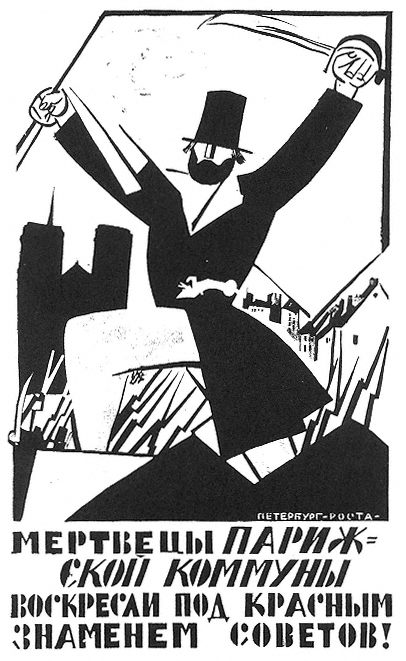
Figure 14.
The Bolsheviks claimed the heritage of the Paris Commune,
as illustrated by this poster, captioned "The martyrs of the Paris Commune
were resurrected under the red banner of the Soviets" (1921).
Zinoviev presided over a ritual in which a "holy relic" of the Paris Commune, one of the last banners to fly over its barricades, was presented by French Communists to the Russians and laid on Lenin's tomb.[6] But in 1919 claims were more modest. Moscow was meant to be only a temporary headquarters; a permanent nerve center would be established in Berlin once communist revolution had swept Germany.[7]
The year between the First Congress and the Second in July 1920 brought an unpleasant surprise: world revolution did not break out. Moscow became the permanent center of world revolution by default. The Executive Committee of the International, mandated to direct operations between congresses, was an essentially Russian body, and its control of the movement solidified. The publication of Lenin's polemic "Left-Wing" Communism: An Infantile Disorder was a first attempt to impose Russian standards on foreign parties; and the Twenty-One Conditions for admission to the International, promulgated at the close of the Second Congress, established Moscow as model and center.
The magnificent complex of church and palace that is known as the Moscow Kremlin was given its present shape in the fifteenth and sixteenth centuries under the first great Muscovite rulers, Ivan III and Ivan IV (the Terrible). Set atop a hill in the middle of the city, surrounded by massive walls, it is an architectural apotheosis of the medieval Russian autocracy: the center as source of power (state) and ideology (church). The creation of the Kremlin and its symbolic aspect coincided with the birth of the most powerful myth of Russian autocracy: Moscow as the Third Rome. The Russian state claimed through its church the mantle of the early Christians, forfeited first by Rome when it strayed from Orthodoxy and then by Constantinople when it was captured by the infidel Turks.[8] The Second Congress of the Third International, held in 1920, when the Soviets claimed the leadership of the world proletariat, convened in the Kremlin. As one of the delegates commented without irony:
Its architecture is supposed to symbolise a temple of honour of the sacred dignity of imperial power. A series of gilded columns run down the hall, but these were now swathed with red bunting in honour of the new power. Where once stood the throne now stood the platform for the presidium of the Congress. Over the throne, under the sweep of an arch, the "All-Seeing Eye" looked down. Long rows of desks stretched across the hall and red carpet covered the parquet floor.[9]
For the first time since the Revolution, the imperial eagles atop the Kremlin towers were regilded.[10]
Literature and posters issued for the congress emphasized the theme of Moscow as center. The cover of the publication of the First Congress had depicted a worker beating the chains off a globe;[11] but a poster of the next year, Dmitry Moor's "Long Live the Third International," showed the same worker hailing the Kremlin (see Figure 15). A commemorative plate by Maria Lebedeva pictured the world movement as a series of concentric circles: on the outer ring, the world proletariat; next, the first stanza of the Internationale ; then the city; and, in the inner circle, a red star radiating the bolt of life from the heavens like Jehovah in the Sistine Chapel (see Figure 16).[12] Vladimir Narbut published a poem for the occasion:
Mongols, Negroes, and Arabs,
And you too, West of fiery aspect,
Use the wisdom of Socrates to create
The unhewn features
Of a Proletariat Atlas.
And may he, tremendous, made-of-steel,
Tense his muscles, as before
And take the Heavens on his shoulders,
Feet planted in Moscow and Resht.[13]
The Congress was first transported to Petrograd for a ceremonial opening in the Tauride Palace (built for Potemkin by Catherine II on her return from the Crimean tour). The Russians used that city's ceremonial center to receive their guests. The British and Italian delegations, who showed signs of cooperating with Bolshevik designs, were fíted with magnificent demonstrations by the army and trade unions through Palace Square; Zinoviev addressed the gathered multitudes from the same balcony once used by the tsar to address his people. (The French, who were intransigent, were given no such greeting.)[14] On the Field of Mars a Red Mass was performed, a requiem at the memorial grave of the "victims of the Revolution"; a brass orchestra and choir performed Wagner's Götterdämmerung .[15]
The foreign delegates could not have failed to notice the political irregularity of some of the symbolic gestures. Two monuments were erected in Petrograd: the one devoted to the Paris Commune was appropriate for a group that claimed the mantle of Marx; but the monument to Karl Liebknecht and Rosa Luxemburg, who one year before had objected strenuously to the founding of the Third International, was not.[16] Nor is it clear whether the visitors appreciated the Trial of the Yellow [Second] International , an agit-trial produced for the benefit of
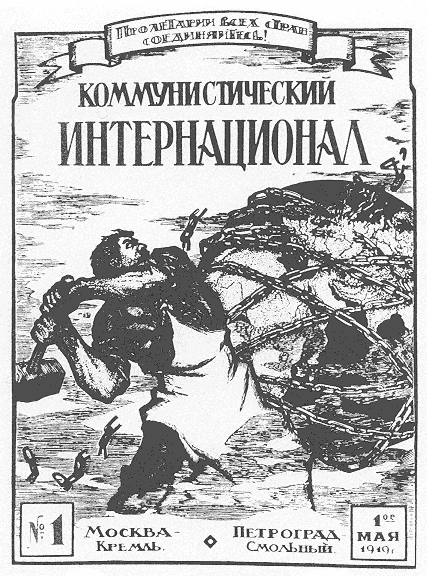
Figure 15.
Graphic representations of the Third International, 1919 and 1920
(Mikhail German, ed., Serdtsem slushaia revoliutsiiu. Iskusstvo pervykh let oktiabria , Leningrad, 1980).
Photo (right) courtesy of Aurora Publishers.
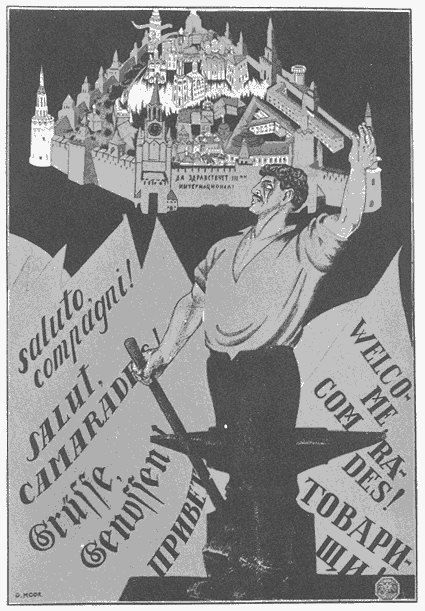
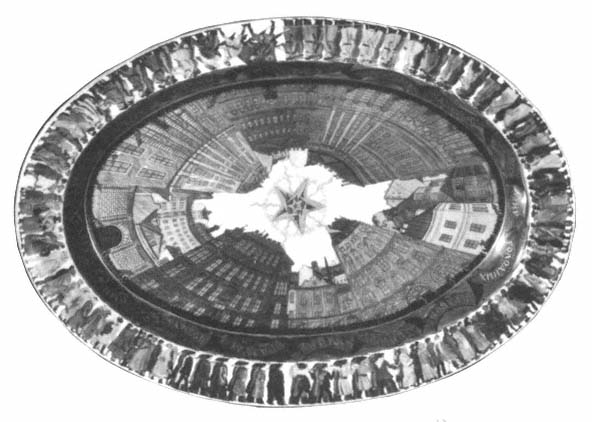
Figure 16.
Maria Lebedevo's commemorative plate for the second Congress
of the Third International. Photo courtesy Aurora Publishers.
delegates who had yet to break with that organization.[17] But most outrageous was surely the fact that the Internationale, Pierre Degeyter's hymn of the workers' movement, was sung to new music; a competition for its composition had been held to which no foreign composer was invited. The jury was headed by Glazunov, ex-director of the Imperial Conservatory of Music.[18]
Any censure was quieted, though, by the magnificent spectacle Toward a World Commune, presented at the Stock Exchange from 10 p.m. to 4 a.m. on July 19.[19] Modeled on The Mystery of Liberated Labor, this production by four thousand soldiers and theater-circle members enacted the history of the Third International for foreign delegates and the citizens of Petrograd. Presented in the form of a mystery play, it portrayed history as cyclical; and the Russian Revolution, the dramatic climax of the performance, took on an inevitability it might not otherwise have had. The fact that the directors were given only ten days to prepare the performance could explain why they relied on tried-and-true methods.
Andreeva once again was the organizer of the event. She delegated directorial duties to Mardzhanov, just returned from Kiev (where, after his success with Fuente ovejuna, he had planned a mass spectacle entitled King Saul ).[20] Mardzhanov further delegated authority for separate episodes to young assistant directors. Petrov, of BDT and the Crooked Mirror, was assigned the first act; Radlov, the second; and Soloviev and Piotrovsky were given the third. For himself, Mardzhanov reserved the coordinating duties of the main director.
The preliminary scenario projected three acts: mankind's past—his enslavement; the present—struggle and victory; the future—the good life. The Third International was shown to be a by-product of European revolution.[21] Yet if the Russians were to be at its helm, they would have to claim its historical source. At Andreeva's instigation the play was changed to reflect the centrality of the Russian Revolution to the international, and to show that the Third International was the rightful heir of the First. The myth of the International was thus rewritten, and the Russians were at its center.
ACT I
Scene i. Communist Manifesto .
The rulers of the world, kings and bankers, erect a monument to their own power with the hands of the workers. . . . On top, a sumptuous celebration of the bourgeoisie; below, the workers' involuntary labor.
The laboring masses bring forward . . . the founders of the First international. The Communist Manifesto.
Only a small group of French workers answers the call to battle. They fling themselves into an attack on the stronghold of capitalism. The forward ranks, met by shots, fall. The red banner of the commune flies. The bourgeoisie flees. The workers seize its throne and destroy the monument to bourgeois power. The Paris Commune.
Scene ii. The Paris Commune and the Death of the First International .
A merry holiday for the Communards. Workers dance . . . the carmagnole. The Paris Commune decrees the foundations of a socialist order. New danger. The bourgeoisie . . . sends the legions of Prussia and Versailles against the First Proletarian Commune. The Communards build barricades, defend themselves bravely, and perish in unequal battle, without having received help from the workers of other nations. . . . The victors shoot the Communards. Workers remove the bodies of their fallen comrades and hide the trampled red banner for future battles. . . .
ACT II
The Second International
The reaction. The triumphal celebration of the victorious bourgeoisie. Below, the involuntary labor of workers reigns. Above, the leaders of the Second International, . . . noses buried in books and newspapers.
Call to war in 1914. The bourgeoisie shouts: "Hurrah for the war. Death to the enemy." The working masses murmur: "We don't want blood." . . . Again the red banner flies. Workers pass the banner from hand to hand and want to present it to the leaders of the Second International.
"You are our leaders. Lead us," shout the masses. The pseudoleaders scatter in confusion. Gendarmes . . . exult and tear apart the hated red banner. The horror and moans of workers.
The graveyard silence is broken by the prophetic words of the people's leader: "As that banner has been rent asunder, so shall the bodies of workers and peasants be torn by war. Down with war!" A traitorous shot strikes the tribune. Triumphant imperialists suggest a vote for war credits. The leaders of the Second International raise their hands after a moment's hesitation, grab their national flags, and split the previously unified mass of the world proletariat. Gerdarmes lead workers away in different directions. The shameful end of the Second International and the beginning of fratricidal world war.
ACT III
The Russian Commune
Scene i. World War .
The first battle. . . . The tsarist government herds long rows of bleak greatcoats to war. Wailing women try to hold the departing soldiers back. Workers, exhausted by starvation and excessive labor, join the women's protest. The wounded are brought back from the front. . . .
The workers' patience is through. Revolution begins. Automobiles, bristling with bayonets, charge by with red banners. The crowd, swept by revolutionary wrath, topples the tsar, then stops dead in amazement. Before the crowd are the new lords: the ministers of the Provisional Government of appeasers. They call for a continuation of the war "to a victorious conclusion" and send the workers into attack. A new courageous blow by the workers returning from the front, supported by a stream of unleashed workers, sweeps away the . . . government. Over the victorious proletariat flares the red banner of the Second Commune with the emblems of the Russian Socialist Federated Soviet Republic. . . .
Scene ii. Defense of the Soviet Republic—the Russian Commune .
Workers and soldiers, having shed their weapons, want to begin building a new life. But the bourgeoisie does not want to accept the loss of its supremacy and begins an embittered fight with the proletariat. The counterrevolution has temporary successes, . . . and only the greatest surge of heroism by the workers' Red Guard saves the Commune. Foreign imperialists send the Russian White Guard and mercenaries. . . . The danger increases. To the leaders' summons "To arms!" workers reply with the creation of the Red Army. Fugitives from areas razed by the Civil War appear. After them come workers from the smashed Hungarian Soviet Republic. The blood of the Hungarian workers calls for revenge. . . . The Red Army leads the heroic battle for the Hungarian and Russian workers, and for the workers of all the world.
Red labor befits the Red Army: it battles against the dislocations of war. The Communist subbotnik . Allegorical female figures of the proletarian victory issue a clarion summons to the workers of the world to the banner of the Third International for the final and decisive battle with world capitalism. The first lines of the workers' hymn.
APOTHEOSIS
The Third International. World Commune
A cannon volley heralds the breaking of the blockade of Soviet Russia and the victory of the world proletariat. The Red Army returns and is reviewed by the leaders of the Revolution in a ceremonial march. Kings' crowns are strewn at their feet. Festively decorated ships carrying the proletariat of the West go by. Workers of all the world, with emblems of labor, hurry to the holiday of the World Commune. In the sky flare greetings to the Congress in various languages: "Long live the Third International," "Workers of the world unite."
A general triumphal celebration to the hymn of the world Commune, the Internationale .[22]
As it had in Mystery, a holiday acted as the symbol of revolution and political ascendance in Toward a World Commune . The scenario as it stood differed little from the scenario of Mystery; the abstract scheme of oppression and revolution was the same, with the roles assigned to
more contemporary rebels. The apotheosis also differed little. As in previous mass spectacles, the Russian Revolution was the inevitable climax to the human drama.