
Part I
The Saur Revolution
2. Lives of the Party
Between April 1978, when the government of Nur Muhammad Taraki took office, and December 1979, when the Soviet Union took control of the Afghan government, a bold attempt was made to transform the Afghan nation into a different kind of social and political entity. Those responsible for this transformation envisioned the establishment of a socialist nation in which class oppression would be wiped out and the productive energies of the poor mobilized. Spearheading the new Afghan state would be the People’s Democratic Party of Afghanistan (PDPA), which was envisioned as a vehicle for incorporating into the governing structure those previously excluded from power: low-ranking military officers and bureaucrats, students, and women. [1] After proper training and indoctrination in the principles of scientific socialism, cadres would go to the countryside to bring literacy to the people and, with literacy, an awareness of the economic and social conditions that consigned the poor to lives of brutal poverty and limited the economic and social development of the nation. There is little doubt that Taraki, Hafizullah Amin, and other leaders of the PDPA saw April 27, 1978, as the dawning of a new era, but the era that began was one of violence and discord rather than of revolutionary promise. Those who flocked to the party standard were far fewer in number than the tens of thousands who took up arms against the regime and the millions who chose exile in Pakistan and Iran over life in the new socialist paradise.
During the early 1980s, many observers came forward to offer their explanations as to why the Marxist revolution failed in Afghanistan. Opponents of the regime—especially the exile resistance parties headquartered in Peshawar—argued that the people saw through the regime’s propaganda and raised the banner of jihad (struggle in the path of Allah) to preserve Islam and dislodge the infidel usurpers from power. Supporters of the regime blamed the popular backlash on the machinations of the traditional elite—members of the royal family, landowners, and religious clerics—who played on the “superstitions and prejudices” of the people in order to misrepresent the party’s real intentions. [2] After the Soviet invasion in December 1979, which installed Babrak Karmal in power, Soviet analysts refocused their criticisms on the deposed leadership, especially former Prime Minister Hafizullah Amin, who was depicted as being an opportunistic despot willing to pervert the principles of scientific socialism in order to preserve his own power.
My examination of the Marxist revolution focuses on the first eighteen months—between the revolution of April 27, 1978, and the assassination of Taraki by his former disciple and successor, Hafizullah Amin, in October 1979. This first eighteen months constituted the crucial historical moment during which the revolution was still winnable. Taraki was the “father” of the revolution and its most visible symbol, and his death marked the demise of its promise, a demise that was fully signaled two months later when the Soviet Union invaded and transformed Afghanistan into an occupied country. The approach I take in understanding the failure of the Marxist revolution is different from that of other commentators on this period; it has two components, the first of which has to do with how I depict the regime. Thus, rather than trying to characterize the regime in generalities and from a distance, I use the government’s own statements, published in newspapers and broadcast over Radio Afghanistan, to establish how its leaders viewed themselves, their relation to the people, their enemies, and their place in Afghan history. In keeping with this approach, the organization of the two chapters in this section is not chronological but thematic; they focus on such matters as the characterization of the revolution, the persona of the leader, the depiction of the party and of the people, and the portrayal of the regime’s enemies.
The second feature of my analysis is my concern with understanding the regime in relation to traditional ideas of governance that held sway in Afghanistan. To date, most examinations of the revolutionary period have been undertaken through the lens of one or another imported ideology (and I view the declarations of the exile Islamic political parties as only slightly less “foreign” than any of the others). In this chapter, I use as my point of reference the principles of governance set forth by Amir Abdur Rahman Khan in the last part of the nineteenth century and subsequent reworkings of those principles, especially during an earlier period of revolutionary upheaval under Amir Amanullah Khan in the 1920s. Hated by many as a tyrant, Abdur Rahman nevertheless forged the basis of governance in Afghanistan and the understandings that people have retained of the natural and proper duties, role, and comportment of its leaders. Amanullah provides an illuminating secondary point of reference for this analysis because he anticipated many of the reforms that the Marxists would later try to put in place, though he did so from his position as a member of the royal family. The transformations that he sought to bring about before his overthrow in 1929 were in many respects forerunners of those of the Marxists and were particularly revealing of the problems they later encountered.
From Coup d’État to Revolution
Dream Comes True—Thousands Throng Arg
KABUL, May 2 (Bakhtar).—Tens of thousands of our compatriots, old, young, women, men and children yesterday and today visited the Arg and Delkusha Palace and other edifices there which have been partly damaged due to ambitious resistance of the last link of despotic Naderi family, Mohammad Daoud. . . .
The patriotic citizens of the country while looking at the majestic palaces and establishments inside the Arg talked to each other about tyranny, revelry and ambition of corrupt Naderi family who were using glamorous palaces for their treacherous deeds, and expressed appreciation to the valiants who victoriously brought down the tower of tyranny and despotism. [3]
The events of the 7th of Saur, 1357 (April 27, 1978), soon came to be referred to by the Marxist regime as “The Glorious Saur Revolution.” In truth, these events are more accurately described as a military coup d’état in that the overthrow of the government of President Muhammad Daud was engineered by a few thousand military officers under the instructions of the outlawed People’s Democratic Party of Afghanistan. President Daud had once been allied with the PDPA, and with the party’s help he had succeeded in orchestrating his own coup d’état against his cousin, King Zahir Shah, in 1973. But, after taking power, Daud had gradually moved away from his former Marxist allies and two days before the April 27th coup had struck against them, ordering that both Taraki and his deputy, Hafizullah Amin, be thrown in prison.
The officers in charge of the arrest had not done their job however. They had allowed Amin to remain under house arrest for a number of hours prior to taking him into custody, and during this time Amin had used his son as a messenger to contact military officers and to set in motion the operation that they had been preparing for and fantasizing about for years. The following morning, tanks moved into position at strategic installations and intersections throughout the capital, while jet fighters strafed the presidential palace where Daud, his family, and principal advisors were holed up. Daud’s republican regime, which had ruled with an authoritarian severity for the preceding five years, collapsed with surprising swiftness. Other military units that might have come to the president’s aid hesitated in their confusion or were delayed by officers sympathetic to or bullied by the coup organizers. Precious time was lost, and Daud and his entourage were killed in a bloody shootout that effectively beheaded the government and left it unable to respond to the crisis.
At first, the identity of the new regime was masked. Military officers made the first announcements, and the Marxist orientation of the coup plotters was concealed. This caution continued for several days until it was finally revealed that the man in charge of the newly instituted Revolutionary Council was Taraki. Educated Afghans at least knew of Taraki from his years as a publisher and writer for various leftist newspapers, most notably the Khalq (Masses), which was the organ of the Soviet-leaning PDPA during the late 1960s, when political parties were briefly allowed to operate in the open. The first and most crucial task of this new regime was to make good on its “revolution” by rallying people to the cause. Taraki and his party supporters (known as “Khalqis”) knew full well that they had a negligible base of support outside the military. From the time that Daud had begun to turn against them, their principal strategy—the strategy that provided such ample and unexpected rewards—was to follow a “shortcut” to power, as Taraki himself admitted in a press conference on August 16:
There were many ways for the deliverance of the people of Afghanistan among which was the classic one based on the ideology of the workers and peasant class. This classic path was a long one. . . . This is the scientific way and we have struggled on the basis of this ideology and this is the basic principle. But we thought to find a short way which could change the destiny of the people of Afghanistan. Fortunately we found this short way in the fact that first of all a party should be founded and through this party work should be done to this effect. . . . We were able to penetrate in the army and give political and class consciousness to the sons of the people and get them organized on party basis. [4]
The success of the coup d’état of April 27, 1978, brought with it the need for the PDPA government to justify its actions, especially its violent killing of President Daud and his family. The basis of this justification was “the historic crimes of the Naderi dynasty,” which had ruled Afghanistan since 1930, when Nadir Khan, a distant cousin of the former king Amanullah Khan, seized power from the former bandit known as Bacha-i Saqao, who had forced Amanullah’s abdication. Nadir qualified for PDPA scorn because of his opposition to the reform program of Amanullah and for having received British assistance in mounting his campaign to overthrow Bacha-i Saqao. [5] In Khalqi parlance,
[Nadir,] with the help of blackguards of colonialism and under their leadership, . . . gathered around himself all traitors and intrigued against independence seekers and true and alert sons of the people of Afghanistan with the assistance of the very same masters, and as he assumed the throne, he indulged in creation of division among the people. He wrenched from the people their freedom, their rights and their bread, and put the men of the valleys and forces of the motherland in stifling chains. [6]
The most effective rallying cry in Afghanistan since the mid-nineteenth century had been the threat of British imperialism, and the Khalqis mined that vein by associating Nadir with the British. In their vision of history, Nadir was the British lackey who ousted Amanullah (the fact that it was Bacha-i Saqao whom Nadir overthrew rather than Amanullah is elided in the Khalqi account), thereby “undoing the good he had done and throwing dear Afghanistan into the dark labyrinth of oppression and misery.” [7] One of the consistent themes that the Khalqis returned to was the use of religion by agents of imperialism—“Muslim-looking farangis” (foreigners) as they were often called—who veiled themselves “under the guise of Islam.” In their interpretation of history, religion had consistently been used as a disguise that allowed outsiders to interfere in Afghan affairs.
Given his commitment to opening up the political process and introducing social reform, Amanullah would seem a natural ancestral figure for the PDPA to hold up for veneration, but because of his failure to implement these reforms, his having been a member of the royal family, and the general hostility to his memory still felt by many Afghans, Amanullah was not much commemorated by the new regime, and connections between his past and their present were not widely commented on. Rather, the government focused its attention on the Naderi dynasty, which replaced Amanullah, especially the last surviving member of that dynasty, whom they had deposed—Muhammad Daud. Daud had long been despised by many Afghans, particularly tribal Pakhtuns, for his harsh suppression of groups that had protested against government policy. Daud’s anti-insurgency activities had been carried out during his younger days as a military officer and provincial governor, but Afghans have long memories for such offenses, and the regime tried to play on this animosity as a basis for popular support. “Now the Naderi dynasty and its last hangman representative is no more, history is on the path of wishes and will of the noble nation of Afghanistan. We shall tell constantly stories of high handedness and decay of the Naderi dynasty to the brave people and the whole humanity. Long live the great nation of Afghanistan and ‘Long live the heroic army of the country.’” [8]
When it first took power, the PDPA had soft-pedaled its Marxist orientation, but by the end of its first summer, the regime began to be more outspoken in its pronouncements, gradually dropping hints of its leftist orientation in its written declarations and providing even more visible indications in the symbols of power it adopted. The most dramatic of these indications was undoubtedly the display on October 19 of an all-red flag that resembled the flags of the Soviet Central Asian republics. As the majority of Afghans are illiterate, this symbol was more revealing of the government’s direction than anything published in the press, but at this stage the government seemed confident that it could weather any adverse consequences of admitting its alignment with the Soviet Union and its adherence to Soviet-style Marxism. Thus, on November 7, in honor of the anniversary of the October Revolution, the Kabul Times published photographs of Lenin and Leonid Brezhnev, and the next day a front-page headline quoted Hafizullah Amin to the effect that the “Saur Revolution is continuation of Great October Revolution.”
Afghan leaders were in fact eager to draw connections to the Bolshevik revolution because they saw their own revolution as the direct lineal descendant of that earlier event, while also believing that the social exigencies of the Afghan situation made their own Saur Revolution uniquely valuable as a model for the rest of the world. This sentiment is evidenced in a long speech by thenDeputy Prime Minister Amin delivered in 1978 at the opening ceremonies of the Afghan Academy of Science. [9] The speech is mostly a long-winded description of elementary Marxist theory, with myriad references to “infrastructures” and “superstructures” and “scientific sociology,” but it also contains a lengthy exegesis of how the PDPA envisioned Afghan society and why the Afghan experience could be considered both the proud successor to the October Revolution and a unique event in the annals of Marxist revolutionary struggles.
Thus, alone among all the world proletarian revolutions, “it was the great Saur Revolution which transferred, like the great October Revolution, the political power directly from the exploiters to the working class.” What made the Saur Revolution unique and gave it a distinction greater even than that of the October Revolution was that “the great Saur Revolution for the first time in the world triumphed under the feudal conditions when the feudal lords and peasants constituted its basic classes”:
Marx had predicted that a true proletarian revolution could occur only in a society where capitalism had triumphed and the working class had been thoroughly beaten down, and Lenin himself had despaired of mobilizing a revolutionary movement among the Central Asian peasant peoples. But, where Marx and Lenin had failed, the PDPA had triumphed by using the military as a “shortcut” to revolution.In the great Saur Revolution, in spite of the fact that it triumphed according to the general and particular laws of the epoch-making working class ideology, the army played a major proletarian role that is the powerful center of the victorious revolution. The army, as a result of the regular work of PDPA, had been transformed into Khalqi forces equipped with the scientific working class ideology and organised through the People’s Democratic Party of Afghanistan, the vanguard of the working class of the country.
On one level, Amin’s speech can be seen as a glorification of what was in reality a necessity. Rather than being a stroke of strategic brilliance, the choice of the military as the avenue by which to seize power was an all-too-conventional one in the Middle East and South Asia, and one mandated in this instance by the fact that the other segments of the society with a proven capacity for military adventure—namely, the tribes—were generally opposed to parties of all ideological persuasions. Therefore, the PDPA’s employment of the military was somewhat unusual merely because it had been able to mobilize this group as effectively as it had through ideological means. Since the recruitment of military officers had been Amin’s responsibility, his glorification of this aspect of PDPA history can also be seen as an act of self-congratulation. Still in the thrall of his unexpected success, Amin glorified the military option as a stroke of genius that qualified the Saur Revolution—and he himself—for a special place in the Marxist pantheon.
In seeking reasons for the eventual failure of the Saur Revolution, one should keep the attitude exemplified in Amin’s speech in mind, for it demonstrates the kind of hubris that led the party to believe in the historical inevitability of the process of revolutionary transformation it had set in motion. The word Afghans use (in both Dari Persian and Pakhtu) for hubris is kibr. A man who acts beyond his station or who behaves in a way that indicates that he seeks merely to benefit himself while ignoring the precepts of society will be accused of “doing kibr,” or being excessively proud (gharur). Taraki and Amin are thought by many Afghans to have committed precisely this sin of acting beyond their rank and claiming a greatness for themselves that others were not prepared to bestow. The fate of such overweening men, Afghans will tell you, is usually disastrous for themselves and others, for their arrogance not only creates resentment in those around them but also makes them incautious. More than anyone else, the man who risks all on a bold gamble, as Taraki and Amin undoubtedly had done, must be most prudent and circumspect. The PDPA leadership, however, had forgotten or never learned this folk wisdom, and their self-absorption caused them to become ultimately more concerned with theoretically defined class relations than with the actual social relations that existed on the ground. [10]
A True Son of the Soil
One may be able to introduce a certain person with a few words or phrases. But the fact is that one should deal with each person with as much details as his characteristics and qualities call for.
The reason is there exist in human societies such personalities that a few words or phrases don’t do any justice to introduce. They may need thick volumes to deal only with their thoughts.
The True Son of the People, the Chief Commander of the Great Saur Revolution, the General Secretary of the Central Committee of the People’s Democratic Party of Afghanistan, the President of the Revolutionary Council and Prime Minister, Comrade Noor Mohammad Taraki, is one of those prominent world figures who needs a few words or phrases for his descriptive title only. One has to compile volumes to introduce his formidable personality in due details. [11]
On October 30, 1978, the Political Department of the People’s Armed Forces published the first extensive biography of Taraki. The biography is an interesting document that provides an insight into not only who Taraki was but also how he and the party thought their leader should be depicted. Many educated Afghans living in Kabul in the 1960s and 1970s knew who Taraki was, at least by reputation, but even in Kabul few knew much about the man. The name “Taraki” told them that his ancestors were from the Taraki tribe, a branch of the Ghilzai confederacy, which meant that he was in all likelihood a native Pakhtu speaker and that his family was probably originally from Ghazni Province, south of Kabul. But this was all most people knew or could infer since Taraki was unknown outside a small circle of educated Afghans in the capital; the fact that so little was known about the man who would be the ruler was a significant matter in a society where family background mattered a great deal.
Americans may look to the myth of the self-made man as justification for forgetting the past and starting afresh, and they have shown themselves willing to vote into office men like Bill Clinton who come from dysfunctional families of little means and less inherited prestige. However, in Afghanistan, especially among Afghan Pakhtuns, who make up the majority of the population, kinship is inescapable and vitally important in reckoning who a man is and where he properly belongs. The most profound innovation introduced by the PDPA was not in the area of land reform or women’s rights. Amir Amanullah, President Daud, and other leaders had begun chipping away at these impediments to change, and the PDPA’s plan—had it succeeded—would have sped up a process that other regimes had initiated. Far more radical for Afghan society was the notion that kinship didn’t matter, that literally anyone could lead the nation.
One sees this idea made flesh in the person of Taraki, who—according to his official biography—was born in the aptly named Sur Kelaye (Red Village) in Ghazni Province in July 1917 to “a poor semi-peasant, semi-shepherd family.” At the age of five, Taraki was hired by a widow to run her errands and look after her house; however, he did not stay in this position long, as his father wanted his son to become literate so that one day he might earn his living as a scribe. Life was never easy in this household. Securing sufficient food for the family was an uncertain proposition because of both poverty and the chicanery of others: “Comrade Taraki’s father was always bothered by problems arising in connection with his precarious mode of living. The great and back-breaking difficulties that he had confronted as a peasant cum shepherd and destitute childhood in relation to the oppressing feudal lords and crafty tribal chieftains were indeed highly taxing to him.” However, Taraki’s father “suffered silently and consoled himself with the signs of brilliance he had traced in his prodigious son. The thought that one day he would see his son in such a movement triumphantly marching among the hard-working intelligentsia, serving the country, raised high hopes in his heart.”
As the story progresses, we discover that there was no noble ancestor dispossessed of his rightful inheritance, no hint that the boy who would be president had any prior claim to that title. The only nobility here is the nobility of poverty and toil, which Afghans had never before seen exalted and treated as worthy of praise. In Afghan culture, nobility is inherited and can only rarely be forged through experience. As Shahmund, an elder of the Mohmand tribe described it to me, “‘The sword of real iron cuts [tura pa asil ghutsa kawi].’ For example, Faiz Gul is the brother of Haji Reza Khan. Since Faiz Gul is a good-for-nothing, his son is just like him. His grandson is also nothing. Since Haji Reza Khan is a good man, his sons are also like him. His grandsons are also like him, and maybe his grandsons’ sons will be even better than him.” [12] Belief in the inherited nature of nobility is also the traditional pillar of Afghan political culture. With the lone exception of Bacha-i Saqao, who ruled forlornly for a year in 1929–1930, all the rulers of Afghanistan from 1747 until 1978 had come from the Durrani tribe. Within that tribe, there were vicious battles for the throne, but no one effectively challenged the right of this tribe to rule until the Saur Revolution.
Justification for the tribe’s status was succinctly expressed by Abdur Rahman in a proclamation to his people; at the beginning he notes that “everyone’s share [nasib] is determined by God on the basis of his merit, circumstances, and capabilities. . . . Each one stands in his own place and position, and hence you people should be grateful to God and to the king.” The proper attitude of every subject should be gratitude, for it is God who has determined one’s position in life:
In whatever rank and position you are and wherever you stand look downward to know how many people are lower than you. When you look downward and see your high rank and position you will receive three blessings [ni‘mat]. First is the consent and contentment of God, for it is written, “If you express your gratitude to God for the blessings He has given you, He will increase them for you.” Second is the approbation and good will of your ruler for you. The third is that you can keep that rank or position that you have, and you can be hopeful for more progress and promotion in the future. God has said that “if you are grateful for His blessings, He will increase them for you.” The increase of blessings, in fact, is progress in rank [daraja]. [13]
Abdur Rahman’s proclamation was written in 1898, eighty years before the Saur Revolution, but Afghans would still concur with the principles contained in it because they are based on transcendent values associated with Islam. Thus, at the center of traditional Afghan political understanding is the belief in the supremacy of God as creator of the universe and ultimate judge of human affairs and in the related tenet that the ruler is bound in a covenantal relationship with God to ensure the safety and prosperity of the community. The ruler’s responsibility, above all else, is to enable the people to practice their faith and to keep them from fitna, a term that can be translated as sedition, disorder, or discord but that carries the larger metaphysical notion of being in a state of anarchy presaging a total collapse of the community.
Far from affirming the notion that “anyone can be president” or that “right ultimately wins out over might,” Taraki’s biography—read through the lens of traditional Afghan political principles—proposes the altogether novel and heretical notion that God erred in allocating his blessings and that human action can correct that mistake. In Afghan culture, people believed that the poor were poor because that is the way God made them; it was their duty to make the best of their situation and to be grateful and obedient to God as well as to those higher than themselves in return for the favors they were given. While this attitude didn’t preclude people from trying to advance their fortunes and to make a better life for themselves than their parents had experienced, it was an altogether different matter who could claim to rule the country. To seek personal prosperity was one thing. To establish oneself as the ruler of all the people was something else entirely—something beyond what any ordinary person could aspire to. Taraki’s life history, however, reverses these basic assumptions; it proclaims that the poor were that way not because of God but because of systematic oppression by “feudal lords and crafty tribal chieftains” and that anyone—even a lowly shepherd’s son—could claim what had been until then the hereditary throne of the Durrani tribe.
Equally revolutionary in light of traditional culture is the implicit notion presented in Taraki’s biography that the means to get ahead in the world is by deserting one’s home and taking up with strangers. Thus, we read that, while still in his teens, Taraki left his native village and sought employment in Qandahar as an office boy at an overseas trading company that sent him to work in its Bombay branch. By dint of his intelligence and hard work, Taraki rose to the position of clerk and used his spare time to read, learn English, and become acquainted with a larger world of affairs otherwise unavailable to Afghans at that time. We don’t find out as much in the biography as we might like about what happened in Bombay. There is the suspicion that Taraki may have been exposed there for the first time to works of socialist philosophy, and some have also speculated that he may have had his first contact there with a Soviet agent who cultivated him for future service.
However that may be, Taraki returned to Afghanistan in 1937, settling in Kabul and using his newly acquired education to begin a career in journalism, which was still in its infancy in Afghanistan at that time. According to the biography, during this period Taraki first “realized with a profound political and class consciousness the pathetic conditions under which the people lived in Afghanistan and became keenly interested in political activities.” Allowing his emerging political sensibilities to influence his writing, Taraki was “harassed” for articles he wrote, but he persevered and began for the first time to meet with other like-minded members of the educated class who shared his convictions. He also started writing short stories and novels of a realist nature with strong political themes that reflected his experiences growing up in poverty.
Most important, from 1943 to 1948, Taraki began to lay the groundwork for the establishment of a political party by “preparing a large number of the intelligentsia to fight against absolute monarchy, aristocracy and despotism of the descendants of Yahya, Nader’s grandfather.” Ultimately, these “long years of struggle led to the founding of Weesh Zalmayan” (Awakened Youth), one of the nascent leftist political parties in Afghanistan that briefly flourished during a period of government liberalization. During the five years of the party’s existence (1948–1953), Taraki, who was then in his early thirties, apparently played an active role but was not so central to its activities as other, older men were or as latter accounts produced by the party portrayed him to be. Thus, one PDPA report had it that Taraki wrote the statement of principles of the party, and the biography itself indicates that Taraki was so significant in the activities of the party that he was “exiled” for his activities to the Afghan embassy in Washington, D.C., where he was appointed press attaché.
Being handed a job in the foreign service in a desirable Western capital is admittedly a strange kind of exile, but, given the later pattern developed by Taraki and Amin of sending disgraced former colleagues off to serve as ambassadors in various distant locales, it is not improbable that the government, in sending Taraki away, was trying to rid itself of someone who was becoming if not dangerous at least a nuisance. Whatever the reality here, Taraki’s moment of truth came when Daud—the same man he would later overthrow—was appointed prime minister by Zahir Shah. In protest at this appointment, Taraki publicly resigned his post in Washington and held a press conference, “explaining the conditions prevailing in Afghanistan, exposing the bankruptcy of the absolute monarchy under the Nader Family with a bunch of feudal lords ruling Afghanistan.” In response, Daud is said to have recalled the former press attaché, at which point Taraki had to decide whether to stay in exile abroad or to return to Afghanistan to face the consequences of his protest. The biography tells us that he went back to Afghanistan, and, “upon his return to Kabul, he telephoned the despotic Daoud from the Kabul Cinema, telling him ‘I am Noor Mohammad Taraki. I have just arrived. Shall I go home or to the prison?’ ” For reasons that are not guessed at in the biography, Daud allowed him to go home but kept him under police surveillance throughout his tenure as prime minister.
We can see in Taraki’s several journeys abroad the reinvention of a common theme in Afghan life histories. In Heroes of the Age, one of the common threads I noted in the lives of a tribal chief, a would-be king, and a Sufi mystic was the protagonist’s exile—sometimes voluntary, sometimes not—from his home. For the tribal chief, Sultan Muhammad Khan, that exile came at an early age, after the murder of his father, when it was no longer safe for him to remain at home. Exile for Sultan Muhammad brought the decisive moment in his life, when he had to resolve whether to stay in the court of his patron, the nawab of Dir, where he had manufactured a comfortable life for himself as a scribe, or to return home to face the dangerous challenge of confronting his enemies and thereby regain his honor. For the king-in-waiting, Abdur Rahman, exile came in his twenties, after seeing his father and uncle both lose the throne of Kabul. He too found a safe refuge and comfortable position with a foreign ruler; however, ultimately, like Sultan Muhammad, Abdur Rahman became dissatisfied with the subservient life of a courtier and set off to recover the throne that was rightfully his. For the Mulla of Hadda, exile meant leaving an impoverished home at a young age to gain religious knowledge and spiritual advancement in India. There, he not only gained the training he needed to become a religious authority but also encountered and fulfilled his preordained destiny by meeting the Akhund of Swat, who would guide him in the path of Sufi enlightenment.
In Taraki’s life history, the journey motif was redeployed and reinvented in interesting ways, with the first journey to Qandahar and Bombay resembling that of the Mulla of Hadda in particular. Thus, Taraki at a young age also decided to leave the poverty, oppression, and limited horizons at home to seek refuge and possible advancement abroad. His search exposed him to other worlds and provided him with the tools needed to open up new fields of knowledge, tools that he then took back to others in his native land. The second trip abroad, to Washington, followed the pattern of the exile journeys of Sultan Muhammad and Abdur Rahman. In Taraki’s case, it was not a family feud or dynastic upheaval that led to his exile but the early struggles of the radical movement to free Afghanistan from the chains of despotism and oppression. Both Abdur Rahman and Sultan Muhammad faced their moments of truth when they had to decide whether to chance a return that would lead them to their death or to their destiny. The biography tells us that Taraki also had to face the same sort of crisis; he had to decide whether to stay abroad in safety or to face the uncertain consequences of a return to the wrath of Prime Minister Daud.
His decision to return home and openly confront Daud is the most heroic act ascribed to Taraki in the biography. While his involvement in covert party organizing was certainly risky, this is the only time Taraki is portrayed facing off against an adversary (albeit over the telephone). Reading between the lines, one might speculate that Daud didn’t take Taraki seriously enough to bother putting him in prison and felt that surveillance was perfectly adequate for so humble an adversary. Daud during this period was sympathetic to most of the ideological positions of the leftists, and the educated elite with whom both men associated constituted such a small circle in those days that some of Taraki’s old friends might also have exerted their influence on Daud to keep him out of trouble. Or maybe none of this happened at all, and this story masks a more ignominious period during which Taraki accepted a government position for the money and then later had to explain it away by making up the story of his confrontation with the prime minister. Whatever the reality, the biographical depiction of these events provides Taraki with a narrative moment of reckoning that would have been typologically comprehensible to Afghans. Whether successfully or not, the biography tries to make of the new leader a recognizably Afghan, though also thoroughly modern, “hero” for a revolutionary age.
The next stage of this would-be heroic life features suffering (“Comrade Taraki . . . did odd jobs to eke out a living. However, as soon as he would land a good job, he was suspended through the intelligence service”); the production of a string of “revolutionary and class-conscious” novels; [14] and the founding of the PDPA (“Comrade Taraki with a high revolutionary spirit almost openly took the initiative to launch his political party. To achieve this end, he began his meetings with a number of youths whom he had already groomed as young revolutionaries so that he could establish the workers’ party equipped with the working class scientific ideology”). The context of the party’s founding was the advent of a period of democratic liberalization in which Zahir Shah promised to open up the political process. This era began with the drafting of a new constitution in 1964 and the election of a representative parliamentary assembly in 1965.
Taraki himself ran for the lower house (wolesi jirga) of parliament from his native district in Ghazni, but he was defeated, as the biography explains, “through Government machinations and shameless intervention in the election.” Other Marxists, however, including Babrak Karmal and Dr. Anahita Ratebzad, were elected and immediately set about making their presence felt in the assembly. The elections had produced a lower house split between conservative and Marxist factions, with a relatively weak and ineffectual center, represented by Prime Minister Muhammad Yusuf, who had been appointed by the king to replace Prime Minister Daud. Immediately after the opening of parliament, the Marxists began accusing the new government of corruption and forced a vote of confidence; it was held on October 24, 1965, before a gallery packed with shouting, chanting Karmal supporters, who managed to disrupt the vote. The next day, the police locked the demonstrators out of the parliamentary chambers, so they took their protest to the streets and were eventually fired on by overwhelmed Afghan troops. This event led to more demonstrations and finally forced the resignation of Yusuf. [15]
Although no direct role in the parliamentary crisis is ascribed to Taraki, the biography does tell us that he was working in this period to organize the PDPA and to found “the glorious historic and brilliant Khalq newspaper.” Although the paper was allowed to run for only six weeks and six issues, it managed in that short time to further divide the already factionalized political climate, especially through its open declaration that “the main issue of contemporary times and the center of class struggle on a worldwide basis, which began with the Great October Socialist Revolution, is the struggle between international socialism and international imperialism.” [16] Religious leaders in the upper house of the parliament (meshrano jirga) demanded an investigation, and the government decided to ban the paper outright on May 23, 1966.
Despite the banning of Khalq, other leftist newspapers were started, including Parcham (Flag) and the Maoist Shu’la-yi Jawed (Eternal Flame). These publications played a cat-and-mouse game with conservative opponents and government censors, taunting with cartoons and editorials, creating minor provocations that went right up to the line that would get them noticed but not banned. One incident in particular stands out during this period, the publication of a poem in Parcham written by Bariq Shafi, the former editor of Khalq, titled “The Bugle of Revolution.” In this poem, the writer intentionally used forms of eulogistic praise (dorud) traditionally reserved for the Prophet Muhammad to celebrate Lenin. Where earlier provocations had resulted in scattered protests, impassioned mosque sermons, and delegations demanding an audience with the king, “The Bugle of Revolution” created a nationwide furor, as news of the outrage spread throughout the country. Inspired by the increasing immorality of the left, mullas from throughout the country traveled to Kabul, where they gathered in the Pul-i Khishti mosque near the central marketplace to protest the poem and give vent to their larger concern over the expansion of leftist influence. [17]
In the parliament, leftist deputies employed the same practice, provoking their clerical opponents while trying not to directly offend the government. Karmal, in particular, was famous for offering public praise of the king while getting into symbolic tiffs with religious deputies, as evidenced in the following story told by Samiullah Safi, a fellow deputy of Karmal’s, whose story is the centerpiece of Chapter Four:
One time Karmal started a speech without the usual invocation of bismillah [in the name of God]. One of the deputies announced, “I have a legal objection.” The president of the assembly, who was Umar Wardak, stopped [Karmal] from talking and asked what his objection was. I don’t remember which deputy it was, but he said that “whenever Karmal makes a speech, he doesn’t say ‘bismillah.’ He must say ‘bismillah ul-rahman ul-rahim.’” If other people would forget to say the “bismillah,” he presumably wouldn’t have minded, but since it involved Karmal, who was a communist and a servant of Russia, . . . people were sensitive to his manner of speaking. So he said, “He must say the ‘bismillah’ before he begins his speeches.”
They put this objection to a vote—whether or not he should say “bismillah.” When the voting took place, even Hafizullah Amin, who was present, raised his hand to show that he thought that “bismillah” should be spoken. The only person in the parliament who didn’t raise his hand was Karmal. After that, Umar Wardak hit the desk with his gavel and said, “It has been unanimously decided that Mr. Karmal must say ‘bismillah ul-rahman ul-rahim’ before starting his speeches.” Then they gave him permission [to speak], and the light went on the microphone; but he started speaking from where he left off and didn’t say “bismillah.” Immediately the assembly broke out in a great hubbub. There was lots of shouting. Karmal didn’t say “bismillah,” so he pushed the mic away and leaned to one side, giving up on his speech. [18]
Another, similar confrontation between Karmal and Maulavi Muhammad Nabi Muhammadi, a Muslim cleric who later became the leader of one of the exile Islamic resistance parties, resulted in a skirmish on the floor of the parliament in which Karmal received a cut on his head. According to Louis Dupree, “When his followers demonstrated outside the hospital, [Karmal] grabbed additional bandages and energetically tied them around his head before appearing to wave feebly to the spirited crowd.” [19] The ultimate effect of this sort of incitement was the paralysis of the government, as a succession of prime ministers tried and failed to exert some modicum of influence over a dysfunctional parliament and incendiary press. Ultimately, this failure led to the mobilization of a coup d’état by Muhammad Daud, a cousin of Zahir Shah and the last prime minister prior to the advent of the democratic era in 1964. Among Daud’s early supporters were members of the PDPA, but they soon became disillusioned with Daud as he reverted to the autocratic style of governing that he had relied on during his earlier decade of rule.
At this moment, according to Taraki’s biography, Taraki struck on his plan to take “a shortcut” to revolution via the armed forces: “Previously, the army was considered as the tool of dictatorship and despotism of the ruling class and it was not imaginable to use it before toppling its employer. However, Comrade Taraki suggested this tool ought to be wrested in order to topple the ruling class thereby and this end could be achieved through extensively doing party work in the army and diffusing the epoch-making working class ideology among the armed forces.” Taraki entrusted the job of mobilizing a military base to the man who was becoming his closest confidant and protégé, Hafizullah Amin.
Comrade Amin who was responsible for the party affairs among the armed forces and enjoyed the trust of the young officers respecting his orders with extreme faith and loyalty soon realized that now the young officers in the armed forces on the one hand adored their great leader Noor Mohammad Taraki and on the other hand were ready to proceed with any revolutionary action with utmost discipline to place themselves in his command with deep loyalty and devotion. The Khalqi officers in the armed forces believed that Comrade Amin as the most faithful follower and disciple of Comrade Taraki was sincerely following his beloved leader’s instructions and faithfully and loyally reported to him on behalf of the Khalqi officers.
Throughout the mid-1970s, President Daud, who earlier in his career had been known as the “red prince” for his leftist views, became steadily more suspicious of his former allies on the left and of the intentions of his Soviet patrons. Many believe that in the months before the Saur Revolution, Daud was sufficiently concerned for his position that he was making plans to renounce or severely restrict aid from the Soviet Union while increasing his reliance on assistance from Saudi Arabia and Iran, both of which he visited in early 1978. Daud’s suspicions of the left were galvanized on April 17, 1978, when unknown assassins shot down Mir Akbar Khyber, one of the best-known Marxists and a close ally of Karmal. Khyber’s funeral attracted a large and vociferous crowd, and a new wave of leftist protests appeared likely in the days ahead. To forestall that eventuality, Daud dispatched police officers in the early morning hours of April 26 to arrest Taraki, Karmal, Amin, and other leading Marxists at their homes. Taraki appears not to have anticipated this move:
Holding his shot gun and on the verge of firing on the police, Comrade Taraki thought it was the thieves or the reactionaries who had raided into his house but soon realized that they were police officers of the inhuman Daoud Regime. When Mrs. Taraki confronted these officers, one threatened her with his weapon and wounded her arm with his bayonet: Sprinkling her blood on the faces of the police officers, Mrs. Taraki exclaimed “this blood would not remain unavenged.”
Showing a political dexterity that would ultimately be his undoing, Amin took advantage of the arresting officer’s leniency in allowing him to remain in his house for several hours to send a message to Marxist officers instructing them to begin their coup d’état on the following day—April 27. Thus, the long planned coup d’état got under way while Taraki, Amin, and other party leaders were in prison. Not until the afternoon, several hours after the beginning of the operation, were military officers able to “release great heroic leader, Comrade Noor Muhammad Taraki and others from their dark cells” and convey them by armored car to Radio Afghanistan, where military officers announced to the Afghan people that a new revolutionary government was now in control of the homeland. After the announcement and as the battle for Kabul continued to rage, the officers took Taraki and other leaders to an air force base outside the capital where they would be safe until the outcome of the coup could be assured.
Thus ends the narrative portion of the biography, the last paragraphs being taken up with fulsome praise for Taraki’s personal attributes. What is striking about the presentation of these attributes is the same thing that one notes about the biography as a whole—that is, how atypical Taraki is as an Afghan leader. Throughout, the story hardly mentions any acts of personal bravery or heroism, beyond the possibly made-up instance of standing up to then-Prime Minister Daud over the telephone. Where Amin (the likely author of the biography) is singled out for praise for his coolheadedness at the time of his arrest, Taraki in the same circumstances appears to have been confused, thinking that he was under threat from burglars rather than from the police, and the only real defiance comes from his wife.
According to one man with whom I have spoken, whose brother led the detail assigned to arrest Taraki, the soldiers could not find him right away because he was hiding in the bathroom. “A soldier opened the door of the bathroom and found Taraki in there with his wife’s chadar [veil] over his head. Then the soldier took off the chadar and called out that he [Taraki] was in the bathroom.” [20] Whether this story is true or not, the hagiographic biography provides few details that augment the image of Taraki as a great leader in any usual Afghan sense. To the contrary, we find out that in the moment of battle, when the revolution could still have collapsed, Taraki had no hand in coordinating operations but was instead whisked out of harm’s way to the relative safety of a military base already in the hands of coup leaders.
In addition to the absence of any singular deeds, Taraki’s life is also notable for other missing elements, most importantly children. In Afghanistan, having children is not only a symbol of a man’s potency, it is also his claim to immortality. In Taraki’s native Pakhtun culture in particular, men without children are soon forgotten, and their names—having no more significance—are quickly elided from tribal genealogies. The absence of a family is also thought to make one vulnerable to the designs of others. Family members, and especially sons, are the ultimate insurance policy, for a man with many sons, along with brothers and nephews, has mlatar—male relatives who will “tie their waists” (something like “girding one’s loins”) for battle to defend their kin and avenge attacks on them. The only individuals who are exempt from needing kinsmen for self-protection are mullas, whose poverty and devotion to religion protect them from assault, and a few celibate saints like the Mulla of Hadda; these saints acquire a surrogate progeny through their disciples, whose names are linked to theirs through lines of spiritual transmission (silsila), which functions as a kind of genealogy in giving status and position to those included in them.
Taraki’s childlessness is noted in the biography, along with the notation that “all members of the People’s Democratic Party of Afghanistan revere him as their father and he reciprocally treats them as his own children.” [21] The implication here is that the party for Taraki displaced the family. This equates in a way with a tenet of Leninist ideology—that the party should be more important to its members than the sentimental attachments of birth, kin, and nation—but this is a notion that only the most alienated and deracinated Afghans would willingly accept. And it would anyway appear that rather than the party’s eliminating such attachments as bourgeois and antirevolutionary, for Taraki the party was a substitute family in which he invested the same sentimental attachments that others placed in their families. That Taraki had this need to treat his younger colleagues as children makes him in some ways a more sympathetic character, but it also made him in Afghan eyes somewhat pathetic and all the more unworthy as a national leader.
Another lack in Taraki’s life prior to the revolution is property. As the biography notes, “Comrade Taraki does not own any personal property with the exception of a one story mud house in Sher Shah Mina, Kabul.” This feature of the life history is again laudable from the point of view of Marxist doctrine and shows Taraki neither to have been corrupted by inherited wealth nor to have bent his principles to acquire property. But even if Taraki’s relative poverty was a mark of his commitment rather than his incompetence, the valorization of being propertyless at age sixty-one is still incomprehensible in Afghan culture, which views property as both a sign of ni‘mat and an indication of a man’s success in life. A man of property is thought of as being “heavy,” or drund, which implies that he is in a position to provide hospitality and benefit to others. Conversely, a man without property is considered “naked” (luchak) and unable to fulfill the requirements of honor, which dictate that a man must be able to provide for himself and for others. Such a man is also vulnerable to the assaults of the world, for he lacks the means with which to defend himself. If a man without property cannot meet the basic demands of honor, how much less prepared is he to handle the far greater obligations of rule? One might even say that having such a man as ruler would be a sign of God’s displeasure with his subjects since the benefits that God allows to the people emanate in the first instance from the ruler. [22]
A final lack that can be noted in the biography is what might be called a kingly persona. Abdur Rahman, the so-called Iron Amir, was the archetype of the battle-hardened warrior who was quick to avenge any slight or suggestion that he was not in charge. Many considered him the cruelest of Afghan monarchs, but as Lord Curzon noted at the time, “None had given so large a measure of unity to the kingdom.” [23] Abdur Rahman’s son, Habibullah, was gargantuan in girth but a shadow of his father as ruler; however, he at least possessed the hauteur that Afghans expect of their rulers. So, too, did Amanullah. For all his plans for reform and his willingness to recast his subjects as citizens, Amanullah carried himself as a king and left no one wondering who was in charge. Zahir Shah was a less prepossessing man, and many Afghans believe that his apparent weakness and unwillingness to rule with a strong hand started in motion the disastrous decline that culminated in the Saur Revolution.
Given the respect accorded strong political personalities in Afghan society, one of the more curious features of recent history is that a man of Taraki’s modest character and talents should have managed to topple Afghanistan’s two-hundred-year-old dynasty. In the modest language of the biography, “Comrade Noor Mohammad Taraki is a dear friend to all hard-working, honest and patriotic compatriots. He is a just leader and teacher. He is highly cultured, modest and compassionate.” What he was not was the “great leader” of government propaganda, at least not in any sense that Afghans traditionally recognized. As already noted, there was no evidence of physical stamina or bravery, no signs of any brilliance as a warrior or orator; and despite the exalted claims made by Amin for the strategic brilliance of Taraki’s revolutionary “shortcut,” he made no notable contributions to revolutionary ideology. Above all else, he was a dreamer and a conversationalist who was apparently most persuasive when speaking with a small group of younger men, and perhaps his single greatest talent was for bringing together more powerful and repellent personalities who, in his absence, could never have worked or even remained in the same room together.
In this sense, one could argue that Taraki’s rise to the top of the Afghan political hierarchy was comparable to the rise of another previously unknown figure—Ahmad Shah Abdali—who was a second-tier tribal leader when a deadlock between more powerful khans led to his being chosen to lead the Durrani confederation of tribes in 1747. The difference is that Ahmad Shah proved to be a true leader; he seized his opportunity and led his tribe to foreign conquests and two centuries of unchallenged hegemony over the Kingdom of Afghanistan. Taraki’s ascendance, by contrast, was short-lived, and his ultimate failure to consolidate his rule reveals a more telling relationship, that between the leader of the PDPA and his own tribal people—the Taraki Ghilzai.
Like most other Ghilzai tribes, the Taraki were opportunistic nomads. Some were sheep and goat herders who migrated with their flocks each summer to high pastures. Some were long-range camel nomads who hired out their animals to carry goods from one market to another. Some were itinerant workers who traveled to India in the winter months to engage in casual labor, while other, more ambitious and adventurous types journeyed as far as Calcutta, where they “hawk[ed] clothing on credit or carr[ied] on usury.” [24] Taraki’s own early career as a clerk for the Pushtun Trading Company in Bombay mirrored his tribe’s age-old association with South Asian trade, and, in that tradition, Taraki remained throughout his life a middleman, a broker in foreign goods who operated on the margins between different social worlds, never fully committing himself to anyone, never being fully accepted any place. This is not the most generous but it may be the most realistic assessment of an itinerant and interstitial career that brought a most unsuitable figure to the pinnacle of power and precipitated a conflict that would consume his people long after his death.
The People’s Party in Cultural Context
Comrade Taraki was tirelessly in touch with those who were equipped with the working class ideology, struggling individually or in separate circles, linking them up with a view to creating the working class party. As a result of his creative work and on the basis of his ardent love for the people, about 30 young men representing all patriotic, progressive and revolutionary youth gathered at Comrade Noor Mohammad Taraki’s humble residence at Sher Shah Maina, Kabul on January 1st, 1965, establishing the first Founding Congress of the People’s Democratic Party of Afghanistan. [25]
Hidden behind the rhetoric of fraternal feeling contained in this passage is the reality that the party that got its start on January 1, 1965, was in crisis almost from the start. The first outward sign of that crisis occurred in 1966 and involved a dispute over whether Amin should be made an alternate member of the central committee of the party. Taraki supported the proposal, but it was resisted by Karmal and a number of his allies on the central committee who would leave the PDPA in 1967 and form their own Parcham (Banner) party. There were a number of reasons for the split. Taraki and others in the Khalq branch of the party were mostly rural Pakhtuns and Pakhtu speakers, while Karmal and his supporters were predominantly Persian speakers from Kabul and other Tajik-majority regions. Karmal was also suspected by Amin and other Khalqis because of his supposed ties to the royal family, though the nature and extent of these ties have long been in dispute. [26] Some have contended that there was a close personal link between Karmal and Daud through Karmal’s father, an Afghan general, who was appointed by Daud during his tenure as prime minister as governor of Herat and Paktia provinces. According to these sources, Daud is even suspected of providing financial assistance to Parcham after its split with the Khalq faction. [27]
While the extent of Karmal’s personal association with the royal family is uncertain, there were philosophical and strategic differences between the Parchamis and Khalqis, with Karmal advocating a more conciliatory line toward the monarchy of Zahir Shah and a gradual approach to political change. [28] In apparent gratitude, the government allowed Karmal’s faction to continue publishing its newspaper, Parcham, well after the Khalq newspaper had been shut down, a fact that further antagonized Taraki, Amin, and other staunch Khalqis. Later, when Daud overthrew the monarchy, Karmal and other Parchamis were initially welcomed into Daud’s circle. Expectations that this embrace would lead to real power were quickly dashed, however, as many Parchami activists were dispatched to low-level government positions in out-of-the-way areas. Even then, the Parchamis continued to advocate a more cautious approach to political change while the Khalqis, led by Amin, were making secret plans for a military coup d’état.
Irrespective of ethnic and linguistic factors, possible royal connections, and policy disagreements, the source of the division between Khalq and Parcham arose more than anything else from the profound personal animosity between Karmal and Amin. In his role as mediator and benevolent friend to all the world, Taraki succeeded from time to time in overcoming the rift—Khalq and Parcham unified again in 1977—but the antipathy between Amin and Karmal was too deep to mend permanently. Some sense of the personality differences and the dislike that Amin and Karmal shared for one another can be gleaned from another story told to me by Safi:
When Hafizullah Amin would come in [to the parliamentary chamber], he would go and sit down with some mulla, and talk and joke. Then he would sit with some elder or some khan or some other deputy or with some educated person. He’d joke, sometimes he’d sit in this chair, sometimes he’d sit in that chair, although everyone knew his seat was on the left [where the leftist deputies tended to sit]. He would talk and joke with everyone, and the deputies would say to him, “Hey, infidel [kafir]! Hey, devil [la’in].” They’d say that sort of thing, and he would laugh. Everyone rejected his political connections, but all of the deputies had social and personal relations with him—everyone, even this Muhammad Nabi Muhammadi. [29] So many times, Amin would sit at a table and talk and debate with them, even Muhammad Nabi Muhammadi. . . . Karmal [however] would act like a sardar [prince]. He would enter in the manner of a Muhammadzai [member of the extended royal family]. He wouldn’t socialize with the deputies. He would come in, looking very serious. He would always go to the left and sit down in a chair in his customary and permanent place. That wretched man would just sit there, quietly, not saying anything. This was his character. . . .
Karmal and Hafizullah Amin were not only opposed to the government, . . . [but] also opposed to each other—violently opposed. It was the most serious opposition that I saw in the four years I was in the parliament. Not once did I see Hafizullah Amin and Karmal shaking hands. By way of example, I tell you that we deputies would be standing around outside before the beginning of a session or during breaks. If Hafizullah Amin was standing in the circle and Karmal went by, he wouldn’t be able to enter the circle—out of fear. He was scared of Hafizullah Amin, just like a mouse, and he wouldn’t come into the circle. He would go far away and wouldn’t shake hands with anyone, but when Karmal was standing in the circle and Hafizullah Amin arrived, Amin would stick out his hand like this to each one and look angrily in [Karmal’s] direction, not offering his hand, but instead offering it to someone else. And in these circles he would dominate the whole conversation, and Karmal would eventually slink away like a mouse, as though he wasn’t included in the group. He couldn’t speak in front of him. That’s the truth.
Amin’s great gift was for persuasion. Where Karmal was an effective orator but aloof in person, Amin was personable and easy in interaction. A rural Pakhtun from Paghman, close to Kabul, Amin was unusually well educated for someone of his background, having gained the opportunity, after graduating from Kabul University in the late 1950s, to study at Columbia University in New York City, where he received a master’s degree in education. On his return to Afghanistan, Amin worked as a teacher and principal at Ibn-i Sina High School and the national teacher-training college (dar ul-ulum). After the founding of the PDPA, Amin used his position and access to young people to recruit members to the party. Because of these early efforts, the Khalq had a considerable edge over Parcham and every other party in gaining support among young educated men, especially among primary and secondary schoolteachers who had been inspired by Amin and who went out into the provinces to spread the message. This support would initially give Khalq an advantage, but it would also ultimately prove to be part of the government’s undoing after the revolution as zealous young teachers became a focus of popular resentment.
After the 1973 coup d’état against Zahir Shah and the decision by the Khalqis to begin implementing their “shortcut” to revolution, it was natural for Amin to play the role of organizer. In the case of military officers, he had an additional recruiting advantage in that many officers were already being sent by the Afghan government to the Soviet Union and Czechoslovakia for military training. By 1970, an estimated 7,000 junior officers were trained in those two states, compared to 600 who went to the United States and lesser numbers to Turkey, India, and Great Britain. [30] As Hasan Kakar has noted, the ideological training of these young men was well along even before Amin got to them. [31] Whether the majority of these officers became communists as a result of their indoctrination is doubtful, but the experience of studying abroad in a more advanced country does seem to have turned many against their own government. So too did the situation they found on their return, for as Anthony Hyman has pointed out, returning junior officers found it difficult “to reconcile their own lowly positions and poor pay with the prestige of army officers in Afghan society as a whole—or their own merits (as they saw them) against the superannuated and inefficient senior officers.” [32]
Likewise, young officers saw firsthand the failure of parliamentary democracy and then experienced the disappointment of seeing Daud’s left-leaning “revolution” become mired in corruption and turn increasingly defensive and conservative. With the collapse of emergent institutions, there was the additional failure of political leaders to come up with development programs for the country at large. Junior officers trained in the Soviet bloc may not have converted to Marxism as a result of their experiences in the Soviet Union. However, most of them did come back more radicalized than when they left, and the failure of the parliament and then of Daud’s regime to make good on the promise of reform certainly made many officers sympathetic to the possibilities of a homegrown Marxist movement. At the same time that junior officers were feeling increasingly alienated from the military establishment and the government, they were also feeling increasingly cut off from their rural roots. In this context, Amin offered not only ideological comfort but also a sense of belonging. The party with its coded language of fraternal fellowship and its secret meetings became for many an alternative family and tribe, replacing the ones they had left behind and from which they had become increasingly estranged by education and distance. The vast majority of those whom Amin recruited were, like himself, deracinated Pakhtuns, and they appear to have felt considerable loyalty to him.
Amin was a strong personality and tended to create as many enemies as converts, but among those whom Amin clearly seduced was Taraki himself. As the biography makes clear, Taraki acted as Amin’s protector when others on the central committee wanted to see his authority diminished. As the biography explained it, “Comrade Taraki used to pay much attention to the cultivation of Comrade Amin’s tactical and strategic talents . . . [and] defended him against all sorts of intrigues and propagandas, . . . safeguarding his loyal disciple against all intrigues resorted [to] by some colleagues consciously or sub-consciously which eventually proved to be in the interests of the enemy.” When the party reunified in July 1977, the Khalqi wing refused to let the Parchamis in on their plan to mount a coup d’état, both because of Parcham’s cautiousness and because of the Khalqis’ suspicion that Parchamis might tip off the government to their plans. According to Taraki’s biography, Khalq suspicion of Parchami loyalty to the revolution proved well founded at the time of the April 27th coup d’état—first, when Karmal “argued that the revolution was doomed to failure and hence members of Central Committee should be dispersed in villages and hide there” and, then, when he urged that Daud only be arrested and not killed.
Rapprochement between the two wings of the PDPA proved short-lived after the revolution. Though Karmal was initially given the post of vice chairman of the Revolutionary Council and deputy prime minister (a title he shared with Amin), he was ousted, along with various of his Parchami allies, in July 1978 and dispatched as ambassador to Czechoslovakia. In reporting on Karmal’s ouster, the government-run Kabul Times was respectful of Karmal and treated his new assignment as a considerable honor. However, with the news of the diplomatic posting of other Parchamis—Nur Ahmad Nur to Washington, Anahita Ratebzad to Belgrade, Dr. Najibullah to Teheran, and Mahmud Barylay to Pakistan—it became clear that this was nothing less than a purge, a fact the government made clear in August with the announcement of the arrest or ouster of various Parchami-aligned “traitors,” whom the government accused of subverting the revolution. These announcements were followed on September 23 by published confessions of various Parchami conspirators who admitted to participating in plans for a counterrevolution that was being orchestrated by Karmal and his allies. The Khalq wing was in a position to execute this purge of its former allies because of its stronger position among military officers.
Following the purges of July, the government set about the task of revolutionizing Afghan society. The main thrust of this effort involved winning over the people, an effort that is discussed in the next chapter. But, particularly after the divisive Parcham purge, Taraki and Amin had also to ensure the loyalty of their own comrades, most important, those in the military who had brought them to power and who could just as easily remove them. On August 1, Taraki addressed the ranking officers of the Fourth and Fifteenth Armored Divisions of the People’s Armed Forces of Afghanistan at the People’s House (the renamed presidential palace) in Kabul. This was one of many speeches given by Taraki during this period, and it is representative in its focus and style. [33]
Taraki began the speech by indicating that he was addressing the officers “in a party capacity as comrades and members of the party cadres.” He waxed nostalgic about “how we used to meet at night and how our comrades used to exert great caution and travel to our home under cover in order to meet us occasionally.” Then, he reminded his audience that it was through these early efforts that “we were able to eliminate the class of exploiters, the era of pharaonic despotism, aristocracy, the ruling classes and those who traveled with them and bring a people’s government in their place.” After more preamble about the importance of “progressive ideology,” Taraki turned to his main subject, which was the role of the military itself, and advised his audience “to once again carefully study the workers’ and farmers’ ideology,” as well as “to closely observe party order, discipline and ideology and not only to observe them but to act on them.” A productive party member, Taraki asserted, was “a philosopher, a dialectician, an historian. . . . Such prominent party members will be able to build our society in accordance with the needs and wishes of the people and can rescue them from the present social and economic ailments.” After digressions into foreign policy and other matters, Taraki concluded his address with this counsel:
Couple your studies and knowledge with action; find good, clean and pious comrades. You should not only be an example of political, social and moral piety in the army but throughout the country so that everyone will say that the Khalqis are truly honorable and trustworthy people to be proud of. Our comrades set such an example even before the revolution. I always used to advise them: Always observe your piety, whether you are a teacher, a director or whatever job you may have. . . . We are capable of attracting even greater trust in our society and of introducing changes for the benefit of the people thus implementing our slogan, which was bread, clothes and shelter. From then on the people can realize their happiness, prosperity and progress.
In examining this speech, I have been struck by certain parallels to the proclamation of Abdur Rahman’s that I analyzed in Heroes of the Age.[34] That document was also addressed principally to members of the military, and the amir—like Taraki—had the same intention: reinforcing the loyalty of the army to the state. Likewise, the earlier text demonstrated some of the same rhetorical techniques as those evinced in Taraki’s address—for example, when Abdur Rahman indicated his personal association with his audience (“During the time of my reign, I have always been sympathetic and benevolent to you people of Afghanistan”), which mirrors in its way Taraki’s nostalgic remembrances of early party meetings. Like Taraki as well, Abdur Rahman offered benevolent advice (“Listen, obey, and weigh well what I am saying to you, for no use can come from lamenting later if you do something wrong now”) and urged a sense of responsibility for those less fortunate than themselves (“You should sympathize with the subjects, who are your own tribesmen and who are continually employed in cultivating their lands, in cutting their crops, in thrashing their corn, in gathering in the harvests, and in winnowing the wheat from the chaff”).
However, as obvious as the similarities are between Taraki’s address and Abdur Rahman’s proclamation, more striking and ultimately more significant for explaining the revolution’s failure are the ways in which Taraki’s speech differs from Abdur Rahman’s proclamation. Thus, where loyalty to the party was Taraki’s principal message, Abdur Rahman emphasized that loyalty to the ruler was an expression of obedience to God, who determines the ranks and positions of mankind (“Obeying the order of the king with complete devotion and loyalty is just like obeying the commands of God”). Taraki’s address included no reference to God, as one would expect given his ideological orientation, but in leaving aside such references, he also left himself vulnerable to attack. In Abdur Rahman’s stern pronouncements, it was sinful to feel envy for another’s good fortune, and he warned of divine punishment for those who were bitter about their lot in life. Taraki, for his part, could only counsel caution and offer the lesser threat of earthly retribution against those who would try to subvert the revolution.
To further strengthen his message, Abdur Rahman also had the rhetoric of honor at his disposal. (“When you lose your position, you will be walking down a street in a state of disgrace [be abru] and dishonor [be ghairat]. No one will even mention your name. You will be forgotten.”) And he had as well recourse to family and kinship. (“The most important thing for you to know is that the kindness and mercy of the king for his subjects is like the kindness and mercy of a father for his son.”) This language is deeply rooted in Afghan culture, and Abdur Rahman appropriated that language for his own ends by portraying himself simultaneously as God’s regent, honor’s arbiter, and father of the nation. The language of class struggle, however, has no ground in Afghan culture. While the rhetoric of segmentary opposition (Ghilzai versus Durrani, Pakhtun versus Hazara, tribes versus state) is well entrenched in Afghanistan, the rhetoric of socialist opposition (the party of “workers, farmers and toilers” versus “the stinking, rotten, feudalist society”)—which is at the center of Taraki’s appeal—had little purchase beyond the circle of socialist true believers. This was particularly true given traditional Afghan suspicions of factionalism (gundi) as a phenomenon antithetical to and disruptive of the intrinsic and natural unity of the kinship group. [35]
The dangers of factionalism are, in fact, nowhere more clearly demonstrated than in Taraki’s life story, which can be seen as a cultural allegory of the impermanence and flawed nature of factions, especially those that emulate or pretend to replace the kinship group. Reduced to its basics, Taraki’s story is that of a childless father who adopts a number of sons, one of whom in particular stands out for his apparent loyalty and gratitude to the older man who has protected him and taken him under his wing. The favored son is, of course, Amin, who worms his way into the father’s good graces through offering the father ever more flamboyant encomiums that delude the father into believing that he is something extraordinary and unique—virtually godlike in his powers and importance. Hubris blinds the father to the true intentions of the favored son and so too do the son’s warnings that the real threat lies with another, evil son, who is not like them. The bad son is Karmal, who comes from the world of the court, and whatever his intentions, whether he is in reality loyal or simply less adroitly duplicitous, the effect of the warnings is to push the father ever deeper into the favored son’s trap. [36] With the father rendered both paranoid and deluded, the favored son is able gradually to take away the father’s power, reducing him ultimately to the status of a pathetic old man who trusts too much and pays too little heed to the dangers around him.
This allegorical approach to understanding the dynamics of Khalqi rulership accord with Abdur Rahman’s account of his life’s travails. As Abdur Rahman told it in his autobiography, most of the problems he encountered prior to securing the throne were the fault of courtiers and supposed allies, men who tried to appear to him as kinlike in their loyalties but who invariably betrayed his trust when given the chance. [37] In a tribal society, one trusts nonkin at one’s peril, for only kin have a vested interest in protecting each other. One must assume that other relationships are contracted through self-interest and that expressions of loyalty—however sincerely uttered—can be contravened by circumstance. Kinship alone endures, and Abdur Rahman’s life history showed that even kinship can be corrupted when an incautious ruler allows his courtiers and would-be allies to spread suspicion and feed their appetite for power and conspiracy. Not having children, Taraki was especially vulnerable, for in the end he had no one to trust, no one whose interests were coterminous with his own. There were only the putative “sons” he had recruited to the party, and the best of them proved only too willing to sacrifice the old man’s trust for the sake of his own ambition.
Conclusion
While it failed in its ostensible goal of creating a Marxist state in Afghanistan, the Saur Revolution is nevertheless the single most important event in recent Afghan history. Some of the effects of the revolution are obvious, for it laid the groundwork for the popular rebellion that swept over the country in 1978–1979, the subsequent rise to power of the Islamic resistance organizations, and later the development of the Taliban movement. Beyond this, however, are other important, though less obvious, effects, which I have considered in this chapter. One of these is the transformation of the idea of what a leader should and could be. The unlikely ascension of Nur Muhammad Taraki to the pinnacle of Afghan politics proved to be an important stage in the evolution of political authority. In the preceding two hundred years, Afghanistan had experienced numerous dynastic feuds, assassinations, tribal insurrections, and a coup d’état; but in every instance but one (the brief reign of Bacha-i Saqao), a member of the Durrani tribe had come out on top.
Taraki changed that, and, in the act of murdering Daud and his entire family, his party virtually ensured that the Durrani dynasty would never return. While it has been noted that Taraki was a Ghilzai—the traditional enemies of the Durranis—and that his ascension could be seen as a revival of that centuries-old rivalry, the most significant fact about Taraki was not that he was from the Taraki Ghilzai tribe, which had little in the way of a corporate identity, but that he was from a poor and insignificant family. In the past, a pretender to the throne would have tried to mask this reality, as in the case of Bacha-i Saqao, whose humble background was improved on and ultimately glorified by his supporters. [38] Taraki, however, made no attempt to hide the poverty of his upbringing; indeed, he flaunted it, in the unrealized hope that other Afghans of similar means would identify with him and see him as their champion. Even though his strategy didn’t work the way he had planned, the very fact that Taraki was able to secure the top position—while also ensuring that virtually all the remaining members of the royal family in a position to make a claim of their own were eliminated—forever changed the nature of leadership in Afghanistan. Taraki may not have succeeded in bringing about a revolution, but he did effectively destroy the mystique of royalty and the notion that only certain men from certain families could rule.
Another significant transformation brought about by the Saur Revolution was the use of the party as a vehicle of political struggle and popular mobilization. The PDPA was not the first political party in Afghanistan. In the early part of the century, during the reign of Amir Habibullah, courtiers and government officials had established the National Secret Party to press for political and social reform, and from the 1940s on political parties of various orientations had been in existence, some covertly, some with government sanction. But the Saur Revolution was the first time that a political party had actually come to power and the first time a party had attempted in any serious way to extend its reach beyond the capital to the population at large. That the effort was ultimately unsuccessful should not obscure how radical a transformation this was. Tribal Afghans in particular have long maintained a wariness with regard to political parties since they are based—in their view—not on enduring and trustworthy links such as kinship but on ephemeral ideas, temporary alliances, and opportunistic individuals. Party loyalties are seen as transitory and artificial and cannot be counted on, and they tend to divide people and create ruptures within kinship units and communities. This being the case, it is not surprising that the PDPA achieved its greatest success not in the countryside but in the two institutions—the military and the public schools—that long served as the principal pipelines through which deracinated tribal Afghans entered into the apparatus of the state.
If one looks at the history of these two institutions, one notices that the military and the schools were both at the center of a number of contests of authority between the state and the tribes. Throughout its history, the state required a strong military to defend itself from external and internal threats, and one of the best recruiting grounds was the tribal areas because of the Pakhtuns’ valorization of warfare and the paucity of economic opportunities available to them. The point of friction was always the terms of tribal participation—the tribes traditionally wanting to set the number of conscripts and to stay as tribal units within the army rather than have their men dispersed to different groups. For its part, the government long resisted these terms, wanting to conscript tribesmen according to its own calculations and to assign them to mixed units whose loyalty would be primarily to the government, not to a tribe or area. On a number of occasions, most recently during what has become known as the Safi War (safi jang) in 1945–1946, individual tribes took up arms against the government over this issue. However, in the years prior to the Saur Revolution, the government was able to maintain the rules of military service, and it was through this institution that the greatest number of Pakhtun tribesmen were exposed to and incorporated within state culture.
Educational institutions were the other great pipeline of tribal Afghans into government service, and here as well there have been numerous contests between tribes and the government over how education would be offered in tribal areas and for tribal students. During Amanullah’s reign, one of the sources of conflict that led to his ouster was the amir’s insistence on making education universally available, including education for girls. Tensions continued to surround education after Amanullah’s overthrow, but subsequent regimes reduced animosity by making coeducation voluntary and limiting it to the primary level, while offering incentives to male students who wished to continue their education beyond the primary level. Through these incremental measures, the government succeeded in establishing primary schools in most of the tribal areas, along with secondary schools in most provincial capitals and two boarding schools specifically set aside for tribal boys in Kabul (Khushhal Khan and Rahman Baba lycées).
In assessing the legacy of the Saur Revolution, it is important to take into account the history of party recruitment within the military and the schools and to recognize that the PDPA was able to come to power because it recognized and exploited the interstitial nature of these institutions, which lay between the governmental and tribal realms. Past actions against the government had relied on the twin engines of Islam and tribalism. Islam generally came in the person of a charismatic Sufi leader and his coterie of followers, who provided communications and logistical support, along with firebrand rhetoric; the tribes were represented by whichever combination of people had been swayed by the leader’s preaching or the prospect of booty (or both) to join in the cause of the moment. While guaranteed to inspire fear and trepidation in far-off Kabul, these insurrections were unreliable affairs that were generally over in a short period of time; they were also relatively easy to defend against if the ruler was sufficiently astute to recognize the threat before it was too late and had enough political capital with other groups to mount a credible defense. Occasionally, such efforts succeeded in threatening the state, but even then there was no guarantee that the new rulers would institute any substantial change of policy. More often than not, as in the case of Amanullah’s overthrow, the religious/tribal insurrection led to a different member of the royal family taking charge and exercising a more prudent, but not fundamentally different type of rule.
While ultimately unsuccessful, the PDPA takeover changed the formula or at least proved that the formula could be changed. Instead of the usual combination of religious and tribal leaders overseeing an unwieldy and undisciplined mass intent on plunder, Taraki and Amin oversaw a network of highly disciplined, tightly organized, and ideologically motivated cadres ready to risk their lives at their leaders’ prompting. The availability of these cohorts was made possible by the prior existence of the military and educational institutions that established the liminal space within which Pakhtuns (who provided the backbone of the Khalqi movement) could leave one world and worldview behind and adopt another. Recall the scene described before from the film Naim and Jabar in which the boy slipped his turban into his pocket. Many young men during this period felt the seduction of the modern world as it appeared before them, moving past, seeming to promise so much if only they knew how to get on board. Schools and the officer corps were full of such people, hung out between the old and the new, caught up in the day-to-day routine of learning (most of which was still conducted on something approximating the traditional rote model), while longing for something bigger and better and, above all else, different. The triumph of the PDPA was that it harnessed this youthful desire, gave it energy and purpose, and set it in motion. As is discussed in the next chapter, the tragedy of the PDPA was that the path it took was not one the vast majority of Afghans were prepared to follow.
Notes
1. The PDPA was known in Persian as Hizb-i Democratik-i Khalq-i Afghanistan and in Pakhtu as da Afghanistan da Khalq o Democratik Gund.
2. Male 1982.
3. Kabul Times, May 4, 1978. The Kabul Times was a government-run newspaper. Grammatical errors in this and subsequent quotations from government publications are in the originals.
4. Kabul Times, August 16, 1978.
5. In a story published in the Kabul Times on December 13, 1978, the government claimed that Bacha-i Saqao was influenced by “Col. Lawrence” and “Moslem-looking farangis” posing as mullas, who inspired him to lead his rebellion against Amanullah. In an interesting addendum to the story of Lowell Thomas’s visit to Kabul, Lawrence also made his way to the Afghan frontier in the late 1920s, in his case serving as an ordinary soldier in a British garrison. Lawrence had enlisted under an assumed name to escape the crush of publicity that followed him in England, but word got out that he was on the frontier, and it occasioned numerous rumors inside Afghanistan that he had somehow orchestrated Amanullah’s overthrow.
6. “A Glance at Historic Crimes of Naderi Dynasty in Afghanistan,” Kabul Times, May 4, 1978.
7. Nur Muhammad Taraki, speech delivered on the fifty-ninth anniversary of the Third Anglo-Afghan war, Radio Afghanistan, August 19, 1978; quoted in Foreign Broadcast Information Series (hereafter FBIS), South Asia Review, vol. 5, August 21, 1978, 52–56.
8. Kabul Times, May 4, 1978.
9. Hafizullah Amin, speech delivered at the opening ceremony of the Academy of Sciences of Afghanistan and reprinted in the Pashto Quarterly 2 (1–2) (Autumn–Winter 1978–1979): v–xxxii.
10. On the dangers of kibr, see Edwards 1996, ch. 2.
11. “The Biography of the Great Leader,” reproduced “by popular demand” in the Kabul Times, October 30, 1978. It was also reprinted in the January 1979 issue of the Afghanistan Council Newsletter 7 (1): 30–32.
12. Edwards 1996, 51.
13. Ibid., 78–79.
14. According to Taraki’s biography, “his outstanding works that greatly enthused the youth were as follows:
- The Drugged Traveller, a revolutionary and class-conscious novel.
- The White, a revolutionary and class conscious novel.
- Sela (a lonely man in search of work) a revolutionary and class-conscious novel.
- The Peasant’s Daughter, a revolutionary and class-conscious short story.
- The New Life, a profound appraisal of the three fundamental parts of the working class ideology namely economy, philosophy and scientific socialism.”
15. Unrest of this sort was not limited to Kabul. In several provincial towns, demonstrations led to clashes between Marxist and Muslim students. One such confrontation occurred in the town of Gardez in Paktia Province in the winter of 1966. In that incident, Muslim students reportedly tied a cloth around a stray dog, wrote the name “Lenin” on it, then sent it toward the Marxist demonstrators. In response, the Marxist students wrote the words “mulla” and “Muhammad” on sheets and attached them to other dogs. This led to a fight involving many townspeople who pelted the students with stones and broke up the demonstration.
16. Quoted in Dupree 1980, 608.
17. See Chapter Six for a more detailed discussion of this protest.
18. Interview with Samiullah Safi, February 1983.
19. Dupree 1980, 615.
20. Interview with Qasim Baz Mangal, July 24, 1994. Qasim’s father and brother both served as aides-de-camp to Daud.
21. From the many laudatory comments in the biography regarding Hafizullah Amin, one suspects that he was either the author or had considerable say in the final form of the work. If that is the case, one must wonder whether Amin might have included some of the biographical information to indirectly sabotage Taraki, even while referring to him repeatedly as “great leader.”
22. See Edwards 1996, 78–79, 102–103.
23. Quoted in ibid., 111.
24. Robinson 1978, 111. For a fictional depiction of these nomads, see Rabindranath Tagore’s short story “The Cabuliwallah.”
25. “The Biography of the Great Leader.”
26. The Taraki biography notes that “Babrak Karmal who was rumoured to have connections with the Royal Court imposed on the party in 1967 a division in accordance with the wishes of the ruling circles and a number of innocent and true patriots were led astray by him and thus kept away from Comrade Taraki according to the wishes of imperialism and the reactionary court.”
27. Hyman 1984, 66. Another source with whom I have spoken, a former government official familiar with both Amin and Karmal, claims that Karmal had bad relations with his father and lived away from him from an early age.
28. See Dupree 1980, 615. The Taraki biography, published after the dismissal of Karmal and other Parchamis from senior positions, explained the initial PDPA rift in the following way: “Following the suspension of the Khalq, due to the presence of a number of elements with undesirable class connections and their political immaturity as far as the working class ideology was concerned and because they had failed to declare their stands, the ruling oppressive classes and circles had penetrated into the party cadres and consequently created some troubles for it.”
29. The name Amin can be translated as “trustworthy.” The term la’in rhymes with Amin and is used to refer to the angel, Satan, who was thrown out of heaven by God for his untrustworthiness.
30. Hyman 1984, 29.
31. Kakar 1978, 212.
32. Hyman 1984, 30.
33. Quoted in FBIS, South Asia Review, vol. 5, August 17, 1978, 51–54.
34. Proclamation reproduced in Curzon 1923. Translation by Nasim Stanazai and David Edwards.
35. See J. Anderson 1983 on the oppositional relationship of qaum (tribe) and gund (faction).
36. This is not the first time that this allegory has been played out in Afghanistan. Amanullah’s story could also be told in a somewhat similar fashion, though with these differences. In his case, the favored son (Amanullah) is lured into disloyalty to his father, Amir Habibullah, by his attraction to an alternative father figure, Mahmud Beg Tarzi, who became Amanullah’s intellectual and political mentor. Through Tarzi, Amanullah gained his interest in reform and also began associating with courtiers, teachers, and foreign advisors who encouraged him to move away from his father and—in the view of some—plan his assassination in order to take control of the throne.
37. See Edwards 1996, 105–108.
38. The best example of the effort to rehabilitate Bacha-i Saqao’s reputation is Ayyari az Khorasan, a privately published biography by Khalilullah Khalili. According to Khalili, Habibullah received the name Bacha-i Saqao (son of a water carrier) not because his father served in this lowly position but because he had once taken water to mujahidin fighting against the British during the Second Anglo-Afghan War. Khalili goes on to tell how Bacha-i Saqao was renowned as a horseman and wrestler and how he joined in the jihad against the Bolshevik conquest of Bukhara. His feats of bravery and skill as a soldier were legendary and caused poems and songs to be composed in his honor. Bacha-i Saqao’s career as a bandit was brought about by circumstances in his homeland north of Kabul, where landlords oppressed the peasantry with impunity. Bacha-i Saqao became a bandit to defend the poor and attack the wealthy, but the government sided with the landlords against Bacha-i Saqao. Rather than being motivated by greed and opportunism, Bacha-i Saqao’s attack against the regime of Amanullah was motivated by his anger over government oppression and the un-Islamic nature of the government reform program. After Bacha-i Saqao’s death at the hands of Nadir, his memory was kept alive by the peasants he had helped. Stories continued to be told about his life, and miracles were commonly attributed to him. The truth of Khalili’s account cannot be ascertained, but it is interesting how completely this telling of the story makes Bacha-i Saqao out to be a noble bandit of the type analyzed by Eric Hobsbawm (1959 and 1981). Khalili himself is worthy of a biography. Generally reckoned one of the premier Persian poets of the twentieth century, he was also a witness to and a participant in more events of recent Afghan history than any man of his generation, beginning in childhood when his father was an important official under Amir Habibullah. Coming from the same village as Bacha-i Saqao, he knew him from a young age and afterward was in his administration. Later, he served under Zahir Shah, at various times as a close advisor. Finally, in his old age, he became a refugee in Pakistan and continued to work as an advisor in the Jamiat-i Islami party of Professor Burhanuddin Rabbani until his death at eighty in 1987.
3. The Armature of Khalqi Power
Having considered Taraki’s life history and his relation to the party, I now consider how the Khalqi government attempted to reinvent the relationship between ruler and ruled. I have already noted various ways in which Taraki and the PDPA leadership deviated from established notions of who rulers could be and whom they should rely on. In this chapter, I consider the manner in which the government presented itself to the people it ruled, how it sought to enlist their support, and how those attempts to mobilize the population diverged in significant ways from long-established understandings of how the government should operate in its dealings with the people. Style is substance, no less in Afghan politics than in our own, and successful politicians learn to negotiate the protocols and practices of their society. The Khalqis, however, in their mode of self-presentation misjudged the needs and wishes of the Afghan people at every stage. Before examining the Khalqi case, I discuss the manner in which some preceding rulers related to their subjects in order to contextualize the strategy chosen by the revolutionary regime.
The first point to note in this analysis is an obvious one: the PDPA government saw its role differently from the way earlier Afghan rulers saw theirs. To take Abdur Rahman again as a point of departure, in his view the sovereign’s primary responsibilities were ensuring the security of the kingdom and providing an orderly and peaceful atmosphere in which his subjects could be free to fulfill their divinely appointed duties as God-fearing Muslims. There was nothing in this social contract about ensuring happiness or prosperity or equality of opportunity, and indeed it was not a social contract at all that bound ruler and ruled but rather divine injunction: “Everyone’s share is determined by God on the basis of his merit, circumstances, and capabilities. Your king also pays attention to these ranks among the people. He has appointed each one of you in one of these ranks from the commander-in-chief to the common soldier. Each one stands in his own place and position, and hence you people should be grateful to God and to the king.” [1]
A graphic representation of the traditional relationship of ruler and ruled is seen in a photograph (Fig. 3), probably taken in 1903, that shows Amir Habibullah, son and successor of Abdur Rahman, at an official darbar (court reception) in Kabul. Standing next to the amir is his son, Amanullah, and arrayed to each side are various court officials and advisors to the amir. A row of soldiers and lesser officials fill the rear of the photograph, while notables in line in the foreground wait to pay their respects to the king. Everyone in the picture is dressed in Western-influenced clothing, but the elements of style are still traditional—the amir alone is seated, the raised platform and carpet indicate the exalted position of the king and his court, the canopy overhead protects the royal party from sun or rain, and the presence on the amir’s right of his young son signals the continuity of the royal line. Also instructive is the fact that the ruler looks neither at the camera nor at any individual in the picture. The assembly is turned toward the ruler, but the ruler heeds his own counsel.
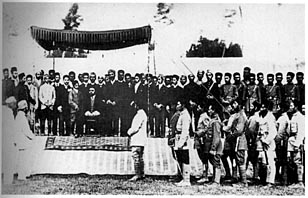
3. Amir Habibullah dabar c. 1903 (Khalilullah Enayat Seraj Collection).
Habibullah was a modernist in one sense—he liked Western inventions, be they automobiles, photography, or golf; but he had little time for the political and social agendas that modernists brought with them and that began to sweep through his kingdom in the first two decades of the century. His son and successor, Amanullah, however, took a different tack. Heavily influenced by his intellectual mentor and father-in-law, Mahmud Beg Tarzi, Amanullah wanted to transform Afghanistan into a modern nation, and he set about that task shortly after he took power in 1919. As noted in the previous chapter, Amanullah was much given to trying on new ideas, as well as different styles of clothing. The most significant of these ideas was that government had a role to play in improving people’s lives. This idea was not original to him; Ottoman and Indian intellectuals, among others, had been formulating the outline for a new Asian and Islamic renaissance in which the non-Western peoples would combine Western advances in science, technology, and political democracy with Asian spiritual and social values. Amanullah intended to be at the forefront of this renaissance, and he demonstrated this commitment through the promulgation of economic and social reform programs meant to improve the social conditions of ordinary people and through the adoption of a more informal and democratic manner of dealing with his subjects.
Though most of Amanullah’s economic reforms were directed toward rationalizing the government’s financial infrastructure and developing new industries, he outstripped the Khalqis in the area of social reform, especially with regard to women’s rights and education. In keeping with his commitment to change, Amanullah adopted a relatively nonhierarchical manner of interacting with subordinates, as indicated in the following assessment by the British diplomat Sir Henry Dobbs, who met Amanullah in 1921 during treaty negotiations:
His Majesty Amir Amanullah Khan is himself probably the most interesting and complex character in his dominions. His manners are popular, jocular and easy to such a degree that even in his public appearances he sometimes lays himself open to a charge of want of proper dignity. In private he loves to indulge in sheer horseplay, changing hats with his courtiers, throwing bits of bread at them or sprinkling them with soda-water, and making most intimate and daring jokes about their wives, families and personal appearance. He eschews all ceremony except in the most formal durbars, dislikes elaborate uniforms and affects a spartan simplicity in his clothes, usually not even wearing a shirt beneath his rough military jacket. Collars, ties and cuffs, which were de rigueur in his father’s time, are now forbidden at his Court. . . . When transacting business he is extremely polite and gentle in manner to his Ministers and courtiers and bears himself among them merely as primus inter pares, encouraging them to argue with him freely and appearing to trust to his superior agility of mind for the gaining of his ends. [2]
One can get a sense of Amanullah’s manner of relating to his subjects in a photograph (Fig. 4), taken in about 1925 in the winter palace at Jalalabad, that shows the amir meeting with tribal leaders. In the photograph, Amanullah is seated on the same level as his tribal subjects and appears to be looking them squarely in the eye. He has eschewed ceremonial garb in favor of a rough military jacket of the sort Dobbs noted, and he seems intent on pressing closer to the leaders, even as they appear intent on maintaining a wary distance. In this meeting, we see no sign of the usual entourage of retainers and officials of the sort that Habibullah usually surrounded himself with; a single secretary with pen and paper is seated to his right, and a spare number of trappings of office are nearby: a fly whisk behind him, a clock across the way, and a telephone set close at hand.
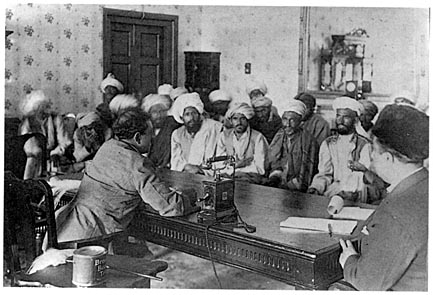
4. Amir Amalullah meeting with tribal leaders, Jalalabad, 1925(?) (Khalilullah Enayat Seraj Collection).
Coming from a more populist tradition, Americans tend to admire this sort of behavior, but Afghans had a good deal more trouble with it, especially with Amanullah’s egalitarian treatment of women. For Amanullah, women’s rights may have begun as a political issue, but they became personal for him after his marriage to the daughter of his mentor, Mahmud Beg Tarzi. Soraya was well educated herself, and Amanullah appears to have been devoted to her, as evidenced by his unwillingness to follow the usual royal practice of contracting numerous marriages for alliance, convenience, and pleasure. Amanullah’s commitment to monogamy was strange enough, but his concerted efforts to reform other customary restrictions on women and girls, as well as his willingness to have Soraya appear in public without a veil, outraged many of his subjects. So too did other mostly symbolic but no less unorthodox gestures, such as his requirement that all delegates to the national assembly (loya jirga) in 1928 wear Western suits. [3] Figure 5 commemorates this occasion, which followed on the heels of Amanullah’s grand tour of Europe, during which he had developed new ideas for the social and economic development of his country. The setting of the photograph was the bleachers of the Paghman race track. Amanullah had spent five days telling the delegates about his trip and his plans for the future. At the moment the photograph was shot, the amir is standing at the top of the aisle, saluting the photographer. Over to the side, his wife, Soraya, wearing the thinnest of veils, stands out as the only women in a sea of male faces—all of whom are dressed in the requisite suit and tie.
5. Meeting of parliamentary deputies, Paghman, 1928 (Khalilullah Enayat Seraj Collection).
Following Amanullah’s abdication and the short-lived reign of Bacha-i Saqao, and with the brief exception of the chaotic period of democratic liberalization in the late 1960s, rulers returned to the more autocratic style that Afghans knew and understood. The first of these rulers was Nadir Khan, a former general who governed in a martial fashion. He was assassinated in 1933, apparently as part of a long-standing family feud, and was nominally succeeded by his teenage son, Zahir Shah, though for the next thirty years power resided principally with his uncles (Muhammad Hashim and Shah Mahmud) and cousin (Muhammad Daud), who ruled sequentially as prime ministers until 1963. [4] During this period, social reforms were gradually introduced, but in a nonconfrontational, nonthreatening way; for example, in 1959 the wives of the prime minister and other important government officials appeared unveiled on the viewing stand at the independence-day ceremonies. Afghans saw that this sort of behavior was once again condoned by the government, but no one was forced to go along, and, in fact, most people outside the upper and middle classes in Kabul chose to ignore the example. The archetype of the mid-twentieth century ruler was, in many respects, Muhammad Daud, who served as prime minister from 1953 to 1963 and as president of his short-lived republic from 1973, when he overthrew his cousin Zahir Shah, until the Saur Revolution in 1978.
Seen in a photograph taken at Persepolis during an official trip to Iran (Fig. 6), Daud was a forbidding but also perplexing figure. During his tenure as president, portraits of the baldheaded Daud glowering at passersby through half-tinted glasses were omnipresent in teahouses and offices. But it was never quite clear what Daud stood for. Was he a leftist—the so-called red prince of his early years—or a Pakhtun nationalist? During Daud’s term as prime minister confrontations with Pakistan regarding the status of the border tribes reached their peak, but he also actively sought Soviet patronage. No one knew where Daud stood for sure, and one might read his vaguely menacing stare as masking a deep uncertainty as to what he wanted to accomplish with his power. Certainly, people didn’t know what to make of him, and while some feared his anger, they also finally didn’t find him that significant in their lives.
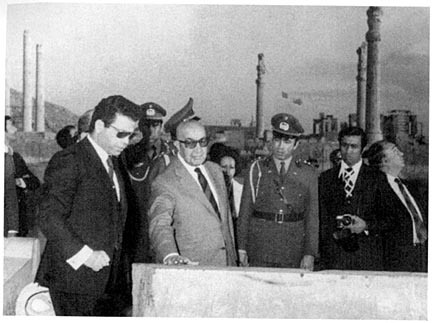
6. President Muhammad Daud, Persepolis, n.d. (courtesy of Qasim Baz Mangal).
Ruler and Ruled
The people recognize me by the name of Taraki which is the well-known name of my tribe and clan. But I say openly that I do not belong to any particular tribe or clan. I belong to . . . the Pushtuns, Hazarah, Uzbek, Tajik and all the country’s nationalities, noble tribes and clans, and I live in the hope of serving the hard-working peoples of this country. [5]
Taraki made the preceding statement in a meeting with elders from various provinces a little more than a month after coming to power, and one can only wonder how it was taken by those assembled to meet the new leader. They, after all, had been called to Kabul precisely because they were representatives of particular tribes and clans, and their status as Pakhtuns, Hazaras, Uzbeks, and Tajiks was evident to anyone who saw them in their ceremonial clothing or heard them speak in their native languages and dialects. In the midst of these representative types, Taraki claimed to be no type at all. Perhaps he hoped to appropriate the interstitial status that the Durrani dynasties had developed for themselves over two centuries of rule. People, after all, had not generally thought of the royal family as being associated with a particular tribe, despite their Pushtun roots. Most of the royal family members spoke Dari Persian among themselves, and some spoke Pushtu only haltingly. [6] More important, many Afghans viewed the royal family as having its own interests but not as favoring any particular ethnic group or tribe among those constituting the Afghan people, loyalty to the royal family itself being more significant than ethnicity. Taraki was not from the royal Muhammadzai lineage, however, and his assertion that he belonged to no group must certainly have rung false to those who heard it, as it would have if anyone among them had stood up and made a similar declaration. Religious leaders—particularly Sufi mystics—could profess their nonattachment to worldly allegiances, but a secular politician could not, and one must assume that those who listened to Taraki’s address and many more like it did not gain a great deal of confidence from what he had to say.
That Taraki should try to engage his audience in this way is not surprising. The truth was that his regime desperately needed popular support. Despite initial claims in the government press that the PDPA had fifty thousand “members and close sympathizers” or the assertion made in July that the government was run by “millions of honest, courageous and patriotic people of Afghanistan . . . from every tribe and region in the country,” [7]the new regime probably had only a few thousand committed members at the time of the revolution, and its ethnic base of support narrowed considerably after the Parchami purges of mid-July took out most of the non-Pakhtun leadership. In certain respects, the situation faced by the PDPA was similar to that of Amanullah when he took power after the assassination of his father in 1919. On that occasion, many people suspected that Amanullah himself might have had a hand in the assassination, a suspicion that appeared to be substantiated when he imprisoned his uncle and older brother, both of whom had a better claim to the throne than he did. Amanullah succeeded in stifling any move against him, however, by redirecting popular discontent into a short-lived border jihad against the British in India. Since religious leaders (who had been his uncle’s primary supporters) had been calling for a jihad for years, Amanullah defused any immediate attack against him and thereby bought the time he needed to consolidate his authority. [8]
The PDPA did not have a recognized foreign bogeyman to turn to, and the action that it had to defend was not a dynastic upheaval, which Afghans understood, but a revolution, an inqilab, which was an entirely unprecedented occurrence. Choosing the cautious path, the regime initially attempted to conciliate rather than upset the people it hoped to lead, soothing suspicions by inviting rural elites to meet the new ruler in darbar in Kabul. This was the traditional custom: bring the elders to the palace, present them with ceremonial robes and turbans, and assure them that the new rulers would treat them well and respect their autonomy. Taraki was new to the role, but he did his best; all through May and June, government newspapers published photographs and stories of the new leader meeting with groups of religious leaders and provincial elders. The vast majority of elders came from the Pakhtun frontier areas, including areas under Pakistani control, and it was not difficult to ascertain why the government sought out leaders from these areas. [9] This is where most acts of antistate violence over the preceding hundred years or so had originated, and, even more than Bacha-i Saqao, it was the border tribes that had been responsible for sealing Amanullah’s unhappy fate. The Durranis of Qandahar may have been the erstwhile tribe of kings, but the Pakhtuns of the frontier were the kingmakers and breakers, a fact that Taraki alluded to when he told a group of Pakhtun elders, “You brother tribes be aware and consider the bitter experience of the Amani movement [those who supported the reforms of Amir Amanullah]. . . . The state is yours. It is not your master. It is your servant.” [10]
The parade of elders continued through May and early June but then abruptly stopped in July, about the same time as the Parchami purges. [11] At this point Amin’s ascendance began in earnest, and the first sign of his new power was the adoption of a more aggressive plan of reform. From this time forward, the policy of conciliating traditional elites appears to have been abandoned in favor of a more radical and reckless plan to mobilize the rural poor, who had never before been treated as politically significant by the government in Kabul. Under Amin’s leadership, the regime staked its future on an alliance with small landholders, tenant farmers, agricultural laborers, and women—politically dormant segments of the population that no previous regime had ever taken seriously. While they represented the largest percentage of the people of Afghanistan, the rural poor had been too preoccupied with making ends meet and too oppressed by rural landowners and creditors to have ever taken much interest in politics or to have speculated on the potential of government for making their lives better. Henceforth, however, the nontribal peasantry was to become the bulwark of the regime, while the tribal elders and other rural elites, whom the regime had initially tried so hard to impress, were labeled “feudals” and “exploiters,” the enemies of the people and the state.
The first stage in Amin’s campaign to politicize and mobilize this population came in mid-July with the promulgation of Decree #6, whose objective was to ensure “the wellbeing and tranquility of the peasants [by] relieving them from the heavy burden of mortgage and backbreaking interests collected by the landlords and the usurers.” [12] In an attempt to rally the rural poor to its banner, the regime used Decree #6 to excuse landless peasants from paying back all mortgages and debts, while allowing those who owned modest amounts of land to pay back only the original sum on debts and mortgages. [13]
The second phase of the PDPA campaign to mobilize previously unpoliticized segments of the population was launched on October 18, with the publication of Decree #7, “for ensuring the equal rights of women . . . and for removing the unjust patriarchal feudalistic relations between husband and wife and for consolidation of further sincere family ties.” Among other provisions, this decree forbad the exchange of bride-price as part of marriage arrangements, limited dowries to a token amount, stipulated that both parties had to agree to a marriage for it to be legal, and outlawed the practice by which the widow of a man could be compelled to marry one of her husband’s relatives. [14]
Finally, the third major piece of the PDPA plan was a comprehensive program of land reform, which was first discussed in depth in the Kabul Times in an article on July 19. This article claimed that 95 percent of the population subsisted on half of all the arable land, while the other 5 percent of the population controlled the other half. Seventy-one percent of landowners, according to the Kabul Times, owned from one to ten jeribs (one jerib is two thousand square meters), and most of these small landowners were also required to lease additional land from wealthier landowners in order to make ends meet. “Hence the vast majority of the villagers lease land under feudal conditions, i.e., in most cases inputs such as water, seeds, farm tools and implements, chemical fertilizer, means of transportation and the like have to be provided by the owner of the land, and the one who works on the land receives a small portion of the crop, as little as one sixth, in compensation for his hard work.” [15] Although Taraki indicated shortly after taking power that it would take at least two years for the government to prepare the necessary surveys and otherwise lay the groundwork for land reform, the regime decided to push ahead with this program, presumably in response to the first signs of popular dissatisfaction, which appeared over the summer. Consequently, on December 2, the government published its Decree #8, the most important stipulation of which was that no family could own more than thirty jeribs of first-quality land and that no person could mortgage, rent, or sell land in excess of that amount.
Although the government promulgated many decrees in addition to these and promised still more, Decrees #6, #7, and #8 were the base on which the regime made its appeal for popular support, and press organs went to extreme lengths to inflate the success of the programs and demonstrate the general acclaim with which they were greeted. Thus, on October 3, Taraki reported to the Central Committee that 11.5 million landless peasants had been released from “the backbreaking burden of usury and mortgage”; and on October 18 it was announced that, after five months of the revolutionary regime, “millions of peasants were freed from the clutches of moneylenders and at least Afs. [Afghanis] 30 billion was gained by landless peasants or petty landlords.” [16] According to government statistics, eight hundred agricultural co-ops with two hundred thousand participants had also been established. The lands of forty thousand farmers had been surveyed for redistribution. Two hundred houses had been built for agricultural-extension officials, with 136 more under construction. Fifteen hundred kilograms of seed had been distributed. Eleven hundred seventy new orchards and vineyards had been organized. Thirty-seven threshing machines, 380 ploughs, 300 wheelbarrows, one thousand sickles, and two hundred pitchforks had been distributed. Four million animals had been immunized or treated for disease. Twenty-three veterinary clinics had been opened. Two hundred sixty thousand boxes of silk cocoons had been handed out; and two hundred thousand acres of land, thirteen orchards, and seventy-six houses belonging to the Yahya dynasty had been “bequeathed” to people. [17]
The declarations of popular support were equally extreme. Thus, in July, banner headlines announced that “Peasants Hailed Decree No. 6,” and articles throughout that month told how the decree was releasing “landless and petty land holders from the yoke of exploiters and feudals.” In August, it was announced that a Muhammad Wazir of Faryab Province was so impressed with the new regime that he donated all his property to the government, including 150 jeribs of land, 480 sheep, 220 lambs, forty-two large and thirty-seven small goats, fourteen cows and calves, three donkeys, and one horse. [18]
In November, the reception for Decree #7 in Kunar Province was similarly enthusiastic, as “students and local people of Sarkanai staged a march in the streets of that woleswali [district administrative center] carrying the photographs of our beloved and revolutionary leader, shouting revolutionary slogans, hurrah and prolonged clappings.” Government-sponsored rallies on behalf of the first two decrees proved to be mere rehearsals for the launching of the land-reform program in the winter of 1979. Throughout January and February, the Kabul Times published articles on the jubilation of peasants who were receiving their new land deeds and celebrating “chain-breaking” Decree #8. In these articles, in among descriptions of peasants chanting “death to feudalism,” “death to imperialism,” “long live and healthy be Noor Mohammad Taraki,” a now-dispossessed former landlord is quoted as welcoming land reform “because if I lost my lands on the one hand I got rid of all the psychological pressures and torturing engagements on the other hand.” [19]
One typical article with the headline “Now No One Will Flog Me to Work on His Land without Wage, Says Peasant” contained the following description of a grateful recipient of government largesse:
Haji Nasruddin, a peasant from Balla Bagh village of Surkhrod [in Ningrahar Province] said smilingly, “God is with those who are helpless. Consequently the decree number eight has come to our rescue. Hereafter whatever we reap belongs to us. Hereafter no feudal lords or middlemen will be able to cheat us. This all has happened with the attention of the Khalqi state. We the toiling peasants have been delivered forever. Today the government is headed by those who work solely for the benefit, for the welfare of the poor and downtrodden. It is a happy occasion that we the peasants have achieved our cherished desire.
“Now with the six jeribs land given to me I am sure I will become the owner of a decent living and will not die of hunger. Before the Saur Revolution the feudal lords used to loot all our products. The rulers at that time sided with the oppressive landlords. Fortunately the Saur Revolution has destroyed their dreams and they can no longer achieve their ominous goals.”
Juma Gul another peasant from the same village said that [“]all my age has passed in poverty but today I have become the owner of land and I hope to continue the rest of my life with the peace of mind. Hereafter no one will dare flog me to work on his land without wages and I will be the master of my own destiny.” [20]
Throughout the winter and spring of 1979, the government pushed land reform forward and announced on June 30 that the program had been completed, with 2,917,671 jeribs having been turned over to 248,114 households. An additional 151,266 jeribs had been allocated to state farms, and 125,000 jeribs had been assigned to local municipalities and provincial departments. All told, the government claimed to have redistributed a total of 3,193,937 jeribs. [21]
It is difficult to guess where all of these figures came from, or, to be more precise, it is unclear whether the land-redistribution figures published by the government represented actual transactions that took place, if only on paper, or were simply invented. We do know that by the spring of 1979, the government had lost its campaign to mobilize popular support, and it was already fighting just to maintain its bases in some areas of the country. The best explanations for this failure are those that take into consideration the local conditions and the situation in which the regime tried to interpose itself. In Part Two, I provide an in-depth explanation for one area of eastern Afghanistan, but here I want to examine some general matters relating specifically to how the Khalqis formulated the relationship of ruler and ruled and how that formulation was popularly perceived.
When the PDPA came to power, it tried to convince the people of their shared values and common concerns, as well as the fact that the government was the “servant” of the people, but the language used to convey these sentiments was an alien one. It was derived from a Marxist lexicon that had no roots in Afghan culture and that struck no resonant chord in the hearts and minds of the Afghan people. The government premised its appeal on two assumptions: first, that material concerns were foremost in people’s minds and, second, that abstract principles of recent vintage could carry moral force. The failure of these premises, as well as the antipathy widely felt toward the people empowered by Khalqi rule, is illustrated in the following account by a village elder from the region of Khas Kunar on the east bank of the Kunar River, close to the border with Pakistan:
In the beginning, the common people of Afghanistan didn’t recognize the true identity and face of the Khalqis and Parchamis as infidels [kafir] and communists. And in their own slogans they said, “We respect Islam, and this is a government of the working people. Everyone has equal rights. And we will save all the people from poverty and hunger.” The slogans that they used were things like “Justice” [‘adalat], “Equality” [masawat], “Security” [masuniyat], “Home” [kor], “Food” [dodai], and “Clothing” [kali]. . . .
After Decree #7, Decree #8 concerning land reform was announced. Since the population of Khas Kunar is very high and the land is very little, few people had more than thirty-six jeribs of land. Their number reached ten or fifteen. By the most shameful kind of action, they took these people’s land and gave it to others. On the land of each one of these people, they organized a march, and they invited all the uneducated people, as well as the students, clerks, etc., to take part. When the land was dispensed and the deeds signed by Nur Muhammad Taraki were given out, they shouted “hurrah!” and slogans like “Death to the feudals!” “Death to the Ikhwan [Muslim Brotherhood]!” “Death to American Imperialism!” “Death to Reactionaries!” and that kind of thing.
Since the slogans of the people of Afghanistan during happier times were “Allah-o Akbar!” [God is great] and “Ya Char Yar!” [Hail, Four Companions of the Prophet Muhammad], they became very unhappy and said that, in addition to the other deeds of the Khalqis and Parchamis, the fact that they had changed “Allah-o Akbar” and “Ya Char Yar” to “hurrah” was a sign of their infidelity. [22]
For Pakhtuns, the slogans chosen by the Khalqis conveyed little of a positive nature. Justice, equality, and security are loan words that make abstract what Pakhtuns typically feel they already have, and, in their experience, when justice, equality, and security are absent, it is precisely because of government interference in their lives of the sort that the new regime was promising. Similarly, home, food, and clothing, which were generally chanted in rallies as a single phrase (“kor, dodai, kali!”), are words that glorify material things that are morally inconsequential and properly kept within the domain of family and kin.
Likewise, when recalling marches at which people were encouraged to shout such phrases as “Death to the Feudals” and “Death to American Imperialism,” one should keep in mind the difference between the rhetoric of Marxist opposition and the dynamics of tribal opposition that heretofore had held sway through much of Afghanistan. In tribal culture, to boast that you intend to kill someone places you under the burden of that claim. Utterances have consequences, and for one to publicly promise to do that which one does not intend ultimately to do or which cannot be done makes one appear foolish and dishonorable. That is to say, if people do not realize that words have weight and use them carelessly, then they cannot be trusted, for they are clearly unaware of the implications of honor and, as such, are a danger to themselves and others.
Beyond the morally contradictory nature of the slogans themselves, government-sponsored rallies failed to achieve their intended effect for several other reasons. Given the defensive orientation of Pakhtun groups and their longstanding suspicion of government interference in their affairs, the arrival in their community of government representatives promising to help them by taking the possessions of one group and giving them to another was hardly welcomed. Even those who directly benefited from the land redistributions were unprepared to receive government largesse. The problem here was not only that the language used by the PDPA was novel but also that people had not tended to look to the government for benefits and, when they had, they petitioned the government; the government did not petition them.
The approach taken by the regime was unprecedented, and in Pakhtun society the assumption is that unprecedented actions should be treated with circumspection until such time as they can be rendered familiar and unthreatening. Thus, when strangers came and encouraged all the poor people in a community to come together as a united body shouting slogans, the need for circumspection and a unified front against the outsiders increased—regardless of the offers and promises being made. In this way, public rallies and marches backfired, especially in rural areas and small towns, and they created the opposite effect from what was intended. Instead of loosening the ties that bound wealthy and poor, government attacks on the “feudal class” encouraged a defensive solidarity among the group as a whole and evoked sympathy for the wealthy, who came to be seen as victims of a more immediate oppression than the abstract oppression invoked by the government. [23]
Another issue to consider is the government rallies themselves as a form of public performance. These events usually involved the presentation by provincial and sometimes national officials of newly printed land deeds to tenant farmers and formerly landless agricultural laborers who were brought to the center of the town or village and handed placards praising the government and damning its enemies. Most newspaper photographs of these events show groups of newly enfranchised farmers carrying shiny shovels and slogan-covered placards while standing or marching in parade-ground formation. However the government intended these performances to be perceived, local people generally viewed them as an embarrassment and a disgrace. Nothing in their experience had prepared them for such events, the symbolic construction of which was interpreted as contradictory to modes of self-presentation esteemed in Pakhtun culture. Thus, for example, such stock performance devices as the unison shouting of praise for the revolutionary party while marching in formation were viewed by people as acts of public humiliation that violated their sense of individual initiative and control. For generations, many Pakhtuns had resisted service in the Afghan army (except when they were allowed to retain their tribal character by serving as militia units) because the discipline demanded by the army ran counter to the cultural valorization of individual autonomy. Wearing a uniform, marching in formation, and obeying the commands of officers were demeaning to Pakhtun sensibilities. However, at least such parade-ground displays were performed at a distance from home, and while it entailed a sacrifice of personal control, military discipline did have the saving virtue of being oriented toward success on the field of battle, an objective Pakhtuns understood and valued.
Government rallies, however, were events staged in the presence of the local community and required individuals to comport themselves in front of their peers in order to glorify an alien institution—the Khalq party. In tribal culture, the only kind of public chanting one traditionally heard was of a religious nature, and the only occasion when individuals lined up in formation and collectively performed orchestrated ritual actions was when they submitted to Allah in public prayer. That people were forced to perform other sorts of collective gestures and utter novel phrases in order to glorify an entity other than Allah made apparent a contradiction that doomed the party’s efforts to enlist popular support. Whatever views people might have had about the inequalities of wealth and power in their communities, their belief in Islam was sacrosanct, and once it had been demonstrated to them that the government authorities wanted them to perform in a manner that placed secular principles above religion, their loyalty could not be reclaimed.
Another example of how the Khalqis lost the confidence and respect of the people was their construction of a cult of personality around President Taraki that transformed him from a “true son of the soil” into a grotesque socialist icon. The first signs of this cult appeared in the early summer after the coup, when headlines began referring to Taraki as “Great Leader.” (For example, the June 27th headline of the Kabul Times announced, “Great Leader Says, We Wish to Ensure Our People a Happy and Prosperous Life.”) The published biography examined in the preceding chapter was another milestone in the cult’s development, as was the announcement on December 9 that Taraki’s birthplace would be converted into a national museum with a special road, three large bridges, and twenty-five smaller bridges constructed to provide public access at a cost of 2.5 million Afghanis. Later, in April, the newspapers proclaimed that, for the first anniversary of the Saur Revolution, Taraki’s birthplace “will be illuminated and decorated with photos of Great Leader of Khalq, national red flags, revolutionary slogans and coloured bulbs.” [24]
One of the more bizarre manifestations of the Taraki cult was the publication in the government press on June 17 of doctored photographs in which the larger-than-life image of Taraki appeared, seated at his desk. In front of him, arrayed around a table, government functionaries, dwarfed by Taraki, are clapping and smiling in the presence of the benevolent “Great Leader” (Fig. 7). [25] On June 18, the same sort of photo was published, this time crudely depicting a giant Taraki with representatives from the Achikzai and Noorzai tribes, Baluchis from Qandahar, and elders from Badghis Province. The retrospective irony here is that as the manifestations of the cult of personality became increasingly outlandish and bizarre, Taraki’s actual authority was steadily being sheared away by his erstwhile disciple Amin, who in all likelihood was the principal author of the Taraki cult and most certainly the agent of Great Leader’s demise. It is interesting to examine this photograph next to those of earlier leaders. Taraki was the one leader who actually rose up from the masses to lead his country. The other leaders whose photographs I have included—Habibullah, Amanullah, Daud—all inherited their right to rule. Taraki pinned his right to rule on the people, the “people’s party,” and his own humble origins. Yet he was the one who ultimately—whether because of insecurity or secret vanity or the manipulations of others—attempted to inflate his stature, thereby only accentuating his limitations and inappropriateness as a ruler.
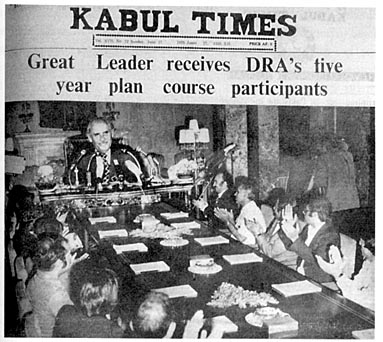
7. President Nur Muhammad Taraki (Kabul Times, June 18, 1979).
The same could be said as well of those who flocked to the party banner and were taken on as mid- and low-level government officials. Time and again, Afghans have commented to me about the quality of the people who came to power with the revolution in the local, district, and provincial branches of administration. When the Khalqis came to power, they brought with them a new style of rule, what they called “a people’s government [that] doesn’t belong to anybody.” The new regime, they declared, was “not a hereditary government run by a number of traitorous Sardars (princes); rather those who run your people’s government at present are millions of honest, courageous and patriotic people of Afghanistan . . . your best patriotic sons from every tribe and region in the country.” [26] What this meant in practice was that considerable power was exerted by local officials, many of whom had been students before the revolution and some of whom had been recruited and trained by Amin himself when he was a teacher and principal at the teacher-training college in Kabul.
As in many developing countries, teachers in prerevolutionary Afghanistan were poorly paid and had little clout in the communities in which they served. Even if they were respected for their learning, they were often outsiders, and, like mullas, they tended to be viewed in a patronizing light because of their dependent status and the fact that their jobs required that they spend most of their time in the company of children rather than adults. One of the accusations most commonly leveled at these teachers once they ascended to positions of authority under the new regime was that they were more concerned with Marxist ideology than with the realities of the social milieus in which they found themselves. Perhaps because of the patronizing treatment and limited respect they had received before the revolution, they did not tend to make much effort to modulate directives coming out of Kabul to local sensibilities and sensitivities, and people came to resent what they considered their high-handed attitude.
Likewise, many informants claimed that after the revolution the party attracted opportunists who exploited the power given them. In the words of one man from Paktia Province, those who first joined the party after the revolution were the kind who “had begun school but not finished, who had wanted to become bus drivers but only managed to become ticket collectors. They started off to work in the Emirates but only made it as far as Iran.” One oft-heard claim is that the party was so short of members when it took power that it would take anyone willing and able to spout back party doctrine and sport the droopy mustaches then in favor among Khalqi supporters. Men from good families and with established reputations would never humiliate themselves in this way, but individuals from the lower strata of society had no family or personal reputation to disgrace and much potentially to gain by association with the party. In the words of Shahmund, the Mohmand elder quoted in the previous chapter, “the sword of real iron cuts.” Men from poor families were unlikely to manifest nobility or to show abilities that had previously gone unnoticed just because they had been elevated to positions of power. In the view of most Afghans with whom I have talked, this type of individual—no-accounts from ignoble families—flocked to the government when the PDPA took power, and not surprisingly they were only too happy to carry out the regime’s campaign against “feudal exploiters” by debasing the old elites who had previously held pride of place over them.
If these elites had been genuinely resented by the less-wealthy and less-prominent strata of society, then the treatment meted out to them by government officials might have been appreciated or at least tolerated. However, in most parts of Afghanistan in the late 1970s, differentials of wealth, while present, were not extreme, the economy was not heavily monetized, and investment opportunities were scarce, all of which meant that more prosperous landowners were generally not taking their profits out of the area. To the contrary, it was still most common for the wealthy to reinvest their profits within their communities through guesthouses (hujra) where they fed their allies, friends, kinsmen, tenant farmers, and potential political supporters. [27] The continuing involvement and investment of the wealthy in their communities, coupled with local beliefs about the sanctity of private property and the generally poor opinion people had of Khalqi officials, meant that in most locales people rejected out-of-hand government efforts to enlist their support.
Enemies of the People
When the PDPA regime first took power in April 1978, the principal threat with which it was concerned was subversion from abroad. Thus, in the first issue of the Kabul Times published after the coup d’état, the regime lashed out at “the mass media of foreign reaction,” which was spreading false propaganda against the “triumphant revolution of Saur Seven.” The false foreign-press reports blasted by the regime labeled the revolution a coup d’état “launched under the leadership of the communist party of Afghanistan with the help of this or that foreign country.” The government’s position was that “the revolutionary stand of Seventh Saur is the beginning of a truly democratic and national revolution of the people of Afghanistan and not a coup d’état.” In similar fashion, the regime railed at “international reactionary circles” that “shamelessly lie that thousands of our patriots were either killed or executed in the course of the revolution and that one of the great religious figures has been executed or that the revolutionaries had acted in contravention of the principles of human rights, the Islamic religion and our national traditions.” At the same time the government was focusing primarily on the threat of subversion by reactionary forces abroad, the Interior Ministry also warned citizens that “in such a revolutionary situation a number of profiteering, wicked, intriguing, subversive and anti-revolutionary elements [might] appear on the scene posing themselves as revolutionaries and consequently cause inconvenience and indulge in threatening and provoking of compatriots and social disruption.” [28]
In the beginning, no one in the PDPA leadership knew precisely where the greatest “antirevolutionary” threat might lie. Perhaps surviving members of the Daud regime would rise up to challenge the legitimacy of the Taraki government. Perhaps the former king, Zahir Shah, or those close to him, would mount an attack from abroad, as Zahir Shah’s father had done when Bacha-i Saqao had taken the throne in 1929. Then again, there was the threat of subversion from within the party itself; this threat was dealt with summarily in July, when the leadership of the Parcham wing was sent abroad. Despite these uncertainties, however, both historical precedent and personal experience suggested to the leadership that their greatest threat would come from forces representing or claiming to represent Islam.
Amir Abdur Rahman, after all, had had to deal with hostile religious leaders, the Mulla of Hadda prominent among them, throughout his reign; and his grandson, Amanullah, had finally been undermined by a religious/tribal coalition centered around various religious figures, principally the Hazrat of Shor Bazaar. [29] Since Amanullah’s downfall, religious leaders had generally been quiescent, but a new generation of secularly educated Muslim activists had risen up in Kabul at roughly the same time that the Marxist parties had begun their activities. Amin, in particular, would have been wary of this threat, for the students he recruited in the late 1960s and early 1970s had regularly faced off against the Muslim student activists in classrooms, in cafeterias, and on the street during sometimes bloody political demonstrations. For much of his tenure in office, President Daud—to his ultimate misfortune—had been more afraid of Muslim activists than of Marxist ones, and he had been responsible for imprisoning many Muslim student leaders. However, some had escaped his dragnet and had taken up residence in Pakistan, where they had been receiving assistance from the Pakistan government of Prime Minister Zulfiqar ‘Ali Bhutto and were preparing themselves for battle against the new regime.
Given his leftist sympathies, Bhutto might have been willing to work with the PDPA and revoke his support for Islamic opposition leaders who had found a safe haven in Pakistan, but by the time of the Saur Revolution, Bhutto was out of power, and the more devout President Zia ul-Haq had taken his place. Whatever slim chance the PDPA regime might have had of reaching an accord with Pakistan over the removal of the still small and ineffectual Islamic parties on their soil was eliminated when the Kabul government began inviting Pakhtun tribes from the Pakistan border areas to meet Taraki. At various times since the founding of Pakistan, the Afghan government had contested Pakistan’s authority over the border areas, most memorably in the late 1950s, when the two countries broke off relations and closed their borders. Consequently, the Khalqi government’s decision to court the cross-border tribes must have been taken as an insult and threat, particularly after it announced its support for an independent Pakhtun state along the frontier. [30] Bhutto had first given refuge and assistance to the Muslim student leaders because of President Daud’s backing of “Pakhtunistan.” Daud had recognized the risk involved in continuing this policy over Pakistani objections and had backed off, but the PDPA made the decision to again embrace Pakhtunistan, presumably to help defuse tribal opposition to the regime. In so doing, however, it guaranteed the survival of the ultimately more dangerous Islamic movement, without in any appreciable way bolstering tribal support.
The regime tried to counter the still labile Islamic threat by reiterating its respect for Islam and equating the Islamic principles of “equality, brotherhood and social justice” with the guiding principles of the regime. [31] Likewise, at the beginning of Ramazan, which fell in early August in the year of the revolution, the regime arranged for the traditional recitation of the Qur’an and prayers to be held at the People’s House. An article in the Kabul Times about this event noted that while in the past Ramazan prayers had been held in only 164 mosques in Kabul, this year they would be performed in 182. [32] However, at the same time that the regime was trying to affirm its Islamic beliefs, it also had to acknowledge the developing threat represented by Muslim extremists based in Pakistan. One example of the regime’s manner of dealing with this threat can be seen in Taraki’s address of August 2 to military officers, which was discussed in the previous chapter. In this speech, Taraki provided his first extensive commentary on the rising threat posed by the Islamic resistance movement:
When our party took over political power, the exploiting classes and reactionary forces went into action. The only rusty and antiquated tool that they use against us is preaching in the name of faith and religion against the progressive movement of our homeland. The bootlickers of the old and new imperialism are treacherously struggling to nip our popular government in the bud. They think that since we took over power in 10 hours, they would, perhaps, capture it in 15 hours. But they must know that we are the children of history and history has brought us here. These agents of international reaction ought to know that by acting in this way they are banging their heads against a brick wall. These agents of imperialism who plot under the mask of faith and religion have not begun this task recently. They have been busy conspiring against progressive movements in this fashion for many long years. You will remember the crimes they committed in various forms in Egypt and other Arab countries. Now their remnants and pupils existing in Afghanistan are acting under the mask of creed and religion in a different fashion. They ought to be uprooted as a cancerous tumor is from the body of a patient in a surgical operation. [33]
While promising that the government and party were “so fully in control that they will not give them a chance . . . to carry out their evil deeds,” Taraki’s statements demonstrate that already at this early date the resistance was making an impact that the government couldn’t ignore or pretend was insignificant. Taraki’s approach to this threat though was predictable. He emphasized that those working against the regime were—like Nadir before them—“agents of imperialism” out to undermine Afghan independence. Echoing the propaganda of earlier regimes against Muslim opponents, Taraki claimed in this speech that the regime’s enemies were not truly inspired by Islamic principles but simply “plot under the mask of faith and religion.” In later speeches, he embroidered this allegation by referring to the Islamic forces arrayed against him as “made-in London maulanas [religious scholars]” [34] and as “the spies of the farangis” who “have spread fire in Afghanistan several times but this time the people of Afghanistan have spread fire against them.” [35] Taraki was referring here to the overthrow of Amanullah, which many Afghans (including some who took up arms against the amir) suspected was secretly instigated and supported by the British government in India. The fact that the British had been absent from the scene for more than thirty years when the regime made its accusations against “made-in London maulanas” would seem to be evidence either of the enduring power of British imperialism as a symbol of evil in Afghan politics or of the inability of the regime to come up with more effective rhetorical ammunition to counter the growing threat.
By the fall of 1978, antigovernment violence had risen dramatically, and the regime announced that it was “declaring jihad” against “the ikhwanush shayateen”—the brotherhood of Satan. Drawing attention to the philosophical connection between the Muslim activists who had gotten their start at Kabul University and the Ikhwan ul-Muslimin(the Muslim Brotherhood) in Egypt, articles in the state-run press condemned Egyptian radicals for hollowing out copies of the Qur’an in order to conceal guns inside and accused Afghan “Ikhwanis” at Kabul University in the early 1970s of having torn up copies of the Qur’an and then blaming leftist students as a way of defaming their opponents. Anti-Ikhwan articles appeared throughout the fall and winter, climaxing in an article on April 1, which stated that “these ‘Brothers of Satan,’ these Muslim-looking ‘farangis’ clad in white but not able to cover their black faces, these false clergymen who have been inspired by London and Paris . . . they are actually ignorant of Islam as they have only learned espionage techniques in London. They wish our people to abandon their religion and be marked with a seal from London.” [36]
The PDPA’s decision to declare jihad against its enemies can be taken as a measure of its desperation after only half a year of rule, especially given the mixed success of state-sponsored jihads in Afghanistan. In 1896, as the Mulla of Hadda and other religious leaders were stirring up trouble against British posts along the frontier, Abdur Rahman had published and distributed among the border tribes a pamphlet in which he asserted—with appropriate Qur’anic citations—that only a lawful Islamic ruler could declare jihad. [37] With his unerring eye for subversion, Abdur Rahman recognized that the activities of the mullas, though directed against his neighbors and not his own regime, could nevertheless embolden the more fractious among them to redirect their efforts against the Afghan state and to claim religious justification for doing so. The anticolonial uprisings of 1896–1897 ultimately failed to achieve their objective of forcing the British out of Peshawar and the frontier, but they did set the stage for a continuing dispute between the state and Afghan religious leaders over who had the right to raise the banner of jihad.
This dispute bubbled up again in 1914–1915, during the reign of Amir Habibullah, when disciples of the now-deceased Mulla of Hadda again agitated for holy war against Great Britain. Habibullah resisted these efforts, on the same grounds set forth by his father, but shortly after his ascension to the throne in 1919, Amir Amanullah allied his government with the religious forces that had long been urging an attack against British bases along the border. Though he disagreed with religious clerics on almost every other matter, Amanullah had long shared their desire to curtail British dominance in the region and had futilely urged his father to declare war to achieve this end, undoubtedly also recognizing the opportunity provided by such a war to consolidate his own rule in the wake of his father’s assassination. The hoped-for war began on May 15, 1919, with an address by Amanullah at the central Id Gah mosque in Kabul; these are some of the words that he is purported to have spoken on that day:
The treacherous and deceitful English government . . . twice shamelessly attacked our beloved country and plunged their filthy claws into the region of the vital parts of our dear country which is the burial ground of our ancestors and the abode of the chastity of our mothers and sisters, and intended to deprive us of our very existence, of the safety of our honor and virtue, of our liberty and happiness, and of our national dignity and nobility. . . . It became incumbent upon your King to proclaim jehad in the path of God against the perfidious English Government. God is great. God is great. God is great. [38]
In this declaration of war, Amanullah hit all the notes guaranteed to arouse Afghan indignation. The British were not depicted as an honorable adversary but as bestial, dirty, and animal-like in their method of assault. They were the attackers, and in their attack they violated the inviolable: the sanctity of the community, defined here in culturally coded terms as “the burial ground of our ancestors” and “the abode of the chastity of our mothers and sisters.” At stake here was more than land; it was honor, liberty, and dignity—values that Afghans esteem above all other virtues. Finally, Amanullah framed his response in religious terms as a jihad, a struggle on behalf of Islam, and he concluded with the traditional rallying cry of allah-o akbar (God is great). Though in later years the war became known in more nationalistic terms as the jang-i istiqlal (the war of independence), it was framed at the time as a religious jihad, and Amanullah relied heavily on religious leaders to extend his message into the tribal areas. At his urging, the Hazrat of Shor Bazaar and several family members, who were well-known Sufi pirs (masters), accompanied the troops to Paktia, where many of their disciples lived, and convinced the local tribes to join the fighting. Similarly, in the eastern (mashreqi) border areas of Ningrahar and Kunar, disciples of the Mulla of Hadda served as Amanullah’s messengers and preached to their followers the virtue of fighting against the infidel British.
The war was ultimately short-lived and inconclusive in its results, but the Afghans managed to achieve one significant military victory, and the British, still depleted after the First World War, agreed to a cessation of hostilities and diplomatic terms that the Afghans viewed as favorable to their status as an independent nation. More important to the discussion at hand, the war showed the potential advantage to a ruler of using the terminology and apparatus of religious jihad for his own ends. Amanullah’s ultimate downfall, however, also demonstrated the risks of this strategy, for in lending his support to religious leaders like the Hazrat of Shor Bazaar, he gave them a stage that helped to energize and strengthen their own standing with the people. Consequently, when he began his controversial reform program, the Hazrat was well positioned to oppose him and rally the same tribesmen against Amanullah whom he had earlier mobilized against the British.
Taraki’s use of jihad to check the Muslim opponents of his regime proved ineffectual by comparison with Amanullah’s use of the same rhetoric to oppose Great Britain, in part because Taraki was directing his rhetoric not at a foreign enemy but at other Afghans. At the same time, given that he had come to power not through any recognized set of procedures but by the violent overthrow of the previous regime, Taraki was not in a strong position to argue, as Abdur Rahman had been able to do, that he alone had the right to declare jihad. His situation was even further compromised by his prior rejection of the title of amir (they being the ones who are named in the Qur’an as entitled to declare jihad) in favor of such Soviet-flavored titles as general secretary (umumi munshi)of the party and president (ra’is)of the Revolutionary Council. Of the various honorifics attached to his name, none made any reference to Islam or put him in a position to wield religious authority, which he had anyway eschewed in his oft-repeated assertion that he owed his power to the party, not to God.
Likewise, there had never been a religiously sanctioned installation ceremony when Taraki had come to power. No religious figure had ever followed the time-honored practice of tying a turban around or placing a crown on Taraki’s head or otherwise symbolizing religious ratification of his rule. The only support the PDPA regime had managed to secure was from a group of unrepresentative and much-maligned government-employed clerics. The better-known religious leaders had been conspicuously absent from official ceremonies and news accounts, and rumors had quickly spread that a number of well-known religious figures had been arrested after the revolution. Among these rumors was one concerning Muhammad Ibrahim Mujaddidi, the son of the same Hazrat of Shor Bazaar, who had played a major role in overthrowing Amanullah. Although not conspicuously political like his father, Ibrahim Mujaddidi was said to have been arrested, along with most of his family, on orders from the Khalqi leadership. No one knew for certain what happened to the Hazrat and his family, but after his disappearance people came to believe that they had all been executed on the orders of Taraki or Amin (or both). In time, those rumors would be verified, though no one has ever been able to prove—as rumors have indicated—that the family was bound and gagged and placed in tin shipping trunks, that targets were affixed to these trunks, and that soldiers who were ignorant of who or what was inside were ordered to use the trunks for firing practice.
In their efforts to check the spread of popular opposition, the regime was hobbled more than anything by its own terminology. From the beginning, it claimed to be different. It was a party of workers and toilers who had come to power not through dynastic succession or even dynastic strife, both of which had precedents in Afghan history, but through a revolution (inqilab)—a “turning around” from what was normal to something altogether out of the ordinary. For people who felt themselves to be oppressed by and alienated from their society’s institutions, who took no solace in what the culture offered them, and who saw no hope in the present or the future, the language of revolution, of overturning the existing order for something unknown and untried, might prove attractive. But most Afghans—whatever their economic circumstances—were not so radically estranged from their social institutions and their universe of cultural signs and signifiers that they found the language of revolution compelling. If anything, it smelled of trouble, of sanctioned disorder, which in the universe of Islamic belief amounted to fitna—sedition, nuisance, trouble, mischief. In the Qur’an, believers are warned against the dangers of fitna in a passage that urges the followers of Muhammad to expel their disbelieving kinsmen from Mecca because “fitna is worse than killing. Fight them until there is no more fitna and the religion of God prevails.” [39]
In the winter and spring of 1979, the Khalqi regime went more and more on the defensive, attempting to counter charges by the “farangis and their puppets” that they were burning mosques (“We have never burnt the mosques but we have constructed them. We have painted them and decorated them well.”) and confiscating sheep and arresting women (“We will neither take anybody’s sheep nor anybody’s woman—who is our sister. She is our honour, and we make efforts to defend them every moment.”). [40] In the summer of 1979, the government tried to substantiate its claim that the resistance parties were the enemies of Islam by holding a press conference at which four residents from a village in the Zurmat district of Paktia Province recounted separate attacks on their villages by “Ikhwanis” who “were burning the Holy Koran and bombing and destroying the mosques. Those who were trapped in their criminal onslaught begged them, Holy Koran in hand, but Ikhwanis ignoring the sacred religious book of Islam, continued their ominous actions.” [41]
During this same period, in a further effort to shore up its support, the regime began a second series of daily meetings with elders from the Pakhtun border zone and other areas with a history of antistate activity, such as Kalakan and Mir Bachakot north of Kabul. The government-sponsored religious organization, the Jamiat ul-Ulama Afghanistan (Society of Afghan Clerics), also trumpeted its support for the regime, declaring that it was lawful according to Islamic law for the government and its supporters to “kill Ikhwanis” in the prosecution of its jihad against enemies of the revolution. [42] Regardless of these efforts, however, the battle against the resistance was going more and more badly. Some reports indicate that Amin even tried to negotiate a power-sharing agreement with Gulbuddin Hekmatyar, the leader of Hizb-i Islami Afghanistan (Islamic Party of Afghanistan), one of the earliest and best-organized resistance parties. But a deal never emerged, and the regime’s reputation continued to plummet amid rumors of arrests and nighttime executions and stories of civilian massacres.
Other rulers before Taraki had also been known for their ruthless suppression of enemies, notably Abdur Rahman, who blew enemies of the state from the mouth of the noon cannon in Kabul and locked up robbers in iron cages suspended on tall poles and allowed them to starve to death in public view so that passersby could reflect on the fate of those who stole on the king’s highway. Nothing the Khalqis did ever approached Abdur Rahman’s punishments in terms of conspicuous excess, but they nevertheless inspired revulsion: first, because general understandings of the acceptable limits of behavior had changed; second, because of their secretiveness; and, third, because many of their victims were known to be innocent of any offense against the regime. For the residents of Kabul and other cities, the regime’s practice of arresting people under cover of dark and not allowing any communication between those accused and their relatives was the source of the most resentment and fear. [43] For those in the countryside, the source of fear was the possibility of being held responsible for antigovernment violence. The most notorious of such retributions was the massacre at the village of Kerala in the Kunar Valley, which occurred in April 1979 and resulted in the deaths of more than one thousand unarmed males. [44]
If the people needed evidence that the Saur Revolution had introduced not needed reform but an era of irreligious disorder, then mass arrests and incidents like the massacre at Kerala provided it and eroded the little store of credibility the regime had built up with the people. And while Taraki and Amin might have been oblivious to this fact or at least still hopeful that their fortunes might change, their Soviet patrons were less sanguine. They viewed the progressive disablement of the Khalqi regime with mounting dismay and horror, particularly the fact that the popular movement gaining the upper hand against their clients in Kabul was becoming increasingly identified with Islam, a force they knew very well could be revived in their own Central Asian republics. The Soviets were not about to let a sympathetic government fall to a popular insurrection. Better to give the lie to the rhetoric of peasant revolution against feudal oppression—a rhetoric that had been on shaky ideological ground to begin with in Afghanistan—than allow a well-meaning, if incompetent, government to fall to a minimally organized and undersupplied insurgency.
Conclusion
From an orthodox Marxist point of view, the PDPA was ahead of its time, trying to create a socialist revolution in a society that was still solidly feudal and a generation or more from achieving a full-blown capitalist economy. While it is doubtless the case that the party got ahead of itself, paying more attention to the ideological blueprint than to the complex realities of the society that blueprint was designed to transform, it is also true that the regime had an opportunity to stay in power and implement incremental change had they had the strategic sense to do so. Many of the mistakes the Khalqis made were avoidable; indeed, many were repetitions of the errors made by Amanullah fifty years earlier and should have been apparent to them as such. Of these, several stand out, such as the decision to highlight women’s rights as a banner issue immediately after coming to power. The education, empowerment, and politicization of women promised to be a multigenerational struggle. It would not be accomplished in six months, and from a strictly pragmatic perspective the enlistment of women into the coalition—even if it could have been carried off—offered little practical political advantage to the regime. Contrary to what the Khalqis seem to have believed possible, women were not likely to become a “surrogate proletariat” any time soon, and if Amanullah’s experience offered no other lesson, it should have been that interference in domestic affairs was a tripwire issue for conservative elements in the country. [45]
Similarly, one wonders at the decision by the regime to embrace the red regalia of Soviet rule, especially after its leaders had wisely distanced themselves from the Soviets in their first few weeks in office. Foreign interference is the other hair-trigger issue for Afghans, whose history is punctuated and defined by its wars with Great Britain. Adoption of red flags and other Soviet-inspired emblems was doubly troubling for Afghans in that it brought to mind their own history and mythology of foreign intervention, while also invoking the dismal specter of the Bolshevik conquest of Bukhara and other Central Asian polities. In the same vein, the use of Soviet-style rhetoric was another crucial mistake, for rural Afghans, who never read newspapers and rarely saw government insignia, did listen to the radio and recognized the resemblance between the rhetoric coming from Kabul and that from the local-language radio stations broadcasting from Soviet Central Asia. A final error on the part of the Khalqi regime—as discussed in this chapter—was the symbolic mismanagement of its reform platform, which succeeded only in alienating those it intended to win over. Viewed in this light, the Khalqis failed not just because of bad policies, inept leaders, or dreadful timing; of at least equal importance was the regime’s rejection of the symbolic codes of Afghan society and the wholesale importation of an extraneous set of codes borrowed from Soviet Marxism. Given Taraki’s career as a social-realist writer steeped in the minutiae of daily life and the regime’s identification with peasants and workers, it is surprising that he and his partisans would be so disdainful of the sensibilities and sensitivities of the people they hoped to lead.
The only viable explanation for this blindness is perhaps that they were so seduced by the promises of ideology that they lost sight of the social realities around them. Taraki, Amin, and the lesser lights of the party were in the grip of a belief system that led them to believe in the inevitability of what they were doing, and their early experiences only confirmed that message. Thus, when the revolution came, it all fell into place so easily. The once terrifying, glowering Daud and his all-powerful ship of state slipped beneath the waves with barely a groan or a shudder. Few mourned their passing, and none of those left from the royal lineage had the stomach or talent to challenge the usurpers. As for the people, they had experienced a coup d’état before. Daud himself had conditioned them to this reality of modern life, and no one seemed to bother much when it happened again. In the eyes of the Khalqi leadership, the revolution had gone as planned. Really, it had gone better than they ever could have hoped, and their Soviet mentors were right over the border, eager to lend their support. What need then was there for caution? Taraki had been proven a prophet when the first phase of his “short cut” to revolution had gone off without a hitch. All that remained was to complete the process by incorporating the people. What the Khalqis forgot was that the people were still by and large very much in the grip of the old ways; among other things, they were willing to abide changes in Kabul only as long as the new rulers kept their distance and didn’t try to alter the time-honored rules of relationship. Taxes were a recognized part of that relationship, as were schools, conscription, and the punishment of crimes; interference in domestic arrangements and other cultural practices was not.
In violating this basic tenet of governance, the Khalqis unleashed a firestorm of popular protest. That much we know; but less commonly remarked on is the role of the regime in helping to ensure that the popular insurgency took on a religious cast. This was the final and in some ways most lasting mistake of Taraki and Amin, for in focusing as they did on the threat of the Islamic elements of the insurgency they helped to define the ensuing conflict in Islamic terms. In retrospect, this seems almost inevitable, but at the time of the coup d’état, Islam appeared to be moving in the direction of many Western religions: it was becoming a matter of personal belief rather than of social or political consequence. [46] We know now what we didn’t know then—namely, political Islam, marching in competitive lockstep with Marxism, had been gaining a constituency in the schools and military, and radical Muslim parties had been making their own plans to take power for some time before the Marxist revolution. However, these efforts, like those of the Marxist parties, were confined to interstitial institutions such as schools and the military and were not widespread in the society at large.
As discussed in Chapter Six, efforts by the proto–Hizb-i Islami party to spread its message of radical Islam to the general population had been conspicuously unsuccessful. People were not interested in supporting radical Islam any more than they were interested in radical Marxism. When the Marxists defied the odds and took power, however, they immediately assumed that their greatest threat would come from their old rivals, the Islamists, with whom they had often butted heads on campuses and in army units. They failed to recognize that their rivals had the same problem they did of mobilizing ordinary people to their cause. In April 1978, the Islamic parties were economically impoverished and politically marginalized, and, as will be seen, they played a relatively minor role when insurrections broke out that first summer. But that wasn’t the way the Khalqis saw it. In their myopia—their vision still obscured by the covert campus and cadre struggles of the late 1960s and early 1970s—the hand of the Ikhwanis was behind all their troubles. Or maybe they knew that the opposition to their efforts was more broadly based than they were willing to admit publicly, and they hoped to limit and ultimately defame the popular insurgency by associating it with the heretofore unpopular Islamic student movement. If that was their strategy, however, it backfired, for in highlighting the role of the Ikhwanis and demonizing them as “brothers of Satan,” they were putting a national spotlight on a movement that at the time was little known outside Kabul and giving it a prominence that would eventually translate into greater public visibility and material support from foreign governments eager to aid the anti-Marxist cause. Thus, just as the Khalqis mishandled the symbolic apparatus of power, thereby alienating those they sought to woo, so their maladroit rhetoric also helped to empower enemies who were as estranged from any significant base of popular support as the regime itself.
Notes
1. From a proclamation by Amir Abdur Rahman; quoted in Edwards 1996, 78.
2. Quoted in Poullada 1973, 60.
3. On unveiling and other symbolic changes undertaken by Amanullah, see ibid. and Gregorian 1969.
4. For an account of the twisted tale of Nadir’s assassination, see Dupree 1980, 474–475.
5. Nur Muhammad Taraki addressing a delegation of elders, June 5, 1978; quoted in FBIS, South Asia Review, vol. 5, June 6, 1978.
6. Two mutually comprehensible dialects of Pakhtu are spoken in Afghanistan. Pakhtu is spoken in the eastern part of the country; Pushtu is spoken in the south and west and was the dialect used by the royal family. The speakers of this language are referred to variously as Pakhtuns, Pushtuns, and Pathans.
7. Transcript of a Taraki press conference, Kabul Times, May 13, 1978. Taraki speaking to Behsud and Wardak elders, July 11, 1978; quoted in FBIS, South Asia Review, vol. 5, July 25, 1978.
8. See Stewart 1973 and Poullada 1973.
9. An article in the May 6, 1978 issue of the Kabul Times announced that “the people in different areas of Tirah in Pashtunistan . . . have wished for the health of Noor Mohammad Taraki,” along with residents of Sultani Maseed and Waziristan in “Pashtunistan.” The next day, elders from Shinwar, Utmanzai, Ahmadzai, Wazir, Daud, Beitni, Masid, Karam, Wazir, Khyber, Mangal, Bangash, Nawi, and Turi were all said to have praised the new regime, while Taraki met with more elders from other border tribes: Atmerkhel, Khwajazai, Khogakhel, Utmankhel, Mohmand, Kukikhel Afridi, and Ahmadzai Wazir.
The May 17 Kabul Times published separate photographs of Taraki and tribal elders from Ahmadzai and Wazir; Mohmand, Utmankhel, and Bajawar; and Afridi and Afridi Tirah.
Similarly, on May 21, more pictures appeared of Taraki with leaders from the Wazir, Masud, Daur, Madakhel, Pari Zamkani, Shinwar, and Taraki tribes. On May 22, a photo was published of Taraki with elders from the Zadran and with other Paktia elders, along with a second photo of him with elders from Badakhshan and Qandahar.
10. Kabul Times, May 20, 1978.
11. These meetings picked up again the following year, as antigovernment violence increased. From late April through November 1979, there were successive waves of meetings with ulama (religious authorities) and tribal elders, mostly from Paktia and Kunar, as well as Kohistanis from specified areas such as Mir Bachakot, Kalakan, and Panjshir—all famous for their past involvement in antigovernment insurgencies. After Taraki’s assassination, in late September 1979, Amin staged a new round of meetings with tribal elders from both sides of the border.
12. Kabul Times, July 17, 1978.
13. Margaret Mills has pointed out that Afghans generally utilized a personal credit arrangement known as gerau, in which the borrower hands over a piece of real property to the lender in exchange for money. At the end of the designated term (usually seven years), the debtor gives back only the original sum, the lender’s profit deriving from usufruct of the collateral property—not from interest on the loaned money, which is illegal in Islam. In Mills’s view, “the government’s rationale for forgiving gerau after seven years was that the lender would already have gotten a usufruct equal to the cash value of the loan. Hence they tried to counter any allegation that release from gerau obligations amounted to the theft of the lender’s principal” (personal communication, 2000).
14. Kabul Times, October 18, 1978. In justifying the government’s promulgation of this decree, the Kabul Times in its July 19, 1978, issue noted that conditions had worsened for the average peasant because of “his persistent observation of unhealthy customs and traditions, such as holding lavish feasts for circumcision, paying of dowry, and large wedding and engagement ceremonies, huge expenditures on funeral and mourning ceremonies and the like.” Social pressure “compels numerous peasants to resort to borrowing on interest from the usurers or soliciting advances and loans from the landlords, which binds him to the land virtually the whole of his life, with little hope for being relieved from the burden of loans and mounting interest.”
15. Ibid.
16. Kabul Times, October 3 and October 18, 1978.
17. Kabul Times, October 18, 1978.
18. Kabul Times, July 18 and August 6, 1978.
19. Kabul Times, November 4, 1978, and January 31, 1979.
20. Kabul Times, February 13, 1979.
21. Kabul Times, June 30, 1979.
22. Interview with Sayyid Mahmud Hasrat, March 31, 1983.
23. Margaret Mills has aptly noted that Afghans didn’t generally view fifteen to thirty jeribs of land as excessive wealth, in part at least because they understood the fragile nature of the agricultural economy. “People well knew that ‘just enough’ land would become ‘not enough’ during regular, periodic droughts—that they would need to borrow again. . . . Gerau’s seven-year cycle in a way took account of periodic crop failures and surpluses” and provided “a bridge strategy that any small landowner had to know well” (personal communications, 2000). The failure of the Khalqi regime to appreciate the importance of these arrangements to those trying to survive in a marginal environment and its failure to institute an alternative source of credit after abolishing the existing system were important factors in the loss of support for the government.
24. Kabul Times, April 22, 1979.
25. The first example of this kind of photograph appeared in the June 17, 1979, issue of the Kabul Times.
26. Taraki in an address to citizens of Behsud and Wardak Province, July 11, 1978; quoted in FBIS, South Asia Review, vol. 5, July 25, 1978.
27. See Anderson 1978.
28. Kabul Times, May 4, 1978.
29. See Edwards 1993a.
30. One example of the regime’s support for Pushtunistan (or Pakhtunistan) was the celebration in late August 1978 of Pushtunistan Day. The Kabul Times on that day published an illustration of the red flag of Pushtunistan on its front page, along with pictures of Abdul Ghafar Khan and his son Khan Abdul Wali Khan, long-time Pakhtun nationalist leaders from the Pakistani side of the border. In addition, various Pushtun and Baluchi “freedom fighters” were also lauded. Kabul Times, August 30, 1978.
31. Kabul Times, June 13, 1978.
32. Kabul Times, August 6, 1978.
33. FBIS, South Asia Review, vol. 5, August 17, 1978.
34. Kabul Times, June 4, 1979.
35. Kabul Times, May 23, 1979.
36. Kabul Times, April 1, 1979.
37. See Edwards 1996 and Ahmed 1976.
38. Quoted in Stewart 1973, 59.
39. Quoted in Lewis 1998, 95.
40. Kabul Times, May 16, 1979; reprinted in the Afghanistan Council Newsletter 7, no. 3 (June 1979).
41. Kabul Times, June 18, 1979.
42. Kabul Times, August 15, 1979.
43. On the PDPA’s use of terror, see Kakar 1995.
44. See Girardet 1985, 107–110.
45. Gregory Massell (1974) has discussed earlier attempts by the Soviets in Central Asia to create a “surrogate proletariat” through the liberation of women. See also Bacon (1980 [1966]).
46. In the 1970s prior to the revolution, far more scholarly works were published on Buddhism in ancient Afghanistan than on Islam in contemporary Afghanistan. Robert Canfield (1973) wrote a paper on Shi ءa/Ismaili relations in Bamiyan Province; Louis Dupree (1966 and 1967) wrote a few articles on Islam; and there were some descriptive works on khanaqas (centers of activity associated with Sufi pirs) in western Afghanistan, but little else. This lack of publications reflects the shared sense of scholars, diplomats, and other observers that Islam was no longer an effective form of political mobilization.
Coda
The Death of a President
KABUL, Oct. 10 (Bakhtar).—Noor Mohammad Taraki, former president of the Revolutionary Council died yesterday morning of serious illness, which he had been suffering for some time.
The body of the deceased was buried in his family graveyard yesterday. [1]
Most observers date the end of the Saur Revolution to December 29, 1979, when the Soviet Union began its invasion and decade-long occupation of Afghanistan. In a symbolic sense, however, the revolution came to an end in late September of that year, when President Nur Muhammad Taraki was put to death on the orders of his erstwhile protégé, Hafizullah Amin. Since that time, there has been considerable speculation as to why Amin decided to assassinate Taraki. The most widely accepted theory is probably that Amin was afraid for his own position, afraid that the Soviet Union was conspiring with Taraki to eliminate him from power. A week or so before his death, Taraki had completed a trip that took him to Cuba and the Soviet Union. While in Moscow, he had met with Brezhnev, and it was later reported that Sayyid Daud Tarun, an aide-de-camp to Taraki secretly in league with Amin, had sent back word to Amin that the Soviets were planning on establishing a new coalition between Taraki and Karmal that would mean Amin’s ouster from power.
According to Hasan Kakar, who has written the best and most unbiased account of these events, the rift between Taraki and Amin had begun back in March of 1979, after Amin was promoted to first minister. One point of difference between the two leaders concerned relations with the Soviet Union, with Taraki advocating Afghanistan’s incorporation within the Soviet bloc and Amin wanting to maintain greater neutrality. Equally important was Amin’s increasing monopolization of power, which alienated him from Taraki and other former Khalqi allies who, “being more or less of the same age as Amin, felt a sense of rivalry with him. They rallied behind Taraki, who, as a cofounder of the party and as an elder, was like a father to them.” Thus began a complicated chess game, involving various Khalqi leaders and Soviet advisors, each working for himself and most deciding eventually that Amin was a danger to them all. Despite the growing animosity between them, Amin continued to build up Taraki’s cult of personality, by calling him “genius of the East,” “the powerful master,” and “the body and soul of the party,” all the time continuing to refer to himself as “his loyal disciple.” In Kakar’s analysis, however much Taraki enjoyed the attention lavished on him, he was not willing to serve “as a figurehead under ‘his loyal disciple,’” and he resisted Amin’s efforts to marginalize him. [2]
The first open demonstration of a rift came in July at a politburo meeting at which Amin blamed Taraki for the government’s failures. Taraki retaliated the next month, accusing Amin of nepotism. The climax came on September 14, following Taraki’s return from Moscow, when Amin was called to a meeting at the presidential palace. Despite assurances from Soviet advisors as to his safety, the meeting was a trap, during which Amin was to be captured or killed. However, Amin managed to escape from the ensuing gun battle, and, with his greater political strength in the armed forces and the military units of the Interior Ministry, he succeeded in having Taraki secretly arrested. On September 16, Amin was “elected” general secretary of both the Central Committee of the People’s Democratic Party of Afghanistan and the Revolutionary Council, as well as president and first minister of the Democratic Republic of Afghanistan. At the same time, newspapers announced that Amin had appointed a new cabinet, ousting Taraki loyalists. They also published a report that Amin’s ally, Tarun, had been buried without indicating that he had been killed protecting Amin during the skirmish in the presidential palace. People were also not told why the eastern city of Jalalabad was officially renamed Tarun shortly after Amin’s takeover or why the newspapers were declaring that “one-man rule will be no more in Afghanistan.”
Most important, no one yet knew the fate of Taraki, the once ubiquitous presence who without warning had disappeared from the news. This situation was untenable, and in early October Amin informed the press that the former president was gravely ill, without specifying the nature of the illness or appearing in any way saddened by the surprising and sudden decline of the man he had once so publicly worshiped. Kabul was inevitably awash in rumors about Taraki’s whereabouts, and they were only partially allayed by a two-sentence article that appeared in the press on October 10; it confirmed Taraki’s death and indicated that he had been buried in a family plot. Amin thereafter attempted to consolidate his own authority, but the Soviets had been committed to Taraki and his planned coalition with Karmal and the Parchamis. Although Taraki was now dead, the coalition was still a possibility, if only Amin could be removed from the scene. To accomplish this end, the Soviets set in motion their plan to topple Amin and return Karmal to Kabul aboard a Soviet aircraft, a move that would effectively place Afghanistan under Soviet control but at the price of alienating the people once and for all from the government.
Karmal’s return on December 27, 1979, effectively signaled the end of the Saur Revolution, but what of Taraki himself—the architect and most visible icon of revolution? Amin announced the death of his former mentor after a grave illness, but the truth of course was different and is worth recounting. And it can be recounted because one of the first official acts of the Soviet-installed Karmal regime was to publish an article on the “martyrdom” of Taraki at the hands of “Hangman Amin.” The focus of this article is a “confession” by Lieutenant Muhammad Iqbal, former head of the patrol group of the People’s House Guards, who, along with two other lower-ranking officers, was assigned the task of murdering the former president. Iqbal’s statement begins with a description of how he was coerced into participation in the murder by his commanding officer. Next comes a long account of trying to find the grave of Taraki’s brother, securing a shroud from a local shop, and finally getting the grave dug. Then comes the encounter with Taraki himself:
Rozi drove the car to the entrance of Koti Bagcha. After he entered, I followed him. We saw Wodood there standing to the west of a building standing on the steps. At this time, Rozi asked him where was “he”? He said “he” was here inside the room. Now the three of us went in. Rozi took out the key from his pocket. The down stair room was locked. He opened the door and entered. When he climbed the steps, he was followed by Wodood and me. We went upstairs. He knocked [on] the door. It did not open. He entered the room through another door. . . . We also entered as he called us to come in. Taraki was standing, wearing a cloak. Rozi told him he was being taken by us to another place. Taraki asked us to carry his bags. Rozi told him he should come down. The bags would be taken care of later on. Then Taraki went back and brought a small bag which he opened, saying it contained Afs. 45,000 and some ornaments. If his wife was still alive, we ought to deliver it to her. Rozi told him to leave the bag there as it would be taken there later on. Taraki led the way followed by Rozi. Wodood had taken one blanket from there. When we came downstairs, he told Taraki to go to a certain room.
. . . [Taraki] gave Rozi his wristwatch to be handed to Amin. Rozi left this on the table. Then he took [out] from his shirt pocket his party membership card and gave it to Rozi which he also placed beside the watch.
It was Rozi now that issued the commands. He took off the bed sheet and asked me to tie up his hands. Rozi tied one of his hands. I tied his other with the help of Wodood. Rozi asked us to stand there while [he] closed the door. We stood there. Taraki asked Wodood to give him a glass of water, Wodood ordered me to do so. When I took the glass Rozi told me it was too late. When I came back, Wodood asked me why I had not brought the water. I told him I was not allowed by Rozi. When Wodood took the glass, he was equally dissuaded. The next day, I asked Rozi why he did not permit us to serve Taraki some water? He said he did not want him to be in trouble after drinking water.
Afterwards, Rozi brought a bed and asked Taraki to lie down on it. After he lied down, I began to tremble. I could not move. Rozi closed his mouth. However, his legs began to kick. He hollered at Wodood to hold his legs. So he seized them but still they kicked notwithstanding. He asked me to hold his knees. After that, he pushed the cushion into his mouth. And when he released him, Taraki was dead.
There follows Iqbal’s account of how the three men took Taraki’s body to the Abchakan cemetery and buried it in the hole that had previously been dug. The confession concludes with a series of questions:
Question:When Taraki was being martyred, did he not ask you to desist?
Answer:Taraki said nothing of the sort. He only gave us his watch and party membership card. And when Rozi ordered that his hands be tied, he even helped us in this. He said nothing at all.
Question:When he was told to lie down, he said nothing. He just carried out the orders?
Answer:He said nothing to us. But with your permission, we can inform the people of Afghanistan the working people of the whole world that we as sons of the people were forced to do this. Whatever we are ordered by the party, we will carry it out. In order to hide his sins, from the people of Afghanistan, Amin resorted to this action. So he imposed this on us.
Question:And Amin also forged a news item as if Taraki had died a natural death.
Answer:Please forgive me because I forgot to tell you about this beforehand. The guard commander told us that the news would be announced over the radio but in a different way. When we heard the announcement the next day, he told us that we were unduly upset. He had told us it would be announced over the radio in a different way. Then he telephoned our detachment that it must wait for contingency. [3]
Not surprisingly, Iqbal, Rozi, and Wodood, along with others associated with Taraki’s murder, soon met their own deaths, as Karmal tried to put as much distance as possible between himself and what the renamed Kabul New Times referred to as the “sanguinary Amin band.” [4] In an effort to salvage some credibility with the Afghan people, the new president, who had once refused to recite the bismillah before his parliamentary speeches, now not only regularly employed that phrase in his addresses to the people but even adopted a new emblem for the state consisting of a pulpit under an arch. The pulpit was included, according to Karmal, because “it is from the pulpit that thousands of the faithful are led to the right path.” Likewise, the new regime decided to abandon the all-red flag adopted by Taraki and return to a tricolored black, green, and red flag. The symbolism of this color scheme, according to the government press, was that black was the color of the great Central Asian mujahid Abu Muslim’s banner; green represented the “victory of our people over the British”; and red was the color of the standards under which the Ghaznivid armies converted the inhabitants of present-day Pakistan to Islam. [5]
Thus, along with Taraki were buried all pretensions to “jump start” a communist revolution in Afghanistan. Karmal inherited a government that had the full force of the Soviet Union behind it but that was devoid of moral authority. This more than anything else was the legacy of Taraki, a well-meaning but fatally misguided man who sought to help his people but brought only disaster on their heads. From Iqbal’s confession, it would appear that the visionary who wrote with passionate intensity of impoverished peasants struggling against ruthless oppressors went to his own death like the proverbial sheep to slaughter. Did he recognize that these men were his designated assassins? Did he know what was coming? The fact that he asked the guards to deliver money to his wife would indicate that perhaps he did. But why did he also give them his wristwatch and ask them to give it to his betrayer, Amin?
In reading this account, my mind turns to the story that was told of Abdur Rahman’s final days—how people from the countryside, hearing rumors of the amir’s illness, descended on the capital like vultures to a kill. Fearing that a mob might take hold of the body and rend it to bits should they try to carry it to the place where Abdur Rahman had chosen to be buried, the frightened courtiers who surrounded the dying amir decided to bury him in the palace grounds. So it happened, and fitting it was that the man who had so often fulminated against the falsity of courtiers had his final orders betrayed by those closest to him—while outside on the streets, the people he had ruled with an iron hand, sensing at last a weakness in their dying master, snarled and snapped like whipped dogs finally let off their leash.
How different Taraki’s death, though there are elements in common, most obviously the treachery of courtiers. Did Taraki’s dispatching of his wristwatch to Amin signal that he had forgiven him, or was it an ironic gesture perhaps, the return of a gift? There is another point in common with Abdur Rahman’s death, namely the secret burial, which was likewise undertaken to protect the courtiers who had sworn to protect their leader but who in the end chose the path of expediency. Missing from Iqbal’s story though is a sense of the main character. Abdur Rahman fought to the end against the disease that was killing him as well as against his enemies. Taraki, for his part, went quietly to his death, suffocated by his own guards. But this too was perhaps in keeping with the man and his life. Taraki was a storyteller, after all, a producer and consumer of myths, and it is thus especially fitting that the last thing to leave the hand of this “true son of the people” was his party membership card.
Notes
1. Kabul Times, October 10, 1979.
2. Kakar 1995, 35, 36.
3. Kabul New Times, January 23, 1980; reprinted in Afghanistan Council Newsletter 8, no. 2 (March 1980).
4. Kabul New Times, headline of January 1, 1980: “Sanguinary Amin Band Ousted, United PDPA Ends Reign of Terror: Murderer Meets His Fate.”
5. Kabul New Times, March 30, 1980.