
17
Mega Biblion: Exposing the Press to Art History
Before there was art history there was art. Whether art will survive art history is a question for others to ponder.
Art history, in its full scholarly manifestation, came late to the Press. Indeed it came late to American universities, at least to this one. In about 1938, when I was working in the University library in Berkeley, one task assigned me was to work with a young professor, recently come from Heidelberg, to build up a collection of books by art historians. Since we were buying basic and standard works, we must have been starting pretty much from scratch. The young professor was Walter Horn, who twenty-five years later was to become general editor of our book series California Studies in the History of Art and who will show up again in the latter part of this chapter. Before then we published quite a number of art books of other kinds.
When I first came to the Press in 1944, the closest thing we had to a best-seller was a book by Erle Loran entitled Cézanne's Composition: Analysis of His Form with Diagrams and Photographs of His Motifs (1943). As a very young artist Loran had lived for more than two years in Cézanne's studio in Aix-en-Provence, painting in the country roundabout once frequented by the older artist. Whenever he recognized a landscape or a road or a building that Cézanne had painted, he photographed it. In a 1930 article he seems to have been the first to think of juxtaposing photographs and reproductions of paintings to note
changes and study the mystery of Cézanne's form. The book, when it came to be written later, went far beyond that beginning, with diagrams analyzing the structure of the paintings. The purpose of the study was broad. Cézanne, said Loran, was "convenient to use as the fountainhead for modern concepts of space organization." A glance at the reproductions, photographs of motifs, and diagrams will show how useful the book is to painters and art students.
It was our best-seller, I said, but we had no books to sell. Printing paper was rationed in wartime, and we could not get what we needed to reprint a book not judged essential to the war effort. But before long we did; the book was reprinted many times, was revised for second and third editions, and is in print fifty years after first publication.
In 1948 we brought out a book that was much more specifically about the teaching of art: The Unfolding of Artistic Activity, by Henry Schaefer-Simmern, with a foreword by John Dewey. The book was based on an experiment financed by the Russell Sage Foundation "for the purpose of showing by actual case histories the development of the creative potentialities in men and women in business and the professions, and in institutionalized delinquents and mental defectives; that is, in persons not devoted to the arts." When I questioned the key word in the title, suggesting something less awkward, the author would have none of it. "It is I, Henry," he said, "I who do the unfolding." But in his preface he speaks of "an art education which will encourage the natural unfolding of artistic activity as an inherent quality of man."
He ran a successful art school in Berkeley, quite unconnected with the University and attended largely, I seem to remember, by housewives. Some said, rather unkindly, that he taught students to do primitive art. The very attractive illustrations in his book may seem to bear this out, but no harm in that, we thought. Although Henry's stiff and rather pompous manner turned off many people, especially in the University, we knew him well enough to look past the manner but were amused to learn that he had been born plain Henry (perhaps Heinrich) Schaefer. Preferring something less ordi-
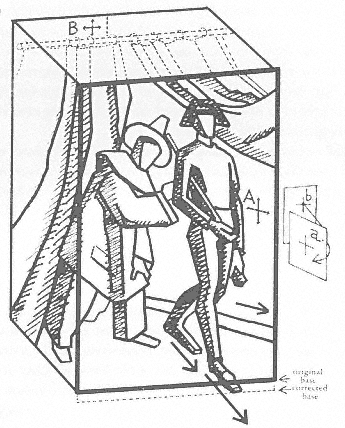
Diagram of Cézanne's Mardi Gras.
nary, he added the name of the small town on the Rhine, Simmern, where he was born. Double names can be acquired in various ways.
A good and helpful book, it was reprinted and used for many years, years during which Henry worked on another and larger book that he never finished. In the meantime he brought in his friend Rudolf Arnheim, the great scholar and theorist in the psychology of art, who wrote books—and we published them—for the next thirty years and more, beginning with Art and Visual Perception (1954), still a standard work. Subtitled A Psychology of the Creative Eye, this book describes the visual process that takes place when people create—or look at—works of art and explains how the eye organizes visual ma-
terial according to psychological laws. In a later volume, Visual Thinking (1969), Arnheim argues that all thinking (not just thinking related to visual experiences) is basically perceptive in nature and that the ancient distinction between perceiving and reasoning is false and misleading. Arnheim was also one of the first important film critics; in a still read early book, Film as Art, he made a strong case for the superior qualities of the silent film.
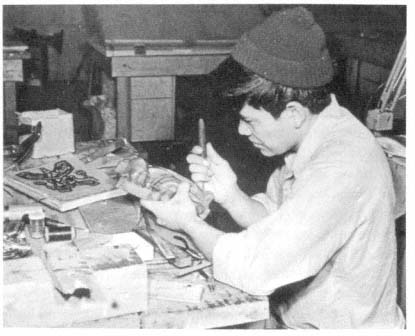
While we were still dealing with Schaefer-Simmern, there walked in the front door a tall man, carrying under his arm a portfolio of striking photographs of the art works of the Haida, the Kwakiutl, the Tsimshian, and other related tribes of the Pacific northwest—art now well enough known but then familiar to only a few and published only in monographs. Robert Bruce Inverarity had spent many of his early Seattle years visiting the wooded and rainy coast between there and Alaska, studying these peoples and their arts. He now proposed a book that would begin with a brief study of the society and culture and would then display the rich variety of the art—not just totem poles, the one form known to many. There would also be a study of the symbols and their meaning. Art of the Northwest Coast Indians (1950) is one of our early books that pioneered a little-known topic and did this so well that it has been selling ever since—usefully selling. A photograph in the British Columbia Magazine, fall 1976, shows a young Indian carver at work in a village on the Skeena River, and in front of him, as source study, is a well-worn copy of our book. Before that I had observed the new totem poles of Bill Read and others going up in Vancouver and Victoria, and had bought a pair of Read's silver earrings for my wife. So the author, and even perhaps the publisher, may claim some part in the contemporary rebirth of a great Indian art style.
Inverarity, then teaching in Los Angeles, is anthropologist, painter, photographer, and something of a genius in acquiring and displaying not only works of art but also large and small objects of material culture. He moved on to establish a folk art museum in Santa Fe, a regional museum in the Adirondacks, and then revitalized the
Indian carver at Ksan with book as model (British Columbia Magazine, Fall 1976).
maritime museum in Philadelphia. When the time came for retirement, Bruce sold his own collection of northwest art to the British Museum. On one of my last working visits to London I was pleased to attend an exhibition of the Inverarity Collection.
In those early days, as I have remembered in another chapter, some of us were pleased to leaven our scholarly list with translations from a number of foreign literatures. Mere adornment, some may call it, since scholarly books had always to be the largest and the basic part of what we published, but translations were appropriate, they gave us variety, and they helped to get attention from booksellers, who tended to shy away from university press books. Art books could serve the same purposes, and they made our daily work more interesting.
Several of us became particularly attracted to the writings of artists about their own work. At that time I was listening to the talk of
Rico Lebrun, an artist who knew how to make clear what he and others were trying to do. And in this interest we were encouraged by a member of the Editorial Committee, Michel Loève, a mathematician who could out-talk professors of French literature in their own field and who could probably have done the same to professors of modern art, had there been any on the Committee. After that kind of performance he would apologize to me, saying that he had the advantage of knowing little about the subject.[1]
And we were publishing in 1952 an anthology entitled The Creative Process, compiled by Brewster Ghiselin of the University of Utah. A collection of short accounts by mathematicians, musicians, artists, writers, inventors, and others, all commenting on the mysterious and sporadic way in which the human mind works, or does not work, in the creation of new things. The subject is too large and too complex for description here, but a comment or two may not be out of place. Nowadays we hear about the left and right sides of the brain, terms not common then. Long ago poets talked about inspiration. In the seventeenth century Blaise Pascal wrote about the esprit de finesse, in which the mind goes directly from problem to solution, without (apparently) following the logical steps of geometric reasoning. That passage is not in Ghiselin's book, nor is Proust's account of the involuntary memory, out of which his own huge books were written, but there are many other striking things. One that has stuck in my memory is Henri Poincaré's description of mathematical creation and the reciprocal roles played by the conscious and unconscious minds. After long mental work had failed to solve the problem before him, he would sometimes put the matter out of mind—or so he thought—and go off on a trip. Then unexpectedly and from nowhere—once as he stepped onto an omnibus—the solution might suddenly appear in his head.
Before we brought out Ghiselin's book, it had been turned down by any number of commercial publishers, who could see no market
[1] See Chapter 9, note 5.
for it. Afterwards it came to the attention of two imaginative paperback editors, Arabella Porter and Victor Weybright of New American Library. They bought paperback rights from us, and for many years the book was available on popular stands for fifty cents or thereabouts. The Press now has its own paperback edition. Publishing, we like to say, is a kind of gambling.
Out of the same interest came a little book of our own, Art and Artist (1956), in which we ourselves put together a number of pieces by present-day artists, writing about their own work. The authors were a mixed lot, some well-known, others not, and included Henry Moore; Jean Renoir and Cesare Zavatini, the film directors; W. Eugene Smith, the photographer; and Rico Lebrun, whose talk about the need for a place to publish such writings had suggested the book. Several of us took an interest, including Michel Loève, mentioned above, and Rita Carroll of the staff. It was an attractive little volume, and if there had been a real need for it, or a strong response to it, we might have tried to make it an annual publication. But the impulse faded, and there were other and more urgent things to do.
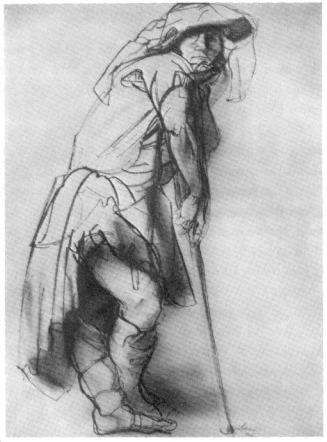
We did, however, bring out a volume of Lebrun's Drawings (1961), together with a collection of his writings. A man of great emotional power, deeply affected by human suffering, fascinated also by color and line, he was then rather famous for his huge triptych of the Crucifixion, now at Syracuse University, and his many related studies of contemporary men and women, centurions, animals, crosses, and other objects. In his talk, in his lectures, he was highly literate and perhaps more eloquent and compelling than any other artist I had heard. It was natural, then, to think that he could write a kind of intellectual autobiography; and he himself was quite taken with the idea.
He tried but could not do it. After a time I came to see that his great talent for words and thoughts, for seeing and understanding the work of others as well as his own, along with his sense of humor and the ability to turn a phrase—that this talent might be called lyrical in nature, suited to the sentence or the paragraph, to the shorter passage, individual, discrete, but not to the organized discourse that
Lebrun, Woman Leaning on a Staff.
makes a book. After all, he was a painter, who portrayed individual objects or scenes, not an ordered world.
So, since he was known as a great draftsman, we decided to do a book of drawings, together with brief writings about himself as artist and about the nature of drawing. But getting these on paper was a problem; his talent was also oral. So in the end I sat at his typewriter in Los Angeles while he paced the floor and dictated his thoughts about this matter or that. Between topics, and when inspiration receded, we teased it back with coffee, wine, and conversa-
tion. In this way quite a lot of oral wisdom was given the quasi-permanence of written words. These I carried home, had retyped, and sent to him.
What did he do then? He did what a bad editor is supposed to do—revised the life out of his words, made them stiff and stilted, more reasonable, less idiosyncratic, less personal. Fortunately I had kept a copy and could try to save him from himself—editor telling author to leave happy imperfection alone, to retain insights in their first fresh form, preserve them from artful revision. For many weeks we fought—vehemently, as friends will—over these few pages, face to face for a time and then by letter while he was at the American Academy in Rome. The book appeared in 1961 (three years before his death), with a foreword by the art critic James Thrall Soby, and went through two printings.
Of himself, Lebrun wrote: "The real drama is in the fact that personal drama produces nothing of merit whatsoever. Many professors have struggled even harder than Cézanne, and for the wrong reasons. In a superior civilization some day, we should have a Pantheon for them. 'He was an ass and toiled as if he had the obligations of a hero.' Who knows how many of us may yet belong to that legion?"
Of his native Naples, forever a part of him: "At every dawn our street, like all others, slowly emerged from visceral darkness into peach-and-brass light, shrouded in miasmic smells and heavenly fragrances, festooned by immaculate laundry hanging everywhere on lines like angels electrocuted by the sun."
Of another kind of line, that of the draftsman: "I use a line, I suppose, as a lifeline to hang on to against the risk of being washed overboard."
And of the Crucifixion, his great subject for several years: "This was a period in which I could go from one picture to another as a speaker goes from one phrase to another—the wood of the Cross, the ladder, the signs, the nails, the hammer, the uniforms of slaughter, the black of mourning. I think it was Melville who had given me the
courage to do this when he wrote about the spade, the lance, the towrope. . . .
"After Christ was taken down and the Golgotha scaffold scrubbed with whitewash, someone discovered that without the irrelevant trivia of blood and pain the Cross made a composition of 'significant horizontals and verticals.' This meant nothing at all to Mary the Mother. Her sight had been made unsophisticated by experience."
In the meantime, in the 1950s, we essayed still other kinds of art books, too many titles for mention here. The director of the new UCLA art gallery, Fred Wight, had embarked on an ambitious program of showing the work of the best contemporary painters, and for each show he put together a small but handsome volume, with critical appraisals and excellent color illustrations. There were books on Hans Hoffman, John Marin, Morris Graves, Arthur G. Dove, and perhaps others I forget. Quite different was Children's Art, by Miriam Lindstrom of the De Young Museum, wife of my old Stanford classmate Charles Lindstrom. Published in 1957 as one of our first paperbacks, the book was for many years a staple of that list, and is still in print.
During our early and amateur years we consorted with Art; in the 1960s, growing old, we found ourselves entangled in a more serious affair, with Art History. Which of my sins brought this fate down upon us is not clear. Perhaps the sin of Ambition.
Ten years after we began publishing our large series of books in art history, I wrote to another press director who had asked advice about undertaking a similar venture: "If you are prepared to deal with short print runs, long production times, much care and expense in producing good illustrations, and an outlandish amount of editorial attention, then the field of art history is open to you, and may God go with you." To the list of tribulations I might have added dealing with foundations, artists, and general editors. They, of course, may have had their thoughts about dealing with me.
The series California Studies in the History of Art now includes more than twenty-five titles, many in more than one volume, all of them large, some of them great. Among the great are The Plan of St.
Gall, by Walter Horn and Ernest Born; Corinthian Vase-Painting of the Archaic Period, by D. A. Amyx; and my own choice for finest book of all, Jean Bony's French Gothic Architecture of the Twelfth and Thirteenth Centuries . The Horn and Born will be considered in a moment. Amyx's volumes were described in an earlier chapter. Bony's great work provides the only satisfactory account I have ever read of how Gothic architecture developed from or arose out of Romanesque. "The past must be relived," writes Bony, "as what it was when it was happening: as a sequence of distinct and unforeseen presents." Among other fine things is a revealing comparison of two great cathedrals, Bourges and Chartres.
The three books just mentioned, in seven volumes and weighing perhaps forty pounds, were all taken in during my time but published after I retired. The two dozen books of the series, many of them distinguished works of scholarship, all handsomely illustrated, amount to a considerable publishing achievement. One has to be proud of them. Perhaps, perhaps, they are worth the pain and trouble occasioned to me and to the Press.
Our old correspondence file, now sadly incomplete, does not make clear how or why we began this large undertaking. Our very first book of this kind, never meant to lead anywhere, came out in 1953: Alfred Frankenstein's After the Hunt: William Harnett and Other American Still Life Painters 1870–1900 . Years later a revised edition went appropriately into the big series. Then in 1957 a Mellon Foundation grant—one given to all university presses—was burning a hole in our pocket, and we spent much of it on German Expressionist Painting, by Peter Selz, then teaching at Pomona College.[2] This was the first general book in English on a period of painting that has since been much written about.
No surviving papers document the leap of our minds from these individual books to the rather grandiose idea of a big series in art history. Ambition, I have said. Princeton and Yale had produced
[2] It was Selz who arranged for Lebrun to paint a large outdoor mural on one of the Pomona College buildings.
some imposing sets. It seems likely that the first impulse toward a series came from Rita Carroll, who was then our art and medical editor and who had been designer of the book by Selz. A surviving memorandum of January 1960 shows that we were considering a number of art manuscripts and that she and I had approached Walter Horn of the art department in Berkeley, asking him to become general editor of a book series. After some hesitation, he agreed and, for better or for worse, we were on our way. Three years later Rita departed the Press, leaving the art books in my lap, alas, with no one to relieve me. In the 1970s Lorna Price, working for us at first and then for the art department, saw the books through the Press.
The first two books, both of moderate size, came out in 1962: The Birth of Landscape Painting in China, by Michael Sullivan of London, and Portraits by Degas, by Jean Sutherland Boggs of the Riverside campus. Neither of these, nor the third book, Leonardo da Vinci on Painting, by Carlo Pedretti of UCLA, was especially difficult to produce, and the illustrations were mostly in black and white. After that the books became larger, the problems more complex, the costs greater. To support the series we solicited a grant from the Kress Foundation, and in 1965 were given $100,000, a considerable sum more than twenty-five years ago. The money was used over a period of years, during which the Foundation took a close interest in our progress, requiring annual reports and much correspondence with Mary Davis, assistant to the president and later executive vice-president. She took a special interest in our illustrations, they needing improvement, she thought. At that time the older art historians had little faith in color reproduction, preferring the greater accuracy of black and white, but younger scholars were demanding color.
In this part of our story, the pièce de résistance, the magnum opus, the casus belli, was a book entitled The Plan of St. Gall, with text by our general editor, Walter Horn, and visual material by Ernest Born, a San Francisco architect. The reader with a taste for academic warfare may turn to Jim Clark's account, at the end of this book, of a ludicrous but crucial battle, perhaps the second most sanguinary
Abbey Grange, Beaulieu St. Leonards.
in the history of the Press. It would not do for me to retell what Clark has told in a way I cannot—with an even hand—but perhaps I may add a few touches to the background along with an opinion or two.
In the 1960 memo mentioned above I reported from a meeting with Horn that he was working on two books, a large one on medieval three-aisled halls or barns and a small one on the plan of St. Gall, a ninth-century vellum manuscript, on which is drawn the building plan of a model monastic community. In the years that followed, and in ways not clear to me, the two books switched places or switched dimensions. The large one, or a part of it, became a thin published volume in 1965, and we shall see what happened to the smaller book.
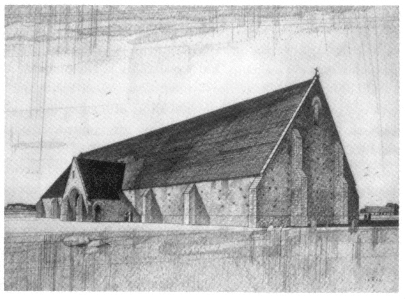
When published, the large-book-become-thin was entitled The Barns of the Abbey of Beaulieu and Its Granges of Great Coxwell and Beaulieu St. Leonards . On the dust jacket we called it "a study in medieval survival: two Cistercian abbey-barns in England dating from
the first half of the 13th century." It is a remarkable volume, perhaps as handsome as any put out by the Press. In retrospect it may also be seen as a trial run for the small-book-become-large. Ernest Born's balanced folio pages, diagrams, and above all his magnificent shaded drawings of interiors and exteriors—these come close to taking one's breath away, and not from the physical effort of holding them up. This book, as they say about some buildings, was constructed on a human scale.
The St. Gall manuscript, then limited to the "guest and service structures" of the plan, was said in 1960 to be in semifinal draft, about 150 pages in length. When approved by the Editorial Committee and accepted by me in 1967, it came to several hundred typed pages, about right for a single quarto volume. As the work moved through the production process during the next twelve years, we paused every now and then to call for new estimates of size and cost, and each time discovered that new sections had been added, along with a few dozen new diagrams and drawings. Expansion seems to have been engineered more by Born, the artist and designer, than by Horn, the author, who may not have had much control toward the end. When published on Christmas Day 1979, three years after I retired, the book had become three huge folio volumes; each of the nearly one thousand printed pages was equal to three or four ordinary book pages. The reader could not easily hold up even one of the volumes; this may be the only three-lectern book the Press will ever publish. And all this served to interpret the lines and words on one side of a sheet of vellum measuring 30 1/2 × 44 inches.
In my skeptical and perhaps scatterbrained way, I sometimes wonder how a research scholar can work on the same project decade after decade and retain faith in its intellectual importance. Perhaps some do not, and that is why their books are never completed. But we can also observe an opposite phenomenon. As the years go by the object or document for study may swell and expand in importance until—until, for example, "The Plan of St. Gall is . . . one of the most fascinating creations of the human mind . . . one of the greatest hu-
manistic statements of the Western Mind."[3] Or until it becomes "a book, over which shines a star, below which one may read Fiat lux ."[4]
In the book itself, on page 53, is the less grand assertion that the Plan is "a document of paradigmatic significance drawn up in the [Carolingian] palace itself under the eyes of the country's leading bishops and abbots." Even this was called "wanton hyperbole" in the Times Literary Supplement . The reviewer there went on to praise Born's drawings but to judge the design of the book too grandiose and confused to be successful.[5]
This much said, I should add that she found much to admire in the volumes, and that the other reviews, or most of them, made up a chorus of praise. We can be confident, I like to think, that The Plan of St. Gall is a great book, although it may be—as a famous writer once said of his own novel—that the pedestal is too large for the statue.[6]
What, then, did this "monument"—a term that irritated Horn but pleased Born—cost the Press in money and in good health? In the battle so well described by Jim Clark, did we suffer a defeat or manage a kind of stalemate? It is not easy to say. The authors and I and those who came after me raised subsidies totaling more than $150,000 against a manufacturing cost of over twice that much; the book sold out the entire edition at a price that varied; but the overhead cost of staff time can never be calculated. After I retired the new production manager, Chet Grycz, spent most of his time for three years on this one project. And the influence on the Press of this huge work of art seems—here I speculate—to have helped bring about a kind of bibliographic intoxication, resulting in publication of a number of large, handsome, and high-priced volumes of a kind that appeal (or do not appeal) to book collectors. Not all of these sold, and their
[3] Horn to Frugé, 30 October 1973.
[4] Born to Horn, 6 December 1973.
[5] Rosamond McKittrick in the issue of 26 December 1980, page 1470.
[6] Flaubert of Salammbô . I quote from memory.
piling up in the inventory contributed to the financial crisis of the mid 1980s. No accurate assessment can be made. The Press suffered but survived.
Moral: Having escaped disaster, more or less, I may now try to extract a message from this last little story. When one feels the tug of ambition, or observes it tugging on someone else, it is well to remember that ambition needs to be curbed by the sterner stuff of tight control.