
1
"Mountains of Resentment"
One Woman' s Struggle against Tokugawa Authority
Follow your judgment.
Ken, 1757
In this study I often rely on data from Nagano prefecture, formerly Shinano province, especially from the Saku district in the east (since 1624 split into a northern, Kita-, and a southern, Minami-, half). This is in part accidental and in part by design and deserves an explanation. (For provinces, see map 1; for Kita-Saku, see map 2.)
Learning of my interest in Tokugawa village law, my colleague Anne Walthall recommended an article about a peasant woman who sued officials in Makibuse, a village in Kita-Saku. As it turned out, this case provided an unusually well documented entry into village politics. Additional reading drew me further into a study of the region, which, I soon found, had been explored by many prominent historians of the early Tokugawa period, including Kodama Kota[*] , Miyagawa Mitsuru, Oishi[*] Shinzaburo[*] , and the pathbreaking local historian Ichikawa Yuichiro[*] . Independent scholars continue this tradition of local history today. Ozaki Yukiya is one of them.
Like Ichikawa before him, Ozaki until recently supported his passion for local history by his work as a high school teacher. He wanted to become a professional historian, but in the immediate postwar period his father, convinced that science was the wave of the future, steered his son in the direction of physics and chemistry. Fortunately, Ozaki was able to squeeze some courses on Tokugawa documents into his schedule at the university. When I established contact with him in 1991, he was teaching high school science by day and researching and writing local history by night and on weekends.
Initially interested in questions of discrimination against burakumin , Japan's indigenous minority, Ozaki organized a club in the mid sev-
enties to explore the history of Mochizuki, the town into which Makibuse has been incorporated. He taught this small group of retired history buffs how to read the difficult Tokugawa texts, and together they began collecting, cataloging, and reading tens of thousands of documents from the storehouses of descendants of Tokugawa village headmen in the area.[1]
In the storehouse of the descendant of Makibuse's headman, Ozaki came across dozens of documents referring to a woman named Ken. Intrigued, he devoted a great deal of time to piecing together the fragments of her story. I retell it here, following the trail of documents, supplemented with relevant historical data from other sources.[2]
The Registration Incident: 1761-1763
Our point of entry into Ken's story is an incident involving the population register of Makibuse that is neither the beginning nor the end of Ken's story (see table 6 for a chronology of Ken's life). I chose this incident because often long-simmering questions regarding status surface in the historical record as disputes around the proper entry in village population registers, which were updated every year. These registers recorded not only a person's name but also his or her social and
[1] Currently the group is writing a multivolume history of the town and its surrounding villages. In the fall of 1992 Ozaki resigned from his high school teaching position to accept an appointment with Nagano's new prefectural museum, scheduled m open near Nagano city at the time of the 1998 Winter Olympics. As director of historical acquisitions for the Tokugawa period, he is at last pursuing his passion for local history on a full-time basis.
[2] Today Makibuse is part of Mochizuki, a township with some 3,100 households and a population of 11,300 that since 1959 has included a number of surrounding villages, each of which in turn comprises what were once several Tokugawa villages. For the materials on Mochizuki, see Mochizuki-machi kyoiku[*] iinkai, Mochizuki no burakushi , nos. 1-5 (1976-79), and Mochizuki no chomin[*]no rekishi , nos. 6-15 (1980-91). The documents related to Ken are still in the possession of the descendant of the Tokugawa headman of Makibuse village, who was reluctant to allow me access to them on my visit there in the summer of 1991. Fortunately, Ozaki had made copies, which he graciously put at my disposal. Ozaki published his findings on Ken in two partly overlapping but mostly complementary articles: "Kenjo oboegaki: Kinsei noson[*] joseishi e no kokoromi," Mochizuki no chomin[*]no rekishi 8 (1983): 61-100; and "Shinshu[*] Saku-gun Makibuse-mura Kenjo ikken—Kinsei noson[*] joseishi shikiron m shite," Rekishi Hyoron[*] 419 (1985): 45-66. References to sources other than those directly pertaining to Ken's story are my own. The story has become famous locally through a play based on it.
legal status. Individuals contesting their status might cause delays in the village headman's submission of the registers to the higher authorities, or they might escalate the confrontation into a lawsuit, in either case leaving evidence for historians to examine. In Ken's case, we are well informed about the immediate issue she was raising and the pressures applied to her to conform. Behind this incident, however, lies the story of a peasant family, which adds a number of other dimensions to this incident.
Population registers, along with village laws and land cadasters (chronologically the earliest of the three), were the most important documents the supravillage authorities ordered the village headmen to keep up-to-date. Titled peasants had to signal agreement with the registers and laws for themselves and their dependents by affixing their seals.[3] In principle, the laws were read at least once a year to all the villagers, sometimes, as in Makibuse, at every formal meeting of the village council.[4] The list of signatures attached to these laws eventually evolved into separate, complete population registers (jinbetsu aratamecho[*] ). The earliest such register in Kita-Saku dates from 1642. A record of Buddhist affiliation, required nationwide since 1665, was first added to these population registers but came to be drawn up separately and known as shumon[*]aratamecho[*] .[5] These lists often functioned as population registers with increasingly detailed information on the age, provenance, and whereabouts of each co-resident of each household and his or her relationship to the household head. By the 1720s a full-fledged, nationwide population census was being conducted every six years. The headman, assisted by the kumi heads (the heads of the official neigh-
[3] On the process of diffusion of these laws from the lord to the peasants and their ratification by the village, see Yokota Fuyuhiko, "Kinsei sonraku ni okeru ho[*] to okite," (Kobe[*]Daigaku daigakuin bunkagaku kenkyuka[*] ) Bunkagaku nenpo[*] 5 (1986): 150-55.
[4] Ichikawa Yuichiro[*] , Saku chiho[*]Edo jidai no nomin[*]seikatsu (Nagano-ken Minami Saku-gun Nozawa-machi: Saku Insatsujo, 1955), 24. As is so often the case with Tokugawa institutions, however, some of these laws antedated the bakufu order: the oldest one in Shinano is from Kyowa[*] , a village five kilometers west of Makibuse, and dates from 1628 (ibid., 15).
[5] For an introduction to the shumon[*]aratamecho[*] , see L. L. Cornell and Akira Hayami, "The shumon[*]aratame cho[*] : Japan's Population Registers," Journal of Family History 11, no. 4 (1986): 311-28. For a recent discussion of the development of population registers, see Yokota Fuyuhiko, "Kinseiteki mibun seido no seiritsu," in Mibun to kakushiki , ed. Asao Naohiro, Nihon no kinsei, 7 (Chuokoronsha[*] , 1992), 41-78, esp. 55-78 (hereafter MK).
borhood groups, the goningumi ), was responsible for drawing up a new register every year and having each entry properly verified and certified with each household head's seal. (For special terms, please consult the Glossary.)
In Kita-Saku district, as elsewhere in bakufu , or shogunal, territories, the yearly population check took place in the third month.[6] A copy of the register remained with the headman, the original being forwarded to the lord's chargé d'affaires, who for Makibuse in 1763 was quartered at an office in Shimogata village, the administrative center for a shogunal bannerman's (hatamoto ) small fief by the same name.[7]
Thus, on 1763/2/8,[8] a woman named Ken refused to certify her household's entry with her seal. A yearly routine had taken on the dimensions of an event. No doubt greatly annoyed by this flagrant case of insubordination by a mere woman, which would reflect badly on his own governance and certainly trigger an investigation from above, the headman, one Chuemon[*] , had no way of concealing the matter, so he reported it to the Shimogata office.
Why was a woman's seal required? Usually the male head of the household held legal authority for all its members, whether affines, cognates, or other co-residents. And Ken was neither single nor a widow. In 1756, then thirty-seven, Ken had married a man a few years her elder. He was from Mochizuki, a way station on the Nakasendo[*] inland highway between Edo and Kyoto, located across a low range of hills
[6] Ichikawa Yuichiro[*] , Saku chiho[*] , 70.
[7] Between 1702 and 1765, Makibuse was one of thirteen villages in the area that together constituted the five-thousand-koku fief of Shimogata (see Nagano-ken, ed., Nagano-kenshi: Kinsei shiryo-hen[*] , Vol . 2, Toshin[*]chiho[*] , pt. 1 [Nagano-shi: Nagano-kenshi kankokai[*] , 1978], 724 [hereafter NAK-KS2 (1)]). Its overlord history, like that of most villages in the fertile Kita-Saku plain, is a complex one. Villages were shifted numerous times, sometimes even divided, among various lords. Makibuse started as a village of the fudai domain of Komoro (first under the Sengoku house, 1590-1622; then under the shogun's brother Tadanaga, 1622-24; then under a Matsudaira, 1624-47). Between 1648 and 1661 it was entrusted as a shogunal possession (azukaridokoro ) to the Aoyama. Subsequently it was part of the Kofu[*] Tokugawa domain until 1700. After two years of incorporation in the shogunal domain proper (tenryo[*] ) under an intendant (daikan ), it was transferred to the jurisdiction of the Shimogata bannerman's fief until 1765. From that year until the end of the Tokugawa period it was again part of the tenryo[*] .
[8] Dates are referred to by year first, followed by the lunar month and the day according to the traditional Japanese calendar.
some two and a half kilometers due west of Makibuse. His name was Rokuemon, formerly Yohachi. Two years before the incident, however, in the winter of 1761, he had left Ken, and his whereabouts were unknown.
At the time of the first registration after her husband's disappearance, in the spring of 1762, Ken requested to keep him on the rosters as the in absentia household head. The following year, however, she officially petitioned the headman, in a document legalized with the seals of her relatives and kumi members (the same persons, since in Makibuse lineages overlapped with neighborhood kumi),[9] to take him off the rosters, leaving her the head of a single-member household, for her parents were no longer alive and she had no heir.
This Ken did on 2/6, that is, only two days before she surprised the headman by refusing to affix her seal to the population register. Had her relatives suspected the trouble she was to cause, they certainly would never have signed the petition. Instead, they would have placed her under the fiduciary authority of one of them, as she had been before her marriage. Did they not know Ken well enough to foresee this? Was this why she had sought legal authority? What lay behind this surprise move?
In his report to the Shimogata magistrate, the headman carefully explained the futile efforts by the village authorities (himself and the four kumi heads) to make this recalcitrant woman comply with shogunal law and also recorded Ken's reason for her behavior:
Ken did not affix her seal to this year's population register. What was the reason for this delinquency? We asked her to please affix her seal, there being regulations concerning the population register. Even if I did it, [she said,] come fall I intend to leave the village, so there is no need for my seal. In any case, [we said,] it is an offense not to affix your seal this year. All the village officials urged her strongly to quickly affix her seal, but no matter what, she did not listen and [just] went home.[10]
The headman also mobilized the members of the next authority level down, namely, Ken's kumi members/relatives, asking them to persuade
[9] Kumi is short for goningumi , the term for a five-household neighborhood association, an official administrative subdivision of a village. Their membership was supposed to cut across, rather than overlap with, lineage membership. Makibuse had four kumi.
[10] Ozaki, "Kenjo ikken," 47-48.
her, but they were equally powerless. He finally ordered her to appear in person in Shimogata, about seven kilometers to the east of Makibuse, across the hills, in the open plateau of Kita-Saku, on the other side of Gorobe-shinden, near the Chikuma River.
But Ken did not budge. "If this is an offense, then it is one I have been looking for that suits me well (ochido ni ainarisoro[*]mo, saiwai nozomu tokoro ni gozaro[*] )," she replied, according to the headman's report, "and even if I receive the death penalty or banishment, no matter what punishment [might await me], I have thought this over very well [and taken all such possibilities into consideration]." Thus Ken not only categorically refused to appear before the Shimogata magistrate—she interpreted the order to do so as a threat—but used the occasion to impress upon the headman again the depth of her determination, countering his order/threat by warning him that threats would be of no use. At least this is the headman's view of the confrontation, aimed at impressing his superior with the particular difficulties he was having with this woman.
Ken's leaving the village would result in the disappearance of a household, which was always an extremely grave matter, for it affected the distribution of tribute that the village as a whole owed the lord. The lord, who "owned" the land, which "owned" the people on it, did not let them go easily. Yet the land under Ken's name was minuscule, a mere 0.19 koku , three-quarters of it a dry plot attached to the homestead.[11] The reassignment of her land to another peasant in order to produce the apportioned part of the village tribute quota could not have been the only thing at stake. As we shall see, there were in the village poverty-stricken peasants in need of land who presumably would have gladly taken over the holding. It seems particularly nasty of the headman to deny this woman her request to leave the village. Was he getting back at her for some unspecified reason?
When moving to a domicile out of one's locale of registration (village or township), one had first to secure a certificate of leave (okurijo[*] , or "sending document") in order to properly register in one's new resi-
[11] The term koku , a measure of volume equivalent to 180 liters or 44.8 gallons, refers to the putative rice yield of fields, the basis for the computation of tribute. All property, including dry fields and homesteads, was converted into koku equivalents for tribute purposes. Ken's property was thus registered as equivalent to a mere 34 liters of rice.
dence. Ken knew the procedure; she had followed it a year earlier, without, however, being granted her wish. This time she seemed to have changed strategy, hoping, perhaps, to force the hand of the village authorities or at least to cause trouble by exploiting the jurisdictional division between village and district.[12]
In 1762/3, only a year earlier and thus around the registration time when she had kept her absent husband recorded as household head, Ken had petitioned to leave the village but the petition had not been granted, possibly because her husband still held legal authority for the household. In 1763, however, she held the title and seal of household head. The petition of 1762 read as follows:
In the winter I was asked [by her lineage and kumi members and possibly also by the village officials] m establish a successor for the household [through adoption of an heir or remarriage], but I do not want to do that. I want to work the fields but cannot even become a tenant. So I have no alternative because I have trouble paying the tribute and performing corvée. Thus I request to donate the residence land, paddies, dry fields and woodland, all of it, to my family temple, the Baikei-in [in the adjoining village of Iribuse]. If this request is honored, then I and Rokuemon [my husband] will have to be taken from the population register. I want to leave Makibuse. By making this request, [I hope] I am putting an end to your order [to establish a successor]. There is no need to call me and talk to me about this again and again. Would you please examine my proposal.[13]
This petition throws some light on the headman's ill will. He refused to grant Ken's request to leave after commending her property to a temple because she had balked at his order to establish an heir. There is evidence here of the same uncompromising, blunt determination that comes through in her refusal to sign the register a year later, when she defiantly told the headman that "I do not care for my life, no matter
[12] Peasants crossing domain boundaries en masse resorted to a similar strategy on a larger scale. Perhaps the most famous such mass exodus was an 1853 crossing from Nanbu to Sendai domain led by Miura Meisuke (see Herbert Bix, "Miura Meisuke, or Peasant Rebellion under the Banner of 'Distress,'" Bulletin of Concerned Asian Scholars 10, no. 2 [1978]: 18-28).
[13] Ozaki, "Kenjo ikken," 48. Makibuse did not have a temple. The village may have split off at some time from Iribuse, where, according to the 1671 population register, 74 of the 133 inhabitants of Makibuse were registered with the Baikei-in; 49 were registered with a temple in Mochizuki (doc. 351 in NAK-KS2 [1]: 779-80).
what happens to me; I am not in the least afraid; there is no need for me to go to the [Shimogata] office."[14]
This was an angry woman who, all by herself, challenged every level of authority: the shogunal magistrate, the village headman, the kumi heads, her kumi members, and her relatives. She stood up against them by refusing to straighten out the succession of the house, sign the register, and appear before the Shimogata magistrate. The headman reports that when her lineage members put pressure on her in the registration incident, "it was useless, she would not consent and started even saying slanderous and irresponsible things." Taking another tack, they pleaded understanding for their own plight: as the group responsible and liable for its members' behavior they would face difficulties because of this incident. But she responded to this plea as she had to the headman's threat, retorting that this was precisely the point: "I have been waiting for this opportunity with the population register in order to cause trouble for the goningumi (goningumi nangi itashisoro[*]tame ni gochomen[*]inkei no setsu to aimachi makari arisoro[*] )." Ken had planned this. What in Ken's past had brought her to this bold confrontation?
Goningumi, or official neighborhood groups, were not supposed to overlap with family networks: the first article of laws of some villages in the area, like Makibuse also under bakufu jurisdiction, specified that these kumi ought not to include only kinsmen or close friends, kith and kin (shinrui naka yoki mono ).[15] This rule obviously was aimed at preventing collusion of interests and increasing local control. In the neigh-
[14] Ozaki, "Kenjo ikken," 49.
[15] Ichikawa Yuichiro[*] (Saku chiho[*] , 13-63) studied forty-one goningumicho[*]zensho , or village laws, of Saku district covering the whole Tokugawa period. Included in these are four versions of the Makibuse village laws, from 1687, 1784, 1801, and 1857. He discovered great similarities, if not complete identity, among many of them across jurisdictions (domains and bakufu territories of various kinds) in three chronologically distinct periods separated by the 1660s and the second decade of the eighteenth century. He appended to his study the full text of the standard version of each period: the laws of the bakufu village of Shimo-Sakurai, nine kilometers east of Makibuse, of 1640 (21 articles), 1662 (56 articles), and 1766 (also 56 articles). (The first two of these laws are translated in appendixes z and 3.) Among the Makibuse laws, the one of interest to us is the first one, dated 1687, which according to Ichikawa is identical, down to the number of articles, to the 1662 version from Shimo-Sakurai. When citing articles of the village law of Makibuse, it is to this text (appendix 3) that I refer. The article about the proper composition of goningumi is the first one in the 1640 version of Shimo-Sakurai village law (appendix 2).
boring village of Kodaira, kin-exclusive kumi had led to trouble;[16] in Makibuse also family networks and kumi overlapped: the six households of Ken's lineage all belonged to the same kumi. In this region, shogunal law clearly had failed to break the power of the local self-governing bodies of the lineages.
One of Makibuse's Poor Peasants: 1719-1744
Ken was a native of Makibuse, the daughter of a peasant named Rihei, whom we shall refer to as Rihei II since her grandfather bore the same name (hence we will call the grandfather Rihei I). Born in 1719, she was forty-four at the time of the registration incident. Her mother was from Yawata village, a station on the Nakasendo[*] two and a half kilometers east of Makibuse (the last station in the Kita-Saku plateau before the highway winds its way westward into the mountains to the next station, Mochizuki, where Ken's husband had come from); Makibuse's northern border also touched the Nakasendo[*] . In 1694, at the age of sixteen, slightly earlier, perhaps, than was usual for girls, Ken's mother had married Rihei II.[17] She bore him a son, Shinzo[*] , in 1700; a daughter, Ine, twelve years later; and finally Ken, her last child, seven years after that, in 1719.
Ken's father died the year she was born. By then Shinzo[*] was nineteen, old enough to work the fields, and Ine, seven, could help care for her baby sister. At age fifteen, rather young, Ine married out to Yawata, where her mother (and paternal grandmother)[18] were from, perhaps to reduce the number of mouths to be fed in the family.[19] Ken's first
[16] See the discussion of this issue in chapter 3.
[17] Ichikawa Yuichiro[*] (Saku chiho[*] , 113) found that the average marriage age in the area was twenty-three to twenty-four for men and sixteen to seventeen for women. These are a couple of years lower than Hayami's findings for another district in Nagano or Smith's findings in his study of Nakahara (Hayami Akira and Nobuko Uchida, "Size of Household in a Japanese County throughout the Tokugawa Era," in Household and Family m Past Time , ed. Peter Laslett [Cambridge: Cambridge University Press, 1972], 502; Thomas C. Smith, Nakahara: Family Farming and Population in a Japanese Village, 1717-1830 [Stanford: Stanford University Press, 1977], 94-96).
[18] See the sixth entry in the 1671 population register of Makibuse, in NAK-KS2 (1): 771.
[19] Smith (Nakahara , 93-95) found that daughters of wealthier families married considerably younger than those of poor families. He suggests that this may have to do with the fact that the poor spent time as servants to supplement family income. In other circumstances, however, early marriage of daughters may have been a solution to the problem of too many mouths to feed.
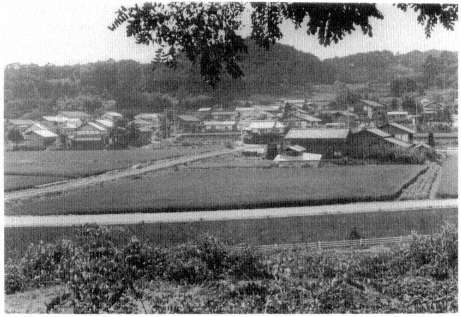
Plate 1.
Makibuse Village. Facing west toward Mochizuki, some three hundred
meters south of the Nakasendo[*] . Photograph by author.
marriage, in 1737 at age eighteen, brought her to Mimayose, two kilometers beyond Yawata on the Nakasendo[*] , leaving her mother and unmarried brother in Makibuse.
Shinzo's[*] bachelor status at age thirty-seven needs some comment, although a specific psychological or other personal explanation is not available. Perhaps he had been married and was divorced; we do not know. The thought that he might have been an unattractive prospect seems culturally incongruent. Males must have had the strategic advantage in a society like that of Tokugawa Japan. It is possible that Shinzo[*] could not afford a wife, that the reason of his bachelorhood was sociostructural rather than personal. In 1671, at least, the only bachelors of marriageable age in the village were indentured ser-
vants.[20] A socioeconomic explanation would thus point to the near-poverty situation of the family, although even "landless," that is, tenant, peasants did marry, as did Ken.[21]
Outmarriage was quite common in Kita-Saku district from fairly early in the Tokugawa period, contrary to Smith's assumption of a "village rule of endogamy except for high-placed families who had to go outside the village to find marriage partners of comparable family rank."[22] The 1671 population register of Makibuse recorded thirty-two peasant households (including fourteen titled peasants), all but two headed by couples (see table 1). In addition, there were seven married sons, brothers, and nephews of titled peasants co-residing with their main families in an extended-family pattern, which makes a total of thirty-seven couples. Only seven of the thirty-seven wives were from Makibuse; all the others had inmarried from villages in the same district or, in one case, from another district. Yawata tops the list of villages as sources for wives, with five. As for outmarriage, fourteen daughters or sisters of current household heads married out. Only two Makibuse women married out to the Kita-Saku plain; the rest settled in the mountain area. On the other hand, ten wives came from the plain. All twenty-three bond servants (genin and fudai ) came from the mountain area, from within a radius of eight kilometers.
Thus, the number of women marrying within the village (seven) was
[20] According to the population register of 1671, none of the bond servants (genin and fudai) were married. There were nineteen indentured servants (genin) in Makibuse—twelve males ranging in age from thirteen to thirty-four and seven females between fourteen and twenty-three—and four lifetime servants (fudai) between the ages of nine and twenty-two (see NAK-KS2 [1]: 771-80).
[21] Smith (Nakahara , 92) found that the probability of male celibacy in lower-class peasant families (those with holdings of less than four koku) was from two to ten times as high as that among wealthier peasants (67 percent for the cohort aged thirty to thirty-four and 41 percent for those aged thirty-five to forty-nine). Pierre Bourdieu discusses the structural necessity of bachelorhood of nonsuccessor males for reproducing the social system in the late nineteenth century m the Béarn in southern France in "Célibat et condition paysanne," Études rurales , nos. 5-6 (1962): 32-135.
[22] Thomas C. Smith, The Agrarian Origins of Modern Japan (Stanford: Stanford University Press, 1959), 61, 62-63 n. 1. My occasional critique of this excellent study should be understood in light of the vast amount of Japanese scholarship produced in the last thirty years. In Nakahara (133-34, 143) Smith reports only that "nearly all daughters were married our of the family" but gives no figures for out-village marriage. See also the following note.
Table 1. | ||||||||||||
Population | Households | |||||||||||
Male (genin ) | Female (genin ) | Total | Horses | Honbyakusho[*] | Kakae | Mizunomi | Total | [Kokudaka ] | ||||
1671 | 73 (13) | 60 (10) | 133 | — | 14 | 18 | 0 | 32 | [175] | |||
1700 | 93 (18) | 80 (10) | 173 | — | 16 | 24 | 0 | 40 | ||||
1717 | 121 (12) | 104 (10) | 225 | 18 | 13 | 30 | 4 | 47 | [205] | |||
1725 | 129 (14) | 99 (11) | 228 | 16 | 12 | 33 | 3 | 48 | ||||
1737 | 136 (15) | 112 (9) | 248 | 16 | 12 | 38 | 2 | 52 | ||||
1750 | 130 (11) | 112 (9) | 242 | 12 | 11 | 35 | 2 | 48 | [205] | |||
1764 | 129 (11) | 115 (9) | 244 | 10 | 11 | 43 | 3 | 57 | ||||
SOURCES : Adapted from Ozaki, "Kenjo oboegaki," table 9 (p. 97); the population for 1671 is from NAK-KS2 (1): 771-81, and the kokudaka is from NAK-KS2 (2), appendix p. 53. | ||||||||||||
NOTE : Land development seems to have reached its capacity in the late seventeenth century. The kokudaka of 205 was first recorded in 1704 (NAK-KS2 [1]: 613); between 1704 and 1834 another 16 koku were added. | ||||||||||||
only half of that marrying out, and this in a community where thirty-seven wives were needed for households to reproduce. If one adds all marital liaisons in and out of the village, the total is fifty-one, out of which only seven, or 14 percent, were endogamous to the village.[23] This contrasts sharply with 50 percent and 75 percent for other villages in the area (Komiyayama in 1669 and Wada in 1713, respectively), as Ichikawa Yuichiro[*] relates.[24] He also concludes that the average marriage age in the district was twenty-three to twenty-four for men and sixteen to seventeen for women, and he notes that almost all of the indentured servants (genin) and lifetime servants (fudai) were unmarried.[25] In 1671 none of Makibuse's nineteen genin or four fudai were married.[26]
Let us return to the narrative. In 1742, five years after her first marriage, Ken's name reappears on Makibuse's family register, which means that she had left Mimayose and her husband, although it is unknown whether this was a divorce. The household she returned to, however,
[23] Finding a wife appropriate to one's economic status, which might necessitate liaisons outside the village, does not seem to have been a motive either. After the 1670s the overwhelming majority of the peasants in Makibuse were very small landholders. The seven marriages within Makibuse that were recorded on the 1671 population register were as follows (honbyakusho[*] means "tired peasant"; kakae refers to a branch house in a lineage):
1. Headman (29 koku) and daughter of honbyakusho[*] (5 koku; 21 koku before partition)
2. Honbyakusho's[*] son (6) and kakae (4) daughter
3. Kakae (2) and kakae (5) daughter
4. Kakae (2) and kakae (5) daughter
5. Honbyakusho[*] (5; 23 before partition) and kakae (5) daughter
6. Kakae (5) and honbyakusho[*] (7) daughter
7. Honbyakusho[*] (7) and kakae (10) daughter
[24] Ichikawa Yuichiro[*] , Saku chiho[*] , 83. On the other hand, Makibuse's geographic distribution of spousal provenance is very similar to that of Kodaira (a village studied in more detail in chapter 3), some four kilometers to the east. The latter's population register of 1694 lists fifty-four couples, in only six of which both partners had been born in Kodaira; in the other forty-eight, one spouse, usually the wife, came from within a radius of twelve kilometers, thirty-six from within a radius of four kilometers (see Komonjo kenkyukai[*] dai ni han, "Genroku-ki no shumon[*] aratamecho[*] o miru," Mochizuki no chomin[*]no rekishi 12 [1988]: 64-65).
[25] Ichikawa Yuichiro[*] , Saku chiho[*] , 110, 113.
[26] See n. 20. For comparative data on lifetime servants and indentured servants in the area, see ibid., 108, 120 ff.
consisted now only of herself and her mother. Shinzo's[*] name had disappeared from the register. The possible reasons for such disappearance are limited to a few: death, outmarriage to another locale (temporary employment elsewhere would be duly recorded and not cause removal of the name), petition by relatives and kumi members for reasons of disinheritance (kando[*] or kyuri[*] ), or abscondence to an unknown destination. The authorities kept a close tab on the whereabouts of all subjects.
The previous year's register offers no clue about Shinzo's[*] fate. Ken's return, however, may have been prompted by the need to take care of her mother, then sixty-four years old (or seventy, according to the entry of that year), and the minuscule plot of land (0.19 koku, the equivalent of 2 ares or 0.04 acres, of medium-quality dry fields) for which her mother was responsible in the village. Or was this a pretext to get out of a marriage that was not working? Ken was left completely alone when her mother died in 1744, two years after her brother's disappearance. She was then twenty-five.
The death of her mother brought a change in Ken's "civic" status, as we know from the next year's entry. Until then the household had been registered as a kakae , or branch family, of her uncle Gendayu[*] , her deceased father's younger brother. Kakae literally means "embrace" or "hold in one's arms" and refers to the client-patron relationship of dependency between branch and main houses; the term will be rendered hereafter as "branch house," "fully established branch house," or simply "client." Now she was legally incorporated into her uncle's household and entered under his name (she was thus chonai[*] , or "on [his] register," that is, co-resident), although it is unclear whether she actually moved into his house, since she had one of her own.
In order to grasp the significance of this change, one needs to understand the highly structured village social and political hierarchy. First, there was the great divide between peasants and nonpeasants, perhaps as great as the divide between rulers and ruled in the society at large. The nonpeasant population increased throughout the Tokugawa period as craftsmen, doctors, and others took up residence in the countryside in increasing numbers.[27] But these nonpeasants were marked in the registers as belonging to an inferior class: all of them were registered as clients or bond servants (genin).[28]
[27] For Saku district, see ibid., I44-46.
[28] Ibid., 128.
The first article in the village laws, including Makibuse's, reveals this hierarchy in the context of certifying that no Christians were present in the village: "Art. 1. Re: Christians. Following the investigations of the past, each and every one, down to the last person, has been thoroughly examined: not only (moshioyobazu[*] ) house owners [but also] men, women, children, servants and semi-independent branch houses (kadoya ), renters, fully established branch houses (kakae), down to (sono ta ... itaru made ) Buddhist monks, Shinto priests, mountain priests (yamabushi ), ascetics, mendicant monks with flutes or bells, out-castes, common beggars and registered beggars (hinin , "nonhumans"), etc...." (see appendix 3). This comprehensive list is clearly hierarchized; none of these undesirables seem to have resided in Makibuse.
Nonpeasants were second-class citizens within the village, yet some peasants also fell into this category. At the bottom were mizunomi-byakusho[*] , literally, "water-drinking peasants," without land of their own, pure tenants whose number increased over time. Next were non-titled landholders, who, although they were autonomous proprietors, were incorporated into a political dependency relationship as real or fictitious fully established branch houses (kakae) to main families, lineage heads, or patrons (kakaeoya ). Thus were constituted lineages and sublineages, crisscrossing or overlapping the kumi (as in Makibuse). All landowning peasants, even immigrants, belonged to a "lineage." Prior to Ken's mother's death, her household was a kakae under her uncle Gendayu[*] .
The titled peasants (honbyakusho[*] ) constituted the village council, and all lineage heads were titled peasants. In the eyes of overlords, they were the official tribute deliverers. The two categories of landowning peasants—fully established branch houses and lineage heads—often had a number of dependents: lifetime (fudai) and indentured (genin) servants, semi-established branch families living in a separate dwelling on the premises (kadoya), renters, and dependent co-resident members, like Ken after her mother's death.
This multilayered class, status, and social hierarchy, which allowed for some controlled mobility (specified later for Makibuse), was thus from the bottom up: nonpeasants, lifetime servants, indentured servants, co-residents, pure tenants, semi-established branch houses, fully established branch houses, titled peasants (who allowed for further power combinations with the suprahousehold authority positions of lineage head, kumi head, and headman).
In 1721 Makibuse counted thirteen titled peasants (the same number as in 1647 but three fewer than in 1700 [see table 4]) and thirty-six others, among whom were four landless peasants who first appear on the rosters around 1710 (see table 1). In 1721, moreover, of the forty-five landholding peasants sixteen had holdings of less than 1 koku, eighteen had between x and 4 koku, and eleven had 5 or more koku. Ken's household was among the poorest in Makibuse. With its 0.19 koku, it was dangerously close to landless status. Ken was not a titled peasant, and her shift in status from fully established branch house (kakae) to co-resident (chonai[*] ) meant the loss of an already very circumscribed control over her own life.
Failed Marriages, Misfired Forgeries:1745-1756
A year after her mother's death, in the winter of 1745, Ken married someone from Kannonji-shinden, six kilometers northwest of Makibuse, into the mountains. This second marriage, however, was not one that would provide her house with a male head or successor because she had married out . Apparently, in this case, unlike in 1762-63, the village authorities put no obstacles in the way of Ken's leaving. Could the only difference have been that this time she seems to have had no plans to transfer her land to a temple? Ken was supposed to take up residence with her husband in Kannonji-shinden. Yet, oddly enough, she did not seize this opportunity to leave the village, because she either returned very soon to Makibuse or remained there all along.
The reason for this short-lived union was recorded as having to do with Ken's husband's postponing the building of their new house because of some problems with its proper geomantic orientation. One is led to believe that there was procrastination and deliberate reluctance on Ken's part because her patron uncle and relatives showed impatience, making her sign a promise in 1746/3 "to move without fail (soinaku[*] ) to Kannonji-shinden by next spring." This time her lineage wanted her out badly, but she did not want to go—the opposite of the situation in 1762-63. The population register of two years later (1748), however, indicates no change: Ken had not moved to Kannonji-shinden, and she remained listed as co-resident under her uncle Gendayu[*] . Ken's return did not signal a firm determination to remain in Makibuse, though, because she went on a three-year stint as a servant
in two places quite different from Kannonji-shinden: Hirabara and Komoro. This absence, however, did not sever her ties with Makibuse, where she remained registered.
Kannonji-shinden was a very small village of Komoro domain, that never amounted to much as it expanded quickly to its full capacity of a meager sixty-four koku.[29] Ken's places of employment were not in the mountains but in the wealthier Kita-Saku plain. She worked first for one year in Hirabara, some fifteen kilometers northeast of Makibuse, then for two years in the castle town of Komoro, the center of the small fudai domain some thirteen kilometers almost due north (gradually reduced by 1700 to 15,000 koku from an original 50,000), of which Makibuse was a part for some time (1590-1647). Both Hirabara (a sizable village of 1,474 koku in 1647, 2,018 in 1834, with a population of 602 in 1760) and the town of Komoro (with 357 households and a population of 3,620 in 1746) were situated on the Hokkokukaido[*] , the highway that splits off to the north from the Nakasendo[*] in Oiwake at the foot of Mount Asama (see map 2).
It seems that, after her misfortunes, Ken sought to escape from her kin and had no intention of continuing the household by adopting an heir or remarrying.[30] Nor did she want to leave the village for good by marrying out to a rather remote place in the mountains like Kannonji-shinden. After her service, she reappears on the village register in 1752 as a resident, and then we lose track of her until her third marriage, in 1756.
There is a short document dated 1755/12 that was signed by the priest of a temple from Koshigoe, some sixteen kilometers northeast of Makibuse, beyond the mountains in the neighboring district of Chiisa-
[29] Originally, Kannonji-shinden was part of Innai village, which in 1624 had a kokudaka of 526 koku, to which 88 koku of new fields (shinden ) had been added by 1703. It remained unchanged until the end of the Tokugawa period (at least until 1834). By 1703 Kannonji-shinden had split off as a separate village with 64 koku, which also remained unchanged. Its population was registered as seventy-nine in 1760. For these figures, see NAK-KS2 (1): 7, 27, 120; and Nagano-ken, ed., Nagano-kenshi: Kinsei shiryo-hen[*] , Vol. 2, Toshin[*]chiho[*] , pt. 2 (Nagano-shi: Nagano-kenshi kankokai[*] , 1979), app. 53 (hereafter NAK-KS2 [2]).
[30] There may have been some affinal connection explaining Ken's choice of Hirabara, although this is sheer speculation. According to the 1671 population register, Heijiro's[*] wife came from there and Heijiro[*] (C[4] of fig. 1) was a brother of Rihei I (C ), Ken's grandfather.
gata, south of Ueda city. It is a certificate of leave addressed to Makibuse village officials, and it mentions Shinzo's[*] name. Ozaki Yukiya discovered several irregularities in the composition of this certificate, especially when compared with a similar one dated a mere eight months later (1756/8):
Paper (issatsu no koto )
Re : this Shinzo[*] . He is a person who was born in the village of Naka-Maruko. There is no question that [his family] has been registered with this temple for generations. Now he is moving to your village as a successor [to a house there]. Therefore, as the original guarantor of his religious affiliation, [I submit] the above document.
Horeki[*] 5/12 [1755/12], Koshigoe village
Zenbo-in[*] temple (seal)
[To :] Makibuse village officials.
Certificate of Leave for Rokuemon
Certificate of leave Re : Yohachi, 39 years old
The above mentioned person was born in this village and is certified as such. He is moving to your honorable village as successor to Rihei. Please add him to your population register and put him under your jurisdiction. For future reference, this sending document is as stated above.
Horeki[*] 6/8 [1756/8],
The [Nakasendo[*] ] Station of Mochizuki,
Omori[*] Hisazaemon, headman (seal)
[To :] Makibuse headman, Tsuchiya Chuemon[*][31]
The second document is addressed to Makibuse's headman (not to the village officials, as the first document is) by the headman of origin, Mochizuki (and not by the person's family temple, as in the first document), where the person in question, Yohachi (or Rokuemon), was registered. It records Rokuemon's age and the house (Rihei's) to which he will succeed in Makibuse, both of which are missing in the former document, and requests that his name be added to the population register in that capacity (also missing in the former document). The second document is more formal and complete.
Next to be noted is the name of Shinzo[*] , the same name as Ken's brother, who had disappeared thirteen years earlier, leaving the house
[31] Both documents are cited only in Ozaki, "Kenjo oboegaki," 67, 68. The title of the second document was added on a separate sheet by the headman for filing purposes.
without a male head. Ken's two divorces and her seeming reluctance to adopt another husband had put the continuity of that house in jeopardy. If someone by that name were now to be recorded in Ken's household, it would appear that the original Shinzo[*] had returned. Everything points to a forgery in the making. Ultimately the attempt must have been abandoned, because no Shinzo[*] appears on subsequent population registers in Makibuse, and the forged document might inadvertently have been filed among the headman's papers. As noted, only one year later, in 1756/8, Ken married Yohachi/Rokuemon from Mochizuki (her third husband).[32] The second document is the one Rokuemon brought with him when he moved to Makibuse (the Rihei mentioned is none other than Ken's father).
It should be pointed out that this kind of document, a notification of a marriage union, does not mention the wife. Is it too much to interpret this as indicating the absence of a legal status for women as contributing to a man's identity as his wife? The two legal entities that are united here are a male and a house. Presumably, if the person being sent were a woman, she would be spoken of as joining a male, as acquiring a new identity as someone's wife. Is the phrase "successor to a house," as Bourdieu suggests, writing of Berber heirs in a similar situation, "an official euphemism allowing people to name the unnameable, that is a man who could only be defined, in the house that receives him, as the husband of his wife"?[33]
Rokuemon's arrival brought another change in Ken's "civic" status: she was promoted from co-resident to head of a fully established branch house (kakae). Moreover, her patron/lineage head was now Juzaemon[*] (E4 of fig. 1), not her uncle Gendayu[*] , her legal guardian for twelve years, since her mother's death.
Shifting Power Within a Lindeage: 1670-1756
At the time, Ken's lineage was subdivided into two sublineages, headed by two patrons: Gendayu[*] and Juzaemon[*] . It had not always been that
[32] Anne Walthall, upon reading this, made the interesting remark that while Shinzo[*] was presumably too destitute (0.19 koku) to take a wife, Ken succeeded in adopting a husband, which was supposed to be more difficult than marrying a woman. Ken's obviously strong personality may perhaps partly explain this.
[33] Pierre Bourdieu, The Logic of Practice (Stanford: Stanford University Press, 1991), 179.
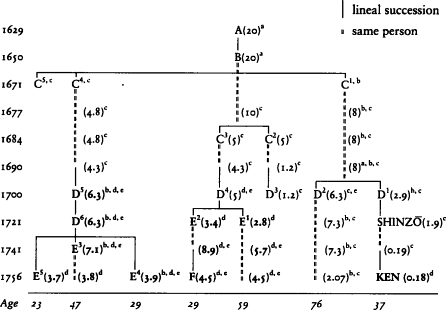
Fig. 1.
Genzaemon's Lineage, 1629-1756
a village headman (plus lineage head and titled peasant)
b lineage or sublineage head
c household in dependent relationship with C line lineage
d household in dependent relationship with D line sublineage
e possession of one horse
Source : Adapted from Ozaki, "Kenjo ikken," table 4 (p. 57).
Notes : The total yield of the lineage property held by Genzaemon (A)
in 1629 is 20 koku; that held by 7 households in 1756 is 22 koku.
Note that Ken switched sublineages: she is not dependent on D2 but on E4 .
way. Originally Ken's paternal ancestors had headed the lineage. Since around 1670 there had been four households, headed then by Rihei I, Ken's grandfather (C1 of fig. 1) Around 1700 there were five households (D1 —D5 ) headed by two patrons, Ken's father, Rihei II (D1 ), being patron to two units, and Rihei's cousin (D5 ), to one. By the 1750s, however, power within the lineage had shifted further away from Rihei's line, for now Rihei II's cousin's son Juzaemon[*] (E4 ) was patron to four households (E1 , F, E3 , E5 ), while the other "patron," Gendayu[*] (D2 ), had Ken "registered under him," but not as a fully established branch house, so that he was, properly speaking, no longer patron of a segment of the lineage.
As mentioned above, the patron-client (or main house-branch house) lineage structure was a strictly internal village affair, not regulated by shogunal law (although disputes concerning it, unresolvable in the village, could come before intendants). That it was private or informal from the lord's point of view does not mean that lineage practice was not formalized and regulated locally. The distinction between private and public does not pertain to the presence or absence of political regulation as such; rather, it defines the modality of jurisdictional recognition between two social units one of which encompasses the other. Thus the famous revenge of the forty-seven ronin[*] of Ako[*] , masterless samurai who avenged their lord, was for the bakufu not a private but a public act and therefore under its jurisdiction. The bakufu left lineages alone, recognizing as legal entities only neighborhood kumi as public institutions at the subvillage level. Nevertheless, as we shall see repeatedly, lineages were crucial for the communal organization of villages.
Every peasant household in the Kita-Saku area had to be accounted for intramurally in a patron-client relationship; none could function otherwise. Even new settlers from outside had first to secure a sponsoring patron in addition to the village council's approval. Since political power was limited to titled peasants, who held access shares to irrigation, common grass or mountain land, and so on, and lineage heads were always titled peasants, a client's access to power and its benefits was totally dependent on his or her relationship to a patron and the latter's position and standing among the titled peasants. A client who had serious complaints about his or her patron or lineage head could ask the village council to switch the household to a different patron.[34] Such change, together with the reasons for it, was duly recorded in the village.
Ken was able to elevate her status from co-resident back to branch house, as it had been when her brother and mother were still alive, by securing a male head and eventual successor to the house through marriage. This increased her autonomy vis-à-vis her lineage patron. Ken's switch to Juzaemon[*] as her new patron was a double blow for
[34] For examples of newcomers seeking a patron, clients wanting m switch lineages (in the neighboring villages of Gorobe-shinden and Yawata}, and other cases illustrating the position of clients, see Oishi[*] Shinzaburo[*] , Kinsei sonraku no kozo[*]to ie seido (Ochanomizu shobo[*] , 1968), 125-37.
Gendayu[*] , for now he lost control over Ken's household and his status as patron, for he had no other clients. The whole lineage, except for himself, because he was a titled peasant, was now controlled by Juzaemon[*] , who had five branch houses as his clients.
The reason for this change was recorded as "disharmony (fuwa )" between Ken and her uncle: "Horeki[*] 6 [1756]. Ken is taken out as coresident from under Gendayu[*] . There being disharmony with her uncle [Gendayu[*] ], Ken is also removed as client and will be client of her cousin [in reality her linealogical third cousin] Juzaemon." Ken's failed marriages and her three-year absence from the village must have been related as cause or effect to this "disharmony," but relations must have been very strained for her to want and to be granted severance from her uncle. We know the real reason from a petition she submitted to the headman in the summer of 1757, a year after her marriage to Rokuemon.
An Open Secret Publicized After Seventeen Years: 1757
On 1757/7/22 Ken made the rounds of all her kumi/lineage members, the three kumi heads and the headman, in other words, all the authority figures in Makibuse. She told them that she had a request to make. This was obviously a serious matter, because that day the headman started keeping notes of meetings, recording also the absence of any officials and the reason for it, as well as occasional quotations of who said what.[35] He obviously was creating a paper trail to cover himself, for Ken's request concerned the violent death of her brother, Shinzo[*] . The headman recorded that he consulted with two villagers that same evening. Two days later he got in touch with the Shimogata magistrate.
Thus prepared, before Ken had even made her request officially known, and most likely having agreed among themselves on a strategy, the village officials took the first steps four days later, on 7/28. On that
[35]
day the gathered officials (the headman and the four kumi heads) called all Ken's relatives for a hearing. When Rokuemon, Ken's husband, was asked whether he agreed with Ken, he replied that "she had not involved him at all (watakushi e wa issai kamawase mosazu[*] soro[*] )." While his answer may sound implausible, it is not impossible that he knew nothing about this matter. He had moved to Makibuse to marry Ken only eleven months earlier. His answer was important, however, because it was certainly irregular for a wife to engage in public action that took on the appearance of a lawsuit without her husband's consent, since he held legal authority over the household.
The interrogators must have known that this was a wedge they could possibly drive into Ken's intentions. In Rokuemon's written affidavit taken three weeks later, it is indeed clearly stated that "I did not know anything about it" and that "I am not of the same mind [as Ken] on this (ichien doshin[*]tsukamatsurazu )."
His wife's pursuit of a lawsuit, with or without his knowledge or assent, must have humiliated Rokuemon, for it showed his inability to keep order in his own household as was his duty. Moreover, lawsuits were to be avoided at all cost. Those who resorted to them were written about in the village law as being on a par with other troublemakers and thus as people who should be reported: "Art. 16. People who are not engaged in cultivation, trade, or any other occupation, or withdraw from consultation with the village, or like quarrels and lawsuits, or do all kinds of bad things should not be hidden [but reported]" (see appendix 3 ).
Rokuemon left Ken in 1759/2, a year and a half after Ken's lawsuit. He may have returned to his native Mochizuki, which was very close. There is also a written pledge from around this time to stay away from sake; his problems must have led him to drink. All his in-laws and the household heads of the Juzaemon[*] group tried in vain to bring him back. Shortly thereafter, Ken added her voice and persuaded him to return.[36]
Obviously, life in Makibuse had become unbearable for Rokuemon, yet Ken prevailed for a while in keeping him home. Finally, he could not take it any longer, and two years later, in 1761, he disappeared for good. Ken, however, must have had problems too, for around the same time she started petitioning to leave the village. Indeed, as we shall see,
[36] The history of Rokuemon's earlier disappearances is discussed only in Ozaki, "Kenjo oboegaki," 72.
her first request coincides with the moment she understood that her suit had failed.
As mentioned above, Ken directed her accusations against her relatives, among others, especially against her uncle and former guardian, Gendayu[*] . This suit, which had been on her mind for some time, sheds light on Ken's second and third marriages. Her second one came to a quick end because her move to another village under a different jurisdiction (Komoro domain) would have made a suit nearly impossible. This marriage would have removed the only voice critical of what had happened to Shinzo[*] .
Perhaps Ken sensed that this arranged marriage was an exile in disguise, which may explain her resistance under the flimsy pretext of inauspicious geomantic matters. Yet her reinstatement as Gendayu's[*] coresident robbed her of the voice she needed if she intended to file a suit, especially a suit against him. Once registered under him, Ken was legally as incompetent as a child, and "hierarchy suits," in which children might sue fathers or retainers might sue their superiors, were outlawed.[37]
Ken's third marriage, to Rokuemon, however, solved the problem of legal voice, because it gave her back her status as a member of an autonomous household. It is quite possible that through this marriage she intended not so much to put the minds of her relatives to rest by securing the succession to her house (especially since later she would categorically refuse to take the necessary steps for establishing an heir) as to dissolve her total dependency on Gendayu[*] , block any interference by him, and gain the necessary authority to act publicly.[38] Rokuemon, perceived by others and perhaps himself as having been used by a scheming woman, lost his bearings, fell apart, ran away, and finally fled for good.
Ken was present at the hearing of 2/28, but she was not asked about
[37] Dan Fenno Henderson, Conciliation and Japanese Law, Tokugawa and Modern , 2 vols. (Seattle: University of Washington Press, 1965), 1:118: "Whether they were family or feudal, the rule was that suits brought by inferiors were not accepted."
[38] I would like to record Professor Yokota Fuyuhiko's cautious reservation as he communicated it to me in Kyoto in the summer of 1994 regarding my interpretation of the legal dimension of Ken's third marriage. In his opinion, universal registration in Tokugawa Japan created, in principle , the notion that everybody had the right to petition or sue, a "right" that was, however, thwarted in many practical ways. In this view, strictly speaking, Ken would not have needed that marriage to give her legal voice.
her "request." Instead, she was told that an oral request would not do: if she had a petition to make, she should put it in writing. The next day, a report of the investigation was sent to Shimogata, probably under the assumption that things had been taken care of. By insisting on a written petition, the officials must have aimed at more than a postponement of the case, calculating that without her husband's consent and assistance, and with the whole village against her, Ken would be unable to draft a formal document.
Ken, however, was a resourceful woman. A week later, on 8/5, in the evening, she delivered a written petition to the village authorities via the proper channel, that is, via Juzaemon[*] , her patron and kumi head. Early the next morning, Juzaemon[*] rushed the document to the headman, who convened the village officials that same evening. Ten days later the document was forwarded to Shimogata.
The first half reads as follows:
This is a request to hold the seventeenth memorial service for my elder brother Shinzo[*] . I have mountains and mountains of grudges against Mr. Chuemon[*] [the headman]. He called my relatives and he called the whole village together, deliberated with them, gave detailed instructions, and [thus] the innocent peasant of my house [my brother] was killed. If he had been guilty [of some crime], my mother or myself would have been told the details by my relatives. [But] because he was blameless they kept silent to us. He was killed [because the headman] had wondered what [other misbehavior Shinzo[*] ] might engage in next, given the things he had been doing. Spite and vexation about this murder have piled up mountain high, which I kept in my heart until this year. I want to pray for the repose of his soul with a memorial offering so that your descendants may not suffer divine retribution. Anyhow, following my judgment (nanibun ni mo kono kata no zonji yori ni ), I request that a memorial service be held.
On 1741/11/ 6 [a week after the murder], my relative Shinzaemon [E1 of fig. 1] called people together and I went [Ken must have returned to Makibuse from Mimayose] and heard details about this. Shinzaemon said that an order had come from the headman to have a memorial service held, since Shinzo[*] had been killed. I returned home and told my mother the details [of what I had heard]. My sister also came from Yawata station [where she had married]. Anyhow, we thought of filing a suit for punishment with the shogunal authorities (gokogisama[*] ). But I was young [twenty-three] and mother lost her mind because this had been too much for her, so that I abandoned the plan until this year.
I have mountains of resentment against Mr Gendayu[*] [my uncle; D2 ] in this matter. [At one point, Shinzo[*] ] lost the horse of my sister's husband Jingoemon from Yawata and came to borrow money [to pay back his
brother-in-law], but my mother refused because they both [her son and son-in-law] were her children [she said], so he went to Gendayu[*] , who lent him the money [on the condition] that [Shinzo[*] ] henceforward stop dealing with horse people. All the relatives signed a note to that effect.
In addition, on 1741/16 his uncle had entrusted his own horse [to Shinzo[*] ], who had [mishandled] it, so that it could nor be sold. For this reason [he] did not [dare to] come home. If he were to come home, my uncle, Mr. Gendayu[*] , threatened to kill him. This being the case, Shinzo[*] pondered setting out for another province, but the thought of leaving his old mother behind alone held him back. So he hung around in the area and stayed at a dry field [owned by the family] at the foot of Ichiyama. There, everybody [got together] and a big crowd drove him out, and so on 1741/10/31, in the evening, it was inevitable that he was killed (uchikorosaresoro[*]wa bitcho[*]gozaro[*] ) beyond the great bridge of Momozawa.
Shinzaemon [E1 ] delivered the first blow with a club, for which I heaped mountains of hatred on him. But now, after seventeen years, I shall forgive him. [They] were told [to kill] this innocent man by the headman, but they should [simply] have banished him. Dan'emon, who delivered blows, after seventeen years I can forgive. Uheiji [F] is without blame, but Bunkyuro[*] [his brother], who died, he also delivered blows and is guilty. I do not know about Chokyuro[*] [E3 ], Naoemon [peasant representative; 1.b of table 5], Iheie [kumi head; 5.F of table 5], Kichizaemon [kumi head; 13.v of table 5] and the people of the village. But those who participated in this murder must know about them.[39]
Thus, the reason for the disappearance of Shinzo's[*] name from the village population register in the spring of 1742 was that he had been clubbed to death by his relatives and fellow villagers a few months earlier. Ken heard about it, although perhaps not in great detail, at the time of the memorial service ordered by the headman, very likely to protect himself and all accomplices against Shinzo's[*] avenging spirit. Together with her sister and mother, Ken had pondered the possibility of pressing charges with the shogunal authorities, a plan she abandoned, but only for seventeen years, as it turned out. Over time, Ken probably picked up bits and pieces of the story, which was a public secret. Realizing Gendayu's[*] role in her brother's murder must have made life under him unbearable, a situation so perfectly euphemized by calling it fuwa , disharmony.
Ken's most serious accusations, however, were directed at the head-
[39] Ozaki, "Kenjo ikken," 50-51. The second half of this document is discussed below.
man for allegedly ordering the murder of a man who, although admittedly a troublemaker, certainly did not deserve the fate that befell him. Ken deduced Shinzo's[*] "innocence" from the silence of those who should have informed her and her mother of the reason for his death. Shinzo's[*] troubles had centered around horse trading and gambling, both activities that were disapproved. Article 51 of the village law specifically warns against horse thieves and go-betweens in horse trading (see appendix 3). This angered most of all his uncle Gendayu[*] , who seems to have used Shinzo[*] as a middleman to sell his own horse, which Shinzo[*] somehow must have spoiled.[40] Understandably angry, Gendayu[*] threatened to kill Shinzo[*] , which implicates him heavily in this "death almost foretold," as Gabriel Garcia Márquez might put it. According to Ken, there had been malign intention to kill her brother: an order by the headman and a threat by Gendayu[*] . She blames her relatives for having followed a death order rather than simply expelling Shinzo[*] , and she names people who might know more about other participants in the murder. Although Ken stated her accusation within the context of a professed desire to hold a memorial service and a willingness to pardon some of those involved in the crime (about which more will be said later), she was seeking at least some justice—from the accused—for a crime committed seventeen years earlier.
If the village officials had ordered the murder as a punishment, they were in double or even triple jeopardy: for contracting a murder, for committing it, and for going beyond the bounds of their penal jurisdiction by issuing a death verdict, if, in fact, that is what they did. This last point is important, for as we know, in principle, "private justice" was forbidden by shogunal law.
The historian Mizumoto Kunihiko lists seventeenth-century laws (which did not change during the next century) at various jurisdictional
[40] In 1737 there were 16 horses in Makibuse, which then counted 12 titled peasants out of a total of 52 households, with a total population of 248. In 1750 the figures were slightly different: 12 horses, 11 titled peasants out of a total of 48 households, and a population of 242 (see table 1); thus there was almost one horse per titled peasant. The price of a horse is discussed as follows by Tanaka Kyugu[*] (1662-1729) in his Minkan seiyo[*] of 1721: "Peasants need horses, but their price has gone up in recent years. In the past, one could get a horse for one or two ryo[*] . Now, however, there are no horses for that price ... now one cannot even get them for ten ryo[*] " (Nihon keizai sosho[*] , ed. Takimoto Sei'ichi, vol. 1 [Nihon keizai sosho[*] kankokai[*] , 1914], 261). In article 13 of appendix 4, a price of "from 3 bu to one ryo[*] " is referred to in 1665.
levels prohibiting punishments such as wounding or killing by villagers: shogunal laws issued for intendants to be applied in their districts, bannerman laws for their fiefs, and bakufu-ordered village laws.[41] The heaviest penalty allowed at the village level was banishment, although, as we shall see in chapter 4, scholars have recently discovered a small number of exceptions. In addition, Mizumoto cites instances of enforcement of such laws: in Okayama domain a headman was beheaded for having "secretly" (i.e., "privately" on his own initiative, without reporting it to the higher authorities), and with the help of others, killed a thief (1676); village officials in a shogunal fief were fined in 1778 for having "secretly" banished a thief to another province. Makibuse's village law explicitly prohibited the killing of evildoers (article 4) or the plotting by peasants of evil things (article 17; see appendix 3).
The officials in Makibuse saw their options for getting rid of this case disappearing fast once an official accusation of murder had been made. If behind the attempt to have Ken married out to Kannonji-shinden lay the intention to get rid of the one dissident voice against them, they had failed. Doing away with the evidence by eliminating the litigant was obviously much too extreme and risky. Besides, the recommended punishment for such a crime in shogunal courts was the death penalty, followed by gibbetting of the severed head.[42] Persuading Ken to withdraw her suit did not work either. Hence, they had to transmit the suit to the Shimogata office because murder was a matter beyond village jurisdiction and the investigation and punishment had to be left to the higher authorities.
What the village officials resorted to, as already mentioned, was seeking secret advice from the Shimogata magistrate on how to handle this
[41] Mizumoto Kunihiko, "Kogi[*] no saiban to shudan[*] no okite," Saiban to kihan , Nihon no shakaishi, 5 (Iwanami shoten, 1987), 285-86 (hereafter NNS 5); the information on village punishment in the following paragraphs comes from p. 286.
[42] Kujikata osadamegaki (1742), art. 71, par. shi, tsuika of 1744 (Tokugawa kinreiko[*]koshu[*] , ed. Ishii Ryosuke[*] , 4 vols. [Sobunsha[*] , 1959-61], 3:419 [hereafter TKKk]). For an English translation of book z of the Kujikata osadamegaki , see John C. Hall, "Japanese Feudal Laws HI: Tokugawa Legislation, Part IV, The Edict in 100 Sections," Transactions of the Asiatic Society of Japan 41, pt. 5 (1913): 683-804. For a German translation of the whole work, see Otto Rudorff, "Tokugawa-Gesetz-Sammlung," Mittheilungen der Deutschen Gesellschaft für Natur- und Völkerkunde Ostasiens in Tokio , supplement to vol. 5 (April 1889).
case before officially transmitting the suit to him. That much we know from Makibuse's headman's diary, but he did not record the nature of this advice. We can only follow the developments surmising what it might have been.
The shogunal legislation that would be applied in an eventual trial was as follows. The law provided for severe punishments, graded according to the nature of the murder, the perpetrators, their motives, their degree of participation, and the status of the victim. For example, accidentally killing a nephew was punished by banishment; but if the murder had been premeditated for gain, it was punished by death (shizai ). Contracting a murder was punished by death (geshunin ); executing a contract murder, by banishment. Among accomplices, the one who struck the first blow received the death penalty (geshunin), those who assisted were banished, and those who did not physically participate in the crime were punished by medium deportation (10 miles).[43]
There existed some half-dozen different death penalties, of which shizai and geshunin were the lowest two. Death penalties were always beheadings, to which various additional degrees of nastiness could be added, such as exposure of the criminal, gibbetting, and so on. Shizai always entailed the availability of the corpse for sword practice (tame-shimono ) by samurai and confiscation of the criminal's property (kessho ). Geshunin, as a rule reserved only for commoners, was based on the retribution principle calling for the taking of a life if a murder has been committed; the corpse and property were left intact.[44]
Investigating an Allegation
On 8/I6, a week after Ken's document was forwarded to Shimogata, Ken's relatives were called together by the village officials to ascertain their intentions. As was to be expected, they disagreed with Ken's statement, which again left her alone to face the whole village and its authorities. She had no allies.
The next day Ken was summoned by the headman and informed of her relatives' intention not to back her up, to which Ken apparently retorted, "If my request is not settled after submitting it to the [Shi-
[43] Ibid.
[44] Hiramatsu Yoshiro[*] , Edo no tsumi to batsu (Heibonsha, 1988), 94.
mogata] public office (Goyakushosama negai age ), I shall go all the way to the Edo office (Edohyo[*] )."[45] The headman's ploy to keep the lid on this case foundered on Ken's forceful counterthreat to bring the case to court in Edo. Always upping the ante in her confrontations with authority, Ken invariably found ways to respond to official threats with threats of her own. Thus, the Shimogata office was officially informed of Ken's suit.
On 8/21 life came to a halt in Makibuse. Early that morning all those involved in Ken's suit, practically the whole village (the headman, the kumi leaders, and all the members of the kumi), were summoned to Shimogata for interrogation. Yet the question addressed to Ken was not about her allegations. It concerned Shinzo's[*] relationship to his household and Ken's knowledge thereof: did Ken know that her brother had been disinherited? She testified that she had never been informed about it but added that if Shinzo[*] had indeed been disinherited, "what I have said will have difficulty standing up (watakushi mosu[*]bun aitachinikui tatematsuri zonji soro[*] )." In other words, her indictment might be null and void.
Ken had married and left home four years before her brother's disappearance. Therefore, it is possible that she did not know that Shinzo[*] had indeed been disinherited only a few months before he was killed. Shinzaemon, however, produced then and there the disinheritance deed. Seeing that the killers would escape prosecution, Ken spat out, "Now I hate you even more." We shall return later to this question of disinheritance (kyuri[*] ). Let us first follow the investigation to its conclusion.
A second question pressed upon Ken was how she had drawn up the lawsuit. Her ability to do this, after all, had thwarted the village officials' plan to ever let it come this far. Ken admitted that she had paid someone to draft the document, but she was fierce in her refusal to reveal the name of the person who had assisted her. "I won't tell you," she fired back, "even if I lose my head for it."
A war was being waged here over knowledge of documents. The disinheritance deed nullified Ken's suit, and she was ultimately accused of lying when she maintained her ignorance of its existence. The officials, on the other hand, tried to prevent her from producing a docu-
[45] Ozaki, "Kenjo oboegaki," 76.
ment, the suit, in order to avoid an investigation, and they insisted (in vain) on knowing who had composed it. Ken's ignorance was the weapon used by the officials against Ken (she should have known about the disinheritance), that she was quick to use against them when she refused to reveal the name of the scribe.
Of course, we do not know who helped Ken. It is unlikely that it was someone from the village. If she had to find help elsewhere, however, she would not have had to search far. Her family temple in Iribuse, to which she intended to commend her property, was only one kilometer away. She could have gone to Yawata, where her sister was living and where her mother and grandmother had come from. By this time in the Tokugawa period there were literate people in most villages, some even with scholarly pretensions. For example, in Katakura village, two and a half kilometers beyond the hills west of Makibuse, one of the village officials had a collection of books and manuscripts, even a copy of a work by Yamagata Shunan[*] , one of Ogyu[*] Sorai's disciples.[46]
There were thus ways to circumvent the village elite's monopoly on writing and on writing in proper form (which meant power in a regime that governed through documents). Ken's "petition," nevertheless, was not in proper form, for it gave too much vent to her resentment and hatred and was devoid of the obligatory deferential formulae, besides being extremely difficult to understand. It looks like a draft for a suit and allows a rare glimpse at a commoner's feelings, and rarer still, at a woman's confrontation with authority.
At this juncture, a senior retainer (karo[*] ) from Shimogata joined the case and examined the evidence. Ken gave up her lawsuit, owing to the legal point made of Shinzo's[*] disinheritance, and then requested to leave the village. She must have realized that life there would be hell, and those with the power to decide whether to release her or to consign her to the village for life must have realized it as well. She was given no final answer; instead, she was "entrusted" to her husband Rokuemon, a euphemism for house confinement. This closed the first round of the investigation. Now that Ken's allegations had been thoroughly discredited, the matter of Shinzo's[*] violent death could be taken up—rather safely, one should add.
[46] Nagano-ken, ed., Nagano-kenshi: Tsushi[*]5 (Kinsei 2) (Nagano-shi: Nagano-kenshi kankokai[*] , 1988), 251 (hereafter NAK-T 5).
A whole month went by before, on 9/21, Gendayu[*] testified and admired to the murder as follows:
Shinzo[*] was doing evil things [gambling] roaming about the mountain where he lived. Therefore, the lineage and the whole village banished him. They drove him out beyond the bridge at Momozawa, at which point Shinzo[*] turned around, and because he raised his hand against me, I had to hit him with the club I held in my hand. In the commotion that followed, it was hard to tell who was doing what (dare to mosu[*]koto mo naku bo[*]nite uchimoshisoro[*] ). Blows fell, resulting in his death.[47]
Gendayu's[*] legal ground for defense was built into his testimony, perhaps on the Shimogata officials' private advice. Shinzo[*] had started the fight, and his death was therefore not premeditated; it was a rebuttal of Ken's attempt to impute intention to the accused. Moreover, he had been thrown out of the village for good reason (gambling), and it was his resistance to this punishment that had led to the tragedy. On Ken's own admission, the headman had wondered "what would be next, given that he does all these things."
That Shinzo[*] "raised his hand first" was most likely crucial to Gendayu's[*] defense—insofar as a defense was still needed. This had two legal consequences. First, it turned Shinzo's[*] violent death into something other than murder: an unfortunate accident for which the victim was to blame (he had resisted expulsion from the village). And second, the alibi introduced an element that today would be labeled "justified and legal self-defense."
One article of the shogunal penal code read: "When, due to the unreasonable behavior of one party, one has no choice but to cut him or her down, if it is certain that the relatives and village headman of the victim acknowledge that he or she was ordinarily unlawful in behavior, offer no excuses for the person in question, and beg that the killer be pardoned, the punishment is to be medium deportation [i.e., a lessening of the sentence]."[48] Moreover, although in principle arrests of criminals by official or private parties had to take place without the infliction of harm, if it happened that the criminals got killed under certain circumstances, the killers would not be held responsible.[49]
[47] Ozaki, "Kenjo ikken," 52.
[48] Kujikata osadamegaki , art. 72 (TKKk 4:1).
[49] Hiramatsu Yoshiro[*] , Kinsei keiji soshoho[*]no kenkyu[*] (Sobunsha[*] , 1960), 683.
Gendayu[*] could not have known of this particular article of the penal code, because the code had been written that same year and was secret, meant only as a set of guidelines for judicial officers of the shogunate.[50] However, the code was also based on previous practice, and an awareness of mitigating circumstances must have existed, at least among bakufu officials.
Perhaps advised by the officials at Shimogata, Gendayu[*] may have aimed his testimony toward legitimate self-defense against an opponent of dubious reputation for whom nobody would speak up. There certainly was enough time to structure Gendayu's[*] testimony that way, since a month had elapsed between the first and second hearings.
A Dubious Case of Disinheritance
At this point the question of disinheritance comes in. Kyuri[*] was a distinctive Tokugawa form of disinheritance, different from an older type (kando[*] ) although often confused with it even in Tokugawa times.[51] It drastically changed one's "civic" status and is best understood in conjunction with other laws.
Japanese disinheritance practice has changed over time. Its main forms were gizetsu , kando[*] , and kyuri[*] . In antiquity, gizetsu ("cutting the obligation") meant expulsion from home and loss of all inheritance rights. During the Kamakura period (1185-1333) it was gradually replaced by kando[*] ("right measure after examination"), applied for unfilial behavior to escape vicarious responsibility for crimes one is afraid one's children might commit, especially when their whereabouts are not known, or simply when parents decide to exercise this right. The descendant had to leave the house and was freed from all filial obligations and rights, including protection, but was not barred from official posts; and the decision could be revoked by the parents. In the Tokugawa period, official permission was required for kando[*] , but now
[50] Dan Fenno Henderson, "Introduction to the Kujikata Osadamegaki (1742)," in Ho[*]to keibatsu no rekishiteki kosatsu[*] , ed. Hiramatsu Yoshiro hakushi tsuito ronbunshu[*] henshu[*] iinkai (Nagoya: Nagoya Daigaku shuppankai, 1987), 504-8.
[51] For the information that follows, see Kokushi daijiten , ed. Kokushi daijiten henshu[*] iinkai, 15 vols. (Yoshikawa kobunkan, 1979-94), 4:253 ("kyuri[*] ") and 3:884 ("kando[*] ") (hereafter KDJ). See also F. Jouon[*] des Longrais, L'Est et l'Ouest: Institutions du Japon et de l'Occident comparées (six études de sociologie juridique ) (Tokyo: Maison Franco-japonaise, 1958), 387-90.
there was also kyuri[*] ("separation for a long duration" or "old separation"). Kyuri[*] had the same prophylactic function against the consequences of possible crimes by absconded offspring. Official ratification was by the parents, kumi, village officials, and the intendant who ultimately permitted the fugitive to be taken from the population rosters, which automatically dissolved marriage and blocked any possibility of holding office.
Laws and institutions often have ambiguous functions. They steer practice along norms and paths to produce good and just behavior, which, however, may only be good and just in some respects but not in others. Hence, they also produce a need for additional laws and institutions to correct these "dysfunctions." Kyuri[*] can be understood in such a way, as a response to the undesirable effects of two other laws. One was the stipulation, inherent in the Tokugawa feudal configuration of power, that crimes be judged in the jurisdiction of the criminal's registration. The simplest of these were domains or fiefs for peasants and samurai. Matters were more complicated for uncommon commoners like priests, registered beggars, outcastes, and the registered blind or for uncommon cases that involved two jurisdictions.[52] The other legal practice with a direct bearing on kyuri[*] was the custom of vicarious guilt or communal responsibility for misbehavior (enza ): the relatives, the kumi, or sometimes the village could be punished for a crime committed by any of its members. Hence they could suffer for a crime committed by someone who had absconded and over whom they had thus lost control.
Legally separating an absconder from the group responsible for him or her through official disinheritance prevented such injustice. Kyuri[*] was thus both a punishment in absentia for someone who had illegally left the village and a protection against possible prosecution of his or her relatives and kumi members for crimes he or she might commit.[53] It should be noted that in the second half of the Tokugawa period com-
[52] See Henderson, conciliation , vol. 1, chap. 4, esp. pp. 86-92.
[53] Oishi[*] Hisakata (1725-94) discusses kyuri[*] and kando[*] in these terms. A former village group headman from Kyushu[*] who traveled widely in Omi[*] , Shinano, and the Kanto[*] , he was hired m 1783 as coordinator of rural administration in the Takasaki domain (Gunma prefecture, east of Kita-Saku), where he composed for his lord a very detailed vade mecum for rural administrators, the Jikata hanreiroku (see Oishi[*] Hisakata, Jikata hanreiroku , ed. Oishi[*] Shinzaburo[*] , 2 vols. [Kondo[*] shuppansha, 1969], 2:123-54).
munal responsibility was activated only for the most extreme crimes: killing one's lord or one's parent. Hence, "disinheritance" was rather dormant as protection for the legally accountable group.[54] It served mostly as a means for the person legally responsible for an absconder to evade social criticism within the village. Also, kyuri[*] could not be enacted against a status superior: one could not "disinherit" one's absconding parent. Such disinheritance was a publicly certified act. It had to be approved by the local headman, and valid reasons had to be stated. Since someone thus "disinherited" was erased from the village registers, this measure needed to be sanctioned by the higher authorities. It changed the official status of the person in question. A disinherited person was thus legally a nonperson and, because he or she was not attached to a legal group, perhaps the village equivalent of a ronin[*] , or masterless samurai. Such a person was thus cut off from the village in all possible ways, having neither obligations to the village nor privileges, including the privilege of protection. He was an outlaw.
A remedy to the possible ill effects of another law, kyuri[*] itself was insufficiently corrected by further laws against its own possible negative effects—except for the important general provision, central but implicit to Ken's argument, that life could not be taken. Article 4 of the Makibuse village law made this clear: "People who have killed someone, or strange people who hang out in shrines, forests, and mountains: the villagers, together with people from neighboring villages, should set out, arrest them, tie them up, and hand them over. If it is difficult to catch them there on the spot, then you have to pursue them however far and catch them where they settle. But no matter what kind of person they are, you cannot kill them" (see appendix 3). Kyuri's[*] only other softening aspect was that it was revokable if the person affected by it mended his or her ways.[55] In Shinzo's[*] case we see how kyuri[*] could be manipulated to prevent a violent death from being categorized as murder.
The next questions to be addressed are the reasons for Shinzo's[*] punishment of disinheritance and banishment. Why the disinheritance, which was an action that ultimately only Shinzo's[*] mother could have sanctioned? And why did the villagers and lineage members mete out
[54] KDJ 4:253.
[55] For an example of documents reversing prior verdicts of disinheritance and banishment, see Dan Fenno Henderson, Village "Contracts" in Tokugawa Japan (Seattle: University of Washington Press, 1975), 190-91, 194.
what turned out to be, in Ken's eyes, deadly punishment for Shinzo[*] —without trial, verdict, or, as reported by Ken, stated reasons? Ultimately, Ken was arguing degrees of appropriate punishment and maintained that they had no right to kill Shinzo[*] .
Two documents exist requesting the disinheritance of Shinzo[*] : one, signed by his mother and relatives, is addressed to the village officials and dated 1741/7; the other, bearing the seals of the village officials, is the one the village officials forwarded to the Shimogata office and is dated 1741/7/21, or barely three months before the murder. Since these documents were so crucial in the murder case, it is of course not unthinkable that they were fabricated post factum for that purpose—after the murder and even after Ken presented her suit.
If the disinheritance deed was a forgery, one might wonder how Shinzo's[*] mother's seal was secured. The modern presumption that seals were always kept at home, however, does not apply universally to Tokugawa Japan. Ishii Ryosuke[*] writes that it was not uncommon for a village headman to keep all the seals of all the households; some village laws even warned against the possible abuses of entrusting one's seal to others, even relatives.[56]
Shinzo's[*] mother's request reads as follows:
Written Petition Submitted in Fearful Deference
My son Shinzo[*] , who made a living as a horse trader, was fond of heavy drinking and misbehaved in various places. Moreover, he did not engage in agriculture. In particular, last fall he left fallow the small dry field we have, leaving me almost starving [the following spring]. Again and again the lineage, united in its views, requested him [to change his ways], but it was of no use whatsoever and the problems remained.
This year on 4/13, he disappeared with Gendayu's[*] horse without leaving a trace. I asked the lineage to look for him everywhere, but he has not been found to this day, and this matter has [still] not been settled. It is hard to gauge what other evil things he might be up to next. I therefore request the shogunal authorities to take him, starting this year, from the population register and disinherit him.
1741/7 The village of Makibuse
Shinzo's[*] mother (seal)[57]
This petition served as the basis for the official document forwarded to Shimogata, which is in three parts: Shinzo's[*] mother's (rewritten) peri-
[56] Ishii Ryosuke[*] , Inban no rekishi (Akashi shoten, 1919), 182, 184.
[57] This document to be found only in Ozaki, "Kenjo oboegaki," 77-78.
tion, an endorsement by her four kumi members/relatives testifying to the truth of her statement, and an addendum by the village officials including further explanations. The first two parts read as follows:
Written Petition
My son Shinzo[*] has not worked in recent years and not supported me, which has made life very hard for me. Moreover, on 4/13 he disappeared, which is why I asked the lineage to look for him everywhere, but to this day he has not been found, and even if we look further, I am alone with nobody to support me. Therefore, I petition to remove [my son] from the population register.
The mother of Makibuse's Shinzo[*]
1741/7/21
The abovementioned Shinzo[*] , as stated in his mother's petition, made an unsubstantial living (fujittai yue yowatari ), which caused great hardship to his mother. Then, on 4/13, he disappeared with his uncle Gendayu's[*] horse. We immediately started a search everywhere without results. On 5/21 we sought an official warrant [for an official search], and we ordered the neighborhood kumi to look for him. We have searched until today but not found him, and nobody has reported him, so that nobody from either the lineage or the kumi has been able to lay a hand on him.
The above is without fallacy. Without any discrepancy do the relatives and kumi endorse the mother's petition. Deferentially looking upward to the shogun (gokogisama[*] ), we humbly request the removal [of Shinzo's[*] name] from the population register.
1741/7/21 The village of Makibuse
petitioner Gendayu[*] (seal)
petitioner Chokyuro[*] (seal)
same Shin'emon (seal)
same Masaemon (seal)
[To :] The village headman
The elders [i.e., kumi leaders][58]
According to these documents, Shinzo[*] had ceased to work the fields and instead had gotten involved in horse trading, with the result that he was unable to support his mother. He drank too much and caused trouble. Moreover, he disappeared with his uncle's horse. (Ken also refers to this matter in her petition, although rather obliquely). Private searches failed to locate him. After one month a complaint was filed; the kumi ordered an official search, with no results.
[58] This document is available only in Ozaki, "Kenjo ikken," 53.
Fleeing became legal absconding only after a certified effort had been made to apprehend the fugitive. A certain amount of time (officially, six periods of thirty days) was fixed during which active searches were repeatedly ordered by the village or supravillage authorities.[59] Hence the mention of the failed search in the disinheritance document (although fewer than six months seem to have elapsed between Shinzo's[*] absconding and the disinheritance): disinheritance, as mentioned earlier, was a legally certified "punishment" for absconding, while absconding was the legally certified status of a fugitive.
The official petition, signed by Shinzo's[*] mother and endorsed by her relatives, was forwarded to the Shimogata office by the village officials, who appended a note with more details to complete the work of character assassination. They mention his asocial conduct with reverberations in the community: drunkenness, general misbehavior, noncompliance with the "will of the lineage," mentioned by Shinzo's[*] mother. Moreover, in the context of an investigation of theft conducted six years earlier (in 1735) by another shogunal office (one in Hiraga, some fifteen kilometers east, in the Kita-Saku plain), Shinzo[*] had been questioned because he was a horse trader (bakuro[*] ). Although Shinzo[*] seems not to have been involved in the 1735 theft (otherwise it would certainly have been used more fully against him), and although this matter was six years old, one surmises that it was made part of the record to give more weight to the argument for disinheritance by establishing, through innuendo, a long record of misbehavior and bad companions. Following this investigation, the lineage had made him promise to abandon horse trading and return to tilling the fields, a promise he had not kept. This, presumably, was "the will of the lineage."
The previous fall, the officials also related, his absence of over twenty days had made him miss the wheat sowing time, which had endangered his mother's food supply. Moreover, on 4/13 he had led his uncle's horse away to sell it and had disappeared wearing his uncle's clothes. This last detail testifies, perhaps, to Shinzo's[*] poverty: members of branch houses often relied on their patrons for material gifts or loans of daily necessity, so these clothes may or may not have been "given" to him by his uncle. His relatives looked for him quietly for one month, but then the kumi was ordered to undertake a formal search, which it did for an-
[59] Mizumoto, "Kogi[*] no saiban," 307; see also Oishi[*] Hisakata, Jikata hanreiroku , 2:113, 114, 119.
other month, without results. Fearing what Shinzo[*] might be up to next, his mother had requested the removal of his name from the register.
The case against Shinzo[*] is made again and again in these documents, at ever higher levels of authority: by his mother, his lineage, the village officials. This reiteration no doubt had a reinforcing effect, solidifying the case against him. Clearly, things were presented so as to put the blame for the removal of Shinzo's[*] name from the registers and the concomitant disinheritance on Shinzo[*] himself. But one senses also the pressure the lineage put on Shinzo's[*] mother to take this drastic step. At this point, however, she could not have foreseen the tragic outcome only three months away. And perhaps neither did anyone else in the village, although there was the alleged threat by Gendayu[*] . Moreover, since kyuri[*] could be revoked, perhaps Shinzo's[*] mother hoped for such a reversal when she consented to the disinheritance—if the document is genuine.
The Decline of a Prominent Peasant Household
In her disinheritance request, Shinzo's[*] mother mentioned that the family's landholdings were minuscule. Indeed, they may have been too small to support her and her son, so that Shinzo[*] had sought additional income in horse trading and perhaps also in gambling. How small was the property?
The family holdings Shinzo[*] inherited at the death of his father in 1719, when he was nineteen, amounted to no more than 1.9 koku, or 1.6 tan , the equivalent of less than 0.4 acres. (His father, Rihei 11, had not managed the property too well: he had lost one third of it, since he had started out with 2.9 koku.) One koku of rice was the amount needed to feed an adult for one year, and one able-bodied adult could normally cultivate three tan.[60] Shinzo[*] was obviously a very poor peas-
[60] Nakane Chie, Kinship and Economic Organization in Rural Japan , London School of Economics Monographs on Social Anthropology, 32 (London: Athlone Press, 1967), 59. See also Oishi[*] Shinzaburo[*] , Kyoho[*] kaikaku no keizai seisaku: Dai ichibu, Kyoho[*] kaikaku no noson[*] seisaku (Zohoban[*] : Ochanomizu shobo[*] , 1978), 20. A similar estimate is given in NAK-T 5:143, where it is stated that a couple could cultivate seven to eight tan (the equivalent of about ten koku). Thomas C. Smith quotes a less productive ratio: four or five adults for one cho[*] of arable (one cho[*] equals ten tan), eight or nine for two, and twelve for three (Agrarian Origins , 6). A holding's kokudaka is only an indirect reflection of its size, for it refers to the computed putative yield of all products converted into rice equivalents, on the basis of which the tribute was calculated. This tribute, in turn, was paid neither in rice nor m any other natural products. After 1726, in all bakufu land in Shinano, the tribute amount, calculated as a percentage of the kokudaka, was converted into a cash amount at the going conversion rate (NAK-T 5:86).
Table 2. | |||||
First-grade | Homestead | ||||
Holdings | Paddies | Dry Fields | Dry Fields | Total Holdings | |
At start of 1727 | 1.03 | 0.79 | 0.14 | 1.97a | |
Disposed in | |||||
1727 | 0.43 | — | — | ||
1729 | — | 0.14 | — | ||
1735 | — | 0.6 | — | ||
1736 | 0.26 | — | — | ||
1737 | 0.17 | — | — | ||
1739 | 0.15 | — | — | ||
1740 | 0.02 | — | — | ||
At end of 1740 | 0 | 0.05 | 0.14 | 0.19b | |
A 1.97 koku = 0.414 ACRES | |||||
B 0.19 koku = 0.042 ACRES | |||||
SOURCE : Adapted from Ozaki, "Kenjo ikken," table 9 (p. 63). | |||||
NOTE : The fields were sold to two distant cousins, E1 and E2 , belonging to the other sublineage, headed by D5 . The 0.14 koku of dry fields constitutes newly developed fields; the remaining 0.05 koku is also made up of newly developed dry fields. All paddles, plus the 0.60 koku of dry fields, are main fields or honden (fields registered on the original seventeenth-century land surveys). | |||||
ant with insufficient land to keep him fully occupied, but in this he was not alone in the village. With 1.9 koku, his was among the twenty-seven households, out of a total of forty-nine, with holdings under two koku.
In 1727, Shinzo[*] started to dispose of the little land he had (see table 2), until by 1740 all the honden ("original paddies": first-grade paddies and first-, second-, and third-grade dry fields) and three-fourths of the newly developed dry fields were sold to two distant cousins (E1 and E2 of fig. 1, who, it should be noted, in the 1720s and 1730s more than doubled their property, to 8.9 koku and 5.7 koku, respectively). Shinzo[*]
kept only a tiny lower-grade dry field in the mountains and the superior-grade dry fields of residence land, a total of 0.19 koku, or 0.04 acres. In other words, he wound up selling 90 percent of the land he had inherited, making him no better off than a landless peasant, as mentioned earlier. In her petition of 1757, Ken stated that her brother Shinzo[*] "went to live in the mountain on his plot of land." This plot of land, at the northern outskirts of the village, beyond the Nakasendo[*] , was the only one he had left besides the residence land. He was killed a year after he sold his last paddy.
In table z one can see that in 1727 Shinzo[*] must have suddenly been in great need of cash. This was when he sold almost half of his prime paddy to his cousin. Two years later he disposed of all the newly developed (low-grade) dry fields, except for the tiny plot in the mountains, which he kept until the end. The next spurt of sales occurred between 1735 and 1740: first the main (honden) dry fields all at one time in 1735, then the remaining precious paddy piece by piece.
It is not clear when Shinzo[*] began horse trading, but it is unlikely that he did so before he started to dispose of the land, in 1727. Until then he must have been working the fields he had inherited seven years earlier. In 1727 he fell into a spiraling circle of horse trading, gambling, drunkenness, and land sales. At least this is the picture one gets from the disinheritance document the village officials submitted to the Shimogata office. Yet these hardships seem to have come in spurts: the first one in 1727-29 (loss: 0.57 koku), the second and seemingly the greatest in 1735-37 (loss: 1.03), the last in 1739-40 (loss: 0.17). Ozaki surmizes that Shinzo's[*] "reprehensible" behavior was most likely not the cause but the result of hardships that may have had something to do with the marriages of his two sisters. His sister Ine got married in this first period, his sister Ken in the second period.[61]
These data Ozaki culled from records unrelated to the case. However, the 1763 incident (with the population register) triggered an investigation, possibly ordered by the Shimogata office. The report reveals a wider background to Ken's lineage and introduces us to some social and political dimensions of the history of Makibuse.
According to this report, Ken's ancestors had been peasants in Maki-
[61] Smith (Nakahara , 97) writes that for peasants "dowry was not normally a significant form of property." His source is late Tokugawa. Yet, the "chest of personal belongings" the bride usually took may have seriously taxed a poor peasant's resources.
buse for several generations, starting in the early 1600s with Genzaemon [A of fig. 1], headman at the time of the land survey in 1629. His holdings were listed at 20 koku, among the four largest land holdings, each between 20 and 24 koku. For four generations, down to Ken and Shinzo's[*] father, Rihei II, the family had been very prominent in the village and no doubt jealous of its prestige, which may help explain the resentment provoked by Shinzo's[*] behavior. What happened to the family between Genzaemon's time and Shinzo's[*] ? The story mirrors the fate of many families in the area. One has only to remember that down to 1662 only three out of twelve families had holdings of under ten koku, while after 1721 that number was forty-six out of forty-nine (and thirty-four of the forty-six had three koku or less [see table 4]).
In the second generation, in the late 1640s, the successor (B) lost the village headship because of an unspecified village conflict, but his holdings were not affected negatively; in fact, they grew even larger (according to the resurvey of 1669-70, he had twenty-three koku).[62] The third-generation successor (C1 , or Rihei I) also held the village headship for one year, in 1689. In the transition from the second to the third generation, in 1684, the property was split among four sons. The successor to the lineage headship (C1 , then the oldest son) received about one-third of the land, and the other three (C2 , C3 , and C4 ) each received one-fifth. However, partitioning had already started more than a decade earlier. According to the population register, in 1671 the family had been split into four separate households: Rihei I (C1 , then the second oldest son), Shinzaemon (B, the father), Heishiro[*] (C4 , the youngest son), and Choemon[*] (C5 , the oldest son, who disappears from the registers thereafter). The latter three, including the father , were all clients of Rihei I, their patron and also the only titled peasant in the lineage.[63]
[62] Ozaki has discovered no further details concerning the village conflict that caused the headship to be lost to another lineage. The research by Mizumoto Kunihiko and Saito[*] Yoshiyuki, introduced in chapter 2, suggests that most of the village disturbances of the 1640s were directed against the arbitrary use the village headman had made of the new power the lords had vested in them (Mizumoto Kunihiko, Kinsei no mura shakai to kokka [Tokyo[*] Daigaku shuppankai, 1987], esp. chaps. 1 and 3 [hereafter Mura shakai ]; idem, "Murakata sodo[*] ," Chusei[*] no minshu[*] undo[*] ,Chuseishi[*] koza[*] , 7 [Gakuseisha, 1985], 289-307; Saito[*] Yoshiyuki, "Kinsei shoki no nomin[*] toso[*] to muraukesei: nengukanjo[*] sodo[*] o sozai to shire," Rekishi hyoron[*] ,no. 475 [1989]: 42-60).
[63] Ozaki ("Kenjo ikken," 57) charts the 1671 generation as one comprising three brothers (Rihei, 37; Shinzaemon, 64; and Heijiro[*] , 34) and a fourth person (Choemon[*] , 39), whose relationship m the other three is unspecified (respectively, C , B, C , and C in fig. 1). Three of these four were relatively close in age, but the fourth, Shinzaemon, was twenty-five years older than the oldest of the trio, which makes it possible that he was their father—assuming also that Choemon[*] is a sibling. According to Ozaki's table, this Shinzaemon was the son of another Shinzaemon. My reasoning is based on the assumption that there is only one Shinzaemon, son of Genzaemon (A) and father of Rihei I and his brother(s).
It should be noted that the father moved out (a pattern of retirement sometimes called inkyo bunke , literally, "retirement branch house"), and the headship was passed on to a house that branched off but was legally the head of the lineage and inherited also the status of titled peasant. Primogeniture was by no means the rule in this region or, indeed, in most of rural Japan in the seventeenth century.
More and Smaller Peasants
In 1734 a bakufu official sketched a picture of the optimal ratio of land to people in an ideal village. Such a model community would have zoo koku (half paddies and half dry fields) and a population of 120 divided into 24 households, 60 males and 60 females, as well as 12 craftsmen or merchants and 6 horses.[64] In terms of arable, Makibuse met this standard: in 1750 it had 205 koku (see table 1). Its population, however, was double what it should have been: 48 households with a total of 242 members and 21 horses.
This model was put forward at the time of the first of three large-scale reforms, the Kyoho[*] Reforms of the 1730s, which attempted to arrest developments that had weakened the bakufu's economic base. The earlier edicts prohibiting the sale of land (1643) and the division of land into holdings of less than to koku (in the case of headmen, 20 koku) (1673) had failed to strengthen the rulers' grip on agricultural surplus. A significant increase in the number of large landholdings syphoned off part of that surplus as land rent paid to landlords by tenant farmers without land, or with too little land to support their households. The history of these two prohibitions—"thou shalt not accumulate" and "thou shalt not divide"—and their implementation is a complex one.[65] Put simply, it is clear that the laws were circumvented in various ways.
[64] Nakane, Kinship , 42.
[65] See Oishi[*] , Kyoho[*] kaikaku .
The limitation on land partitioning was dealt with locally by officially (tatemae ) limiting the number of titled peasants and recording branch houses as working part of the main family's land (buntsuke ). This practice can also be found in Makibuse, for instance in Genzaemon's lineage. The 1677 cadaster shows the land registered under Rihei I's name and indicates the amount tilled separately (buntsuke) by each household of the lineage.
Oishi[*] Hisataka, the eighteenth-century local administrator of Takasaki domain in a neighboring province, explained this "partition" as marking the division of inheritance but not separately established branch houses (bunke ).[66] If branch houses were established, their heads would be titled peasants and would pay tribute and corvée directly, he wrote. In Makibuse, however, those households marked as buntsuke in the 1677 land cadaster had already been registered six years earlier in the 1671 population register as branch houses (kakae), that is to say, as separate branch houses under a patron. It is not clear whether these houses paid their tribute directly, as Oishi[*] Hisataka suggested, or through their patron. What is certain, however, is that they were branch houses without being tided peasants. Over time, the number of titled peasants in Makibuse decreased somewhat, while the number of households providing tribute and corvée increased dramatically. Thus the bakufu's definition of a titled peasant (as seen through Oishi's[*] eyes) was at variance with the village's. In the village of Makibuse, the title became a privilege and a mark of political, not economic, power. Like shares or stock that could be sold, titles were transmissible and negotiable. In order to purchase one, an individual needed "economic capital," but as figure z indicates, one could hold on to it as symbolic (and political) capital even if one's holding was less than 2 koku. Note that household L of figure z had only 0.4 koku, whereas the village headman had 33 koku, and they were both titled peasants.
As in the case of neighboring Kodaira, which is analyzed in detail in chapter 3, partitioning leveled economic differences between titled peasants or patrons and (nontitled) branch houses. Such partitioning of the lineage's holdings by establishing branch houses was a common practice in Makibuse. Other examples are the Iemon and Kichisaburo[*] lineages (see table 3 and fig. 2).
[66] Oishi[*] Hisakata, Jikata hanreiroku , 2:110. On Oishi[*] , see above, n. 53.
Table 3. | |||||||||
Lineage Households | |||||||||
Lineage Patron and Co-residents | A | B | C | D | E | G | K | ||
1719 | A + d/e/f/g/h (5 sons) | 13 | 4 | 5 | |||||
1723 | H + d/e/f/g (4 sons) + k/m (2 fudai) | 14 | 4 | 4 | |||||
1729 | H + f/g (2 sons)+k (1 fudai) | 7 | 4 | 4 | 3 | 3 | |||
1731 | H + f(1 son)+ k (1 fudai) | 4 | 4 | 3 | 3 | 3 | 3 | ||
1736 | F | 3 | 4 | 3 | 3 | 3 | 3 | 0 | |
SOURCE : Adapted from Ozaki, "Kenjo ikken," table 3 (P. 55). | |||||||||
NOTE : Over a span of thirteen years, between 1723 and 1736, the lineage, headed by A, added four households, D-K; by 1719, B and C already existed as autonomous households. The position of economic prominence of the main house over the branch houses disappeared as its size dropped from 14 koku to 3 and its holdings were equalized with those of all the other units of the lineage. Notice that H, the successor to A, was the youngest of five sons (d-h) and that the holding was divided equally among them. Of the two fudai of 1723, the female (m ) had disappeared from the registers by 1729; the remaining male fudai (k ) was eventually established as branch house K without land (mizunomibyakusho[*] ) in 1736. It was quite usual for fudai to marry and have families of their own after being set up as a separate branch. Thus, the practice of branching off of fudai must have led to a population increase. | |||||||||
The same leveling trend was manifested throughout the village (see table 4). Between 1647 and 1662 the distribution of holdings among titled peasants remained stable: four units had holdings of 20-24 koku (one of them being the A and B generations of Genzaemon's lineage), five units had 10-14 koku, two had 5-9 koku, and one had 3 koku. The one household with less than 1 koku in I647 had disappeared from the registers three years later, leaving a total of twelve titled peasant households by 1662.
By 1677, however, the situation had changed drastically, although official registration maintained a fiction of continuity: four households were shown to have more than 20 koku, four to have 10-14 koku, seven to have between 4 and 9 koku, and one with 1 koku, bringing the total to sixteen, an (official) increase of four. Yet, in reality, seven out of this total of sixteen holdings (each officially registered under one house) were divided among two to five households, usually evenly, resulting in a massive (unofficial) increase in the number of households owning 1-10 koku of land. The distribution was as follows: one house of 29 koku (that of Chuemon[*] , the village headman); one of 11 koku and one
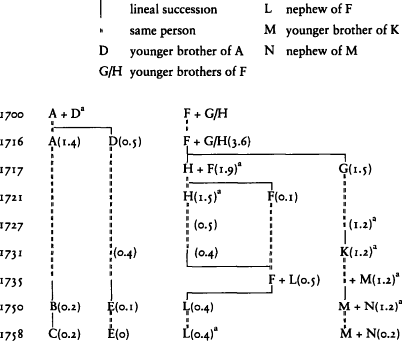
Fig. 2.
Kichisaburo's[*] Lineage, 1700-1758
a titled peasant
Source : Adapted from Ozaki, "Kenjo ikken," table 7 (p. 61).
Notes : Nonce the kokudaka of 0.4 of title peasant L in 1758.
It will be remembered that the headman, also a titled peasant,
had over 30 koku. Smith (Agrarian Origins , 39 n. d) states that
to "ignore the minimum [below which partition was not practical]
was to invite ruin." Yet this is precisely what seems to have been
happening here and else where in the village. Hayami Akira wrote
that there were no cases of holdings under 5 koku being divided
("The Myth of Primogeniture and Impartible Inheritance m
Tokugawa Japan," Journal of Family History 8, no. 1 [1983]: 23).
of 10 koku; thirteen in the 5-9 koku range; and fifteen in the 1-4 range, bringing the actual total to thirty-one households, an increase of nineteen over the 1662 total.
In subsequent decades the partitioning of lineage lands continued. By 1721 the total number of households had risen to forty-nine (thirteen titled peasants, thirty-two branch houses, and four landless peasants), with two holdings above 30 koku; one of x4 and one of 10 koku; seven in the 5-9 koku range; eighteen in the 1-4 koku range; and sixteen with less than 1 koku. Four peasants were registered as without land of their own.
By 1700, when Ken's grandfather Rihei I divided his property (increased by 1 koku to a total of 9), some branches of Genzaemon's lineage were struggling to survive on very diminished holdings. Ken's father, Rihei II (D1 ), received only 2.9 koku, and her uncle Gendayu[*] (D2 ), 6.3 koku. Her father's cousin (D3 ), with only 1.2 koku, soon disappeared from the land register. The other branch of the lineage was doing better: another cousin of her father's (D5 , who held 6.3 koku) formed a sublineage with yet another cousin (D4 , holding 5 koku) and the latter's two successors (E2 and E3 ).
In 1703 Ken's father, Rihei II, transferred half of his already small holdings to his brother Gendayu[*] , retaining only 1.5 koku for himself. He must have been experiencing financial difficulties, an indication that the decline of this line did not start with Ken's brother, Shinzo[*] . Peasants in this situation had few options. Obviously, they lacked the means to develop substantial new fields. Moreover, the terrain may not have allowed further development. Over more than four generations, between 1627 and 1756, the lineage's holdings increased by a mere 2 koku.
One solution was part-tenancy, but it is not clear whether this was an option in Makibuse. There were only a few holdings large enough to use labor beyond the nuclear family (two holders of more than 30 koku, one of 14 koku, and one of 10 koku [see table 4]), labor that may have been provided by hereditary or indentured servants who do not seem to disappear, even though the population grew considerably and at a much faster rate than the village kokudaka (see table 1). On the other hand, branch house or client status no doubt included some duties for the lineage head or patron that may have been remunerated; indeed, some clients may have been quasi-tenants.
Another solution for surplus members of the household was to seek regular employment in towns or cities or short-term employment during the slack winter season.[67] This is what Rihei II did. In 1712 he left his wife and daughter Ine (Ken was not yet born) and took twelve-year-old
[67] Seasonal employment m Edo during the winter months was customary in some areas in Nagano, even for villages far north, such as Yomase in Takai district. Documents show Yomase villagers petitioning to go to Edo from the ninth to the third month in 1701-2. In 1757 in Otsukoto (Suwa district), which had 130 households, the number of those who officially petitioned to spend the winter months in Edo was 33 (NAK-T 5:366). In Kodaira (see n. 24), exactly half of the peasants (9 out of 20 titled peasants and 18 out of 36 kakae) were themselves listed as being in service outside the village (all titled peasants but one, and no kakae, went to Edo); this, in addition to II of their children (see Komonjo kenkyukai[*] , "Genroku-ki," 67).
Table 4. | ||||||||
1677 | ||||||||
Koku | 1647 | 1650 | 1662 | Officially | In reality | 1721 | ||
33 | Z (1) | |||||||
32 | ||||||||
31 | Y (1) | |||||||
30 | ||||||||
29 | Z | Z | ||||||
28 | ||||||||
27 | X | |||||||
26 | ||||||||
25 | W | |||||||
[3] | [1] | |||||||
24 | Z | Z | Z | |||||
23 | x | x | x | C1 | ||||
22 | ||||||||
21 | W | W | W | |||||
20 | A | B | B | |||||
[4] | [4] | [4] | [1] | |||||
19 | ||||||||
18 | ||||||||
17 | ||||||||
16 | ||||||||
15 | ||||||||
[0] | [0] | [0] | [0] | |||||
14 | 1 | 1 | 1 | V | 1 (1) | |||
13 | 1 | 1 | T | |||||
12 | 3 | 2 | 1 V | S | ||||
11 | S | 1 | 1 | |||||
10 | S | S | B | 1 (1) | ||||
[5] | [5] | [5] | [4] | [2] | [2] | |||
9 | 1 | 1 x | 2 (1) | |||||
8 | 1 | 1 | 1 | 1 M | 1 x C1 | 1 (1) | ||
7 | 1 | 1 v v | 1 (1) | |||||
6 | 1 | 1 | 1 | 1 | 1 m | 2 (2) | ||
5 | x w w | 1 | ||||||
[2] | [2] | [2] | [5] | [13] | [7] | |||
(Table continued on next page)
Table 4 | ||||||||
1677 | ||||||||
Koku | 1647 | 1650 | 1662 | Officially | In reality | 172I | ||
4 | 2 | 2 w w w | 1 | |||||
t t t | ||||||||
s s s C4 | ||||||||
3 | 1 | 1 | 1 | 7 (2) | ||||
2 | m | 3 | ||||||
1 | 1 | 1 x | 7 (1) | |||||
0+ | 1 | 16 (1) | ||||||
[2] | [1] | [1] | [3] | [15] | [34] | |||
0 | 4 | |||||||
Total | 13 | 12 | 12 | 16 | 16+15=31 | 49 (13) | ||
SOURCE : Adapted from Ozaki "Kenjo ikken," table 5 (p. 58). | ||||||||
NOTE : Letters A-C refer to households of the Genzaemon lineage (fig. 1), M-Z to households of other lineages; small letters refer to households that are branch houses of capital-letter lineages that were officially listed in 1677 under the patron families. Numbers indicate households whose relationship over time could not be traced between 1647 and 1662. Totals of 1647 through "1677 (Officially)" all refer to titled peasants; those of "1677 (In reality)" comprise the same 16 titled peasants and their 15 branch houses after partition; the totals for 1721 are for the number of households and, in parentheses, the number of titled peasants. The number of households almost quadrupled between 1647 and 1721 (from 13 to 49), although the aggregate yield remained more or less the same: approximately 166 koku in 1647 and 186 koku in 1721. (Numbers have been rounded to the nearest even number.) Cf. table 1. The increase in small and minuscule holdings was dramatic. Landless peasants appeared in 1721 (4), when another 23 households with less than z koku were very close to becoming landless. In 1647 only 4 out of 13 households held less than to koku; in 1721 that number was 45, and only 4 held more than 10 koku. | ||||||||
Shinzo[*] with him to Edo (some 180 km, or twenty-four way stations on the Nakasendo[*] , away), where they worked together for two years. After his father returned home, Shinzo[*] stayed in Edo another three years; then he worked a year in the tiny village of Gan (at the southern end of Makibuse's valley, some 7 km from home).
These efforts proved somewhat successful, for in 1716 Rihei II was able to "buy back" 0.5 koku from his brother, increasing his holdings to 1.9 koku. This is the amount of land Shinzo[*] inherited three years later. However, when Rihei II sold part of his land to his younger brother Gendayu[*] in 1703, he also relinquished, or very likely sold, to
him his inherited lineage headship and his status as titled peasant.[68] Also, when Rihei II left for Edo, he had to step down from the village office of kumi leader, an office he would be unable to recuperate upon his return because he lacked the prerequisite status of titled peasant. Rihei II, whose great-grandfather and grandfather had been village headmen and whose father, Rihei I, had held the office for one year in 1689, had become an impoverished, untitled peasant.
A brief excursus is called for here regarding the link between village office and peasant status in Makibuse. As table 5 indicates, in the first half of the eighteenth century the number of titled peasants in the village decreased by one-third, from sixteen to eleven. These five households became clients of other titled peasants (household numbers 2, 4, 10, 14, and 15). On the other hand, some clients became titled peasants, trading status with their patrons. This is what happened between Rihei II (D1 ) and his younger brother (D2 ), and they obviously were not the only ones: see the three switches in the Kichisaburo[*] lineage recorded in 1717, 1735, and 1764 (line II of table 5); see also figure 2. This table and figure also show younger brothers superseding their older brothers (e.g., in lines 7, 8, II, and 12 of table 5), although one must here distinguish between shifting the status to a different household headed by a younger brother (D1 and D2 in line 7) and keeping the status within the same household with the younger brother succeeding his older brother as the head of the household (K and M in line 11). It is also clear that these shifts do not occur in the more well-to-do lineages (lines 1, 3, and 5), which also are able to hold on to village offices more durably. It should be noted that after 1735 the office of elder was combined with that of kumi leader (which meant the lineage head, since kumi here were constituted along lineage lines).
Lineage Tensions
Let us recapitulate Ken's story in light of this information. Some time between his marriage in 1694 and the birth of Shinzo[*] in 1700, Rihei II set up a separate household, leaving his younger brother Gendayu[*] with
[68] In Kasuga, a village southwest of Makibuse, across the hills, the village law stipulated the price a client had to pay to his patron in order to be set free and become a titled peasant as 20 ryo[*] (Nagano-ken, ed., Nagano-kenshi: Tsushi[*] 4 [Kinsei 1] [Nagano-shi: Nagano-kenshi kankokai[*] , 1987], 466 [hereafter NAK-T 4]). For a study of land pawning and redemption, see Shirakawabe Tatsuo, "Kinsei shichichi ukemodoshi kanko[*] m hyakusho[*] takashoji," Rekishigaku kenkyu[*] , no. 552 (1986): 17-32.
Table 5. | ||||||||
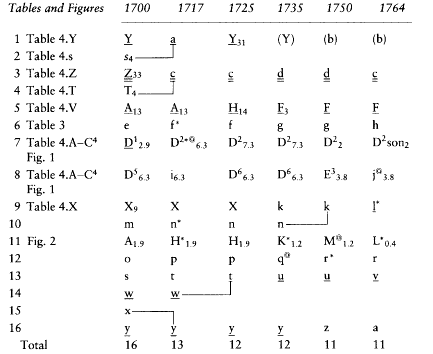 | ||||||||
SOURCE : Adapted from Ozaki, "Kenjo ikken," table 8 (p. 62). | ||||||||
NOTE : Column one is a guide to lineages diagrammed in other tables (for example, Table 4.Y = table 4, lineage Y). Letters representing household heads that appear in other tables are capitalized. All other peasants are represented by lowercase letters in alphabetical order.    |
their mother. In 1700 Rihei was thirty-seven and Gendayu[*] was eighteen. The division of the property greatly favored Gendayu[*] , perhaps because he took care of the mother: Rihei received 2.9 koku, while Gendayu[*] received 6.3, or more than twice Rihei's portion. As we have seen, the succession rules in the village were not hard and fast, least of all that of primogeniture. Nevertheless, because his brother got the lion's share, Rihei had to find ways to prevent his economic situation from declining further. It was perhaps as a means to reassert symboli-
cally the importance of his line over his brother's that Rihei adopted his father's name, thereby resurrecting his forebear and affirming his claim to the latter's power and position inherited as titled peasant, patron, and kumi head. Yet economic reality prevailed: Rihei wound up selling his titles and office to Gendayu[*] , which further increased the gap between the two families, this time in terms of political power. This was part of the legacy he left Shinzo[*] when he died at age fifty-six.
Shinzo's[*] stay in Edo during his adolescent years must have changed his outlook on the world. He returned to a life as a poor peasant without hope of improving his lot by working the fields. To the great dismay of his lineage members, who counted village headmen among their ancestors, he sought his fortune in horse trading. Worse, he courted the company of gamblers and suspected thieves.
From Shinzo's[*] perspective, however, it must have appeared that part of the reason for his misery lay with his uncle Gendayu[*] , who had wound up with most of the family's property and with the family's titles. It should be noted that none of the land Shinzo[*] sold in his seven separate sales went to Gendayu[*] : it all went to the competing and rising sublineage (see table 2). The constant criticism of his ways by the lineage and their attempts to make him change his style of life must have further alienated Shinzo[*] .
But the advice his relatives gave him carried more import than that of an ordinary uncle or aunt: as members of his kumi, they were responsible for his behavior in the eyes of the community and the authorities. Their opinions, therefore, constituted official admonitions. The head of his kumi was the representative of the village headman, behind whom stood the authority of the bannerman and ultimately the shogun. This being the case, it was difficult for Shinzo's[*] mother to defend her son, and her agreement to request the disinheritance, if it was her doing, undoubtedly signified her public disapproval of Shinzo's[*] course of action. She had to align herself with the village authorities. Yet, even thus isolated, Shinzo[*] could not bring himself to leave the village, for which he paid with his life.
As Ken pointed out in her lawsuit, the legal grounds for killing Shinzo[*] were open to question. The official effect of disinheritance was to relinquish communal responsibility, but it was revocable. Although expulsion from the village could have been a justifiable punishment for habitual gambling, it should not have meant irreversible exile. Yet it was pushed in that direction, ordered by the headman, given full lin-
Table 6. | |
1694 | Rihei II [D1 of fig. 1] (30), lineage head, titled peasant, son of village head, member of village council, marries young woman from Yawata (16) |
1700 | Rihei (36) and Gendayu[*] [D2 ] (20) set up separate households; Shinzo[*] born |
1712 | Ine born; Rihei and Shinzo[*] (12) leave for Edo; Rihei stays two years; Shinzo[*] stays five years and then works in Gan village one year |
1719 | Rihei dies; Ken born |
1727 | Ine (15) marries and moves to Yawata |
1737 | Ken (18) marries and moves to Mimayose |
1741 | Shinzo[*] (42), Gendayu's[*] client |
1742 | Ken returns and becomes Gendayu's[*] client (kakae) |
1745 | Ken's mother dies; Ken under Gendayu's[*] tutelage (chonai[*] ) Winter: Ken (26) marries man from Kannonji-shinden |
1746 | Ken returns to Makibuse; lives alone |
1749 | Ken in service at Hirabara |
1750-52 | Ken in service in Komoro, then returns to Makibuse and lives alone |
1756 | Ken (37) marries Rokuemon (39), from Mochizuki; leaves Gendayu's[*] tutelage |
1757 | 7/22 Ken's oral petition for a memorial service for her brother; headman starts keeping diary (until 11/18) |
1759 | 2/24 Rokuemon disappears |
1761 | 9/- Rokuemon (44), disappears for good |
1762 | 3/- Ken (40), requests to leave Makibuse |
1763 | 2/6 Ken requests to take Rokuemon off the population register |
1795 | 1/8 Ken dies |
NOTE : Ages are given in parentheses. | |
eage support. That Shinzo[*] resisted expulsion is understandable, but his resistance, if we believe Gendayu's[*] version, resulted in his death.
Ken bitterly resented the outcome. Yet, when she challenged its legality, the disinheritance document saved the accused by giving Shinzo's[*] violent death justification legitimized by authority (the Shimogata magistrate).
Protection Against an Avenging Spirit
In her efforts to bring this affair into the open and question its legality, Ken obviously could not count on any cooperation from within the village. She said she paid someone to draft the suit, although that may not have been true. Payment, however, made the relationship between herself and the scribe a business one, exculpating the scribe from any charge of sympathy for her case. But bringing it into the open must also have been a catharsis for Ken, as the second half of her petition/suit shows:
As for his memorial service, following my judgment (nanibun ni mo kono kata no zonji yori ni ), it should be held so that none of your descendants might suffer retribution. The service itself should consist of daily recitations at Zenkoji[*] in perpetuity (kono yo aran kagiri ) and, also at Zenkoji[*] , a forty-nine-day ritual; daily recitations in perpetuity at Koyasan[*] and a lantern; at the family temple of Baikei-in, recitation of one thousand sutras in perpetuity.[69] If things turn out that way, I shall sponsor all this. I shall go to Zenkoji[*] [to arrange] for the service. I shall bring money from you and I shall contribute my own part (sesshagi mo kono setsu dodo[*]itasu beku soro[*] ). Koyasan[*] is a place where women are not allowed, hence my husband Rokuemon will represent me. He will also, in a similar fashion, collect money, including travel expenses.
Although I am talking like this, I do not want to request even one sen. It would not be proper to do [as I say] if each and every one is not convinced [that it is the right thing to do]. You should all get together and follow your judgment (zonji yori ni nasaru beku ). I also am following my own. If you are convinced [of the rightness of this case], then Chuemon[*] [the village headman], Gendayu[*] , Shinzaemon [E1 of fig. 1], Dan'emon,
[69] The forty-nine-day "ritual (tsukare )" probably refers to the period after death during which a number of purifying exorcisms are performed. The lantern may. refer to a standard stone lantern or to one used in memorial services. Zenkoji[*] was famous as a Pure Land to which all souls were said to go immediately following death. On Zenkoji[*] , see Donald F. McCallum, Zenkoji[*]and Its Icon: A Study in Medieval Japanese Religious Art (Princeton: Princeton University Press, 1994).
Uheiji [F] should write a deed [of apology for the murder]. If that is what they think is right, then I shall write a document [to forgive them]. I also want a deed [of apology] from Chokyuro[*] [E3 ] and all the other officials, and then I in turn shall write a document [to forgive them]. I [shall] feel no [further] resentment toward my relatives. I have no resentment toward Juzaemon[*] [E4 ], Heihachi [E5 ], and, among the officials, toward Tadasuke [kumi head; 9.1 of table 5; the other two kumi heads were mentioned as guilty in the first half of the petition]. As for the people of the. village who did not show up here today, I do not need their monetary contribution for the service. I have nothing else to say. As stated above.
1757/8 Ken (seal)
[To: ] The village headman
The officials[70]
Thus Ken had devised a number of rather extraordinary memorial events—perhaps commensurate in her eyes to the crime to be expiated—in order that the descendants of her brother's murderers might not suffer divine retribution. She hints at supernatural retribution and vents her resentment but is also determined and resourceful to overcome a difficulty she, as a woman, might encounter in executing her plan. Ken would take charge of it all and collect monetary contributions from everyone, but she wanted these only if people were convinced that the murder had been a mistake and were ready to apologize for it in writing. She appealed to everyone's conscience. She wanted a verdict from a tribunal less than she wanted an apology from everyone. That, however, she would not get.
For all those involved in Shinzo's[*] murder, the deed of disinheritance had wrapped up the case. On 9/21, accused of false testimony concerning her lack of knowledge of the disinheritance, Ken was "entrusted" to her kumi; that is, she was restricted in her comings and goings and put under surveillance. A month later, on 10/26, she was summoned before the Shimogata authorities again and told that her suit was an "unspeakably impudent petition (iwarezaru daitan naru negai )" that on principle ought to be investigated. Instead, she was told, in the condescending voice of paternalistic authority, "you are forgiven because you are a woman [but] will be ordered house confinement because of your offense."
When the village officials received this order, they used it to restore
[70] This second half of Ken's petition is to be found only in Ozaki, "Kenjo oboegaki," 93-94.
"peace" in the village. Through the priest of her family temple, they promised Ken that they would not enforce the house arrest order if she reconciled herself with her relatives, that is, if she stopped harassing them—a second put-down, turning the victim into the cause of the trouble. This new proposal made Ken furious, and at first she resisted it forcefully. Finally, perhaps recognizing that it would be futile to further resist her relatives and the whole village, backed as they were by bakufu authority, Ken stated her intention to comply with their demands.
The failure to obtain an apology or win her lawsuit had not broken Ken's spirit. The trouble arising from her refusal to affix her seal to the population register in 1763 proves this. That year, it so happened, was the twenty-third anniversary (according to Japanese reckoning) of Shinzo's[*] death, something that must not have escaped Ken. (Individual dead are memorialized with more than the annual rites at special anniversaries—the seventh, eleventh, thirteenth, and twenty-third.) This time Ken did not accuse her relatives or the village of wrongdoing, but pleaded hardship in having to work the fields, pay tribute, and perform corvée. She asked for understanding for her plight and proposed a solution, namely, that the fields she was supposed to work be removed from the tax register and commended to her temple and that she leave the village. In fact, Ken's solution was another expression of her total rejection of her relatives and her village, no doubt prompted by her unwillingness to accept their denial of any wrongdoing in her brother's murder.
In this she resisted, of course, the solution proposed by the village authorities, namely, to provide for an heir. This threw them into confusion once again, but they could not let a woman who had caused them so much trouble have her own way. The two sides were at an impasse again. The village wanted a successor to Ken's house and therefore did not want to let her go, so that the land would remain in the village. She did not want to stay, nor did she want her land to go to anyone in the village. There seems to have been more behind village officials' insistence that she establish an heir (part of a new agreement Ken signed, in which she also promised to continue as a peasant and keep the peace) than, as Ozaki surmises, a desire to comply with overlord law not to let peasant houses die out. Ken was not even a titled peasant; her holding was tiny, and many families could have used more land.
What came of this promise? Twenty years later, according to Maki-
buse's population register of 1782, Ken was still living alone. She also appears on the tax register of 1792 as a tribute payer. She still had not complied with the wishes of the authorities. Ken's tombstone, next to her mother's and Shinzo's[*] , perhaps erected by her lineage in fear of their avenging spirits, records the date of her death as 1795/1/8. She lived alone in Makibuse until she was seventy-six. One can only imagine what her life must have been like during those last thirty years. The best way to describe it, leaving room for the imagination, is the way her life under Gendayu[*] was described: fuwa , without harmony.
Conclusion
Through the story of Ken we have made the acquaintance, in unusually vivid detail, of a peasant woman and some salient events in her life. Ken's life and that of her family were tied to a past of increased economic hardship, which many others shared. It also unfolded in a wide geographic setting beyond the village, reaching all the way to Edo. There her father and brother hoped to accumulate savings to alleviate the family's plight, and there Ken thought she might eventually find justice. Ken was a stubborn and strong woman who followed her own conscience (see the several instances of kono kata no zonji yori ni in her petition). Her sense of justice was reflected in a trail of documents recording a series of confrontations with authority at various levels: her husband, her relatives as a lineage and as a neighborhood kumi, the village officials, the headman, and shogunal representatives.
Ken's sense of justice clashed with the authorities' concern for order. With a firm grasp of the system of governance, geared toward the maintenance of order, Ken succeeded more than once in strategically subverting it to pursue what she judged to be just. She manipulated two of her marriages this way. Although illiterate, she produced an important document, in format a petition for a memorial service, in reality a demand for justice in the form of an apology from the village authorities, in effect a lawsuit against them for murder. She knew how to gain a public voice to lodge this suit and how to embarrass the headman and her kumi. She threatened to wield the symbolic weapons provided by religion and by the courts to find retribution and justice from two faraway centers that she must have imagined as detached from the nasty world she experienced: Zenkoji[*] , a nonsectarian Buddhist pilgrim center
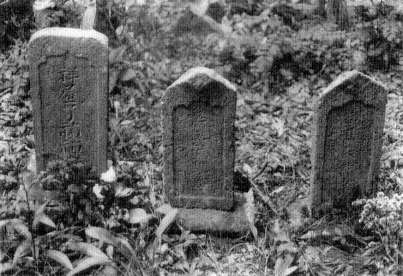
Plate 2.
Ken's Tomb. Left to right : the tombstones of Ken, her mother, and
Shinzo[*] . Photograph by author.
and also a transit point for the souls of the recently deceased; and Edo, a political center where powers and authorities converged and to some degree lost their local character.
Ultimately, this match between a woman seeking justice and a system seeking "harmony" was uneven. Authority was not to bend to law, and law was not to bow to reason, according to a Tokugawa saying. In practice, therefore, authorities did not issue public apologies, because only subjects could be in the wrong. Ken, who thought justice might be a concern of the shogunal authorities, found that they functioned with the same logic as her village superiors. Once she publicly forced the issue of an apology, the two levels of authority, intra- and extravillage, formed a common front. Then Ken's resistance turned passive. Within the village that became her prison, she kept control over her property and her life until the end of her days by not adopting an heir or a husband as her superiors would have had her do.
Power in a village, as we see it used by both sides in Ken's story, is social power that is steeped in public, official power. One's relatives and lineage provide an immediate social framework that has at the same
time a public character, because it overlaps with the official neighborhood system and its internal hierarchy of main and branch houses, which takes on an official dimension by the distinction between titled and nontitled peasant households. In addition, the manipulation of power at the village level has wider dimensions because of the strategic possibilities offered by the intersection of intra- and extravillage authorities. Here we can mention the attempts by the village authorities to prevent the petition/suit from leaving the village; the threats by Ken either not to appear before the extramural authorities (in the registration incident) or to bring her suit to them (in the murder case); the collusion between the intramural and extramural authorities with regard to the investigation of the murder; and the pressure on the part of the village authorities to extort promises by granting suspension of a punishment (house confinement) decided beyond the village.
Because Ken was a woman, her interactions with village authorities and the expectations she confronted must have been those of patriarchal power. Yet, in apparent control of her three marriages, firm and outspoken in her confrontations with her kumi members and village officials, and countering the headman's threats with some of her own, Ken flaunted those expectations. When the officials finally dug in their heels, denying Ken her request to leave the village and transfer her land to a temple, they put her in her place as a woman , which was to secure males (a husband or an heir) on the land to produce tribute. Ken, however, was equally firm in sticking to her earlier warning: "There is no need to come and speak about this to me again."
Ken must have been scolded often by her relatives and superiors. One clear instance was when the Shimogata authorities told Ken that she was not given the full punishment she deserved for her "unspeakably impudent" suit because she was a woman. Here condescendence yields, by way of scolding, the double profit of a feigned compassion and understanding and a real punishment. Scolding is perhaps the first means to activate explicitly when threatened, the (usually unformulated) power of doxa or common sense, which as it is used here is that of gender-asymmetrical propriety.
In all moves made by parties in the power field encompassing both village and supravillage authorities, written documentation played a crucial role. Conflicts and disputes revolved around, and were ultimately resolved by, the creation of legally recognized documents; for example, in the case of the headman's diary, the record of steps taken by him
could eventually be used in court. The following instances of the crucial role of documentation come to mind: the ability to write petitions in proper form; the manipulation of population records; the importance of written and certified disinheritance documents that were forwarded beyond the village; a petition for a memorial service that could not be suppressed because it contained a charge of murder; the many occasions where written promises were exacted (to not drink sake, to establish an heir, to move in with a new husband in another village, to live in harmony, to work the fields, etc.). Documents were indispensable for regulating conduct within the village. Village life was highly legalistic and formalized, a far cry from a Gemeinschaft governed by informal understandings, where the spoken word is binding.
Moreover, intervillage linkages of various kinds played an important role in defining networks that could be exploited for a number of purposes. Not only was Makibuse exogamous to a very high degree but some of its inhabitants spent long periods of time working outside the village. Its position on a major highway made Edo appear available and within reach to the villagers and must have increased the flow of information that could be put to use in various ways. Villages were less isolated than often imagined.
The question of village autonomy has been debated back and forth by Japanese historians, most of whom choose either to defend it or to deny that it had any substance. The Tokugawa political landscape, being neither homogeneous (which would make the village insubstantial) nor divided into two heteronomous spheres (which would disregard the grave imbalance of power between villages and lords), is perhaps best visualized as two fields of power that created at their intersection a space for manipulation from either side.