
"Ritual of the Rival Tribes"
As is shown below in Chart 2, the uninterrupted stretch that begins with the "Rival Tribes" at nos. 57–67 and extends through the whole of the "Procession" to "The Sage" at no. 71 divides into three large sections. As is evident, the construction in the first of these sections adheres to Type I; four contrasting blocks of material are
| ||||||||||
placed in abrupt juxtaposition to one another.[2] Indeed, in the original stage action, Blocks A and B accompanied the individual movements of two contending tribes, while Block C accompanied a type of tribal "clash." In Section II, extended repeats of Block C alternate with a new (E

The block structure of Section I is outlined in Example 38. In quarter-note beats, the brackets record the varying lengths of the four alternating blocks, their internal subdivisions, and subsequent modifications in block succession. Note the prolonged absence of Block C at nos. 58(+6)-62; it is eventually reclaimed at no. 62 as the principal block of Section II. Block D is in turn ignored in Section II, with its principal fragment retrieved at the beginning of Section III.
Attention in Example 38 is focused primarily on Block B and its two motivic units, a and b. There are five B statements in Section I, the first of which, at no. 57 + 2, introduces an a4–b3 motivic order as a point of departure. This is modified at no. 58 by a 4 + 2 delineation, which is reinforced at no. 59 by back-to-back 4 + 2 statements, the second of which features a transposition by a major third. The initial 4 + 3 division returns at no. 59 + 5 but is then followed, after an extended introduction of the new lyrical Block D, by a 4 + 4 + 2 statement. The specifications are summarized in Chart 3.
Obviously, the invariant element in these B statements is motive a, which retains the stable duration of four quarter-note beats. In contrast, motive b, varying between three and two beats, is mobile and as such determines the modification of subsequent B statements. Moreover, the mobility of motive b is in no way patterned. Yet, following the back-to-back 4 + 2 statements at no. 59, the restoration of its original 4 + 3 count at no. 59 + 5 may be felt as a welcome return to its—at this point—nearly forgotten point of departure.
Notice, too, that upon successive restatements, the horizontal motives, lines, or parts are fixed registrally in relation to one another. In accord with most structures adhering to Type I, these parts share the same irregular periods as defined by the shifting meter, so that the vertical disposition—the harmony or vertical alignment—remains unchanged from one statement to the next. (The disposition for Block B is given only for the initial two statements in Example 38; subsequent reentries do not deviate from this model.)
[2] The block labeled D in Section I refers to the passage at no. 43; the material here is derived from Block B in the "Rival Tribes." Recall that, according to the chronology of the sketchbook, the music of the "Rival Tribes," "Procession," and "Sage" was composed before that of the "Abduction."
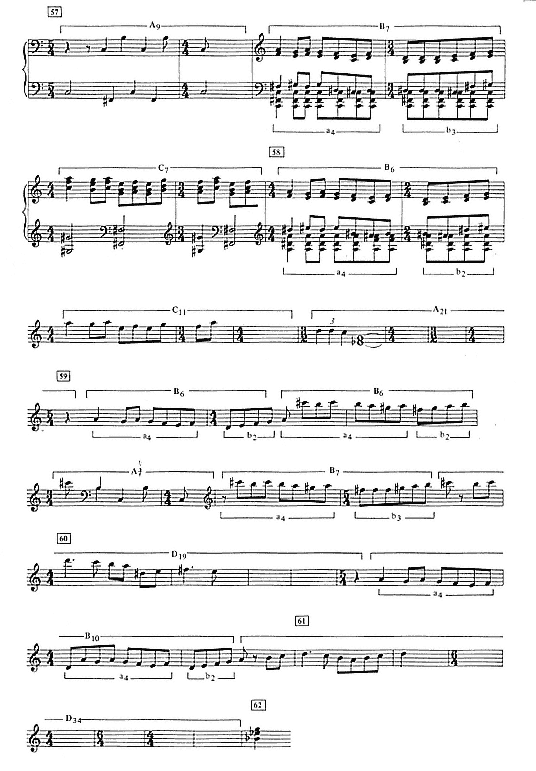
Example 38:
"Ritual of the Rival Tribes"
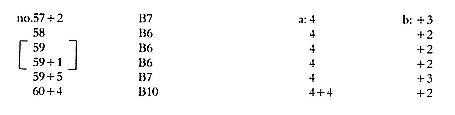
Chart 3:
"Rival Tribes"
In Section I, the quarter-note is the tactus, with a tempo marking of 168. And since the meter shifts throughout by way of the tactus, perceptual adjustments are made with greater ease than in those instances where, as examined earlier, a dissection by smaller units of beat leads to an actual disruption of the pulse. Nonetheless, that Block B's initial 4 + 3 count at no. 57 + 2 might be heard and understood as an abbreviation of a "rational" 4 + 4 count (with, in other words, Block C entering a quarter-note beat too soon at no. 59 + 4) seems by no means farfetched. For it does appear that, pursuant to the higher-level duple implications of a steady
