
7
The Pinnacles of Power
There is nothing that is not political. Everything is politics.
—Thomas Mann, The Magic Mountain
Delhi, most certainly, is not the symbol of India's slavery. The place which is the real headquarters of the rulers is Simla.
—Mahatma Gandhi, "Five Hundredth Storey"
The British presence in India was mainly political in nature. The imperial state's civil and military servants made up the overwhelming majority of the subcontinent's European population, and their role was a clear one—to rule. Whether this rule found expression in the brute force of military campaigns and police actions, the stately ceremonials of parades and durbars, the daily decisions of political agents and district commissioners, or the numerous other forms through which the colonial state exercised power, it occurred within what was seen as the public sphere.
Although the British found the hill stations enticing places to which to escape from their imperial obligations, these havens of private pleasure assumed public roles as well. This claim may seem odd, but its incongruity recedes when we recall that the private and public were bound together in a dialectical web. The outlines of this web could be discerned even in the hill stations' high concentrations of women and children, those parties thought to be least implicated in the public sphere. As Linda Colley has observed with regard to British society, the existence of separate spheres affirmed that the woman was "indispensable to the well-being of the state through her private influence on her citizen husband and education of her children."[1] If women played this role in the homeland, they did so even more emphatically in the colonial realm. The British recognized that one of the greatest threats to their rule in India was the erosion of cohesion within their ranks, the loss of a sense of common identity and purpose under the onslaught of alien influences; and it was precisely for this reason that they gathered their women and children together in highland cottages and schools where the values essential for the continuation of their power
[1] Linda Colley, Britons: Forging the Nation 1707-1837 (New Haven, 1992), 273.
could be cultivated. What occurred within those domestic and institutional walls was never as fully detached from the public realm of the raj as it seemed.
Nor were the reputations of hill stations as purely private sites inconsistent with the increasing importance they acquired as seasonal headquarters for various official agencies. In the second half of the nineteenth century, the public sphere began to intrude directly on Simla and many of its sister stations through the formal transfer of government offices to these summer resorts. The main impetus for this move was the great mutiny and rebellion. What had previously been individual officials' personal preferences for holidays in the hills was transformed in the aftermath of the events of 1857-58 into a formal policy of shifting various government headquarters into the higher elevations during the hot months. At least in part, this annual migration occurred because the hill stations appeared aloof and secure; they seemed immune from the paroxysms that had shaken imperial authority in the plains. The intent behind the retreat of the government to the hills, then, was to make it difficult for Indians to breach the walls of power. Yet this security could be achieved only by turning the hill stations themselves into public places. They became increasingly drawn into the political processes of the colonial realm, with the result being their inexorable erosion as places apart from the rest of India.
How could the British maintain their control over India's multitudes? This question lay at the heart of every decision made by the representatives of the raj but especially the one that determined the size and the role of the British population on the subcontinent. The planting of settlers in foreign soils had been an integral feature of British colonialism in its early Irish and North American manifestations, but in South Asia it showed little promise. For over a century and a half, the British had clung to the margins of this densely populated land, surviving because of the sufferance of Indian rulers. The prospects for colonists remained slight even after the East India Company wrested control from the Mughal empire and its successor states in the late eighteenth and early nineteenth centuries. The company extracted its profits from the indigenous inhabitants. Its European agents consisted of a small administrative elite—whose collective goal was to acquire a fortune and retire to an English landed estate—and a much larger body of mostly lower-class Irish and Scottish troops, whose death rate was so high that the fate of those few who managed to make it through their lengthy terms of service was a matter of little concern. Not until the
company lost its monopoly in 1833 did a significant number of planters, merchants, and other independent entrepreneurs enter the country to seek their fortunes, but few of them showed much inclination to raise their children and live out their lives in this distant land. India remained a realm distinct and separate from the settler colonies of the empire.[2]
Most authorities strongly objected to white colonists, and for good reasons.[3] As the American experience had shown, colonists tended to be politically contentious, often raising their voices against imperial rule and stirring up strife with native peoples. They also presented social problems by engendering a large poor-white and mixed-race population that blurred the boundaries between ruler and ruled and thereby weakened British claims of superiority. Nor did they offer significant economic advantages in India since most could find no viable niche in a society that already possessed a large and productive indigenous population of farmers, artisans, merchants, and others.[4] Lord William Bentinck did suggest in an abortive 1829 minute that the East India Company support European settlement as a means of diffusing Western skills and values among Indians, but the London court of directors dismissed the proposal as "absurd," and Bentinck himself conceded that the country offered little or no opportunity for the average emigrant from Britain.[5]
Yet the vision of an India colonized by white settlers never fully faded from view: it shimmered like a mirage over the highland regions of the
[2] European settlement in India has been examined by David Arnold, "White Colonization and Labour in Nineteenth-Century India," Journal of Imperial and Commonwealth History 9, no. 2 (Jan. 1983): 133-58; P. J. Marshall, "The Whites of British India, 1780-1830: A Failed Colonial Society?" International History Review 12, no. 1 (Feb. 1990): 26-44; Raymond K. Renford, The Non-official British in India to 1920 (Delhi, 1987), ch. 1; and John Riddy, "Some Official British Attitudes towards European Settlement and Colonization in India up to 1865," in Essays in Indian History , ed. Donovan Williams and E. Daniel Potts (London, 1973), 17-41.
[3] See C. A. Bayly, Imperial Meridian: The British Empire and the World, 1780-1830 (London, 1989), ch. 3.
[4] Ironically, this view was often shared by members of the nonofficial commercial community in India. In an 1833 pamphlet demanding greater rights for Europeans under East India Company rule, the author sought to deflect criticisms that colonists were not "sufficiently respectable" by arguing that it was only "the highest class" that could establish itself on the subcontinent. "The poorer classes of society could not find their way to India; or, when there, could not find employment." John Crawfurd, Notes on the Settlement or Colonization of British Subjects in India (London, 1833), 23.
[5] C. H. Philips, ed., The Correspondence of Lord William Cavendish Bentinck , vol. 1 (Oxford, 1977), 201-13, 225.
subcontinent. Some of the earliest advocates of hill stations were enthusiastic about their potential as sites for permanent colonies of Europeans. They argued that the elevation and isolation of the highlands would allow settlers to thrive there. Particular interest was paid to the Nilgiris. The commander of the Pioneer Corps, which constructed the first road into the Nilgiris, argued in a series of letters to the Madras Gazette that the region was an ideal location in which officials could retire, soldiers could recuperate, and merchants and farmers could prosper. He urged authorities to grant tracts of land to planters, suggesting in a prescient aside that coffee and tea held promise as commercial crops.[6] Others advocated the Nilgiris as a site for colonization, notably the medical officer and publicist for Ootacamund in its early years, Robert Baikie.[7]
Far to the north, an officer in the Bengal cavalry spoke of the Himalayas as "a great natural fortification, a stronghold for Europeans."[8] This was a tempting vision, and among those taken by it was Major-General Sir S. F. Whittingham, the commander of the Meerut and Cawnpore divisions of the army. In 1830 he urged Lord Bentinck to offer soldiers grants of land in the area around Mussoorie in lieu of pensions. In a flight of fancy, he envisioned a feudal-like colony of veterans ensconced in the Dehra. Dun valley below Mussoorie, where they would raise pigs, chickens, and other products for the local market, while on the heights above "well behaved Europeans might hope to be taken into the service of gentlemen having estates on the hills, as overseers."[9]
This desire to re-create the lineaments of English agrarian society in the Indian highlands inspired several settlement schemes in the 1820s and 1830s. The Madras council approved a modest plan in 1825 to send five British military pensioners to the Nilgiris, where they were to be given land, tools, livestock, and other supplies necessary to establish themselves as small farmers. What became of this endeavor is unclear, but again in 1830 the government of Madras issued orders to provide plots of land and
[6] Major William Murray, An Account of the Neilgherries, or, Blue Mountains of Coimbatore, in Southern India (London, 1834), 27, 32, 37, 43.
[7] Robert Baikie, Observations on the Neilgherries , ed. W. H. Smoult (Calcutta, 1834), 39. Another early commentator recommended the colonization of the Nilgiris by "Eurasians or Indo-Britons," but this proposal cut against the grain of the efforts to establish ethnic enclaves in the highlands, and it received little attention or support. See James Hough, Letters on the Climate, Inhabitants, Productions, etc. of the Neilgherries, or Blue Mountains of Coimbatoor (London, 1829), 137-38.
[8] Capt. H. Drummond, Notes on the Colonization of the Himalayas (Edinburgh, 1845), 3.
[9] Philips, Correspondence , 456.
tools to fifty-six invalid soldiers, whom it hoped would become the nucleus for a community of "small farmers of hardy, active, persevering and industrious habits" in the Nilgiris.[10] At about the same time, a number of East India Company pensioners began to congregate in Dehra Dun, and many of them acquired summer cottages in Mussoorie. Few, however, took up farming, so in 1838 the government sought to encourage the development of European commercial agriculture in the area by alienating large tracts of land. The scheme came to an ignominious end when it became clear that most of the property had gone to officials whose intentions were almost entirely speculative.[11] Nor did the Nilgiri effort to place pensioners on small holdings leave any perceptible trace. The popular explanation for the failure was that the "class of men" who remained in India on pensions "but rarely offer an example of industry or sobriety, while the effects of their long residence in the low country, added to their (generally) advanced age, render them . . . insensible to the advantages of the change" to the hills.[12]
Many members of the colonial administration doubted whether even the most industrious and sober British pensioners could succeed as small farmers. When in 1856 the Indian government inquired into the prospects for settling retired army officers and soldiers on the land, officials all across India responded in the same vein: alienable land was too scarce, hired help too dear, Indian farmers too fierce as competitors, and British pensioners too poorly prepared for the physical demands of agricultural labor.[13] Although the report that summarized these reactions did refer to Darjeeling and the Nilgiris as possible sites for colonization, it concluded that India otherwise offered little or no hope for white settlers.
Brian Hodgson, the British envoy to Nepal, was the only official among the respondents to express enthusiastic support for European colonization. He devised a scheme that went well beyond the bounds of the government's inquiry about army pensioners, suggesting that large numbers of impecunious Scottish and Irish peasants be planted in the Himalayas. As he saw
[10] See report dated 10 Nov. 1830, E/4/939, Madras Dispatches, IOL; and PP, Papers Relative to the Formation of a Sanitarium on the Neilgherries for European Troops , Session 729, XLI, 1850, 29, 34-35, 50.
[11] G.R.C. Williams, Historical and Statistical Memoir of Dehra Doon (Roorkee, 1874), 314-32; Capt. O.E.S. Powers, Dehra Dun Past and Present: Guide and Directory to Dehra and the Doon District (Dehra Dun, 1929), 4-5.
[12] Baikie, Observations , 39.
[13] See the correspondence reprinted in "Report on the Transactions of the Government of India in the Military Department in 1856-57," in General Report on the Administration of the Several Presidencies and Provinces of British India, 1856-57 , pt. 1 (Calcutta, 1858), 1-25.
it, they could supply wholesome foodstuffs for themselves and other Britons in India, as well as provide "some fifty to one hundred thousand loyal hearts and stalwart bodies of Saxon mould" (an honorary upgrade for peoples usually sniffed at as Celts) to serve as a reserve force against internal threats to imperial rule.[14] While Hodgson's voice may have been a lonely one within the government in 1856, various individuals and groups outside its ranks were calling for the creation of European colonies in the highlands.[15] Perhaps the most prominent of these advocates was Hyde Clarke, an agent for Indian railway and planter interests. In 1857 he published Colonization, Defence and Railways in Our Indian Empire , a book that provided detailed accounts of the development of Darjeeling, Simla, and some twenty other hill stations around the subcontinent. Its main purpose was to persuade readers (especially the governors of the East India Company, to whom it was dedicated) that the construction of the railway and telegraph made possible the colonization of the highlands with European planters, soldiers, invalids, pensioners, and others. Clarke, like Hodgson, believed these colonists would supply a "copious reserve" prepared to sweep down from their highland abodes at the earliest signs of trouble on the plains: "the colonization of the hill regions of India with English will give us a hold which can never be shaken off."[16]
Composed immediately prior to the outbreak of revolt in 1857, the strategic arguments of Clarke and Hodgson acquired a prophetic quality as disorder swept northern India. The realization that a large body of colonists might provide a useful line of defense against rebellion convinced Parliament in 1857 to appoint a select committee to investigate the prospects for European colonization in India. After collecting five fat volumes of testimony, however, the committee concluded that the subcontinent was best suited for "a class of superior settlers," who could serve as overseers of Indian laborers. It believed that the colony offered scant "inducements to
[14] Hodgson's report reappears under the title "On the Colonization of the Himalaya by Europeans" in B. H. Hodgson, Essays on the Languages, Literature and Religion of Nepal and Tibet , pt. 2 (1874; reprint, Varanasi, 1971), 83-89.
[15] See, for example, the claims for Darjeeling as a suitable site for European settlers in Friend of India , 20 Nov. 1856, cited in Capt. J. G. Hathorn, A Hand-Book of Darjeeling (Calcutta, 1863), 110, and in the pamphlet Darjeeling , reprinted from the Calcutta Review , no. 55 (1857): 29. Robert Baikie, The Neilgherries , 2d ed. (Calcutta, 1857), makes much the same claim for the Nilgiris.
[16] Hyde Clarke, Colonization, Defence and Railways in Our Indian Empire (London, 1857), 126. Also see his postmutiny assessment, "On the Organization of the Army of India, with Especial Reference to the Hill Regions," Journal of the Royal United Service Institution 3 (1860): 18-27.
the settlement of the working classes of the British Isles" because of the harshness of the tropical climate, the scarcity of alienable land, and the abundance of indigenous labor.[17] These conclusions seemed so sweeping in their rejection of white colonization that most historians have lost sight of a subtext that made an exception of the highland regions. The committee expressed its confidence that the hills could serve as sites for permanent colonies of Europeans. Its views were shaped by the testimony of those who claimed some knowledge of the Indian highlands.
Major-General George Tremenheer, the first person to testify to the committee, set the tone for the inquiry by insisting that India's general unsuitability for colonization did not apply to the hill stations. The precipitous terrain of the Himalayas prevented colonization on "a large scale," he conceded, but the example of the Lawrence Asylum convinced him that many poor Europeans who currently languished in the plains could become productive if transferred to the hills. Send the children of British soldiers and similarly marginal Europeans to the Himalayas, he urged, where they might be protected from the degenerative influences on the plains and trained in the mechanical and other skills appropriate for the supervision of Indian laborers.[18] The benefits of the highlands for domiciled European children and their parents were stressed by other witnesses as well. A veteran of twenty-five years of service in the Bombay presidency recommended Mahabaleshwar as a convalescent station for British soldiers and as an asylum for their children.[19] Dr. James Ranald Martin, a leading authority on the diseases of India, advocated the removal of all British troops to highland cantonments.[20] Captain John Ouchterlony, an army engineer who had spent several years in the Nilgiris, testified at great length about their potential for colonization, insisting that European planters, soldiers, pensioners, women, and children could reside there in health and security.[21] Numerous people who had worked in India in nonofficial capacities also voiced enthusiasm for hill colonies. Thus, it is hardly sur-
[17] PP, Report from the Select Committee on Colonization and Settlement (India) (1859), Session 2, V, iii.
[18] PP, First Report from the Select Committee (1858), Session 1857-58, VII, pt. 1, 1-13. Tremenheere also urged that access to the hill stations be improved by constructing rail lines to the foot of the ranges where they were located.
[19] Major George Wingate, in PP, Fourth Report from the Select Committee (1858). Session 1857-58, VII, pt. 2, 56.
[20] PP, First Report from the Select Committee (1858), Session 1857-58, VII, pt. 1, 18.
[21] PP, Third Report from the Select Committee (1858), Session 1857-58, VII, pt. 1, 1-41.
prising that the committee itself reached the conclusion that the highland regions of India held genuine potential as sites for colonization by Europeans: it referred specifically to Darjeeling, Ootacamund, and other hill stations.[22]
The post-1857 period did see a dramatic expansion of European agricultural settlement in the highlands. The extension of the railway system into the vicinity of these hitherto remote regions and the state-assisted development of commercial crops that thrived at higher altitudes—notably tea, coffee, and cinchona—made it economically feasible for settlers to come to the hills, and Lord Canning assisted the process by liberalizing the rules for alienating land to Europeans.[23] British planters began to congregate in substantial numbers on the slopes around Almora, Darjeeling, Kalimpong, Shillong, Ootacamund, Coonoor, Kodaikanal, Yercaud, and various other hill stations in the second half of the nineteenth century. They brought an added dimension to the social and economic life of the hill stations they encircled, a dimension that derived from the primal appeal of an agrarian existence—its stability, rootedness, permanence—and that was especially apparent when the men who owned or operated estates were accompanied by their wives and children. Many of the planters, however, were bachelors who were employed by large companies and who had no lasting attachment to the land. In addition, nearly all the planters were members of that "class of superior settlers" who oversaw the work of indigenous laborers rather than farmers who worked the fields themselves. In the subtle but useful semantic distinction drawn by David Arnold, they were settlers rather than colonists.[24]
Thus, the tantalizing social vision of scattered highland sites densely populated by white colonists who lived like simple yeomen on the fruits of their own labors and loomed like avenging angels over the troubled plains never materialized. The Nilgiris was virtually the only location that
[22] PP, Report from the Select Committee (1859), Session 2, V, iv. Testimony by nonofficials in support of European settlement in the hills includes that by John Freeman, in PP, First Report from the Select Committee (1858), Session 1857-58, VII, pt. 1, 113; Joseph Gabriel Waller, in PP, Second Report from the Select Committee (1858), Session 1857-58, VII, pt. 1, 201; Alpin Grant Fowler, in PP, Third Report from the Select Committee (1858), Session 1857-58, VII, pt. 1, 49; Joseph Hooker and George Howard Fenwick, in PP, Report from the Select Committee (1859), Session 1, IV, 6, 39.
[23] Riddy, "Some Official British Attitudes towards European Settlement," 39.
[24] Arnold, "White Colonization," 134. Settlers, Arnold suggests, were planters and others who had the capital to hire laborers, while colonists were expatriate agriculturalists who had to rely on their own labor.
continued to attract serious attention as a site for colonization. In the early 1870s the Madras government, responding to pressure from the British Indian press, directed the superintendent of government farms to investigate the prospects for European agricultural settlement. His report proved to be an exercise in ambivalence. He asserted that the natural conditions were suited to the establishment of colonists on the land but that small farmers would require extensive training and assistance from the state in order to succeed. He doubted whether military pensioners or rural laborers from England and Scotland were up to the task, and so he focused his attention instead on locally born children trained from an early age in technical hill schools like the Lawrence Asylum.[25] Even this modest recommendation was dismissed by the state, which was content with the status quo. In the Himalayas, a rare effort to start a European agricultural colony was the sadly misnamed Hope Town, a place some ten miles from Darjeeling where missionaries attempted to establish a few dozen poor whites as petty farmers. Within a short time, Hope Town had become a ghost town.[26] Some years later, an Anglican clergyman proposed that a colony of destitute Europeans be established at the foot of the Darjeeling hills, but authorities concluded that the money would be better spent by sending them to Australia.[27]
The government's brushing aside of the occasional proposal to transplant poor whites to the hills was thus the sorry denouement of the debate about the colonization of the Indian highlands. While a few officials were doubtless still drawn to the notion that those on the margins of British Indian society might redeem themselves and buttress the raj as successful, small, highland farmers, most held that poor whites (though perhaps not their children) were beyond personal redemption or political benefit. And if they were unsalvageable, what purpose would be served by encouraging new colonists of the same class from Britain? India's imperial rulers could not bring themselves to add to the very element that seemed in their eyes to demean the social standards of the white community and to drain the resources of the state. Thus, the lengthy flirtation with highland colonies
[25] W. R. Robertson, Report on the Agricultural Conditions, Capabilities, and Prospects of the Neilgherry District (Madras, 1875). A summary of the report appears in Report on the Administration of the Madras Presidency, 1874-75 (Madras, 1876), 121-23.
[26] See Hathorn, Hand-Book , 110-18.
[27] Correspondence in General Department, Miscellaneous, June 1876, Proceedings of the Lieutenant Governor of Bengal, WBSA.
of white farmers amounted to little in the end. The British raj sought other means to sustain its power. Yet these too would involve the hill stations.
While the Indian government believed that it had little to gain from concentrating colonists in the highlands, it did grant the hill stations a place in its strategic and political designs. Their enlarged significance in the operations of the raj gave them an unmistakably public importance in the latter half of the nineteenth century.
The army saw the hill stations with new eyes in the aftermath of the 1857 revolt. It had long recognized the health benefits of these places, but it now began to appreciate their strategic value. When violence erupted on the plains below, the hill stations of the western Himalayas remained tranquil, providing sanctuary for many British women and children. With the subsequent boost in the number of British troops committed to Indian service and the improvements in transportation brought about by the railway, it seemed both sensible and feasible to station a larger portion of the army in hill cantonments. In 1859-60 the military department of the government of India launched an extensive survey of highland locations suitable for quartering British soldiers. Its aim was both to determine the prospects for expanding existing sanitaria and cantonments and to identify new sites for development.[28] The results were striking. In India's strategically vital northwestern quadrant, a number of highland cantonments were established in the decade after the revolt. These included Balun, Chakrata, Ranikhet, and Solon. Dalhousie, although surveyed for use as a cantonment in 1853, was not occupied until 1860. In central India, a military station was established at Pachmarhi. Far to the east, Shillong's origins could be traced to the military department's efforts in the early 1860s to find a site in the region to settle soldiers on the land.[29] In the Nilgiris, a small military sanitarium known as Jackatalla was renamed Wellington and transformed into a major cantonment for the Madras Army. Other sleepy stations experienced similar surges of expansion. In addition, military au-
[28] Selections from the Records of the Government of India (Military Department) , nos. 1-3: Report on the Extent and Nature of the Sanitary Establishments for European Troops in India (Calcutta, 1861, 1862).
[29] See the memoranda in nos. 7-10, 7 Jan. 1863, Home Dept. Proceedings, Public Branch (A), INA.
thorities investigated a number of highland locations across India that proved unsuited for development because of the lack of water, the prevalence of malaria, or other limiting factors.[30] A Parliamentary commission reporting on the sanitary state of the Indian Army in 1863 added to the reputations of highland cantonments by recommending that a third of British forces be placed in hill quarters on a rotating basis.[31]
For many critics, this shift of British forces to the hills did not go far enough. The Liberal politician Charles Dilke insisted that there was "no reason except a slight and temporary increase in cost to prevent the whole of the European troops in India being concentrated in a few cool and healthy [hill] stations."[32] An 1869 Lancet editorial, reprinted in the Times , argued that health considerations made it essential for authorities to place still more soldiers in hill stations.[33] The medical case for sending most if not all British troops to highland cantonments reappeared in various other forums.[34] A great deal of attention was also given to the unrealized strategic potential of the highlands. Some enthusiasts were convinced that the advent of the railway and the telegraph made it possible to harbor all British forces in the hills, where they would be secure from surprise attack but positioned to respond quickly to troubles anywhere in the subcontinent. Advocates of white colonization were enamored with the idea that soldiers stationed in the hills could be convinced to settle there when their terms of service came to an end and thereby could become the nucleus of permanent settlements that would serve as reliable reserves of military man-
[30] Selections from the Records of the Government of Bengal , no. 36, pt. 2: The Maghassani. Hills as a Sanatarium (Calcutta, 1861); Selections from the Records of the Government of Bengal , no. 38: Papers Relating to a Sanatarium upon Mount Parisnath (Calcutta, 1861); and the reports by Lt.-Col. (later Gen.) Douglas Hamilton, Report on the Shevaroy Hills (Madras, 1862), Report on the Pulni Mountains (Madras, 1864), and Report on the High Ranges of the Annamullay Mountains (Madras, 1866).
[31] PP, Report of the Commissioners Appointed to Inquire into the Sanitary State of the Army in India , XIX, 1863, 143-52. The commissioners would have recommended that a greater proportion of British troops be quartered in hill stations except for concerns about the effects on military security.
[32] Charles Wentworth Dilke, Greater Britain: A Record of Travel in English-Speaking Countries , vol. 2 (London, 1869), 244-45.
[33] Times (London), 16 Jan. 1869, p. 5, col. 6.
[34] See "Hill Stations of India as Sanitaria for the British Soldier," Calcutta Journal of Medicine 1, no. 8 (Aug. 1868); William Curran, "The Himalayas as a Health Resort," Practitioner (Jan. 1871); and William Curran, "Further Evidence in Favour of a Hill Residence for European Soldiers in India," Irish Journal of Medical Science 52, no. 104 (1871).
power. Ootacamund's local newspaper argued in favor of settling soldiers and their families in the Nilgiris, asserting, "When it comes to the question of defencibility, Ootacamund, and for that matter almost every spot on these hills, is unapproached by any in India as a place of security."[35] Kashmir excited the imagination of Rudyard Kipling, who had the narrator of his short story, "His Private Honour" (1891), fantasize about planting army pensioners in that lovely vale, where they would "breed us white soldiers."[36] Perhaps the most important proponent of the strategic value of the hills was Major-General D.J.F. Newall. In the two-volume The Highlands of India Strategically Considered (1882), he sought to show that the colonization of the highlands by European troops was both feasible and essential to the "future for British India." The book provided a detailed region-by-region survey of the many stations and cantonments scattered across the Indian highlands. Little more was required, it suggested, than the authorities' open-mindedness in order to transform these stations into military colonies that would ensure the security of British rule.[37]
The arguments of Newall and his confreres were not enough, however, to initiate a full-scale withdrawal of European troops from the plains to the hills. Senior army planners could not be convinced of the strategic merits of removing the bulk of their forces from active duty on the plains, and they had little incentive to invest their resources in efforts to settle ex-soldiers in the hills. Nor did the prospect of occupying the pristine highlands with drunk and debauched "Tommies," as the army's rank-and-file were often perceived, do much to relieve official anxieties about white colonization in general. Despite all of these concerns, it remains incontestable that hill stations acquired an importance to the military in the late nineteenth century that they had never before possessed. By the 1870s, a sixth of the British forces in India were located in hill cantonments, and two decades later the proportion was nearer a quarter.[38]
Not only did the hill stations provide billets for British troops; they also provided headquarters for their officers. The consolidation of the commander-in-chief's staff and offices in Simla and the transfer of other army
[35] South of India Observer , 27 January 1877.
[36] Rudyard Kipling, "His Private Honour," in Many Inventions (New York, 1925), 134.
[37] Major-Gen. D.J.F. Newall, The Highlands of India Strategically Considered (London, 1882).
[38] David Arnold, Colonizing the Body: State Medicine and Epidemic Disease in Nineteenth-Century India (Berkeley, 1993), 79.
command centers to Murree, Ootacamund, and elsewhere in the hills were among the signs that a profound shift was taking place in the geographical concentration of imperial power.
But the hill stations acquired their most significant public role in the raj as political capitals. When Gandhi wrote in 1921 that Simla was the true headquarters of the rulers of India, he was stating what everyone knew to be the case. Simla had become the principal residence of the viceroy of India, the commander-in-chief of the Indian Army, the lieutenant-governor of Punjab, and a host of other government dignitaries; it had become a vibrant political capital with an imposing array of public buildings from whence the affairs of state were conducted; it had become the nerve center of the raj. The changes at Simla, moreover, had been replicated on a provincial scale in Ootacamund, Darjeeling, Mahabaleshwar, and elsewhere: hill stations throughout India had become hubs of imperial power.
In the first half of the nineteenth century, however, hill stations did not operate as official centers of power, even though their inhabitants and visitors were intrinsically political beings. Governors-general and governors went to highland sanitaria for much the same reasons as other visitors—the appeal of the climate, the search for health, the desire for relaxation. While they were there, they continued to conduct the affairs of state, to be sure, but most of the panoply of power and the bureaucracy that carried out its pedestrian transactions were left behind. No fixed pattern of "seasons" governed the peregrinations of the heads of state. Some governors-general, such as Lord Auckland, enjoyed extended stays in Simla; others, notably Lord Canning, disliked the place and avoided it after one brief sojourn. The duration and frequency of visits to hill stations varied among governors and other regional authorities as well. Occasionally the length of a governor-general's holiday in the hills gave rise to concern that he was neglecting his official duties. Lord Dalhousie in particular was subjected to repeated attacks by the Calcutta press and critics in England for spending so much time in Simla; even the court of directors of the East India Company took him to task for his fondness for the place in 1853.[39]
[39] Minute by Dalhousie, 17 May 1853, enclosure to Dispatch #16 (1887), L/PJ/6/199/643, IOL. Also see Marquess of Dalhousie, Private Letters of the Marquess of Dalhousie , ed. J.G.A. Baird (Edinburgh and London, 1910), 168, 186; and Sir William Lee-Warner, The Life of the Marquis of Dalhousie , vol. 1 (London, 1904), 301, 370.
Usually, however, imperial heads of state managed to escape the realm of politics when they went to the hills.
The politicization of the hill stations occurred in the second half of the nineteenth century. In this matter as in so many others, 1857 marked an important turning point. After the revolt the authorities' sojourns to the hills acquire a powerful, if often tacit, new motive—the desire to carry out official duties in an environment secure from the perils that had arisen with such dramatic force on the plains. Even though Lord Canning had himself spent little more than three weeks in the hills over a span of six years, in 1861 he granted governors and lieutenant-governors permission to reside for four months of every year "at the most convenient hill station." He allowed the Madras and Bombay governments to augment their official presences in Ootacamund and Mahabaleshwar, approving a request by Bombay for funds to assist its annual migration and a proposal by Madras to sell one of the governor's two residences in Madras so as to purchase one in the hill station. He also approved a medical request by the lieutenant governor of the North-West Provinces to spend his summers in Naini Tal. Although he avoided addressing the broader implications of these separate decisions and expressed reservations about the wisdom of the governor-general's making it a practice to leave Calcutta for the summers, Canning in effect took the first step toward an official endorsement of governments' seasonal flights to the hills.[40]
A rationale for this nascent policy came from Sir Bartle Frere, one of the most respected members of the governor-general's council. Railing against "the absurdity of forcing our Governors to live all the year round in the worst climate in their charge," he grounded his case in part on claims for the health benefits of the highlands. However, he also proffered an argument based on historical precedent. Citing examples from China, Persia, and, of course, Mughal India, he declared: "Every great oriental ruler, with any pretensions to civilization has his summer and winter residence." In effect, Frere sought to legitimize the seasonal migration of government to the hills by associating it with what was seen as an indigenous, "oriental" model of governance. This, in turn, was simply one aspect of a sweeping endeavor by the British in the post-1857 era to restructure their rule along
[40] Minute by Canning in no. 34, 13 May 1861, Home Dept. Proceedings, Public Branch, INA. Also see correspondence on Bombay hill stations in nos. 117-21, 28 Aug. 1861, Home Dept. Proceedings, Public Branch (A), and correspondence of the lieutenant governor of the North-West Provinces about Naini Tal in nos. 52-54, 28 Feb. 1861, and nos. 64-66, 30 April 1862, Home Dept. Proceedings, Public Branch, INA.
increasingly aloof and autocratic lines and to imbue it with symbols that evoked past patterns of authority.[41]
The decisive moment in the establishment of a highland headquarters for this self-styled oriental regime occurred in 1864. The new viceroy, Sir John Lawrence, brought his executive council and some five hundred government staff members with him on his summer sojourn to Simla in that year. The transfer of the council, which served as the viceroy's cabinet, represented a formal shift of decision-making power away from Calcutta, the official capital. The secretary of state for India, Sir Charles Wood, realized the move would set an important precedent and was reluctant to approve it for that reason. But Lawrence refused to accept the viceroyship unless he could conduct the affairs of state from Simla. Every year thereafter at the onset of hot weather the British rulers of India removed themselves and an ever-expanding contingent of bureaucrats to their Himalayan hideaway, where they remained for the subsequent six months or more.[42]
As Simla began to overshadow Calcutta in political importance, the position of Calcutta as the official seat of government became a topic of debate (and it continued to be one until the transfer of the capital to Delhi was announced at the imperial durbar of 1911). In 1867, Sir Stafford Northcote, Wood's successor at the India Office, appointed a special committee to consider whether the lieutenant-governorship of Bengal should be raised to a governorship and, if so, whether the capital of India should be moved to a different location. To Northcote's apparent surprise and dismay, this committee exercised its mandate to beat back what it saw as Simla's threat to Calcutta. Not only did it conclude that Calcutta should remain the capital, but it urged that the viceroy and his entourage be "prohibited" from undertaking their annual migration to Simla.[43] The
[41] Minute by Frere in no. 35, 14 May 1861, Home Dept. Proceedings, Public Branch, INA. For the shift in the British strategy of governance, see Thomas R. Metcalf, The Aftermath of Revolt: India 1857-1870 (Princeton, 1964); Bernard S. Cohn, "Representing Authority in Victorian India," The Invention of Tradition , ed. Eric Hobsbawm and Terence Ranger (Cambridge, 1982); and Francis G. Hutchins, The Illusion of Permanence: British Imperialism in India (Princeton, 1967), ch. 8.
[42] Pamela Kanwar, Imperial Simla (Delhi, 1990), 34-39.
[43] Report of the Special Committee, 14 Nov. 1867, in L/PJ/6/190/2034, Public and Judicial Dept., IOL. Simla's role in the considerations of the committee and in the subsequent half-century of debate about the transfer of the capital from Calcutta is entirely ignored in Robert Grant Irving, Indian Summer: Lutyens, Baker, and Imperial Delhi (New Haven, 1981).
committee and its sympathizers argued that the move to and from Simla cost the government too much time and money, that it alienated the Indian clerks who were forced to abandon their homes and families in Calcutta, and that it isolated authorities from the salutary sway of public opinion. These would remain the principal charges against Simla for decades to come. The most forceful response to the committee's complaints came from Henry Maine, the distinguished legal member of the viceroy's council. Maine mocked Simla's critics by insisting that it was the capital already in all but name: "the theory that Calcutta was the capital was preserved only by a fiction, and a fiction so transparent that, did I not know something of the power of fictions, I should wonder at men being blinded by it." Maine argued that the cost of the annual migration and the time spent in transit had been substantially reduced by recent improvements in transportation and communication, and that the cool highland climate made officials more productive in the summer months. Moreover, "almost all governments originating in the conquest of hot countries by persons born in a cooler climate have been, as a matter of history, more or less peripatetic," an assertion that echoed Frere. A more conciliatory stance was taken by Lord Lawrence, who assured Calcutta's defenders that he had no desire to abandon it as the official capital of India. Nevertheless, he forcefully defended the seasonal shift of government to Simla: it was salubrious, unlike Calcutta with its summer saunas; it was secure, as had been proven by the loyalty of the local chiefs and their subjects during the recent uprising; and it was located near the strategic heart of India, which consisted of the Punjab and the North-West Frontier.[44] Lawrence's defense proved decisive: an uneasy truce ensued that left Calcutta with the outward guise of power but Simla with most of its substance.
Simla's position as the principal headquarters of the imperial government soon became all but unassailable. The viceroy and his council began to spend so much time in the hill station that the secretary of state felt obliged in 1877 to insist that they remain in Calcutta from November 1 through April 15 each year. The order was simply ignored.[45] A growing army of clerks and other state functionaries accompanied the viceroy to Simla to conduct the everyday business of the raj. Not only did major
[44] Minutes by Lawrence, 19 Feb. and 23 March 1868, and Maine, 2 Dec. 1867 and 16 March 1868, L/PJ/6/190/2034, Public and Judicial Dept., IOL. Others active in this exchange of minutes were Henry Durand and James Strachey.
[45] Salisbury to Lytton, 20 Dec. 1877, L/PJ/6/190/2034, Public and Judicial Dept., IOL.
departments such as the foreign office, finance, and public works transfer their operations to Simla for the bulk of each year, but so did a great many lesser agencies, among them the offices of the surgeon general and sanitary commissioner, the director general of the post office, the commissioner of salt revenue for northern India, the inspector general of forests, the surveyor general, the meteorological reporter, the director general of telegraphs, the director general of railways, the commissary general-in-chief and the commissary general for transport, the director general of ordinance, and the director of army remounts.[46] The annual cost of moving the government from Calcutta to Simla and back averaged around Rs. 800,000 through most of the 1880s.[47]
The physical appearance of the station underwent a transformation as it sought to accommodate this enlarged bureaucratic presence. What had been an overgrown village consisting of fewer than three hundred privately owned European cottages in the mid-1860s soon became a small metropolis, its center bounded by a chain of multistoried government buildings and its boundaries pushed in all directions by the rapid increase in population. The greatest spate of public construction occurred in the 1880s (Figure 10). Arising in this decade were the secretariat and the army headquarters, two great iron and concrete structures said to have been modeled after the Peabody building in London; the Tudor-style post office; the fortresslike telegraph office; the rambling Swiss Gothic Ripon Hospital; the large stone courthouse and cutcherry of the deputy commissioner; the public-works building; the town hall, an ambitious Victorian Gothic complex that housed municipal offices, the police station, an assembly hall, a Masonic hall, and the Gaiety Theater; and the Swiss chalet-influenced foreign office, which was pronounced "the most picturesque of all the Government buildings."[48] The greatest of these public projects, however, was the Viceregal Lodge, a castlelike edifice of gray limestone that served as the official residence of the viceroy. Prior to its completion in 1888, governors-general and viceroys had leased a series of private homes for their stays in Simla, most recently a half-timbered Tudor villa known as Peterhof. The decision to built the
[46] Dispatch #25, Lansdowne to Cross, 2 April 1889, L/PJ/6/250/687, Public and Judicial Dept., IOL.
[47] Dispatch #16, Dufferin to Cross, 15 March 1887, 22, L/PJ/6/199/643, Public and Judicial Dept., IOL.
[48] See Public Works Department, Completion Reports of Public Office Buildings and Clerks' Cottages at Simla , serial no. 21 (Calcutta, 1889). The comment on the foreign-office building comes from Edward J. Buck, Simla Past and Present , 2d ed. (1925; reprint, Simla, 1989), 106.
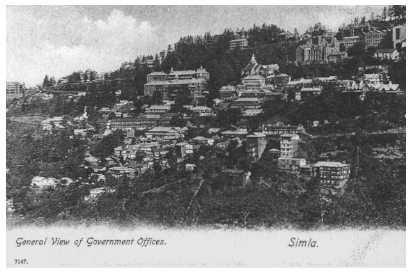
Figure 10.
Government office buildings perched along the ridge in Simla.
From a postcard in the possession of the author.
Viceregal Lodge was a statement in stone of the government's intention to establish a permanent presence in Simla. Designed by the public-works department's principal architect, Henry Irwin, in a dark and heavy Elizabethan Renaissance style and located atop Observatory Hill at the western end of Simla, it was built to impress, with the entry hall paneled in teak, the ballroom hung with tapestries of silk, and the dining room embellished with heraldic shields. It cost Rs. 970,093 to construct.[49]
Although new construction slackened after the 1880s, the stones of state continued to cast a heavy shadow over Simla. In 1897 the army took over the secretariat building, and its previous tenants acquired a new building; the Punjab government rebuilt and expanded an existing structure to serve as its impressive new headquarters in 1902; the Walker Hospital for Europeans arose in the same year. The government of India purchased a series of houses in the late nineteenth and early twentieth centuries for use as residences by council members and other high-ranking officials. It also constructed a number of cottages, hostels, and barracks for its European, Anglo-Indian, and Indian clerks, who found it increasingly difficult to
[49] Public Works Department, Completion Report of the New Viceregal Lodge at Simla , serial no. 22 (Calcutta, 1890).
afford the high rents on the open market. Small wonder so many visitors felt that the weight of officialdom was intolerable in Simla.[50]
Similar public-building projects were undertaken at other hill stations as they acquired recognition as political headquarters. London had rejected several requests by the government of Madras in the 1860s to transfer its council to Ootacamund for the summer months, but Madras continued to press for the move. A pamphlet published in 1869 argued that Ootacamund's "commanding position," its ease of defense, its space for troops, its salubrious climate, and its economic potential made it the logical site for the Madras government.[51] When another plea from Madras was made in 1870, the secretary of state relented, approving a three-month stay by the governor and his council in Ootacamund.[52] The India Office was persuaded to reverse itself because of the precedent established by the viceroy's inhabitancy of Simla. Still, London officials remained wary: Sir Erskine Perry warned that "the evil of a small official clique living exclusively with one another without any of the advantages to be derived from contact with an independent intelligent non official community cannot well be exaggerated." For this reason, the secretary of state insisted that the Ootacamund residency be limited to three months annually. But this restriction was soon ignored, as Perry had suspected it would be when he asked, "What is there to prevent the three months being changed eventually into the whole year."[53] What indeed? By the 1880s the governor and his council were spending as many as eight months annually in Ootacamund.
Once the barrier posed by London's opposition had been breached, nothing apart from the natural constraints of geography could prevent bureaucrats from marching across the length and breadth of India into the hills. Mahabaleshwar soon established itself as the so-called summer headquarters of the government of Bombay, although authorities actually occupied the station from early April to mid-June (when they fled the monsoons to Poona) and again from mid-October till the end of November. The official season soon extended from April to October or even November in many of the Himalayan stations. The lieutenant-governor of Bengal
[50] For fuller treatment of the subjects discussed in this paragraph and the preceding one, see Buck, Simla Past and Present , chs. 2, 6; and Kanwar, Imperial Simla , ch. 4
[51] Ootacamund as the Seat of the Madras Government , pamphlet reprinted from the Madras Mail , 1869, 3, Passim.
[52] Minutes on the removal of the government of Madras to the Nilgiris, nos. 151-52, 15 Jan. 1870, Home Dept. Proceedings, Public Branch, INA.
[53] Note by Sir Erskine Perry, 4 Feb. 1870, L/PJ/6/35/448, Public and Judicial Dept., IOL.
began to take his government to Darjeeling, while the government of the United Provinces followed its lieutenant-governor to Naini Tal. The lieutenant-governor of the Punjab established his first summer residence at Simla in 1871, moved it to Murree for the 1873-75 seasons, then returned to Simla again. Pachmarhi became the summer headquarters for the chief commissioner of the Central Provinces in 1873. Shillong was sanctioned to serve as the year-round capital for the government of Assam in 1874, although by the early twentieth century its governors began to imitate the migration of their counterparts elsewhere in India by repairing to a chateau on a hill above Shillong during the summer months.
This formal transfer of provincial authority to the hill stations led to the proliferation of government buildings, especially stately homes for heads of state. The Punjab government in 1878 purchased Barnes Court, a large Tudor-style manor house, as the official Simla residence for its lieutenant-governor. In Darjeeling, a mansion previously owned by the maharaja of Cooch Behar was acquired and remodeled in 1879 to serve as an official residence for the lieutenant-governor of Bengal. In Mahabaleshwar, a government house was built in 1886 for the governor of Bombay. A lavish residence for the lieutenant-governor of the United Provinces was completed at the turn of the century on a site overlooking Naini Tal. The most significant spate of public-works projects occurred, however, in Ootacamund. In 1877 the Duke of Buckingham and Chandos, then governor of Madras, began construction of a governor's mansion on the slopes of Dodabetta peak, above the rest of the station. Modeled after his own country home, Stowe House, the lavish Italianate structure proved so expensive to build—Rs. 783,000 including furnishings, with an additional Rs. 60,000 for a ballroom in: 1900—that it became known as "Buckingham's Folly" (Figure 11).[54] Cutcherry Hill was the name attached to a cluster of administrative buildings that arose near the symbolic center of Ootacamund, St. Stephen's church. John Sullivan's original home, Stonehouse, was turned into government offices in 1870 and rebuilt in 1875-77, when a new council chamber, offices, and a clock tower were added for Rs. 31,400. Further additions and improvements cost Rs. 44,962 in 1883-84, Rs. 17,660 in 1899, and Rs. 68,000 in 1906-07. In 1884 the Madras Army spent Rs.
[54] Sir Frederick Price, Ootacamund: A History (Madras, 1908), 56-57. Also see Judith Theresa Kenny, "Constructing an Imperial Hill Station: The Representation of British Authority in Ootacamund" (Ph.D. diss., Syracuse University, 1990), 185-92, who reproduces on p. 158 a shrewd and scathing ditty, "This Is the House the Duke Built," which first appeared in the Madras Mail , 24 July 1880.
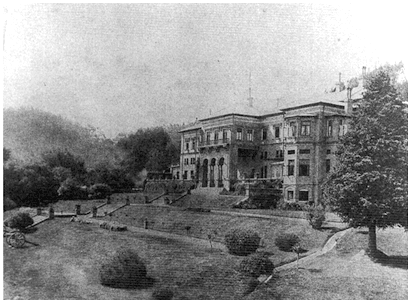
Figure 11.
The Madras governor's mansion, Ootacamund.
From Sir Frederick Price, Ootacamund: A History (Madras, 1908).
70,000 to move its headquarters into a nearby building. Married clerks' quarters were built in 1884-85 at a cost of Rs. 22,676, a postal and telegraph office in 1884 for Rs. 56,960, and a printing-press building in 1904 for Rs. 84,495. Lesser sums were spent on items like a saluting battery to acknowledge the arrival and departure of the governor and other dignitaries.[55] Furthermore, the cost of moving the government from Madras to Ootacamund increased from some Rs. 25,000 per annum in the 1870s to Rs. 43,341 in 1884-85.[56] These expenditures were one measure of the metamorphosis of Ootacamund into a permanent headquarters for the Madras government.
The spate of public building was also, however, a provocation to the nonofficial public in Madras and other towns in the presidency. In 1881 the secretary of state for India received a memorial from the citizens of Madras, protesting the annual migration of the presidency government to
[55] Price, Ootacamund , 20-21, 100; W. Francis, The Nilgiris (Madras, 1908), 358-59. Also see Kenny, "Constructing an Imperial Hill Station," chs. 5, 6.
[56] Minute by Henry Waterfield, 6 April 1881, L/PJ/6/35/448, and minute on the annual cost of the move to Simla and Ootacamund, 1886, L/PJ/6/190/2034, Public and Judicial Dept., IOL.
Ootacamund. The memorial complained that the move was an unnecessary expense, that it led to the construction of a lavish mansion for the governor at a time of famine, that it caused suffering for Indian clerks and servants who found the highland climate uncongenial, that it inconvenienced those obliged to conduct regular business with the government, and that it removed officials from public scrutiny for as much as nine months every year. The document concluded by addressing the broader implications of the government migration to the hills:
Your Memorialists are convinced that the growing tendency of Governments throughout India to desert their respective capitals for the greater portion of the year, and to retire to places at great distances therefrom whence they cannot exercise the control and do the duty required of them, has much to do with bringing about the present financial embarrassment of the Empire, and the consequent heavy taxation now prevailing throughout India.
Appended to the memorial were some 220 pages filled with approximately thirteen thousand signatures in English, Tamil, and Telegu.[57]
Madras was the scene of an even more impressive protest against the government's migration to the hills in 1884. The apparent spark was the transfer of the Madras Army headquarters to Ootacamund, but the causes of discontent clearly went much deeper. A public meeting drew "the largest assemblage within the recollection of the oldest inhabitants" of the city, attracting some nine to fifteen thousand people to the Esplanade, according to the London Times .[58] The crowd divided into English-, Tamil-, and Telegu-speaking groups to listen to speeches by various local notables, including Bishop Coglan of the Roman Catholic Church; Sir Alexander MacKenzie, a prominent businessman and member of the governor's council; Raja Sir Madhava Rao, who had served as dewan for the princely states of Travancore, Mysore, and Baroda; Ananda Charlu, who helped to found the nationalist Madras Mahajan Sabha in 1884 and later became president of the Indian National Congress; and a number of British and Indian lawyers. Here, then, was an issue on which a heterogeneous array of parties, otherwise polarized by race, class, and other distinctions, could find common ground. The assemblage approved a memorial that resembled the one drafted in 1881, again objecting to the expense of the transfer of government to the hills and warning that the authorities' isolation there
[57] Memorial to the Marquis of Hartington, 4 March 1881, L/PJ/6/35/448, Public and Judicial Dept., IOL.
[58] Times (London), 7 July 1884, p. 5, cols. 1-2.
"deprives them of feeling the pulse of the country, . . . estranges them from their native fellow subjects, and . . . exposes them to the risk of forming erroneous opinions of the requirements of the times."[59] The leaders of the 1884 protests, however, exhibited a good deal more political savvy and determination than had been shown three years earlier. Public meetings were held throughout the presidency to coincide with the Madras event; telegrams of "sympathy" were sent by groups in Bellary, Salem, Coimbatore, and elsewhere. The petition drive garnered over twice as many signatures as the earlier initiative, and the petition itself was sent not to the India Office, where its predecessor had sunk with scarcely a ripple, but to Parliament, where its complaints received a public airing.[60] Members of both houses spoke to the protesters' concerns, with several lords especially critical of the transfer of the government to the hills. Lord Napier, whose long and distinguished military career in India had culminated in his appointment as commander-in-chief of the Indian army (1870-76), insisted on the floor of the Lords that "the Government and Council should have their abode in the places where the citizens spend their days." Lord Stanley, who had been secretary of state for India (1859-60), warned that the "chief evil [of the use of Ootacamund as government headquarters] was that the officials became more and more separated from the inhabitants of the country, and more ignorant of their wants and feelings."[61] The London Times gave these remarks and other ramifications of the Madrasi events extensive attention in its pages.
While it was the protests over the annual migration of the Madras government to the Nilgiris that had attracted the attention of members of Parliament, the Times , and others, critics both in India and in Britain meant their objections to apply more broadly to include other provincial governments as well as the imperial government. In effect, the entire raj was on trial. The practice of transferring the agencies of authority to the hill stations had become so widespread among so many tiers of the imperial government that the resentments against it boiled up not only in Madras
[59] The full text of the memorial appears as app. A of Kenny, "Constructing an Imperial Hill Station."
[60] A petition containing 26,717 signatures was presented to the House of Lords; another 7,299 appeared on a petition to the House of Commons. Times (London), 21 July 1884, p. 5, col. 2. Telegrams of "sympathy" from twenty-five civic and other groups are reproduced in Kenny, "Constructing an Imperial Hill Station," app. B. Chapter 5 of Kenny's dissertation provides a good account of the 1884 protest meeting and its political ramifications.
[61] PP, Hansard Parliamentary Debates , 3d ser., vol. 293 (1884), cols. 1346, 1349.
but all across India. In Calcutta and elsewhere, public meetings were held to protest the annual migration.[62] Evidence of the widespread resentment can be found in the private papers of Sir George Russell Clerk. A distinguished veteran of the Indian political service, Clerk had been twice governor of Bombay (1847-48, 1860-62), permanent undersecretary of state for India (1858-60), and, finally, a member of the viceroy's council (1863-67). He grew increasingly disturbed after his retirement by the tendency of the Indian government to spend most of its time in the hills. He collected clippings from English-language and vernacular newspapers that complained about the practice, and he interspersed these items with his own scathing comments. One clipping spoke derisively of "government by picnic ," another of "the frivolous and fatal atmosphere of Simla." Clerk himself warned, "It is a fatal mistake to disregard the mortification and the contempt with which the people view their highly paid functionaries secluding themselves thus for ten months yearly, and so shirking their duties." In the view of this grizzled veteran, the actions of the current coterie of officials stamped them as "Sybarites," whose "frivolities and effeminacy" jeopardized the foundations of British rule.[63]
The migration of the government to the hills did, to be sure, have its supporters as well. Kipling weighed in on the issue with his poem "A Tale of Two Cities," which cast Calcutta residents' complaints about Simla as simple envy: " 'Because, for certain months, we boil and stew, so should you." ' Its final lines asserted that "for rule, administration, and the rest, Simla's best."[64] Similarly, an article in the Calcutta Review dismissed the objections to Simla and Darjeeling as self-interested, coming as they did from Calcutta merchants and lawyers, especially the lawyers, who saw their income and influence diminish because of the seasonal flight to the hills.[65] Yet the voices of Kipling and the author of the Calcutta Review piece were scarcely audible above the loud chorus of complaints.
Despite the remonstrances from press and public in Madras, Calcutta, and elsewhere in India, the critics could do little to prevent the annual migration by the government to the hills. Neither, it seems, could Parliament. Although the India Office, responding to the petitions and pro-
[62] See, for example, H. M. Kisch, A Young Victorian in India: Letters , ed. Ethel A. Waley Cohen (London, 1957), 213.
[63] Sir George Russell Clerk Collection, MSS. Eur.D. 538/6, IOL.
[64] Rudyard Kipling, "A Tale of Two Cities," in Verse: Definitive Edition (Garden City, N.Y., 1952), 75-77.
[65] C.J. O'Donnell, "Simla, Calcutta and Darjeeling as Centres of Government," Calcutta Review 83 (Oct. 1886): 398-419.
tests, demanded a closer accounting of the costs entailed in the annual migrations and sought to impose limits on the number of officials who took part, it conceded that the use of hill stations for political headquarters was a fait accompli . This conclusion came after an 1887 investigation revealed just how thoroughly the hill stations had become woven into the fabric of British rule in India.[66] "It does not seem possible," sighed one India Office bureaucrat, "for the Secretary of State to forbid the practice [of migration of the hills] or to lay down a limit of 3, 4, or 6 months, as the maximum period of hill-residence in any year." Another observed that "the time has come for recognizing the fact that Simla is the place where the Government of India is, as a rule, carried on."[67] Lord Cross, the secretary of state for India, officially conceded the point in a dispatch to the viceroy, Lord Lansdowne:
The annual transfer of the Government to Simla has now been a recognized practice for twenty-four years; it has been acquiesced in by successive Secretaries of State in Council; the head-quarters of the Army have long been established there; large expenditures have been incurred in the provision of public buildings; and I am not in the circumstances prepared to disturb existing arrangements.[68]
The secretary of state's surrender did nothing to silence the public outcries against the official migration to the hills. Increasingly, however, those objections came from one quarter in particular—Indian nationalists. Time and again, Indian members of the Legislative Assembly complained about the public costs of the annual governmental migration to the hills.[69]
[66] See Dispatch #16, Dufferin to Cross, 15 March 1887, L/PJ/6/199/643, and the memoranda by regional governments responding to the request for information on their use of hill stations in L/PJ/6/226/732, Public and Judicial Dept., IOL.
[67] Memorandum by Henry Waterfield, 8 June 1888, and letter by J.A.G., 14 June 1888, L/PJ/6/226/732, Public and Judicial Dept., IOL.
[68] Dispatch #116, Cross to Lansdowne, 25 Oct. 1888, L/PJ/6/226/732, Public and Judicial Dept., IOL. Cross did demand that the government remain in Calcutta from November 1 through April 15, reiterating a requirement ineffectually imposed by Lord Salisbury in 1877, and Cross insisted that the same limitations apply to provincial governments. But he backed down from these demands when the viceroy objected. See Dispatch #9, Lansdowne to Cross, 29 Jan. 1889, and Dispatch #37, Cross to Lansdowne, 18 April 1889, L/PJ/6/224/252, Public and Judicial Dept., IOL.
[69] See the memoranda generated by these challenges in nos. 223-36, Oct. 1911, Home Dept. Proceedings, Public Branch (A); no. 75, March 1917, Home Dept. Proceedings, Public Branch (B); no. 136, April 1917, Home Dept. Proceedings, Public Branch (B); no. 1/54/1927, 1927, Home Dept. Proceedings, Public Branch; and no. 1/12/1930, 1930, Home Dept. Proceedings, Public Branch; all in IOL. The
1927 memorandum cites similar questions by Indian members of the Legislative Assembly in 1920, 1921, 1925-26, and 1926-27.
Gandhi's objections to the practice were enunciated in his essay on Simla, "Five Hundredth Storey." He compared the government to a shopkeeper who placed his shop in the topmost floor of a building, inconveniencing his customers. "The thirty crore customers of this Government, the country's shopkeeper, have to climb not 60 feet but 7,500 feet! . . . Is it any wonder that the country starves?" Carrying his metaphor to its logical conclusion, he declared, "To win swaraj means to oblige the Government . . . to descend from the five hundredth floor to the ground floor and introduce naturalness in its relations with us."[70] Despite its distinctive rhetorical cast, the essential thrust of Gandhi's criticisms was largely the same as those that had been voiced in the late nineteenth century: a government that isolated itself in the hills lost touch with the needs of its subjects. Yet the many British Indian merchants, lawyers, and other nonofficials who had played prominent roles in the earlier protests no longer did so. Whatever measure of collaboration they had forged with Indians against a regime that both parties regarded as aloof and arrogant was fleeting, and it dissolved in the racial polarization that accompanied the rise of militant nationalism in the twentieth century.
Power and privilege were at the heart of the debate about the annual migrations of the supreme and provincial governments to hill stations, just as they were at the heart of the debate about the European colonization of the highlands. The key questions concerning colonization were these: What role existed for white settlers in this densely populated land? Would their exclusion leave imperial authority exposed and unprotected? Would their inclusion subvert the boundaries between colonizer and colonized? Questions of a similar gravity arose over the choice of political headquarters: What locations were best suited to be centers of imperial authority? Should the rulers' proximity to their subjects be the primary criterion in determining the sites of power, or should the security and comfort of the rulers take precedence? All these questions were answered in different ways by different parties, demonstrating that a multiplicity of interests operated within this colonial polity.
[70] Gandhi, "Five Hundredth Storey," in Collected Works , vol. 20 (Delhi, 1966), 117.
Yet the interests that counted most were those of the mandarins, the high officials who oversaw the operations of imperial rule, and the answers they gave to the preceding questions were the ones that took precedence in determining the character of the raj. Despite the lobbying efforts of advocates of white settlement, the recommendations to make the highlands sites for colonies of European agriculturists, or even military and political centers, attracted little support from the government in the first half of the nineteenth century. Around midcentury, several developments, above all the 1857 revolt, reoriented official opinion. Authorities acquired a new appreciation for the highlands, and they sought various ways to put them to imperial use. They may have remained unconvinced that the settlement of poorly capitalized men on small plots of land could succeed, but the remarkable proliferation in the second half of the nineteenth century of tea, coffee, and cinchona estates was a significant step toward the establishment of a permanent European presence in the highlands, and it was made possible through the state's alienation of land, construction of a railway system, experimentation with plants, and other active subventions. The most significant indication of the increased appreciation of the highlands, however, was the effort to turn hill stations into centers of government. For the viceroys who found Simla a more congenial place from which to conduct the affairs of state than Calcutta, for the governors, the lieutenant-governors, the chief commissioners, and even district officials who sought out highland headquarters of their own, and, indeed, for the thousands of clerks and servants who followed their superiors on these annual migrations and the tens of thousands of lawyers and merchants and others who resented the practice, it became apparent that a massive shift in the geography of power occurred in the latter part of the nineteenth century, a shift from the plains to the hills.
Sandria Freitag has argued that an indigenous Indian public sphere in the colonial era took shape in "a world from which the British had excluded themselves; and it was this overt act of exclusion by the state itself which marks the greatest difference between the colonial public arena and the public sphere of western Europe."[71] While Freitag herself makes no reference to hill stations, it has been suggested here that they were in fact the
[71] Sandria B. Freitag, "Enactments of Ram's Story and the Changing Nature of 'The Public' in British India," South Asia 14, no. 1 (June 1991): 89. Also see the other essays in this issue of South Asia , which is devoted to an examination of a colonial public sphere.
logical outcome of this exclusionary process. The British determination to impose an aloof and vigilant system of authority over the Indian population in the aftermath of 1857 was realized through the progressive concentration of political and military might in the hill stations. The consequences of this action would be not only the rise of a distinctively Indian public arena but also the struggle to sustain an exclusively British one.