
Development of the Genre
In 1886 Grierson published forty-two examples of biraha song texts. At that time a song consisted of just two rhymed lines of text and lasted less than a minute in performance. No musical instruments were used. This genre existed solely as a village form and was prevalent among the Ahir (cowherds and milkmen) caste, who now prefer the term Yadav[*] . This genre still exists today with the same village and caste associations but is called khari[ *]biraha , probably to distinguish it from the new genre that developed over the last hundred years.
This is an example of a kharibiraha :[2]
Ram ki[*] laraiya[*] ke na paibe[*] Ravanwa, jekari[*] bagal me[*] Hanuman
Sona[*] kai Lanka tohari[*] mati[*] me milai[*] hai, tor dihai[*] toharo guman[*]
[2] This version was provided by Ram Sevak Singh (2/VI/83 Marcus Collection: RSS interview no. 1). A slightly different version of the same was provided by Lakshmi Narayan Yadav (1975:1) and Nakharu Yadav (Marcus Collection: XXIII:8, 14/III/84). Besides Grierson's forty-two examples (1886), which are in Devanagari script with English translations and commentary, see also Henry (1988; chap. 5, pp. 6 ff.) for seven examples transcribed into Latin script and translated with commentary. For recordings, see Columbia 9102021, The Columbia World Library of Folk Primitive Music , vol. 13: Indian Folk Music (as listed in Henry 1988, chap. 5:5). A single example is provided. Rounder Records: Chant the Names of God. Marcus Collection (VII:30 and VIII:11) includes eight examples.
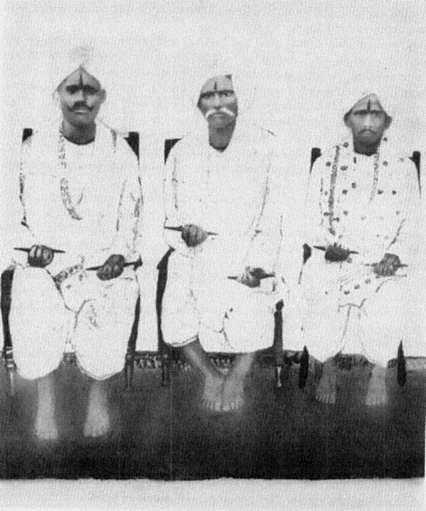
Fig. 8
Bihari (center), said to be the creator of biraha[*] , and two of his main disciples. On
his right is Ramman, the namesake of the Ramman akhara[*] . All three are holding
kartal s[*] . With the exception of the chairs, this group typifies the early biraha
ensemble (photograph from the 1920s).
[Ravana cannot succeed in fighting Ram, who has Hanuman at his side, / (to Ravana:) Your golden Lanka will be mixed with the soil (i.e., destroyed), your pride will be broken.]
Oral history holds that the earliest stages of the "modern" biraha (as distinct from khari[*]biraha ) were the creation of one man, Bihari Lal Yadav, who lived from 1857 to 1926 (see fig. 8). Generally referred to as
Guru Bihari, he is universally recognized as the founder of biraha[*] . (Thus, we have the remarkable occurrence of a folk music genre with an acknowledged founding figure.)
The form that Bihari used for his own compositions included an unlimited number of rhymed lines: the genre had grown to allow for more content. Among the changes which Bihari is said to have effected were the invention of a new instrument and its introduction into biraha performance. This instrument, the kartal[*] , consists of two pairs of tapered metal rods, each approximately nine inches in length. The singer holds a pair in each hand, creating a high-pitched ringing sound by rhythmically hitting the two rods against each other (see fig. 8). This instrument is unique to biraha and is thus one of the more obvious identifying elements of the genre.[3]
Bihari introduced his new genre into the urban environment when h e moved to the city of Banaras[4] and began performing at city temple festivals, called shringar s[*] . At the time, the most prominent forms of entertainment at these festivals were kajali[*] (another regional folk genre), Indian classical music, and performances of courtesans, which included music and dance. Bihari began performing biraha at kajali functions. He came away from a number of these the acknowledged "winner" of the event: in kajali performances, two or more ensembles would perform at the same event, and there would be an element of competition between the ensembles. This element of competition was later incorporated into city performances of biraha . Thus biraha had its first successes in the urban environment.
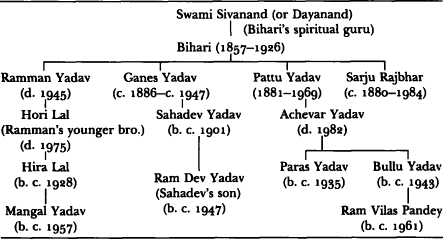
As Bihari's fame spread (he gained renown as both singer and poet) he acquired a number of disciples (shishya s or chela s). When his disciples later attracted students of their own, separate lineages developed. These lineages are called akhara s[*] or, less commonly, gharana s[*] . Bihari had four main disciples and these in turn have their own students (see table 3.1). The various akhara s do not keep records of their members. The system relies on the social contact of the guru-chela relationship for its maintenance (generally, poets are the gurus, singers are the chela s). All acknowledge that the akhara[*] system in biraha began with Bihari.[5]
[3] The word kartal is used across northern India to name various other idiophones ("a musical instrument—as a gong—that sounds by the vibration of its constituent material" [Webster's Seventh New Collegiate Dictionary]). This version of the kartal is unique to biraha .
[4] Bihari was born in a village named Patna near the Aurihar station, Saidpur tahsil, in Ghazipur district. He moved to Banaras at an early age in search of employment and eventually took up permanent residence in Ahiriyana, a section of the city adjacent to Nichi Bag (L. N. Yadav, 1975:3; Ram Sakal Yadav, n.d., 3).
[5] Some biraha singers come from non-Bihari lineages. Most of these lineages have their roots in the kajali tradition. Kajali[*] (or shayari[*]kajali ) is a folk musical genre of easternU.P. and western Bihar, which flourished for a hundred years or more, but which met almost total eclipse with the rise of biraha . Many kajali[*] performers, wanting to continue their musical careers, came into biraha . Thus kajali lineages became biraha lineages. Interestingly, the presence of a gharana[*] system within folk music has been little noticed.
|
These akhara s[*] play a major role in organizing the social and performance aspects of the tradition. For example, membership in one or another of the akhara s is mandatory for anyone wanting to become a professional biraha[*] singer. One reason for this is that biraha singers do not improvise their song texts; rather they obtain and memorize texts from poets who belong to one specific akhara[*] . The song texts are the property of that akhara . Thus it is only through membership in an akhara that a singer can obtain songs to sing.
The akhara phenomenon also plays a major role in determining who will perform when the performance is of the competitive, or dangal , variety. In dangal s the two competing biraha ensembles must be from different akhara s. Thus, it is not only the two singers who are competing but also the two akhara s. One's membership in an akhara is not an obscure piece of information; rather it is announced at the end of every song. All songs end with a section called the chap[*] (literally "stamp") in which the poet has composed lines that list the major figures in his specific akhara 's lineage. Thus the audience is constantly being reminded of the singer's akhara affiliation. This is a sample chap , written by Mangal Yadav, a poet and singer of the Ramman akhara :
Swami, Guru Bihari, Ramman Hori, dharm anuyayi[*] ,
Hira, Lakshmi, kavi Mangal sevai mandir nit bhai[*] . . .
[Swami (Bihari's guru), Bihari, Ramman, and Hori are followers of the dharma (i.e., are religious) / Hira Lal, Lakshmi, and the poet Mangal serve the temple daily . . .] ("Lakshmi" is Lakshmi Narayan, b. c. 1941, who, as the grandson of Ramman, is considered the present-day titular head, or khalifa[*] , of the Ramman akhara[*] .) Bihari's disciples and others who constitute the next generation of poets composed in a new structure, which included the addition of a periodic refrain called the teri[*] (the creation of which is attributed to Bihari himself). In time, the teri came to be considered the very essence of the biraha[*] form. Recognizable by its distinct poetic structure and melodic line, the teri , in content, is said to encapsulate the song's dominant statement and rasa (aesthetic quality).
Over a period of some thirty years (c. 1920–1950) three distinct formal structures evolved, all centering around the use of the teri line. All three can be said to be variants of the "traditional biraha structure," "biraha in its maturity." Once evolved, all three continued to exist side by side.[6] Besides the teri , two other compositional features characterized the traditional biraha form in its maturity. These are the antara[*] (dophuliya[*] and caukara[*] varieties) and the uran[*] .