
8—
Relations with Non-Tribal Populations
In the preceding chapters we have seen that most of the changes in the economic condition and life-style of tribal people have been caused by contacts with materially more advanced and politically more powerful populations. Such contacts are not an entirely novel phenomenon, for few of the tribesmen of Andhra Pradesh have ever lived in total isolation, but the intensity of their impact has grown enormously within the past forty years, and it is growing all the time. The improvement of communications, particularly the construction of motorable roads, as well as the intensified intervention of government agencies in more and more aspects of citizens' activities, have combined to undermine the independence of tribal societies. The degree of interaction with non-tribals varies according to both topographical and economic factors. Small groups in out-of-the-way places are less likely to be affected by contact with outsiders than settled communities close to a commercial highway or in the midst of agriculturally rich country. Where there are few resources to attract settlers or traders, primitive tribes may be left in peace even though access to their habitat is not difficult, while in other areas the prospect of growing lucrative cash crops rapidly leads to fierce competition between the local tribesmen and rapacious immigrants.
Among the Chenchus of the Nallamalai Hills, true competition with outsiders occurred only recently. For a long time, probably several centuries if not longer, their contact with more advanced populations was focussed on a primitive barter trade. The Chenchus were in need of knives, axe heads, and iron for arrow tips, and the com-
modities they gave in exchange were honey, wax, berries, and sometimes perhaps venison. When they discarded the leaf dress of their ancestors, they needed cotton material for scanty pieces of clothing, and with the adoption of a more settled mode of life, they also sought to acquire such household goods as pots and mill-stones. By the time the Forest Department of Hyderabad State began to exploit the Chenchus' habitat and contractors started to fell trees and bamboos, Chenchus had an opportunity to earn cash wages, with which they could buy some of the novel commodities and occasionally also small quantities of grain. At the same time merchants of the plains began to purchase increasing quantities of minor forest produce, such as aromatic resin, kernels of Buchanania latifolia , and corollae of Bassia latifolia , the so-called mahua flowers used for the distillation of liquor. Contacts resulting from such barter remained, however, rather fleeting. There was little occasion for Chenchus to entertain any lasting social relations with the plainsmen who bought or bartered such jungle produce, for all the transactions were seasonal and involved contacts with a variety of plainsmen. Though in such transactions the Chenchus may sometimes have been cheated, there was little interference with their life-style, and no outsider had any desire to settle in their densely wooded habitat. Such was still the case when I lived with the Jungle Chenchus in 1940, but since then various changes have occurred, as discussed in chapter 3.
When I returned to the same area in 1977 and again in 1980, I found that the Chenchus were no longer the sole inhabitants. In various localities non-tribals had settled and begun to cultivate on a small scale in some clearings where a few plots of land had been allocated to Chenchus. But the Chenchus had shown little perseverance in cultivating, even though the government had distributed some plough bullocks. They preferred to let out such land to Banjaras and other plains people, who cultivated and gave them a share of the yield.
In some localities there is another type of cooperation. In Pulajelma, for instance, there are several families of Banjaras who come with large herds every year in the month of May. They graze their cattle in the forest until the following January, and throughout the eight months of their stay they live in a kind of symbiosis with the Chenchus of the locality. The Chenchu women draw water from a well close to their own huts, and carry it to the Banjara camp. In return for this service they get butter-milk from the Banjaras, and this they consume mixed with millet gruel. The Chenchus insist that every Chenchu household must get some of the milk, irrespective of the work its members have done for the Banjaras.
A more complex situation, involving members of several different
castes, has arisen in Vatellapalli. In 1940 this was a Chenchu settlement of eight huts, but herdsmen from villages of the lower Amrabad Plateau used to bring their cattle for grazing in the surrounding forest, moving from camp to camp. Social contact with the Chenchus was then minimal.
Subsequently, several families of Waddars settled for a time at Vatellapalli and started cultivation. Because of friction with forest officers, they left after some time. In order to make the local Chenchus learn how to cultivate, the Social Service Department then settled eighteen families of Harijans of Mala caste at Vatellapalli. Both Chenchus and Harijans were allotted some land and plough bullocks, and the idea was that by their example the Harijans would teach the Chenchus agriculture. At first the project was reasonably successful, and several Chenchus learned to plough and reaped some grain crops from their fields. But with the exception of one man, who in 1978 was still cultivating, all the Chenchus gave up cultivation when their plough bullocks became old and died. They then hired out their land to the Harijans, and were quite content to get a share of the produce, while they themselves engaged in the collection and sale of minor forest produce. The latest arrivals are Banjaras, who keep cattle but also cultivate some land which they have been allotted. Harijans and Banjaras alike describe the Chenchus as hopelessly inefficient cultivators, and it seems that most Chenchus subscribe to this assessment and leave agriculture to others while concentrating on the gathering of forest produce. In this occupation they no longer have a monopoly, however, for Harijans and Banjaras have also started to collect marketable forest produce, though they do not range over as large a forest area as the Chenchus do. In 1977 the number of Chenchu households had grown to twenty-four. There were no newcomers among them, but all were descendants of the eight families who had lived in Vatellapalli in 1940.
A similar situation has arisen in Sarlepalli, an old Chenchu settlement which now has a mixed population. Besides twenty-one Chenchu households, there are thirty houses of Harijans, Gollas, Waddars, and Muslims. The houses stand between kitchen gardens and give an impression of permanence. Here, too, the Chenchus were allotted plough bullocks and encouraged to take up agriculture. But when the bullocks died in a cattle epidemic, they gave up cultivation, and leased out their land to the many non-tribals who had settled at Sarlepalli. Only a few of those newcomers have obtained patta land. Most are content to cultivate land belonging to Chenchus and to pay the owners rent in either cash or kind. The Chenchus, too, seem to be satisfied with getting a rent of about fifty kilograms of grain per acre. They are now free to collect forest produce for sale and seem to be quite well off. Some have even been able to buy buffaloes, but most of
them own neither cattle nor poultry. Here I had the impression that there is no animosity between Chenchus and non-tribals, and that the symbiosis of foodgatherers and agriculturists is far more successful than the symbiosis of ethnic groups with similar, and hence competitive, economies in Adilabad District.
The Chenchus on the lower Amrabad Plateau are in a very different position. Here they have lived for some generations in close contact with non-tribal agricultural populations. The Chenchus of some communities, such as Mananur, were able to acquire land and learn to cultivate before there was great pressure on land, and some have retained their holdings despite periodic indebtedness to merchants and moneylenders. The proximity of the forest enables the Chenchus of Mananur to supplement their income by collecting forest produce and selling it for cash to the local depot of the Girijan Corporation.
In the villages east of Amrabad, the condition of the Chenchus is much less favourable. They depend entirely on agriculture, but most are short of land and of plough bullocks, and work mainly as farm servants or casual labourers for landowners belonging to the higher Hindu castes. The most impoverished group of Chenchus in this area lives in tiny huts built on an outcrop of rock near the large and prosperous Hindu village of Venkeshwaram. Only one of the Chenchus owns a little plot of land, but as he has no bullocks he lets it out to a Mala cultivator, who gives him as rent only one quarter of the yield. An old woman told me that when she came to the village as a young girl there were plenty of roots and tubers in the jungle, but that now the forest has receded because of the expansion of cultivation, and forest produce has become scarce. Here and elsewhere the Chenchus also complained that the competition of non-tribals restricts their earnings from the collection of forest produce. Real income from agricultural wages has also decreased. In 1940 I had noted that the average daily wage in these villages was 3 kilograms of grain, but now landlords pay Chenchus only 1 1/2-2 kilograms of grain for a day's work.
In the large village of Jangamreddipalli near Amrabad, nineteen Chenchu families form a small minority, and in 1977 they were entirely dominated by a Reddi landlord, who paid male farm servants an annual wage of Rs 600 without giving them food or clothes. By 1980 their condition had slightly improved, for most of the Chenchus had been allotted some land by government, and the Tribal Welfare Department had provided them with plough bullocks.
Despite such occasional assistance by government, symbiosis with advanced populations has not proved beneficial to the Chenchus of this area. They appear on the whole less well fed than the Forest Chenchus and enjoy less independence and freedom from exploitation. But whatever the material prospects of the Village Chenchus
may be, they have at least the ritual status of a non-polluting caste, whereas in South India many primitive jungle tribes became low caste and untouchable when assimilated within the caste system. The Chenchus' relatively good caste status may be due to their early association with hermits and priests of outlying temples, as well as to their conformance to the Hindu prejudice against beef eating. Hence they may draw water from the same wells as Brahmins and have free access to all Hindu temples. Yet their houses never stand inside the villages where the higher Hindu castes and Muslims dwell, but are situated in hamlets on the outskirts, very much like the settlements of such Harijans as Malas and Madigas. And while the latter play a traditional and by no means unimportant role in rural Telugu society, the Chenchu is still an outsider and does not participate to any great extent in the social and ritual life of the villages.
The relations of the Konda Reddis with non-tribals who settled in their country have already figured in chapter 2, where the problem of land alienation was discussed in detail. Similarly, the effect of exploitation by timber and bamboo merchants on the Reddis' economy has been dealt with in chapter 4. Reviewing developments throughout the Reddi country during the period from 1940 to 1979, we cannot come to any other conclusion than that on the whole the Reddis have not benefited from their contact with materially and politically more advanced populations. The only ethnic groups whom they meet on a basis of equality are such tribes as Koyas and Bagatas, as well as certain communities of craftsmen. The Kammar blacksmiths of the Godavari region, for example, live in a style similar to that of the Reddis and despite their low ritual status participate in many of the latter's festivals.
Between Reddis and the merchants and cultivators from the coastal region who settled in riverbank villages, on the other hand, there is no social meeting ground. The newcomers, most of whom belong to Hindu castes of middle status, look down upon the Reddis, feeling both socially and economically so superior that they regard them in no other role than that of potential victims of exploitation. Settlers intent on purchasing or leasing a Reddi's land may fraternize with the vendor and ply him with drink till they can persuade him to put his thumbprint to a piece of paper which gives the settler rights to his land in return for a derisory sum or other insignificant benefits. As soon as the deal is completed, the settler loses interest in his drinking companion. The surest way of making a Reddi pliable is to lead him into debt, and we have seen that one of the first non-tribal settlers in Koida opened a liquor shop and sold drink to Reddis and Koyas on credit as the first phase in his campaign for the acquisition of land suitable for growing tobacco and chillies. In The Reddis of the Bison
Hills I have shown that in the 1930s and 1940s timber merchants used the system of debt bondage as the easiest means of acquiring a docile labour force, and while the exploitation of forest coups by large firms, such as the Sirpur Paper Mills, has done away with this type of abuse—though by no means with all forms of corruption—indebtedness of tribals is still the most important factor in the perpetuation of the Reddis' economic domination by outsiders.
Apart from merchants settled in riverside villages and dealing with large numbers of tribals, such as the many Reddis earning cash wages by bamboo cutting, there are also petty traders who periodically visit Reddi hamlets and peddle a limited range of goods. While I camped in Gogulapudi, a small hill settlement, a woman of Kapu caste with two young girls carrying some baskets arrived. She was selling salt, sugar, oil, vegetables, and some other supplies, and extended credit to those Reddis who had no cash in the house. She seemed on familiar terms with the Reddi women and spent the night in one of their houses. I was told that she was a frequent visitor in out-of-the-way villages and made a living by her petty trade. It is partly through such pedlars that Reddis become aware of events outside their villages and learn to understand the people in the more advanced villages. Thus, modes of dress and behaviour change imperceptibly through the example of the few non-tribals who are on friendly terms with Reddi families.
In the hills of East Godavari District, specifically in Chodavaram Taluk, Reddis have for several generations lived in symbiosis with members of an untouchable caste known locally as Valmiki, or Konda Mala. In chapter 4, in which I discussed the economic relations between Reddis and Valmikis, we have seen that, although of socially lower status than the Reddis, the Valmikis have succeeded in dominating and, indeed, exploiting the Reddis. Recent changes in the pattern of trade have diminished the possibility of exploitation, but developments in the educational sphere now work in favour of the Valmikis. As many of them have been converted to Christianity, they have had many opportunities to obtain a relatively good education in mission schools, and this is expressed in a high literacy rate. Superior educational qualifications now give Valmikis great advantages in the competition for employment in government service. Many Valmikis have been appointed as teachers and to clerical posts, whereas the number of Reddis in government employ is minimal. Even more important is the success of Valmikis in the political field. Valmikis are now represented in the Legislative Assembly of Andhra Pradesh, holding seats reserved for tribals, while Reddis have so far shown little political ambition. As long as the muttadar represented their people vis-à-vis the officers of government, lack of interest in politics was of little consequence, but since the abolishment of the system of feudal chiefs the
Reddis are undoubtedly at a disadvantage compared with educationally more advanced populations such as the Valmikis, particularly as the latter also profit from the reservation of jobs and seats for tribals.
In Vishakapatnam District, which adjoins the Reddi country to the north, Valmikis also form a substantial population in such tribal areas as Paderu Taluk. There they live in large villages side by side with Bhagatas and Konda Doras. Neither in house-style nor in dress is there much difference between Bhagatas and Valmikis. Both communities appear to be relatively prosperous, their houses are well built, and their irrigated rice fields are carefully tended. The situation of Paderu Taluk at an altitude between 2,000 and 3,000 feet and the difficulties of communication have so far prevented a massive immigration of non-tribals from the coastal region. People from the lowlands find the low temperatures of the winter months troublesome, and until recently there was no all-weather motor road between Vishakapatnam and Paderu. In 1978 many villages of Paderu Taluk could not be reached by jeep, and during the monsoon even access on foot was often difficult. Hence, so far advanced populations from the lowlands have not been attracted to settle in remote valleys where they would be cut off during part of the year. Along the motor road which leads from Paderu to the northern part of East Godavari District, however, members of various Telugu castes have settled during the past twenty years. Though they arrived mainly as traders and moneylenders, they did acquire some land, but not to an extent which seriously jeopardized the landholdings of the local tribals.
In the neighbouring Srikakulam District, different conditions prevailed. There Jatapus and Saoras are the principal tribal communities, and in the hill areas adjoining the state of Orissa, these tribes used to be the main population. As in East Godavari District, there were some tribal feudal chiefs with the title muttadar , and judging from the sanad documents some of them still possess, their authority was recognized by the British administration as early as 1848. During the last two or three generations, members of Hindu castes infiltrated into the hills both from the coastal lowlands and from Orissa, and their settlement led to the usual alienation of tribal land. In Bhadragiri Taluk, for instance, much of the flat land in the valley bottoms passed into the hands of newcomers, while the indigenous tribals practised shifting cultivation on the hill slopes. The community mainly responsible for the alienation of tribal land throughout the hill regions of Srikakulam District is the Sundis, or Sondis, originally a caste of toddy sellers and distillers of arrack, many of whom have turned into moneylenders. As early as 1909, E. Thurston referred to this caste in the following passage:
The Sondis are gradually getting much of the best land into their hands, and many of the guileless hill ryots into their power. Mr. Taylor stated in 1892 that the rate of interest on loans extorted by these Sondis is 100% and, if this is not cleared off in the first year, compound interest at 100% is charged on the balance. The result is that, in many instances, the cultivators are unable to pay in cash or kind, and become the gotis[*] or serfs of the sowcars, for whom they have to work in return for mere batta (subsistence allowance), whilst the latter care to manipulate their accounts in such a manner that the debt is never paid off.[1]
It is a sad reflection on the inability of successive governments, British and Indian alike, to protect tribals against exploitation that the conditions graphically described in the above passage have continued to prevail over nearly a century, although they were clearly known to the authorities. The fact that they were not remedied, even when in other parts of Andhra Pradesh steps were taken to eliminate land alienation and debt bondage in tribal areas, ultimately led to the insurgency under Naxalite leadership mentioned in chapter 1. This was clearly an act of desperation in the face of intolerable oppression by non-tribals, and it proved effective in bringing about a change in government policy. Under the new policy much of the land usurped by Sundis, Oriya Brahmins, and other non-tribals was returned to Jatapus and Saoras, and the relations between tribals and non-tribals were placed on a new basis. Some of the non-tribals, such as numerous Oriya Brahmins, who had acquired land in Srikakulam without giving up their holdings in Orissa, returned to their original home villages, but others had been settled in Srikakulam for long periods, and stayed on, making the best of the new, and for them unfavourable, situation and undoubtedly hoping that a change in government policy would enable them to recover some of the lost land.
Mondemkallu, a large village in the Bhadragiri area, is a good example of the multi-ethnic society which grew up during the years of unrestricted immigration. This village comprises about 500 households, and of these 200 are of Oriya Brahmins, Sundis, and other trading castes. There are Jatapu streets and at some distance from them an entire Saora settlement, which is noticeably poorer than other parts of the village. There is also a potters' street and a quarter of Oriya-speaking gardeners, who rank as tribals and have retained their plots of land.
The Sundis and other non-tribals are now lying low and try, apparently not unsuccessfully, to make a living by trade and possibly by moneylending. When in 1979 I enquired whether, despite the vig-
[1] Castes and Tribes of Southern India 6:400.
ilance of government officials, cases of illegal transfer of land between tribals and non-tribals occurred, I learned that a few cases have indeed come to the notice of the authorities, most of them related to arrangements of sharecropping which enable non-tribals to regain a foothold in land officially re-allocated to the original tribal owners.
In villages such as Mondemkallu, some Jatapus live in a style similar to that of Sundis, and it would appear that the self-confidence they gained at the time of the Naxalite movement, as well as the resulting change in government policy, is now enabling them to hold their own in their interaction with non-tribals. I noted a similar attitude of self-assurance on the part of tribals at a weekly market in Sitampeta. Jatapus and Saoras arriving with their wares, mainly goats, pigs, fowls, and large bunches of bananas, were by no means ready to accept the prices offered by traders, who tried to tempt them with bundles of banknotes as soon as the villagers arrived at the market. The tribals bargained very vigorously, and managed to sell goats for as much as Rs 110, rejecting all lower offers. This is certainly a considerable change in attitude compared with that which had prevailed as long as most tribals were deeply indebted to merchants and had no choice but to deliver their produce to their creditors at rates arbitrarily fixed by the latter.
The relations between tribal communities and non-tribals in Adilabad has been dealt with at some length in my book The Gonds of Andhra Pradesh (pp. 27–35) and insofar as the eastern part of the district is concerned, there are also references to this problem in the analysis by Michael Yorke contained in chapter 9. In this context it will therefore suffice to concentrate on those aspects of the problem which have undergone major changes in recent years. There are two major causes of such changes. One is the sudden influx of non-tribals, who have occupied large parts of the district which a generation ago were purely tribal territory. While this development occurred without encouragement by government and partly even in the face of some rather ineffective opposition by local officers, the other major change in community relations is the result of a deliberate reversal of policy by the Government of Andhra Pradesh.
As long as small numbers of non-tribals lived among the Gonds and Pardhans of taluks such as Utnur, relations between tribals and non-tribals were fairly amicable. Here and there some Marathas owned a few acres of land in a Gond village, possibly a relic of the brief time when the Maratha kingdom extended as far as the Adilabad highlands. The Maratha owners of such lands either let them out to Gonds, charging a moderate rent, or lived in small clusters near Gond villages and cultivated the land themselves. In either case they maintained a low profile, and were so small a minority that they did not threaten in
any way the social and economic order of the tribal people among whom they lived. Quite a different situation arose when the demographic pattern was reversed and the erstwhile Gond majority turned into a minority. In extreme cases such as in Jainur and Indraveli, non-tribal newcomers occupied the central parts of villages and established a bazaar street with modern houses, while the Gonds were confined to hamlets situated at the periphery of the locality.
In such places the new settlers imported the house-style and manner of living of the lowlands, and the Gonds continued to build dwellings of wood and wattle, seldom having the means to copy the houses of those who had taken over most of their land and profited from the trade in newly introduced cash crops. So great is the gap between the Gonds' living standards and resources and those of the Hindu and Muslim settlers that there would be no real basis for social relations even if differences in language, ideology, and traditions did not present obstacles in the way of personal, in contrast to purely commercial, contacts.
The members of the immigrant communities are not content to dominate the region economically, but they are ambitious to gain influence in the local system of authority. This can be done most effectively by achieving appointments as patel and patwari . The position of patwari , in particular, makes it possible for an incumbent to manipulate the allocation and transfer of land, a power which in the present social and political climate also facilitates the collection of very substantial bribes.
Unlike Gonds, who seem to have lost the ability to cooperate for their mutual protection, most of the immigrant communities have set up networks of members in economically and politically influential positions, and through these networks exert a power which the Gonds can no longer match. A few examples of clusters of influential non-tribals will demonstrate the composition of such networks.
Utnur has been a centre of influential Muslims ever since the days of the Nizam's government, and even today, when Muslims are no longer a privileged community, a network of locally powerful Muslims remains. The doyen of one of these networks is Tajuddin, sarpanch of Utnur. He served at one time as revenue inspector, and his father was head constable in the Utnur police station. He has large landholdings in Utnur, Dantanpalli, and Birsaipat, and he also operates as a moneylender. Among his close kinsmen are Abdul Rahim, who at one time held the position of patwari for Jainur, Daboli, Jendeguda, Ragapur, Pithaguda, and Burnur, having replaced the Gond patwari of these villages. Abdul Rahim's younger brother, Khalil Ahmed, is patwari of the important village of Hasnapur. The mother's
sister's son of Abdul Rahim is Mohamed Ali, patwari of Dubbaguda, Daboli, and Jamni.
Another Muslim family, remotely related to Tajuddin, consists of Hasham, patwari of Salevada and Shampur, his brother-in-law Ismail, patwari of Tosham, and Sheik Husain, son-in-law of Ismail, who is patwari of Kando and Rampur. The latter is also secretary of an informal association of patwari , and maintains close contact with the so-called asaldar patwari , who are all Brahmins and were hereditary watandar whose consent had to be obtained—and often bought—when anyone was to be appointed as patwari .
There is also a network of Reddis (a Telugu Hindu caste different from the Konda Reddis), and the leading figure of this cluster is Linga Reddi, a landowner with holdings in Utnur and Darmasagar, who also owns a liquor shop at Indraveli, while his wife runs a moneylending business. He is closely related to Hanmanth Reddi, who in 1978 was deputy forest ranger at Janaram and who owns a liquor shop in Utnur. His wife lives in Utnur and also lends money.
Another cluster is made up of Mahars, members of a Maratha caste of low status but considerable business skill. This cluster centers around the village of Narnur. There Lokhandya Soma owns a great deal of land and in 1977 had 200 head of cattle. He is a great moneylender, lending money at an interest rate of 25 percent per annum on the security of mortgages of land. He is considered the richest man in Utnur Taluk. His son Baba Rao is patwari of Tadi Harapnur and five other villages, and Lokhandya Soma's two mother's brother's sons are Raja Ram, patwari of Chorgaon, Sungapur, Doranda, and Pipri, and Linga Rao, who is patwari of Malangi, Umri, Sangwi, Rumankhassa, and Ganeshpur. Finally there is Nam Deo, the classificatory brother's son of Baba Rao, who lives in Tadi Harapnur but is patwari of Babijheri, Bopapur, and Khairdatwa.
There are similar clusters of families of Rajputs, Hatkars, Komtis, Kalals, and Banjaras, all of whom combine economic power with the authority some of their members exercise as patwari .
The role played by such networks in the alienation of tribal land for the benefit of immigrant Muslims, Hatkars, Marathas, or Mahars, as the case may be, explains to a great extent the inability of the Gonds to resist the massive onslaught of newcomers on their ancestral land. For the combination of financial resources and the key position of patwari in the system of land rights enabled such clusters of powerful families to outwit illiterate Gonds of modest means at every step and to sabotage even the campaign of the government to restore alienated tribal land. Yet as long as the transfer of land from Gonds, Pardhans, Kolams, and Naikpods to members of any other community remained
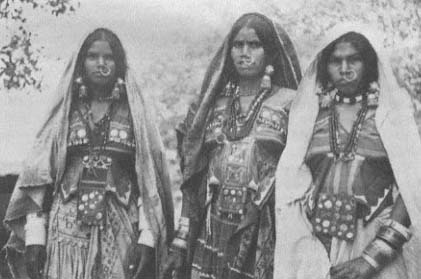
Banjara women who had immigrated from Maharashtra into the highlands of
Adilabad. In race, language, and customs they differ fundamentally from the
indigenous tribals. Their characteristic dress, made of multi-coloured materials
and heavily embroidered, betrays the Banjaras' North Indian origin.
strictly illegal, there was always the possibility of counteracting the tricks and falsifications of corrupt patwari , and all hope was not lost for tribals if a sympathetic officer took the trouble to investigate cases of land alienation in depth.
However, in 1977 a decision by the Government of Andhra Pradesh removed one of the most important safeguards against the transfer of tribal land to new settlers. In that year the Banjaras, also known as Lambaras, were notified as a scheduled tribe, and this notification invested them with all the privileges hitherto enjoyed only by the truly aboriginal tribes of Andhra Pradesh. The reason for this move on the part of the government was basically political, for Banjara leaders had been pressing for some time for their inclusion in the list of scheduled tribes, and as some 600,000 votes were at stake, the political party in power finally yielded to this pressure. The Indian parliament endorsed the proposal made by the Government of Andhra Pradesh, even though in the neighbouring state of Maharashtra the Banjaras do not have the status of a scheduled tribe.
In Adilabad District, the Banjaras are among the most recent immigrants. Their homeland is undoubtedly North India, and in physical
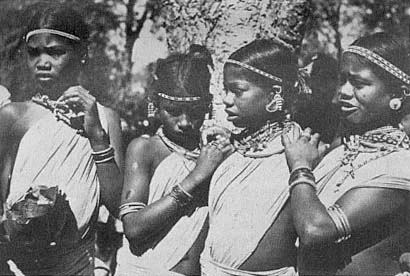
Muria Gond girls of Bastar wearing solid silver necklaces and many strings
of glass beads; their saris are invariably white.
characteristics, language, and traditional dress they are akin to the population of Rajasthan. Originally they were engaged both in cattle breeding and in the transport of goods on the backs of their pack bullocks, and it was in their capacity as carriers that they served the Mughul armies and moved in their wake as far south as the Deccan. When modern means of transport outstripped the Banjaras' bullock caravans, many of them took to farming, with particular emphasis on the raising of live-stock.
In Adilabad District, the settlement of Banjaras is of very recent date, and in the 1940s there were still many old Gonds who remembered the time when the first immigrants arrived with their carts and cattle from the neighbouring districts of Berar. They first settled in the taluks of Kinwat and Adilabad, but when no more land was available in the riverain plains south of the Penganga, they pushed into the highlands and ultimately occupied a great deal of land in the heart of the Gond country. Generally more dynamic than the easygoing Gonds, hardworking, and shrewd, they succeeded in displacing the indigenous tribals in many villages of Utnur Taluk, and in the early 1940s there were already Banjaras who owned several hundred acres, but cultivated only a small part themselves, hiring out the rest at high rents. In their relations with Gonds they were on the whole oppres-
sive and employed their greater business sense and their powerful physique to bully and intimidate their Gond neighbours. As early as 1948, I wrote in my The Gonds of Adilabad (p. 62): "Once Banjaras gain a foothold in a village, it is generally lost to Gonds or Kolams." Subsequent events proved this sentence to be truly prophetic, for by 1976 numerous old Gond villages had been taken over by Banjaras, and the acquisition of Gond land by new Banjara settlers progressed at a steady pace. When special revenue officers probed into cases of alienation of tribal land, it was found that many of them involved the illegal acquisition of Gond land by Banjaras. After the notification of the Banjaras as a scheduled tribe, the Land Transfer Regulation could no longer be invoked to restore such land to the rightful Gond owners, and it can be clearly foreseen that more and more tribal land will pass into the hands of Banjaras. As in neighbouring Maharashtra they do not enjoy the privileges of a tribe, it is only natural that many Banjaras cross into Andhra Pradesh and avail themselves there of facilities to which they are not entitled in their home state.
In Utnur Taluk, where in the 1940s Gonds, Pardhans, and Kolams still formed the overwhelming majority of the population, in the years 1978 and 1979 alone some 20,000 acres of land were assigned on patta to Banjaras. This is more than the entire allocation of land to tribals in the previous twenty-five years, and can be explained only by the strong pressure Banjara political leaders and their allies in the ruling party were able to exert on the revenue authorities of the district. Seen against the background of a situation in which many Gonds and Kolams had for years vainly tried to obtain patta for land they were already cultivating (see chapter 3), this massive operation indicates that the Banjaras have suddenly become the most privileged community in the district. But the ability to acquire tribal land is only one of the privileges recently gained by Banjaras. In addition, they now have the right to occupy seats in the Legislative Assembly reserved for tribals, and we have seen in chapter 5 that both the tribal seats previously held by Gonds have now been gained by Banjaras. As soon as the long-deferred panchayat elections are held, Banjaras will undoubtedly also displace many Gond chairmen of gram panchayats . As the Banjaras have for some time been the main competitors of the Gonds throughout the western part of the district and in the central highlands, it is obvious that their notification as a scheduled tribe has made the existing protective legislation virtually ineffective insofar as the indigenous tribes of Gonds and Kolams are concerned. Land-hungry Banjaras are now moving into the tribal area not only from Maharashtra, but also from the Telengana districts of Karimnagar and even Warangal, where most land is in the hands of advanced communities, from whom it cannot be wrested as easily as from the tribals of Adilabad.
Seen from a wider historical perspective, the infiltration of the tribal regions of Adilabad by Banjaras appears as yet another phase in the Aryan conquest of Peninsular India. For, while Gonds and Kolams represent the aboriginal, dark-skinned, Dravidian-speaking population of the Deccan, the light-skinned Banjaras of North Indian racial type, who speak a Sanskritic language, are just the latest wave of Aryan conquerors replacing an indigenous people. It is not without irony that the Muslim ruling class of Hyderabad State, though themselves largely of North Indian origin, had passed legislation protecting the Gonds from such immigrants from the north as the Banjaras, but the "Dravidian" members of the Government of Andhra Pradesh have opened the floodgates in the face of an invasion of such "Aryan" populations as Marathas and Banjaras, who are now posed to establish themselves as the dominant communities in the northernmost district of the state.
The expectation that with the progress of education Gonds and other tribals would gradually move into a position in which they could meet members of other communities on equal terms has so far not been fulfilled, and in the next chapter Michael Yorke explains very clearly why, despite an increasing flexibility of cultural barriers, the Gonds are very far from being accepted as integral parts of greater Indian society.
Postscript to Chapters 1–8
An anthropologist's work is normally one of the most enjoyable tasks falling to the lot of social scientists. It is exhilarating to probe into the functioning of societies other than one's own, and to discover that there are innumerable ways in which human beings can attain harmony with their environment and can model universal desires in such a manner as to allow the members of their community to adjust to each other for their mutual benefit. Any one who had the good fortune to share over long periods the life of tribal societies undisturbed by the influence of self-seeking outsiders must have experienced the sense of well-being prevailing in such societies, and it is pleasant to describe and analyse the working of communities living in an atmosphere of contentment and cheerfulness.
All the more depressing is the duty of the chronicler to recount the decline and ultimate disintegration of tribes which only a generation ago had appeared secure in the maintenance of their traditional life-style. In much of my earlier fieldwork, such as the study of the Konyak Nagas in 1936 and subsequent research among the tribes of Arunachal Pradesh, I was dealing with homogeneous societies which had not yet been subjected to the infiltration of alien elements and were thus free of the corrupting impact of economic exploitation.
The tribal populations of Andhra Pradesh, to whose re-study I devoted the greater part of the years 1976 to 1980, present a very different picture. Here the change that has occurred during the past thirty years has been mainly for the worse. Few of the tribes I studied in the 1940s have been able to preserve their economic and social independence. Hence the foregoing chapters make depressing reading, and the fieldwork on which they are based was a far from pleasurable experience. The strong emotional ties which linked me with such communities as the Gonds of the Adilabad highlands and the knowledge that I was no longer in a position to redress or even mitigate their grievances made it hard to observe the turn in their fortunes in a spirit of detachment. Indeed I often wished that I had preserved the memory of the far happier tribal life which I had known in earlier years.
Comparing the present atmosphere among the Gonds and Kolams of Adilabad with that still prevailing among the tribes of Arunachal Pradesh, to be discussed in chapter 11, I assumed it was only in the highlands of Northeast India that tribesmen had been able to retain their economic independence and joie de vivre. But this assumption was misleading, as I learned soon after completing the larger part of the manuscript of this book, for it was then that I had the unexpected opportunity of revisiting a tribal area not far from Andhra Pradesh
which has been saved from the ills afflicting the tribes of that state. This unblemished tribal haven lies in the Bastar District of the state of Madhya Pradesh, and though my visit was a brief one, it convinced me that in Peninsular India, too, there are still regions—rapidly shrinking, unfortunately—where tribal people lead a life in accordance with their own traditions and inclinations.
In the days of British rule, Bastar was a princely state whose dynasty, though claiming descent from the Kakatiya kings of Warangal, felt close to its tribal subjects and favoured the retention of the customs and life-style of their forefathers. There may have been little "development" in the modern sense, but communities belonging to a variety of Gond tribes were free from the harassment of unsympathetic petty officials, and their land was not threatened by the greed of alien immigrants.
Travelling by jeep from the eastern border of Adilabad District across a belt of Maharashtrian territory towards Narainpur in Madhya Pradesh, I passed for many hours through almost unbroken stretches of high forest. Only here and there patches of slash-and-burn cultivation or ploughed land surrounded a small hamlet of thatched huts. This was the kind of scenery I remembered so well from the highlands of Adilabad in the days before the forests had been ruthlessly felled and waves of non-tribal settlers had swamped the original inhabitants. In Bastar there was no sign of such a process, and even in the vicinity of Narainpur, the taluk headquarters, tribals secure in the possession of their land coexisted peacefully with a few families of artisans and traders who made a living by close economic interaction with the local Muria Gonds.
The weekly market in Narainpur contrasted sharply with all the markets in the tribal area of Adilabad. While there nearly all the stalls are manned by non-tribal traders, in Narainpur the local tribals, predominantly Murias in their tribal dress, establish their stalls and offer substantial quantities of vegetables, fruits, pulses, and various grains for sale. Their customers are mainly the non-tribal residents of Narainpur, many of them government servants, who buy their domestic requirements from the tribal stall-keepers and casual traders. Hence there is hardly any likelihood of tribals buying on credit and becoming gradually indebted to shopkeepers. On the contrary, the Murias sell their products for cash, and this serves them for the purchase of the few manufactured goods of which they are in need.
In the Muria villages I visited, there was a relaxed atmosphere indicative of well-being and prosperity, and in my conversations with the villagers no cases of harassment by officials or moneylenders were even mentioned. There is still enough cultivable land to go round, and nearly all the Murias have their own plough bullocks. Those who
work the fields of neighbours or friends are paid in grain, never in cash. I was explicitly told that no one buys on credit and no one borrows from moneylenders. In times of need villagers borrow from each other.
The cohesion of the village communities also finds expression in the persistent vitality of the institution of the ghotul, the youth dormitory made famous by Verrier Elwin's book The Muria and their Ghotul (Bombay, 1947). In Nayanar the ghotul was not only well maintained but had been enlarged by annexes, which had not been there when I visited the village in 1948. Boys and girls continue to sleep in the ghotul, and in Malignar village I was able to observe the preparations for a triannual feast at which the boys and girls entertain all the villagers. The young people were pounding and cleaning the rice to be cooked, and the zeal and cheerfulness with which they worked betrayed an esprit de corps hard to find among the much more subdued tribal populations of Andhra Pradesh.
I found the same spirit in a remote village of the Abujhmar Hills, where all the people, men, women, and children, had gathered to thrash the newly reaped grain, a task which the setting of the sun and the rise of the full moon did not interrupt. This work, too, was done in a festive mood, with singing and laughing and the inspiration of ample quantities of home-brewed beer.
The Gonds' favourable position in Bastar can perhaps be explained by the long tradition of a liberal tribal policy in the erstwhile princely state and the one-time involvement of high-powered and anthropologically minded British administrators such as Sir Wilfrid Grigson, followed by equally dedicated members of the Indian Administrative Service such as Dr. B. D. Sharma. The young subdivisional officer of Narainpur, Rakesh Bansal, who accompanied me on my tour, was a worthy successor to those outstanding personalities. He clearly had a good rapport with the tribals, and his obvious sympathy for their way of life in turn inspired confidence and explained the success of the present policy.
The experience of those days spent among the Gonds of Bastar confirmed me in the view that the welfare of tribal populations depends not only on the laws under which they live, but even more on the spirit in which such laws are implemented.