
1. The Anachronistic References
A terminus post quem for the dating of the book can be provided by five anachronistic references: the religious persecutions and Jewish martyrdom, the destruction of the pagan cult, the Jewish expansion to Phoenicia, the existence of many Jewish fortresses, and the annexation of Samaria to Judea (Chap. III.4-7, 9, above). The first reference proves that the book could not have been composed before the religious persecutions of Antiochus IV Epiphanes (168 B.C. ). The other four point to the time of the Hasmonean state (142/1-63 B.C. ). In order to be more precise in determining a post quem
[1] End of the fourth century: Wacholder (1971) 236-37, (1974) 269-73. End of the third century: Schürer (1901-9) III.607. Ca. the year 160: Hengel (1971) 301ff., (1989) 50. "Before year 100 B.C. ": Stein (1934) 8-9; Jacoby (1943) 67; Schaller (1963) 26-27; Walter (1976) 148, (1989) 402; Feldman (1993) 208-9. Close to the year 100: Willrich (1895) 25; W. Schmid and Stählin (1920) II.619. Beginning of the first century A.D. : Willrich (1900) 126-27. Cf. the survey by Holladay (1983) 287, 296 n. 59.
date, a short survey of these major developments in the Hasmonean state is necessary.
The statement that there are "many fortresses of the Jews" in the country (I.197) may reflect the situation found from the later days of Simeon, the last of the Hasmonean brothers.[2] In the time of Judas Maccabaeus, after the purification of the Temple (164-160), Beth Zur was the only fortress controlled by the rebels, and even this only intermittently.[3] His brother Jonathan (160-143) is said to have fortified Beth Basi, near Bethlehem, in 159 (I Macc. 9.62ff.). Seven of the fortresses established in the Judean Hills by Bacchides in 160/59 (I Macc. 9.50-52) were deserted by their garrisons in 152/1 (I Macc. 10.12, 11.41). They may well have been regarrisoned by Jonathan's standing army.[4]
A comprehensive fortification project was launched by Simeon (143-135). He is reported to have fortified the Temple Mount (I Macc. 13.53), Beth Zur (14.33), Adida on the fringe of the Shephela (11.38), Gezer (13.48, 14.34), Jaffa, on the sea (13.11, 14.34), and Dok, near Jericho (14.16). He also positioned Jewish soldiers in the former Seleucid Akra in Jerusalem (14.36-37) shortly before totally demolishing it.[5] The covenant between Simeon and the people (Sept. 140) praises him for fortifying the "cities of Judea" (14.33; cf. 13.33, 38; 15.7). Apparently this also refers to other fortresses, perhaps to those deserted by Bacchides' garrisons. The later territorial expansion in the time of Simeon's successors added to Jewish control more Hellenistic fortresses.[6] Their number considerably grew under his successors.
[2] This is also implied by Willrich (1900) 96-97.
[3] I Macc. 4.59-60; and see Bar-Kochva (1989) 287.
[4] This is possible in view of Jonathan's standing army and the need to find new tasks for it. On these questions, see Bar-Kochva (1977) 169ff.
[5] On the sequence of events in Simeon's handling of the Akra, see Bar-Kochva (1989) 453-54.
[6] The most recent discussion of the Hasmonean fortress is Shatzman (1990) 36-97. With the exception of Galilee it contains a comprehensive survey of the available material, especially the archaeological, and modern views as well. I disagree, however, with many of Shatzman's statements and conclusions (e.g., pp. 37, 42, 45, 59, 63, 79, 84-86).
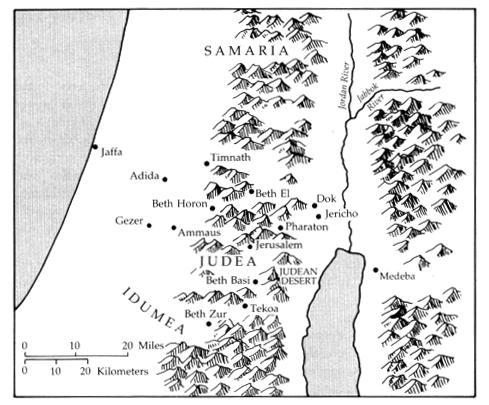
4.
Jewish fortresses in the time of Simeon.
The paragraph about the great settlement drive of the Jews in Phoenicia (I.194) brings us to the days of John Hyrcanus, Simeon's son (135-104). In the period preceding the Hasmonean conquests there were just a few small Jewish enclaves on the coastal plain.[7] Massive Jewish settlement of the region could have started only after its occupation by the Hasmonean rulers. The conquest was carried out in several
[7] See Ezra 2.32; Neh. 11.34-36; I Macc. 5.23 (Narbatta), 11.34 (the Lydda toparchy); II Macc. 12.3, 8. The sources clearly indicate that except for the Lydda district, which was situated on the eastern edge of the coastal plain and the low hills of the Shephela, the other settlements and enclaves were too small to defend themselves. The survey by Klein (1939) 68ff. is in places rather speculative.
stages. Simeon opened a narrow corridor to the sea via Gezer to Jaffa, and expelled the local population (143-142).[8] There is no direct reference to the precise date and extent of Hyrcanus's westward expansion. However, the information about the early conquests of Alexander Jannaeus, Hyrcanus's son, indicates that by the late days of John Hyrcanus, the coast between Strato's Tower in the north and Ascalon to the south was in Jewish hands.[9] This means that the Hellenistic cities of the region, Apollonia, Iamnia (Jabneh), and Azotos (Ashdod), mentioned in the general summary list of the Hasmonean occupations (Ant. XIII.395), were conquered by Hyrcanus.[10] Notably, in summing up Hyrcanus's achievements, Georgius Syncellus, the Byzantine chronographer, states (I.548, ed. Dindorf):
He distinguished himself by many successes and victories against the neighboring Arabs, the Idumeans, the coastland of Phoenicia [
] and Samaria.

The sentence, like two others on the days of Alexander Jannaeus, may well have been drawn from a knowledgeable source.[11] The reference to the region as "Phoenicia" is also instructive for interpreting the sentence in Pseudo-Hecataeus.[12]
[8] Gezer: I Macc. 13.43-48; 14.7, 34; 15.28. Jaffa: I Macc. 13.11; 14.5, 34; 15.28. The mention of Iamnia (Jabneh) among Simeon's conquests in Ant. XIII.215 and Bell. 1.50 may be a mistaken interpretation of I Macc. 16.8-10 in relation to 15.40. The account by Nicolaus of the time of Simeon, the sole source of Josephus's version (see Hölscher [1904] 10-11; Bar-Kochva [1989] 452-53), was a hasty, inconsequential, and badly organized summary of I Macc. 13.31-16.22, supplemented from another source by the story about the destruction of the Akra.
[9] Ant. XIII.324, 357; Bell. I.61, 87.
[10] So also Avi-Yonah (1966) 64; Kasher (1990) 121 n. 18.
[11] These data corroborate information on the days of Jannaeus that does not appear in Josephus, and at least once even contradicts his account. For the possible origin in Justus of Tiberias (via Julius Africanus), see Gelzer (1885) I.225-26, followed by many others. See, e.g., Schürer (1901-9) I.62-63; Schürer et al. (1973-86) I.37. But see the objections of Rajak (1973) 365-68, (1987). The latter underestimates the historical significance of the differences between Syncellus and Josephus. They cannot be mere paraphrases of the Josephan text. See also M. Stern (1981) 44 n. 100; and esp. S. Schwartz (1990).
[12] On the usage of the term, see pp. 103-4 above.
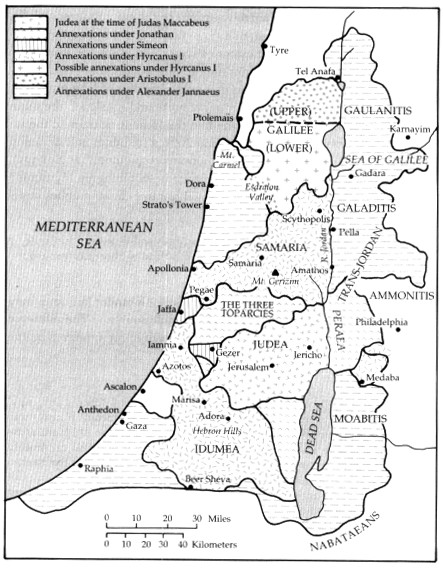
5.
The Hasmonean expansion.
The chronology of Hyrcanus's conquests in the region can be established on the basis of two Roman documents and the general background. At the same time, without additional archaeological evidence we may not yet determine which parts of the region were occupied in the various phases. It seems that at least some parts had already fallen
into Jewish hands in the early days of Hyrcanus's reign, probably in the years 135-132. They were temporarily lost with the invasion of Antiochus VII Sidetes in 132. Hyrcanus regained his territorial conquests and seems to have expanded them between 127 and 125. In 113 the Jews again lost control of the area when Antiochus IX Cyzicenus made his brief drive to the south. It was soon restored, in 112, and Hyrcanus may have made some new encroachments in that year, as well as taken further steps to consolidate Jewish control of the region.[13]
Alexander Jannaeus (103-76) expanded Jewish dominance in the north during the first year of his reign,[14] occupying the cities of Strato's Tower and Dora on the Carmel coast (Ant. XIII.326, 335; Bell. I.61). In 102, Jannaeus turned to the area south of Ascalon.[15] He conquered Anthedon, Raphia, and Gaza, the later flourishing city being thoroughly destroyed (Ant. XIII.357-64, Bell. I.87). Ascalon was the only gentile city on the coast south of Mount Carmel to retain its independence.[16]
The pace of Jewish settlement in the region cannot be ascertained. It can only be said that in the time of the Hasmonean state the demography of the region changed decisively in favor of the Jews. This is well attested by Strabo (XVI.2.28), who drew on a Hellenistic source from the time of the Hasmoneans,[17] and is evident from Josephus's accounts of the occurrences in the region at the time of the Great Revolt against the Romans.[18] The Jewish community in the Judean Hills in the period of the Maccabean uprising suffered from overpopulation and
[13] See the discussion in Extended Notes, n. 2 p. 291.
[14] On the sequence of events in the year 103/2, see M. Stern (1981) 33ff., (1985) 98ff.; cf. van't Dack and Clarysse in van't Dack et al. (1989) 109-10. For the absolute chronology, see Schürer (1901-9) I.256 n. 1; Schürer et al. (1973-86) I.200 n. 1.
[15] On the dating of the destruction of Gaza to around the year 100 B.C. , see Extended Notes, n. 3 p. 292.
[16] On the special status of Ascalon and its historical background, see Kanael (1955) 10ff.; Avi-Yonah (1966) 62-68; Rappaport (1970); M. Stern (1985) 22.
[17] The reservation must be noted that Strabo's additional statement that the "village" Iamnia and its surroundings could supply 40,000 armed men is certainly grossly exaggerated. Assuming the 10%-15% standard recruiting rate in antiquity (see Bar-Kochva [1989] 56-57), this means a population of 275,000-400,000 inhabitants.
[18] See, e.g., Jos. Bell. II.509, 513-16; III.9-28, 414, 428-31; IV.443-49; Lament. Rabba 2.2 ( = BT Gittin 57a).
land scarcity.[19] The newly occupied fertile plains near the sea obviously offered new possibilities. Determining the chronology and development of the settlement drive would involve a number of unanswerable questions. Which areas and cities of the region were occupied in each of the above-mentioned phases? Were the Hellenistic cities destroyed? And if so, when?[20] And what happened to the local inhabitants? Were they deported as were the inhabitants of Jaffa in the time of Simeon, or the people dwelling in the Scythopolis Valley in the later days of Hyrcanus and elsewhere in the time of Alexander Jannaeus?[21] And if so, were they driven out immediately after the occupation? Or were all these drastic measures taken only after the year 112, when Hyrcanus became more confident of himself in view of growing crises in the Seleucid kingdom? Whatever the answers to such questions, the settlement of "many tens of thousands" as per Pseudo-Hecataeus (Jos. Ap. I.194) could not have taken place overnight. This reference could indeed reflect the demographical situation in the coastal plain as early as the middle of John Hyrcanus's reign (ca. 120 B.C. ), but it may also indicate a later post quem date.
A later date does in fact appear from the statement about pagan cults. The Jews are said to have destroyed all (


[19] See Bar-Kochva (1977) 168ff. The population of Judea at the time of the Maccabean Revolt seems to have been even larger than assessed in that article; see Bar-Kochva (1989) 56-57; and cf. 50-56.
[20] Cf. the case of Gadara, which was occupied early in Jannaeus's reign (Ant. XIII.356) but destroyed only toward the end of his reign (XIV. 74).
[21] Pp. 125 above and 132-33 below. See further Extended Notes, n. 4 p. 294.
enlarged borders of the Hasmonean state or to the Holy Land as a whole. Such a campaign is indeed known from the time of the Hasmonean state and has been referred to in one way or another by modern scholars. However, its chronology and development have yet to be clarified.
Acts of violence against the cults of the gentile population became increasingly common after the death of Antiochus IV (end of 164 B.C. ). In his expedition to rescue Jews in the enclaves outside Judea (163 B.C. ), Judas Maccabaeus punished the city of Azotos by destroying its altars and idols (I Macc. 5.68), and burned the temple of Karnayim, in Trans-Jordan, because the enemy found refuge there (5.43-44). For the same reason Jonathan, his brother (160-143), destroyed the temple of Dagon in Azotos in the year 148/7 (10.84, 11.4). All these acts, however, do not seem to have been motivated by a preconceived policy, but were a response to special, local circumstances. They were launched outside the Jewish-controlled area and certainly would not be described as the destruction of "all temples" in the Holy Land.[22]
A systematic destruction of foreign cults was first carried out by Simeon, who is explicitly said to have "cleared out" the idolatry, probably statues and cult objects, of Gezer (Gazara) and the Akra, the Jerusalem citadel (I Macc. 13.47-48, 50). The same certainly happened in Jaffa, where the local population was expelled, and Jews settled in their place (I Macc. 13.11). However, since the "corridor" occupied by Simeon was rather small, the scale of these operations was still rather limited. And what is more important, there is no reference to the destruction of temples in his time. As the achievements of Simeon were comprehensively recorded by his contemporary admirer the author of I Maccabees,[23] and his operations against pagan cult especially lauded (14.7), the absence of such a reference cannot be accidental. It seems, therefore, that there were no impressive temples in the rural areas of the "corridor" As for Jaffa, Simeon, who actually recognized Seleucid
[22] Contrary to Willrich (1895) 21-22, (1900) 95. Cf. Schaller (1963) 27; Hengel (1971) 303; Holladay (1983) 329 n. 25. In their view the sentence under discussion reflects the aggressive opposition of Mattathias and Judas Maccabaeus to the pagan cult imposed on Judea by Antiochus IV and the destruction of two temples outside Judea by Judas Maccabaeus and Jonathan (see below).
[23] The only significant undertaking of Simeon that was not recorded was the destruction of the Akra (see Ant. XIII.215-17, Bell. I.50). On the reason for this, see Bar-Kochva (1989) 454.
supremacy over the city (15.35), was perhaps careful enough not to provoke too much antagonism at that stage and therefore refrained from demolishing the temple or temples of that celebrated harbor city. This may have taken place sometime later, in the days of John Hyrcanus.
Much more extensive was the destruction of pagan cults by his successors John Hyrcanus (135-104), Aristobulus I (104/3), and Alexander Jannaeus (103-76), covering more regions of the Holy Land. In contrast to the abundant information on the days of the Hasmonean brothers, our knowledge of the days of these later rulers is mainly based on excerpts from secondhand sources, which were badly adapted and arranged by Josephus.[24] Consequently not all the conquests are reported, and the destruction of temples is only occasionally mentioned. However, as appears from a number of references, the general policy of the Hasmonean rulers toward pagan cults is quite clear, and we can accordingly assume that after becoming confident of their ability to face possible Seleucid retaliation, they did not spare pagan temples and cults in the occupied territories. This was certainly done in the Hellenized cities reported to have been partly or utterly demolished or whose populations were sent into exile. The same obviously applies to regions whose inhabitants were forced to convert to Judaism.
Hyrcanus's expansion took place in the early and later days of his reign. His campaigns on the coastal plain (in the years 135-132, 127-125, 112) have been referred to above.[25] The occupied stretch of land between Ascalon and Strato's Tower included three Hellenistic cities—Apollonia, Azotos, and Iamnia. At least in the first two there were respectable temples of considerable magnitude.[26] However, it could be that Hyrcanus was careful, like his father, Simeon, and refrained from destroying temples as long as there was an immediate danger of a Seleucid reaction. The opportunity may have come in the year 112/11, when the Seleucid kingdom sank ever deeper into its longest internal
[24] On the sources used by Josephus, see Hö1scher (1904) 11ff.; on their confused adaptation by Josephus, see nn. 29 and 49 below.
[25] See pp. 126-27 and esp. Extended Notes, n. 2 p. 291.
[26] On the temple of Azotos, I Macc. 10.84. Apollonia, as appears from its name, most likely dedicated a temple to Apollo, who replaced Rešef, the old Canaanite god of fire, after whom the site had first been named. The excavations of the site so far cover only a tiny part of the Roman city, and therefore are not of any help for the present discussion (see Roll and Ayalon [1989] esp. 34-38).
crisis, the struggle between Antiochus IX Cyzicenus and Antiochus VIII Gryphus.[27]
For this reason, the second stage of his campaigns, which covered a larger area, was launched at about the same time (112/11-107). At that stage Hyrcanus turned to the regions south and north of the Judean Hills. He first conquered Idumea, totally destroying Marisa and Adora, its main cities, and converting the Idumeans to Judaism (Ant. XIII.257-58, XIV.88).[28] This campaign was followed by an expedition against the Samaritans (in the year 112/111). Hyrcanus occupied southern Samaria, demolishing the Samaritan temple at Mount Gerizim (Ant. XIII.254-58).[29] In 108/7, Hyrcanus carried out the second phase
[27] On the background and main developments, see the survey by Bellinger (1949) 66ff.; Will (1967) II.373-74; Cohen in van't Dack et al. (1989) 15-16, 121-22. The later devastation of Jewish territories by Antiochus Cyzicenus, in the year 107, which was an attempt to force Hyrcanus to raise the siege of Samaria (Ant. XIII.278), just shows the readiness of the Seleucid contenders for the throne to come to the aid of their Hellenistic allies even when they were themselves in dire straits. This further emphasizes the need for restraint on the part of the Jewish ruler before the year 112/11.
[28] The date of the occupation of Idumea has recently been established by the excavations in Marisa. The lower city, occupying about 75 acres, was totally destroyed by Hyrcanus, and the latest coins, belonging to Antiochus IX Cyzicenus, are from the year 200 of the Seleucid calendar, i.e., 113/12 B.C. The same date appears on an inscription found in one of the nearby burial caves, and the Rhodian handles scattered in the lower city cannot be dated later. The many ostraca and inscriptions, and the recurrence of Kos, the Idumean deity, show that the population included a substantial Idumean element, in addition to the Phoenicians known from the celebrated cave inscription found at the beginning of the century by Peters and Thiersch. The unsystematic excavations carried out on the acropolis at the beginning of the century did not definitely identify the site of the temple, but this still may be located. See a preliminary report: Kloner (1991) esp. 33, (1991a) 82-83. On the numismatic evidence, see Barkay (1992/3). On the inscriptions: Oren and Rappaport (1984).
[29] The destruction of the Samaritan temple and its city should be dated to 112/11 in view of the hoard found on the site. See Magen (1989) 31-37, 48-51; id. (1990) 87, 96. The same date appears from the coins found in nearby Shechem, which was also destroyed (Wright [1965] 172, 184). It appears from the excavations that the city on the top of Mt. Gerizim was totally destroyed by Hyrcanus. This dating, as well as that of the occupation of Idumea, definitely proves that the passage in Ant. XIII.254-58, drawing on Nicolaus (see Bell. I.62-63; cf. Hölscher [1904] 12), was not incorporated in the correct chronological sequence already by the time of Nicolaus.
of his northern campaign.[30] He first laid siege to the city of Samaria and at the same time occupied northern Samaria as well as Scythopolis. The inhabitants of Scythopolis and "its valley" are said to have gone into exile (Scroll of Fasting, 15-16 Sivan), and Jewish settlers were presumably introduced.[31] The temple of Zeus in the city (SEG VIII.33) and other cult monuments were certainly destroyed. After a year of siege, the Hellenistic city of Samaria was conquered, and Josephus reports in detail how the Jews obliterated all traces of this great city by flooding it (Ant. XIII.281). The nearby Esdralon (Jezreel) Valley and probably also Lower Galilee may well have been occupied shortly afterwards.[32]
Hyrcanus's son, Aristobulus I, expanded to the north in his single year as ruler (104/3). He launched a campaign in Galilee (Bell. I.76), probably Upper Galilee, and forcibly converted the Itureans (Ant. XIII.318-19), Arabs residing mainly in the Lebanon Valley.[33]
Alexander Jannaeus (103-76), the great Hasmonean conqueror, pursued the antipagan policy with much vigor In the year 102 he occupied Strato's Tower and Dora (Ant. XIII.324, 335, 395), the Hellenized Phoenician cities on the Carmel coast, treating the inhabitants harshly (Syncellus I.558, Jos. Ant. XIV.76).[34] Shortly afterwards (in the year 102/1) came the turn of Anthedon, Gaza, and Raphia, the coastal cities south of Ascalon (Ant. XIII.357-64, Bell. I.87). The detailed account of the Gaza siege records the killing of the city councilors in the temple
[30] For the date see Avi-Yonah (1966) 72-73; Schalit (1969) 201-2; Schürer et al. (1973-86) I.210 n. 22; van't Dack and Clarysse in van't Dack et al. (1989) 22.
[31] On the fate of Scythopolis, see Fuks (1983) 64, referring to Ant. XIII.355. This also appears from Strabo XVI.2.40.
[32] See Klausner (1950) III.89 and others. The reference to Jewish settlements in Lower Galilee at the beginning of Jannaeus's reign in Ant. XIII.337-38 (though the number of captives is grossly exaggerated; cf. XIII.344) indicates that Hyrcanus occupied the region at the time of his Samarian campaign, or even earlier (Ant. XIII.322-23). See also Bar-Kochva (1977) 191-94; Rappaport (1993) 28-29. On the evacuation of the region by the Assyrians, cf. recently Gal (1990) 142-43 and Na`aman (1989) 46ff., as opposed to former views.
[33] For their location according to the unique ceramics attributed to them, see Dar (1991). However, Dr. R. Fränkel of Tel Aviv University has found similar ceramics in various places in the Israeli Upper Galilee. See M. Stern (1993) 8ff. on the occupation of Upper Galilee.
[34] References for the date: see p. 127 n. 14 above. Syncellus explicitly names only Dora as one of the places where a total massacre had taken place.
of Apollo and the destruction of the temple itself (Ant. XIII.364). The Hellenistic temple at Beer Sheva may have been destroyed shortly afterwards.[35] In the next stage, which took place between the years 96-93 and 83-76,[36] Alexander Jannaeus occupied almost all the gentile territories in Trans-Jordan. A fair number of Hellenized cities, as well as Moabite sites, are listed as being destroyed or having their inhabitants deported (Ant. XIII.395-97, XIV.74-76, 87-88), and massacres of the entire population are recorded for most of them (Sync. I.558). In the case of Pella, it is explicitly asserted that the city was destroyed because its inhabitants refused to convert to Judaism (Ant. XIII.397). Excavations at Tel Anafa, an unidentified Hellenistic city on the slopes of the Golan Heights, show that the site was completely destroyed in the year 80.[37] This suggests that more Hellenistic cities than those listed in the sources suffered the same fate (perhaps also implied in Ant. XIV.76).[38] The campaign against pagan witchcraft conducted by Jews in Ascalon (which was never occupied by them), at the time of Alexander Jannaeus,[39] indicates that certain manifestations of idolatry in the Holy Land were persecuted on private or royal initiative even outside the borders of the Jewish state.
The above survey suggests that the statement of Pseudo-Hecataeus, reporting systematic and total destruction of temples, can record events already in the time of John Hyrcanus. A terminus post quem would seem to be provided by his later major campaigns in Idumea and Samaria (112/11-107), rather than by his early conquests on the coastal plain. We do not know whether all the Hellenistic cities between Ascalon and Strato's Tower were already occupied during the early expeditions, and one cannot be sure that their temples were demolished immediately after the conquest. In any case, just a few temples were involved, and such an operation affected only a small part of the Holy Land. However, the total number of temples destroyed by the Jews in 112/11-107 during the conquest of Marisa, Adora, Shechem and Mount Gerizim, Samaria,
[35] See Shatzman (1990) 56.
[36] See pp. 138-39 below.
[37] See Weinberg (1971) 97; Herbert (1979); Fuks (1979/80). For possible identifications, see Fuks, ibid. (Arsinoë); and Bar-Kochva (1976) 70. n. 44 (Antioch in Hulata).
[38] Cf. Schürer et al. (1973-86) I.240 n. 25.
[39] See Hengel (1984); Efron in Kasher (1990) 318-41.
Scythopolis, and their chorai, and the size of the newly occupied areas, which was twice as large as Judea proper, are more likely to have inspired the statement of Pseudo-Hecataeus.
The last and perhaps most instructive anachronistic reference is the statement that Samaria was annexed to Judea by Alexander "free of tribute" (Ap. II.43). For its historical background, some scholars have suggested that the sentence reflects, in exaggerated form, the territorial changes in the later years of Jonathan's leadership (from 152 B.C. ), when the Seleucids certified the annexation of the three southern toparchies to Judea, free from many taxes.[40] However, the exaggeration is too great, the three toparchies occupying no more than a quarter of the Samaritan Hills and less than 15 percent of the district of Samaria as a whole.[41] Moreover, Pseudo-Hecataeus uses the term aphorologetos, which refers to exemption from the phoros, the symbol of foreign rule, while the Seleucids waived only duties and income taxes. Jonathan even offers to pay the phoros when asking for exemption from other taxes (I Macc. 11.28).[42]
[40] See Willrich (1895) 21-22; Hengel (1971) 302; Walter (1976) 147-48; Holladay (1983) 334 n. 55.
[41] The district included also Galilee; see p. 119 n. 206 above.
It remains therefore to accept the assumption of other scholars that the sentence was written under the influence of the occupation of the districts of Samaria by John Hyrcanus, that is, in 112/11-107B.C.[43] An instructive typological parallel can be found in the famous Talmudic legend that attributes to Alexander the Great the destruction of the Samaritan temple, although it was actually carried out by John Hyrcanus concurrently with the annexation of Samaria.[44]
The purpose of Against Apion II.43 is obviously to legitimize the occupation of Samaria by implying that the Jews only restored rights granted to them by Alexander the Great. The principle of precedent played a major role in Hellenistic diplomacy and literary polemics, and had its effects also on Jewish literature. The tendency among Jews and Samaritans to relate some of their later achievements to Alexander can be observed in the series of stories in Josephus on Jewish and Samaritan relations with Alexander (Ant. XI.313-46) and the above-mentioned Talmudic parallel. At the same time one should not rule out the possibility that the author was also inspired by at least some general knowledge of the hostility between the great Macedonian conqueror and the Samaritans.[45]
The occupation of northern Samaria, or rather the end of the siege of the city of Samaria in the year 107, which completed the conquest of the region, should thus be taken as a post quem date. We could go one step further and ask where and when such a legitimation of the conquest was asked for. The author, an Egyptian Jew,[46] was certainly aware of the grievances harbored by the Samaritans against the Jews for destroying the Samaritan temple and annexing their land. The inhabitants of Coile Syria, including the Samaritans, were used to appealing to Hellenistic rulers to spare them from Hasmonean oppression,[47] and disputes between Jews and Samaritans in Egypt arising out of events that occurred in the Holy Land are recorded to have been brought before and decided
[43] So Willrich (1895) 21-22, (1900) 97; Stein (1934) 7-8; Schaller (1963) 27; Walter (1976) 148.
[44] BT Yoma 79a; and the parallel in the medieval scholion to the Scroll of Fasting, 21 Kislev.
[45] On the persecution of the Samaritans by Alexander, see Cross (1963) 118-19; Coggins (1975) 106-8; Egger (1986) 74-75.
[46] See pp. 145-47 below.
[47] See, e.g., I Macc. 11.4-5; Ant. XIII.275-80, 328ff.
by the Ptolemaic king (Ant. XII.10, XIII.74).[48] In the year 107, at the time of the siege of Samaria, Antiochus IX Cyzicenus applied for help on behalf of the Samaritans to Ptolemy Lathyrus, who was still co-regent with his mother, Cleopatra III (Ant. XIII.278).[49] Though Cleopatra was against any intervention, Lathyrus dispatched six thousand troops to support the Syrian king. This was one of the reasons for the breach with his mother (ibid.). It stands to reason that Samaritans as well as Jews would have presented their arguments on that occasion.
Another opportunity for the Samaritans to appeal to the Ptolemaic queen came immediately before and during her expedition to Palestine in the year 103/2 (Ant. XIII.348ff.).[50] The expedition was indeed meant to counter the advancing troops of Lathyrus, who from his base in Cyprus invaded Judea, but she also considered deposing Alexander Jannaeus and renewing direct Ptolemaic rule in Judea. It is told that Cleopatra's counselors advised her not to allow the accumulation of too much power in the hands of Alexander Jannaeus and recommended that she occupy his kingdom, though the Jewish commanders of the Ptolemaic army warned that in doing so she might lose the support of her Jewish soldiers (Ant. XIII.353-54). Egyptian Jews thus played a major role in the discussions about the future of Judea (and Samaria). One would assume that deputations of the local populations, including the Samaritans, were also allowed to present their case. A legitimation of the conquest of Samaria was badly needed for Egyptian Jews in the year 103/2, even more than it was in 107. Year 103/2 as a terminus post quem will also appear from an analysis of the sources of inspiration for
[48] On these traditions, see Fraser (1973) I.285-86; Rappaport (1990) 378-87.
[49] The Josephus story about the intervention of Antiochus IX Cyzicenus (XIII.275-80) includes two versions. The first (paras. 275-77), which was taken from Nicolaus (see Bell. I.64-66; Hölscher [1904] 13), does not mention the participation of Ptolemy Lathyrus. The second (paras. 278-80), based on another source, probably Strabo, differs in several respects from the Nicolaus version. Josephus tried to harmonize the two versions in para. 277b.
[50] The date has been established on the basis of a demotic inscription from Karnak dated to 27 Sept. 103. It clearly shows that by then Cleopatra was already in control of Ptolemaïs. See the reading of the text by Winnicki (1981) and in van't Dack et al. (1989) 53-61, and the comments of van't Dack (1981); M. Stern (1985) 100; Cohen in van't Dack et al. (1989) 122-24; van't Dack and Clarysse, ibid. 109.
the unique explanation provided by the author of Pseudo-Hecataeus as to the purpose of Jewish residence in the Egyptian Diaspora.[51]