
The View from the Ground
When the Research Corporation came into his life, Lawrence shared the inhibitions of the academic scientist against securing a personal financial interest in his discoveries or inventions. This inhibition arose at the end of the nineteenth century, when applications of electricity made physicists newly useful and threatened the identification of professors with high culture and disinterested speculation. Patents and professors should not mix. "Working as he does with public funds, directing as he does the minds and hands of students, it is, to say the least, scarcely honest [for a professor] to go with the results of such work to the Patent Office." Thus a British periodical for applied science editorialized in 1884. As for the Germans, "It is well known throughout the world," they said, "that the physical laboratories of Germany have no windows looking towards the patent office."[23] In the United States, Popular Science Monthly castigated people who would degrade science to a "low, money-making level," and memorialists praised defunct physicists who had resisted the blandishments of industry. That was their morality and their opportunity: "Nature turns a forbidding face to those who pay her court with the hope of gain, and is responsive only to those suitors whose love for her is pure and undefiled."[24]
These inhibitions—"a gesture of repugnance toward money-making as a practice inconsistent with intellectual integrity"—remained strong in the 1930s despite the increasing integration of academic science and industrial development. Hale built it into
[22] Letters of, resp., 14 Sep 1931 and 6 Aug 1931 (RC).
[23] The electrician, 13 (1884), 454; Münsterberg, Science, 3 (1896), 162, anent the discovery of x rays.
[24] Texts from circa 1900 quoted in Heilbron in Bernard et al., Science, technology, and society , 67.
his quest for endowment for academic science; donors need have no worry, he said, that their gifts would enrich their recipients; "the men of science . . . may be counted upon to devote their efforts to the advancement of knowledge without thought of personal gain." The unconventional Szilard's constant attendance on the Patent Office caused his friends to warn him of "an opposition to you [from the British physicists] on account of taking patents." "It is not customary [he allowed] to take out patents on scientific discoveries." In defending Steenbeck's claim to the invention of the betatron, the German industrial physicist Carl Ramsauer apologized for the "unusual" character of the documentation, "a prior patent application rather than a [scientific] publication."[25] But there was the difficulty that anyone might seek to patent a process openly described in the scientific literature after adding some small improvement to it; scientific ethos and self-protection did not run in parallel. A way out of the difficulty was to raise patenting to a social responsibility, according to the following formula. "In spite of the fact that I think that university people should not be interested in patents," Urey wrote his collaborator in the elecrolytic separation of deuterium, "for the protection of pure science . . . it would be wise to patent this process."[26] That was the way Lawrence came to think under the tutelage of the Research Corporation.
The University gave him no guidance. The cognizant body, the Board of Research, demonstrated its level of leadership and vigor of oversight in its opinion about what it understood to be a patent on a process for making radium from sodium. Leuschner to Lawrence: "We do not feel ourselves quite competent to judge the ethical side of the question. Your and Mr Poillon's own knowledge concerning the practice of pure physicists in this regard I think should be sufficient to guide you in whatever action you wish to take." And Leuschner to Poillon: "We have faith in the Research Corporation because it is a non-profit corporation and
[25] Quotes from, resp., Gray, Harper's, 172 (1936), 539; Hale, ibid., 156 (1928), 243; Polanyi to Szilard, 11 Nov 1934 (Sz P, 17/197, and Weart and Szilard, Szilard , 40); Szilard to Segrè, 1 Apr 1936, in Szilard, CW, 1 , 732; Ramsauer, note in Nwn, 31 (1943), 235.
[26] Urey to E.W. Washburn, 3 May 1933 (Urey P, 5). Cf. Connolly, Science, 86 (1937), 38–45.
supports research where its funds, according to its own judgment, are best applied."[27] By the time the ersatz radium came up, Lawrence was ready to put himself in Poillon's hands. He had put off patenting the cyclotron as unbefitting despite the Corporation's urging. Then he learned from John Slater, the new head of MIT's physics department, that an engineer at Raytheon had hit on the idea of a "proton merry-go-round" independently of all its other inventors. Raytheon called in a former student of Slater's, Eugene Feenberg, to calculate the machine's practicality; and, on receiving assurance of its promise, applied for a patent. "It would never occur to me," so the physicist's ethos spoke through Slater, "to patent such a thing." "It never occurred to me to patent the work we are doing either," Lawrence replied, "and I am doing so only at the urgent request of the Research Corporation and the Chemical Foundation, who apparently have a better perspective of practical things than we have."[28]
The work and immediate practical problems then fully occupied his time. His magnet, valued at $25,000, weighed over eighty tons. Where to put it? While Federal deliberated over making the gift, Lawrence toured the campus in search of a firm floor. Since he proposed to work on an engineering scale, he faced the challenge of winning a foothold in the preserves of the engineers. Civil Engineers politely declined to house him; Mechanical Engineers robotically refused him the ideal space they underutilized in the Mining Building; and he turned to Cottrell not only for the money to move and refurbish the magnet, but also for somewhere to put it.[29] Sproul supplied the firm floor. On August 26, 1931, also the day that Molly announced their engagement at the New Haven Lawn Club, Lawrence was assigned the Civil Engineering Test Laboratory, "a large frame structure with several substantial concrete piers in the rooms" (plate 3.1), for his experiments. We take this far-seeing decision of Sproul's as the foundation act of the Radiation Laboratory.[30]
[27] Leuschner, for Board of Research, to Lawrence, 10 Oct 1934 (35/77), and to Poillon, 23 Nov 1933 (RC); Owens in Marcy, Patent policy , 658.
[28] Sproul to Poillon, 4 Sep 1931 (25/2); Bremer in Marcy, Patent policy (1978), 558; Slater to Lawrence, 4 Sep 1931, and reply, 8 Sep 1931 (35/3).
[29] Lawrence to Cottrell, 10 June 1931 (15/16), and to Akeley, 21 Mar 1930 (1/12).
[30] Lawrence to Poillon, 27 Aug (quote) and 8 Oct 1931 (15/16); Lawrence toTuve, 27 Aug 1931 (MAT, 8). The Laboratory received its name from the regents on 12 Jan 1932, which Birge, History, 4 , xi, 22, takes as its birthday.
Sproul's act freed Lawrence's operations from control and even supervision by the Department of Physics, although the Laboratory remained an integral part of the Department until 1936 and a satellite until 1939. From the beginning the Laboratory had a research budget exceeding the Department's, which remained just under $12,000 from 1930/31 to 1932/33, and fell to $8,000 in the worst Depression year, 1933/34, while the Laboratory's expenditures continually increased.[31] Lawrence spent his money without overscrupulous accounting and, when he required more, raised it from outside the University or by dealing directly with Sproul. Although Lawrence's rapid rise and independent base inspired jealousy in some of his fellow seekers after truth, in general his relations with his colleagues in the Physics Department were cordial, if not close. No senior member of the Department besides Lawrence steadily worked in the Laboratory during the 1930s.
Lawrence did not find it easy to consolidate his domain. The usual administrative burden of establishing a new institution in old surroundings was increased in his case by the weight of the magnet. "It is one hell of a job getting things moving," he wrote Cooksey in December, in the technical language of administrators. "I guess the new magnet is too damn heavy."[32] He got it moved first to the Pelton Waterwheel Company in San Francisco to rebuild the poles (plate 3.2).[33] He saw to the renovation of the new laboratory and to the eviction of most of its tenants. The mapping division of the Forest Service and French phonetics remained to soak up radiation (fig. 3.1).[34] And he laid industry under contribution. Federal Telegraph gave 650 gallons of transformer oil (value $227.50); American Smelting and Refining Company lent lead for shielding; and Federal supplied old, gassy, reject 20-kW oscillator tubes.[35]
[31] Birge, History, 3 , app. xvi: A; infra, §5.1.
[32] Lawrence to Cooksey, 23 Sep 1931 (4/19).
[33] Lawrence to Poillon, 29 Sep 1932, 9 Jan 1933 (15/16); to Joliot, 20 Aug 1932 (10/4).
[34] Lawrence to Sproul, 10 Aug 1936 (25/3); Seaborg, Jl., 1 , 12.
[35] Lawrence to Leuschner, 4 Apr 1932 (46/23R); to Federal Telegraph, 8 Sep 1932 (7/10); to Poillon, 29 Sep 1932 (15/16); to B.C. Tuthill (Federal), 2 Feb 1933 (25/1); to Livingston, 22 Oct 1935 (12/12).
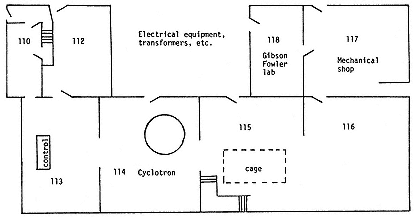
Fig. 3.1
Layout of the ground floor of the old Radiation Laboratory. Room 118
belonged to Chemistry. Seaborg, J1, 1 , 12.
Lawrence became very adept at scrounging. He always needed power tubes, power transformers, and just plain power. In 1932 he wanted tubes for an x-ray machine. Federal sold them at $330 a piece, discounted. Lawrence offered $225 and the thought that if the Laboratory made a successful high-voltage x-ray plant with them, Federal's fortune would be made too. He tried the same ploy with the Deforest Radio Company: "The engineering development of our method will lead to a considerable oscillator tube business. In view of this you may feel disposed to furnish us tubes for our experimental development at considerable discount." Deforest allowed 10 percent; Federal agreed to accept $225, and charge the rest to charity; Lawrence stayed with Federal.[36]
Transformers provided an unlikely subject of comedy. GE loaned three 25-kW, and PG&E three 75-kW transformers, total value $2,000, in the fall of 1931, for three months or so. That was not to know Sproul or Poillon, who badgered the companies into extending the loans and then selling at a giveaway discount.[37]
[36] Lawrence to L.E. Replogle, Deforest Radio Company, 8 Sep 1932, and reply (6/15); to Federal, 7 Jan and 2 Feb 1933, and reply (25/1).
[37] Lawrence to Leuschner, 18 Sep 1931 (25/1); to GE, draft request by Fuller (25/2); to Cottrell, 21 Nov 1931 (15/3); GE to Lawrence, 22 Sep 1931 and 5 June 1933 (7/28); Leuschner to Poillon, 16 June 1933, and reply, 7 July 1933 (25/1, 15/16A); Lawrence to Poillon, 3 June and 16 Sep 1933 (15/16A); Sproul to GE, 27 Sep 1933, and reply, 22 Dec 1933 (7/8).
On power, however, PG&E would not budge. In reply to Leuschner's pleas, the Company's president observed that PG&E was the second largest taxpayer in the state and saw no reason to abate its charges to an institution it already supported beyond its desires. "It seems to me the cost of experiments coming in the category of 'pure science' ought to come out of the funds of the University." For years Sproul had to top off Lawrence's power bill from his emergency fund.[38]
With gifts in kind and discounts Lawrence stayed within his first-year budget, that for 1931/32, even though he decided to rebuild the magnet more extensively than he had expected. Federal's gift was asymmetric; to provide a sufficiently uniform field for the cyclotron, however, it needed symmetrical poles on either side of the gap in which the vacuum tank would sit (plate 3.3). The Laboratory accordingly procured the answering pole from the remaining derelict. By November 1931, with almost everything bought or ordered, given and discounted, Lawrence had $600 left from the $7,500 from the Research Corporation and the Chemical Foundation. That, he thought, would get him through the rest of the academic year 1931/32, on the big cyclotron project at least.[39] But he had other things in mind as well.