
10—
Plague in Los Angeles, 1924:
Ethnicity and Typicality
William Deverell
Anglo Saxon civilization must climax in the generations to come. . . . The Los Angeles of Tomorrow will be the center of this climax.
Clarence Matson, "The Los Angeles of Tomorrow," in Southern California Business, November 1924
Turn-of-the-century booster marketing of Los Angeles rested upon simple images and symbols. Neatly tended gardens, attractive boulevards, and lovely homes: all could be represented as common, even prosaic, sights in the promised "Sunny Southland." Without doubt, regional climate occupied a special and iconic place in the creed of boosterism. Characterized especially by year-round warmth and aridity, weather proved an irresistible touristic lure. Boosters needed little convincing that climate merited a central role in their sophisticated selling of a "semi-tropic" city. Such reliance can easily be discerned in the myriad references to sunshine and health in such promotional vehicles as Land of Sunshine or the Southern Pacific's Sunset.[1] A wider embrace of nature's beauty and good health was exhibited by the hugely successful public relations firm known as the Los Angeles Chamber of Commerce which adopted the catchphrase "Los Angeles—Nature's Workshop" as one of its regional mottoes.[2]
Inherent to this campaign which sold a new commodity (the city itself) was a particular method, that of incessant reference to typicality and "the typical" (see figs. 10.1, 10.2). Image-making relied on repetition and sameness, on typicality, and this theme exists as backdrop in nearly every organized campaign of advertising Los Angeles from the railroad era of the 1870s and 1880s forward through the 1920s. The marketing was hardly as complex as it was merely brilliantly redundant, what with lithographic or photographic reproduction of the same neighborhoods, the same homes,
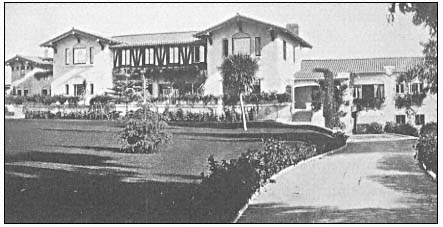
Figure 10.1
Typical southern California residence.
Courtesy of the Huntington Library.
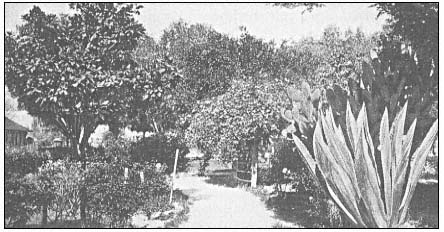
Figure 10.2
Typical park in California.
Courtesy of the Huntington Library.
the same palm trees, the same bungalows, typical street scenes, typical vegetation, typical orange groves (with those ever-present snow-capped San Gabriels in the background). Postcards—little more than mass-produced and mass-distributed images of representativeness—blanketed the nation with images of Los Angeles life and landscapes. What may seem like caricature today was critical repetition then, the visual construction of regional idioms explicitly designed to encourage capital investment, tourism, and settlement. Stock images of life in Los Angeles were designed around the simple notion of representing the representative, over and over again.[3] But is there more to this story of wishful and pretty sameness?
Now look at these images (see figs. 10.3, 10.4), also from the mid-1920s, also from Los Angeles: disorderly, not neat, not beautiful. Yet the claim is that these views are also somehow "typical," apparently trustworthy representations of what Mexican Los Angeles looks like, what Mexican Los Angeles is like. The concern in this essay is to examine that assertion and the darker dimensions of the booster project surrounding "typicality." Behind the careful repetition of every ostensibly benign representation of the typical this and the typical that lay uglier assumptions, assumptions less about gardens, trees, or bungalows than about people, especially people of color.[4]
A plague epidemic, like that which struck Los Angeles in the fall of 1924, is a decidedly atypical event. But the municipal response to this public health crisis was refracted through a prism of stereotype, a civic tendency to render ethnic (in this case Mexican) lives, culture, and behavior as somehow "typical." To be sure, this story of plague is also about terrifying disease and family tragedy.
On October 2, 1924, Dr. Giles Porter, of the Los Angeles City Health Department, answered a call at the home of Jesus Lajun at 700 Clara Street. A day laborer for the Los Angeles Railway, Mr. Lajun was clearly ill, but Porter suspected nothing remarkable about the flu-like symptoms or Lajun's swollen and tender groin. Like her father, Francisca Concha Lajun, aged fifteen, seemed to be suffering from a bad case of the flu. She complained of a headache and a sore throat, and she had a temperature. Francisca did not get any better the next day, and a neighbor, Luciana Samarano, dropped by to help care for her. On October 4, now desperately ill, Francisca was taken to the hospital, but she died on the way there. Cause of death was listed as "double pneumonia."
Weeks passed. Meantime, infection careened virtually unseen through neighborhoods, homes, and bodies. At the end of October, physician George Stevens called Los Angeles General Hospital to report his suspicion that some highly contagious disease was whipping through the same neighborhood
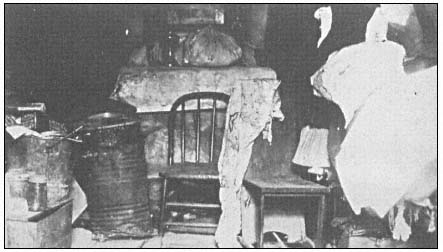
Figure 10.3
Typical interior of Mexican home.
Courtesy of the Huntington Library.
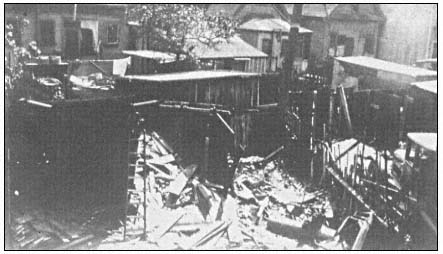
Figure 10.4
Typical backyard.
Courtesy of the Huntington Library.
where the Lajun family lived. He and another doctor, Elmer Anderson, had recently seen patients over there, all of whom complained of similar symptoms: chest pain, backache, fever. Stevens requested that a quarantine ward be set up to receive patients.
On October 29, an ambulance accompanied by Dr. Emil Bogen, resident physician of Los Angeles General Hospital, was sent over to the predominantly Mexican (and overwhelmingly poor) district. Bogen and the attendants found a group of people clustered around the front porch of a little house. In the house's only room, an old Mexican woman lay crying on a large double bed. Her cries were regularly broken by hacking coughs. A young Mexican man of about thirty lay on a couch against the wall; he did not cry, but he was clearly "restless and feverish." Several other people were in the room; one man agreed to translate discussion. Bogen found out that the man had gotten sick the day before, that he had a pain down his spine, and that he was running a dangerously high fever of about 104 degrees. He had red spots on his chest. The old woman had been coughing for two full days. She spit up blood. The ambulance took these two people away, to General Hospital.[5]
At another house nearby, a man, his wife, and their young daughter complained of the same aches and pains. They, too, exhibited disturbing symptoms. They appeared extremely anxious, their corneas were cloudy, and their faces had a sickly blue tinge. Four boys, brothers, were sick at yet a third house. Bogen learned that their mother and father had already died of what was thought to be pneumonia. Others were sick nearby, the interpreter said. Authorities took the boys to the hospital.
This house at 742 Clara Street, where the boys had gotten sick, would become the death house.[6] Before it was all over it must have seemed as if the house was possessed by evil, which, in a way, it was. In addition to the boys, others at 742 Clara complained of lingering sickness that day. Physicians took cultures from two of the sick adults, and they inoculated a guinea pig with the cell samples. The animal would soon die, as would the two people. Health investigators at General Hospital began piecing together information about those who had already died, including the parents of the sick, now-orphaned, boys. Original diagnoses of the sick people, which ran the gamut from meningitis, influenza, pneumonia, and typhus, began to be reconsidered.
"Lucena [it seems likely that her name was actually Luciana] Samarano, age 39, female, Mexican, 742 Clara Street," is how the medical inspection began which described the boys' mother. Luciana had fallen ill in the middle of October, just at the time she began to care for Francisca Lajun, and died within five days at the tiny house where she, her family, and a handful of roomers lived. Six months pregnant when she first fell ill, Luciana de-
livered a stillborn infant shortly before dying.[7] Doctors first ascribed her death to heart disease. Family members held a wake at the Clara Street house which was attended by many family members and friends. Burial followed at the Municipal Cemetery.
Luciana's husband, Guadalupe, had gotten sick a few days after his wife died. So had Jessie Flores, a family friend and next-door neighbor who had nursed Luciana during her illness. Guadalupe went downhill very fast, and a Spanish priest, Father Medardo Brualla from Our Lady, Queen of the Angels Church in the nearby plaza, had been summoned. The situation looked hopeless, but it was decided to send Jessie and Guadalupe to the hospital anyway. Father Brualla administered last rites. Jessie Flores and Guadalupe Samarano were dead within days. So, too, was Father Brualla.[8]
Unsuspecting health officials released Guadalupe Samarano's body to remaining family members so that they might hold funeral services at 742 Clara Street, just as they had been held for his wife, Luciana. Horace Gutierrez, Luciana's young cousin, was the next to get sick, and it was his illness and eventual death that really confirmed the presence of an epidemic. As Horace lay dying in the hospital, Dr. George Maner, the hospital pathologist, happened to engage in a conversation with several of the younger physicians who expressed confusion over the symptoms of several critically ill patients, Gutierrez and Guadalupe's brother Victor among them. At first facetiously, Dr. Maner suggested that perhaps the patients were suffering from plague; he had just finished reading about plague in Manchuria. But when he found evidence of just that beneath his microscope after performing an autopsy on Horace's body, the physician no longer joked. He sought the advice of a colleague, who, upon seeing the distinctive, unmistakable microscopic representation of Yersinia pestis, supposedly exclaimed, "Beautiful but damned."[9] An ancient disease, the Black Death, had arrived in the city of tomorrow.
The four Samarano brothers tried to fight off the intruder trying to kill them. Ten-year-old Roberto had gotten sick the same day as his mother's cousin. And like Horace Gutierrez, he died on October 30. Soon all the boys were deathly ill in the general hospital. Gilberto died next, then Victor. Little Raul hung on (see fig. 10.5). Horace Gutierrez's sixteen-year-old brother Arthur died. Fred Ortega, a boarder at 742 Clara Street, died. Joe Bagnola, another boarder, died. Alfredo Burnett, Luciana Samarano's son from an earlier marriage, was admitted to the hospital at the end of October along with all the others, exhibiting "weakness, fever, irritability, and stupor." He died on November.11
Many more people would sicken and die, especially those who harbored the plague infection in their chests (where it could easily migrate, person to person). People who had visited 742 Clara Street to help with chores got sick and died. Luciana Samarano's sixty-three-year-old mother, who lived at
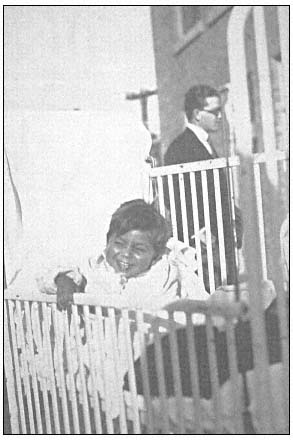
Figure 10.5
Plague survivor Raul Samarano, c. 1925.
Courtesy of the Huntington Library.
342 Carmelita Street, developed a cough and a fever and died in a matter of days. Samarano relatives at 741 Clara Street died. Guadalupe Valenzuela, fifty-two years old, from Marianna Street in Belvedere Gardens, just across the city line, could not fight off the disease. Neither did her son, Jesus, and her daughter, Maria. Jesus and Maria were cousins of Guadalupe Samarano. At least one of them had been to Luciana Samarano's funeral in the middle of October. Jesus died first, at home, on October 31. Health officials learned from Maria that relatives were expected from New Mexico; guards rushed to meet them on the train station platform and prevent them from coming to the house.[10]
Throughout the first week of November, now a month after the first
victim had died, the body count rose. Fear and rumor spread through the neighborhood. The Jimenez brothers had lived at 742 Clara Street, but when everyone in the house started getting sick and dying, they had quickly moved to nearby Date Street. But they did not move quick enough. One day after moving, Mike Jimenez got sick. Then his brother Jose fell ill with fever, aches and pains; both brothers died within days. Eulogio Peralta, twenty-two, from Bauchet Street, died. A credit slip found among his effects was from the Fox Outfitting Company on South Broadway in downtown where Eulogio worked. It showed Peralta's address as 742 Clara Street. Like the Jimenez brothers, Eulogio Peralta had tried to outwit and outrun the plague by moving away when people started getting sick and dying. Like the Jimenez brothers, it was too little, too late, and the disease caught him and killed him.
Thomas Vera, a young man who lived in a shack out back of 712½ Clara Street with three other adults and two children, died. He had been a friend of the Jimenez brothers, Mike and Jose. Hanging out with them probably killed him. Emmett McLauthlin died. With his brother Frank, Emmett ran an ambulance service from where he lived on Hope Street. He had helped move Guadalupe Samarano from 742 Clara Street to the county hospital at the end of October.
Thirty-two-year-old Mary Costello almost died. She had been the attending nurse to Guadalupe Samarano in late October. Complaining of headache, backache, chills, pains in her chest, and exhibiting "marked general malaise," Costello was hospitalized in an isolation ward at the end of the month. By Halloween she was spitting up blood. Doctors hooked her up to an intravenous injection of a Mercurochrome solution, a combination germicide and herbicide. This did not kill nurse Costello; neither did the plague. After a week, she had improved slightly; by month's end, still exhibiting the symptoms and characteristic weariness of a bout with pneumonic plague, Mary Costello had seemingly beaten the disease. Little Raul Samarano also fought off the pneumonia consistent with this strain of plague bacillus. As such, he was the only member of his family to escape death.[11]
The 1924 plague outbreak in Los Angeles was the last major outbreak of the disease in the United States. More than thirty people died, most all of whom had been connected by networks of kin or neighborhood. Ninety percent of those killed by the disease were of Mexican descent.
The situation calls for drastic action.
DR. WALTER DICKIE TO WILLIAM LACY, PRESIDENT
OF THE LOS ANGELES CHAMBER OF COMMERCE,
NOVEMBER 15, 1924
Plague is a mysterious and especially frightening disease. Its arrival in Los Angeles in the mid-twenties, in a poor neighborhood within sight of downtown, elicited a powerful response from the city's leaders. In an era (and
city) rife with Americanization programs, many of which were explicitly concerned with "purity" and "hygiene," there can be little doubt that plague represented an apex of "uncleanliness" and demanded sometimes desperate cleansing measures.[12] The intravenous injections of Mercurochrome which Mary Costello endured, for instance, were thought to be a way of sterilizing the body's infected blood and other fluids.
A similar activity took place in particular Los Angeles neighborhoods, where authorities attempted cleansings as well, often with agents no less fierce than Mercurochrome. Not unlike an isolation ward at the county hospital, these neighborhoods underwent physical isolation, quarantined by force and heavy rope. Ironically enough, many had already been virtually quarantined by the restrictions imposed upon populations socially and politically ostracized due to ethnicity and class. Plague simply presented another method by which to enforce isolation of Mexican neighborhoods and Mexican people. And in ordering and describing this work, city authorities let suggestions of ethnocentric blame creep into their reasoning and their documents, not to mention assertions of white supremacy over and above supposed Mexican typicality. To turn our view in that direction, we must follow the city's response to the plague, in facets medical, political, and military.
Dr. Walter Dickie, Los Angeles resident, secretary of the California Board of Health, and the man who would take charge of medical affairs surrounding the outbreak, apparently first read about the epidemic in his morning newspaper at the end of October or beginning of November. The as-yet-unnamed disease had taken nine lives, the paper said, and seemed to be a kind of especially virulent pneumonia. Dickie wired an official of the city health department, inquiring as to the cause of death of Luciana Samarano. The reply read simply: "Death L. S. caused by Bacillus pestis."[13]
Word began to spread, in both official circles and the infected neighborhood. Benjamin Brown, a surgeon attached to the United States Public Health Service, wired the U.S. Surgeon General of the gravity of the situation in early November. His telegram was encoded for secrecy. "Eighteen cases ekkil [pneumonic plague]. Three suspects. Ten begos [deaths]. Ethos [situation bad]. Recommend federal aid." The Surgeon General responded by immediately sending a senior surgeon to Los Angeles to monitor the situation and make regular reports.[14]
Acting on the basis of their own diagnosis, the city health department ordered a quarantine of the so-called "Mexican district," a downtown section of small homes and industrial sites around Macy Street. The quarantine was to begin at midnight on October 31. Patrol of the roped-off area, which housed an estimated 1,800 to 2,500 people, was left to the Los Angeles Police Department and guards employed by the health department.
With rope supplied by the Los Angeles Fire Department, the authorities shut down the Macy Street neighborhood. In-and-out traffic was forbidden; guards were placed at both the front and back of any home known to house (or have housed) a plague victim. Health authorities urged residents to clean their homes inside and out; people were also told to wear thick clothing (especially underwear) at all times. The everyday activities of people ceased, and "gatherings of all nature" were prevented. Children were to stay home from school and keep away from movie houses. Pacific Electric trolley conductors, running their cars down Macy Street, shouted to riders that no one was to get on or off the cars at any of the regular stops.[15]
Los Angeles city government also responded. Mayor George Cryer called an emergency meeting for Monday afternoon, November 3. Present were various medical personnel representing federal, state, and local agencies, as well as others less versed in the particulars of infectious disease transmission or prevention: "members of the Board of Directors of the Chamber of Commerce, the local publishers and the business and financial interests of the city." These civic and commercial leaders understood that the plague outbreak might make the city a victim as well. The hastily convened committee of "experts," which constituted nothing less than the ruling oligarchy of the city, would meet more than once during the scary weeks of the epidemic's virulent phase.[16]
All medical and preventive work in connection with the epidemic was placed under the direction of Dickie of the Board of Health. He suggested that the city adopt or continue various emergency procedures. All cases of possible plague were to be sent to the county hospital, and a laboratory was to be set up immediately; "all undertakers [were] instructed not to embalm any bodies of Mexicans or others dying suddenly or of undetermined causes until the bodies [could] be examined by a representative of the State or City Health Department"; and rodent trappings would begin immediately in order to establish the boundaries of the epidemic.[17]
The quarantine continued and grew to include other neighborhoods. Rumors spread that a hundred, two hundred, Mexicans were dead and dying. Between residents and the police powers stepped the Los Angeles County Charities, trying to ensure "cubicle isolation" of homes. Parents were told to prepare a mixture of hot water, salt, and lime juice for their children to gargle several times a day. Charities' staff made a card index of every member of every home, and they delivered packages of food and bottles of milk to each house.[18] The Catholic Board of Charities sent into the field a priest and a social worker who spoke Spanish. Physicians and nurses began daily house-to-house tours, hailing occupants (who by public health standards of the day were called "inmates") from streets and sidewalks to determine if anyone within had fallen sick. People caught outside their homes
or neighborhoods had to sleep in the Baptist Mission Church at the corner of Bauchet and Avila streets because the authorities would not let them pass through the ropes.
The quarantine, which lasted two weeks, would eventually stretch to include five urban districts. And there can be little doubt, given the way in which these neighborhoods were described (by language and perimeter), that there existed a perceived overlap between ethnicity and disease. The aim was to ensure that both large and small congregations of Mexican people be snared within the net. The quarantine included: the Macy Street district, largest of the five and including the Clara Street address; South Hill Street district, which included "one large apartment house, occupied by Mexicans"; the Marengo Street district, "including several isolated Mexican homes;" the Pomeroy Street district, including "two isolated Mexican homes"; and the Belvedere Gardens district, just outside city boundaries, where an unknown, though considerable, number of Mexicans lived.[19]
Records from the Belvedere Gardens describe the perimeter established by Carmelita Street, Brooklyn Avenue, a ravine just off Marianna Street, and Grandview Street. Like the city's efforts, the county quarantine was highly militarized. Health authorities later boasted that the epidemic ended so quickly precisely because the county's eventual four hundred quarantine guards and support personnel "were placed on a military basis and the organization was perfected." Some quarantine guards, most of whom were paid five dollars a day (except those working in closest proximity to the plague contagion, who were paid more), had been soldiers in the First World War; some even had wartime quarantine experience.[20]
Although they were dealing with an extraordinary situation, county officials gave the quarantine careful thought. The plans reveal ethnic as well as epidemiological attitudes. The Belvedere quarantine operation was placed in the hands of county health chief J. L. Pomeroy, a man with significant quarantine experience who believed that special guard details were "the only effective method of quarantining Mexicans." Pomeroy worried that Belevedere residents might disrupt quarantine procedures: he and his men "worked quietly" throughout the day of November 1 "so as not to unduly alarm the Mexicans." Pomeroy wondered about "a general stampede" and admitted that "we feared [the Mexicans] would scatter." The quarantine went up and around the neighborhood with stealth. "We waited until mid-night so as to give them all a chance to get in . . . then the quarantine was absolute."[21]
Guards, sworn in and issued badges, took up patrol "in the field" on one of three eight-hour shifts. Shifts had captains as well as quartermasters, guards "walked post," and surplus military and armory equipment provided the materiel of guard camps. Guards complained of run-of-the-mill
soldiers' ailments: one burned himself when a coffee pot blew its top, another rushed to get a dose of "lockjaw preventive serum" when he stomped on a nail.
Guards did more than prevent the daily comings and goings of people in the neighborhood. Despite "general orders" which listed rule number one as "No Shooting," guards spent a good deal of time killing stray cats and dogs, a handful of chickens, a donkey or two, even a goat. They also damaged or destroyed a considerable amount of property within the militarized perimeter. Mrs. Pasquale Moreno, for instance, seems to have had her sewing machine requisitioned by quarantine guards, who broke it. Firewood, at least in the early days of the quarantine, proved scarce, and quarantine guards, trying to stay warm under chilly November skies, looted the neighborhood. Mr. L. S. Camacho, who lived on Brooklyn Avenue, later sought damages from health authorities for the destruction of a house he owned on San Pablo Court. There quarantine guards in search of combustibles ripped off plaster boards, an entire door, and even stole a stepladder—all of which they promptly burned. Neighbors swore that they had seen the guards attack the little house. In a later investigation of the claim, the County Health Department's special agent agreed that "half of the rear of the house was torn out by the guards." Mr. Camacho was granted his compensation request of fifteen dollars.[22]
We do not know what came of Benigno Guerrero's claim for damages in the amount of sixty dollars for the Mexican food destroyed at his business (which he translated as "Quality Tamales Home") in Belvedere. But we do know that he wrote a letter to health officer Pomeroy:
My dear Dr. Pomeroy,
Enclosed you will find the bill of food that I have being forced to destroy. That food was my only capital to keep my business going and I am sorry not to possess your language to impress you with the idea, than such small amount of money was the only means to provied [sic] food for my family, wife and four children; 8, 6, 3 and 1½; years old. Bring your attention to that situation, my dear Dr. Pomeroy and you will grant than the bill be payed.
Sincerely very truly yours,
B. Guerrero[23]
Most of the property destruction was by plague-fighting design, however, and not the result of individual action by quarantine guards. The overall plan, borrowed from San Francisco's program of plague eradication in the earlier part of the century, was a combination of slash and burn destruction and a campaign to lift structures well off the ground with blocks so that cats and dogs (those lucky enough to escape execution as strays) could run under the buildings in hunting rats. In the words of Walter Dickie: "The
quickest and cheapest [method], the one we are adopting, is to take everything off the ground in the blocks infected and raise it 18 in. above the ground and take the siding off all sides of the house except the front so dogs and cats can go under, so when you get through, you can see all under." Accordingly, various "sanitary details" in both the city and county ripped the siding from homes, especially at the foundation level, buried garbage, and burned spare lumber, old furniture, clothing and bedding, even entire shacks. Workers sprayed houses and other buildings with petroleum or sulphur, and they scattered lime and rat poison everywhere. Some squads utilized "hydrocyanic" gas, a cyanide mixture; others rigged hoses to truck exhaust pipes and pumped carbon monoxide into buildings. By the end of 1924, quarantine guards had performed well over ten thousand plague "abatements" of greater and lesser destruction.[24]
The destruction of these homes and shacks without compensation was likewise part of the overall plan. In conversations with the City Council and Board of Directors of the Los Angeles Chamber of Commerce (which had quickly established its own health and sanitation committee), Dickie had advised that the structures to be "cleansed" first be declared nuisances, which meant that no compensation would need to be paid to property owners. "I wouldn't advise any compensation at all," said Dickie. Council members wondered aloud about the legality of such a move, but once assured by Dickie that "no compensation" was the way to go, they assented. Nor were destroyed houses or buildings replaced. An official report, issued less than a year after the plague outbreak, stated that over a thousand shacks and old houses, "housing Mexican wage earners mostly," had been destroyed and that, all told, roughly 2,500 buildings had been destroyed in the months from November 1924 toJune 1925.[25]
Not only would buildings have to be destroyed. Rats would have to be killed, thousands and thousands and thousands of them. The Chamber of Commerce appointed a committee of its own to explore, in conjunction with the City Council and medical personnel, ways to raise money to kill plague-carrying rats and squirrels. The City Council would eventually grant the extraordinary sum of $250,000 for November 1924 through July 1925 (and twice that for the next twelve months) to be used primarily in rodent eradication programs. An entirely new city department arose sui generis to wrestle with the rat problem. Like some sort of latter-day Hudson's Bay Company, the department hired hunters and placed one dollar bounties on dead rats and ground squirrels. The staccato "pop" "pop" "pop" of small caliber weapons could be heard throughout the city day and night, and rodent poison appeared everywhere. The poison, a thick syrup containing phosphorous or arsenic, was spread on little squares of bread and cast about throughout entire neighborhoods, both quarantined and not. Its resemblance to molasses apparently caused rat killers some concern that the poi-
son atop "dainty poison croutons" would find its way into the mouths of children (later, the officials of the federal Public Health Service would discontinue the practice for just this reason). Once the city began killing rats, Mexicans in the infected neighborhoods (who had been kept in the dark about what was killing them) knew that the epidemic had a name: plague.[26]
The rat-proofing work took on the appearance of a desperate fire-fighting operation as the city tried to extinguish both Yersinia pestis and the urban rat. Squads worked their way (and their spray) through entire neighborhoods in lock-step formation, attacking rats and structures (and unfortunate stray animals) house by house, block by block.[27] The effort was not entirely limited to ethnic neighborhoods: "It is important to remember," this same report noted, "that the danger from infected rats exists . . . even in residence districts occupied by native Americans, and these must be dealt with as definitely as the foreign districts." Be that as it may (apparently inhabitants of "foreign districts" could not, by definition, be "native Americans"), rat eradication work tended toward particular confluences of ethnicity and poverty. The program would work best "in the Mexican, Russian, Chinese and Japanese quarters by the destruction of all structures not worth rat proofing."[28]
The carcasses of countless rats stacked up at an emergency laboratory established in the Baptist Mission at Bauchet and Avila, where people rendered homeless by the quarantine sought shelter. Later moved to a more permanent location on Eighth Street, the lab (or "ratatorium") acted as headquarters for the ambitious rat-killing, rat-counting, and rat-testing operation.
Back at the county hospital, hospital personnel tried to ward off the chance of infection. Anyone suspected of either having plague or coming into contact with a plague victim had been immediately shuttled from quarantine to the county hospital. There, in isolation at the recently completed contagious disease building, they were labeled with red tickets to distinguish them from other patients. Physicians unaccustomed to wearing gloves during autopsy procedures took up the habit. Hospital workers wore gowns, rubber gloves, caps, and gauze masks. When that protection was deemed insufficient, they took to wearing a full face mask made from a pillowcase, eye holes cut out and covered over with clear celluloid. Physicians later noted that "procuring and working in these masks was a matter of considerable exertion, and also of considerable comment and divertissement."[29]
The Perils of Bad Publicity
The thing that interests us and probably you more than this list of fatalities is what is the cause of this outbreak.
DR. WALTER DICKIE BEFORE THE BOARD OF DIRECTORS, LOS ANGELES CHAMBER OF COMMERCE, NOVEMBER 6, 1924
By the middle of November, although occasional plague deaths would continue through the new year, the epidemic was believed to have ended.[30] By Thanksgiving, the Chamber of Commerce had received a signed statement from Dickie that the plague was over, a document which the organization deemed "just the thing to be good publicity."[31] Damage control, already under way by then, accelerated. The Los Angeles Realtor in its December 1924 issue, for instance, ran a feature by Chamber President William Lacy. Entitled "The Truth About Los Angeles," the article urged readers not to believe all that they had heard about the city's recent problems. Hysterical talk about "a slight drought," a power shortage, a foot and mouth epidemic, and "a slight epidemic of pneumonic plague" ought not deter people from visiting or investing in Los Angeles. It was a credit to the people of the city, Lacy continued, that concerted and cooperative work stamped out "the few cases of pneumonic plague."[32]
Commercial figures such as Lacy found themselves in a propaganda war with the East, mostly of their own making. For years, as eastern papers and publications pointed out, Los Angeles boosters crowed about the unique symbols of southern California living. Sunshine, fat oranges, pretty little bungalows, palm trees: boosters bombarded eastern cities and eastern folk with these ever-so-familiar images. But now, as Los Angeles found itself in a public relations tight spot, competitors and critics seized the opportunity to point out the limits of booster hubris in the City of Angels. Even typicality had its limits, if not its opponents.
For instance, in a hard-hitting piece for The Nation, former editor of the Los Angeles Daily News William Boardman Knox took the Los Angeles Chamber of Commerce to task for keeping the plague epidemic (as well as other health problems) under journalistic wraps. According to Knox, the plague and resulting quarantine provoked a mass exodus from the city as well as an economic collapse: "land values dropped 50 percent; bankruptcy courts were flooded with yesterday's millionaires; bank clearings were cut in half." In other words, Knox intimated, "don't believe all you hear (or see ) about Los Angeles." The "typical" might be self-serving artifice, less than what met the eye.[33]
The city's commercial elite attempted to combat the rash of unfavorable publicity: at stake was the sheer viability of the campaign to establish the yardstick of typical Los Angeles places, diversions, scenes. Worse, winter tourism from East to West was threatened. But Chamber of Commerce stalwarts were, if anything, masters of spin. Even before the plague epidemic had become widely known, the organization had pledged to redouble its efforts at selling Los Angeles after being chastised by one of its leaders for not doing enough. "I think the Chamber is in the most dangerous moment in its career," Paul Hoffman told his fellow Chamber directors (exactly one
day before the plague epidemic became known to public health officials). "We have got to impress the people of Los Angeles with the fact that we are going on to bigger things—If we go on as we have been doing, I don't think that is enough."[34]
Such a necessity apparently became all the more imperative in the wake of the epidemic. The Chamber's Publicity Committee, as Knox intimated in his Nation essay, was not about to let unfavorable news get in the way of advertising Los Angeles. And they had certainly kept bad news about the city's health record quiet before; already that year, the Chamber had wrestled with news about a smallpox outbreak in the city. At the beginning of the year, Chamber directors exchanged fears about what widespread knowledge of smallpox would mean. "It would be a black eye we couldn't get over for years," said one. Another added that "it is my personal feeling to suppress publicity."[35] All through November Chamber directors reiterated the desperate need to counteract eastern news of trouble in the Southland, even to the point of agreeing to print up special postcards (what else?) which every Chamber member could then rush east.
The local press stood by ready and willing to help—help through omission as opposed to commission. George Young, managing editor of the Examiner, eased the minds of the Chamber's Board of Directors when he assured them (with specific reference to the plague) that editors all along the Hearst chain "would print nothing we didn't think was in the interest of the city." Indeed, one teenaged resident of Los Angeles, who would grow up to be a local physician, remembers the plague as "a big hush up." Even his father, who owned a suitcase factory on Los Angeles Street, within walking distance of the Macy Street quarantine, knew little if anything of the outbreak.[36]
The Spanish-language paper El Heraldo de Mexico, which generally supported the plague suppression efforts, referred to "the hermetic silence in which authorities have locked themselves." News of the plague dominated El Heraldo's headlines for days and days in November.[37] Examiner Editor Young, backed up by Harry Chandler of the Los Angeles Times, even thought that a virtue could be made of "the close squeeze we just had." Once the rat eradication program did its work, "we could then advertise Los Angeles as the ratless port."[38]
Faced with a medieval problem like Black Death in their "Los Angeles of Tomorrow," nervous boosters from the Chamber sought out health officials for briefings throughout the month, even after the various quarantines had been lifted. For instance, at a Saturday meeting on November 15, Walter Dickie spoke at length about the plague in front of directors of the Chamber of Commerce and the Los Angeles City Council.
Standing before a map of greater Los Angeles, Dickie pointed out that
the black pins jabbed into the map "are pneumonic plague cases." His few yellow pins were bubonic cases. Though the assembled civic leaders certainly knew it, Dickie nonetheless pointed out that the epidemic, and the rats which helped spread it, were "not only a health problem but an economic problem." In this, Dickie made explicit reference to the port of Los Angeles. "I realize that the dream of Los Angeles and the dream of officials and the Chamber of Commerce is the harbor. Your dream will never come true as long as plague exists in Los Angeles and as long as there is any question of doubt in reference to the harbor." Unless the harbor received a clean bill of health, as soon as possible, Dickie warned, "half of the commerce of your harbor will quickly vanish. . . . No disease known," Dickie stated ominously, "has such an effect upon the business world as the plague." Chamber leaders and councilmen must have blanched.[39]
The situation was desperate, Dickie warned. Even if the determination of plague foci (or origins of each case) looked to be complete, no one could be sure about much of anything, at the harbor or anywhere else. The proximity of the Macy Street quarter to downtown Los Angeles and important industrial sites made the problem all the more acute. Dickie did not want any rats from the Mexican quarter chased into downtown. "You are not a great way off from [the] Baker building," he pointed out, obviously gesturing to his map and the city's commercial district.
Nor did people relish the thought of Mexicans from the district coming into downtown, as they did every single day for work or shopping. Cafe, restaurant, and hotel workers who lived in the Macy Street district lost their downtown jobs, as did others characterized simply as Mexican, therefore dangerous. The Biltmore Hotel, for instance, fired its entire Mexican labor force of 150, regardless of the home addresses of these men and women. A delegation of Mexican governmental officials and journalists met with the Chamber of Commerce to protest the action; they were met by Clarence Matson, whose 1924 prophecy about the city's Anglo-Saxon future opens this essay. The Chamber promised to look into the matter.[40]
Dr. Dickie wanted more laboratory support, more manpower for rat-killing and rat-proofing, and he wanted more medical teams for autopsy work. The latter request was "so that all Mexicans that die and all suspicious deaths that come into the Bureau of Vital Statistics shall be examined." The association of disease with ethnicity could not have been made more grimly explicit: "If it is not a general rule to autopsy all Mexicans that die of acute illness and are suspicious, many foci are going to be overlooked." In other words, this plague outbreak had become (indeed had been since the beginning) peculiarly Mexicanized.[41]
Dickie had overseen the placing of thousands of rat traps and would need thousands more. But he admitted that the Macy Street district—where 90 percent of the plague victims had encountered the disease—had not re-
ceived as much attention, for instance, as the harbor. In a remarkable admission (and plea for help), Dickie implored his audience of elite Anglo businessmen: "I wish you gentlemen would go down to the Macy St. district. We haven't done anything because it is a question whether that area is worth the money you will have to put on it to clean it up and after you clean it, whether it will pay the property owner to put it into shape for human habitation. That is something [that] should be considered by the city."[42]
Dr. Dickie did not mean that nothing had been done in the Macy Street quarter; after all, the houses and structures there had been attacked by the sanitary squads who sprayed, burned, knocked down, and lifted up. But he did mean to ask the Council and Chamber whether or not they would see to it that the area be, essentially, razed and rebuilt. "All [of the area's little shacks and homes have] to be gutted out and destroyed and go back to the original structures and each original structure must have the ground area all exposed so that there can be no place for harboring rats."[43] Those assembled assured the physician that they well understood his warnings ("We are thoroughly alive to the situation") and would support cleanup efforts even if they cost a half million dollars.
Dickie ended his comments before the assemblage by arguing that the city must do more about the housing conditions of "the foreign population." "There is no reason why these Mexicans shouldn't be housed in sanitary quarters in the environment they are used to living in," he pointed out. Otherwise, the city risked epidemics (of smallpox, plague, typhus) of far greater proportion than the current crisis. Dickie chastised the city's elite: "As long as you have the foreign population, Mexicans, Russians, and various nationalities, you have to take care of them." City/county boundaries did not make any difference. The situation in Belvedere Gardens was just as bad, if not worse, than that within Los Angeles itself: "I haven't seen anything in my life to equal it," Dickie said, whereupon councilman Boyle Workman piped in that houses in Belvedere Gardens were "built out of piano boxes."[44]
Destruction would have to take place before construction, an activity that the city and county officials apparently pursued with some enthusiasm.[45] Furthermore, the publicity problem occupied a great deal of time as well, and this seemed to take precedence over any committed plans for renewal. Even health officials got into the act. In his report describing the city's health care response to the plague, City Health Commissioner George Parrish listed the name and address of each plague victim, hoping in some way to combat what he called "the grossly exaggerated reports published in the Eastern newspapers, with the evident intention of stopping the ceaseless migration of tourists to this wonderful city."[46]
Officials also engaged in a congratulatory discussion of their own in explaining why this had been but a "slight epidemic."[47] For one, it seemed
as if the plague had limited foci, with at least ten cases, including most of those in the county, traced directly to 742 Clara Street. The alacrity with which Angelenos began killing rats was also fortunate. And lastly, officials thought that they had been lucky in another respect, again couched in terms of supposed ethnic typicality. "The Mexican," read one contemporary report, "unlike the Oriental, does not attempt to hide his sick or dead. Being a Catholic people, they always, when ill, call the Priest, and generally are prompt in securing medical aid." This Catholic practice was seen in marked distinction to the Chinese and their response to the deadly plague outbreak in San Francisco's Chinatown earlier in the century.[48]
Revelation of such cultural practices, and, more important, revelation of the concomitant tendency of the dominant culture to stereotype such practice as "characteristic" or "typical," encourages us to read the reaction to the plague epidemic of 1924 as part of the typifying project which elites participated in during the period. Knowing how those inside the various quarantines felt or acted in the face of organized, even militarized, public health or police authority is a difficult task. Outside of official pleas for reparations, there is little information or documentation in quarantine or political records. It is equally if not more difficult to know what the epidemic and fear of disease meant to these thousands of people caught behind the quarantine ropes.[49] But if our analysis of the plague is contextualized within a broader social and cultural landscape, we may see reaction to it on the part of Anglo authority as an important part of a veritable public relations campaign to validate the booster paradigm of "typical Los Angeles."
Conventional reduction of things, events, landscape features, and individuals to archetypal representation both created and reinforced cultural tendencies toward ethnic stereotype.[50] For instance, in attempting to determine how certain plague victims encountered the disease, officials relied upon reflexive assumptions about traditional, that is, typical, Mexican behavior and Mexican attitudes. How did teenaged Francisca Lajun, who lived down the street from 742 Clara Street, contract the plague which quickly killed her? The answer was unclear, but ethnic stereotype supposedly could explain a great deal. As such, "Mexican-ness," or simply "being Mexican," created an environment which could foster disease.
"That evidence could not be obtained to connect these two cases [Francisca Lajun and anyone at 742 Clara Street] may be explained by the reluctance of the Mexican to impart information, especially when he does not fully comprehend the reason. If the tendency of the Mexican to visit relatives and friends during their illness is recalled, the explosive nature of this outbreak, limited to friends and relatives, is partly explained."[51]
Similarly, Chamber of Commerce leaders declared before health personnel that they knew about the living conditions of Mexicans, or at least
enough to understand the transmission of the disease (even though it is clear that most had never been into the largely Mexican Macy Street quarter before). By their reckoning, this knowledge alone could rightly be substituted for epidemiological expertise. Experience as capitalists and paternalists, and even as tourists, provided the necessary skills and reference points.
"I am not only familiar with the housing conditions of our Mexicans," Director William Lacy said, "but familiar with the Mexican peon's way of living in Mexico." There, fifteen years previous, Lacy had witnessed an outbreak of plague on the west coast in which, he said, the "Mexican population died like fleas." The only recourse had been to "blast practically half the city down and drive the people into the country in order to clean up the city." Los Angeles had better not repeat that history. On the contrary, the aim was to keep the population quarantined both in "their" and "a" place: "as we are bound to have that population, we must assume the responsibility of providing them a place to live peaceably." Lacy seemed not to realize the odd juxtaposition of "peaceableness" with health; it was as if the plague had made the "docile" Mexicans of Los Angeles unruly.[52]
But of course that was true; the plague had rendered Mexicans unusually dangerous in the eyes of many whites, not only because Mexicans seemed to have the disease but also, I suspect, because the disease was seen to be peculiarly Mexican. Perhaps Anglo anxiety in this chicken-and-egg manner helps explain the even more interesting language of some of William Lacy's colleagues. D. F McGarry closed one discussion by pointing out that the city's Mexican population could not easily be dislodged from the poor districts. "In many instances they are there because of cheap rent contiguous to their work. They cannot afford to live in quarters that would be acceptable to us or as should be for the ordinary citizens."
The assumption that Mexicans were not somehow "ordinary" is interesting enough (i.e., they existed in some category reserved for them as Mexicans ), but McGarry followed this remark with a fascinating slip, by averring to "this particular plan of eradicating them from those districts, which is highly proper and wise." Rat-killing and potential solutions to a "Mexican problem" merged: eradication as verb, if not action, of choice.[53] Perhaps it was just too difficult for the councilman to think about where to put them once the quarantines, be they social, economic, or medical, were lifted.
There is little doubt that the cross-over of words and concepts between rats and Mexicans occurred. Recall Dr. Pomeroy's fear that the Mexican population in Belvedere "would scatter" or "stampede" if they knew of the plague or of quarantine plans. Even the militarized response to the plague—best expressed by the quarantine and sanitary details—had as its purpose a goal of aggressive cleanliness aimed at both rats and Mexicans. Just as Mercurochrome was thought to be a cleanser for the plague's internal manifestations, so too with "petroleum spray" and chloride of lime aimed, not
surprisingly, at the lives of those people who existed at the confluence of poverty and ethnicity, effectively "quarantined" well before the epidemic hit.
This is not to suggest that, given the epidemiological history of the 1924 plague outbreak, the specifics of such associations had no validity whatsoever. Certain links of sociability, ethnicity, neighborhood, and kin obviously contributed to the pattern of plague distribution. But it is in the generality of elite Anglo comment and point of view, the instinctive, reflexive reach to such phrases as "the Mexican" that we recognize the broader implications regarding assumptions of ethnic and racial typicality.
The most obvious expressions of Anglo categorization in this regard were also the simplest and most graphic. Illustrations (reproduced in this essay) which accompanied the contemporary public health document describing the plague outbreak noted such environments as the "typical interior of [a] Mexican home" and a "typical backyard." It is as if the photographer—in this case more than likely a public health official—had merely wandered over from his Chamber of Commerce assignment of shooting "typical factories" or "typical palm trees" to taking pictures of "typical Mexicans" (although the absence of people in the photographs is interesting). So-called typical images of Mexican lives and homes, homes far removed from the stock bungalow images, no doubt served to relieve a fair amount of anxiety in the health or civic community. Reaction to such images might accomplish two related tasks. One, if the plague rendered Mexicans something other than "peaceable," photographs which repositioned them into their usual, "typical" spaces and places might serve to render them less unruly in the minds of elite Anglos. And two, "typical" images of degradation and filth could seemingly help solder the perceived connections between plague transmission and ethnicity; any of these photographs would inevitably commingle disease with poverty, poverty with ethnicity, ethnicity with disease. It was, after all, typical.[54]
Descriptions of the districts, really nothing more than extended captions to the images, confirmed patterns of seeing and believing. Quarantined neighborhoods, bulging under an "ever increasing Mexican population," exhibited the "usual number of over-crowded rooming houses and temporary shacks on the back lots." Even the cumulative collection of typical Mexicans could create a homogeneous group: "the unobstructed and uncontrolled immigration from Mexico tends yearly to increase this class of inhabitants."[55]
The practice of assigning ethnic Mexicans to rigid cultural containers, boxes even more rigid than those created by street or district boundaries, encouraged Anglos to look at Mexicans in certain, particular ways. And plague in 1924 offered a kind of proof to the essentialist theorem. In other words, if the dominant view tended toward an image of all ethnic Mexicans as a class of equally degraded, poverty-stricken laborers living in ratinfested congregations, what could offer greater affirmation than a nasty
outbreak of pneumonic plague which killed mostly Mexicans? It isn't difficult to discern the outlines of the ugly circular logic.
The 1924 plague epidemic in Los Angeles killed people in a few distinct neighborhoods; it killed people who came into contact with one another, and the dead were nearly all ethnic Mexicans. These were not mutually exclusive categories. But neither were they part of an essentialist triangle, where the one category (place, culture, ethnicity) naturally led to the other. Yet an examination of the reaction to the plague reveals a tendency on the part of the dominant culture to view and to explain the plague epidemic along such lines, lines of familiarity and lines of typicality.
Such a response could do little to break down conventional understandings of ethnic life and culture in Los Angeles. On the contrary, contemporary language helped reinforce ideas about "the typical Mexican" and restricted laborer space in the industrial economy. Having embarked upon a booster city-building journey which demanded iconic images and symbols, Anglo Los Angeles produced an ambitious glossary of "the typical," a project which, alongside obvious socio-economic stratification, effectively snared ethnic Mexicans and held them fast. Just as Anglos in Los Angeles felt certain that they understood the bungalow and the palm tree, so too did they self-consciously assert that they understood this Mexican, frozen in time and quarantined in space.