
Three—
The Rise of a Folk Music Genre:
Biraha[*]
Scott L. Marcus
Biraha is a folk music genre of the Bhojpuri region, a cultural and geographical entity comprising eastern Uttar Pradesh and western Bihar.[1] From the writings of G. A. Grierson in the 1880s we know that biraha[*] existed as an isolated village genre in the nineteenth century (Grierson 1886). By the 1960s and 1970s, however, it had developed into the single most popular folk music genre of the region, thriving not only in village areas, but also in the cities of the region and, most prominently, in the city of Banaras.
Biraha 's development from relative obscurity to its present position of popularity has been accompanied by changes in virtually every aspect of the genre: song structure, performance context, the concept of ensemble, the use of musical instruments, economic circumstances, and so forth. In this chapter these and other points will be discussed in turn. Special attention will be given to those developments which facilitated the genre's success in the urban environment.
Biraha is an entertainment genre of the lower castes of the region, the common folk. As it exists today, the performing ensemble, consisting of a lead singer accompanied by musical instruments and a small chorus, performs narrative songs, each lasting about forty minutes.
[*] Research in India (1983–84) was funded by a Fulbright-Hays fellowship. Copies of recordings made during this period are housed at the UCLA Ethnomusicology Archive and at the Archive and Research Center for Ethnomusicology in New Delhi. The collection includes over seventy-five hours of recordings of live biraha performances and over thirty-six hours of recorded interviews. Later references to this collection will be to the "Marcus Collection."
[1] The indigenous language of this region is Bhojpuri, a dialect of Hindi. For this study the main areas involved are the districts of Varanasi, Mirzapur, Ghazipur, Azamgarh, and Jaunpur. Banaras is in the center of this immediate area.
Performances usually feature two or more ensembles and include five to ten hours of continuous music. Each ensemble, of five to six people, positions itself on a raised platform; the main singer stands while the other members of the ensemble sit below him.
Biraha[*] is, for the most part, performed in two distinct contexts: in the villages, and in the city. Village performances occur during the wedding season (March to May); city performances occur during the temple festival season (September to early December). In both contexts the performances are free and open to anyone wishing to attend. Audiences range from 150 to 1,200 people. These performances are thus important examples of lower-class culture occurring in public arenas.
Song texts focus on a variety of topics. Songs not only continue a tradition of retelling and reinterpreting stories from the religious heritage, they also keep audiences up to date on significant current events. Songs telling stories of the heroes of the pre-1947 struggle for independence also play a major role.
Biraha 's popularity has resulted in a swelling of the numbers of performers. Today there are thousands of biraha[*] performers: dozens in Banaras proper and one or more ensembles in virtually every village. The most popular singers have achieved virtual "superstar" status, becoming "household names" throughout the region and acquiring substantial wealth.
Development of the Genre
In 1886 Grierson published forty-two examples of biraha song texts. At that time a song consisted of just two rhymed lines of text and lasted less than a minute in performance. No musical instruments were used. This genre existed solely as a village form and was prevalent among the Ahir (cowherds and milkmen) caste, who now prefer the term Yadav[*] . This genre still exists today with the same village and caste associations but is called khari[ *]biraha , probably to distinguish it from the new genre that developed over the last hundred years.
This is an example of a kharibiraha :[2]
Ram ki[*] laraiya[*] ke na paibe[*] Ravanwa, jekari[*] bagal me[*] Hanuman
Sona[*] kai Lanka tohari[*] mati[*] me milai[*] hai, tor dihai[*] toharo guman[*]
[2] This version was provided by Ram Sevak Singh (2/VI/83 Marcus Collection: RSS interview no. 1). A slightly different version of the same was provided by Lakshmi Narayan Yadav (1975:1) and Nakharu Yadav (Marcus Collection: XXIII:8, 14/III/84). Besides Grierson's forty-two examples (1886), which are in Devanagari script with English translations and commentary, see also Henry (1988; chap. 5, pp. 6 ff.) for seven examples transcribed into Latin script and translated with commentary. For recordings, see Columbia 9102021, The Columbia World Library of Folk Primitive Music , vol. 13: Indian Folk Music (as listed in Henry 1988, chap. 5:5). A single example is provided. Rounder Records: Chant the Names of God. Marcus Collection (VII:30 and VIII:11) includes eight examples.
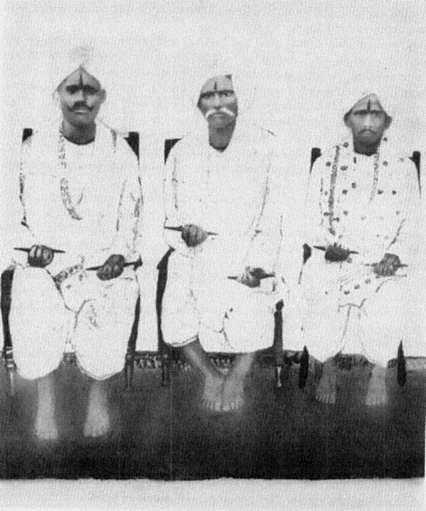
Fig. 8
Bihari (center), said to be the creator of biraha[*] , and two of his main disciples. On
his right is Ramman, the namesake of the Ramman akhara[*] . All three are holding
kartal s[*] . With the exception of the chairs, this group typifies the early biraha
ensemble (photograph from the 1920s).
[Ravana cannot succeed in fighting Ram, who has Hanuman at his side, / (to Ravana:) Your golden Lanka will be mixed with the soil (i.e., destroyed), your pride will be broken.]
Oral history holds that the earliest stages of the "modern" biraha (as distinct from khari[*]biraha ) were the creation of one man, Bihari Lal Yadav, who lived from 1857 to 1926 (see fig. 8). Generally referred to as
Guru Bihari, he is universally recognized as the founder of biraha[*] . (Thus, we have the remarkable occurrence of a folk music genre with an acknowledged founding figure.)
The form that Bihari used for his own compositions included an unlimited number of rhymed lines: the genre had grown to allow for more content. Among the changes which Bihari is said to have effected were the invention of a new instrument and its introduction into biraha performance. This instrument, the kartal[*] , consists of two pairs of tapered metal rods, each approximately nine inches in length. The singer holds a pair in each hand, creating a high-pitched ringing sound by rhythmically hitting the two rods against each other (see fig. 8). This instrument is unique to biraha and is thus one of the more obvious identifying elements of the genre.[3]
Bihari introduced his new genre into the urban environment when h e moved to the city of Banaras[4] and began performing at city temple festivals, called shringar s[*] . At the time, the most prominent forms of entertainment at these festivals were kajali[*] (another regional folk genre), Indian classical music, and performances of courtesans, which included music and dance. Bihari began performing biraha at kajali functions. He came away from a number of these the acknowledged "winner" of the event: in kajali performances, two or more ensembles would perform at the same event, and there would be an element of competition between the ensembles. This element of competition was later incorporated into city performances of biraha . Thus biraha had its first successes in the urban environment.
As Bihari's fame spread (he gained renown as both singer and poet) he acquired a number of disciples (shishya s or chela s). When his disciples later attracted students of their own, separate lineages developed. These lineages are called akhara s[*] or, less commonly, gharana s[*] . Bihari had four main disciples and these in turn have their own students (see table 3.1). The various akhara s do not keep records of their members. The system relies on the social contact of the guru-chela relationship for its maintenance (generally, poets are the gurus, singers are the chela s). All acknowledge that the akhara[*] system in biraha began with Bihari.[5]
[3] The word kartal is used across northern India to name various other idiophones ("a musical instrument—as a gong—that sounds by the vibration of its constituent material" [Webster's Seventh New Collegiate Dictionary]). This version of the kartal is unique to biraha .
[4] Bihari was born in a village named Patna near the Aurihar station, Saidpur tahsil, in Ghazipur district. He moved to Banaras at an early age in search of employment and eventually took up permanent residence in Ahiriyana, a section of the city adjacent to Nichi Bag (L. N. Yadav, 1975:3; Ram Sakal Yadav, n.d., 3).
[5] Some biraha singers come from non-Bihari lineages. Most of these lineages have their roots in the kajali tradition. Kajali[*] (or shayari[*]kajali ) is a folk musical genre of easternU.P. and western Bihar, which flourished for a hundred years or more, but which met almost total eclipse with the rise of biraha . Many kajali[*] performers, wanting to continue their musical careers, came into biraha . Thus kajali lineages became biraha lineages. Interestingly, the presence of a gharana[*] system within folk music has been little noticed.
|
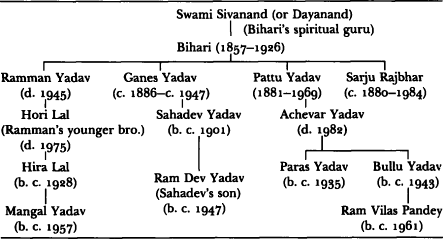
These akhara s[*] play a major role in organizing the social and performance aspects of the tradition. For example, membership in one or another of the akhara s is mandatory for anyone wanting to become a professional biraha[*] singer. One reason for this is that biraha singers do not improvise their song texts; rather they obtain and memorize texts from poets who belong to one specific akhara[*] . The song texts are the property of that akhara . Thus it is only through membership in an akhara that a singer can obtain songs to sing.
The akhara phenomenon also plays a major role in determining who will perform when the performance is of the competitive, or dangal , variety. In dangal s the two competing biraha ensembles must be from different akhara s. Thus, it is not only the two singers who are competing but also the two akhara s. One's membership in an akhara is not an obscure piece of information; rather it is announced at the end of every song. All songs end with a section called the chap[*] (literally "stamp") in which the poet has composed lines that list the major figures in his specific akhara 's lineage. Thus the audience is constantly being reminded of the singer's akhara affiliation. This is a sample chap , written by Mangal Yadav, a poet and singer of the Ramman akhara :
Swami, Guru Bihari, Ramman Hori, dharm anuyayi[*] ,
Hira, Lakshmi, kavi Mangal sevai mandir nit bhai[*] . . .
[Swami (Bihari's guru), Bihari, Ramman, and Hori are followers of the dharma (i.e., are religious) / Hira Lal, Lakshmi, and the poet Mangal serve the temple daily . . .] ("Lakshmi" is Lakshmi Narayan, b. c. 1941, who, as the grandson of Ramman, is considered the present-day titular head, or khalifa[*] , of the Ramman akhara[*] .) Bihari's disciples and others who constitute the next generation of poets composed in a new structure, which included the addition of a periodic refrain called the teri[*] (the creation of which is attributed to Bihari himself). In time, the teri came to be considered the very essence of the biraha[*] form. Recognizable by its distinct poetic structure and melodic line, the teri , in content, is said to encapsulate the song's dominant statement and rasa (aesthetic quality).
Over a period of some thirty years (c. 1920–1950) three distinct formal structures evolved, all centering around the use of the teri line. All three can be said to be variants of the "traditional biraha structure," "biraha in its maturity." Once evolved, all three continued to exist side by side.[6] Besides the teri , two other compositional features characterized the traditional biraha form in its maturity. These are the antara[*] (dophuliya[*] and caukara[*] varieties) and the uran[*] .
Experimentation Leading to the Modern Biraha[*] Structure
The three varieties of the "traditional biraha structure" consisted solely of teri , antara , and uran , and as such were pure "100 percent biraha " structures. In time, however, this purity of melodic and poetic structure became undesirable: poets and performers began to feel the need for greater variety. This variety was achieved when, from the later 1940s (and possibly earlier), poets began to substitute new forms and melodies for one or two of the units within the traditional biraha structure. Sometimes the antara s[*] were replaced by poetic forms such as chand , or sawaiya[*] . However, strict adherence to poetic forms was never a major aspect of biraha composition. Rather, poets would apply the art of parody to already existing melodies. (This is a process whereby the poet selects an existing song as a source for a new melody; he composes a new text on the chosen melody, using the song's original text to guide the phrasing.)[7] The common term for these borrowed melodies is tarz (singular and plural). Occasionally the terms dhun and lay are also used.
[6] These three structures still exist today but are relegated to use in short songs (the kind that are needed for All India Radio/Akashvani and commercial recordings).
[7] This definition of "parody" is common in Western classical music studies; see Grout 1973:142. This use of parody is an extension of a long-standing tradition in Bhojpuri musical culture. Grierson wrote, "In the country districts, I never heard of a new tune being invented. There seems to be a certain stock of melodies ready made, to which thewords of every new song must be fitted" (1886:210). Grierson commented further that the songs "by no means follow the strict and complicated metric laws. . . . Any number of syllables, long or short, can be crowded into a line, so long as the need of a musical ictus is satisfied" (1884:198–99). He added, "In these . . . songs the melody to which they are sung is the only guide, and so long as the accent or musical ictus is provided for, the author cared little whether his syllables were long or short" (1886:209).
For biraha[*] this new technique of parody had major consequences for the success of the genre. The singer could now keep the interest of his audience not only with the story line, but also by the use of various popular melodies. The technique came to be used in two ways. It was the perfect strategy for keeping up with the trend-oriented aspect of modern popular culture: if a new song were sweeping the city (from a film or on the radio or records), within a week or two biraha singers would be incorporating that song into their own. But parody could also be applied using traditional songs. Thus, the singer now had the ability to play up to the conflicting trends of "modernization" and rural and Bhojpuri pride. This could even be done within the same song by first quoting the latest Bombay film song and then introducing a village melody. This technique proved highly successful.
There is a large body of tarz available to the poet for use through the process of parody. Bombay is forever providing new film songs. (Films in India usually have five songs each. These songs are the object of a "Top 40" type of popularity.) There are also the melodies used by non-Bhojpuri music ensembles: qawwali[*], alha[*] , and Nautanki[*] .[8] And there are the melodies of Bhojpuri folk music. Poets are proud to point out that Bhojpuri musical culture alone offers an unlimited source for melodies ("anant bhandar"). Bhojpuri musical culture has some twenty or more genres that are more or less melody-specific.[9] Among these are songs associated with specific castes (for example: mallah[*]git[*] , boatmen songs; dhobi git , washermen songs, etc.), songs associated with specific rites of passage (sohar , birth songs; vivah[*]git , wedding songs, etc.), songs associated with specific seasons (kajali[*] , songs of the rainy season; phaguwa[*] or holi[*] , springtime songs) and a large number of other miscellaneous folk song genres (khemta[*] , kaharawa[*], chaparahiya[*], jhumar[*], purvi[*], lacari[*], bideshiya[*] , and others).
To increase the entertainment value of their performances, singers even began to sing a few lines of the borrowed melodies' original text before proceeding to sing the parodied lines. As far as the story of the biraha song was concerned, this was a complete digression, but the en-
[8] Alha[*] and Nautanki both exist as Bhojpuri genres, but their roots are to the west of the Bhojpuri region (see chapter 2 for a discussion of Nautanki).
[9] For example, Grierson wrote that his forty-two examples of khari[*]biraha were "all sung to the same melody" (1886:211). He adds that "every mill-song must be sung to the melody called 'jatsar[*] ' " (1886:210).
tertainment value could not be denied; audiences loved it then and continue to do so now.
Beginning in the late 1940s, there followed a long period of experimentation. Poets tried all varieties of tarz in differing orders. By the late 1960s a new structure began to emerge. By about 1970 this new structure became standard for virtually all full-length biraha[ *] songs. This is still the case today. The most surprising aspect of this structure is that the formal elements of the traditional biraha (the teri[*] , caukara[*] and uran[*] ) have been reduced to minimal representation. Non-biraha melodies now outnumber the traditional biraha melodies! This has given rise to frequent statements that biraha no longer exists; it is now a composite genre best called simply lok git[*] , a "folk music." It is now common to hear someone say, "Yes, lok git is happening up the street," referring to a biraha performance. However, despite their own statements to this effect, the biraha community continues to call their genre biraha .
Poets and singers emphasize that the new structure is flexible; the requirements of a particular story line might necessitate a change in the structure. But there is an inviolable aspect of the above progression: the song as a whole must progress from naram to garam (literally "soft to hot"), that is, the level of excitement must build. There can be no slackening of the energy level in the middle of the song. The climax should come at the end (before the final uran ). Accordingly, tarz are judged for the quality of energy that they evoke. The beginning and ending progression are stable features of virtually every full-length song because of the "naram to garam" effect that they help create.
The Ensemble:
Biraha[*] as a Profession
During the period when the above changes in song structure were taking place, there were also major developments in the performing ensemble. During Bihari's time, there was no concept of a fixed ensemble. A singer would bring one or two companions to serve as a chorus, or he might ask one or two people from the audience to sing with him. All three people would play the kartal[*] (see fig. 8).
When biraha poets began to experiment with the traditional structure of the biraha song, the resulting complexity necessitated that the chorus members be specialists. Uninitiated singers were no longer able to sit in casually as chorus members. Thus, a new entity emerged, the parti[*] (the English word "party"), consisting of a lead singer and usually two steady chorus singers (teribharnewale[*] or terikahnewale[*] ).
At about the same time, changes in the genre's instrumentarium expanded the ensemble's size. In the late 1940s a few singers experimented with adding a dholak[*] player to the ensemble (a dholak is a barrel drum with skin heads stretched over the two open ends of the barrel).
Shortly thereafter, the harmonium was added (a portable keyboard instrument; the sound is produced by air from hand-pumped bellows passing through reeds). In time, both the dholak[*] and the harmonium gained wide acceptance. While it was still common in the 1970s to find village parties that did not include a harmonium player, by the 1980s the dholak and harmonium had become standard features of all biraha[*] ensembles. The standard biraha party today is a five- to six-man ensemble: a lead singer, a dholak player, a harmonium player, and two or three chorus singers. The latter provide rhythmic accompaniment by playing the kartal[*] and another idiophone called the jhanjh[*] . Recently a few parties have experimented by adding a flute player in some of their city performances. However, this is as yet an isolated phenomenon.
An important aspect of the modern-day party is an explicit hierarchy among the party members. While many comment that in Bihari's time the ensemble was an informal group of equals, today the lead singer is clearly the head of the ensemble. A party is known by the name of its lead singer alone (e.g., Hira Lal and Party). It is the lead singer who is hired to give a performance and it is he who is paid. He in turn pays his party members. The pay scale for the different members reflects their relative status. Today, the best-paid parties are paid for each performance: Rs. 40 for the harmonium player; Rs. 35 for the dholak player; Rs. 30 for the two chorus members. After paying out these fees and any travel expenses the lead singer keeps all remaining money.[10] This often amounts to from five to ten times what he has paid his individual party members. Thus, it is only the lead singer who achieves substantial wealth and fame. It is not uncommon for the party members to comment on their second-class status.
The addition of musical instruments to the ensemble has been credited with instigating the change in the genre from avocation to vocation. Before the introduction of the dholak and harmonium, singers were invited only informally to sing at a given function. Remuneration, only in the form of inam[*] , was minimal. Older singers all point out that singing was then an avocation, an act of love ("Log shauk se gate[*] the.") With the introduction of the dholak and harmonium players, the situation had to change. The dholak and harmonium players were not members of the biraha community. Their skills were in demand among a number of other performance genres that coexisted in the area (especially qawwali[ *] and kajali[*] ). Thus, they had to be paid to assure their steady attendance and loyalty. This meant that the biraha party could
[10] Besides a preset fee that a singer receives, a large part of the renumeration for a performance comes in the form of inam , gifts of money and other miscellaneous items that members of the audience bring up to the lead singer during the performance. The lead singer keeps all inam for himself. During weddings, members of the groom's family are usually quite generous with inam .
no longer be invited informally, but rather had to be hired for the occasion. The lead singer was now obliged to ask for preset fees. Initially these fees were small, but as the genre grew in popularity, so the fees increased accordingly. Today there are a number of lead singers who have become very wealthy from their performances, earning over Rs. 50,000 a year.
The Larger Social Context
Biraha[*] has traditionally been a genre of the Ahir and neighboring castes (Rajbhar[*] , Kurmi, Mallah[*] , etc.). These groups are from the lower end of the caste system. Common ranking (by members of the upper castes) places these groups at the top of the fourth (Shudra) varna (the fourfold ranking of the various castes: Brahmin, Kshatriya, Vaishya, and Shudra).
Performers and members of the biraha[*] audiences are usually from the lower castes. People from the upper castes consider it beneath their dignity to attend biraha performances; they do not consider biraha to be worthy of their attention. Recently, however, the lucrative aspect of biraha has attracted singers from all castes. Today some 20 percent of biraha singers are from outside the traditional group of castes. Everyone associated with the genre is proud to state that today there are singers from every caste. (One of the great figures in the history of the genre, Ram Sevak Singh, is a Thakur, i.e., of the Kshatriya varna . Among the top performers today are a Brahmin, a Thakur, a Harijan, and a Muslim.)
As was mentioned, biraha is performed in separate village and city contexts. In the rural areas, weddings occur during the spring months; it is here that biraha finds its village context. (The length and dates of the wedding season vary each year according to astrological considerations. In 1983 it lasted three months, from April to June. However, in 1984 it lasted only one month, from April 14 to May 14.) Marriages in this part of India are village exogamous. Weddings take place in the bride's village, at the bride's house. The groom, his male relatives, and a large number of their male guests all travel to the bride's village in a procession called the barat[*] . The barat arrives in the evening (6:00 to 9:00 P.M .) and leaves around 4:00 or 5:00 P.M . the following afternoon. The members of the barat set up camp in a field near the bride's house. Large tarps are spread out; a colorful tent is often erected for the occasion.[11]Biraha performers are hired to entertain the groom's marriage-party members during their stay in the bride's village. There are two time periods when entertainment is considered necessary: two to three
[11] By late March or early April most crops have been harvested and the fields are empty. Thus there is ample room to accommodate large wedding parties.
hours (from 9 or 10:00 P.M .) on the first night, and some five to six hours (usually beginning around 10:00 A.M .) during the following day.
When biraha[*] existed only as khari[*]biraha and then later as the early stages of the modern biraha , the genre was performed at weddings in an informal manner only. (Khari[*]biraha is still performed in this fashion.) But as the expanded party came into being, biraha became part of the formal entertainment. Today, biraha is the featured entertainment at weddings of the Ahir and neighboring castes, that is, biraha 's constituent castes.[12] (Biraha[*] singers from other castes perform regularly for their own castes' weddings.)
When biraha is performed at weddings, the person in charge of the entertainment is the groom's father (called the barat[*]malik[*] , the lord or master of the barat ). He or one of his sons, brothers, or helpers travels to the biraha singer's house and hires the latter to perform at the upcoming wedding. The barat malik can hire as many parties as he wants. If there is more than one biraha party (occasionally there are three, four, five, or more), the parties will take turns, each performing one song at a time.
The second major context for biraha performances is the city temple festival season. The festivals, called shringar s[*] , are held annually for each functioning Hindu temple and serve as festivals of rededication and redecoration. Residents of a temple's immediate neighborhood form a committee to organize the festivities. Besides arranging for fresh coats of paint and occasionally major and minor building renovations, the shringar[*] committee also organizes one, two, or three nights of religious and social functions. Many temples have a regular date for their shringar (reckoned by the Hindu calendar). The shringar season as a whole is said to start with Krishna Janmashtmi[*] (late August to early September) and run until early December.
Religious functions include a hawan pujan[*] (a ritual performed by Brahmin priests which centers around a sacrificial fire) and possibly a reading of the Ramayan[*] in its entirety (called Ramayana[*]path[*] ), or a communal session of bhajan singing led by a local kirtan[*]mandali[*] (an informal group of men who gather, usually weekly, to sing devotional songs), or both. For the social functions the shringar committee arranges one or more of the following forms of entertainment:
1. biraha ;
2. qawwali[*] (a Muslim musical genre, which is often adapted with Hindu themes for these occasions);
[12] The top singers are in great demand during this period. It is not uncommon for them to be booked daily for the length of the wedding season. After finishing a performance at about 5:00 P.M ., the party members eat and then set off for their next performance, usually later in the same day at some other village.
3. orchestra (a recent phenomenon in which a band performs imitations of hit film songs; these bands appeared in Banaras in c. 1978);
4. the showing of a film;
5. Indian classical music (chosen only rarely).
If the shringar[*] is to last more than one day, it is common to have two or more of the above, that is, one performance each evening.
As was mentioned above, when biraha[*] first entered the shringar circuit, kajali[*] was the most common form of folk music to be performed at these functions. Initially, biraha singers sang on the same programs with kajali singers. A number of biraha singers fared very well in these events. In time, some committees decided to hire only biraha parties. Armed in the 1950s with new instruments and the newly developing formal structure, which put a premium on the entertainments and sentimental values of its melodies, biraha began to take over performance opportunities from kajali .[13] By the mid-1960s this had become a major trend, so that by the 1970s kajali (the shayari[*]kajali that was performed at shringar s[*] ) had virtually disappeared. The expression on everyone's lips today is "kajali tuti[*] ," kajali broke. Biraha[*] (and, to a lesser extent, the other forms listed above) has taken its place. Today, biraha is the dominant form of entertainment at Banarsi shringar s.
Once a shringar committee has decided on the type of entertainment it wants, one or more of the committee members will approach the performers of their choice and hire them for their shringar . The money needed for these functions is collected by door-to-door solicitation from the homes and businesses in the immediate neighborhood. Contributions (called canda[*] ) are usually Rs. 2, though some people and the larger neighborhood businesses might give Rs. 11, 21, or more.[14]
The entertainment functions take place on the city street nearest the temple. They begin at 10:00 or 11:00 P.M . when normal city activities have come to a halt. Most functions are of sufficient size to warrant the closing of the street. The entertainment continues until after sunrise. In fact, the hustle and bustle of the morning activities (especially the street traffic) play a major role in bringing these functions to a close.
These events are free and open to everyone. Most of the people in the audience are residents and shopkeepers of the neighborhood.
[13] Biraha was further aided in its overtaking of kajali by its flexibility of content. Kajali[*] was restricted in content, as it had been inexorably linked to songs depicting aspects of the rainy season. As such, kajali was also restricted to only a certain segment of the year (end of June to September, the Indian rainy season), whereas biraha could be performed all year round.
[14] N. Kumar (1984:201) reports that this door-to-door collection of donations is a recent phenomenon. "Previously, only those temples which had wealthy donors had grand shringar s," i.e., shringar s that include one or more evenings of entertainment.
Women, however, attend only in the morning as the events are coming to a close. A significant percentage of the audience are people who just happened upon the function while traveling to or from other engagements. There are also devoted fans who will travel across the city to hear their favorite singers. Audiences range from 150 people at some poorly attended functions to over 1,200. Attendance depends largely on the fame of the two lead singers.[15]
These functions are advertised in three ways. Sign boards called list s[*] are hung by the sides of the road or are painted on any available wall space. Announcements of upcoming events are often published in the local Hindi newspaper, Aj[*] , on its third page. But the most effective source of advertisement is the loudspeakers that are placed up and down the street for one to two hundred yards on the morning of the first day of the shringar[*] . All of the shringar 's activities are broadcast over these loudspeakers, bringing the occasion to the attention of thousands (often tens of thousands) of people.
When biraha[*] is to be performed at these functions, two ensembles are hired. These performances are called dangal s, a word which emphasizes that the program is viewed as a competition between the two parties. Two stages are set up approximately a hundred feet apart. The audience sits between the stages either on large tarps that are spread on the street or (more rarely) on chairs that are provided. The audience first faces one party, which will sing two songs. Then the audience turns around and hears two songs from the other party. The two parties alternate in this fashion throughout the night. Each set of two songs usually lasts from one to one and a half hours.
The success of the entertainment functions within shringar s[*] can be attributed to a number of factors. Since the events are held in the name of religion, the committees usually have no trouble collecting the necessary funds. The functions themselves fit into the general mold of Banarsi festivals by incorporating the standard repertoire of lights, decorations, music, an open-air setting, and all-night activities (N. Kumar 1984:289, 291). The lights include long strings of mini-bulbs
[15] There is a markedly different ambience in the wedding and shringar performances. At weddings, the members of the audience are all considered to be guests of the bride's family. One's every need is attended to. Water, snacks, and food are all provided. Attention is given to assure that everyone has sufficient room to sit. These points are in contrast to the circumstances at the city shringar s. One can buy refreshments from nearby food stands or tea shops; however, nothing is provided free or brought to the members of the audience. Seating is generally first come, first served. There is seldom any feeling that one is a guest, although the members of the shringar committee are supposed to ensure everyone's comfort. (The exception to this comment are the large contributors in the canda[*] collection drive. These people are treated as guests of honor with special seating being provided for them.)
("Christmas lights" in the United States). These are hung from poles along the side of the road. The resulting effect is that of curtains or a lengthy canopy, which helps to define and ornament the site for the event. Further decorations are provided by folk painters who are hired to paint on any available wall space in the immediate shringar[*] area.
The element of competition has also contributed to the success of these events. When performed at shringar s[*] , biraha[*] (and qawwali[*] ) features an aspect of competition between two lead singers (and their ensembles). A few shringar s have also sponsored programs of wrestling and forms of weight lifting (using jori[ *] , a pair of long, cone-shaped weights, and gada[*] , a club with a spherical mass at one end), with trophies being given to the winners of the various events. Members of the audience often comment that the aspect of competition is one of the major attractions of these musical and athletic events.
There is also an implicit sense of competition among the various neighborhoods as to which area has the best shringar . This has resulted in numerous two- and three-day shringar s and in the committees vying for the most famous performers. A few committees have recently sponsored two or three consecutive nights of biraha as a way of distinguishing their shringar from others in their vicinity.[16]
Biraha 's[*] position of prominence at these festivals reflects, in part, the major change in the nature of shringar s that has occurred over the last fifty years. Nita Kumar (1984) reports the withdrawal of members of the upper classes from these and other public festivities. A new "morality" caused the upper classes to frown on culture in public forums. Classical music and the music and dance of courtesans, prominent on the streets of Banaras some forty to fifty years ago, both retreated to indoor, usually private settings. Banaras's classical musicians began following "a different set of expectations of the constitution of a 'proper' audience, of audience appreciation, and of the value of a professional artist. The 'public,' crowds, and open gatherings have become negative concepts now" (N. Kumar 1984:193). Shringar s[*] , with but a few exceptions, have been left to the domain of the lower classes.
With the withdrawal of the upper classes from the audiences, if not the financial support, of shringar s, these festivities became an important symbol of lower-class identity and a major forum for lower-class cul-
[16] Competition exists in many other aspects of Banarsi culture: within the wrestling and weight-lifting clubs (called akhara s[*] ), which are common throughout the city; in the singing of nat[*] by different Muslim groups on the occasion of the birth anniversary of the Prophet; and informally in the desire to have the best images (religious statues) for Durga[*] Puja[*] or Vishwakarma Puja, the best tazias for Muharram, and the best martial arts groups (groups that use swords and sticks) for Ramlila[*] processions, etc. (see Kumar 1984).
ture.[17] "Shringar s[*] . . . are indicative of a 'lower class' identity, in that they serve to separate and define their participants. . . . The event is considered to be one belonging to the low classes, of the poor and uneducated" (see chapter 5 in this volume). Biraha[*] , a music of the lower classes, was embraced as the appropriate form of entertainment for these events.
Biraha , the Mass Media, and Stardom
Besides offering the potential for asserting lower-class identity, shringar s[*] were also vehicles for developing neighborhood pride. Today each neighborhood wants its own shringar[*] . This trend has been supported by major increases in the size and population of Banaras: surrounding rural areas are becoming urbanized; thus the number of neighborhoods is increasing. Also neighborhoods within the city are becoming subdivided, with each smaller division wanting its own festivals.
It is clear from the above that there are a number of performance contexts available to the performer. Fame and fortune are real possibilities. Besides the separate city and village seasons described above,[18] there has also been, for the top singers, a third season. Since the early days of the modern-day biraha[ *] , the top performers have been called to Calcutta, Bombay, cities in Gujarat, and the like to give performances for laborers who are originally from U.P. and Bihar. These performances take place from December to February when winter's cold puts an end to all performances in eastern U.P. and Bihar. These programs are unusual for two reasons. First, many are "ticket programs," that is, one must buy a ticket in order to gain admission. Second, the performers are often paid as much as ten times what they earn for performances in the Banaras area (this being above travel expenses, which are provided separately). Thus, except for the monsoon season, the top biraha parties have performances throughout the year.
When the initially skeptical producers of commercial records became convinced of the lucrative aspect of producing regional folk musics, biraha and other Bhojpuri genres began to appear on records. For biraha this first happened in 1955. Since then a number of recording companies have produced records of biraha , initially on 78-rpm and now on
[17] As Sarma (quoted in Kumar 1984:321) states for Durga[*] Puja[*] associations, the shringar committees have also played an important role by offering "chances for the young men to organize and show their organizational and artistic talents on a mass scale."
[18] There are exceptions: some city families call for biraha at their weddings; temple shringar s also take place in the villages. Biraha is also commonly performed at the griha pravesh ceremonies of biraha 's constituent castes (the formal ceremony before a new house is officially occupied).
45-rpm. These recorded songs have been either three or six minutes in length.
Biraha[*] was first broadcast over the radio from All India Radio's Allahabad station in about 1960. Later the government built AIR Sarnath, the Banaras station. There are presently some eighty-five groups that perform folk music on AIR Sarnath's folk music show. Each day a different group's music is broadcast: six songs spread out over three different shows, at 1:50 P.M ., 5:15 P.M ., and 6:40 P.M . The songs, five minutes in length, are in any of some fifteen different folk genres. Biraha is one of these genres. A given group's music is usually broadcast four times a year. Musicians and poets refer to the short songs that they must prepare for radio or records as chote (small) lok git[*] or simply lok git to distinguish them from the longer songs that make up the bulk of their repertoire.
In the last eight years audio cassettes of biraha[*] have also appeared. With audio cassettes, recording of full-length songs is now possible, as the time limitations imposed by records and the radio are no longer a factor. Today cassette stores in Banaras offer dozens of cassettes of live biraha performances. (The lok git of radio and records are all studio recordings.) However, 99 percent of these cassettes are illegally produced. Microphones are set up, often near the loudspeakers that are a part of every live performance, without the knowledge or consent of the performers involved. The people who produce cassettes from these recordings establish no contact whatsoever with the performers themselves. Needless to say, performers are not paid for these recordings.
The relative ease and low cost with which cassette recordings can be made and duplicated has resulted in a major pirated-cassette industry. Within days after a legitimate cassette or record appears in the market, there are two, three, or four pirated copies of the new release available on various spurious labels. The duplicate cassettes all have different covers and designs, but they are identical to the original in content. Because of this pirated industry, all but two legitimate companies have been forced to stop producing commercial recordings of biraha .
In the last few years, a few biraha ensembles have performed on television. The shows are taped in Lucknow. In 1984 biraha appeared for the first time in a film ("Sonawa[*] ka Pinjara[*] "). Two ensembles performed, each presenting one short song. Television and film will undoubtedly play significant roles in the future of the genre. (In late 1984, Banaras received its own TV relay station; however, shows are not as yet produced locally.)
This variety of performance contexts has made biraha a compelling profession to which performers are attracted from a very young age. A child first enters the active biraha community of performers by casually
sitting in with the chorus members. This is allowed on an informal level: there is always room on the performers' chauki[*] (the platform on which the performers sit or stand) for such an individual. After a while the child will learn the format structure of the songs and the melodies that are used. Next he must memorize a few short songs. Children who show the desire and ability to master a few songs are occasionally given a chance to perform at the end of a biraha[*] program. (During the shringar[*] season, this would be at about 7:00 A.M . following a night of continuous music.) These children would use the party of one of the professional singers.
Over the past fifteen to twenty years, singing in school competitions has played a role in the training of new artists. Yearly competitions are held in October/November. The singing of folk songs is just one of the activities in competitions that also include marching and wrestling. Winners in each category progress from school-wide competitions to mandal[*] -wide, district-wide, regional, and then state and national competitions. One of the younger biraha singers who has gained considerable popularity recently had his training and gained recognition in these competitions.
When a singer wants to become a lead singer in his own right, he must do two things: he must organize his own party and he must decide which akhara[*] he wants to join. Once he has decided on a particular akhara , he arranges for a public ceremony to be performed (called sinni[*] ), during which he officially pledges his allegience to that akhara (he "sinni carhate[*] hai," raises up sinni ). At the same time, a member of that akhara (either the titular head of the akhara , called the khalifa[*] , or one of the akhara' s poets) publicly and officially accepts the singer into the akhara . Having performed this ritual, the new member is then given access to all the songs of this akhara .[19]
One of the earlier stages on the road to fame is becoming a "radio artist." A singer and his party must sit for an audition, called a "voice test," before a panel of judges appointed by the radio station. These auditions happen four times a years. A group must pass this test for their music to be broadcast over the radio four times a year.
At a given function, singers and their parties usually perform only with other singers of equal age and status. As a young singer becomes popular and gains a following, his big break will come when one of the superstars agrees to sing "against" him (i.e., in the same program). This
[19] The territorial aspect of song ownership is taken very seriously. A singer may not sing a song that belongs to another akhara . If a singer changes his akhara , he can no longer sing any songs of his former akhara . If he were to go ahead and sing such a song, any member of the biraha community who is in the audience and realizes what is happening can speak up and demand that the performance be stopped.
becomes the young singer's "ticket to fame." Word spreads that he has sung against the famous "so and so." If he fared respectably in that performance, other singers of fame will soon agree to perform "against" him. Once the young singer has performed with the most popular singers, he has officially "arrived." The frequency with which he is asked to give performances will increase dramatically. He will enter a very substantial income bracket, leaving behind the poorer economic circumstances of the majority of his audience.
In the past, the most popular singers lived either in village areas or in the city. Recently, however, with the rise in the popularity of the genre and the development of "superstar" status for the top of performers, there is a new prerequisite for becoming a full-time professional singer: the singer must take up lodging in the city of Banaras, so that he is easily available for those wanting to hire the top artists. The result of this newly felt need is that all the main performers are now residents of the city of Banaras. Banaras has thus become the center for the genre.[20]
Conclusion
Members of the biraha[*] community are unanimous in emphasizing that biraha is a product of Bhojpuri culture. It is village life that typifies this culture. Significantly, the genre had its roots in the villages: its earliest stage, khari[*]biraha , has existed solely as a rural genre. When poets began to introduce non-biraha melodies into the biraha form, they continued to rely heavily on traditional Bhojpuri songs. In interviews and even within the notes inserted into performances, poets and singers have stressed the traditional roots of many of the tarz: "There is an endless store of Bhojpuri tarz, tarz which our people have been singing for ages." Singers have introduced these melodies with pride: "This is a Bhojpuri tarz , a completely traditional tarz ." Furthermore, the kartal[*] , the instrument that most typifies the genre, is a product of village life: it closely resembles the iron rod that is the major functional element in the ploughs of the region. Members of the biraha community take pride in stressing the grass-roots elements of the genre. At the same time, many aspects of biraha 's development are the result of urban influences, such as the emphasis on film tunes as a source for new melodies and the introduction of the harmonium into the ensemble. (The harmonium is not traditionally found in the villages.)
[20] While villages continue to have biraha ensembles (informants tell me—and my own observations support the claim—that every village has one or more biraha ensembles), these ensembles are nonprofessional or semiprofessional. Many of the younger singers who move to the city do not abandon their villages; rather, they maintain dual residence.
Biraha[*] , increasingly, is an urban genre that can thus be seen as being informed by two opposing urges: the desire to stress the genre's rural and vernacular (Bhojpuri) roots; and the desire to adopt new features and new developments (new instruments, the latest film songs, or the latest developments in structure). In order to reconcile these two urges a song structure has developed which uses a number of different melodies, all within the same song. A single song can thus respond to both urges simultaneously: after presenting one or two traditional folk melodies, the singer can move on and introduce the latest film song.
The two opposing urges are further reconciled by the new Bhojpuri film industry: the latest film songs can now be Bhojpuri songs. Until recently, Bhojpuri films were a rarity; now they are quite common: in 1983 there were five or six newly released Bhojpuri films. Poets have remarked that they now seldom include the new Hindi film songs; new songs from the latest Bhojpuri films provide an ample supply of new melodies.
The urban influence can be seen as having affected more than just the content and structure of the songs: it can be argued that it was Banaras's urban environment which helped to break down the genre's social isolation. In the villages, it might well have remained restricted to the Ahir and neighboring castes. Performed on the streets of Banaras, the genre came to have a wider following. It became not so much a genre of a certain group of lower castes as the property of the lower classes in general. As such, biraha 's[*] fortune came to be linked with the rise of lower-class culture and the growth of the shringar[*] phenomenon that has taken place in Banaras over the last fifty years.
The success that biraha has experienced has been aided by forces both external and internal to the genre itself. For one, biraha appeared in Banaras at an advantageous point in time, when lower-class culture and its temple festivals were expanding. Equally important, singers and poets proved remarkably flexible in their understanding of what constituted the genre. Change was never shunned. Rather, the genre was shaped and reshaped over the years to keep it responsive to the interests of its audiences.
An Example of a Modern-Day Biraha
[This is an excerpt from a live performance. The song tells the story of a theft that occurred at the Vishwanath[*] temple in Banaras in January 1983. The lines in italic were sung; the rest were spoken (not s or the accepting of inam[*] ). The excerpt begins when the singer, having just finished singing the gazal , is accepting an inam ]:
O.K. my dear brothers, I've received a puraskar[*] of Rs. 6 and a garland of flowers from my brother, Debi Lal.
But the tarz has changed, my dear friends. This is a Bhojpuri tarz :
My Rs. 125,000 nose-ring fell in the middle of the bazaar .
O king, I've lost a lot in my young age .
Yes, this is the tarz , my dear friends, but the words of the song [the new text superimposed on this melody]:
The thief took Rs. 1,600,000 in gold in the dark of night.
The sinner desolated the Shiva temple in Kashi [Banaras] .
Four thefts had taken place, little was taken.
On the fourth of January in the early morning the thieves entered the temple .
The thieves got gold in the fifth theft .
The sinner desolated the Shiva temple in Kashi .
O.K., brothers, I've received a Rs. 2 puraskar[*] from the honorable Lal-ji Yadav. Thank you.
Pay attention, my dear friends. This was not the first theft. Before this there had already been four thefts at the Vishwanath temple [the most important temple in Banaras]. But in the previous four thefts, the thieves couldn't get their hands on a significant amount [of money]. If you'll remember this winter's weather, from the first of January [1983] till the fifteenth, the weather was so bad that, forget about the night time, in the daytime darkness remained spread [over the city]. All day long it remained foggy. So what can be said about the night time? During that fiercely cold night, on the early morning of January fourth, the thieves entered the temple. When they tried to pull up the gold at the base of the Shiva lingam , they weren't able to do so. So the thieves began to hit their heads on the lingam ; calling out in appeal, they said, "O Bhole Nath [an epithet of Shiva], you are very merciful. It was with great difficulty that we've come here. Bhole Nath, please give us the gold." Shiva is so merciful that he closes his eyes and gives the thieves the gold! But the next day, the police officials [realize the situation and] become troubled. They go into the Shiva temple and begin to hit their foreheads [against the lingam ]. Appealing to Shiva, they say, "You are so merciful, O Bhole Nath, please help us catch the thieves." He gave the gold to the thieves, and now, it might take some time, but surely He'll turn over the thieves to the police.
Now comes a tarz from the Balliya-Chapara border [an area 170 km. northeast of Banaras on the U.P.–Bihar border, very much in the heartland of the Bhojpuri region]. Which tarz is this? A completely traditional tarz . This is a Bhojpuri tarz that people have been singing for ages. Which tarz is this?
O Ma, I went to wash my hair at Father's pond, when a sparrow took away my nose-ring and a crow took my necklace .
In this tarz the words of the song:
The gold wasn't coming into their hands so the sinners starting praying, the thieves asked "O Lord of the World [an epithet of Shiva] give us the gold ."
The merciful Shiva closed his eyes .
The thieves took the gold; the news spread .
Trying to get a lead they ran around; then the police officials asked, hitting their heads, "O Bhole Baba, give us the thieves."
Not only in India, but throughout the whole world, commotion spread. What commotion spread? This is set in the teri[*] :
The thieves desecrated Tripurari [an epithet of Shiva],
In every direction commotion spread that a major theft has taken place .
[The song goes on to describe the public outrage, the mass demonstrations that took place on the streets of Banaras, and the events that let up to the capture of the thieves and the recovery of the gold.]