
Chapter Five—
Verklärte Nacht , op. 4 (1899)
The string sextet Verklärte Nacht was both the culmination of Schoenberg's Dehmeljahr and his first instrumental masterpiece. At once chamber music and program music (a novel combination acknowledged as such by contemporary critics), it hovers generically and chronologically between the Brahms tradition represented by the D-Major Quartet of 1897 and the Liszt-Strauss tradition that was to be explored further by Schoenberg in the symphonic poem Pelleas und Melisande (1902–3).
The sextet was preceded by three attempts at program music, each of which remained a fragment. One is a brief thirteen-measure draft (in short score) for a symphonic poem entitled Hans im Glück, which appears to date from 1898 (see Maegaard 1972, i: 152; Bailey 1984, 44–45). A more substantial fragment, begun in the summer of 1898, is the symphonic poem Frühlings Tod, based on a poem by Nikolaus Lenau (the poet of Schilflied.) A short score of the piece extends 255 measures, a full score 135. Because Frühlings Tod has been discussed in detail twice (Thieme 1979, 183–215, and Bailey 1984, 45–51), it will not be treated here. Suffice it to say that it shows Schoenberg beginning to grapple with chromatic harmony and Wagnerian sequential construction on a scale broader than he had attempted before. The third fragment, which is closest in style and medium to Verklärte Nacht, is a string sextet entitled Toter Winkel, a 34-measure fragment in B minor, based on a poem by Gustav Falke. The manuscript of Toter Winkel is undated, but it probably was written in 1898 or early 1899.[1]
In each of these cases, it may have been the poetic source that failed to sustain
[1] The work is discussed in detail by Thieme (1979, 173–83) and Bailey (1984, 38–44), both of whom include a complete facsimile of the score.
the initial creative spark ignited in Schoenberg. As in his Lieder, so in his program music, the encounter with Richard Dehmel's work was to be decisive. Indeed, as I have suggested in the preceding chapter, it was probably the composer's successful engagement with the poetry of Dehmel in the songs of the spring and summer of 1899 that inspired him to attempt—and complete—the sextet that became op. 4.
The exact date of composition of Verklärte Nacht in relation to the songs of 1899 cannot be precisely determined. The handful of sketches are undated; the autograph manuscript, which shows considerable revision and recomposition (to be treated below), is dated 1 December 1899. Egon Wellesz, an authoritative source, whose information was in many cases provided (or corrected) by Schoenberg himself,[2] reports that the sextet was composed in September (Wellesz 1925, 14). Schoenberg himself says that the sextet was composed in three weeks, but gives no specific dates (Schoenberg 1975, 55).[3] Zemlinsky tried to have the work performed at the Wiener Tonkünstlerverein, which had given the D-Major Quartet in the preceding season (1898–99), but the sextet was rejected (Zemlinsky 1934, 34). It was given its premiere by the Rosé Quartet (augmented by two players) in March 1902; the score was published, after many delays, by Verlag Dreililien in May 1905.[4]
From all this evidence, it seems logical to assume that the sextet was conceived and written during a relatively short span in September 1899, then was revised intermittently over the course of the fall, so that the complete score was finished on 1 December. Another tantalizing possibility is that the major revisions reflected in the manuscript were undertaken just over two years later in preparation for the first performance (no manuscript parts survive for this performance), or even later still, as Schoenberg was preparing the score for publication. The most likely scenario, however, is that the essential inspiration and creative work, as well as the most intensive revisions, took place in the late summer and fall of 1899, when the composer was strongly in the thrall of Dehmel's poetry.
It was suggested in the previous chapter that the Dehmel poem "Verklärte Nacht" is similar in several respects to "Erwartung" and is less sexually explosive than some of the other poems from Weib und Welt selected by Schoenberg in 1899. Like "Erwartung," "Verklärte Nacht" has a clear, almost rigidly symmetrical
[2] See chapter 2, n. 14, above.
[3] Willi Reich (Reich 1971, 7) misquotes Zemlinsky as saying, "In the summer of 1899 (during a holiday together in Payerbach) Schoenberg composed a sextet." In fact, Zemlinsky does not specify a date, implying only that the sextet was composed "soon after" the first performances of the D-Major Quartet (Zemlinsky 1934, 34).
[4] On the date of publication, see chapter 4, n. 7.
structure, in which the first, third, and fifth stanzas are spoken by an implied narrator, the second and fourth by one of the two protagonists:
Zwei Menschen gehn durch kahlen, kalten Hain;
der Mond läuft mit, sie schaun hinein.
Der Mond läuft über hohe Eichen,
kein Wölkchen trübt das Himmelslicht,
in das die schwarzen Zacken reichen.
Die Stimme eines Weibes spricht:
Ich trag ein Kind, und nit von dir,
ich geh in Sünde neben dir.
Ich hab mich schwer an mir vergangen;
ich glaubte nicht mehr an ein Glück
und hatte doch ein schwer Verlangen
nach Lebensfrucht, nach Mutterglück
und Pflicht—da hab ich mich erfrecht,
da ließ ich schauernd mein Geschlecht
von einem fremden Mann umfangen
und hab mich noch dafür gesegnet.
Nun hat das Leben sich gerächt,
nun bin ich dir, o dir begegnet.
Sie geht mit ungelenkem Schritt,
sie schaut empor, der Mond läuft mit;
ihr dunkler Blick ertrinkt in Licht.
Die Stimme eines Mannes spricht:
Das Kind, das du empfangen hast,
sei deiner Seele keine Last,
o sieh, wie klar das Weltall schimmert!
Es ist ein Glanz um Alles her,
du treibst mit mir auf kaltem Meer,
doch eine eigne Wärme flimmert
von dir in mich, von mir in dich;
dir wird das fremde Kind verklären,
du wirst es mir, von mir gebären,
du hast den Glanz in mich gebracht,
du hast mich selbst zum Kind gemacht.
Er faßt sie um die starken Hüften,
ihr Atem mischt sich in den Lüften,
zwei Menschen gehn durch hohe, helle Nacht.[5]
[5] The text is reproduced here as it appears in Dehmel's Weib und Welt (Berlin, 1896), 61–63. There are certain small variants between this version and that printed at the head of the score of Schoenberg's Verklärte Nacht.
Two people walk through the bare, cold woods; the moon runs along, they
gaze at it. The moon runs over tall oaks, no little cloud dulls the heavenly
light, into which the black points reach. A woman's voice speaks:
I bear a child, and not by you. I walk in sin alongside you. I have gone
seriously astray. I believed no longer in good fortune, yet still had a great
longing for a full life, for a mother's happiness and duty; then I became
reckless; horror-stricken, I let myself be taken by a stranger and even
blessed myself for it. Now life has taken its revenge: now have I met you,
oh, you.
She walks with clumsy gait. She gazes upward; the moon runs along. Her
somber glance drowns in the light. A man's voice speaks:
The child that you conceived, let it be no burden to your soul; oh, look,
how clear the universe glitters! There is a radiance about everything; you
drift along with me on a cold sea, yet a special warmth glimmers from you
in me, from me in you. It will transfigure the strange child, you will bear it
me, from me; you have brought the radiance into me, you have made me a
child myself.
He holds her around her strong hips. Their breath mingles in the air. Two
people walk through the high, clear night.
The poem was apparently conceived the day after Dehmel's first amorous encounter with Ida Auerbach in November 1895, and, except for the pregnancy, directly reflects that experience. In a letter of 30 November, he reminded her of "the moonlight" and asked, "Did you also feel it, this radiance [Glanz, as in the poem] coming through the clouds while I led you through the streets? You, me. Everything glowed [glänzte]" (Dehmel 1923, 224–25). Dehmel was proud of the structure of "Verklärte Nacht" and claimed to have found in it "the form for the new ballad, which owes nothing to the old-fashioned masquerade; it is a form that permits the entire life of a soul and human fate to be depicted in a thousand variations" (Dehmel 1923, 225). In fact, Dehmel was to go on to make "Verklärte Nacht" the model for (and the first poem in) an entire collection of poems with the same basic 36-line structure, Zwei Menschen: Ein Roman in Romanzen (1903).
Form in Verklärte Nacht
Cast in a single movement, and lasting just under half an hour, Verklärte Nacht is the most extensive, ambitious instrumental structure completed by Schoenberg up to this point. Its formal disposition has prompted divergent analytical perspectives. Webern, probably the earliest commentator, described Verklärte Nacht as simply "frei phantasierend" (Webern 1912, 23). Schoenberg's own discussion, written for record liner notes in 1950, seems to take a similar tack in that he does not explicitly treat the larger form, but rather associates certain specific musical
themes with portions of the poem.[6] In 1921, Wellesz proposed a more intimate relationship between the overall structure of the sextet and the Dehmel poem:
The structure of Verklärte Nacht, in accordance with the poem, is made up of five sections, in which the first, third, and fifth are of more epic nature and so portray the deep feelings of the people wandering about in the cold moonlit night. The second contains the passionate plaint of the woman, the fourth the sustained answer of the man, which shows much depth and warmth of understanding.
WELLESZ 1925, 67
In more schematic terms, what Wellesz proposes as the larger musical form of Verklärte Nacht is something corresponding to the five poetic stanzas as ABA'CA". A, A', and A" represent the more "epic" or narrative segments; B and C, the direct speeches of the protagonists. Wellesz's plan is persuasive, although the actual unfolding of the sextet is, of course, considerably more complex than the rondo-like scheme implied by the letter designations. As Carl Dahlhaus has suggested, "the rondo ground-plan, which gives the work formal support, is as it were covered with a web of thematic and motivic relationships, a web which becomes tighter and thicker as the work proceeds" (Dahlhaus 1987, 97). In other words, the different segments of Verklärte Nacht are closely related by motivic variation, and toward the end of the work earlier themes are recalled.[7]
The Wellesz-Dahlhaus analytical stance toward Verklärte Nacht is, I believe, the most reasonable one to assume, since it grants to the sextet a form that is musically coherent and yet at the same time reflective of the broader structure of the poem. Several commentators, however, including Wilhelm Pfannkuch and Richard Swift, have gone further in according to Verklärte Nacht a more purely musical shape, that of sonata form. In this respect, the sextet is seen implicitly as the successor of the forms of the D-Major Quartet and explicitly as the direct precursor of the large one-movement instrumental works Schoenberg composed in 1902–6, including Pelleas und Melisande, op. 5; the First Quartet, op. 7; and the First Chamber Symphony, op. 9.
In 1963, Pfannkuch suggested that Verklärte Nacht represents, if only "vorstufenhaft," Schoenberg's first attempt to blend sonata form with a larger structure resembling the standard four-movement format. According to Pfannkuch, the sextet consists of two principal themes (mm. 1–49); a transition (50–104); a sec-
[6] Schoenberg's commentary appears in the booklet accompanying the Columbia recording The Music of Arnold Schoenberg, vol. 2. It is excerpted in Bailey 1984, 31–34.
[7] On the relationships between the poem and motivic and formal procedures in Verklärte Nacht, see also Schmidt 1978, 181–84.
ondary theme (105–31); a "development" (132–80); a brief "reprise" (181–87); a transition, further reprise, and more transition (188–228); an inserted "adagio" movement (229–369); and a reprise/coda (370–418) (Pfannkuch 1963, 269–70). (The exact measure numbers, although not given in Pfannkuch's analysis, have been added here.)
In 1977, Swift argued that Verklärte Nacht consists of a pair of sonata forms, preceded by an introduction, linked by a transition, and followed by a coda (Swift 1977, 7). In this plan, the A, A', and A" segments of the Wellesz-Dahlhaus scheme constitute, respectively, the introduction, transition, and coda; the B and C portions become the two sonata forms. Swift's analysis remains highly problematic on the detailed level, essentially because it employs the traditional labels of sonata form without arguing effectively for their applicability. Rather than being passed over quickly, however, his analysis should be dealt with at some length because it raises issues of formal structure important to an understanding not only of Schoenberg's early music, but of much of the post-Wagnerian instrumental repertory.
There are three major problems with Swift's approach. First, as even he admits, Schoenberg's sextet is lacking in much of the tonal polarity that lies at the basis of sonata form even late into the nineteenth century. Not only is there "an astonishing absence of emphasis upon the dominant as a large-scale tonal area" (Swift 1977, 9), but there is no consistent dominant substitute. (As will be suggested below, the dominant does play a significant role in the latter part of the sextet, but not as a large-scale key area.) Second, as Klaus Kropfinger has observed, it seems misleading for Swift to relegate what is really the primary thematic material of the sextet—material that returns prominently in the first violin of the "second group" of Sonata II—to an "introduction," "transition," and "coda," terms that imply secondary status (Kropfinger 1984, 142). Third, the proportions of the various sections in Swift's "sonatas" are suspiciously unbalanced, and his partitioning tends to obscure other more plausible interior formal arrangements. For example, the "bridge" of his Sonata I lasts 42 measures, longer than either the first or second groups, and its supposed boundaries override or obscure a clear A (mm. 50–62) B (63–68) A' (69–74) thematic-formal structure (involving what I call themes 3a and 3b; see below, ex. 5.1), which is followed by a new theme (4a) at m. 75. In Swift's analysis, theme 3a appears in the "first group," while the contrasting 3b (stepwise and chromatic) and the return of 3a are relegated to the bridge.
Swift acknowledges that the second sonata incorporates thematic material from the first, but his diagram does not adequately reflect the way or the places in which earlier themes are brought in. All of mm. 229–44 is lumped in the "first group," although an important articulation point is surely provided in m. 236 by the entrance of the theme from m. 29 (2a). The "bridge" of the second sonata is
surprisingly brief—only five measures—by comparison with the earlier bridge. While the broad theme in

At issue here is the necessity of invoking sonata form at all, when so many distortions are required to make it fit. A brief comparison may be appropriate between Verklärte Nacht and a roughly contemporary programmatic work, Strauss's Don Juan (1889). Though the medium and the mood differ, both works are in a single movement of about the same length. In both works the poetic source is printed at the front of the score and could be said to bear a similar relationship to the musical form.[8] Yet Don Juan is much more closely tied to principles of sonata form (see Hepokoski 1992, 192ff.). The first 148 measures form a clear "exposition." The bold E-major theme of m. 9 functions as a first theme, and the first group closes with a firm cadence on the tonic at m. 40 (rehearsal letter B ). This is followed by a transition based on the first theme and some new material, leading up to the strong preparation of a contrasting key beginning at m. 71 (D ). The preparation involves an extended V/V pedal (
In fact, Strauss provides no development as traditional in design as the preceding exposition. Instead, he moves to a stable G (minor, then major) and introduces three new themes (m. 199, K; m. 236, L; m. 299, N). The G then serves as dominant to the bold horn theme presented in C (actually, first on G as dominant) at m. 316. Only after this are earlier themes combined and fragmented in the manner of a classical-romantic development section. This section concludes with an extremely long dominant pedal (mm. 425–49, 459–75) that clearly suggests "retransition." The recapitulation, beginning at m. 476 (W ), is truncated but unmistakable: it incorporates the first theme and the horn theme, both in the tonic.
Even allowing for Strauss's imaginative reworkings of the standard form from
[8] Walter Bailey (1984, 28) has suggested that Schoenberg did not initially want to include the poem with the printed score. The evidence to which Bailey points is a letter of 2 August 1905 in which Schoenberg's publisher. Max Marschalk of Verlag Dreililien, urges him to furnish the program ("raus mit dem Programm"). This letter, however, refers, not to Verklärte Nacht, which had already been published in May (see chapter 4, n. 7, above), but to Pelleas und Melisande, a score the composer was trying to persuade Marschalk to accept for publication. The letter is part of the extensive correspondence from Marschalk in the Schoenberg Collection of the Library of Congress. What we do know about the poem and the sextet (gleaned from contemporary reviews) is that at the premiere of Verklärte Nacht in March 1902, the text was distributed only to critics, not to the general public.
the "development" on, Don Juan is much more clearly shaped by sonata principles than is Verklärte Nacht. (It is not surprising that Strauss presents a very traditional exposition before beginning to deviate from the formal model.) For one thing, the fashion in which Strauss lays out broad diatonic key areas and sustains them—at least in the background—for long periods is characteristic of sonata form, as are the prominent tonic-dominant relationships. The surface of Schoenberg's sextet is much more chromatic and—pace Swift—any diatonic background is less audible. Schoenberg also annexes (as will be seen) a greater number of key regions, and they tend to be more remote from the tonic than Strauss's keys (even than his G-C harmonic axis).
Another important difference involves the number of themes. Strauss's exposition is normative (even restrictive) in this regard: one main theme for the first "group," one for the second. Schoenberg's Verklärte Nacht is, as we shall see below, characterized by a relative profusion of themes, most of them very brief. There are no fewer than five theme groups in the first part, some comprising two or more distinct ideas. To pigeonhole some of these into a "first group," others into a "bridge," others into a "second group," is fundamentally to falsify the thematic and formal processes of the sextet.
There is no question, however, that Verklärte Nacht employs certain techniques and has certain sections that are reminiscent of sonata form (as Pfannkuch suggests). The presentation and unfolding of themes up to m. 132 fulfills an "expository" function. The broad theme in E major at m. 105 (5a) can be heard to resemble a "second theme" because it is preceded both by more agitated developmental (transitional) material characteristic of a "bridge" and by dominant preparation. Even though there is considerable motivic variation and development, the portion of the sextet up to m. 132 is clearly different in nature from what follows, up to m. 180. This latter part functions and sounds like a "development," because of an almost schematic use of modulation, sequence, thematic fragmentation, and contrapuntal combination. The segment from m. 370 on, in which various earlier themes are combined in the tonic major, clearly acts as a kind of reprise or "recapitulation." But to try to force Verklärte Nacht into a sonata form (or two) is to create a Procrustean bed (or twin beds) that the material simply will not fit.
Thematic Style and Structure
Verklärte Nacht can more accurately be said to be shaped by thematic processes and large-scale harmonic procedures lying largely outside the sonata tradition. The thematic material in Verklärte Nacht is unfolded by continuous transformation that is more malleable and subtle than anything we have seen in Schoenberg's earlier works. Example 5.1 presents the basic thematic ideas; the numbering bears
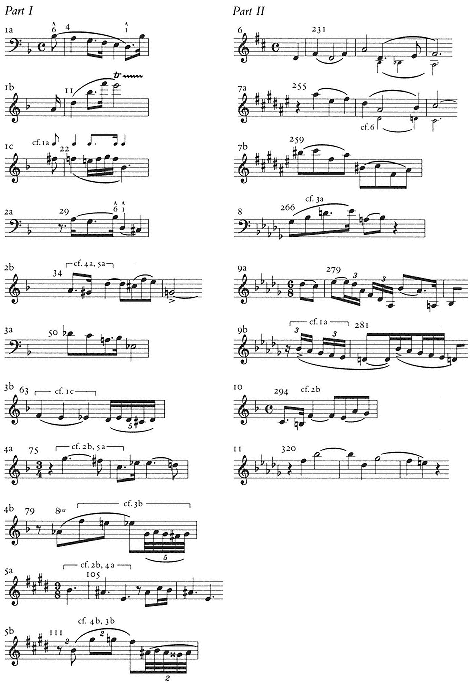
Example 5.1
Verklärte Nacht, op. 4, principal themes.
no relation to sonata-form "groups," but attempts to reflect the way themes are clustered in the sextet, where sections tend to be separated off from one another by such articulative features as distinct ritardandos (as at m. 28, before 2a), fermatas (as at m. 49, before 3a), changes of meter (as at mm. 74—75, before 4a), or modulation and dominant preparation (mm. 100–4, before 5a). For ease of reference I shall refer to the section of the sextet that extends up to the arrival in D major in m. 229 as part I and to everything thereafter as part II. It is hoped this broad partitioning will be as uncontroversial as possible, so as to allow the thematic connections and processes to "speak for themselves." In ex. 5.1 the themes of each part of the sextet are aligned vertically to show relationships and derivations as clearly as possible. Relationships not easily or conveniently demonstrable in the example are suggested by "cf." and are explained more fully in the prose commentary that follows below. The example makes no attempt to show an entire thematic statement (or the harmonic context), but only the basic unit from which Schoenberg works.
It is one of the distinctive features of Verklärte Nacht that the basic thematic kernels tend to be very brief, usually only a measure long. A frequent pattern (as in themes 2a, 3a, and 5a) is a twofold presentation of the one-measure unit, which is then extended by means of sequence or variation. This practice represents a kind of compression and modification of the classical-romantic thematic structure that Schoenberg was to call a "sentence," in which a unit (usually of two measures) is first presented on the tonic, then on the dominant, and then "developed" and "liquidated" in a continuation (usually in four measures). The overall proportion is thus 1:1:2, or 2:2:4 (see Schoenberg 1967, 58–59). The themes of Verklärte Nacht differ significantly from this model in that the repetition is normally not on the dominant, but at the original pitch level; harmonic motion takes place in the continuation. The short thematic units of Verklärte Nacht serve to give part I of the piece a somewhat breathless, urgent quality unlike anything in Schoenberg's earlier instrumental work, but rather like the motivically intense Dehmel songs of 1899, especially Warnung.
Two other features are particularly characteristic of part I of the sextet: the themes tend to appear in pairs (indicated as "a" and "b" in the example), and the initial theme of each of the first three groups (1a, 2a, and 3a) is in the lower register, from which the range tends to rise during the unfolding of a section. Theme Ia is clearly intended to be somewhat "neutral" and introductory. It is characterized by the stepwise descent from the sixth to the first degree of the D-minor scale and by the dotted rhythms of the second and fourth beats. The dotted rhythm continues through mm. 9–10, then forms part of theme Ib, which can be heard as an elaboration of Ia; like la it has an upbeat, followed by a quarter note on the downbeat, then a dotted rhythm, then a longer note value. Theme Ib also prominently features the first and sixth degrees, now heard in disjunct
form rather than connected by a stepwise scale. Theme IC shares with Ia the upbeat moving down a half-step to a quarter note on the downbeat. As in both Ia and Ib, the second beat involves some kind of diminution—the dotted rhythm has now been fleshed out to four sixteenths—and the third beat has a longer note value.
Theme 2a, the woman's agitated first theme, is distinctly (and appropriately) different in mood from the theme I family, but the relationships are still strong. The theme returns to the low register of Ia, whose


In the third measure of 2a, the


Theme 3a, presented in


3a, mm. 50–62
3b, mm. 63–68
3a', mm. 69–74
4a, mm. 75–78
4b, mm. 79–82
4a', mm. 83–86
4b', mm. 87–90
Sequential development of 4a, mm. 91–99
Transition / introduction to 5a, mm. 100–104
5a, mm. 105–10
5b, mm. 111–14
5a', mm. 115–20
5b', mm. 121–23
Sequential development of 4a and 5b, mm. 124–32
What is perhaps most striking about this segment is the close relationship among the "b" themes. Theme 3b consists of descending semitones culminating in a turn figure; 4b keeps the semitone descent

The unfolding of the paired theme groups 3 and 4 seems so logical and persuasive that it is hard to imagine any other possible ordering. But the autograph manuscript of Verklärte Nacht (at the Library of Congress) reveals that Schoenberg originally set down the themes in a different arrangement:
3a (the present mm. 50–60)
3b (mm. 63–68)
4a (mm. 75–78)
4b (mm. 79–82)
4a' (mm. 83–86)
4b' (mm. 87–90)
3a' (mm. 69–74)
Sequential development of 4a, mm. 91–99
In this ordering, 3a' is separated off from 3a and 3b and inserted before the sequential development of 4a. It seems clear that Schoenberg conceived both 3a' and the sequential development of 4a as passages that would together form a kind of continuous development or developmental transition leading up to theme 5a. But he reconsidered this scheme, perhaps deciding that despite the close thematic relationship between 3a and 4a, 3a' would remain too isolated amidst all the material from the theme 4 group; or, to look at it the other way around, that 3a' would interrupt the continuous flow of theme 4 material.[9]
By moving 3a' back to just after 3b (and by adding the present mm. 60–62 between 3a and 3b), Schoenberg thus created a rounded ternary structure for the theme 3 group and a more plausible sequence from two presentations of the 4a–4b pair into a sequential development based on 4a. It could be said that the final arrangement "de-sonatifies" the passage. Where the original ordering tends to group developmental or transitional gestures together, the revision spreads them out so that each theme group has its own developmental segment and is more self-contained.
To return to the final version: given the constant and fluid evolution of thematic shapes and the relative lack of exact repetition up to this point in Verklärte Nacht, the presentation of 3b, 4b, and 5b—especially the identity between the latter two—has a powerful effect. It is almost as if the thematic discourse of the sextet is beginning to collapse, to double back on itself. And, indeed, the discourse does in a sense break down here with the collapse onto to the octave Ds at m. 132, followed by the awesome drop to the low unison E. This is the moment that marks the start of what is often called the "development."
Schoenberg introduces relatively few new themes in part II of Verklärte Nacht, largely because there is considerable recapitulation or reappearance of themes from part I. There is also less of an emphasis on paired or multiple theme groups. In general, the new themes of part II are broader and less chromatic than those of part I, although several of them still show a preoccupation with semitone movement. Themes 6 and 7a, both distinctly associated with the man, are closely
[9] The reshuffling of material in this section of Verkärte Nacht is discussed briefly in Stephan 1974, 270.
related. Theme 6 is so limpidly diatonic that the chromatic passing note in the accompanying voice in m. 232 (


Theme 7a relates not only to its immediate predecessor, but also to the numerous themes in part I that juxtapose a dissonant leap (here


The theme in


Schoenberg's basic strategy in part II of the sextet appears to be to increase the associations with part I across themes 7a–10, then to pull back for one especially distinctive final theme (11). The "recapitulation" continues with the return of the first theme of part II, theme 6, which in turn ushers in the actual return of theme 1a, in combination with 7a and 10, at m. 370. While some of these compositional procedures can be seen clearly to relate to traditional instrumental forms, the actual thematic-formal structure of both parts of Verklärte Nacht is sui generis.
Tonal-Harmonic Relationships
Equally distinctive is the web of harmonic or tonal relationships from which the sextet is spun. Throughout, Schoenberg explores the possible intersections between what might be called diatonic/dominant and chromatic/half-step worlds. By diatonic/dominant I mean those relationships that revolve mainly around the tonic-dominant axis, especially V-I (or V-I). Although, as Swift notes, the dominant is absent as a "large-scale key area" in Verklärte Nacht, it is nonetheless present as a significant harmonic force, especially in the recapitulatory portions of part II (as will be seen below, in the next section). Other significant relationships are based primarily on half-step motion around certain important pitches or key areas—hence the designation chromatic/half-step.
It has been suggested above how half-steps are also important motivic elements in many of the individual themes. This phenomenon, and its relation to the larger tonal dimension of the sextet, was articulated by Schoenberg himself in a remarkable two-page analytical document entitled "Konstruktives in der Verklärten Nacht," which was written out, as the composer notes on the manuscript, "on a sleepless night" in Barcelona in 1932 (see plate 1).[10] This document, which offers a good starting point for a consideration of tonal aspects of the sextet, consists of ten numbered examples (and several other unnumbered ones), each of which demonstrates the larger-scale harmonic resonances of semitones within the themes:
|


[10] The "Konstruktives" manuscript has been reproduced and briefly discussed twice before, in Thieme 1979, 216–21; and Bailey, 1984, 31–32 and 36–37.
[11] See the remarks reported by Dika Newlin in Newlin 1978, 214, and Newlin 1980, 229.
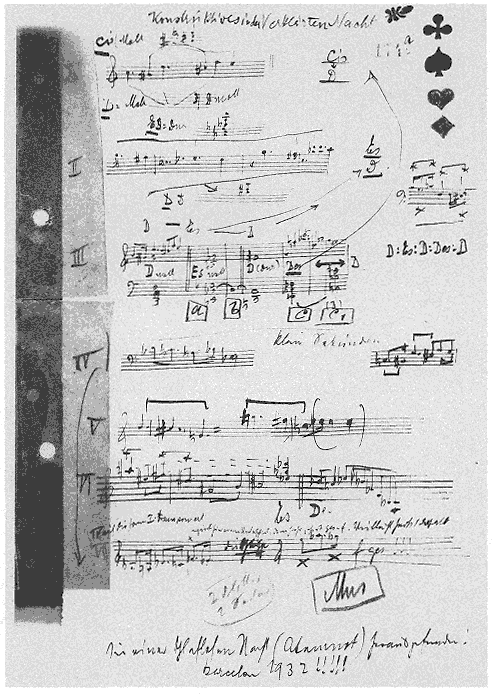
Plates 1A and 1B
"Konstruktives in der Verklärten Nacht," manuscript reproduced by permission of the Arnold Schoenberg Institute.
|



|


At the bottom of page 2 Schoenberg notes that "of all these motivic and structural connections, I was conscious only of those under III a-b-c-c1. Everything else was the diligent effort of my brain, working 'behind my back,' without seeking my approval."[12] In other words, Schoenberg claims to have intended only the symmetrical circumscription of the tonic a half-step above and below. (In the reports of Dika Newlin, however, Schoenberg is said to have claimed not to have been aware of this structural principle while composing. See Newlin 1978, 213–14; Newlin 1980, 229.)
Schoenberg frequently praised the power of his own subconscious in creating musical relationships (see, for example, Schoenberg 1975, 85–86). What should concern us here is less their documentable intentionality (or lack thereof) than their significance within the composition. Some of Schoenberg's observations in the "Konstruktives" analysis seem of minor importance for Verklärte Nacht —for instance, the demonstration in example VIII that certain notes of theme 7a outline

[12] The German reads: "Von all diesen motivischen und konstruktiven Zusammenhängen war mir nur die unter III a-b-c-c1 bewußt. Alles andere sind Fleißaufgaben meines Hirns, die es 'hinter meinem Rücken' gemacht hat, ohne meine Zustimmung einzuholen." I am grateful to Anita Lügenbuhl for help with the transcription of Schoenberg's handwriting.
analytical premise of "Konstruktives"—that Verklärte Nacht is built on both the large and small scale around a few specific tonal relationships—is undoubtedly appropriate. The areas surrounding the tonic by semitone from below and above,
Especially significant at the opening of the sextet are the symmetrical relationships pointed out by Schoenberg in the small example at the far right of II: those deriving from the half-step above the fifth degree,


Across the first fifty measures of the sextet, then, Schoenberg has reversed the original roles of the
The half-step manipulation is one part of a broader harmonic strategy at the opening of Verklärte Nacht. This strategy seems to have two goals: gradually to infiltrate a purely diatonic D-minor sound with chromatic tones and to unfold a large-scale cadential structure whose basic root motion is i-ii-V-i, as is suggested in ex. 5.2. Let us consider first the chromatic infiltration. As the opening section unfolds, the diatonicism is sustained, not only by the tonic triad, but by the subdominant-type chord, the half-diminished ii7 . This harmony is familiar from several of the songs examined in the previous chapter: the reader will also recall that it formed the central Klang around which Mädchenfrühling was shaped. It
[13] A stimulating essay about the function and the context of the "inverted ninth" chord in Verklärte Nacht is Lewin 1987.

Example 5.2
Verklärte Nacht, mm. 1–29, harmonic reduction.
likewise forms the most important non-tonic sonority in the first section of Verklärte Nacht. The first significant intimation comes at the sustained, double-dotted quarter note in mm. 5–6, the longest melodic note value up to this point. Locally, the E and G of this chord are upper neighbors to the D-F of the tonic triad; but if we add an implied or inferred

In m. 9, Schoenberg introduces the first non-diatonic pitch. The leading tone


Schoenberg has distinctly upped the level of dissonance: as the dominant of the leading tone, this
From m. 17 on, the dissonance level is intensified still further. The bass at last moves definitively off the D, rising chromatically up to the E. This E supports a ii7 chord with a raised fifth (


the piece. The sequence of mm. 22–23 is, like what has preceded it, based on vagrant chords, the diminished and half-diminished sevenths, and we end up in m. 24 on the familiar

From the viewpoint of root motion, the large cadential structure that extends over the first section of Verklärte Nacht is twice interrupted: i–ii-V // ii-V // ii-V-i (ex. 5.2). But, as I have suggested, this tonal scaffolding is by no means straight-forward or conventional, since the diatonic roots, very much as in mm. 14–17 of the song Jesus bettelt, often support vagrant chords. The cadential framework is also unusual in that the pre-dominant ii chord gets considerably more weight than the dominant by virtue of its presence in mm. 11–12, 18–20, and 24–27. The dominant pitch A never supports or is supported by an actual dominant harmony: in mm. 13–17, a D pedal underlies the "dominant hexachord" in the melodic voices; in mm. 18–21 the chords above the bass A are half-diminished and diminished; and in m. 28 there is no harmonization of the A at all.
The dominant withheld in the first section becomes more apparent—indeed, insistent—in the theme 2 group, mm. 29–49. Here the half-diminished ii chord returns in mm. 34–38, where the ascending stepwise bass outlines the diminished fifth


The Tonal-Formal Structure and Revisions of Part II
One of the most intriguing aspects of the large-scale design of Verklärte Nacht is the way in which Schoenberg sets about establishing the tonic major in part II, a process that forms a complement or corollary to the thematic plan discussed above, whereby part II takes on an increasingly recapitulatory function. The half-step approaches to D major of which Schoenberg was so proud, as represented in example III of plate 1, tell only part of the story. The actual confirmation of D takes place through strong dominant preparation, of the kind hinted at, but then left unfulfilled, before m. 50. Both Verklärte Nacht as we know it and the revisions evident in the autograph suggest that Schoenberg was entirely confident neither about how much dominant was necessary to assure closure, nor just

Example 5.3
Verklärte Nacht, key areas and dominant preparations in part II.
where the dominant should be applied. If there is any compositional weakness in the sextet, it lies in this area.
After the initial presentation of D major at m. 229, D is given dominant preparation (or at least persuasive cadential preparation) four different times in part II, as shown in the tonal overview in ex. 5.3. The first instance is at the approach to theme 11, where the tonic is actually withheld and the A7 resolves to
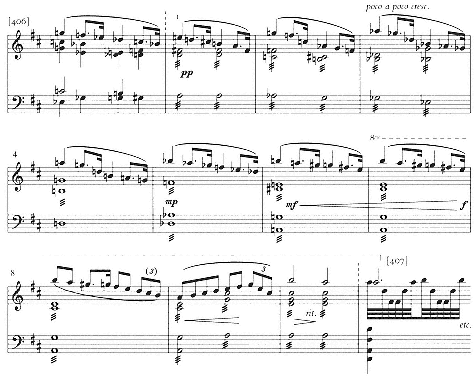
The autograph of Verklärte Nacht reveals that Schoenberg originally included yet a fifth passage of dominant preparation near the very end, comprising ten measures between what are now mm. 406 and 407 (ex. 5.5). Here the dominant gathers force during a big crescendo in the last five measures, then resolves to a subito pianissimo at m. 407. These ten measures are indicated for deletion in the autograph, and the present mm. 406 and 407 are linked together by the marks "VI-" and "-DE." Although Schoenberg rightly came to sense the redundancy of this passage, we might regret its omission especially because of the striking fashion in which the A7 is approached; in mm. 5–6 of the deleted passage, it is approached directly from the
Although he eliminated this redundancy, Schoenberg decided to let stand another that is much more striking and has greater formal ramifications: the triple forte climax of mm. 338–40 is replicated quite closely by the "Sehr gross" of mm. 391–93 (ex. 5.4b, d). At least one sensitive musician was disturbed by this "double" climax. In 1943, while preparing a performance of the string orchestra arrangement of Verklärte Nacht, the conductor Bruno Walter wrote to the composer to point out the repetition and to request a large cut, comprising the omission of my ex. 5.4b and the subsequent 46 measures leading up to ex. 5.4d. He
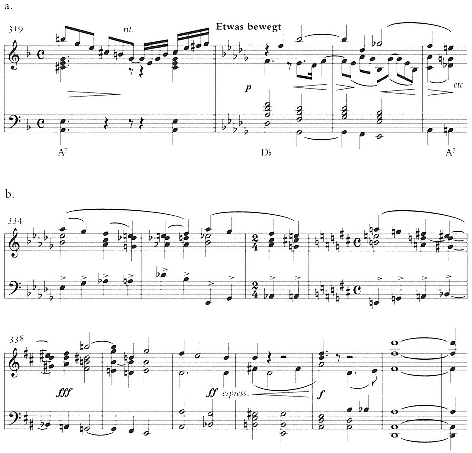
Example 5.4
Verklärte Nacht, dominant preparations of D.
noted, "For me it will create a difficulty in performance that the soulful development that follows these measures [338–42] of definitive status ends up in the same measures."[14] Even if Schoenberg could not approve such a large cut, asks Walter, would he consider eliminating the developmental-sequential passage in mm. 378–89? "Don't you find," he wrote, "that all conflicts have already been
[14] Letter in the Schoenberg Collection at the Library of Congress, dated 18 December 1943. The original reads: "Das die seelenvolle Entwicklung, die diesen Takten des Definitiven folgt, in die gleichen Takte muendet, wird mir . . . auch zum Auffuehrungsproblem."
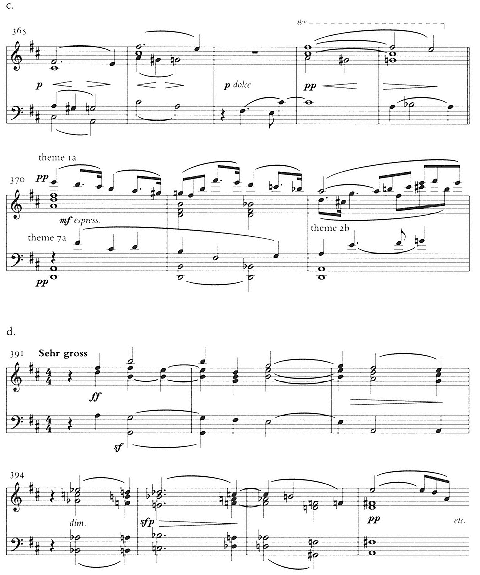
Example 5.4
continued
Example 5.5
Verklärte Nacht, passage of dominant preparation deleted from autograph (reduction).
resolved with the passage at m. 338, so that here [at m. 378] we have attained spiritual readiness for the coda [probably mm. 401ff.]?"[15]
No reply from Schoenberg survives, but to judge from a subsequent letter from Walter, and from responses made by Schoenberg to other similar requests, the composer absolutely refused to join what he had in 1918 called the "cutting conspiracy" (Schoenberg 1964, 54). At that time, when Zemlinsky had requested a similar large-scale cut in Pelleas und Melisande (to be discussed in chapter 7), Schoenberg replied:
I am against removing tonsils although I know one can somehow manage to go on living even without arms, legs, nose, eyes, tongue, ears, etc. In my
[15] The original German reads: "Finden Sie nicht, dass alle Konflikthafte bereits mit der Periode um 338 geloest ist, so dass wir hier bereits die seelische Bereitschaft für die Coda erreicht haben?"
view that sort of bare survival isn't always important enough to warrant changing something in the programme of the Creator who, on the great rationing day, allotted us so and so many arms, legs, ears and other organs. And so I hold the view that a work doesn't have to live, i.e., be performed, at all costs either, not if it means losing parts of it that may even be ugly or faulty but which it was born with.
SCHOENBERG 1964, 54
Schoenberg obviously felt the same in the case of his sextet. He may also have felt that the "double" climax is no redundancy: although the passages at mm. 338–40 and 391–93 are similar, each leads into very different material. The first culminates in theme 6, the second in the chromatic progression taken over from mm. 41–45. Thus, the first returns us only to the beginning of part II of the sextet; the second takes us back further, to a significant element of part I, an element that, moreover, served as a climactic conclusion to part I in mm. 181–84. The chromatic progressions at mm. 181–84 and 394–97 therefore occupy analogous positions near the endings of parts I and II respectively. And, of course, only at the latter occurrence does the

It may be as hard for us as it was for Schoenberg to envision a reduction of 54 measures, or about 13 percent, in a work as seemingly compact as Verklärte Nacht. But Walter, a sensitive musician, was definitely on to something. What he isolated with his proposed cut was, in a sense, a symptom of Schoenberg's main compositional problem or task in part II of the sextet: the establishment of the tonic D major by means of its own dominant, and the concomitant fulfillment of the demands of the chromatic/half-step relationships.
The basic tonal structure of part II is outlined above in ex. 5.3. Initially, the large-scale key structure appears to point toward a symmetrical division of the D octave into major thirds:

After the D major of theme 6, the first tonal region touched upon is



Example 5.6
Derivation and function of the German sixth chord.
moves on toward F major at m. 291 (the harmony becomes more stable at m. 294). This F major leads on to the most developmental/sequential passage in part II, which culminates fortissimo on the A7 harmony of mm. 316–19. It is this harmony that resolves directly to the
This resolution represents the nexus of Schoenberg's chromatic and diatonic strategies in Verklärte Nacht, especially in part II: A7 , ostensibly the dominant of D, is redefined as the German sixth of
It is striking how the German sixth-tonic resolution not only introduces theme II, but becomes an integral part of it. The half-cadence that ends the first phrase in m. 322 is made not to the dominant, but to the German sixth (see ex. 5.4a). This progression is repeated in m. 324 and three more times at the climax in mm. 332–36. The goal of what follows could be said to restore to A its rightful function as the dominant of D. The process begins in earnest at m. 337, where the chromatic progression containing the A7 is at last pushed sequentially up a halfstep (see ex. 5.4b), thus reaching


In fact, the rehabilitation of the dominant is not completed at the approach to D at mm. 337–42. The bass resolves down to A, but not to a dominant seventh; instead, the A passes swiftly to a sustained G, which supports a subdominant type of sonority (ii6 on the downbeat of m. 339). The actual cadence to D in mm. 342–43 is made not via its own dominant, but from the subdominant. Only after the harmonic energy of the preceding
The autograph manuscript of Verklärte Nacht suggests that the harmonic elegance of part II was not easily achieved. While part I was written out with relatively few revisions (the most significant have been discussed above), Schoenberg apparently found it more difficult to balance the various demands of tonal resolution and thematic recapitulation in part II. Beside the removal of ten measures of dominant in the coda, discussed above (ex. 5.5), there are several other important revisions that relate specifically to the
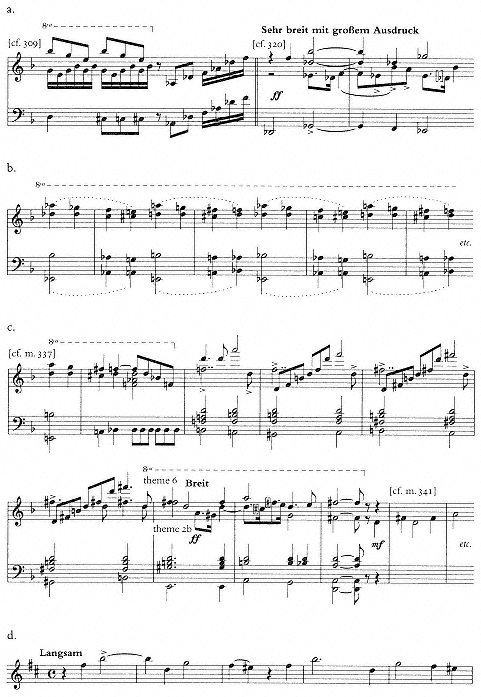
The first revision involves the approach to theme 11. The present mm. 310–19 represent an actual addition or interpolation; in the earlier layer represented in the autograph, theme 11 (m. 320) was approached directly from something like the present m. 309, as shown in ex. 5.7a.[18] The
The most important changes come within theme II itself and in the "half-step" approach to D major. In the earlier version evident in the autograph, the second three-measure phrase of the theme is identical to the first; in the revision Schoenberg changes the


[17] In addition to the autograph manuscript for Verklärte Nacht, there survive four loose pages of sketches (numbered 984–87 at the Schoenberg Institute), most of which concern revisions for part II and were probably made in conjunction with changes evident in the autograph.
[18] In the autograph, all of the present mm. 309–44—incorporating the sequential passage just before the fortissimo A , theme ll itself, and the first big resolution to D major—are contained on a large Einlage that was inserted by Schoenberg into the manuscript between the numbered pages 26 and 27. Of the music on the Einlage, only mm. 310–19 represent an actual addition; the rest served to replace passages crossed out by Schoenberg. Measures 310–19 are also sketched or drafted on p. 987 of the sketches.
Example 5.7
Verklärte Nacht, passages from autograph (reductions).
second full measure in ex. 5.7b) is harmonized, not with a


Schoenberg's revision makes this passage much more powerful, not only by eliminating the seesawing and by focusing the harmonic motion, but by adding powerful metrical expansion and contraction. In mm. 331–35, the notated


The actual approach to and arrival on D major (cf. ex. 5.4b) are also handled very differently in the early version represented in the autograph, as shown in ex. 5.7c. The

The immediate aftermath and confirmation of the D-major arrival, corresponding to mm. 344–55, remained unchanged from the early to the final version, but the continuation from the present m. 356 was originally quite different. Especially significant or suggestive is that in the early version there is no hint of the elegant contrapuntal recapitulation of themes now at m. 370 (see ex. 5.4c). Instead, the developmental/sequential passage following m. 356 culminates in a return of theme 11 in the tonic, D major (ex. 5.7d). At this point, the autograph trails off to a single line, then after theme 11 breaks off altogether. Yet as far as
[19] The revision of theme 11 (melodic line only) is drafted on p. 985 of the sketches. This seems to represent an intermediate stage between the early and final versions in the autograph. The sequential seesawing has been eliminated, but the metrical expansion and contraction are not yet evident.
it goes, the early draft clearly suggests that Schoenberg planned to "recapitulate" theme II in the tonic, something that does not occur in the final version of the sextet.
As he came to a halt here and rethought his compositional strategy, Schoenberg must have realized that theme 11, first heard in
Thus it can be said that even in its final form, the sextet still reveals something of Schoenberg's struggle to achieve adequate formal, thematic, and harmonic closure. None of this takes away from the work's status as a masterpiece. In Verklärte Nacht, composed only two years after the D-Major Quartet, Schoenberg was working for the first time with a freer, extended instrumental form. To this endeavor, he brought (and to later such endeavors would continue to bring) all his basic instincts for assuring tonal and formal coherence, instincts that had only recently been put into the service of much more conservative, traditional forms.