
Communal Regulations and the Timing of Herding Patterns
The opening and closing of livestock-management zones in parts of the Khumbu valleys during the summer and early autumn establishes a limited form of rotational grazing that gives a basic shape and timing to herd movements in all the valleys for three to five months of the year. The operation of the nawa system does not prescribe a fixed pattern for regional herding. Families still exercise considerable choice over their herd movements. Many families decide to move their stock into other areas before a particular zone is officially closed by the nawa, and in some years a few families choose to move their stock into zones before they are officially opened. But the sequential closing and opening of zones to grazing certainly is a major factor in herding decisions and transhumant patterns during the months when the system is in effect.
The first closures of zones to livestock take place in eastern Khumbu in May when all stock is excluded from the immediate vicinity of Pangboche and Phurtse following the end of planting and the ritual Tengur circumambulation of the fields (map 11).[48] Elsewhere no areas are closed until June and the time of the Dumje festival. The zones of lower Thamicho are the next to be closed, an event that takes place each year on the tenth day of the fifth month in the midst of the Dumje festivities.[49] Nauje and Khumjung-Kunde close the area in and around their villages to grazing only after the end of Dumje.[50] Since the date when villages are closed to grazing is tied to the lunar calendar the date
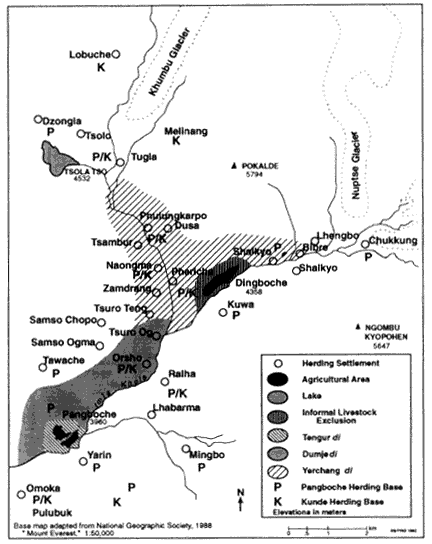
Map 11.
Imja Khola Pastoral Management
of closure can vary from year to year by several weeks. In some years Dumje and the closure of the village to stock comes in June, in other years well into July.
There are usually enough families in the lower-altitude Khumbu villages who keep their cows and crossbreeds in the villages until the last possible minute that there is a general upward movement of people and
stock to the high country just before the lower valleys are closed to grazing. The stock spend the rest of the summer up valley until after the main village crops have been harvested.
Within a few days after Dumje the nawa in Khumjung and Kunde announce that the area around the villages will be closed to livestock five days hence. All stock must be gone from the zone near the villages and the gunsa of Teshinga by the first day of the sixth month, two weeks after Dumje. Nauje nawa also formerly announced the imminent closure of the village area to stock just after Dumje and also gave a five-day notice that they shouted out from the top of a big rock in the center of the settlement. In Thamicho, before nawa regulation was abandoned in the late 1980s, the lower Bhote Kosi valley was closed before Dumje as far north as the bridge just south of Thami Og, and after Dumje the ban on livestock was extended as far as the Mususamba bridge on the Langmoche Chu. Phurtse stock at this point in the year have already been excluded from the settlement, but now the herds must also be cleared from the lower valley to a point beyond Konar. The summer livestock ban at Pangboche has similarly closed the area immediately adjacent to the village for several weeks before Dumje. Now Yarin and other areas of the lower Imja Khola are closed.
Families choose their own moving day from within the period allotted before the zone is closed to grazing. The day chosen by each family usually is a day of the week or a particular date that is considered particularly auspicious. This may be one of the days considered lucky each month, such as the fifteenth, the day of the week that is lucky because it was the day on which the head of the household was born, or a day that has been determined to be lucky by consulting horoscopes or a Tibetan farmer's almanac. On the morning of the move juniper boughs are burned outside the house sending fragrant clouds of smoke skyward. To this offering the family head adds a few prayers, and then the windows are latched and the door locked and the family sets out on foot, driving their stock ahead of them and leading a few yak or zopkio laden with the household goods and supplies they will require for the summer. The lead member of the party carries a prayer flag on a length of bamboo. This will be set up at wherever the family settles and is moved with them during the summer from herding hut to herding hut.
For the next three or four months families camp out in the tiny herding huts and resa, moving from pasture to pasture according to their own whims and perceptions of pasture conditions. These high country months are a time of the year that many look forward to eagerly, a time of green slopes sparkling with wildflowers, crystal mornings beneath the great peaks, plentiful milk and yoghurt, and, best of all for many people, freedom from the gossip, factionalism, and social demands of village
life. Up in the high-herding settlements there is time for life to revolve around one's own family and those of a very few neighbors.
Once beyond the border of the closed zone a family may set up its base wherever it chooses and some families go little further the entire summer.[51] Other families move between a number of high-herding huts and temporary resa. Only in the Imja Khola area does anything other than family decision making dictate any particular structure to the rest of the summer's movements. Here the operation of another livestock-exclosure zone closes a large area of good grazing ground after the Yerchang festival one month after Dumje. Most herders tend to herd in this zone until it is closed and usually base at this time in the settlement where they will celebrate the festival. Family custom and preferences for whom they want as neighbors at the festival have a good deal to do with the choice of site.
In most of Khumbu Yerchang is a major event combining communal rituals with an intense period of socializing.[52] The festival consists of a day of rites, several of which involve prayers believed to ensure the health and prosperity of the herds. All the members of a herding settlement, regardless of home village affiliation or clan, gather together to offer prayers to the great god Khumbu Yul Lla and the other deities of Khumbu. These rites include the dedication of torma (consecrated flour and butter images) representing the livestock associated with Khumbu Yul Lha: yak, sheep, and goat. At this time some families may make some of their livestock chetar , dedicated to the gods, and these animals are hence forever free of the threat of being killed by humans.[53] The crowning event is a rite in which each household plants a pole bedecked with prayer flags at a common outdoor shrine.[54] A number of days of celebration follow. Each family in the settlement hosts a party at its hut. One party takes place each day until the round is completed. The celebration of Yerchang thus marks one of the most intensive communal periods of the year, a time of major interaction with a few families in shared ritual, feasting, drinking and dancing. Yerchang is only carried out at certain high-herding settlements, and families choose where they want to celebrate it largely on the basis of the people with whom they want to share the festival. Most families return to the same place each year making this one of the few fixed points in the pastoral calendar.[55]
Herders in most of Khumbu may simply remain where they are after Yerchang since no further livestock exclosures are implemented. Many families in these areas, however, shift base, generally moving farther up valley if they have places there. In the Imja Khola and Lobuche Khola areas herding families must disperse after Yerchang due to the subsequent closing of most of the Yerchang sites to grazing. For the next six weeks or more most herders in the upper Imja Khola and Lobuche Khola valleys
move up into the highest-altitude areas of eastern Khumbu.[56] Within this remaining open area families are free to move as they will, and the places most popular for grazing vary slightly from year to year. Kunde families emphasize the Tugla area in some years, for example, and in other years move to Melinang when the grass is best there.
The opening of areas closed to livestock in September and October influences herd movements in all the valleys. Although no herder is obliged to move his herd into an area simply because it has been opened, in practice most herders are eager to let their stock graze areas that have been protected from grazing for as many as three months. Some are indeed all too eager, and nawa are kept busy issuing reprimands to those whose stock violate the final days of the grazing ban. In each valley several zones are sequentially opened and livestock accordingly move down valley in several stages, all of which takes place within a two- or three-week period between late September and mid-October. Usually each zone is opened first for grass cutting and a flurry of activity then takes place as hay is harvested and wild grass cut. Zones where there are also agricultural sites are next opened for harvesting, and only then are livestock permitted to enter them.
In the Bhote Kosi and Dudh Kosi valleys there are, or recently were in the case of Thamicho, fewer stages in the down-valley pastoral migration than in the Imja Khola valley. In the Dudh Kosi valley Tarnga was opened first, then all the area down to the bridge below Thami Og, and finally the lower valley. Hay and crop harvests preceded herding in each of these areas. In the eastern Dudh Kosi area the timing of the opening of the zones to various activities is based on the ripening of the first buckwheat in Phurtse in certain fields in the center of the village. In 1987 the first white buckwheat grains were seen here on August 19. Five days later the cutting of hayfields and of wild grass was allowed in the Konar area. Normally this might have been allowed somewhat sooner, for in this year the opening was delayed to coincide with an auspicious day. On September 10 that area was opened to livestock and Phurtse was opened to potato harvesting. Buckwheat harvest began on September 23 in Phurtse and the area was then also opened to cutting wild grass. On October 1 the area between Phurtse and Pangboche villages along the Imja Khola valley (but not including Phurtse itself) was opened to livestock. The settlement itself was finally opened to stock on October 10 following the completion of the buckwheat harvest. Khumjung stock move first into the area just north of Mong once Phurtse has lifted the seasonal ban it enforces there on grass cutting and grazing, then into the Teshinga area once that area has been opened to grass cutting and harvest at the gunsa has been completed. The ban on livestock in Khumjung and Kunde itself is the last to be relaxed, an event that takes
place in mid-October after the completion of the buckwheat harvest and most of the potato harvest. The management of livestock exclusions in Nauje, before this was discontinued in 1979, was the simplest system of all. Here there was only a single zone to be concerned with. Grass cutting was allowed in September, after the fifth day of the eighth month, Dawa Gepa. The exact date was chosen by the nawa with regard to the maturity of wild grass for hay making. The area was reopened to livestock in October, Dawa Guwa, following the harvest.
The process in the Imja Khola valley is somewhat more complex. Here there are more zones involved and the harvest at Dingboche also complicates the sequence. The high-altitude zones in the upper Imja Khola and Lobuche Khola valleys are opened first, in the reverse sequence of their closure. Each is opened first for wild grass and hay cutting and only then for herding. The order of these openings is fixed and the timing between the opening of different zones for different activities throughout the valleys is scheduled according to a standardized, lunar-calendar-based sequence. The sequence is initiated by the arrival of mid-summer which, according to the Sherpa reckoning of the seasons and their relationship to the lunar calendar, can come rather late in the year. In 1987 the mid-summer point in the Sherpa calendar came on September 1. When mid-summer arrives the first zones in eastern Khumbu begin to be opened for grass cutting. The Ralha area comes first in the sequence.[57] A week later, on September 7 in 1987, grass cutting is allowed in the zones that were closed after Yerchang. A week after that (September 14, 1987) these zones are opened to grazing. On this day the nawa also allow the barley harvest at Dingboche to commence.[58] Precisely one week later Dingboche is opened to grazing. In 1987 all families had completed their harvest here by that date except for one, which finished the work by mid-afternoon. Dispatch is important in order to avoid crop loss, for large numbers of livestock are immediately moved into the area as soon as it is opened for grazing. Despite the relatively late start of this sequence of zone openings in 1987 barley was still harvested somewhat earlier than Sherpa farmers would have preferred. Khumbu barley is always harvested several weeks before it fully ripens, perhaps as a safety precaution against damaging weather in October or simply as a compromise in order to allow the grass cutting, crop harvesting, and transhumant cycles in the valleys to proceed more smoothly. But the 1987 harvest had to be carried out when the grain was even less mature than usual. Some farmers noted that harvest took place at the right time on the calendar but at the wrong time according to the plants.[59]
After stock return to Dingboche there remains only the lifting of the remaining grass- and hay-cutting, crop-harvesting, and grazing restric-
tions in that reach of the Imja Khola valley between the confluence of the river with the Lobuche Khola at the Dolimsampa bridge and the Pangboche area. A week after stock moved into Dingboche, on September 28 in 1987, many herders moved their stock down valley beyond the Dolimsampa bridge into the remaining two zones outside of Pangboche.[60] Pangboche itself was opened to grazing on October 9, after all the buckwheat and most of the potatoes had been harvested.