
Land Consolidation
Of the tangible matters at issue between the Republic and Bophuthatswana and KwaZulu, land consolidation and the acquisition of land illustrate better than any other the extent to which homeland leverage is still limited. For at least sixty years the availability of good, arable land has been a major grievance of the Tswana and Zulu. The Native Trust and Land Act of 1936 promised some amelioration of existing difficulties, but those promises have never been completely fulfilled. Now that the logic of separate development assumes and decrees that these homelands will have to provide for a growing number, perhaps even a growing proportion, of all Tswana and Zulu, there is less land available per person than ever before. Yet land is a sensitive subject for blacks as well as for whites, and is seen by many as a precondition for the economic and political development of the homelands.
The central government has long been aware that Bophuthatswana and KwaZulu are too small, too fragmented, and too poorly endowed with arable land to provide for a rising standard of living and increased agricultural productivity. The Native Trust and Land Act aimed to add to their areas and reduce their fragmentation, but essentially it only rationalized an existing system of reserves. It did not provide, and was not intended to provide—as homeland leaders point out—a territorial base for embryo nations. Nor did the Republic's consolidation proposals of 1972 and 1973 ameliorate the problem. Representing unsatisfactory compromises from both planning and geopolitical points of view, they pleased few. The journal Woord en Daad ("Word and Deed"), the mouthpiece of the Afrikaanse Calvinistiese Beweging (Afrikaans Calvinist Movement), was outspoken in criticism of the government. The proposals, it said, "led to serious doubts about the credibility of the policy of separate development and the honesty of the Government, and consequently of the whites."[41]
Because the Republic's proposals for consolidation conformed only to the
[40] For both meetings, see Rand Daily Mail, 2 Feb. 1976.
[41] Quoted in ibid., 13 July 1973. The Mafeking Mail, 18 June 1973, was also critical. "This is a long, long way from pleasing anybody," it said of the Bophuthatswana consolidation scheme.
overall land totals of the 1936 act, there was no prospect that they could satisfy the homelands. Land is, after all, both an ideal and a real issue. It has the historical overtones of conquest and deprivation, and the present-day starkness of distress—of overcrowding, poverty, and enforced resettlement. Yet the suggested consolidations provided for little redress or relief, the promised reduction of Bophuthatswana to six large blocs and KwaZulu to ten coming without any substantial addition to the area of the homelands and with serious disruptions to the current settlement patterns of both blacks and whites. Moreover, when introducing the proposals, the government could give no precise indications of their timing and/or their cost. "I cannot," M. C. Botha told Parliament, "even give a rough estimate of the time or the money involved."[42] At the 1975 level of central government expenditure for white-owned land being transferred, all of the hectares scheduled to be handed over to blacks should be purchased by 1990. A rapid, generous consolidation into single homelands would have been of considerable value to the South African government for public relations purposes; a delayed and limited consolidation was of little value at home or abroad.
When Botha announced the consolidation proposals for Bophuthatswana in 1973, he conceded that Mangope would "probably be a little disappointed."[43] The segments of the homeland would be reduced from nineteen to ten and a total of 352,000 hectares of African land (94,000 in the Transvaal and 258,000 in the Cape) would be given to whites. In return Bophuthatswana would receive 605,000 hectares of white-owned land (218,000 in the Transvaal and 387,000 in the Cape), for a net gain of 254,000 hectares. More than 120,000 Tswana would have to be uprooted and moved. Upon his return from a visit to the United States in 1973, Mangope was more than a little disappointed. He denounced the proposal as a sham. Chief Maseloane had voiced the same sentiment when the proposals were announced.
Earlier Mangope's government, supported by Pilane, had put forward its own consolidation scheme that involved the shift to Africans of many millions of hectares of white-owned land, the transfer to black rule of a half million whites, and the annexation of the white towns of Kuruman, Taung, Warrenton, Vryburg, Delareyville, Lichtenburg, Mafeking, Koster, Rustenburg, and Zeerust. Mangope made it clear that he had no objection to whites staying in the homelands and becoming citizens. The result was a unified parallelogram stretching from Warmbad, north of Pretoria, to the border of the Orange Free State, near Christiana, and westward north of Postmasburg to the border of Botswana. The northern border of the homeland would be Botswana. In size, this consolidated territory would be larger than the
[42] Botha, quoted in The Star , 28 April 1973.
[43] Quoted in ibid. , 26 May 1973.
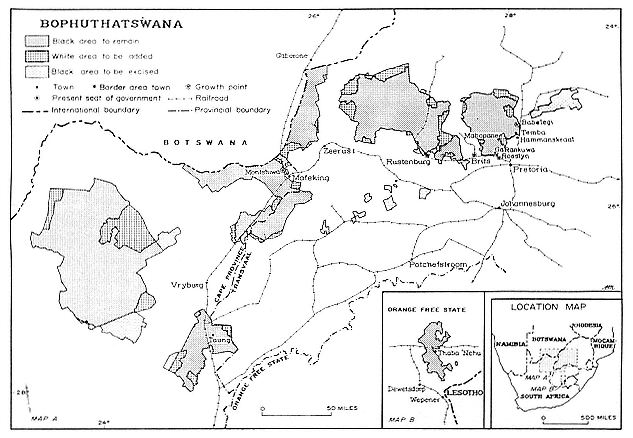
Map 5.1
proposed consolidation of bophuthatswana. Sources: Republic of South Africa,
BENBO, Bophuthatswana Economic Revue, 1975 (Pretoria, 1976); Muriel Horrell,
The African Homelands of South Africa (Johannesburg, 1973).
Orange Free State. Mangope said at the time, "I do not think that we would be satisfied with anything less as a basis for independence."[44]
For KwaZulu the complicated process of rearranging the map includes the transfer of 300,000 hectares of African land to whites and the addition of 463,000 hectares, including only 227,000 hectares of the lands promised in 1936. Of the land offered to KwaZulu, 239,000 hectares are to be taken from state-owned territory, the remainder, presumably the more arable lands, are to be purchased from white farmers. The net gain to KwaZulu is 163,000 hectares, including the R100 million Jozini Dam irrigation scheme on the Pongola River. (The Jozini project is itself controversial, experts being unsure of the fertility of the Makatini flats, which are meant to be irrigated by the waters of the Pongola. Swaziland has also demanded compensation for upstream flooding to be caused by the dam. At the moment the project has been stalled and the dam has not been allowed to fill.) Although the Republic has agreed to transfer white-settled Port St. Johns to the Transkei, the consolidation proposals deny KwaZulu the port city of Richards Bay and a potential port on Sordwana Bay. They also deny KwaZulu the income-producing Hluhluwe game reserve, but transfer the Umfolozi game reserve to the homeland. During the election campaign of 1974, the deputy minister of Bantu administration and development indicated that Eshowe, once the administrative capital of Zululand, could eventually be transferred to KwaZulu, but he was overruled by Vorster at another political meeting. Moreover, some of the proposed consolidations consist of the artificial connection of enclaves by long isthmuses. As the united Party's leader in Natal commented, the proposals promised fragmentation, not consolidation. "This," he said in Parliament, "is a debate about partition."[45]
Buthelezi had rejected similar consolidation proposals throughout 1972 and early 1973. No plan made by whites without intensive consultation with Africans could, he made clear, hope to meet with Zulu favor. Nor could the wholesale dislocation of Africans be justified unless whites were equally affected. When the provisional plan was issued he said that no government of KwaZulu could possibly allow its name to be associated with the upheaval of 133,000 Zulu for the sake of a meaningless consolidation. "If the Government is going to move these people, it is not with our co-operation. We prefer that they are left alone and not uprooted until a plan is produced which is acceptable to all races in Natal." He went on: "The world can now witness that we were not consulted in these plans, that we reject them, and that what is allocated to us by Whites is done by naked baasskap because all that matters to the Nationalist Government is White supremacy."[46]
[44] See ibid. , 14 April 1973.
[45] Radclyffe Cadman, quoted in the Sunday Times (Johannesburg), 10 June 1973.
[46] Quoted in The Star , 20 April 1973.
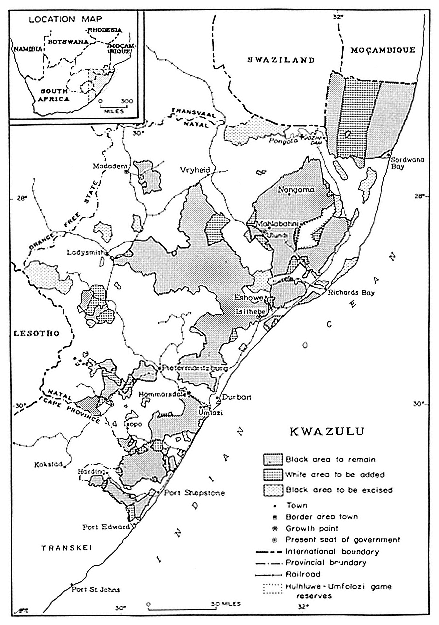
Map 5.2
proposed consolidation of kwazulu. Sources: Republic of South Africa,
BENBO, KwaZulu: Economic Revue, 1975 (Pretoria, 1976); Muriel Horrell,
The African Homelands of South Africa (Johannesburg, 1973).
Buthelezi objected strongly to the Republic's retention of Richards Bay. "If the . . . Government seriously wanted KwaZulu to be a viable state," he pointed out, "then Richards Bay should be our port so that we have an outlet to the sea and a possibility of getting anywhere near economic viability."[47] (Woord en Daad agreed. "How did the Trekkers and the old Transvaal Republic not strive and struggle for an outlet to the sea? How bitterly unjust did we not find it . . . ?")[48] Various Zulu spokesmen and several white politicians also noted that the consolidation proposals had allocated the best African-owned sugar cane areas to whites. Blacks, said a United Party legislator from Zululand, who had "farmed sugar cane for generations," absurdly were being moved to new blocks of land where "growing sugar was impossible."[49] Two academic observers reported that the proposals would not improve KwaZulu's economic base or give it real prospects for "meaningful independence. . . . A politically independent KwaZulu that is not enlarged, enriched and consolidated will be a thoroughly nonviable state, overly dependent on White South Africa, impossible to adminster and burdened with a depressing man-land ratio."[50]
Dladla joined Buthelezi in condemning the suggested plan. "The present generation of Whites," he said, seems "determined to dispossess us of everything that constitutes wealth in order to keep us in semi-slavery conditions." Specifically deriding plans to remove Africans from lands along the Drakensberg escarpment and the upper Tugela River, he said that it was time that whites are "told in no uncertain terms that we, as Black people of this country, deserve a fair distribution of land." If, he went on, "the Government is prepared to move 100,000 people in order to please 90 farmers and gain a few votes from the United Party, we want them to know only the barrel of a gun will move us from our land and heritage. . . . We will not rest until justice is done to the Black man." Later Dladla rejected a specific portion of the plan with blunt words. "The Government wants to strip us of our land and force us on to barren land which will compel us to work for farmers. The Government is making our people into cheap labour units and we will not tolerate this."[51]
The debate over these proposals took three years. The issue became a major one with the publication of the first proposals in mid-1972, the final proposals being accepted by resolution in Parliament only in May 1975. Long before this date Buthelezi, using the stratagem of refusing to be
[47] Quoted in ibid., 20 Jan. 1973.
[48] Quoted in ibid., 12 June 1974.
[49] Cadman, quoted in ibid., 17 Feb. 1973.
[50] Alan C. G. Best and Bruce S. Young, "Homeland Consolidation: The Case of KwaZulu," South African Geographer, IV (1972), 68–69.
[51] Quoted in The Star, 9 June 1973. See also Dladla, again quoted in Natal Mercury, 27 Dec. 1973.
associated with proposals on which he had not been consulted, urged Vorster to stop the limited consolidation of KwaZulu. "Since no meaningful consolidation would be achieved," he said in March 1973, he was against the plan. He could not accept the responsibility of moving thousands of people. "We asked . . . the government," he told the press, to "drop its policy of trying to consolidate KwaZulu . . . [instead] of trying to lead us to independence as a state in separate blocs."[52] Vorster's reaction to Buthelezi's dissatisfaction was conveyed to President William Tolbert of Liberia. KwaZulu, Vorster said bluntly, would never be consolidated into a single territory, even though the process of consolidation would continue.[53]
Only after being satisfied with regard to land, Mangope and Buthelezi have reiterated often, can attention ever be given to independence. Without sufficient land, independence would be a mockery. Mangope has called for "a more fair and just sharing of the land." The 1936 Act, he has said, in no way provided for future independent sovereign states. "Any continued references to this act in the context of Homeland consolidation has the taste of a dishonest subterfuge, and will do untold harm."[54] "We will not be eager to receive independence," Buthelezi said, "if it will be in the spirit of 'Since you want independence, take and starve.'" He later made it clear that the Zulu were not so "naive as to participate in a scheme to defraud us by asking for so-called independence, before land consolidation and without [the] purchase of foreign territories within our boundaries."[55] He said that the Zulu had never wanted South Africa to be chopped up into homelands, but since they had been they should realistically reflect former territories.[56] Subsequently, at a meeting of homeland leaders in late 1974, everyone (except Matanzima) explicitly rejected independence for their territories until they had been consolidated and provided with a viable economic infrastructure.[57]
The issue between the government, on the one hand, and the homeland leaders (except Matanzima), on the other, had not been resolved when the consolidation proposals were accepted by the Republican Parliament in 1975. At issue between them was the government's insistence on linking land to the ethnicity and the race of the groups and individuals who were to own it. Hence the homeland leaders have repeatedly pressed, as an alternative to independence, for a federation of properly consolidated homelands that would be based on territorial, not on ethnic and racial criteria. At a summit meeting with the prime minister in January 1975, Buthelezi reiterated the link between consolidation, independence, and political rights. Homeland
[52] Quoted in The Star, 31 March 1973.
[53] The Times, 17 Feb. 1975.
[54] Mangope, "Political Future of the Homelands," 5.
[55] Quoted in The Star, 14 Sept. 1971; Rand Daily Mail, 26 April 1972.
[56] The Star, 5 April 1975.
[57] The Times, 18 Nov. 1974.
leaders, he said to a huge gathering in Soweto, "did not want the homelands to be given independence as they were now. . . . They would remain poor states forever dependent on crumbs from the Pharoah's table." Unless the homelands were enlarged and properly consolidated, the only alternative was for Africans to be represented in the central Parliament.[58] In April he emphasized the egalitarian and historical bases of the claim to more land: "Either South Africa converts to one man one vote or it fully recreates the former homelands as consolidated economically viable units."[59] But the proposals went through Parliament essentially unchanged. They gave little comfort to the homeland leaders, and apart from achieving a considerable reduction in the number of homeland fragments, did little to alter the territorial bases of the respective homelands. If the territorial settlement remains as set out in 1975 proposals, the Republic's government may find that major concessions in other areas of policy will be necessary if separate development is to remain credible.