
Five
The Evolution of Saints' Devotions in the Diocese of Grenoble
If saints symbolized different constellations of cultural and religious meaning, how do we assess the changes in saints' cults? Not all uses of devotions are very revealing of change over time, and many of the ways villagers venerated their saints were not recorded often enough for systematic evaluation. Personal expressions of piety—prayers, vows, anonymous offerings at altars—are not accessible to historians of the village except when recorded in notarial acts establishing chapels or founding masses. Other forms of devotion such as confraternities, pilgrimages, or processions drew on only a fraction of the whole panoply of saints. Baptismal records, used to examine given names, show that godparents (who gave their names to children) were usually grandparents or occasionally uncles and aunts. As a result, names alternated from generation to generation in a family and were not particularly sensitive to changes in the cult of saints.[1]
To grasp the evolution of saints' devotions across the whole diocese, therefore, we need to find a means of tracing their appearance in and disappearance from people's religious lives. We need a manifestation of the cult of saints that was conspicuous in villages, that was consistently recorded, and that responded to changes in religious sensibilities. For-
[1] Other studies also show names to be unreliable in deciphering religious attitudes. See the comments of Alain Molinier in Une paroisse du bas Languedoc: Sérignan, 1650-1792 (Montpellier, 1968). For a modern but very similar description of the naming of children, see Tina Jolas, Yvonne Verdier, and Françoise Zonabend, "Parler famille," L'Homme 10, no. 3 (July-September 1970): 5-26, esp. 13.
tunately, the records of pastoral visits provide just such a tool in their information on the chapels dedicated to saints.
Within the sacred space of the community, a chapel was the small territory of grace that villagers recognized as the place where the saint's presence was strongest. There villagers could ask for their saint's help, acknowledge its receipt, and render thanks by leaving a votive offering. The chapel anchored the saint in the community. It tied him or her to the chapel's patrons and to those who came there to ask for aid. But devotion to a particular saint did not last forever. New saints attracted the villagers' veneration, and chapels of discarded saints fell into disrepair or were transferred to other cults. When Bishop Scarron's vicar-general, Saint-Jullin, visited la Buissière in 1665, he remarked that the saints of various chapels in the church were either forgotten or being forgotten. Similarily, Le Camus found that in 1683 the parishioners of Saint-Léger (in Chambéry) no longer remembered the saints of some twenty chapels listed by Bishop Laurent Alleman in his late fifteenth-century visit.[2] Hence chapels can reveal the evolution of villagers' feelings about saints, and we can use them to trace changes in the cultural meanings saints symbolized.
Chapels carried a deep significance in part because they required a major investment, both financial and emotional. The founders had to construct a building or an altar in a church, and they had to endow the altar to pay for a priest to say masses. They usually financed the service through the income from donations of land. Few village families could afford these costs on their own. Wealthy landowners—city people who had land in the village, local seigneurs, rich clergymen, ecclesiastical institutions, or nobles with homes in the area—could undertake the expense. Le Camus's visits indicated that local village notables, those who displayed the honorific sieur before their names, also owned patronages. But often villagers had to rely on a group of families, a confraternity, or the entire community to finance a chapel, continue its maintenance, and provide its expensive ornaments. Le Camus insisted that each chapel have an altar stone, crucifix, silver chalice, candle-holders, balustrade, linens, and the like.
Despite the costs, would-be patrons frequently fought one another for the right to shoulder the financial burden a chapel imposed. Endowing a chapel allowed them to display wealth and extend patronage to a client when choosing a priest for the service. Thus their expenditure
[2] ADI 4G.270, pp. 266-271; 4G.276, p. 182.
visibly signaled their piety as well as their standing in the community.[3] We are left most often with the financial records of chapels, but the money villagers invested does not fully account for the complex feelings that tied them to saints and moved them to endow altars. Chapels also joined people to saints in other ways: in individual prayers uttered at the altar, in anonymous offerings left there, in urgent trips prompted by some special need, or in hurried visits paid while passing by. Even if the chapel was neglected, it could beckon to the villagers in an emergency. Its physical presence in the village reminded people of their community's historical tie to the saint. Their prayers, offerings, and financial investment reminded the saint of her or his attachment to the people.
Beyond the appearance or disappearance of altars dedicated to saints, the location of chapels also reveals the evolution of devotions. Every altar (and therefore every saint) held a place within a hierarchy of chapels in a village's religious space. In the eyes of the Church, this space was carefully structured, and each position corresponded to a rank of importance.[4] The most prestigious was the main altar of the parish church. The second most important location was to the immediate right of the main altar. The space to the immediate left held the third position.[5] The rankings descended toward the back of the church, with those chapels closest to the door in the lowest positions. Many of the parish churches were not large enough for a very sophisticated articulation of space; they had room for only one or two lateral altars. Even minor chapels inside a church, however, held a higher rank than those outside.
The hierarchy of positions made the evolution of saints' devotions visually evident in the parishes of the diocese. In some instances, Counter-Reformation devotions replaced earlier saints in chapels located near the main altar. In other churches, the older saints did not disappear but were moved away from the main altar, closer to the door.[6] And, at times, devotions were pushed out of the church into
[3] Le Camus's visits mention frequent lawsuits over chapel patronage; examples include ADI 4G.272, pp. 689 (la Buissière) and 1278 (Saint-Léger); 4G.276, p. 132 (le Bourget).
[4] On the relation of spatial hierarchy to the evolution of saints' devotions, see Froeschlé-Chopard in Religion populaire , pp. 72-84; in a contemporary Parisian context see Wilson, "Cults of Saints," pp. 250-253.
[5] The end of the church containing the main altar pointed toward the sacred east; nearby chapels were close to the Host. The right-left distinction is associated with the common classification of right above left (Wilson, "Cults of Saints," p. 251 n.18).
[6] Alphonse Dupront refers to them as "door saints" in his preface to Froeschlé-Chopard, Religion populaire , p. 14.
outlying chapels in the village, though exterior saints could also find their way inside.
We must remember it was the Church that arranged the religious space of villages to accentuate the importance of the main altar and the eucharistic service performed at it. The villagers, in contrast, had often been more closely attached to the altars of saints or confraternities. Now certain villagers who sought to associate themselves with those heavenly figures they saw as important and with prestigious earthly authorities adopted saints acceptable to the reformers and founded decently furnished chapels in the spaces to the right and left of the main altar. Other villagers purposely honored their saints in chapels near the door or outside the church.[7] In doing so, they removed themselves from the ecclesiastical center of the village, where the power of outsiders—the bishops—was growing stronger. But they also venerated the outside saints precisely because their chapels were situated in places of importance to villagers: at the boundaries of their community, near streams, on mountaintops, in the fields, close to meadows where their livestock grazed, beside the roads by which they traded with other communities. It was at these limits to the village, places of economic activity and sites of potential crisis, that villagers most needed the help of their saints.
Saint-Pierre-D'albigny
The pattern is evident in the church of the Savoyard parish of Saint-Pierre-d'Albigny where, over the course of two decades, Saint Anthony lost his privileged position near the main altar and found himself pushed to the door (fig. 1).[8] When Saint-Jullin visited the parish in 1665, Anthony's chapel occupied the position to the right of the main altar. Though it had no patron or endowment, it was sustained through offerings that people left at the altar. Across from it on the left, the confrères of Saint Joseph had constructed their own altar. The exact nature of the confraternity is uncertain, but judging from the members' practice of saying sixty-nine memorial masses for each deceased brother, it seems to have been an Agonisant group rather than a craft organization of carpenters. The Joseph group clearly held pride of place
[7] Wilson notes how "popular cult(s) may enter by the door" ("Cults of Saints," p. 252).
[8] The bourg's location above the Isère northeast of Montmélian likely involved it in prosperous river commerce, as suggested by the increase in communicants from 800 to 1,200 between Le Camus's 1672 and 1683 visits.
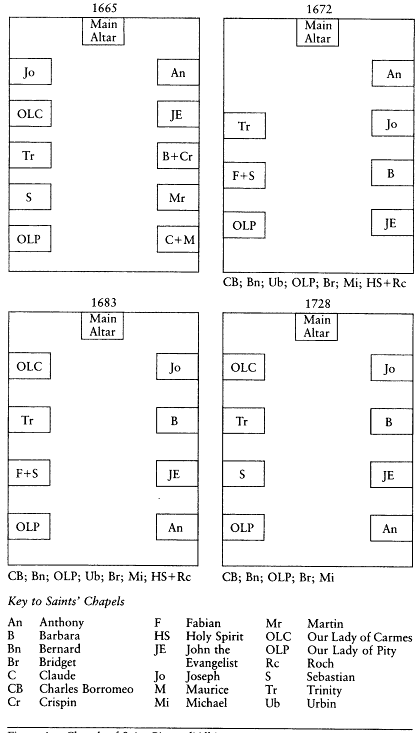
Figure 1.
Church of Saint-Pierre-d'Albigny
over the other confraternity in the church (that of Our Lady of Carmes) as well as over the old Holy Spirit association, which had no chapel. And Joseph's altar also outranked that of Sebastian established by the community after a vow. Most likely, then, Joseph's devotees were from the community's elite. When Le Camus first visited the parish in 1672, he found that Anthony's chapel still occupied the position nearest the main altar on the right side, but that the Joseph confraternity had moved its altar across the church to a place directly behind it. By the time of Le Camus's fourth visit in 1683, Anthony had lost his hold on the highest spot in the church and had been moved to the lowest, near the door. Those who venerated the guardian of livestock would continue to maintain his chapel, but they would now do so at a distance from both the Host and the most important position in the church.[9]
Vizille
The example of Vizille shows even more vividly how the acceptance of Counter-Reformation cults changed the interior space of a church (fig. 2).[10] In 1665, the church contained five chapels with a sixth under construction. To the right of the main altar was a chapel dedicated to Saint Blaise, further down the ruins of a Holy Spirit chapel, and then an altar to John the Baptist. On the left, Mary Magdalen was the titular saint of the chapel closest to the main altar. Nearer the door was a Nicholas altar under the patronage of the Lesdiguières family, the local seigneurs and most important noble family in the Dauphiné. In between the two altars, the noble Arnaud de Viennois was building a new chapel.
When Le Camus arrived in 1672, he found the situation somewhat changed. The Blaise chapel, once in an enviable location on the right, had disappeared. The local prior, Claude Canel, who was also a conseiller-clerc in the Parlement and a close associate of the bishop, was rebuilding the Holy Spirit chapel but intended to rededicate it to Francis de Sales. Le Camus ordered John the Baptist's altar torn down and moved lower in the church. The villagers may have taken a decade to fulfill this command since only in 1683 does the chapel receive further
[9] ADI 4G.270, pp. 477-482; 4G.272, pp. 1473-1479; 4G.276, p. 172; 4G.284, p. 623.
[10] Vizille, situated south of Grenoble, had 1,800 communicants in 1672 and 1,100 in 1683. As the seat of the Lesdiguières family and with connections to other Grenoblois nobles and clerics, it was closely tied to Grenoble's social and professional life.
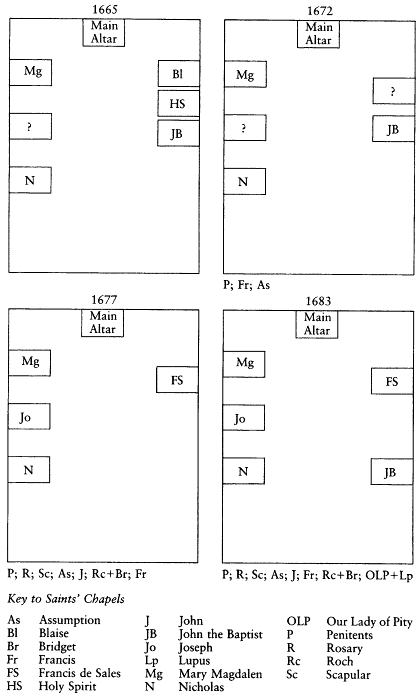
Figure 2.
Church of Vizille
mention. Of the chapels on the left, those of Magdalen and Nicholas remained, and the middle one was still under construction. On his third visit in 1677, Le Camus found the altar of Francis de Sales established. The middle chapel was finally completed and dedicated by its noble patron to Joseph.
Outside the church, the evolution of saints' devotions took another direction. In 1672, the exterior chapels included one for the penitential confraternity, a Saint Francis chapel in the house of the Brothers of Charity who administered a local hospital, and an Assumption altar in the seigneurial château. By 1677 two of the community's hamlets had endowed chapels, one to Saint John and one under the double vocable of Roch and Bridget. Two confraternities, the Rosary and Scapular, had established themselves in the penitents chapel, though in this case the choice was prompted by the main church's state of disrepair. In 1683, a third hamlet had added a chapel dedicated to Our Lady of Pity and Saint Lupus.
Inside the church, the saints of the Counter-Reformation were taking hold: Francis de Sales, Joseph, and the Magdalen, though her chapel was an older foundation. Nicholas remained because he had powerful patrons. The villagers, however, still needed healing and protecting saints—Roch, Bridget, Lupus, and Mary under the medieval vocable of Our Lady of Pity—who had to find their homes in the community's outlying hamlets.[11]
Goncelin
Not every parish had patrons who were as illustrious or as close to the bishop as those of Vizille. Nor was the evolution of devotions in other communities as dramatic as it was there. More often Counter-Reformation cults took root quickly only where they had a strong local base of support, such as a confraternity. Others made their impression very slowly and achieved, at best, only a tense coexistence with the older cults. The tension was reflected in the placement of their chapels. The situation in Goncelin, for example, was more typical than that of Vizille (fig. 3).[12] In 1665, the parish church had a chapel to Saint Anthony to the right of the main altar. It had no patron or endowment, but it did receive frequent offerings from parishioners. Below it on the
[11] ADI 4G.270, pp. 1-2; 4G.272, pp. 341-350; 4G.273, pp. 786-791; 4G.276, pp. 39-41.
[12] On the eastern side of the Isère north of Grenoble, Goncelin had 1,100 communicants in 1672 and 1,500 a decade later, suggesting that it, like Saint-Pierre-d'Albigny, prospered from river commerce.
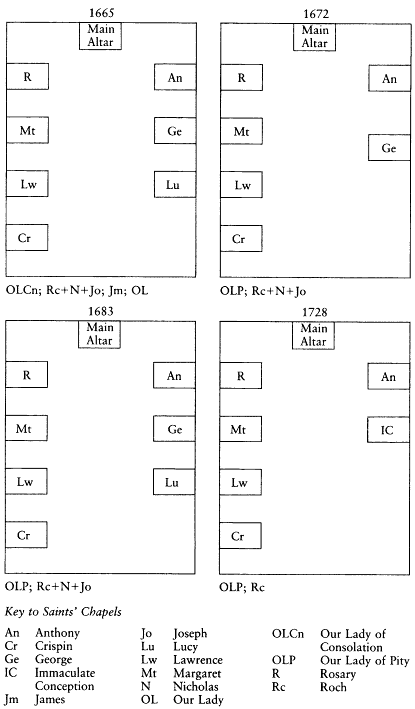
Figure 3.
Church of Goncelin
same side stood an altar to Saint George with a noble patron, and one to Saint Lucy, which had a landed endowment for masses but no patron. On the left near the main altar was a Rosary chapel that had formerly been located next to Anthony's. A Rosary confraternity, established without episcopal permission, maintained it. Below it was an altar with uncertain revenues dedicated to Saint Margaret, a chapel to Lawrence with a noble patron, and the shoemakers' confraternity chapel dedicated to their patron saint, Crispin. The church also contained a penitents chapel located in a balcony. A Holy Spirit altar had previously disappeared. Outside the church were four chapels: one dedicated to Our Lady of Consolation (referred to in later visits as Our Lady of Pity), another to Our Lady, a third one to Saint James, and a final altar dedicated to three saints. The community had constructed the last chapel in fulfillment of a vow to Saint Roch, but the confraternity of boatmen said masses there for Saint Nicholas and the woodworkers for Saint Joseph.[13]
In comparison with the chapels of Vizille, those of Goncelin changed little. This is not to say that no evolution occurred, only that it was not simply the result of the bishop's reforming efforts. The inhabitants had lost their devotion to the Holy Spirit. The Rosary cult had moved to a place of prominence on the left of the main altar. The privileged position not only promoted Counter-Reformation spirituality but elevated an organization that continued customary confraternal activities such as processions and remained socially inclusive (unlike the more acceptable but exclusive Blessed Sacrament associations). Cults persisted here because they had strong bases of local support either from individual donors, in the case of Anthony; or from confraternities, in the case of Crispin, Joseph, or Nicholas; or from the whole community, in the case of Roch. The first devotion to reflect a more abstract spirituality does not appear until 1728 during the first complete visit of the diocese after Le Camus's death. The new bishop, Jean de Caulet, found that the altars of George and Lucy had disappeared from the right, where a chapel to the Immaculate Conception (a most abstract devotion) now stood. The new altar, however, held a position lower than that of Anthony.
What all three examples—Saint-Pierre-d'Albigny, Vizille, and Goncelin—suggest is the complex interplay in devotional change between the local power of high-ranking nobles and clerics, social tensions, the
[13] ADI 4G.270, pp. 367-372; 4G.272, pp. 462-468; 4G.276, pp. 11-13; 4G.284, p. 66.
organizational life of the community, and the evolution of saints' devotions. Socioeconomic conditions may also be important, but the similarities between Goncelin and Saint-Pierre-d'Albigny indicate the need for caution in associating cultural and economic change. Both seem to have been growing, prosperous river bourgs. Yet one experienced a more marked shift in religious life than the other. Religion was not static in any of these towns, but its development depended a great deal on particular local circumstances.[14]
The instance of Goncelin suggests that Le Camus did not mount a full-scale assault on the older saints. He did insist that offices be said only for the saints from the Roman calendar and for the approved local saints of the diocese: Vincent, Hugh, Ferjus, Cérat, and Apre.[15] If a community venerated others, he might try to hinder its devotion by making certain festivals non-obligatory. His success, however, was limited. In 1693, for example, he had to rescind an earlier order and restore to the status of fêtes chômées the festivals of Matthias, Bartholomew, Matthew, Thomas, James and Philip, James and Christopher, and Simon and Jude. He upgraded these fêtes because he recognized the "pitiful state" of his flock in a time of war and famine and hoped that returning the saints to the people would "reheat and nourish their piety and devotion."[16]
More problematic for a community were the bishop's efforts to hamper its usual means of honoring a saint. If a chapel was not repaired or furnished to his satisfaction, he would order the priest to stop saying mass at the altar and might eventually demand its destruction. Villagers did not always have the financial means to make the repairs. Or perhaps they did not share the bishop's sense of propriety. When the inhabitants of Saint-Pierre-d'Albigny or Goncelin left offerings on their Saint Anthony altars, they felt little need for new crosses, candleholders, linens, and so forth. And in numerous parishes, offerings continued to appear at altars Le Camus had condemned, indicating that the bishop's conception of the cult of saints did not go unchallenged.
Sometimes the bishop changed the entire function of a chapel's space in the church, thereby depriving villagers of a place to venerate their saint. In Fontaine, for instance, he ordered an unendowed chapel to
[14] The next chapter looks more closely at such circumstances in one community.
[15] Recueil des ordonnances , pp. 305-306.
[16] Affiche-Le Camus, BMG 1438; Recueil des ordonnances , pp. 302-304. The original demotion of some of these saints was most likely connected to their questionable histories; for instance, hagiographers linked Matthias to the Basilidian heresy (Lenain de Tillemont, Memoires , pp. 406-408). I owe this reference to Janet MacMillan.
Saint Blaise removed and a confessional, the perfect symbol of the Counter-Reformation, installed in its place.[17] He also made it difficult for villagers to express gratitude to their saints in customary ways. When in various parishes, the bishop saw chapels littered with small replicas of hearts or limbs—gifts left by people who had received cures for those parts of the body—he demanded the removal of these tokens.[18] Some communities found that they could no longer present offerings to their saints as they had in the past. In Bissy, villagers thanked Saint Valentine by bringing him chickens, which they placed in a cellar under his altar. Le Camus instructed them henceforth to offer only bread and wine in the church. And the inhabitants of Saint-Martin-d'Uriage who brought offerings of veal and ham to Anthony's altar were told to leave them at the church door.[19] In various parishes he tried to stop or alter processions: in Valbonnais he prohibited a monthly procession led by the priest of the Scapular chapel; in Saint-Pierre-sous-le-Château (Chambéry) he refused parishioners the right to parade stone statues of Sebastian; in Saint-Pierre-d'Albigny he ordered readings from the Abridged Christian Doctrine instead of a procession honoring Sebastian and Fabian.[20]
But people maintained strong attachments to the specific images of their saints, especially if the images worked miracles. Insofar as Le Camus succeeded in imposing his standards, he broke the close link between image, practice, and cult, thus undermining certain saints without directly attacking them. Chapels dedicated to old cults were more likely to be sites for these newly prohibited practices than those with Counter-Reformation devotions. Once the bishop uprooted the "superstitions and indecencies," people could no longer approach their saints in the accustomed manner. Le Camus hoped that his flock would find more acceptable ways to show their devotion, but a saint who was inaccessible was useless. Either the bishop's orders had to be subverted or the saint and his or her chapel abandoned.
The Chapel Data Base
In their reports on chapels, pastoral visits provide the information necessary to trace the bishop's impact, the villagers' acceptance of or re-
[17] ADI 4G.272, p. 1108.
[18] Examples in ibid., pp. 561 (Murianette), 621 (Jarrie), 1097 (Claix), 1222 (Pariset), and 1262 (Apremont).
[19] Ibid., pp. 520-521 (Saint-Martin-d'Uriage), 1360 (Bissy).
[20] Ibid., pp. 161-162 (Valbonnais), pp. 1298-1299 (Saint-Pierre-sous-le-Château), 1476-1477 (Saint-Pierre-d'Albigny).
sistance to his orders, and the longer evolution of the diocese's cult of saints. I have compiled the information into a large data base on the religious foundations of the diocese, drawing on the visit of 1665 carried out by the vicaire-général , Saint-Jullin, and on Le Camus's visits of 1672 and 1683.[21] Those prior to 1665 are too fragmentary to be of any systematic use, as is the one from 1677. And in his later tours Le Camus's preoccupation with other matters such as the conversion of Protestants prevented his careful reporting on chapels, though he still handed down orders for their repair. The visits of 1665 and 1672 present the array of saints to whom people in the diocese were devoted before his arrival and at the time of his first tour. The 1683 visit records the evolution of saints' devotions after his first decade—the period of his greatest impact. By using the three visits, we can follow the evolution over two decades. And we can also date the arrival of new devotions to see whether they were, indeed, the result of Le Camus's work or if they predated his appearance in the diocese.
Le Camus's immediate successors, Ennemond de Montmartin and Paul de Chaulnes carried out no similar campaigns. It was only with the accession of Jean de Caulet, in 1726, that the diocese once again had a prelate who visited its entire territory. He did not, however, start his first tour until two years later and did not complete it until 1734. The record of his visit illustrates the continuing impact of Counter-Reformation devotions and religious conceptions and provides, in a sense, an epilogue to the story of the Counter-Reformation's impact on the diocese.[22]
With the addition of a pouillé dating from 1497, we can enlarge the picture by examining the diocese's panoply of saints at the close of the Middle Ages.[23] The pouillé's completeness is remarkable. Unfortunately, no sixteenth-century documents rival it. This problem leaves the analysis with a considerable gap of time during which the diocese's sentiments toward its saints cannot be traced systematically. The inclusion of the pouillé proves useful nonetheless. The survival of certain saints over a century and a half suggests the strength of the links between their cults and the village religion of the diocese. But the disap-
[21] The visit of 1665-1667 is in ADI 4G.270, that of 1672-1673 in 4G.271 and 272, and that of 1683-1685 in 4G.276.
[22] ADI 4G.284.
[23] A pouillé is a diocese's list of all sources of ecclesiastical revenue, including chapels; like a visit, it lists the vocables, patron, revenues, and services of chapels. It frequently gives the location of chapels inside or outside the church but does not usually report on their condition. The 1497 pouillé in ADI 4G.390 is in an eighteenth-century copy.
pearance of other saints should quickly dispel the notion that "popular religion" before the Counter-Reformation was either immemorial or changeless. The paucity or incompleteness of records between the pouillé and the 1665 visit leaves the reasons behind the evolution opaque, but the comparison between the two will make clear that it was unremitting.
The information recorded for each chapel includes its vocable, patron, endowed masses, income, physical condition, and location. Although we must consider all these categories of information in deciding if a devotion was active in a community, we cannot give them all equal weight. The report on a chapel's condition reflected the bishop's view of a proper chapel, not necessarily that of the villagers. Nonetheless, a neglected altar could remain standing in the church or in a dilapidated outside chapel long after its saint had ceased to excite any interest in the parish. Generally a saint who was still important to villagers would have a chapel with a foundation, income, and perhaps a patron. For purposes of this analysis, I have assigned each chapel to one of five possible locations: to the right of the main altar, to the left of the main altar, on the right side of the nave, on the left side, or outside the church.[24]
To deepen our understanding of cultural exchange in the area we must also examine the whereabouts of saints' cults within the diocese and the routes by which they traveled. To do so I have divided the diocese into four regions.[25] In each region, villages had similar economic activities, social structures, and communal political arrangements. In the Oisans and Valbonnais to the east of Grenoble, the first region, villages lay along or near one of the major routes to Italy. The villagers here participated in an active communal political life in part because they needed to manage scarce resources and in part because the presence of the local seigneurs was weak. The character of their religious life reflected and supported this communal involvement. The second region, the deanery of Savoy to the north, was not part of France. Its religious life contributed to the Savoyards' sense of autonomy. The third region consists of the Vercors, the Chartreuse, and the southern part of the diocese. Each was a mountainous area in which villages were isolated and their inhabitants impoverished economically and culturally. Literacy rates here were lower than elsewhere in the diocese. The
[24] Since churches vary in size and number of chapels, and since the visits' descriptions of outside chapel locations are not specific, the chapel locations cannot include more than five positions.
[25] See the description of the diocese in chapter 1.
only exceptions to this rule were those villages located very close to Grenoble. New religious conceptions would have had a hard time reaching the isolated villagers. The fourth region comprises the parishes along the Isère valley from the Savoyard border near Allevard to Grenoble, around the barriers of the Chartreuse and Vercors massifs to Tullins and Vinay with their metallurgical and weaving industries, and on to the western edge of the diocese. For reasons of geographical contiguity, I have added the area from Grenoble south to Vizille. The Isère ties the region together. The seigneurial presence was stronger in villages here than in the mountains, and Grenoble landowners played a large role in the parishes' political, economic, and religious lives. The analysis of chapels by region will determine the degree to which each had its own array of saints. The regional routes for and barriers to the movement of devotions can, in turn, suggest some of the limits to the Catholic reformers' impact and the extent of the villagers' creation of their own religion.
The Saints of the Diocese of Grenoble
The number of religious foundations dedicated to saints or other devotions increased considerably from the late Middle Ages to the time of Le Camus.[26] The 1497 pouillé recorded 637 foundations. The 1665 visit listed 862, and the 1672 visit 1,076. The inhabitants of the diocese were clearly very busy establishing new chapels and confraternities in the seven years before Le Camus's arrival. Saint-Jullin's tour may have sparked some activity, but for the most part this more than 20 percent increase occurred while Bishop Scarron had all but retired to his library at Herbeys and the clerical impetus behind religious change, whether from parish clergy, religious houses, or missionaries, was weak.[27]
After the new bishop's first decade, the number of foundations fell off to 919. The decline suggests that Le Camus had some immediate success in ridding churches of their devotional debris. His orders to destroy neglected altars, clean and repair the others, and put them on a surer financial base seemed to be bearing fruit. But only an examination of the saints of the altars can show how great an impact he had on local spirituality. By 1728, the number of foundations had increased spectacularly to 1,202. Because of the lapse of time between Le Camus's
[26] To give a more complete view of dedications to saints, I include confraternities; usually, though not always, they had altars under the same vocable. For these cases, I count only the chapel or the confraternity to avoid counting one foundation twice.
[27] See chapter 1, note 38.
death and this visit, the growth cannot be attributed simply to his work or to the diocese's reaction to him. It does correspond, however, to other evidence of people returning to their old saints or searching out new ones in the difficult years of the late seventeenth and early eighteenth century.[28]
What is most immediately noticeable about the cult of saints in the diocese is its great variety. The 1497 pouillé lists eighty-seven different devotions to which chapels and confraternities were dedicated. As the number of foundations increased, so, too, did the number of devotions. The total for 1665 was 112; for 1672, 130; for 1683, 131; and for 1728, 141. Most of these cults, however, appeared very infrequently. And a relatively small group attracted the attention of many villagers. The number of devotions with fifteen or more foundations (or that appeared in at least 5 percent of the parishes) was consistently small: thirteen (1497), nineteen (1665), nineteen (1672), nineteen (1683), eighteen (1728). They remained mostly the same cults from year to year. Only a few had truly widespread appeal with foundations in more than a quarter of the diocese's parishes. These figures suggest, first, the great importance of a very small number of saints or devotions, and, second, the great localization of other cults. The villagers of the diocese shared very few of their saints.
The array of late medieval holy figures consists, not surprisingly, of craft, therapeutic, and protecting saints (see the appendix). The Virgin headed the list with twice the number of foundations as any saint. She appeared primarily under the general vocable of Our Lady (eighty) or Our Lady of Pity (seventeen). Following her were saints drawn from the group of the Fourteen Holy Helpers led by Catherine of Alexandria, whose cult was very widespread both in numbers of chapels and their geographical location. Her chapels were distributed among all four regions, with a slightly higher proportion in the second and slightly lower in the third. Her martyrdom on the wheel made her a particular favorite of knife grinders and potters but especially of cartwrights and transport workers, groups less numerous in the isolated and roadless mountains of the Vercors and the Chartreuse. Other Holy Helpers included George, a protector of women, and Sebastian, the plague saint.[29]
[28] See above and chapter 3. On the combination of war, economic distress, and plague in the early decades of the eighteenth century, see Norberg, Rich and Poor , pp. 82-83.
[29] On the Fourteen Holy Helpers, see Metford, Dictionary of Christian Lore , p. 102. Their cults spread widely in Europe in the fourteenth and fifteenth centuries. Other members of the group present in the diocese were Anthony of Padua, Blaise, Christopher, Denis, Margaret, and Nicholas, each with fewer than fifteen chapels.
Anthony, the guardian of flocks, was the diocese's second most popular saint in 1497. Devotion to him, as to Catherine, was spread over the entire diocese with a somewhat disproportionately large number of chapels in Savoy. After Anthony, Mary Magdalen had the most foundations. Catholic reformers would later propagate her cult because it taught penance and a contemplative life. But for the people of southern France she was a local saint, since Provençal tradition held that she had come to Marseille with Martha and Lazarus and had retired to a remote cave to live out her days. Because of the years in the cave, she might have been connected with the wilder places of the diocese's communities. Indeed, most of her chapels were located outside parish churches. Many of her altars were in hospitals where she fulfilled the role of healer advertised by her attribute, the ointment jar. But in Saint-Pierre-de-Genebroz (Savoy), the parishioners exhibited their great devotion to her at a chapel "situated on a crag (roche r)."[30] Located in such places, she could mark boundaries, provide a goal for rogation processions, and serve as a sentinel against dangers from beyond the areas of human settlement.
Michael, with about as many chapels as Mary Magdalen, was certainly connected with remote places and mountaintops.[31] In this diocese a good number, though not a majority, of his chapels were outside churches.[32] From his position on summits, Michael could fulfill his role as the one who rescued souls from hell and brought them to heaven. Saint James guarded not remote rocky spots but the mountain routes that led to his shrine at Compostella.[33] His chapels were established in the hospitals that tended to the pilgrims as well as in churches. He also had a local significance. People of the diocese considered relics in the village of Echirolles, just south of Grenoble, to be his. Two centuries earlier Bishop Laurent Alleman had denied the validity of the relics, and so did Le Camus, but to no avail. The villagers refused to give up their belief in the relics. In fulfillment of an old vow, Grenoble's consuls continued, right up to the Revolution, to make an annual procession to the chapel on James's fête.[34]
The magnitude of John the Baptist's cult is difficult to gauge because the visits do not, or perhaps Le Camus's village informants did not,
[30] ADI 4G.273, p. 393.
[31] Attwater, Avenel Dictionary , p. 245; Metford, Dictionary of Christian Lore , p. 174.
[32] I describe one such chapel in Uriol; see chapter 3.
[33] Gabrielle Sentis, "Sur les 'chemins de Saint Jacques' en Dauphiné," Bulletin mensuel de l'Académie delphinale , 8th s., 17, no. 1 (January 1978): 26-31.
[34] Ibid.; ADI 4G.270, p. 314; 4G.272, pp. 547-548; 4G.273, p. 792.
always distinguish carefully between chapels dedicated to him and those under the name of John the Evangelist. Many are listed simply under John. Nonetheless, most of John's chapels in each visit belonged to the Baptist, and if others can legitimately be added to the list, his cult was one of the most widespread. John the Baptist was important for the village religion of this diocese, as for that of many others, because his festival coincided with midsummer. Villagers celebrated it by dancing around bonfires built to honor Saint John. For the reformers few customs exhibited more clearly the "remains of paganism."[35] Finally we can round out the list of the most revered traditional saints in the diocese with the thaumaturges Claude and Bartholomew, as well as Margaret, the patron of unmarried women, and Nicholas, the patron of unmarried men to whose chapel at Huez (Oisans) sterile women came to rub against a phallic-shaped stone.[36] The craft saints—Crispin for shoemakers, Eligius for metalworkers, Nicholas, again, for boatmen— did not have many chapels but show up in the bourgs where their confraternities were organized.
The chapels of most of the saints described so far were distributed throughout the four regions of the diocese. But for several cults such as those of Catherine, Anthony, and the Holy Spirit, the deanery of Savoy proved especially fertile ground. It seems also to have been a reservoir from which cults spread into the French part of the diocese. The reason, most likely, was the transalpine situation of the duchy. The Alps did not present a barrier to cultural change but a route by which it traveled. Saints' cults moved through the duchy from Italy and, like those of the Fourteen Holy Helpers, from other alpine areas in Germany and Austria. In 1497 over two-thirds of the chapels or confraternities dedicated to the Holy Spirit were located in the deanery. But by the midseventeenth century, its portion had fallen to a third.[37] The devotion had taken hold in the communities along the Isère in region four, which now owned the major share of Holy Spirit foundations. Saint Eligius also moved from Savoy down the Isère into France, though the number of his chapels was never large. In 1497, the deanery had all but one of his chapels; by 1672, only one remained there. The focus of his cult had
[35] Delumeau shows, however, that Bossuet and other reformers frequently compromised their attacks on the fires by seeking not to abolish them but rather to "christianize" them as a means of "banning superstitions" (Delumeau, Le catholicisme , pp. 269-270).
[36] Chanaud, "Folklore et religion," pp. 54-56. Chanaud draws on van Gennep for information on the stone at Huez. The custom may postdate the seventeenth century, as Le Camus's visits do not mention it, though they record dances on Nicholas's festival.
[37] The percentages of Holy Spirit foundations in the deanery were 68 (1497), 42 (1665), 34 (1672), and 33 (1683 and 1728).
shifted to the metalworkers' confraternities in the bourgs along the Isère.[38] Some Savoyard saints almost never moved beyond their borders. The cult of Saint Grat, a protector of livestock, had no presence whatsoever in France. Maur, too, was primarily a Savoyard saint, though the number of his chapels was small.[39] Theodulus was also practically confined to Savoy. In 1665, seventeen of his eighteen chapels were located there. By 1672, the devotion had dropped dramatically to three chapels, all Savoyard.[40]
These saints gave the village religion of the deanery of Savoy a different cast from that across the border. They helped foster the Savoyards' sense of cultural separateness from the French. Their decline in the seventeenth century suggests a weakening of this independence.[41] The disappearance of certain devotions, however, does not mean that Le Camus's program was succeeding here any more than in the French part of the diocese. Rather, village religion developed in Savoy as it did in France with the retention of many older cults and the adoption of certain new ones like that of Francis de Sales, with its distinctive local meanings.[42] The cult originated in Savoy and moved downriver into France. In 1672, the first visit to record dedications to him, regions two and four had three chapels each. After that, the Savoyards showed themselves more attached to their saint than their French neighbors. In 1728, eight of his eleven foundations were in the deanery.
If this discussion has dwelt at length on the late medieval saints, it is because they continued to attract the devotion of parishioners in the diocese well into the eighteenth century. The saints who healed or helped remained essential to village religion. So did the customs, beliefs, and meanings their cults entailed. The number of chapels dedicated to the thaumaturge Claude rose between 1497 and 1672 and stayed at the same level throughout Le Camus's episcopate. The chapels of Mary
[38] Perhaps this shift corresponded to a decline in the Savoyard metallurgical industry. This industry was expanding, however, in the French part of the diocese (Bligny, ed., Histoire du Dauphiné , p. 267).
[39] Whether Maur refers to Maurus, a sixth-century monk, or is a local variant of Maurice, the commander of the martyred Theban Legion, is not certain. Maurice is listed in the visits as a devotion separate from Maur but never had more than two chapels in the seventeenth century.
[40] Van Gennep identifies him as Theodore, a fourth-century bishop and promoter of the cult of the Theban Legion, an association that gave him great popularity in the Alps where these martyrs were widely venerated. Theodulus guarded the Savoyards' flocks and protected their crops against storms. In the deanery Francis de Sales had tried but been unable to revive the cult of this bishop, though he survived in other Savoyard dioceses (van Gennep, Culte populaire , pp. 7-32).
[41] This development provides a cultural complement to the political fate of the deanery as it became a satellite of France (Nicolas, La Savoie au 18e siècle , p. 30).
[42] On Francis de Sales, see chapter 4.
Magdalen, Michael, and John the Baptist suffered a small decline before 1665 but then stabilized until 1728.
The mere presence of chapels dedicated to these saints does not of itself demonstrate the persistence of their cults. If we examine how many of these chapels were active—at which masses were said and which therefore most likely had revenue and possibly patrons or donors—the resiliency of the diocese's traditional saints becomes even clearer.[43] In 1665 and 1672 priests were drawing revenue from about two-thirds of Mary Magdalen's chapels, a sizable proportion. In 1683, about half of her chapels had masses performed, an average amount. By 1728, the figure had returned to almost two-thirds, and the Magdalen also had more chapels than many saints. Her attraction for the people of the diocese had remained strong. So had George's. In 1665, 69 percent of his chapels were active. By 1672, the percentage had fallen to 50, but the overall number of his chapels had risen from thirteen to eighteen. In 1683, 60 percent of his foundations showed activity; the same was true in 1728. The cults of other traditionally popular saints grew stronger. Of Michael's chapels 52 percent were active in 1665 and 59 percent in 1672. He suffered a drop to 42 percent in 1683 but by 1728, had jumped to 65 percent, his highest point ever. And Claude rose from 44 percent (1665) to 60 (1672). He then fell back to 43 percent in 1685, but in 1728 priests were saying masses at 67 percent of his chapels.
The only successful late medieval saint who underwent a considerable decline was Catherine. In 1497, she possessed fifty-four chapels in the diocese; by 1665, she had only thirty-eight. And by 1728, the total had dropped to thirty. In numerous parishes, her altars had fallen into desuetude. By 1672 at Saint-Paul-de-Varces (south of Grenoble, at the foot of the Vercors), Le Camus found that parishioners had demolished Catherine's chapel. In Saint-Pierre-d'Entremont (on the Savoyard border), he gave parishioners permission to turn her chapel into a sacristy, though all might not have agreed on the change since in 1677 the sacristy was still unbuilt.[44] Despite signs of weakening devotion to Catherine, her cult remained quite strong. In 1683 and 1728, she had
[43] The percentages given below are based on the number of chapels where masses were performed compared to the total number under that vocable. Percentages based on the number with an endowment or other income would be slightly but not significantly lower, since masses usually implied revenue. Masses were said at some altars based on anonymous offerings rather than endowments. The percentage of those listed with patrons is, however, lower since the patronage of chapels was not always certain or reported.
[44] ADI 4G.272, p. 1085 (Saint-Paul-de-Varces); 4G.273, p. 356 (Saint-Pierre-d'Entremont).
more chapels than all but a handful of other saints. Furthermore, between 1665 and 1683, the proportion of her active chapels increased from about half to two-thirds. Catherine could still be a useful saint to the people of the diocese, and her traditional functions could be employed in some untraditional ways. In the early eighteenth century, a noblewoman established a chapel dedicated to Catherine in a cannon factory she owned in Saint-Gervais (western edge of the Vercors).[45] Catherine and her wheel had been promoted from protecting humble carters to overseeing royal armaments.
One old saint—Anthony, that stalwart protector of beasts and people—not only resisted any decline from medieval prominence but actually flourished in the era of Le Camus. From thirty-four foundations in 1497, his cult grew to include fifty-one in 1665 and sixty-five in 1728. The biggest increase came between 1683 and 1728 when fifteen chapels were added to the total. And more than 50 percent of his chapels were usually active. Villagers continued to honor him in their customary ways. They brought veal and hams to the altar in Saint-Martin-d'Uriage (a practice that irritated Le Camus). They offered oblations that helped maintain his chapel on the right of the main altar in Goncelin. And as members of the herdsmen's confraternity in Saint-Vincent-du-Plâtre (Chartreuse), they indulged on his fête in what the curé called "débauches."[46]
Anthony's continuing strength, especially the increase in his foundations after 1683, can be tied to the difficulties the diocese suffered in the last decades of the seventeenth century and the first decades of the eighteenth. In a period of warfare, with the threat of plague and famine hanging heavily over them, villagers more than ever before looked to Anthony for help and protection. He was not the only saint to whom they turned. The number of Roch's chapels also rose markedly in this period, as did those of Francis de Sales in the deanery of Savoy. But few saints combined thaumaturgic powers and local associations as strongly as Anthony, and, therefore, few helpers or healers could so well serve the people of the diocese.
The persistence of older sacred friends indicates their irreplaceability in village religion. Their tenacity, however, can too easily leave the impression that the cult of saints as a whole was changeless. Such was not the case. The old thaumaturgic or protecting saints provided continuity with the past, but around them the panoply of devotions in the
[45] ADI 4G.284, p. 401.
[46] For Goncelin and Saint-Martin-d'Uriage, see above notes 10 and 16; for Saint-Vincent-du-Plâtre, ADI 4G.276, p. 232.
diocese was transformed between 1497 and the midseventeenth century and from then to the early eighteenth century. The cults of certain saints who were entirely absent from the 1497 list grew dramatically in the seventeenth century. I have already described that of Francis de Sales, but much more important numerically were those of Roch and Joseph.
Roch was a plague saint, and many of his chapels appear to have been established from vows made during the epidemic of the late 1620s and early 1630s.[47] But, as was the case with Anthony's cult, the biggest increase, one of 64 percent, came between 1683 and 1728. Villagers needed Roch's protection from the lash of disease during a time of war. Their devotion was often intense. In Goncelin, parishioners made six processions a year to their Roch chapel.[48] The bishop's orders could not deflect such fervor. To prevent the vogue on Roch's fête during which villagers in Miribel-les-Echelles danced to acclaim Roch's protection, Le Camus commanded the priest to say a very early mass at the saint's chapel. His orders were to no avail. In 1728, Jean de Caulet found that the villagers were still celebrating the vogue in great numbers, and that villagers from neighboring parishes were joining them.[49] In fact, a count of Roch's chapels may not reveal the real depth of his cult because they often attracted the devotion not just of one community but of an entire area.[50]
Joseph was also new to the diocese and enjoyed great success. He had seventeen chapels in 1665, and the total had almost doubled by 1672. In 1665, 65 percent of his altars had endowed masses, but the proportion declined to 40 percent in 1672. Over the next decade, the total number of his chapels fell to twenty-two, but over 50 percent of them were active. The waning interest in a Counter-Reformation devotion is puzzling, but the Blessed Sacrament and the Rosary experienced similar declines. Few older cults encountered such a fate. Le Camus's efforts to ensure that each chapel had a proper endowment may have had some effect on the new devotions as did, perhaps, his insistence that confraternities dedicated to them were illegal if they did not have episcopal
[47] For instance in Rives (north of Tullins) where parishioners founded a chapel to Roch and Sebastian in 1628 (ADI 4G.276, pp. 313-316) and in Miribel-les-Echelles (Savoyard border) where their counterparts established a Roch chapel at about the same time (4G.272, p. 1011).
[48] ADI 4G.284, p. 66.
[49] ADI 4G.272, p. 1011; 4G.276, p. 195; 4G.284, p. 775. For one of Le Camus's few successful attempts to suppress a vogue on Roch's festival, see the visit of Vimines (Savoy) (4G.276, p. 190).
[50] See the visits of Clarafond (Savoy) (ADI 4G.276, p. 145) and Mouxy (Savoy), whose parishioners made processions to Roch's chapel in Clarafond (ADI 4G.284, p. 475).
permission. Or villagers may have overextended themselves in an earlier rush of enthusiasm for these cults and were now husbanding their spiritual and financial resources, putting them where they would do the most good. In any case, Joseph's cult (as well as those of the Blessed Sacrament and the Rosary) rebounded in the succeeding decades. Indeed, by 1728 he had forty-three foundations, and priests were saying masses at over 70 percent of them, a striking figure.
With Joseph the Counter-Reformation appeared to have a triumph, but given the complexity of Joseph's meanings the conclusion must be more nuanced.[51] He was not a saint whom villages, as collective entities, sought out as a protector. His chapels most often had as patrons devout nobles or well-to-do commoners eager to ally themselves with the bishop. But patrons did not always adopt the meanings of the cult that reformers preferred. In Auris-en-Oisans in May 1696, a carpenter named Nicolas du Ser had a notary draw up a contract detailing his vow to reestablish Saint Joseph's chapel in the parish church. Le Camus had ordered the chapel destroyed because it had no endowment. Du Ser's act contained no defiance of the bishop. He donated land in perpetuity to pay for masses and took on the responsibility of maintaining the chapel. But the act suggests the continuation of a more customary form of saint's devotion. The choice of the saint was significant. Joseph was certainly acceptable to the reformers, provided that the devotion emphasized his role as a paternal figure or patron of the good death. But Joseph had an older meaning as well. He was the patron saint of carpenters, and it seems likely that du Ser, the carpenter, had this meaning in mind. Furthermore, he ordered not just masses on Joseph's festival but a procession as well. It would not be a long procession of the sort that infuriated reformers, but it was a procession nonetheless. It would go to the hamlet of Cours, thereby signaling not a Counter-Reformation style religious expression centered on the parish church but rather a more traditional expression that included outlying chapels and, hence, the entire community in village religion.
Other devotees of Joseph also exhibited customary forms of belief and practice. Du Ser's colleagues who celebrated Joseph's vogue in the carpenters' confraternity of Saint-Laurent-du-Pont (Savoyard border) were "more attached to the cabaret than the church." The confrères of the more acceptable Agonisant group in Saint-Pierre-d'Albigny said sixty-nine requiem masses for their departed brothers, a practice that Le
[51] On the meanings of Joseph's cult, see chapter 4. For what follows see ADI 4G.101 (Auris-en-Oisans).
Camus also disliked.[52] Thus some honored Joseph as an example for pious fathers or for those facing death, thereby opening village religion to the sensibility of the Catholic reform. Many, however, turned to him for the same reasons they looked to other saints. And they often signaled their intentions by building their Joseph chapels outside their parish churches, a location that indicated their distance from the Counter-Reformation.
Such ambiguities were also possible in Anne's cult. She advanced the devotional objectives of Catholic reform, but she also undertook more customary responsibilities in village religion. Anne had only seven chapels in 1497. Between then and 1665, the total grew to eighteen and varied little thereafter. Since Anne was a member of the Holy Family as well as the educator of the Virgin, her increase might well indicate inroads made by Counter-Reformation spirituality, but the location of the chapels suggests otherwise. Villagers venerated Anne not in chapels near the main altar but in those near the church door or outside. In fact, in each visit her exterior chapels outnumbered those in any other position. Anne held no claim to the highest places in churches. Instead villagers sought her out elsewhere. The regional location of her foundations adds another clue to parishioners' perception of this saint. In 1497 all her altars were in regions three and four. In 1665 a disproportionately large share—one-third—were found in region one, and by 1728 almost half of Anne's chapels were established there. In the mountainous Oisans and Valbonnais, Anne could, especially in her exterior chapels, protect villagers from drought and avalanches. Inside, but near the doors of parish churches, village women seeking her guardianship could visit her altars and leave their prayers and offerings. Anne, as a Counter-Reformation symbol, made little impression on the people of the diocese. Her cult remained strong because she protected people from very local problems.
The other saints that reformers preferred also had little impact. Peter was venerated in only a dozen chapels in 1497. That number fell to eight by 1672 but returned to its earlier level in 1683. Usually more than half of Peter's chapels, however, were active. Thus the most important of bishops had a very small, but consistent, following in the diocese. More contemporary heroes of the Counter-Reformation left barely a trace: Charles Borromeo and Francis Xavier never had more
[52] ADI 4G.276, p. 196 (Saint-Laurent-du-Pont); and note 9 above. The proportion of Joseph's chapels with confraternities as patrons ranged roughly from 20 to 40 percent from visit to visit, though the nature of these confraternities is not always apparent from the visit.
than a chapel each. The only new saint with notable success was Francis de Sales.
The cults discussed so far, however, represented neither the principal focus of villagers' devotional life nor its area of greatest change. The overwhelming majority of religious foundations in the diocese's parishes were dedicated to Mary or to Christ-centered devotions. Although this was the case both before and during the Counter-Reformation, the particular Marian or christocentric cults that attracted villagers changed considerably, and their domination of village religion grew.
The most prevalent Marian title for chapels in 1497 was simply that of Our Lady (or Beata Maria ). In many cases the compilers of the pouillé may have been unaware of more precise vocables. Certainly the proportion of Our Lady chapels in relation to all Marian foundations decreased in the more detailed later visits. The second most widespread, late medieval, Marian devotion was Our Lady of Pity (Pitié ).[53] And the third was Our Lady of Consolation. In addition, the diocese had a host of Marian vocables with only a few chapels each, if that. Some took their names not from one of Mary's generalized qualities but rather from their location, such as Our Lady of Lachar (parish of Varces), of Claix (Saint-Just-de-Claix), or of the Rotunda (Cruet).
Le Camus by no means challenged Mary's importance in the diocese. He sought only to enforce his exacting standards on her chapels. He tried to abolish, for instance, the beliefs and practices that surrounded certain of the old chapels, particularly those that were sanctuaires à répit .[54] To these shrines—Tullins had one—parents brought stillborn infants to be revived for baptism. Le Camus mistrusted such miracles. He commanded that the doors of the chapel at Tullins be locked, that infants no longer be exposed on its altar except under the constant vigilance of a priest, and that no stillborn infant be baptized there unless it displayed signs of life that were verified by "persons of probity."[55] But nothing he ordered undercut either devotion to Mary at this chapel or the hope that she would resuscitate infants.[56] The bishop had no greater success in undermining devotion to Our Lady of Graces who worked miracles at her chapel in Cruet (Savoy), in stopping the dancing and bonfires with which villagers honored a plague vow to Our Lady of
[53] Pitié could also be translated as compassion, but Our Lady of Compassion shows up as a distinct devotion, though without many chapels.
[54] I leave aside here the processions and pilgrimages to important Marian shrines at Notre-Dame-de-Myans or Notre-Dame-de-l'Osier, which I have discussed above; see chapter 1.
[55] ADI 4G.272, p. 896.
[56] See the 1728 visit of Tullins in ADI 4G.284, p. 698.
Lachar, or in preventing the fairs and vogues by which villagers celebrated the fête of Our Lady of August in the parish of Notre-Dame-de-Commiers (Drac valley) and la Chapelle-Blanche (Isère valley, northeast of Grenoble).[57]
In the seventeenth century the most important Marian cults were first, the Rosary, and second, Our Lady of Pity, but their vitality was less a reflection of the reformers' influence than of the intensity with which village religion honored the Virgin. Foundations of Our Lady of Pity grew from seventeen chapels in 1497 to sixty-six in 1665 and stayed close to this level from then on. From one-half to two-thirds of the altars were active at any one time. But even this notable increase could not compare with the spectacular success of the Rosary. The devotion did not exist in the diocese in 1497, but in 1665 it had fifty-seven foundations, more than any other cult except those of Sebastian and Our Lady of Pity. Over the next seven years, the cult practically doubled to 103 altars or confraternities and became the most widespread cult in the bishopric. Despite a slight decline in 1683, the Rosary grew to 175 foundations and remained the diocese's dominant devotion.
The reasons for the tremendous spurt of growth between 1665 and 1672 are not clear. Dominicans, who propagated the cult, do not appear to have engaged in any energetic missionary work. Nor did other religious orders. Probably no single explanation for the Rosary's increase exists. Instead, success built on success as villagers around the diocese adopted the devotion, formed confraternities, and built chapels. The Rosary was appealing for a number of reasons. It offered women a more organized and public spiritual role than any other confraternity. It also permitted the village elite, who established the confraternities and chapels, to gain prestige in their communities by associating themselves with a new cult, one approved by reformers. And by bringing the Rosary into their villages, they revitalized their village religion and gave it a new basis of organization with themselves at the head.[58] Thus the Rosary imported the forms of Counter-Reformation spirituality into village religion. But village religion adapted it to the aspirations of its participants and its customary practices such as organizing confraternities and staging processions. The combination of meanings, those associated with the village and those associated with the Counter-Reformation, were essential to the Rosary's success. Marian devotions
[57] ADI 4G.272, p. 1493; 4G.276, p. 174; 4G.284, p. 563 (Cruet); 4G.273, p. 823 (Varces); 4G.276, pp. 18 (la Chapelle-Blanche), 46 (Notre-Dame-de-Commiers).
[58] I explore this further with an example in chapter 6.
that did not carry these double implications made little headway in the diocese. The Immaculate Conception, for example, never had more than one chapel.
In 1497, the Holy Cross garnered most of the devotion to Christ, followed by the Holy Spirit, whose confraternities were beginning to spread from Savoy into France.[59] By 1672, the number of Holy Spirit groups had grown from nineteen to thirty-two, located mostly in Savoy and the Isère valley. Scarron's efforts to dissolve the confraternities had largely failed, even though a number of them were in decay. Le Camus had somewhat better success. In 1683, the total number of Holy Spirit chapels had fallen to twenty-one, but priests were saying masses at three-quarters of them. The Holy Spirit endured despite the efforts of bishops bent on ridding their diocese of these bastions of communal religious autonomy.[60]
Other christocentric cults had little impact on the diocese. The number of chapels dedicated to the Trinity was quite small and varied little from its medieval base. The Holy Savior had only five chapels in 1728, its high point. The Catholic reform had even less to show for its efforts to promote its own christocentric cults. The Holy Name of Jesus or the Incarnation of the Word never appeared among the diocese's chapels. The Infant Jesus had only four, and those not until 1728.
The Transfiguration of Our Lord, though not a new cult, had no chapels in 1497 and seven in 1728.[61] The total is not remarkable, but their proximity is. Five of the seven were in parishes of region one, specifically in the Valbonnais area or between it and Bourg-d'Oisans. One of the remaining chapels was in a parish just over the imaginary line between regions one and four, and the other was not much farther away.[62] The locations of the Transfiguration's chapels described a small circle of cultural interaction in which spouses, land, and goods as well as cults were exchanged.[63] The appearance of the Transfiguration chapels here and nowhere else in the diocese also suggests the religious entrepreneurship of certain villagers. They were among the merchants who left their communities each winter to pursue commerce elsewhere
[59] Thirteen of the nineteen Holy Spirit foundations in 1497 were located in region two.
[60] On the Holy Spirit, see chapter 1.
[61] The Transfiguration had become a universal feast of the Church only in 1456. Though not specifically a Counter-Reformation devotion, it would not have been widely promoted much before the reform.
[62] The parishes were Entraigues, Ornon, Lavaldens, Chantelouve, Siévoz, Séchilienne, and Notre-Dame-de-Mésage.
[63] The Transfiguration can also be considered a mountain devotion because Christ was transfigured on Mount Tabor.
in France and beyond, and who likely brought back new devotions with them. New cults followed the same roads as the merchants and thus took root in their mountain communities. As I shall show in the following chapter, the political and social conditions within these villages made them fertile breeding grounds for religious change. They were territories filled with a vital religiosity if not always with grace.[64]
The most triumphant christocentric devotion in the diocese was the Blessed Sacrament. It built on no medieval foundations, yet by 1665 it had fifty-two chapels and confraternities distributed around the diocese. Despite a setback in 1683, the cult continued to grow, reaching 156 chapels in 1728, which left it second only to the Rosary.[65] The establishment of the devotion in parishes generally took one of two forms, either Confraternities of the Blessed Sacrament or penitents, but penitential groups were by far the majority. In 1665, more than 50 percent of the Blessed Sacrament foundations were penitents. In 1672 and 1683, they claimed 75 percent of the foundations, and by 1728 the proportion had risen to 88 percent. The Confraternities of the Blessed Sacrament never rose above the 17 percent they had in 1665 and actually lost ground thereafter.
A reformer like Le Camus could thus take only partial comfort in the extraordinary growth in devotion to the Eucharist. Villagers found in it, as they had in the Rosary, a powerful expression of their piety and an innovative means of organizing their religious lives. They did not deny all the meanings that the Catholic reform attached to the Host. Penitents treated it with as much reverence as confrères of the Blessed Sacrament did. They piously performed their confessions and attended mass, even if they did so in their own chapels rather than in parish churches. But the penitents did reject at least one aspect of the reformers' view of the Eucharist, that which saw it as a symbol of episcopal control over village religious life.
The analysis of the pastoral visits, therefore, reveals a picture of devotional life increasingly dominated by the cults of the Rosary and the Blessed Sacrament and including the diocese's surviving healing and helping saints. The spirituality of the Counter-Reformation was adapted to village religion with its concern for miraculous contact with
[64] Region one also had a disproportionately large share of Saint James's chapels, testifying to the pilgrimage routes through the mountains. It was more receptive to the Rosary than regions two and three and to the Blessed Sacrament than regions three and four.
[65] I omit here and for the Rosary figures on chapels with masses founded, because the visits did not generally record masses that confraternities said. Thus figures on endowments would underrepresent the activity of these chapels.
the divine, for communally organized religious life, and for the possibility of expressing individual and familial piety as well as conflicts over position and prestige.
Some comparison with the situation in other areas of France is possible, though few extensive studies exist. We do know that the Rosary and the Blessed Sacrament cults became common throughout the southeast.[66] The Rosary was a particular success. Michel Vovelle has described the "elementary type of church" in Provence as having its Rosary chapel on one side of the main altar and another dedicated to a christocentric cult or perhaps to Joseph across from it. Much the same could be said for other places.[67] As was the case in the diocese of Grenoble, the saintly heroes of the Counter-Reformation had little impact elsewhere, but certain cults associated with the reform—notably Joseph's—enjoyed success.[68] The most detailed studies show that old devotions, the cults of the traditional thaumaturgic and protecting saints, remained strong.[69] People throughout France, it seems, preferred to keep their old saints even as they added the Rosary and eucharistic cults to their devotional life.
That villagers themselves were instrumental in the importation of new cults such as the Rosary and the Blessed Sacrament is borne out by the dates of their arrival in the diocese. Both cults built up a sizable number of foundations in the first half of the seventeenth century during the years before Le Camus's arrival when neither Scarron, his predecessors, nor religious orders were doing much to bring the new spirituality to remote mountain parishes. Counter-Reformation devotions reached the diocese well ahead of the Counter-Reformation. Although Le Camus did not recognize it, religious change was in full swing when he started his first tour of the diocese. The next spurt of growth occurred after the 1680s, when the bishop's efforts were encumbered by war, economic distress, and his own advancing age. Here, again, the bishop only contributed to religious change already in progress.
[66] Sauzet, Contre-réforme , p. 260; Froeschlé-Chopard, Religion populaire , pp. 108-117, 271-291; Vovelle, Piété baroque , p. 160.
[67] Vovelle, Piété baroque , p. 162; Pérouas, La Rochelle , p. 501; Ferté, La vie religieuse , pp. 363-364; Soulet, Traditions et réformes , pp. 252-253; Hoffman, Church and Community , p. 119.
[68] Vovelle, Piété baroque , pp. 162-163; Froeschlé-Chopard, Religion populaire , pp. 117-120.
[69] Vovelle, Piété baroque , p. 163; Froeschlé-Chopard, Religion populaire , pp. 85-94; Victor-L. Tapié et al., Rétables baroque de Bretagne et spiritualité du XVIIe siècle (Paris, 1972), pp. 168-171; Soulet, Traditions et réformes , p. 278; Ferté, La vie religieuse , pp. 336-358; Alain Croix, La Bretagne au 16e et 17e siècles (Paris, 1981), pp. 1111-1124. Hoffman, however, notes the disappearance of old cults in the diocese of Lyon (Church and Community , p. 119).
The evolution of saints' devotions in the diocese of Grenoble—the patterns of adoptions and adaptations, regional differences and timing, survivals and resistances—suggests that villagers made their own religious decisions. Catholic reformers did not impose new devotions and forms of spirituality on them. Instead, the people of the diocese chose from among the array of Christian devotions according to their religious desires and aspirations as well as the prospects and constraints within their village society. They constructed their village religion by employing new symbols and expressions of piety and by emphasizing certain of their meanings. They combined these with the symbols, practices, and meanings to which they were accustomed and which fulfilled the traditional purposes of religion in their communities. What remains now is to examine this process at work and observe how and why villagers of one community went about the task of reordering their religious lives.