
A Mexican Rock Fusion
Rejecting the translated refritos of an earlier generation and the fusilado copies of their own, a new wave of Mexican rock musicians emerged between 1969 and 1971 seeking to forge an original style of rock music that
would be recognized as distinctively Mexican.[31] Moreover, if Mexican rock had once been associated largely with Mexico City, other provincial capitals now became known for their rock scenes as well.[32] The capital still continued to be the logical place of convergence, however, since the major record companies were located there. But at the same time, most bands continually toured the provinces. In this way a national public, projected from the capital yet nurtured by the provinces, was directly constructed. The logical culmination of these developments would generate both the musical festival at Avándaro in 1971 and the societal backlash and government crackdown on Mexican rock shortly thereafter.
What is central for us to understand about this new movement is that it was referred to as La Onda Chicana .[33] The term Chicana described a shift in attitude and musical creativity away from the dependence on copying and toward a new fusion of Mexican and foreign—especially U.S.—rhythms and protest images. "It was at the end of 1970 when the creative desire began to awake among our musicians, a desire that had not been totally present earlier, and an eagerness among our groups to advance at last and begin to CREATE music," wrote Armando Molina of La Máquina del Sonido.[34] The term also reflected the fact that English had now been adopted as the language of choice for recordings as well as performances. Thus to many outsiders—Mexican and foreign alike—La Onda Chicana seemed even more of a copy of foreign rock culture than before. But for Mexican youth who identified with La Onda Chicana, the label signaled the reality of recognition. The Mexican rock movement had been named , and this was regarded by fans and some in the recording industry as the crucial step needed for representation in the universal rock movement.
There is significant irony to the fact that while in the United States the Chicano Movement referred to a struggle for political power and cultural self-determination, in Mexico this term was being applied to a counter-cultural scene characterized by foreign rock influences and performance in English. Indeed, at one level these separate appropriations of the same term were completely contradictory: Chicano for Mexican Americans largely meant a repudiation of colonized values and the search for an "authentic" collective identity based on the notion of la raza (literally, race, a politicized notion of a collective self-identity based on racial, linguistic, and cultural attributes). As Carlos Muñoz Jr. writes:
Whereas white youth radicalism contributed to the making of a counterculture stressing humanistic values, Chicano youth radicalism represented a return to the humanistic cultural values of the Mexican working class. This in turn led to the shaping of a nationalist ideology, which
although antiracist in nature, stressed the nonwhite indigenous aspects of Mexican working-class culture. This nationalism defined Mexican Americans as mestizos , a mixed race people, and rejected identification with the white European/Hispanic roots of Mexican culture. It further called for the rejection of assimilation into the dominant, white Anglo-Saxon Protestant culture of the United States.[35]
While Muñoz's depiction of the Chicano movement underscores its romanticism, he no doubt misses some of the countercultural nuances that also filtered into Chicano identity (including the role of Mexican American rock bands from East Los Angeles and elsewhere).[36] Nonetheless, his interpretation rightly emphasizes Chicano youth's search for a nationalist identity apart from the United States. In Mexico, however, Chicano, now referred to a repudiation of sacrosanct nationalisms. The term reflected a search for new collective identities based on a fusion of Mexican indigenous and mestizo culture with the rock counterculture that emanated, above all, from the United States. Thus, while one group scorned "modernity" in the search for Mexican "authenticity," the other rejected presumptions of nationalist authenticity in the search for new meanings to be found in that very same expression of "modern culture." Both Chicano groups, however, shared a similar fate: they were wrestling with the historic and more contemporary legacies of U.S. imperialism in their respective, and at times overlapping, searches for new collective identities.[37]
Yet if for Chicanos in the United States the struggle for liberation was spearheaded by political action, in Mexico this option had been squelched by the government massacre of 1968, a position reaffirmed by a paramilitarist attack on protesting students in the capital in June 1971 (see below). For many on the Mexican left, the emergence of a Mexican rock movement indicated the depoliticization of youth after 1968 and the transference of political action to cultural rebellion characterized by desmadre. For others, rock and politics failed to align with one another in Mexico during this period, unlike what occurred in other Latin American countries later in the decade, especially in Brazil and Argentina.[38] This latter position reflects a certain nostalgia for a "lost opportunity" common among critics in the United States as well: if rock had addressed political issues more explicitly, the energy of youth rebellion might have been harnessed in the direction of radical political change. Thus Víctor Roura, who has written extensively on rock, simplistically argues that Mexican rock was totally disengaged from politics during this period.[39]
Yet La Onda Chicana was not so much a shift away from a political discourse as the development of a trajectory intrinsic to the 1968 student
movement itself: the rupturing of the state's monopoly over symbolic capital.[40] The significance of the Mexican counterculture (La Onda) lay precisely in its capacity to resist authority by reconstituting an imaginary community apart from the state yet tied to the nation. A countercultural discourse grounded in the political developments of 1968 was sustained after the massacre on account of the continued transnationalization of rock culture. It was through this resemanticization of foreign rock and the emergence of a native rock idiom (La Onda Chicana) that the discourse of an imagined Mexican community was wrested from state control.[41] Despite the centrality of foreign rock, it was largely through the development of La Onda Chicana that such a rewriting of national identity could in fact transpire. For if foreign rock provided the signposts of rebellion, native rock offered the possibility of transforming that rebellion into something constructive. The political impact of the Mexican counterculture was thus at the level of the everyday which, precisely because the state sought to organize everyday life around a coherent, containable discourse of national identity and ritualized practices, posed a challenge to the logic of social relations. As an active site of resistance, rock music culture (like the 1968 student movement) worked toward the delegitimization of state authority.
While the student movement represented a short-lived social movement for political reform centered in Mexico City, La Onda had become an "antisocial" social movement that extended throughout the country. Its membership was vast and loosely connected, yet bound together by a common (if abstractly defined) set of ideas and values. José Agustín later defined La Onda as a "common, youthful, universal, authentic and spontaneous spirit that allows kids to converge around rock music in order to organize for a qualitative change of society."[42] As a countercultural movement, its political acts were found in its mode of expression; its "politics" were an anti-politics. At the same time, however, La Onda's raison d'être was grounded in a mass-culture commodity, rock music, which was linked to national and transnational capitalist structures. This link suggested not only a level of dependency on such structures but also, and more important, the ramifications of commercialization. As long as foreign rock was kept at a distance its commercial implications could be downplayed by intellectuals, who heralded rock's vanguard contributions. But as foreign rock came closer to Mexico—so close that an emulative, native rock movement developed—the dangers of commercialization were loudly denounced. Furthermore, marketing of La Onda Chicana involved the commodification of images and symbols held sacred not only by the state but by the left as well. This double bind—dependency and commodification—formed the basis of a
powerful, if in retrospect overly simplistic, cultural-imperialist critique of La Onda Chicana that still exists in some quarters.
While a number of Mexican rock groups had emerged by 1971, it is perhaps appropriate that the most commercially successful band to head this movement took the name La Revolución de Emiliano Zapata. "La Revolución," as they became known, first appeared out of Guadalajara in 1971 after they cut a record with Polydor.[43] In a unprecedented move, their original single, "Nasty Sex" (sung in English), was heard on Guadalajaran commercial radio. While the song's title suggests something erotic, the lyrics actually convey a more ambiguous message about the value of relationships in an age of sexual liberalization:
Oh, my baby forgot
That the rocks can also
Sing a song of love.
Oh somebody told me
That she was sleeping
With a tricky guy.
Hey babe, change your manners
And go by the way of the sun.
Can't you see that this kind of sex
Is gonna let you down?
Let you down.
Oh, take it so easy when I tell you
Not to run away.
Babe, try to understand
And don't turn your face to reality.[44]
Is the song suggesting that the woman alluded to should not sleep with "a tricky guy" because he is someone who does not really care for her? Is there an implicit message not to "run away" from the "reality" of one's home? Ultimately, one doubts that it mattered much what the lyrics actually might have meant. The medium was the message. Within a brief period, La Revolución was heard on commercial radio stations in Mexico City as well. "With the inclusion of 'Nasty Sex' on Radio 590, La Revolución de Emiliano Zapata struck down a decade of intolerance and incomprehension: the taboo against programming songs by Mexican rock groups,"[45] wrote Parménides García Saldaña for the rock magazine Piedra Rodante . Although all of their songs on this first album were in English, they were hailed, somewhat exaggeratedly, by another rock critic as the "the most popular Mexican group of the last 355 years, exclusively with original ma-
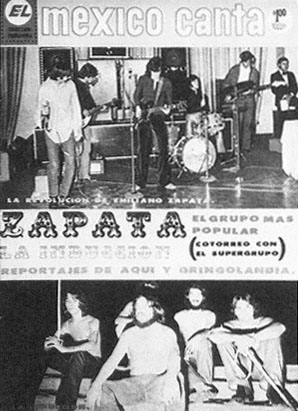
Figure 13.
By 1971 the impact of La Onda Chicana had completely
transformed the image of México Canta, here featuring
the groups La Revolución de Emiliano Zapata and La
Inducción. Source: México Canta, August 1971, in the author's
personal collection.
terial."[46] Even the normally cynical García Saldaña acknowledged that, "despite being a mediocre song, 'Nasty Sex' is danceable."[47]
In appropriating the name and symbolism of the nation's most revered peasant revolutionary, the musical group La Revolución de Emiliano Zapata had proved that via rock the state could be mocked while national identity was reinvented on new terms (see Figure 13). In fact, the most significant aspect of La Onda Chicana in general was that its rock performance could not avoid being an implicit critique of official nationalism. Under Mexico's authoritarian regime, any act of reappropriation suggested direct defiance
of state-sponsored nationalism. In this respect, Mexican rock contributed to the creation of a countercultural community that outwardly criticized the official discourse of national community as it strove to reinvent that community on different terms.
In the case of La Revolución de Emiliano Zapata, this reimagining of community found a parallel in the student movement, where images of Zapata were also displayed by protesters. In both cases, Zapata was revered at the expense of state authority and legitimacy. However, in 1968 Zapata symbolized the unrecognized demands of the peasantry for land and liberty. Students battled with the government over which group most authentically represented Zapata's unfulfilled goals. By contrast, in 1971 the figure of Zapata appearing on record covers and music reviews suggested the liberation from a static, mythologized interpretation of the national warrior. As he appears, for example, on the cover of Piedra Rodante , eyes fixed on the viewer from atop his mounted horse—the long hair and bell-bottoms of band members posing in the foreground loosely hanging down—his meanings are now multiple: Which is the "real" Zapata? Who are the "real" Zapatistas? Indeed, how has his struggle been redefined? Who will represent that struggle? As the caption below the photograph sardonically suggests, we can no longer imagine Zapata only as a peasant revolutionary: "Who might have imagined that the Zapatistas would take the capital? Not even Don Venustiano [Carranza] would have believed it."[48] The reference is to the temporary capture and voluntary retreat from the capital by the Zapatistas during the early phase of the revolution; later crushed by the triumphant Carrancistas, Zapata's guerrilla forces never regained their strength. But it is also a reference to the fear of desmadre which capital residents presumed that the rural, poorly educated guerrilla army would bring upon their city. With the triumph of La Revolución (the band), once again the threat of social disordering lurked.
While the band's first album featured a classic photograph of a posing Emiliano Zapata printed over a metate-textured background (symbolic of the campesino), the cover for their second album was a photomontage of leftist and countercultural images and text: Salvador Allende, Che Guevara, César Chávez, "La imaginación al poder" (Imagination is power), "La libertad es hija de la libertad" (Liberty is the daughter of freedom), and other like materials are all found on the cover. The use of collage—of mixing images and references from foreign as well as national origins—reflected a strategy aimed at forging an original fusion that set Zapata (and the band) within the broader historical context of countercultural and revolutionary revolt. On the inside—although a single album, the cover opens up—
a grainy, black-and-white photograph shows band members sitting around an open campfire, recalling perhaps an image of the original Zapatistas, a well-recognized notion of Mexico's folkloric past—and its jipiteca present.
Other bands also sought to match the boldness of La Revolución in creating names drawn from the national consciousness. And like La Revolución, many emerged from the northern provinces, though they descended on the capital in search of record contracts and commercial opportunities. In creating names and images that specifically made reference to the Mexican experience, these groups forged an essential psychic space for youth in which they could reimagine themselves as social actors among the changing, newly constituted reference points of national identity. As the longhaired, countercultural look sported by band members of La Revolución suggested an identification of individual liberty with Emiliano Zapata, the group Bandido, for instance, recalled a nostalgia for the outlaw, beyond the reach of the state. Another band, División del Norte, was an obvious reference to the defeated popular army led by Pancho Villa. Finally, a group named Nuevo México underscored everything the movement stood for: the yearnings for a new nation constructed from the old. Still, not every band sought explicitly to appropriate imagery and symbolism from the national repertoire. Some of the best-known bands took names such as Love Army, Peace and Love, and Three Souls in My Mind.[49]
If images and band names could play an important role in the reimagining and thus reinvention of national community, it was, of course, in the music itself that the search for identity was centrally located. The music invested youth with a shared sense of collective power that was of their own making. As the lyrics from the song "Tenemos el poder" (We've Got the Power), by Peace and Love, expressed it:
When we're on stage and making music,
there's something that you can't take away.
'Cause our feeling's our own creation.
It's awfully groovy to play together,
and that's why I say:
We've got the power.
You've got the power.
It's within you
and somewhere you can feel it,
communicate it.
With our music we feel the power
and all we want for all of you
is to feel the same.
Say it proud:
We've got the power.[50]
Yet how does one reconcile the fact that certain bands, such as Peace and Love, sought an explicitly "Latin rock" sound—already pioneered by Santana—while other groups like the Spiders (Guadalajara) or 39.4 (Guadalajara) pursued a sound more closely modeled on Anglo rock?[51] Falling in between these two groupings, one locates bands that sought a greater fusion of rock, Latino, and indigenous rhythms, such as La Revolución de Emiliano Zapata, La Máquina del Sonido, Nuevo México, and Toncho Pilatos. Moreover, there was not necessarily any direct association between a band's name and its musical style: Love Army created a Latin-rock sound (and performed many songs in Spanish), while Bandido stylized themselves as a hard-rock group with an all-English repertoire. The first album by La Revolución, with their hit "Nasty Sex," showed little trace of Latin rhythmic influences (the influence of Creedence Clearwater Revival, however, was clearly evident) and was entirely in English. And while their second album reflected a shift toward greater inclusion of Latin American instruments and influences, virtually every song was still in English.[52] Perhaps the one common denominator among these bands, however, was an image of Mexican jipismo: long hair, indigenous necklaces and clothing; a posture of "dropping out" to form one's own communal society. Thus, where do we locate the fine line between popular culture—as an aesthetic as well as political effort at self-representation—and cultural imperialism, as the imposition of a dominant, foreign worldview and the simultaneous confinement of opportunities (in economic as well as cultural terms) for local representation?
This contradictory image can be explained in part by the competing demands of aiming simultaneously for a national audience and an international one. On the one hand, La Onda Chicana reflected an effort to reach out to a broad Mexican market attuned to international trends but now demanding greater originality. For some groups, therefore, the search for new compositions led them to experiment with different musical genres, ranging from the blues to indigenous folk music. As Joaquín Lépez of La Revolución de Emiliano Zapata later explained, "[W]e loved to play the blues, but how far could we take it? How much did we really know about the blues? What we heard or what we made up, but that road ended quickly. You didn't have the base, a framework. So, there comes a moment when without such a base you begin the search. And so you begin to hear Andean music and whatnot, and you go from there, no?"[53] The group Love Army
perhaps best articulated what the impact of this rock fusion meant for creating an original style of rock music: "We don't play anything that's copied. We play our own music, that's all. Of course it's influenced, but you can't label it as rock, soul, blues, mariachi, or anything else because it's none of that. It's our music 100 percent, with the name Love Army.... If one takes into consideration all of those influences, including Aztec music such as Náhuatl rhythms and musical ideas from everyone [in the group], from all of that emerges the music of Love Army, 100 percent made in Mexico."[54] In another example, the first album by Nuevo México was appropriately titled Hecho en casa (Homemade). Víctor Roura later commented: "The majority of their songs being instrumentals, Hecho en casa is a presentation of and testimony to a dignified coalescence of rock made precisely at home."[55]
Not surprisingly, many bands found inspiration in the success of Santana's Latin-rock music, which had triumphed on the world stage at Woodstock.[56] Carlos Santana had proved that rock could be an open-ended genre, capable of absorbing other musical sounds and rhythms. Indeed, Santana was the prodigal son for Mexican rock critics: he had made it in gabacho-landia ,[57] and his fans in Mexico hoped he would someday return. Describing a concert of his in Chicago, a critic for México Canta wrote:
The kids follow the rhythm of Santana's incredible tunes, singing along with him; on all sides you see long-haired youth dancing to the rhythm of his music; their happy faces reflect the music's acceptance.... [T]otally amplified, the music reaches all the way to the marrow of your bones and makes your blood boil, igniting a supercharged energy; the feeling is general, and people dance with their feet, their legs, their arms, their hands, their head: getting off is easy if you follow the magic rhythm which these guys can play.[58]
Santana, in other words, had succeeded at what every Mexican band aspired to do. He had created a national as well as international audience and had done so by inventing a new rock fusion "that blended the acid-rock of the Haight-Ashbury era with blues and New York salsa."[59] Peace and Love was one band that reflected the influence of Santana. Their song "Latin Sentiment" (performed in English and Spanish) gives a sense of the music which accompanied it:
We're getting all excited just
By playing-hearing Latin music
Congas, cowbells all the
Rhythm section
All we want for everyone
Is to get in the groove and
Express yourself and
Do your thing anyway you
Want it
Clap your hands, kick your feet
Move your body all around
Feel the beat, you will see
Latin feeling, it's out of sight yeah!
Latin feeling, Latin feeling.[60]
For other Mexican groups, however, the strategy consisted of creating an "international" sound that reproduced the success of foreign idols such as Creedence Clearwater Revival, Chicago, and the Rolling Stones. For instance, the Spiders produced a sound quality that received favorable commentary from critics but that displayed virtually no Latino influences.[61] In a fundamental sense, therefore, we should recognize how the dual pressures of "nationalizing" and "internationalizing" simultaneously rendered two, in important respects distinctive, native rock styles: Latin-rock fusion and Anglocentric rock (derived from African American blues). In both cases, however, the notion of collage applied: the conscious effort to create, through the manipulation of band images as well as musical quotations, a native rock concept that spliced together international and native references.
The constant criticism by rock reviewers and the badgering by interviewers regarding a band's "originality" suggested that the rock aesthetic pursued by La Onda Chicana was considered by many to be inchoate at best and a colonialized copy at worst. In understanding the movement's apparent contradictions, we must avoid falling into the doctrinaire cultural-imperialist argument that presumes a mass of passive consumers of foreign culture, absorbing the aesthetic and ideological implications of a foreign rock "invasion." While the presence of foreign rock and the images that accompanied it were widely circulated, the musicians and their Mexican audiences became increasingly self-conscious about the need to create an original rock sound as well as an "original" countercultural movement. Mexican rock was not necessarily displacing foreign rock, but as new bands emerged and succeeded in commercializing their art form a new assortment of images and sounds began to complement and build on a foreign rock repertoire which already existed. Through this commercialization process, members of La Onda Chicana could feel increasingly connected to one
another and, perhaps more significantly, to a global countercultural movement in a way never before experienced. As one participant recalled:
I believe there were pioneers who were capable of doing the same thing being done in the United States, making music that we enjoyed. True, it was music influenced [by foreign rock] in large part ... but it was our own music. It unified us and while similar [to foreign rock], it was also different. It was uniquely Mexican. I remember quite well the band La Revolución de Emiliano Zapata; the name alone assured you of a sense of nationalist credibility. But they played rock in English and were Mexican. I don't know if they had any impact [in the U.S]. I doubt it.[62]
Thus, we must try to understand La Onda Chicana not only as a consequence of imperialism but fundamentally as a response to imperialism as well.
How, then, do we account for the fact that all bands composed overwhelmingly in English? I would suggest there are four ways to understand this phenomenon. First, there were clear pressures to record in English in order to internationalize oneself, to seek success in foreign markets. Despite Santana's success with the Tito Puente tune "Oye como va" (sung in Spanish), English was still the dominant language for rock, in itself an indication of the cultural hegemony exerted by the United States and Britain over the rock movement globally. There was an overriding assumption by most bands that the "real market" for rock was a U.S. and European one, and thus in order to "make it" one would have to appeal to that market. Armando Nava of Los Dug Dugs revealed in a 1979 interview that he recorded in English "because my intention is to get my songs sent [to the United States]."[63] Ironically, however, with the brief exception of Polydor, Mexican recording companies gave scant marketing consideration to the mounting Latino (Chicano) population in the United States.[64] "So, rock can't be global?" asked the rock critic Víctor Roura prophetically in 1973. "Will it always be self-enclosed within the same circle? Is English the only medium for rock? Just because rock was born sung in English, one can't sing in Spanish, German, French, etc.?"[65] Indeed, some bands produced identical versions of their songs in English and Spanish in an apparent effort to appeal to a national and international market simultaneously. This was also a necessary factor shaped by the commercial radio industry: stations dedicated wholly to imported foreign rock demanded rock in English, and vice versa for Spanish-only music stations. Thus it became a common strategy among bands to produce more than one version of their material.[66]
Second, the use of English, especially in live performances, was intrinsically linked to notions of the avant-garde and thus a more "authentic" rebellious sound. Even the refritos had incorporated English exclamations, guttural grunts, and drawn-out vowels in imitation of their Anglo counterparts. English connected the audience with an imaginary vision of vanguard participation, even when many if not most fans found the lyrics inaccessible. As Ramón García, a working-class fan of rock, later remarked:
If in general, you didn't understand what was being sung in English, you at least knew they were saying something to you. It was somebody who reflected your ideas, who represented your people. Even when the [U.S. and British bands] were saying something, and they have nothing to do with your people, at any rate you're a human being, and so you capture something [of the feeling]. But to see someone play from a band [that you know], you really felt it. Immediately, you went wild for them; you felt that they were saying something [to you].[67]
Lyrics were often so poorly enunciated that even an English-language speaker no doubt had difficulty deciphering their meaning. Still, English was considered at the time to be an inextricable part of the "feeling" produced by rock, whether you were from the upper or lower classes.
A third explanation is suggested by the fact that performing in English allowed musicians greater latitude of expression in order to avoid direct censorship of their songs. As Víctor Roura writes, bands "began to incorporate political questions into their compositions, but they concealed them by singing in English."[68] Herbe Pompeyo concurred, noting, "It would have been difficult to get much diffusion for a song in Spanish" that contained controversial themes.[69] This would have been particularly true for the 1971 hit, "Viva Zapata," recorded in English by Los Locos:
I'm gonna talk to you about Zapata
He fought for the land
He was Zapata.
He died a long time ago
But he's still on the road.
Follow his teaching.
Follow Zapata.
I'm digging on the earth
Until I'm exhausted.
When seeds are growing up
It makes me feel fine.
I fight the way he did
And that is how I feel.
Viva Zapata.
Viva Zapata.[70]
Other songs, such as the hard-hitting "Caminata cerebral" (Walk within My Brain) by Love Army, were written in English and in Spanish, with the hope that one might receive airplay:
Oh, what about what he said,
Already forgotten.
What happened with the thirty coins
That he gave you?
Because I don't believ what you're telling me,
I know it's not the truth.
What is certain is that I prefer
To walk within my brain.
I have to go.
Unions and bosses have
Lowered my morality.
If I keep my underwear on,
They'll lower that as well.
Because justice takes time,
I don't think I'll wait.
I prefer to walk within my brain.
I have to go.
Hey Christ, don't return
Don't let them shave your head!
No one will understand your Age of Aquarius.
Because I know that if you return,
You won't be preaching.
Just seeing your long hair,
People are going to freak.
Yeah, they'll make you cry.[71]
Roura argues that in the English version, written to enhance the chances of airplay, the song "lost all of its message. It was reduced to nothing."[72] This is debatable, as most listeners were probably also aware of the Spanish translation. In the case of Three Souls in My Mind, his biographer writes that Lora's "irreverent lyrics ... were disguised" not only because of the English but also because the song titles were shortened on the album cover (for example, "Let Me Swim in Your Bed" became simply "Let Me Swim").[73]
Last, we can interpret the reliance on English as integral to an aesthetic notion of rock as poetry. The literary impact of performers such as the Beatles, the Rolling Stones, and Bob Dylan—in fact, all of the respected
groups from that era—was considerable. Rock magazines devoted increasing amounts of space to publishing foreign lyrics with their accompanying translation. Fans regarded rock lyrics as part of a larger vanguard cultural movement; demand for such translations was high. As one reader wrote to the editors of POP:
The articles on philosophy, psychology, theology, metaphysics ... are in fact widely read and discussed. As youth, we're very interested in that material.... Oh yeah, I almost forgot! [Add] another section with lyrics to the songs from the best albums by: BOB DYLAN, DONOVAN, JOAN BAES [sic ] JOHN MAYALL, GEORGE HARRISON ... songs with a message, but of course translated into Spanish, as there are a lot of us who don't know English and so don't learn about the important message these songs are sending us.[74]
As we have seen, literary figures of La Onda lavishly incorporated rock lyrics, often left untranslated, into their writings. In general, rock lyrics were even more respected as poetry in Mexico than in the United States. This may have reflected a more deeply entrenched tradition of poetry and literature in Latin American thought. But there was another factor, too. The distancing intrinsic to all acts of translation generated a more profound aura surrounding rock lyrics: English created—and continues to generate—a sense of mystery to be unraveled, even more so when it involves popular culture.[75]