
Meadow
The manors of Peterborough Abbey enjoyed good riverside locations that provided the estate with 1,515 acres (613 ha) of Domesday meadows.[43] Geographically the Abbey's holdings of assessed meadowlands were quite dispersed. The greatest concentration of meadow resources lay furthest from the Abbey. Its more distant manors, which served as staging points to the north (Thurlby, Collingham, Fiskerton, Scotter, Walcot), possessed 61.4 percent (930 acres) of the assessed holdings.[44] Its home manors (Boroughbury, Longthorpe, Castor, Glinton, Werrington, Pilsgate, Fletton) husbanded only 17.8 percent (271 acres) of assessed meadow. Slightly less than a quarter of the Abbey's assessed meadows lay on its western Northamptonshire manors. Figures 4 and 5 show the distribution of meadow on the Abbey's estate.
Medieval farmers usually mowed meadows for hay. From mid-December to early summer, they enclosed meadows to protect the production of the hay crop. They mowed the hay from mid-June to July. Then, depending on management, livestock grazed the mown meadows, unless a second hay crop was to be taken in late August.
Farmers can also choose to graze meadows with their stock rather than mow them.[45] The decision to mow or graze riverside meadows depends on seasonal strategies of matching livestock populations with
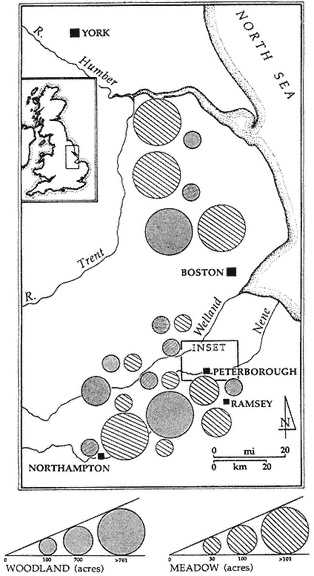
Fig. 4
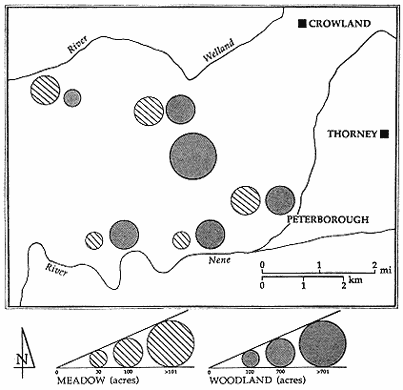
Fig. 5
Figs. 4 and 5.
The meadow and woodland resources of the Abbey recorded in the Domesday Book.
pastoral resources. Mowing and storage of hay for winter fodder implies a pastoral economy where the number of animals exceeds winter pasture and one in which movements of livestock can be coordinated with storage locations. If farmers graze meadows in the summer, they must store some other source of fodder for the winter or move the animals to winter pasture. The decision to mow or graze depends, too, on who controls the resource and on the demands of the livestock economy. Medieval farmers usually restricted the grazing of alluvial meadows to cows and horses. Dairy cows, in particular, had special need to feed on the early spring flush sprouting in alluvial meadows, when other forage was scarce.
Low-lying river-meadows can also be managed as water meadows by constructing a system of drains, weirs, and channels. Archaeologists have found evidence of water meadows in late Saxon Winchester.[46] Water meadows are usually associated with sheep farming. The sheep, especially ewes, are let on the irrigated meadow in March and April to graze on the spring flush. They are then removed to allow irrigation for a July hay crop. Livestock then grazed the new growth of late summer, the aftermath.
The Domesday survey assesses meadow acreage on the estate, without comment on its management. The 1125 survey rarely mentions meadow acreage or meadow-related activities such as mowing in its list of peasant services. At Kettering the survey does mention extra meadow worth fifteen shillings. To give a comparative value for this figure, 6,048 acres (2,419 ha) of stocked (oneratur ) woodland at Oundle in 1086 were valued at twenty-five shillings. Tinwell also had extra meadow valued at six shillings. Extra hay (et de feno de super plus ) valued at six shillings is reported at Great Easton. When the 1125 survey does record mowing services, they are owed usually by the Abbey's sokemen. At Glinton and Fiskerton, sokemen mowed and carted hay one day for the Abbot.
The Domesday survey did not record demesne or peasant livestock on the Abbey's manors. The 1125 survey lists demesne livestock and the number of peasant ploughs on many of the manors. Only the weakest associations between the numbers of demesne oxen, or the estimated number of peasant oxen, or the total of demesne and peasant oxen and the Domesday meadow acreage can be found when those values are plotted. The estimated number of peasant oxen correlated most closely with meadow acreage, but in this case there was only a 13 percent probability that the correlation was significant. Such statistics belie a linear relation between pastoral resources and tillage on the estate in the early twelfth century.[47]