
The Xenon I
The visitor standing in the 6th-century Basilica simultaneously stands in a building of the 4th century B.C. , one-third of which is covered by the Basilica. Labeled Xenon on the plan
(Fig. 30), this more ancient building probably served as a hotel for some of the athletes and trainers who came to Nemea every two years to compete in the Panhellenic games.
Hotels were ubiquitous in ancient Greece by the 4th century B.C. ,[55] but few scholars have investigated the physical evidence and the written sources which pertain to them.[56] Thucydides—the only ancient author to mention the architecture of a hotel—laconically described one built at Plataia in 426 B.C. as measuring 200 feet on each side with rooms all around, above and below.[57] This description has been interpreted as that of a square building with a central court and has been used to identify some buildings with such a plan as hotels. The building at Nemea, however, differs from Thucydides' description. Rather than being square, the Xenon here is a long, narrow rectangle which clearly lacked a central court. Indeed, for its time, the Xenon's plan was unique. It has been possible, however, to identify it by using criteria of location, plan, and associated finds.
Eating and drinking vessels as well as hearths for cooking found throughout the southern rooms indicate that these rooms were restaurants of a sort; the paucity of such evidence in the northern rooms suggests that they were used for living and sleeping. The plan of the building, which was divided into apartments, with sleeping quarters and dining areas in each, further suggests that it can be identified as a hotel, or xenon . The location of the Xenon, near the Sanctuary of Zeus but outside the Sacred Square, on the major road through the
[55] Buildings to provide temporary shelter for visitors seem to have been typical at the larger sanctuaries of antiquity: at Olympia the Leonidaion and at Epidauros the katagogeion , for example.
[56] Greek hotels are mentioned briefly in general books such as L. Casson, Travel in the Ancient World (Toronto 1974), and specific examples are discussed in some guidebooks to sites or in individual articles. The only complete exploration of the subject is by L. Kraynak, Hostelries of Ancient Greece (Ph.D. diss., University of California, Berkeley, 1984).
[57] Thucydides 3.68.3.
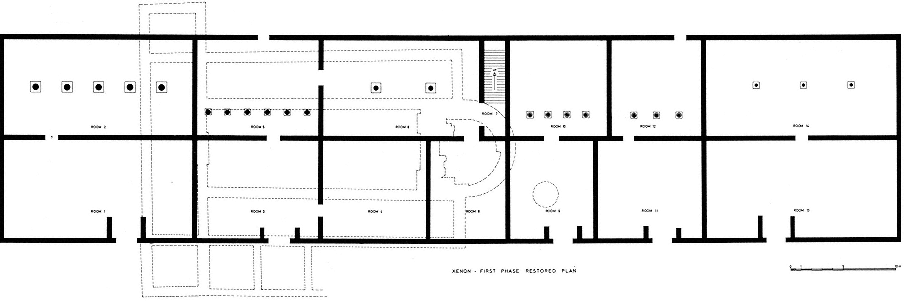
Fig. 30.
Restored plan of the Xenon with outline of the Basilica.
valley, suggests that the structure was secular but played an important role in the business of Nemea; its proximity to the Bath brings it into the realm of athletics. Finally, excavations in Room 12 produced a jumping weight, and strigils have been found elsewhere. Thus this was not only a xenon but specifically a building designed to house the athletes who came from all over the Greek world to compete at Nemea.
The Xenon is visible where it emerges east and west from beneath the remains of the Basilica; it extends for a total of 85 m. A median wall divides the structure longitudinally; latitudinal walls form rooms of varying sizes. The Xenon, like the Temple of Zeus, has parastades , or walls which project into the rooms on either side of the five doorways in the south wall along the main road. Projections like these in the
Temple on either side of the cella door protected delicate moldings from damage, but there was no similar need in the Xenon. The two doorways found in the north wall lack projections like those beside the doors in the south wall. But even though the reason for them remains obscure, the projections serve us well by marking the facade of the Xenon; the building was oriented toward the ancient road, not the sanctuary.
Another odd feature of the Xenon is the row of interior columns in all but one of the northern rooms. Although interior columns per se are common enough, the position of these in the Xenon, some on the longitudinal axis of a room, others south of it, is unusual. Inasmuch as the columns must have served to support weight, and since they occur only in the northern rooms, a second story has been restored over the
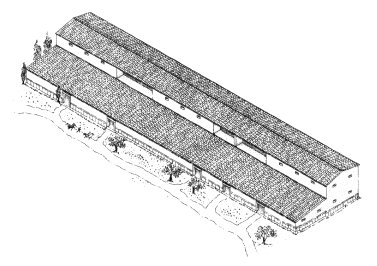
Fig. 31.
Perspective drawing of Xenon with restored second story and roofs.
northern part of the building (Fig. 31). The rooms restored above Rooms 5, 10, and 12 have recessed balconies whose back (north) walls are supported directly by the off-center columns of the ground-level rooms. The anomalous shape of Room 7 is due to its use as a stairwell giving access to the second story.
The western end of the Xenon protrudes from below the narthex of the Basilica. Only the foundations of the exterior walls and column bases in Room 2 remain. The median wall of the Xenon protrudes from beneath the nave of the Basilica, crosses the narthex, and continues outside it. In this wall, built of reused blocks of all sizes and shapes, "mortared" with clay, the Aristis inscription now on display in the museum (see p. 37, Fig. 11) was found reused.
Several trenches (now backfilled) have been sunk through the tile pavement of the narthex. At the bottom of one trench the continuation of the median wall of the Xenon is visible
and, north of it, a square column base which is the eastern-most base in Room 2. A coin of Philip II found in this portion of the median wall verified that the Xenon was built in the late 4th century B.C.
The median wall of the Xenon continues uncovered for the entire length of the nave, disappearing into an undug portion before reappearing in the apse of the Basilica. Although the remains of the Xenon within the nave appear chaotic and confusing at first glance, they are worth exploring.
East of the threshold at the entrance to the nave and north of the median Xenon wall are six column bases, one with the stub of a column still in situ (in Room 5 on the plan). Although originally discovered long ago, the record was so sketchy that it could not be understood until old trenches were cleared in 1980. The rediscovery of these column bases was especially welcome because Room 5 had been the only major northern room which seemed to lack interior columns. Moreover, the column stub gives us the type and diameter of the columns in this room, evidence not available for other colonnaded rooms.
A scrappy, poorly constructed wall which crosses the median wall of the Xenon and touches the corner of the second column base from the northwestern corner of the nave represents a second, hastily built, phase of the Xenon, documented elsewhere in the remains. The occasion for it was the brief period around 235 B.C. when Aratos of Sikyon returned the games to Nemea (see museum case 18, pp. 57-58, and n. 35).
The visitor can obtain a closer view of the median wall from the unexcavated strip of. ground along the south side of the nave whence more of the excavated portion of the Xenon is visible. Here, in the corner of Room 4 formed by the median wall and the wall between Rooms 3 and 4, is a round hearth paved with cobblestones. When it was discovered in 1962, a stand like that in House 4 (see p. 76), roughly made of reused roof tiles to support a pot over hot coals, was found
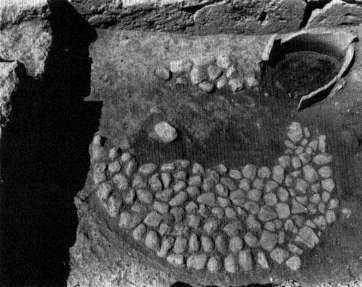
Fig. 32.
Hearth and stand in the northwestern corner of Room 4 of the Xenon
in 1964, from the south. The stand has since been removed.
over the northeastern part of the hearth (Fig. 32). The hearth itself was covered with ashes, several pots (shattered when the roof collapsed), and cow bones (one cleaved by a sharp instrument). Clearly Room 4 was a kitchen. The food prepared there may have been consumed in Room 3, on the other side of the wall from the hearth, where a group of drinking cups and cooking pots was found, pressed into the dirt floor when the wall and roof fell on them.
Beyond the hearth (to the east) another scrappy wall crosses the median wall of the Xenon and disappears into the scarp. The date of this wall corresponds to that of the other poorly built wall near the base of the column in Room 2; it too represents Aratos's short sojourn in Nemea.
The visitor who returns to the south aisle of the Basilica can visit the eastern end of the nave for a view of the apse and
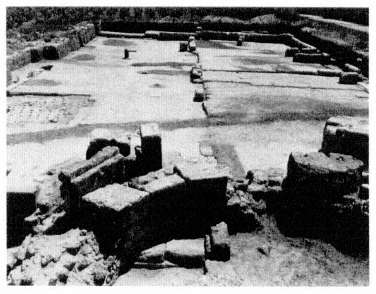
Fig. 33.
The apse of the Basilica, with the eastern end of the Xenon
visible in the background, from the west.
the area beyond it (Fig. 33). The median wall of the Xenon continues into the apse with the threshold between Rooms 6 and 8 and, beside it, another reused block, set in upside down, with the inscription Telestas, a man's name.[58]
After a tour of the rest of the site, we shall return to the eastern end of the Xenon, where the remains allow us to see how the building was constructed. For now, however, we return down the steps from the Basilica to the path, turning right (west) along the path over the ancient road. We leave the path where it turns north toward the Temple of Zeus, striking out westward along the line of a modern road which crosses a bridge over the Nemea River. Just to the right (north) of a large service gate in the fence is the Heroön.
[58] IG IV.486. The letter forms suggest a date in the 5th century B.C. ; the man Telestas whose name is inscribed here should not be confused with the one whose name is scratched on the Stadium tunnel wall (see pp. 36 and 188).