
The Non-Han State
In the non-Han culture of the steppe, marriage may be characterized as (1) a transaction in which considerable wealth (or its substitute, labor) passed from the family of the groom to that of the bride (i.e., the "brideprice"); (2) a polygynous arrangement whereby all wives, or a group of senior wives, had equal status; (3) cross-generational alliance; (4) separate residence for married sons; and (5) an exogamous system in which intermarriage with the paternal line was permitted after a given number of generations (five, seven, or nine) (see Krader 1963). Women were well integrated into the husband's family, so much so that they sometimes received a personal share of the husband's patrimony apart from that given to male offspring. This in turn meant that wives rarely left the husband's family to remarry. Should a widow be unable to survive on her share of the patrimony, that share would be amalgamated with that of another male in the family through the levirate—marriage to a brother, uncle, nephew, or son (by another woman) of the late husband. Polygamy, separate residence for adult sons, and the absence of a ban on cross-generational marriage alliance facilitated the movement of widows from one unit of the family to another (see Holmgren 1986b).
Leaders were selected primarily on the basis of maturity and competence, thus obviating the need for regents—male or female (Holmgren 1981-83b; Fletcher 1986; Holmgren 1986c, 1987). This meant that consort families participated in government only as heads of tribal subunits within the confederation, not as wifely, sororal, or maternal kin. Because marriage could not be used by one group to undermine the authority of another, it was able to develop as a diplomatic device, usually taking the form of a simultaneous exchange of women conducted across a range of leaderships. The condition contrasts with that of the Chinese state, which was hampered in foreign marriage diplomacy by its emphasis on lineal succession, monogamy, and the role of the wife and her relatives in supporting the throne during minority rule (Holmgren n.d.).
For China specialists, the absence of steppe customs in states of non-Han origin, or the presence of forms approximating those found in the native Chinese regime, is often seen as evidence of sinification. But similarities can be misleading. One cannot assume that they arise for the same reasons. For example, the Ch'i-tan (Khitan) abandoned the exchange of women with foreign states during the Liao period (A.D. 916-1122) because one particular group of outsiders had been given an exclusive permanent lien on marriage relations with the ruling house. In fact, the Chinese model was never completely adopted by any conquest regime. Rather, individual elements of the model were selected, modified, and integrated with the steppe tradition. In each case, the mix provided a well-integrated, workable system of control
designed to meet specific political needs. At the same time, each approach was unique; that is, the amalgam of Chinese and steppe traditions was never exactly the same.
The variety and political ingenuity of systems developed by non-Hah states are demonstrated below. Here it remains to point out some common characteristics. First, nearly all non-Han states actively discouraged or severely circumscribed marriage ties between the throne and the Chinese. Second, the circle of imperial marriage partners tended to remain relatively stable, and consequently the various sets of in-laws overlapped to a much greater extent than in the native Chinese regime; that is, the same groups continued to supply both wives and husbands for imperial offspring almost indefinitely. Third, in non-Han states there was a more carefully regulated, and thus much greater, correlation between political privilege and social status as seen through marriage relations with the royal house than in the Chinese state (on these points, see also Rawski's chapter in this volume). Even Northern Wei, the one great exception to these generalizations, moved toward this type of system in its later years.
All these characteristics grew out of the need to protect the non-Han minority's privileged place in government against encroachment by the Chinese. Finally, examination of the histories of these northern conquerors in predynastic and dynastic times reveals a link between the abrupt appearance of new forms and attitudes to marriage and a shift in power-sharing among males of the ruling lineage. The link is highlighted most forcefully in T'o-pa history, which saw two quite distinct shifts in attitudes to marriage and inheritance—the first occurring during the foundation era, the other at midpoint in the history of the imperial state. A similar, equally dramatic shift can also be observed in early Ch'i-tan and Mongol history (see Holmgren 1987). The sections below outline the main features of the marriage systems that developed in tandem with this new approach to power-sharing among male kin. As we shall see, the systems so devised had little in common with each other or with the model established by the native Chinese state.[18]
The T'o-pa Wei
Northern Wei (A.D. 399-534) developed a marriage system that emphasized the common interest between the throne and collateral branches of the ruling house in controlling the ambitions of outsiders, both Chinese and non-Han. That is, Wei marriage strategy protected the privileged place of paternal kin in selection for office by denying other interest groups access to power through marriage ties with the throne. Thus, in spirit and form Northern Wei policy resembles that of the Ming: imperial wives and concubines came from outside the ranks of the bureaucratic and military elite; there was active discrimination against the ruler's wifely and maternal kin in selection for high office; and there were few cross-ties between sororal and wifely kin; that
is, daughters of princesses (FZD) and maternal cousins (MBD) were not taken into the imperial harem.
Wei strategy went much further, however, in that the T'o-pa attempted to separate the wife's biological function of producing an heir from her political role. First, mothers of eldest sons were never appointed to the rank of empress in their lifetimes and might well be made to commit suicide after the son was named as heir to the throne. Second, empresses were appointed only on an irregular basis and were invariably childless. They did not act as titular or foster mothers to eldest sons, and they all came from the ruling families of recently conquered states and thus had few if any relatives of influence in the outer court. They were thus purely symbolic figures representing the integration of their peoples into the T'o-pa empire. In short, the T'o-pa adopted the Chinese principle of primogeniture but rejected the idea of succession by a son of the empress. They thus dispensed with the most critical aspect of the Chinese system—the role of the senior widow as head of the ruling house and de facto head of state in times of political crisis. Under the T'o-pa such crises were to be addressed by senior officials of the outer court who were either unrelated to the throne or were princes of the blood or select sororal kin. In this system, imperial princesses were given in marriage either to leaders of refugee groups arriving in Wei from other states, or to members of a select line of a non-Han lineage (the Mu family). In the former case, the aim was to neutralize a potentially hostile group that had settled in the realm. In the latter instance, repeated bestowal of daughters upon sororal nephews (ZS) created a group of loyal kin who, being T'o-pa in all but name, could be chosen for office in the same way as princes of the blood, thus supplementing the latter's meager numbers. Care was taken, however, that these sororal bonds were never translated into wifely/maternal relationships.
Measures taken to control the ambitions of agnates centered not on supervising their marriages, but on bestowing equal rights in selection for office. Political rank and social standing within the ruling lineage therefore depended on loyalty and service to the throne as perceived by the emperor of the day. Thus, for princes of the house (the most privileged group in the empire), marriage was apolitical. And because brothers, nephews, and younger sons were free to choose wives without reference to the throne, many branches of the house intermarried with commoner, even slave, families—wives being chosen for reasons of love or physical beauty. It seems, then, that for the T'o-pa, the wife's social standing was of little consequence.
In summary, the early Wei ruler was not primus inter pares but a true autocrat who derived his chief support from, but nevertheless controlled in an absolute way, all members of the imperial lineage as well as senior bureaucrats of the outer court. In the early Wei system (400-490s) all paternal kin, males and females, were far more trusted than wives. Although the trust placed in sisters was in some cases extended to their husbands and sons,
sisters' daughters did not marry back into the imperial line to become wives and mothers of emperors. Nor were the female offspring of distant male agnates permitted to marry back into the ruling line, as might have happened in the steppe tradition.
In the 480s the throne began to use the marriages of female offspring to gain access to the social network of the Chinese elite. The change in policy was geared to the better integration of wealthy provincial Chinese into state-controlled political and economic structures. In this way, the policy of marriage avoidance with the bureaucratic elite began to break down. Other strategies remained in place, however, in particular those relating to the political power of mothers and wives. A decade later, the narrow aim of protecting the government positions of paternal kin was widened to encompass all non-Han elites. To this end, the system of selection to office was overhauled so that political rank now depended on social status, with the latter being defined (for the non-Han) by ancestral service or degree of blood/ marriage relation to the throne. The 490s thus saw a revival of the predynastic tradition whereby all lines of the ruling family were ranked according to seniority (birth). This revival was accompanied by a shift in attitude toward marriage for male offspring. That is, a controlled, elitist marriage strategy was developed during the 490s in an effort to establish a recognizable and "respectable" circle of families from which the ruling line and close paternal kin (males and females) could draw their spouses. From there, Wei moved rapidly toward the system seen under conquest regimes, namely, marriage exchange within a closed circle of mestizo and non-Han elites who dominated key administrative posts.
Such changes in the marriage system created instability in the top echelons of the bureaucracy as male agnates clashed with the throne over the issue of political privilege for relatives of the emperor's mother and wife. In addition, distant branches of the emperor's family suffered a decline in political status as they struggled to protect their place in government against incursions from the emperor's more privileged uncles and brothers and other non-Han elites who now had better access to power through wifely and maternal ties with the throne. In the search for ways to maintain their status, distant male kin turned to marriage alliance with the families of eunuchs and palace attendants. Here, long-term social security associated with membership of the imperial house was exchanged for informal, high-level (but often short-lived) political influence. Such cross-status alliances were no longer tolerated, however, for they were held to be subversive to the new political order.
The Ch'i-tan Liao
Whereas early Wei marriage strategy focused on protecting the throne and paternal kin from the ambitions of powerful outside interest groups, Liao (A.D. 916-1122) marriages were designed to minimize the dangers posed by
the emperor's male agnates. The system grew out of the support given to the founder of the regime by his wife and her family against other tribal leaders and, more important, against the founder's uncles and brothers, who refused to relinquish their traditional leadership rights. In this system, princes of the blood who were only distantly or remotely related to the throne were more trusted than close male agnates. Accordingly, the latter were given mainly honorary titles and nonfunctional posts associated with the shell of the old political order. As reward for their support in helping to institute the new monarchical and centralized system of government, the family of the first empress (an outsider in relation to the old power structure) was given exclusive rights to marriage relations with the throne and a hereditary lien on key posts in the newly developing system of administration.
In the mature Liao marriage system, all branches of the imperial house (the Yeh-lü) as well as those of the consort clan (the Hsiao) were ranked according to degree of kinship with the founding emperor and empress. The highest-ranking branches of the ruling family (the emperor and his close relatives) married into those of the consort clan and vice-versa. In this way, the ruler was supported not only by his mother and her uncles and brothers (who doubled as senior officials of the outer court), as in the Chinese system, but also by his mother's female kin—her sisters and nieces—who doubled as consorts for his uncles (FB), brothers, and nephews (BS). Here, cross-generational alliance flourished, with members of the consort clan marrying down into younger generations of the imperial house, all of which increased the likelihood that the empress's sisters and nieces would be able to control their husbands and thus help to protect the ruling line from the threat of armed revolt or usurpation by close paternal kin (figure 2.4).
The Liao system, then, was almost a parody of that of the Chinese. Ranking within the harem was determined by the political status of the woman's male kin, and the status of her male kin was determined by social rank defined according to blood ties with the founding empress and current ruler. The correlation of social status, selection for office, and provision of spouses for the royal house was thus much higher than ever intended or seen under any Chinese regime. This is not to say that there was no political and social mobility. Indeed, the middle Liao period saw considerable upward mobility as the throne attempted to weaken the power of relatives of the first empress by broadening the base of the consort clan: here, the new rules of surname exogamy, repetitive marriage-exchange, and hereditary rights to office were circumvented by the simple device of surname adoption; that is, by using the steppe practice of fictive kinship to integrate outsiders into the political system. The same device was later taken up by the consort clan as a means of incorporating its followers into the system. It was only after the system was revamped in the latter part of the regime (1020s) that genuine blood ties with the founding unit were stressed.
Although most Liao rulers married maternal cousins (MBD), distinctions
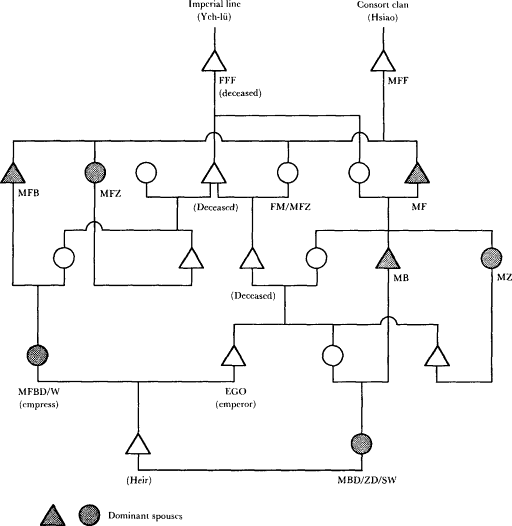
Fig. 2.4.
Cross-generational marriage: Liao
such as MBD and FZD, relevant to the Chinese model, are less applicable because the system of exchange meant that a wife who was MBD might also be FZD. Cross-generational alliances complicated the situation. The eighth ruler, for example, married a woman who was his mother's paternal cousin (MFBD) and his father's maternal cousin (FMBD) (figure 2.5). Although Liao rulers could marry their maternal aunts (MZ) as well as daughters of the mother's or grandmother's brother (MBD or FMBD), they could not,
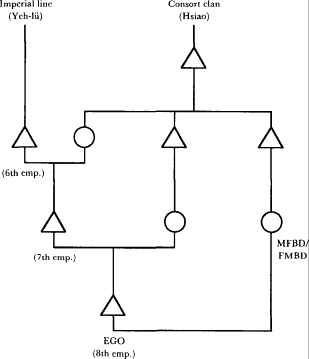
Fig. 2.5.
Cross-generational marriage with MFBD/FMBD in late Liao
despite the high status of maternal aunts and cousins, take the female offspring of such women into the imperial harem (MZD). Liao practice here differed from China's because such offspring always carried the surname of the imperial house (Yeh-lü). This explains why power held by the empress's aunts and sisters did not pass to their offspring (although it did reappear in the following generation through the female line). For males of the consort clan, political status initially passed to both male and female offspring but from there was transmitted only through the male line. In short, all members of the consort clan, whatever their gender, tended to have more power than their spouses, including the emperor himself. Because the status of the empress dowager extended to her close relatives regardless of gender, the normal gender inequality between husband and wife was reversed, not for the emperor's sisters as in the Chinese model, but for those of the empress and empress dowager. The military authority assumed by these women in times of crisis (see Wittfogel and Feng 1949:200, 557) was a symptom of this condition.
In theory, the Liao system of marriage exchange should ultimately have
incorporated the consort clan into the imperial house to such an extent that all divergent interests between it, the throne, and paternal kin would disappear. The system favored the consort clan, however, more than it did the throne. Even in early Liao, the emperor was in danger of being overshadowed by members of the consort clan. Action taken to redress this situation was short lived, ending in the fourth reign with the emperor's personal withdrawal from government in a manner similar to that seen in the late Ming. In the latter part of Liao, however, the authority of the throne was protected to some extent by factionalism within the consort clan as wives of one generation battled with those of the next, and as barren empresses struggled to hold their place in the system against fertile concubines. In effect, the various branches of the consort clan began to behave in the same manner as competing generations of wifely and maternal kin in the native Chinese state.
The Mongol Yuan
In predynastic times the Mongol leadership (early 1200s) developed a marriage system that achieved a near-perfect balance among all the parties discussed above. It continued on into the Yuan era (A.D. 1260-1368) with very little change other than a gradual drift in administrative, fiscal, and military power away from the periphery toward the center. This shift ultimately left secondary branches of the imperial house unable to defend the integrity of the throne against bureaucratic forces.
Distinctions were horizontal in the Mongol system rather than vertical. Paternal relatives and the leaders of subordinate tribes and allied states were invested with identical powers that, although located away from the center, were basically imitative of those held by the supreme ruler in the central domain. In this system, close paternal kin tended to be more trusted than remotely related male agnates. Accordingly, they were given a significant amount of autonomy on the outermost rim of the empire. Their role as regional overlords and the local autonomy granted to other tribal leaders together formed the linchpin of government. Power, then, was invested as much on the periphery of the realm as at the center.
Participation by princes and allied leaders in the selection of the supreme ruler and strict supervision of marriage and succession procedures within the various kingdoms and fiefs were some of the means the center used to control the strong centripetal forces within the realm. By early Yuan times, inheritance of territories held by collateral branches of the house was regulated so as to emphasize service to the center and to prevent control of the fief from falling into the hands of outsiders. Older sons were expected to earn their own kingdoms, and the fief went, not to the youngest son of the wife in the traditional manner (ultimogeniture), but to the youngest adult son who had no fief of his own at the time of his father's death or to a collateral male relative who held the territory in trust until the youngest son came of age. In
this way, families that married into the ruling lineage were unable to gain control of the various princely domains. Marriage alliances were also carefully scrutinized by the center to prevent collusion between princes of the house and allied tribal leaders also on the periphery.
The local autonomy granted to conquered and allied leaders was contingent upon their acceptance of a sister or daughter of the Mongol ruler in marriage. This, combined with an enforced system of monogamy, lineal succession (ultimogeniture), and female regencies within the allied state, guaranteed effective control over the subject tribesmen by the central domain. In the final analysis, however, control rested on the demonstrated military superiority of members of the ruling house. Herein lay one of the chief weaknesses of the system: fragmentation could be prevented only by continuous conquest and expansion or by instituting an overarching bureaucratic structure controlled by the center. The latter development in the Yuan era (1270s) led to the emasculation of the male agnates' traditional powers and domination of the throne by senior officials of the outer court who were unrelated to the throne.
Traditional Mongol practice emphasized polygamy and the full integration of wives into the husband's family, so the position of the ruler's married sisters and daughters as agents for the natal line was an anomaly. Thus, in contrast to brideprice systems operating at other levels of Mongol society, the imperial princess was furnished with a lavish dowry symbolic of her continuing membership of the ruling house. At the same time, remnants of the traditional mentality wherein the husband regarded his wife (or wives) as an integral, permanent part of the family worked to the advantage of the ruling house in that the allied leadership did not see the woman's participation in the affairs of the kingdom as a gross imposition. The continued existence of traditional ideology is also seen in the center's use of the levirate: sisters and daughters who failed to produce offspring able to inherit the kingdom simply married the incoming heir—one of the late husband's uncles, brothers, nephews, or sons by another woman. In this way, the center managed to avoid problems of control arising from infertility, high infant mortality, and sexual avoidance.
In theory, pacts with allied leaders were between equals. Each allied group therefore had the right to exchange women with the ruling house in the traditional manner. The pacts were structured, however, to benefit the central domain rather than the allied kingdom. On the one hand, real sisters and daughters of Mongol rulers were sent out to become wives and mothers of the rulers of allied states, but on the other, women selected as spouses for the ruling house usually came from relatively powerless lines of the subject leadership—branches that in many cases had only a remote blood connection with the real leaders of the kingdom. This was particularly so where the Onggirat tribe was concerned, for it had a hereditary lien on the provision of
the senior wife who produced heirs for the supreme office. Thus, at the center, MBD alliances were as rare as those of FZD, and allied tribal leaders (sororal kin) had no chance of becoming wifely/maternal relatives of the emperor and were thus effectively barred from excessive interference in the affairs of the ruling house. All this helped to maintain an equitable balance of power between sororal and paternal kin stationed on the periphery of the realm.
Because the different sets of imperial relatives were confined to administrative duties associated with specific territories located beyond the center, the Mongol ruler, along with his mother and wife, worked in isolation with a group of advisers of non-Han, but largely non-Mongol, origin who were set quite apart from the marriage circle. In effect, then, the ruler's wife was cut off from her natal family both by physical distance and by sororal kin who controlled communication between the center and forces within the allied kingdom. As we have seen, identification of the empress with the interests of the throne and the bureaucracy free of reference to the aspirations of her natal kin had been a long-held dream of many Chinese. It was achieved by the Mongols primarily through the decentralized system of control, but the condition also accorded with traditional ideology that saw the wife as an integral part of the husband's family. In sum, the empress in the Mongol-Yuan dynasty was seen as an individual to be entrusted with power and authority in the same manner as an imperial sister or brother.
The alienation of brothers and sisters was prevented by their participation in the election of the supreme ruler. As in the Liao, all adult sons of the wife were potential heirs to the throne, with the final decision being made after the death of the ruler. The successor was chosen at an assembly of relatives who were major fief holders—princes of the house, the late ruler's paternal aunts (FZ), sisters, and daughters, their husbands and/or sons, and the late ruler's mother and wife. In the interim, either the youngest adult son by the wife, or the wife herself, acted as regent. Because only competent adults were eligible for the position of leader and adult males could assume regency powers, the opportunity for mothers and wives to assume the full powers of state fell well short of that provided by the Chinese system. As we have seen, in the Chinese state, male agnates were usually barred from holding regency powers, and the senior widow was able to govern in the name of an infant or child, retaining the power of dethronement. Neither that power nor heir selection was the sole prerogative of the Mongol wife; all such matters were decided through the family assembly.
This, then, was the system that prevailed in the early years of the Yuan dynasty. Expansion of the bureaucratic sector at the provincial and central levels in the dynastic era saw a gradual shift, however, in the balance of power away from the emperor at the center and the various kingdoms and fiefs on the periphery toward bureaucratic forces beyond the marriage circle.
In this shift, the power of the wife (the empress) moved away from her traditional place in the extended family of fief holders toward Chinese-style relations with members of the outer court. But, unlike conditions in most native regimes, her working relationship with senior officials was not supported by the presence of natal kin, and thus her position was far less secure than in the native state. As we have seen, such conditions had existed in the early state of Wei (A.D. 220-65), and a similar situation was to occur under the subsequent Ming regime, although in neither case did the system arise from influences or borrowings from the non-Han tradition.