
Partisan Forest (1943–1944)
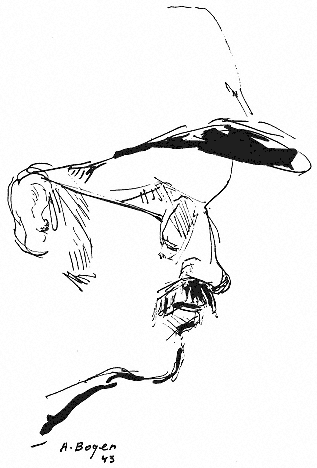
Portrait of Sutzkever by A. Bogen, drawn in the partisan forest, 1943.
Stalks
Two years I longed for stalks,
Silent stalks in a familiar field.
When I struggled in the vise
That caught me
And blocked
The road,
The green road to those stalks —
But not the stalks in the familiar field.
And when my breath melted the vise —
A wind in my veins
Whistled and called:
— "Get up, son of man, the stalks are ripe.
Now your own body is like a stalk."
And as fate walks, so walked I
Through burned cities
To that call.
But when I came, weary, through the sunset,
I reached my longed-for field —
They lay there, my brothers,
Killed over the field.
And the stalks with glowing spears,
Layer upon layer, grew through
The skulls, the ribs,
And climbed higher, higher, higher,
o the sun that gathers back its light,
As if each stalk rushed to overtake
The others.
One stalk
Went wandering
Through a mouth with clenched teeth!
Two stalks crept through shoulders.
And there, a stalk searching for a way —
A hand reaching out of the earth.
And a cornflower through an eye, weeping —
What do I see now in the evening light?
I see a field with stalks, blood red.
And rushing to me closer, comes a mower
And mows the afterwar fresh bread.
Narocz Forest, September 1943
To My Wife
I
Don't count the toll of wounds,
The suffering, the scar.
You have ignited once
A newborn baby star.
And at your feet, a spring
In our dark cave has curled,
And suddenly a baby's
Cooing has touched the world.
And like the purest spring
The word was then revealed,
But up above us no one
Must hear what must be sealed.
I knelt for you in thanks,
My spirit too did lift,
I brought you from above
Two blades of grass, a gift.
II
A child is not an other —
It's you alone and me.
It leads up on a ladder
Close to ourselves, you see.
But still before we thought
A name for him that's right,
The axes and the crowbars
Have plundered in the night.
The babe knew not a thing,
It dozed off in its rest,
A German came and ripped him
Away from mother's breast.
And what can take its place,
Dear, desolate and wild,
When from afar they glow,
The small bones of our child.
III
— And breathlessly we rush,
Through swamp and growth so wild,
You hold in hand a rifle —
A shadow of your child.
And every time the rifle
Spits out the chunk of lead,
In its dull glow we see
The child that we have bred.
As air fills up the world,
It fills our minds, a shield.
In pink of dawn, it rises,
Appears here in the field.
And over all our wounds,
Our suffering, our scar,
It did not disappear,
The newborn baby star.
Narocz Forest, September 30, 1943
March Through Swamps
Swamps.
Swamps.
Swamps.
We splash
Through flooding copper.
We carry
Forest-partisans on naked shoulders.
Behind us —
In wheeling circles, the enemy.
Ahead —
Breathing in moon-scales —
Winks, draws us in, the melting soil.
The legs, sunk somewhere deep …
On frog-keys
They play
A hymn to the swamps.
Deeper.
Nightier.
Abyss.
Glimmer —
A star in the mud —
Is rest there?
Knees — ensnarled in phosphor-nets.
Bellies — bound with glowworm belts.
Hail
Pounding on naked bodies
Frosty flaming sweat.
Soon — soon —
The naked bodies will sink,
Arms — no longer strain to stretch
High up, clutching the guns.
Only a lost sigh over shoulders
Floods consciousness
Over our maddened senses.
They grasp how real is
The serpentine intoxication,
And tear apart net after net — —
We harden the swamps with our will.
We draw to the island, the hidden hill.
We shall get there. Bold, bolder!
We carry wounded partisans on our shoulders.
Zazherye Forest, October 13, 1943
Farewell
I
Oh, not to mourn for you I come, city of my song.
For wet is still your soil, though your face is scorched.
I want to enter you like a night with glowing stars,
To shine into all windowpanes,
Wells,
Malinas. [33]
To shine into the Gaon's shul, where, from the HGRA, [34]
God's H was torn off and what remained is GRAY —
(Where is the letter H,
Does it wander now within my soul?)
And into the Great Synagogue, left alone in the Synagogue Yard [35]
With fortress walls that guard the past, the muteness.
And on Straszun Street 6 —
The very last barricade, [36]
And in the canals beneath the earth
Where Jews
Hoped for liberation and celebrated May Day.
I want to enter you like a night with glowing stars,
To shine into every house — standing or destroyed.
Into faces, living or not — for me they live!
For, as a person feels his arm just now cut off
And sees the golden ring on his severed finger —
So I feel the link
With houses,
Friends.
II
You are my first love and my first love you will remain.
I bear your name through the world
As my distant grandfather bore
Through the desert flame the Mishkan [37] on his shoulders.
(Oh, grandfather, you too hoped to see a shore!)
And anywhere I wander —
All the cities will
Transform into your image.
I will not strike roots
In any other soil,
As the water lily torn from its umbilical cord
Cannot strike roots again
In a scrap of soil under water's pressure —
And swings, lost over abyss of waves,
And no one, no one sees that the cord is torn —
III
… And dear to me as never before is your Yiddish —
The flickering wick
Of an orphaned Eternal Candle,
For only in mama-loshn [38] did a tiny baby cry:
Father,
Of all the words in the world, I lack one: Mama!
IV
I am the child that carries a blade of grass
When they lead him to slaughter.
I am the woman hiding in the sewers
Along with her newborn babe, not severed from her belly,
Where the gloom is so Infinite you think
Of mice splashing in the mud:
Angels are singing!
I am the old man, gray and wrinkled as a walnut,
Who needs, to cheat about his age, to look like twenty.
I am the boy "younger than need be"
Who must scratch his face and stand on tiptoe.
I am the last word of one fallen into the pit,
I am the helplessness of one paralyzed
Who cannot bring his arm to his throat —
To free himself.
I am the man returning from the city with gunpowder in his boots,
Creating from it a savior
As the Maharal [ 39] created a Golem.
I am the one madly in love on a creaking gallows.
(His eyes suck in from afar a smiling woman.)
I am already burned.
Frozen.
Beheaded.
But with the stream of the Viliya — swims to you my song.
V
Not to those who defiled you —
Not to them will you belong.
They will crawl blindly on their knees to your gates
And thorns will prick a second time their blindness.
No mercy in the cloud above Ponar —
It will answer prayers with rusty lightning.
Graveyard stones will tear themselves off the earth
And every single letter will hurl into their face.
And the Saint Anna Church, red like our blood,
With no mercy, will lock its narrow doors,
And like a curse forged from copper — will toll
For them the old bells in my dusk city.
And if no more Jews remain in my city —
Their souls live on in its alleys.
And he who thinks a house is empty
And walks in
And puts up an idol, a table, makes a bed,
Puts on an abandoned shirt,
A dress,
A shawl —
At night, he will hear the crying of children,
And the shirt will become a grater, shredding his skin.
Until he runs madly out of the house
As if his conscience,
Turned into a crow,
Went back into his brain.
And he will run — his own shadow will not catch up with him.
VI
From the whole world, barefoot scouts will come
With green willow-branches to your gold-stripped temple.
And everyone will dip into your heart
For a handful of ash
And take it home
To light his long slumber.
But I, who grew in the shadow of your splendor,
I carry you whole — a bloody scroll.
Vilna Ghetto and Narocz Forests, 1943–1944
Frozen Jews
Did you ever see in fields of snow
Frozen Jews, in row upon row?
Breathless they lie, marbled and blue.
Of death in their bodies, no hint and no clue.
Somewhere their spirit is frozen and saved
Like a golden fish in a frozen wave.
Not speaking. Not silent. Just thinking bright.
The sun too lies frozen in snow at night.
On a rosy lip, in the freeze, still glows
A smile — will not move, not budge since it froze.
Near his mother, a baby starving, at rest.
How strange: she cannot give him her breast.
The fist of a naked old man in surprise:
He cannot release his force from the ice.
So far, I have tasted all kinds of death,
None will surprise me, will catch my breath.
But now, overcome in the mid-July heat
By a frost, like madness, right in the street:
They come toward me, blue bones in a row —
Frozen Jews over plains of snow.
My skin is covered with a marble veil.
My words slow down, my light that is frail.
My motions freeze, like the old man's surprise,
Who cannot release his force from the ice.
Moscow, July 10, 1944