
The USSR Academy of Sciences' Leningrad Scientific Center
As noted earlier, the drive toward integrated research-production management may also be seen in local support for attempts by the Academy of Sciences to unite all preexisting Leningrad operations within a single Leningrad-based scientific center. Along with wartime evacuations and losses, the prewar transfer of the Academy of Sciences' main administration to Moscow depleted Leningrad of many of its leading researchers and weakened its institutional base within the national academy structure.[56] By the mid-1950s, the relocated academy had spawned a dozen republic-level academies of sciences, as well as an embryonic network of regional scientific centers, including the prestigious Siberian Division based in Novosibirsk.[57] Two decades later, nearly every autonomous republic had an academy "scientific branch" integrating a series of research functions under local management.[58]
Meanwhile, Leningraders had only a handful of academy research facilities (e.g., institutes, laboratories, libraries, archives), most of them mere "Leningrad branches" in the hierarchy of Moscow-based research institutions. This long-standing subordination, by which Leningrad facilities were subdivisions of Moscow research institutes, placed many decisions concerning critical personnel, research, and resources in the hands of institute directors in charge of major academy installations in the capital. Such a state of affairs meant that Leningrad's local political officials had less than direct or total control over the academy's Leningrad operations. Admittedly, however, many in the city's scientific community preferred having the general political oversight function lodged with officials far away in Moscow rather than situated virtually next door in Leningrad itself.
By the mid-1970s, Grigorii Romanov had taken considerable interest in the state of the academy in Leningrad. In 1975, acting at Romanov's prompting (at least according to anecdotal evidence), the academy merged existing Leningrad divisions, as well as sections of a half-dozen Moscow-based social science research centers, to form the Institute of Socioeconomic Problems.[59] Very soon thereafter, Leningrad party officials began to agitate for a similar arrangement in the natural sciences so as to ensure that academy research would better serve the interests of local industry (and of political leaders such as Romanov).[60] As the seventies closed, Leningrad politicians were lobbying to upgrade the local presence in the academy structure, thereby recapturing some of the status lost when the academy moved to Moscow during the 1930s.
This advocacy for improved status not unexpectedly encountered bureaucratic opposition within the academy itself. To gain greater autonomy, Leningrad research centers would have to sever their longstanding affiliations with Moscow institutions, and the Muscovites naturally resisted such proposals. The academy began to relent, however, responding to pressure from an ever-more-powerful Romanov and other Leningrad-based politicians to hold local scholars accountable first and foremost to the Leningrad party organization. Considerable unofficial and unpublished evidence points to Romanov's major role in this effort. His growing stature in the national Communist Party hierarchy undoubtedly assisted the efforts of Leningraders to seize control of their local institutions. In 1979, the entire academy structure in the Northwestern RSFSR (see Map 1) was placed in the jurisdiction of a new Leningrad-based interagency coordinating council.
The new body quickly established 14 specialized subcouncils to coordinate all research in Leningrad (both the city and the region), as well as in the Arkhangelsk, Vologda, Novgorod, Murmansk, and Pskov regions and in the Karelian and Komi autonomous republics.[61] The new coordinating council did not limit itself to the Academy of Sciences, but publicly declared its intention to direct all research activities in the natural, technical, and social sciences carried out within its jurisdiction by all research centers, regardless of their institutional subordination.[62] In an article appearing in Pravda on August 4, 1981, Romanov emphasized the role of the council in coordinating the relationship between scientific research and economic production.[63] Thus, Romanov made it clear, as he did again in the party's leading ideological journal, Kommunist, that Leningrad science must serve Leningrad industry.[64] Finally, just weeks after Romanov had left Leningrad to join the Central Committee's Secretariat in Moscow, the Academy of Sciences, acting at the behest of the Central Committee, announced the formation of a new Leningrad Scientific Center, responsible for all academy activities in the Northwestern RSFSR (see Chart 4).[65]
The establishment of the academy's Leningrad Scientific Center
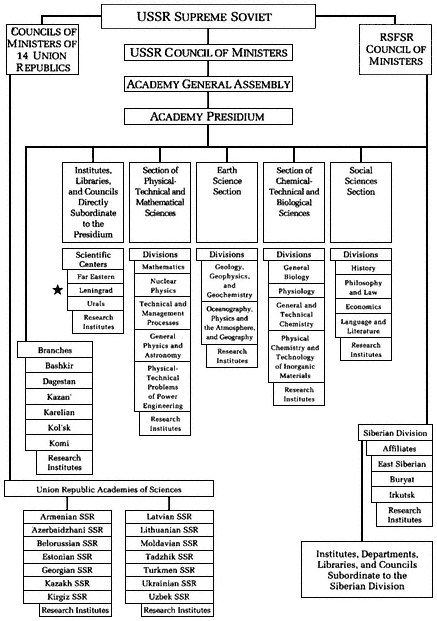
Chart 4.
Research system of the USSR Academy of Sciences
and the Academies of Sciences of the Union Republics.
marked a new stage in the relationship between Leningrad's scientific and industrial communities (and one not necessarily welcomed by scholars concerned with basic research). Based more fully on local control than was true of previous academy arrangements in Leningrad, the center declared its primary objective to be the advancement of local economic production. In published interviews appearing at the time, the center's chief executive, Academician Igor Glebov, noted that the new organization would seek to direct all research (not just that of the academy) toward the more efficient utilization of research results in production. Glebov reported that the center had incorporated 14 academy scientific councils and 31 research institutes operating within the Leningrad region, while its presidium included the 80 full and corresponding members of the academy resident in the region.[66] The center also anticipated moving the bulk of its operations to Shuvalovo, a new satellite community on the city's northern outskirts.
Romanov, Glebov, and, later on, Lev Zaikov repeatedly observed that the center's research branches must link scientific research with economic production so as to enhance opportunities for technological innovation in local industry.[67] In this regard, the creation of the Leningrad Scientific Center is yet another stage in the continuing effort of local political elites to control and maintain the city's economy as a leading innovative center in the national economic system.
In February 1985, on the eve of Konstantin Chernenko's death, Romanov returned to Leningrad to present his election speech to the RSFSR Supreme Soviet ward in the city's Smol'ninskii District.[68] The address, which turned out to be his last major public appearance in the city, stressed the need to quicken the pace of technological innovation in Leningrad industry. He offered perhaps the most precise formulation of the Leningrad Scientific Center's role in that effort, pointing to the development of the Ukrainian Academy of Sciences as a model to be emulated in Leningrad. Romanov's references to the Ukrainian academy are noteworthy, for that institution had reoriented much of its research effort around applied research designed to enhance the republic's economic potential.[69] Significantly, one of the first major institution-building efforts of the new Leningrad Scientific Center was the formation of a new Institute of Information Sciences and Automation just one year later, in March 1986.[70] This theme of the center's role in linking science and industry has been frequently repeated since.[71]
The history of the founding of the academy's Leningrad Scientific Center, as well as the development of local scientific-production associations, illustrates long-standing themes in the Soviet approach to R&D. As Thane Gustafson has pointed out, these are that (1) science is the source of most worthwhile innovations; (2) industry is a source of most obstacles to innovation; and (3) the solution is to give scientists direct control over production facilities.[72]