
PART I
ENEMIES FACE TO FACE
On August 8, 1945, two days after an American B-29 dropped an atomic bomb on Hiroshima, General Douglas MacArthur said to news correspondent Theodore White, "Wars are over, White, wars are over. There will never be another war. Men like me are obsolete. There can't be any more wars."[1] This inspiration seems to have come on MacArthur, a lifelong warrior, like a flash of light. It remained with him for a long time and had a profound effect on his thinking.
The bombing of Hiroshima was an awesome event. A 4-ton bomb containing uranium 235 was detonated over Japan's seventh largest city, an important regional and military center with a population of 400,000. The most powerful weapon in history, its explosive force equaled 12.5 kilotons of TNT, the same as a conventional bombload of two thousand B-29s. It destroyed 90 percent of the city. Within the next four months probably between 90,000 and 100,000 persons died as a result, including a dozen or so American prisoners of war and thousands of imported Korean workers. Many more Japanese died thereafter from injuries directly attributable to the bomb.[2]
Two days later the Soviet Union, in a speedup of its schedule, declared war on Japan and attacked Imperial Army forces in Manchuria and Korea. The day after, August 9, a second atomic bomb, of 4.5 tons and made of plutonium 239, was dropped on Nagasaki, with an explosive force of 22 kilotons of TNT. Within a month between 60,000 and 70,000 people died as a result. Ironically, the bomb was dropped about
two miles off target when the plane was getting low on fuel and detonated not far from the Urakami Cathedral, a large Roman Catholic church. The military necessity of dropping a second atomic bomb has become one of the more debated issues of World War II.
Yet Japan was not ready to surrender. It was a nation with a long and proud history of military valor. This samurai tradition, sometimes called the "spirit of Yamato," had not disappeared during a century of modernization. The conflict in the Pacific had been tough and brutal, aptly described as a "war without mercy," but the imperial forces had fought without surrender in a series of bloody battles in the western Pacific. Japanese leaders had had great difficulty in deciding how to react to the Potsdam Declaration issued in Germany by the major Allied powers on July 26, 1945, calling on Japan to proclaim the unconditional surrender of its armed forces or face "prompt and utter destruction." Prime Minister Suzuki Kantaro, an octogenarian retired admiral and hero of the Russo-Japanese War, decided after a tense debate with his advisers that Japan would "ignore" the Allied statement. The word he used, mokusatsu , somehow got into the press the next day. The New York Times reported that Japan "formally rejected the Allied declaration."[3]
But staggered by the cataclysmic blows received during the month of August, Japan's leaders had to choose between vague Allied peace terms that might be a disaster for the nation and continuation of a war Japan could not win. The Supreme Council for the Direction of the War, a six-member body of senior officials created a year earlier to make defense policies, met on August 9 to decide what to do.[4] Three of its members, all military men, were determined to fight on until one final "decisive battle" would show both sides the futility of further combat and compel them to agree to negotiate an armistice. But the events of August made even these ardent warriors waver. They had no defense against this terrible new American weapon, although in the confusing period after the bombing of Hiroshima very few people knew what had hit them. The USSR's entry into the war wiped out the last hope of enlisting Soviet mediation and dividing the Allies. The council, and the cabinet that met soon afterward, were hopelessly deadlocked after tense meetings that lasted much of the day. In desperation the prime minister requested another meeting that night to put the issue directly to the emperor, an action without precedent in Japanese history.[5]
Despite General MacArthur's flash of inspiration, World War II was
not over. Nor could it be said—yet—that Japan was ready to give up, despite all its battle losses in the Pacific, the fearful pounding from the air it had been undergoing, the Allied peace offer, two atomic bombs, and Soviet attacks on the outposts of its empire.
Chapter 1
Tense Beginnings
World War II ended when the emperor decided that Japan should accept the offer of terms made by the Allied powers. Two gozen kaigi , "meetings with the emperor," were required before the bitter division in the Supreme War Council could be bridged. In this unique crisis, only the emperor could make the decision. And only he had the authority to ensure that it would be carried out. At the first meeting the emperor said, "I cannot bear to see my innocent people suffer any longer." He added that he did not believe his armed forces could repel an invasion. He felt regret for all those who had died in the war and said it would be "unbearable" to see "the loyal fighting men of Japan disarmed" and some "punished as instigators of the war."[1]
After this meeting on the night of August 9, the Japanese government sent a note to the United States stating that it accepted the Potsdam Declaration on the understanding that acceptance would not prejudice "the prerogatives of His Majesty as a sovereign ruler." The United States replied artfully that "the authority of the Emperor and the Japanese Government to rule the state shall be subject to the Supreme Commander for the Allied Powers, who will take such steps as he deems proper to effectuate the surrender terms." At the second meeting on August 14, the emperor said he thought the U.S. response was "evidence of the peaceful and friendly intentions of the enemy" and reiterated that he could "not endure the thought of letting my people suffer any longer."[2] At this point the United States was intensifying the bombing of Tokyo.
The Japanese then sent a reply accepting the Potsdam terms and giving assurance that they would carry out the surrender arrangements. President Harry S Truman announced the same day that he considered the reply "a full acceptance of the Potsdam Declaration, which specifies the unconditional surrender of Japan."[3]
The Japanese people heard the voice of their emperor for the first time when he broadcast to the nation on August 15. Despite the stilted court language used by the man known as Tenno to his subjects and as Hirohito to the outside world, his meaning was unmistakable. Speaking of the Allied powers' statement at Potsdam, he said, "Our Empire accepts the provisions of their joint declaration." He did not use the word surrender . He added, perhaps optimistically, that Japan had "been able to safeguard and maintain the structure of the imperial state.[4]
The willingness of the Japanese to respond to "the voice of the crane" by abandoning a policy of militant nationalism and calmly facing an unknown and frightening future was strikingly illustrated that day.[5] Historians debate what caused Japan to surrender, but the intervention of the emperor was crucial. Nevertheless, despite all Japan's troubles, including the shock of the atomic bomb, the emperor's intervention would probably not have been effective or even possible before August 10. After his death in 1989 the Tenno became known as Emperor Showa, meaning "enlightened peace," a title that his deeds in 1945 and afterward may well justify.
A new cabinet was soon organized, headed by Prince Higashikuni Naruhiko, an uncle-in-law of the emperor and. a career army officer. The cabinet's greatest concern was that the armed forces might not obey the emperor's cease-fire order of August 16. Hotheaded rightists might try to seize control of the government, or army forces on the Asian mainland might decide to fight on. But the authority of the imperial order prevailed, and after a few tense days and a number of suicides by recalcitrant rightists or military men carrying out the code of loyalty to ,the throne, compliance was complete throughout the empire.[6]
General MacArthur was at his headquarters in Manila when the war ended. He had been told officially on August 15, 1945, that he would be named supreme commander for the Allied powers to receive the Japanese surrender and command the Allied forces of occupation. He did not return to Washington or receive any special briefing for his new assignment.
Yoshida Shigeru, who had retired from the diplomatic service in 1939, was living at his country home in Oiso, thirty-five miles south-
west of Tokyo, at that time. He was not feeling well, but he was not so sick that he could not get up to Tokyo to celebrate with his friend Prince Konoe Fumimaro. Yoshida, who enjoyed parties and whiskey, got so tipsy that he fell asleep and missed his stop on the train back home.[7]
The first U.S. forces landed in Japan on August 28, two weeks after the imperial pronouncement. That interval provided a respite for both sides, giving time for emotions to simmer down and for future steps to be planned. A sixteen-member Japanese delegation went to Manila on August 19-20 to receive advance copies of the surrender documents and work out details for the ceremony. The businesslike discussions covered all the necessary ground in two meetings. The Americans were firm, but, according to one of the Japanese, they were "gentlemen. "[8]
MacArthur had decided that he would go to Japan at an early time, just as he had accompanied his invading forces during his campaigns in the Southwest Pacific. "To prevent regrettable incidents," the Japanese wanted a longer delay than MacArthur would accept. Although staff members worried about his security, they finally reached a compromise with the Japanese on a three-day delay in the arrival of the advance party—to August 26, with the general to come in on August 28.[9]
Providentially, a typhoon blew up on August 22, and the Americans decided to wait two more days. On August 28 the advance group of 146 communications and engineering specialists landed at Atsugi air base, thirty miles southwest of Tokyo, to make final arrangements for the arrival of the main elements. Two days later, on August 30, U.S. troops arrived in force both at Atsugi and at the big naval base of Yokosuka, fifteen miles east of Atsugi. Every four minutes another big transport plane arrived and unloaded troops and equipment. When MacArthur came in on his command plane, Bataan , at 2 P.M., the sky was bright and Mount Fuji stood out clearly forty miles to the west.[10]
As the plane neared Japan, MacArthur's military aide and close confidant, Brigadier General Courtney Whitney, nervously mused to himself: "Had death, the insatiable monster of battle, passed MacArthur by on a thousand fields only to murder him at the end?" Whitney's worry was not unfounded. The Imperial Army had some 3 million men in Japan's home islands, and 300,000 of its best troops were in the Tokyo area, trained for a last stand. Only 4,200 U.S. soldiers were in the vicinity when the supreme commander slowly descended from his plane at Atsugi. Winston Churchill later termed this act "the outstanding accomplishment of any commander during the war... in the face of several million Japanese soldiers who had not yet been disarmed."[11]
Except for the spirited music offered by the Eleventh Airborne Divi-
sion band, there was no ceremony. MacArthur had wanted no massive display or parades and had passed the word that there should be no delegation of Japanese to meet him, although Japanese reporters and photographers would be permitted to cover his arrival. For the benefit of those assembled there, the general pronounced the less-than-immortal words, "Melbourne to Tokyo was a long road, but this looks like the payoff."[12]
The Japanese press wrote up the event in detail for the intensely interested nation. It made much of the general's informal dress—khaki uniform, open collar, no jacket or ribbons, aviator glasses, and even his corncob pipe. The photo of MacArthur emerging from his plane and calmly surveying the situation attracted worldwide attention. One Japanese writer compared MacArthur's descent from his plane to the well-known actor Kikugoro descending the hanamichi , or passageway to the stage of the kabuki theater. The general always took care that his dramatic arrivals, like the one a year before when his forces invaded the Philippines, were well photographed.[13]
An astute Japanese editor who knew the United States well termed MacArthur's exploit "an exhibition of cool personal courage; it was even more a gesture of trust in the good faith of the Japanese. It was a masterpiece of psychology which completely disarmed Japanese apprehensions. From that moment, whatever danger there might have been of a fanatic attack on the Americans vanished in a wave of Japanese admiration and gratitude."[14]
Nevertheless, the general realized he had taken a big chance. A few weeks later he proclaimed that "probably no greater gamble has been taken in history than the initial landings where our ground forces were outnumbered a thousand to one."[15] But it had been a carefully considered gamble. The parleys at Manila and the treatment of the advance party had given powerful evidence of Japan's determination to cooperate and of its well-known ability to maintain order. Disciplined cooperation with the. occupation forces replaced fear and tension and continued as the order of the day for the next six and one-half years.
The Japanese were taking a gamble, too, although the savage beating they were suffering every day at the end of the war left them little room for bargaining. Japanese moderates had calculated that the United States would not be a vengeful conqueror, and they had all but convinced themselves that the victors would not seek to destroy or mutilate: the emperor system.[16] The initial actions of MacArthur and the U.S. troops reinforced these hopes.
On September 2, two days after MacArthur's arrival, the occupation of Japan formally began with the surrender ceremony on the battleship Missouri . In that interval the general was busy working out Allied surrender arrangements, drafting the two speeches he was to give (one at the ceremony and the other to the people back home) and, most difficult of all, trying to coordinate Allied plans for the surrender of Japanese forces in China, Southeast Asia, and the western Pacific.[17] His office was in the cavernous customs building in Yokohama, which was one of the few big structures in the area to survive the air raids in fairly good shape.
The arrangements for the surrender had given both sides some trouble. The victorious Allies had difficulty in deciding which of them should sign the surrender papers, finally agreeing that representatives of the Big Four—the United States, China, the United Kingdom, and the Soviet Union—should sign first, followed by representatives from five other Allies. The U.S. Army and Navy had to work out some service differences over which should have the bigger role, senior navy officials believing, not without reason, that the navy had done more to bring about the defeat of Japan than the army had. But since General of the Army Douglas MacArthur had been designated supreme commander for the Allied powers to accept the surrender and carry out its terms, Fleet Admiral Chester W. Nimitz, the navy's top commander in the Pacific, was given the honor of signing as the representative of the United States of America. The navy got the bonus of a decision by President Truman that the event should take place on a U.S. battleship named after his home state and christened by his daughter. The rivalry did not end there, however, because even as the main American units started to land in Japan on the morning of August 30, reports from Yokosuka circulated that navy landing boats were "full of admirals trying to get ashore ahead of MacArthur."[18]
Japan had a more acute problem: no one wanted to sign a "surrender" document. The United States had abandoned its first plan—that the emperor sign—and had accepted a British suggestion that his authorized representatives would be good enough. It then became necessary for two Japanese to sign—one for the government and the other for the military command—to conform with Japan's constitutional division between civilian and military authority. Prime Minister Higashikuni was ruled out because he was a relative of the emperor. The army chief of staff, General Umezu Yoshijiro, threatened to kill himself if he were pressed to sign. The one senior official willing to accept this onus was
the minister of foreign affairs, Shigemitsu Mamoru, who appeared genuinely to believe that surrender was good for the nation and would give it a chance to start over on a wiser course.[19] Under pressure from the throne, Umezu gave in and agreed to sign for the imperial general staff. He and Shigemitsu were accompanied on the Missouri by a group of nine officers and diplomats.
The surrender ceremony was the most photogenic event of the occupation. It was not the dramatic scene John Trumbull portrayed of Washington receiving the British surrender at Yorktown. No band played "A World Turned Upside Down," although this would have been even more fitting for the Japanese in 1945 than it had been for the British in 1781. But the Missouri did have one outstanding historical touch: mounted on a huge bulkhead for all to see was the Stars and Stripes (bearing thirty-one stars) flown by Commodore Matthew C. Perry when his "black ships" entered Edo Bay in 1853 to force the opening of Japan to the outside world. And the American flag that had flown over the U.S. capitol on December 7, 1941, the day Pearl Harbor was bombed, flew over the Missouri .
The ceremony began at 9A.M. on September 2. The Japanese delegation had come aboard the Missouri a few minutes before. Several hundred Allied officers were waiting along with reporters and photographers, including some Japanese. The U.S. officers, without ties or decorations, contrasted with the other officers, who were in dress uniform, and the Japanese diplomats, who wore formal morning attire with top hats. No one carried side arms. There was no ceremonial surrendering of swords.
General MacArthur presided over the ceremony, which took only twenty minutes. In accepting the surrender, the general expressed the hope that "out of the blood and carnage of the past," a better world would emerge. "Nor is it for us here to meet... in a spirit of distrust, malice or hatred. But rather it is for us, both victors and vanquished, to rise to that higher dignity which alone befits the sacred purpose we are about to serve."[20]
After MacArthur signed the two copies of the surrender documents, one in English and the other in Japanese, the two Japanese representatives signed, followed by the nine Allied representatives. The foreign minister was not sure where to sign and had to be shown. The Canadian representative signed the Japanese copy on the wrong line, forcing the three remaining signatures out of place. When a troubled Japanese official pointed out the error to MacArthur's chief of staff after the
ceremony, a considerable colloquy took place. The chief of staff then inked in and initialed the necessary corrections The performance on the Missouri was at least better than the German surrender four months earlier, when the wrong documents were signed at Rheims on May 7 and a second surrender ceremony had to be held two days later in Berlin to do it right.[21]
The key clauses in the surrender instrument read, "We hereby proclaim the unconditional surrender to the Allied Powers of the Japanese Imperial General Headquarters and of all Japanese armed forces and of all armed forces under Japanese control wherever situated.... The authority of the Japanese Emperor and the Japanese Government to rule the state shall be subject to the Supreme Commander." The emperor's rescript of September 2 commanded the Japanese government and armed forces to "faithfully carry out" the provisions of the surrender document.
After the signing ceremony, General MacArthur made a radio broadcast to the American people, which was delayed in transmission so that President Truman could make a speech right after the surrender ceremony. The general was eloquent and statesmanlike: "We are committed by the Potsdam Declaration of principles to see that the Japanese people are liberated from this condition of slavery.... If the talents of the race are turned to constructive channels, the country can lift itself from its present deplorable state into a position of dignity."[22]
The occupation had officially started. The emperor's decision to end the fighting had been indispensable. General MacArthur had set the tone—low-key and businesslike but firm and decisive. The tensions on both sides began to dissipate. U.S. troops went around unarmed. Japanese men and women began to appear again on the streets of Yokohama and Tokyo in their usual numbers. In place of the hostilities of the past, the two countries started to look for ways to resolve in peace the clash of their conflicting purposes and different cultures.
Japan was in bad shape at the end of the war. About two million of its people had lost their lives. Of these some six hundred thousand were civilians killed or injured in air raids, in the fighting on Okinawa, and in the atomic bombings.[23] More than half a million military men were reported missing at the end of the war, most of them captured by the Russians in Manchuria and taken to Siberia as prison laborers. The British also detained a large number of prisoners of war in Southeast Asia and employed them as laborers for several years.
Sixty-six of Japan's larger cities, including Tokyo and Yokohama,
were about half-destroyed. Eight and one-half million persons were homeless. More than one-quarter of Japan's residential housing was wiped out or badly damaged. The country had lost one-quarter of its national wealth, equal to $26 billion worth of its capital stock, such as buildings, machines, and equipment.[24]
During World War II Allied leaders had declared that Japan would be compelled to give up all territory it had "taken by force and greed."[25] Defeat meant that it would lose half its territory, leaving it with only 142,644 square miles, almost identical to what it possessed in 1833 when Commodore Perry first arrived. The loss of the southern Kuriles was a particularly hard blow because Japan had legally established its claim well before its colonial expansion. If Roosevelt and his advisers had known this piece of history, they might have qualified their agreement at Yalta in early 1945 that "the Kurile Islands shall be handed over to the Soviet Union." In August 1945 Washington decided only at the last minute that Soviet forces rather than U.S. forces should occupy the Kuriles.[26] A generation later the Japanese government and many of its citizens were still protesting the loss of the southern Kuriles and the adjacent islands off Hokkaido, the Habomais and Shikotan, that are geologically distinct from the Kuriles but were also seized by the Soviets in 1945.
The United States took control of the Ryukyu Islands in June 1945 after a bloody campaign. The islands were returned to Japanese control in 1972 after twenty-seven years of U.S. administration. Except for the Ryukyus and a few other small islands to the south, including the historic battleground of Iwo Jima, all of which were returned to Japan by the United States, Japan's territory has not changed since the surrender.
At the end of the war Japan's population was about 72 million. Around 7 million more Japanese, military and civilian, were located outside of Japan, mostly in China. About 2 million Koreans and. Taiwanese lived in Japan as conscript laborers or farmers. Soon after the war ended, massive repatriations took place. More than one-half the Koreans and Taiwanese returned to their homelands, although many Koreans came back to Japan because of unsettled conditions in Korea. The net balance of all these shifts in population added more than 6 million to Japan's total in the years after the war, bringing it close to 80 million in 1950.[27]
There had been no panic or breakdown in morale or control during the war. The cohesiveness and discipline of Japanese society, reinforced by strict police surveillance and tight organization by neighborhoods
throughout the country, seemed equal to any disaster. Japanese populations on Saipan and Okinawa had gone to their deaths by the thousands as the U.S. forces swept over the islands, thereby providing strong evidence that the people in the homeland would not waver if they, too, had to face the supreme holocaust. Harry Truman's hope that the United States "could avert an Okinawa from one end of Japan to another" was probably a factor in his decision to use the atomic bomb and seek to end the war quickly.[28]
Forceful resistance to the war had been almost totally absent, although there were many examples of dissatisfaction and noncooperation during the war. Popular opinion was carefully controlled in wartime Japan, the people knew little about the disasters that had befallen the imperial forces, and the few incidents of dissidence that did occur were ruthlessly suppressed. As a result, evidence of revolutionary antiwar resistance was minor. The decision to surrender came as a great blow to most Japanese, even if many of them realized the situation was all but hopeless.
With the war finally over, a flood of emotions swept over the country—fear, humiliation, and even relief. The government tried for a time to whip up a campaign of "national penitence" for the "mistakes of the government, the bureaucrats and the people,"[29] but little came of it. The people seemed to feel little sense of guilt about the war or about what Japan had done. But they did feel the war had been a surpassing disaster, and many thought their military leaders had misled and failed them. People seemed to feel more resentment toward their leaders than penitence about themselves, and some spoke of the Americans as "a liberation army" rather than as conquerors. Other euphemisms soon came into common use: people did not say "the surrender" but "the end of the war," and "garrison force" was used instead of "occupation force."[30]
In contrast to Japan, the United States was at its zenith of power and prestige when the war ended. In defeating the Japanese empire almost single-handedly, the United States had won its greatest victory since the founding of the republic. It was the richest and most powerful nation in the world. It was the sole possessor of the atomic bomb. America had also made a large contribution to the defeat of Nazi Germany and was a leading player in Allied negotiations to reach a postwar settlement in Europe. Pax Americana was at hand. Its executor in Japan was Douglas MacArthur.
Chapter 2
First Encounters
Japan's sudden surrender forced Washington and Tokyo to throw their war machines into reverse and improvise new arrangements. Americans and Japanese spent much of the month of September getting organized and learning more about each other. Except for a few diplomats, military attaches, and businessmen in both countries and some American scholars and missionaries, the rival nations did not know each other very well. Although Douglas MacArthur and Yoshida Shigeru were well-traveled men, neither had more than a passing acquaintance with the other's country. MacArthur's meetings in September 1945 with Shigemitsu, Yoshida, and the emperor were therefore of capital significance as a learning experience for both sides and as a means of determining the basic procedures and style of the occupation.
Before going to Japan in 1945 MacArthur had spent sixteen years in Asia, served four tours of duty in the Philippines, and been in Japan briefly four times. After a lengthy trip around Asia in 1905 and 1906, he spoke of its "mystic hold upon me" and grandly observed, "It was crystal clear to me that the future and, indeed, the very existence of America were irrevocably entwined with Asia and its island outposts." After meeting some of the Japanese military men who had distinguished themselves in the Russo-Japanese War of 1904-1905, he described them admiringly as "grim, taciturn, aloof men of iron character and unshakeable purpose." He added that he "was deeply impressed by and filled with admiration for the thrift, courtesy and friendliness of the ordinary citizen" of Japan.[1]
At the outbreak of World War II MacArthur was in command of U.S. and Philippine forces in the Philippines. After putting up a brave but hopeless defense against the invading Japanese, his forces were on the point of surrender in 1942 when President Franklin D. Roosevelt ordered him to Australia to command Allied forces in the Southwest Pacific. MacArthur led U.S. and Australian forces in a number of well-planned and skillfully executed operations through New Guinea and the Philippines. In June 1945 he was appointed to command the forces scheduled to invade southern Japan five months later. No doubt his confidence that "destiny had called him to the Orient" was bolstered when the Soviet Union and the United Kingdom concurred in his selection by Truman as the supreme Allied commander in Japan.
Commanding in both stature and personality, MacArthur rarely displayed doubt in his ideas or uncertainty in his action. His talent for managing situations and influencing people was almost theatrical. Lord Mountbatten, the Allied commander in Southeast Asia, remarked that "he does not look at all fierce or commanding until he puts his famous embroidered cap on. As we went out together to face the photographers and he pulled his cap on, his whole manner changed. His jaw stuck out and he looked aggressive and tough, but as soon as the photographers had finished, he relaxed completely, took off his hat, and was his old charming self."[2] The hat was for MacArthur what hair was for Samson.
MacArthur had some remarkable attributes of body and mind. He was unusually healthy. He could stand at attention for an hour at a Fourth of July review and show no weariness. He caught cold only a couple of times during his five and one-half years in Tokyo. He took no exercise. Even more remarkable was his memory. After one reading he could remember a document clearly for a long period. Or he could remember people and what they had talked about for years after he met them. He memorized the names and pertinent facts about luncheon guests and would astonish them with how much he knew about them. His command of the facts made him a formidable advocate in any discussion. Yet he was not above tailoring his views in ways he thought would appeal to his listeners. And his memory seems to have been selective, for he sometimes failed to remember important things he had said or done.
His personal life was uneventful. He made a happy marriage in 1937 after the failure of his first try. In the interim between marriages he had an interlude with a Eurasian mistress. His only child, a son who was
named Arthur after his distinguished grandfather, was born in 1938 and lived with his parents throughout the war and the occupation.
MacArthur knew the Philippines well and had an affection for its people. He admired Japan's military capabilities but knew little of the country's people and politics. In his memoirs he characterized Japan as a "feudal society of the type discarded by the Western nations four centuries ago," terming it a "theocracy" where the "God-Emperor was absolute" and where there were no civil or human rights. During the war he liked to say, as he told Roosevelt's emissary, the playwright Robert Sherwood, in early 1944, that the destruction of Japan's military power would eliminate the concept of the emperor's divinity, thereby creating a spiritual vacuum and an opportunity for concepts such as democracy and Christianity to flow in. The general went on to say perceptively that enlightened leadership by the United States in the occupation of Japan "will make us the greatest influence on the future development of Asia. If we exert that influence in an imperialistic manner, or for the sole purpose of commercial advantage, then we shall lose our golden opportunity, but if our influence and our strength are expressed in terms of essential liberalism, we shall have the friendship and the cooperation of the Asiatic people far into the future."[3]
During his tenure in Tokyo the general met with more than one hundred Japanese, singly or in small groups. On a few occasions he met with big delegations, such as thirty-five new women Diet members on June 20, 1946, or a group of swimming champions on August 10, 1949. He met only about fifteen Japanese more than once. He received the emperor every six months, for a total of eleven times, always at his residence, the American Embassy. The crown prince with his American tutor, Elizabeth Vining, called on MacArthur once. He saw Yoshida some seventy-five times, far more than any other Japanese.[4] In his memoirs MacArthur made only passing reference to Yoshida and Japan's other postwar leaders. He gave the emperor more space than any of the others.
In September 1945 the supreme commander saw more Japanese than in any other month of the occupation. He seemed eager not only to convey his views but also to hear what they thought. He saw the emperor, the prime minister, the deputy prime minister, two different foreign ministers, the finance minister, the leaders of the Diet, mayors of the big cities, and some former military men. Rarely did MacArthur summon Japanese to meet with him. He called in Yoshida once or
twice but almost invariably let the Japanese take the initiative if they wanted to see him.
MacArthur once told his political adviser he would "never break bread with the Japanese." He had no social contacts with any Japanese, although he did not object to others on his staff doing so. He did not impose any broad restrictions against "fraternizing" with the Japanese. The general did not travel about the country. He did take one long sightseeing ride around downtown Tokyo in the early days of the occupation, and he occasionally motored to the airport ten miles away to greet senior visitors. Otherwise his routine seven days a week was strictly limited to going back and forth from his residence to his headquarters in the Dai Ichi Insurance building one mile away.[5]
After the first few months, MacArthur confined his meetings with Japanese in most cases to only a few senior officials. His style of leadership seemed to change at that point. General Charles A. Willoughby, his longtime intelligence officer and one of the "Bataan crowd" (the group that had left the Philippines with MacArthur in 1942), used the term grand seigneur to describe MacArthur during the occupation; he began to keep his distance from all but the most important Japanese and an inner circle of his top staff officers.[6] His immediate staff found him relaxed and easy to get along with.
The most significant of MacArthur's early meetings took place a day after the surrender on board the Missouri . On September 3 Foreign Minister Shigemitsu rushed to Yokohama to persuade the general to suspend action on three proclamations he had already signed. These decrees would have placed all powers of government under the authority of the supreme commander, set up military courts to deal with violations of occupation orders, and established occupation currency as legal tender in Japan. This meeting, MacArthur's first with a Japanese cabinet minister, was critical for the losers as a test of what they might expect from the conquerors. The proclamations seemed to point to direct military government by the occupiers.[7]
Shigemitsu told the general that the Japanese government would faithfully carry out the Potsdam Declaration and the surrender terms and would issue whatever orders the supreme commander required to give these documents effect. Shigemitsu said that the occupation authorities could, of course, act directly if they were not satisfied with the government's performance. MacArthur replied, "There would be no difficulty if the content of the proclamations were carried out by the
Japanese Government and people" acting in good faith. He added, in a remarkable display of flexibility, that the U.S. government "had no thought of destroying or enslaving the Japanese nation" and was indeed "considerering ways to assist Japan somehow in its difficulties." Following the meeting the proclamations were suspended. For the duration of the occupation, orders were issued to and executed by the Japanese government. Its bureaucratic system was thus preserved intact, thereby affording an important element of continuity but at the same time, according to some critics, enabling Japanese bureaucrats, one of the pillars of the prewar administrative system, to remain in office and possibly dilute the impact of occupation directives.[8]
That MacArthur signed the three proclamations was surprising because the notes exchanged by the United States and Japan on August 10 and 11 made it clear that the emperor and the Japanese government would continue to function. In the rush of events at the time of the surrender, this new policy may not have been clearly understood. In any case, MacArthur removed any doubts by his concession to Shigemitsu. The Japanese had been particularly exercised by the proclamation that U.S. military scrip would be valid currency in Japan, a practice the Japanese had freely employed in areas occupied by their forces.
The Japanese probed for other soft spots in the U.S. position. They had resisted an Allied order in August to turn over their diplomatic records in neutral nations on the ground that this did "not correspond to any provision" of the Potsdam Declaration. Obviously, the Japanese hoped to carry on diplomatic relations with neutral nations. After Shigemitsu was so indiscreet as to leak to the press the results of his talk on September 3 with the supreme commander, MacArthur requested Washington to issue a statement that because Japan had surrendered unconditionally, he should not entertain any question as to his supreme authority. Faced with this display of U.S. firmness, the Japanese carried out a new order to turn over these records and also terminated all relations with neutral nations.[9] Throughout the occupation Japan deftly skirted the issue of "unconditional surrender," and the United States obliged by never pressing it. Although a few Japanese legalists have continually asserted that the surrender was in fact conditional by virtue of the wording of the Potsdam Declaration and the notes exchanged at the time, this has not been an important historical issue.
After seeing Shigemitsu, MacArthur met with other cabinet members. He saw the first postwar prime minister, Prince Higashikuni Naruhiko, a bluff career army officer, but did not find much common
ground. The supreme commander lectured the prince at their first meeting on the role women could play in a democracy, and two weeks later, at a meeting with the prince on September 29, the general said he saw no reason for any change in the cabinet.[10]
The general also met twice with the deputy premier, Prince Konoe, scion of one of Japan's oldest families and prime minister three times in the years leading up to the war. At their first meeting, on September 13, MacArthur held forth on the evils of Japan's prewar nationalist zealots. Three weeks later Konoe delivered his favorite lecture on the subversive threat to Japan during the war from "the union of the military forces and the left" and on his fear that "if you wipe out in one blow the established feudal forces and the zaibatsu (powerful family combines) as well, Japan will immediately go communist." MacArthur did not respond to this dire advice, which was much like what Konoe said to the emperor eight months before. Instead, the general asserted that the constitution should be revised and suggested to Konoe that he was still young enough to lead liberal elements in the country.[11]
At MacArthur's behest several staff officers met with Konoe and passed on suggestions for constitutional change. The emperor and his dose adviser, Marquis Kido Koichi, the privy seal, decided to use Konoe as a special consultant to study constitutional issues from the point of view of the palace, possibly because they thought this might please MacArthur.[12] Konoe and his team energetically rushed ahead with their study.
On September 17 SCAP headquarters moved to the imposing head office building of the Dai Ichi Insurance Company in downtown Tokyo, across the moat from the imperial palace. The Japanese had hoped to be spared the indignity of occupation of their capital, but the Allied commander decided to rule Japan from an office within sight of the palace.[13] And for years to come American GIs would look on Tokyo as the Mecca of the Orient and visit there in droves.
The same day the prime minister summoned Yoshida Shigeru from Oiso to the capital. Higashikuni offered Yoshida the portfolio of foreign minister to replace Shigemitsu, who had not got along well with either the occupation or his cabinet colleagues and had been forced to submit his resignation. After some hesitation Yoshida accepted and was invested by the emperor late that evening. Yoshida did not even have time to change his creaky brown shoes for a proper pair of black ones.[14]
The new foreign minister had been born in Yokohama in 1878, two years before MacArthur. Yoshida's natural father was Takenouchi Tsuna,
a businessman and minor political figure. His mother was probably a geisha. He was soon adopted by Yoshida Kenzo, a childless, well-to-do merchant in Yokohama. The young Yoshida received a good education and inherited a considerable patrimony that enabled him to live comfortably for the rest of his life. He attended Tokyo Imperial University, which even then was at the apex of the educational system. He married the daughter of Count Makino Nobuaki, who was himself the adopted son of one of modern Japan's founding fathers, Okubo Toshimichi, and influential in public life until well after World War II.[15]
Yoshida lived the first thirty-five years of his life in the reign of Emperor Meiji and had many of the characteristics attributed to the leaders of that era, the "men of Meiji," such as education in the Chinese classics, patriotic pride, loyalty to the throne, and, in many cases, a broad international outlook. As a diplomat in China in the 1920s, Yoshida supported Japan's tough policies and pursuit of "special interests." As consul general in Mukden from 1925 to 1928, however, he squabbled with the militarists, whose policies of force, intrigue, and assassination he considered extreme. The Foreign Office in Tokyo did not back him up, and he was recalled. He landed the job of vice minister of foreign affairs in 1929 in the cabinet of the ill-famed Tanaka Giichi, considered one of the architects of Japan's tough policies in China, and was lucky enough after that to find pleasant postings in Europe. He remained keenly interested in Chinese affairs throughout his life. He served as ambassador to Rome in 1931-1932 and turned down an offer of the ambassadorship to the United States in 1932. He never served in the United States, but he visited there twice, in 1932 and 1935. Yoshida was not an admirer of U.S. foreign policy; he described it as "irresolute and indecisive" and once asserted, "The national character of the United States is such as to make it basically not very dependable in diplomacy."[16]
In 1936 Yoshida almost became foreign minister. On February 26 of that year a number of prominent public figures were assassinated in the most notorious coup attempt of the prewar period, the "2-26" incident. Yoshida's daughter, Kazuko, saved the life of her grandfather, Count Makino, when right-wing militarists tried to assassinate him. When a new government was formed in the aftermath of the coup attempt, Yoshida was proposed for the post of foreign minister in the cabinet of his friend and diplomatic colleague Hirota Koki. Imperial Army leaders vetoed his nomination. As it turned out, if he had got the job, he might have been foreign minister when Japan invaded China in
1937. In that event he, like Hirota, might well have been tried as a war criminal after the war.[17]
Yoshida ended his prewar career as ambassador to the Court of St. James from 1936 to 1938. In London he developed considerable admiration for the British political system, with its parliamentary politics and combination of aristocratic and democratic traditions. In his later political career he seemed to prefer the classic liberalism of British democracy, with its stress on parliamentary government and free-enterprise economics, to the more populist version found in the United States. Britain's success in economic diplomacy also appealed to him. While in England he again incurred the wrath of the militarists at home by firmly—and unsuccessfully—opposing Japan's joining with Nazi Germany in the Anti-Comintern Pact of 1936. Out of favor with the groups running the government, he retired in 1939.
He used his numerous diplomatic contacts in Tokyo in an effort to halt the slide toward war in 1941, again futilely. Yoshida was not a pacifist, but he did feel that the Axis nations could not win a war against Britain, which would certainly be joined by the United States. After the war began he struggled as a patriotic and strong-willed man to find ways to get Japan out of it on favorable terms. He helped Konoe prepare a memorandum for the emperor in February 1945 stating that the war was lost and that Japan should end it quickly before the, throne itself was endangered and the threat of a communist revolution became serious. The "Konoe Memorial" bore no fruit at the time, but the Tenno may have had had it in mind in August when he made his decision for surrender.[18]
The immediate result of the Yoshida-Konoe appeal was to arouse Japan's military police, the Asian version of Hitler's Gestapo, to the threat of what they called the "Yoshida antiwar movement." They arrested Yoshida in April 1945, grilled him for forty-five days, and released him in late May, after the second ferocious firebombing of Tokyo burned down the prison in which he and two fellow prisoners were being held. This experience gave Yoshida a halo of martyrdom that made him a symbol of resistance to militarism ever after.
Barely five feet tall and chubby in build, Yoshida was a witty and acerbic man with strong likes and dislikes in both people and ideas. He had an independent mind and a stubborn personality that set him apart from most Japanese, who are often reticent in expressing personal views. He was a far cry from the typical bureaucrat. He had great confidence in his own judgment, especially in diplomatic matters, and
scorned those who did not see things the way he did. He was close to his daughter, Kazuko, who learned perfect English as a girl in England and was of great help to him in dealing with the English-speaking world. His wife died in 1937, and he had an agreeable association thereafter with a well-born geisha. In a personal allusion, he is reputed to have said that "sons of geisha like geisha."
In taking on the job of foreign minister, Yoshida faced the greatest challenge of his career—representing a defeated nation before the supreme commander for the Allied powers, a senior and an imperious officer of the U. S. Army. Late in the morning of September 20, three days after Yoshida's appointment became official, he was ushered into General MacArthur's spartanly appointed office. As usual, Yoshida was dressed like a European gentleman of the old school in a dark Western suit and white shirt with wing collar. It was the first time the two men had ever met.
Yoshida had two goals. First, he wanted to get to know the top Americans because he was confident his background and official position would make him Japan's most effective representative in dealing with them. Second, he wanted to talk about the emperor. To "protect the emperor" had in fact been the paramount goal of nearly all Japanese at the time of the surrender. Now, one month later, the Tenno was still sitting undisturbed on his throne. Because the Allies had not made their plans clear, Yoshida decided to raise the delicate matter by proposing that the Tenno call on MacArthur, although Yoshida was himself a little fearful about the emperor's making a call in "enemy territory."[19]
Speaking in somewhat quaint but quite understandable English, the foreign minister opened by saying he would like to convey the cordial regards of the emperor as well as his own pleasure in welcoming the general to Tokyo. He then asked, "for his information," if the general expected the emperor to pay a visit. Without hesitation MacArthur replied that it "would give him the greatest pleasure to see the Emperor" but that he did not want to "embarrass or humiliate" him. Yoshida then asked about the time and place for a meeting "if the Emperor should call." The general suggested the American Embassy.
The two men then discussed stories in the press about Japanese war atrocities and the atomic bomb.[20] Yoshida commented that the Japanese press got some of its ideas from the American press. He and MacArthur both carefully followed the press and resented press criticism.
MacArthur thereupon launched into one of the short speeches (the
Japanese called them sekkyo , or sermons) he liked to give all his visitors. Japan's military leaders had been foolish to start the war, he said, and they had followed a foolish strategy. The general then ticked off some of the problems Japan would have to act on. It would have to deal with devastated cities and 7 million demobilized men. More people would have to be given the right to vote. Freedom of the press would have to be recognized. He emphasized the power of "democracy" and Japan's need for better leaders.
Yoshida responded with a little speech of his own. "Democracy" had swept through Japan after World War I. Political parties had carried democracy to such an extreme that military men hesitated to appear in public. But the situation had changed when the Depression began in 1929, giving rise to Nazism, fascism, and communism. In Japan support for the military increased. Yoshida said democracy takes time to develop and needs an affluent country in which to thrive. The conversation ended with MacArthur commenting on the poor quality of textbooks in the schools.
This first encounter was reassuring to the new foreign minister. He had won the supreme commander's ready agreement to a meeting with the emperor. He had got across one of his favorite ideas: Japan could not become democratic until economic conditions improved. And he found he could exchange ideas with the general on sensitive matters, something they would often do in the future. Yoshida said later that MacArthur was not like generals in the Imperial Army, who conceitedly strutted around clutching their swords.
After this first meeting, Yoshida told his daughter that MacArthur seemed to be somewhat theatrical. The general liked to pace up and down his office as he talked, thereby causing Yoshida to turn back and forth to hear the general's words. Yoshida began to imagine that he was locked up with a pacing lion, and he burst out laughing. The general asked what was so funny. Yoshida thought he might be in trouble but replied nonchalantly that he felt as if he were hearing a lecture inside a lion's cage. MacArthur, who was not used to cheeky people, Japanese or American, glared for a moment, and then he, too, laughed. Yoshida was famous for his puckish humor, and, although MacArthur was not, it is just possible that this episode happened the way the foxy old diplomat described it.[21]
The Tenno called on the supreme commander a week later. The visit was the emperor's idea and broke with court tradition: emperors had often received foreign dignitaries but had never called on them. With a
small retinue he drove the short distance from the palace to the American Embassy in midmorning, stopping for traffic lights, unlike the general, for whom the Tokyo lights were always turned green. The emperor was ushered into the embassy residence and presented to MacArthur, who led him into a large reception room. There, no doubt to the emperor's surprise, a military photographer snapped several pictures. The general had carefully planned this photographic opportunity.
The two men began a forty-five-minute conversation,[22] with only the emperor's interpreter present. The Tenno asked about the general's health after his many years in the tropics, and the general replied that he was in good condition. Then, speaking firmly, MacArthur launched into a twenty-minute speech on the destructiveness of modern war, especially air power and atomic bombs. A future war would mean the end of humankind. It was the duty of statesmen and experienced leaders to guide the world toward peace. If Japan had continued the war, it would have been destroyed. Therefore, the emperor's decision to end the war was a wise one that avoided immeasurable suffering. Some feelings of hate and revenge might persist in public attitudes, which were difficult to control in any country, but clearheaded people did not feel that way.
The emperor said that he had wanted to avoid the war and that he had been most pained when it started. The general observed that it was hard for one person to change the direction of events when they had gained momentum. The emperor responded that he and the Japanese people knew they had lost the war, adding that he wanted to devote all his efforts to building a peaceful Japan and that the Potsdam Declaration would be carried out fully. MacArthur commented that the emperor could guide the Japanese people in carrying out the many orders they would receive; he emphasized that he would be grateful for the emperor's advice at any time.
Evidently in a genial mood, the general recalled some of his previous visits to Japan. He also thanked the emperor for sending flowers on the occasion of Mrs. MacArthur's arrival a few days before. The meeting ended with pleasantries about the general's family and the weather. The general showed the emperor to the door as a special courtesy.
The meeting became known to the whole world two days later, September 29, when the front page of the minuscule Tokyo dailies carried a photograph showing the two men standing side by side in the embassy living room. The Tenno looked small and stiff in his formal morning attire. The general, towering over his guest, was in summer
khakis without tie, jacket, or ribbons, looking older without the familiar braided cap of a field marshal in the nonexistent Philippine Army to cover his receding hairline. This was without doubt the most sensational photo of the occupation.[23]
Many Japanese felt humiliated when they saw the picture. Not only did it show that the emperor was very much a human being; it was also a grim reminder of the defeat and subservience of their nation. The general said later that he had rejected the advice of his staff to summon the emperor as a show of power because he felt this "would outrage the feelings of the Japanese people and make a martyr of the Emperor." But MacArthur felt no such compunction about insisting on publication of the photograph. One discordant report on the meeting has been attributed to former Foreign Minister Shigemitsu, who said the emperor wanted to see the general because he was nervous about his war responsibility and was playing the role of flatterer to sound out MacArthur's intentions.[24]
MacArthur did not make any record of his talk with the emperor or even tell Washington that they had met. A Japanese official, however, briefed the foreign press on October 1 about the meeting, saying the emperor was particularly impressed "that General MacArthur did not make any reference as to who was responsible for the war." MacArthur was reported to have stated that "the smooth occupation was really due to the Emperor's leadership." The official added that the Japanese expected the supreme commander to pay a return call on the emperor.[25]
In his memoirs published in 1964 MacArthur quoted the emperor as saying, "I come to you, General MacArthur, to offer myself to the judgment of the powers you represent as the one to bear sole responsibility for every military and political decision made and action taken by my people in the conduct of the war." The general added, "This courageous assumption of a responsibility implicit with death, a responsibility clearly belied by the facts of which I was fully aware, moved me to the very marrow of my bones." In that instant, "I knew I faced the first gentleman of Japan in his own right." The available record from official Japanese sources does not contain any reference to war responsibility. Nevertheless, the emperor may indeed have felt responsible for the nation's wartime actions, it being the Japanese tradition for a superior to claim responsibility and often resign when those under him become involved in some untoward happening.[26]
When MacArthur wrote that he had facts belying the emperor's assertion of war responsibility, he was probably referring to the
Japanese constitutional practice in which the emperor did not decide national policy but acted in accordance with the recommendations of his cabinet and advisers. Despite the provision in the Meiji Constitution that "the emperor is the head of the empire, combining in himself the rights of sovereignty," the Tenno always acted as a constitutional monarch. On military matters, he acted on the advice of the military. On civilian matters, he acted on the advice of the cabinet. The emperor played the role he had been taught by his mentor, Prince Saionji Kimmochi, the last genro , or "elder statesman." This view of the emperor's constitutional role was consistent with the doctrine of imperial will that grew up in Japan's modern era; it prescribed that actions taken in the name of the emperor reflect the overwhelming consensus of all those about the throne, even if the emperor had a different personal view. A corollary was that no decisions should be taken in the emperor's name if they were controversial or risked bringing discredit or disadvantage to the nation. The decisions that led to the war in 1941 were made unanimously by the cabinet, the emperor was fully informed about them, often they were made in his presence, he knew in advance of the plan to attack Hawaii, and he even made suggestions about how to carry it out.[27]
In this situation the views of those who had access to the emperor and to his closest advisers became critical. This very small group was almost totally isolated from the rudimentary political process that existed in Japan before the war. For example, no more than fifteen men made the decision to begin war against the United States in 1941. The emperor's power of supreme command under the Meiji Constitution was interpreted to mean that the nation's military leaders could make decisions on national defense in the name of the emperor without restraint by the cabinet or Diet. In addition, the emperor system spawned various supraconstitutional and advisory bodies, notably the Privy Council, that were not subject to cabinet or parliamentary control and that advised the emperor directly.[28]
Marquis Kido, the lord privy seal, had said in 1939 that because the emperor was a scientist, a pacifist, and a liberal, the danger existed that a gulf could grow between him and the right wing. Kido thought the emperor should show "a little more understanding of the army." In 1941 Kido probably thought that the military nationalist elements, the "renovationists," had become stronger than the more internationalist and democratic elements, the "constitutional monarchists." He therefore supported the appointment of General Tojo Hideki to succeed
Konoe as prime minister in October 1941, hoping Tojo might try to restrain the militarists. Tojo did for a time work with the Foreign Office in an effort to find a diplomatic solution to the crisis in relations with the United States, but within a few weeks his cabinet voted unanimously to carry out the decision of the Konoe cabinet to go to war because diplomatic measures had not succeeded. The emperor "displayed no signs of uneasiness. He attended the cabinet meeting that took this fateful action and seemed to be in an excellent mood." Actually, the emperor seemed to like Tojo.[29]
The distinguished British historian Sir George Sansom once recounted a tale told him by MacArthur. In discussing the events that led up to the attack on Pearl Harbor, the general asked the emperor, "Why did you not at this point just tell your ministers that this could not be done?" The emperor replied, "But I am a constitutional monarch. If I am advised by my prime minister and other ministers that this must be done, I must do it, even if I do not like it." According to Sansom, this "shattered the general."[30]
In speaking later of his eleven meetings with the Tenno, MacArthur said that these talks ranged over most of the problems of the world and that he always carefully explained the underlying reasons for occupation policy. He commented that the emperor "had a more thorough grasp of the democratic concept than almost any Japanese with whom I talked. He played a major role in the spiritual regeneration of Japan, and his loyal cooperation and influence had much to do with the success of the occupation." At another time the general said of the emperor: "He's a gentleman. He is well educated and well informed. He would ask the right questions.... When you consider the ancestry, all the inbreeding and so on, I think he's quite remarkable." It was clear the supreme commander felt the emperor was a valuable asset for the occupation.[31]
MacArthur's respect for the emperor, like the good relationship he had begun with Yoshida, was, as a prominent Japanese historian has recognized, of basic importance to the occupation. Yet in September 1945 the Allied nations had not yet decided whether the emperor's leadership in ending the war freed him of any responsibility for the events leading up to the war.[32]
Chapter 3
Planning and Organizing the Occupation
The occupation of Japan was the largest foreign policy operation in the history of the United States in its duration, the number of Americans involved, and the tremendous authority they wielded. Washington made the basic plans and preparations; the organization and implementing actions were largely the handiwork of General MacArthur and his staff. The Japanese had not made any advance plans to be occupied—the very word senryo (occupation) was for some time taboo—but they proved to be quick and clever improvisers.
Several features of the plans for the occupation were significant. The planning was almost entirely the work of Americans. Its purpose was to reform and punish Japan, not to help rebuild it or make it an ally. The planning ignored the problems of how the Japanese were to feed themselves and revive production of consumer goods, let alone rebuild their industrial machine. It paid no attention to what was going on in the world around Japan and seemed to assume that Japan would have only a modest and unimportant international role. It presupposed that Nationalist China would be a major power in Asia and the most important U.S. ally in the region. It also assumed that the Soviet Union would follow cooperative policies. It said nothing about Korea or Taiwan or Okinawa. Pax Americana, as Washington saw Asia in 1945, seemed to be based on short-term, localized, and sometimes ill-conceived policies.
MacArthur played almost no role in planning these policies. He read about the Potsdam Declaration in the newspapers. He did not know about the atomic bomb until a few days before it was dropped on
Hiroshima. But as a self-assured officer with long experience at senior levels of military command and as the obvious choice for the top job in Japan, he felt no qualms about his new eminence. For a time the United Kingdom questioned whether his mission was simply to receive Japan's surrender on behalf of the Allied powers or to go ahead and implement the surrender terms. This doubt soon faded. The supreme commander remained and his authority grew.[1]
The general came to consider himself an international officer responsible not only to the U.S. government but to all the major Allied nations. In fact, he received 111 directives during the occupation, of which 60 were decisions by the Allied powers and the rest actions by the United States.[2] Many of the early U.S. plans he received were the work of academic and diplomatic experts who knew Japan well and had been able to avoid the pressure for draconian solutions that planners for Germany experienced.
The most concise summary of U.S. plans was composed by MacArthur himself. "From the moment of my appointment," he later wrote in his memoirs, "I had formulated the policies I intended to follow, implementing them through the Emperor and the machinery of the imperial government." Flying in to Japan on August 30 a few hours after he had received from Washington the text of the initial policy he was to carry out, he paraphrased the actions he was to take:
First, destroy the military power. Punish war criminals. Build the structure of representative government. Modernize the constitution. Hold free elections. Enfranchise the women. Release the political prisoners. Liberate the farmers. Establish a free labor movement. Encourage a free economy. Abolish police oppression. Develop a free and responsible press. Liberalize education. Decentralize political power. Separate the church from state.[3]
This was MacArthur's recipe for making the new Japan: a summary of the U.S. policy paper he had just received from Washington. Several of his goals, such as suffrage for women, liberation of farmers, and political decentralization, went beyond the Washington guidance. He did not mention reparations. MacArthur's formulations showed his direct approach to policy issues: long and complex analyses were not his style, and he left them to the staff to wrestle with.
The most significant policy statements he received were the Potsdam Declaration and two papers prepared by the United States—the initial policy statement and a basic postsurrender directive. These three documents gave MacArthur a lot of policy, more in fact than he wanted.
The Potsdam Declaration provided the fundamental statement.
Based on an original draft by the State Department with a few emendations by British officials, it was drafted for the most part in the Pentagon. In thirteen short paragraphs the declaration set out in sweeping language the "terms" the Allies would impose: unconditional surrender and disarmament of Japan's armed forces, punishment of war criminals, payment of reparations, limitation of Japan's territory, "strengthening of democratic tendencies," and a peacefully inclined and responsible government established by the freely expressed will of the Japanese people. The occupation would end when these goals were attained.[4]
An early version of the declaration contained a provision allowing the Japanese to retain the monarchy if it was suitably reformed, but this was dropped when American leaders could not agree on it.[5] Even so, Japanese diplomats drew some reassurance because the Allies had gone on record stating that "the authority of the Emperor and the Japanese Government ... shall be subject to the Supreme Commander for the Allied Powers," thus meeting, at least for the time being, Japan's one condition for surrender—retention of the emperor. Moreover, Japanese experts were confident that if given the choice, the people would certainly choose to keep the imperial institution.[6]
The second key document was the "Initial United States Post-Surrender Policy," approved by President Truman on September 6, 1945. In mid-August John J. McCloy, the assistant secretary of war, who had been the principal redrafter of the Potsdam Declaration only a few weeks earlier, produced a draft of the initial policy by hastily revising a much longer policy draft to align it with the Potsdam statement. The initial policy set out many general goals, such as demilitarization, freedom of religion, creation of democratic political parties, and protection of civil rights. It provided more specifically for three major reforms. First, "active exponents of militarism and militant nationalism" were to be excluded from public office or responsible private positions; this was the basis for a later "purge" of top officials. Second, "organizations in labor, industry and agriculture organized on a democratic basis" were to be favored; this authorized support of a free labor movement. Third, "a program for the dissolution of the large industrial and banking combinations which have exercised control of a great part of Japan's trade and industry" was to be favored; this aimed at the notorious zaibatsu and their banks. Another key clause stated that' U.S. policy would be to use the Japanese government, not support it.[7]
A significant provision that reflected the liberal trend of some postwar thinking in Washington stated that "changes in the form of govern-
ment initiated by the Japanese people or government in the direction of modifying its feudal or authoritarian tendencies are to be permitted and favored." If force had to be used to make these changes, "the Supreme Commander should intervene only where necessary to ensure the security of his forces" and the attainment of all his other objectives. MacArthur was shocked by this wording, which seemed dose to an invitation to violence.[8]
The United States was the only Allied power to engage in detailed planning for postwar Japan. When British policymakers were shown an earlier draft of the initial U.S. policy, they commented that a large and direct occupation, which might be expensive and risky, could be avoided if the Allied powers applied external controls to Japan's trade and foreign relations and confined themselves to occupying easily held key points and putting on occasional demonstrations of military power. These were the views of Sir George Sansom, probably the outstanding authority in the West on Japanese history. He thought sweeping reforms were not needed and that only a few changes in basic institutions would be required to convert Japan into an acceptably democratic state. This was far from what U.S. policymakers had in mind.[9]
When the initial policy was made public on September 22, 1945, U.S. public opinion seemed to welcome it. The British Foreign Office commented that the economic provisions went much farther than the terms of the Potsdam Declaration. The Japanese were reported to be "aghast." Nevertheless, the Japanese government decided to wait and see. Yoshida commented later that the policy's "objectives were, in essence, our own from the moment the war had ended."[10]
The policy paper was formally approved with minor changes one and one-half years later by the eleven-nation Far Eastern Commission (FEC), formed in 1946 to make Allied policy for Japan. Before submitting the paper to the commission, the State Department discreetly deleted a provision that the policies of the United States would govern in case of differences among the Allies. MacArthur praised the commission, for which he had scant respect, for producing this "great state paper,"[11] which the FEC entitled "Basic Post-Surrender Policy for Japan."
The third key policy document was the "Basic Directive for Post-Surrender Military Government in Japan Proper" sent to MacArthur on November 3, 1945. This was the longer, more detailed paper from which the initial policy had been cloned in mid-August. When MacArthur saw a version of the new directive in early September, he pro-
tested that it was a "rigid and stringent directive...which all but removed from him the detailed method of execution of the mission which has been assigned to the Supreme Commander." He thought it was "in certain respects far beyond the principles set forth in the surrender terms and the Potsdam Declaration" and "would require a much greater force for a greater length of time than is now contemplated."[12]
The War Department hastily replied that the directive "was primarily the concern of the State Department" but could be construed merely as guidance for MacArthur, who could recommend changes and exercise "reasonable latitude" in executing it. Guidance rather than direc-tive had become the standard way for the Joint Chiefs of Staff (JCS) to deal with MacArthur during the occupation, an approach that reflected Washington's special deference to the Far Eastern commander. The State Department considered the directive something the War Department wanted so that people in the field would know exactly what they were supposed to do.[13]
The basic directive was an interagency document that had not been submitted to the president or the FEC. In structure and some wording it was similar to the famous JCS 1067, the governing statement of policy for the occupation of Germany that reflected the drastic Morgenthau concept of severely limiting the level of the losing nation's industrial production.[14] The directive for Japan was three times as long as the more authoritative initial policy and contained some severe and punitive provisions, especially in the economic field:
—The supreme commander would "not assume any responsibility for the economic rehabilitation of Japan or for the strengthening of the Japanese economy." Helping the economy would not be a task of the victors. This became the best known of all provisions in the basic direc-tive, especially in Japan.
—Strikes would be prohibited only when the supreme commander considered they would interfere with military operations or directly endanger the occupation forces. This was another provision intended to give democratic forces freer rein. MacArthur and his staff prohibited several strikes during the occupation, but they did not cite this provision as the basis of their action.
—The supreme commander could import supplies only to supplement local resources and only when needed to "prevent such widespread disease or civil unrest as would endanger the occupation forces or interfere with military operations." This provision, also contained in
JCS 1067 for Germany, authorized import of food and raw materials to combat starvation and, eventually, to enable industry to get started up.
Despite MacArthur's misgivings, the basic directire became an important fount of policy for SCAP. One enthusiastic liberal on the staff asserted that the directive provided the authority to put the principles of Franklin Roosevelt's New Deal into effect in Japan.[15] In fact, U.S. planning for Japan went far beyond the New Deal, especially its provisions for radical reform of political and social institutions, not to mention its stern demands for punishing war criminals and purging nationalist leaders. The Japanese did not see the basic directive until 1949, when it was released for publication in the massive study on Japan's "political reorientation" by the Government Section (GS) of SCAP.
These American policy papers drew on many sources, including the Bill of Rights, trust-busting legislation, New Deal social programs, and several state constitutions. Added to these were the traditional powers of victors to destroy the enemy war machine, exact reparations, punish war criminals, and remove political leaders. Washington guidance was strangely silent on several key points: How extensive the "purge" of public officials should be? What kind of changes should be made in the constitution? Should Japan be permanently disarmed? How should "large industrial and banking combinations" be defined? Enfranchisement of women and land reform were not mentioned. In the economic field the supreme commander was told to make extensive reforms, but he was not told how to keep the badly battered Japanese economy afloat or feed the people, problems that he was soon to face.
MacArthur was not a man to want much guidance from his nominal superiors. He once commented in the early days of the occupation that it had been impossible during the war to obtain any clarification of the basic policies he received from Washington, and as a result he had found it necessary to improvise. The general indicated he himself would therefore interpret general policies such as the Potsdam Declaration, "which is broad and capable of varied interpretation."[16]
Contrasting sharply with the massive U.S. planning effort was the Japanese preoccupation with the present and the immediate future. During the war Japanese diplomatic planners had studied American policy statements, especially the Potsdam Declaration. Additional planning was undertaken by government and academic economic experts, who examined matters such as Allied reparations policy and the Bretton Woods monetary arrangements worked out by the Western powers in
early 1945. The Japanese were particularly anxious to figure out the economic implications of possible limitations on Japan's standard of living.[17]
One man who had some ideas about what to do was Yoshida Shigeru. On August 27, 1945, twelve days after the emperor's historic broadcast and the day before the first Americans were to arrive, he dashed off a couple of notes to an old friend, Kurusu Saburo, who had been in Washington as a special emissary at the time of Pearl Harbor. Yoshida started his note with a sentence in English: "If the devil has a son, surely he is Tojo. "Tojo was no doubt the most unpopular man in Japan at that point, and Yoshida was suspicious of most military men. Yoshida sketched a hopeful blueprint. "The way we have accepted defeat is a performance without parallel anywhere. Now we should apply all our efforts to rebuilding our empire. The cancer of militarist policies must be cut out. Political activity must be reformed. Public morals [must be] promoted. Our diplomacy will have to be totally recast." He then optimistically forecast, "The business world will be improved not only by the advancement of science but also by inviting in American capital." His final words were that he had been reading the English historian G. M. Trevelyan and was filled with admiration for the way British leaders had rebuilt their nation in the nineteenth century' after the loss of the American colonies and the long wars against Napoleon.[18]
Organizing for the occupation was a major task for both Americans and Japanese in the month of September. Running big military operations was one of the supreme commander's strong points. General Dwight Eisenhower, who served under MacArthur in the Philippines for four years, said later he was "deeply grateful for the administrative experience he gained under General MacArthur," without which he did not believe he "would have been ready for the great responsibilities of the war period."[19]
Along with organizing his staff, MacArthur felt it was essential to start disarming Japan's forces and forestall any threat of dissidence. On October 4, 1945, in a meeting with Karl T. Compton, president of the Massachusetts Institute of Technology, MacArthur said that he wanted to establish his control in Japan within thirty days, before armed guerrilla bands started operating in the mountains. Although there had been a few reports of the existence of dissident groups, MacArthur wanted to hold off taking actions that might be seriously disruptive—for example, a purge of wartime leaders. He also rebuffed an invitation from Presi-
dent Truman to return to Washington for a victory parade in his honor, citing the "extraordinarily dangerous...situation" in Japan.[20]
SCAP had given the Japanese responsibility for demobilizing their armed forces. Huge amounts of military materiel were destroyed, and military production facilities were set aside for reparations to be awarded later to the Allied powers after they agreed on how war material should be divided up. On October 16, 1945, MacArthur announced that Japan's armed forces "are now completely abolished....Approximately seven million armed men...have laid down their weapons. In the accomplishment of the extremely difficult and dangerous surrender in Japan, unique in the annals of history, not a shot was necessary, not a drop of Allied blood was shed."[21] Without doubt, the demobilization of all Japanese forces within two months of the surrender was a remarkable feat and powerful evidence of Japan's desire to carry out the surrender terms. Any threat of armed resistance had dissipated.
From the moment of surrender the occupation launched a barrage of orders to the government. During the eighty months of its life, SCAP issued some six thousand SCAPINs, or SCAP instructions, on an enormous range of matters, mostly small but on occasion monumental. Other instructions—letters, memoranda, and verbal orders—were also issued. The stream never stopped, but the early months produced the heaviest flow.
The general believed in clear and simple lines of control, leaving no one in doubt that he was the boss. He would permit no American or Allied activities in Japan that he did not control. At the outset, he set up two headquarters, one to control Japan (GHQ SCAP) and the other to command U.S. forces in the Far East (GHQ FEC). MacArthur felt that if an organization "is right at the top, it will be right at the bottom."[22]
GHQ SCAP had fifteen staff sections at its peak strength. The most influential were the Government Section, which dealt with the Diet and political matters; the Economic and Scientific Section (ESS); the Civil Information and Education Section (CIE), which handled education and religion; and G-2, which controlled intelligence and censorship.[23] At its peak strength GHQ SCAP numbered about 5,000 persons. MacArthur also commanded the Eighth Army under Lieutenant General Robert L. Eichelberger in Yokohama and the Sixth Army under General Walter Krueger in Kyoto. At the outset the two armies each had about 230,000 troops. The Sixth Army was disbanded at the end of the year, leaving the Eighth Army with about 200,000 troops. By the end of 1948 the Eighth Army numbered 117,580, including a small British
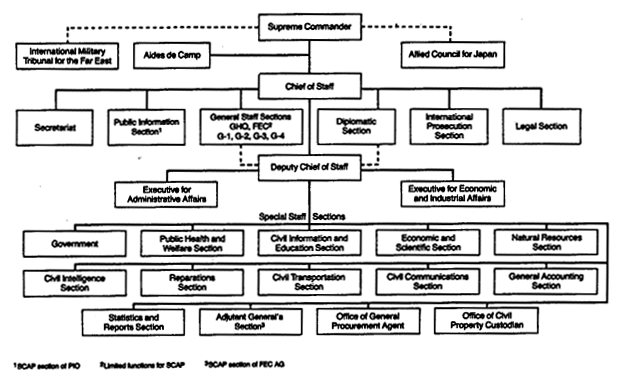
SCAP Organization Chart
Commonwealth contingent. Large military forces were never needed for the occupation of Japan.
The general held few staff meetings and saw very few members on his staff outside of section chiefs and staff aides. Those who had ready access were the chiefs of the important sections—GS, ESS, G-2, and the Diplomatic Section (DS), which dealt with foreign diplomats. The general saw a few outsiders fairly often, such as the British and Canadian ambassadors and a few American newsmen. He did not have a lot of meetings, perhaps three or four a day, and often they were quite lengthy.[24] MacArthur delegated freely to his section chiefs. He made decisions after reading a one-page abstract or summary prepared by staff officers on the basis of the often complex and lengthy memoranda submitted by the staff sections, as, for example, on the reorganization of the Yokohama Specie Bank. He was not one to delay or agonize over intricate problems. Press releases were important and were often issued in his name, even if he had little to do with the subject matter.
The occupation staff was short of people who had more than a passing knowledge of the country. Only two of MacArthur's section chiefs, William Sebald of DS and Lieutenant Colonel Donald R. Nugent (USMCR), the second chief of CIE and a former high school teacher, had had extensive prewar experience in Japan. Japanese-Americans, a number of whom were professionally trained, were almost all engaged in language work. Nevertheless, the occupation could boast of many persons well qualified in specialized fields.
MacArthur occupied a small office facing an inner court on the sixth floor of the Dai Ichi Insurance building. The occupation took over many office buildings in downtown Tokyo as well as many of the Western-style houses still standing in the city. At one point it had been suggested that Tokyo University might be requisitioned to serve as the headquarters for the occupation, but this idea was not pursued. The Japanese government paid to owners as "occupation costs" the cost of rentals and maintenance of buildings taken over by U.S. personnel. Japan paid more than $4 billion in occupation costs during the eighty months of the occupation; this was about twice as much as Japan received from the United States in economic assistance.[25]
Finding a role for the U.S. State Department was a knotty problem. State wanted a separate office that would handle international political and economic issues, as was the case in the American zone in Germany, but MacArthur insisted that the office be under his control. State finally yielded, and the staff of the political adviser, called POLAD, found a
niche serving as a sort of foreign office in SCAP. Later POLAD took on some political and economic responsibilities, but the role of the State Department was minor for most of the occupation.[26] Under Secretary of State Dean Acheson, a supporter of tough policies toward Japan, decided in 1945 that he did not want a "Japan hand" to head the Tokyo office and selected a China expert, George Atcheson, Jr., to be the first political adviser.
The organization of local U.S. military government teams posed another problem. Initially set up in fifty-three places around Japan to observe and assist in carrying out SCAP policies and consisting on an average of about fifty persons each, these teams were useful in keeping contact with local Japanese officials and even in helping the police ensure that rice collection quotas were filled and taxes paid, but many' teams were inadequately staffed and poorly informed of what the Tokyo headquarters was doing. In 1948 they were renamed civil affairs teams, and their operations were significantly reduced.
The Japanese had the daunting task of preparing themselves to deal with an administration whose purposes and methods they could only dimly fathom. But they plunged ahead resolutely. They set up a central liaison office (CLO) on August 22, 1945, at the request of MacArthur's headquarters in Manila, to serve as a channel between the occupation and the Japanese government.[27] The CLO had representatives from other agencies and established field offices all over Japan to match the American local government teams. These field offices were useful for placing unemployed officials from the Foreign Office, some of whom, such as Okazaki Katsuo and Asakai Koichiro, were later top diplomats. The head of the CLO's Yokohama office, Suzuki Tadakatsu, was especially valuable in his relations with General Eichelberger. Handling criminal incidents by Americans, particularly in the early days of the occupation, was a special test of the liaison system. The Japanese meticulously reported these cases, and the Americans investigated them with equal care, although they did not always prosecute suspects vigorously. Incidents continued throughout the occupation, some of them serious, but each side usually felt the other was acting in good faith. The occupation forces won much goodwill from the Japanese population for their friendly behavior. Former Imperial Army officers were impressed by the good conduct of American enlisted men. Recognizing the crucial importance of the CLO in keeping good relations with the occupation forces, Prime Minister Yoshida kept a firm grip on its operations until it was disbanded in 1948. By then SCAP sections were deal-
ing directly with their counterparts in the Japanese government and no longer needed a liaison agency.
To put occupation orders on a legal basis, the Japanese either passed enabling legislation or issued ordinances under the blanket authority of imperial ordinance no. 542 of September 20, 1945. This decree gave supralegal effect to occupation orders and imposed severe penalties on Japanese for violations. A total of 293 imperial ordinances (called cabinet ordinances after the new constitution went into effect in 1947) were issued during the occupation.[28]
The pressure exerted by the occupation led to the resignation of the caretaker Higashikuni cabinet on October 5, six days after MacArthur told the prime minister he saw no reason for a cabinet change. Installing an imperial prince as prime minister and for good measure making another prince from the old nobility the prime minister's deputy, neither of whom was able to make much headway with MacArthur or his staff, had clearly been a stopgap device that had run its course by early October.
The resourceful lord privy seal, Marquis Kido, decided that the new prime minister should be someone with a clean record and a diplomatic background. Yoshida said he did not even want to be considered. Baron Shidehara Kijuro, a former foreign minister known for his scholarly ability in English and his prewar advocacy of "peaceful diplomacy," was chosen. Shidehara was seventy-five and had been out of the public eye for ten years. Some even asked, "Isn't Shidehara dead?" He told the emperor he had no confidence he would be adequate as prime minister, and the emperor replied, "Who has confidence under today's conditions?" The only questions MacArthur asked Foreign Minister Yoshida about Shidehara were how old he was and if he spoke English.[29]
On October 9 the Shidehara cabinet was installed and included Yoshida as foreign minister. George Atcheson, the political adviser, called it "mediocre." Shidehara was eager, despite his frail health and long absence from public life, not to be a passive agent of the occupation but rather to carry out some of the urgent tasks facing the nation. One of his first projects, to strengthen the police, was turned down by SCAP, which was not yet ready to deal with that sensitive issue.[30]
Yoshida, one of the activists in the cabinet, thought economic reconstruction should be Japan's number one goal. He enlisted the help of a number of specialists from business and academic circles with whom he met regularly for advice. Several of the country's outstanding economists helped him, including Okita Saburo, an electrical engineeer by
training who became a world-famous authority on economic development, and Tsuru Shigeto, a Harvard Ph.D. and later president of Hito-tsubashi University, Japan's equivalent of the London School of Economics. Several of these men, foreseeing the inevitable disaster, had met in secret even before the war ended to plan for the future.[31]
On October 11 Shidehara called on the supreme commander. One observer made the witty comment that new prime ministers now had to call on the supreme commander in addition to visiting the Grand Shrine at Ise. At the outset the general took the unusual step of first reading to Shidehara, and then giving him, a short paper listing five basic reforms MacArthur wanted instituted "as rapidly as they can be assimilated." Prefaced by the statement that unquestionably "liberalization of the constitution" would be necessary, the points listed were:
1. Give women the right to vote, which would make "government directly subservient to the well-being of the home."
2. Encourage labor unions and correct child-labor practices.
3. Institute a more liberal education to make clear that government is "the servant rather than the master of the people."
4. Eliminate practices "which through secret inquisition and abuse have held people in constant fear."
5. Promote "a wide distribution of income and ownership of the means of production and trade."
The selection of points and wording was MacArthur's own, probably with some staff help, and, except for the last point, was not taken from any instruction he had received from Washington. Presurrender planning had made no direct reference to women's suffrage and may have'. taken for granted that it was a basic policy goal. In Washington the State Department told the British ambassador it did not have the text of what MacArthur had given Shidehara.[32]
The prime minister said his government would try to carry out these policies. It was already taking steps to include women's suffrage in a new election law and was looking into some of the other points raised by the general. Encouragement of labor unions and "antitrust" action seemed to give Shidehara some concern, but he said his government would study them. He then commented that Japan had been on the road to a liberal and democratic state some years earlier, before a "malign influence was allowed to prevail." The principle of respecting the will of the people would emerge again but "in the shape of Japanese
democracy" and not like democracy in Western countries. MacArthur said he realized there had been an "interruption" in Japan and added that he wished the new government well. MacArthur's espousal of the "interruption" theory was somewhat at variance with his frequent characterization of prewar Japan as "feudal" and seemed to put him in the camp of those, such as Yoshida, who thought Japan had been on the road to democracy but had temporarily "stumbled."[33]
Nothing seems to have been said about the constitution, but there was almost surely a gap between the thinking of the supreme commander and that of the prime minister about how far constitutional revision should go. Nevertheless, two days later Shidehara appointed a special cabinet minister, Matsumoto Joji, to study the constitutional issue. At the emperor's request, Konoe was hard at work on the same problem. In early November two New York papers wrote editorials criticizing this "acceptance of Konoe as the man to lead Japan to democracy." SCAP quickly issued a press release denying any connection with Konoe and warned Atcheson not to have any further association with him. Konoe's connection with the occupation thus ended abruptly.[34]
The Shidehara cabinet, true to its word, went ahead with election reform. On December 15 the Diet passed a law giving the right to vote to all citizens older than twenty; this action more than doubled the electorate, which had been limited to males older than twenty-five. The law also increased the size of electoral districts, long an issue in Japanese politics. General MacArthur and his Government Section decided not to intervene in the Japanese legislative process, despite the strong SCAP propensity, especially in the early days of the occupation, to press for Japanese adoption of U.S. models. Paradoxically, the Japanese decided in 1947 to go back to the former system of medium-sized districts.[35]
By the fall of 1945 the political parties were busy getting organized. They tended to repeat the late prewar pattern of two large conservative parties and a scattering of smaller parties. The first to organize after the surrender was the Socialist Party, set up on November 2, which preferred to be known in English as the Social Democratic Party because this had a sweeter ring to American ears. Katayama Tetsu, a former Diet member and a prominent lawyer, was its leader. For the first time in Japanese history, the communists formed a legal party. They began to organize after their leaders were let out of prison in early October, with Tokuda Kyuichi and Shiga Yoshio in the vanguard. Early in 1946 another prominent figure, Nosaka Sanzo, returned from exile in China
to join the leadership. The communist newspaper Akabata , or "Red Flag," began publication on October 20, its daily circulation soon growing to six hundred thousand.[36]
The two large conservative parties had only barely discernible differences in doctrine. The head of the Liberal Party, which had 50 seats in the lower house, was the most skilled politician to emerge on the early postwar scene, Hatoyama Ichiro,withmore than thirty years of experience as a political leader. The Progressive Party, with 249 members, was the biggest in the "Tojo Diet" elected in 1942. By December 1945 thirty-five other political parties had declared their intention to participate in the forthcoming election.
The four major parties—Liberal, Progressive, Socialist, and Communist—all advocated in varying ways strict execution of the surrender terms, political and economic reform, and respect for individual rights. The liberals and progressives supported the emperor system, the socialists were silent on this score, and the communists advocated its abolition. The conservatives favored free economic enterprise, the socialists promoted a socialized and planned economy, and the communists wanted participation by the people in the management of industry and confiscation of idle agricultural land. Hatoyama spoke out strongly against communism.
The political pattern that emerged right after the war shaped the entire future of the Japanese system—strong conservative and centrist forces, with socialists to the left of center and communists to the far left. A two-party system never developed.