
The CCP's Land Program:
1937–1941
It is generally assumed that the CCP's land program had gone through a major change from the Kiangsi period to the resistance period. The origin of this notion is of course the CCP itself and its pledge of February and September, 1937, that confiscation of the landlords' property would be discontinued for the sake of the united front. But William Hinton's study of the social relationship in the rural bases leads one to doubt whether a thoroughgoing peasant mobilization
[88] Lin Piao, et al., Chin-pei yu-chi chan-cheng chi-shih , pp. 29–30.
[89] Growth of one revolutionary base , p. 204.
was really compatible with a continued presence of the landlord class under any circumstances.[90] To eliminate this confusion, I will examine in this section the land program of the CCP in the early stage of the war. The modified land program which was in effect after 1941 will be treated in Chapter VII. It will be shown that integration of the peasants into the infrastructure of the bases presupposed a land revolution.
To gain a proper perspective on this question, let us first take a look at the sequence of land revolution which became the standard procedure in the Kiangsi period. A succinct statement of its outline is found in a report written by Mao Tse-tung in 1933.[91] In it he described the stages of land revolution in the Central Soviet, of which he was the chairman. At the outset he affirmed irrevocably:
All past experience has proved that only through the correct solution of the land problem and only through the fanning to the highest degree the flames of class struggle in the rural districts under the resolute class slogan can the broad peasant masses be mobilized, under the leadership of the proletariat, to take part in the revolutionary war, participate in the various aspects of Soviet reconstruction, and build up a strong revolutionary base. . . .[92]
The statement is so unqualified as to cast doubt on the possibility the advanced struggle area." In the newly developed area,
After smashing the Kuomintang's main force and removing overt military threat to an area, the land revolution proceeded in three stages: the stage of land confiscation and land redistribution; the stage of land investigation; and the stage of land reconstruction. As the area advanced through these stages, it was called respectively the "newly developed area"; the "comparatively retarded area"; and the "advanced struggle area." In the newly developed area,
the unfolding of the land struggle is still in the stage of land confiscation and redistribution. Here the central problems are: the overthrow of the regime of the landlord class by armed forces, the establishment of a revolutionary provisional regime (a revolutionary committee); the build-up of local armed forces of the workers and peasants; the formation of revolutionary mass organizations; the confiscation of the land and other property of the landlord class, and the redistribution of the land of the rich peasants to the hired farm hands, poor peasants, and middle peasants.[93]
[90] Fanshen: A Documentary of Revolution in a Chinese Village (New York: Monthly Review Press, 1966).
[91] "The Land Investigation Drive Is the Central Task of Great Magnitude in Base Areas," in Hsiao Tso-liang, ed., The Land Revolution in China, 1930–1934 (Seattle: University of Washington Press, 1969), pp. 202–205.
[92] Ibid. , p. 202.
[93] Ibid. , pp. 202–203.
In the third stage,
solid Soviet regimes have been established, local armed forces and revolutionary mass organizations have been widely set up, the feudal and semi-feudal forces of landlords and rich peasants have been completely crushed, land has been thoroughly redistributed, and the land struggle of the peasant masses has entered upon the stage for the reform of land and the development of its productivity.[94]
The specific purpose which occasioned this report was Mao's call to carry out a thorough drive for land investigation, the most important program for the second stage in the "retarded struggle area." By this time, counter-revolutionaries who openly resisted the Communist political power had been destroyed. The locus of counter-revolutionary forces had shifted from the overt military sphere to the more amorphous sociological sphere. The old ruling elites who survived the first stage "have taken off their counter-revolutionary masks and put on revolutionary masks." They continued to exert feudalistic influence on the poorer masses by all sorts of subterfuge. The method of dealing with the class enemy in this stage was land investigation (ch'a-t'ien ). It was a drive to discover the so-called "black field" (hei-t'ien ), land which was not recorded in the land register because of under-reporting. Those found concealing a "black field" were designated counter-revolutionaries in disguise and punished accordingly. Moreover, the whole land investigation drive was to be conducted a second, a third, or even a fourth time in some areas, each time netting new counter-revolutionaries. This pattern of continued revolutionary vigilance is confirmed by William Hinton from his observation of the post-war land revolution as well. Did the Chinese Communists really dispense with these programs during the war or not? If they did, what made it possible?
The major source of confusion about the land program of the war period is the extreme secrecy in which it has been surrounded until today. All of my search has failed to turn up any major directive or resolution for the initial period of the war. I must begin with an analysis of CCP documents prior to the war. The starting point is the position taken by the Wayaopao Resolution of December, 1935. It advocated that "the Communist Party and the soviet must make sure to satisfy the peasants' demand for land." In this way the CCP was to "join together the land revolution with the national revolution."[95] The Resolution accepted Wang Ming's proposal made in Moscow that the soviet government relax its treatment of the rich peasants, and
[94] Ibid. , p. 203.
[95] Mao Tse-tung-chi , V, 34.
commercial and industrial enterprises belonging to the national bourgeoisie.[96] Confiscation of the rich peasants' property ceased. But the policy of confiscating the property of the landlords and traitors in the "Japanese-occupied areas and their surroundings" remained intact.[97]
By September, 1936, the CCP had decided to accept the bourgeoisie in the united front. But the landlords were never admitted into the united front. The CCP's telegram of February, 1937, promised simply that the policy of confiscation would be discontinued. Also in February, a propaganda document was issued by the Party to allay the fears of the members who took the united front proposal as a surrender to the Kuomintang. It assured them that the land which had already been confiscated in the past would not revert to the former owners.[98] In March, confiscation ceased in the Shen-Kan-Ning Border Region.[99] Then on May 12, the rights of citizenship were formally restored to the landlords in those few hsien in Shen-Kan-Ning where they had not yet been liquidated.[100] As late as May, however, some Party branches in the outlying areas were carrying out confiscation.[101] At the May conference of Soviet Area Party Delegates in Yenan, Mao was criticized for his insistence on "anti-feudal" struggle. The debate seems to have touched on some important policy question in implementing united front strategy. It is my inference that either at this conference or perhaps earlier in the spring, the CCP formulated its policy on the land question and secretly disseminated it to Party and army units in the field.[102]
It is quite possible that the CCP's pledge to cease confiscation was offered before it arrived at an internal consensus as to what alternative policy should be adopted toward the landlord class. In July, 1937, Mao offered an "Eight Point Program" and contrasted it with a policy which he condemned as "compromise and concessions." One item demanded, "Abolish exorbitant taxes and miscellaneous levies, reduce land rent, restrict usury, increase the workers' pay . . . . " The other proclaimed: "Financial policy should be based on the principle that those with money should contribute money and that the property
[96] Ibid. , pp. 30–31.
[97] Ibid. , p. 34.
[98] Warren Kuo, "The CCP Pledge of Allegiance to the Kuomintang," Issues and Studies , August, 1968, p. 49.
[99] Lin Po-ch'ü's report of January, 1939, Shen-Kan-Ning pien-ch'ü ts'an-i-hui wen-hsien hui-chi , p. 14.
[100] Electoral Laws of the Shen-Kan-Ning Border Region, Ibid. , p. 53.
[101] Min-hsi-nan chün-cheng wei-yüan-hui [Southwestern Fukien military affairs committee], Wei t'ing-chih nei-chan i-chih k'ang-Jih kei k'e-pu-tui k'e-chi tang ti hsin [The letter to all armed units and the Party at all levels concerning cessation of internal war and resistance against Japan] (BI).
[102] See above, pp. 40, 90.
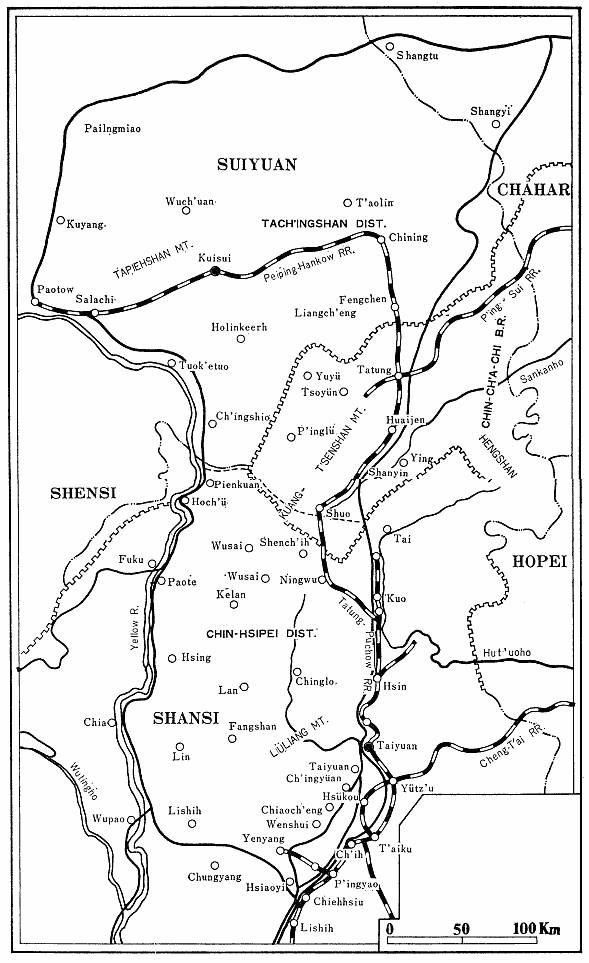
Map 8
The Chin-Sui (Shansi–Suiyüan) Border Region, circa 1944
of the Japanese imperialists and Chinese traitors should be confiscated . . . . "[103] The stormy meeting of the Politburo in Loch'uan in late August passed a "Ten Point Program." It repeated the same points as the Eight Point Program. Neither of them demanded a "unified progressive tax" which was stated as the Party's goal in Wayaopao.[104] The term was not to be mentioned again until Mao made his report to the Sixth Plenum[105] and the first Administrative Program of the Shen-Kan-Ning Border Region was proclaimed in April, 1939.[106] The stated position of the CCP in August, 1937, therefore, was: (1) reduction in rent and interest; (2) new taxation system which reduced the rate of exaction at least on some peasants; (3) increase in pay for farm laborers; (4) continued expropriation of those who were labeled "traitors"; and (5) cessation of confiscating the property of the landlords qua landlord.
It is said that "if the relationship between the army and the civilians is handled poorly it originates mostly in the supply of food."[107] In a country where the population was in a tight balance with the ecology, imposition of an extra number of people to be fed and clothed on the existing population of a given area often meant the difference between survival and starvation. As a part of united front concessions, the Kuomintang government paid a monthly sum of 500,000 yuan for the authorized strength of the Communist forces.[108] This was hardly enough. At any rate, the Communist forces as well as their base infrastructure were rapidly expanding beyond the authorized limit. The provision for the troops and civilian personnel "divorced from production" had to be met directly by local revenue. In this, the Chinese Communists were no different from any other regional power in China's modern history. When a Communist unit occupied a new area, whose local government had not been preserved by civilian cadres through united front arrangement, it often met a rather hostile reaction. During the first winter of 1937, Nieh Jung-chen's unit northeast of Wut'ai lived a wretched life. Traitors had not yet been suppressed. During this phase, the Communist forces were carrying out an outright military occupation. The provision for the troops could not wait. Yet, the mechanism for revenue collection could not function until a local anti-Japanese government was built from the ground up. The Communist forces resorted to confiscation of the property of the
[103] Selected Works , II, 18.
[104] Mao Tse-tung-chi , V, 29.
[105] Ibid. , VI, 216.
[106] Shen-Kan-Ning pien-ch'ü ts'an-i-hui wen-hsien hui-chi , p. 40.
[107] Ma Han-ping, Wang Chen nan-chen-chi [The chronicle of Wang Chen's southern expedition] (Hong Kong: Chungkuo ch'u-pan-she, 1947), p. 13.
[108] Mark Selden, The Yenan Way in Revolutionary China (Cambridge, Mass.: Harvard University Press, 1971), pp. 139–140.
rich. The Sixth Detachment of the New Fourth Army in Huaipei area reported, for instance, that
several thousand troops and several thousand work personnel had to be fed and clothed. In everything we needed revenue, and yet nothing had started at the time. Our finance was in difficulty, and we could count on but a small tax revenue. Therefore, we had to resort to two emergency measures. One was striking the traitors, the other was to get donations from the rich households. Even that was inadequate. . . .[109]
Confiscating the property of the rich and sharing the loot with the poor had been the standard practice of the Red Army when it moved through a strange territory or in an early phase of settlement before the revenue collection mechanism was built up.[110] It seems that the Eighth Route Army had to resort to the same method in the very early phase of base construction. In addition, so-called "loans" were secured: hsi-k'uan if it was in cash and hsi-liang if it was in grain. Such loans were usually treated as an advance on tax. An I.O.U. was issued, which then became a note of credit against subsequent tax payment.
Lack of adequate data and monographic studies compels me to grope in the dark concerning the tax system in the early phase. There was considerable variation in the practice from one place to another. In Shen-Kan-Ning the government relied exclusively on confiscation and expropriation to meet its expenditure until 1937. Then the system of "national salvation public grain" (chiu-kuo kung-liang ) was instituted.[111] This was definitely a progressive taxation, though it is not known whether it was a single tax and hence displaced all the other taxes. The Chin-Ch'a-Chi Border Region relied on land tax (t'ien-fu ), custom duties, and internal loans at the outset. At least some part of this border region was still collecting land tax along with "national salvation public grain" in 1940.[112] It is my inference that "national salvation public grain" was an interim measure which was used before the slightly more routinized "rational burden" system was instituted. It seems that they were both quite arbitrary.
[109] Liu Jui-lung's report to the second Huaipei District political council (October, 1942), in Huaipei k'ang-Jih min-chu chien-she [Anti-Japanese democracy building in Huaipei] (Huaipei Su-Wan pien-ch'ü hsing-cheng kung-shu, 1942), p. 23.
[110] In 1948, Mao stated: " . . . hasty dispersal of social wealth is to the disadvantage of the army. Premature distribution of land would prematurely place the entire burden of military requirements on the peasants instead of on the landlords and rich peasants . . . . " Selected Works , IV, 251. While the statement was made in the civil war period, the logistic needs of the army remained constant.
[111] "Wo ti hui-i," Ming Pao , No. 59, November, 1970, p. 88.
[112] "Chin-Ch'a-Chi pien-ch'ü ti hsing-shih" [The situation in the Chin-Ch'a-Chi Border Region], Chieh-fang , No. 115, p. 14.
Again Chin-Ch'a-Chi was in the lead in switching from old land tax to the new system. The new tax system was called "rational burden" (ho-li fu-tan ) and was a progressive taxation. This was clearly intended to have a socially leveling impact. Hence, if the differential tax burden was passed from the rich to the poor in the form of higher rent and interest, the tax would lose its effectiveness. The commencement of "rational burden" or any other system that favored the poor was, therefore, accompanied by measures to reduce rent and interest (chien-tsu, chien-hsi ). By February, 1938, the Chin-Ch'a-Chi Border Region promulgated the first regulation on rent and interest reduction.[113] By March, it was already moving into the second stage of the "rational burden" system.[114] How the Communist unit there overcame the opposition so quickly is not known.
The most widely used form of rent and interest reduction in north China in the early period was called "quarter down in rent, 10 percent interest" (erh-wu chien-tsu, shih-fen chien-hsi ). It meant reduction of all existing land rent by 25 percent and freezing it until further change. This was an interim measure before a border region government had enough time, power, and cadres to conduct land investigation to make an accurate land register. Interest rate on all loans, including new ones to be contracted under the new regulation, was to be no more than 10 percent per annum.[115]
Rent and interest reduction alone presupposed a social change of great magnitude. They could not have been carried out without thorough mobilization of the masses and the backing of the Communist forces. Since I will deal with the rent and interest reduction campaign in Chapter VII, only one statistic will be noted here. The Chin-Ch'a-Chi Border Region carried out a campaign to return the land held as collateral by money-lenders to the borrowers by recomputing the interest at the newly enforced rate. In four special districts (or military sub-districts), all in Hopei Province, 69,400 mou (1 mou = 0.15 acre) of land was returned by June, 1940.[116] Naturally such a campaign had the effect of drying up the private source of credit, but the Party was interested in the political goal of winning mass support at
[113] Liang-nien-lai pien-ch'ü ta-shih-chi [The chronicle of important events in the border region in the two years] (The Secretariat, the Chin-Ch'a-Chi Border Region Administrative Commission, 1939), p. 4.
[114] Ibid. , p. 7.
[115] These rates are my own inference from the post-1941 practices. See p. 249 below. Rates varied tremendously depending on the local military balance of power between the Communists and their enemies.
[116] Kung-fei fan-tung wen-chien hui-pien [Collection of documents on the reaction of the Communist bandits]: Land policy (Ministry of National Defense, Republic of China) (BI), p. 179.
this stage. It goes without saying that both rent and interest reduction and "rational burden" were enforceable only in areas where Communist control was thorough.
The "rational burden" was in effect until 1941, when it was superseded by the "unified progressive tax" in some places.[117] They both embodied the principle that "those with money should contribute money," which was another name for progressive tax. But rational burden was infinitely easier to handle from an administrative point of view, a vital requisite for application in wartime in or near the battlefield. The label and principle of rational burden originated with Yen Hsi-shan, though the CCP applied it in many places in north China. The rational burden was a single progressive tax reckoned once a year. The first phase was called the "hsien class rational burden," which was superseded soon by the "village class rational burden." The hsien class rational burden seemed to have been a slight routinization of confiscation of the property of the landlords and the rich. It was handled directly by the hsien class governments through their ch'ü level offices, both of which were in the hands of reliable Communist cadres. The number of households that could be dealt with by the hsien government must have been limited. In the Shangtang area of the T'aihang mountain (the Third Special District, Po I-po), where the 129th Division settled, the transition to the village class rational burden did not come until the fall of 1938.[118]
In this system the hsien government classified every village into one of eleven classes representing the total asset in each. Quality of land, old land tax assessments, houses, and other properties were all taken into account in a rough fashion in classifying a village. Each village was then assigned to a class with corresponding points. First class village rated 2 points, second class 1.9 points, down to the eleventh class with 1 point. Each point and a fraction thereof stood for a village's share of tax within the total budget of the hsien .[119] That is, the hsien government would distribute its levy according to the number of points represented by the villages in its jurisdiction. The actual worth of a point became known only when the total annual budget of the hsien government was closed. This was therefore similar to the work point system that was in use during the stage of agricultural cooperation in the 1950s.
[117] For details of the rational burden system, I have relied on valuable data collected by the Japanese forces which occupied the Shangtang area in the heart of the T'aihang District. Sugiyama Corps and the Huangch'eng Intelligence Center, Sansei-sho[*] Wajun-ken chiho[*] Kyosanto[*] chiku jokyo[*] chosa[*] hokoku-sho[*] [Investigation report of the conditions in the Communist district in the Hoshun hsien area of Shansi Province] (hereinafter Hoshun Investigation Report ): Vols. I and II.
[118] Hoshun Investigation Report , II, 5.
[119] Ibid. , p. 34.
The village office, with the cooperation of the village Mobilization Committee, was then charged with the task of distributing the burden among the households in its jurisdiction. The hsien government no longer interfered in tax assessment at the village level, with certain exceptions. The object of taxation seems to have been a peculiar category that reckoned property and income on a single scale. For tax purposes a household was classified in terms of (1) interest and dividend; (2) property, liquid as well as non-liquid; and (3) salaries, wages and other compensation for service.
The method used in assessing tax liability for ordinary peasant household was as follows. A village (hsin-pien-ts'un ) was divided into groups of yen —a yen being a collective security system made up of thirty households. The richest and the poorest households in any given yen were classified as the first and the twentieth class respectively. Using them as a rough standard, the remainder were fitted into the intervening classes. The twenty classes were not always filled in any one yen , as several households tended to cluster into the same class. Each class was then given corresponding points. In Hoshun hsien assignment of points to each class was left to the discretion of each village, so long as the series was discreet. In one example suggested, the first class was assigned 35 points; the second class 28 points; the third class 20 points; the fourth class 18.5 points, and so on down to the twentieth class with 1 point.[120] Collectively, therefore, a village had the power to decide who belonged to which class, and then to decide how many points should be assigned to each class.
Excluded from this classification were the rich (fu-hao ) and the destitute. When the wealth of the rich was determined by the villagers, the information was forwarded to the hsien government, which then decided special tax rates. A clear guideline for defining the rich cannot be found in the document I have. Judging from actual examples enumerated in Shangtang's case, the rich were landlords and rentier class. Generally they owned forty mou or more of land; a few owned less land but possessed other sources of income. Those who were judged to be indigent were exempted from tax and became eligible for relief administered by the village government.
According to an official propaganda leaflet collected by the Japanese in the Shangtang area:
The rules in the previous regulations of rational burden [i.e., Yen Hsishan's statute] required that distribution of burden be determined only after a thorough investigation of property and income.
This regulation does not require investigation of property but relies only
[120] Ibid. , p. 24.
on an estimate. This is entirely due to the fact that the war of resistance makes urgent demands on revenue. This cannot be met if we are to rely on the previous regulation which was very time consuming [in administration].[121]
It is my inference that under the leadership of the Sacrifice League, the Mobilization Committee, or some mass organization, the peasants were conducting a sort of collective and mutual tax assessment session. Everyone was subject to this collective judgment.
It is extremely convenient to let the village office handle [the rich]. This is because all the people in a village know well the amount of property and income of the rich. Therefore the village office cannot be deceived even though the hsien government may be fooled. . . . Even if the rich tries to conceal his income, public opinion, criticism, and guidance by the whole village will make him feel insecure not to share the burden. Those in the village who, because of some special relationship with the rich or because of their interest, try to defend the rich . . . will also be attacked by the whole village.[122]
This method of collective assessment foreshadowed the method of "democratic assessment" used in the 1950s to distribute work points to the members of an agricultural cooperative.
The hsien government of Hoshun collected its revenue in grain, cash, and other goods. Grain was presumably priced at some fixed cash value. Of the taxed goods, the most frequently collected, according to the captured file of official communications, were the hand-sewn shoes made of cotton cloth priced at fifty cents a pair; cotton cloth; and cotton suits. The Japanese investigator estimated that a household in the Shangtang area turned in three-and-a-half pairs of shoes annually to the government. Tax was not collected all at once or at fixed intervals. Grain was stored away locally and dispersed. As need arose, it was collected by the government in small installments. An advance notice would come from the hsien government, routed through the ch'ü office, such as:
Order: The Fourth Ch'ü Office; Series 99.
Mr. Chang Fu-ch'ang, Village Chief:
For the daily actions of officers and soldiers at the front, supply of shoes is in urgent demand. You are hereby ordered to mobilize 380 pairs of shoes in your village and to deliver them. You will receive 50 cents a pair for cost of manufacturing. Your assistant chief is requested to mobilize 80 pairs forthwith and to deliver them to this office by the fifteenth of the month. You will be punished severely for violation, insincerity, or failure to deliver in time. . . .
Each shoe must bear the name and address of its maker.[123]
[121] Ibid. , p. 25.
[122] Ibid. , p. 26.
[123] Ibid. , p. 40.
Or if a Communist army unit passed through a village, the village had to feed the unit in exchange for grain tickets (liang-p'iao ). The tickets then became a note of credit to be offset against the village's share of tax. Again, during emergencies forced loans from the rich were permitted. It was estimated that Hoshun hsien collected 23,000 piculs (1 picul = 133.3 pounds) of food grain and 300,000 yuan in cash or its equivalent in one year.[124]
It seems fair to say that under the rational burden system the distribution of a village's share of tax was carried out by a majoritarian method. The poor were given a choice of taxing the rich to reduce their own share. With assurances from the Communist cadres that this accorded with the principle that "those with money should contribute money," they opted for this method. In the T'aihang District, the raising of a fist at a mass meeting determined tax liability.[125] Only such an arbitrary method would have enabled the CCP to endear itself to the masses while assuring a source of revenue for itself. A thin line separated tax collection from expropriation, as witness the following report from the Chin Ch'a-Chi Border Region:
At night the soldiers gathered in the storage rooms of the village chief and the rich families to reckon and collect money, grain, oil and flour, potatoes, and administrative expenses. According to "rational burden" the village chief ought to pay most. Besides there were five big families, but they refused responsibility. In the stable in the courtyard the self-defense troops started a quarrel. "The chief's is the richest family." "No, he should give fifteen tan of potato." In the end the chief whispered consent, and he watched [the sacks of] grain and potatoes carried away from his storage cellar one after another.[126]
Apart from regular tax, the rich households were subjected to periodic pressure to provide "contributions," "loans," and the like. In the Shangtang area, the rich were also subjected to a small amount of "confiscation" from time to time, though the nature of infractions were not reported.[127] What was the amount of levy on the base area's population? A sample from the Japanese data is presented in Tables 1 through 5. The families A through D in Table 1 were the four leading landlording households in Hoshun hsien . It is apparent that they were destined to be liquidated rapidly. In a small hamlet called Sanch'i, also in Hoshun, there were altogether 167 families. Of this, the first twenty-one were rich enough to be classified as "hsien rational burden rich households." While the government's levy on these house-
[124] Ibid. , p. 70.
[125] Growth of one revolutionary base , p. 149.
[126] Lin Piao, et al., Chin-pei yu-chi chan-cheng chi-shih , p. 23.
[127] Hoshun Investigation Report , II, 138–150.
holds was heavy, the bulk of the village's families, Nos. 22–117, were paying relatively little in tax. The families No. 118 through No. 167 were tax-exempt or were receiving relief.
Mao states that "In the first stage, from 1937 to 1939, we took very little from them [the people]; during this stage they were able to build up considerable strength. In the second stage, from 1940 to 1942, the burden on the people was increased . . . . "[128] In Ch'ang-chih in the T'aihang District, average tax on "the people" decreased as follows: 1937, BR$ (border region yuan ) 3.34; 1938, BR$0.85; 1939, BR$0.857. In Yangch'eng: 1937, BR$1.732; 1938, BR$1.182; 1939, BR$0.629.[129] On the whole, tax decreased in this area by four-fifths of the pre-war level for the masses. Isabel and David Crook report from another village in the T'aihang District that, as soon as a Communist-sponsored government was established in late 1939, "national salvation public grain" was collected from the richest 30 percent of the village population. Shortly thereafter, the rational burden went into effect. The tax burden continued to be borne by 30 percent of the population. "For 70 percent of the villagers to be free from taxation was a state of affairs never dreamt of before," the Crooks report.[130]
We can now reconstruct the political aspect of the very early stage of the Communist base construction. As soon as a Communist unit entered an area and overcame overt military opposition, it reduced rent and interest and practically abolished taxes for the majority of the peasants in the area. The expenditures for maintaining the Com-
| |||||||||||||||||||||||||||||||||||||
[128] Selected Works , III, 114.
[129] Growth of one revolutionary base , pp. 148–149.
[130] Isabel and David Crook, Revolution in a Chinese Village: Ten Mile Inn (London: Routledge and Kegan Paul, Ltd., 1959), pp. 46–47.
|
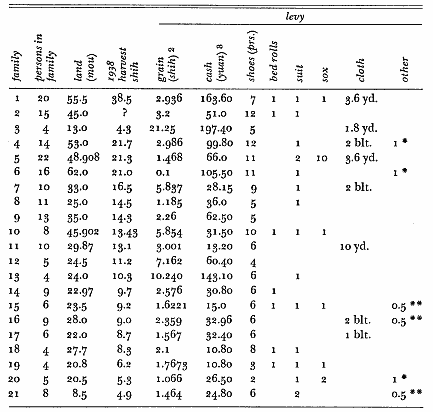
munist forces and the civilian cadres were borne mostly by a minority who were rich. The poorer majority supported the new regime and incurred the resentment of the landlords and the rich peasants, who made all sorts of threats in private. The poor were then committed to the defense of the new regime. For roughly two years, this state of affairs persisted. To pay for increased tax out of reduced income, the rich sold their property. The sort of social and political changes entailed by this confiscatory tax policy by 1940 will be discussed in Chapter VII.
| ||||||||||||||||||||||||||||||||||||||||||||||||||||||||||||||||||||||||||||||||||||||||||||||||||||||||||||||||||||||||||||||||||||||||
| ||||||||||||||||||||||||||||||||||
|
The tax and rent reduction program of the CCP was revolutionary. It amounted to confiscation by installment. Its fully revolutionary character cannot be appreciated until some inquiry is made into the treatment of the so-called traitors. If the development of a Communist base in the resistance period paralleled that in the Kiangsi period, should the traitors be considered the equivalent of counter-revolutionaries? Data concerning the suppression of hostile elements in the Communist bases and their environs are very difficult to obtain.
The Party was obviously reluctant to reveal such data. In addition, the suppressed elements did not have organized, political existence; and they left no record of their fate. Among the CCP's enemies hidden in the rural areas were bandits and traitors. Both were usually liquidated physically. In the early stage of base construction, the "anti-traitor work" (ch'u-chien kung-tso ), which included the suppression of bandits, was primarily the responsibility of the Communist forces. At this stage it was part of a military security of the unit in question. Thereafter as the boundary of a base expanded, new areas were subjected to the same program while authority in the older central district passed gradually into the hands of civilian government. The process of handling traitors gradually became routinized until, in the final stage of development, it merged with ordinary legal process.
Bandits were numerous after the outbreak of the war. In Shen-Kan-Ning, where banditry was not a serious problem, more than forty bands were eliminated by early 1939, including 800 bandits killed and wounded and 400 captured.[131] On the periphery of the border region, suppression of bandits was not yet complete, it was reported. The reference seemed to be to Suite and Lungtung Sub-districts which were not subjected to the civil war type of land revolution before the united front came into existence. In one year period ending in November, 1942, 846 bandits were liquidated in Yenfu District in Kiangsu.[132] According to Liu Jui-lung, the head of the Huaipei District government, bandit suppression by October, 1942, was as follows: Ssunan, fourteen bands; Hungtze, six bands; Ssuyang, seven bands; Hsüfengchia, five bands; Huaipao, nine bands; Ssuwulingfeng, six bands; Ssuhsiu, ten bands; P'eichüt'ung, two bands; Hsiut'ung, sixteen bands—for a total of seventy-five bands. The size of only twenty-eight bands was reported. Some were 20 or 30 strong, while the largest ones had from 200 to 400 men. Average size of the twenty-eight bands reported was 90.[133] Multiplied by 75, the putative total bandit population was 675 for the Huaipei District. As will be shown in Chapter VIII, this area was exceptionally infested.
Statistics concerning traitors are more difficult to find. According to
[131] Shen-Kan-Ning pien-ch'ü ts'an-i-hui wen-hsien hui-chi , p. 11.
[132] Jao Shu-shih, Hua-chung ch'u-chien pao-wei kung-tso ti chi-pen tsung-chi chi chin-hou ti jen-wu [The basic conclusion and the future task of anti-traitor and security work in central China] (report to the Central China Anti-Traitor Conference, November, 1942), Chen-li , No. 1, March, 1943, p. 25.
[133] Huaipei k'ang-Jih min-chu chien-she , appendix. I am assuming that the so-called "bandits" were in fact bandits, though in the case of central China in particular the distinction between bandits and armed landlords seems to have been tenuous.
Yang Hsiu-feng who was running the government of the South Hopei Military District, 279 were eliminated in one year ending September, 1939. These included 51 in Weihsien, 45 in P'inghsiang, 31 in Feihsiang, 30 in Tsaoch'iang, and 20 in Chülu.[134] Again, the Chin-Ch'a-Chi Border Region was the model of anti-traitor work. It was an object of envy among the units of the New Fourth Army in central China, where political conditions were infinitely more complex because of the persistence of the Kuomintang's influence. In the Wut'ai area, there were a number of Buddhist temples with a total of 1,000 priests who were reported to have acted as traitors.[135] We do not know their fate. In October of 1940, Shu T'ung, who headed the political department of the Chin-Ch'a-Chi Border Region, stated that in the three years since the founding of the government, 1,402 traitors had been eliminated.[136] As a Communist base developed with increasing mass support, anti-traitor work became part of mass mobilization and created a tense vigilante atmosphere. In Shen-Kan-Ning there were 700 traitor-weeding committees, one in every hsiang; 9,000 traitor-weeding small groups; and 100,000 members in them by January, 1939.[137] As the Japanese forces never seriously threatened this border region, the anti-traitor work there had class character.
I can only infer the identity of these traitors. There is no doubt that a substantial number of them were genuine traitors. But a large number seemed to have come from among the landlords and the rich peasants who were subjected to confiscatory taxation. Po I-po deplored in mid-1939 that "in the past we drove the landlords, the rich men, and gentry to become traitors by exploiting them."[138] But if so, why were there not insurrections by the landlords against the Communist forces? The reported figures of traitor liquidation—if they can be trusted and if they are representative—were not staggering ones. Assuming that a standard-sized hsien in Hopei had 250 villages, liquidation of fifty traitors in one year amounted to one for every five villages. Assassination and liquidation increased in number after mid–1940, as will be shown below, but even then the CCP was defi-
[134] Pacification War , No. 1, p. 209.
[135] Lin Piao, et al., Chin-pei yu-chi chan-cheng chi-shih , p. 62.
[136] Chieh-fang , No. 120, p. 24.
[137] Shen-Kan-Ning pien-ch'ü ts'an-i-hui wen-hsien hui-chi , p. 11.
[138] "Ts'ui-hui ti-wei cheng-ch'üan ti chi-pen cheng-ts'e [The basic policy for destroying the enemy and puppet political power], Wo-men tsen-yang tsai ti-hou chien-li k'ang-Jih cheng-ch'üan [How we have built the anti-Japanese political power behind the enemy] (Huang-ho ch'u-pan-she, 1939), p. 14. See also Liu Shao-ch'i, in "Hua-pei chan-ch'ü kung-tso ti ching-yen," pp. 304, 314, in which he talks about executions.
nitely more restrained than during the Kiangsi period. It seemed that somehow the Chinese Communists managed to carry out the land revolution while holding the class tension just short of the breaking point. This paralleled the CCP's relationship with the Kuomintang at the national level.
Several factors may be adduced to account for the CCP's success in this respect. First, the CCP's approach left the door open for the rich to survive by submitting to gradual fleecing. Its measures were radical only in the central base areas but were indistinguishable from the policies of the competing forces, Japanese and Kuomintang, on the periphery. The CCP leaders pointed out often that it was imprudent to pressure the landlords on the periphery of a base as they would bring the Japanese forces in.[139] Second, the landlords as a class were more literate and educated; they understood the national predicament better than ordinary peasants. In the Shangtang area of Shansi, the most radical villages were those in which educated sons of native landlords had returned home and cooperated with the CCP.[140] P'eng Te-huai pointed out that the educated sons of the landlords were somewhat detached from the material interests of their parents.[141] One hsien magistrate in Shansi held a banquet for the local notables and peasants' representatives; he revealed Yen Hsi-shan's order on rent reduction and managed to persuade the landlords to sign a pledge of cooperation which he posted in the area.[142] Last, though not the least in importance, was the military supremacy of the Communist forces in the rural areas in the first two years of the war. This supremacy enabled the Communist party to impose its definition of the situation on the rural population.
"Political power grows out of the barrel of a gun" indeed in China's countryside. But the over-all strategic milieu in which the CCP's gun was exercised added to its efficacy. The war silenced the competing guns, and the landlord class as a whole was more amenable to accepting the CCP's exactions because of the national emergency.
[139] This is mentioned repeatedly in many documents. See, for instance, Kung-fei huo-kuo , III, 410.
[140] Hoshun Investigation Report , II, 39.
[141] Kuan-yü hua-pei ken-chü-ti kung-tso ti pao-kao [Report on north China base work] (Report to the cadres above the battalion and hsien class in the T'aihang District, December 18, 1942), Kung-fei huo-kuo , III, 385, Liu Shao-ch'i quotes some landlords in Shansi who said, "Japan is now invading us. Pay whatever rent and debt that you can, and it's all right," in "Hua-pei chan-ch'ü kung-tso ti ching-yen," p. 314.
[142] Ibid.