
Pulling Together Makes Strength
If Jersey Standard was becoming more directly involved in the great Mexican oil boom, was not its arch rival, Royal Dutch-Shell, close behind? In fact, the competition of the one tended to drive on the other, and together, Jersey and Shell were driven by the success of the Pearson and Doheny groups. Unlike the image presented by many observers at the time — and by some historians since — Shell and Jersey Standard were not engaging in some sort of death struggle to wrest control of world markets and oil supplies from each other. The Mexican oil boom created El Aguila and Huasteca, potential competitors. So, like Jersey Standard, the Royal Dutch-Shell had to get into Mexico.
The Royal Dutch had its beginning in oil production in the Dutch East Indies (today Indonesia). By the end of the nineteenth century, the Royal Dutch had built up markets in the Far East supplied by production and refining in Sumatra. Standard Oil once, in 1897, attempted to buy out the company, an offer the Dutch directors refused to take, and in 1907, the Royal Dutch combined with the British company Shell Oil Transport, widening its access to markets in Europe, Great Britain, and especially throughout the British Empire.[172] The Royal Dutch-Shell was not averse to using its special national privileges in a Dutch colony and did what it could to keep Standard Oil from developing in the Dutch East Indies. At least this was the view of Standard's executives; actually, Standard established production on the island of Sumatra despite the best efforts of the Royal Dutch.
Shell's interest in Latin America came through its imperial connection. As a half-British, half-Dutch company, it explored the possibility of producing oil amidst the numerous pitch lakes of the British island colony of Trinidad. Before World War I, Shell was selling petroleum products in many of the larger markets of Latin America. According to the "straight-line" theory of the president of the Royal Dutch-Shell, Sir Henri Deterding, the expanding company needed to find produc-
tion close to its new markets. As Sir Henri explained, "[Shell's] business has been built up primarily on the principle that each market must be supplied with products emanating from the fields which are most favorably situated geographically. . . . In order, however, to maintain our position in the world market it is not sufficient to be satisfied with the advantages already obtained. We must not be outstripped in this struggle to obtain new territory."[173]
Deterding directed his crews from Trinidad to Venezuela. Shell acquired options to several huge but quite neglected Venezuelan oil concessions. The Mexican oil boom having just begun, no Americans were interested in developing any more production — at least, not yet. So Shell had a free hand in Venezuela for a decade. By 1912, crews of American geologist Ralph Arnold had selected drilling sites, and the first small production for Shell came in 1916 in the Maracaibo Basin. Here it built a small refinery whose products soon undersold those imported into the country by Jersey's West Indian Oil Company. Shell finally brought in a gusher in 1922, and the Venezuelan oil boom was on.[174] By that time, the American oil industry had become quite interested in finally shifting its attention from Mexico to the great Venezuelan oil boom. A decade earlier, however, Mexico was the biggest name on the international oil map.
In the very same year that Shell sent geologists to Venezuela, 1912, it established its first subsidiary in Mexico. The Royal Dutch-Shell saw its Mexican — and to a lesser extent, its future Venezuelan — production as a method of getting into the domestic United States market. At the time, Shell was setting up marketing outlets in California for its Sumatra production. It could use Mexican and Venezuelan production for markets on the East Coast of the United States.[175] Having shunned an opportunity to purchase Furber's Oil Fields of Mexico, Shell rushed into the swarm of lease prospectors, obtaining an option on 150,000 acres in the northern fields. The N.V. Petroleum Maatshappij La Corona was formed in the Netherlands in December of 1912 in order to funnel five hundred thousand guilders into the Mexican enterprise. Seven wells were drilled on various properties in Topila. Only the fifth well, in January 1914, came in a gusher, initially producing 100,000 bd of the thicker crude of the northern fields.
La Corona would have preferred working on a larger, more secure oil field of its own. It acquired the 1.25-million-acre hacienda north of Tampico, San José de las Rusias, and purchased 820,000 acres of the El Cojo hacienda. Neither yielded much oil. La Corona had also
purchased land for a tank farm and oil terminal at El Rodeo on the southern bank of the Pánuco River, just four kilometers from the mouth of the river. Upriver, at Chijol, La Corona constructed a river terminal in order to dispatch its oil downriver by barge. By 1914, the Dutch colony in Tampico numbered nearly one hundred people, mostly employees of La Corona and workers from the Dutch colony of Curaçao.[176] Expansion was cut back during the war as a result of the parent company's lack of cash.
Like El Aguila, La Corona could not expand at the very moment that Jersey Standard's subsidiary, Transcontinental, was growing rapidly. La Corona suffered from the multiple transport, marketing, and capital problems then afflicting war-torn Europe. Although oil had been exported from the El Rodeo terminal before the war, La Corona's dependence on European tankers curtailed exports during the four years of the European war. At any rate, the heavy quality of the crude from the Pánuco area required much refining before it could be used for motor oil and fuel oil. La Corona had shut in its Pánuco No. 5 well, which lost much of its high flow rate as a result.[177] Production rose, but slowly, from 553,000 barrels in 1916 to 737,000 barrels in 1917, but only because La Corona was buying out smaller companies. The 20,000-bd refinery that La Corona planned had to await construction until after the war. Production rose following the war when its wildcat crews entered the southern fields as well, opening up Cacalilao in 1920. Thereafter, Corona's production rose from 4.2 million barrels in 1920 to 17.5 in 1922. By then, the encroachment of salt water was greatly reducing La Corona's potential.[178] This small firm would remain part of Shell's entree into Mexico, but La Corona could hardly be termed, by itself, a great success. It was not Shell's ticket into American and other Latin American markets.
Following the war, therefore, Deterding moved quickly to expand in Mexico in other ways. He negotiated to purchase El Aguila. Apparently, this suitor had approached Lord Cowdray as early as 1914, but Deterding rejected a purchase at the time because El Aguila lacked long-term sales contracts for its great production. In 1918, however, Shell wanted to create a larger "all British" oil concern in Mexico. Deterding had wanted to buy 51 percent of El Aguila's shares. Since the Royal Dutch-Shell was already half British, then El Aguila would have remained very much a British entity, thus overriding some of the concerns of the British government.[179] The two companies entered into formal contract in March of 1919. The Royal Dutch-Shell paid the
Pearson group a reported £10 million. By agreement, Shell's share actually was less than 50 percent but the Pearson group, contractually, turned over managerial control to Shell, permitting it a majority of members on the board of directors. Shell's managerial control would last for twenty-one years — until 1 January 1940.[180] In this way, Deterding was acting on another of his business maxims: "Pulling together makes strength." That is to say, large business enterprises succeed not when they engage in cutthroat competition and price wars but when they combine through alliance and partnership.[181]
Cowdray had wanted a market pooling agreement to be included in the sales contract. El Aguila would thereby gain access to Shell's worldwide markets for all its excess Mexican production, none of which thereafter would be in danger of going unsold. But Shell resisted. "I shall consider it my duty." Deterding wrote to Cowdray, "even if no Pooling Agreement is entered into, to safeguard the interests of the Mexican Eagle shareholders in every way."[182] Cowdray bought it. So did the British government, which had been advised of the negotiations and did not raise the same objections it had to a Standard Oil-El Aguila combination.
Lord Cowdray finally solved his paradox of rapid growth. The merger with Shell increased the refining and marketing capacity available to handle El Aguila's vast production, which he considered necessary for the continued and unimpeded growth of El Aguila. Also, by this time, he had become quite annoyed at the obstacles placed in his path by the British government. El Aguila now benefited from Shell's superior access to capital for expansion and to petroleum technology for future exploration. Shell also benefited. It jettisoned the small La Corona refinery at Tampico and expanded the El Aguila refinery into Mexico's largest. In 1920, the Shell-Mex Company was established in order to combine its own marketing organization with that of the Anglo-Mexican Company in England.[183] Moreover, in Mexico, Shell became the second largest producer, surpassing the growing Jersey Standard subsidiary, Transcontinental. This must have provided Deterding no end of satisfaction. In one fell swoop, Shell had obtained at least one-quarter of all Mexican production and one-half of the Mexican market.[184]
Production now proceeded at full tilt, in part because of the relaxation of wartime disruptions and the availability of capital. Rising prices spurred the entire process. Having sold for as little as 40 cents before the war, a barrel of Gulf Coast crude oil had climbed to $1.80
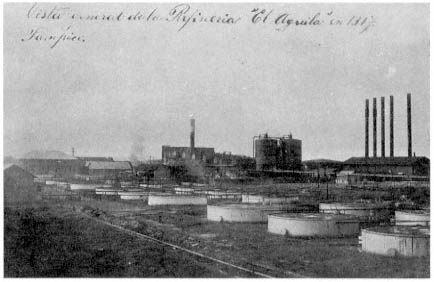
Fig. 9.
Panorama of the El Aguila refinery at Tampico, 1917. This was already Mexico's
largest refinery, and construction was still continuing. Nearly one thousand men
worked here. Courtesy of the Rama del Trabajo, Archivo General de la
Nación, Mexico City.
in 1918 and reached a peak of $2.50 in 1920 before falling again. (See graph 1.) El Aguila's production overcame its ceiling of less than seventeen million barrels per annum during the war years to reach nearly thirty-three million barrels in 1920 (see table 6). Remarkably, this advance in production came about just as the cornerstone well of the entire company, Potrero No. 4, was beginning to show signs of exhaustion. On 3 December 1918, company officials received word from the field managers that the well showed emulsion. Additional indications of hot salt water in the oil caused the well to be pinched back and finally shut in. Potrero No. 4 had yielded nearly 104.8 million barrels of crude oil in its nine years of existence. Some of its past production remained to be used. More than 9.8 million barrels of Potrero's crude remained stored in huge, open-air earthen reservoirs.[185]
As regards direction of the company, El Aguila's former officials, all of whom had been recruited over the years by Lord Cowdray, continued operating the company's business. J.B. Body would eventually leave the general managerial position in Mexico City and take up an office in Shell's London office, where he coordinated the Mexico activi-
ties. T.J. Ryder remained in the New York office until he retired early in the 1920s. Two assistant managers in Mexico would eventually move into the direction of El Aguila's affairs in Mexico. J.A. Assheton replaced Body as general manager and A.E. Chambers acted as his deputy. Most supervisors of oil fields and refineries remained at their posts. The continuity of company policy was significant, as was the deference that Shell headquarters gave to this experienced team to run the oil operations in Mexico and deal with local labor and political conditions.
Salt-water intrusion, a signal of the impending exhaustion of the oil field, was not easily dismissed. Geologists, drillers, and their employers had been aware all along of the relationship between the salt water and the oil in the limestone reservoirs. Two wells that Pearson had drilled near the Dos Bocas blowout had produced little else but hot water. As early as 1911, numerous wells in the El Ebano field, Mexico's oldest, had begun to yield "large quantities of hot water with the oil." Several wells at the Hacienda Santa Fe, near Topila, which Pierce had acquired, had also gone to salt water as early as 1913.[186] Now that the truly prolific wells of the southern fields were flowing emulsion, Shell was confronted with having paid £10 million for declining oil fields. The company moved to reassure its stockholders. In its 1920 annual report, El Aguila said: "Particular emphasis is drawn by the directors to the fact
| ||||||||||||||||||||||||||||||||||||||||||||||||||||||||||||||||||||
that the appearance of salt water in some of the more heavily exploited fields need cause no anxiety to the shareholders, in view of the company's large reserve territories."[187] But the annual report was wrong. The great Mexican oil boom had already reached the beginning of decline.
What was the difference between the great Mexican oil boom, one may ask, and those oil booms that had preceded it in the United States? Just in terms of the economic structure of the industry, there were few. Lease-takers searched for prospective oil properties, dealing directly with landowners and local property records as they did in the United States. The entire industry was based on the private-property contract. Thanks to those mining laws changed by nineteenth-century Mexican liberals in 1888 and 1892, the oilmen acquired land by purchasing or leasing it directly from the landowner. The ranchero and hacendado's sale of the oil underneath their houses, fields, pastures, and forests did not come under the purview of the state at all. As in the United States, therefore, the oilmen's exploitation of the oil deposits could be brutal and wasteful in areas dominated by small property owners and many
companies. Their exploitation could be more conservationist in areas dominated by large landholdings and few oil companies. Offset campaigns were just as prominent a feature of the Los Angeles oil boom of the 1890s, where rigs were placed as close to each other as "holes in a salt shaker." Offset wells could also be found at Topila, Pánuco, Alazán, Amatlán, Zacamixtle, and Los Naranjos.
In the United States, the oil industry of the twentieth century was becoming ever more integrated into the world economy. This was even more true in Mexico. The major market for Mexico's oil was the United States and, secondarily, Latin America and Europe. When the world's price for petroleum rose and fell, so did the prices for Mexico's crude oil. Profits grew during times of strong demand. They slowed down during times of excess worldwide production. Each boom in the United States fostered the development of a large number of individual companies, a few of the fortunate first-comers usually emerging into significant business organizations. Some of these boom-created entities thrived and expanded their production, refining, and marketing outlets in order to survive the boom that created them; many competed with the existing multinational oil companies. The same was true in Mexico. Moreover, the tendency of a maturing oil boom had been to consolidate and integrate the larger companies through acquisition of complementary assets downstream and upstream. El Aguila and Huasteca were Mexican-based companies that best typified this economic behavior.
Finally, one is struck with the tendency of the entrenched great companies to move into an area of oil boom. In the United States, Standard Oil had had a long history of moving out of western Pennsylvania in order to follow the oil booms west, into Ohio, Indiana, Illinois, Iowa, Kansas, East Texas, Louisiana, Oklahoma, West Texas, and California. From its base in Sumatra, the Royal Dutch-Shell worked its way east toward California and west toward Europe and Venezuela in a global process of consolidating both markets and production. For those reasons, Jersey Standard and Shell inevitably felt a need to enter Mexico. They could no longer ignore the Mexican oil boom that was fostering such intense competition for market shares in the United States, Europe, and Latin America. Also, during World War I, the Americans had the advantage of being able to expand internationally, while British companies were set back.
What was different about the oil boom in Mexico? The oil was found in limestone, not oil sands, and produced a lot of gas. This was merely a matter of technological adaptation to oil drillers. But it
mattered not at all to the basically Anglo-American structure of the oil industry.
The important differences were cultural and political. This was Mexico, after all, not the United States. Neither the Mexican politicians nor the native work force were satisfied with the way in which the capitalistic industry was developing. No doubt, some Mexican landowners were reveling in their newfound wealth. But the Mexican state worried about its ability to control the industry as a source of tax revenue and as a threat to state power. Only the distraction of the Revolution and the strength of international demand prevented the Mexican state from intervening in the affairs of the oil companies. Furthermore, the workers wanted an economic institution that provided security and dignity to their lives. Mexican laborers would organize to resist those aspects of modern capitalism that threatened their culture and their security. Even as the foreign companies developed the Mexican oil industry according to strict capitalistic and market considerations, the politicians and the workers, each in their own way, were preparing to reclaim the Huasteca Veracruzana as their own.