
An Overview Of The Japanese Civil Service
To place the discussion of recruitment in perspective, it is necessary to note a few outstanding aspects of the Japanese civil service. The preceding chapter has already delineated its basic legal and institutional framework. The national public-service law spells out its basic standards, principles, and procedures. The law sets up the National Personnel Authority as one of the two "central personnel administrative organs" (chuo jinji gyosei kikan ).[1] Until 1984, the Bureau of Personnel in the prime minister's office was the other organ. In July of that year, however, the Bureau of Personnel was transferred to the newly created Management and Coordination Agency (Somucho).[2] In practice, the authority functions as. the principal personnel agency in the Japanese government.
At the policy making level, the authority consists of three commissioners (jinjikan ) who are appointed by the Cabinet for four years with the approval of both houses of the Diet. No two commissioners may belong to the same political party or be graduates of the same faculty of the same university. They may be reappointed but their maximum term of office is twelve years. One of the commissioners is designated by the cabinet as president (sosai ) of the authority. The commissioners may not be removed from office except through impeachment. The daily operations of the authority are in the hands of a staff of about seven hundred persons headed by the secretary general (jimu socho ).[3]
[1] hapter 2, articles 3 through 25 of the national public-service law in Jinji-in, Ninmen kankei horeishu [Collection of Laws and Ordinances Concerning Appointments and Dismissals], 1984 ed. (Tokyo: Okurasho, Insatusukyoku, 1984), pp. 14-19.
[2] yosei Kanricho, Gyosei kanri no genjo: Gyosei kaikaku no doko , pp. 26-28. In the 1984 reorganization the Administrative Management Agency (Gyosei Kanricho) was abolished and most of its functions were taken over by the newly created Management and Coordination Agency.
[3] or details regarding the organization and functions of the National Personnel Authority, see Kato Hisabumi, Jinji-in: Nihon no shihai kiko [The National Personnel Authority: An Organization That Controls Japan] (Tokyo: Rodo Junposha, 1966); Kyoikusha, ed., Kaikei Kensa-in, Jinji-in, Naikaku Hoseikyoku [The Board of Audit, the National Personnel Authority, and the Cabinet Legislation Bureau] (Tokyo: Kyoikusha, 1979), pp. 69-116; and Sato Tatsuo, Kokka komuin seido [The National Public-Service System] (Tokyo: Gakuyo Shobo, 1975), pp. 13-16. See also the text of the National Public Service Law (kokka komuinho ) in Jinji-in, Ninmen kankei horeishu , 1984 ed., pp. 12-45.
In 1987, the president of the authority was Utsumi Hitoshi. Born in 1917, Utsumi graduated from the law faculty of the University of Tokyo in 1941 and entered the Home Ministry in the same year. He retired from the civil service after serving as the administrative vice-minister of the Defense Agency. He was appointed to his current position in 1984 by his former classmate in both Todai and the Home Ministry, Prime Minister Nakasone Yasuhiro. The other two commissioners were Sano Hiroyoshi (b. 1916) and Ishizaka Seiichi (b. 1922). A 1937 graduate of Aoyama Gakuin University who majored in English literature, Sano had worked as a journalist for Asahi shinbun and NHK and as a political commentator before being appointed to his present position in 1985. Ishizaka graduated from Todai's engineering faculty in 1944, where he also did graduate work, and served in the Ministry of International Trade and Industry (MITI) for twenty-five years. He was appointed a commissioner in 1986. Traditionally, one of the three commissioners has always been a former journalist and another has had a scientific or engineering background.[4]
The basic principles guiding the Japanese civil service may be summed up in two words: democracy and efficiency. Democracy implies that unlike the Emperor's officials in prewar Japan, the public servants in postwar Japan must be true to their name: as article 15 of the 1946 constitution puts it, "all public officials are servants of the whole community and not of any group thereof."[5]
To help attain this goal, the public service must be opened up to the entire people: the principle of open and equal access to civil-service appointments needs to be implemented. This does not mean that all citizens are guaranteed government jobs, which no government can afford to do, but that they are assured of an equal opportunity to compete for such jobs. This is where the other principle comes into play:
[4] aniai Kenzo, "Kankai jinmyaku chiri: Chuo shochohen: Jinji-in no maki" [Who's Who in Central-Government Ministries and Agencies: The National Personnel Authority], Kankai , Aug. 1987, pp. 39-41.
[5] or the English text of the Japanese constitution, see Suekawa Hiroshi, ed., Iwanami kihon roppo, Showa 49-nenban [Iwanami Six Fundamental Laws, 1974 Edition] (Tokyo: Iwanami Shoten, 1973), pp. 110-16.
that of efficiency. In other words, the guiding criterion of civil-service appointments shall be merit—the objective qualifications of candidates as demonstrated in their educational attainments, experience, and performance in examinations. The mechanism through which and the degree to which these twin principles are translated into reality will be the focus of our inquiry in this chapter.
Let us now attempt to clarify the bewildering array of categories in the Japanese civil service. As of 1 July 1987, there were a total of 4,506,725 public employees (komuin ) in Japan, of whom 1,172,797 belonged to the national government and the remainder to the various local governmental units. As figure 1 shows, the national public employees are divided into two broad categories: the general service (ippan shoku ) and the special service (tokubetsu shoku ). The latter, which comprised 328,507 employees in July 1987, encompasses such diverse positions as the prime minister, ministers of state, commissioners of the National Personnel Authority, deputy director general of the cabinet secretariat, director general of the cabinet legislation bureau, parliamentary vice-ministers, judges and other employees of the courts, members of the Diet and their secretaries, and employees of the Defense Agency.[6]
The ippan shoku public employees are in turn divided into (1) those governed by the regular compensation law (kyuyoho shokuin ), (2) those governed by the special compensation law (kyuyo tokureiho shokuin ), and (3) public prosecutors. In July 1987 there were 505,791, 336,332, and 2,167 persons respectively in the three categories. Nearly 90 percent of public employees who are subject to the special compensation law are postal employees; the remainder are engaged in such specialized occupations as forestry, printing, and engraving.[7]
Finally, the ippan shoku public employees who are subject to the regular compensation law are subdivided into seventeen categories, each of which carries its own salary schedule. They are (1) the Administrative Service I, (2) the Administrative Service II, (3) the Specialized Administrative Service (senmon gyosei shoku ), (4) the Taxation Service, (5) the Public Security Service I, (6) the Public Security Service II, (7) the Marine Service I, (8) the Marine Service II, (9) the Educational
[6] ee art. 2 of the national public-service law in Jinji-in, Ninmen kankei horeishu , 1984 ed., p. 13. All the statistics cited here are taken from Jinji-in, Komuin hakusho , 1988, esp. p. 251.
[7] bid., pp. 39 and 168.
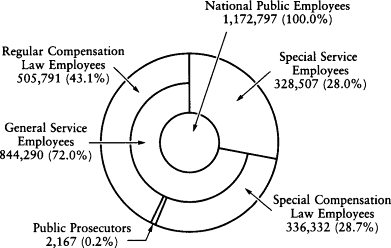
Fig. 1.
Number of National Public Employees
Source: Jinji-in, Komuin hakusho, 1988 (Tokyo: Okurasho, Insatsukyoku, 1988), p. 251.
Service I, (10) the Educational Service II, (11) the Educational Service III, (12) the Educational Service IV, (13) the Research Service, (14) the Medical Service I, (15) the Medical Service II, (16) the Medical Service III, and (17) the Designated Service (shitei shoku ).[8]
By far the single most important of these categories in terms of both size and relevance for this study is the Administrative Service I. In 1987 it consisted of 227,725 or 46.8 percent of all persons covered by the seventeen salary schedules. It includes most people whom one ordinarily associates with civil service. The Administrative Service II salary schedule, on the other hand, covers drivers of automobiles, operators of all mechanized equipment, guards, and other people who are engaged in similar activities. The Specialized Administrative Service, which was newly established in 1985, encompasses inspectors and judges of the Patent Agency, inspectors of ships, those who work in the air-traffic-control field, and others whose duties require specialized knowledge and skills. The Educational Service I schedule covers the faculty and staff of colleges and universities. With 52,619 persons under its rubric, it was the second-largest category in 1987. The schedule for the Designated Service, on the other hand, is one of the smallest, subsuming under its rubric such positions as administrative vice-minister, head of
[8] bid., p. 168.
an external bureau (gaikyoku )—an entity that is affiliated with but not an integral part of a ministry or an agency—bureau chief, dean of a college, head of a laboratory or a research institute, and director of a hospital or a sanatorium. In 1987 these positions numbered 1,357.[9]