
Geothermal Importance of Hydrovolcanism
Field, experimental, and theoretical aspects of hydrovolcanism profoundly influence our understanding of the development, location, and nature of geothermal reservoirs in volcanic fields. Tephra stratigraphy, bedform analysis, and grain size and textures are pertinent geological information that can be interpreted to help determine the hydrologic conditions in a volcanic field. Detailed petrographic analyses of lithic constituents in the ejecta can also reveal the nature of the stratigraphic and thermal regime below a volcano; some examples of geothermal studies in Italy provide excellent documen-
tation of the ways pyroclastic rocks have been employed to locate hydrothermal reservoirs. Finally, with knowledge of basement stratigraphy and aquifer locations, the theory of hydraulic fracture can be developed to show how a secondary permeability developed in basement rocks allows convection to prolong the transfer of residual magmatic heat to aquifers.
Tephra Stratigraphy: Geometry and Depth of Reservoir Rocks
The availability of groundwater and its depth have significant influence on the stratigraphy of hydrovolcanic tephra deposits (Heiken, 1971; Barberi, 1985; Barberi et al ., 1988). In general, where drilling information has located aquifers in volcanic fields, the aquifer depth can be correlated to types of volcanic eruptions. Figure 2.36 shows a hypothetical basin in which the aquifer is shallow or nonexistent at its margins and located at great depth near the basin's center. Eruptions of basic magma through the shallow aquifer form monogenetic structures such as single maars or tuff rings; the aquifer is gradually depleted until eruptions are no longer explosive. The magma then tends to congeal in the conduit, which eventually stops activity. If magma intersects a deep aquifer, it interacts with water under greater pressures; this delays the formation of vapor until the mixture approaches the surface, where it forms frothy ejecta that erupts in a Plinian fashion. The deep mixing does not deplete the aquifer, so repeated eruptions can occur before the magma solidifies. The surface expression of such hydrovolcanism might be a caldera complex with numerous
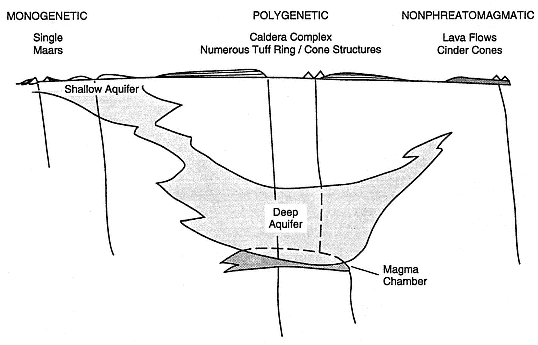
Fig. 2.36
An idealized cross section of a basin in which magma has erupted through rocks of varying
saturation. Where aquifers are shallow, monogenetic landforms such as single maar craters
probably form. However, if the aquifer is deep enough to surround a magma chamber, prolonged
interaction between the magma and water produces polygenetic landforms such as calderas with
numerous tuff rings and cones. In contrast, at locations where magma erupts without interacting
with an aquifer, lava flows and cinder (scoria) cones are the usual volcanic landforms.
tuff rings and tuff cone structures (however, we emphasize the fact that not all calderas are related to hydrovolcanism). Where erupting magma encounters no groundwater, activity is confined to lava-flow emplacement and perhaps some Strombolian scoria cone eruptions.
In shallow hydromagmatic eruptions (interaction within several hundred meters of the surface), the characteristic eruption shown schematically in Fig. 2.37 develops. The idealized stratigraphy illustrated in Fig. 2.38 reflects a gradual decrease in the amount of water interacting with the magma. With initial abundant water supplies (water:magma ratio >1.0 by mass), hydroclastic eruptions might begin with phreatic bursts that produce mud slurries, lahars, and peperite deposits. As the eruption progresses, less water feeds the rising magma (water:magma ratio @ 0.5 to 1.5), and discrete explosions of wet steam and tephra deposit cool, wet pyroclastic surges. Later the water:magma ratio reaches levels (water/magma < 0.5) appropriate for very energetic eruptions of superheated steam and tephra that produce highly inflated, hot and dry pyroclastic surges capable of depositing sandwave beds. Final eruptions deposit fallout tephra and lava flows as the water supply is cut off from the magma conduit.
Deep hydromagmatic eruptions (interaction at depths from several hundred meters to several kilometers) follow a different pattern; the one described here develops a Plinian eruption sequence. Figure 2.39 depicts a Plinian eruption conduit passing at depth through an aquifer and displaying a magma fragmentation level that is receding down the conduit with time. Barberi (1985) hypothesized that in this eruption water/magma interaction will not begin until the fragmentation level has receded below the depth of the aquifer and conduit pressure falls to values less than hydrostatic. Before this stage, overpressure in the conduit is greater than hydrostatic so aquifer water does not flow into the conduit; however, after the fragmentation level passes through
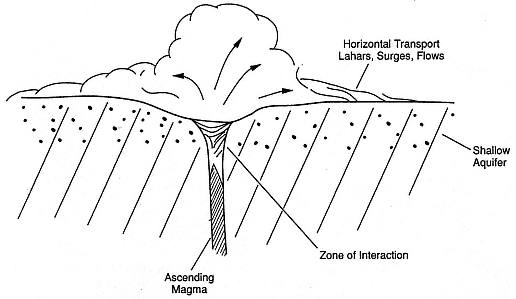
Fig. 2.37
When magma erupts through a shallow aquifer (dots), the aquifer is quickly depleted;
consequently, the eruption becomes dryer in character and forms monogenetic,
maar-tuff ring structures.
the aquifer, pressure in the conduit may fall below hydrostatic and water/magma interaction will begin. Proof of this hypothesis depends upon whether the aquifer water is really at hydrostatic pressure and whether the erupting gas-pyroclast mixture above the fragmentation level has a pressure gradient below hydrostatic.
Delaney (1982) demonstrated that when saturated rocks are heated by nearby magma, pore pressures increase sufficiently to drive hydrologic flow in the direction of least resistance (see Table 2.9). In cases where the magma is more permeable than the aquifer, the heated pore water might be forced into the magma. This hypothesis fits many observed tephra sequences in areas where information is available from drilling (Barberi, 1985; Barberi et al ., 1981). Barberi (1985) illustrated his model for deep water/magma interaction with a series of diagrams that
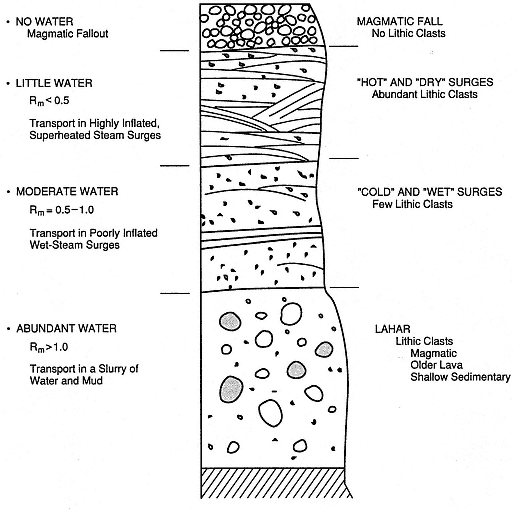
Fig. 2.38
This idealized depositional sequence for a shallow hydromagmatic eruption shows tephra
deposits of decreasing water abundance; such an eruption may end in solely magmatic
eruptions of pumice, scoria, or lava.
(Adapted from Barberi, 1985.)
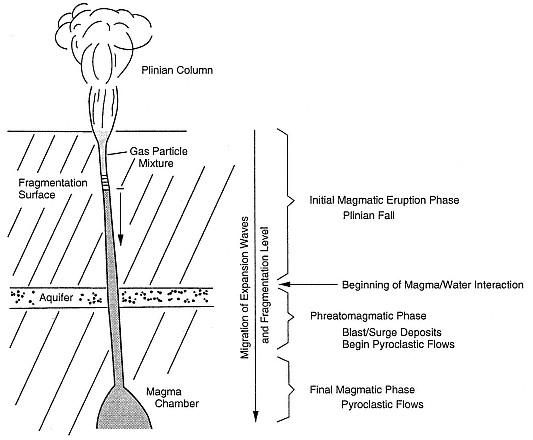
Fig. 2.39
In deep hydromagmatic eruptions, strong magma interaction with a deep aquifer begins after
the fragmentation surface recedes down the conduit to the depth of the aquifer. Decreased
gas pressure in the conduit above the fragmentation surface allows pore pressures in the aquifer
to drive water into the conduit. At right, the sequence of eruption styles is correlated with
the gradual migration of the fragmentation level (expansion waves) down the conduit.
(Adapted from Barberi, 1985.)
| ||||||||||||||||||||||||||||||||||||||||||||||||||||||||||||||||||||||||||||||||||||||||||
show the progression from a Plinian over-pressured eruption column (Kieffer, 1984a, 1984b) to a pressure-balanced eruption column to a Phreatoplinian eruption phase; during this process, the fragmentation level in the conduit has receded to the depth of the aquifer (Fig. 2.40).
Figure 2.41 illustrates the idealized tephra depositional sequence from a deep hydrovolcanic eruption. Initial tephra deposits are magmatic Plinian pumice falls that blanket topography. At the intermediate stage, the eruption enters its hydrovolcanic phase (Phreatoplinian), which is marked by surge and blast deposits filled with lithic fragments from the aquifer. The final stage is characterized by emplacement of pyroclastic flows that may show many features similar to those of wet surges (such as accretionary lapilli). It is possible for the pyroclastic flow stage to be marked by periods of dry and wet expulsions of tephra that feed the pyroclastic flows, so some parts of the deposit may show entirely dry products and others may show more influence of water/magma interaction. An example of such behavior can be interpreted from the pyroclastic flow and surge deposits of the Laacher See volcano in Germany. The repeated phreatomagmatic depositional cycles found by Fisher et al . (1983) within the pyroclastic ejecta at Laacher See are attributed to varying degrees of water/ magma interaction. The degree of water/ magma interaction in our present interpretation is a function of the fragmentation level depth in the conduit: when it fluctuates above and below an aquifer, eruptions cycle between wet and dry.
Pyroclastic rocks can be used to interpret the geometry of aquifer rock units at depth below a volcanic field, as is depicted in Fig. 2.42. In this hypothetical case, the aquifer rocks are a potential geothermal reservoir. A crescent-shaped caldera wall is exposed on one side. The caldera-forming pyroclastic flow shows two major facies: (a) a coarse-grained tuff with pumiceous and a few lithic fragments in the northern portions of the outflow sheet, and (b) a fine-grained lithic-rich phreatomagmatic (hydrovolcanic) tuff in the southern portions of the outflow sheet. Tuff ring and cone vents are found along part of the caldera wall and along fault trends that extend southeasterly out of the caldera. In addition, lava flow vents are evident outside the caldera in the outflow sheet. Using the distribution of hydrovolcanic products, it is possible to infer the geometry of a saturated basement rock unit. Apparently, the caldera erupted at the intersection of an east-west fault structure and a northwest-southeast-trending one. Ring vent eruptions to the north of the fault were dry and dispersed magmatic products northward; eruptions south of the fault must have involved water from the aquifer to produce hydrovolcanic eruptions that dispersed phreatomagmatic tephra southward. The limits of this saturated reservoir rock can be further constrained along the northwest fault trend between the smaller hydrovolcanic vents and those that extruded lavas. Examples of such interpretations from the Sabatini and Albani volcanic fields of Italy are described in the following section.
Summarizing hydrovolcanic eruption sequences and aquifer depths, Fig. 2.43 is a plot of the water:magma ratio as a function of median tephra grain size. Very fine grained tephra deposits are an earmark of hydrovolcanic activity; theoretical arguments supported by field observations have determined that the finest grain sizes correlate to water:magma rations near 1.0, which are best suited for development of economically significant hydrothermal systems. Further support for this argument is developed in the following sections, which discuss such features as country rock fractures and thermal regimes—information that can be derived from detailed analysis of the lithic fragments contained in tephra deposits.
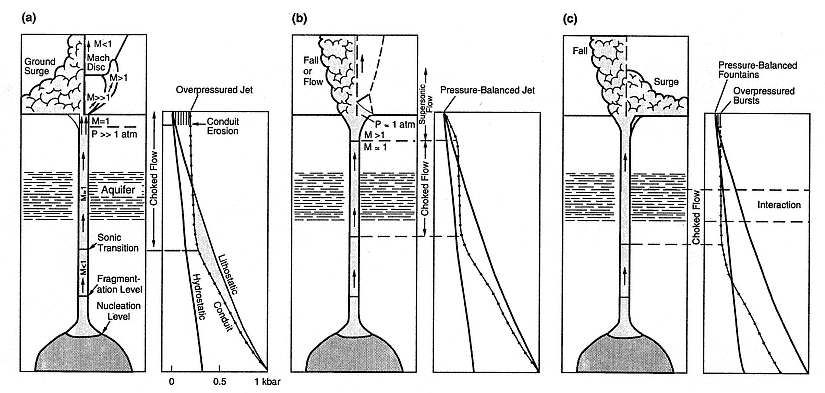
Fig. 2.40
Sequences of pressure gradients around the conduit for a Plinian eruption involving a deep aquifer. (a) Initial
eruptions are highly overpressured at the vent, causing blast conditions that involve both a
supersonic jet with a Mach disk structure (Kieffer, 1984b) and the eruption of ground surges.
(b) As the fragmentation level recedes down the conduit, the transition from a choked, sonic-speed flow
(M » 1) to one at supersonic speed (M > 1) occurs at depth, allowing eruption of a jet near atmospheric
pressure and development of a Plinian column that produces fallout deposits. For these first two eruption stages,
conduit pressure (dotted line) is greater than hydrostatic, which precludes the flow of much water from
the aquifer into the conduit. Wherever the conduit pressure is greater than lithostatic, conduit erosion will
add lithic fragments from that stratigraphic level to the erupted mixture. (c) When conduit pressure falls
below hydrostatic, water from the aquifer mixes with the magma to produce deep-seated hydrovolcanic
eruptions; abundant lithic fragments from the aquifer rock are emplaced in pyroclastic flows and surges from
a now-collapsing eruption column.
(Adapted from Barberi, 1985.)
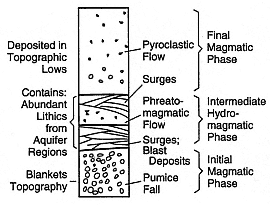
Fig. 2.41
Idealized stratigraphy of deep hydromagmatic
eruption products, showing transitions from
early magmatic eruption of pumice fallout to
intermediate stages of hydromagmatic eruptions
of surge blasts to dry or wet eruptions of
pyroclastic flows (with accretionary lapilli).
(Adapted from Barberi, 1985.)
Lithic Ejecta: An Important Geothermal Prospecting Tool
Lithic ejecta can provide information about the (a) subvolcanic stratigraphy, (b) aquifer depth and physical properties, (c) aerial extent of the fluid reservoir in a volcanic region, and (d) chemical and thermal regime of rocks at depth. An in-depth study (for example, Barberi et al ., 1988) involves the collection of tephra samples, petrographic microscopic point counts of lithic constituent abundances, comparisons of the abundances with the stratigraphic position in both the tephra deposit and the regional rocks, and x-ray analyses of alteration assemblages found in lithic fragments.
Figure 2.44 schematically illustrates a hydrovolcanic eruption upward through a varied stratigraphic section that consists of three principal rock units. The interaction of water and magma occurs in aquifer rock unit 2, and subsequent eruptions excavate rock unit 1. Through analysis of the resulting tephra deposit, depicted in Fig. 2.45, the basement stratigraphy can be reconstructed. In this case—an eruption sequence that becomes wetter with time—the lowest tephra units contain mostly lithic fragments from the upper rock unit (unit 1) because it is excavated as the crater is formed. Later magmatic pumice-fall units might contain a small percentage of lithic fragments (< 10% by volume); lithic fragments from the deepest unit (unit 3) are most abundant because that unit is fractured by magma intrusion. When the hydrovolcanic dry eruption begins, lithic abundances increase by 5 to 20 vol%; those from the aquifer unit (unit 2) nearly equal those from the other two stratigraphic units combined. Final, wet eruptions produce the greatest abundance of lithic fragments (10 to 50 vol%), most of which are from the aquifer unit.
A good example of the correlation between basement stratigraphy and lithic fragments comes from geothermal investigations on the island of Nisyros, Greece (Barberi, 1985). Figure 2.46 shows the eruptive sequence and a correlation between its lithic constituents and the basement lithology encountered in a geothermal well. The hydromagmatic phases of the eruption produced dune-bedded pyroclastic surge deposits in which lithic fragments came from deep, permeable rock units, whereas the magmatic pumice fall units have lithic fragments from units higher in the basement stratigraphy in which little permeability was found. In this case, the hydroclastic tephra provide evidence of permeable rock units at depth. In addition, the lithic constituents of the hydroclastic units show alteration mineral assemblages that indicate elevated temperatures existed in the permeable strata.
The thermal regime of basement rocks is also reflected by lithic constituents found in pyroclastic strata. By careful study of the paragenesis of alteration minerals in lithic fragments, including stable isotope variations (for example, 18 O and 13 C) and fluid inclusion analysis (such as Cl-, SO4 , B, NH4 , and SiO2 ), it is possible to surmise not only the geochemical nature of hydrothermal fluids at depth but also their evolution with
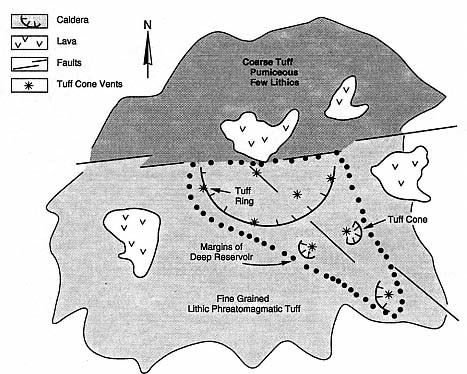
Fig. 2.42
Hydrothermal reservoir geometry (dotted line) inferred from a geological map showing
areas underlain by dry (pumiceous) and wet (phreatomagmatic) volcanic products.
A pyroclastic flow has been erupted from a caldera; it is pumiceous in its northern
regions but lithic-rich and fine-grained in its southern portions. Tuff ring and tuff
cone vents exist within the region underlain by the hydrothermal reservoir, whereas
lava flow vents are outside that region. The caldera lies at the intersection of two fault
systems. The east-west fault system marks the northern boundary of the hydrothermal
reservoir, presumably as an aquitard, and the southeast-northwest-trending fault
apparently localizes the aquifer along its southern extent. Because the caldera straddles
the northern boundary of aquifer rocks, eruptions from its northern side are dry,
whereas those from its southern side are of a phreatomagmatic character.
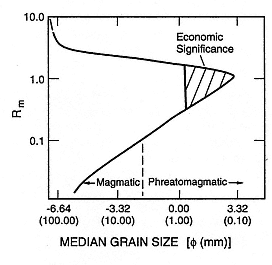
Fig. 2.43
Hypothetical water:magma mass ratio (Rm ) as
a function of the near-vent median grain size of
pyroclastic rocks. Where median grain sizes of
tephra are finest (between 0.1 and 1.0 mm),
the inferred water: magma mass ratio is
between 0.3 and 1.0. In this range of Rm ,
the hydrothermal potential—and therefore
the economic significance—is greatest.
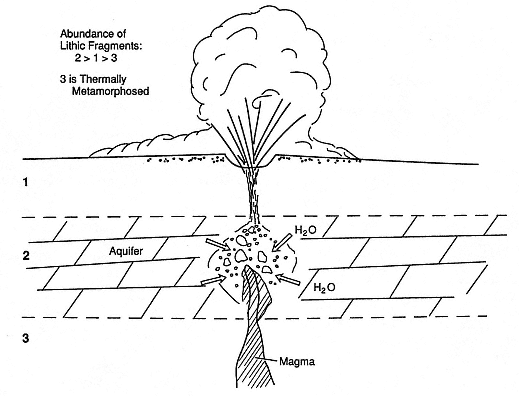
Fig. 2.44
Sketch of a hydromagmatic eruption through basement stratigraphy consisting of three rock types:
1 and 3 are of arbitrary lithology, and rock 2, a limestone aquifer where the water/magma interaction
occurs, is thermally metamorphosed near the volcanic conduit. The abundance of lithic fragments
carried within the ejecta are shown by rock type. Type 2 is most abundant, because of the
explosive fragmentation that occurs in the aquifer. Lithic type 1 is greater than lithic type 3
because it represents near-surface rocks eroded from the conduit walls by
the pressurized mixture of steam and tephra. Lithic type 3 is least abundant
because its deep lithology is little affected by the erosive power of upward migrating magma.
time and thermal regime. In the example from Nisyros (Fig. 2.46), the four zones of secondary minerals found in the geothermal well include—with increasing depth—argillic, argillic-phyllitic, phyllitic-propylitic, and propylitic mineral assemblages, the lowest three of which show up in lithic fragments from the tephra deposit. Figure 2.47 reviews basic hydrothermal alteration facies and equilibrium temperatures represented by the mineral assemblages that characterize each facies. Secondary mineral assemblages in volcaniclastic rocks are also good indicators of burial depth (Viereck et al ., 1982). Glass shards commonly alter during diagenesis to zeolites, feldspars, opal-ct, and quartz as well as smectite clays and consequently can indicate temperature and burial depth (Fig. 2.48).
Excellent examples of the use of hydrovolcanic tephra and lithic constituents in exploration for geothermal reservoirs are provided by studies in the Latium volcanic province of Italy. This area (shown in Fig. 2.49) includes the Vulsini (Latera) volcanic complex, Vico volcano, the Sabatini volcanic complex, and the Albani volcanic complex, all of which exhibit important hydrovolcanic features (De Rita et al ., 1983).
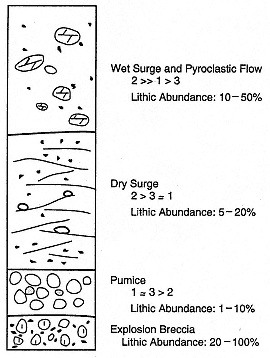
Fig. 2.45
An idealized stratigraphic section produced by
the eruption illustrated in Fig. 2.44. The basement
stratigraphy is represented by lithic fragment
abundances that are sensitive to eruption
sequence. Initial, dry pumice eruptions promote
nearly equal abundances of types 1 and 3 as
a result of vent widening and the relatively
large area of contact between the magma
and type 3. Conduit pressure is too great to
allow much cavitation of rock type 2. As
eruptions become hydromagmatic, the
abundance of type 2 increases significantly.
Funiciello et al . (1976) and Funiciello and Parotto (1978) described the correlation between sedimentary lithic ejecta in pyroclastic deposits of the Albani and Sabatini regions. Figure 2.50 is a sketch geologic map of the Alban Hills south of Rome. The dominant feature of this area is the Tuscolano-Artemisio caldera and the distribution of its phreatomagmatic ejecta, which is mainly to the west of the caldera. In surrounding areas, the sedimentary basement rock, consisting of Mesozoic to Cenozoic marine rocks, is exposed and is also represented by lithic fragments in the tephra of the volcanic field. The abundance of these lithic fragments and the locations of hydrovolcanic vents allowed Funiciello and Parotto (1978) to reconstruct the substrate below the volcanic complex (Fig. 2.51). The hydrovolcanic vents are located above a structurally high block of water-saturated continental shelf and basin rocks. North-northwest faults crossing this block have contributed to fracture permeability.
A second example from Italy is the Sabatini/Cesano region described by Funiciello et al . (1976). In the eastern part of the volcanic field, the authors were able to distinguish both shallow and deep aquifers. In shallow interactions, hydrovolcanic vents were monogenetic maar craters with a diameter of 1 km or less, whereas deep interactions produced poorly defined maar structures and complex caldera structures. These caldera structures appear to represent the coalescence of several maar vents that eventually collapsed together to form a single caldera. An example of this sequence of events is the Baccano caldera, whose walls expose hydrovolcanic tephra from numerous vents (see also Fig. 4.21). Fine tephra, exposed in ridges of phreatomagmatic tephra agglomerates, have a high chloride and sulfate content that is inherited from the deep hydrothermal reservoir fluids involved in water/magma interaction. In addition, ejecta analysis by scanning electron microscopy and energy dispersive x-ray
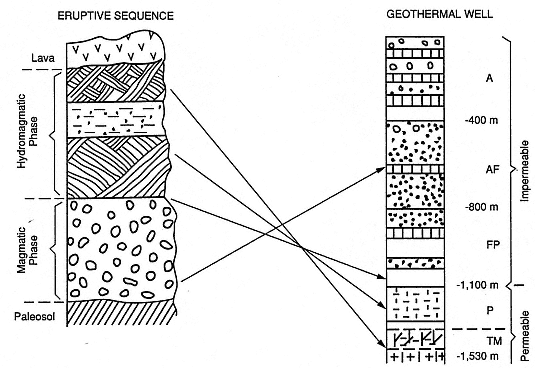
Fig. 2.46
An example of lithic stratigraphy determined by correlations with a geothermal well in Nisyros,
Greece. The eruptive sequence shown is a magmatic-phase pumice fallout on a paleosol
substrate that is overlain by dune- and massive-bedded hydromagmatic tephra capped
by a lava. Lithic fragments from the magmatic-phase deposits correspond to impermeable strata
that are logged in the geothermal well, whereas the lithic fragments in the hydromagmatic-phase
deposits correspond to deeper, increasingly permeable strata. Hydrothermal alteration observed in
the geothermal well increases downward from argillic (A) through argillic-phyllitic (AF),
phyllitic-propylitic (FP), and propylitic (P) to thermally metamorphosed rock (TM).
(Adapted from Barberi, 1985.)
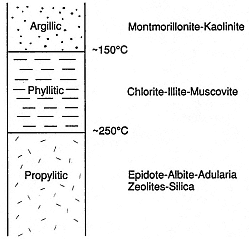
Fig. 2.47
Review of hydrothermal alteration facies
and characteristic mineral assemblages shown
as a function of depth and temperature.
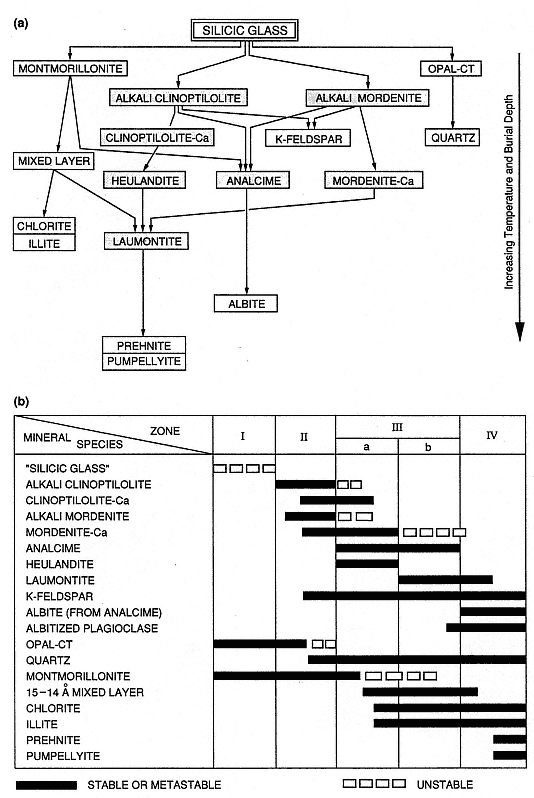
Fig. 2.48
Burial diagenesis of zeolites and clays. (a) This flow diagram shows the development of authigenic
zeolites (shaded boxes) and silicates from silicic glass during burial diagenesis and metamorphism.
(b) In this chart of mineral assemblages in a thick section of marine silicic volcaniclastic rocks,
zones I to IV indicate increasing burial depth. Zone I is characterized by partial alteration of silicic
glass to montmorillonite and opal-A/opal-CT. Zone II shows additions of alkali zeolites formed by
reaction of silicic glass with interstitial water. The transition to Zone III (where alkali zeolites are
transformed into analcime, heulandite, and laumontite) occurs at temperatures of 84 to 91°C.
The transition to Zone IV (analcime transformed to albite) occurs at temperatures of
120 to 124°C and marks a gradation into the thermal metamorphic regime.
(Adapted from lijima, 1978.)
analysis allowed Funiciello et al . to classify secondary mineral paragenesis and determine the most recent temperature and chemistry of deep reservoir fluids involved in the hydrovolcanic eruptions. Their schematic geologic map (Fig. 2.52) was created from lithic ejecta analyses, which show excellent agreement with geophysical studies of regional gravity, electrical resistivity, and heat flow (Fig. 2.53).
The Funiciello et al . (1976) study constitutes a major step toward the application of volcanology to geothermal prospecting. They stated that
"As a first approximation, we assume that the surface covered by products of recent phreatomagmatism, rich in ejecta from the deep sedimentary basement, delimits the minimum dimensions of a potential geothermal field. As a second approximation, the study of the sedimentary ejecta allows [us] to reconstruct the stratigraphic and structural characters of the sector where the phreatomagmatism occurred. This [study] makes it possible to interpret the paleogeographic and tectonic evolution of the area and to fit it within the regional geology."
With respect to thermal regimes, Funiciello et al . (1976) added:
"Furthermore, if a sequence of phreatomagmatic products in several layers is available, the comparative investigation of the mineralizations in the different layers supplies indicators on the evolution of the hydrothermal field in the time."