
Three
The Urban Economy
"Surat," declared the municipal councillors of the western Indian city in an address to the viceroy, Lord Curzon, in 1900, "is now but a shadow of its former self."[1] What had been in the seventeenth century South Asia's greatest international entrepôt had become, by the beginning of the twentieth, a rather unexceptional mofussil town. Gone were the ships carrying goods to and from the East Indies, the Middle East, Africa, and Europe. Gone were the groups of merchants from overseas who had once given the city a vibrant cosmopolitan character. Gone, too, were the indigenous merchant princes of Surat, once among the richest in the world. During the nineteenth century fires and floods had struck the city time and time again, leaving some parts uninhabited for decades. With the building of railways and the silting up of the Tapi River, which flows through the city to the Arabian Sea only a few miles away, the trade of Surat's harbor had largely disappeared. Thousands of residents, both wealthy and poor, had left for the booming commercial-industrial-administrative center of Bombay. Surat had ceased to be a central place of great significance and had become instead a satellite of the great colonial port to the south.
The decline of Surat has been a dominant theme in the writing on the city's history and has colored even its own residents' perception of their locality. Yet for the historian whose interest centers on understanding the social roots of late nineteenth- and early twentieth-century politics, Surat's socioeconomic fabric is as significant a subject as its decline. Curzon and other British administrators of his time might have been surprised at the considerable continuity in the quality and character of urban life in Surat. Physically the city had hardly undergone metamorphosis. It remained, as it had been three centuries earlier, crowded, often dirty, with the well-built houses of wealthy citizens
standing in contrast to impermanent structures of urban laborers and artisans. Pedestrians and carts pulled by men and bullocks still struggled past each other in the narrow alleyways and streets. Most Surtis continued to live in tightly defined localities; no new neighborhoods had replaced those devastated by natural and human-made disasters. The only obvious signs of British presence were the tiny settlement of foreigners near the police grounds, the Irish Presbyterian church and its mission school, a few scattered post offices and public buildings, the railway station, and a single "imperial" road from the city center to this station. Three modern factories stood isolated on the edge of the city. Although the municipality had torn down the inner walls of the city for sanitary reasons, Surat's outer walls still stood.
Even more significant for the purposes of this study, there were important continuities in the local economy and economic structure. Under British rule, the institutions of colonialism had no doubt penetrated the material life of many Surtis, and both merchants and artisans had had to make adaptations to changes in Indian and international conditions. But these changes did not disrupt relationships built around ties of affection, status, and community that had always been critical to the urban economy. Instead residents tended to reproduce preexisting economic structures and practices as they adjusted to their incorporation in the vast empire ruled by the British and a world economy dominated by European capital.
The Seventeenth-Century Economy
Interpretations based upon the westernization and the Marxian approaches tend to start from an assumption of an autonomous and stagnant precolonial society that was, with the imposition of colonialism in the nineteenth century, suddenly subjected to the powerful exogenous forces of Western education and capitalism. Recent historical scholarship, however, has thrown into doubt any static conception of the "traditional" Indian economy. Frank Perlin, a leading figure in this reconsideration, has argued: "India, like Europe, was affected by profound and rapid change in the character of its societies and economies, and state forms, from at least the sixteenth century. . . a fundamental aspect of that development was a local merchant capitalism which emerged independently of that in Europe, but within a common international theatre of societal and commercial changes."[2] By the early Mughal period, a highly developed commercial system had taken shape in South Asia, one characterized by a number of features once thought to be associated only with modern capitalism: considerable agricultural production for the market, the penetration of merchants and traders
into the agrarian economy, the manufacture of large volumes of luxury and nonluxury textiles for domestic and international consumption, a sophisticated monetary system, and extensive trading networks integrating the subcontinent with West Asia, Southeast Asia, China, and Europe.
Located on the western Indian coast in the southern portion of Gujarat—an especially important region of trade and industrial production—Surat was a critical center in this international economy (see map 1). An indigenous commercial economy, with a history that predated the arrival of the first ships of the English East India Company, thrived in the city. The vibrancy of local commerce was readily apparent to all visitors. Ovington, a late seventeenth-century British traveler, wrote of Surat:
Surat is reckoned the most fam'd emporium of the Indian Empire, where all commodities are vendible, though they were never there seen before. The very curiosity of them will engage the expectation of the purchaser to sell them again with some advantage, and will be apt to invite some other by their novelty, as they did him, to venture upon them. And the river is very commodious for the importation of foreign goods, which are brought up to the city in hoys and yachts, and country boats, with great convenience and expedition. And not only from Europe, but from China, Persia, Arabia, and other remote parts of India, ships unload abundance of all kinds of goods, for the ornament of the city, as well as the enriching of the port.[3]
Under Mughal rule, which began in 1573, Surat replaced Cambay as Gujarat's premier commercial center. By the seventeenth century the population of the city had expanded to somewhere between 200,000 and 400,000.[4] New neighborhoods, peopled by artisans and petty traders, sprang up outside the older settlements which had clustered close to the river's edge. As travelers' accounts attest, the city quickly developed its compact, congested, even unsanitary character while becoming India's most important commercial outlet.
By the high point of the Mughal Empire, the city was the hub of a great number of important trade routes: roads and coastal waterways that linked the port with the manufacturing centers of Bharuch, Cambay, and Ahmedabad within Gujarat; the more extended routes along the coastline of the subcontinent to Bengal in the east, Malabar in the south, and Sind in the west; the overland cart paths to the Mughal heartland in northern India; and overseas routes in the Indian Ocean, particularly to the Persian Gulf and the Red Sea, but also to eastern Africa and Southeast Asia, China, and Japan. Traders based in Surat played critical integrating roles through much of this vast network, coordinating production by artisan family firms, selling commodities
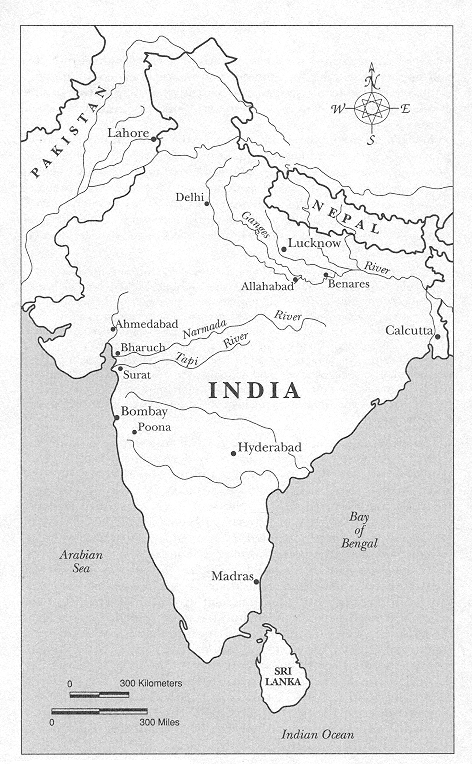
Map 1.
The Indian Subcontinent.
through their agents located in all the major cities of India and in numerous commercial centers overseas, and purchasing goods to channel back through the port. Gujarati shippers, mostly Muslims, transported both luxury items and goods for ordinary consumption to international markets in vessels that rivaled the European ships in trade if not in battle. The credit notes (hundi s) of local merchant bankers (sharaf s) which were honored all over the subcontinent, made possible substantial transactions between towns in India and with ports overseas without large initial cash outlays. Surat's merchants also penetrated into the countryside of South Gujarat as moneylenders and tax-farmers and as traders in the agrarian produce of the region.[5]
With this expansion in business activity came the development of powerful mercantile elites. Merchant princes such as Virji Vohra, a Jain trader and banker during the mid–seventeenth century, and Abdul Ghafar, a Sunni Bohra shipper at the turn of the eighteenth century, were probably among the world's wealthiest persons. They and a few dozen other traders and bankers who had benefited from domestic and international commerce under Mughal rule held a dominant position not only in the economy but also in important areas of the city's social life. As the research of Ashin Das Gupta has demonstrated, the business elite of Surat and Gujarat came from vastly differing social backgrounds. Indian merchants included Brahmans, Hindu and Jain Vaniyas, Muslims (both Shia and Sunni), and Parsis. But foreign traders from Armenia, Arabia, Turkey, Europe, and other distant lands also lived in Surat and participated in its commerce during the seventeenth century.[6]
Despite this sophisticated commercial order, the local economy hardly fit the image of an order built upon the free, amoral exchange that supposedly goes hand in hand with capitalism. A striking feature of economic organization in the city was the way in which strong social relationships grounded in indigenous moral conceptions intersected with and bolstered trading and production relations. For artisans and traders, both big and small, the joint family served as the basic economic unit. Caste was also essential to the structuring of economic life. It was not uncommon for entire trades to be dominated by particular castes or communities which tried to ward off outside competitors and employed social sanctions to reinforce business agreements. In lines of commerce involving a number of communities these same functions could be performed by guild-like organizations known as mahajan s, which set rules for conducting business, fixed holidays, and established prices and wages for artisans, but which also exercised religious functions, such as building temples and rest houses for Hindu and Jain pilgrims.[7] Such communities of trust often provided much-needed
security against the risks of rapidly fluctuating markets, business agreements not backed by legally enforceable contracts, and the provision of finance by individual bankers rather than by impersonal institutions.
Particularly critical to commercial and financial dealings in Surat and in its larger trading networks were perceptions of the reputability of the transacting partners. Merchants frequently conducted their trade as much on the basis of their abru as on their material resources. Even more than its English equivalent, credit, the word abru suggested a family firm's reputation for honoring its agreements and its more general status within urban society. The significance of abru to the commerce of the city is most apparent in the operations of the great sharaf s. The credit of individual merchant bankers was essential to the acceptance of their hundi s in trading centers not only in Surat itself but also elsewhere in the Mughal Empire and in the ports of the Persian Gulf and Red Sea. If these hundis s had lost their viability, then the merchants who carried them would have been unable to make their purchases, and the whole trading network could have collapsed.[8] According to one local saying, the credit of Atmaram Bhukan, an especially prominent eighteenth-century banker of Surat, was so great that even if his hundi s were tied to the branches of a tree, they would still be accepted.[9] Credit also affected the willingness of traders to deposit funds with a banker, as local merchants confirmed in an eighteenth-century petition to the East India Company:
The entire belief that property is perfectly secure in the house of a shroff [sharaf ] forms what is called his credit which more than his actual money is the instrument of his dealing and the greater source of his profits. Those who come to trade in this city either bring their bills on the shroffs or lodge the produce of their goods with them during their stay from many parts of India. . . for all these sums deposited, no receipts are given, the books of the shroffs and the opinion of their faith and substance are the total dependence of the people who deal with them.[10]
As we shall see in the next chapter, opinions of the "faith and substance" of individual merchants were established not in their business dealings alone, but also in patterns of religious giving and the exercise of moral leadership in the community.
Even in the organization of local industry, business relations were often built around preexisting social ties. Most historians tend to agree that joint-family artisan firms exploiting chiefly family labor and producing in the home were the basic units of industrial activity. Textiles usually were manufactured in distinct steps performed in different workshops by different semiautonomous artisans rather than in larger operations under a single roof supervised by a single industrialist.
Specific caste groupings tended to control the labor in specific stages of the overall process, thus providing group members with some protection against outside competition. Most artisans, however, lacked sufficient knowledge of market conditions and were too vulnerable to the frequent changes in demand to participate in commercial activity directly without seriously endangering the survival of their firms. Usually they relied upon local merchants—with whom they often developed long-standing relationships—for the supply of capital, either in the form of cash advances or of raw materials. These merchants offered low payments to their artisan clients but often provided work during slack periods.[11] Thus, to use Goren Hyden's term, there existed in the domestic manufactures an "economy of affection," in which production relations overlapped strongly with noneconomic social bonds.[12] The moral economy of domestic manufacture allowed local artisans and merchants alike to bear better the risks of participation in the unstable market conditions of the precolonial period.
All this suggests special problems with social science models that have viewed joint-family, caste, community, and patron-client relations as "precapitalist" or "feudal" social forms at odds with market-oriented economies. Certainly precolonial is a more satisfactory label. But the perpetuation of these forms after 1800 suggests that, even in using this alternative terminology, we must avoid any teleological reasoning that would suggest the incompatibility of these structures with the altered economic circumstances of colonialism. Under British rule, many precolonial institutions and relations adapted to changes in the larger world rather than disintegrated. Thus, even in the midst of a decaying city, an economy that relied on relationships of affection and trust continued to sustain itself.
Decline without Collapse
That Surat suffered a serious contraction in its economic activity between 1700 and 1900 seems beyond dispute. Two distinct phases of decline are discernible. The first began before the establishment of full British sovereignty over the city in 1800 and was at least partially a product of developments independent of the East India Company's rise, such as the growing insecurity of trade routes in the Mughal Empire, the increased pressures placed on local merchants by Mughal noblemen eager to supplement their revenues, and shrinking markets in the Red Sea and the Persian Gulf as a result of instability in the Safavid and Ottoman Empires. These developments were accompanied by changes in which the English did have a hand, such as the displacement of Indian shipbuilding by European competitors and, particularly, the
rise of Bombay as a major center of commerce.[13] The new port city, protected from Maratha raids and Mughal exactions alike, attracted many merchants from Surat itself, including some who had made fortunes as brokers of the company and as independent traders. Nonetheless Surat remained a major center of western Indian trade and industry at the end of the eighteenth century.
The second, more serious, phase of decline began with the establishment of colonial rule and lasted until about 1870. During this period Surat experienced a series of catastrophes: floods, earthquakes, famines, and fires, the most devastating being the fire of 1837, which raged for days and destroyed 7,000 homes and caused 5 million rupees damage. At the same time, the Tapi River gradually silted up, making the city inaccessible to the largest vessels. Yet, given the wealth and the resilience of the city's commercial elites, Surat might have rebounded from these traumas if not for serious structural changes associated with the rise of British power: the breaking of government's financial dependence on local merchant bankers, which eliminated a profitable area of investment for localsharaf s; the agrarian depression of the 1820s and 1830s, undoubtedly caused by excessive company revenue demands on the countryside; the declining position of the Mughal gentry and other landed elites who had been major consumers of Surti luxury goods; and shifts in patterns of international trade caused by the continued contraction of West Asian demand and the emergence of serious competition from the great European manufacturing centers. Also significant was the continued growth of Bombay, first as a port, then with the development of the modern textile industry, as a major manufacturing center. Large numbers of local merchants migrated there to participate in the burgeoning commerce.[14]
Given the range of factors working against the city's prosperity, one might initially wonder how Surat remained as important as it did. Clearly, nineteenth-century demographic figures do not indicate an expanding urban economy. In 1816, Das Gupta has estimated, there were approximately 150,000 people living in the city, already a significant drop from a century earlier. In 1851, a local census estimated the population at 89,505.[15] Even taking into account likely underreporting, the city had lost at least one-third of its population during the first fifty years of company rule. Residents left entire neighborhoods abandoned after fires and floods, and little new construction took place. The city lost its cosmopolitan flavor, since few foreign traders chose to maintain local outposts any longer. Centers like Bombay, Ahmedabad, and Karachi, where one can legitimately talk about processes of urbanization, were characterized by large numbers of migrants, high proportions of males, and a concentration of residents between fifteen and
thirty-five, the prime working years. The demographic characteristics of Surat, by contrast, approximated those of the general, predominantly rural, population of Bombay Presidency as a whole (see Appendix, tables A1–A5).
But Surat did survive. And by the time of the first imperial census in 1872, its population had leveled off at just over 100,000 people. For the next six decades, the city maintained stability in its numbers (see Appendix, table A6).
This survival was made possible largely by continued mercantile and artisanal activity. The city sustained into the twentieth century a prosperous and diverse set of indigenous merchants who still controlled much of social and economic life. Most of Surat's wealthiest men continued to be either traders or sharaf s.[16] At the same time the city's character as a home for small-scale industry consolidated itself. By 1921 Surat had a higher proportion of its population working in industry (47 percent) than Bombay (about 39 percent).[17] But in contrast to those in other industrial centers of western India, virtually all Surtis employed in manufacturing were concentrated in home-based industry.[18] The 5 percent of the local labor force employed in larger units worked mainly in the city's three cotton mills, each founded by a member of the old Mughal nobility and each of which was afflicted with constant problems in attracting capital.[19] Local business communities refrained from investment in modern industry, preferring either to devote their capital to commercial enterprise or to the mills of Bombay.[20]
The persistence of considerable artisanal production in Surat is particularly surprising given classical historiographical assumptions which suggest that the competition of factory-produced goods from Britain brought about the ruin of indigenous manufactures. Undoubtedly Surti artisans were unable to compete in most lines of ordinary cloth intended for everyday consumption. Certain processes in textile production, such as cotton spinning and cloth dyeing, suffered greatly from the influx of European and Japanese goods. But local merchants and artisans showed considerable resourcefulness in exploiting niches in the world economy relatively free from the competition of large-scale Indian or European industry. This was especially true in luxury manufactures such as the making of pearl necklaces, jari (gold thread) products, kinkhab (gold and silk cloth), and other fine silk and cotton textiles. Markets in these goods survived, in part because old ruling and landed groups retained some prosperity under the British imperium and continued to use their incomes to maintain life-styles involving conspicuous consumption, and in part because newly emerging elites chose to emulate the aristocratic style, particularly on important ceremonial occasions. Even the Parsis of Bombay, thought to be among the most west-
ernized communities of India, were important consumers of luxury textiles. Important markets for local goods existed in Gujarat, the Punjab, Bengal, the Deccan, and South India.[21]
Older markets in the Indian Ocean trade also survived, though hardly at seventeenth-century levels. In 1802, after decades of supposed decline in West Asian commerce, 35 percent of Surat's exports went directly to Arabia and Persia, about the same as the amount going to Bombay (much of which was undoubtedly reexported to the Red Sea and Persian Gulf). The value of piece goods exported to the Middle East far outstripped that of the region's cotton exports, easily South Gujarat's most substantial contribution to specifically colonial needs. A century later, many of Surat's most prosperous businessmen were continuing to sell local textiles, primarily luxury goods, in the traditional marts of the Red Sea and Persian Gulf areas, while others sent local manufactures to South Africa, Burma, Thailand, and China.[22]
In 1910, the Collector of Surat District, perhaps forgetting Surat's illustrious past, even found reason to trumpet the city's successes in the luxury manufactures before his superiors in his annual administrative report:
Not only is Surat the world's center for the pearl trade, but it also holds the premier position in all India for gold and silver wire, and tinsel and brocade work and pre-eminently for the spangles and spirals of silver and silver gilt which it exports to Madras, Delhi, and many other centers. The Mahomedan population of Surat is very enterprising in foreign trade. Scarcely a family has not a branch establishment somewhere. From Tibet to South Africa, from Siam to Mombasa, everywhere the Rander and Surat Bohras penetrate and take with them silk and other goods manufactured in Surat. The wire and tinsel industry employs 10,000 persons while silk weaving employs another 10,000. Benares, formerly the chief competition, has now succumbed and it is said that at least 3000 skilled artisans have migrated from Benares to Surat recently because the employment and the state of the industry is better here.[23]
Two of the industries mentioned in this report—pearls and jari —had in fact undergone something of a resurgence during the last decades of the nineteenth century. Pearl production received a considerable boost from the migration of Naginchand Jhaverchand, known as the "king of pearls," to the city after the 1896–97 plague in Bombay. Naginchand founded a syndicate of Jain pearl dealers in Surat whose members bought large quantities of pearls from Arab dealers in Bombay and brought them to Surat to be strung.[24] The jari industry had also grown considerably. Surat had been only one of a number of major centers producing jari and jari products during the 1870s and 1880s, with, according to one estimate, around 1,200 men employed in
various phases of the industry. Local artisans, however, continued to improve their production methods, capturing markets from competitors in other cities who did not. Jari capitalists, largely drawn from the Patidar, Daudi Bohra, and Hindu Vaniya communities, fueled this expansion by searching out new markets and by providing their artisan clients with the capital to make technological changes. By 1910 the city was the leading jari manufacturing center in India, far surpassing Ahmedabad, Yeola, Poona, Delhi, and Lahore. Only Benares remained a serious rival. A local survey taken in 1909 estimated that nearly 500 dealers and from 8,000 to 10,000 workers were involved jari and its subsidiary industries.[25] Expansion in the luxury manufactures may not have been sufficient to produce overall growth in the city as a whole, but it did sustain a certain equilibrium in the local economy.
While merchants and artisans continued to depend upon the commerce in luxury goods, they were nonetheless profoundly affected by developments in the larger world. By the early twentieth century, local textile producers had come to depend heavily on various foreign sources for their raw materials: silk thread came from China, gold and silver from European bullion markets, aniline dyes from Britain, and cotton yarn often from Japan. Pearl dealers obtained their raw materials from abroad, then sold the finished product through Bombay exporters to Europe. Not a single important local industry was untouched by changes in the world economy. But such changes did not need spell economic ruin when local economic actors adjusted to them with sufficient ingenuity.
Of course, some Surtis were involved in trades that could more appropriately be deemed colonial in their character, such as the trade in the agricultural produce of South Gujarat. Much of the region's cotton and grain, for instance, was sent to Bombay, where it was either sold to consumers or sent abroad. As overseas demand grew for India's raw produce during the nineteenth century, the marketing of grain and cotton expanded steadily.[26] Yet these trades were only a small portion of the city's commerce. In 1895, cotton and grain dealers constituted about 5 percent of local payers of income tax; only six of Surat's seventy-two top income earners were cotton or grain dealers.[27] Most people in these lines of commerce were Vaniyas or Brahmans.
There were also merchants engaged in the commerce of the Surat District in goods like cloth and sugar, trades which fit neither the traditional nor the colonial category perfectly. This commerce, always of some importance in the region, expanded under British rule, particularly after the construction of important railway lines that converged in Surat. In the fifteen years after the construction of the Tapi River Valley railway in the 1890s, cloth imports into Surat grew from 900,000
rupees to 2.5 million in value.[28] Piece-good dealers purchased millmade cloth in Bombay and Ahmedabad through their agents, brought their goods to Surat, then either sold the goods or reexported them to the villages of South Gujarat. These traders were not confined to any single caste but generally belonged to high-status communities with long histories of commercial activity, such as Hindu and Jain Vaniyas, Brahmans, Daudi Bohras, and Memons.
In sum, Surat in the late nineteenth century was characterized by a complex market economy operating at a number of levels.[29] Given this evidence, it is hard to accept the contention of R. D. Choksey that the "story of trade" in nineteenth-century Gujarat concerns only "internal exchange of mostly agricultural commodities, and overseas shipment of raw materials through the port of Bombay."[30] The older luxury trades survived and often expanded alongside the export-oriented commerce in agrarian produce. A heterogenous and prosperous set of local merchants adapted to a slowly changing economic environment by exploiting diverse markets and sources of raw materials, both new and old. It is true that this commercial activity was not sufficient to fuel a "takeoff" in the urban economy. Surti producers were virtually excluded from participation in the manufacture of ordinary cloth and other necessities, the fields of investment that may have offered the greatest potential for expansion. But residents were able to sustain the commercial character of their city by continuing to supply areas of the world economy where Europeans had failed to become effective competitors.
The Culture of the Economy
The ability of local merchants and artisans to sustain precolonial economic patterns in the midst of British rule and economic decline becomes even more impressive when we turn to the social character of economic activity. No doubt, colonial institutions entered the lives of many economic actors in Surat, particularly the city's merchants, bringing about major changes in business practice. Most substantial traders had to cope with the British legal system when they entered contractual relationships. If they sold their goods overseas or obtained their supplies from abroad, they now had to deal with an emerging customs bureaucracy. Many faced new municipal regulations as well. The city's greatest sharaf s dealt with imperial joint-stock banks, where they often acquired credit and made deposits.[31] Virtually all merchants used the railways for transporting their goods;jari dealers even conducted much of their trade through the postal system. Most wealthy traders now had to pay income taxes to the district revenue establishment, which required them to fill out increasingly detailed forms. Dealing with all
these institutions required literacy, so education in government-funded municipal primary schools became essential, at least for merchants and bankers (as opposed to petty traders and artisans).[32] In short, the lives of Surat residents became entangled with a number of institutions introduced by the subcontinent's new rulers.
Yet these changes did not necessitate a radical restructuring of relations among the Surtis themselves. In both trade and industrial production, late nineteenth-century urban dwellers recreated economic relationships along well-established lines, often finding these relationships useful in coping with the new political and economic circumstances of the nineteenth century. Throughout the city commercial transactions and productive relations grounded in networks of trust and in powerful social bonds such as kinship, caste, and patron-client ties continued to provide security and stability for local economic actors.
Nineteenth-century British administrators and businessmen did very little to upset market mechanisms that were already capable, in many respects, of meeting colonial needs. In the luxury industries, the mainstay of Surat's economy, British business really had little interest. Though Indian textiles had been a major object of East Indian Company interest during the eighteenth century, the reorganization of local industry ceased to be a major priority of the English during the nineteenth.[33] The government of India made little attempt to regulate commercial practice and the treatment of labor in the luxury manufactures or to pass development-oriented legislation that might have transformed the nature of handicrafts production. But even in those trades most affected by European demand, British firms tended to work through existing social networks. Until quite late in the century, for instance, Bombay cotton dealers relied on local mahajan s to ensure that their transactions would be honored in the absence of legal contracts. One English cotton trader stationed in Bombay during the 1870s reported that his firm regularly contributed a cess of 7 annas, 3 pice, per bale to the Hindu charities of guilds in up-country centers. In return, the mahajan s backed the firm when local dealers failed to live up to oral agreements. Since the guilds could ruin any trader through ostracism, very few indigenous traders refused to meet their obligations. In this case, when one broker overdrew his account, the English business simply stopped payment of its cesses to the local temple. The middleman in question then quickly honored his agreement, apparently under heavy pressure from his mahajan.[ 34]
Reliance on mahajan s no doubt declined by the early twentieth century, as contracts increasingly became the norm in European business practice. Still, few British companies had the ability to circumvent in-
digenous commercial networks and deal directly with the producer in the field. As A. D. D. Gordon has demonstrated, networks for the marketing of textiles and the acquisition of raw cotton from the mofussil often replicated features—such as the place of the sharaf s in finance and exchange, the importance of trust in economic transactions, and the chains of intermediaries linking producers with exporters—that had been in place before colonial rule. Bombay firms bought raw materials at the point of export only after they had passed through the hands of a series of Indian middlemen.[35]
Ultimately the form of business relations at the local level had less to do with colonial priorities than with the concerns of indigenous actors. Foremost among these was the need for insurance against the continued uncertainty of the city's markets. Commercial insecurity preoccupied artisans and merchants during the nineteenth century as it had during Mughal times. Modern rail networks, postal systems, and the telegraph had improved transport and the flow of information, but local businessmen still faced considerable risks stemming from fluctuations in supply and demand, minimal government regulation, poor infrastructural facilities, and the limited development of a modern banking system. As in earlier times, few merchant families could sustain their firms for more than three generations. Those in the luxury trades may have been particularly vulnerable to ups and downs in their businesses. There were large seasonal and long-term variations in the demand for jari and silk. In 1900 the Collector of Surat reported that the trades in jari, embroidered silk, and cotton cloth were all in depression. One merchant, who had done 4 lakhs of business the previous year, now found himself without buyers. [36] But within just a few years the same industries were thriving again. In 1907 and 1908 the survival of the local pearl trade was in question, yet in 1910, as we have seen, Surat had risen to preeminence in the world pearl markets.[37] Patterns of economic behavior strongly backed by noneconomic structures helped participants in many professions cope with these fluctuations.
Local Industry
In the domestic manufactures, economies of affection continued to reproduce themselves. Artisans in the jari industry, for instance, built their firms around social relationships that permitted stable family livelihoods and their firms' survival into future generations. Members of the joint family provided much of the needed labor, with females and children performing valuable tasks in the workshop. Many of the akhadedar s (master craftsmen) had quite large families and thus avoided the costs of hiring nonfamily members. When an artisan could not obtain sufficient labor from his own family, he usually recruited within his
caste. Caste organizations often worked to ensure that the group retained control over skills of a profession by punishing those who hired outsiders or who leaked manufacturing secrets. Within the workshop, akhadedar s often acted as patrons to their employees, offering gifts on ceremonial occasions such as marriages and providing loans to meet workers' short-term needs. The laborers' indebtedness helped master craftsmen maintain access to a stable and dependable work force at low cost and over extended periods of time and cut down on the likelihood of theft, which was a danger in industries that handled small, valuable goods.
The master craftsman in turn was usually dependent on a merchant patron, who advanced the firm cash and raw materials in exchange for privileged access to the final product. In the gold-thread industry, for instance, individual jari merchants provided silver, the most important raw material in jari manufacture, to a few akhadedar clients, who then processed these materials for their patrons on a commission basis. Rather than receiving payment for each commission executed, most artisan firms developed running accounts with a single merchant and drew upon these accounts when they needed money for work or subsistence. The craftsmen generally fell into arrears, becoming almost permanently obligated to the merchant. Usually they could change patrons only when a new bidder for their services offered to pay their debts. Such dependent ties were at least partially welcome to the artisan, since they provided both dependable outlets for their goods and security against the frequent slumps which characterized the industry.[38]
Merchants involved in marketing luxury manufactures preferred to advance money and raw materials to artisan clients performing specialized tasks rather than to attempt to consolidate all the various production processes under one roof. Clientage arrangements with a few akhadedar s gave them access to cheap sources of labor but required little commitment of fixed capital, thus lowering the likelihood of overextension. When sudden upswings took place, the merchants could often respond quickly by mobilizing their reliable pools of skilled labor. When downswings occurred, the merchants gave their artisan clients just enough work to keep them hanging on.[39]
Trade
In contrast to artisans, most merchants rarely ran the risk of failing to maintain subsistence. But to enhance their businesses' chances of survival in a competitive trading climate, they too chose to reduce their uncertainties by building their commercial activity on a wide range of social ties. At all levels of trade, the extended family firm—the pedhi —remained the basic unit of mercantile organization. Some of the more
substantial traders maintained pedhi branches in towns throughout western India in order to have personal agents on the spot, ready to make quick purchases of raw materials or to dispose of finished goods.
In dealings with their fellow traders, local businessmen continued to build their relationships at least partially along lines of mutual trust. A few lines of commerce, such as the Jain-dominated trades in silver and pearls, were controlled exclusively by members of a single community. In such cases, strong social pressure could be brought to bear on a merchant who failed to honor a commitment to a member. In the multicommunity trades, occupational mahajan s that restricted participation to those willing to subscribe to a common set of ethical standards, including the payment of a cess to the guild's religious charities, continued to play important roles in the local economy.[40] In all commercial transactions, the personal reputations of those involved remained critical. Traders who had developed reputations of respectability in the community could obtain goods without immediate cash payments and could acquire credit at low interest rates from sharaf s with little or no security because of their perceived trustworthiness.[41] For some the introduction of legally enforceable contracts during the nineteenth century was only an added safeguard.
Most traders continued to rely on the indigenous merchant bankers for credit. The sharaf s of Surat may have no longer performed the diversity of economic functions of their seventeenth- and eighteenth-century predecessors, but they still played financial roles that were essential to the urban economy. In 1895, thirty-four of the top seventy-two income earners in the city were engaged in banking or moneylending.[42] Traders at all levels used local moneylenders and bankers extensively and rarely dealt directly with the modern joint-stock banks of Bombay (no joint-stock bank yet existed in Surat). The cotton trade in South Gujarat was almost entirely financed by indigenous bankers, though many of these sharafi firms were now centered in Bombay.[43] In the jari industry, jhaveri s (silver dealers) acted as bankers by providing merchants with the silver used in the industry at low interest rates.[44]
For local traders, the indigenous bankers had many advantages. Though many of the sharaf s themselves had extensive dealings with joint-stock institutions, their methods of conducting business with their clients often remained intact. They continued to provide personal services, many of which were unavailable in modern banks. They kept flexible hours, accommodating clients with emergency needs. They allowed traders and shopkeepers overdrafts on their accounts. They issued hundi s which were honored throughout western India, and they discounted the bills of banking firms from outside the city. Perhaps above all, they maintained absolute secrecy. Confidentiality was particu-
larly critical to the merchants of Surat, who often conducted their businesses on the basis of personal prestige and were anxious not to let details of their financial dealings become public knowledge. The greatest sharaf s carried reputations as extremely trustworthy and respectable persons, reputations that were necessary to their success. It was not uncommon for a banking firm simply to collapse upon the death of its founder. The importance of the indigenous banking system as a whole, however, survived such individual failures.[45]
The Development of The Educated "Class"
Given the many signs of structural persistence in the local economy, the late nineteenth-century development of the educated professions seems essentially a subtheme in the history of the city. As a headquarters of the district administration, Surat naturally attracted men seeking jobs in the revenue establishment, railway administration, post office, and the courts. The needs of the government, the municipal bureaucracy, and private corporations for educated employees expanded steadily during the late nineteenth century. In addition, a tiny number of people with English educations were able to establish lucrative careers in the independent professions, particularly law and medicine. Between 1892 and 1908, the number qualified to vote in the general ward of the municipality, an electoral ward composed largely of professionals, government employees and pensioners, and other educated persons, grew from 596 to 871.[46] Still, this was a tiny percentage of the total urban population. And few controlled the resources or the patronage of the great sheths (respectable merchants). Before World War I the growth of the services never overwhelmed the commercial and industrial character of Surat or produced a fundamental shift in the larger social structure.
Nor did the growth of the professions stimulate a sudden transition from a closed, static society in which economic roles were defined by caste to an open, class-based society. The picture was far more complicated. In the past, Hindu and Jain Vaniyas had undoubtedly dominated trade, Brahmans and Kayasthas the literate professions. But evidence of wealthy Brahman businessmen throughout the seventeenth and eighteenth centuries suggests that intrafamily mobility between occupations had been both significant and widely accepted in earlier times.[47] The presence of Vaniyas in the professions and Brahmans in business fields during the later nineteenth century seems to reflect at most a speeding up of preexisting processes of social circulation. It is also important to note that there was as yet extremely little movement of middle- and low-caste groups such as the Golas, Ghanchis, and Kha-
tris into either the professions or the most prestigious lines of commerce. Caste remained an important determinant of occupational opportunity.
Moreover, those who moved into the professions really did not constitute an independent "class" in the fullest sense of a set of persons who not only occupy a common economic position but also share an identity as a group distinct from other classes in society. In Surat, many educated men came from intact extended families where one or two brothers sought jobs in law or administration while the others remained in business. And, as the Cambridge scholars have shown for other regions of India, often those who acquired schooling served as agents of landed or merchant magnates. In civic politics, there was sometimes direct incentive for educated men to identify themselves as members of an "advanced class" opposed to a supposedly backward indigenous "aristocracy." Yet within the inner arenas of local politics these same people regularly worked as subordinates within vertical factions controlled by wealthy merchants and other magnates. During the Gandhian period, as we shall see, government employees, fearful of threats to their jobs, did tend to act more as a coherent group—for instance, by voting for moderate politicians in elections for the local municipal council. But such behavior was provoked by a short-term crisis and did not mark any permanent shift to a class-based politics. For the most part, public politics in Surat, particularly in high-caste society, tended to organize itself much more along the lines of faction than of either caste or class.[48]
Conclusion
Thus the Surat of 1900 retained many of the structural features of the famous seventeenth-century port city. The experience of Surat under colonial rule contrasts both with the pattern of rapid expansion characteristic of the major imperial administrative and commercial centers and with that of forced town growth typical of places that served chiefly as entrepots for brokers dealing in exportable cash crops.[49] Surat may perhaps represent a third type of urban place associated with colonialism, that of a mature, relatively stable center able to sustain forms of commerce that did not compete with European products and able to reproduce preexisting social relations as it participated in a larger metropolitan economy.
The continuity in local economic structure raises doubts about interpretations that stress the necessity of a radical transformation in socioeconomic relations to the development of a public culture. Any attempt to relate the economic facts to the forms of politics that emerged dur-
ing the late nineteenth century must be a much more subtle one. We can safely conclude that the material life of many of the city's most prosperous people became implicated in colonial structures ranging from the bureaucracy to the railways to the educational system, and that the dependency of the Surtis on these structures militated against dramatic challenges to colonial power from below. But in pointing to such factors, we have not identified the processes by which civic politics were given their positive content. The key, I will argue, lies largely outside the economy: in the rhetorical interaction of indigenous elites with their colonial rulers and in the condition of colonial domination. But first we must examine the character of politics in the inner political domains of the city, domains which were of little vital concern to the British.