
Chapter 1—
Introduction
Some sixty kilometers upriver along the North Bank of The River Gambia lies the Mandinka-speaking community of Kerewan (ke'-re-wan). The dusty headquarters of The Gambia's North Bank Division is located on a low rise overlooking rice and mangrove swamps and a ferry transport depot that facilitates motor vehicle transport across Jowara Creek (Jowara Bolong), one of the River Gambia's principal tributaries. Since the Kerewan area was dominated by opposition political parties throughout the nearly thirty-year reign of The Gambia's first president, Al-Haji Sir Dawda Jawara (1965–1994),[1] it became something of a developmental backwater. Before 1990, Kerewan town had no electricity or running water beyond a few public standpipes. For a community of 2,500 residents, there were no restaurants and only a poorly stocked market that lacked fresh meat. Indeed, from the standpoint of the civil servants assigned to the North Bank Division (see map 1), Kerewan was considered a hardship post. Mandinka speakers sarcastically referred to the divisional seat as "Kaira-wan," a place where "peace" (Mandinka: kaira ) reigned to the point of overbearing stagnation. Neighboring Wolof speakers, meanwhile, disparaged the community by dubbing it "Kerr Waaru"—"the place of frustration."
Kerewan's reputation was only partially deserved, however, for the community was actually the center of a great deal of productive economic activity. Over two decades beginning in the mid-1970s, the town's women transformed the surrounding lowlands into one of the key sites
of a lucrative, female-controlled, cash-crop market garden sector. A visitor to Kerewan as recently as 1980, when I made my first trip to The Gambia, would have found that vegetable production on the swamp fringes ringing Kerewan on three sides was decidedly small-scale. Most gardeners, virtually all of whom were women,[2] worked single plots that were individually fenced with local thorn bushes or woven mats. Outside assistance in obtaining tools, fences, and wells was minimal. Seed suppliers were not yet operating on a significant scale, and petty commodity production was largely confined to tomatoes, chili peppers, and onions. The market season, accordingly, stretched only a few weeks, and sales outlets were all but nonexistent. Most Kerewan produce was sold directly to end users in the nearby Jokadu District by women who transported their fresh vegetables by horse or donkey cart and then toted them door to door on their heads (a marketing strategy known as kankulaaroo ).
By 1991, when I completed the principal phase of research for this book, large gardens on the outskirts of Kerewan had come to dominate the landscape (map 3). Each morning and evening during the October–June dry season, caravans of women plied the footpaths connecting a dozen different fenced perimeters to the village proper. Over the course of nearly twenty years, the number of women engaged in commercial production rose precipitously from the 30 selected to take part in a pilot onion project in the early 1970s to over 400 registered during an expansion project in 1984, and some 540 recorded in my own 1991 census. The arrival of the first consignments of tools and construction materials donated by developers for fencing and wells in 1978 initiated an expansion period which saw the area under cultivation more than triple in size, growing from 5.0 ha to 16.2 ha in ten years. Between 1987 and 1995, a second wave of enclosures nearly doubled that area again. At least a dozen separate projects were funded by international NGOs, voluntary agencies, and private donors. These donations were used toward the construction of thousands of meters of fence line and roughly twenty concrete-lined irrigation wells. In addition, there were some 1,370 hand-dug wells and nearly 4,000 fruit trees incorporated within Kerewan's garden perimeters. Growers purchased seed, fertilizer, and other inputs directly from an FAO-sponsored dealership in the community and sent truckloads of fresh produce to market outlets located up and down the Gambia-Senegal border, which thrived on the vegetable trade. In sum, the Kerewan area developed over two decades into one of the most intensive vegetable-producing enclaves in the country.
Exactly how all of this was possible is one of the questions I attempt to answer in this book. For the obstacles to the garden boom were formidable. At the point of production in low-lying areas where most communal garden sites were located, gardens were forced to compete with rice plots, fruit orchards, and foraging herds of cattle and small livestock for space and access to water. The specific points of contact and potential conflict between each of these production systems followed a certain temporal rhythm determined by the seasonal growth pattern of individual crops, interseasonal variation of cropping strategies and range management techniques, and successive stages of tree growth. These spatial and temporal dynamics carried with them distinct political ecological implications that were expressed in the "idioms" of property rights and labor claims (Watts 1993). In order to gain access to land suitable for gardens, protect it from livestock damage, and tap into existing groundwater reserves, women first had to secure usufruct rights from male landholders and then leverage funds from developers for fencing materials and well construction. Finally, and most critically, gardeners somehow had to regain control over their own labor in the face of a wide range of competing demands that were often carefully monitored by the women's husbands or senior female relatives.
A second set of dynamics involved working out ways to generate a worthwhile return for garden labor. Once gardeners had solved the production problems imposed by the unforgiving climate conditions along the southern boundary of the Sahel (in large part through backbreaking efforts at hand-irrigating their crops), they were then faced with negotiating profitable marketing arrangements with truck drivers and vegetable buyers. Moreover, securing the economic benefits of the garden-based livelihood system entailed defending crop rights on the home front. In Mandinka society, the right to sell or otherwise use or dispose of a particular agricultural commodity has varied historically, often by gender and on a crop-by-crop basis (Gamble 1955; Haswell 1975; Weil 1973, 1986). For example, with the notable exception of the large pump- and tidal-irrigated swamps Judith Carney and Michael Watts studied in central Gambia (chap. 2; cf. Carney and Watts 1990, 1991), the rice crop was grown by women but was ultimately destined for joint household consumption and could not be sold. By contrast, most fresh vegetables grown on the North Bank were clearly destined for market, and these sales generated revenues that were considered private income. As gardeners' incomes grew, negotiations over household budgetary obligations became a key site of intra-household struggle.
A third set of problems women encountered involved keeping pace with the sometimes fickle policies and practices of development agencies. In its early stages, the garden boom was heavily supported by voluntary agencies, NGOs, mission groups, and other donor agencies. This assistance included material support in the form of construction supplies, tools, and small loans, technical support for well construction, and, in some cases, legal and political support in the form of advocacy on behalf of women's land rights. Beginning in the mid- to late 1980s, however, the prevailing development paradigm shifted, and many of the agencies that had once supported the garden boom began working at cross-purposes with the women vegetable growers. Under the guise of sustainable development, several of the larger international donors providing direct aid to The Gambia embarked on new initiatives to address environmental problems in the region, and NGOs and voluntary agencies quickly followed suit. In practical terms, this meant that some funding for gardens was withdrawn and that a new set of competing claims emerged with respect to the low-lying lands where the women's gardens were located. Specifically, developers were attracted to the irrigation potential of these areas and sought to tap it for the purposes of establishing woodlots and orchards through agroforestry practices. Moreover, they sometimes justified their efforts to reclaim the lowlands on the grounds that agroforestry practices helped involve women directly in environmental management, this despite the threat tree planting in gardens sometimes posed to the women's horticultural efforts. On the face of it, policy measures that first promoted women's gardens and then sought to convert them to fruit orchards or woodlots seem contradictory. Most orchards and woodlots were in fact controlled by male land-holders rather than female gardeners, and their immediate effect was to displace gardens altogether in many cases. This inconsistency can only be explained in light of the shifting ideologies that motivated development interventions in the region at the time these changes took place in the mid-1980s.
Theories Connecting Gender, Development, and the Environment
The image most widely used to capture the "plight" of Third World women is that of an African peasant woman toting an improbably large and unwieldy bundle of firewood on her head (fig. 1; see discussion in Braidotti et al. 1994). She may or may not have a young child tied to her
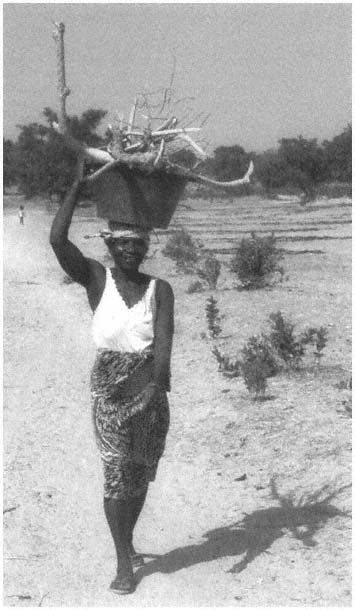
Figure 1.
Gender and environmental management. Hauling firewood: a key icon
of the gender, environment, and development literature.
back, but the image is always meant to convey that she has traveled a great distance to gather her load. As a metaphor, this feminine icon suggests the incredible burdens women shoulder, and the great lengths they go to, to satisfy the multiple and competing demands society and their families place on them. The implication is that women suffer these conditions universally, as a class, and that pure, selfless motives drive them to undertake routinely dull, repetitive, and ultimately thankless tasks. At the same time, the graphic portrayal of firewood collectors is meant to underscore the idea that close connections exist between women and the natural environment. It suggests that women forced to gather wood from the countryside Dead a hand-to-mouth existence, where knowledge of the landscape is bred of necessity and deep personal experience, and where the vagaries of climate and ecology have profound and immediate implications for human well-being. Thus, by virtue of their collective lot in a singular division of labor, women mediate the relationship between nature and society, and they feel the brunt of natural forces as a consequence.
Such images convey a stark reality: life for peasant women is often filled with considerable toil and drudgery. Yet if these women suffer a common plight, it resides not in any particular niche in some all-encompassing division of labor but in the countless ways the range and variety of their lived experiences are distorted in the words and images conveyed by outsiders (Parpart 1995; Jackson 1993). The wood-gathering icon represents Third World women as Africans, African women as peasants, and peasant women as a single type. There is no geographical detail at either localized or macropolitical scales that might serve as an explanation for the plight thus portrayed. Moreover, to render such women as beasts of burden, dumb, stolid, unwavering in their support of their families, unstinting in their service of same, is to acquiesce in the notion that they are perpetual victims, steeped in need, and incapable or disinclined to contest their lot creatively.
This tension between images of women as victims and women as autonomous actors traces back to the earliest efforts of developers to promote Women in Development (WID) programs in the Third World. The United Nations-sponsored convocation in Mexico City in 1975 proclaimed an International Decade for Women and initiated efforts within the major development agencies to address a broad agenda of issues deemed especially pertinent to Third World women. The image of the long-suffering African woman figured prominently in these discussions and debates, largely because of the influence of Ester Boserup
(Boserup 1970). Her widely cited work set forth several related propositions: (1) that women in general, and African women in particular, play key roles in most rural production systems; (2) that women's contributions to the food security of their families are made in the face of numerous obstacles, including limited access to land and labor resources and systematic exclusion from the benefits associated with technological change; and (3) that, therefore, there is considerable scope for increasing food production by women through a combination of financial and technical assistance measures. The basic development strategy that flowed forth from these premises had as its primary objective the achievement of "modernization with equity" (Bandarage 1984; Roberts 1979). In effect, the early WID activists advocated reformist rather than structural changes, calling for more equitable distribution of development benefits rather than substantive changes in the development process itself.
This position came under attack from several directions. Critics of WID objected to both the use of "women" as a universal, undifferentiated category and the unidimensional emphasis on women, per se, as opposed to an exploration of the full scope of gendered social relations. They noted the analytical confusion between production and (social and biological) reproduction and the cultural biases privileging the goals and aspirations of Western women over their Third World counterparts. They were also particularly distressed by the lack of a direct challenge to the existing power structure implied by the blind acceptance of the premises of modernization theory (Bandarage 1984; Braidotti et al. 1994; Kabeer 1994; and Parpart and Marchand 1995 offer excellent reviews of this literature).
Such criticism gave rise to two main alternatives to the "Women in Development" paradigm, each objecting to one of the main terms of reference incorporated in the WID framework. The first, known as "Women and Development" (WAD) was essentially a critique of development practice. Its proponents objected to male-dominant, top-down approaches. In their view, substantive change for women could not result from simply reforming this existing development apparatus. Instead, WAD activists argued in favor of a grassroots program of participatory, women-only projects (Parpart 1995). The second major alternative to WID, known as Gender and Development (GAD), took as its point of departure a critique of the essentialist views of "women" embedded in both WID and WAD approaches. Drawing heavily on the writings of socialist feminists and a group of Third World feminists (Sen and
Grown 1987), the GAD position offered a theory that sought to explain gender relations as power relations that grow out of specific social and political contexts:
[The GAD] perspective leads to a fundamental re-examination of social structures and institutions, to a rethinking of hierarchical gender relations and ultimately to the loss of power of entrenched elites, which will effect [sic] some women as well as men. It focuses on both the condition of women, i.e. their material state in terms of education, access to credit, technology, health status, legal status, etc., and the position of women, i.e. the more intangible factors inherent in the social relations of gender and the relations of power between men and women . . . (Rathgeber 1995, 206, emphasis in the original)
The WAD and GAD critiques have had enormous influence on the international debates concerning gender and development politics,[3] yet many of the ideas central to the original WID formulations still hold remarkable sway in the major development agencies. One reason for this persistence is that it took these agencies until the mid-1980s to formally adopt WID as a programmatic emphasis. The United Nations Development Program (UNDP) and the World Bank, arguably two of the most influential multilateral development institutions, established their WID programs only in 1986 and 1987, respectively.[4] A second reason for the persistent essentialism stems from the fact that development efforts directed at women have been premised on the dubious notion that women possess inherent capacities for nurturing and self-sacrifice. These ideas derive their staying power in part from a selective reading of contradictory empirical evidence, and in part from the recurrent tendency to naturalize gendered power structures. The problematic implications of such notions can be illustrated by comparing two sets of development ideologies and practices, one focused on the relationship between women and their families, and the other on the relationship between women and the environment.
Maternal Altruism
Analysts have long been influenced by a substantial body of empirical evidence suggesting that women across categories of class, race, ethnicity, and national origin devote a significantly greater proportion of their economic assets and physical and emotional energies toward the tasks of providing and securing their families' well-being than do men. Whitehead coined the phrase "maternal altruism" to refer to the ideology
that stipulates that women are, by virtue of their identities as mothers and wives, "naturally" predisposed toward nurturing and self-sacrifice (Whitehead 1981; see also Harris 1981). Patterns of altruistic behavior have been observed among certain groups of women in the areas of food and health care provisioning,[5] and the primary role women play in reproductive labor in many societies has been well documented (Beneria and Sen 1981; Deere and Leon 1987). Such findings have led analysts to generalize broadly regarding women's economic motives and behavior: "Virtually all income in women's hands . . . is devoted to household and family expenditures, reflecting the socially ascribed roles of women in meeting daily welfare needs. Increasing the income of rural women thus may be one of the surest ways of increasing basic family welfare in the countryside" (Jiggins 1994, 200; see also Palmer 1991). Furthermore, these ideas have led development planners in such areas as women's income generation and Maternal and Child Health Care (MCH) projects to proceed on the basis of erroneous assumptions. From this perspective, any income generated for women by whatever means—through craft production or the cultivation of cash crops—will produce benefits for a broad social circle. In terms of health care, practitioners have reasonably linked prenatal and neonatal maternal nutrition and health status with the health status of infants and young children. The assumptions many health care professionals share that women are solely responsible for caregiving is much more problematic, however. Schoonmaker-Freudenberger's (1991) insightful analysis of an integrated health and nutrition project funded by UNICEF (United Nations International Children's Emergency Fund) in rural Senegal the late 1980s offers a case in point. This project failed to meet one of its central goals—the increased consumption of health care services via enhanced women's income generation—partly because planners failed to realize that the health and day care services provided by the project were funded by fathers rather than mothers in almost all cases.
The evidence drawn from the Senegalese case that men play specific "nurturing" roles in many societies is only one type of empirical finding that works against the maternal altruism model. There is also an extensive literature that demonstrates clearly and unequivocally that women in a variety of material circumstances routinely work toward private economic ends that have little to do with meeting the joint welfare needs of their families. Where nurturing models see familial social relations as revolving around a natural core of "maternal altruism," the "new household" literaure views them as being governed by an ever-changing
"conjugal contract" (Guyer 1984; Harris 1981; Whitehead 1981, 88, 107). The household unit is instead identified as "the site of separable, often competing, interests, rights and responsibilities" (Guyer and Peters 1987, 210). Research has demonstrated that the question of which marriage partner pays for necessities such as food, children's schooling and clothing, health care, and petty daily expenses is determined through constant struggle in many African households (Dwyer and Bruce 1988; Folbre 1986; Guyer 1988; Muntemba 1982; Whitehead, 1981). Notions of maternal altruism are confounded by evidence that shows "husbands and wives lending each other money at rates only slightly less usurious than the prevailing market rate, the payment of wages inside households, wives selling water to husbands in the fields, husbands selling firewood to wives, and wives and husbands selling each other animals that are consumed by the family on feasts and special occasions" (Gladwin and McMillan 1989, 350). Similarly, access to land, water, and other natural resources available to the household is contested by marriage partners, and between and among men and women co-resident in households but of different generations (Davison 1988; Dey 1981; Longhurst 1982; Roberts 1979; Thomas-Slayter and Rocheleau 1995). The allocation and remuneration of intra-household labor is particularly fraught with tension, especially under conditions of rapid political economic change, such as climate perturbations, the introduction of new crop varieties by developers, and market fluctuations for key commodities and inputs (Berry 1984; Carney 1988a, 1988b; Carney and Watts 1990, 1991; Goheen 1996; Jones 1986; Leach 1994; Mackintosh 1989; Madge 1995a; Mbilinyi 1991; Moore and Vaughan 1994; Roberts 1988). All of these processes of negotiation and accommodation hold potential for undermining the assumption that women exhibit altruistic tendencies toward family members.
The new household theorists do not, as a rule, deny the evidence that specific groups of women act in apparently selfless ways to support and protect their families and communities under particular circumstances. They recognize the virtues of such social behavior and endorse it in principle (see discussion in Whitehead 1981). The distinction they maintain, and one I endorse, is that such self-sacrificing behavior is neither inherent nor natural, and that the ascription of altruistic motives exclusively to women has clear political consequences. The assumption of maternal altruism leads to the expectation that women will deny themselves and shoulder additional burdens in the interests of family well-being. Development initiatives are sometimes designed accordingly, with women
trapped in domestic roles by the very programs intended to benefit them (see illustrations in Stamp 1990).
Women and the Environment
Whereas nurturing behavior is widely ascribed to women within the household unit, a parallel "naturalism" (Guyer 1984), a kind of "maternal altruism"-writ-large, often lies behind the association of women with the environment (Haraway 1989; Jackson 1993). The political and philosophical movement known as "ecofeminism," which was formed around the notion that women have a "special" relationship with the environment, has generated a lively debate within the feminist community. Rocheleau et al. (1996) count ecofeminism as one of at least six separate bodies of theory and practice that bring together feminism and environmentalism (see parallel discussions in Plumwood 1993 and Leach et al. 1995). Some of these positions, which include ecofeminism, feminist environmentalism, socialist feminism, feminist poststructuralism, environmentalism, and the authors' own approach, which they call "feminist political ecology," were developed in direct response to the emergence of the ecofeminist discourse. Taken together, the different theories embrace a wide range of political perspectives.
According to Rocheleau et al., ecofeminists "posit a close connection between women and nature based on a shared history of oppression by patriarchal institutions and dominant Western culture.[6] Some ecofeminists attribute this connection to intrinsic biological attributes (an essentialist position), while others see the women / nature affinity as a social construct to be embraced and fostered" (Rocheleau et al. 1996, 3). The distinction between the essentialist ecofeminist position and social ecofeminism has important political implications. As a political principle, the emphasis on the struggle against patriarchal domination places women in a subordinate, defensive position. The more socially oriented position, while still premised on a naturalized connection between women and the environment, constructs the position of women in more positive terms. By virtue of the work they do, women are engaged in a relationship with nature that is characterized by "reciprocity, symbiosis, harmony, mutuality and interrelatedness" (Braidotti et al. 1994, 93). This "closeness" is constituted as a distinct advantage for women because it yields "privileged knowledge." The development community, and most particularly the group of liberal feminists Rocheleau et al. identify simply as "environmentalists,"[7] came to appreciate this dis-
tinction belatedly in the midst of global ecological crisis and made it the basis of a broad range of development policies. As Braidotti et al. explain, "In the late 1980s . . . [t]he images of women in the South as victims became transformed into images of strength and resourcefulness. In the wider debate on sustainable development women were increasingly promoted as 'privileged environmental managers' and depicted as possessing specific skills and knowledge in environmental care" (Braidotti et al. 1994, 88; see further discussion in Leach et al. 1995). This process by which the core ecofeminist principles, with all of their problematic assumptions concerning "natural" connections between women and the environment,[8] were adopted by development agents and incorporated into development plans is one of the central concerns of this book.
My own position in these debates is somewhat eclectic, drawing insights from each of the remaining "schools" of thought identified by Rocheleau et al., but aligning most closely with "feminist political ecology" and "feminist environmentalism."[9] According to these authors, feminist political ecology:
begins with the concern of . . . political ecologists who emphasize decision-making processes and the social, political and economic context that shapes environmental policies and practices. Political ecologists have focused largely on the uneven distribution of access to and control over resources on the basis of class and ethnicity. . . . Feminist political ecology treats gender as a critical variable in shaping resource access and control, interacting with class, caste, race, culture, and ethnicity to shape processes of ecological change, the struggle of men and women to sustain ecologically viable livelihoods, and the prospects of any community for "sustainable development." (Rocheleau et al. 1996, 4)
The closely related "feminist environmentalist" position is often identified with the work of Bina Agarwal (1992). In a pivotal essay, Agarwal argues that by emphasizing natural and spiritual bonds between women and the environment over the material circumstances that shape those ties, many ecofeminist writers have simply reproduced limited and ultimately self-defeating notions of femininity. In effect, she contends that ecofeminists have fallen into many of the same analytical traps as those who subscribe to uncritical notions of maternal altruism. In addition to persistent essentialism, and a one-dimensional theory of power that neglects cross-cutting relations of class, race, and ethnicity, the core position of ecofeminism:
locates the domination of women and of nature almost solely in ideology, neglecting the (interrelated) material sources of this dominance (based on
economic advantage and political power). . . . [E]ven in the realm of ideological constructs, it says little . . . about the social, economic, and political structures within which these constructs are produced and transformed. Nor does it address the central issues of the means by which certain dominant groups . . . are able to bring about ideological shifts in their own favor and how such shifts get entrenched. . . . [T]he ecofeminist argument does not take into account women's lived material relationship with nature, as opposed to what others or they themselves might conceive that relationship to be. (Agarwal 1992, 122–123)
The materialist focus Agarwal advocates is one broadly shared by several major theorists of gender, environment, and development working in Africa (Berry 1984, 1989, 1993; Carney 1988a, 1988b, 1993; Jackson 1993, 1995; Leach 1991, 1992, 1994; Mackenzie 1990, 1991, 1994; and Rocheleau 1987, 1991, 1995). In a wide range of African contexts, women are deeply involved in environmental management by virtue of the simple fact that they do so much of the physical labor in their respective societies. Drawing water, gathering firewood, cultivating crops, processing and storing food, and collecting medicines and applying treatments—these tasks are often the primary, if not sole, responsibility of women (Rodda 1991). By virtue of their disproportionately heavy workload in these areas, women are often directly disadvantaged by environmental degradation and decline as the labor required to perform routine tasks increases. By the same token, since women are directly responsible for day-to-day management of many vital resources, they constitute the key to success in promoting new strategies of environmental rehabilitation and repair. It is their regular contact with the resource base, born of specific work responsibilities, then, rather than some sort of natural symbiotic relationship, that has given particular groups of women privileged knowledge of resources their communities depend upon.
This analysis of the "women and the environment" question provides critical insights for sorting through the politics of the recent developmental interventions that invoke either the roles of women or gender as central organizing principles in environmental management:
[Rural women forest dwellers and cultivators] could . . . be seen as both victims of the destruction of nature and as repositories of knowledge about nature, in ways distinct from the men of their class. The former aspect would provide the gendered impulse for their resistance and the response to environmental destruction. The latter would condition their perceptions and choices of what should be done. Indeed, on the basis of their experiential understanding and knowledge, they could provide a special perspective on the
processes of environmental regeneration, one that needs to inform our view of alternative approaches to development. (Agarwal 1992, 126–127)
The problem comes, as Agarwal has indicated, when these work routines are stripped of their contextual significance, and when the relationship between women and nature is naturalized and essentialized.
Jackson has noted that an emphasis on the simple fact that women possess key environmental knowledge obscures the difficulties of gaining access to that knowledge and making it the basis of a program of environmental initiatives (Jackson 1993). Furthermore, as Leach argues in her insightful study of the gendered nature of forest politics in Sierra Leone, the observation that women are highly dependent on the environment for meeting their needs, and thus important targets for incorporation into environmental management programs, might well "impl[y] that any outside intervention would be a help, and that women would willingly participate because they have no choice" (Leach 1994, 25). In a similar vein, women as "managers" of the environment very quickly become "assets to be 'harnessed' in resource conservation initiatives" (Leach 1994, 25). In sum, "[The] arguments [of some ecofeminists] that close conceptual links between women and nature can provide the basis for an ecologically sustainable future thus run the risk of, in effect, giving women responsibility for 'saving the environment' without considering whether they have the material resources to do so" (Leach 1994, 34; see also Plumwood 1993).
What the foregoing discussion suggests is that the notions of maternal altruism and a naturalized connection between women and the environment are mutually reinforcing. The role of women as environmental managers derives directly from their role as household managers. Their presumed skills in providing "environmental care" derive from maternalistic impulses generated in the context of familial relations. Assumed links between family and environmental well-being add weight to assumptions that environmental interventions focused on women will bear special dividends for all. In this regard, development approaches to women and the environment simply magnify problems that originated in WID approaches based on notions of altruism and self-denial.
If the different ways of naturalizing gender relations reinforce each other, so, too, do their respective critiques. Where the new household theorists have encouraged us to inspect the internal workings of household dynamics, critical feminist environmentalists and feminist political ecologists have urged us to deconstruct and denaturalize the working re-
lationships that shape the nature of the gender and environment encounter. We are encouraged by the advocates of each of these positions to look inside the household and throughout the different echelons of the state and the international development agencies to understand how connections between particular forms of gender relationship and specific approaches to environmental management have been forged.
Theory and Practice:
Gender, Environment, and Development in Africa in the 1980s and 1990s
The particular constructions of female identity that surfaced in the household studies and gender and environment debates have helped shape the policies and practices of development and state agencies throughout Africa. The remaining chapters of this book will be devoted to an examination of these policies as they emerged in development interventions along The Gambia River Basin in West Africa. The first half of the book will explore the phenomenon of the garden boom and its implications for gendered social relations in the Mandinka communities of The Gambia's North Bank. The second documents the shift in development policies that took place in The Gambia in response to the environmental mandate that emerged in the mid- to late 1980s. Both sections of the book look critically at the various ideas underpinning development policies and the ways in which the agencies' actions were received by men and women in rural communities. Before proceeding to that discussion, however, it is worth briefly reviewing the broad political economic context in which these interventions occurred.
The overriding material condition affecting life and livelihood in Africa during the late 1970s and 1980s—the years that WID and gender and the environment surfaced as major development motifs—was persistent drought. This phenomenon had several dimensions: the actual agroclimatological conditions that limited the ability of rural populations in many parts of the region to reproduce themselves from one year to the next, the famine conditions that ensued in some areas as drought-related food shortages were exacerbated by civil war and economic crisis,[10] and the full-scale, crisis-oriented relief and rehabilitation interventions that swept the region in its aftermath.
The geographical distribution of drought is difficult to map with precision, given the remarkable variability of rainfall that occurs across spa-
tial and temporal scales on the continent. Nicholson's (1985, 1993) research defines a Sahelian zone in West Africa as an area loosely bounded by Mauritania and Guinea in the west and Chad and Northern Cameroon in the east. This region experienced generalized drought conditions from 1968 to 1973,[11] a particularly bad year in 1977, dramatic shortfalls from 1982 to 1984, generally poor rains from 1985 to 1988, and finally a brief upturn as rainfall levels in 1989 and 1990 returned to the long-term average. In Southern Africa, the Kalahari region experienced above average rainfall in the 1970s and a dry cycle similar to the Sahel in the 1980s, with Zambia and Botswana experiencing what climatologists called "the worst climatic disaster in the recorded history of the subcontinent" (Robbins 1983, 56). East Africa, defined as Kenya, Tanzania, Rwanda, Burundi, and Uganda, was "abnormally wet" over an extended period beginning in 1977 and continuing throughout the 1980s. These conditions stood in sharp contrast to the Horn of Africa to the north, where devastating droughts and horrific famine compounded by civil war laid siege to parts of Ethiopia, Somalia, and the Sudan for the better part of a decade.
The material conditions produced, in part, by drought included sharp reductions in food production, devastatingly high mortality rates in livestock herds, deforestation and denudation of landscapes, massive relocation of rural populations, and the outbreak of disease epidemics that contributed to hundreds of thousands of human deaths. Residents of rural communities were forced to resort to a range of increasingly desperate measures to help them cope with poor harvests and inadequate range resources. There was heavy reliance on food aid assistance as well as a significant departure from prevailing cropping and animal husbandry practices. The region's cities, areas of high labor demand, and countries hosting relief camps bore the brunt of the refugee burden, and the food security situation in these areas declined proportionately. In Ethiopia, in 1984, some 6.7 million people, 47 percent of whom were children under fourteen, were suffering from starvation and malnutrition (United Nations 1984c). By 1985, there were 3–5 million people in relief camps primarily located in Sudan, Ethiopia itself, and Somalia, with hundreds of people dying daily (United Nations 1987). Mauritania lost up to 80 percent of its livestock (United Nations 1984c), a major blow to herds already dramatically reduced by drought a decade earlier (Franke and Chasin 1980). Meanwhile, regional grain producers such as South Africa and Zimbabwe were forced to halt exports to their
needy neighbors and seek out sources of food aid to alleviate their own grain shortages (Robbins 1983).
In 1982 and 1983, drought conditions were so generalized (see Nicholson 1993, fig. 6) that only three African countries had registered significant increases in their food output: Botswana, Lesotho, and Swaziland (United Nations 1984a). In 1984, twenty-seven countries in Africa were experiencing abnormal food shortages, and an additional nine countries were experiencing drought (United Nations 1984b). In 1985, the situation worsened in many areas. Twenty countries (Angola, Botswana, Burkina Faso, Burundi, Cape Verde, Chad, Ethiopia, Kenya, Lesotho, Mali, Mauritania, Mozambique, Niger, Rwanda, Senegal, Somalia, Sudan, Tanzania, Zambia, and Zimbabwe) remained on the UN's critical list, which designated areas where conditions had "sharply deteriorated." According to one report, "some 30 million of 150 million persons living in drought-affected nations [were] categorized as 'seriously affected,' and 10 million of these . . . had to abandon their homes and lands in search of food, water and pasture" (United Nations 1985a).
September of 1985 brought the first faint glimmer of hope. As the UN Chronicle announced:
Eleven African countries—Angola, Botswana, Burkina Faso, Cape Verde, Chad, Ethiopia, Mali, Mauritania, Mozambique, Niger and Sudan—received near or above-average rainfall in the last two months, and people have begun planting. Six other countries—Burundi, Lesotho, Rwanda, Senegal, Somalia and Tanzania—will need to import food commercially, but they might not need emergency food assistance. . . . Also, Zimbabwe had a bumper harvest and Kenya and Zambia are not expected to seek emergency food aid. (United Nations 1985b)
These first rains were interpreted by much of the international community as an indicator that the worst had passed, but, as the UN Office of Emergency Operations in Africa report noted, "One good rainy season can hardly be expected to undo the damage of several years of drought" (United Nations 1985b). Indeed, over $1 billion was still required in 1986 to meet "emergency" needs (United Nations 1987). Six countries remained on the list of those most "critically affected"—Ethiopia, Sudan, Angola, Mozambique, Cape Verde, and Botswana (United Nations 1986).[12]
When drought and famine conditions struck the Sahel region in the early 1970s, the official development community and the international aid organizations were slow to act, and the consequences were especially
devastating (Franke and Chasin 1980). When these conditions recurred in the Sahel, the Kalahari, and especially in the Horn, in the 1980s, an all-out effort was made to mobilize support from the international community. What emerged in 1984 and 1985 was considered the "greatest peace-time relief operation in history" (United Nations 1986). Fifty international relief agencies were operating in Ethiopia alone (Vestal 1985). Over the eighteen months between October 1984 and April 1986, official aid to drought and famine affected areas totaled an estimated $3.38 billion, with 6 million metric tons of food aid delivered (United Nations 1987) and 3 million lives saved (United Nations 1986).
The funds generated through aid channels were used initially for such precious commodities as food, shelter, fresh water, sanitation facilities, clothing, blankets, and medicines, but the effort soon expanded to include the revitalization of much of the transportation infrastructure in hard-hit areas and the provision of equipment—train cars, trucks, air transport services—necessary to move the relief supplies to the areas where they were most needed.[13] In effect, the scope of the problem gave rise to a new geography of relief operations. In order to stem the out-migration from rural areas and reduce the oppressive conditions in the major refugee camps, several major relief agencies resolved that food should be "brought to people where they are, before they become destitute, in order that they may remain on their lands and withstand the crisis in familiar surroundings and with the support of their families without the trauma of moving from their homes to new environments" (United Nations 1985a). This entailed moving into areas that were often quite remote, especially in Ethiopia, where some of the worst-affected areas were in the highlands (Vestal 1985). While infrastructural improvements were key, overall the approach was considered "more humane and more cost-effective than resorting to supporting people in camps or in overcrowded urban settlements" (United Nations 1985a).
Faced with these requirements, nearly all of the major donors sharply increased their bilateral aid allocations to Africa. Official aid from the United States to Africa increased by 175 percent in 1984, with a doubling of aid to Ethiopia alone. Italy, Belgium, and West Germany allocated 90 percent, 75 percent, and 40 percent of their total development assistance budgets, respectively, for relief measures in Africa in 1984. At the same time, special dispensations of grain were sent by France and Canada, and additional large donations of cash and in-kind contributions originated in the Netherlands, the European Community,
the United Kingdom, Australia, the Soviet Union, and East Germany (United Nations 1984c).
These massive military-style mobilizations of human and material resources through official channels were matched by the broad-based financial support of private citizens. Several spectacular benefits featuring film and music celebrities helped raise public consciousness of the Ethiopian crisis. Some estimates put the total raised by organizers of the internationally telecast rock concert, "Live Aid," at $50–70 million; the special appeal to United States citizens, "USA for Africa," raised $50 million; and a second effort organized by musicians, "Band Aid," earned $12–25 million (Vestal 1985). Much of this aid was subsequently funneled into the programs of private voluntary and nongovernmental organizations serving on the front lines of the relief effort. These agencies generated additional public support by making direct appeals to the public via television, radio, and direct mail solicitations. The success of these appeals was illustrated by the case of the United Kingdom, which provided $46 million worth of official funds for drought aid and refugee problems in Africa in 1984. By comparison, in November of the same year, private citizens in the UK generated $10 million worth of donations in a two-week period alone (United Nations 1984c).
Saving the Children
The implications of this outpouring of financial support stretched well beyond the domain of famine relief. While the primary focus of media attention was Ethiopia, the funding streams flowing into Africa had a much broader geographical impact. Development agencies across the continent were suddenly relatively flush with money earmarked for programs that would improve food security, reduce environmental degradation, or contribute toward greater economic stability. In the broadest terms, this meant a shift in emphasis from relief to rehabilitation. Africa as a whole had been dramatically exposed to the world as the site of greatest need. It was, in the words of the UN Secretary-General, "the only continent where standards of living have declined in the past decade and continue to decline today" (United Nations 1986). Confronted with this record of developmental failure, the "development apparatus" (Ferguson 1990) went into overdrive in an attempt to "provid[e] the foundation for resumption of economic progress" (United Nations 1986). More specifically, this post-drought developmental mandate cre-
ated significant openings that the WID and, later, the gender and environment lobbies were able to exploit to good effect.
At an ideological level, the maternal constructions motivating women-centered development initiatives dovetailed neatly with the multidimensional effort to intervene to save "starving African children" that emerged in the wake of the drought. In practical terms, post-drought reconstruction efforts in particular emphasized the virtues of women's income generation and food production programs as the means most likely to serve the needs of the entire household, and by extension the development needs of the entire continent. By similar token, women were recognized for their contributions to environmental management and were accordingly incorporated into programs designed to renew the natural resource base. In this way, the continent was simultaneously stripped of geography—all of Africa was Ethiopia—and gendered in a very particular way—women became the continent's salvation.[14]
In sum, the 1980s saw the introduction of very specific ideas of maternity under the guise of WID and gender- and environment-oriented development initiatives. These constructed maternities reinforced each other and meshed with the dramatic changes in the region's economic, political, and social geography produced by persistent drought circumstances. The combined effect was a sharp upsurge in international aid which targeted with increasing specificity the Africa region, agricultural and natural resource development, and female producers. Thus, the unprecedented social and economic changes wrought by the Gambia's garden boom took place on an ideological and political economic landscape that was itself undergoing rapid transformations. Rural Gambians were accordingly presented with a particular mix of opportunities and constraints embedded in shifting development policies. What I present in the following chapters is an account that explores in greater detail the structural conditions developers set in place and analyzes the tactics and strategies different groups of rural Gambians developed to manipulate these structures for personal gain. In chapter 2, after a brief introduction to my Gambian research setting, I begin this task with a discussion of the impressions North Bank residents themselves had of their changing economic circumstances.