
The Scope of Delian Trade
Perhaps it is not surprising that the overwhelming majority of contractors and workers on Delos whose origin can be determined came from nearby islands, or that the beneficiaries of the Delian banks, whether sacred, public, or private, were neighbors. But (it will be objected) the preponderant role of locals in these sectors of the economy hardly eliminates from trade persons of more distant origin. And one category of Delian evidence speaks unequivocally of ties between Apollo's island and a widespread net of Greek cities: the proxeny decrees. Several hundred survive in better or worse states of preservation, passed in honor of citizens from all over the Greek world, from Lebanon and Palestine to Italy, from Kyrene to Olbia and Pantikapaion.[58]
These decrees are not easy to deal with. In the first place, unlike Athenian decrees of the same period, they have no dating formula; particularly frustrating is the absence in all but two cases of the name of an arkhon, which would have given a precise date. We are therefore reduced to guessing dates from the careers of the proposers and letter forms.[59] In
[55] Cheese: ID 440A69, 445.14; wax: IG XI 2.154A36, 161A111, 287A54, 62, ID 316.84; miltos: IG XI 2.287A62; these lists are not complete. For honey from Syros and Kythnos, see Roufos in Oribasios, Collectionum medicarum reliquae, ed. Johannes Raeder, Corpus medicarum graecarum, vol. 6, pt. 1, fasc. 1 (Leipzig, 1928), ii.63; for bees as a type on Keian coins (both federal and city), see G. Reger and M. Risser in Landscape Archaeology, 305–17. For cheese from Keos, see Aiskhylides in Aelian 16.32; cheese from Rheneia and Kythnos, see chapter 7, n. 46.
[56] IG XI 2.165.38, 47, 199A77 for stone quarried at Kestreion, evidently a site on Delos. Quarries are abundant on the island; see now Philippe Fraisse and Tony Kozelj[*] , BCH 115 (1991): 283–96. For Tenian and Parian marble, see IG XI 2.199A39, 203A70 and A95. Cf. Gustave Glotz, REG 32 (1919): 240–50.
[57] Vallois, 1.55–64, esp. 62–64.
[58] IG XI 4.510–857. Marek, 71–73, 247–80. For a newly discovered part of IG XI 4.844, the proxeny decree for Apollonides of Khersonessos, see BCH 115 (1991): 722 and 723, fig. 4.
[59] IG XI 4.576 (arkhon' s name lost), 769 of 180 or 176 B.C. For careers, see Vial, passim; on letter forms, G. Reger, Historia 43 (1994): 35–39.
the second place, individually they tend to be depressingly uninformative. Brief, formulaic, stripped of any detail, most simply give the Delian who moved the inscription, the honorand, his father's name, his ethnic, and a bald statement that the honorand "continues to be a good man concerning the temple and the city of the Delians and honors the temple on Delos and continues to do the Delians good" (



Nevertheless, the uninformativeness of these documents has not stopped commentators from drawing economic inferences. Felix Durrbach went so far as to affirm that all proxeny decrees for citizens of Hellespontine states must have related to the trade in grain between Delos and the Black Sea; that Rhodian theoric visits had a commercial component; and that, even without explicit proof, the many decrees for Khians must have attested to an interest in Delian commerce.[62] It is therefore worthwhile to consider the implications of these documents. In general I want to explore two approaches. First, I want to consider what relations in fact lie behind
[60] Marek, 71–73, for Delian decrees, with map facing p. 72, 332–81, esp. 359–64, on the economic function of proxenoi, with 359–60: "Handelsbeziehungen können zwar durch das Ethnikon des Honoranden allein ebensowenig ausgeschlossen wie unterstellt werden." Further, Christian Marek, MBAH 4.1 (1985): 67–78. IG XI 4.510–857 for the decrees; I exclude 858–1021 as too incomplete for analysis. Commerce or trade: IG XI 4.627 (= Choix, 46), 691 (= Choix, 43), 840 (cf. ID 1408A, 11.46 and M.-F. Baslez, REG 89 [1976]: 351).
[61] Cf. Bagnall, 153.
the proxeny decrees. Many, we shall see, sprang from benefits in the political or religious spheres, not the economic. Second, specific regions that provide numerous decrees need to be considered for possible economic connections. There are some independent tests we can apply to these groups of documents to help ferret out such relations.
The Purposes of Individual Proxeny Decrees.
In some cases, it is possible to identify the honorand and guess the occasion for his award despite the silence of the decrees. Political activity often seems to lie behind the honors. Apollodoros of Kyzikos and Hermias, both nesiarkhoi of the Nesiotic League, resided on Delos and served as liaisons between the island and its outside hegemones.[63] Kallias son of Thymokhares of Athens commanded the Ptolemaic troops at Andros who participated in the liberation of Athens in 287 B.C. . and oversaw the transfer on Delos of grain to representatives of the Athenian demos.[64] Demaratos son of Gorgion the Lakedaimonian, whose family had long-standing connections with Delos, represented Delian interests before Lysimakhos and his court (IG XI 4.542). The great Ptolemaic courtier Sostratos son of Dexiphanes received his honors in conjunction with a decree of the Nesiotic League, whose first few lines, although unfortunately mutilated and incomplete, nevertheless make it clear that he had taken some action beneficial to the league in conjunction with its then nesiarkhos, Bakkhon (IG XI 4.563 [= Choix, 22], 1038 [= Choix, 21]). Another Ptolemaic court official, Sosibios, may have been honored because he was on Delos in 246 B.C. to found a new Ptolemaic religious festival.[65] In other cases, such as that of Dikaios son of Diokles, the honorands may have facilitated access or a favorable hearing for Delian ambassadors at the hegemonic court (IG XI 4.631 [= Choix, 34], cf. esp. II. 2–3). Representatives of many other monarchs appear, and with the turn of the century, Roman officials like Publius Cornelius Scipio take their place in the ranks of the honored.[66]
[63] IG XI 4.562 (= Choix, 20), 565; cf. G. Reger, GRBS 32 (1991): 229–37. See Marek, 251–63, on political honorands; 263–69 on honorands connected with cult, etc.; and 269–75 on traders, bankers, and contractors.
[64] IG XI 4.527; Shear; Christian Habicht, Untersuchungen zur politischen Geschichte Athens (Munich, 1979), 45–67; Michael J. Osborne, ZPE 35 (1979): 181–94.
[65] IG XI 4.649 (Choix, 44), with Glotz, REG 29 (1916): 316 n. 7.
[66] IG XI 4.649 = Choix, 44; 561 (with OGIS 724), 563 (= Choix, 22), 588 (cf. P. M. Fraser, JRS 39 [1949]: 56), 631 (= Choix, 34), 677 (Ptolemies); 585 (with W. Heckel, ZPE 70 [1987]: 161–62), 666 (= Choix, 48), 679–80 (= Choix, 47), and probably 681–82 (Antigonids); 765–66 (Attalids); 712 (Scipio).
In some cases, political connections may be suspected, not because of the names or origins of the honorands, but because of the name of the proposer of the honors. During the first third of the second century, one Telemnestos son of Aristeides dominated Delian politics; he was responsible for the passage of over seventy decrees, including one in honor of Herakleides son of Xeinias of Byzantion, who may have been the ambassador of Antiokhos III.[67] Telemnestos passed two decrees for Khians (IG XI 4.767 and 793) otherwise unknown. The decrees honoring Timon son of Nymphodoros, a banker on Delos who aided the Nesiotic League in the purchase of grain, and Tharsagoras son of Polykles of Siphnos, who had represented the league in the business, were also from his pen.[68] His many other decrees surely also flowed from political motivations.[69]
In every case about which we can say something, these "political" honorands obtained their honors either on account of local activities or because they had rendered assistance to Delian ambassadors at a foreign court. These honors imply no great, long-distance economic connections; rather, they reflect the quite parochial political worries of the Delians themselves. Furthermore, at least some of these men came to Delos primarily for religious reasons, perhaps including the dedication of monuments of thanksgiving, such as that of Attalos after his defeat of the Gauls in 241 B.C. or Antigonos Doson's dedication after his victory at Sellasia.[70] Or the honors may reflect simple acts of piety. Many of the decrees honoring citizens of individual cities must have been passed for theoroi, who visited Delos each year by the dozens, like Philodamos, a Rhodian arkhitheoros of around 280 B.C. (IG XI 4.614; cf. IG XI 2.161B17, 162B13). Asklepiodoros son of Kraton of Karystos is probably identical with the Asklepiodoros honored at Epidauros; perhaps he visited both sanctuaries as a theoros?[71] Kings, too, might send representatives for religious reasons, as in the case of Antigonos Gonatas honoring his sister Stratonike, who herself was ardently devoted to the Delian deities.[72] Some of the private persons who came for
[67] Etienne, 107–10; M.-F. Baslez and C. Vial, BCH 111 (1987): 300–301; Vial, 279. IG XI 4.778, Polyb. 21.13.3, 14, 15.12, cf. Choix, p. 76.
[68] IG XI 4.759 and 760, cf. IG XII 5.817.31 with testimonium 1349.
[69] Cf. also Roland Etienne in L'Etranger dans le monde grec (Nancy, 1988), 164–66.
[70] IG XI 4.1109 (= Choix, 53), 1110 with Holleaux, II.164 n. 1; IG XI 4.1097 = Choix, 51.
[71] IG XI 4.605; W. Peek, Inschriften aus dem Asklepieion von Epidauros (Berlin, 1969), 67, no. 101.2.
[72] Bruneau, 561–62; K. J. Beloch, Griechische Geschichte IV (Berlin and Leipzig, 1927), 2.199–200. For her piety, see Bruneau, 546–50.
religious reasons include Ktesippos son of Ktesippos of Khios, who was melanephoros.[73] The Delians also honored tragedians, comic poets, artists, actors, musicians, philosophers, and athletes drawn to the island by its festivals.[74] Behind the hundreds of anonymous or unidentified honorands must lurk many others who came to the island for political or religious reasons. The cases in which it has been possible to suggest plausible noneconomic reasons for some individuals whose homes were far away to have been honored on Delos undermine any facile assumption even that a body of decrees honoring men who originated in one region, like the Black Sea, must reflect economic activity. Rather, these documents must be examined individually to see what, if any, reasons can be detected.
Decrees from Specific Geographic Regions and the Delian Economy
Two regions have often been pinpointed as having important commercial relations with Delos. Rhodos, which ruled the Kyklades in the first third of the second century (a fact that complicates the interpretation of the evidence), was both a great trading center and the source of the thousands of Rhodian amphorae found not only on Delos but elsewhere in the Greek world. Byzantion guarded the gateway to the Black Sea, whose resources included animals, slaves, honey, wax, and dried fish, and sometimes grain (Polyb. 4.38.4–5); the cities of the Hellespontos and of the Black Sea itself can be examined in the same context. In addition, it will prove enlightening to look at another site, much closer than either Rhodos or Byzantion, which sat at the end of the normal route of travel that ran from Athens through Delos to the East: Khios.
Rhodos
Seventeen proxeny decrees honoring Rhodians are known.[75] Four of them honor individuals involved in military activities.[76] Two more almost certainly have no economic aspect. Kleombrotos son of Leonides (IG XI 4.690) is listed in a catalogue of Delphic proxenoi, and another Rhodian who may be his son served in Delphi as a foreign judge (SIG3 585.221;
[73] IG XI 4.819–20, 1249–50, cf. M.-F. Baslez, Chronique d'Egypte 50 (1975): 297–303, with BE (1977): 316.
[74] IG XI 4.544 (poet), 567, with 2.105.18 (actor, cf. Paulette Ghiron-Bistagne, Recherches sur les acteurs dans la Grèce antique [Paris, 1976], 360), 615 with 2.115.21 (actors), 572–73 (poets), 594 (artist), 646 (musicians), 613, 624 (philosophers), 744 (probably athlete). This list is far from exhaustive.
[75] IG XI 4.580, 589, 596, 614, 648, 651, 683, 690, 711, 714, 751–55, 839, 842.
[76] IG XI 4.596 (= Choix, 39), for a Rhodian nauarkhos and his trierarkhoi; 751 (= Choix, 67), for Epikrates, a fleet commander (cf. Livy 37.13.11, 14.1–2, 15.6); 752–53 (= Choix, 63), for Anaxibios, another military commander.
614). Kleombrotos's activities seem likely to have had a religious (or political) purpose. Even more intriguing is Praxon son of Aristonymos. Polybios (28.23.1) mentions a Rhodian embassy to Alexandria sent to reconcile Antiokhos IV and Ptolemaios Philometer, which, however, arrived too late to be of any use. It was headed by a Praxon. Unfortunately, Polybios does not give his patronymic. One other honorand, Philodamos, was arkhitheoros.[77] At least seven of the seventeen decrees honoring Rhodians have noneconomic explanations. This is particularly striking, since Rhodos's well-attested commercial interests ought to have made Rhodians prime candidates for business-related honors. But Rhodes also had noncommercial reasons for maintaining contact with other cities in the Greek world, and these reasons—piety and politics prominent among them—obtained for Delos as much as for any other city.[78]
The Hellespontos and the Black Sea
The one proxeny undoubtedly awarded for commercial reasons went to Dionysios of Byzantion, who was honored for supplying Delos with grain at a reasonable price (IG XI 4.627 = Choix, 46). As was also true of Rhodian merchants;[79] Dionysios's city of origin had nothing to do with the source of his goods. Athenian decrees provide abundant corroborating examples: the citizen of Kypros who imported grain from the Black Sea to Athens in the late fourth century; the Milesian who brought grain from Kypros; the Sicilian merchant who intended to sell olive oil (from Sicily?) in the Black Sea and buy grain to import to Athens. Dionysios's honors therefore do not have anything to say about commercial ties between Delos and Byzantion. Furthermore, many of the numerous decrees honoring citizens of Byzantion, Khalkedon, Lampsakos, Kyzikos, Abydos, Rhoiteion, Olbia, and Pantikaipon, like many of those honoring Rhodians, had noncommercial motivations.[80] The single decree for a Kyzikenos honored Apollodoros son of Apollonios, the nesiarkhos of the Island League. Kyzikos also had religious connections
[77] IG XI 4.614, IG XI 2.161B17, 162B13.
[78] Marek, 257–59 (with reservations); M.-F. Baslez and Claude Vial, BCH 111 (1987): 281–312. Other Rhodians whose honors may have had political or religious reasons: Praxidamos son of Arkhinomos, Lindos, I.87, ca. 267 B.C. , IG XI 4.648; Anaxidikos son of Dionysios, coining official, 200–275 B.C. , B. V. Head, A Catalogue of Greek Coins in the British Museum, vol. 18, Caria and the Islands (London, 1897), p. 253 no. 246; 754–55; Anaxibios son of Pheidianax, JÖAI 4 (1901): 164–66, no. III; 752–53 (= Choix, 63).
[79] IG II 360.35–40, 407.6, 12, 903.6–9 with Philippe Gauthier, REG 95 (1982): 275–90, and SEG 32.132. Alain Bresson, Index 9 (1980): 144–49.
[80] IG XI 4.510, 530, 570, 627 (= Choix, 46), 778, 779–80 (Byzantion); 618, 645 (Khalkedon); 518, 571, 708 (Lampsakos); 562 = Choix, 20 (Kyzikos); 517 (Abydos); 582 (Rhoiteion); 813–14 (Olbia); 609 (Pantikaipon).
with Delos, as two important decrees demonstrate.[81] Herakleides son of Xenias of Byzantion may be identical with the Herakleides of Byzantion sent by Antiokhos III to treat with Scipio in 190 B.C.[82] Th. Homolle conjectured that Metrodoros of Lampsakos (IG XI 4.708) was the man who captured Thasos for Philip V in 202 B.C. , but as Pierre Roussel has pointed out, this must remain uncertain (IG XI 4, p. 37). Antiokhos son of Theodikos of Lampsakos, known from an unfortunately fragmentary Delian document (IG XI 4.518), was also honored at Eretria on Euboia (IG XII 9.216), although in language too vague to support any inferences about his benefactions. Finally, the decree for Herakleitos of Khalkedon (IG XI 4.618) honors him specifically for his accomplishments as a poet.
Potentially, then, five out of the sixteen documents honoring citizens of these Hellespontine or Black Sea cities reflect ties other than commercial ones. The results are not different from those obtained for Rhodos and do not support the contention that the interests of these cities in Delos were exclusively or primarily economic. It might be possible to argue that commerce lies veiled behind the bland language of the decrees were it not for the decree honoring Dionysios of Byzantion, which shows the Delians had no compunction about expressing economic benefactions quite bluntly. The rarity of business explanations in a very large corpus of decrees, however, cannot be attributed just to chance. Rather, we must assume that the Delians rarely had occasion to honor anyone with proxenia purely on the basis of his economic activities. This does not mean that merchants did not frequent Delos, or that the Delians did not benefit from their presence. But the Delians as a corporate body honored men for other benefactions, typically connected with either politico-military activities or generosity to the temple. Even for premier "trading states," this must have held true.
Khios
There are nearly as many decrees preserved for Khians as for Rhodians or for the Byzantines and their neighbors, and some positive evidence for trading by Khians on Delos exists. Khians supplied Apollo with pitch and roof tiles, and although it is hazardous to assume that Khians necessarily traded in Khian products, Khios did in fact produce pitch. Moreover, as we shall see in chapter 4, the islands off the coast of Asia Minor produced
[81] IG XI 4.1027 and 1298, an oracle granted the Kyzikenoi by Apollo at Delphi; improved text at L. Robert, BCH 102 (1978): 466 (= Documents d'Asie Mineure [Paris, 1987], 162).
[82] IG XI 4.778, Polyb. 21.13–15; cf. Eckart Olshausen, Prosopographie der hellenistischen Königsgesandten. Teil I: von Triparadeisos bis Pydna (Louvain, 1974), 193–94, no. 137, who does not, however, mention the possible identification (see Roussel, IG XI 4, p. 51); Choix, p. 76. Cf. Nymphaios of Byzantion, IG XII 5.802, with Etienne, 93, 187.
good grain crops. Delos may well have looked to them for supplies when the Kyklades suffered shortages, especially as the more easterly islands seem often to have escaped droughts that afflicted the central Aegean.[83]
When we look at the decrees, however, we find the same pattern as for Rhodos and Byzantion. One Khian was honored for religious reasons, another as a poet; a third, whose name appears on Khian coins, may perhaps have had political connections. A fourth, Kleandros son of Themistos, held a prominent position on Khios, where he served on a board to erect a statue honoring a Koan. (The Khians also honored Teleson son of Autokles, a member of one of Delos's richest families.)[84] The Khian Theon son of Straton, who dedicated two gold phialai in 195 B.C. or a little earlier, also set up a statue to his wife, Nikokleia daughter of Aristodemos.[85] A prominent family of Khians is also attested on Delos. The parents, Dexios son of Philon and Parmo daughter of Attinas, were honored by their sons Philon and Biottos with an exedra, and their daughter Parmo dedicated a frankincense burner to Apollo. Son Philon offered Apollo a chorus for the Deliades in 182 B.C. It is possible that the family had connections on Amorgos.[86] No evidence exists as to the nature of this family's involvement with Delos, but by analogy with Iason's family from Arados, whose dedications were very similar, we may suspect that Dexios and his relatives were wealthy Khians who expressed their piety on the sacred island.
Two Khians have very interesting proxeny decrees. Philistos son of Philistos received ateleia, enktesis, and politeia (with the right to choose his own phratry), prodikia, asylia, ephodos, and proedria (IG XI 4.547.10–17 = Choix, 28); the other, Polianthos son of Aristes, received ateleia, proedria, politeia, enktesis, and prodikia (IG XI 4.599.8–10, 13–14). The
[84] IG XI 4.819–20, 572, 599 (with comm. p. 18), 597, with SEG 18.333.12, and G. Dunst, Klio 37 (1959): 66; 1022, with Vial, 302–3.
[85] ID 442B74–75, cf. 1429A, II.10, 1432Aa, I.38; IG XI 4.1195.
award of politeia is rare on Delos, that of prodikia unexampled except in these two inscriptions, and that of asylia to an individual known only from Philistos's award. Christian Marek proposes that this mix of privileges, which cannot be coincidental, points to metics established on Delos, for whom prodikia and asylia would be particularly useful "if they were entangled in legal conflicts on Delos and their possessions were threatened with seizure."[87] But as we shall see below, the Delians did not grant prodikia or politeia to persons definitely settled on Delos as metics. The analysis must also take into account the award of citizenship, politeia. This rare privilege normally went to men who had high political connections with Delos's hegemones: the Antigonid nesiarkhos Apollodoros of Kyzikos; Sostratos of Knidos, the great Ptolemaic court official; and Dikaios of Kyrene, another Ptolemaic official.[88] This makes it very likely that despite our ignorance of the exact circumstances of these Khians' awards, they played some very important political role, probably in connection with one of the great hegemonic powers.
In fact, as for Byzantion, Khios can boast only one citizen whose commercial interests on Delos are unequivocally attested. Eutykhos son of Philotas was a banker resident on Delos who financed shipping:




Once again, the ties between the citizens of Delos and Khios are religious and political obligations, not commercial ones. The "international" importance of Delos derived from its religious position, which in turn entailed certain political consequences; its location on routes between Greece and Asia also had consequences, but neither of these circumstances led to the development of a great trading center on the island. Comparison with neighboring Tenos, which like Delos had an important sanctuary, corroborates these results. A large number of Tenian proxenies were awarded for political or religious reasons. Those with religious implications—the award or renewal of asylia for the temple—had the greatest geographical reach, although they also included important neighbors like the Kretans, whose avidity for piracy made their acceptance especially important. The political
[87] Marek, 249.
[88] IG XI 4.562.14 = Choix, 20 with Reger, GRBS 32 (1991): 229–37; 563.11 = Choix, 22; 631.19–20 = Choix, 34. Cf. Choix, p. 37.
[89] ID 320B58, 396A30, 442B71–72, 425.15. Cf. E. Schulhof, BCH 32 (1908): 107–8; E. Ziebarth, Hermes 32 (1917): 430; M.-F. Baslez, REG 89 (1976): 352; Marasco, 140–41.
proxenies show less geographical range; Athens, Rhodos, and Rome figure prominently. Very few can be identified as having certain commercial causes. Roland Etienne's concluding remark on Tenian economic activity applies equally to all the Kyklades: "The activities of the Tenians who lived on Delos show that economic motives are no less important for the movement of persons at a short distance in the Kykladic area than on a greater scale," with decided emphasis, however, on the "short distance."[90]
Grants of Privileges and the Role of Honorands
Typically, the Delians granted their proxenies a mix of privileges that often included freedom from taxes (

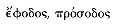








Unfortunately, this approach is fraught with difficulties. It might be thought, for example, that freedom from taxes (

[90] Etienne, 173–95, esp. 189–94, quotation 194–95.
[91] IG XI 4.547 (= Choix, 28); 599; 627 (= Choix, 46); 547, 562 (= Choix, 20), 563 (= Choix, 22), 599, 631.
he was in town, makes a good candidate for a trader.[92] But in IG XI 4.573, which honors the comic poet Eukles of Tenos, the only named privilege is freedom from taxes. There is therefore no clear connection between this privilege and trade; indeed, the only unambiguous trader awarded a proxeny was granted not ateleia but

M.-F. Baslez suggests that persons granted the right to own property on Delos, but no strictly honorary privileges, like proedria, or commercial ones, like ateleia, were foreigners coming to live on Delos; the increase in numbers of such awards in the second century would then attest to a growing metic population.[96] In fact, the disappearance of ateleia cannot be connected to any such phenomenon. As we have already seen, awards of particular privileges were not tied to the activities or status of the honorand. Rather, the kinds of honors typically awarded changed over time. In the decrees of the late fourth and third centuries, the Delians normally awarded explicitly ateleia, proedria, prosodos to the boule and demos, and enktesis, and they often also indicated that all other privileges granted to proxenoi and euergetai were granted to the individual in question as well (e.g., IG XI 4.513.16–19). Only rarely is one or another of these privileges
[93] IG XI 4.759, 763–64, 779–80; cf. Marek, 272–73.
[94] IG XI 4.616, 516 with Lacroix, BCH 48 (1924): 409; Marek, 274–75.
[95] IG XI 4.583, cf. IvPerg 157A1; IG XI 4.561, cf. OGIS 724 and Bagnall, 153; IG XI 4.638 with Marek, 265 and 430 n. 329; IG XI 4.716 (= Choix, 58).
[96] M.-F. Baslez, Studia Phoenicia 5 (1987): 276, REG 89 (1976): 351–52.
omitted, for reasons unrecoverable to us. But sometime between about 230 and 200 B.C. , the Delians began to leave out certain privileges, sometimes ateleia (IG XI 4.667, 681, 693, 699, 701), sometimes proedria (IG XI 4.656, 699). By the early second century an entirely new formula developed, in which honorands were normally granted explicitly only enktesis and prosodos. Occasionally decrees from this period explicitly awarded proedria in addition to prosodos.[97] Baslez's view implies that the addition of proedria guarantees a truly "honorary" decree, as opposed to those intended to entice metics to settle on Delos by awarding enktesis. But in fact the presence or absence of an explicit grant of proedria looks arbitrary. Why would the Delians refuse proedria to Nabis, king of Sparta, and the banker Timon, who helped grain buyers for the Nesiotic League, while granting it to a Spartan official, a representative of Eumenes II, and a doctor from Halikarnassos?[98]
Moreover, it is very difficult to see how the award of enktesis is supposed to reflect the influx of persons wanting to live on Delos when every single decree passed after 200, and all but four passed before 200, contained this provision.[99] These include decrees honoring men who would never live on Delos, like Nabis of Sparta and the Pergamene court official Demetrios son of Apollonios. Indeed, there is positive evidence that the award of enktesis cannot really have helped metics to settle on Delos. Two of the honorands awarded enktesis are explicitly said to have been living on Delos for a long time.[100] The grant of enktesis was not their inducement to stay on the island, for they had clearly already committed themselves to that, but rather their reward for benefactions to the Delians and their god. The bankers provide a good example. Timon, Mantineus, and Theon all did business with the temple; Eutykhos may well have been honored for his establishment of a sacred fund.[101] Proxeny decrees expressed recognition by the Delians of people who had benefited the city and temple; those benefactions may sometimes have been financial or commercial, but the decrees themselves were not passed as inducements to economic activity, but for good works. Christian Marek has sensibly written: "Generally, foreigners became proxenoi who lived on Delos and were active in the branches of the
[97] IG XI 4.717, 765, 769, 775, 777, 825, 826, 842.
[98] IG XI 4.716 (= Choix, 58), 759, 717, 765, 775.
[99] Absent from IG XI 4.511, 573, 623, 636; it should probably be restored in 534 and 842.
[101] Cf. Marek, 273–74, with further references.
economy typical for the island. They attained this honor in most cases because they had done a benefit to the polity of Delos and to the temple; their occupation gave them the opportunity, and they were able to afford it because of their wealth."[102]
The Ancient Economy and Regionalism
If Delos cannot be regarded as a center of a pan-Hellenic trade, where prices were regulated by a general Aegean market, the existence of a general Aegean market is itself called into question. This problem is inextricably connected with larger issues in the ancient economy, including the nature of trade, the character of polis demand, and the relation between partly or largely closed local economies and the pan-Mediterranean trade in staples and luxuries.
I cannot do more here than adumbrate some of the implications of my study for these problems and outline my sympathies in the larger issues, which have been and continue to be vigorously debated.[103] The idea that the Hellenistic Aegean saw an extensive price-setting market has appealed to many scholars. Fritz Heichelheim argued forcefully for it in his Wirtschaftliche Schwankungen. Johannes Hasebroek accepted it implicitly in Trade and Politics when he wrote that "the great cleavage in ancient economic development comes with the beginning of the Hellenistic age. The importance of this caesura is much greater than has been supposed; and the remarkable economic progress achieved by this age cannot be duly appreciated until it is recognised how many of its characteristics were still absent in the fourth century."[104] Michael Rostovtzeff, whose formulations
[102] Marek, 274.
[103] For some recent work with bibliography, see Elizabeth Lyding Will, Reicretorice romanae fautorum acta 26 (1987): 71–77; Lutz Neesen, MBAH 4.1 (1985): 49–66; H. W. Pleket, MBAH 3.1 (1984): 3–36; C. R. Whittaker, Opus 4 (1985): 49–76; P. W. de Neeve, Opus 4 (1985): 77–110; M. M. Austin and P. Vidal-Naquet, Economic and Social History of Ancient Greece: An Introduction (Berkeley, 1977); Peter Garnsey and C. R. Whittaker, eds., Trade and Famine in Classical Antiquity (Cambridge, 1983); M. I. Finley, The Ancient Economy (Berkeley, 1985); Domenico Musti, L'economia in Grecia (Rome and Bari, 1981); Peter Garnsey, Keith Hopkins, and C. R. Whittaker, eds., Trade in the Ancient Economy (Berkeley, 1983); Marasco, 125–81; Dominic Rathborne, Economic Rationalism and Rural Society in Third-CenturyA.D. Egypt (Cambridge, 1991), passim; Edmund M. Burke, TAPA 122 (1992): 199–226. This list is by no means exhaustive.
[104] Johannes Hasebroek, Trade and Politics in Ancient Greece, tr. L. M. Fraser and D. C. MacGregor (London, 1933), vi.
are generally qualified and nuanced, also presupposed a large-scale price-setting market in his claims that in the world of Alexander the "demand for Greek goods of special types was large, the buying capacity of the market was continually increasing" and that "the successful efforts of the Hellenistic kings to intensify production . . . [led to] a steady fall of prices in the Aegean Sea."[105] His far more cautious remarks specific to Delos are worth quoting at length:
Since Delos was a centre of commerce closely connected with Rhodes and Alexandria, we may safely assume that the fluctuation of prices in Delos reflects the movement of prices in the rest of Greece. But I hesitate to draw far-reaching conclusions from curves of prices at Delos based on statistical data that are far from complete. We know too little of the general history of the Aegean world in the third century and more especially of the history of Delos to be able to determine the causes of the fluctuations. It seems, however, reasonable to ascribe the gradual stabilization and fall of prices between 270 and 250 B.C. to the Ptolemaic hegemony in the Aegean. With the downfall of this hegemony there was a recurrence of trouble and prices began to rise. It is likewise reasonable to assume during the period 270–250 B.C. a certain correspondence between prices in Egypt and in the Aegean, particularly as regards grain and papyrus. We may perhaps see a certain relation between the prices of pitch, tar, timber and the vicissitudes of the Macedonian kings. Farther than this I hesitate to go.[106]
Despite the qualification and hesitancy, Rostovtzeff continues to see a limited Aegean price-setting market, operating only for certain goods at certain times and in certain parts of that world.
In The Livelihood of Man, Karl Polanyi argued that this price-setting
[105] M. Rostovtzeff, AHR 41 (1935–36): 235, 239–40; cf. Rostovtzeff, II.1026–1312.
[106] Rostovtzeff, 235–36. Thirty-five years later, the views of Rostovtzeff, Heichelheim, and others continue to frame interpretation of the Delian prices. For Edouard Will's view, see below; in her recent study of the Delian community, Claude Vial cites several of the publications I have mentioned, and remarks, "Ces études [of the Delian economy] ont l'intérêt de comparer les faits déliens aux faits du reste du monde hellénique, ce qui améliore la compréhension des uns et des autres, et de replacer certains phénomènes économiques déliens dans leur contexte réel, le monde égéen et méditerranéen" (Vial, 283–84). Oddly, she neglects Heichelheim, who went the farthest in trying to set "[les] phénomènes économiques déliens dans leur contexte réel, le monde égéen et méditerranéen."
market was the invention of Kleomenes of Naukratis, the man Alexander had left behind to govern Egypt after his own departure for the East. Polanyi defended Kleomenes from what he regarded as slanderous later opinions and hailed him as "surely one of the greatest and most influential men of the Alexandrian period." His great accomplishment was to create a "'world' grain market" (Polanyi's quotation marks) in which "[f]or the first time, the prices in the various Greek cities were closely related to one another on a consistent basis; we can speak here of a true market price for the eastern Mediterranean, with supplies being moved according to price ratios."[107] Polanyi's main evidence for this view—aside from the anecdotes in the pseudo-Aristotelian Oikonomikos —is the famous description of Kleomenes' trade network in the speech Against Dionysodoros ([Demos.] 56). The speaker is prosecuting Dionysodoros and his business partner Parmeniskos for violating the terms of a bottomry loan of 3,000 drachmas, which the speaker and his partners had lent on the condition that the ship return to Athens. Instead, the ship discharged its cargo (of grain, as becomes apparent) at Rhodes, left for Egypt, picked up another cargo, and returned to Rhodos (56.3):
Parmeniskos sailed on the ship, while this one [i.e., Dionysodoros] waited here. For, gentlemen of the jury, they were—so that you should not be unaware of this fact—all underlings and operatives of Kleomenes who was in charge of Egypt. Since the time he took over the office he has done no little harm to your city, and even more to the other Greeks, by reselling and manipulating the prices of grain, both himself and those with him. For some of them send money to Egypt, others sail to the ports, and others who stay in them distribute the dispatched goods. Moreover those who stay put send letters about the current prices [
] to those who are away, so that, if grain is expensive among you, they convey it here, but if it becomes cheaper, they sail down to some other port. Hence not least, gentlemen of the jury, has the grain business been price-rigged by means of such letters and cooperation. Now when they sent the ship out from here, they left with grain relatively expensive. That's why they allowed it to be written in the contract that they were to sail to Athens and not into any other port. But afterwards, gentlemen of the jury, when Sicilian imports came and the price of grain dropped and these men's ship arrived in Egypt, this man [i.e., Dionysodoros] straightaway sent somebody to Rhodes to report to his associate Par-

[107] Karl Polanyi, The Livelihood of Man (New York, 1977), 238–51, quotations at 240, 241, 249–50.
meniskos the current conditions at home [
], knowing that it would be necessary for the ship to put in at Rhodos.

Parmeniskos received the message and, in full contempt of the contract, unloaded his cargo at Rhodos and sold it (56.10). The result of this arrangement, for Polanyi, was to create at Rhodos a grain price that "would tend to reflect the average prices in the Greek cities, i.e., the Rhodian price would tend to be a 'world' market price, the various local prices tending to differ by the amount of transport charges."[108]
Several problems emerge. However much Dionysodoros's creditor abhorred the system in which his opponent participated—and we must always bear in mind that we are confronted here with a forensic speech—even he would have had to admit that there were many traditional elements in it. Nothing was more common in the fourth century, and indeed long before, than the dispatch of ships and money from a consuming center like Athens to a producing one like Egypt for the purpose of buying grain to bring home.[109] One of the speaker's main fears, in fact, is, not of "market manipulation," but of his exposure, as a resident of Athens who has lent money for the purchase of grain, to prosecution for failure to ship that grain to Athens.[110]
Furthermore, no indication emerges from the plaintiff's case that a general price-setting market developed. The plaintiff does not complain that an Aegean grain price had emerged, which differed from place to place by the cost of transport, but that Kleomenes "has done no little harm to your city, and even more to the other Greeks, by reselling and manipulating the prices of grain": that is to say, Kleomenes schemed to raise prices. The Oikonomikos reports explicitly the same objective in Kleomenes' plan to buy up all Egyptian grain direct from producers and to sell it to foreigners at the outrageous fixed price of 32 dr (Oik. 2.33e, 1352b14–20). The context of this activity, like Dionysodoros's, was the great famine of 330–326 B.C. , which gave Kleomenes the opportunity—as the author of the Oikonomikos explicitly tells us—to intervene.[111] The "great harm" Kleomenes is alleged to have perpetrated should be sought in his price-fixing—as indeed the plaintiff plainly states. In this Kleomenes stands at the head
[108] Ibid., 249.
[109] For a recent discussion, see Paul Cartledge in Trade in the Ancient Economy, 1–15.
[110] [Demos.] 34.37, 35.50. Briefly, Douglas M. MacDowell, The Law in Classical Athens (Ithaca, N.Y., 1978), 158.
[111] [Arist.] Oik. 2.33a, 1352a16–23. Cf. André Wartelle's remarks in the Budé edition, p. 31 n. 1.
of a long line of Hellenistic "price-fixers" in times of famine, among whom large landowners figured prominently.[112]
Moreover, Kleomenes' "distribution scheme," if I may call it that, seems to have required not a general price-setting market but a large number of relatively independent local markets. The operation exploited the difference between prices at relatively close range. These price differences were not simply the result of differing transportation costs, since otherwise there would have been no higher profit in moving the grain. On the arrival of a grain shipment from Sicily, prices in Athens crashed—proof enough that prices in the Peiraieus were set in the Peiraieus, not at Rhodos. A general price-setting market would have defeated Kleomenes, whose only apparently new element, it would seem, was his communication network: "Those who stay put send letters about the current prices [

The small scale of the trade is also striking. Dionysodoros and Parmeniskos, like so many other traders, have but one ship. The plaintiff depicts them as Kleomenes' creatures, but they depended on Athenians for financing. Their ties to Kleomenes' system may have been no more than that they bought their grain in Egypt and used other merchants to move around information about price changes in Athens. And the decision to winter at Rhodos may have been determined in part by the fact that it was possible to sail between there and Alexandria even in winter; goods could be stockpiled on Rhodos to be ready for transshipment as soon as the weather cleared in the spring.[113]
Finally, the outcome of this sordid business is worth stressing. At news of low prices at Athens as a result of the unexpected arrival of grain ships from Sicily, the traders completely abandoned their plans, and Parmeniskos unloaded his goods at Rhodos. This illustrates for us, as for the ultimate purchasers and consumers of the grain, the unreliability of the supply network, and helps to explain the concern that so many states show in the Hellenistic period about assuring grain supplies. If a major consumer like Athens could be so victimized, it is easy to imagine how little pull a small city like Delos or its Kykladic neighbors would have. Chance variations in
[112] Pleket, MBAH 3.1 (1984): 3–36.
[113] M. Zimmermann, ZPE 92 (1992): 212–13.
price could drive suppliers quite suddenly away. The whole crucial matter of food supply must therefore have involved a great degree of uncertainty, which in turn would make the Delians and their neighbors strive for selfsufficiency, or at least the ability to supply oneself from sources known, local, and therefore easier to control.
Generally speaking, discussions of markets in the Hellenistic economy have not shown much sophistication. A large-scale, long-range, unified price-setting market for a good like grain requires the reliable exchange of local price information, available to all participants; reliable, reasonably quick transportation to respond to local changes caused by local conditions; redistribution and storage centers; and indifference on the part of consumers as to the origin of the goods they buy and on the part of producers as to the ultimate destination of their products. The Hellenistic Aegean met only some of these conditions, only in part, and only some of the time. The prosecution of Dionysodoros certainly shows that some merchants attempted to exchange price information. But that information was clearly only partial and tended to arrive only slowly; by the time it reached an interested trader, it might already be obsolete. Parmeniskos sold his cargo at Rhodos in response to news that prices had collapsed at Athens, not because prices were highest at Rhodos. The difference is important, for Parmeniskos's information was only partial. He knew prices were poor at Athens, but he evidently did not know where they were better, or else he surely would have sailed there to sell the grain. This circumstance gains interest for us when we recall that Dionysodoros and Parmeniskos were operating in the context of the very widespread grain shortage of 323/2 B.C.[114] The speech really only demonstrates the transmission of information about prices at Athens; the more general claim of the plaintiff that "those who stay put send letters about the current prices [

The other conditions such a market requires are likewise only partially or conditionally met. Transportation clearly constituted a serious problem. The huge grain ships attested to by Moskhion and Lucian were rarities, and the bloated demand of an overpopulated Rome that made them necessary had no counterpart in the Hellenistic Aegean, not even in Athens.[115]
[114] Garnsey, 154–62.
[115] Casson, Ships, 184–89.
The constraints of the sailing season, which largely confined the movement of goods to the months between May and October, forced traders to do most of their buying and selling at a time of year when prices were often least favorable (the grain harvest fell in May–June). Although we know precious little about these aspects of the trade, there were certainly some redistribution and storage points in the Aegean—Rhodos being the most prominent—but for many poleis, including Athens and Delos, the point of attracting grain was not to export elsewhere but to supply local needs. Finally, there was a strong prejudice in the ancient world in favor of civic autarkhy: the notion that a polis ought to be self-sufficient to the extent possible, especially in foodstuffs. People preferred locally produced goods, and poleis worked to try to assure crops sufficient to feed their own populations.[116]
It turns out, then, that some evidence cited in favor of a general Aegean market in fact speaks against it. The interpretations of Delian economic history offered in the following chapters proceed in the same direction. This is not to deny the existence of long-distance trade in staples as well as luxuries, but rather to put that trade in perspective. The scale of pan-Mediterranean and pan-Aegean trade was small; and when Delos's role grew in the late third and second centuries, it was not to become "plus qu'un centre de redistribution pour la région centrale de l'Archipel,"[117] but rather to assume its full role as exactly that: a center of redistribution for the Kyklades.
Perhaps the best test of this view is the contention, first argued by Heichelheim, that high Delian prices around 314–270 B.C. reflect demand for Greek goods by new settlers in the Greek East. As we shall see in chapter 5, this claim rests in fact on only a handful of prices for olive oil (high estate rents in 314–290 B.C. must be attributed to completely different causes, as I show in chapter 6). Since no other goods show elevated prices, the notion of a general inflation because of high eastern demand—I leave aside the "flood of bullion" from Alexander's conquests, which also proves to have no connection with price changes (see chapter 7)—becomes untenable. There are better explanations for the high olive prices, which do not require a world market and have support both in the Delian documents themselves and in the political situation in the central Aegean in the late
[116] As one example out of dozens, consider the lengthy struggle between Priene and Samos over the possession of agricultural territory on the mainland, Plut. Mor. 295f–296b, IvPriene 37 = SIG 599.
[117] Vial, 341.
fourth and early third centuries.[118] The other economic phenomena on independent Delos will also be seen to be most easily explained by appeal to local conditions and a strictly limited local market.
[118] Heichelheim, Wirt. Sch., 55–56; Rostovtzeff, 158–59; see esp. Larsen, 380: "It is well known that the flood of currency let loose by Alexander the Great caused a general rise in prices." Rostovtzeff, 165–66, dissents somewhat from this view, attributing the main cause of the general rise in prices under Alexander and the Epigonoi to a "rapid increase in the demand for Greek commodities both for home consumption and export," with the infusion of Persian money as a subsidiary cause. On Alexander's foundations, see—magno cum grano sails!—Plut. De fort. Alex. 1 (Mor. 328E); App. Syr. 57.