
Conclusion: Dora Wordsworth, a Daughter's Story
My dear Sir,
I earnestly wish that the little volume here inscribed to you, in token of affectionate veneration, were pervaded by more numerous traces of those strengthening and elevating influences which breathe from all your poetry—'a power to virtue friendly'. I wish, too, that such token could more adequately convey my deep sense of gratitude for moral and intellectual benefit long derived from the study of that poetry—for the perpetual fountains of 'serious faith and inward glee' which I have never failed to discover amidst its pure and lofty regions—for the fresh green places of refuge which it has offered me in many an hour when
The fretful stir
Unprofitable, and fever of the world
Have hung upon the beatings of my heart;
and when I have found in your thoughts and images such relief as the vision of your 'sylvan Wye' may, at similar times, have afforded to yourself.
Felicia Hemans, canceled Dedication to
Scenes and Hymns of Life, 1834
Then I made her get a book, and read English to me for an hour by way of penance. I frequently dosed her with Wordsworth in this way and Wordsworth steadied her soon; she had difficulty in comprehending his deep, serene and sober mind; his language too was not facile to her; she had to ask questions; to sue for explanations; to be like a child and acknowledge me as her senior and director. Her instinct instantly penetrated and possessed the meaning of more ardent imaginative writers; Byron excited her; Scott, she loved; Wordsworth only, she puzzled at, wondered over, and hesitated to pronounce an opinion upon.
Charlotte Brontë, The Professor (1857)
In chapter 5 much of the poetry and many of the letters quoted were concerned with or were inspired by Dora Wordsworth: as an infant, a child, a young woman. Dora emerges from these texts as a dutiful daughter who assumes a major role in her father's life and in the life of Rydal Mount: taking dictation, presiding at tea, visiting neighbors, threatening to become a scholar (see figure 6). Dora's letters and papers do not contradict this image so much as they reveal the difficulties inherent in assuming the domestic role and in her later attempt to modify the script. Dora's travel journal of 1828, quoted briefly in chapter 5, reveals much about Dora's character and her commitments. In her letters, too, Dora shows herself to be a generous and loving person, but a woman who sometimes feels her generosity and love stretched to the limit, as we shall see particularly in letters to Maria Jane Jewsbury and in one crucial letter that she wrote to Isabella Fenwick upon first visiting Tintern Abbey.[1]
But before looking at either the travel journal or at this group of letters, I would like to clarify Dora's perspective on gender. It is clear that Dora grew up in a household of talented, thinking women, but not women who sympathized with radical notions of gender or of equality between the sexes. From her early letters on and in her journals, for instance, Dorothy Wordsworth voices contempt for bluestockings and for anything that smacks of female literary careerism. In the 1820s, when Felicia Hemans presented herself at Rydal Mount, the women generally felt that she talked too much and thought too much of her own talents. Nor did they look kindly on Sara Coleridge's intense studies, even though Sara Coleridge never had ambitions for a literary career. Much later, Harriet Martineau was welcome at the Mount, in part, I think, because her eccentricities were so endearing that they cloaked her intellectual accomplishments.
Dora Wordsworth for the most part accepted the outlook of Rydal Mount, as her actions and comments make clear. In a letter to Susan Wordsworth (27 July ?1843), Dora describes a visit to the Mount by a Dr. Howe and his wife from Boston. Dora's response is both funny and revealing, for she first describes the doctor and then says that he came "with a horrid rude clever, radical woman of a wife Oh what a dislike I took to that woman." "Horrid rude clever"—all in one breath. Only add "radical" and the description is complete. Wordsworth himself, with characteristic disdain for Americans, writes to Miss Fenwick: "The Husband is an intelligent Man, and his Wife passes among Americans as a bright Specimen of the best they produce in female character" (LY 4:461).
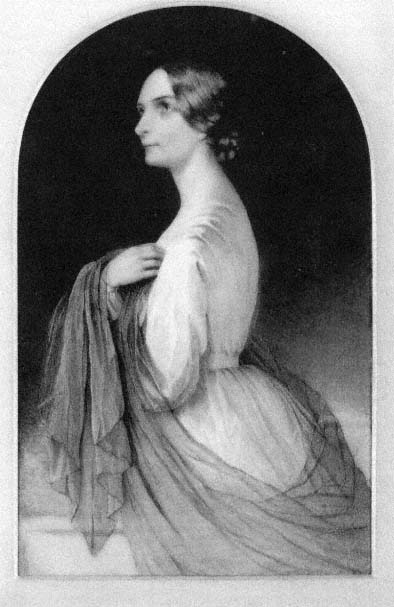
Figure 6.
Dora Wordsworth. Watercolor on ivory by Margaret Gillies. 1839. By
permission of the Wordsworth Trust, Dove Cottage, Grasmere,
England.
I surmise that this horrid woman was none other than the feminist Julia Ward Howe, who visited Rydal Mount with her husband, an admirer of Wordsworth. No doubt Mrs. Hemans was meek in Dora's eyes in comparison to what she saw as this American virago. Dora had a generous spirit, but even her generosity was cooled by the spectacle of this woman, who perhaps presented many opinions about the woman "problem" that Dora found threatening. In this case, Wordsworth's description of Dora in "The Triad"—"Insight as keen as frosty star / Is to her charity no bar" (149–50)—misses the mark.
Dora on the Rhine: Summer, 1828
Dora's identification with the values of Rydal Mount did not shield her from controversy or prevent her from thinking and feeling for herself. Dora may never have succeeded as a student of German, but, as her journal of 1828 reveals, she became a keen and usually sympathetic observer of the human and natural scene. Dora made the most of her education: she read her father's poetry, and she read and thought about journals written by her aunt and mother. She was aware of the conventions of journal-writing and wanted to create vivid descriptions for her family to share. She was also aware of her responsibility in recording the journey "through Belgium, down the Meuse by boat, up the Rhine to Godesberg and back through Holland" (Moorman 2:435) as a memorial of time spent with her father and Coleridge.
In addition to the descriptions she includes in her journal, Dora hopes to bring home pencil sketches of interesting scenes. She expends a good bit of energy setting up her sketching apparatus, only to be disturbed by hordes of onlookers who break her concentration. This entry is typical: "I sat me down, soon a rabble was collected, my Father did his best to encourage me, & disperse the crowd but it was all in vain & not having nerve[?] to bear the idea of positively blocking up the causeway I rose in a fluster—anxious as I was to bring away one at least characteristic memorial of a Dutch Town" (82).
Although Dora is often frustrated, she does produce several sketches (which, unfortunately, have not been preserved with the manuscript). But even though we lack this visual record, in her journal Dora does indeed recreate the scenes in vivid, pictorial language. In fact, she characteristically thinks in compositional terms and frames each scene for a viewer, commenting on both the scene and her way of perceiving it: "Town beautiful vanishing from our sight—whilst in front exquisite
views open upon us. Walls of rock on each side assuming grotesque forms. Now a Tower, now a Pillar—now rounded, now square"(16b). Dora says that she sees everything with an "English eye" (29), and she refers to Lake District colors and skies: "today has been quite a Lake colouring day" (41). As she composes her scenes with a disciplined eye, Dora uses such words as frame and foreground and refers to painterly techniques: "The Ruined Castle of Hammerstein on the ridge of a hill was very fine; it presented itself to us under favorable circumstances, backed by a wild sky one that Salvatore Rosa would have delighted in" (36).
What I have found most interesting about Dora's composition is that she highlights the human element and includes the sometimes rough and messy details of everyday life, a technique linked in chapter 1 to the picturesque and to women artists. Dora's scenes are not neatly compartmentalized. For instance, on the way to Ghent she sees this:
Country very interesting—a tempting road through Avenues of trees to our left—women reaping, cloth bleaching—a flock of Sheep tended by their Shepherd & his Dog which would make a sweet picture—Banks deepen lowly Cottages sprinkled about—road on each bank & each through an avenue of trees—Water lilies abundant—a black & white Goat tottered close together on the steep bank.
(7)
What is so striking about this entry is the way that Dora weaves together—really, pieces together like a quilt—the various elements she sees, adopting a technique that will be familiar to readers of Dorothy Wordsworth's journals. Dora's details come alive in a loosely unified composition, but the details have an integrity and poignancy of their own. Dora sees people at work (women reaping) and the material results of labor (cloth bleaching); she reveals the human dependency on nature and the interrelationship of the human and animal worlds in the "sweet picture" of the shepherd. Her final image of the tottering goats seems to suggest the precariousness of it all—yet she holds the scene together.
Dora is intrigued by perspective in more than a visual sense. Upon entering a village, she comments that "People become more humanized" (41) when you get close to them. She wants people to be human, to be individuals, and she tries to think beyond stereotypes. Dora also empathizes with the people she meets and focuses on their points of view. For instance, she describes an encounter that Wordsworth uses for his poem "The Jewish Family." Wordsworth invokes the "Genius of
Raphael" (1) to inspire his description of the beautiful children of this impoverished woman. Wordsworth's poem is sympathetic and appreciative, yet he idealizes the family (a mother, a son, and two daughters), viewing them as representatives of the Jewish diaspora:
Two lovely Sisters, still and sweet
As flowers, stand side by side;
Their soul-subduing looks might cheat
The Christian of his pride:
Such beauty hath the Eternal poured
Upon them not forlorn,
Though of a lineage once abhorred,
Nor yet redeemed from scorn.
(33–40)
Although Dora does not want to "anticipate Father's Poem by transcribing my thoughts & feelings," she cannot resist noting "one affecting thing…. When Mr. Coleridge told this Rachel how much he admired her Child—'Yes,' said she, 'she is beautiful (adding with a sigh) but see these rags & misery—' pointing to its frock wh was made up of a thousand patches" (49; also quoted in PW 2:525n). Whereas Wordsworth takes the perspective of the idealizing Christian viewing the family's otherness, Dora Wordsworth allows the woman to speak of her misery and to reveal her awareness of the paradox that such a bereft child could be so beautiful. Dora does not so much anticipate her father's poem as she complements his perspective. Her way of seeing seems closer to Joanna Baillie's theory in her "Introductory Discourse": "The Highest pleasure we receive from poetry, as well as from real objects which surround us in the world, are derived from the sympathetic interest we all take in beings like ourselves" (6). Even in 1843, when Wordsworth was recalling the scene for Isabella Fenwick, he focused on the physical beauty and "intelligence of [the Jews'] countenances" as opposed to those of the German peasantry, rather than commenting on this particular woman's plight. And yet one sentence in his note reveals her devotion to her faith and its laws despite her destitute (and abandoned?) state: "We had taken a little dinner with us in a basket, and invited them to partake of it, which the mother refused to do, both for herself and children, saying it was with them a fast-day; adding diffidently, that whether such observances were right or wrong, she felt it her duty to keep them strictly" (PW 2:525n).
Throughout her journal Dora Wordsworth is aware of the potential for the poetic or artistic vision to obscure as well as clarify the material
scene. For instance, she describes the following scene around Coblentz when a storm was gathering:
far too poetical a scene for me to write upon[—]a wild, glowing, yet subdued sky veiled in part by the rapidly advancing storm—a building of lurid white—nay of a color only heard of in enchanted Castles rising out of a river—behind it a field or lawn of a green which could only come from faery land and this seen under the arches of a noble massive & gloomy bridge—The falling rain too soon awoke us from our dream. We hastened on Shore—took shelter under a gate-way where fifty ragged Children—put to flight all bewitching or poetical imaginings—
(37–38)
Dora Wordsworth can paint this picture of an enchanted castle in faery land in all its splendor, but the most interesting part of the passage occurs at the end, when the presence of "fifty ragged Children" brings the viewer back to earth. What strikes me is not only the contrast between the enchanted scene and the ragged children, but the fact that Dora recognizes the implicit suffering of the children and deliberately puts them in the picture so that her readers can see in this perspective too. Dora wants to inscribe—not transcend—the material world and its inhabitants, although she is moved by and comments on the religious art and architecture that she observes. Dora's spirituality, in other words, is grounded in empathic responses to the people and the world around her, not in renunciation or transcendence.
Dora at Tintern Abbey: Spring 1838
We recall that Dorothy Wordsworth was eager to subdue the waywardness of young Dora's character. Dora herself suggests that it was the discipline of school that finally taught her this control. When writing to her godchild Jemima Quillinan on Jemima's fourteenth birthday (6 October 1833), Dora thinks of herself at fourteen and writes that "school-discipline to me who till that time had been perfectly wild was as irksome as it was needful but when once broken in I found the life a very happy one & after an imprisonment of three years I was almost as loath to resume my liberty as I had been to part with it." It seems in this letter that Dora is initiating Jemima into the feminine role of nun-like imprisonment. Dora could be giving a personal commentary on "Nuns Fret Not," implying that she too had felt the weight of too much liberty.
But despite this seeming acceptance, Dora's letters of the period betray a sadness and a yearning. Dora's sense of loss is particularly apparent in her correspondence with Maria Jane Jewsbury, which continues until her friend's death in 1833. In these letters, the only group of Dora's letters published thus far, Dora writes intensely of her love for her friends and family. She refers to Sara Coleridge's marriage and new infant daughter and follows the difficult story of Edith Southey's plans to marry. But most telling is her response to Maria Jane Jewsbury's own marriage plans. Jewsbury had introduced herself to the Wordsworth family as an admirer of the poet and an aspiring "poetess" herself. She had become friendly with the whole family but was especially intimate with Dora. In a letter to Dora (12 March 1831) Jane (then thirty, three years older than Dora) wrote that she hoped to marry a poor clergyman named Mr. Fletcher, of whom her father disapproved but who was given a probationary period. Jane describes Mr. Fletcher as "one, who, if he realize his own temporal prospects, and satisfy my moral requirements—I shall certainly feel bound in honour and inclination to marry, some time after his probation is ended."[2] Some of the conflicts Jewsbury felt may have affected Dora Wordsworth quite personally: Maria Jane Jewsbury wanted her father's approval for her marriage, and she felt torn in leaving her widowed father and younger siblings for a life of her own. In the letter quoted above, she refers to her sister Geraldine as nearly nineteen and presumably capable of taking her place in the family. Thus Dora witnessed closely the wretchedness of her friend who desired to marry against the will of her father and who already had given the siblings "the best of me." By mid-October 1831 Jewsbury wrote of her impending marriage to Mr. Fletcher, who had accepted a chaplaincy with the East India Company in Bengal.[3]
In March 1831 Dora writes another letter to Jane. This document reveals her feelings on the prospect of her friend's marriage—the move to Bengal, which intensifies her unhappiness, is not yet in the picture. Rather than the more public stance of happiness at Jane's good fortune, Dora confides:
You well know with what feelings your letter was seized & read; a thousand thousand thanks—for the first time in my life I have had to struggle against the feeling that distance & death only differ in name—when I had you by [m]y side I could not think so—now alas at times it weighs me to the ground—when I pass your door—when I throw myself on the sofa—when I stroll into the garden. I feel mournful stillness—sad & mournful as the stillness of death—This I know will wear [a]way, but the love & affection which
now call out the feeling will never fade [I think I m[a]y say never may I not?] I am perfectly calm & cheerful downstairs; my sadness I keep to myself—& indeed I do not nurse it—but endeavour to be thankful for the large portion of undeserved pleasure that has been granted to me—
When you left me I turned to the only fountain, whence pure hope, comfort, & consolation can be drawn—then I read your letter & then what do you think I had strength & courage to do—In compliance with your wish I burnt all your letters except those written to me during your illness these treasures I will never part with—by the time I had done this—Father & Mother were returned from their drive to Grasmere & found me bright as usual & ready to read to them which I did—But when I retired to my own room oh it was more than I had strength for—then I did give way & wept myself to sleep long before you had gone to rest—[4]
This letter suggests not only the degree of the love between the friends, but also the fact that their relationship is much closer even than Dora's with her immediate family. Much has been written about such intense female relationships—how common they actually were in nineteenth-century England and America.[5] While there might be genuine love and devotion felt for family (as there certainly was in Dora's case), this female friendship fulfills a need for intimacy that cannot be found in merely familial relationships. The kind of love Dora feels for her parents makes her want to protect them and thus to hide her grief: to be bright as usual downstairs but let the grief overflow in private. By burning the letters Dora makes sure that no one else will share Jane's intimacy—although Jane obviously preserved Dora's letters. And from the comments that Wordsworth makes to Quillinan on Jewsbury's death, it is clear that he either does not understand or does not acknowledge the depth of Dora's love for her:
Poor Mrs Fletcher (Miss Jewsbury that was) has found a grave in India—from the first we had a fore-feeling that it would be so. She was a bright Spirit, and her sparkling, of which she had at times too much, was settling gradually into a steady light. Her journal is to her friends very interesting, and I cannot but think that if she had survived, we should have had from her pen some account of Indian appearances and doings with which the public would have been both amused and instructed. She died of Cholera, but the particulars of her death have not reached her friends.
(LY 2:719, June 1834)
What is remarkable is the absence of any comment on Dora's loss, which must have been far greater than that of the public who could no longer hope for amusement and instruction from Jewsbury's pen. Indeed,
Wordsworth fails to exhibit any real feeling for Jewsbury's literary ambitions. But beyond that, either he betrays great insensitivity, or he is simply oblivious to Dora's intense love.
When Dora contemplates Jane's marriage, even before she knows that her friend's destination will be another continent, she anticipates the loss of the frequent visits and shared feelings. Her language is extreme—she is seized with emotions on receiving the letter; for the first time in her life she connects death with distance. The stillness that Wordsworth had valued for its spiritual consolation in The White Doe becomes for Dora the dread of emptiness. The emotions Dora feels are closer to her father's "Strange fits of passion," where the narrator associates death and loss with his distance from Lucy's cottage and confides his story to "the lover's ear alone." She writes to Jane using the language of love, and goes on to say, "I wish I might just be alone for a few days—my heart sickens at the thought of appearing joyous, my thoughts will turn to you I feel what I have parted from, I know not if ever I shall again have those eyes overflowing with love cast upon me—& that thought causes mine to overflow with tears—… how I longed for you last Evening."[6]
Such erotic language was not unusual for female friends, but in Dora's case it sounds particularly urgent, perhaps because Dora realizes that with the loss of her female friends to marriage she too may have to face the prospect of her father's disapproval if (when) she wants to marry. (Dora had already received offers, but no one but Quillinan would she consider.) In this sense, the intense language of her letters to Jane may be her way of trying to maintain her life as a loving and dutiful child. She may realize, in other words, that she too may have to go through a similarly painful family conflict if she is to marry, so she channels her desires in a safer direction. The love for a female friend, from this perspective, represents less family conflict and strife because it does not involve leaving home and forming a new household. It represents the intimacies of girlhood, as Dora's later letter to her old school friend Mary Calvert (?26 July 1841) from a newly discovered group of Dora's letters at the Wordsworth Library makes clear. Dora writes to Mary, anticipating Mary's objections to her marriage to a Catholic: "Mr Quillinan is to make me his before we leave Bath." Dora wants to treat Mary with "frank affection as when we were school girls together [] & before that to interchange thoughts with each other as freely as with our very selves." But she knows, I think, that this time is no more.
Not that Edward Quillinan is ever far from Dora's thoughts in 1831. Many of her letters are to Quillinan or to his daughters, Rotha and
Jemima. She writes to the girls with great affection, saying on 27 April 1832 that "I write to you now not because I have anything particular to write about but because writing to you is next best thing to talking to you." In a letter shortly following this one, Dora assures Edward "that as long as life is given to me your Darlings will have one friend who must always think of them with a Mother's [] & love them with a Mother's Love & whose only regret will be or rather is that her power of serving them falls so very short of her desire to serve" (26 June 1832). Quillinan had obviously asked a great deal from Dora in making this request, although they still seem to be coy regarding their mutual affections. Dora writes on 6 October 1833 that "when I was young even I never found any one disposed to flirt with me so now I have no reason to complain: as to petrified hearts those who have them may be envied & I congratulate you on your good fortune & only wish I were in like ease." Such indirection and irony is typical of Dora's correspondence with Quillinan during the early and mid 1830s, until Quillinan pushes the point in 1838.
In 1838 Dora Wordsworth's relationship with Edward Quillinan and with her parents reaches a crisis. By the spring of 1838, Dora has let her father know that she wanted to marry Quillinan, although, according to Alan Hill's note, Dora had written to Quillinan that "'My love for you is a spiritual Platonism such as a man might feel for a man or woman for woman … I wish for your own sake you were fairly married to someone else.' To this E. Q. replied from Rydal Mount on 8 Dec., calling her advice heartless: 'I am not spiritualized enough for you—you—frigid disagreeable thing! … it is a woodpecker's tap on a hollow tree in my ears: it is a squirt of lemon-juice in my eyes, and it is gall and wormwood on my tongue'" (LY 3:497n). Quillinan admits to having flirted with her in the past, but writes to Dora later in December 1837 that "I have had some troubles so severe as nothing but a rational and thoughtful and downright and resolute, though passionate, love for a good and virtuous girl could have given me fortitude to bear" (LY 3:549–50n). It is clear from this interchange that Quillinan was not easily refused, especially on platonic grounds. His letters have a passion and urgency that perhaps scared Dora and that certainly presented her emotions with a less ideal, romantic love than she felt for Jane.
To heighten her anxiety about marriage, Dora received this response from her father: "I take no notice of the conclusion of your Letter; indeed part of it I could not make out. It turns upon a subject which I shall never touch more either by pen or voice. Whether I look back or forward it is depressing and distressing to me, and will for the remainder
of my life, continue to be so" (LY 3:549, 5 April 1838). After a lifetime of smooth affection, this is the way Wordsworth responds to Dora's request, invoking his law and his authoritative silence through the metonymy "by pen or voice."
The dispute between Dora and her parents over her desire to marry would finally be mediated by Isabella Fenwick, the family friend who was close to all concerned. This woman was clearly more important in Wordsworth's life than the editorial reduction of her to "Fenwick notes" would indicate. But before Miss Fenwick would actually help to make the marriage possible, she became the person to whom Dora revealed her private thoughts and frustrations, by pen and voice: "to you dearest Miss Fenwick I say nothing because my feelings be too deep for words but you will give me credit for feeling as I ought to one to whom I owe so much you can never know till hidden things are brought to light in another & happier world" (19 April 1838).
Of all the letters I have found from this period, Dora's unpublished letter of 19 April 1838 is the most revealing both of Dora's emotions and of her reading of her father's poetry. In this letter Dora talks of a trip to Tintern Abbey and its environs with her friends and cousins. Dora describes the day as a glorious mix of light and shade: "had my heart been in sunshine I too should have been in 'wild ecstasies'"—alluding, of course, to the passage in "Tintern Abbey" where the speaker blesses his sister and looks toward the time when her "wild ecstasies shall be matured / Into a sober pleasure" (138–39). Dora's allusion implies not only that she does not feel the sober pleasures of maturity but also that her heart prevents her from feeling the immediate pleasures of the scene. As Dora looks down on the ruins, she continues: "as it was this beauty was overpowering I could only weep & wish myself more worthy of such privilege I felt it was all to me 'as is a landscape to a blind man's eye."' Here Dora distinguishes herself from her father, who had claimed that "These beauteous forms, / Through a long absence, have not been to me / As is a landscape to a blind man's eye" (22–24). Dora's letter is obviously filled with emotion, but she wants to feel consoled by the scene and by her memory of "Tintern Abbey." It almost seems that she wants to take Dorothy's place and to carry on the consoling vision, but she is unable to do so.
Dora's response also contrasts sharply with that of Mary, who visits Tintern Abbey and the Wye Valley with Joanna and Tom Hutchinson in May and June of 1812. This tour provides a dramatic setting for a se-
ries of love letters between William and Mary, for William remains in London while Mary tours the Wye. Mary writes to her husband on 29 May:
With a beating heart did I greet the Wye—O sylvan Wye thou Wanderer thro the Woods!—O what a verdant bed does it rest in where we first came in sight of it! I was most exceedingly delighted with this Ride—I dare say this Country, indeed it must be so, looks far more beautiful than when the season is further advanced—when the leaves are in full perfection—[7]
Although Mary Wordsworth approaches the Wye Valley with reverence for her husband's poem, she makes the interesting observation that the valley must look even more beautiful in late spring than in midsummer, when the valley is "clad in one green hue." This comment distinguishes her vision to a certain extent from her husband's. She continues in her next letter (2–3 June 1812): "O William what enchanting scenes have we passed through—but you know it all—only I must say longings to have you by my side have this day been painful to me beyond expression" (219). Mary accepts the spirit of "Tintern Abbey" and the authority of William's judgment, only wishing William were there to share the experience.
William responds, in a most passionate letter of 3–4 June 1812, "I think of you by the waters & under the shades of the Wye" (229):
I received very expeditiously your sweet Letter from Hereford; That very evening, viz Tuesday, I had been reading at Lamb's the Tintern abbey, and repeated a 100 times to my self the passage ["]O Sylvan Wye thou Wanderer through the woods," thinking of past times, & Dorothy, dear Dorothy, and you my Darling.
(227)
Completing this epistolary duet, William injects more sadness and sense of loss into the scene by his repetition of the "O Sylvan Wye" and the allusion to Dorothy. Whereas Mary evoked the emotion of seeing the Wye River through the mediation of William's line, William lingers over the passage that begins with the conditional thought that he does not complete in "Tintern Abbey": "If this be but a vain belief …" Wordsworth's sadness in rereading this passage of his own poetry is poignantly ironic if we recall that the Wordsworths' daughter Catharine died suddenly in June 1812, just after this correspondence, and in later years both William and Mary would look back over these letters with bittersweet memories, as Mary's later notations on the letters indicate.
Perhaps Dora's grief at Tintern Abbey is not only for herself but also for her Aunt Dorothy, who (as Wordsworth observed above) by this time was but a shadow of the young woman who had stood on the cliffs above the Wye Valley in 1798. In a letter dated (probably) March 1838, Dorothy Wordsworth wrote to her niece a letter that Dora must have received with great sadness. I quote it in full:
They say I must write a letter—and what shall it be? News—news I must seek for news. My own thoughts are a wilderness—'not pierceable by power of any star'—News then is my resting-place—news! news!
Poor Peggy Benson lies in Grasmere Church-yard beside her once-beautiful Mother. Fanny Haigh is gone to a better world. My Friend Mrs Rawson has ended her ninety and two years pilgrimage—and I have fought and fretted and striven—and am here beside the fire. The Doves behind me at the small window—the laburnum with its naked seed-pods shivers before my window and the pine-trees rock from their base.—More I cannot write so farewell! and may God bless you and your kind good Friend Miss Fenwick to whom I send love and all the best of wishes.—
(LY 3:528)
Although the letter gives evidence of Dorothy's past life—from her imperfect allusion to The Faerie Queene to her keen description of the view from her window—the overwhelming feeling is of dislocation and sadness. For the Wordsworth family the image of Dorothy before the fire even in the warmest weather became a painful symbol of her derangement.[8]
Several reports by visitors to Rydal Mount reveal the family's response to the cruel irony of Dorothy's condition. The Duke of Argyle wrote a letter in September 1848 that describes Wordsworth reading "Tintern Abbey" aloud in the presence of Mary and Dorothy:
The strong emphasis that he put on the words addressed struck me as almost unnatural at the time—'My dear, dear friend' ran the words,—'in thy wild eyes.' It was not till after the reading was over that we found out that the old paralytic and doited woman we had seen in the morning was the sister to whom T.A. was addressed, and her condition accounted for the fervour with which the old Poet read lines which reminded him of their better days. But it was melancholy to think that the vacant silly stare which we had seen in the morning was from the 'wild eyes' of 1798.
(PW 2:517)
Dorothy's letter and this description indicate both Dorothy's physical and mental decline and its effect on the family. Fifty years after he stood with Dorothy above Tintern Abbey, the poet reenacts the scene and sur-
vives in the face of yet more drastic change. But Dorothy cannot hear his exhortations, nor has she continued to live the life that her brother imagined for her.
Dora Wordsworth was very likely thinking of her aunt during her visit to the Wye Valley and Tintern Abbey—and thinking that her father's exhortations were difficult to follow. In her letter to Miss Fenwick, Dora goes on to say that she and her party traveled to the abbey itself in a hailstorm, but then left their coach in the sunshine. Now it seems, Dora is on her own ground. She is no longer retracing the steps of 1798 and "Tintern Abbey," but does what her father had not recorded: she climbs the narrow steps of the abbey and looks out on the valley from this perspective. Although it is very cold, she does not hurry, "since I saw it thoroughly & felt it more than I had felt the glories of the Wye & [ ]cliffs." Dora confesses feeling more deeply while in the abbey, explaining that "maybe the sadness, the ruins, the desolation of the place were more in harmony with my own feelings." Perhaps Dora also connects the monastic past with the confinement she feels in her own life, a theme not introduced in "Tintern Abbey" but, as we have seen, evident in Wordsworth's later poetry. She is certainly not oppressed by the weight of too much liberty when she visits the abbey and finds the "courage to mount the narrow winding staircase." Ten years after the incident at Bruges, Dora seems to be far from the "Maiden" "Borne gaily o'er the sea, / Fresh from the beauty and the bliss / Of English liberty" (38–40).
Dora is not so downcast that she cannot reflect on her experience of visiting Tintern Abbey. In fact, she focuses after these descriptions not on her loneliness and grief but on the value of the trip. "The Wye is one of the first things of which I have heard so much that more than realized my expectations." Whereas Wordsworth frequently writes of unfulfilled expectations and "something evermore about to be" (1805 Prelude, 6:542), Dora takes stock of the event itself, emphasizing that neither her father's poem nor the prints that she had seen of the abbey and its surroundings had prepared her: "I was not prepared for such fine cliffs not cliffs of such extent…. The Abbey too was much finer—the prints I have seen give you no idea of its beauty tho' one cannot well say why for they are very correct when you come to compare them with their stormy 'archetype.'" What Dora achieves in this letter to Miss Fenwick is, paradoxically, a consolation based on her own experience, judgment, and feelings. By the end of the letter she is still unhappy, but she is not oppressed by thoughts of what she should feel or what would be correct to see. By sharing both her sorrow and her insight with her friend, Dora
finds some strength. And an addendum to the letter explains that she has received an "affectionate" letter from her father in response to a "bold speaking out one of mine." In a moving reversal, Wordsworth's daughter changes the course of her own life and instructs the poet of household affections to look into his own heart.
The Cultivation of Women
One year before Dora Wordsworth stood at Tintern Abbey and wondered about the direction of her own life, her father went on a tour of Italy with his old friend Crabb Robinson. A few years before this tour, Robinson recorded in his Diary that Wordsworth "returned with me to chambers and we spent several hours in reading his manuscript and I wrote from dictation—rather a trying task."[9] Perhaps Robinson should have learned from this, but, nevertheless, on the tour the friends had a brief falling out, with Robinson explaining that he "was forced to resist his too large demands on my good nature" (172). Based on this experience, Wordsworth decided while abroad that he would never again go on a long trip without a "female companion" (Moorman 2:527). When Wordsworth dedicated the Memorials of a Tour in Italy, 1837 (1842) to Robinson, he thanked him
For kindness that never ceased to flow,
And prompt self-sacrifice to which I owe
Far more than any heart but mine can know.
Robinson may have been honored by this dedication from a friend he truly loved and admired, but we know from his Diary that he felt the strain of playing the woman's part.
Robinson, who shrewdly referred to Dorothy Wordsworth, Mary Wordsworth, and Sara Hutchinson as Wordsworth's "three wives," understood what others have realized as well: that Wordsworth thrived within his circle of female supporters who made it possible for him to produce and continuously revise a great body of poetry. As we have seen, Wordsworth's poetry and his attempts to define himself as a poet over a long career were influenced by the actual women in his life, by his reluctant and often unconscious identification with suffering or abandoned women, by his perception of the proper feminine role, and by his uneasiness in the company of contemporary women writers. And according to many reports, Wordsworth was finally silenced as a poet by the
loss of Dora three years before his own death—the loss he had most feared, the loss from which he could not recover.
Throughout his career Wordsworth sympathizes with female characters and cares deeply about the women in his life, but he is never really able to enter into another consciousness with what Keats referred to in a letter to George and Tom Keats (41, December 1817) as "negative capability." I do not agree, however, with those who say that Wordsworth was too masculine or too obsessed with his own egotistical sublimity, because such an analysis overlooks his identification with such figures as the banished Negro and Laodamia. Yet a certain blindness in Wordsworth's poetry prevents him from moving out of what is often an unconscious identification to a fuller awareness of those he imagines. Wordsworth continues to see others as the Other. Even in his moving and sympathetic poem on the Jewish family, for instance, he ultimately remains outside their experience, looking in this case from the perspective of the Christian seeing the Jewish child not in his historical plight but as an "exquisite Saint John" (24) who becomes an emblem of Wordsworth's own religious faith.
Wordsworth's poetic self-dramatization as Lear or Milton, as a father who desires "to curb" his daughter in "A Little Onward," proves prophetic of his dilemma with Dora. He adores her, as we have seen, but his love threatens to confine Dora and to deny her the passionate life that he has lived and the kind of happiness that has nurtured him. When Dora rebels, Wordsworth's first response is to silence her, in a way ironically reminiscent of Richard Norton's treatment of Emily in The White Doe. There is no space in Rydal Mount for this disruptive voice. And yet, under the intervention and mediation of others, Wordsworth relents.
Keats's characterization of Wordsworth as the poet of "the egotistical sublime" has certainly stuck, but his contemporaries made many contradictory observations of Wordsworth. Witnesses of his later life—in particular those, such as Isabella Fenwick and Crabb Robinson, who knew him well—all note that the poet himself embodies contradictory impulses. In 1845, Miss Fenwick tells Aubrey de Vere that "No degree of intimacy … can diminish your reverence for him, though you would discover a small … man in the midst of the great and noble man—he has in fact two natures, though the better one prevails."[10] Likewise, Harriet Martineau comments on Wordsworth's advice to charge her house-guests for meat: "The mixture of odd economics and neighborly generosity was one of the most striking things in the old poet."[11] A small man and a noble man; odd economics and generosity—it seems finally
best to acknowledge Wordsworth's contradictions and to view his imagination of women as a part of this odd mixture.
While Wordsworth was nurtured within his intimate family circle, the women with whom he lived and worked plotted their lives around his and cultivated their own gardens with varying degrees of success. They also left a legacy for us as readers of Wordsworth—especially those of us who have been trained to read like Dorothy in 1798 or 1802 ("ask yourself in what spirit it was written") or Felicia Hemans in 1834, but who also identify with Dora standing in Tintern Abbey or George Eliot struggling with the Wordsworthian method of instruction. I hope that this book has shown at least one way to admire the poet, to love the poetry, and yet to critique some of the assumptions about women upon which Wordsworth's poetry and life were founded.