
PART TWO
SURAT CITY AND THE LARGER WORLD
Three
The Urban Economy
"Surat," declared the municipal councillors of the western Indian city in an address to the viceroy, Lord Curzon, in 1900, "is now but a shadow of its former self."[1] What had been in the seventeenth century South Asia's greatest international entrepôt had become, by the beginning of the twentieth, a rather unexceptional mofussil town. Gone were the ships carrying goods to and from the East Indies, the Middle East, Africa, and Europe. Gone were the groups of merchants from overseas who had once given the city a vibrant cosmopolitan character. Gone, too, were the indigenous merchant princes of Surat, once among the richest in the world. During the nineteenth century fires and floods had struck the city time and time again, leaving some parts uninhabited for decades. With the building of railways and the silting up of the Tapi River, which flows through the city to the Arabian Sea only a few miles away, the trade of Surat's harbor had largely disappeared. Thousands of residents, both wealthy and poor, had left for the booming commercial-industrial-administrative center of Bombay. Surat had ceased to be a central place of great significance and had become instead a satellite of the great colonial port to the south.
The decline of Surat has been a dominant theme in the writing on the city's history and has colored even its own residents' perception of their locality. Yet for the historian whose interest centers on understanding the social roots of late nineteenth- and early twentieth-century politics, Surat's socioeconomic fabric is as significant a subject as its decline. Curzon and other British administrators of his time might have been surprised at the considerable continuity in the quality and character of urban life in Surat. Physically the city had hardly undergone metamorphosis. It remained, as it had been three centuries earlier, crowded, often dirty, with the well-built houses of wealthy citizens
standing in contrast to impermanent structures of urban laborers and artisans. Pedestrians and carts pulled by men and bullocks still struggled past each other in the narrow alleyways and streets. Most Surtis continued to live in tightly defined localities; no new neighborhoods had replaced those devastated by natural and human-made disasters. The only obvious signs of British presence were the tiny settlement of foreigners near the police grounds, the Irish Presbyterian church and its mission school, a few scattered post offices and public buildings, the railway station, and a single "imperial" road from the city center to this station. Three modern factories stood isolated on the edge of the city. Although the municipality had torn down the inner walls of the city for sanitary reasons, Surat's outer walls still stood.
Even more significant for the purposes of this study, there were important continuities in the local economy and economic structure. Under British rule, the institutions of colonialism had no doubt penetrated the material life of many Surtis, and both merchants and artisans had had to make adaptations to changes in Indian and international conditions. But these changes did not disrupt relationships built around ties of affection, status, and community that had always been critical to the urban economy. Instead residents tended to reproduce preexisting economic structures and practices as they adjusted to their incorporation in the vast empire ruled by the British and a world economy dominated by European capital.
The Seventeenth-Century Economy
Interpretations based upon the westernization and the Marxian approaches tend to start from an assumption of an autonomous and stagnant precolonial society that was, with the imposition of colonialism in the nineteenth century, suddenly subjected to the powerful exogenous forces of Western education and capitalism. Recent historical scholarship, however, has thrown into doubt any static conception of the "traditional" Indian economy. Frank Perlin, a leading figure in this reconsideration, has argued: "India, like Europe, was affected by profound and rapid change in the character of its societies and economies, and state forms, from at least the sixteenth century. . . a fundamental aspect of that development was a local merchant capitalism which emerged independently of that in Europe, but within a common international theatre of societal and commercial changes."[2] By the early Mughal period, a highly developed commercial system had taken shape in South Asia, one characterized by a number of features once thought to be associated only with modern capitalism: considerable agricultural production for the market, the penetration of merchants and traders
into the agrarian economy, the manufacture of large volumes of luxury and nonluxury textiles for domestic and international consumption, a sophisticated monetary system, and extensive trading networks integrating the subcontinent with West Asia, Southeast Asia, China, and Europe.
Located on the western Indian coast in the southern portion of Gujarat—an especially important region of trade and industrial production—Surat was a critical center in this international economy (see map 1). An indigenous commercial economy, with a history that predated the arrival of the first ships of the English East India Company, thrived in the city. The vibrancy of local commerce was readily apparent to all visitors. Ovington, a late seventeenth-century British traveler, wrote of Surat:
Surat is reckoned the most fam'd emporium of the Indian Empire, where all commodities are vendible, though they were never there seen before. The very curiosity of them will engage the expectation of the purchaser to sell them again with some advantage, and will be apt to invite some other by their novelty, as they did him, to venture upon them. And the river is very commodious for the importation of foreign goods, which are brought up to the city in hoys and yachts, and country boats, with great convenience and expedition. And not only from Europe, but from China, Persia, Arabia, and other remote parts of India, ships unload abundance of all kinds of goods, for the ornament of the city, as well as the enriching of the port.[3]
Under Mughal rule, which began in 1573, Surat replaced Cambay as Gujarat's premier commercial center. By the seventeenth century the population of the city had expanded to somewhere between 200,000 and 400,000.[4] New neighborhoods, peopled by artisans and petty traders, sprang up outside the older settlements which had clustered close to the river's edge. As travelers' accounts attest, the city quickly developed its compact, congested, even unsanitary character while becoming India's most important commercial outlet.
By the high point of the Mughal Empire, the city was the hub of a great number of important trade routes: roads and coastal waterways that linked the port with the manufacturing centers of Bharuch, Cambay, and Ahmedabad within Gujarat; the more extended routes along the coastline of the subcontinent to Bengal in the east, Malabar in the south, and Sind in the west; the overland cart paths to the Mughal heartland in northern India; and overseas routes in the Indian Ocean, particularly to the Persian Gulf and the Red Sea, but also to eastern Africa and Southeast Asia, China, and Japan. Traders based in Surat played critical integrating roles through much of this vast network, coordinating production by artisan family firms, selling commodities
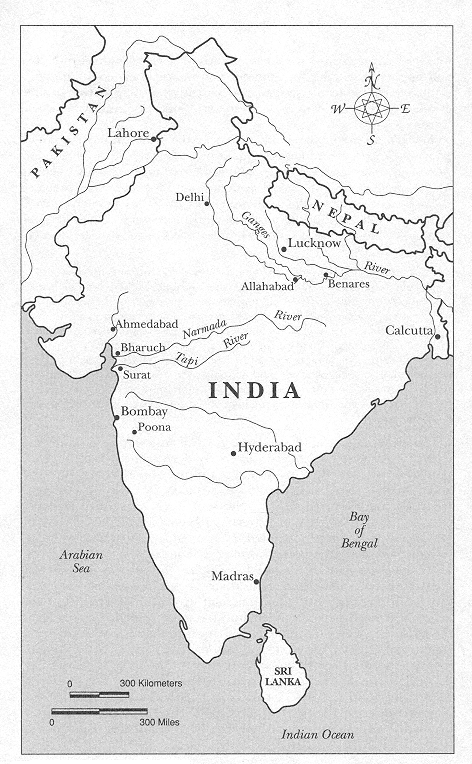
Map 1.
The Indian Subcontinent.
through their agents located in all the major cities of India and in numerous commercial centers overseas, and purchasing goods to channel back through the port. Gujarati shippers, mostly Muslims, transported both luxury items and goods for ordinary consumption to international markets in vessels that rivaled the European ships in trade if not in battle. The credit notes (hundi s) of local merchant bankers (sharaf s) which were honored all over the subcontinent, made possible substantial transactions between towns in India and with ports overseas without large initial cash outlays. Surat's merchants also penetrated into the countryside of South Gujarat as moneylenders and tax-farmers and as traders in the agrarian produce of the region.[5]
With this expansion in business activity came the development of powerful mercantile elites. Merchant princes such as Virji Vohra, a Jain trader and banker during the mid–seventeenth century, and Abdul Ghafar, a Sunni Bohra shipper at the turn of the eighteenth century, were probably among the world's wealthiest persons. They and a few dozen other traders and bankers who had benefited from domestic and international commerce under Mughal rule held a dominant position not only in the economy but also in important areas of the city's social life. As the research of Ashin Das Gupta has demonstrated, the business elite of Surat and Gujarat came from vastly differing social backgrounds. Indian merchants included Brahmans, Hindu and Jain Vaniyas, Muslims (both Shia and Sunni), and Parsis. But foreign traders from Armenia, Arabia, Turkey, Europe, and other distant lands also lived in Surat and participated in its commerce during the seventeenth century.[6]
Despite this sophisticated commercial order, the local economy hardly fit the image of an order built upon the free, amoral exchange that supposedly goes hand in hand with capitalism. A striking feature of economic organization in the city was the way in which strong social relationships grounded in indigenous moral conceptions intersected with and bolstered trading and production relations. For artisans and traders, both big and small, the joint family served as the basic economic unit. Caste was also essential to the structuring of economic life. It was not uncommon for entire trades to be dominated by particular castes or communities which tried to ward off outside competitors and employed social sanctions to reinforce business agreements. In lines of commerce involving a number of communities these same functions could be performed by guild-like organizations known as mahajan s, which set rules for conducting business, fixed holidays, and established prices and wages for artisans, but which also exercised religious functions, such as building temples and rest houses for Hindu and Jain pilgrims.[7] Such communities of trust often provided much-needed
security against the risks of rapidly fluctuating markets, business agreements not backed by legally enforceable contracts, and the provision of finance by individual bankers rather than by impersonal institutions.
Particularly critical to commercial and financial dealings in Surat and in its larger trading networks were perceptions of the reputability of the transacting partners. Merchants frequently conducted their trade as much on the basis of their abru as on their material resources. Even more than its English equivalent, credit, the word abru suggested a family firm's reputation for honoring its agreements and its more general status within urban society. The significance of abru to the commerce of the city is most apparent in the operations of the great sharaf s. The credit of individual merchant bankers was essential to the acceptance of their hundi s in trading centers not only in Surat itself but also elsewhere in the Mughal Empire and in the ports of the Persian Gulf and Red Sea. If these hundis s had lost their viability, then the merchants who carried them would have been unable to make their purchases, and the whole trading network could have collapsed.[8] According to one local saying, the credit of Atmaram Bhukan, an especially prominent eighteenth-century banker of Surat, was so great that even if his hundi s were tied to the branches of a tree, they would still be accepted.[9] Credit also affected the willingness of traders to deposit funds with a banker, as local merchants confirmed in an eighteenth-century petition to the East India Company:
The entire belief that property is perfectly secure in the house of a shroff [sharaf ] forms what is called his credit which more than his actual money is the instrument of his dealing and the greater source of his profits. Those who come to trade in this city either bring their bills on the shroffs or lodge the produce of their goods with them during their stay from many parts of India. . . for all these sums deposited, no receipts are given, the books of the shroffs and the opinion of their faith and substance are the total dependence of the people who deal with them.[10]
As we shall see in the next chapter, opinions of the "faith and substance" of individual merchants were established not in their business dealings alone, but also in patterns of religious giving and the exercise of moral leadership in the community.
Even in the organization of local industry, business relations were often built around preexisting social ties. Most historians tend to agree that joint-family artisan firms exploiting chiefly family labor and producing in the home were the basic units of industrial activity. Textiles usually were manufactured in distinct steps performed in different workshops by different semiautonomous artisans rather than in larger operations under a single roof supervised by a single industrialist.
Specific caste groupings tended to control the labor in specific stages of the overall process, thus providing group members with some protection against outside competition. Most artisans, however, lacked sufficient knowledge of market conditions and were too vulnerable to the frequent changes in demand to participate in commercial activity directly without seriously endangering the survival of their firms. Usually they relied upon local merchants—with whom they often developed long-standing relationships—for the supply of capital, either in the form of cash advances or of raw materials. These merchants offered low payments to their artisan clients but often provided work during slack periods.[11] Thus, to use Goren Hyden's term, there existed in the domestic manufactures an "economy of affection," in which production relations overlapped strongly with noneconomic social bonds.[12] The moral economy of domestic manufacture allowed local artisans and merchants alike to bear better the risks of participation in the unstable market conditions of the precolonial period.
All this suggests special problems with social science models that have viewed joint-family, caste, community, and patron-client relations as "precapitalist" or "feudal" social forms at odds with market-oriented economies. Certainly precolonial is a more satisfactory label. But the perpetuation of these forms after 1800 suggests that, even in using this alternative terminology, we must avoid any teleological reasoning that would suggest the incompatibility of these structures with the altered economic circumstances of colonialism. Under British rule, many precolonial institutions and relations adapted to changes in the larger world rather than disintegrated. Thus, even in the midst of a decaying city, an economy that relied on relationships of affection and trust continued to sustain itself.
Decline without Collapse
That Surat suffered a serious contraction in its economic activity between 1700 and 1900 seems beyond dispute. Two distinct phases of decline are discernible. The first began before the establishment of full British sovereignty over the city in 1800 and was at least partially a product of developments independent of the East India Company's rise, such as the growing insecurity of trade routes in the Mughal Empire, the increased pressures placed on local merchants by Mughal noblemen eager to supplement their revenues, and shrinking markets in the Red Sea and the Persian Gulf as a result of instability in the Safavid and Ottoman Empires. These developments were accompanied by changes in which the English did have a hand, such as the displacement of Indian shipbuilding by European competitors and, particularly, the
rise of Bombay as a major center of commerce.[13] The new port city, protected from Maratha raids and Mughal exactions alike, attracted many merchants from Surat itself, including some who had made fortunes as brokers of the company and as independent traders. Nonetheless Surat remained a major center of western Indian trade and industry at the end of the eighteenth century.
The second, more serious, phase of decline began with the establishment of colonial rule and lasted until about 1870. During this period Surat experienced a series of catastrophes: floods, earthquakes, famines, and fires, the most devastating being the fire of 1837, which raged for days and destroyed 7,000 homes and caused 5 million rupees damage. At the same time, the Tapi River gradually silted up, making the city inaccessible to the largest vessels. Yet, given the wealth and the resilience of the city's commercial elites, Surat might have rebounded from these traumas if not for serious structural changes associated with the rise of British power: the breaking of government's financial dependence on local merchant bankers, which eliminated a profitable area of investment for localsharaf s; the agrarian depression of the 1820s and 1830s, undoubtedly caused by excessive company revenue demands on the countryside; the declining position of the Mughal gentry and other landed elites who had been major consumers of Surti luxury goods; and shifts in patterns of international trade caused by the continued contraction of West Asian demand and the emergence of serious competition from the great European manufacturing centers. Also significant was the continued growth of Bombay, first as a port, then with the development of the modern textile industry, as a major manufacturing center. Large numbers of local merchants migrated there to participate in the burgeoning commerce.[14]
Given the range of factors working against the city's prosperity, one might initially wonder how Surat remained as important as it did. Clearly, nineteenth-century demographic figures do not indicate an expanding urban economy. In 1816, Das Gupta has estimated, there were approximately 150,000 people living in the city, already a significant drop from a century earlier. In 1851, a local census estimated the population at 89,505.[15] Even taking into account likely underreporting, the city had lost at least one-third of its population during the first fifty years of company rule. Residents left entire neighborhoods abandoned after fires and floods, and little new construction took place. The city lost its cosmopolitan flavor, since few foreign traders chose to maintain local outposts any longer. Centers like Bombay, Ahmedabad, and Karachi, where one can legitimately talk about processes of urbanization, were characterized by large numbers of migrants, high proportions of males, and a concentration of residents between fifteen and
thirty-five, the prime working years. The demographic characteristics of Surat, by contrast, approximated those of the general, predominantly rural, population of Bombay Presidency as a whole (see Appendix, tables A1–A5).
But Surat did survive. And by the time of the first imperial census in 1872, its population had leveled off at just over 100,000 people. For the next six decades, the city maintained stability in its numbers (see Appendix, table A6).
This survival was made possible largely by continued mercantile and artisanal activity. The city sustained into the twentieth century a prosperous and diverse set of indigenous merchants who still controlled much of social and economic life. Most of Surat's wealthiest men continued to be either traders or sharaf s.[16] At the same time the city's character as a home for small-scale industry consolidated itself. By 1921 Surat had a higher proportion of its population working in industry (47 percent) than Bombay (about 39 percent).[17] But in contrast to those in other industrial centers of western India, virtually all Surtis employed in manufacturing were concentrated in home-based industry.[18] The 5 percent of the local labor force employed in larger units worked mainly in the city's three cotton mills, each founded by a member of the old Mughal nobility and each of which was afflicted with constant problems in attracting capital.[19] Local business communities refrained from investment in modern industry, preferring either to devote their capital to commercial enterprise or to the mills of Bombay.[20]
The persistence of considerable artisanal production in Surat is particularly surprising given classical historiographical assumptions which suggest that the competition of factory-produced goods from Britain brought about the ruin of indigenous manufactures. Undoubtedly Surti artisans were unable to compete in most lines of ordinary cloth intended for everyday consumption. Certain processes in textile production, such as cotton spinning and cloth dyeing, suffered greatly from the influx of European and Japanese goods. But local merchants and artisans showed considerable resourcefulness in exploiting niches in the world economy relatively free from the competition of large-scale Indian or European industry. This was especially true in luxury manufactures such as the making of pearl necklaces, jari (gold thread) products, kinkhab (gold and silk cloth), and other fine silk and cotton textiles. Markets in these goods survived, in part because old ruling and landed groups retained some prosperity under the British imperium and continued to use their incomes to maintain life-styles involving conspicuous consumption, and in part because newly emerging elites chose to emulate the aristocratic style, particularly on important ceremonial occasions. Even the Parsis of Bombay, thought to be among the most west-
ernized communities of India, were important consumers of luxury textiles. Important markets for local goods existed in Gujarat, the Punjab, Bengal, the Deccan, and South India.[21]
Older markets in the Indian Ocean trade also survived, though hardly at seventeenth-century levels. In 1802, after decades of supposed decline in West Asian commerce, 35 percent of Surat's exports went directly to Arabia and Persia, about the same as the amount going to Bombay (much of which was undoubtedly reexported to the Red Sea and Persian Gulf). The value of piece goods exported to the Middle East far outstripped that of the region's cotton exports, easily South Gujarat's most substantial contribution to specifically colonial needs. A century later, many of Surat's most prosperous businessmen were continuing to sell local textiles, primarily luxury goods, in the traditional marts of the Red Sea and Persian Gulf areas, while others sent local manufactures to South Africa, Burma, Thailand, and China.[22]
In 1910, the Collector of Surat District, perhaps forgetting Surat's illustrious past, even found reason to trumpet the city's successes in the luxury manufactures before his superiors in his annual administrative report:
Not only is Surat the world's center for the pearl trade, but it also holds the premier position in all India for gold and silver wire, and tinsel and brocade work and pre-eminently for the spangles and spirals of silver and silver gilt which it exports to Madras, Delhi, and many other centers. The Mahomedan population of Surat is very enterprising in foreign trade. Scarcely a family has not a branch establishment somewhere. From Tibet to South Africa, from Siam to Mombasa, everywhere the Rander and Surat Bohras penetrate and take with them silk and other goods manufactured in Surat. The wire and tinsel industry employs 10,000 persons while silk weaving employs another 10,000. Benares, formerly the chief competition, has now succumbed and it is said that at least 3000 skilled artisans have migrated from Benares to Surat recently because the employment and the state of the industry is better here.[23]
Two of the industries mentioned in this report—pearls and jari —had in fact undergone something of a resurgence during the last decades of the nineteenth century. Pearl production received a considerable boost from the migration of Naginchand Jhaverchand, known as the "king of pearls," to the city after the 1896–97 plague in Bombay. Naginchand founded a syndicate of Jain pearl dealers in Surat whose members bought large quantities of pearls from Arab dealers in Bombay and brought them to Surat to be strung.[24] The jari industry had also grown considerably. Surat had been only one of a number of major centers producing jari and jari products during the 1870s and 1880s, with, according to one estimate, around 1,200 men employed in
various phases of the industry. Local artisans, however, continued to improve their production methods, capturing markets from competitors in other cities who did not. Jari capitalists, largely drawn from the Patidar, Daudi Bohra, and Hindu Vaniya communities, fueled this expansion by searching out new markets and by providing their artisan clients with the capital to make technological changes. By 1910 the city was the leading jari manufacturing center in India, far surpassing Ahmedabad, Yeola, Poona, Delhi, and Lahore. Only Benares remained a serious rival. A local survey taken in 1909 estimated that nearly 500 dealers and from 8,000 to 10,000 workers were involved jari and its subsidiary industries.[25] Expansion in the luxury manufactures may not have been sufficient to produce overall growth in the city as a whole, but it did sustain a certain equilibrium in the local economy.
While merchants and artisans continued to depend upon the commerce in luxury goods, they were nonetheless profoundly affected by developments in the larger world. By the early twentieth century, local textile producers had come to depend heavily on various foreign sources for their raw materials: silk thread came from China, gold and silver from European bullion markets, aniline dyes from Britain, and cotton yarn often from Japan. Pearl dealers obtained their raw materials from abroad, then sold the finished product through Bombay exporters to Europe. Not a single important local industry was untouched by changes in the world economy. But such changes did not need spell economic ruin when local economic actors adjusted to them with sufficient ingenuity.
Of course, some Surtis were involved in trades that could more appropriately be deemed colonial in their character, such as the trade in the agricultural produce of South Gujarat. Much of the region's cotton and grain, for instance, was sent to Bombay, where it was either sold to consumers or sent abroad. As overseas demand grew for India's raw produce during the nineteenth century, the marketing of grain and cotton expanded steadily.[26] Yet these trades were only a small portion of the city's commerce. In 1895, cotton and grain dealers constituted about 5 percent of local payers of income tax; only six of Surat's seventy-two top income earners were cotton or grain dealers.[27] Most people in these lines of commerce were Vaniyas or Brahmans.
There were also merchants engaged in the commerce of the Surat District in goods like cloth and sugar, trades which fit neither the traditional nor the colonial category perfectly. This commerce, always of some importance in the region, expanded under British rule, particularly after the construction of important railway lines that converged in Surat. In the fifteen years after the construction of the Tapi River Valley railway in the 1890s, cloth imports into Surat grew from 900,000
rupees to 2.5 million in value.[28] Piece-good dealers purchased millmade cloth in Bombay and Ahmedabad through their agents, brought their goods to Surat, then either sold the goods or reexported them to the villages of South Gujarat. These traders were not confined to any single caste but generally belonged to high-status communities with long histories of commercial activity, such as Hindu and Jain Vaniyas, Brahmans, Daudi Bohras, and Memons.
In sum, Surat in the late nineteenth century was characterized by a complex market economy operating at a number of levels.[29] Given this evidence, it is hard to accept the contention of R. D. Choksey that the "story of trade" in nineteenth-century Gujarat concerns only "internal exchange of mostly agricultural commodities, and overseas shipment of raw materials through the port of Bombay."[30] The older luxury trades survived and often expanded alongside the export-oriented commerce in agrarian produce. A heterogenous and prosperous set of local merchants adapted to a slowly changing economic environment by exploiting diverse markets and sources of raw materials, both new and old. It is true that this commercial activity was not sufficient to fuel a "takeoff" in the urban economy. Surti producers were virtually excluded from participation in the manufacture of ordinary cloth and other necessities, the fields of investment that may have offered the greatest potential for expansion. But residents were able to sustain the commercial character of their city by continuing to supply areas of the world economy where Europeans had failed to become effective competitors.
The Culture of the Economy
The ability of local merchants and artisans to sustain precolonial economic patterns in the midst of British rule and economic decline becomes even more impressive when we turn to the social character of economic activity. No doubt, colonial institutions entered the lives of many economic actors in Surat, particularly the city's merchants, bringing about major changes in business practice. Most substantial traders had to cope with the British legal system when they entered contractual relationships. If they sold their goods overseas or obtained their supplies from abroad, they now had to deal with an emerging customs bureaucracy. Many faced new municipal regulations as well. The city's greatest sharaf s dealt with imperial joint-stock banks, where they often acquired credit and made deposits.[31] Virtually all merchants used the railways for transporting their goods;jari dealers even conducted much of their trade through the postal system. Most wealthy traders now had to pay income taxes to the district revenue establishment, which required them to fill out increasingly detailed forms. Dealing with all
these institutions required literacy, so education in government-funded municipal primary schools became essential, at least for merchants and bankers (as opposed to petty traders and artisans).[32] In short, the lives of Surat residents became entangled with a number of institutions introduced by the subcontinent's new rulers.
Yet these changes did not necessitate a radical restructuring of relations among the Surtis themselves. In both trade and industrial production, late nineteenth-century urban dwellers recreated economic relationships along well-established lines, often finding these relationships useful in coping with the new political and economic circumstances of the nineteenth century. Throughout the city commercial transactions and productive relations grounded in networks of trust and in powerful social bonds such as kinship, caste, and patron-client ties continued to provide security and stability for local economic actors.
Nineteenth-century British administrators and businessmen did very little to upset market mechanisms that were already capable, in many respects, of meeting colonial needs. In the luxury industries, the mainstay of Surat's economy, British business really had little interest. Though Indian textiles had been a major object of East Indian Company interest during the eighteenth century, the reorganization of local industry ceased to be a major priority of the English during the nineteenth.[33] The government of India made little attempt to regulate commercial practice and the treatment of labor in the luxury manufactures or to pass development-oriented legislation that might have transformed the nature of handicrafts production. But even in those trades most affected by European demand, British firms tended to work through existing social networks. Until quite late in the century, for instance, Bombay cotton dealers relied on local mahajan s to ensure that their transactions would be honored in the absence of legal contracts. One English cotton trader stationed in Bombay during the 1870s reported that his firm regularly contributed a cess of 7 annas, 3 pice, per bale to the Hindu charities of guilds in up-country centers. In return, the mahajan s backed the firm when local dealers failed to live up to oral agreements. Since the guilds could ruin any trader through ostracism, very few indigenous traders refused to meet their obligations. In this case, when one broker overdrew his account, the English business simply stopped payment of its cesses to the local temple. The middleman in question then quickly honored his agreement, apparently under heavy pressure from his mahajan.[ 34]
Reliance on mahajan s no doubt declined by the early twentieth century, as contracts increasingly became the norm in European business practice. Still, few British companies had the ability to circumvent in-
digenous commercial networks and deal directly with the producer in the field. As A. D. D. Gordon has demonstrated, networks for the marketing of textiles and the acquisition of raw cotton from the mofussil often replicated features—such as the place of the sharaf s in finance and exchange, the importance of trust in economic transactions, and the chains of intermediaries linking producers with exporters—that had been in place before colonial rule. Bombay firms bought raw materials at the point of export only after they had passed through the hands of a series of Indian middlemen.[35]
Ultimately the form of business relations at the local level had less to do with colonial priorities than with the concerns of indigenous actors. Foremost among these was the need for insurance against the continued uncertainty of the city's markets. Commercial insecurity preoccupied artisans and merchants during the nineteenth century as it had during Mughal times. Modern rail networks, postal systems, and the telegraph had improved transport and the flow of information, but local businessmen still faced considerable risks stemming from fluctuations in supply and demand, minimal government regulation, poor infrastructural facilities, and the limited development of a modern banking system. As in earlier times, few merchant families could sustain their firms for more than three generations. Those in the luxury trades may have been particularly vulnerable to ups and downs in their businesses. There were large seasonal and long-term variations in the demand for jari and silk. In 1900 the Collector of Surat reported that the trades in jari, embroidered silk, and cotton cloth were all in depression. One merchant, who had done 4 lakhs of business the previous year, now found himself without buyers. [36] But within just a few years the same industries were thriving again. In 1907 and 1908 the survival of the local pearl trade was in question, yet in 1910, as we have seen, Surat had risen to preeminence in the world pearl markets.[37] Patterns of economic behavior strongly backed by noneconomic structures helped participants in many professions cope with these fluctuations.
Local Industry
In the domestic manufactures, economies of affection continued to reproduce themselves. Artisans in the jari industry, for instance, built their firms around social relationships that permitted stable family livelihoods and their firms' survival into future generations. Members of the joint family provided much of the needed labor, with females and children performing valuable tasks in the workshop. Many of the akhadedar s (master craftsmen) had quite large families and thus avoided the costs of hiring nonfamily members. When an artisan could not obtain sufficient labor from his own family, he usually recruited within his
caste. Caste organizations often worked to ensure that the group retained control over skills of a profession by punishing those who hired outsiders or who leaked manufacturing secrets. Within the workshop, akhadedar s often acted as patrons to their employees, offering gifts on ceremonial occasions such as marriages and providing loans to meet workers' short-term needs. The laborers' indebtedness helped master craftsmen maintain access to a stable and dependable work force at low cost and over extended periods of time and cut down on the likelihood of theft, which was a danger in industries that handled small, valuable goods.
The master craftsman in turn was usually dependent on a merchant patron, who advanced the firm cash and raw materials in exchange for privileged access to the final product. In the gold-thread industry, for instance, individual jari merchants provided silver, the most important raw material in jari manufacture, to a few akhadedar clients, who then processed these materials for their patrons on a commission basis. Rather than receiving payment for each commission executed, most artisan firms developed running accounts with a single merchant and drew upon these accounts when they needed money for work or subsistence. The craftsmen generally fell into arrears, becoming almost permanently obligated to the merchant. Usually they could change patrons only when a new bidder for their services offered to pay their debts. Such dependent ties were at least partially welcome to the artisan, since they provided both dependable outlets for their goods and security against the frequent slumps which characterized the industry.[38]
Merchants involved in marketing luxury manufactures preferred to advance money and raw materials to artisan clients performing specialized tasks rather than to attempt to consolidate all the various production processes under one roof. Clientage arrangements with a few akhadedar s gave them access to cheap sources of labor but required little commitment of fixed capital, thus lowering the likelihood of overextension. When sudden upswings took place, the merchants could often respond quickly by mobilizing their reliable pools of skilled labor. When downswings occurred, the merchants gave their artisan clients just enough work to keep them hanging on.[39]
Trade
In contrast to artisans, most merchants rarely ran the risk of failing to maintain subsistence. But to enhance their businesses' chances of survival in a competitive trading climate, they too chose to reduce their uncertainties by building their commercial activity on a wide range of social ties. At all levels of trade, the extended family firm—the pedhi —remained the basic unit of mercantile organization. Some of the more
substantial traders maintained pedhi branches in towns throughout western India in order to have personal agents on the spot, ready to make quick purchases of raw materials or to dispose of finished goods.
In dealings with their fellow traders, local businessmen continued to build their relationships at least partially along lines of mutual trust. A few lines of commerce, such as the Jain-dominated trades in silver and pearls, were controlled exclusively by members of a single community. In such cases, strong social pressure could be brought to bear on a merchant who failed to honor a commitment to a member. In the multicommunity trades, occupational mahajan s that restricted participation to those willing to subscribe to a common set of ethical standards, including the payment of a cess to the guild's religious charities, continued to play important roles in the local economy.[40] In all commercial transactions, the personal reputations of those involved remained critical. Traders who had developed reputations of respectability in the community could obtain goods without immediate cash payments and could acquire credit at low interest rates from sharaf s with little or no security because of their perceived trustworthiness.[41] For some the introduction of legally enforceable contracts during the nineteenth century was only an added safeguard.
Most traders continued to rely on the indigenous merchant bankers for credit. The sharaf s of Surat may have no longer performed the diversity of economic functions of their seventeenth- and eighteenth-century predecessors, but they still played financial roles that were essential to the urban economy. In 1895, thirty-four of the top seventy-two income earners in the city were engaged in banking or moneylending.[42] Traders at all levels used local moneylenders and bankers extensively and rarely dealt directly with the modern joint-stock banks of Bombay (no joint-stock bank yet existed in Surat). The cotton trade in South Gujarat was almost entirely financed by indigenous bankers, though many of these sharafi firms were now centered in Bombay.[43] In the jari industry, jhaveri s (silver dealers) acted as bankers by providing merchants with the silver used in the industry at low interest rates.[44]
For local traders, the indigenous bankers had many advantages. Though many of the sharaf s themselves had extensive dealings with joint-stock institutions, their methods of conducting business with their clients often remained intact. They continued to provide personal services, many of which were unavailable in modern banks. They kept flexible hours, accommodating clients with emergency needs. They allowed traders and shopkeepers overdrafts on their accounts. They issued hundi s which were honored throughout western India, and they discounted the bills of banking firms from outside the city. Perhaps above all, they maintained absolute secrecy. Confidentiality was particu-
larly critical to the merchants of Surat, who often conducted their businesses on the basis of personal prestige and were anxious not to let details of their financial dealings become public knowledge. The greatest sharaf s carried reputations as extremely trustworthy and respectable persons, reputations that were necessary to their success. It was not uncommon for a banking firm simply to collapse upon the death of its founder. The importance of the indigenous banking system as a whole, however, survived such individual failures.[45]
The Development of The Educated "Class"
Given the many signs of structural persistence in the local economy, the late nineteenth-century development of the educated professions seems essentially a subtheme in the history of the city. As a headquarters of the district administration, Surat naturally attracted men seeking jobs in the revenue establishment, railway administration, post office, and the courts. The needs of the government, the municipal bureaucracy, and private corporations for educated employees expanded steadily during the late nineteenth century. In addition, a tiny number of people with English educations were able to establish lucrative careers in the independent professions, particularly law and medicine. Between 1892 and 1908, the number qualified to vote in the general ward of the municipality, an electoral ward composed largely of professionals, government employees and pensioners, and other educated persons, grew from 596 to 871.[46] Still, this was a tiny percentage of the total urban population. And few controlled the resources or the patronage of the great sheths (respectable merchants). Before World War I the growth of the services never overwhelmed the commercial and industrial character of Surat or produced a fundamental shift in the larger social structure.
Nor did the growth of the professions stimulate a sudden transition from a closed, static society in which economic roles were defined by caste to an open, class-based society. The picture was far more complicated. In the past, Hindu and Jain Vaniyas had undoubtedly dominated trade, Brahmans and Kayasthas the literate professions. But evidence of wealthy Brahman businessmen throughout the seventeenth and eighteenth centuries suggests that intrafamily mobility between occupations had been both significant and widely accepted in earlier times.[47] The presence of Vaniyas in the professions and Brahmans in business fields during the later nineteenth century seems to reflect at most a speeding up of preexisting processes of social circulation. It is also important to note that there was as yet extremely little movement of middle- and low-caste groups such as the Golas, Ghanchis, and Kha-
tris into either the professions or the most prestigious lines of commerce. Caste remained an important determinant of occupational opportunity.
Moreover, those who moved into the professions really did not constitute an independent "class" in the fullest sense of a set of persons who not only occupy a common economic position but also share an identity as a group distinct from other classes in society. In Surat, many educated men came from intact extended families where one or two brothers sought jobs in law or administration while the others remained in business. And, as the Cambridge scholars have shown for other regions of India, often those who acquired schooling served as agents of landed or merchant magnates. In civic politics, there was sometimes direct incentive for educated men to identify themselves as members of an "advanced class" opposed to a supposedly backward indigenous "aristocracy." Yet within the inner arenas of local politics these same people regularly worked as subordinates within vertical factions controlled by wealthy merchants and other magnates. During the Gandhian period, as we shall see, government employees, fearful of threats to their jobs, did tend to act more as a coherent group—for instance, by voting for moderate politicians in elections for the local municipal council. But such behavior was provoked by a short-term crisis and did not mark any permanent shift to a class-based politics. For the most part, public politics in Surat, particularly in high-caste society, tended to organize itself much more along the lines of faction than of either caste or class.[48]
Conclusion
Thus the Surat of 1900 retained many of the structural features of the famous seventeenth-century port city. The experience of Surat under colonial rule contrasts both with the pattern of rapid expansion characteristic of the major imperial administrative and commercial centers and with that of forced town growth typical of places that served chiefly as entrepots for brokers dealing in exportable cash crops.[49] Surat may perhaps represent a third type of urban place associated with colonialism, that of a mature, relatively stable center able to sustain forms of commerce that did not compete with European products and able to reproduce preexisting social relations as it participated in a larger metropolitan economy.
The continuity in local economic structure raises doubts about interpretations that stress the necessity of a radical transformation in socioeconomic relations to the development of a public culture. Any attempt to relate the economic facts to the forms of politics that emerged dur-
ing the late nineteenth century must be a much more subtle one. We can safely conclude that the material life of many of the city's most prosperous people became implicated in colonial structures ranging from the bureaucracy to the railways to the educational system, and that the dependency of the Surtis on these structures militated against dramatic challenges to colonial power from below. But in pointing to such factors, we have not identified the processes by which civic politics were given their positive content. The key, I will argue, lies largely outside the economy: in the rhetorical interaction of indigenous elites with their colonial rulers and in the condition of colonial domination. But first we must examine the character of politics in the inner political domains of the city, domains which were of little vital concern to the British.
Four
The Inner Politics of the City
Given the elements of economic continuity in Surat, it is perhaps not surprising that key forms of local social life also tended to reproduce themselves over time. The economy certainly did not determine the character of urban society, but everyday economic practice under colonialism bolstered preexisting social structures such as the extended family, caste, and mahajan. Long before the establishment of colonial rule, social organization in the city had adapted to, and proved compatible with, an indigenous form of merchant capitalism. The slow contraction of the city's economy, without sharp discontinuities in its basic character, was hardly sufficient to effect a full-scale transformation of society during the late eighteenth and the nineteenth centuries. Nor did the British legal system provide a shattering blow. On the one hand, indigenous institutions often successfully resisted being overwhelmed by the law; on the other, the courts and colonial policy generally affirmed rather than undermined relations based upon caste, male dominance, and social deference.[1]
From the seventeenth century into the twentieth, Surat was composed of diverse groupings defined chiefly by descent. Members of these sometimes intimate communities tended to congregate in distinct neighborhoods, to have their own forms of ritual life, and to form and maintain their own social institutions. For most residents, the affairs of these communities continued to be the most important domain of social action and their chief source of psychic satisfaction well into the twentieth century. Colonialism did not destroy the primacy of the inner arenas of urban life.
A major preoccupation of politics in these inner arenas was family reputation and community integrity. The social and economic well-being of every family depended upon preserving acceptance and re-
spect within the larger grouping or groupings of which it was part. Each such group, to use anthropological parlance, constituted a "moral community"—a set of individuals prepared to make judgments about one another and sharing a language and vocabulary for doing so.[2] Ordinary Surtis obtained status by observing and upholding essential group norms. Leadership often required a further step: active involvement in setting and enforcing these norms.
The idiom for making assessments about authority and respectability in the inner domain was, for most groupings in the city, one of precolonial origin. To make this point is not to suggest an unchanging culture. Though local residents thought of themselves as maintaining a stable system of values, they often in fact reinterpreted group traditions and norms in the course of everyday life. Nevertheless, the symbolic equipment which informed their decision-making—the "vocabulary of motive" in which they expressed their solidarity and made and judged claims to authority—was usually derived from traditions that predated colonial rule.[3] Colonial law and administrative policy contributed to this continuity by freezing certain indigenous principles as the critical standards of each collectivity, sometimes at the expense of others.
Unevenness in the available records makes any effort to reconstruct the languages of day-to-day politics in the inner arenas an extremely difficult one. Much of these politics took place outside any formal political institution, and even when such institutions existed, they rarely had the regular procedures for taking minutes or recording speeches that existed in local public organizations. Local newspapers are also generally silent on these issues since their editors' understanding of what constituted news remained largely confined to the affairs of the civic arena. We can, however, reconstruct indigenous political idioms by examining certain unwritten "statements" implicit in more general styles of leadership and organization. This chapter offers a sketch of the social organizations and the idioms of authority operating within the city's various communities around the turn of the twentieth century. It begins in the central areas of the city, then moves to the urban periphery.
Society in the Urban Core
A fundamental dividing line of urban society in Surat lay between the neighborhoods in the urban core and those in the outlying neighborhoods, or pura s (see map 2). The core areas, clustering around the castle and the city chok (square), were peopled principally by high-status Hindu and Jain families employed in business, government service, and the professions, along with dependents who provided personal
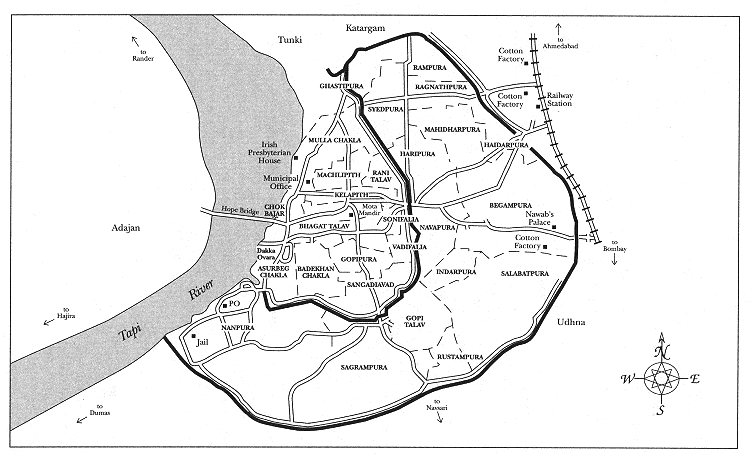
Map 2.
Surat in 1877
services to these families. The pura s, by contrast, consisted largely of cohesive collectivities of artisans and petty traders and a few, even more self-contained communities of more prosperous residents such as the Parsis and Daudi Bohras. Until the 1860s, a wall had stood between the inner and outer city, roughly demarcating the bounds of the two types of society. But this basic pattern of social organization survived after the municipality leveled the wall for sanitary reasons.
The dominant families living in the central areas of Surat belonged to a category of high-caste jnati s (subcastes) known as the Brahman-Vaniya.[4] Included were a variety of Brahmans such as the Nagar, Anavil, and Audich; as many as forty-one subdivisions of Hindu Vaniyas; Jains (who were considered Vaniya by caste and who were also characterized by numerous jnati s); Kayasthas; and Brahma-Kshatriyas, all caste groupings associated with either commerce or government service. Together, these high-status families composed almost one-fourth of Surat's population.[5]
Residents of Brahman-Vaniya background maintained wide social ties across the boundaries of their various subcollectivities. Members of different endogamous units could belong to the same occupational mahajan, dine with one another, worship alongside each other in the same temples, and participate in the same festivals. In some cases, marriage alliances between families of distinct jnati s of the same broad caste grouping (e.g., the Vaniyas) were possible if proper arrangements were made ahead of time and if small fines were paid.[6] High-caste jnati s rarely segregated themselves from each other but lived together in localities in the urban core, such as Vadifalia, Sonifalia, Gopipura, Nanavat, Chok Bazaar, and Haripura.[7] Sectarian divisions also failed to preserve rigid boundaries. In their religious practice, Jains and Vaishnava Hindus employed Brahmans in domestic ceremonies, performed worship in each others' shrines, and honored the same holy men. Intermarriage was possible in some cases, especially since some jnati s included both Jain and Hindu families.[8] In contrast to most South Asians, the Brahman-Vaniyas placed little emphasis on the ranking of their internal subgroupings. At the same time, they generally kept a great social distance from peoples of low or middle caste. Descent thus remained critical for inclusion in this community.
Patterns of economic life among those employed in trade and the professions no doubt contributed to the diffuseness of Brahman-Vaniya organization. Because high-caste society was fluid, participation in most lucrative forms of trade was rarely preordained by heredity. Often survival in commerce necessitated abandoning the occupation of one's father and taking up some new business; the involvement of individual families in a single line of commerce for more than two or three
generations was more the exception than the rule.[9] Merchants could grow prosperous from quite modest beginnings during their own life-times.[10] And as we have seen, there was no rigid barrier obstructing Vaniyas from entering administrative positions or Brahmans from becoming merchants. Such considerable mobility kept social boundaries from hardening around narrower social groupings such as the endogamous unit.
The necessity of economic cooperation between families of different castes or sects in commerce also promoted relatively broad group affiliations. Vast and complex networks of trade based on trust and the need for interaction between traders and those involved in the literate professions nourished a larger community of mercantile and service-oriented families in which members shared a language for assessing each other's worthiness as persons.
For high-caste Surtis, and particularly for the city's merchants, the maintenance and improvement of reputation have always been central concerns. Members of the community employed a number of words for referring to their reputations: man, pratishtha, ijjat, and abru (all roughly translatable as honor, reputation, or prestige). The most significant of these was the term abru, perhaps because it conveyed both senses in which reputation was critical to the Brahman-Vaniyas: as the economic credit of the family firm and as its perceived status in local society. This conflation of meaning was no coincidence. Western Indian traders, like their counterparts in northern India studied by Chris Bayly, viewed social prestige and creditworthiness as inextricably related. Integrity in business dealings contributed to a merchant's or banker's social standing. Conversely, a firm's ability to mobilize capital and to carry on transactions without exchanges of cash often depended on a family's general image of respectability.[11]
Abru in both its interlinked meanings was an extremely fragile quality. High-caste families often built up local respect and honor over long periods of time, even generations, yet could easily dissipate their social standing by a single act of indiscretion such as an improper marriage, questionable business practices, meat eating, alcohol consumption, or contact with low-caste persons. Such uncertainty sometimes led to an extreme fastidiousness in pursuing and guarding reputation. Rival families competed with each other in the satisfaction of community norms, for instance, by attempting to marry their daughters to the sons of prestigious sheth s or by spending lavishly on wedding feasts and religious festivals. "Poor Surati," lamented one late nineteenth-century critic of local life, "his highest ambition is to celebrate the marriage of his children with 'abru.' Abru, what a wonderful thing [it] is, that you can not understand if you are not a Surati."[12]
Key to the acquisition and sustenance of abru was adherence to dharma, the sacred moral obligations that the community considered incumbent upon all of its members.[13]Dharma, as any work on Hinduism will confirm, is a code of conduct inherent in a person's gender, caste, or age group. In practice, however, the term refers not to some timeless notion; rather, its meaning has been reinterpreted and transformed over time and in various social contexts. In the dynamic culture of high-caste Gujaratis, the sources of dharma were located in three religious traditions, traditions that were theoretically and textually distinct but that actually had colored each other through interaction over the centuries. From Brahmanical Hinduism came concerns with ritual inclusion and exclusion and with social ranking based upon relative levels of purity and impurity.[14] Jainism, derived from the teachings of non-Vedic spiritual preceptors—the most prominent being Mahavira, a saint of the sixth century B.C. —contributed an emphasis on ahimsa (nonharm to living creatures), the importance of self-abnegation, and the tradition of performing austerities (tapas ) by monk and layman alike.[15] Finally, Vaishnavism, spread through Gujarat after the fifteenth century by a series of Hindu saints, stressed the importance of devotion (bhakti ) to Rama and Krishna, the mythical heroes of the great epics the Ramayana and the Mahabharata. Vallabhacharya (1478–1521), the most popular of these saints, rejected tapas as a path to salvation, advocating instead seva (devotional service) to Krishna. Such service could be rendered by personal worship, singing hymns (bhajan s) written by the saints, or offering food and clothing to the deity. Vaishnava religion in theory had a distinctly egalitarian flavor, emphasizing the capacity of all to achieve spiritual fulfillment through devotional surrender.[16]
High-caste families established their reputations through enduring patterns of social action grounded in a vocabulary drawn from these religious traditions. To a Western eye at least, high-status Hindus and Jains lived lives of considerable personal restraint, practicing vegetarianism, abstaining from alcohol, maintaining simplicity in dress and in housing, and refraining from overt expressions of sexuality.[17] They manifested their concern with the protection of living creatures, particularly the cow, by sponsoring panjrapol s (hospices for sick and aged animals).[18] They observed pollution strictures and social rules governing the selection of acceptable marriage partners for their offspring. And they engaged in worship of Jain and Vaishnava deities. Women particularly assumed the responsibility of upholding family honor by presenting offerings to images in temples, singing bhajan s, participating in religious festivals, and occasionally embarking on pilgrimages to holy sites.[19]
Leaders within high-caste society came from families that had built
up their abru through often painstaking efforts and that promoted the collective respectability of the larger community. Local conceptions of authority fit imperfectly with British notions that pictured India as dominated by hereditary community headmen. In Surat men attained leadership positions only by actively and continuously espousing, interpreting, maintaining, and defending dharma in ways that group members found satisfying. Throughout the city's history, the most prestigious of Brahman-Vaniya leaders usually came from among the city's wealthiest magnates. Around 1900, a handful of great merchants held particular sway. Among Hindus, the Mahajan Sheth (the leader of the chief Vaniya organization), the cotton merchants Ishwardas Jagjivandas Store and Thakordas Modi, the banker Gangaram Bharatiya, the sugar merchant Viththaldas Khandwala, and the piece-goods dealers Tribhuvandas Popawala and Motiram Reshamwala were especially prominent. Among Jains, the most significant were the families of the Nagarsheth (head of the chief Jain organization) and the pearl merchants Naginchand Jhaverchand and Hirachand Motichand. Some of these men came from families that had enjoyed high status in the city for generations; others had risen to prominence only during their lifetimes. But all had successfully cultivated special reputations through their efforts to safeguard and promote community integrity.
Within their jnati s, the sheth s often were involved in setting and enforcing ethical standards that preserved and enhanced the prestige of the ritual unit. Through organizations known as panchayat s they regulated the conduct of jnati members in matters such as commensality and marriage, thus upholding the position of the group in the larger community. The most powerful magnates, however, had established their authority far beyond the confines of their jnati s. Two kinds of roles seem particularly critical to their prominence in the locality: that of religious patron and provider of community needs, and that of leader within collective institutions known as mahajan s.
Religious Giving
For the wealthiest merchants, following the dharma perhaps first and foremost meant giving. Evidence from the seventeenth century to the twentieth suggests great continuity in the importance of social spending to the development of elite status. The ideal sheth was one who scrutinized his books closely but who sacrificed large amounts of his wealth in sacred causes rather than accumulated capital or spent his resources to maximize his personal comfort; "Gifts by the lakh, accounts by the penny," went one Gujarati saying.[20] While this ideal may never have been realized perfectly, it was common for the greatest magnates to live in quite modest homes with sparse furnishings yet to expend vast
amounts in forms of giving regarded as meritorious. Status-generating gift giving took a multiplicity of forms: furnishing jobs and other forms of patronage to relatives and community fellows; providing food in times of distress; building wells, rest houses, and temples; and sponsoring substantial communal feasts. At Divali time, the great sheth s regularly made gifts to relatives, dependents, brokers, and Brahmans. Colonial accounts, no doubt a bit exaggerated, claim that merchants sometimes exhausted their entire savings in the celebration of single festivities.[21]
Religious giving was especially critical to the achievement and maintenance of places of special esteem. The sacrifice of considerable wealth to Hindu or Jain deities epitomized the ascetic values of local religion. Adherents of both sects regarded the sponsorship of festivals, shrines, and saints as the dharma of persons with substantial fortunes. In the vocabulary of Vaishnava belief, the commitment of worldly belongings to Krishna was a particularly meritorious form of seva. In Jain terminology, merchants gave concrete expression to the principle of ahimsa through patronage of panjrapol s. In effect, sheth s translated through religious giving some of their financial capital, to which a stigma might be attached if it were either allowed to accumulate visibly or exchanged for personal possessions, into symbolic capital valued throughout high-caste society, thus generating personal authority.[22]
Because of the importance of sacred giving in high-caste society, temple building tended to cluster in the core neighborhoods of the city. In 1935, for instance, there were forty-eight Hindu temples and eighteen Jain temples in Gopipura alone. Vadifalia had thirty-eight. In the outskirts of the city, Sagrampura, Salabatpura, and Rampura, by contrast, had ten, ten, and three, respectively.[23]
It would serve little purpose here to reconstruct the entire gift-giving activities of specific Surti firms. There has not been a substantial businessman in the history of the city who has not left some evidence of his generosity on behalf of his family's deities. What is important to note, however, is the tremendous diversity and the vast geographic range of some merchants' gift-giving patterns. The Chakawala family, which maintained a banking firm in Surat during the late eighteenth century, apparently saw no contradiction in building a temple to Shiva in the village of Katargam while donating thousands of rupees in seva to Vaishnava deities.[24] The Travadi family, wealthy Brahman bankers around the turn of the nineteenth century, built shrines scattered across India and a major temple to Balaji in Surat, which still stands today.[25] Manekchand Jhaveri, a Jain jeweller of the late nineteenth century, built rest houses for pilgrims and hostels for Jain students in Surat, Bombay, Kolhapur, Ahmedabad, Ratlam, and numerous other
centers where Jains traded and worshiped.[26] Even merchants who began to develop an interest in secular philanthropy rarely abandoned sponsorship of diverse religious causes.[27] At the onset of World War I, Vaishnava and Jain religion remained a sphere of activity largely outside the control of the colonial state, one very much shaped and controlled by local sheth s.
Mahajans and Shethia Roles in Surat
While such patterns of religious munificence are common to Hindu commercial communities all over India,[28] merchant culture in Gujarat distinguished itself by the importance given to collective institutions known as mahajan s.[29] In Brahman-Vaniya society, these organizations constituted a form of corporate activity that far surpassed the endogamous unit in importance. They proved resilient in the face of late nineteenth-century conditions, surviving shifts in the world economy and the imposition of the British legal order. For Hindu and Jain sheth s alike, the mahajan s were often critical arenas in which authority was generated and perpetuated.
Mahajan s are known to have existed in Gujarat for at least eight centuries.[30] They apparently developed anywhere in the region the problems of commercial interaction and social control became too complex for individual jnati s to handle. In Surat the first mahajan s formed early in the city's history. East India Company records from 1669 refer specifically to a "councill" of local Vaniyas known as the "Mahager," which organized eight thousand traders to leave the city in protest against the proselytizing activities of a Muslim qazi (judge).[31] Unfortunately, the English were not sufficiently concerned with the internal workings of Gujarati society to provide us with much understanding of the structure and day-to-day activities of mahajan s during the seventeenth and eighteenth centuries. Yet from the occasional references available, mahajan s appear to have been important institutions around which merchants repeatedly organized themselves.
While historians of Gujarat have tended to agree that mahajan s are significant to study, there has been little consensus about the actual nature of the organizations. Ashin Das Gupta has insisted that mahajan s were essentially social organizations whose membership was confined to narrow groupings (such as castes or religious sects) and whose functions were primarily sociocultural rather than commercial.[32] Michael Pearson, Dwijendra Tripathi, and M. J. Mehta have viewed these institutions as business organizations whose main purpose was to secure the commercial interests of a body of traders.[33] The evidence from Surat suggests that both approaches draw a distinction between economic and cultural institutions that did not exist in practice; each ignores the
extent to which commercial and social preoccupations interpenetrated and reinforced each other in the culture of high-caste Hindus and Jains. The main concern of mahajan leaders was with minimizing threats to abru in both its interlinked senses—social honor and economic credit. Each organization attempted to manage the collective integrity of the group by formulating, then enforcing, codes of behavior that covered a broad spectrum of Brahman-Vaniya life. Each restricted behavior that could prejudice the position of the whole, thus promoting a more stable sociocommercial environment in which individual families could pursue greater security, profit, and prestige. In short, mahajan s, like other high-caste institutions, were enmeshed in the politics of reputation.
Occupational Mahajans
There were two types of mahajan s in Surat. First, there were occupational mahajan s, guild-like structures of all the traders in a single line of business. Second, there was the Samast Vanik Mahajan (the mahajan of all Hindu Vaniyas), also known as the Hindu Mahajan by the early twentieth century.
Occupational mahajan s existed in most prestigious lines of commerce. During the late nineteenth century, the city's sharaf s, jhaveri s (silver dealers), merchants in cotton, grain, and sugar, and numerous other sets of traders each possessed their own organizations. Some apparently had existed for many decades, while others formed when businessmen in a specific trade felt the need for organizational structure. Ghee merchants, for instance, formed a guild in 1913 in order to control commerce in adulterated ghee, most probably in response to new municipal measures which threatened to punish sellers of the inferior product.[34] Existing records are not sufficient to judge the lifespan of the average guild. A few may have been impermanent bodies whose vitality depended on the initiative of individual leaders or the perception of some threat to the collective interests of a set of traders. Rather than see each guild as an entity lasting many generations, it is probably more profitable to view the mahajan as an organizational model that leaders of the mercantile community invoked repeatedly in generating formal institutions to manage problems of business.
Membership in most occupational mahajan s crossed the lines of caste and sect. In 1899 even some Muslim merchants belonged to the guilds of the sugar and cloth traders, though they were a distinct minority and had little voice in decision making.[35] Generally a few sheth s dominated the affairs of the organization. Formal leadership often belonged to the head of a specific family, who often passed the title on to a son. When the son was not of sufficient financial and moral standing, how-
ever, members might replace him with someone more worthy. Usually several other reputable merchants also exercised influence over the decision-making process. In most cases for which there is evidence, members deferred to this informal "council" of magnates by backing proposed measures unanimously in meetings.[36]
Occupational mahajan s certainly performed a wide range of commercial functions. Perhaps their primary purpose was to control who could practice a certain trade. When the ghee merchants' guild formed in 1913, its sheth s issued written notices to merchants outside the city that they should trade only with guild members, they warned that members might be expelled or otherwise reprimanded for dealing with nonmembers, and they set up rules requiring approval of all new members.[37] In some guilds, a fee was required of new applicants, perhaps as much as 300 or 500 rupees.[38] Obviously such restrictions provided a certain degree of security to participants in a guild against excessive competition. The organizations rarely tried to control prices, though they did attempt on occasion to check wages paid to artisans. E. Washburn Hopkins, an American Sanskritist whose study is a rich though not unproblematic source on Gujarati mahajan s, suggested that an employer who wished to entice craftsmen to work for him by offering higher wages had to "ask the guild about it and abide by their decision."[39]
Sheth s of the mahajan s set holidays and established and enforced standards of business practice, threatening violators with fines and even expulsion. Each guild kept steady pressure on its members to uphold their business agreements. When a merchant failed in business, the guild might investigate his business dealings to determine the reason for failure. According to Hopkins, "If it is found that he has failed dishonorably, he is dropped [i.e., expelled]; if honorably, the creditors accept a part of the debt and help him to tide over his difficulties when he repays all."[40] The public knowledge that a guild might bring its sanctions to bear on unscrupulous dealers or offer financial help to members who had fallen into debt contributed to the integrity of the entire body of traders.
The guilds also settled trade disputes, sometimes in efforts to prevent potentially embarrassing conflicts from spilling over into the courts. Since abru depended so greatly on maintaining the secrecy of business dealings, traders were anxious to avoid having their disputes settled by outsiders—particularly in public forums beyond the community's control—and regularly resorted to the mahajan s for arbitration. Refusal to accept the sheth s' decision—for instance, by refusing to make payments to an aggrieved party—could result in ostracism.[41] In effect, the mahajan s tried to protect the economy of trust from being over-
whelmed by a commerce based on contract and courtroom. The possibility of filing bankruptcy in British courts probably made some inroads into the ability of the mahajan to enforce its judgments, but guild involvement in dispute settlement was still the norm at the turn of the century.
But while occupational mahajan s were critical to the maintenance of commercial morality, they also played a vital role in the promotion of local religious life. Every guild linked itself publicly with some sacred institution of importance. Each collected a cess, called lago, on the trade of their members and passed the proceeds on to the important Vaishnava and Jain shrines. In Surat, guilds controlled by Jains tended to forward their proceeds to the city panjrapol.[42] The sugar traders' mahajan sent its cesses to Mota Mandir, the leading Vaishnava shrine in the city, and compelled even its Muslim members to contribute.[43] In fact Hopkins asserted that the system of collecting cesses was so "perfect" in Surat that members of mahajan s rarely gave money to any charity directly.[44] This was no doubt an exaggeration, but the cesses of the mahajan s were a major source of income for many religious institutions in the city.
The powers mahajan s possessed were indeed formidable. In mild offenses, such as the nonobservance of a guild holiday, a mahajan' s leaders might impose a fine of several hundred rupees. In more serious cases, a member could be expelled, an action that was economically ruinous and socially catastrophic. According to Hopkins:
When a member is . . . cut off from the guild, he may be ostracized from the caste. In the latter case he becomes a social pariah, more wretched than a village dog. But even if one is only cast out of the guild, one is often ipso facto, outcasted. In the country, such an outlaw is debarred from all social recognition. No man will work with him or for him, nor will anyone serve him, no broker will act for him, no servant will remain in his house. The carpenter, the baker, the confectioner, the blacksmith, the tile-maker, the very potter, lowest of the lowly, refuse to take his orders, deliver goods to him, or perform any service for him at any price. Caste here has yielded entirely to the guilds.[45]
Thus, through expulsion, a family could even lose its identity as a member of the community. Such steps were potentially drastic, yet apparently members considered them necessary to protect the integrity of the whole trade. Only with this necessary collective base of reputation acquired through participation in the mahajan' s affairs could the merchant family firm cultivate its own individual prestige and credit in the community through such actions as temple donations and prestigious marriages.
The Samast Vanik Mahajan
Like many other Gujarati cities, Surat also had a greater mahajan which embraced families belonging to a wide range of occupational groups. Scholars have often referred to this as a "city" or "city-wide" mahajan. Hopkins even suggested the analogy of a chamber of commerce.[46] But if Surat's larger body is at all typical, such terminology is of limited usefulness. This organization certainly enjoyed a broader authority than the individual guilds and could organize large numbers of traders to act collectively, but it did not cut across caste or religious boundaries in its membership. Descent rather than occupation appears to have been the chief criterion for inclusion. The institution was entirely a Vaniya organization, composed, according to one account, of forty-one Hindu Vaniya jnati s.[47] Though most families who participated in its affairs were involved in trade, a number of educated professionals and government servants belonged as well. Jains and non-Vaniyas, on the other hand, did not belong. The Jains, however, had their own multi-jnati organization, similar in many respects to the Hindu Mahajan, known as the Jain Sangh. The hereditary leader of this later organization was the head of the Parekh family of Nanavat, and was called the Nagarsheth.[48]
The formal leader of the Samast Vanik Mahajan was the Mahajan Sheth, a great magnate who acted as a headman in all meetings of the organization. In the late nineteenth century, the position of Mahajan Sheth had been held hereditarily for at least several generations, perhaps back into the seventeenth century, in the family of Bhagubhai Dwarkadas.[49] The only other formal office was that of a priest or clerk (gor ), whose chief function was to invite the Vaniyas to collective gatherings. But a few wealthy and respected sheth s with no hereditary position were also prominent leaders in the organization. Among the more notable participants in early twentieth-century sessions were the Mahajan Sheth, Ishwardas Jagjivandas Store, Thakordas Balmukandas Modi, Vithaldas Khandwala, and Tribhuvandas Popawala. Decisions were generally arrived at by the consensus of these great sheth s, then unanimously approved by the larger body of members.[50]
In Gujarat such greater mahajan s tended to play a role in handling community issues that single guilds and jnati panchayat s were unable to manage. Because of the breadth of their authority, they were particularly valuable in settling conflicts outside the bounds of guild and jnati. They regularly arbitrated trade disputes between members of different guilds.[51] They were also involved in resolving tensions with artisans. According to Hopkins, high-caste merchants lived in fear that craftsmen, who had their own guilds (panch s), might band together against individual traders. Such conflicts with low-status persons could produce both economic harm and social humiliation. But by joining together with Vaniyas practicing many different trades, businessmen could usu-
ally thwart such resistance with a counterboycott that would prevent the artisans from receiving their daily necessities. The threat of such action, Hopkins reported, was usually sufficient to cow most craftsmen into submission.[52]
On the basis of the evidence from Surat, however, the regulation of inter-jnati social intercourse (vahevar ) among the Vaniyas was as significant a function of the Samast Vanik Mahajan as the resolution of trade disputes. The organization attempted to enforce rules of appropriate Vaniya behavior by controlling such matters as commensality, marriage, and participation in its own affairs. The Hindu Mahajan particularly sought to limit vahevar with those of inferior status or doubtful integrity. In 1900, for instance, a faction within the Dasha Jharola Vaniyas protested that some members within their jnati had eaten with the Pancha Vaniyas, with whom the mahajan did not allow social intercourse. The sheth s of the mahajan fined the offenders 751 rupees, compelled them to undergo a purification ceremony, and warned that refusal would mean that no true Vaniya could ever eat with them or marry their daughters. In the short run, this step assured the complainants that they would not be stigmatized by the actions of their caste fellows.[53] In the long run, it produced greater compliance with group norms among all the families concerned. The mahajan also considered the applications of local merchants to sponsor communal feasts, taking into account the moral character of the potential sponsor and the satisfactoriness of the arrangements he proposed for the occasion.[54] In 1911, after members of untouchable castes entered the rows of feasting Vaniyas during a communal gathering, in effect polluting all present, it was the leaders of the mahajan who took precautionary steps to ensure that similar incidents did not recur.[55] Occupational mahajan s would have been ill-suited to the regulation of these ritual matters, since no single guild embraced the full range of persons affected by such decisions.
Like the occupational mahajan s, the Samast Vanik Mahajan was closely linked with local religious institutions. The Mahajan Sheth, for instance, served as trustee of the panjrapol. Many of the organization's activities revolved around devotional service to Mota Mandir and its maharaj, the leader of the Vallabhacharya sect in the city. The mahajan organized feasts to honor the maharaj on religious holidays and on other special occasions, such as his marriage and sacred-thread ceremonies.[56] Vaniya families often vied among each other for the honor to host the mahajan' s celebration. In the early twentieth century, when a succession struggle in Mota Mandir threatened to divide the local sectarian hierarchy, leaders of the mahajan stepped in as arbitrators to prevent the conflict from spilling into the courts.[57]
Leaders of the mahajan viewed themselves as upholding a consistent
set of ethical standards for the Vaniyas. But because they were constantly involved in adapting the dharma to new contexts, they in fact often reinterpreted principles of collective morality. One example of this is the organization's treatment of overseas travel. In the eighteenth century, Vaniyas had settled as far away as the Persian Gulf.[58] But during the nineteenth century, high-caste Hindus throughout western India had come to treat travel overseas as permanently polluting. When Mohandas Gandhi, a Modh Vaniya and the future leader of the nationalist movement, announced his decision to go to England for higher education in 1888, the sheth of his caste in Bombay informed him: "Our religion forbids voyages abroad. We have also heard that it is not possible to live there [England] without compromising our religion. One is obliged to eat and drink with Europeans."[59] Gandhi defied the order and was "excommunicated." But as the number of Vaniyas wishing to go abroad grew, community leaders were forced to reconsider their position. In 1906 the Samast Vanik Mahajan of Surat reached a formal compromise: those who had gone overseas could resume vahevar with other Vaniyas if they would undergo a ceremony of purification upon their return.[60] Vaniya organizations elsewhere in western India soon followed suit. At a time when the issue was creating disabling conflicts in some castes, the mahajan' s ability to adapt to changing realities without seeming to abandon a dharma that community members regarded as immutable certainly contributed to its continued vitality.
Records of the activities of Hindu sheth s during the famine of 1899–1900 provide a different sort of evidence about the adjustment of the mahajan' s leadership to the danger facing the community and its values. The famine, perhaps the most severe in the region since the seventeenth century, posed a serious short-term crisis for high-caste residents, threatening to destabilize the social order and to undermine critical Brahman-Vaniya concerns. The price of grain rose sharply, and reports of riots in other western Indian cities raised the specter of unrest in Surat. In the countryside, hunger and disease killed many and left thousands of children without parents. Christian missions began to take large numbers of orphans into their care, thus arousing concern among Hindus about losing ground to the religious creed of their rulers. The scarcity of water and fodder caused the death of many cattle.[61]
The mahajan adopted several measures to meet the crisis. It founded a Hindu orphanage that competed with the Christians for homeless children. It augmented the activities of the panjrapol in order to care for the growing number of sick and starving cattle. Perhaps most significant, it pressured the grain merchants to stop all exports from the city. Even merchants with previous agreements to sell to agents out-
side Surat were ordered to break their commitments under the threat of mahajan sanctions. This measure checked further inflation in grain prices and defused the potential for serious urban unrest.[62]
The ethical conceptions which informed merchant action in this instance have strong parallels with the notion of "moral economy"—the idea that needs of local consumers must be met before those of the market—that E. P. Thompson discovered in his studies of eighteenthcentury England.[63] The mahajan, in bringing a halt to grain exports, took on a responsibility that in precolonial times had been assumed by the state but that the British had abdicated in the interest of free trade. The motivations for this action were clear: the famine was a threat to high-caste society and to the identity of the Brahman-Vaniya traders as persons who placed dharma above their personal profit. Interference with the free operation of the market effectively confirmed the ideal that wealth should not be pursued at the expense of the community's integrity.
The most dramatic context for mahajan action was that of resistance to government policy. In precolonial times, there are repeated references to its ability to organize social protest among the Vaniyas, most dramatically, in 1669, when it attempted to prevent the Muslim qazi from interfering with Hindu religious practice and in 1795, when it took similar actions to pressure the British into providing the community with protection against Muslim rioters. In the nineteenth century the mahajan' s sheth s organized local Vaniyas to protest imposition of Bengal Standard weights and measures on the trading community in 1848, to oppose the establishment of a license tax on local businesses in 1878, and to petition the government of India in 1892 against the Age of Consent Bill prohibiting marriages of children under 12.[64] In each case merchants associated with the mahajan resorted to group action when they perceived a common threat to the security of the community and its values. In all but the last instance, they imposed sanctions against those who failed to follow mahajan directives, thus ensuring nearly universal compliance.
One strong theme running through many of these activities by both forms of mahajan is conflict management. As men who handled large sums of money and as members of families that enjoyed a privileged position in local society, merchants may have been especially susceptible to involvement in disputes—disputes with each other, disputes with lower-status persons, and disputes with state officials. But open conflicts could undermine the image of simplicity, austerity, and discretion so critical to maintaining their image of social respectability. By managing disputes before they became serious, a mahajan could hope to preserve the low profile of all its members, combatants and noncom-
batants alike. The effectiveness of mahajan s in accomplishing this end may account for the willingness of local merchants to submit to the often-severe forms of discipline that these organizations gave out.
Given the fragmentary character of evidence before the 1880s, it is difficult to estimate whether the authority of mahajan s eroded over the course of the nineteenth century. Existing documentation clearly demonstrates, however, that these organizations remained important politically in Surat up through World War I despite the growth of global capitalism, the colonial legal system, and the municipality. Through these bodies, high-caste Hindus and Jains were to a great extent successful in preserving some autonomy from the demands of the British Raj. Political discourse in the inner arena of mahajan activity continued to focus on questions of dharma, familial abru, and community integrity. Public and colonial discourse, by contrast, proved to be a very poor vehicle for articulating most key Brahman-Vaniya concerns well into the twentieth century.
Society in the Outlying Neighborhoods
Hindu Communities of Middle and Low Status
Outside the central areas of the city in neighborhoods such as Begampura, Sagrampura, Navapura, Salabatpura, and Mahidharpura were Hindu communities of artisans and petty traders collectively known in Gujarat as "Ghanchi-Gola."[65] Together with noncaste Hindus—the so-called untouchables—these communities constituted more than 50 percent of the city's population. Included in this category were a number of caste groupings such as the Golas (traditionally rice pounders by profession), the Ghanchis (oil pressers), Khatris (weavers), Darjis (tailors), Suthars (carpenters), and Kanbis (who worked mostly as artisans). Many of these collectivities contained within them several distinct jnati s. Harry Borradaile, a British official who compiled caste rules for the whole of British Gujarat in 1827, reported more than two hundred distinct endogamous units living in Surat. Most of these were groups of middle-and low-caste background who lived in the pura s.[66]
Members of Ghanchi-Gola communities often had a rather ambivalent relationship to the high-status merchants and government servants. Many of their families had established clientage ties with individual Brahman-Vaniya, Parsi, or Daudi Bohra families as dependents who performed services such as washing and stitching cloths, pounding rice, or repairing furniture for their high-caste patrons; as artisans who obtained their raw materials and sources of finance from the merchants to whom they sold their finished goods; or as petty traders who borrowed heavily from Vaniya moneylenders. Such ties often led to the
development of long-standing affective relationships in which patrons provided their clients important services—loans, gifts on special occasions, small jobs during periods of business slump—in return for the labor or interest payments of the client. The Ghanchi-Golas also participated to a certain extent in a common religious life with the upper castes, celebrating the same festivals and worshiping in some of the same temples. But there were also serious tensions in these relationships. High-caste residents tended to regard the Ghanchi-Golas collectively as beyond the pale of respectable society, and they worried about the threat to the local moral order which they believed these communities posed. Members of the lower and middle castes engaged in a variety of non-Brahmanic practices, such as meat eating, alcohol consumption, and widow remarriage, that served implicitly to contest and mock high-caste normative standards. As a whole they acquired a reputation for unsavoriness and unruliness that evoked upper-caste disdain and anxiety.[67]
In contrast to high-caste society, where elaborate social networks developed beyond the ritual unit, Ghanchi-Gola society assumed a somewhat cellular quality. The tight corporate character of its social organization appeared quite clearly in residential patterns. Often members of individual jnati s clustered in small, well-defined localities. The Golas (who today prefer the name of Ranas), composed of three different jnati s, lived in exclusive enclaves in Navapura. Tailors, washermen, basketmakers, and potters all had their own streets where they lived and plied their wares. Khatris and Kanbis also tended to live among their jnati fellows, though often their houses were interspersed with those of people belonging to two or three other castes.[68] In moments of crisis, such as the salt tax riots of 1844 and the license tax riots of 1878, members of the different communities joined together in protest involving violence, suggesting perhaps a latent consciousness of class that was not apparent in everyday social and institutional life.[69]
Small, closely-knit corporate groupings, often the jnati s, served as the most important basis of political organization in the outlying neighborhoods. Almost every collectivity possessed its own panch (caste organization), which often performed both as a regulator of ritual affairs and as a craft guild. The panch occupied a far more vital place here than did the panchayat s of the upper-castes. Its leaders, the patel s, were often hereditary headmen, who set codes of conduct within the group and acted as intermediaries with other groups. Early twentieth-century religious reformers who attempted to propagate vegetarianism and abstinence from alcohol regarded the conversion of the patel s as a first step to the success of their movement.[70] British civil servants, who tended to view the Ghanchi-Gola communities as remote and impene-
trable, relied almost exclusively upon the patel s to maintain social order.[71] Colonial recognition of these headmen strengthened their dominance in middle- and low-caste society as well as the salience of caste to social organization in the outlying localities.
The corporate character of Ghanchi-Gola communities was also reinforced in economic practice. Many of these groups were associated with one or two occupations, or a limited number of them, which might be termed the group's "traditional" occupations. The Ghanchis controlled oil pressing, milk selling, and trade in firewood. Most Kumbhars were engaged in the manufacture and sale of pottery. The Golas were commonly involved in rice pounding. Even in the more complex industries, such as the manufacture of silk and jari, specific communities concentrated on processes involved in the production of a single commodity. The traditional occupation was rarely the exclusive source of employment for all members of the group, but it was quite common for a single community to monopolize a specific trade or craft. This tendency toward group control of certain occupations was not always undermined by economic change. During the early twentieth century, the Golas, who had been displaced by the mechanization of the rice industry, began to move into winding jari. By 1930 they had attained near total control over winding operations, displacing the once-dominant Muslims, in effect establishing a new "traditional" occupation. By building such monopolies, artisans and petty traders could limit competition from outsiders and develop relatively stable and dependable relationships with the few laborers they hired from among the ranks of their caste fellows.[72]
The traditional occupation often assumed a dharmik character for its members, though the sources of Ghanchi-Gola dharma relied less on Sanskritic scriptures than on the oral traditions of individual groups. Many communities had collective myths justifying their control of their craft. The Golas, for instance, claimed to have originally been Rajputs from Mewada who adopted the name gola (menial servant or slave) in order to protect themselves from the fearsome god Parashuram. In hiding, Shiva, their protector, gave them the mortar and pestle of the rice-pounding trade with which to make their livelihoods.[73] Since this myth established a time when the community had had higher ritual status than the present, it implicitly contested high-caste attempts to attribute to the group's members an inborn inferiority.[74] At the same time it attributed a sacred quality to rice pounding.
One responsibility of the community panch was to preserve this dharmik trade for group members. Often the organizations set strong rules preventing the communication of artisan secrets to outsiders and reinforced these with caste sanctions.[75] They also attempted to spread
work among members during times of depression, thus regulating competition and ensuring the survival of as many family firms as possible. The patel s of the panch could go so far as to set wage rates and working hours for artisans and to order which days would be observed as holidays in the traditional occupation. The panch also settled occupational disputes.[76] On occasion the organizations acted as craft unions, pressuring merchants to accept certain payment levels and employment practices.
Ritually the panch and its headmen were involved in enforcing marriage and commensal rules essential to group integrity and solidarity. patel s levied fines against violators of group norms and had the power to ostracize those who engaged in especially offensive behavior.[77] They also raised funds for regular communal feasts, which, among some middle-caste groupings, could surpass the dinners of the Vaniyas in conspicuous expenditure.[78] The patel s often retained control of the caste vessels employed on such occasions and the right to use them.[79] Little collective money was apparently spent on seva to religious shrines. The British legal system, which had codified caste laws for dozens of local jnati s, tended to confirm the authority of the patel s over community funds in the courts.
Headmen of artisan and petty-trading communities did not simply uphold static codes of behavior, but like the Hindu Mahajan, reinterpreted their group's dharma over time. Frequently the sense of community solidarity derived from cultural practices that implicitly denied Brahmanical norms. Nevertheless, attempts to raise status within the social hierarchy by adopting high-caste practices were common in many of these communities. Such "Sanskritizing" efforts inevitably depended upon the support of group leaders. In 1906 headmen among the Khatris and Golas made bandobast (enforcement of moral codes by threat of social sanctions) against the consumption of alcohol.[80] Only four years later a Gola leader organized a meeting to promote temperance, compassion for animal life, and general "improvements of morality" among his community. Those present at the meeting sang bhajan s composed by bhakti saints and listened to the preaching of holy men on abstinence and vegetarianism.[81] Once the patel s abandoned their backing of such ventures, however, the movements tended to fall apart.[82]
The periodic rise and fall of Sanskritization efforts among pettytrading and artisan communities suggest that headmen were continually involved in balancing the specific traditions and preoccupations of their groups against Brahman-Vaniya values. High-caste ideology provided certain ethical standards that middle-caste groups might choose to espouse in attempts to contest their positioning in local society. But even in the midst of such patel s exhibited a concern for
maintaining the distinctiveness of their community, insisting that all members subscribe to new behavioral norms. During the late nineteenth and early twentieth centuries, there were few signs of the weakening of group solidarities among middle-caste communities. The jnati s of middle and low status thus continued to retain a cohesiveness absent in the organization of the higher castes.
Muslim Communities of Surat
Surti Hindus constituted less a unified community than a series of subcultural groupings that drew upon a partially shared idiom as they defined their separate identities. The social distance between Brahman-Vaniya and Ghanchi-Gola proved a major barrier to any form of concerted behavior by local Hindus as a whole. At no point during the nineteenth century did various Hindu groups come together in any communally based action. The same could also be said of the local Muslim population. Though only about one-fifth of the city's population, the Muslims of Surat possessed a diversity that rivaled that of Hindus. Muslims, too, belonged to a large number of kin-based communities, most of them demarcated not only from non-Muslim groups but also from each other. Different Muslim communities lived in distinct pockets scattered around the city, usually in the outlying pura s.
One general line of differentiation in local Muslim society was that between "immigrant" Muslims—that is, Sunni Muslims claiming origins in West Asia—and "convert" Muslims, who acknowledged descent from indigenous Hindu communities.[83] The immigrants included the families that had once been associated with the top ranks of the Mughal administration. During the seventeenth and eighteenth centuries, Muslims from Turkey, the Red Sea, and Persian Gulf had been among the wealthiest of Surat's traders.[84] With the decline of Asian shipping, some abandoned Surat, while others took up less lucrative professions. Families belonging to the old Mughal nobility, on the other hand, retained much prominence under colonialism. In 1900 some of these families were still known by the titles of their late eighteenth-century ancestors: the Nawab of Surat, the Nawab of Bela, the Kazi (judge), and the Bakshi (army paymaster).[85] These families survived for the most part on land-holdings and pensions granted by the government in exchange for their continued loyalty.
Many of the convert Muslim communities, by contrast—most notably the Patani Bohras, who were Sunni Muslims, and the Daudi Bohras, who were Shia—continued to play important mercantile roles, some among them managing firms with considerable international business. There were also communities of Muslim petty traders, such as butchers
and cart drivers, and groupings of Muslim artisans, such as the Momnas and the Tais, both of whom did weaving. Most of these collectivities recognized indigenous, non-Muslim forebears. Many were as tightly corporate in character as their counterparts among Hindus of middle caste. Some even had their own neighborhoods or streets, where the majority of their members lived.[86]
The leading immigrant families retained a strong collective identity as the former ruling group and attempted to keep alive the memory of their past prominence through preserving at least the illusion of the old sharif culture, a syncretic style of life that had developed out of the interaction between foreign Muslim and indigenous Hindu elites in the Mughal courts during the sixteenth and seventeenth centuries.[87] The sharif ideal which they sought to emulate stood in stark contrast to the austere traditions of the Brahman-Vaniyas. Members of the old nobility lived in palaces often beyond their means to maintain; they secluded female family members, spent considerable sums on clothing and jewels, patronized Urdu poets, and organized public displays with great military pomp.[88] They also maintained a tradition of patronizing Indian Islamic institutions, such as mosques, dargah s (shrines to Sufi saints), madrasa s (centers for Islamic learning), burial grounds, and festivals. Particularly important for their "symbolic investments" were the shrines of the Edrusi Sayyids, Muslim spiritual leaders who had migrated to Gujarat from West Asia during the sixteenth century and who had maintained a hereditary influence in the region ever since. The Edrus family had a reputation for Islamic scholarship and the ability to perform miracles. Its headmen offered personal and spiritual advice to the families associated with them and were important in mediating local conflicts. Their ties with the old Mughal nobility, occasionally bolstered by marriage, remained close into the twentieth century.[89]
The old Mughal elite did not, however, develop an identity as leaders of the Muslim community until the later nineteenth century. In 1795, after rioting had broken out in the city, the local nawab essentially disclaimed any responsibility for restoring order among his coreligionists, asserting to the Surat chief, "You will be pleased, Sir, to reflect that the excesses of a riotous mob are not to be controlled at pleasure by anyone. In the case of a person committing violation of what they deem sacred, the Mussalmans assemble of themselves and consider themselves as subject to the will or authority of no person."[90] Such a rhetorical position stands in sharp contrast with that of men from the same families a century later, when their status in colonial circles depended upon casting themselves as "natural" leaders able to control their coreligionists. The nawab' s appraisal, however, was certainly a realistic one.
The immigrant elite carried little weight among the majority of Muslims in the city, particularly among those who did not trace their origins to the Islamic territories outside South Asia.
Structurally, many of the nonimmigrant Muslim groupings were not unlike Hindu jnati s; in fact many were caste groupings that had converted to Islam en masse in pre-Mughal times. A few like the Patani Bohras, a convert group which had migrated to Surat from northern Gujarat, had an organization known as a jama't, a functional equivalent of the Hindu panch. The sheth s of this organization, mostly substantial merchants by occupation, sponsored communal feasts on wedding occasions and religious holidays and closely supervised community morality, punishing violators of group norms with fines and social ostracism.[91] They also acted as trustees of the community's charitable property, which included a mosque, some land, several burial places, and a hall for group feasts. The butchers too had a particularly strong organization. On special holidays, it auctioned the right to keep a single shop open and used the funds to finance its own Muslim shrines.[92] Though the leaders of Muslim communities were not as concerned with retaining control over commensality or with enforcing absolute endogamy as their Hindu counterparts, they clearly shared an interest in maintaining the ritual boundaries of their descent-based groupings. Islam no doubt provided much of the repertoire of symbols critical to group identity in all these communities. But in each case, this was a specific form of Islam, often colored by the group's pre-Islamic traditions and by continuing contact with non-Muslims.
The wealthiest and most tightly organized of all Muslim communities in Surat was the Daudi Bohras. The Bohras were descendants of Hindu petty-trading groups who had been converted to Islam by Shia Ismaili preachers after the eleventh century. Their prosperity grew during the seventeenth and eighteenth centuries as many built successful businesses through intracommunity networks of trust and shared resources. By the late nineteenth century many had established comfortable livings as shopkeepers dealing in commodities such as hardware, books, spices, sweets, groceries, and hides throughout western India. Some were extremely wealthy dealers in piece goods, with businesses stretching to Thailand, China, Arabia, and South Africa. Very few attained high proficiency in English or moved into the literate professions.[93]
The Bohras were sharply set apart from the other Muslims. Both men and women wore clothing and maintained appearances which distinguished them from all other residents of the city. Almost all lived in a single large neighborhood in Navapura. The most critical marker of the Bohras' ethnicity was their special form of religious practice. They
continued to observe many "Hindu" traditions such as the holding of community feasts and the observance of Divali as the beginning of their accounting year. Their faith was an esoteric doctrine, distinct from the beliefs of other Islamic groupings. A small, clearly defined set of religious specialists alone had access to the scriptures of the community, which were written in a Gujarati laced with Arabic words. At the apex of the religious hierarchy was the da'i, the spiritual head of the community. The da'i was believed to be inspired directly by the Imam-inseclusion, whom the Daudis considered to be living in a place of concealment. Each da'i appointed his successor before death, in theory through revelation from the Imam.[94] Mastery over the scriptures and other ritual qualifications proved more critical than heredity in determining succession, though sons well educated in community tradition often did assume their fathers' places. Since the office of da'i carried with it tremendous authority over the laity, disputes about the legitimacy of succession sometimes led to bitter conflict in which the losing factions, ostracized for their dissent, founded offshoot communities. The British courts usually backed the cause of the established da'i and his followers against these challengers.[95] As a result the authority of the religious hierarchy may have been stronger under colonial rule than ever before.
The powers and social responsibilities of the da'i and the priesthood were indeed considerable. They controlled a vast charitable administration that touched the life of every Daudi. Each member of the community had to pay seven different types of taxes to maintain this establishment; particularly wealthy individuals often made additional personal donations of great value.[96] With these funds the Bohra leaders built and kept up mosques, madrasa s, burial places, and community halls. They also provided social welfare services for the poorer Bohras and the families of previous da'i s.[97] The tight control of the Daudi establishment generally left members little room to develop independent giving patterns; it insisted that all donations be channeled through the collective leadership.
The priesthood also closely regulated the social behavior of group members. Every Daudi tied him- or herself personally to the da'i by taking an oath of allegiance at the age of puberty.[98] The oath articulated the doctrines by which the oathtaker was supposed to live, stressing particularly loyalty to the Imam. Approval of the religious specialists was essential to holding any critical ceremony in the life cycle, particularly marriage. The leadership enforced a rigid endogamy, certainly as strictly as any Hindu community. Those who violated community law were punished with fines or, in extreme cases, with social ostracism as well, much as in the Hindu jnati s.[99]
A few wealthy merchants also exerted considerable authority within the community. Daudi sheth s, however, built up their positions largely through close association with, and patronage of, the religious leadership. It was commonplace for sheth s to hold community banquets to honor the da'i on important ceremonial occasions—for instance, important weddings or his return to Surat from his frequent travels.[100] As among Hindu merchants, sheth s with a history of giving to community charities enhanced not only the social position of their family but also their capacity for raising credit. In a grouping that often managed to contain economic transactions within its collective boundaries, one's reputation within the community assumed great significance.
For the Bohras, Islam provided the vocabulary of motive critical to attaining and maintaining authority. Their Islam, however, was a special product, one that had been given a unique shape by leaders of the community over the centuries. In a sense, the Daudi Bohras exemplified the pattern of boundary maintenance among Muslims of Surat. Muslim groups in the city had forged many distinct subcultures by integrating their own traditions with universalistic Islamic symbols such as the mosque and burial ground. In effect each had its own Islam which group leaders employed more to sustain the separateness of their community than to participate in an international religious brotherhood. Muslims, like Hindus, were a series of communities in which membership was based first and foremost on shared descent.
The Parsis
A final but critically important community in Surat was the Parsis. Though numerically small—Parsis were only 6 percent of the city's total population in 1872—members of the group exerted great influence in urban affairs because of their wealth and, in the nineteenth century, their education. Most lived together in relatively exclusive neighborhoods located in Ranitalav, Nanpura, and Rustampura, outside the core of the city.[101]
Followers of Zoroaster, a religious teacher in sixth century B.C. Persia, the Parsis had migrated to the Indian subcontinent from Persia to escape incorporation into Arab Islamic polities after the seventh century. They apparently lived in western India as agriculturalists for hundreds of years before moving into Gujarati cities to take jobs as artisans and traders during the sixteenth and seventeenth centuries. During the early eighteenth century a few established large fortunes by working as brokers for the East India Company and its officers.[102] As company activity shifted to Bombay, Parsis were among the first to emigrate to the new port, where they often became successful as compradors of British firms, as independent merchants, and eventually as industrialists.[103] Of
those who remained in Surat, some continued as merchants, petty traders, and artisans. The most successful, however, were those who took up positions in the early British administration and the new professions.[104]
In India the Parsis had always formed an extremely cohesive community, characterized by forms of religious belief drawn from the teachings of Zoroaster, an ethos of philanthropy, and strong communal organizations. Parsi religious behavior may have been highly affected over the centuries by patterns of Hindu worship, yet it retained its distinctive character. To European observers, its most exceptional features were the special place of fire in religious observance (usually mistaken for fire worship) and the practice of leaving the dead in dokhma s—open towers exposed to the elements and to scavenging birds—practices which had no parallel elsewhere on the subcontinent. Early travelers were also impressed with the charitable traditions of the group. John Ovington, who visited the city during the mid-seventeenth century, remarked of the Parsis, "They shew a firm affection to all of their own sentiments in religion, assist the poor, and are very ready to provide for the sustenance and comfort of such as want it. Their universal kindness, either in employing such as are needy and able to work, or bestowing a seasonable bounteous charity to such as are infirm and miserable; leave no man destitute of relief, nor suffer a beggar in all their tribe; and herein so far comply with that excellent rule of Pythagoras, to enjoy a kind of community among friends."[105] Though the ideal was never realized as fully as Ovington supposed, public giving did assume a very prominent place in Parsi culture and in generating community leadership. Forms of giving regarded as particularly auspicious were the building of Atash Beherams, where the Parsis performed their religious rites, and of the dokhma s, both of which were essential to the sustenance of any Parsi grouping.[106] Also important was the patronage of dharmashala s, where poor, elderly, and sick community members could acquire food and other care; wells, where all members of a Parsi neighborhood could obtain water; and dispensaries.[107] Much is unclear about how these early institutions were administered. Though the Parsis of the early eighteenth century had their own panchayat, modeled in part after Hindu panch es, it is not known how extensive the authority of this organization had become.
Under British rule, however, preexisting forms of communal life became increasingly institutionalized. During the late eighteenth century, prominent Parsis in Bombay, eager to eliminate customs that smacked of Hindu influence and to extend control over their community fellows, began to press the East India Company to acknowledge the legitimacy of a formal community leadership. In 1818 the leadership of the
Parsi Panchayat was fixed in the hands of eighteen community members chosen in a public meeting. A few select families quickly moved into positions of special influence in the Panchayat. At first the organization tended to be very active, when the interest of these families was at a peak, followed by great lulls, when their interest flagged. The Panchayat never did develop the importance of Hindu communal institutions in regulating the social conduct of group members and had lost this function altogether by the 1860s. But the organization remained an important focus of community politics since it controlled a large and growing charitable establishment. By sponsoring hospitals, educational institutions, and academic scholarships, the Panchayat and other Parsi institutions won for the group a progressive image among British civil servants, while community identity grew increasingly sharp. Many of the old Parsi families continued to exert authority in the Panchayat into the twentieth century.[108]
Early in the nineteenth century the Bombay Panchayat was responsible for supervising charitable funds in Surat. In 1841, however, the funds had grown so large—especially after Parsis donated huge sums in response to the fire of 1837—that the Bombay organization decided to appoint a local panchayat of nine leading notables from Surat to act as trustees for communal properties. Institutionalization of Surat's Parsi leadership continued in the years that followed. In 1865 the provincial administration established the Parsi Matrimonial Court for Gujarat to advise the judges of district courts in all matters concerning marriage and succession, whose members were chosen by the government on the recommendation of leading Surti Parsis.[109] By the turn of the twentieth century, the Parsi Panchayat had come to control communal properties worth many lakh s, and the number of community organizations in the city had further multiplied. Those who enjoyed influence in Parsi society invariably participated in one or more of these formal institutions. Often the families which had been prominent before the establishment of the Parsi Panchayat were able to preserve and even to enhance their authority by becoming trustees in the new organizations. The Modi, Vakil, Cooper, and Taliyarkhan families enjoyed positions either on the matrimonial court or Panchayat virtually as an hereditary privilege.
One family that attained informal recognition both within the community and among the British as enjoying a sort of headmanship of the Parsi community by the nineteenth century was that of Rustomji Khurshedji Modi. This family claimed the position of davar, or spiritual leader of the Parsis, and traced its descent back to kings of Persia. In the mid-seventeenth century a leading figure in the Modi family had built a dokhma in Surat and had financed a number of other charitable
institutions. His successors continued his philanthropic legacy. In the early 1700s the Modis acted as representatives of the Parsis in negotiations with imperial authorities, a role they continued to enjoy for the next two hundred years. Both the nawab s of the eighteenth century and the British during the nineteenth recognized the status of davar and consulted the Modi on matters affecting his community. By the nineteenth century the family head also served as chair of the meetings which nominated new members of the Panchayat and Parsi Matrimonial Court, using this position to ensure that his own candidates won appointments. During the 1890s, rising figures within the community tried repeatedly to challenge the position of the family but found the way blocked by the Modis' continued prestige as well as by their close ties with British civil servants.[110]
Imperial rule had much to do with the growing formality of Parsi organization. More than any other group, the Parsis had a history of close interaction with the British, a history that antedated colonial rule in the city. A bureaucratic structure to administer Parsi affairs was one product of this interaction. Some Englishmen, observing the great strength of formal institutions devoted to community welfare in the community, came to the conclusion that the Parsis were the most westernized of the Gujarati communities. But the process of institutionalization was not simply an outgrowth of Western norms and organizational structures. Parsi leaderships had developed these institutions not to merge themselves with their rulers, but rather to maintain and enhance their control over community affairs and to preserve a distinct Parsi identity. The hardening of group solidarity in the nineteenth century was as much a product of the continuing Parsi concern with maintaining the well-being of community members as it was of a British drive to regularize administration. The Parsis remained a collectivity where membership was defined by birth and where leaders came from a relatively small number of prestigious families who commanded the deference of lesser families. Indeed, reviewing the historical record, one suspects that the inner, community-oriented domain of Parsi politics expanded in significance with the growing wealth of individual families and the increased resources of communal organizations.
Conclusion
Any attempt to make universal generalizations about processes of social continuity and change over three hundred years applicable to all local communities is bound to founder in a city as diverse and complex as Surat. But with the evidence presented in this chapter and the last, we can dismiss one set of hypotheses that could be offered as an explana-
tion for the emergence of public culture in the later nineteenth century: that the development of capitalism, the colonial administration, and the British legal order had produced so fundamental a transformation in local society as to create an entirely new class system in the city, and that the new classes that had formed as a result embraced public politics as a means of expressing their newly emergent class interests. Such a model for understanding the development of civic politics makes sense only if one set of relationships ill-suited to capitalism steadily gave way to another, more functional set. Yet in the inner domain of local politics, the Surtis continued to reproduce a social order in which men and women remained concerned primarily with questions of family status and reputation, in which older idioms of authority met the challenges posed by changes in the larger world, well-established leadership styles such as that of the Hindu sheth continued to carry considerable weight, and collectivities based upon descent often retained the cohesion necessary to enforce a wide range of group norms. Most people located their own preoccupations in these various inner arenas, not in their wider religious communities and certainly not in the almost anonymous civic arena. The structures and idioms of local social life persisted, not because of any inherent intransigence or reluctance to change among the Surtis, but because these social forms remained relevant to the material and psychic needs of the population.
Before World War I, the civic arena grew not so much at the expense of preexisting economic and social forms as in addition to these forms. It formed another layer of politics—an outer domain—governed by a different terminology and moral principles, one that existed above and outside the inner sphere. To account for this puzzling development, we need to explore the political and symbolic interactions between indigenous elites and their rulers and the context of domination by outsiders to the city. The next chapter begins this process by looking at the relations between subject and ruler before the emergence of British colonialism.
Five
The Outer Politics of the City
Throughout Surat's history—from the sixteenth century into the twentieth—local merchants and other residents lived in states dominated by outsiders. Despite their considerable wealth and prominence, the great sheth s never attempted to assert rulership of their city directly. Instead they abdicated authority to alien conquerors, in part because Hindu and Jain mercantile values proscribed open involvement in political rule and the use of military might, in part because the few attempts (largely by Muslim merchants) to develop an armed capability were quashed in early stages. Warrior communities with origins outside Surat, with only a handful of local agents but usually able to call upon formidable armies, consistently controlled the city's governance. During the early sixteenth century Surat was ruled by the Muslim kings of the Gujarat Sultanate. In 1573 the Mughals captured the city and made it part of a vast agrarian empire covering most of northern India. When this empire finally crumbled during the eighteenth century, independent Mughal princes, Maratha warlords, and the traders of the English East India Company vied with each other for political dominance and control over the port's revenues. Only in 1800 did the English take firm command and again integrate Surat into a larger polity that supported itself by extracting revenue from the countryside. The Company Raj, transforming itself eventually into the British Empire, lasted until Indian independence in 1947.
Domination by foreign overlords put local elites in an ambivalent position. On the one hand, there were considerable advantages to be had from aligning oneself with the powerful outsiders. Protection of personal households and of commerce, jobs in the district administration, and opportunities for profit all flowed from catering to the needs of the nobility. But the rulers were men with very different social back-
grounds from those of local residents and held very different cultural norms. Often they placed heavy material and symbolic demands on the business communities, straining key indigenous values. Alien rule meant that merchants had to be continuously preoccupied with potential threats from above to their social and commercial reputations. The outsiders' near-monopoly over the instruments of force gave them the power to destroy any resident, whether at the whim of an individual nobleman or under authority of the law.
In such an uneasy environment, concerns with sustaining and enhancing wealth and family status, with extending trade, and with promoting religious values—the essential preoccupations of the merchant moral world—propelled indigenous elites into protective relationships with the political authorities, relationships that were based upon moral principle as well as material advantage. A fundamental characteristic of these relations was the symbolic dependence of the local magnate on the outside nobleman. Surti businessmen saw their political position as one of deference, even of supplication. As one merchant put it in an appeal to the British in 1918, evoking the powerful Hindu metaphor of the mute and helpless cow reliant on its benevolent master, "The people are cattle and the king is the keeper of the cattle compound."[1]
Since deference is so critical to understanding the relationship of local elites to their rulers, it is worth exploring this concept a bit further. In contemporary societies conditioned by the ideology of equality, deference is thought of primarily in terms of the inferiority it expresses:by meekly expressing fealty to a superior, a weaker party confirms the stronger's power. In practice, however, deferential relationships generally have a transactional character. As an underling offers supplication to an overlord, he or she may also be establishing claims to patronage or protection. With the statement "The people are cattle and the king is the keeper of the cattle compound," Surti businessmen certainly acknowledged the authority of the British Raj but at the same time held colonial civil servants responsible for the well-being of local merchants by stressing the latter's reliance on imperial favor. Surti notables regularly conferred legitimacy upon outside rulers through such symbolic acts, but implicit in these efforts were attempts to compel the ruling group to recognize certain obligations to its client-subjects and to honor the principles upon which it claimed its rule was based. A moral component was thus injected into relations inescapably based upon inequality. As a result, despite the cultural boundaries demarcating the governors and the governed, flexible mutual expectations developed, ones that were constantly subject to renegotiation. In a climate of great political uncertainty, deferential behavior became an important survival mechanism for the merchants and their culture.[2]
While urban magnates consistently sought to establish deferential relationships with their rulers, the shape in which they communicated their submission altered over time. In general sheth s and other influential figures in the city expressed obeisance in forms that carried weight with the powerful outsiders. They participated in ritual acts meaningful to their political overlords, they engaged in forms of institutional life which the overlords valued, and they grounded their appeals for justice in ideals and symbols drawn from the overlords' own ethical system. When one ruling group replaced another, or as the ideology of a particular ruling group changed, local elites, concerned that they receive continued political patronage and protection, adjusted their manner of addressing their overlords.
Elite groups in Surat were thus always bilingual. They may have built up their statuses in the inner arenas of the city by drawing upon political idioms specifically associated with their own descent-based groupings, but they also involved themselves in the construction and reconstruction of an outer arena of politics where they interacted more closely with their rulers. This arena had its own distinct modes of expression and its own institutional forms; even the grounds of conflict and debate were distinct. Those who participated in this arena may have contended specific actions of the ruling group, but they did so largely within languages derived from the political overlords. In essence, as they accepted a set of alien standards with which political claims could be made and negotiated, local elites built up both the hegemony of their overlords and their own subordination within a larger empire.
Merchants and Mughal Rule
In Mughal times, it was usually the actions of individual noblemen rather than the policies of the imperial center that posed the greatest threat to mercantile life and culture. To use Michael Adas's apt term, the seventeenth-century political system in Surat was a "contest state."[3] In this form of polity, a king may claim a monopoly of authority in theory, but in practice alternative power centers easily develop as a result of poor communication and limited control over officials and local lords. Owing to the relatively weak integration in such polities, intense rivalries tend to develop within the ruling group, and a premium is placed on personal, patron-client ties rather than on bureaucratic loyalties. Under Mughal rule, the mansabdars —the small group of soldierofficials ultimately responsible for collecting revenue and maintaining the armed forces—constantly competed among themselves for status, wealth, and power, both in the imperial capital and in far-flung district
headquarters.[4] In Surat intranobility conflicts may have been particularly acute. There was a governor of the city and a governor of the port, as well as a handful of other officials only nominally subordinate to either, all with poorly delimited powers and areas of jurisdiction, all operating semi-independently of the center in their day-to-day decisions. The emperor generally intervened in the affairs of his local officials only in extraordinary situations.
The ability of the mansabdar sto operate free of imperial constraint under most circumstances produced great insecurity for local merchants. The noblemen regarded the exaction of money, jewels, and other valuable items as a legitimate prerogative of power, and their efforts to accumulate personal fortunes at the expense of the local trading population were rarely checked by their superiors. Repeated seizures of property could cause not only immediate material damage to a merchant's enterprise but also long-term harm to his reputation as one who honored his commercial and community obligations. When inspired by Islamicizing impulses, members of the ruling group could directly endanger Hindu and Jain religious sensibilities. In 1669, for example, the qazi (judge) of Surat forcibly converted several Hindu sheth s to Islam, circumcised at least one Hindu scribe (who committed suicide out of disgrace), and threatened to destroy local temples, all apparently in an effort to propagate Islam.[5] Merchants were obviously anxious to avoid such indignities, which could permanently affect their personal honor and their religious practice.
Often traders were able to frustrate members of the nobility by means of what James Scott has called "everyday forms of resistance"—small individual acts of resistance such as nonpayment or incomplete payment of taxes, false compliance with state regulations, the maintenance of secrecy about the size of family resources and the character of a firm's business practices, and, on occasion, even the more serious step of migration away from the city.[6] Concealment appears to have been a particularly important defense mechanism. The Vaniyas of Gujarat had a special reputation for evasiveness in speech and action. Merchants hid their wealth, living in spartan households with minimal furnishings, so that it was often impossible for any outsider to estimate the size of their seizable or taxable assets. Seventeenth-century English travelers attributed the simplicity of the merchant way of life not to Hindu and Jain traditions of nonpossession and self-abnegation but to the fear of Mughal exactions.[7] It seems possible, however, that ascetic traditions informed and legitimized silent forms of day-to-day struggle against the nobility's demands and its culture. The merchants' methods of blocking the nobility's efforts to extract greater resources from the community were pervasive in local society and cumulatively placed seri-
ous constraints on what members of the ruling group could accomplish in extracting resources from local businessmen. And usually they did so without creating the danger of more direct confrontations. In Gramscian terms, we may think of these forms of resistance as reflecting a "contradictory consciousness"—a fragmented outlook that denied the legitimacy of certain demands made by the Mughals and that provided the merchants with a sense of identity and solidarity in opposition to the ruling group but that did not constitute a fully articulated challenge to the state or to sentiments of allegiance and subordination.
Everyday resistance, however, was rarely sufficient to check the worst threats to mercantile wealth and respectability. To ensure that they would not be subjected to extraordinary pressures, sheth s often needed to cultivate powerful patrons from among the overlords, as one seventeenth-century representative of the English East India Company observed:
There is another thing above all the rest an impardonable offense; for a banyan or rich broker to grow wealthy without protection of some great person, for it is so mighty a disquiet to the governor, that he can never be at ease till he have seen the bottom of this mischief; which is always cured by the transfusion of treasure out of the banyans into the governor's coffers; which makes them humble suitors for the umbrage of any of quality to screen them from this violence.[8]
The need to cultivate such ties and to mitigate potential conflict with individual noblemen drew commercial magnates into the politics of the Mughal durbars (courts), both in Surat and in the imperial capital. Merchants apparently attended the court of the city's governor with some regularity; occasionally, they sent delegations to petition the emperor in Delhi or Agra. A few especially prominent traders apparently even kept regular representatives at the imperial capital.
Entry into darbari politics necessitated participation in symbolic activity meaningful to the ruling group, in particular, the offering of tribute. Among the nobility, a gift, either cash or jewels and other precious items, was expected whenever an inferior sought access to a superior, whether the inferior was a noble calling upon the emperor at court or a subject attending the local durbar of a district officer.[9] "In Asia," noted the Frenchman Bernier, "the great are never approached emptyhanded."[10] A donor, in making his presentation, expressed his allegiance and subordination to the nobleman. The gift was often accompanied by ritual bowing that symbolized the sense of humility and obeisance that a supplicant was supposed to feel in the presence of a great representative of the empire.[11] The Mughals could and did reject presents that they believed did not adequately reflect the position and
resources of the presenter. Acceptance of tribute, on the other hand, implied recognition of the donor's status as a person worthy of association with a nobleman. Often a semistable, personal alliance with a noble patron developed that could prove of considerable advantage to the merchant client. In the short run the recipient of tribute conferred honors on the giver with a special robe, turban, or shawl.[12] In the long run, more material awards might ensue: exemptions from certain duties, recognition as a community leader in negotiations, and even access to the resources of the state.
As the records of European travelers attest, traders in Surat regularly offered tribute to their rulers. Apparently any audience at all in a nobleman's court required some gift. "The first time one goes to wait upon the Governor [of Surat]," wrote the Frenchman Thévenot, "as they come they lay before him five, six or ten rupees, everyone according to his quality."[13] Indigenous elites seem to have accepted the necessity of gift giving when they visited the durbars. Such occasions were opportunities to express their loyalty, their deference, and their recognition of the nobleman's authority in return for personal favors, protection, and whatever honors he might decide to bestow. According to one local history, the banker Atmaram Bhukan once avoided arrest by presenting the Mughal governor with a platter filled with two thousand gold coins. In making this gift, the merchant reportedly stated, "I am your child. Kill me or save me." The governor not only pardoned the sheth for his crime but also gave him a special robe and turban.[14] One early seventeenth-century account suggests that merchants even gave the emperor considerable sums of cash to ensure that the slaughter of cows did not take place.[15] Members of the English East India Company, too, engaged in the politics of tribute, though they tended to regard the gifts they gave in Surat itself as bribes and usually expected an immediate favor in return.[16]
Local sharaf s also lent huge sums to imperial officials, often with little expectation of repayment. Like gifts, these "loans" bestowed authority on the recipient because they served implicitly to acknowledge the nobleman as a legitimate ruler. To the Mughals loans were essential to finance military campaigns, meet the costs of administration, and maintain their expensive ways of life. In 1627, local merchants, including the members of the East India Company, provided thousands of rupees to Shah Jahan as the prince tried to gather resources for establishing his claim to the throne.[17] In 1657, Shah Jahan's son, Murad Baksh, obtained loans of half-a-million rupees from the wealthy Jain businessman Virji Vorah in an attempt to seize power after his father had fallen ill.[18] In normal times, Vorah and other merchants like him apparently bankrolled both local governors and noblemen in the imperial capital.
The merchants no doubt saw loans to the nobility as an investment in good relations with those in powre or likely to attain power. Virji Vorah himself was at one point so influential with the local governor that he was able to prevent all the city's traders from dealing with the East India Company.[19]
By giving gifts and providing loans, mercantile elites contributed mightily to the material and symbolic reproduction of the Mughal ruling group. Present giving was a major source of income and finance for the nobility; it also served to constitute the authority of local official and emperor alike. Those who gave tribute in turn generated personal identities as important subjects of powerful mansabdar s. The representatives of great firms also served other critical functions in the Mughal state: as land-revenue and customs collectiors, as negotiators between the government and the local community, and even as advisers on policy. Such evidence confirms Karen Leonard's argument that the support of mercantile elites was essential to the Mughal kingdom. Indeed, because of the merchants' contributions to imperial power, it is reasonable to consider the seventeenth-century state as a Mughal-Bania order, though one must be careful not to construe the relationship between mansabdar and businessman as one of equality.[20]
Even in those rare instances when they engaged in collective action against oppression by a nobleman, the traders remained subordinate to the Mughal elite. Much merchant protest involved seeking alternative patrons among the ruling group, including the emperor himself, rather than a complete rejection of Mughal authority. In 1669, when Hindu and Jain traders opposed the proselytizing efforts of the city's qazi representatives of the traders' mahajan appealed first to the city's governor. When the governor's help proved ineffective, the merchants, eight thousand in number, shut down their shops, left the city en masse for the neighboring town of Bharuch, and appealed tot he emperor, Aurangzeb, to intervene. A servant of the East India Company reported, "Several addresses have bin made to the king, each party [that of the merchant and that of the qazi ] using all probable measures to justify itselfe to the prejudice of the other." The merchants no doubt observed the advice of the English that they make "their generall humble request to the King" (emphasis added). Each delegation certainly gave tribute. In Bharuch, the traders even briefly entertained offers from the governor of Ahmedabad in Gujarat that they settle in his city under his protection. Finally, after almost two months, they received an edict (farman ) from Aurangzeb assuring them of their safety and of greater religious tolerance. According to company accounts, they returned to Surat immediately and resumed their commerce, "to the great satisfaction of the Governor, officers, and all the inhabitants of the town
[presumably with the exception of the qazi ]."[21] Thus, in both the merchants' resistance and the emperor's response, personal deference and personal favor had been sustained. The business community's behavior stayed within the bounds of what the Mughals considered legitimate action. One might consider it, by Mughal standards, to be a form of constitutional protest that followed certain well-accepted conventions of registering dissent, one that highlighted the injustices of an individual nobleman without calling the legitimacy of the state into question.
Unfortunately, few petitions written by local elites survive for the historian to examine the language used in addressing the ruling group. One major exception comes from a movement of merchants against Dutch actions in 1704. In this case, a set of Muslim and Hindu merchants, led by the Patani Bohra trader Abdul Ghafar, attempted to pressure the Mughal governor of the city into forcing the Dutch East India Company to honor an agreement (muchalka ) to compensate all Surti shippers who were victims of piracy in the Arabian Sea. The governor, Najabat Khan, had canceled this agreement after the Dutch promised to provide escort for Indian ships willing to form convoys. The merchants objected, insisting that the Dutch should compensate even victims who did not participate in the convoys. They first sent protest missions to the Mughal court. At the same time, they put pressure on the governor in his durbar to cancel his earlier pronouncement in a petition that argued:
During the last twenty years nations of hatmen [i.e., Europeans], robbed merchants of about 140 lakh s of rupees in goods and bullion. Although we were never wanting, in spite of that loss, to show all politeness to these peoples, they have not refrained from creating disturbances. They are lacking in submission to the king and go beyond the way of the muchalka which they have signed. They have further incited their fellow hatwearing Portuguese to create even greater difficulties. It would be well if these people submit to the king of the Muslims and abide by the agreements they have themselves made. In that case the people of God can carry on their trade in peace and the way to Mecca become safe. But in case the contrary takes place, the trade of the hatmen must be forbidden and hindered in His Majesty's lands. Only then will they at long last in the fortunate administration of the king tire of such conduct and return to an observance of the muchalka which they passed. Then the trade of the town and the way to Mecca will come to prosper. But in case anyone entertains feelings to the contrary and designs to put the aforesaid muchalka aside and those nations of hatmen are no longer submissive, then it will certainly come to pass that this city with its Muslims will be ruined and the hatmen will be strengthened.[22]
While the phrasing of the petition undoubtedly reflects its translation into a European language, it nonetheless is quite useful in showing
the Surtis' ability to appropriate the idiom of the Mughal polity. Obviously, the key points the merchants tried to drive home were the nobility's obligation to safeguard Surat's trade and an Islam in danger, and the failure of the Dutch to be appropriately submissive to the emperor. They evoked both the Mughal sense of responsibility for the empire's Muslim subjects and Mughal expectations of obeisance as they asserted their own claims to justice. Implicit in the document was the assumption that the authority of the emperor was beyond question. But the petitioners were not bowing obsequiously to the imperial nobility. Rather, they were employing Mughal principle—including the importance of deference itself—to challenge the policies of a specific official. In short, the merchants used the language of the rulers to question the legitimacy of actions taken by a member of the ruling group. Eventually, one may note, Abdul Ghafar and his followers apparently were effective in having Najabat Khan removed from office. One suspects that the Bohra merchants' missions to the court and his appeal to Mughal notions of justice were instrumental to this accomplishment.
In sum, the local magnates' need for greater control over their environment led them to enter the discursive system of the durbar. By engaging in gift giving, by demonstrating their deference to noblemen, and by translating their concerns into Mughal conceptions of justice, they effectively established relations of clientage with members of the nobility. But while accepting and acknowledging their position of inferiority to the ruling group, the merchants negotiated the terms of their relations with their overlords, making possible the perpetuation of their own moral communities, the extension of their commerce, and the development of a more secure political influence.
The Rise of the Anglo-Bania Order
During the eighteenth century, even as elite groups in the city continued to submit to the nobles of the Mughal Empire, the Surtis began to participate in and indeed to construct the hegemony of another set of outsiders: the traders of the East India Company. The ascendancy of the British in Surat was not accomplished in a single act of conquest but in a series of smaller advances spread over nearly a century. The most important of these occurred in 1759, when the company assumed jurisdiction over Surat's castle, leaving Mea Achan, the local nawab, in control of the city administration; and in 1800, when the English retired a successor of the nawab through treaty, thereby establishing control over the government of the city and the surrounding countryside.[23] At each stage in the expansion of its power, the company sought and received the support of local magnates. Indeed, there were times when the ex-
pansion of British power was as much a response to indigenous pressures as it was an outgrowth of a drive for empire issuing from the English. As Lakshmi Subramanian has argued, colonial rule was an Anglo-Bania creation—or even more accurately, the joint creation of the company and a diverse urban notability.[24]
The reasons for the development of alliances between the city's mercantile elite and the East India Company are now—after the nationalist haze which once clouded history writing on India has cleared—not hard to fathom. Traders had traditionally tried to obtain sponsors from among powerful extralocal authorities for protection against plunder and other threats to mercantile life. As the British capacity to employ force increased early in the century, some sheth s looked to the company not only as a source of profit but as a means to check the nawab. Then, as the company developed into the premier military power along the western Indian coastline, more and more local notables sought to cultivate its favor.
To some commercial magnates the British had indeed become more valuable patrons than their Mughal counterparts. Having lost most of their external sources of income during the eighteenth century, the old nobility began to turn the screws more tightly on the mercantile population.[25] The nawab' s administration also proved ineffective in maintaining local law and order, which became evident when it failed to prevent a series of riots directed against prominent merchants during the last two decades of the eighteenth century. In contrast, the English had interests that overlapped with those of local businessmen. The company and its officers, like the Surti traders, desired to remove the personal exactions, town duties, and barriers to the flow of currency that had been instituted by the nawab s. Company rhetoric decrying local instability and calling for "free trade" undoubtedly struck a responsive chord among many local businessmen.[26] At sea the British offered protection for ships carrying goods under the English flag but allowed those with no special ties to the company to fall prey to Maratha pirates. Not surprisingly, larger and larger numbers of Hindu, Muslim, and Parsi traders actively sought English protection during the second half of the eighteenth century, a service that the factors were often quite eager to provide.[27]
The company's ascendance did not at first produce a major dislocation in local notions of authority. British merchants eased into their roles as overlords, only gradually abandoning preexisting rulership styles and discourses of power. For a time the government of the company exemplified the contest-state model as well as—or better than—its Mughal predecessor. Central authority in the organization resided thousands of miles from India, its structure within the subcontinent
was often poorly demarcated, and its officials in Surat generally regarded their posts as opportunities for personal enrichment. As soon as they began to exercise political clout, Englishmen began to fashion themselves as local potentates similar to the nawab s and to seek tribute from merchants eager to acquire protection and expand trade.[28] Most significant, the company maintained its formal subordination to the Mughal emperor, acquiring farman s from the imperial capital to sanction each advance in its political status in Surat and flying the Mughal flag alongside that of the English over the city's castle.[29]
As a result, local elites only partially altered the rhetoric and ritual of their approach to rulers as British power grew. Gifts and loans remained nearly as significant for cultivating ties with servants of the company as they had been with the mansabdar s. Already by 1740 reports of taking presents had become so commonplace that the board of directors had complained: "We can never expect a faithful discharge of the trust reposed in our servants if they allow themselves to be corrupted by Divali bribes or New Years gifts, let them be called by what name soever, the thing is the same."[30] Gifts retained their significance in Surat much longer than in Bengal, not being formally abolished until 1797 and probably continuing well after that.[31] Near the close of the century, the chief of the factory at Surat annually entertained prominent local persons at Christmas—much as the nawab did at the time of important Islamic observances. Each visitor was expected to bring some token of his submission and received a small gift in return.[32] Relations between local magnate and company servant continued to be conducted in a profoundly personal idiom.
Loans also continued to be important for building special relations to the English. Because of its perpetually weak financial state, the company readily accepted transfers of capital from Surti bankers, even as it transformed itself from a trading organization into a territorial power.[33] The bankers willingly offered large sums of money, recognizing that they would acquire powerful political patrons. At one point the head of the firm of Atmaram Bhukan provided the English with 500,000 rupees deposited with him by the defeated Maratha chieftain, Peshwa Bajirao II. The company in turn offered the banker the title of Sardar (which he refused) and sent him two golden parrots and a letter of commendation.[34] The Surati sharaf Arjunji Nathji Travadi, also previously a banker of the Marathas, furnished more than 3 million rupees in loans to the English armies in the late eighteenth and early nineteenth centuries, for which he was eventually rewarded with the grant of a large village.[35] Travadi's tremendous influence with the British became evident at his murder trial in 1801, when, under pressure from high-ranking officials, the court found him guilty but sentenced him
only to pay eight thousand rupees for a new jail, to distribute cows among Brahmans, to support the widow of the deceased, and to loan the company 1 million rupees. For some time, the sharaf also ran the revenue administrations in two districts, regularly using the funds for personal investments before they were forwarded to the government.[36]
In short, Indian traders accommodated themselves to the expectations of powerful Englishmen, but Englishmen were developing their own models of ruler-subject relations along the lines of well-established Indian precedents. Nonetheless, petitions from the trading community provide firm evidence that local sheth s were also adjusting themselves to some notions of authority that were peculiarly English. The most interesting of these documents stem from an episode of rioting that occurred in 1795, when Muslim artisans and petty traders had attacked merchant neighborhoods, injuring several businessmen, causing lakh s of rupees in property destruction, damaging Hindu images in local homes and temples, and in one household, stripping female members of their clothes and jewelry. For Hindu and Daudi Bohra merchants, the rioting was a serious threat to their safety and their familial honor; they also feared that their commercial credit would suffer if the general perception of their ability to keep property safe were affected. The failure of Mughal administrators to secure order led the merchants and other leaders to view the company as their main hope. Both leading figures of the local mahajan and the da'i of the Bohras sent petitions to the company pleading for greater guarantees of their safety.[37]
In their petition the sharaf s of the mahajan appealed directly to the material concerns and the moral conceptions of the English traders. Much of the document stressed how local commerce would be damaged and the company's profit ruined if steps were not taken to restore order quickly. One might be tempted to regard such blatant calls to self-interest as acts without any "cultural" content, but similar rhetoric would have been inappropriate in petitions either to Mughal princes a century earlier or to British civil servants a century later. Clearly it was the company's self-image as a trading institution that made appeals like this so likely to have an impact. The merchants also invoked specifically English notions of justice. They reviewed the history of the company in Surat, suggesting that it had attained control of the castle in 1759 "at the request and advice of the inhabitants for the general good and quiet of the place [Surat]" and that the English at that time had promised to provide the merchants with protection against local governors in return for their cooperation. They went on to state:
Your petitioners as the principal trading inhabitants of this city have ever considered themselves as under the special protection of the Company, referring themselves to the English chief for the time being even in ordi-
nary occasions amongst themselves relative either to money disputes or to businesses of their caste and religion, but particularly applying to him in cases of grievance, or apprehension either committed by the Mogul Governor, or any of his numerous officers who all sanction their actions with his name, and whose oppression would soon dispeople the town unless awed and checked by the authority of the English chief as governour of the Mogul's castle which alone gives him a general right of protection to all the inhabitants.[38]
The merchants pleaded that they were "unarmed and unguarded," "relying wholly for their safety on the protection of the English flag." The da'i similarly argued, "I have ever considered myself under the protection of the flag of the hon'ble English Company" and urged that he be granted a guard for the "protection of my life and property."39
Thus, by asserting in effect that the position of the English was based on a historically established social contract between the merchants and the company, by appealing to the self-image of Englishmen as guarantors of the "life and property" of Indians against the despotism of the Mughals, and by evoking the symbolism of the flag, the merchants and the da'i tried to convince the Bombay government that it should provide greater protection and possibly to assume direct control over the city. The petitioners effectively translated their concerns with the preservation of their abru, the maintenance of social order, and the security of their religious practice into the terms of the company's professed values and then attempted to hold the European traders to these principles. The tone of the documents was both openly deferential and covertly demanding. Evoking their sense of dependence on foreign overlords, the merchants implicitly staked a claim to expanded patronage during a period of crisis. This rhetoric carried great persuasive power, bolstering the position of factions within the company that had long been clamoring for an extension of British power in the city. Only five years later, this takeover took place.
The activities of the merchants and the da'i after the riots illustrate how alliances between the British and important local leaders had emerged well before the formal achievement of British rule. These alliances were founded not only on shared political and economic interests but also on a partial cultural accommodation of Surti magnates to the value system of the newly rising power. Thus, even before formal colonial rule had begun, local elites had developed forms of ritual and rhetorical expression for access to the British. In the process they had defined their own identities as dependents of the Europeans and had accepted partially alien values as the standards by which political rulers were to be judged. Through acts of deference located in the moral conceptions of their new overlords, they had effectively transferred their allegiance from Mughal rule to the British Raj.
Conclusion
The examination of precolonial politics points out a final set of problems with the transformational interpretations that have been used to interpret cultural change during the later nineteenth century in India. Local conceptions of political authority and justice were not simply static values based upon primordial identifications, waiting to be shaped by Western education and European capitalism. Instead, elite appropriation of the language of the ruling group had been going on in Surat for several hundred years before the emergence of "public" politics. Local magnates had consistently been involved in developing political principles and allegiances beyond those required in the immediate politics of their descent-based communities as they attempted to cultivate alliances with outsiders who governed their city. The chief factors which contributed to shifts in the political culture of this outer domain were changes in the notions of authority espoused by the overlords who dominated the city and the creative efforts of the merchants themselves to interpret these notions in specific situations.
The reformulation of elite identities and values which took place in Surat after 1850 thus must be understood as a continuation of this ongoing adjustment to ideologies of the ruling group, not as an entirely new development.