
Chapter One
The Health of a Discipline
DIE ARCHÄOLOGIE IST IM GRUNDE EINE NAIVE WISSENSCHAFT.
W.-H. Schuchhardt, Adolf Furtwängler (1956)
Many of the more thoughtful professional exponents of archaeology in the present generation have been troubled by the suggestion that they practice a "naive science." A good number have joined in the active search for changes to raise the intellectual standing of their discipline. Few of this number, however, have been classical archaeologists; and this is merely a recent and relatively conspicuous sign of a long-standing, and long-accepted, state of affairs.
Elementary grammar might suggest that "classical archaeology" is a subdiscipline that forms an integral part of one subject—archaeology—and has especially close links with another—classics. But elementary grammar, here as in some other instances, is profoundly misleading. In the first place, it obscures the fact that, operationally speaking, classical archaeology is more closely linked to a third discipline, art history, than it is to either archaeology or classics. That is to say, research and teaching connected with the history of Greek and Roman art have accounted for a very large proportion of the activities, over the past two hundred years, of those called classical archaeologists. Even now, more than half of the sum of their work must be of this kind.
But, secondly, when we turn from the operational to the institutional aspect, the realities again give the lie to grammar: for we find that classical archaeologists, if they work in universities, are much more often grouped formally with classicists than with archaeologists, or for that matter with art historians, though there are exceptions.
It is not difficult to discern the accidental historical factors—the extraordinary artistic attainments of the Greeks and Romans in the first case, the educational background of the individual classical archaeologist in the second—that explain these apparent discrepancies. If it were merely a question of nomenclature, one could point to many other academic subjects that, at least in older universities, sometimes retain names—from "Physic" and "Natural History" to "Rhetoric"—that once corresponded both to real activities and to contemporary linguistic practice for describing those activities; but that have been rendered misleading by subsequent developments in one or both respects. But I do not believe that classical archaeology is in quite the same position as these other subjects, or that the issue is , in its case, purely one of nomenclature. Rather, I would argue, many classical archaeologists are to this day consciously or unconsciously pursuing, albeit in a more organized way, the same objectives as the founding father of their discipline, Johann Joachim Winckelmann, dead now for more than two hundred years. Likewise, the normal institutional arrangement within universities reflects the hard fact that the published results of the activity of classical archaeologists, where their interest extends beyond the confines of the subject itself, are more likely to be read and used by classicists than by the practitioners of archaeology, art history, or any other subject.
But from these preliminaries, we come now to a somewhat paradoxical conclusion. Grammar and nomenclature, operational and institutional practice may all unite in implying that classical archaeology is a dependent subsidiary of some other subject; yet in a way that implication is false. The fact is that the
traditional activities of classical archaeologists do not today conform at all closely to those of any other discipline. To this extent—and herein lies the paradox—classical archaeology is an independent subject.
The reasons for this qualified independence, as so far considered, are negative ones: the subject is tradition-bound and it lacks wide academic appeal. Of the three adjacent disciplines that have come under discussion, two at least have passed through a period of change, or at least of ferment: there are today both a new archaeology and a new art history. Both these new movements have gained considerable ground within their subjects; but in so doing, they have had the effect of carrying those subjects further away from any contact with classical archaeology.
This has not been an encouraging introduction, and it is time to say something more positive. If one of the messages of this book is that even the present degree of qualified independence retained by classical archaeology should be given up, this will not, I think, prove to be a major sacrifice; certainly not in proportion to the potential gains. What I believe is that the present dignified remoteness of the subject on the academic plane could give way to the kind of acknowledged intellectual vitality that attracts attention across a range of other disciplines. If this happens, I believe that classical archaeology will still be found to be an exceptional discipline; but exceptional in its capacity to contribute to the fulfillment of new aims rather than in its fidelity to old ones. I think that classical archaeology can answer some of the more pressing needs of the new movement in archaeology, and that its capacity to integrate ancient art history into the study of the total material culture of the classical civilizations opens the way to a kind of art-historical approach that is often impossible in the case of other epochs. This broadening of range would undoubtedly also increase the potential participation of classical archaeology in the work of the other branches of classical studies.
Since classical archaeology's closest relationship is with classics, it is worth taking a slightly closer look at the present nature of this relationship. Some classical archaeologists would accept their traditional grouping within classics without question, and under pressure many more would on balance settle for a continuation of that arrangement. But it is harder to elicit true candor as to how classicists regard classical archaeology, and I want to try to consider this topic without relapsing into anecdotalism. There are certain considerations that are more obviously relevant to the British university system than to any other, but that may nevertheless deserve mention. First, it is not only possible but relatively common in Britain to achieve a degree in classics, even an outstanding degree, without having devoted one hour's study to classical archaeology. Second, to broach more delicate matters, it is also quite common for a very moderate undergraduate performance in classics to be the prelude to a specialized career in classical archaeology. This second observation loses much of its significance if, as many would maintain, classical archaeology requires quite different skills from pure classics; and both points depend for their importance on the degree to which the British pattern is matched in other countries.
At this point, however, objective criteria begin to run out, and I fall back on my subjective impressions, formed by experience of three very different British universities, and refined by briefer encounters with a number of institutions in other countries. I hazard the generalization that the repute of classical archaeology as a discipline has, in the past, been a fairly modest one among other classicists; but that the situation is today slowly improving. Scholars in other branches of classical studies seem increasingly to be acknowledging the relevance of material and physical evidence to their own researches: this happens occasionally among ancient philosophers, sporadically among philologists, more frequently among literary scholars, and most prominently among ancient historians. The realization leads to increasingly frequent
consultation of classical archaeologists, either through the medium of the latter's writings or directly and orally. The first often precedes the second, a sign perhaps of some discrepancy in objectives, or else in linguistic codes. The results are seen when the classicist in question handles such matters in print. Though one can still find examples of the absolute disclaimer—a declaration of total abstention from archaeology—even in connection with topics where archaeological evidence could obviously be applied, the mere inclusion of such a statement (as opposed to complete silence) may be taken as a sign of advance. More often nowadays one finds the classicist bringing at least a bold pair of tongs to a topic for which there is relevant archaeological material, and a polite note of acknowledgment to an archaeologist will be included. To tell the truth, the archaeologist in question is sometimes the one whose office is just along the corridor, who is charitably assumed to have a mastery of his whole subject. But there has been a detectable move away from the tone of lofty disdain once in order for such citations: the tone of, say, the judge proudly disowning all knowledge of vaudeville has given place to that of the father excusing himself to his children for his ignorance of pop music. Sometimes the degree of commitment expressed is much greater than this, however; and, best of all, some classicists today are prepared to familiarize themselves at first hand with archaeological material, and with what has been written about it.
The severest test undoubtedly comes when issues arise where the archaeological and the literary or documentary evidence are in conflict. In these contexts, one can still hear (if not read) unabashed statements as to the virtual worthlessness of the former class of evidence. Surprising though it may seem, my own treatment of a few such issues in the second chapter of this book might be read as giving a measure of support to such attitudes, though not to their expression in this form. But all the reactions that we have been surveying are alike in that they at least imply
recognition of some kind. They may not, most of them, be compatible with a view of classical archaeology as a central and indispensable adjunct of classical learning; but they show an acknowledgment that this allied subject exists, and that its practitioners are people who can understand one's own language and can on occasion be consulted with advantage. Furthermore, as I have suggested, the relationship between pure classics and classical archaeology is improving today, at least in some superficial ways.
Even if accepted in full, these statements may not appear to add up to much—even when one adds to them the observation, made in my Foreword, that the appointment of archaeologists to the Sather Professorship of Classical Literature has apparently come to seem progressively less incongruous in recent decades. But all this appears in a different light once one turns, by way of comparison, to the relationship between classical and nonclassical archaeology.
The intellectual revolution within nonclassical archaeology has gone a long way towards transforming the nature of that discipline. Most nonclassical archaeologists in America and Britain, a good many in France, Italy, and Scandinavia, and a few in Germany and Eastern Europe may be reckoned among its supporters. The revolutionary movement cannot keep forever the title it has adopted, but "new archaeology" is still a recognizable and perhaps an acceptable appellation in the 1980s. The impact of the new archaeology has had many beneficial effects, and even if it had not, its great following would make it a force to be reckoned with. Some of the approaches and methods of the new movement seem to cry out for application in the classical context; classical archaeology for its part stands in some need of the stimulus this would bring; but so far, from the point of view of the narrow interests of classical archaeology sensu stricto , the advent of the new movement in archaeology has been something of
a disaster. To be criticized, even attacked, is one thing; to have the very existence of one's subject ignored is another.[1]
There are reasons for this silence, both obvious and underlying. In America, for one thing, much of the literature of the new archaeology, whether prehistoric or historical in content, is North American not only in authorship but in subject matter. Of course, this explanation can hardly be applied to Europe. There, the most influential single figure has without doubt been David Clarke (1937–76).[2] I may be prejudiced in favor of a fellow archaeologist whom I knew and liked, but with Clarke I always felt that a door to classical archaeology was kept slightly ajar. In his best-known work, Analytical Archaeology , he admitted evidence from two areas that, though they lie respectively on the edge of, and within, classical archaeology, have always been "privileged fields" among British new archaeologists: the Aegean Bronze Age and Roman Britain. It is true that in the thirteen-page index to the second (posthumous) edition of that book, all mention of key terms such as "Aegean," "Roman," "obsidian," "spondylus," and "Dressel type 1 amphorae" has been extirpated, as if somehow impure; but the discussions are still there, and can be found by those who know enough to look instead for key concepts such as "distance decay models," or key names such as "Hodder, I." and "Renfrew, C." On the other hand, Clarke's next major work, the essays he edited under the title Models in Archaeology , offered twenty-five contributions of which not a single one dealt with the Mediterranean world in any period later than the pre-
[1] See, in this connection, A. M. Snodgrass, "The New Archaeology and the Classical Archaeologist," AJA 89 (1985): 31–37, a paper presented at a meeting of the Archaeological Institute of America, New York, April 3, 1984.
[2] See, especially, his Analytical Archaeology (London, 1968; 2nd ed. 1978, ed. R. Chapman), and the posthumous Analytical Archaeologist , edited by his colleagues (London, 1978). For tributes to the man, see, for example, (G. E. Daniel) Antiquity 50 (1976): 183–84, and B. Wailes, "David L. Clarke," JFA 4 (1977): 133–34.
historic.[3] Less often noted is the olive branch he held out in a short, but important, article to archaeologists working on the better-documented cultures: their studies would, he wrote, "provide vital experiments" in using the control of documentary sources over inferences based on purely material evidence.[4] This procedure is, as we shall find in the next chapter, roughly the converse of what traditional classical archaeology has spent part of its time doing. But in any case David Clarke's tragically early death not long after had a dampening effect on whatever initiatives he had in mind here, as indeed on archaeological endeavor of many kinds. His successors have shown little interest either in taking up those initiatives themselves or in monitoring the activities of those already working in these other branches of archaeology. This absence of communication was certainly not characteristic of the work of the previous generation of nonclassical archaeologists: read the writings of Gordon Childe, Christopher Hawkes, or Stuart Piggott and you will find, not only rich evidence of communication with classical (and other "historical") archaeologists, but also learned and firsthand familiarity with their subject matter. This is why I said earlier that, in this direction, the outward relationships of classical archaeology actually appear to be weakening.
One can find explanations for the change at several deeper levels. There is, first of all, an almost technical factor: since many of the theoretical models now adopted in European prehistory are ones that sternly exclude the possibility of links with the classical world contributing to cultural change, it naturally follows that familiarity with the material of classical archaeology has less claim to attention. On a more abstract level, most younger archaeologists today, in Europe almost as much as in America, see
[3] As was observed by J.-C. Gardin, "A propos des modèles en archéologie," RA (1974), pt. 2, 341–48.
[4] D. L. Clarke, "Archaeology: The Loss of Innocence," Antiquity 47 (1973): 18.
their subject as having more in common with anthropology than with a historical and linguistic discipline such as classics. A conspicuous by-product of this reorientation has been the language barrier that has grown up between the younger new archaeologists and more traditionally minded practitioners of their own and other disciplines. David Clarke made this into a substantive issue by advocating the use of what he called "interconnecting jargon."[5] Ironically, he meant this as a way of building bridges across interdisciplinary gulfs, but he did not have this particular gulf in mind.
I am not going to add to the volumes of (usually rather angry) discussion that have been expended on the linguistic style of the new archaeology, but turn instead to an allied, but slightly different, question—that of linguistic genre. It struck me recently that, when Jeremy Sabloff was invited to contribute a survey of intellectual trends in American archaeology, he could not have chosen a better phrase than he did for his main title: "When the Rhetoric Fades."[6] When advocacy predominates, as it has done so far in the literature of the new archaeology, at the expense of exemplification and practice in general, the existence is implied of a larger audience of colleagues whose main role is to be convinced by that advocacy. The most valid criticism of the new archaeology is surely that, to date, it has preached too much and practiced too little. I am reminded of the (no doubt apocryphal) social worker who said: "We are all here on earth to help others; what on earth the others are here for, I don't know."
Finally, there is an explanation at a deeper psychological level for the estrangement between classical archaeology and the "new archaeology." It is to be found in the categorization of human intellects. I was first alerted to the existence of a possible scien-
[5] D. L. Clarke, ed., Models in Archaeology (London, 1972), 75.
[6] "When the Rhetoric Fades: a Brief Appraisal of Intellectual Trends in American Archaeology During the Past Two Decades," BASOR 242 (Spring 1981): 1–6.
tific basis for making a distinction between "convergent" and "divergent" types of intellect by Liam Hudson's Contrary Imaginations .[7] Hudson distinguishes between the convergent type of mind, which excels at finding the right answer to questions where there is a right answer, and the divergent type, which excels in the quite different aptitude for thinking of a wide variety of possible answers to questions that are open-ended. The two types were found to correlate with different ranges of academic subjects chosen for specialization. The group Hudson studied consisted of fairly intelligent boys at English secondary schools, and this limitation may appear to invite obvious criticism: for example, on grounds of the exclusion of girls, or of the restriction in specialization to subjects offered in English secondary schools. But Hudson's results showed an impressive consistency. At the converger end of the scale—that is to say, among those whose intelligence showed a marked bias towards success in solving the "right answer" problems and relative weakness in the open-ended tests—it was the future specialists in mathematics, physics, chemistry, and—alone among arts subjects—classics, who featured prominently. At the opposing, diverger end of the spectrum, history, English literature, and modern languages were common choices. There are also a few pieces of evidence scattered through Hudson's book to suggest that the future practitioners of archaeology in general, had they been a clearly identifiable group, would also have featured at the divergent end—an impression reinforced by many public pronouncements of the new archaeologists (on the undesirability of particularism and empiricism, for example), notwithstanding their advocacy of scientific method. It is not, then, surprising that some of the sharp-
[7] Liam Hudson, Contrary Imaginations (London, 1966). For the connection between mentality and choice of subject, see 42 and 157, table 3. For hints of a correlation between "divergence" and an interest in archaeology, 26–27 (the maverick biologist "Wernick") and 157 n. 4 (an extreme diverger); see, generally, 146 for the finding of "rebelliousness" among social scientists.
est mutual criticism in the academic world, between or within disciplines, comes from the opposing ends of this spectrum. It is hardly a coincidence, for example, that the one full-length critique of the new archaeology that has so far appeared has come from within classical archaeology—Paul Courbin's Qu'est-ce que l'archéologie?[8] —or that its criticism should be predominantly unfavorable. Archaeology is in the unusual (though not necessarily unfortunate) position that the extremes of convergence and divergence can be predicted to occur within the same discipline—or at least, in a discipline that goes by a single name—and it is not so far obvious that the results of this tension have been beneficial. Complementary endeavor and fruitful rivalry require a higher degree of mutual respect than the two sides in this dichotomy have hitherto been able to muster.
There are, in short, a variety of reasons why a neglect of classical archaeology, on the part of the new archaeologists especially, was predictable. But how far was it also justifiable? Some would perhaps embark on a simple quantitative line of reasoning here. If pursued to its logical conclusion, this would presumably run as follows: "Classical archaeology deals with cultures that, at their mean spatial extent, covered perhaps 5 percent of the inhabited surface of the globe and, in temporal duration, comprise perhaps .04 of 1 percent of man's existence to date: ergo , it merits the attention of .00002, or one in 50,000, of the world's archaeologists, or the same proportion of the time of all of them." This is, of course, a reductio ad absurdum , as everyone would acknowledge: and the reasons for this realization are not without relevance. They range from considerations of the past—the differential speed of human cultural advance—to those of the present—the state of our existing knowledge—and to those that link present and past—the legacy of classical civilization to modern thought and practice. I choose these examples because they can
[8] P. Courbin, Qu'est-ce que l'archéologie? (Paris, 1982).
in some measure claim to be objectively measurable; arguments that cannot make such a claim (aesthetic admiration, pedagogic value, sheer interest) are best passed over here.
The crude quantitative argument is clearly not a clinching one, but other arguments might be advanced. If it is at all true that classical archaeology suffers from a "separation from a common tradition of archaeological research," that it has "painted itself into a corner" (I borrow both these phrases from other, more or less worried, commentators within the subject), then there are grounds for anxiety that extend far beyond the lack of communication with the new archaeology. Classical archaeology may excel in offering strikingly new answers to old questions; but in the long run this is much less fruitful than asking entirely new questions. A healthy discipline is one where major advances occur from time to time in the way the subject is practiced, and, as a result, in the kind of work people actually do. I would judge that this is true of most intellectually vital disciplines today, and furthermore that the frequency of these "breakthroughs" has perceptibly increased in the second half of the twentieth century, thanks no doubt to improved communications and an increase in the total input of time and money. Classical archaeology has benefited, if more modestly than many subjects, from these favorable factors of recent years; yet, as adumbrated in the opening pages of this book, it cannot easily point to major advances and reorientations of thought.
Another test of the health of a discipline was also hinted at earlier: its capacity to maintain a balanced, bilateral relationship with other, superficially entirely distinct, subjects. For archaeology as a whole, David Clarke in 1972 advocated an attitude that "allows the possibility that archaeology can make outward contributions to other disciplines, an essential feature if the discipline is to survive " (my emphasis). He claimed that (again, for archaeology as a whole) such outward contribution had already begun on a small scale "towards branches of mathematics, com-
puter studies and classification, and to the social and behavioral sciences."[9] He was doubtless right, but most archaeologists would certainly admit that archaeology's intellectual "balance of trade" with other subjects remains markedly in deficit; and in any case, what contribution has classical archaeology made on the outgoing side? One could easily point to fruitful, two-way collaborations between classical studies in general and other disciplines; for example, with anthropology, as the Sather Lectures of E. R. Dodds thirty-five years ago, and of Geoffrey Kirk and Walter Burkert more recently, serve to remind us;[10] but for much of this period, classical archaeology as such hardly participated in the collaboration. The beginnings of a major, archaeologically based contribution to anthropology (within the classical field, that is) may be perceptible in the work of the school emanating from the Centre de Recherches Comparées dans les Sociétés anciennes in Paris,[11] which will make other calls on our attention later on.
Perhaps we have reached a point where it may be conceded, at least for the purposes of the argument, that classical archaeology today stands in danger of a certain stultification. If so, the explanation may partly lie in its traditional incorporation in classical studies, and in its resultant tendency to accept aims originally laid down for it by the sister subjects of classics and ancient history. I would argue that classical archaeology has an existence as a branch of knowledge independent of even these allied disciplines; and this argument seems to lead inexorably to the conclu-
[9] Clarke, ed., Models in Archaeology (cited above, n. 5), 75.
[10] See E. R. Dodds, The Greeks and the Irrational ; G. S. Kirk, Myth: Its Meaning and Functions in Ancient and Other Cultures ; and W. Burkert, Structure and History in Greek Mythology and Ritual (Berkeley and Los Angeles, 1951, 1970, and 1979, respectively vols. 25, 40, and 47 of the Sather Classical Lectures).
[11] An early landmark here was the 1977 colloquium in Ischia published as La Mort, les morts dans les sociétés anciennes , ed. G. Gnoli and J.-P Vernant (Cambridge, 1982), where both the organizers (A. Schnapp and B. d'Agostino) and more than half the contributors were archaeologists.
sion that that existence should lie within archaeology as a whole, since the alternative has been seen to be a rather sterile isolation (see above, pp. 2–3). If it is to achieve the intellectual vitalization that I believe lies within its grasp, then it can only do so by capitalizing on its own strengths. These derive from factors and achievements that on the one hand are really quite independent of its traditional subordination to classical studies and on the other exempt it from the need merely to ape the practices of other branches of archaeology.
Classical archaeology has many strengths, whether potential or realized. It cannot, for example, be entirely without interest for archaeologists of any persuasion that there exists a branch of their subject where it is possible for the results of fieldwork, not merely to show the empirical plausibility of, but conclusively to verify earlier hypotheses; and we shall see presently that classical archaeology has such a capacity. More prosaically, classical archaeology can dispose of a body of evidence that is notable, not only for its sheer quantity, but for the degree of "processing" it has already undergone. There is in the first place a relatively strong tradition of full publication of excavation finds and museum collections, a point rightly emphasized by Colin Renfrew in his centennial address to the Archaeological Institute of America in 1980,[12] though he was tactful enough not to spell out the implied contrast with the record of other branches of archaeology in this respect. The phrase "The Great Tradition," which Renfrew used in his title on that occasion, was I think intended to apply first and foremost to classical archaeology, and to reflect "greatness" in a wider field than that of mere thoroughness in the publishing of results.
Let us however consider a small example of how this specific tradition of full publication might be turned to fruitful use. Among other things, the new archaeology advocates building up
[12] "The Great Tradition Versus the Great Divide," AJA 84 (1980): 287–98, especially 295.
"a body of central theory capable of synthesizing the general regularities within its data."[13] In Method and Theory in Historical Archaeology (another work, incidentally, that despite its title mentions classical archaeology only as a kind of type-symbol), Stanley South observes such a general regularity in the shape of a patterned casting-off of behavioral by-products around an occupation-site, naming it the Carolina Artifact Pattern.[14] This was abstracted from five separate excavated deposits of eighteenth-century date, each on about the scale of a single domestic unit, dug by himself or another excavator in North and South Carolina between 1960 and 1973. Having established the existence of this pattern, he rightly sought to test its validity and extent by comparing the data from other sites of the period within the area then dominated by British colonial culture—only to discover that such data were difficult to find: other excavators had not provided complete artifact lists. Eventually he found one adequately published site, Signal Hill in Newfoundland, which offered for comparison three deposits of slightly later date (c. 1800–1860). But even here there was a difficulty: the excavator had not listed nails (a detail that touched the heart of a reader who, intermittently over the past twenty years, has been saddled with the responsibility for publishing iron nails from Mediterranean excavations). South had to extrapolate a ratio of numbers of nails to total numbers of all finds in the "Architectural" classification, before he could proceed with the testing (whose results indeed proved positive) of the Carolina Artifact Pattern.
Let us imagine, however, that South had elected to carry out his study, not in colonial North America, but in classical Greece. What he would then have found is that one site alone, Olynthus, would have provided over eighty assemblages, each on the scale of a single domestic unit, with finds of a variety of types recorded
[13] Clarke, Analytical Archaeology (cited above, n. 2), xv.
[14] S. South, Method and Theory in Historical Archaeology (New York, 1977), chap. 4.
by location.[15] It is also significant that these deposits, excavated between 1928 and 1938, were (notwithstanding the intervention of a world war and enemy occupation of the site) fully published by 1952, in fourteen volumes, nails and all. I hope this first point is sufficiently clearly made.
Classical archaeology can certainly boast a "Great Tradition" in works of synthesis and analysis, especially in the essentially visual branch of the subject. The two greatest names here are undoubtedly those of Adolf Furtwängler (1853–1907) and Sir John Beazley (1885–1970). Both men had the extraordinary capacity of looking at thousands, indeed tens of thousands, of archaeological objects of a given kind and, at least for a critical period, retaining some kind of memory of every one of them. Take, for example, the work that was probably Furtwängler's masterpiece, Die griechischen Gemmen (1900): we learn from Schuchhardt's commemorative lecture, which provides the epigraph to this chapter, that in the writing of this book, Furtwängler examined between fifty and sixty thousand engraved stones. As for Beazley, in his two major works on Athenian painted pottery alone, he classified and attributed some thirty thousand of these larger and more elaborately decorated objects. In so doing, each man systematically organized and established the pattern for a whole subbranch of archaeology. That they did so "for all time" (as Schuchhardt tentatively claimed for Furtwängler's work on gems) is not necessarily to be accepted, or indeed wished for. It is an admirable feature of many academic disciplines (though one that occasionally generates stress) that they combine unswerving loyalty to past heroes with the realization that the future vitality of the subject depends in part on the fallibility of these same figures.
[15] See D. M. Robinson, Excavations at Olynthus , vol. 14, Terracotta and Lamps Found in 1934 and 1938 (Baltimore, 1952), "Master Concordance of Proveniences," 465–510, supplementing the "Concordance of Proveniences" for metal finds and loom-weights in vol. 10 (1941), 535–50, and replacing earlier partial concordances in vols. 8 (1938), 344–54, and 13 (1950), 451–53.
Thus it is easy to anticipate the lines of criticism to which even such works as these are vulnerable. With Beazley, for example (much more than with Furtwängler), there is the serious point that in general he abstained from setting out the steps of reasoning that led him to his attributions of vases, being largely content to let the results speak for themselves. One recalls another plea from the preface of Analytical Archaeology : for "systematic and ordered study based upon clearly defined models and rules of procedure." In a similar way, it is undeniable that many classical excavation reports are content to follow a time-honored routine in the presentation of their finds, rather than to explain or modify that routine.
Yet another aspect of classical archaeology's "Great Tradition"—this time unquestionably a by-product of its association with the other branches of classical studies—is an almost unique degree of acquaintance with the topography and history of its own archaeological terrain. This applies not only to the territory of Greece and Italy, but in some degree to that of every one of the twenty-five or so other modern countries that, at some period, lay partly or wholly within the cultural orbit of Greece and Rome. One can put one's finger where one chooses on a large-scale map of any relevant part of Europe, Asia, or Africa: the chances are that someone, somewhere would be able to give you a fair idea of what was happening in that specific area two thousand years ago. Can as much be said of any other area, of remotely comparable size, in the world?
But this boast, once again, is not one that brings all discussion to an end. The local museum director who knows everything about the archaeology of the province of Monsalvat or Münchhausen may well have a mastery of the two classical cultures that enables him to carry out effective fieldwork in some quite distant part of the classical world—say Roman North Africa. Conversely, he may well have skills that qualify him to excavate, say, a prehistoric burial or a late medieval abbey (as well as a classical
site), as long as they are in his own province. But both his time range and his space range, though they may be quite great in the one dimension, are small in the other. He will be unusual if he has knowledge of, or interest in, the general archaeological principles that would enable him to fill the intervening gaps and transform his two intersecting furrows into a rationally cultivated field. Unless he has, he can hardly without qualification be called an "archaeologist."
It is in fact to archaeological fieldwork that I wish to devote the remainder of this chapter. The claim that classical archaeology has a "Great Tradition" here as well will probably be widely received with raucous laughter in other archaeological circles, so low has its repute sunk in this respect. Yet it was once a reasonable claim, and perhaps not so long ago as many would imagine. I wish to give some examples that will show some of the distinctive strengths of classical archaeology in terms where all can assess them, though I hope also not to shrink from acknowledging the limitations that these examples reveal. They will, I hope, serve to make clear one of the reasons why I think classical archaeology has a unique contribution to make to the advancement of archaeological practice.
I begin, perhaps unexpectedly, with a figure from the fairly distant past, whose methods are often and understandably criticized today: Wilhelm Dörpfeld. In several ways, one could argue that his field methods during his long campaigns of excavation in the Nidri Plain on the island of Leukas in western Greece (Figure 1) in the years 1901–13 were anything but exemplary. These excavations are chiefly remembered for the motive that inspired them: Dörpfeld's unshakable conviction, in the face of powerful counterarguments and at the cost of disparagement, even ridicule, from contemporaries, that Leukas, rather than the island more recently called Ithaka, was to be identified with the Ithaka of the Homeric Odyssey . This conviction was not by any means an absurd one; it has not been conclusively disproved in the sub-
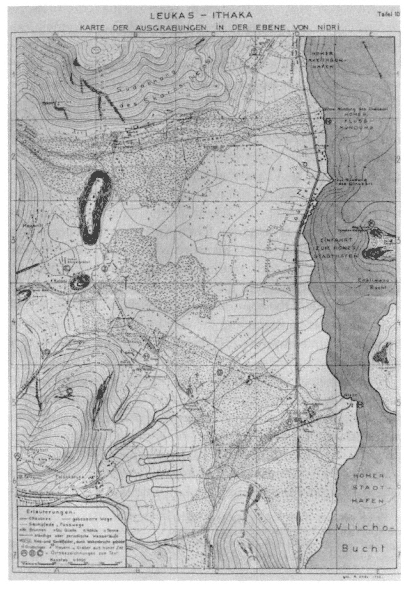
Figure 1.
Dörpfeld's excavations in the Nidri Plain, Leukas (Plan) (after W. Dörpfeld).
sequent eighty years, and as late as 1949 the first edition of the Oxford Classical Dictionary held that the question "remains an open one." Dörpfeld was insistent, at least when he thought carefully about what he was saying, that the purpose of his excavations on Leukas was not to prove the identity of Leukas and Homeric Ithaka, but to test the general validity of his theories.[16] He thus displayed a realistic grasp of the fact that no archaeological find from a prehistoric era can, in principle, demonstrate the identification of an entity such as "the palace of Odysseus." He had witnessed at first hand the skepticism that, in some quarters, had greeted even the general import of Schliemann's discoveries at Hissarlik, Mycenae, and Tiryns. By this criterion, his excavations were far from being the fiasco that some opponents suggested; we can take him at his word when he says that he was very satisfied with their results. As later knowledge showed, these results did not serve his ulterior purpose well, since they were mostly not of the appropriate date for the setting of the Odyssey . Yet what he found and the way he found it were both in themselves rather impressive, especially for the first decade of this century.
His preliminary travels on Leukas, besides persuading him of its identity as Homer's Ithaka, led him to one locality, the Nidri Plain (Figure 2), as being the main focus of prehistoric settlement on the island. Various considerations deriving from the text of the Odyssey disposed him to look for a town and a palace not centered on a hilltop citadel, like Mycenae or Troy, but located on level ground. He predicted that he would find them in the Ni-
[16] Most clearly, in his controversy with Wilamowitz: "Da ich mehrmals ausdrücklich erklärt habe, daß ich durch diese Grabungen nicht erst die Identität von Leukas mit dem homerischen Ithaka beweisen will, sondern nur die Probe auf die Richtigkeit meiner Darlegungen zu machen gedenke, so ist mir Sinn und Ton seiner [i.e., Wilamowitz's] Worte nicht verständlich. Ich habe allen Grund, mit den bisherigen Resultaten der Grabungen zufrieden zu sein" (AA [1904], 74). But elsewhere, notably in Alt-Ithaka (Berlin, 1927), 120, 150, 154, he states candidly that the goal of the excavations in the Nidri Plain was to find "die Stadt des Odysseus."
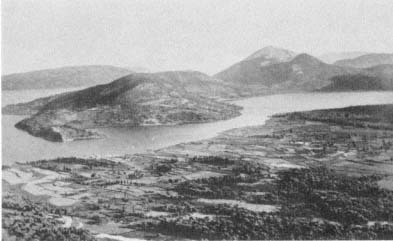
Figure 2.
General view of the Nidri Plain.
dri Plain and trusted his arguments enough to commit himself, year after year, to covering this considerable area with search trenches. They were deep trenches (Figure 3): on average, he reached prehistoric levels only four to six meters down. (A first point of interest is indeed the fact that the prehistoric land surfaces, correctly and observantly identified by him from the scatters of potsherds, had been so deeply buried under later alluvial deposits: Dörpfeld's experience at Olympia, one of the few major Greek sites where a similar state of affairs prevailed, must have helped him here.) The search trenches—which appear in Figure 1 as straggling lines of oblong symbols, mostly running north-south across the plain—were for a long time unsuccessful in locating anything in the form of architectural traces. But Dörpfeld was generations ahead of his time in recognizing and seeing the significance of buried prehistoric land surfaces, frustrated though he undoubtedly was by the absence of actual buildings.
Eventually, his luck changed. Every one of the lettered symbols in Figure 1 represents a significant discovery of these years, and
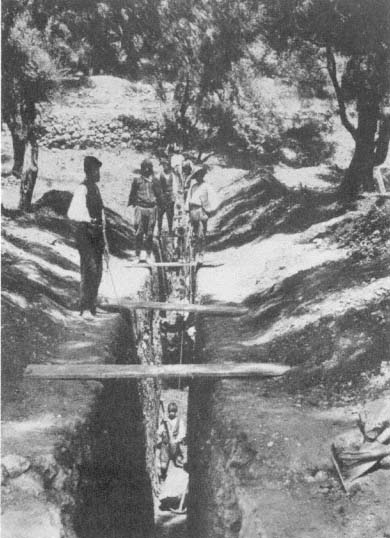
Figure 3.
View of one of Dörpfeld's trenches, Nidri Plain, Leukas.
we shall concentrate on half a dozen of them. The map is laid out in 500-meter squares, and we can see from the density of these major finds that Dörpfeld had not been following a will-o'-the-wisp. His eye for a major locus of prehistoric settlement—surely the major locus on the island, as the nature of the finds will confirm—had not failed him. Besides many scattered graves, he found three major prehistoric burial grounds: a huge Early Bronze Age one, with at least thirty-three circles of graves, at R (towards the bottom right of Figure 1), and two large Middle Bronze Age ones at F (northwest of R ) and S (towards the top left). He found a settlement of oval houses—probably Middle Bronze Age—on the slopes of the hill Amali above the plain (bottom, right of center, not marked with a letter). He found a system of water pipes (line of alternate dashes and dots, running northeastwards to B , lower center), which he also claimed as prehistoric. And he found a massive building, whose side wall ran for forty meters, at P (close to R ), which he naturally identified as a palace, though once again it is most probably of Early Bronze Age date: the foundations lay below the water table, which helps to explain why, to this day, the building remains incompletely excavated.[17]
Dörpfeld seldom seems to have laid aside his Odyssey text; yet, consciously or otherwise, he was operating, not as an unsuccessful exponent of Homeric studies, but as a first-class field archaeologist. The truly significant thing about his discoveries is that, irrespective of his original hypothesis, they remain, eighty years later, the richest and most informative finds of their period that have been made anywhere in the western half of the Greek homeland, partly thanks to the fact that Dörpfeld published them all in commendable detail. The R graves are arguably the
[17] For the R graves, see Alt-Ithaka (cited above, n. 16), 178, 181, 184–86, 217–50; F graves, 173, 213–17; S graves, 164, 179, 181, 207–13; settlement on Amali hill, 175, 201–3; water system, 159, 196–98; large building, 174–75, 177–78, 198–201.
most impressive of their period from anywhere in Greece, and their contents imply that they are a guide to the location of the leading settlement on Leukas, and perhaps in a wider area of western Greece. None of this would have been achieved had his actual operational methods not been so sound, so exhaustive, and (for 1901) so pioneering.
Different archaeologists will draw different morals from this story. For some, it will exemplify classical archaeology's subservience to literary aims. But this reasonable criticism of the subject as a whole must not be allowed to shade off into the untenable claim that it is thereby prevented from practicing "good," or alternatively "real," archaeology. Dörpfeld's discoveries are none the less real, or his methods (for their day) less good, because of his application, or misapplication, of the principle that an archaeological reality could be searched for behind the Homeric epics. The principle itself, in its general outlines, can hardly be disparaged without qualification, after the extraordinary archaeological results that it yielded between the years 1870 and 1940.
I shall develop the case by two further examples taken, unlike Dörpfeld's, from the central historical periods that are the strict concern of classical archaeology, and taken also from more recent practice. First, Olympia, where in the 1870s German excavators had conducted an inconclusive search for a building described 1,700 years earlier in Pausanias's Description of Greece (5.15.1): the workshop in which, six centuries earlier still, the sculptor Pheidias had worked on his statue of Zeus, which became one of the Seven Wonders of the ancient world. The general location, west of the main sanctuary, was not in doubt and two buildings, A and C , had emerged as the likely candidates, without the evidence making a choice between them possible. In 1954, under Emil Kunze, the Germans returned to the search (Figure 4): they were looking for the traces of sculptural activity that had eluded their predecessors, and for evidence that would date that
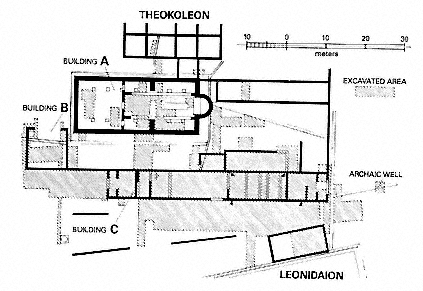
Figure 4.
Olympia: plan of the Pheidias Workshop excavations, 1954–58 (after A. Mallwitz).
activity.[18] Outside the south wall of "Building A ," and partly underlying (and therefore predating) "Building C ," they found both in ample quantity. This enabled them to identify "Building A " (so far as I know, to unanimous acceptance) as the workshop of Pheidias. It also enabled them to settle—to general if not quite universal satisfaction—a controversy over the dating of the statue within Pheidias's career, even though the differing views in that controversy spanned, at most, a period of only thirty years. It threw direct and detailed light, for the first time, on Greek
[18] For the excavation in general, see A. Mallwitz and W. Schiering, Die Werkstatt des Pheidias in Olympia , vol. 1, Olympische Forschungen, no. 5 (Berlin, 1964); but the fullest account of the sculptural material remains that of E. Kunze in Neue Deutsche Ausgrabungen im Mittelmeergebiet und im Vorderen Orient (Berlin, 1959), 277–95. On the problems of interpretation of the molds, see H.-V. Herrmann, Olympia: Heiligtum und Wettkampfstätte (Munich, 1972), 254 n. 605; further study is being undertaken by W. Schiering.
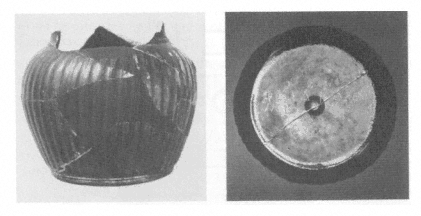
Figure 5.
Two views of the mug inscribed with Pheidias's name.
methods of workmanship in the untypical materials (gold, ivory, wood, and other substances) in which this and other exceptional statues are known to have been made. But it also included a more spectacular find: a black-glazed mug, on the underside of whose foot are scratched the words "I belong to Pheidias" (Figure 5). The amusing, but unworthy, rumor arising from the feeling that this find was "too good to be true"—that the inscription was a hoax, perhaps by a mischievous, if gifted, student—has now, it seems, been laid to rest: microscopic examination of the surface of the clay within the actual area of the incised letters has shown that the incision was done long ago, and before the diagonal break (itself of considerable age) occurred (Figure 6).[19]
Here, then, was an excavation designed to solve one, and if possible two, problems, and that solved them both: one at least (that of location) not merely with a reasonable degree of plausibility, but beyond any reasonable doubt. This conclusion must stand, I think, even though later research suggests that the position with the sculptural material is more complicated than was first apparent: not all of it may in fact be associated with Phei-
[19] See W.-D. Heilmeyer, "Antike Werkstättenfunde in Griechenland," AA (1981), 447–48.
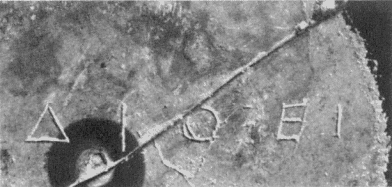
Figure 6.
Close-up view of the Pheidias inscription.
dias's work on his colossal statue, and the workshop may have been used again later. As we have seen, however, Pheidias's activity here is beyond question.
My final example involves another great work of classical antiquity: the combined sundial and calendar erected by the emperor Augustus in the Campus Martius at Rome in 9 B.C. In 1976 by means of a complex series of arguments, mathematical, astronomical, and archaeological, Edmund Buchner reached certain conclusions about the location, level, form, and function of the gigantic horizontal network, some 160 by 75 meters in area, where the readings of the sundial were taken (Figure 7). He was working largely from a single archaeological datum: the known location and approximate height of the obelisk that had formed the pointer of the sundial, which had been found in 1748, but reerected on a different site. He ended his argument with the words: "A mere fragment of this network would afford us a picture of the whole—and confirm or refute my conclusions,"[20] cou-
[20] "Schon ein Stückchen des Liniennetzes könnte uns ein Bild vom ganzen vermitteln—und meine Ergebnisse bestätigen oder widerlegen" ("Solarium Augusti und Ara Pacis," RM 83 [1976]: 365; the article was reprinted in E. Buchner, Die Sonnenuhr des Augustus [Mainz, 1982]).
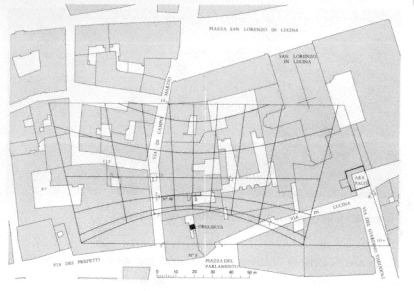
Figure 7.
Deduced location of the Solarium Augusti, with sites of excavations of 1979 and 1980 (after E. Buchner).
pling this with a prediction that, on grounds of the known later history of the site, the evidence of the network would be there to find.
Three years later he set out to test these conclusions by excavation: and that in a heavily built-up area near the heart of the modern city, where the very largest available space (Figure 8) would be afforded by the width of a narrow street. It was in fact in the cellar of a house (48 Via di Campo Marzio), where Buchner had predicted the intersection of two "month-spaces" in the calendar portion of the network, that the decisive find occurred. Here, at a depth of well over six meters below street level, was found a travertine block into which a nine-inch-high, bronze letter A had been embedded in lead. Other letters soon followed, showing that the A was the second letter of PARTHENOS—Virgo in the more familiar Latin form of the zodiacal calendar (Figure 9). In this case, as with Kunze's find at Olympia, the full picture
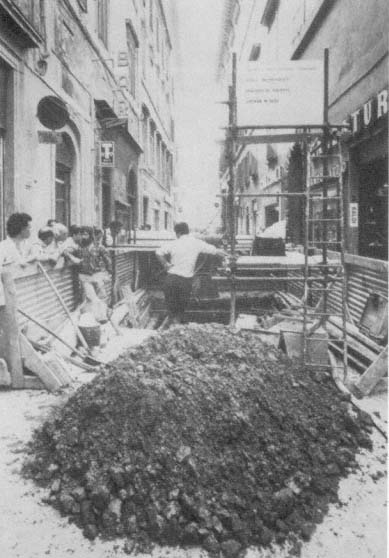
Figure 8.
Solarium Augusti: view of 1979 excavation in the Via di Campo Marzio.
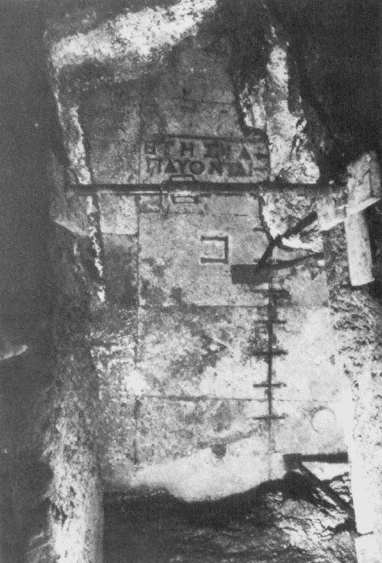
Figure 9.
Solarium Augusti: view of 1980 excavation in the cellar of no. 48, Via di Campo Marzio.
once again turned out to be slightly less clear-cut than first impressions had suggested. Buchner struck the sundial network at a slightly higher level than predicted, and the reason later became plain: this was not Augustus's original sundial, but a slightly later (perhaps Domitianic) replacement, which for obvious reasons had to be located exactly on top of its predecessor (since the obelisk presumably had not then been moved).[21] But again, as at Olympia, the location and identification had been established beyond any doubt.
What do these instances, collectively or individually, prove? What strengths of classical archaeology do they illustrate? At the simplest level, they show excavators testing hypotheses and validating their general soundness—in the latter two cases proving their specific correctness. This last is pretty rare in real-life archaeology. Where else but in the classical world can one dig a narrow hole twenty-one feet deep and find at the bottom almost exactly what one predicted? Where else could you excavate the site of a known individual's activity 2,400 years earlier and find the actual autograph of that individual? I am aware that similar things do occasionally happen in the archaeology of Egypt, of the Near East, and of China; and one might add that they happen all the time in that other archaeology, the one that the layman encounters most often—archaeology as depicted by the mass media. Raiders of the Lost Ark is only one of the more recent in a long line of variations on this theme. But all this is far from the normal experience of any archaeologist, and apparently even further from the ideals of the new archaeology. Yet how great, in reality, is this last-mentioned distance, and in what exactly does it consist?
In many ways, the most impressive feature of these three instances is what took place before excavation began. Dörpfeld ex-
[21] See E. Buchner, "Horologium Solarium Augusti," RM 87 (1980): 355–73, likewise reprinted in Die Sonnenuhr des Augustus (cited above, n. 20).
amined the landscape of a sizeable piece of territory and then committed himself to one smaller part of it as being the likeliest location of what he was looking for. Though not in the way he had hoped, his judgment was vindicated in a way that has been perhaps of at least equal benefit to archaeology at large. Kunze set out to find the solution to two controversies, each at least eighty years old, and did so convincingly. Buchner developed a complex and highly specific hypothesis and committed himself to it in print before testing it with resounding success. Thus far, these excavators were observing the precepts of the new archaeology: "Develop explicit assumptions and then test them"; "Cross the boundary lines of disciplines, making outward contributions to the other disciplines if possible"; "Count, measure, and quantify where possible"—all these maxims are exemplified by one or more of the cases illustrated.
But from this point on a gulf begins to open up. Three of the strongest pejorative terms used by the new archaeologists to condemn traditional approaches are "blind empiricism," "pure description," and "particularism." Now I hope to have shown that by no stretch of imagination can the first of these charges be made to stick here: the methods of the three excavators were anything but "blindly empirical."
As for the second charge, I have heard the phrase "purely descriptive" applied to the whole discipline of classical archaeology, most often in contrast with "explanatory" or "explicatory," used of approaches directed at answering the question "Why?" It might be argued that each of these discoveries opened up questions of an explanatory kind, about which the excavators themselves probably pondered. In Dörpfeld's case, the obvious question was why a Greek place-name, "Ithaka," should have migrated from one island to another between the time of the formation of the Homeric epic and the dawn of Greek history, as on his view it would have to have done; and we know that he was much exercised by this problem. Kunze's finds showed, as most would agree, that the statue of Zeus at Olympia was the work of
Pheidias's old age, after his great commission in the Parthenon at Athens. But in that case how and why did a strong ancient tradition grow up that he was prosecuted and died in prison in the immediate aftermath of his work in Athens? Buchner's discovery of the early replacement of Augustus's sundial suggests a connection with the fact (attested by Pliny the Elder a few years after its construction) that the original sundial began to go progressively wrong in its time-keeping. Why did this happen? Yet, when all is said, we must admit that the actual fieldwork I have described was not in itself directed at answering these questions.
It has similarly to be conceded that these achievements also fall foul of the third criticism: they are decidedly particularistic. And, in Lewis Binford's words, "Once . . . the focus of study moves to comparative pattern recognition and evaluation of variability, particularistic approaches are thereafter trivial, uninteresting and boring—even to their advocates."[22] With the last four words, Binford unquestionably goes too far—we have seen how and why particular approaches continue to interest some of us—but let that pass. More important is the fact that some new archaeologists have conceded that particularistic approaches can act as a springboard for other advances of a more approved kind. Thus, in the very book in whose introduction Binford uses the words just quoted, Stanley South writes: "The fact that Noël Hume uses the particularistic approach does not mean that the descriptive classifications and data emerging from his work cannot be used for other approaches."[23] I would go further and say that, without both the foundation and the contrast provided by traditional work carried out in the "particularistic" spirit, the new archaeologists would find it very much harder to make headway with the theoretical, universalizing, anthropologically oriented, and, at times, law-seeking approaches they pursue. It is hard to imagine a better springboard than Dörpfield's (at least for
[22] Introduction to S. South, Method and Theory (cited above, n. 14), xi.
[23] Method and Theory , 10.
its period) for further work on prehistoric settlement and land use in the area in question; or than Kunze's for that most exotic manifestation of human creative enterprise, sculpture in gold and ivory; or than Buchner's for the study of early time measurement. We have seen classical archaeology excelling just where we should expect it to excel: in finding a right, or at least an exceedingly convincing, answer to questions that have a single answer.
Archaeology needs both approaches. It needs to confirm its theoretical hypotheses, not once, but repeatedly, and if some of the confirmations approach total certainty, as is only possible in a field such as classical archaeology, with its outstandingly rich data base, then archaeology will be the better for it. In classical archaeology, I admit, it is the generalizing approach that is in short supply, but I do not think that it matters very much whether this lack is made good by insiders or outsiders. If the insiders were by some means to achieve this, however, it would be reassuring to be able to feel that the fact would at least be noticed by other archaeologists.
"History is, strictly speaking, the study of questions; the study of answers belongs to anthropology and sociology. . . . Culture is history which has become dormant or extinct," W. H Auden asserted.[24] Most archaeology deals with time-spans of such length that it inevitably concerns itself with "culture" to the same degree anthropology does. Most, but not quite all. There are epochs in man's past where the state of the evidence is such that it allows archaeologists to study "questions" that were then, often for the first time, being asked; and to examine the material evidence for the first attempts to answer them, rather than the "extinct history" of the widely accepted answer. Classical archaeology deals with perhaps the most important of these exceptional epochs. Yet not everything in classical archaeology falls into this class of enquiry, and history itself studies many different kinds of
[24] The Dyer's Hand , Vintage Books edition (New York, 1968), 97.
questions. I shall attempt in subsequent chapters to show how the subject could increase its intellectual vitality by stepping over some of the artificial boundaries, narrower than those the restrictions of the discipline themselves impose, that it has allowed itself to accept.