
The Power of the Gun: The Emergence of Modern Chinese Warlordism
Edward A. Mccord
Table of Contents
- Preface
- Introduction
- 1— Late Qing Military Organization
- 2— The Politicization of the Military: The New Army and the 1911 Revolution
- 3— The Provincial Regimes of the Early Republic: Civil Government under Military Governors
- 4— Military Problems and Policies of the Provincial Regimes
- 5— Centralization and the Provinces under the Dictatorship of Yuan Shikai
- 6— The Anti-Monarchical War and the Inception of Warlordism
- 7— The North-South War and the Triumph of Warlordism
- 8— Warlord Rule and the Failure of Civil Provincialism
- Conclusion
- Appendix: The Organizational Structure and Strength of Late Qing and Early Republican Armies
- Notes
- Abbreviations
- Glossary
- Works Cited
- Index
Preface
This book to some extent grew out of a general interest I developed during the anti-war movement of the early 1970s in the relationship between military force and society. At the time, I certainly had no indication that this interest would lead me to a study of Chinese warlordism. The more immediate genesis of this particular project was a graduate paper at the University of Michigan that focused not on the emergence of warlordism but on its demise. As is often the case in historical research, though, my work on this paper, which was in itself hardly memorable, drew me backwards in time to consider why warlordism appeared in China in the first place. A feeling that this topic had not been adequately treated in the existing literature was one factor in my decision to make warlordism the subject of my doctoral dissertation. Originally, I envisioned my dissertation as a more general study of warlordism that might perhaps take one chapter to deal with the question of warlord origins. As my research progressed, I began to see that the emergence of warlordism was a complicated process that could not be addressed in so brief a manner. My desire to outline this process with greater precision increasingly framed and dominated my research. As I began to write the dissertation, what had begun as a preliminary question for my research turned into its central focus.
I am very grateful to the numerous teachers, colleagues, and friends whose guidance, advice, and support were instrumental in the making of this book. First, I would like to thank the co-chairs of my dissertation committee, who saw me through the development and completion of my first manuscript. Albert Feuerwerker provided thoughtful criticism and constant encouragement. Ernest P. Young's insights and questions helped me to strengthen the focus of the original dissertation
and suggested improvements for subsequent revisions. Second, I would particularly like to thank two reviewers, Joseph Esherick and Donald Sutton, for their meticulous reading of my revised manuscript and many invaluable suggestions. Next, I would like to express my gratitude to a number of other people who took the time to read all or part of my manuscript in its various stages and to offer helpful comments on it, including Chun-shu Chang, Martin K. Whyte, Stephen MacKinnon, Joyce Kallgren, Donald Price, and Christopher Alhambra. Finally, I would like to thank all the other people who over the years provided me with advice and assistance in pursuing my research or, in allowing me to talk to them about my work, inspired me with their insights and suggestions. Although these benefactors are too numerous to list, I would be remiss if I did not offer special thanks to Jerome Ch'en, Diana Lary, Lin Zengping, Mao Jiaqi, Tao Hongkai, Arthur Waldron, Odoric Wou, and Zhang Kaiyuan. While I owe much to these people for any of the merits of this book, I, of course, must take responsibility for its shortcomings.
I am also grateful for the financial support I received over the years to support the research and writing of this book. I am particularly thankful for fellowships from the Committee for Scholarly Communication with the People's Republic of China, the Social Science Research Council, and the Fulbright-Hays program, which supported nearly two years of research in the People's Republic of China. In this regard, I also need to thank the institutions that hosted me during my research in China: Huazhong Normal University, Hunan Normal University, Nanjing University, and Peking University. Fellowships and grants from the Center for Chinese Studies and the Graduate School of the University of Michigan provided support during the writing of my dissertation. I am grateful too for a postdoctoral fellowship from the Center for Chinese Studies at the University of California at Berkeley, which gave me an opportunity to carry out additional research and to begin revising my manuscript for publication.
Finally, I need to thank the various libraries in China and the United States that opened their stacks to me over the course of my research. One of the greatest difficulties I faced in pursuing this study was the problem of sources. Warlordism arose in a time of great disorder and frequent civil war, conditions hardly conducive to the preservation of historical materials. Busy with their wars, the warlords themselves took little care to preserve documentation of their rule. The War of Resistance against Japan (1937–45) also had a devastating impact on library and archival holdings in central China, the main area
of my research. One result of this situation was that I had to be very eclectic in the use of different types of materials for my research, including document collections, memoirs, oral history records, local histories, and contemporary newspapers and periodicals. In order to track down various scattered sources potentially useful for my research in China, I visited a number of different university, city, provincial, and institutional libraries in Wuhan, Changsha, Nanjing, and Beijing. Although nearly all of these libraries were gracious in their assistance, my special thanks must go to the Hubei Provincial Library, the Hunan Provincial Library, the Wuhan City Library, and the Beijing University Library for the extraordinary efforts they made to meet my research needs. In the United States, I would like to thank the staffs of the Asia libraries at the University of Michigan, the University of California, and Columbia University; the Hoover Institution Library at Stanford University; and the Library of Congress for their assistance. The detail I sought in tracing the emergence of warlordism on a regional level would not have been possible without the aid I received from all these libraries in both China and the United States.
Introduction
The military suppression of demonstrators in Beijing in the summer of 1989 was a stark reminder that China's Communist Party leaders had never lost sight of Mao Zedong's famous observation, "Political power grows out of the barrel of a gun."1 Strangely enough, scholars of China's modern history have often been more reluctant to acknowledge the political importance of military power in the founding and survival of China's Communist government. Explanations of the Communist Party's political strength have usually paid more attention to ideological or organizational factors than to the control and application of armed force. It would be equally wrong to interpret the party's political success only in terms of military force, but the recurring and crucial political interventions of the People's Liberation Army suggest the need for a more balanced appraisal of the importance of military power in modern China's political development.
The role of the military in modern Chinese politics can only be properly understood when placed in its historical context. In 1921, the year in which the Chinese Communist Party was founded, China was suffering endemic civil warfare, which had begun a decade earlier with the 1911 overthrow of the last imperial dynasty and was fed by continuing political struggles for the control of the Republic established at that time. By the end of this decade of civil war, the possession of armed force had become an essential determinant of political power. The main benefactors of this condition were a large number of competing military commanders, usually referred to as "warlords." Relying on the personal command of their armies, these warlords extended their control over government administration and fought wars with each other to expand their political influence. Mao's recognition
of the linkage between military force and political power was not simply the result of abstract theorizing. Rather, it was a practical acknowledgment that under such conditions the Communist Party's own political struggle would depend not only on the battle for the hearts and minds of the Chinese people but also on the control of military power.
The study of the emergence of warlordism in the early twentieth century thus provides a crucial starting point for an understanding of military-civil relations in contemporary China. Unfortunately, scholarly research on this subject has been quite uneven. On one hand, many Chinese historians have been reluctant to focus attention on this painful chapter in China's modern history. Western historians, on the other hand, often seem disconcerted by the difficulty in finding meaning in the constant civil wars and complicated political maneuvers that characterized the warlord period. In the mid 1960s, the publication of two ground-breaking warlord biographies by James Sheridan and Donald Gillin attracted more attention to this subject from Western scholars.2 In the decade from 1970 to 1980, a number of important studies appeared in the West that took a closer look at various individual warlords, or warlord cliques, and their political struggles.3 In the late 1970s, historians in the People's Republic of China also began to show new scholarly interest in this topic.4 It was at this point, though, that Chinese and Western research parted company. In the 1980s, just as the field of warlord studies was gaining legitimacy among Chinese historians, Western scholarship on the topic went into a decline, from which it has yet to recover.5
The lack of sustained Western scholarly attention to Chinese warlordism suggests that the historical relevance of this topic is still not fully appreciated. Most textbooks continue to give the warlords and their wars only a brief treatment before moving on to more detailed examinations of other, by implication more important, developments. Warlordism thus tends to appear as an aberration with little lasting impact on Chinese society or politics. The neglect of this subject in Chinese history is curious in contrast to the work of historians in other fields who have found war to be a catalytic force for far-reaching social, political, and economic changes. Some approaches used in past Western studies of Chinese warlordism may have inadvertently contributed to the perception of its comparative unimportance. Most studies have focused narrowly on the warlords themselves, through biographies of individual warlords, histories of warlord factions, or studies of warlord politics. This may have made it easier for
others to dismiss warlord studies as a self-contained and rather esoteric field. A shift to more topical and contextual approaches may encourage greater appreciation of the connections between warlordism and the broader transformation of modern Chinese society. This study hopes to make some small contribution toward meeting this challenge through a close examination of the emergence of modern Chinese warlordism.
Its identification as the subject of this study necessitates some initial consideration of how warlordism is to be defined. One question that immediately arises is whether to use this particular term at all. In Chinese, the word warlord (junfa ) has a particularly pejorative connotation. Historically, this has resulted in attempts to distinguish, often on the basis of political criteria, between bad "warlords" and good "military commanders." To avoid such value judgments, some Western scholars have substituted the term militarism for warlordism , thus identifying all the military strongmen of the Republican period by the supposedly more neutral label militarist .6 One argument against this usage is the considerable baggage of historical and theoretical meaning acquired by the term militarism since its initial appearance in the mid nineteenth century.7 For example, militarism is frequently used to refer to martial attitudes, ideologies, or policy orientations. Certainly modern Chinese society produced advocates of military strength and martial virtues who might be labeled militarists in this sense. However, not all militarists of this type were military men, and not all powerful Chinese military commanders were militarists in their ideological orientations. The term militarism therefore does little to clarify the particular features that characterized the military's role in early Republican society and politics.
One concept employed by social scientists that comes closer to describing the more restricted sense of militarism seen in the Chinese case is praetorianism . With the political role of the Praetorian Guard in ancient Rome as its referent, praetorianism has been defined as "a situation where the military class of a given society exercises independent political power within it by virtue of an actual or threatened use of military force."8 However, this term has also undergone a certain degree of elaboration by social scientists, even to the point of expanding its application to groups other than the military.9 Although perhaps remaining useful as an encompassing term, praetorianism is still too broadly defined to serve as a precise description of the specific form of military rule found in Republican China. Unlike the classic cases of military intervention usually referred to as examples of
praetorianism, the military in Republican China did not exert its political influence as a single class or as a corporate body. Rather, a multitude of relatively autonomous military commanders competed with each other for political power. One way to describe this situation might be to use a qualified term such as fragmented praetorianism or, as suggested by Donald Sutton, fragmented militarism .10 Definitional clarity, however, seems best served by a retention of the label warlordism for this distinctive fragmented form of military rule. The word warlord itself also conveys an image of the personal power of individual commanders that was another essential feature of the Chinese phenomenon. No abstract term describes the characteristics of the military power-holders of the early Republican period more clearly than the label applied to them by people who lived under their rule.
In reaching a conclusion on the terminology to be used, the above discussion also highlights the main points that should be included in a definition of warlordism . Adapting the definition of praetorianism , warlordism may be described as a situation where a number of individual military commanders exercise autonomous political power by virtue of the actual or threatened use of the military force under their personal control.11 This definition accents the importance of understanding not only why military intervention in Chinese politics occurred, but why it took the particular form it did.
The frequency of military coups in Africa, Asia, and Latin America after World War II spurred a lively scholarly debate among social scientists seeking to explain the reasons for military interventions in the political arena. While numerous models have been proposed, many scholars recognized early on that no monocausal model could explain the variety of experience represented by this phenomenon in different nations and at different times.12 Indeed, the main effect of empirical studies seeking to prove or disprove various models has been to accentuate the diversity of factors that have contributed to specific military interventions. One response to this situation might be to build increasingly complex typologies of military-civil relations to account for the variety of individual cases. The closer models derived from such typologies come to approximating particular cases, however, the more they become merely descriptive rather than explanatory. Historians, concerned more with the explanation of specific historical events or phenomena than with the construction of universal models, may be less dismayed by this situation than other social scientists. For a historian, the general literature on military interventions is useful, not in providing a definitive model into which to fit Chinese warlordism, but
in supplying different analytical approaches that may all contribute to a fuller understanding of this particular phenomenon.
Most attempts to explain why the military intervenes in politics can be subsumed under one of three general approaches.13 The first finds the cause of military interventions within the military itself. Proponents of this approach emphasize features of military organizations that contribute to their capacity for political intervention, such as technical expertise and training, cohesive and hierarchical organizations, or nationalist orientations.14 The second school of interpretation looks for the causes of military interventions not within the military but in the structural or societal conditions of the countries where they occurred. Samuel Huntington exemplifies this approach in his observation that "the most important causes of military intervention in politics are not military but political and reflect not the social and organizational characteristics of the military establishment but the political and institutional structure of society."15 Huntington theorizes that "praetorianism" occurs when the development of a society's political institutions fails to keep pace with expanding political mobilization. Other researchers have focused on similar cases of systemic disequilibrium—evidenced in economic dislocation, political disorder, or social tension—as providing the main context for military interventions. In this approach, then, the military is largely drawn into politics by the failure of civil government or civil institutions to deal effectively with these systemic problems. The third approach represents an attempt to bring idiosyncratic human motivation back into consideration. Samuel Decalo largely defines this approach in a study of military coups in Africa, where he argues that personal factors, particularly the self-interested motives of coup leaders, play a primary role in military interventions.16
On a theoretical level, the above approaches are sometimes posed as mutually exclusive interpretations. Because they deal with distinctively different levels of analysis, though, these approaches in application often turn out to be more complementary than antagonistic. Indeed, the evidence supporting each of these approaches suggests that the motives of military commanders, the military's organizational characteristics, and general societal conditions all play some role in influencing military interventions. The exact mixture or comparative importance of these different factors depends on the specific conditions of particular cases. The goal of this study is not to advance any one of these general approaches but to provide a synthetic explanation for the rise of Chinese warlordism that is informed by them all. At the
same time, the categories of these three approaches provide a useful framework in which to analyze past explanations of the origins of Chinese warlordism and to suggest the directions this study should take.
At first glance, the pattern of personal power represented in warlordism seems to support the approach that finds the source of military interventions in the personal motives and ambitions of military men. Although this approach is rarely represented in more recent scholarly studies, contemporary observers in the warlord era often blamed the conditions of warlordism on the self-interested actions of the warlords themselves. A 1924 article tops a list of answers to the question, "Why are there so many civil wars?" with the simple statement, "Because there are warlords seeking personal profit."17 A simple consideration of the particular nature of Chinese warlordism, though, raises some problems with this approach. The importance of idiosyncratic factors seems most plausible in explaining the actions of a single charismatic military leader in the context of a specific coup situation. However, a general trend toward political intervention by numerous military commanders, such as seen in the case of warlordism, requires a broader explanation. Assuming that military officers in early twentieth-century China were not radically more ambitious or self-interested than their counterparts in earlier or later periods, personal factors do not explain why warlordism occurred at the particular period when it did. Furthermore, whereas the behavior of many warlords in specific events can be understood in terms of their personal motivations, it does not explain how they were able to bend armies to their own political wills in the first place. The conditions that gave rise to warlordism must therefore be sought within a context broader than the individual interests of the warlords themselves.
The next level of analysis, military organization, has provided the basis for several important interpretations of the rise of warlordism. One theory, mainly associated with Luo Ergang and Franz Michael, traces the roots of China's twentieth-century warlords back to the development of "personal armies" in the mid nineteenth century. In this view, the independence of these armies caused an increasing devolution of state power into the hands of regional military commanders, who eventually, after the collapse of the last imperial dynasty in 1911, became warlords. Thus, warlordism is traced back to general changes in Chinese military organization and to the specific structure of personal and regional military power that it created.18 A contrasting organizational theory can be found in Donald Sutton's case study of
the Yunnan provincial army, where he proposes to reveal the origins of warlordism "by studying organizational behavior within a single army."19 Unlike the previous theory, Sutton determines that the Yunnan army at the end of the Qing dynasty was a relatively modern, impersonal force. In his view, the relative strength of the Yunnan army as a cohesive military organization contributed to the establishment of regional "militarism" in Yunnan during the 1911 Revolution. Likewise, the disintegration of the Yunnan army's cohesion under the early Republic eventually gave rise to full-blown warlordism or "fragmented militarism."
The stark contrast between these two theories immediately suggests a weakness in purely organizational explanations of Chinese warlordism. Both theories fail to account fully for the organizational diversity of the late imperial and early Republican Chinese army. The first theory assumes a continuity in personalist military organization, which Sutton's study does much to disprove. At the same time, while proposing that the experience of the Yunnan army "could serve as a microcosm of an almost universal two-stage process," Sutton also acknowledges that "the Yunnan Army was not typical for its time." Indeed, he admits that "provincial armies differed greatly in their size and power, their military effectiveness, their internal structure . . ., and in their cohesion."20 The variety of forces that ultimately provided the power bases for different warlords suggests the difficulty in attempting to trace warlordism back to a single form of military organization. This situation also suggests that an explanation of the rise of warlordism must ultimately consider conditions extraneous to the military itself.
This finally brings us to the approach that seeks the sources of the military's political role in structural or societal conditions. One example of this approach is a formulation that has had a major influence on how historians in the People's Republic of China interpret the origins of warlordism. In a 1928 analysis of China's recent history, Mao Zedong linked warlord conflicts to China's "localized agricultural economy (instead of unified capitalist economy) and the imperialist policy of division and exploitation by marking off spheres of influence."21 Warlordism is thus seen as having its roots in the dual context of China's "semi-feudal economy" and foreign imperialism. Mao was not the first Chinese political thinker to suggest these connections, but his pronouncement had the effect of canonizing them for Chinese Communist historiography. Unfortunately, as a result of Mao's imprimatur, Chinese scholars hesitated to analyze this theory in any
detail, let alone consider alternate interpretations. Only recently have Chinese scholars begun to look beyond these broad generalizations and to acknowledge some of the problems in applying them.22 Even so, this interpretation has largely continued to define the parameters of inquiry into warlord origins among Chinese historians.
The suggestion of a strong linkage between warlordism and imperialism originally gained popularity in China during the anti-warlord, anti-imperialist movement of 1919 (usually referred to as the May Fourth Movement). In essence, this theory suggested that the imperialist powers replicated their rivalries in China by supporting specific warlords in their spheres of influence, thus keeping China weak and divided for easy exploitation. This view primarily appears in stock descriptions of warlordism by Chinese scholars, but some Westerners have also incorporated it into their discussions of the factors giving rise to warlordism.23 In practice, though, hard evidence of a close causal relationship between imperialism and warlordism has been fairly difficult to come by. For example, a detailed study by Odoric Wou has showed that one major warlord, Wu Peifu, usually failed in his efforts to gain political or material support from the foreign powers usually identified as his backers, Great Britain and the United States.24 In recent studies, some Chinese scholars have also acknowledged that most minor warlords, particularly those in remote locations, had minimal, if any, contact with foreign powers. They have also noted that even the larger warlords, rather than being simply beholden to the foreign power whose sphere they inhabited, had more complicated, and sometimes antagonistic, relations with various foreign powers.25 Such circumstances show that the policies of imperialist nations did not directly foster warlord rule in the sense implied, for example, in charges that the United States and the USSR instigated military coups in their client states in the Cold War era.
Although the assumed linkage between imperialism and warlordism in its original application seems insupportable, the influence of imperialism should still be recognized as part of the general political context in which warlordism arose. The threat of imperialism was after all a major catalyst in the nationalism that inspired Chinese politics in this period. Attention should also be paid to specific circumstances created by imperialism that may have influenced warlordism's course. Even so, the effects were often contradictory. For example, the foreign power consensus recognizing only Beijing as the seat of China's national government after the fall of the Qing dynasty favored the reunification of the country, not the political independence of multiple
warlords. On the other hand, the provision of foreign loans and the foreign guarantee of customs revenues to the Beijing government may have encouraged its proclivity to use military force to resolve political conflicts, thus strengthening the military's political role. In the end, such influences taken together are still insufficient to find imperialism to be a main causal agent in the rise of warlordism, except in the broad sense that the whole political development of modern China would have been different in the absence of foreign pressure. The most important conditions specifically shaping the emergence of Chinese warlordism were domestic, not foreign.
The other half of Mao's pronouncement does posit a general domestic condition, the existence of a semifeudal economy, as providing a foundation for warlordism. Although this part of Mao's statement is again more often quoted than analyzed, its main application stresses the manner in which China's low level of economic integration contributed to broader political disintegration. As such, this condition could be included among other "latent factors"—such as China's geographical expanse, poor communications, ethnic diversity, and particularistic loyalties—identified by other scholars as contributing to China's susceptibility to political fragmentation in the warlord period.26 The problem with all these factors, though, is that they were applicable for a much longer period than just the warlord era. What needs explanation is why the centripetal forces that generally kept China united were overcome in this particular period by centrifugal forces. Equally important is the need to explain why political fragmentation in this period took a military form. Broad generalizations about the nature of Chinese society or its economy do little to answer such specific questions.
An effective structural explanation of warlordism must show a more direct connection between particular societal conditions and the emergence of military men on the political scene. One explanation that comes closest to meeting this requirement postulates the importance of a political vacuum created by the 1911 overthrow of China's last imperial dynasty to the rise of warlordism.27 Scholars who express this view generally suggest that the lack of strong civil forces and institutions enabled the military to seize political power following the 1911 Revolution. Because this view presupposes the organizational strength of the military in making this move into politics, it is often found in combination with one of the theories of warlord origins that stress organizational developments inside the military. Thus, the military forces waiting in the wings in 1911 are either the personally oriented
regional armies described by Luo and Michael or the cohesive modern military organizations depicted by Sutton. In this case, then, structural and organizational theories neatly combine together to explain the emergence of warlordism.
Although many works cite some form of this political vacuum theory, the exact nature of the civil collapse that is assumed to have resulted from the 1911 Revolution has never been the subject of rigorous analysis. Indeed, the theory appears to make a questionable equation of civil government with the imperial system, and so sees their collapse in tandem. This seems to underestimate the adaptability of China's civil bureaucracy to changing political circumstances. More important, it fails to take into account the substantial expansion of civil politics that took place outside the imperial government before the 1911 Revolution and its potential to provide a new foundation for civil rule. Thus, it seems likely that a failure of civil politics, rather than a true civil political vacuum, would better describe the conditions that opened the way for warlordism.
This brief survey of the various approaches and theories that have been applied to the origins of warlordism shows that much work still needs to be done on this topic. Many of the generalizations that have been made about the rise of the warlords do not stand up to more careful historical analysis. Other theories have been flawed by their in-attention to the precise social and political conditions under which warlordism appeared. The goal of this study is to take a fresh look at the combination of factors that created warlordism in China, with a particular effort to stay close to the social and political "ground" on which this development occurred. This is done through a historical approach that relies primarily on a chronological narrative. Within this narrative, however, an attempt is made to focus on a number of overlapping conditions that ultimately transformed military commanders into politically dominant warlords.
The first chapter of this study begins with an examination of Chinese military organization in the late Qing period. Although the rise of warlordism does not seem tied to any one form of military organization, the organizational diversity and fragmentation of the Chinese army had a shaping influence on the particular fragmented form of military rule that eventually emerged. Ironically, while fragmented military organization originally served dynastic interests by weakening the military's potential for political intervention, once the military began to play a political role under the Republic, this fragmented organization contributed to the growth of political disunity.
The second important condition influencing the rise of warlordism deals with what S. E. Finer has called the military's "disposition" to intervene in politics.28 This issue is introduced in Chapter 2 through an examination of the politicization of military men in the late Qing period. This chapter shows that a change in the social composition of new modern-style forces raised in the Qing dynasty's last decade and a half helped to link the military to burgeoning reform and revolutionary movements. The resulting politicization of the military led to its first open political intervention—participation in the 1911 Revolution.
Although military men may have whetted their political appetites in 1911, the revolution itself did not lead immediately to the appearance of warlordism. Rather, as seen in Chapters 3 through 5, different civil political alternatives arose at provincial and central levels in the Republic's first years that were to some extent able to forestall the establishment of military rule. A failure to reach a consensus on these political alternatives, however, ultimately led to a final condition that would ensure the emergence of warlordism—the militarization of politics. The concluding chapters of this study show how politics was militarized as competing political authorities looked to military men to resolve their fundamental political conflicts. To borrow Finer's terminology again, the civil wars provoked by these political conflicts provided continuing "opportunities" for military interventions in the political arena. Under these conditions, the gun soon became the most important political determinant. Political reliance on military force continued the politicization of the military and in turn politically empowered military commanders. Military men were thus given many opportunities to bend political conflicts to serve their own political ambitions. Military commanders who took advantage of these opportunities thus became "warlords."
The historical approach of this study emphasizes the unfolding of warlordism as a process. For the most part, military rule in Republican China did not begin with abrupt military seizures of power or military coups directed against civil authority. Rather, it began as a process of political aggrandizement by various military commanders acting through posts or offices that were for the most part legally obtained. Equally important, the process of warlordism was uneven. Warlordism did not appear at a single moment throughout China, but at different times from one area to the next. Even within a single area, the path to warlordism might vary from one military commander to the next. The process depended on the particular circumstances, or "opportunities," in different areas, and the individual response, or
"disposition," of military commanders to circumstances presented to them. It is not surprising, then, that scholars sometimes differ over the exact dating of the beginning of the warlord era. Different dates are possible depending on what level of politics, what region of the country, or what individual military commander is being examined.
Recognition of the uneven development of warlordism created some problems in determining the proper context for this study. Simply given China's size, not to mention the multitude of warlords and the complexity of their experiences, any attempt at an all-inclusive national study would make it difficult to carry out a detailed empirical examination of the rise of warlordism. The solution to this problem was a narrower case study. Nonetheless, a case history of one warlord or of one warlord clique, the approach followed by most past warlord studies, would increase the difficulty of differentiating between the general process of warlordism and potentially unique experiences. The obvious solution to this problem was to focus on a particular region that would include more than one warlord or warlord clique, and that would allow for closer attention to the social and political context in which warlordism arose. Although provincial studies have become common in the China field, a study of one province carries some of the same problems of exceptionality as the study of one warlord. The compromise solution adopted here was a two-province study that would not be so broad in scope as to prevent detailed historical exposition, but broad enough to allow the inclusion of more diverse experiences as a basis for generalization.
The two provinces chosen for this study are the neighboring provinces of Hubei and Hunan in central China (see map). In area, Hunan is somewhat larger than Hubei (approximately 84,000 square miles to 73,000 square miles respectively). At the beginning of the twentieth century, each of these provinces was estimated to have a population of around 25 million people. The two provinces are geographically joined by the central Yangzi plain, which spreads westward from Wuhan in Hubei along the triangle formed by the Yangzi and Han rivers and then southward beyond Dongting Lake into north-central Hunan. The geographical linkage of the two provinces is represented in their names, which simply designate their relative positions north (Hubei) and south (Hunan) of the plain's largest body of water, Dongting Lake (five to six thousand square miles at its highest level). Enriched by alluvial soil and watered by numerous rivers and lakes, the central Yangzi plain shared by these two provinces is one of China's most fertile agricultural regions.
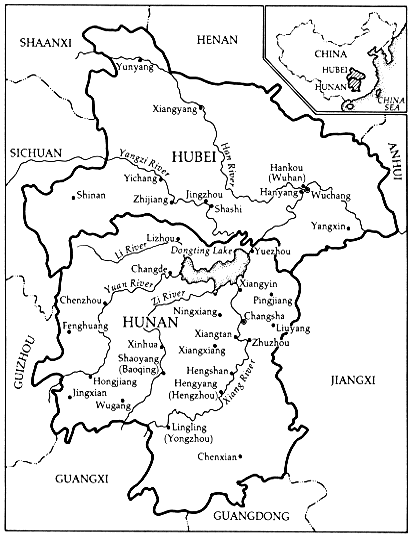
Map of Hubei and Hunan
Hubei and Hunan have traditionally had strong economic and political ties. Located at the juncture of the Yangzi and Han rivers, Wuhan (actually composed of three cities: the Hubei provincial capital, Wuchang; the commercial port of Hankou; and the industrial center, Hanyang) was historically the trade center for the entire central Yangzi region. Hunan was particularly tied into this regional trading network by geographical factors. The waters of all four of Hunan's
main rivers (the Xiang, the Zi, the Yuan, and the Li) converge around Dongting Lake and then flow via the Xiang River into the Yangzi River at the Hubei-Hunan border upstream from Wuhan. Trade thus flowed naturally along these waterways and helped forge strong commercial links between Hunan and Hubei. Historically, the close connections between these two provinces were reflected in political administration. During the Ming dynasty (1366–1644), Hubei and Hunan actually formed one province, Huguang. The separation of the two provinces occurred during the Qing dynasty (1644–1911), but even then they remained joined under the supervision of the Huguang governor-general, whose capital was at Wuchang.29 The existence of close geographical, economic, and political ties between Hubei and Hunan helps give this study more cohesion than would have been possible with a more arbitrary selection of two provinces. Study of these two provinces also benefits from the excellent foundation provided by Joseph Esherick's work on the 1911 Revolution in Hunan and Hubei, as well as other previous case studies of these provinces.30
Beyond the general case that might be made for the advantages of a combined study of Hubei and Hunan, my selection of these two provinces for a study of the emergence of warlordism was ultimately based on more specific methodological considerations. Provinces that have been the subject of past warlord studies have usually been located on China's periphery, heightening the problem of exceptionality.31 The choice of Hubei and Hunan was therefore a deliberate effort to redirect attention to central China in the hope of both increasing the validity of generalizations and aiding contrasts with previous provincial studies. These two provinces also provide instructive cases because they were frequently at the center of the successive political and military conflicts, beginning with the 1911 Revolution, that provided an important context for the rise of warlordism. In particular, the two provinces lay along a shifting boundary between centralizing efforts from Beijing and provincial attempts to defend local self-government that was at the root of many of these conflicts. The political tensions and divisions within this two-province arena in this era thus provide a greater comparative framework than might be assumed from the historical closeness of these two provinces. The comparative value of a study of these two provinces is also enriched by the diversity of military units, from central armies to local and provincial forces, found in Hunan and Hubei during this period. The frequency of military conflicts within these two provinces, linked to political struggles that often went beyond their borders, again played a role in the rise and fall of
various forces and the movement of different armies in and out of the region. Although more confusing than the cases of provinces where single warlords or warlord cliques maintained dominant positions for longer periods of time, the complexity of military forces in Hubei and Hunan presents a clearer picture of the dynamics that made military force the main determinant of political power.
Generalizations drawn from any case study, no matter how carefully chosen, can only be tentative. In the course of this study, it will become apparent that the experiences of Hunan and Hubei were in themselves unique in a number of respects. Neither province can be presented as totally representative of other provinces or of China as a whole. That caveat does not, however, reduce the value of this case study. Indeed, acknowledging the diversity found in these two provinces actually serves the purposes of this study by showing the manner in which the general process of warlordism unfolded in the context of varying local conditions.
1—
Late Qing Military Organization
Many commanders who emerged as warlords in the early Republican period began their military careers in the armed forces of China's last imperial dynasty. A brief outline of the late Qing military system is therefore a logical starting point for any investigation into the origins of Chinese warlordism. This task is complicated, though, by the considerable changes in military organization that occurred in the late Qing period. Beginning in the mid nineteenth century, a succession of internal and external threats compelled the Qing dynasty to seek ways to improve its military defenses, including the introduction of new forms of military organization. Beyond the issue of military efficiency, the creation of new military forces also altered the traditional arrangements by which the dynasty had ensured its control over its armies. The tension between these two objectives, military strength and military control, largely framed changes in military organization in this period.
The original Qing military system represented the culmination of long-standing efforts by the imperial Chinese state to ensure the political reliability of its armed forces. Reacting against previous historical usurpations of the imperial throne by military commanders, the Song dynasty (960–1279 A.D. ) and its successors commonly sacrificed some military efficiency to prevent a concentration of military power in individual hands. In the mid nineteenth century, the Qing dynasty reluctantly deviated from this policy. Faced with widespread rebellions that threatened its survival, the Qing court allowed the formation of new armies that achieved greater military effectiveness by relying on personally oriented command structures. In doing so, though, they also increased the power of military commanders. As noted in the Introduc-
tion to this study, some scholars have viewed the appearance of these new nineteenth-century armies as initiating a devolution of central power to regional military organizations, ultimately giving rise under the Republic to warlords who drew their power from these same personally oriented regional military bases. Some attention must be paid to the debate that has surrounded this theory because of its past influence in framing the study of warlord origins. On an empirical level, though, this theory cannot show a consistent causal connection between the regional military organizations it finds in the late Qing period and actual warlords under the Republic. Indeed, the theory's greatest weakness is a failure to account properly for the effects of more complicated changes in military organization that immediately preceded the fall of the dynasty and the rise of warlordism.
A second stage in the transformation of late Qing military organization occurred around the turn of the century in response to increased threats from Western and Japanese imperialism. In order to meet the challenge of foreign armies, the court approved the creation of new forces based organizationally on Western military models. By building an officer corps selected for its professional expertise in Western military science, and not for its particularistic ties, these new forces not only increased military effectiveness but lessened the dangers of personalism. Strictly in organizational terms, these Western-style forces reduced the problem of military control seen in earlier, personally oriented armies.
A survey of military forces in Hunan and Hubei shows that the efforts of the Qing dynasty to strengthen its military power through new types of military organization never resulted in the creation of a single, uniform national army. The Chinese army on the eve of the 1911 Revolution remained a confusing hodgepodge of forces, ranging from remnants of traditional armies to newer Western-style units. Since almost all of these forces were represented in later warlord armies, no particular form of military organization can be held completely accountable for the rise of warlordism. Late Qing military disunity was further complicated by the geographical division of military authority along provincial or regional lines. On the one hand, this situation reflected the inability of the late Qing court to provide the organizational and financial resources necessary for a cohesive national army. On the other hand, organizational fragmentation was yet another way in which the imperial state traditionally protected itself from military usurpations. Whatever advantages a fragmented military might have had for the imperial system, they quickly disappeared after
its demise. Military reforms, particularly the introduction of Western armaments, increased the relative coercive power of the Chinese army in Chinese society. In its fragmented state, though, the army was not prepared to act as a unifying national force in the face of political instability. Military intervention, when it occurred, would reflect the disunity of the military itself and thus contribute to fragmented political rule in the shape of warlordism.
The Traditional Qing Military System and the Rise of the Yongying
For the first two centuries of its existence, the Qing dynasty's army was divided into two distinct branches. The first branch was the Banner Army (baqi , literally the "eight banners"), an organization of hereditary soldiers established before the Manchu penetration of the Great Wall. This army was primarily a Manchu force in that most adult male members of the Manchu tribal population were enrolled in it, but elements of it were also culled from Chinese and Mongol subject populations. After the Manchu conquest of China proper, most of the Banner Army was concentrated in garrisons around Beijing as a capital guard. Another large portion, stationed in the northeast, protected the Manchu homeland. Finally, other Banner garrisons were located at strategic points throughout the provinces and along the northern frontier.1 The second branch of the Qing military was the Green Standard Army (lüying ). This was a predominantly Han Chinese force, formed after the Manchu conquest, largely modeled on the military organization of the preceding Ming dynasty. Charged primarily with the maintenance of local order, Green Standard troops were scattered throughout the country in small garrisons.2
One significant feature of the traditional Qing military system was its careful elaboration of checks and balances aimed at preventing the concentration of military power in a manner that might present a threat to dynastic rule. The separation of Banner and Green Standard armies was in itself an attempt to make each branch serve as a check on the other. Thus, no unified command was ever created over both of these branches, and each had its own distinct administration. Even the troop deployment of the two branches had a counterbalancing purpose. Although the Green Standard Army was over twice as large as the Banner Army, the Banner Army's larger, strategically placed garrisons served as a check upon the more fragmented Green Standard forces.3
Internal divisions of authority within each of the two military
branches also hindered any concentration of military power. The Banner Army derived its name from the individual "banners," or units, of which it was composed, each identified by its own distinctive colored flag. While each banner had its own separate command structure and bureaucratic administration, Banner Army garrisons were formed not by one banner but by a combination of forces taken from a number of different banners. Thus even within the dynasty's most loyal forces, organizational divisions weakened the power of individual garrison commanders. The lines of authority in the Green Standard Army were even more intricate. Provincial commanders-in-chief (tidu ) theoretically had direct command over all the Green Standard units in any one province. However, provincial governors and governors-general also had broad supervisory powers over the Green Standard forces in their territories, and sometimes even more direct command over specific Green Standard units. At the same time, the military authority of these two offices overlapped in a way not unlike the counterbalancing of their positions in the civil administration. Finally, in major military campaigns, special expeditionary forces were formed by combining a number of different units from both Banner and Green Standard armies. The commanders of such campaigns were often appointed, not from among the officers of any of its component forces, but from the ranks of the civil bureaucracy. Thus, the traditional organization of Qing armies blurred military authority and chains of command in such a way as to hinder the accumulation of military power in the hands of any one official or any one military officer.4
Beyond the division of authority between and within its two military branches, the Qing court also relied on other measures to enhance dynastic control over its armies. First, the court appointed most military officers directly, thus keeping them dependent on imperial favor. As with civil officials, Green Standard commanders were not allowed to serve in their home provinces. This "law of avoidance" hindered possible combinations of military power with local interests. At the same time, frequent rotation of military officers at all levels prevented the establishment of close ties among officers, or between officers and their men. Finally, all military units were kept financially dependent by direct funding from the central Board of Finance. By such policies the dynasty carefully guarded against the development of independent personal or local bases of power within the military.5
While the complicated system of checks and balances within the Qing armed forces protected the dynasty from a military threat from below, it also reduced military effectiveness by hindering coordination
and initiative. The advantages of the traditional system might have offset its disadvantages if the quality of the troops themselves had remained high. Unfortunately for the dynasty, the fighting ability of both Banner and Green Standard forces deteriorated steadily over the course of the eighteenth and nineteenth centuries.
The Banner Army began to decline soon after the Manchu conquest of China was completed. The quality of Banner officers suffered inasmuch as talented Manchus found better career opportunities within the dynasty's civil administration, leaving less able men in command of Banner forces. With fewer wars to fight, sedentary garrison life also quickly blunted the military skills and martial ardor that had originally characterized the frontier soldiers of the Banner Army. Banner soldiers, forbidden to leave military service for other occupations, were also demoralized by policies that kept their pay constant despite rising prices. By the mid eighteenth century the Banner Army had become an indolent force that could no longer be relied on to meet the dynasty's defensive needs.6
Green Standard forces maintained their effectiveness for a longer period, but they also suffered from officers who ignored military training and lined their pockets with cuts from their men's already low pay. In order to survive, Green Standard soldiers were forced to moonlight; often they simply deserted. This only encouraged further embezzlement by officers who maintained the fiction of full-strength units. By the nineteenth century, many Green Standard units were reduced to one-half, and in extreme cases to one-sixth, of their official size.7 In 1851, officials responding to a call for counsel from the Xianfeng emperor recited a familiar litany of the problems besetting the dynasty's armies: underpaid and abused soldiers, corrupt officers, padded enrollments, and neglected training.8
The serious consequences of the decline of the Qing army did not become fully apparent until the mid nineteenth century, when the dynasty faced a conjunction of serious external and internal military threats. The Opium War (1839–42) initiated a period of more forceful Western pressure on China to open up to foreign trade and religious proselytization. China's defeat in this war exposed the weak and demoralized condition of its armies and raised questions about the Qing dynasty's ability to provide more than minimal defense, but Western military threats were for a time blunted by treaty concessions. A more serious challenge came from a series of internal rebellions, the most significant of which was the Taiping Rebellion (1851–64). The steady defeat of both Banner and Green Standard forces by Taiping armies
endangered the very existence of the dynasty. The crisis of the Taiping Rebellion forced the dynasty to abandon some of its military traditions in order to experiment with new and more effective types of military organization.
As its armies fell back before the spread of rebellion, the court's attention was drawn to the only forces that were showing some success against the rebels, namely, militias (tuanlian ) and more highly militarized local mercenary corps (xiangyong , literally "village braves") raised by local elites for community self-defense. The dynasty conceded that its best hope for survival might lie with these local units. At the same time, it also retained ambiguous feelings about the existence of armed forces outside the more carefully controlled traditional military system. Thus while officially approving the organization of local forces, the court also sent a number of high civil officials back to their home provinces as "militia commissioners" to supervise, and ensure the loyalty of, these forces. One of these commissioners, and the most important person in the subsequent development of new military forces, was Zeng Guofan. Returning to his native Hunan in 1852, Zeng realized that purely local-level militarization would be insufficient to defeat the Taipings. While retaining the fiction that he was simply promoting militia recruitment, Zeng set about creating a new and larger military organization. By absorbing local mercenary corps and new recruits, Zeng eventually raised over 130,000 men for his Xiang (Hunan) Army. This army became the model for the formation of other similar forces, the most important of which was Li Hongzhang's Huai (Anhui) Army. These new forces, the yongying (literally "brave battalions"), provided the military power that finally defeated midcentury rebellions and restored peace to the empire.9
One reason for the success of the yongying was an organizational structure that provided a degree of cohesion lacking in Banner and Green Standard forces. Departing from the depersonalized bureaucratic structure of the traditional military system, yongying leaders like Zeng and Li chose their own subordinate commanders, often from among their relatives, friends, or classmates. These commanders then selected their subordinate officers, who in turn personally supervised the recruitment of their soldiers. Reflecting this personally based organization, yongying units at the lowest level were often identified by the names of the men who both recruited and led them. Yongying units were in fact so closely identified with the men who formed them that they often had to be disbanded upon their deaths. As a further cohesive measure, individual yongying units were usually recruited from
specific localities, and the army as a whole from one particular region or province. As seen in the names of Zeng Guofan's Xiang Army and Li Hongzhang's Huai Army, the regional bases of the yongying also became one of their identifying characteristics. Yongying units were therefore bound together by a chain of consciously promoted personal loyalties and local ties. These particularistic features of yongying organization fostered better coordination among officers, closer relations between officers and men, and higher overall morale. At the same time, an uncomplicated pyramidal organizational structure permitted an efficiency of command that was impossible under the traditional military system. The formation of the yongying provides an interesting example of a situation where a search for military effectiveness led to rejection of more impersonal, bureaucratic organizational features that would normally be considered more "modern" and hence more effective.
While the organizational features of the yongying had undeniable military advantages, they also gave an unprecedented amount of power to yongying leaders. First, these leaders were largely free of the overlapping checks and balances that had limited the military authority of army commanders under the previous military system. Second, since these commanders personally controlled recruitment, appointments, and promotions in their armies, they were able to ensure a high level of personal loyalty from their subordinate officers and men. Finally, measures taken to meet the financial and administrative needs of the yongying also served to increase the powers of their commanders. The financially strapped court could not provide sufficient funds to meet the basic needs of these new military forces, let alone maintain the high pay standards needed to preserve troop morale. Therefore, following precedents established in the financing of local militias, yongying commanders gained permission to impose local commercial taxes, called lijin , for the support of their armies.10 These taxes provided yongying commanders with funding sources largely independent of central control. At the same time, by becoming the paymasters of their own armies these commanders again strengthened their personal control over their men. To administer the personnel, logistical, and financial needs of his army, Zeng Guofan also expanded his personal secretariat (mufu ) into a sophisticated private bureaucracy.11 Other yongying leaders followed Zeng's example in creating large support staffs that remained largely free of central bureaucratic control.
As the value of the yongying became clear, the Qing court pro-
moted many yongying commanders to governorships and governor-generalships, giving them further powers to marshal local resources to meet the needs of their armies. Such commanders thus extended their authority from their military commands into civil administration. Other yongying commanders and officers were also rewarded with other civil titles and appointments. As a result, in the postrebellion period a large number of high court and provincial posts were in the hands of men with yongying backgrounds. Top yongying leaders like Zeng Guofan and Li Hongzhang would emerge as the empire's leading statesmen. In the context of the midcentury rebellions, new forms of military power had thus become a medium for political advancement.
The principle behind the traditional system of military organization had been to prevent the concentration of power in the hands of military commanders. Military exigency in the mid nineteenth century forced the dynasty to modify this principle and allow an unprecedented aggrandizement of military, financial, and administrative powers by yongying leaders. Although these new forces may have saved the dynasty from defeat at the hands of internal rebels, the court's acceptance of these personally oriented organizations was something of a political risk. In the end, only the yongying commanders' loyalty to the Qing ensured the commitment of their armies to dynastic interests. Except for this loyalty, the personal military power of yongying leaders in many respects resembled that of warlords under the Republic. It is hardly surprising, then, that some scholars have seen the rise of yongying as a pivotal event that led inexorably both to the collapse of the Qing dynasty and to the rise of warlordism.
The Political Legacy of Yongying Organization
In studies published in Chinese in the 1930s, Luo Ergang first linked the origins of warlordism to the development of the yongying . Luo particularly focused his attention on the personalization of military power that was manifested in yongying organization. According to Luo, the yongying were not national armies; rather, they "belonged" to their commanders. While this personalization of military power in itself undermined the central power of the court, it had an even greater political effect when yongying commanders obtained posts as governors or governors-general and thus gained control over provincial administrations and finances. According to Luo, the possession of personal armies allowed late Qing governors and governors-general to emerge as provincial "dictators" capable of resisting central orders, or even threatening the court, in the pursuit of their own interests. The
rise of the yongying therefore resulted, not only in the loss of central control over military force, but in a broader devolution of central political power to provincial governors and governors-general.12
Luo Ergang's interpretation was further elaborated, and introduced to Western scholars, through the work of Franz Michael. Michael's main contribution was the development of the concept of "regionalism" to describe the decline of central power that began with the formation of the yongying . According to Michael, "regional leaders" such as Zeng Guofan and Li Hongzhang "organized their own military forces in their home regions, combined this locally-based military power with political organizations loyal to them, and drew their financial support from the regions they occupied. These regional organizations provided their leaders with bases of autonomous power."13 Thus, for Michael, the personal military power provided by the yongying , which he refers to as "regional armies," was responsible for a broader "regional" combination of military, administrative, and financial powers by yongying commanders. Michael also notes that the ascension of these commanders to positions as governors and governors-general institutionalized the autonomous power bases they had created as army leaders.14
Both Luo and Michael maintain that the personalist organization of the yongying became an enduring characteristic of Chinese military organization from the mid nineteenth century on. It both created regional autonomy under the Qing and served as the foundation for warlordism after the fall of the Manchu dynasty. Thus the rise of warlordism is directly connected to changes in military organization that began in the mid nineteenth century. "The situation of 'soldiers belonging to the generals' began with the military expansion during the reign of the Xianfeng emperor [1851–61]," Luo observes. "Undergoing a number of developments, this situation led first to the dufu (governors and governors-general) of the Guangxu reign [1875–1908], and then progressed further to create the regionally separate warlords of the Republican period."15 Michael likewise sees Republican warlords as the direct heirs of nineteenth-century regional leaders. "Regional power, once established, eventually held its own," he notes. "The organizations of Tseng Kuo-fan [Zeng Guofan], Li Hung-chang [Li Hongzhang] and other regional leaders of the nineteenth century marked the beginning of the disintegration of dynastic power that finally led to the collapse of the dynasty and to the system of warlordism that replaced it."16 One appeal of the Luo-Michael thesis is that it sees warlordism as the result of a lengthy process of general political
decline rather than as a temporary aberration. The widespread influence of this theory is seen in its frequent citation in both general textbooks and specialized studies of warlordism.17
This interpretation of the origins of warlordism has not gone completely unchallenged. Criticism of the thesis, however, has come not from the field of warlord studies but from scholars of late Qing political and military organization. These scholars have argued convincingly that the personal powers of the midcentury yongying commanders, and later governors and governors-general, were never as great nor as autonomous as portrayed by Luo and Michael. To the extent that these scholars present a different view of late Qing political structure, they also challenge the suitability of the Luo-Michael thesis as an explanation of the origins of warlordism.
Ralph Powell, Wang Ermin, and Liu Kwang-ching have all questioned the tendency of the Luo-Michael thesis to discount the loyalty of the yongying commanders to the dynasty as a factor enabling the court to maintain considerable central control. According to these scholars, as long as the legitimacy of the Qing emperor was recognized, the court retained key central powers, which were effectively used to hinder the development of regional political autonomy.18 The most important of these powers was that of appointment. First, the appointments of yongying commanders as provincial governors and governors-general need not be seen as the court's de facto recognition of the power of military commanders who had gotten beyond its control. Chinese emperors traditionally used senior civil posts as rewards for men who had performed significant military services for the dynasty. Such appointments did not therefore automatically signify a devolution of central power. Second, up to the fall of the dynasty, the court proved quite capable of transferring or removing these top officials at will. Even though some leading figures, such as Zeng Guofan and Li Hongzhang, had lengthy tenures in important posts, Liu Kwang-ching has shown that most provincial governors continued to be rotated on a regular basis. Finally, Liu also notes that although the governors were largely able to select yongying officers and staff for their expanded personal secretariats, the dynasty maintained its power of appointment over most regular military and civil bureaucrats.19 Under these circumstances the autonomy of provincial governors does not appear to have been as great as Luo and Michael would have us believe.
Although the considerable degree of independent military power exercised by yongying commanders during the period of rebellion is sel-
dom denied, critics have also noted that the lack of central authority over these forces was not as complete or as lasting as claimed by the Luo-Michael thesis. This is most notably seen in the court's ability to order drastic reductions in yongying strengths after the rebellions ended. Indeed, in the case of Zeng Guofan's Xiang Army, the demobilization was nearly complete. The dynasty furthermore retained ultimate authority over the deployment of the yongying and was able to enforce the transfer of forces from one province to another over the opposition of provincial governors. Liu Kwang-ching has also shown that the court increased bureaucratic control over many yongying officers by giving them concurrent appointments in the Green Standard Army.20 Thus the court had means to assert its authority over the yongying and did so with some success.
Some scholars have also raised questions about the supposed financial independence of yongying commanders and late Qing governors and governors-general. David Pong's study of military financing in Jiangxi Province during the Taiping Rebellion shows that yongying commanders such as Zeng Guofan were indeed able to gain unprecedented control over certain revenues, such as the lijin . Nonetheless, he also shows that these sources of income were never sufficient for their needs. In the end, Zeng remained dependent on the court for access to provincial revenues from Jiangxi and other provinces to meet his military expenses.21 Liu Kwang-ching also notes that the court never lost its power to approve financial disbursements and by this means prevented the yongying commanders from achieving complete fiscal independence. Furthermore, he shows that after the suppression of the rebellions, the central government gained access to a large portion of the revenues from new provincial sources such as the lijin by demanding special remittances for central expenses. Thus, the special sources of income created to support the yongying did not become the exclusive financial preserves of the post-Taiping governors and governors-general.22
Franz Michael's concept of the development of regionalism is considerably weakened by the picture of more limited autonomy of yongying commanders and provincial governors presented by these scholars. In a study of the Huai Army, Wang Ermin goes even further, raising questions about the application of the concept of regionalism to the yongying . Although their officers and men were predominantly drawn from one province or area, the yongying often campaigned or were stationed in other provinces. Wang notes that the Huai Army was never stationed in Anhui, where it had originally been formed,
and was eventually scattered, on court orders, over a number of provinces. Likewise, in spite of its Anhui origins, the Huai Army received financial support, not from the province of Anhui, but from Li Hongzhang's main financial base in Jiangsu. Thus, according to Wang, aside from their original recruiting bases, the "regional" character of yongying forces is not easily identifiable. In the end, Wang is unwilling to characterize yongying commanders like Li Hongzhang as nascent warlords controlling autonomous regional power bases. Instead, he proposes that yongying leaders simply used their positions to build "military factions" (junxi ) that were little different from the personal political factions commonly found in the Chinese bureaucracy in any dynastic period.23
Finally, scholars studying the role of provincial governors and governors-general in the late Qing political structure have challenged the view embedded in the Luo-Michael thesis of an oppositional relationship between these officials and the central government. While not ignoring the contradictions that often existed between the court and its provincial officials, these scholars offer convincing evidence that late Qing governors and governors-general generally acted more as centralizing agents than as autonomous "regional leaders" undermining central power. According to Wang Ermin, the powerful military organization created by Li Hongzhang in northern China while he was Zhili governor-general served dynastic policy aimed at increasing military strength in the capital area. Li's power was thus not organized in opposition to the central government but in support of it.24 Liu Kwang-ching complements Wang's conclusions with a study of Li Hongzhang's role as leader of the "self-strengthening" reform movement. On the one hand, according to Liu, court support remained essential for the implementation of Li's modernizing program. On the other hand, with this support Li performed central government functions in pursuit of clearly national goals.25 Daniel Bays reaches a similar conclusion about another leading Qing provincial official, Zhang Zhidong, during his tenure as governor-general at Canton (Guangzhou). According to Bays, Zhang could not act independently of imperial sanction, and his power depended less on any personal power base than on imperial favor. As governor-general, Zhang pursued national goals and acted as an agent for central interests. In this regard he often conflicted with, rather than represented, entrenched local or regional interests.26 Livingston Merchant has even shown how the Qing court used the establishment of a new governor-generalship over the three northeastern Manchurian provinces in 1907 to strengthen both central
and civil control over the region.27 Given such evidence, it is untenable simply to view late Qing governors and governors-general as autonomous regional "dictators" who accumulated power at the expense of the Qing court.
The critics of the Luo-Michael thesis do not deny that late Qing provincial governors and governors-general were in some regards more powerful figures than their pre—Taiping Rebellion predecessors. Their studies, however, reflect a more complicated understanding of the sources of late Qing political power beyond the control of personal military forces. In particular, late Qing governors and governors-general gained power through their leadership in various "self-strengthening" or reform programs. While these programs depended on court support and served national aims, the governors who were most successful in their promotion also obtained a larger share of national and local revenues and control over the personnel of new agencies outside the regular bureaucracy. At the same time, leadership in these programs resulted in the creation of power not so much at expense of the central government as through the general expansion of state activity.
The strength of late Qing governors and governors-general does suggest a more indirect factor that may have influenced the later rise of warlordism. When military commanders in the Republican period took control over provincial governments, they quite naturally looked to late Qing governors and governors-general as models that allowed for a strong executive with broad authority over both military and civil administration. The only difference was that provincial warlords were able to operate in the absence of the central controls that had restricted the autonomy of their late Qing predecessors.
On a more general level, the combined civil-military authority granted late Qing governors also reflected a mutual permeability between civil and military spheres in late imperial China that may have had some influence on later warlordism.28 At least in principle, Chinese tradition praised the combination of civil and military talent in cultivated gentlemen.29 Chinese officials were generalists, expected to be competent in both civil and military affairs. As seen in some instances described above, civil officials were often given supervisory powers, or even direct command, over military forces. Similarly, members of the civilian gentry led the way in the organization of the yongying . Conversely, successful military commanders might be rewarded with civil titles or posts. Within this cultural and institutional tradition, the assumption of civil powers by military men in the Re-
public was not necessarily looked upon askance. At the same time, however, the mutual permeability of the civil and military spheres cannot in itself be seen as causing warlordism. Indeed, this permeability obviously allowed a flow in two directions. While it may have lowered inhibitions against the rule of military men in the Republic, for most of the late imperial period this permeability functioned more to maintain civil control over the military.
Returning to the issue of the legacy of the yongying , the more detailed research that has emerged since Luo and Michael presented their views suggests that they may have exaggerated the effects of yongying organization on late Qing political structure. The works of revisionist scholars generally fail to support the conclusion that the formation of the yongying was responsible for a serious decline of central power and the rise of autonomous regional power bases. However, one further aspect of the Luo-Michael thesis remains to be explored: the effect of the yongying on subsequent Chinese military organization. It is, after all, the similarities between the personally oriented yongying and the private armies of the warlords that appear to be the strongest sign of a causal relationship between mid-nineteenth-century changes in military organization and the rise of twentieth-century warlordism. However, to show this linkage, continuity must also be traced through the intervening military developments of the late Qing period.
Military Self-Strengthening in the Late Nineteenth Century
Despite the obvious superiority of the yongying to the Banner and Green Standard armies in the suppression of mid-nineteenth-century rebellions, the yongying never completely replaced these more traditional forces. Vested interests within the older armies were one obstacle to this, but the Qing court also had its own reasons for opposing the total elimination of its traditional forces. Even in their weakened condition, the Banner and Green Standard armies could still serve dynastic purposes by acting as a check on the yongying . The rise of the yongying did not, therefore, lead to the total transformation of the Qing military system but simply added a third branch to it.
The ability of Banner and Green Standard forces to counterbalance the yongying would be limited, however, if they remained in their deteriorated condition. Thus in the 1860s and 1870s several attempts were made to strengthen and retrain some Banner and Green Standard units to a level more equal to the yongying . Because inertia in the Banners proved to be almost impossible to overcome, most of these
attempts focused on the Green Standard Army. Zeng Guofan, while serving as governor-general of Zhili Province, provided the model for the reform of the Green Standard Army through the application of certain yongying features, such as more simplified organization, higher pay scales, and more rigorous training. With dynastic encouragement, a number of provinces followed Zeng's lead in an attempt to revitalize all or part of their Green Standard forces, which were then designated the lianjun , or "Trained Armies." In the end, though, these efforts met with only limited success. In most areas, the lianjun , like the Green Standard Army, continued to be relegated to the task of preserving local order, while the yongying remained the dynasty's real defensive force.30
In general, the main focus of military reform in the second half of the nineteenth century was not military reorganization but the spread of Western military technology. Despite the dynasty's eventual success in quelling internal rebellions, China's 1860 defeat in the Anglo-Chinese War was a reminder of its continued vulnerability to foreign threats. Even as they emerged as the dynasty's strongest forces, the yongying remained vastly inferior to the armies of the foreign powers. Therefore, as part of a more general program of self-strengthening, the dynasty approved a number of measures aimed at revitalizing its armed forces through the adoption of Western armaments.
The Qing dynasty's military self-strengthening was a comprehensive effort that involved both its naval and land defenses. On the naval side these efforts entailed nothing less than the creation of a modern navy based on Western models. By 1894 this new navy consisted of sixty-five warships and forty-three torpedo boats.31 Efforts to strengthen the dynasty's land armies focused primarily on introduction of modern Western military weaponry into established forces. Some yongying had been partially equipped with Western arms during their struggle against midcentury rebellions, and this was another factor in their effectiveness. With the restoration of peace, concerted efforts were made to arm all armies, including Green Standard and Banner forces, with modern weaponry. One problem the Chinese faced in these efforts was their dependence on foreign armament sources. Therefore, another goal of the self-strengthening movement was to lessen this foreign dependency by the construction of arsenals, or factories, for the manufacture of modern weapons and ammunition. By 1894 there were nearly ten such arsenals, the most famous of which was the Jiangnan Arsenal, established by Li Hongzhang at Shanghai in 1867.32 The production of these arsenals, however, was uneven and never
completely met the needs of China's armies. In the end, many Chinese soldiers, especially those in unreconstructed old-style forces, continued to be armed with traditional weapons.
One of the greatest obstacles to China's military reforms in this period lay in the quality of its officer corps. The effective introduction of Western weapons hinged on the training provided to the soldiers who were to use them. Although some training was initially provided by hired foreign instructors, this function ultimately had to be taken over by China's own officers. On the whole, Chinese officers proved ill-suited to this task. Non-yongying officers continued to be chosen through a traditional military examination system that, except for some rote memorization of passages from military classics, mainly emphasized physical prowess in certain martial skills, such as archery, horseback riding, and weight-lifting. The products of this system were poorly equipped either to understand or to adapt to changes in military technology. Because many yongying officers had come from the ranks of the civilian gentry, they were generally better educated than the products of the military examination system. At the same time, they seldom had any specialized military training. Many of these men also exhibited the civil elite's traditional disdain of the military and saw participation in military drill as a demeaning exercise.33 Thus, in all branches of the military, training remained lax and officers continued to respond slowly to the new demands placed on them by the introduction of Western technology.
In the mid 1880s, the establishment of two military academies based on Western military instruction marked an effort to provide a more thorough remedy for the deficiencies of the Chinese officer corps. The first academy was established by Li Hongzhang in Tianjin in 1885 and the second by Zhang Zhidong in Canton in 1887. Both academies used German instructors to train a small number of officers in Western military practices. Although the establishment of these academies was an important step, their graduates were still too few to effect a real transformation of the Chinese officer corps.34
In the end, military reforms in the late nineteenth century were half-measures that proved incapable of meeting the dynasty's defensive needs. Attempts to revitalize the Banner and Green Standard armies failed to bring them up to yongying standards. They remained more of a burden on the dynasty's resources than an aid in its defense. Very quickly, the yongying also began to show signs of degeneration similar to that which had occurred earlier with the Banner and Green Stan-
dard armies. Indeed, the close relations among officers that gave the yongying their cohesion also made it difficult to enforce discipline or prevent corruption. Some progress was made in the introduction of modern Western arms, but inadequate training, the poor quality of the officer corps, and the preservation of organizational forms ill-suited to new military technology reduced the impact of these new weapons on Chinese military efficiency.35 While the rise of the yongying and subsequent military reforms enabled the dynasty to keep internal order, in the long run they proved incapable of defending the nation against foreign armies.
The Organization of the New Armies
The real test of the effectiveness of the military self-strengthening reforms of the late nineteenth century came with the Sino-Japanese War of 1894. The army and navy units that bore the brunt of this war were considered China's best, namely, Li Hongzhang's Huai Army and the Beiyang, or "Northern," Navy. Nonetheless, the outcome of the war showed that the best was not good enough. The Huai Army was shattered and the Beiyang fleet totally destroyed. The shock and humiliation of this defeat by a much smaller Asian nation acted as a catalyst for even more fundamental military reform. At the same time, the efficiency of Japan's more thoroughly Westernized army showed the direction these reforms would have to take.
Two strong proponents of Western military organization, Zhang Zhidong and Yuan Shikai, provided leadership for this next stage of military reform. In 1895, Zhang established a new force, the "Self-Strengthening Army" (Ziqiangjun), at Nanjing, while Yuan formed the "Newly Created Army" (Xinjianjun) in Zhili Province.36 With court approval, these units were the first military forces in China to be based entirely on Western models. Thus, these armies were not only equipped and trained with Western arms, but were also organized along the lines of Western armies. The simple yongying pyramidal structure was abandoned in favor of a functional division of units adapted to the use of advanced military technology. Thus, following German tables of organization, both armies were divided into three main branches—infantry, cavalry, and artillery—along with separate engineering and other technical components. German officers were employed to aid in the initial training and organization of these new units. To maintain the high quality of their armies, both Zhang and Yuan also emphasized careful recruitment, strict discipline and train-
ing, and generous pay. Nonetheless, their adoption of modern European military organization was the most radical and significant feature of the Self-Strengthening and Newly Created armies.
For a number of years, the Self-Strengthening and Newly Created armies remained experimental units with little impact on the Chinese military system as a whole. China's humiliation at the hands of the foreign armies sent to suppress the anti-foreign Boxer Uprising in 1900 provided the stimulus for further military reorganization. The Self-Strengthening and Newly Created armies then became models for the establishment of other Western-style armies, conventionally labeled the "New Armies" (xinjun ) by scholars.
The most important of the New Armies was the Beiyang Army built by Yuan Shikai after he succeeded to the Zhili governor-generalship following the death of Li Hongzhang in 1901. With the Newly Created Army as its core, the Beiyang Army grew by new recruitment and the incorporation of other forces (including the Self-Strengthening Army), until by 1906 it contained six divisions.37 Beginning in 1901, the dynasty also developed a series of plans aimed at the establishment of Western-style forces in every province. In 1901, a weeding-out process was initiated within yongying, lianjun , and unreconstructed Green Standard forces. The best troops were to be reorganized along Western lines as provincial "standing armies" (changbeijun ), the second best were to be reorganized as reserve or constabulary units, and the worst were to be disbanded. The standing armies, usually expanded by new recruitment, became the foundation for provincial New Armies. In late 1903 a Commission for Army Reorganization was established to centralize military policies and to standardize the organization of the New Armies. In 1906 the commission unveiled a ten-year plan setting the size of Western-style New Armies in each province, and establishing a goal of thirty-six divisions for the entire nation.38 By 1911 considerable progress toward this goal had been made. Although few New Army units ever reached their full strength, seventeen New Army divisions and twenty independent infantry or mixed brigades were established.39 Although only in existence for a few years, by 1911 these new forces became the dynasty's main military force.
Beyond changes in organizational structure, another important measure that accompanied the development of the New Armies, and contributed to their superiority, was a greater commitment to the creation of a professional, Western-trained officer corps. This also reflected the acceptance of a more "scientific" or intellectual approach to military education than was seen in China's traditional military organizations.
Before the turn of the century, the only new additions to the military academies founded by Zhang Zhidong and Li Hongzhang in the 1880s were a few schools established by Zhang and Yuan Shikai in the late 1890s to provide officers for their Western-style forces. In 1901 the court finally abolished the traditional military examination system and ordered the establishment of military academies in every province. Promising students were also sent abroad, particularly to Japan, for higher military educations. In 1904, the Commission for Army Reorganization issued a more complete plan for a nationwide system of military education. Following Japanese models, military primary schools were to be established in each province, secondary schools in four major cities, and officer and staff colleges in the capital area. By 1911, most of this system was in place and graduates of Western-style military schools began to fill positions in the New Armies.40
The Luo-Michael thesis discounts the changes that occurred with the formation of the New Armies and instead finds only the continuation of trends seen in the organization of the yongying . Since they were still organized provincially, the New Armies are perceived as the personal armies of governors and governors-general, and as serving as the basis of continued regional autonomy. The New Armies, then, are simply viewed as transformed yongying providing a bridge to the later private armies of the warlords.
The case of Yuan Shikai and the Beiyang Army is usually singled out as the most important example of this linkage. Since Yuan succeeded to Li Hongzhang's posts as Zhili governor-general and commissioner of northern trade in 1901, he is seen as the direct heir to Li's regional organization. Yuan's Beiyang Army is likewise seen as a yongying offshoot, since initial recruits for Yuan's Newly Created Army were culled from Li's Huai Army. Despite Yuan's use of German military organization, Luo Ergang notes that Yuan's personal control of the Beiyang Army resulted in a situation "that was in fact not the slightest bit different from that created by the Xiang Army system."41 In the end, the Beiyang Army is seen as providing Yuan with the personal military base he later needed to seize political power as president of the Chinese Republic. Likewise, the emergence of Yuan's Beiyang Army subordinates as warlords after his death is seen as the result of their inheritance of the fragments of his regional military organization. Thus the perpetuation of yongying -style military organizations is presented as leading directly to warlordism.
In an effective extension of earlier critiques of the Luo-Michael
thesis, Stephen MacKinnon has challenged the above interpretation with his own studies of Yuan Shikai's rise to power and the development of the Beiyang Army.42 First, MacKinnon has shown that Yuan's power over the Beiyang Army was more limited than usually assumed. "Although Yuan Shih-k'ai [Shikai] had considerable influence over the Peiyang [Beiyang] Army, the central government in Peking [Beijing] had ultimate financial and administrative control," he observes. "Yuan's influence over the army depended upon the strength of his political position in Peking and not upon his control of an autonomous regional base in Chihli [Zhili]."43 MacKinnon notes that Yuan's own financial resources were insufficient to meet the needs of the Beiyang Army. Expansion, or even maintenance, of the Beiyang Army was only possible because of court support that ensured the allocation of other funds for Yuan's use. Yuan's ability to obtain this financial support, and to maintain administrative control of the Beiyang Army, was dependent on his influence over the Empress Dowager and his facility at court politics.44
Second, MacKinnon rejects the idea that Yuan Shikai controlled a regional base autonomous from the central government. Rather, Yuan was a nationalist who "saw the salvation of the Chinese nation in the creation of a strong, centralized state."45 When combined with the previously cited revisionist studies of late Qing governors and governors-general, MacKinnon's interpretation suggests a more sophisticated picture of the structure of power in the late Qing period than a steady devolution of power to regional military leaders. Indeed, MacKinnon proposes an alternative model of "three simultaneously expanding and overlapping modes of power" at central, provincial, and local levels.46
Finally, MacKinnon uses the case of the Beiyang Army to address the issue of the personal organization of military power that supposedly linked the New Armies to the private armies of the warlords. According to MacKinnon, the centralized and functionally divided structure of the Beiyang Army followed "comparatively modern professional bureaucratic lines" that contrasted sharply with the simple, personalized organization of the yongying .47 At the same time, these organizational differences were also accompanied by a reduction of the personalism that had characterized the yongying . For example, MacKinnon shows that Beiyang officers were regularly rotated. This functioned to eliminate the ties of personal loyalty within specific units between soldiers and officers, and between lower officers and their superiors. Furthermore, whereas yongying officers were selected on the
basis of personal or regional connections, Yuan emphasized military education and training in the recruitment of his officers. Because of their independent military qualifications, MacKinnon finds that their loyalty to Yuan was based more on professional expediency than on personal loyalty. In conclusion, given its dependence on court financing and support and its modern organizational structure, MacKinnon argues that the Beiyang Army was a "national" rather than a "private" army.48
MacKinnon's study of the Beiyang Army shows that the Luo-Michael thesis assumes a continuity in Chinese military organization that ignores the fundamental changes that took place in the formation of the New Armies. In their organization, the New Armies more closely resembled the Western and Japanese armies of their day than the earlier, personally oriented yongying . This was not true merely of Yuan's Beiyang Army. Donald Sutton's study of the Yunnan Army also notes that this New Army "entered the Republic with an essentially modern, non-private structure."49 To a large extent, then, the development of New Armies marked a rejection, not a continuation, of yongying organizational features. Contrary to the claims of the Luo-Michael thesis, the New Armies cannot be shown to have been a vehicle for the transmission of the principles of personalist organization from the yongying to later warlord armies.
Although the perpetuation of personalist military organizations may not have been responsible for the rise of warlordism, it is still possible to see some significance in the appearance of personalist structures in both mid-nineteenth-century yongying forces and later warlord armies. Personalism as an organizing principle of Chinese military organization was a recurring pattern in times of state weakness, sufficiently so for precautions to be erected against it in the late imperial military system. On a deeper level, the problem of personalism in the military was simply one manifestation of a fundamental tension in the traditional Chinese state between the social values of Confucianism, with its emphasis on personal relationships, and the bureaucratic interests of the imperial government. In this regard, while personalism may not have been the primary organizing principle in the New Armies, it may be going too far to say that it was totally eradicated in the relations between New Army commanders and their subordinates. Some scholars have indeed criticized MacKinnon for underestimating the personalist ties Yuan fostered by patronizing young officers in his army.50 Nonetheless, too much can be read into such personal ties, which after all are not uncommon in the functioning of
any organization. The rise of warlordism was not predicated on the continuing and growing strength of personalist organizations within China's military forces. Rather personalism reappeared as a stronger organizing force in Chinese armies as emerging warlords gained political autonomy.
Although the establishment of the New Armies initiated a major transformation of China's military system, they never completely supplanted the empire's older forces. The Banner Army in particular survived with very little change. Periodic efforts were made to incorporate some Banner troops into the new military system, and one of the Beiyang Army's six divisions was formed from retrained bannermen. But in general it was acknowledged that there was little to be salvaged from the Banner Army. In 1907 a decree was finally issued calling for the gradual disbandment of the Banner garrisons and ordering bannermen to seek civilian occupations. Nonetheless, the Qing court found it nearly impossible to free itself of its obligations to the Manchu bannermen, and by 1911 almost no progress had been made toward this goal.51
More success was achieved in the reduction of non-Banner forces. As already noted, the 1901 orders initiating the establishment of Western-style provincial armies began the process of weeding out and demobilizing the worst of the older provincial forces. According to the plan formed at that time, 20 to 30 percent of the empire's Green Standard and yongying troops were slated for disbandment.52 In 1907 the Commission on Army Reorganization reiterated the intention to disband the worst of these troops and reorganize the remainder, along with better-quality recruits, into provincial "Patrol and Defense Forces" (xunfangying ). These units were to do double duty as a constabulary in times of peace and as reserve forces for the New Armies in times of war. Like the New Armies, they were to be equipped and trained with modern weapons. Because of the priority given to the New Armies in training and weaponry, most Patrol and Defense Forces fell far short of the new standards expected of them. Nonetheless, by 1911 Patrol and Defense Forces had been established in most provinces and they became a semimodern military presence between the New Armies and the remnants of old-style forces that remained scattered across the country.53
One of the peculiar features of military reform in late Qing China, especially when contrasted with countries like Japan, was its failure to establish a single, unified national army. Certainly, vested interests as well as central administrative and financial difficulties slowed the
elimination or reorganization of old-style forces. Nonetheless, the preservation of some old-style units, along with the formation of Patrol and Defense Forces, also revealed a continuing reluctance to concentrate all military power in one organization. Purely in terms of military strength, there could be little argument against the advantages of a unified army. At the same time, the fragmentation of military power as a means of maintaining dynastic control over the military was a tradition not easily repudiated, and a strategy that continued to have some validity. Indeed, with the outbreak of the 1911 Revolution, the dynasty relied on loyal but weaker old-style forces to counter rebellious New Armies in some provinces. The failure of this effort suggests that dynastic interests might have been better served by giving more attention to counterbalancing forces. In any case, the disunited state of the Chinese army was an important military legacy of the Qing dynasty for the succeeding Chinese Republic. The specific configuration of military forces in the provinces of Hunan and Hubei on the eve of the 1911 Revolution gives a clear picture of the nature and extent of this military fragmentation.
Provincial Military Organization in Hunan and Hubei on the Eve of the Revolution
One particular feature of the fragmentation of China's armed forces grew out of the imperial court's decision to rely on provincial initiative for the actual implementation of military reforms. Most newly created or reorganized military forces, including the New Armies, were under provincial control, and thus were in effect "provincial armies." To a certain extent, this decision simply recognized that the creation of a truly unified central army was beyond the existing organizational and financial means of the central government. The organization of New Armies on a provincial basis was therefore something of a concession to the superior ability of provincial governors to organize the necessary resources. At the same time, the division of the New Armies into separate provincial forces also served more traditional balance-of-power concerns. Efforts by the Commission for Army Reorganization to standardize the New Armies sought to facilitate their integration into a unified command in times of need, but maintained the fragmented organization that had always characterized the Qing military. As a consequence of this decision, allowances also had to be made for different conditions that would affect the pace of military reforms in each province.54 As seen in the cases of Hubei and Hunan, the exact composition of provincial forces varied widely depending on each
province's resources and the vigor and interests of its resident governor or governor-general.
Compared to most other provinces, Hubei had a very early start in the formation of its New Army. The main influence in the development of Hubei's New Army was Zhang Zhidong, who, except for two short interludes, held the post of Huguang (Hunan-Hubei) governor-general at Wuchang for the entire period from 1889 to 1907.55 As already noted, Zhang was one of the leading proponents of military modernization, and during a short tenure as governor-general at Nanjing in 1895 he had pioneered the introduction of Western military organization with the establishment of the Self-Strengthening Army. Upon his return to Hubei in early 1896, Zhang was only allowed to bring one battalion of the Self-Strengthening Army back with him. Once in Hubei, though, Zhang expanded this force with some of Hubei's better yongying soldiers to form a two-battalion "bodyguard" (hujun ) of one thousand men. This unit, organized primarily on Western principles, was the beginning of Hubei's New Army.56
In subsequent years, Zhang continued to add new Western-trained battalions to Hubei's military forces. By 1902, the size of Hubei's New Army had grown to over seven thousand men. By 1904 it exceeded eleven thousand men.57 According to the 1906 plans of the Commission for Army Reorganization, Hubei was slated, on Zhang's recommendation, to support two New Army divisions. By this year, Hubei's New Army was already large enough to organize one of these divisions, designated the 8th Division, and to establish a mixed brigade, the 21st, which was meant to serve as the base for the second division.58 After Zhang's departure from Hubei in 1907, however, the expansion of the Hubei army stalled, and by the outbreak of the 1911 Revolution this second division was still not completed. Nonetheless, with over sixteen thousand men, Hubei's New Army was one of the largest and best trained of the provincial New Armies in south and central China.59
Zhang Zhidong was generally pessimistic about the possibility of turning Hubei's old-style troops into effective soldiers. In 1897 he did establish a program that brought troops and officers from old-style forces to the provincial capital to receive further military training.60 In the end, though, Zhang favored the demobilization of these older forces, especially the less efficient Green Standard Army, to free funds for the recruitment of better-quality soldiers for the New Army.61 In the late nineteenth century, the Green Standard Army was Hubei's largest military force, numbering, according to one account, over
eighteen thousand men.62 As early as 1897 Zhang initiated a program for the staged disbandment of these troops. This program continued even after Zhang's departure. Although some seven thousand troops may have remained in Hubei's Green Standard Army as late as 1910, by mid 1911 they had all been disbanded.63 The size of Hubei's yongying forces fluctuated considerably over time, making an exact accounting of their number difficult. A rough estimate, however, would place them at half the size of the Green Standard Army.64 Because yongying soldiers were generally of higher quality than Green Standard troops, Zhang made more of an effort to salvage some of them. Thus, as noted above, some yongying soldiers were used in the initiation of Hubei's New Army in 1896. After the demobilization of the worst yongying troops, the remainder were eventually organized into Hubei's Patrol and Defense Forces. Sources vary in their accounting of the size of these forces, from several thousand to over seven thousand men.65
Because provincial governors and governors-general had no supervisory powers over the Banner garrisons in their provinces, these forces were largely unaffected by provincial military reforms. In Hubei, though, nearly two thousand bannermen were recruited into newly trained military and police forces, including the New Army. After this, over seven thousand bannermen still remained in Hubei's Banner garrison at Jingzhou. As elsewhere in China, this garrison survived until the 1911 Revolution despite the 1907 imperial decree calling for the elimination of the Banner system.66
Military reforms in Hunan were not carried out at the same pace or on the same scale as in Hubei. One reason for this was Hunan's smaller provincial revenue. Another contributing factor, though, may have been differences in administrative leadership. Despite his position as governor-general of Hunan and Hubei, Zhang Zhidong focused his military reform efforts almost entirely in Hubei Province. Hunan's military reforms were left primarily in the hands of its provincial governor. Here Hunan no doubt suffered from a fairly rapid turnover of governors: twelve different men held the governorship from 1895 to 1911, none of them for longer than four years, a lack of administrative continuity that may have slowed Hunan's implementation of military reforms.67
In contrast to Hubei's early start, a Western-style New Army was not formed in Hunan until 1904. This force began with a core selected from the province's best yongying troops, which was then expanded through new recruitment.68 According to national plans, Hunan was
slated to support one New Army division. However, by 1907 it only had sufficient troops to organize one mixed brigade, designated the 25th Mixed Brigade. By 1911, Hunan's New Army was still limited to this one unit of approximately 4,500 men.69
In comparison to Hubei, a far greater number of old-style troops also survived in Hunan to 1911, even considering the fact that Hunan had no Banner garrison. In the late nineteenth century, Hunan had a large Green Standard Army, numbering around 23,000 men. In 1902, in preparation for the formation of the province's New Army, a ten-year plan was issued for the staged demobilization of most of Hunan's Green Standard Army, excepting only eight specific units containing a total of about ten thousand men.70 By 1910, the Green Standard Army in Hunan was reduced to around sixteen thousand men, and perhaps as many as four thousand more were disbanded before the 1911 Revolution.71 Almost no effort was made to retrain Hunan's Green Standard units, and those that survived to 1911 were little changed from their original organization.72 At the end of the nineteenth century, there were only some five thousand yongying troops in Hunan. These forces doubled in size from 1897 to 1904 as new recruitment was carried out so that these troops could take over local defense duties from the debilitated Green Standard Army. In 1906 these troops were reorganized to meet new national standards for Patrol and Defense Forces.73 The actual size of Hunan's Patrol and Defense Forces varied considerably in the following years, and estimates of their total number range from twelve thousand to over fourteen thousand men.74 There was some attempt to provide modern training and arms for Hunan's Patrol and Defense Forces, but in the end they remained a semimodern force in contrast to the New Army.75
The cases of Hunan and Hubei exemplify the variety of military forces that existed in the provinces on the eve of the 1911 Revolution, ranging from the relatively modernized New Armies to the anachronistic Banner and Green Standard forces. At the same time, these two cases also show the considerable differences in the composition of military forces that could exist from one province to another. (See Table 1 for a comparative listing of military forces in Hunan and Hubei in 1910.) This inconsistency reflects the basically decentralized manner in which military reforms were implemented. The overall result was to complicate further the fragmented state of China's military system.
The provincial variation in military forces illustrates the importance of individual governors and governors-general in determining the pace
|
||||||||||||||||||||||||||||||||||||
of provincial military reforms and the composition of provincial military forces. Nonetheless, the provincial forces were far from being the "personal armies" of these officials. In Hunan, the rapid turnover of governors alone shows that these men were easily separated from the military forces they had helped mold. Even Zhang Zhidong, with his long tenure as governor-general and his preeminent role in military reforms, was unable to ensure that the military forces he had created would remain solely under his control. Thus, Zhang was forced to abandon nearly all the Self-Strengthening Army he had established at Nanjing when he was ordered back to Hubei in 1896. Likewise, during a temporary appointment to Nanjing from 1902 to 1903, he was allowed only a bodyguard to accompany him to his new post.76 On a number of occasions Zhang was forced to revise his own plans for the development of Hubei's New Army to comply with central orders. The court was even able to effect the permanent transfer of some of Zhang's best Hubei troops to other provinces.77 Therefore, even though it is true that the court gave governors and governors-general considerable leeway in implementing military reforms, these officials did not have absolute control over the forces they created. Likewise, the court's continued power of appointment, seen in its ability to shift important figures like Zhang from post to post, shows that the governors had not acquired political autonomy as a result of their authority over provincial military forces. Late Qing governors, with their
broad authority over civil and military administration, may have served as executive models for Republican warlords, but they were hardly proto-warlords.
Conclusion
Searching for the antecedents of warlordism in specific forms of late Qing military organization does not in the end seem a particularly constructive exercise. Nearly all the different types of military forces that existed on the eve of the 1911 Revolution were represented in the ancestries of various warlord armies. This alone suggests that no one form of military organization was specifically related to the rise of warlordism. Any attempt to draw a connection between warlord armies and late Qing military forces is further complicated by the expansion and restructuring of military forces during and after the 1911 Revolution. The armies of many warlords had no late Qing roots but were based on military forces that were only formed after the revolution. In terms of organizational influence rather than direct ancestry, it was paradoxically the least "personal" of the late Qing military forces, the New Armies, that would serve as the model for most warlord armies. Because the New Armies were the Qing dynasty's best-trained and most effective troops, military commanders seeking to survive the civil warfare of the Republican period naturally attempted to organize their forces according to this standard. Nonetheless, in the context of this warfare, warlord commanders often found the implementation of the New Army model no easier than it had been for late Qing officials. Amid the proliferating armies of the Republican period, organizational diversity remained even more evident than had been the case in the late Qing era.
There is ultimately more significance in the similarity between the fragmented state of the late Qing military system and military conditions under the warlords than in the continuity of any particular military organizational form. China on the eve of the 1911 Revolution had no single unified army, and the growth of provincialism during the revolution did nothing to alter this situation. Thus, the Chinese military did not enter the Republican period as a single corporate body that might have acted as a focus of centralizing power. Rather, the lack of military unity exacerbated the political instability of the early Republic. When the military did exert its influence, the result was not the emergence of a single strong military dictator but a plethora of independent warlords.
To discover the reasons for the rise of warlordism, one must look
beyond the nature of Chinese military organization to the broader conditions that actually encouraged military men to intervene in politics. The natural starting point for this is an examination of the historical circumstances that led to the military's first important political intervention, the 1911 Revolution. Significantly, the provincial New Armies were the major force in this crucial first intervention.
There is nothing in the organization of the New Armies per se that would lead one to expect this outcome. Rather, the changing social composition of the New Armies in the context of new political conditions politicized them and prepared them for their revolutionary role. At the same time, the fragmentary application of military power in modern Chinese politics also became evident for the first time in the revolution. Military support for the revolution was determined on a province-by-province basis. Even within revolutionary provinces, military support of or opposition to the revolution was decided on a unit-by-unit basis, sometimes even dividing a unit into two camps. The fragmentary form of the military's participation in the revolution, encouraged by the disunified structure of the Chinese army, was a pattern that would continue into the warlord era.
2—
The Politicization of the Military:
The New Army and the 1911 Revolution
One irony of late Qing military reforms was that the Western-style New Armies created to strengthen the dynasty contributed to its demise. The republican revolution that forced the abdication of the Manchu emperor began with an uprising by the Hubei New Army. A succession of provinces soon followed Hubei's lead in freeing themselves from dynastic rule. In the first four cases, New Army uprisings or coups again initiated the revolution. After this, some provincial assemblies declared independence before any military action. But in most of these cases they also received advance support from the New Armies.1 Oddly enough, only a few scholars, most notably Edmund Fung, have specifically studied the role of the military in the 1911 Revolution.2 Nonetheless, this topic is important, not only because it advances our understanding of the revolution itself, but because the military actions of 1911 provided a precedent for more expansive military interventions in the early Republic.
New Army participation in the 1911 Revolution naturally raises the question of why these forces turned their backs on the dynasty they were sworn to defend. Hatano Yoshihiro has suggested that one source of the revolutionary inclination of the New Armies was peasant discontent funneled into them via peasant recruits.3 However, as peasant soldiers were common in Chinese forces of all types, this interpretation fails to explain why revolutionary activity in 1911 was particularly concentrated in the New Armies. Joseph Esherick and Edmund Fung have argued convincingly that a more significant factor behind New Army support for the revolution was the introduction of educated military school graduates into its officer corps and literate recruits into its ranks.4 The social background of these young intel-
lectuals, drawn primarily from the lower gentry, facilitated their participation in the increasingly radical elite politics of the late Qing period that ultimately led to the revolution. The revolutionary potential of the New Armies therefore had a specific social foundation.
Within the general literature on military coups, the influence of the social backgrounds of military men on the disposition to intervene in politics has been a point of debate. Organizational theories, particularly those that portray the military as a modernizing force, often see intervening armies as insulated from the social divisions within their societies. Their specialized education and skills supposedly set military personnel apart from other social groups and imbue them with universalistic values enabling them to represent national interests rather than those of a specific class or ethnic group. Interpretations that link military coups to social and political conditions are obviously more likely to see the social origins of the military as a factor in its behavior. For example, some scholars have characterized all modern armies as middle-class forces that intervene in politics to advance middle-class interests, which can be conservative or progressive depending on the circumstances.5 Other scholars have countered this generalization by noting that military coups have been led by officers from all social backgrounds and may or may not serve the interests of any one class.6 The diverse conditions of military coups thus suggest that an army's social background is only one potential variable in the disposition to intervene in politics. The influence of this factor in any particular case depends on the existence of historical circumstances sufficient to activate a response from the intervening army based on its social character.
The effect of the social composition of the Chinese New Army on the 1911 Revolution must be investigated in this light. Elite recruitment in both the officer corps and the rank and file of the New Armies resulted in an important change in the social character of these forces. This social transformation only became politically significant, though, within the context of the more general elite politicization that occurred in the late Qing period. Military participation in the 1911 Revolution was only one side of a broader elite political disaffection. Under these circumstances, however, the social character of the New Armies also affected the manner in which they participated in the revolution. Provincial New Armies generally did not act as independent forces in the revolution but as partners in a broader coalition with civil elites.
While this social analysis is crucial for an understanding of the military's role in the 1911 Revolution, care must be taken not to
assume its applicability to the military's subsequent political intrusions. Although the significant elite composition of the New Armies helped to legitimate their participation in the revolution, the revolution in turn provided a broader justification for the political use of military force. Given the continuing social complexity of the Chinese army, the precedent created by the 1911 Revolution affected all military men, not just military men from elite backgrounds. The legitimation of the use of military force in politics generally increased the political autonomy of all those who wielded military power.
Although it is possible to see a certain logical progression from military participation in the 1911 Revolution to the emergence of warlordism, the pattern of political activity manifested by the military during the revolution still differed significantly from the characteristics usually associated with warlordism. The most obvious difference seen in the cases of Hubei and Hunan is that the political power of the military was not yet personally wielded by military commanders. Instead, common soldiers and petty officers initially assumed leadership in the Wuchang and Changsha uprisings. The 1911 Revolution was a time of flux in civil-military relations in which no one outcome, let alone warlordism, was assured. The specific application of the precedent established by the 1911 Revolution would only be determined by the conditions that followed in the revolution's wake.
The Social Transformation of the New Army
An essential goal of late Qing military reform, as noted in the previous chapter, was the creation of a professional officer corps educated in Western military science and technology. Military schools were established to train these officers, eventually forming a nationwide system of military education. The success of this program, however, required the enrollment of a type of man different from those who had previously sought careers as army officers. Traditionally, Chinese officers had been selected through a military examination system that stressed feats of strength and martial skills while only requiring minimal literacy. In a society where literary skills were highly prized, intellectually promising men from elite families generally sought advancement through the more prestigious civil service examination system. The military examinations in turn usually drew men from more lowly social backgrounds, often from the army's rank and file. In the new military schools the traditional priorities were reversed. Beyond general physical requirements, the main emphasis was now placed on literacy and intelligence, not on physical skills. In practice this meant that
military students, and thus China's future army officers, would largely be drawn from among the better-educated scions of elite families.
Recognizing that the best-qualified students would come from the educated classes, proponents of modern military education made elite recruitment for military schools a deliberate social policy. For example, for the military academy he established in Wuhan in 1896, Zhang Zhidong specified that entrance examination applicants be civilian or military degree-holders, expectant officials, or members of established official or gentry families.7 Deliberate upper-class recruitment can also be seen in the reservation of a quota of seats in military primary schools for the children or relatives of officials.8 The educational requirements set for entry into most military schools also served effectively to narrow the class base of potential students. For example, national regulations issued in 1905 required that applicants for military primary school entrance examinations either be graduates of civil upper primary schools or have equivalent educational backgrounds.9 As Hatano Yoshihiro has noted, the result of this requirement was that "even at the lowest level, officers would be drawn from landlords, rich farmers, and prosperous merchants because only these could afford to send their sons through senior elementary schools."10
Considerable efforts were also made to improve the quality of common soldiers in the New Armies, with similar social effects. Whereas landless peasants, vagrants, or even petty criminals were often recruited to fill the vacancies in old-style forces, recruitment standards for the New Armies were generally higher and more strictly adhered to. New regulations tightened physical requirements and established procedures to ensure the recruitment of law-abiding men of good character (such as requiring proof of family backgrounds and guarantees from local officials). In contrast to previous forces, which were often recruited in provinces other than those in which they were stationed, New Army recruits were primarily drawn from within the province where their units were organized. This was a deliberate policy to facilitate background checks on new recruits by local officials. The most significant change in recruiting standards, though, involved efforts to ensure that at least some recruits were literate. For example, national regulations in 1905 set a goal that one-fifth of the recruits in every unit meet basic literacy requirements.11 Zhang Zhidong went further in setting a target of 50 percent literacy for the Hubei New Army.12 Under Zhang's influence, basic literacy became in practice almost a mandatory requirement for Hubei army recruits.13
The attempt to increase literacy within the ranks of the New Army
served a practical purpose. The creation of an effective modern army required soldiers who could read simple regulations and written orders and follow maps on maneuvers. Zhang Zhidong pointed out that the establishment of a literate army would simply bring China's armed forces up to Western standards.14 At the same time, the recruitment of literate soldiers also served a special purpose in the initial formation of the New Armies. Since some time would pass before the new military schools could produce sufficient officers for the expanding New Armies, literate soldiers could be trained within the ranks to fill lower, noncommissioned positions.15
Although the advantages of educated officers and literate soldiers were understood, one obstacle to this goal was the low esteem in which the military profession was held by China's traditional literati. Here care must be taken not to overexaggerate the anti-military bias of Chinese culture. Martial heroes were common in the popular tradition, and in certain periods of Chinese history the sword was a more important determinant of social and political power than the pen.16 Chinese officials were expected to be competent in both civil and military affairs, and in times of need civil gentry often provided leadership for local military forces. Thus, civilian officials and gentry took the lead in organizing yongying during the Taiping Rebellion, and gained high government positions as rewards for their military accomplishments. Nonetheless, in normal times, the civil service, not the army, was still seen as providing the main path for social and political advancement. Thus, at the end of the Taiping Rebellion, many yongying officers from gentry backgrounds gave up their military posts for positions in the civil bureaucracy. There was little question that for most of these men the prestige of the civil service far outshone that of a military career.17 Deliberate efforts were thus needed to enhance the prestige of the military profession in order to attract educated men into military service.
With the formation of the New Armies, both material and status incentives were employed to make military careers more attractive. To begin with, New Army officers were paid better than comparable officers in the traditional forces. The status of military officers was also increased by assigning them comparatively high official rank in relation to civilian officials.18 Considerable effort was also made to raise the prestige of graduation from the new military schools. For example, graduates returning from overseas military academies were awarded high-status jinshi or juren degrees.19 To show how military careers were valued, the court established a special military school for impe-
rial nobles, and important men such as Zhang Zhidong sent their own relatives to military academies.20 In the end, though, the educational criteria required for entrance into military schools, and the Western course of studies they provided, had the greatest impact on the prestige of the officers these schools produced. Unlike old-style military officers, military-school graduates had educational credentials that placed them on a level closer to the traditionally admired civilian literati.
Changing the status of army officers would be difficult, however, as long as the army as a whole was held in low esteem. Thus, efforts were also made to raise the status of ordinary soldiers in the New Armies. As a first step, higher pay levels were again maintained. Better treatment in terms of food, clothing, and shelter was also recognized as a way to improve the appeal of military service.21 Besides this, status inducements were offered to families whose sons enlisted in the New Armies. For example, they were given partial land tax remissions and other privileges, such as representation in lawsuits, usually reserved for the lower gentry.22 Zhang Zhidong also proposed special honors for retired soldiers, including homecoming welcomes by local officials, exemption from corvée duties, and immunity from torture by courts. Zhang argued that as a result of such measures, "people would take being a soldier as an honor, and members of established families [shizu shijia ] and prosperous households would willingly come forward to fill the ranks."23 As seen here, the attempt to improve the status and quality of common soldiers was strongly wedded to a policy of elite recruitment.
The extent to which educated young men from higher social backgrounds were drawn into military careers as either officers or soldiers was not, however, solely owing to these official efforts. If one turns to the motivations of the men themselves, one sees other factors that also served to make military careers more honorable and attractive, the most important of which was rising nationalism. The humiliation of China's defeat in the Sino-Japanese War, and subsequent Chinese weakness in the face of Western and Japanese military intrusions during the Boxer Uprising and the Russo-Japanese War, did more than convince the Qing government of the need for military reform. These events also aroused widespread concern, at least among the educated elite, that China's national existence was endangered by encroaching imperialism. Although political disagreements existed over the exact remedy for this national weakness, there was a consensus that a strong military was an urgent requirement. Influential publicists bemoaned
the pacifism of China's civil tradition and encouraged the development of a more martial national spirit.24 Such discussion heralded a significant change in traditional attitudes toward the military profession.
In this patriotic atmosphere, a considerable number of educated young men decided to "exchange their pens for swords." Such was the case of Shi Taojun, a Hunan student who went to Japan in 1904 intending to pursue an advanced civilian education. Shi was soon caught up in the nationalist fervor of the time and, after months of agonizing, finally decided to switch to military studies, eventually graduating from Japan's Army Officers' Academy (Rikugun Shikan Gakko* ). Shi recalled that with youthful naiveté he had felt "as if my own pursuit of military studies would directly influence whether or not the nation would survive."25 The memoirs of other men who were military students in this period, many of whom became important military figures under the Republic, often cite equally intense nationalist feelings as a key factor in their decisions to abandon civilian for military education.26
Nationalist idealism aside, more practical considerations also influenced many educated young men to pursue military educations. Unquestionably, one important concern arose from the 1905 abolition of the traditional civil service examination system. An entire generation whose lives had been spent studying the Confucian classics in preparation for these examinations, including many who had already achieved lower degrees, were suddenly forced to consider new alternatives for social advancement. Although enrollment in the new civilian school system was the most obvious substitute for the traditional examinations, this route was fraught with new difficulties and uncertainties. Competition for entry into these schools was intense. Many older students found themselves thwarted by age regulations for entry into lower-level schools. Others found the time required to advance through the new system daunting (six years each for primary and secondary schools). In this regard, financial constraints were often a major concern. Under the traditional examination system it had theoretically been possible for poorer students to study at home with the help of tutors, but even the minimal expenses for tuition, food, and lodging required to attend the new schools were beyond the means of many families. Under these circumstances many young men began to see military service as an attractive alternative.27
A young man considering a military career generally had two routes open to him. Entry into military schools was, of course, the preferred path into military service. Given the need for officers in the New
Armies, graduation from the lowest-level military schools, or even shorter military training programs, could be enough to obtain an officer's post in one of the provincial New Armies. Thus, in contrast to the civilian school system, a military education offered a secure position after a shorter, and thus less expensive, term of education. For educated young men who found even this course of study too expensive, or who failed competitive entrance examinations, direct entry into the ranks as a common soldier might still have advantages. Indeed, national New Army regulations promoting the recruitment of literate soldiers specifically called for the training of such recruits and their promotion to the rank of sergeant within eight months of their enlistment. Promising young soldiers could also be recommended from the ranks to attend special training programs or to fill positions in military schools reserved for them. Thus, for an ambitious young man, even a stint as a common soldier could be a route to military advancement.28 One young scholar who joined the Hubei New Army in 1906 summarized the opportunities and constraints leading to enlistment in the army in this way: "At this time, the examination system had already stopped and most intellectuals were obliged to find another road to take. Those whose family situations were good went to study abroad (mainly in Japan), those at the next level down took tests for local schools, and those without money entered the New Armies as soldiers."29
A combination of idealistic and practical considerations therefore led educated young men to apply to military schools or even to enlist in the ranks of the provincial New Armies. The case of Li Pinxian, a Guangxi native who later became a military commander in the Republican Hunan army, provides a good example of the complex motives that led many men into military careers. After failing to pass the last of the traditional civil examinations held in his county, Li successfully tested into a military primary school. In choosing this course, Li said, he had been influenced both by the nationalist fervor stirred up by the foreign invasion during the Boxer Uprising and by a feeling that the end of the examination system had made other routes of advancement more difficult. Defending his decision to his skeptical family, Li had argued that "the time of the traditional examinations was past. Rather than sitting at home like a rotting log, it was better to seek a new way out by discarding literary studies for the military. Moreover, the nation was weak and surrounded by waiting foreign powers, and its salvation depended on the military. Most important, it would not do to let the rare opportunity presented by the establishment of the New
Army slip by."30 Thus, practical career considerations, including both the negative pressure of the abolition of the civil service examinations and the positive incentive of opportunities in the New Armies, combined with nationalism to help the younger generation of educated men overcome the traditional bias against the military profession.
Whatever the particular mix of motivations for each individual, the entry of educated young men into the Chinese military became a notable trend in the last years of the Qing dynasty. As early as 1896, in the wake of the Sino-Japanese War, over 4,000 applicants from all over the nation applied for 120 available positions in the military academy established by Zhang Zhidong in Wuhan.31 Later military schools likewise attracted many more applicants than could be accepted. To give one example, over 500 young men, 80 to 90 percent of whom were upper primary-school graduates, took part in preliminary examinations in Hunan's Wugang County to fill the one position allocated the county in the 1909 class of the Hunan Military Primary School. Although this class was only supposed to accept 120 students, over 200 were eventually admitted to accommodate a large number of children from official-gentry families who sought entry beyond the quota reserved for them.32 Although by 1911 the graduates of these military schools were only beginning to work their way up through the officer corps of the New Armies, their presence signified an important change in the social composition of the Chinese military. Indeed, the elite nature of the New Army officer corps has led some scholars to characterize it as an "appendage" or "extension" of the gentry class.33
The degree to which educated young men were recruited as common soldiers varied somewhat from one province to the next.34 Such efforts were particularly successful, though, in the Hubei New Army, where literate recruits even included large numbers of degree-holders. One Hubei New Army soldier reported that 36 of the 96 men who joined the army with him during a recruiting drive in his county were lower-level degree-holders.35 The same pattern was also apparent in Hunan. Despite its later development and relatively smaller size, the Hunan New Army contained over 300 lower-level degree-holders.36 Thus the rank and file of the New Army contained a large component of educated men whose presence in the military would have been unthinkable only a few decades before.
The social transformation of the New Armies was a self-sustaining process. On the one hand, official policies and changing political conditions increased the status of the military and thus encouraged educated men to consider military careers. On the other hand, the increasing
presence of educated men in the New Armies further enhanced the prestige of the military profession and encouraged others to follow in their paths. One effect of this process may have been an improvement in the quality of the Chinese military, but another, less anticipated result was to create the conditions for the military's immersion in the new nationalist-inspired political ferment of the late Qing period.
The Politicization of the Military
The traditional imperial system inherited by the Qing dynasty was a centralized bureaucratic monarchy that discouraged all political activity outside the government, and severely limited political criticism even within its bureaucracy. In the dynasty's last two decades, an unprecedented growth of extragovernmental political activity challenged this tradition, ultimately bringing down the imperial system, along with the Qing dynasty, in the 1911 Revolution. Mary Rankin has shown how the formation of a "public sphere" based on expanded elite managerial functions in the nineteenth century provided a foundation for elite political activism and oppositional public opinion.37 The most important factor in the acceleration of this process and its extension from local to national affairs at the end of the nineteenth century was the impact of foreign imperialism. In particular, China's defeat in the Sino-Japanese War provided a patriotic imperative for elite political activism. The result was an elite-based reform movement seeking social, political, and economic changes to prevent the further erosion of national sovereignty, while also demanding a greater political voice in determining the content and implementation of these reforms. A profusion of magazines and newspapers helped to spread the nationalist message, while new means of political expression emerged in the form of public meetings, petition drives, and political clubs.
The Qing court was not totally unresponsive to these new political demands. On the one hand, the government tried to take the initiative by instituting official reforms, including of course the establishment of the New Armies. On the other hand, in 1907 the court acknowledged demands for broader political participation and sought to keep it under control by approving the formation of local, provincial, and national assemblies. For many nationalist Chinese, though, these dynastic reforms were too late and too limited. The result was a debate over whether national strength would be best achieved by the dynasty's preservation or by its overthrow. In 1911 this issue was finally resolved by a republican revolution.
The politicization of Chinese society that began in the late Qing
period was a process that did not cease with the 1911 Revolution. In the decade following the revolution it grew to include ever-larger segments of Chinese society, culminating in mass movements involving large numbers of common workers and peasants. However, in the period up to the revolution, politics largely remained an elite affair. The social transformation of the New Army became important in this context. The politicization of the Chinese military began when educated young men entered the New Army who shared in the same general nationalist awakening that was stirring the broader elite to political activism.
The earliest and most obvious manifestation of the politicization of the military did not occur within the army itself but within military schools, with their large concentration of students drawn from elite backgrounds. Lucian Pye has suggested that modern military training in itself sensitizes army officers in developing nations to their country's backwardness and thus increases their inclination to intervene in politics.38 However, in the Chinese case, the politicization of many military students preceded their enrollment in military schools. Indeed, as already noted, nationalist concerns often affected their decisions to pursue military careers in the first place. Many military students had even been active in reform or revolutionary movements before their entry into military schools.39 Nonetheless, the concentration of large numbers of students, both military and civil, in urban centers created the environment for an even greater spread of nationalist and eventually revolutionary ideas. The politicization of military students thus had less to do with their military studies than with the conditions responsible for the general politicization of China's modern educated students.
Student politicization was especially evident among the young Chinese who gathered in Japan to pursue higher educations. While in the last years of the nineteenth century fewer than a hundred Chinese were studying in Japan, by 1906 the number leaped to nearly eight thousand. Of these students, almost seven hundred were enrolled in military schools.40 Although the size of the student community was itself a factor in the growth of the student political movement in Japan, these students' relative freedom from official supervision also gave them greater scope to engage in political activity. The political atmosphere in Japan was also intensified by the presence of various outlawed political activists who found Japan a convenient operating base. They included not only the revolutionary followers of Sun Yat-sen, but exiled reformers whose attempt to carry out radical reform from inside the Qing government (the Hundred Days' Reform) had been
suppressed in 1898. Under these conditions, the Chinese student movement in Japan became the vanguard of the general nationalist student movement.
Military students in Japan were no less politically active than their civil counterparts. The case of Wu Luzhen provides a prominent and early example of the range of political activities pursued by some military students in Japan. Born into an impoverished Hubei gentry family, Wu had been moved by China's defeat in the Sino-Japanese War to enlist in the new-style army organized by Zhang Zhidong in Hubei in 1896. Zhang selected Wu from the ranks to attend Hubei's first military academy and in 1898 sent him as a government student to Japan. There Wu joined the select first Chinese class of Japan's Army Officers' Academy. Soon after his arrival in Japan, Wu met Sun Yat-sen and joined his revolutionary party, the Xingzhonghui. Taking advantage of the political instability around the time of the Boxer Up-rising, Wu participated in an ill-fated uprising attempt in Hubei led by the reformer Tang Caichang. When this plot was uncovered, ending in Tang's capture and execution, Wu returned to Japan, where he continued his military studies. This failure did not end Wu's political activities. For example, he participated in the foundation of the Chinese Students' Association, an organization that soon became a center of political activity for the flood of Chinese students coming to Japan.41 As with many other students, Wu apparently saw no contradiction in his desire to serve the nation through a military career and political activities that placed him at odds with China's ruling dynasty.
As time went on, the Chinese student movement in Japan was increasingly radicalized by the seeming inability of the Qing government to defend the nation against imperialist aggression. A case in point was student agitation in 1903 against the Russian occupation of Manchuria. At the suggestion of the Hunan revolutionary leader Huang Xing, 130 students attending a protest meeting formed a special "Student Volunteer Army" to fight the Russians. The Qing court, however, saw the students' activities as inappropriate interference in foreign affairs and asked that the Japanese government disband the Student Army. Incidents such as this intensified student disillusionment with the dynasty and increased the appeal of revolutionary solutions.42 Along with other Chinese students in Japan, large numbers of military students joined Sun Yat-sen's expanded revolutionary organization, the Tongmenghui, when it was founded in 1905. Among these were over a hundred students from Japan's Army Officers' Academy, or over one-third of its Chinese enrollment.43
The politicization of Chinese military students in Japan was impor-
tant because of the influence they exerted after their assignment to military posts in China. Many would continue to participate surreptitiously in political and revolutionary activities within the military. Wu Luzhen, who returned to Hubei in 1901, was again an early example. Zhang Zhidong was impressed enough with Wu's talents to ignore his known political leanings and appoint him to a series of important posts in the Hubei New Army. Despite his official position, Wu maintained contacts with reformists and revolutionaries both inside and outside China. There is some evidence that Wu himself would have preferred the establishment of a constitutional monarchy to republican revolution. However, in his political activities he did not always distinguish between these two alternatives. Thus, as an officer in Hubei, Wu was credited with providing assistance to revolutionary organizations and encouraging the enlistment of intellectuals with revolutionary sympathies in order to spread nationalist ideas within the New Army.44
Because of their advanced military educations, many graduates of Japanese military schools were assigned posts in Chinese military academies, where they played an influential role in spreading new political ideas among their students. One such person was Jiang Zuobin, another Hubei graduate of Japan's Army Officers' Academy, who was among the first of its students to join the Tongmenghui in 1905. Upon his graduation in 1907, Jiang became an instructor at the Baoding Officers' Academy. There, at least according to his own somewhat self-serving memoirs, he secretly inculcated his students with revolutionary ideas and helped to form revolutionary organizations. Jiang noted that several dozen of his classmates, including six of his fellow Hubei provincials, also returned to take posts in New Army units or military schools, with similar hopes of promoting revolutionary activities.45 Thus, many politicized graduates of Japanese military schools became conduits for the spread of new political ideas through both Chinese military schools and the New Armies.
Within China, students at military schools were likewise a particularly receptive audience for nationalist and revolutionary ideas. The only difference between them and their compatriots at Japanese military schools was that stricter supervision by school officials in China often inhibited open political activity. Nonetheless, such activity did sometimes take place, again within the context of the broader student nationalist movement. For example, nearly the entire student body of Hunan's Military Primary School joined in a massive student funeral procession cum political demonstration held in Changsha in 1906
for two young Hunan political activists who had committed suicide.46 As with their Japanese-trained counterparts, these military students would carry their political ideals with them after their graduation and assignment to New Army posts. In contrast to the Japanese graduates, though, military students in China often had a more direct influence on the rank and file of the New Armies while they were still in school. This was particularly true in Hubei, where students in the Special Military Primary School were drawn entirely from the ranks of the Hubei New Army. These students maintained close ties with educated soldiers in their original units and thus provided a special channel for the spread of anti-Manchu ideas back into the army.47
The politicization of the New Army was not solely based on the influence of military-school graduates. The large number of educated young soldiers were themselves easily moved by the same nationalist concerns that stirred military students to political activity. Within the army, though, there was less opportunity for either soldiers or officers to engage in open political activity. Unlike other elites in Chinese society at this time, the military was granted no legal outlet for political expression. Even so, military men began to ignore legal constraints and participate in some open political activities in the Qing dynasty's last years. For example, men in uniform made up almost half of those attending a large public rally held in Hankou in 1910 to protest the possible granting of foreign loans for railway construction. No less a figure than Li Yuanhong, commander of Hubei's 21st Mixed Brigade, joined the "railroad-protection movement" by participating in the formation of Hubei's Railway Assistance Association. Li was even nominated to serve on a delegation to carry Hubei's protests over this issue to Beijing, though this nomination was soon withdrawn in recognition of the trouble such a commission might cause an active service officer.48 Such cases, limited as they are, show the extent to which many military men shared in general elite political concerns. As elite dissatisfaction with dynastic policies grew, it is also hardly surprising that increasing numbers of military men also began to look with favor on the idea of revolution. Indeed, the politicization of the military found its greatest and most significant expression in secret revolutionary activity.
The Revolutionary Movement in the Hubei and Hunan New Armies
The early revolutionary movement in China looked primarily to anti Manchu secret societies to provide the manpower to overthrow the
Qing dynasty. As an adjunct to secret-society rebellion, there were some attempts to subvert official troops to the revolutionary cause. Most of these attempts, however, concentrated on using secret-society connections within the armies, and so were directed mainly at old-style forces, where secret-society influence was greatest. This strategy seldom proved effective in inducing more than a small number of troops to participate in revolutionary uprisings. Most revolutionary leaders were slow to perceive the revolutionary potential engendered by the social transformation and politicization of the New Armies. When revolutionary activists finally began to pay attention to the New Armies, it was not just the result of their disillusionment with the continued failures of secret-society uprisings, but a belated recognition of the independent growth of revolutionary sentiment and even revolutionary organizations within these newer military forces. It was no coincidence that the military uprising that finally set the 1911 Revolution in motion took place in Hubei, where the revolutionary organization of New Army troops had its earliest start and greatest effect.
The beginning of revolutionary organizing within the Hubei New Army dates to a small gathering of revolution-minded civilian students and intellectuals in Wuchang in the summer of 1904. The participants of this meeting discussed various revolutionary strategies and voiced their disillusionment about the problems of secret-society uprisings. Out of this discussion came the insight that the growing number of literate young men in the Hubei New Army created a new potential for revolutionary action. A revolutionary strategy was thus born aimed at the subversion of the New Army. Because they believed that most of the New Army's officers were too concerned with advancing their careers to risk political action, the group decided to direct their organizing efforts at common soldiers. Several members of the group immediately enlisted in the New Army to make contact with soldiers sympathetic to the revolutionary cause. A number of soldiers recruited by these infiltrators soon joined the original group to establish Hubei's first indigenous revolutionary organization, the Science Study Center.49
Although the Science Study Center was forced to dissolve at the end of 1904 when its members were linked to a revolutionary plot, the establishment of this organization set a pattern for future revolutionary organizing in Hubei. A succession of revolutionary societies sprang up in the following years that continued to make the subversion of the Hubei New Army their main goal. Table 2 lists the most important of these organizations and their founding dates. Like the Science Study
|
||||||||||||||||||
Center, each organization used the guise of study societies as a cover for revolutionary activities. Owing to official detection or internal problems, none of these organizations were particularly long-lived. Nonetheless, after each setback, a new organization would eventually form, with a sufficient overlap in membership from its predecessor to establish continuity. More important, each reincarnation marked a further expansion of the revolutionary movement within the Hubei New Army.
The history of Hubei's revolutionary organizations has been traced in detail in other accounts and does not need to be repeated here.50 Nonetheless, there are several points concerning the development of these organizations that should be emphasized. One important feature of Hubei's indigenous revolutionary organizations was the steady "militarization" of their memberships. Whereas the original organizers of the Science Study Center were mainly civilian intellectuals, the success of their organizing efforts within the New Army meant that the members of subsequent societies were predominantly military men. For example, a majority of the two hundred odd members of the Society for the Daily Increase in Knowledge were soldiers.51 The title of the next organization, the Hubei Military Alliance, reflected the strong military composition of its membership. Indeed, over time, feelings that secrecy could be better maintained if membership were kept within the military led to a discouragement of civilian participation. Although all these societies had some civilian members, after the formation of the Hubei Military Alliance most were predominantly military bodies.52
The exclusion of officers also remained characteristic of Hubei's revolutionary societies. This does not mean that officers were not in-
fluenced by revolutionary ideas. Indeed, revolution was reportedly a frequent topic of discussion among officers. Few, however, were willing to endanger their careers for the uncertainties of the revolutionary cause.53 Thus, with the founding of the Society for the Promotion of Popular Government, concern about the trustworthiness of officers led to an actual rule against their admission as members. At different times this rule was broken for some lower officers, particularly if they had been members of revolutionary organizations before rising to their posts. Nonetheless, Hubei's revolutionary societies for the most part remained not just military organizations but organizations of common soldiers.54
There were also significant organizational developments in the succession of Hubei revolutionary societies. The looser structures of the earlier societies gave way to tighter and more elaborate organizations, developed to accommodate increased membership and to reduce security risks. By 1910, the Society for the Promotion of Military Studies had a cellular structure and a representative system that bore a remarkable resemblance to Leninist principles of organization. Cells were formed within individual military units, and contact with, or knowledge about, the activities or membership of other units was prohibited. Society members acting through these unit organizations elected representatives at company, battalion, and regimental levels who were responsible for continuing the subversion of their units and for handling communications between units. In contrast to the mass membership meetings of the early societies, only regimental-level representatives met each other, forming a kind of central committee. Instructions to the broader membership were then relayed down the line of unit representatives. Besides helping to maintain secrecy, this system eventually facilitated the mobilization of revolutionary soldiers by creating a shadow chain of command that could supplant the army's normal command structure.55
Besides the interconnected succession of revolutionary societies that had begun with the Science Study Center, one other revolutionary organization played an important role in the subversion of the Hubei New Army, the Forward Together Society (Gongjinhui).56 The Forward Together Society was founded in Tokyo in 1907 by revolutionary activists, mainly from central China, who had fallen out with the leadership of the Tongmenghui over several issues. For example, they disagreed with the Tongmenghui's strategy of concentrating uprisings along China's southern coast instead of in the central Yangzi River valley. In the beginning, the Forward Together Society continued to
view secret societies as the main force for revolutionary uprisings. However, activists pursuing this course in Hubei were quickly disillusioned by their inability to exert real control over their supposed secret-society allies. Therefore, in 1909, the Forward Together Society in Hubei also turned its attention to the subversion of the Hubei New Army, adapting many of the recruiting techniques and organizational features developed by the Science Study Center and its successors.57
Despite the convergence of revolutionary strategies, the Hubei branch of the Forward Together Society remained distinct from other Hubei revolutionary organizations on a number of points. First, while recruiting within the military, the Forward Together Society remained more open to civilian participation. Second, the Forward Together Society maintained closer ties to revolutionary groups outside Hubei. The Science Study Center and the Society for the Daily Increase of Knowledge had originally had some ties with broader revolutionary groups such as Huang Xing's Huaxinghui and Sun Yat-sen's Tongmenghui. Both these societies, however, were forced to dissolve when their ties to uprising plots by these larger bodies were discovered. Thus for security reasons the organizations that followed the Society for the Daily Increase in Knowledge turned inward, maintaining few contacts with outside groups. One of the contributions of the Forward Together Society was to reconnect Hubei to the broader revolutionary movement. This was especially true in September 1911, when a tenuous merger was effected between the Forward Together Society and the Literature Society, the last in the chain of indigenous Hubei revolutionary societies.58
Although no completely reliable figures are available, by October 1911 between one-fourth to one-third of Hubei's New Army, four to six thousand soldiers, had probably been recruited into one or the other of Hubei's revolutionary organizations.59 In no other province was the subversion of the New Army so extensive. There are a number of reasons for the relative success of the revolutionary movement in Hubei. First, the Hubei New Army had been in existence longer than any other New Army outside the Beiyang Army. Revolutionary organizing began in the Hubei army while many other provincial New Armies were still in the process of formation or were quite small. Second, the Hubei New Army was mainly garrisoned in Wuhan, a major treaty port, where nationalist and revolutionary influences were easily felt. Third, unlike in the Beiyang Army, official precautions against revolutionary organizing were relatively lax.60 There can be no doubt, though, that the most important factor contributing to the
success of revolutionary organizing in the Hubei New Army was its especially high concentration of literate soldiers. The presence of these soldiers first attracted revolutionary organizers, and the demand for educated recruits enabled revolutionary activists to infiltrate the New Army with ease. Outside personal contacts, the written word was the major means for the dissemination of revolutionary thought. Revolutionary newspapers were specifically directed at New Army soldiers, gaining their attention with stories on official corruption in the army.61 More inflammatory revolutionary tracts or pamphlets were often left secretly under soldiers' beds.62 The large number of literate soldiers in the Hubei New Army made such tactics effective. Thus, since the social transformation of the New Army was most advanced in Hubei, the Hubei New Army was particularly susceptible to revolutionary subversion.
In contrast, revolutionary organizing in the Hunan New Army had a fairly late start. Indeed, it was not until 1910 that revolutionary activists in Hunan began to look seriously at the revolutionary potential of the province's New Army. Before this, Hunan revolutionaries primarily focused on establishing ties to secret societies. Even on the eve of the 1911 Revolution some important revolutionary leaders continued to see the New Army as an auxiliary force to support secret-society uprisings.63 Nonetheless, a sympathetic base for revolutionary organizing did form within the Hunan New Army. Within a few years of the New Army's creation, military school graduates, including many graduates of Japan's Army Officers' Academy, had supplanted the army's initial officers, who had been drawn from old-style forces. As previously noted, the Hunan New Army also attracted a considerable number of educated young men, and even holders of lower-level degrees, into its ranks as common soldiers. Few of these men had not been exposed to revolutionary literature, and many were predisposed to the revolutionary cause.64
The most important figure in the revolutionary activation of the Hunan New Army was a young officer named Chen Zuoxin. Chen began his revolutionary career, even before entering military school, as a participant in Tang Caizhang's abortive 1900 uprising in Hubei. In 1902 Chen quit his classical studies to enroll in a military training school in Changsha. After his graduation, Chen entered the Hunan New Army and rose to the position of artillery platoon commander. He remained an ardent reader of revolutionary literature and organized a revolutionary study group in the army under the guise of academic study.65 Finally, in 1909 Chen's activities were discovered
and he was arrested. Only the sympathetic protection of his Japanese-trained company commander limited his punishment to transfer to another unit. When a rice famine resulted in rioting in Changsha in April 1910, Chen felt that a revolutionary situation had arisen. He therefore approached the commander of his regiment, a graduate of Japan's Army Officers' Academy, and urged him to "seize the opportunity." Lacking Chen's confidence, the officer refused to act, but limited disciplinary action against Chen to discharge from the army. After the loss of his post, Chen remained in Changsha and maintained close ties to revolutionary sympathizers within the New Army.66
In mid 1910, Hunan revolutionary activists outside the New Army finally began to turn to it as a possible source of revolutionary power. Chen Zuoxin then became the main link between these men and his former New Army comrades. For example, in July 1910, Jiao Dafeng, leader of the Hunan branch of the Forward Together Society, met Chen for the first time to discuss raising military support for a secret-society uprising.67 In early 1911, revolutionary activists meeting in Changsha to support a Tongmenghui uprising in Canton again looked to Chen to raise a response within the New Army. At this time, a cavalry platoon commander, Liu Wenjin, assumed responsibility for actual organizing within the Hunan New Army. Liu first tried to obtain the support of other lower officers, but few were yet willing to risk their careers for the revolutionary cause. He then turned his attention to recruiting common soldiers, among whom he found a more enthusiastic response. In March 1911, Liu was able to gather sixty to seventy representatives from various New Army units for a meeting that resolved to work to spread the revolutionary message further within the Hunan army and to prepare to respond to revolutionary outbreaks elsewhere in China. Unfortunately, the provincial authorities learned of this meeting, and further planning had to be postponed. Liu and other leaders of this meeting were able to escape punishment, however, when sympathetic New Army officers warned them of pending official actions. Despite this setback, Liu, like Chen Zuoxin, continued to work secretly to prepare the Hunan New Army for revolutionary action. Four months later, Liu was able to organize a meeting of over two hundred men, mainly soldiers from the New Army, who pledged to continue military preparations for a revolutionary uprising.68
Besides Chen Zuoxin and Liu Wenjin, few other New Army officers were actively involved in revolutionary organizing in Hunan before the 1911 Revolution.69 Therefore, as in Hubei, the main military
participants in the revolutionary movement were common soldiers. Nonetheless, it is significant that effective suppression of this movement was thwarted by officers, who, as noted by one observer, "although not daring to participate in revolutionary activities, also did not dare to suppress them."70 Although these officers may have rejected the revolutionary appeals of Chen Zuoxin and Liu Wenjin out of concern for their own careers, they were not necessarily unsympathetic to the revolutionary cause. Indeed, some of the Hunan New Army's Japanese-trained officers had entered the Tongmenghui in their student days. This was the case with Chen Qiang and Zhang Yipeng, two New Army battalion commanders who had warned the participants in the March 1911 revolutionary meeting of pending official suppression.71 Even though these two men were unwilling to take a more active role in revolutionary plotting, they did agree in secret correspondence with former revolutionary comrades to provide tacit aid for these activities.72 Thus while not providing leadership for the revolutionary movement, the presence of such officers helped to create a climate that allowed the movement to expand within the New Army.
Compared to the rich and complex history of the revolutionary movement in the Hubei New Army, this summary of revolutionary activities in the Hunan New Army makes for thin reading. In Hunan there were no equivalents of the tightly organized revolutionary societies that one sees in Hubei. Nonetheless, by 1911 there had been a significant growth of revolutionary sentiment within the Hunan New Army. Furthermore, the revolutionary meetings organized by Liu Wenjin had elected representatives for each New Army unit who were made responsible for revolutionary propaganda and organization within these units. Thus, even if no formal revolutionary society had been established, a rudimentary revolutionary network existed that could be mobilized when the need arose.73 In the end, revolutionaries within the Hunan New Army were not organizationally strong enough to initiate a successful uprising on their own, but once the revolution had started elsewhere, the revolutionary potential of the Hunan New Army could easily be tapped.
The Wuchang Uprising
The increasing revolutionary sentiment within the Hunan and Hubei New Armies at the end of the first decade of the twentieth century did not arise in a vacuum. Joseph Esherick's study of the 1911 Revolution in Hunan and Hubei has detailed the combination of factors—ranging
from popular discontent over taxes raised to support reform programs to elite frustration over dynastic unwillingness to speed the institution of constitutional government—that contributed to the appearance of a "revolutionary milieu."74 The political radicalization of the New Armies was therefore part of a growing inclination toward revolution within Chinese society as a whole. But it was nonetheless a military uprising by the Hubei New Army that set this revolution in motion.
The Wuchang uprising was both the end result of long years of revolutionary work and the immediate upshot of fortuitous events. The stage for the uprising was set with the formal unification of the Literary Society and the Forward Together Society in September 1911. Confident of their progress in subverting the New Army, leaders from both groups met on September 24 and agreed to prepare for a military uprising in October.75 Before these preparations were completed, an incident occurred that forced more precipitous action. On October 9, a bomb being manufactured at the Forward Together Society's headquarters in the Russian Hankou concession accidentally exploded. When they arrived on the scene, concession police discovered revolutionary society paraphernalia, membership lists, and other documents, which they handed over to the Qing authorities. Relying on this evidence, the military police launched raids on other revolutionary hideouts and arrested several dozen revolutionary activists, three of whom were executed on the morning of October 10. Although intended to forestall an uprising, these actions had the opposite effect, raising fears within the New Army of mass arrests and executions. While most of the top revolutionary leadership fled, the network of revolutionary representatives in the New Army remained intact. These men quickly decided that the only hope for themselves was an immediate uprising.76
On the evening of October 10, New Army soldiers in units inside and outside Wuchang rose to assault the city's walls, ammunition depots, and government offices. After briefly attempting to mount a defense with loyalist troops, both Ruicheng, the governor-general, and Zhang Biao, commander of the Hubei 8th Division, fled the city. Seeing the rise of revolutionary troops on all sides, Li Yuanhong, commander of the 21st Mixed Brigade, also abandoned his post and went into hiding. By the next morning the capital of Hubei Province was in revolutionary hands. This process was repeated on October 11 and 12 as New Army uprisings across the Yangzi River established revolutionary control over the industrial city of Hanyang and the commer-
cial port of Hankou. For the first time since the beginning of China's revolutionary movement, a major provincial capital and important urban center had fallen to revolutionary forces.77
The Wuchang uprising demonstrated the extent to which revolutionary disaffection had spread within the Hubei New Army. According to reasonable estimates, approximately 3,500 New Army troops, slightly more than half the New Army forces stationed in the Wuhan area, participated in the uprising. Only about 1,400 New Army troops, a large percentage of whom were Manchus, resisted the uprising, while the rest remained neutral or fled during the initial outbreak of fighting. For the most part, police and Patrol and Defense Force units in the Wuhan area, numbering around 2,400 men, remained loyal, playing out their expected counterbalancing role. But they proved no match for the militarily superior and highly motivated New Army rebels.78 Thus the success of the Wuchang uprising validated the revolutionary strategy of subverting the New Army as the key to revolutionary military power.
The rough political division between the New Army and old-style forces was also reflected in the revolution's spread through Hubei. For example, New Army troops played a leading role in bringing the important commercial city of Yichang over to the revolution. The response of the semimodern Patrol and Defense forces was more mixed, with some units briefly resisting the revolution, while others gave it their support.79 The Manchu Banner garrison at Jingzhou in Hubei also resisted a siege by revolutionary armies from Hubei and Hunan for a month before finally accepting a negotiated surrender in mid December 1911.80 The conditions of the revolution in effect forced the military to make a political choice either to uphold or to oppose the dynasty, but this was decided on a unit-by-unit basis, or even divided units into different camps. The lack of a single military response to this challenge reflected the fragmented structure of the Qing military system, as well as the various levels of politicization among the different forces within it.
A significant feature of the Wuchang uprising was its character as a soldiers' revolt. Reflecting the composition of Hubei's revolutionary societies, the men who initiated the uprising were mainly common soldiers, along with a few petty officers, most of whom ranked no higher than platoon commander. Whatever personal ties or loyalties may have existed between higher officers and their men had little effect on the rebellion. A number of lower- and middle-level officers who tried to stop their troops from joining the uprising were killed. Others fol-
lowed the example of their superiors and fled or went into hiding once it became clear that their men had sided with the revolution.81 The inability of the governor-general, top army commanders, or middle-level officers to contain the uprising contradicts any characterization of the New Armies as "personal armies."
It would be a mistake, however, to see the Wuchang uprising in terms of a conflict between common soldiers and officers. Most career-minded middle- and upper-echelon officers had been unwilling to risk active participation in revolutionary organizations and so were not involved in the plotting of the uprising. This does not mean that they were necessarily opposed to the idea of revolution once they saw it had some chance of success. Some revealed ambiguous feelings toward the uprising in initial attempts to remain neutral. For example, He Xifan, a battalion commander in the 8th Division, sought to keep his own men from joining the uprising but also made no move against the rebels. Once revolutionary control over Wuchang seemed secure, He offered his services to the revolutionary cause.82 Whether out of idealism or opportunism, a good number of company, battalion, and even regiment commanders eventually came forward to support the revolution in the days following the success of the Wuchang uprising.83
For the most part those officers who did eventually choose to come over to the revolutionary side were made quite welcome. The flight of top revolutionary leaders before the uprising had created something of a leadership vacuum. Even though revolutionary military representatives were able to take charge of their own units, none had sufficient rank or authority to assume command over all the units involved. The rebels sought to resolve this problem by recruiting higher officers with more command experience. Thus on the first night of the uprising, revolutionary activists used all their powers of persuasion to convince a company commander in the engineering battalion, Wu Zhaolin, to assume military leadership of the uprising. Wu was not totally unsympathetic to revolutionary ideas, and in 1906 had even joined the Society for the Daily Increase in Knowledge. However, when revolutionary troops first approached the Wuchang arsenal that Wu was guarding on the night of the uprising, his initial inclination was to hide. Wu was quickly apprehended, though, and after some hesitation agreed to take command.84 The next day a similar case occurred when revolutionary troops persuaded a reluctant company commander to accept command of uprising forces in Hanyang and Hankou.85
The belated or reluctant participation of New Army officers in the revolution emphasizes the importance of common soldiers in assuming
the initiative for, and initial risk of, the uprising. At the same time, the eventual willingness of these officers to cast their lot with the revolution was another indication of the extensive political disaffection that had arisen within China's best military forces. A division was created, though, within the revolutionary camp between lower-ranking uprising participants and more cautious late-joining officers. While the revolutionary war continued, this division was overshadowed by a general cooperative spirit, but after the revolution it reappeared as a source of tension within the postrevolutionary forces.
The New Army uprising at Wuchang clearly deserves the general acclaim it received as the crucial first spark in China's republican revolution. This spark's ability to generate a broader conflagration, however, was not merely owing to the military accomplishments of the Hubei New Army. The impact of the initial military success of the uprising was enhanced when a significant section of Hubei's civilian elite proffered its support for the revolution. The first sign of this civilian backing came quickly on the morning of October 11 when important members of the Hubei gentry, largely former advocates of a constitutional monarchy who had become disillusioned with the possibility of further reform under the dynasty, met with New Army revolutionaries at the Hubei Provincial Assembly to help establish a new revolutionary government. At this meeting, no less a personage than Tang Hualong, president of the Hubei Provincial Assembly and the leading figure in Hubei's constitutionalist and railroad-protection movements, rose to announce his support for the revolution.86 At this point the Wuchang uprising became more than a military coup. It became a revolution backed by a broad coalition of both civil and military elites.
The main problem facing the New Army revolutionaries and their civilian allies at this first meeting was the selection of a leader for the new revolutionary government. Noting the "military era" that would exist while the revolutionary war continued, Tang Hualong expressed the consensus of the meeting when he called for leadership by a military man. In accordance with this, the government established was officially designated a "military government" (junzhengfu ). In regard to who should head this military government, the main concern of the assembly seems to have been that this person have sufficient rank to guarantee acceptance of his authority within the New Army and to enhance the new government's prestige. As there was no one among the ranks of the revolutionaries on the scene who met these desiderata,
a consensus was reached to name Li Yuanhong, commander of Hubei's 21st Mixed Brigade, to the post of military governor (dudu ). After this, Tang Hualong accepted the assembly's nomination to head up the government's civil administration.87
The selection of Li Yuanhong as military governor was certainly not based on his revolutionary credentials. Indeed, before abandoning his post after the outbreak of the uprising, Li had executed a revolutionary organizer who tried to incite his troops to rebel.88 In the end, though, the revolutionary assembly put its pragmatic concern to strengthen the authority of the new government above Li's lack of a revolutionary background. Having been involved in the organization of Hubei's New Army since 1896, Li had both the rank and the military experience appropriate to such a high office. At the same time, as an officer who was known to be uncorrupt and attentive to his men's needs, Li was well-liked by the New Army's rank and file. Furthermore, unlike the many senior New Army officers (such as Zhang Biao) who had had their starts as officers in old-style forces, Li had received a modern military education at the Tianjin Naval Academy. Thus the educated soldiers and officers who formed the core of the revolutionary army respected Li's professional credentials. It hardly hurt that Li was also known for his sympathetic treatment of educated men within the New Army.89 Prior to the uprising, Li had even shown considerable leniency in disciplining soldiers caught participating in revolutionary organizations.90 It is significant that before the uprising these same qualities led revolutionary activists to give serious consideration to the possibility of recruiting Li as military governor in the event of a successful revolt.91 Outside the military, Li also had a progressive reputation for his participation in the railroad-protection movement. This was a point appreciated by Tang Hualong and other members of Hubei's reform-minded civilian elite. Finally, Li's ability to speak English, and his generally good reputation among the foreign community, might help avoid foreign intervention in the revolution.92 Thus both civilian and military groups had had no trouble agreeing that Li Yuanhong was the best available candidate for the military governor's post.93
The only flaw in the selection of Li Yuanhong as military governor was that it was made without his consent, and indeed over his opposition. After his hiding place was discovered, Li had to be brought under guard to attend the meeting that elected him to his new position. It was several days before Li finally agreed to take up the post, after re-
peated threats of violence from the revolutionaries and expressions of support from important members of the Provincial Assembly, the Chamber of Commerce, and other elite organizations.94
The selection of Li Yuanhong as military governor, coerced or not, did have important propaganda value. Proclamations issued under his name (though without his approval) were used alongside appeals by Tang Hualong to show that the Wuchang uprising had the support of eminent military and civilian leaders.95 After assuming his duties, Li wrote frank letters to Qing officials encouraging them to join the revolution, stressing its "civilized" (wenming ) character and the broad participation of educated elites.96 Within Hubei the announcement of Li's leadership had an immediate calming effect, while also serving notice to the nation that the Wuchang uprising was no mere flash in the pan. Li's association with the revolution, along with other prominent figures like Tang Hualong, was also instrumental in persuading civilian officials and military officers to offer their services to the new government.97 Meanwhile, revolutionaries in other provinces were encouraged to hasten their own plans to rebel. One particular contribution of the Hubei uprising was that it attracted sufficient military and political support to enable it to survive until revolutionary preparations in other provinces could be completed.
The Changsha Uprising
The news of the Wuchang uprising had an electrifying effect in Hunan, where revolutionary activists had long planned to coordinate their own efforts with those of their Hubei neighbors.98 Excited students abandoned their classes to await further news from Hubei, while in army camps the events in Wuchang became the dominant topic of conversation.99 Aware of the widespread revolutionary sentiments in his province, Hunan's governor, Yu Chengge, turned to Huang Zhonghao, a prominent member of the Hunan gentry, to take command of Hunan's Patrol and Defense Forces and organize defenses against a revolutionary outbreak. Realizing that the New Army was the greatest source of danger, Huang advised its removal from Changsha. Over half of the New Army was quickly redeployed to outlying counties, while the remainder was restricted to camps outside the city's walls. Patrol and Defense forces, which Huang knew were less influenced by revolutionary thought, were then called in to take over the defense of the provincial capital. These actions, however, only served to intensify revolutionary determination to act before the revolutionary strength of the New Army had dissipated.100
Events in Hunan after the Wuchang uprising give ample evidence of the emerging prorevolutionary coalition of civilian and military elites. As soon as the news of the Wuchang revolt reached Changsha, a number of secret meetings were held to discuss plans for a revolutionary response that included not only revolutionary leaders and New Army activists but also progressive members of the Provincial Assembly and other elite groups.101 Soon even Tan Yankai, the president of the Provincial Assembly, who was Hunan's most prominent constitutionalist leader, had secretly expressed his support for a "civilized revolution" (wenming geming ).102 When Governor Yu planned a roundup of suspected revolutionary activists, Tan intervened to prevent it, convincing Yu that the suspects presented no real danger.103 Tan and other prominent members of Changsha's gentry even tried, unsuccessfully as it turned out, to persuade Huang Zhonghao to assume military leadership of a proposed revolutionary regime.104 That these men felt they could approach Huang without fear of reprisal reveals the dilemma faced by loyalist officials in the rising tide of revolutionary sentiment. Any suppression of the revolutionary movement would have had to include action against a significant segment of Hunan's top civilian elite. The lack of will to take this step only served to strengthen the revolutionary position.
Although widespread elite support set the stage for the revolution in Changsha, a New Army uprising again initiated it. As in Hubei, the initial risk of the uprising was primarily born by common soldiers and a few petty officers organized through preexisting revolutionary networks. On the morning of October 22, revolutionary representatives in New Army units camped outside Changsha assembled their comrades for an assault on the city.105 The rebels met no opposition from the New Army's officer corps. Before the uprising, most officers deliberately ignored the growing revolutionary discussion in their units. On the day of the uprising, a good number of upper- and middle-echelon officers were absent, either on assignment to observe military maneuvers in northern China or on weekend leaves. Once the uprising got under way, most New Army officers still on duty managed to stay out of the way, while a few were persuaded to join the revolt.106 The only potential opposition came from the Patrol and Defense Forces now guarding the city's walls. As it turned out, support for the revolution had already grown so strong that these soldiers agreed to open the city's gates without a fight. New Army soldiers quickly took possession of the city, and the governor himself met the rebels to acknowledge the revolution before abandoning his post.107 In the end, the only
men who lost their lives in the Changsha uprising were Huang Zhonghao, the Changsha magistrate, and a few other officials who refused to accept the new order.108
A broad consensus helped ensure the quick victory of the Changsha uprising, but the revolutionaries and their allies were less united over the question of who should lead the new government. As in Hubei, revolutionary leaders, military representatives, and prominent members of the civilian elite met at the Provincial Assembly immediately after the success of the uprising. Unlike in Hubei, however, no high-ranking military officer was available who could be persuaded to assume the post of military governor. In at least some quarters there was an expectation that Tan Yankai would assume leadership of the new government.109 Instead, however, the Forward Together Society leader Jiao Dafeng rose to claim the military governorship as his own. In making this claim, Jiao pointed to his long record of revolutionary organizing, notwithstanding that he had been chiefly active in Hunan's secret societies and not in the military. As a founding member of the Forward Together Society who had worked to coordinate revolutionary activities in Hunan and Hubei, Jiao also had the advantage of close contacts with Hubei's revolutionary leaders. Finally, as a Tongmenghui member, Jiao claimed to have been deputed by Sun Yat-sen to assume the military governorship.110 Tan Yankai then rose and agreed to yield the position. Echoing the sentiments expressed by Tang Hualong in Hubei, Tan stated that as a civilian he did not have the military abilities needed to assume leadership of the revolution.111 Jiao's boldness therefore won the day, and the assembly accepted his claim. On Jiao's recommendation, Chen Zuoxin was awarded the post of vice military governor in recognition of his revolutionary leadership in the New Army. Following Hubei's example, Tan Yankai was then nominated to take charge of the province's civil administration.112
Although Jiao and Chen both had impeccable revolutionary credentials, neither man had sufficient status to ensure enthusiastic support from the broader Hunan elite. Jiao in particular was barely known outside revolutionary circles, and his assumption of power seemed more than a little presumptuous. Not surprisingly, many felt that the twenty-five-year-old was too inexperienced to hold a post of such responsibility, and his style of government also did little to inspire elite confidence. Jiao was something of a "common man's military governor," and his headquarters was open to all and often filled with large, raucous crowds. There were also complaints about Jiao's carelessness in making appointments—for example, in allowing some
office-seekers to decide their own titles and duties. Even sympathetic revolutionaries were troubled by the disorderly appearance of Jiao's administration, and his opponents were convinced that Hunan under Jiao was heading for anarchy.113 The most serious objection to Jiao's rule centered on his secret-society affiliation. After taking office, Jiao's main concern was to provide military assistance to the revolutionary front in Hubei. Given his past revolutionary work, he naturally turned to the secret societies as a recruiting base for an expanded revolutionary army. Soon large numbers of secret-society members began to arrive in Changsha in answer to Jiao's call. For much of Hunan's elite, Jiao's secret-society connections represented a serious challenge to the existing social order.114
Joseph Esherick has shown how concerns over Jiao Dafeng's military governorship touched upon the central dilemma faced by progressive elites in their support of the 1911 Revolution. On the one hand, the revolution offered the elite a chance to increase its own influence in local and provincial government, both in its own interests and to "carry out its plans for elite, Westernizing reform with no further fear of frustration by Peking."115 On the other hand, revolution, especially when involving secret societies, raised the specter of social disorder that might threaten the bases of elite power. Esherick suggests that the concern of the elite to maintain their social and political control in the face of this danger helped consolidate elite support for the revolution once it seemed inevitable. In Hunan, Jiao's close ties to secret societies seemed to raise the possibility that the revolution might yet undermine, rather than uphold, elite power.116
Elite concerns over the course of the revolution under Jiao's rule were first manifested in an institutional challenge to his authority as military governor. The day after Jiao's election, a provisional representative assembly, or "senate" (canyiyuan ), was established at Tan Yankai's urging. The membership of this senate was based on a list of nominees also drawn up by Tan. Most were members of the old Provincial Assembly, with the addition of other politically active members of the civilian elite, including a few revolutionaries. Not unexpectedly, this body elected Tan Yankai as its first president. In a hurriedly drafted charter, the senate claimed ultimate jurisdiction over the entire government, including the military governor.117 This alarmed some revolutionaries, who feared that restrictions on the military governor's power might hinder his ability to deploy military forces and supplies for the revolutionary front. Therefore, on October 30 a revolutionary-dominated meeting abolished the senate and reconcentrated all mili-
tary and civil authority under the military governor. Yielding to this decision, Tan Yankai resigned from his posts both as president of the senate and head of civil administration.118
Even as this first challenge to Jiao's authority was being settled, a conspiracy was forming that was willing to take more drastic steps to ensure Jiao's removal. The participants in this conspiracy included prominent members of the civilian elite as well as a number of New Army officers.119 In the end, New Army participation ensured the plot's success. On October 31 one of these New Army conspirators, a Japanese-educated regiment commander named Mei Xing, sent his troops to assassinate both Jiao Dafeng and Chen Zuoxin.120 This decisive action ended Jiao Dafeng's ten-day rule as Hunan's first military governor and placed the Hunan revolution firmly in elite hands.
New Army participation in the coup against Jiao reflected a division within the New Army over Jiao's military governorship. Revolutionary representatives in the New Army who had met Jiao before the uprising had bowed to his revolutionary experience and credentials and accepted his leadership.121 In the wake of the uprising, Jiao had extravagantly promised military promotions to all those who had participated in it, including officerships for all New Army soldiers. These soldiers became Jiao's main base of support within the New Army.122 Fewer promotions, however, were given to the soldiers and officers of units who had been sent away from Changsha before the uprising. This became a cause of resentment among these units after their return to the city. Mei Xing's regiment was one of these units, and Mei himself had failed in his efforts to obtain a brigade commander's commission.123 Many men in the New Army also shared the general elite concern about Jiao's plans to raise a secret-society army. Mei Xing himself had pleaded with Jiao to reconsider this policy.124 Finally, as recruitment of this army began, Jiao's opponents spread rumors that he intended to disband the New Army to make room for his secret-society followers.125 Thus the corporate survival interests of the New Army, and the career interests of some of its members, combined to create New Army opposition to Jiao. The anti-Jiao conspirators' opportunity finally came when an expeditionary force made up of the New Army troops most committed to the revolution departed Changsha for the Hubei front on October 27. Four days later, Mei Xing sent his troops to eliminate the secret-society "bandit" he claimed had taken control of the Hunan government.126
It is noteworthy that the New Army coup against Jiao did not result in his replacement by a military officer. After Jiao's death, Mei's troops did first call upon him to become military governor. The suc-
cession of a military man to what was, after all, a military post could certainly have been justified. What occurred instead, however, was a remarkable deference to civilian leadership. First Mei himself firmly refused to accept the military governorship. Then Yu Qinyi, another Japanese-educated regimental commander, whom Jiao had raised to division commander, suggested to the assembled troops that Tan Yankai was the candidate best suited for the post.127 "If the man we nominate today as military governor does not have [appropriate] qualifications and prestige, he will not be able to conciliate the people," Yu argued. "Since Mei Xing won't accept the military governorship, then none of us military men can do so. Therefore, in my opinion, there would be nothing better than to nominate a civilian administrator such as the president of the Provincial Assembly, Tan Yankai."128 Soldiers were then sent to Tan's home to bring him before the assembled troops. On Tan's arrival, the soldiers expressed their support for Tan's assumption of the military governorship by acclamation. After some modest protestation, Tan conceded to their will.129 So, with military support, the post of military governor was placed in civilian hands. This, more than anything else, shows that although the military power of the New Army had been essential for the success of the revolutionary uprisings, the military's role in the 1911 Revolution was less as an autonomous force than as one component of a broader elite coalition.
Finally, it might be noted that Tan's assumption of the military governorship may have helped to lessen military threats to the new regime from within Hunan. In general, military support for the revolution in Hunan followed the pattern seen in Hubei. New Army troops sent out from Changsha before the uprising helped to spread the revolution in some areas, the most important case being the riverport city of Yuezhou.130 Old-style forces more generally opposed the revolution. Thus, several loyalist officials in western Hunan used Green Standard troops as an anti-revolutionary base, before finally accepting the revolution in mid December.131 The greatest threat to the uprising came from a number of Patrol and Defense commanders outside Changsha who initially opposed the revolution. However, they ceased their resistance once news reached them of Tan Yankai's succession to the military governor's post.132
Conclusion
Samuel Huntington has suggested that "praetorianism" occurs as "one specific manifestation of a broader phenomenon in underdeveloped societies: the general politicization of social forces and institutions."133 This observation provides a starting point for an understanding of the
emergence of warlordism. Chinese society was undergoing just such a process of politicization in the period immediately preceding the appearance of the warlords. The politicization in this case, though, was primarily an elite phenomenon, much narrower than the process in Huntington's formulation. Nonetheless, there is a connection between this general elite politicization and the specific politicization of the Chinese military. The key to this connection is the social transformation of the New Armies that occurred as the combination of official enticements and nationalist concerns induced educated young men to seek military careers in the New Armies. The New Army men who played such an important role in the 1911 Revolution were drawn from the same broad elite stratum that was involved in the burgeoning new political activity of the late Qing period. The political disaffection of a large section of the New Army was a reflection of the broader elite estrangement from the Qing dynasty that provided the foundation for revolution.
The civilian-military coalition that formed in support of the 1911 Revolution was essentially an elite construction, and it was the social character of the New Army that made the military's participation in this coalition possible. In both Hubei and Hunan, members of the provincial civilian elite cooperated easily with the revolutionary representatives of the New Armies, even though many of these representatives were common soldiers or petty officers. This cooperation reflected acceptance of a certain level of social equality that would have been unimaginable if illiterate peasants had made up the bulk of the New Army's rank and file. Indeed, the fate of Jiao Dafeng's attempt to bring secret societies into the revolutionary coalition indicated an elite determination not to allow the revolution to become a social challenge from below. In contrast to this threat, the New Army was a welcome ally to the civilian elite.
Beyond this broad social analysis of the New Army's participation in the 1911 Revolution, attention must also be paid to the individual motivations of the men involved. Literate men entering the New Armies were motivated by both career concerns and nationalist sentiments. Men who had already begun to achieve their career goals within the New Army officer corps were more hesitant to risk involvement in revolutionary activity. Even middle-echelon officers who had been strongly influenced by nationalist and revolutionary ideas generally waited until the uprisings in Wuchang and Changsha showed some sign of success before joining the revolt. Career concerns may explain why common soldiers and petty officers, who had less to lose, pre-
dominated in revolutionary organizations and took the lead in initiating the uprisings. Indeed, some circumstances of New Army participation in the coup against Jiao Dafeng suggest that frustration among men in the lower ranks over their careers may have increased their disposition to political action.
The combination of the social composition of the Hubei New Army and the individual motivations of its officers and men helps explain Hubei's special position as the cradle of the 1911 Revolution. As a result of Zhang Zhidong's efforts, the number of literate men among the rank and file of the Hubei New Army, and not just in the officer corps, was greater than in any other province. Without the literate common soldiers who initiated it, the Wuchang uprising would not have occurred when it did, if at all. The particular pattern seen first in Hubei and then in Hunan did not necessarily hold true for later provinces joining the revolution. New Army action in support of the revolution in other provinces was usually led directly by military-school graduates in the officer corps. However, this only heightens the importance of the early uprisings in Hubei and Hunan. Just as officers in Hubei and Hunan belatedly joined the revolutionary camp once some chance of its succeeding became apparent, New Army officers sympathetic to the revolutionary cause in other provinces were emboldened by the successes in Hubei and Hunan.
Military participation in the 1911 Revolution can only be explained by the particular historical circumstances that surrounded it. Nonetheless, the politicization of the military that accompanied the revolution, and the revolution's legitimation of the use of military power for political purposes, were in themselves conditions that would increase the military's disposition to further political interventions in the Republican period. Seen in hindsight, the preconditions for warlordism were already being established. It is another matter, though, to see military participation in the revolution as nascent warlordism. First, the broader politicization of the military seen in revolutionary uprisings did not reflect the exercise of personal power by military commanders. Equally important, New Army revolutionaries in Hubei and Hunan showed a remarkable willingness to cooperate with, and even defer to, civilian political leadership. Military necessity may have enhanced the army's political role during the revolution, but this did not necessarily mean that military rule was the only possible outcome. A closer look at the postrevolutionary provincial regimes in Hunan and Hubei shows, not a slide into warlordism, but an attempt to hold military rule at bay.
3—
The Provincial Regimes of the Early Republic:
Civil Government under Military Governors
China's 1911 Revolution was an epochal event, which not only brought down the Manchu dynasty but ended a two-thousand-year-old tradition of imperial government. Supporters of the revolution clearly hoped that the Republic would provide a new foundation for national strength. Instead, the decade following the revolution was characterized by increasing political instability, recurring civil warfare, and the devolution of political power into the hands of competing military commanders. The rise of warlordism, then, was the most obvious sign of the ultimate failure of the 1911 Revolution to achieve its intended goals. In acknowledging this outcome, though, historians are still faced with the task of trying to explain how a revolution that held out such promise could produce such a contrary result.
As noted in the Introduction, many studies of warlordism portray the establishment of military rule as an immediate consequence of a collapse of civil government, or a political vacuum, created by the 1911 Revolution. "Militarism, whether Central or regional, emerged in response to the disorder created by civil weakness, by the vacuum at the centre of the Chinese polity and in the regions," Diana Lary observes in a precise statement of this theory.1 Scholars who follow this interpretation usually suggest that no civil groups or organizations existed in the early Republic strong enough to fill the void created by the collapse of the imperial state and its bureaucracy. Consequently, only the military was left to step into the political breach.2 Indeed, Lucian Pye takes the appearance of Chinese warlordism as a model for cases "in which the military stand out because in a disrupted society they represent the only effectively organized element capable of competing for political power and formulating public policy."3
Those who see a political vacuum resulting from the 1911 Revolution as initiating military rule do not always agree on when this condition became "warlordism." One side sees the start of warlordism as conterminous with the founding of the Republic in 1912. Diana Lary argues for this date "on the ground that thereafter China was clearly under military rule, that military might had become the ultimate arbiter and legitimator of power holding."4 The other side contends that military rule in the initial years of the Republic did not yet have the fragmented character essential to define it as warlordism. In particular, the first president of the Republic, Yuan Shikai, is often seen as having maintained a semblance of unitary control over the nation as a result of his military rule through the Beiyang Army.5 Thus, Donald Sutton differentiates between the onset of militarism in 1911 and the debut of warlordism in 1916: "The age of militarism began in 1911, when the New Armies overthrew imperial authority and established a Republican government. Politics from then on was militarized: military men ruled directly or permitted a facade of civil rule. For a time military institutions, chiefly the Peiyang [Beiyang] Army, preserved a kind of unity, and central authority was reconstituted until 1916, the start of the period of warlordism."6 Warlordism in this view thus begins when Yuan's death in 1916 facilitated the fragmentation of the Beiyang Army and ended central restraints on provincial militarists. This dispute over whether warlordism per se began in 1912 or 1916 does not, however, alter the widespread consensus that civil government effectively gave way to military rule with the 1911 Revolution.
A closer examination of the political conditions following the 1911 Revolution raises questions about the assumptions of this political vacuum theory. The demise of the imperial state was, of course, an important effect of the 1911 Revolution. Nonetheless, the fall of the Qing dynasty did not automatically cause the collapse of civil administration. At the central level, the negotiated transfer of power from the last Qing emperor to Yuan Shikai as president of the Republic ensured the survival of much of the imperial bureaucracy. Equally important, there was no general collapse of civil administration at local or provincial levels. The cases of Hubei and Hunan in particular show how provincial revolutionary regimes often worked with local elites to minimize the disruption of local government. They also moved quickly to reorganize provincial administrations and to select civil bureaucrats to replace imperial appointees. Simply in terms of administration, the revolution caused some temporary disruption but certainly no general political vacuum.
The strength of civil administration in the provinces was the result of something more than bureaucratic inertia. It derived from the active involvement by politicized elites in the establishment of revolutionary regimes, and as such represented the culmination of a decade of expanding elite politics. One special feature of late Qing elite politicization that became even more evident in the new revolutionary regimes was its provincialist cast. Although primarily driven by nationalist concerns, many progressive elites in the decade before the revolution were frustrated by their failure to achieve their political goals at the national level. They therefore turned their attention to the implementation of political, social, and economic reforms at the provincial level.7 It was, as Ernest Young has noted, "the infusion of what we would call nationalist goals into a provincial framework."8 This provincialist orientation expressed itself in a wide variety of organizational forms, from provincially based reform clubs to revolutionary societies. This provincialism found its greatest expression though in the newly established provincial assemblies, and their demands for greater participation in the administration of local and provincial affairs. As Young again notes, the provincialism of this period "rested upon a strong assertion of rightness: provinces should run their own affairs."9 Late Qing political developments therefore laid the organizational and ideological groundwork for a "provincialist" alternative to the imperial government structures that were to be overthrown by the revolution. Here indeed was an "element" other than the military able and willing to compete for political power in the context of the new political conditions created by the revolution.
The cases of Hunan and Hubei clearly show how the establishment of elite-based provincialist regimes provided a foundation for the continuation, rather than collapse, of civil government. During the revolution, provincial military governments not only maintained civil administration but assumed control over most state functions previously claimed by the central government, including the organization and command of military forces, the collection and allocation of taxes, and the appointment of local and provincial officials. This increased provincial autonomy did not represent a total rejection of central authority. Indeed, the new regimes nominally subordinated themselves first to the revolutionary provisional government at Nanjing and then to the republican government organized under President Yuan Shikai at Beijing. Nonetheless, the self-governing demands of provincialism justified the expanded claim of provincial governments over administrative affairs within their own borders. Meanwhile, the expansion of
political participation through representative institutions and political parties reinforced the new and essentially civil base of political authority of these regimes. A view from the provinces in these cases reveals, not a vacuum in civil politics and government, but rather a vibrant new civil polity.
Before totally discounting the assumption that military rule began in the provinces with the 1911 Revolution, one must acknowledge that the nomenclature assumed by the new provincial regimes sometimes obscured their civil features. In 1911, most revolutionary provinces followed Hubei's lead in forming military governments (junzhengfu ) headed by military governors (dudu ).10 Civilian elites normally acquiesced to these military governments as a wartime necessity, or even insisted upon them as an aid in the preservation of social order.11 One important result was that the top provincial executive changed from being a civil official, with some supervisory authority over military forces, to a military official with even greater control over both military and civil administrations. I argue, however, that the existence of military governors did not necessarily mean the establishment of actual military government. By examining the civil administration and politics of Hubei and Hunan, this chapter will show that these military governors to a large extent derived their authority from roles they fashioned for themselves in the vibrant civil polity of the early Republican period. An examination of the military policies of these governors in the next chapter will further show the relative weakness of military force in the foundation of their political power. When seen in this light, the non-military rule of the early Republican military governors in Hunan and Hubei appears quite distinct from that of their warlord successors.
In the end, the assumption of a postrevolutionary political vacuum leading to military rule oversimplifies a much more complicated political situation in early Republican China. The concept of a political vacuum appears in the general literature on military interventions as an example of one particular structural condition that may leave a society open to military rule. It is not, however, the only political condition that may contribute to this outcome. Sidney Finer, for example, makes a careful distinction between military interventions that result from political vacuums and those that are responses to political crises. Thus he notes that the military may also intervene in states with well established civil institutions where fundamental political conflicts result in military violence.12 Recognition of the strength of the Chinese civil polity following the 1911 Revolution, at least at the provincial
level, clears the way for a better understanding of the more specific political conditions that ultimately brought military force into Chinese politics.
Continuity and Change in Local Administration
In Hubei and Hunan, as in most other provinces, the 1911 Revolution began first in the provincial capital and then spread outward to other cities, towns, and rural districts. A close examination of this process shows that the effect of the revolution on local government was much less disruptive than might have been expected. This was largely the by-product of elite control of the revolution at both provincial and local levels. In most cases, local elites, with the full approval of the revolutionary governments in the provincial capitals, stepped in to ensure the continuation of local civil administration and the preservation of local order.
As a matter of survival, the consolidation of the revolution within their provincial borders was an immediate concern of the Hubei and Hunan revolutionary governments. Thus, among their first proclamations were appeals to local governments to accept the new republican order. These proclamations showed a strong interest in avoiding the disorder that might occur if the revolution resulted in the breakdown of local administration. By presenting the overthrow of the Manchu dynasty as the main goal of the revolution, they argued against any more radical social or political change. Thus, the provincial governments explicitly called for the continuation of normal local administration and urged local officials who were willing to renounce their allegiance to the dynasty to remain at their posts.13
The spread of the revolution in Hubei and Hunan followed fairly rapidly on the heels of the successful uprisings in their capitals. There was, however, considerable variety in the course of the revolution from one locality to the next. As noted in Chapter 2, one determining factor was the position of local military forces. However, military support, or opposition, mainly affected the course of the revolution in larger cities that had substantial army garrisons. In other places, especially those with smaller garrisons, the main force for the revolution often came from secret society or peasant forces raised by local revolutionaries. At the same time, many towns and counties avoided military or revolutionary conflict entirely when local officials took flight or declared their support for the revolution. Support for the revolution by a prefectural capital usually led to more or less spontaneous revolutionary declarations by the prefecture's subordinate counties. In other
cases, county magistrates submitted to the revolution at the behest of touring "pacification commissioners" sent out by provincial or local revolutionary governments. Although more attention is usually given to places where revolutionary struggles took place, in most counties the revolutionary transition took place with little or no bloodshed.14
As in the Wuchang and Changsha uprisings, elite support was an important factor in the fairly rapid spread of the revolution. In some cases, local elites met with revolutionaries in advance to assure them of their backing. In other cases, elite delegations welcomed revolutionary forces into their cities. Those local officials who came over to the revolution usually did so either with elite support or under elite pressure. Local elite support for the revolution was seldom simply a result of newfound revolutionary idealism. In his analysis of the spread of the revolution in Hunan and Hubei, Joseph Esherick has shown that local elites in most cases decided to join the revolution when they saw that this was the only way to prevent even greater disorder: "When army revolutionaries or secret societies—or both together—made it impossible to resist the revolution without severely threatening social stability, the elite opted for revolution. This choice was made easier by the willingness of the active revolutionaries, also largely from gentry families, to ally with the local elite and address themselves to the problems of law and order."15 Thus, on the local as well as provincial level, elites saw more benefits in joining the revolution than in opposing it.
Elite anxiety about the danger of social disorder during the revolution was not unfounded. In many areas, bandit bands took advantage of the temporary political confusion to expand their forays, sometimes under the guise of supporting the revolution. An even greater threat to the existing social order came from secret-society forces that rose in response to the revolution in many localities. Not all of these forces were under the control of revolutionaries sympathetic to elite concerns, and they were much less inclined to see the social status quo as sacrosanct. By joining the revolution themselves, local elites were able to define the goals of the revolution and thus ensure that it did not threaten their own interests.
The provincial revolutionary governments also encouraged the active participation of local elites in the revolution as a means of preventing social and political disorder. Thus, while urging local officials to stay at their posts, the Hubei government called upon elite-run local self-government offices to take more direct responsibility for local affairs. The priority placed on the maintenance of order was seen in
instructions for these offices "to take police administration and militia as their most important business."16 Tan Yankai's government also supported the formation of militia by local elites as a way of ensuring the preservation of order in the aftermath of the revolution.17 Thus, in most areas, the forces of order mobilized quickly to prevent any threat. Secret society forces were instructed to disband, and those that refused were treated as bandits or rebels and forcibly suppressed by local militia or government troops.18 Elite participation ensured that the revolution remained a political not a social revolution.
Elite support for the revolution also minimized any potential disruption of local government that might have occurred. Local elites generally stepped in to fill any breaches in local administration caused by the flight of Qing officials or to assist revolutionaries in the formation of new local governments. Given this situation, it is hardly surprising that one of the results of the revolution was an increase in elite influence in local administration. Joseph Esherick notes that if the danger of social disorder was one incentive for elite participation in the 1911 Revolution, the opportunity to use the revolution to increase elite power was another.19 Even before the revolution, self-government offices established by the Qing as local advisory bodies offered a vehicle for expanded elite participation in local government. With the revolution, elite-dominated local assemblies asserted an even stronger political role. This was particularly true in Hunan, where local assemblies arose in nearly every county. The powers sometimes wielded by these bodies can be seen in one county, where an assembly claimed the authority to veto the local magistrate's orders and to appoint his staff.20
Although elite influence over local government did increase as a result of the revolution, it did not lead to complete local independence from higher governmental authority. Rather, the most important change was a devolution of central authority over local administration to the provincial governments. There was, of course, some delay before this provincial authority could be exerted. The Hubei government in particular had to concentrate all its initial energy on defending itself against a Qing counterattack. Under these conditions, responsibility for local administration was left in the hands of whatever combination of elite or revolutionary forces had taken control of different localities. In both Hubei and Hunan, the establishment of local branch military governments complicated local administration in the early stages of the revolution. Led by prominent revolutionaries or military commanders, these governments often assumed fairly autonomous control
over both military affairs and civil administration. Once peace was restored, though, these branch military governments were abolished and provincial governments began to establish more direct control over local administration.21
The most obvious substitution of provincial for central authority over local government was in the appointment of county magistrates. Under the Qing, provincial governors had appointed county magistrates from lists of expectant officials assigned to them by the central government.22 After the revolution provincial governments began to replace late Qing holdovers, or ad hoc substitutes, with men selected by their own criteria.23 One of the main effects of provincial government control over local appointments was the abandonment of the law of avoidance. Under the Qing, this regulation inhibited any identity of interests between officials and the areas they governed by keeping them from holding posts in their home provinces. With the establishment of military governments dominated by provincial elites, provincial natives were now given preference for local government posts. A chart of county magistrates appointed after the revolution in Hubei shows that 90 percent were Hubei natives. Interestingly enough, none of these magistrates served in their home counties.24 This suggests that the assertion of provincial appointment powers may have included a new unspoken law of avoidance based on county rather than provincial distinctions.
In conclusion, there is little evidence to suggest that the 1911 Revolution did more than temporarily disrupt local government in most areas. In general, elite concerns for order ensured the continuation of local civil administration, albeit with an accompanying increase in elite influence. Likewise, although the 1911 Revolution may have undermined central power over local government, total administrative fragmentation was prevented by the assumption of this power by the new provincial regimes.
Civil Administration and Politics under the Provincial Military Governments
Although military concerns took top priority at the beginning of the revolution, the new provincial regimes did not ignore civil administration. Indeed, civil government structures were quickly organized and staffed. They did not, however, simply replicate preexisting Qing governmental institutions. Rather administration was rationalized to meet the practical needs of the new governments and tailored around the reformist goals of the elite coalition that had formed them. At the
same time, struggles over the structure and staffing of the new civil administrations set patterns that would come to define the civil politics of the provincial regimes.
In both the Hubei and Hunan military governments, provincial civil administration was initially concentrated in a single office. In Hubei, Tang Hualong drew up a set of regulations, approved on October 17, creating four ministries (bu ) under the military governor. The first three ministries handled military affairs, while the fourth, the Ministry of Government Affairs (Zhengshibu), supervised civil administration. The Ministry of Government Affairs was further subdivided into seven bureaus (ju ): Foreign Affairs, Internal Affairs, Finance, Justice, Transportation and Communications, Records, and Organization.25 In Hunan, regulations approved on October 25 divided military and civil administration between the Ministry of Military Government (Junzhengbu) and the Ministry of Civil Government (Minzhengbu). Six departments (si ) were created under the civil branch: Civil Government, Finance, Education, Justice, Transportation and Communication, and Foreign Affairs.26 While all ministries in both provinces were placed under the military governors, the creation of a single ministry for civil administration gave considerable power to their civilian heads, namely, Tang Hualong and Tan Yankai.
In both Hubei and Hunan, the staffing of newly formed civil administrations quickly became a source of political conflict between constitutionalists and revolutionaries. Before the revolution, political competition between these two groups reflected opposing views as to whether national strength would best be achieved by reform under a constitutional monarchy or by the establishment of a republic. By 1911 many constitutionalists had grown disheartened over the pace of reform under the dynasty and had opted for revolution. Even though the revolutionaries welcomed this change of heart, years of antagonism had left an undercurrent of mutual distrust between the two groups. Many constitutionalists continued to see revolutionaries as radical extremists whose predilection for violent political action endangered public order. Revolutionaries on the other hand tended to see the constitutionalists as conservative opportunists whose commitment to the revolution was still suspect. To some extent, the conflict between the two groups was also a matter of practical politics. As a result of their commitment to work for reform through legal channels, the ranks of the constitutionalists were dominated by members of the gentry who had either served as government officials or had gained
political experience through new legal institutions such as the provincial assemblies. These men naturally felt that they were the best qualified to take over the administration of the provincial governments. Meanwhile, many revolutionaries were reluctant to let Johnny-come-lately constitutionalists benefit politically from the revolution in this manner. With Tang Hualong and Tan Yankai controlling their provinces' civil administrations, this was exactly what seemed to be happening.
The civil administration bureau heads under Tang Hualong's Ministry of Government Affairs in Hubei were all men with constitutionalist ties, primarily provincial assemblymen or former Qing officials. None of these men had originally been members of revolutionary organizations. In Tang's eyes, the qualifications of these men no doubt made them excellent candidates for their posts. For some revolutionaries, though, these appointments seemed a deliberate attempt to keep the fruits of the revolution out of revolutionary hands. Therefore, on October 25 a group of revolutionaries pushed through a reorganization of the Hubei government eliminating the Ministry of Government Affairs. The ministry's seven bureaus were transformed into six ministries and a secretariat and placed directly under the control of the military governor. As a result of this reorganization, Tang lost his position as head of civil administration and was left with a less significant post as the minister of organization. All the bureau chiefs originally selected by Tang were removed and the new civil ministers, with the exception of Tang, were all Tongmenghui or local revolutionary society members.27 Unable to continue working under a cloud of revolutionary distrust, Tang gave up his post in late November and left the province.
In Hunan, the political struggle for the control of civil administration took place against the backdrop of the conflict over Jiao Dafeng's military governorship. Indeed, while the Ministry of Civil Government had been placed under the military governor, one of Tan Yankai's supporters had originally proposed to make this office equal to the military governor so as to remove civil administration entirely from Jiao's control.28 As seen in Chapter 2, the political struggle between revolutionaries and constitutionalists in Hunan initially focused on the institution of a senate claiming authority over the military governor. The revolutionary counterattack that forced the abolition of the senate and Tan's resignation from his posts as senate president and head of civil administration turned out to be a Pyrrhic victory. With
Jiao's assassination, the benefits of the revolutionary insistence on strengthening the military governor's authority over civil administration accrued to Tan Yankai.
Although the struggle over civil administration had a different political outcome in Hubei and Hunan, the organizational effects were the same. In both provinces single offices with general authority over civil administration were eliminated in favor of a larger number of functional offices, eventually all labeled departments (si ), placed directly under the military governors. After some adjustments, each province ended up with a total of eight departments: Military Affairs, Internal Affairs, Finance, Education, Justice, Transportation and Communication, Foreign Affairs, and Industry.29 Besides being a rational reorganization of provincial administration, the emphasis given such areas as industry, transportation, and communications revealed the reform interests of China's politicized elites.
As in the case of local government, the most significant change in provincial administration resulting from the revolution was a loosening of central control. The provincialism that justified this change was again most apparent in the manner in which provincial offices were filled. Under the Qing, all provincial officials were centrally appointed. While governors were generally responsible for the administration of their provinces, the court also appointed financial, educational, and judicial commissioners, as well as a number of other specialized officials, who were accountable only to central ministries.30 The independence of these officials acted as a central check on the governors. During the revolution, the provincial governments assumed appointment powers over all provincial as well as local offices. The duties of the former provincial commissioners were taken over by provincial departments headed by men appointed by, and accountable to, the military governor. Although arguably a progressive step that eliminated some of the confusing welter of offices and overlapping authority of Qing provincial administration, this structure also meant that the military governors emerged with far greater administrative power and political autonomy than their Qing counterparts. As with local officials, the law of avoidance was abandoned and provincial administrations were staffed with members of the provincial elite. Thus one newspaper characterized Hubei's postrevolutionary administration by saying: "After the revolution, all government power was in the hands of natives of the province. Officials were gentry, and gentry were officials; it was difficult to make a distinction between them."31
The provincialism that led to the staffing of government posts with
natives of the province also assumed that the provincial regimes would provide a vehicle for greater political participation. As in the late Qing era, the main expression of this demand for political participation would be found in deliberative assemblies. By claiming to express the "will of the people" (minyi ), these assemblies served an even more important function in the revolution by legitimating the new provincial regimes. At this time, few questioned the assumption that the determination of this "will" should be left in the hands of the elite. Even so, a rudimentary concept of popular sovereignty was established that provided the basis for a new form of political authority.
During the early stages of the revolution, elite political participation was mainly effected through ad hoc public assemblies, such as those that first met to form the provincial military governments and elect military governors. Similar meetings approved successive changes in government structure and personnel, as well as making major policy decisions.32 These meetings generally reached their decisions by consensus, and they were informal in the sense that they had no defined membership. At the same time, they were very clearly elite meetings whose participants were confident of their right to govern. It was possible, though, to "stack" a meeting by ensuring that one's supporters turned out in force. Thus the revolutionaries who sought to abolish Tang Hualong's Ministry of Civil Government and Tan Yankai's senate organized sympathetic assemblies to achieve their ends. Inasmuch as these meetings chiefly expressed the political will of the provincial elite, they also gave voice to the political divisions within it.
Although informal meetings served their purpose in the early stages of the revolution, there were soon efforts to supplement or replace them with more formal representative assemblies. The provincial assemblies of the late Qing era might well have served this purpose. The meetings forming Hubei and Hunan's military governments were held in provincial assembly halls, and provincial assemblymen, not the least of whom were their presidents, Tang Hualong and Tan Yankai, played important roles in the new governments. John Fincher has shown how provincial assemblies generally helped to legitimate not only the 1911 Revolution but the provincial governments that emerged from it.33 However, in Hubei and Hunan many assemblymen returned to their home counties at the outbreak of the revolution. Even if all these assemblymen supported the revolution, they could not be quickly reconvened. Likewise, under the conditions of the revolution, the holding of new elections would have been difficult if not impossible. Thus, in both Hubei and Hunan, "provisional" assemblies
were established as temporary expedients. In Hubei, this provisional assembly was created in January 1912 by holding elections for county representatives among the natives of those counties present in Wuhan. The result of this election was that most provisional assemblymen were drawn from the administrative staff of the provincial government.34 In Hunan, the formation of the senate might be seen as a first attempt to establish a truncated version of the provincial assembly. Later in December 1911, a provisional assembly was finally formed by reconvening those members of the previous provincial assembly who were willing to return to Changsha and serve the new regime. These provisional assemblies were significantly different from their late Qing precursors because they were legislative rather than simply consultative bodies and had broad new powers, including the raising of taxes, the approval of provincial budgets, and the right to impeach officials.35 Thus late Qing demands for more representative government were met in these early Republican assemblies.
The provisional assemblies remained in force until early 1913, when new elections were held in both provinces. These elections were linked to plans to replace the provisional National Assembly formed during the revolution with a more regularly constituted body. As the upper house of the new National Assembly was to be elected by the provincial assemblies, new elections for these bodies also had to be held. By February 1913, provincial elections in Hubei and Hunan were completed. In March the new provincial assemblies were seated, and in April they finished their selection of national assemblymen.36
The most important political development accompanying the 1913 elections was the formation of electoral parties. Following the revolution there was a proliferation of political "parties," many of which were little more than factional groupings. The exigencies of representative government, however, demanded the consolidation of these smaller groups into larger parties capable of building electoral majorities. The most successful party to emerge in this period grew out of the Tongmenghui. The Tongmenghui had formally reorganized itself from a revolutionary society into an open political party in March 1912. In preparation for upcoming elections, the party joined with several other minor parties in August and assumed a new name, becoming the Guomindang, or Nationalist Party. Vigorous electioneering by Guomindang leaders paid off when the party gained the largest representation in both houses of the National Assembly, as well as majorities in a number of provincial assemblies.37 Hunan was one province where the Guomindang achieved a clear majority in provincial assembly elec-
tions. In Hubei's Provincial Assembly, the Guomindang came in a close second to its main rival, the Republican Party (Gonghedang).38
The election of assemblies, and the development of political parties, were the main manifestations of the emergence of a new postimperial polity. Certainly this new polity was not without its problems. As might be expected, given the immaturity of the political system, elections were marred by incidents of bribery, corruption, and other irregularities. There was also little question that politics in this period was still an elite affair. The assemblies largely remained elite-dominated bodies, and the political parties were more associations of politicized elites than popular or mass parties. Nonetheless, the elitist nature of early Republican political institutions does not mean that they were not viable or that they were incapable of adapting to broader and more popular political demands.39 Indeed, the early Republic had already seen a dramatic increase in the size of the electorate as a result of lower voter qualifications in early Republican election laws. Whereas the electorate for late Qing assemblies was less than 1 percent of the population, the registered electorate in the 1913 elections represented between 6 and 10 percent of the population.40 This figure compares favorably with the size of the electorate in Japan at this time, the beginning of its period of "Taisho democracy." For all its faults and limitations, the new polity provided a context for increasing political participation and a foundation for the establishment of civilian political authority.
Rather than showing a collapse of civil government, the administration and expanded politics of the postrevolutionary provincial regimes in Hubei and Hunan give every indication of a potentiality for the continuation of civilian rather than military rule. Such a conclusion, however, seems to be at odds with the fact that the top executive positions in these provincial regimes continued to be military posts. The existence of military governors did not, however, simply reflect the existence of military rule. Ultimately, the authority of the military governors in Hubei and Hunan was based more on their adjustment to, and manipulation of, civilian politics than on their control of military force.
Hunan's "Civilian Military Governor"
Tan Yankai was perhaps the most unmilitary of the military governors to emerge from the 1911 Revolution. Indeed, the political capital Tan brought with him to the post was almost entirely civilian in nature. One of Tan's main assets was his family's, and his own,
high status within Hunan society. Tan was the scion of a prominent and wealthy gentry-official family. His father had attained the jinshi degree, the highest degree awarded in the traditional examination system, and served in a succession of provincial governorships and governor-generalships before his death in 1905. Tan Yankai also showed an early talent for classical studies, calligraphy, and the other cultural skills that were the accouterments of the Chinese gentry. He rose rapidly through the examination system, and in 1904, at the youthful age of twenty-four, also achieved the jinshi degree. Tan brought added glory to his family and his province by placing first among all jinshi candidates and was rewarded with a position in the famed Hanlin Academy. Thus through his family background and his own precocious success, Tan attained the status and prestige that gave him easy access to the network of elite and official contacts that was the channel to power in traditional Chinese society.41
Tan Yankai's special position in Hunan society was, however, based on more than the traditional criteria of family background and educational achievement. Of equal importance in his rise to political leadership was his participation in Hunan's progressive reform movement. Returning to Hunan after his examination triumph, Tan turned his attention to more modern concerns. His initial public role was as a promoter of modern schools, serving as the director of one modern school and acting as a fund-raiser and a sponsor for several others. On this basis he also served for a time as head of the Hunan Education Association. Tan soon expanded his activities beyond education to involve himself prominently in both the railroad-protection and constitutionalist movements. In 1908, Tan was elected to represent Hunan's opposition to foreign railroad loans in Beijing. He was also selected to participate in the preparations for the establishment of Hunan's Provincial Assembly. When this assembly was formed in 1908, Tan was elected its first president. He went on to achieve national prominence through his participation in the 1910 petition movement for the early opening of a National Assembly. Tan's disillusionment with the dynasty's response to this appeal was instrumental in his final decision to support the revolution.42 Thus on the eve of the revolution Tan had emerged as the clear leader of Hunan's reform-minded political elite. It is not surprising that many would look to Tan for leadership during the revolution, and in particular to provide an alternative to the relatively unknown and politically inexperienced Jiao Dafeng.
Despite his obvious qualifications, Tan's position at the beginning
of his military governorship was by no means secure. The greatest threat he faced was the possibility of a revolutionary countercoup. The assassinations of Jiao Dafeng and Chen Zuoxin shocked and angered their revolutionary comrades. In the days after the coup, Changsha was alive with rumors that Jiao's followers were preparing to move against Tan to retake control of the Hunan government. From the other side, the New Army units involved in Jiao's death were reportedly preparing to extend their purge to Jiao's associates.43 This volatile situation was quickly defused when revolutionary leaders reached an accommodation with Tan, accepting his leadership as a means to prevent further disorder.
There are a number of reasons why this accommodation was possible. First, there is some question as to whether Tan himself was personally involved in the coup, the main evidence of his complicity being his failure to punish its perpetrators. Indeed, most of the conspirators received high posts in Tan's administration, including a division commander's position for Mei Xing.44 At the same time, there is the contrary evidence that Tan and his family seem to have been noticeably surprised by the coup.45 It is possible that Tan's "cover-up" was simply an effort to prevent further disorder once the deed was done. In any case, Tan was careful to express his sorrow over Jiao and Chen's deaths. The Hunan government gave the two men elaborate official funerals and provided their families with financial compensation. By such actions, Tan sought to heal the breach with Hunan's revolutionaries, giving them a chance to cooperate without too much loss of face.46
The revolutionaries also had to be concerned about how an open break with Tan and his constitutionalist allies might affect the revolutionary cause. Cooperation with prominent gentry leaders like Tan could contribute to the stability and prestige of the new military government, whereas conflict with them might slow broader acceptance of the revolution. During the conflict over the senate issue, some radical revolutionaries had proposed strengthening Jiao's position by assassinating senate members and Tan's appointees in the civil administration. However, the opponents of doing so won the day with this argument: "To carry out the revolution, we need to enlist the services of talented men, and to plan our advance in concert with them. Only then can we achieve our greater goal. The men on this list [marked for assassination] are all well-known Hunan personalities. If they are killed, how can we win the hearts of the people? In the future who will dare work with us for the revolution?"47 Even in the light of Jiao's
assassination, this argument still carried weight as long as Tan and his allies had not forsworn the revolution altogether.
The division between constitutionalists and revolutionaries was also not as broad as it is sometimes portrayed. Before 1911 the two groups were divided over the tactical issue of the necessity of revolution, but at the provincial and local level they generally agreed about types of reforms needed for China's national regeneration. The barrier between the two groups was, as a result, quite permeable. As circumstances changed, individuals could and did shift easily from one camp to the other. Indeed, in 1911 the circumstances were such that both sides finally came together in agreement on the need for a political revolution.48 As previously noted, the underlying issue behind the coup against Jiao was that his secret society activities might lead to social as well as political revolution. Joseph Esherick has shown that the revolutionaries themselves were far from united on this issue.49 The majority of revolutionary leaders were, after all, drawn from the same broad elite as the constitutionalists. Although many saw the secret societies as a revolutionary tool, few were any more willing than the gentry as a whole to accept the social disorder that might result if secret societies were given a free hand. Therefore, once Jiao's death eliminated the immediate threat of secret-society revolution, the way was cleared for increased cooperation between revolutionaries and constitutionalists.
On a more personal level, Tan Yankai's past relationship with Hunan's revolutionary movement, and its leaders, eased the path to accommodation. Although Tan's conversion to revolution had come relatively late, his attitude toward the revolutionary movement was generally more tolerant than antagonistic. For example, in 1904 Tan had used his influence to protect the Mingde School, which harbored a number of revolutionary teachers, such as Huang Xing and Zhou Zhenlin, from attacks by conservative gentry. According to one account, when orders for Huang's arrest were issued after the discovery of an uprising plot, Tan aided his escape by intervening with the Hunan authorities to prevent an overly energetic search.50 By this action, Tan built a basis for later cooperation with the man who was to become the second most important revolutionary leader in the Tongmenghui after Sun Yat-sen.
In the end, Huang Xing himself played a major role in re-cementing the revolutionary alliance with Tan in the aftermath of Jiao's assassination. Since Hunan was his home province, Huang had watched the course of the revolution there with special concern. Upon receiving
news of the coup, Huang immediately sent calming instructions to revolutionary leaders in Changsha. In his message, Huang stressed that the most important objective was to prevent any further instability that would either discourage other provinces from joining the revolution or adversely affect Hunan's ability to assist the revolutionary war in Hubei. Although expressing sympathy over Jiao's death, Huang therefore urged his comrades to give their support to Tan. To this end, Huang's emissary, Zhou Zhenlin, called a mass meeting of soldiers and civilians to relay Huang's instructions. Zhou's impassioned speech was well received and the immediate danger of a revolutionary countercoup was reduced. "Tan's first term as Hunan's military governor was, under the pressure of events, supported by revolutionary party members," Zhou noted.51
Despite this general accommodation, a few revolutionaries continued to seek revenge against those they saw as responsible for the anti-Jiao coup. For the most part, these were men who had been active in fomenting secret-society revolution or revolutionary soldiers who had worked closely with Jiao and Chen Zuoxin during the Changsha uprising. These men were responsible for a series of assassination attempts and uprising plots that would continue through 1912 and 1913. For example, Mei Xing was permanently crippled in a bomb attack.52 In March 1913, a number of military officers and local revolutionary activists, including Liu Wenjin, were implicated in a military uprising attempt against Tan.53 Such incidents have sometimes been cited to show the continuation of a revolutionary struggle against Tan's constitutionalist regime.54 In fact, these plots only represented a minority revolutionary faction, which did not have the backing of Hunan's most important revolutionary leaders.55 Tan, for his part, exhibited leniency toward prominent uprising suspects. For example, Liu Wenjin and other officers implicated in the March 1913 plot were given short prison terms or simply removed from their posts.56 In general, the accommodation forged between Tan and Hunan's revolutionary leadership at the beginning of his term of office was never seriously challenged.
Finally, Tan's success at preserving good relations with revolutionary leaders was very much owing to his own character and approach to politics. One quality frequently attributed to Tan was bamian linglong , the ability to be pleasing to all parties. As one memoir notes, "Whether with the constitutionalist clique or the Nationalist Party, northern or southern powers, old or new factions, politicians or military men, elders or youths, Tan was able to project feigned sincerity to
all."57 Tan's detractors saw this quality as simple political opportunism, and charged him with the manipulation of factions for his own ends.58 Irrespective of whether his sincerity was feigned, Tan used his personal skills to build and maintain a political consensus in support of his rule. In the end, one of Tan's main strengths as military governor was this ability to act as a political mediator among Hunan's various political forces.
One particular example of the consensus-building politics characteristic of Tan's regime was the attempt to balance Hunan's sectional interests. The traditional examination system had divided Hunan into middle, western, and southern "routes" (lu ), and the self-interested ties that developed among the gentry of these routes in the late Qing period provided the basis for sectional political factions in the early Republic. In order to lessen the conflict among these factions, attempts were made to divide political appointments equally among men from each route. For example, the president and two vice presidents of the Hunan Provincial Assembly were each from a different route. Tan, likewise, spread department-head appointments in his administration equally among the three routes.59
For the most part, Tan did favor men with constitutionalist backgrounds in his appointments in Hunan's civil administration.60 Here too, though, it is possible to see too great a division between constitutionalists and revolutionaries. Most of Tan's appointees were men with modern, often Japanese, educations, who interacted easily with revolutionary leaders with similar backgrounds. Although predominantly active in the constitutionalist movement, many of these men, like Tan himself, had at different points shown some sympathy for the revolutionary cause.61 Furthermore, as noted by Tan's minister of foreign affairs, in appointing these men Tan not only paid attention to their talents and character, but demanded their support for the revolution.62 Finally, it should be noted that men with revolutionary backgrounds were not completely excluded from Tan's administration. For example, the head of the Justice Department was a Tongmenghui member, and under him this department remained very much a Tongmenghui preserve.63 Perhaps an even more important revolutionary appointment was that of Zhou Zhenlin to head a special financial institution, the Revenue Bureau. According to Joseph Esherick, Zhou's position at the head of this bureau was an "opening to the left" whereby Zhou carried out a program of "iconoclastic egalitarianism" through extortionate exactions from conservative or loyalist gentry families. Through this post, Zhou exerted a considerable revolutionary
influence on Hunan's provincial government.64 Thus Tan did allow revolutionaries to maintain some footholds in his administration.
There is also other evidence of Tan Yankai's efforts to ensure continued revolutionary cooperation in the political consensus supporting his government. For example, Tan was careful to maintain good relations with Huang Xing and other Tongmenghui leaders. He frequently sought Huang's advice on major policy issues and gave Huang an elaborate official welcome when he visited Changsha in October 1912.65 The most obvious indicator of Tan's special care to preserve his accommodation with the revolutionary party, though, was his role in establishing the Hunan branch of the Nationalist Party in the summer of 1912.
In the immediate aftermath of the revolution, there was in Hunan, as elsewhere, a proliferation of small political societies and parties. In this early period, while political alliances were just being established, it was not unusual for a single individual to belong to a number of different parties.66 Not surprisingly, Tan allowed several of these small parties to claim him as their leader.67 Such a position was consistent with Tan's bamian linglong character and with his efforts to build as broad a political consensus as possible behind his regime. As the home province of a number of important revolutionary leaders, though, Hunan remained a particularly strong base for the Tongmenghui. Indeed, Song Jiaoren, the mastermind behind the expansion of the Tongmenghui into the Nationalist Party, was a Hunan native.68 Hunan was therefore an obvious organizing focus for the new party.
In July 1912, Qiu Ao, a prominent Hunan Tongmenghui activist, arrived in Changsha at the behest of party leaders to organize a Hunan branch of the Nationalist Party and to prepare the party's campaign for upcoming provincial and national assembly elections. Qiu soon discovered that Tan was willing to join forces with the Tongmenghui in the establishment of the new party. Having obtained Tan's support, Qiu easily drew other members of Hunan's constitutionalist elite into the Nationalist Party. When the Hunan branch was formally established in September, Tan was named its head and nearly all the other important officials in Tan's administration were assigned posts in the branch organization. At the same time, Tan also appointed Qiu to head the Department of Civil Government, an important office supervising local administration and elections. Qiu took advantage of this position to appoint sympathetic magistrates and election officials in order to give Nationalist Party candidates an edge in the upcoming elections. As might be expected, the Nationalist Party won large
majorities in Hunan's national, provincial, and most county assembly elections.69
Tan's ability to bring about an effective amalgamation of Hunan's constitutionalist and revolutionary elites was no doubt facilitated by the Nationalist Party's attempt to broaden its base by casting off some of the more radical principles that had been associated with the Tongmenghui. For example, the Nationalist Party dropped Sun Yat-sen's program of land reform and the Tongmenghui's original call for the political equality of women. These changes made it possible for the party to appeal to a more socially conservative constituency than it had in the past. The party's platform also contained strong support for increased local self-government, an obvious attraction for the politicized elites who were Tan's main allies.70 Nonetheless, it is unlikely that the Nationalist Party could have been as successful as it was in Hunan without Tan's personal and active support. In Tan's mind, it seems, the Nationalist Party was less important for its political program than for its potential to provide an organizational basis for a continued elite consensus of revolutionaries and constitutionalists. At the same time, in his desire for consensus, Tan also continued to maintain good relations with other political factions and parties even after his commitment to the Nationalist Party.71
The military governorship of Tan Yankai provides one of the best examples of the fact that, at least within some provincial regimes, there was a potentially strong political basis for the continuation of civilian rule after the 1911 Revolution. Although he was officially Hunan's military governor, Tan's political power was primarily based on his status in Hunan's civilian society, and was strengthened by his skills as a politician in the context of the emerging postrevolutionary civil polity. Tan, as one of his contemporaries would later write, essentially served as a "civilian military governor" (wenzhi dudu ).72
The Consolidation of Hubei's Military Governorship
Unlike Tan Yankai, Li Yuanhong was, of course, a military man, and his military rank and reputation were important factors in his selection as Hubei military governor. His control of military force, however, was not an asset he brought with him to the post. On the contrary, his inability to prevent his own troops from joining the Wuchang uprising showed the weakness of his personal military power. Furthermore, because of his initial opposition to the revolution, Li began his tenure as
military governor with very little power of any sort. This was recognized even by those who supported his selection as military governor. One revolutionary activist later recalled: "At the time, Li only had the empty title of dudu . The actual intention of revolutionary party members was only to use Li's name to calm the hearts of the people. They saw no need for Li to bear any real responsibility or to interfere in any practical matter."73 Despite this weak beginning, within a year of the Wuchang uprising, Li had consolidated his position as Hubei's military governor and had become a political force to be reckoned with, both provincially and nationally. Chapter 4 will show that Li's careful attention to the problem of military control was one element in the strengthening of his position. At the same time, an equally important factor was Li's ability to take advantage of the political consensus that had brought him to the military governorship in the first place.
In the first two months after the Wuchang uprising, Li had to face a number of challenges from revolutionaries who were uneasy with the authority that had, at least theoretically, been placed in his hands. The first challenge came with the establishment of a branch military government in Hankou immediately after that city's New Army uprising. The organizers of this government were primarily members of the Literature Society who were disturbed by the prominence of non-revolutionaries such as Li Yuanhong and Tang Hualong in the Wuchang military government. In establishing the Hankou branch government, these men consciously saw themselves as creating a more revolutionary alternative to the Wuchang government, and they ignored its orders as they saw fit. This attempt to create an autonomous revolutionary base was, however, short-lived. With the Qing reconquest of Hankou in early November, the Hankou branch government disintegrated, and most of its leaders left Hubei to assist revolutionary struggles in other provinces.74
A different sort of challenge to Li's authority came when Huang Xing arrived in Wuhan on October 28 to take command of military defenses against counterattacking Qing forces. Huang's Tongmenghui entourage assumed that his leadership would be accepted by Hubei's revolutionaries, and sought a position for him that would make him equal if not superior to the military governor. They quickly found that there was strong opposition to this proposal, and not just from constitutionalists and moderate New Army officers. Local revolutionary activists, who were proud of Hubei's achievement in initiating the revolution, were unwilling to subordinate themselves to a late-arriving outsider, even one with Huang's revolutionary status. Eager to avoid
any break in revolutionary ranks, Huang placed himself under the Hubei military government by accepting the post of commander-in-chief from Li. It is possible that an important military victory by Huang might have strengthened his position enough to make him a threat to Li. However, when Hanyang fell to Qing forces on November 27, many Hubei revolutionaries, rightly or wrongly, held Huang responsible. Shortly after this defeat, Huang and his entourage left Hubei for Nanjing, where they made a fresh start in the establishment of a Tongmenghui-dominated government.75
Finally, there was one other equally unsuccessful attempt to create a revolutionary post with authority over Li in the establishment of the Office of General Supervision (Zongjianchachu) under Liu Gong, the president of the Forward Together Society. This office was supposed to have supervisory powers over the entire military government, including the military governor. However, having largely obtained his position in the Forward Together Society because of his financial contributions, Liu did not have sufficient status within the revolutionary movement to turn his post into a position of real political strength. Recognizing this, Liu finally left Wuchang in early 1912 to organize an expeditionary army in northern Hubei.76
Despite these efforts to place some check on Li Yuanhong's authority, there was rarely any serious discussion about replacing him. One exception to this occurred when Wuchang came under Qing artillery fire after the loss of Hanyang. Fearing for his own safety, Li left the city and set up headquarters in a neighboring town. This outraged many revolutionaries determined to defend the capital, some of whom proposed removing Li from office on the charge of deserting his post. Just at this point, though, a cease-fire was arranged between the Qing and revolutionary forces. Cooler heads argued that, to preserve revolutionary strength in the upcoming peace negotiations, every effort had to be made to prevent any break in revolutionary ranks. So Li was encouraged to return to Wuchang, and the incident was forgotten.77 This affair reveals one reason Li Yuanhong was able to survive in his post. Since he had been raised up as a figurehead to inspire popular confidence in the revolution, any attempt to remove him might have the opposite effect. Indeed, Li's flight from Wuchang had caused a panic among the city's inhabitants, who feared that it presaged a revolutionary defeat.78 The maintenance of popular morale was a strong argument against any attempt to oust Li from his post.
Li's official position as head of the military government was also never effectively challenged for the same reason he had been chosen
for the post in the first place. No one else in Hubei was acceptable as a leader to all the different supporters of the revolution. Li's selection as military governor had been instrumental in winning the support of non-revolutionary elites and New Army officers. Whereas these people were willing to serve under Li, they were less willing to accept the leadership of revolutionary activists. The revolutionaries might have ignored this sentiment if the revolutionary party itself had presented a united front. This was not, however, the case. Forward Together Society members, who had a strong presence in the Wuchang government, opposed the autonomy of the Hankou branch government, with its predominantly Literature Society leadership. Literature Society members, meanwhile, were unwilling to accept the authority of Forward Together Society leaders such as Liu Gong. Huang Xing likewise found his efforts to assert a broader Tongmenghui-based authority over the Hubei government blocked by the provincialist sentiments of Hubei revolutionaries. Given their own factional differences, Hubei's revolutionaries found they could only compromise on a non-revolutionary military governor.
Finally, revolutionary unease about Li's authority as military governor may have been mitigated by apparent revolutionary control over Hubei's military government in its early stages. In the first few days after the Wuchang uprising, the actual day-to-day decisions of the Hubei government were made by revolutionary activists in a specially created Strategy Council (Mouluechu). In the subsequent reorganization of the military government, this power was passed to the Ministry of Military Affairs (Junshibu), which was again controlled by revolutionaries. Wartime exigency allowed this ministry not only to have final authority over military affairs, but to intervene in civil administration and foreign affairs. Despite the military governor's nominal authority, real power was in the hands of this ministry, which wielded it with little reference to Li.79 Finally, major policy decisions in the first months of the new regime continued to be made in assemblies that were easily dominated by revolutionaries. Thus the revolutionaries had no trouble undermining Tang Hualong's attempt to keep civil administration in constitutionalist hands. Given these conditions, most revolutionaries saw no immediate need to force Li Yuanhong's removal. At the same time, many of them bore little personal respect for Li except in his role as a useful puppet.80
Despite initial revolutionary disregard for his authority, Li Yuanhong had the potential to be much more than a figurehead. Even if he had not originally been a supporter of the revolution, Li gained
prestige simply by being the first military governor in the province that had initiated it. Li's prestige was further enhanced when, in recognition of Hubei's contribution to the revolution, he was elected vice president of the Republic in December 1912 by the provisional national government at Nanjing. As Li's reputation grew, he also began to take a more active role in the actual administration of the Hubei government. Hubei's revolutionaries had insisted on a concentration of power in the military governor's office, and Li was the ultimate beneficiary of this policy.
Continuing political divisions within the revolutionary camp also aided the consolidation of Li's political authority. In Hubei, unlike in Hunan, revolutionaries, not constitutionalists, emerged from the revolution as the more powerful political force. Hubei's revolutionaries, though, remained sharply divided into factions largely rooted in the original division between the Forward Together Society and the Literature Society. Two Forward Together Society leaders, Sun Wu and Zhang Zhenwu, and one Literature Society leader, Jiang Yiwu, were the most important faction leaders at this time. Because of the common character in each of their names, they were often referred to collectively as the "Three Wus." Not coincidentally, Sun Wu was the head of the powerful Ministry of Military Affairs, while Zhang and Jiang served as its vice ministers.81
One of the most divisive issues for Hubei's revolutionaries in early 1912 turned on their relationship to the national leadership of the Tongmenghui, and to the Tongmenghui-dominated Nanjing provisional government. Given their province's contribution to the revolution, Hubei revolutionaries had expected to be well represented in the Nanjing government. A number of them, including Sun Wu, had gone to Nanjing in the hope of receiving high posts. However, when ministerial appointments were announced, no Wuchang uprising participants were included.82 Another event that poisoned relations between Nanjing and Wuhan was a Nanjing proposal to raise funds through a foreign mortgage on Hubei's mines.83 The defense of provincial resources against central actions favoring foreign control had played an important role in elite disaffection from the Qing dynasty. No matter how this proposal was justified by the new "center," it raised the same defensive nationalist response among Hubei's elite. Playing on these antagonisms, Sun Wu banded together with a number of other disappointed office-seekers to organize a new political party, the Minshe, or People's Society. Although the party was open to all, its active membership was predominantly Hubei-based. The principles of
the Minshe were vague, except for consistent opposition to the Tongmenghui and its leaders, Sun Yat-sen and Huang Xing. In order to create a political alternative to the Tongmenghui, the party threw its support to Li Yuanhong.84
The establishment of the Minshe was a key event in the development of political parties in Hubei. Originally a haven for revolutionaries alienated from the Tongmenghui, the Minshe soon drew close to other political parties formed from the Tongmenghui's constitutionalist opposition. In mid 1912, the Minshe merged with these parties to form the Republican Party. Meanwhile, the Literature Society faction around Jiang Yiwu became the main base for the Hubei branch of the Tongmenghui, and later the Nationalist Party. Many of the more radical members of the Forward Together Society, especially those associated with Zhang Zhenwu, also turned away from Sun Wu to support the Tongmenghui. Zhang Zhenwu himself though remained something of a political maverick and was frequently at odds with both Sun Wu and the Tongmenghui.85
Li Yuanhong benefited from the political infighting among Hubei's revolutionaries in several ways. Most obviously, the lack of revolutionary unity weakened their ability to act as a counterforce to the powers of the military governor. At the same time, factional struggles within the Hubei government also forced many revolutionary leaders from their posts. The worst offender in this case was again Sun Wu, who used his influence as minister of military affairs to keep Literature Society leaders from positions of power.86 Sun's blatant attempts to strengthen his own faction's power created many enemies, some of whom began to plot his overthrow. On the night of February 27, 1912, these conspirators led a mob of troops and disbanded soldiers to attack the Ministry of Military Affairs and other offices of Sun's supporters. Although originating as a coup against Sun Wu, a riot ensued that became an opportunity for others to settle their own political grudges. For example, rioting troops killed Zhang Tingfu, the only member of the Literature Society to attain the rank of division commander in the Hubei army. Other civil officials and military officers unconnected with Sun were also attacked and the entire government was thrown into temporary disorder.87
The February 27 incident was essentially an internal struggle among revolutionaries, and Li Yuanhong emerged from it unscathed. At the same time, the restoration of administration in the wake of this disorder provided Li with a golden opportunity to strengthen his own position vis-à-vis Hubei's revolutionaries. Sun Wu and many of his
followers were forced to resign from their government and army positions in the face of the opposition shown to them in the incident. In the confusion of the moment, other revolutionary officeholders also fled their posts or resigned. Li was therefore given a chance to refill these offices with men more to his own liking. The most important change was the appointment of Zeng Guangda, a non-revolutionary New Army regiment commander, to succeed Sun Wu. This began the breakup of the independent revolutionary power base that had existed within the Ministry of Military Affairs. This change was symbolically represented by the ministry's demotion to the level of a department. In replacing other officials, Li announced his intention to seek out "famous scholars and gentry of high repute." To give a few examples, Li nominated Fan Zengxiang, a former Qing provincial treasurer, as minister of the interior, replacing a Japanese-educated Tongmenghui and Forward Together Society member. Likewise, the minister of education, another Forward Together Society member, was succeeded by a former Hanlin scholar and president of the Hubei Education Association. Under Li's influence, then, the administration of the Hubei government was slowly placed in the hands of more conservative gentry and former officials. At the same time, Li was able to carry out this pervasive administrative shake-up without attracting too much antagonism from outgoing officeholders, who blamed their factional enemies, not Li, for their problems.88
Li was also very careful to make sure that these personnel changes did not take on the look of a purge of revolutionaries. Thus he made a special effort to placate Sun Wu with praise for his achievements, even while accepting his resignation.89 A number of revolutionaries also continued to hold important positions in the Hubei government at the ministerial or department-head level.90 What mattered more to Li was not their revolutionary backgrounds but their willingness to accept his authority.91 Finally, Li tried to give the appearance of favoring "new men" in assistant positions where they could gain experience.92 By this means, Li avoided alienating the large number of revolutionary appointees at the lower levels of his administration. Li can therefore be seen as performing a delicate political balancing act. While clearly attempting to replace independent-minded revolutionaries in his administration, he tried to do so without turning the entire revolutionary camp against him.
Li's ability to maintain amicable relations with many revolutionaries, even while consolidating his own political power, was consistent with his general response to the political struggles that emerged in
Hubei after the 1911 Revolution. An American consular report written in February 1912 noted that Li was becoming a strong leader precisely because he belonged to no one faction, and so remained the one person that all different factions could unite behind.93 The pattern of Li's actions in 1912 suggests that he was very aware that he had gained his position by being acceptable to a broad spectrum of political forces. He sought to strengthen his position, not by throwing his support to any one group, but by maintaining his place above them all. As noted in a later consular report, as a result of his nonpartisan appearance, all political factions willingly supported Li as an alternative to seeing any other faction gain a dominant position.94
Li's nonpartisan approach characterized his relationships with emerging political parties. Like Tan Yankai in Hunan, Li did not, in the beginning, tie himself to any one party. Certainly, Sun Wu's People's Society, and the Republican Party that succeeded it, looked to Li as their leader, and Li was more than willing to accept their political support. However, Li's association with the People's Society was not proof, as some historians have asserted, of Li's break with the revolutionary party.95 Indeed, Li also joined the Tongmenghui after its transformation into a legal political party in early 1912 and was elected as one of its vice chairs (xieli ) along with Huang Xing.96 Hubei's factional politics were increasingly subsumed within the conflict between the Republican Party and the Tongmenghui, but Li retained his connections to both parties and was usually seen as taking an unbiased position between them.97
Li did not, however, simply stand aloof from Hubei's political struggles. Rather, he took advantage of his position to mediate political disputes. One example of this occurred when Sun Wu returned from his failed attempt to acquire a post in Nanjing and created a political controversy by suggesting that Hubei should withdraw its recognition of the Nanjing government. Li stepped into this conflict to reconcile Sun Wu with angry Tongmenghui supporters and to prevent a break with Nanjing.98 Newspaper accounts of conflicts between the Tongmenghui and the Republican Party in Hubei also frequently note Li's role as a mediator. Indeed, he acquired the sobriquet "Auntie Li" for his likeness to an aunt conciliating her quarreling nieces and nephews.99 Through this role, Li effectively strengthened his political role as the neutral representative of Hubei's political consensus.
By late 1912, when Hubei's political conflicts began to take a more violent turn, Li's position as military governor was strong enough for him to take a more forceful approach to challenges to his authority. In
July 1912, persistent rumors began to circulate that Tongmenghui activists in Hubei were plotting to overthrow Li's government. Finding this useful political ammunition, the Republican Party openly charged the Tongmenghui with subversion. A military conference called by Li in early July dissolved into a fistfight when Republican Party members repeated these charges against several Tongmenghui officers.100 Tongmenghui leaders consistently denied these rumors and generally blamed Sun Wu for spreading them. Nonetheless, some revolutionary activists had indeed become dismayed with the increasingly conservative cast of Li's administration, and a number of them had begun to consider such action. On July 17, three such men, all former Literature Society activists, were arrested in Wuhan, accused of fomenting rebellion, and summarily executed.101 The furor over this incident had barely died down when, in mid August, Yuan Shikai, on Li Yuanhong's request, had Zhang Zhenwu and one of his close associates arrested in Beijing. Without bothering with a formal trial, Yuan had both men immediately executed.102
The execution of Zhang Zhenwu severely shook Li's reputation for political nonpartisanship and changed his relations with Hubei's political parties. In arranging Zhang Zhenwu's death, Li clearly overstepped his legal authority. After the fact, Li issued copious evidence of Zhang's supposed crimes.103 However, given the irregularity of the execution, and the known enmity between Zhang and Li, it was easy to see Li's action as politically motivated.104 For many Tongmenghui members, it was also disturbing evidence that Li was drawing closer to Yuan Shikai. Although Sun Yat-sen hoped to avoid an open break with Li, most of the Tongmenghui leadership felt that cooperation with Li was no longer possible, and he was therefore expelled from the newly formed Nationalist Party.105 From this point on, Li had no alternative but to look increasingly to the Republican Party as his main base of political support. The success of the Republican Party in the Hubei Provincial Assembly elections in early 1913 was in turn influenced by the stronger support it began to receive from Li.106
Another result of the deteriorating relations between Li and the revolutionary party after Zhang Zhenwu's death was that more revolutionary activists began to plot in earnest for Li's overthrow and linked this to a broader struggle against Yuan Shikai. Most of these plots sought to replicate the success of the Wuchang uprising by organizing sympathetic troops in the Hubei army to carry out a military coup. The result was a series of military revolts, beginning with an uprising by cavalry troops at South Lake outside Wuchang on September 24,
1912. Li's response to such plots was forceful and unhesitating. The South Lake uprising, like others that followed it, was quickly and bloodily suppressed by troops that remained loyal to Li.107 To stop these plots, Li also resorted to the declaration of martial law and the summary execution of suspected rebels. By late 1912, Li's regime began to take on a more authoritarian cast, with the expansion of secret police forces, the surveillance and harassment of revolutionary leaders, and the censorship of newspapers.108
Despite their best efforts, revolutionary plots against Li were never able to repeat the success of the Wuchang uprising. This failure cannot simply be attributed to the effectiveness of Li's political suppression. Rather, these plots clearly failed to evoke the same broad response that had been the key to the success of the 1911 Revolution. In trying to raise support for their cause, revolutionary activists declared that "the good fortune of the Republic could not truly be enjoyed" unless Li and Yuan were overthrown.109 This rather ill-defined goal no doubt suggested to many that the uprisings were motivated more by hopes of personal gain than by principled ideals.110 As such, the broader political elite saw no reason to risk potential disorder by supporting a struggle against Li. Indeed, the membership of the Nationalist Party itself was hardly united on this course of action. The uprisings against Li rested on a narrow base and so remained isolated military putsches.
It would appear that, rather than being shaken by revolutionary plots, Li's authority in late 1912 and early 1913 grew even stronger.111 There is little question that some of Li's increased power came from the consolidation of his control over Hubei's military and the use of coercive force to defend himself against revolutionary plots. Accounts sympathetic to the revolutionary cause have sometimes used this to portray Li as a militarist who only held power through the application of military force. Less attention is usually given, though, to the fact that the revolutionary plotters Li suppressed had themselves already abandoned civilian politics for military force as a means to achieve their political objectives. Under such circumstances, any government would claim the right to respond with force to prevent a military coup. At the same time, the complete failure of these plotters to provoke a popular uprising against Li suggests his success in maintaining the strong consensus he had built around himself in the first year of his rule. Finally, there is little indication that Li's own goal was to make himself into a provincial military dictator. Indeed, his advocacy of a division of civil and military power suggests quite the opposite intent.
The Establishment of Hubei's Civil Governorship
The supremacy of military governors over both civil and military affairs had been accepted by revolutionary regimes as a matter of wartime expediency. Once peace was restored, the continuation of such authority in a military post was less justifiable. It was another matter, though, to expect these governors to give up the expanded powers they had become accustomed to exercise. Therefore, it was an act of some boldness when in early 1912 Li Yuanhong placed his considerable prestige as the first revolutionary military governor, and vice president of the Republic, behind a proposal to separate military and civil powers in the provinces. Going beyond lip service to this principle, Li proposed that Hubei lead the way with the appointment of a civil governor (minzhengzhang ).
Li's initial proposal for the separation of civil and military administration, issued on April 10, 1912, was a remarkably harsh critique of what he saw as the "baneful effects" of military rule. Li charged reliance on military power in government with causing defiance of central authority, favoritism in personnel appointments, excessive military recruitment, wasteful military expenditures, and incessant fighting over political spoils. One of Li's main concerns, though, was to avoid any repetition of the military fragmentation that had occurred in previous periods of Chinese history. The special danger of this situation at this particular time was that it might open the way for the partition of the nation by foreign powers.112
It is significant that Li did not call for civil supremacy over the military but for an equal division of authority between military and civil governors. From the vantage point of a professional military man whose main concern was national defense, Li saw problems in the combination of military and civil power in either office:
At the beginning of the revolution, [military and civil] rule could be combined because there was civil war. After the revolution, though, future wars will be directed outside our borders. If a civilian official controls both military and civil governments, but is without military skills, how will the soldiers obey his commands? If a military officer controls military and civil administration, and then there is an incident that requires him to go on campaign, who will be left in charge of local government?113
There are indications that Li also sought to prevent civilian control of the military at the provincial level as a first step toward unification of the country's military forces into a truly national army. "As long as
military and civil administration are not separated, then there will be no military unification," he said. "As long as there is no military unification, there will be no advancement in the nation's defense plans."114 To the extent that Li was calling for military autonomy from provincial civilian authority, though, the effect was to reduce, not increase, the political power of the military governors.
Many historians have doubted Li's sincerity in proposing the separation of military and civil powers. The conventional interpretation has been that Li's main goal was to curry favor with Yuan Shikai, since Yuan also favored this proposal.115 This argument becomes less convincing, however, when Li's actions are seen in the context of his political career as a whole. Revisionist historians such as Xiao Zhizhi and Ren Zequan have shown that a stand against military rule was a consistent feature of Li's political position throughout the Republican period.116
Li wasted no time in carrying out his pledge to have Hubei lead the way in the separation of military and civil power. The selection of a civil governor for Hubei was completed within a week of Li's original proposal. The manner in which the governor was selected is a good indication of the new configuration of provincial political power in the early Republic. On April 16, the Hubei Provincial Assembly fulfilled its legitimating role by electing a governor. In this election, the assembly accepted Li's nominee, Fan Zengxiang, the former Qing provincial treasurer whom Li had appointed minister of internal affairs the previous month. Finally, central approval came on April 19 in the form of a presidential "appointment" from Yuan Shikai. There is little question here, though, that the province, not the president, controlled the selection process. After the election, Li urged Fan to take up his new post, promising that he would restrict himself entirely to military administration.117
Belying the speed and apparent ease of this process, there had been some opposition inside Hubei to Li's proposal for the establishment of a civil governorship. Contrary to what might be expected, this opposition did not originate within the military, but came from the staff of the civil administration and, more important, from the Tongmenghui. Opposition within the civil administration reflected the concerns of bureaucrats that a new governor might make personnel or administrative changes that would threaten their positions. The opposition of the Hubei branch of the Tongmenghui followed the position of its national leadership. Their main argument was that a centralization of provincial authority under the military governors was still necessary
for the effective consolidation of the Republic.118 Underneath this, however, there was a political concern that the establishment of civil governors, with Yuan Shikai's support, might be used to undercut the revolutionary party's power in provinces controlled by Tongmenghui military governors. Owing to this opposition, Fan's election in the Provincial Assembly had only been achieved through special lobbying efforts, at Li Yuanhong's behest, by the president of the assembly, Liu Xinyuan. This opposition did not cease after Fan's election, but shifted into political attacks directed against Fan himself. Li attempted to mediate this conflict within his administration and with Hubei's political parties, but refused to change his position on the necessity of an independent civil governor. Nonetheless, under a barrage of attacks, Fan finally declined the office.119
The initial setback over Fan Zengxiang was overcome by his replacement with Liu Xinyuan. Liu actually began to serve as acting civil governor while Fan's position was still in question. But this arrangement came under attack by Liu's political opponents, who objected to his combination of legislative and executive power. This issue was resolved when Fan's resignation was accepted, and Liu officially resigned the presidency of the assembly on July 1, 1912, to take up his duties as civil governor. Before doing so, Liu demanded, and received, full assurance from Li that he would be given complete control over Hubei's civil administration and its personnel.120 Announcing Liu's assumption of the post, Li declared that the civil governor would have full authority over the province's civil departments, as well as local and provincial police affairs.121
Liu Xinyuan was a Hanlin scholar who had held several important provincial posts under the Qing dynasty. He was also a prominent member of Hubei's constitutionalist gentry and had been active in the railroad-protection movement. His presidency of the Republican Provincial Assembly was preceded by a vice presidency in Hubei's late Qing assembly. Contact Liu had had with Li in earlier reform activities facilitated their cooperation in this period.122 Quite naturally Liu's personnel preferences were very much in accord with Li's own. For example, in plans for the reform of local government, Liu reportedly hoped to use degree-holding gentry to replace many of the inexperienced government students who had been appointed county magistrates in the aftermath of the revolution. To one office-seeker, Liu reportedly said: "All my advisers and the members of my staff are hanlin, juren, daotai , or zhifu [i.e., degree-holders or former Qing officials]. If a person is from this society or that party I certainly won't
use them [for that reason]."123 In theory, Liu was not opposed to the use of "new men" if they showed signs of talent, and many such men were present on his staff. Nonetheless, his preference for employing gentry officials was no secret. It is no wonder, then, that the news of Liu's assumption of office created a minor panic within the Hubei bureaucracy.124
Liu's tenure as civil governor was troubled from the beginning. He did indeed create enemies by staff changes and personnel cuts. Those who lost their jobs quickly joined failed office-seekers in charging Liu with undue favoritism. The political factions that had opposed the separation of military and civil administration in the first place were especially antagonistic to Liu. This was particularly true of the Tongmenghui and its successor, the Nationalist Party. Beyond whatever antagonism Tongmenghui members may have harbored against Liu because of his constitutionalist background, the party was also the representative of the "new men" of revolutionary merit who felt that their opportunities for political advancement were blocked in Liu's administration. In this sense, the establishment of the civil governorship acted to exacerbate Hubei's increasingly bitter political conflicts.125
As Liu Xinyuan came under increasing political attack, he was further weakened by Li's failure to provide the full support for the civil governor's position that he had promised. Despite Li's pledge to restrict himself to military administration, there was a general assumption that he would still exercise some informal supervision over civil affairs.126 Furthermore, since the Hubei government had originally been organized around military concerns, civil and military affairs were still closely intertwined in many areas. The heads of the civil departments and offices used claims of military ramifications to circumvent Liu's authority with direct appeals to Li. When Li, as was his habit, stepped in to mediate these disputes, he acted as a final arbiter with authority over, rather than equal to, the civil governor. Such interventions by Li steadily eroded Liu's power in the government. Some civil offices even refused to acknowledge Liu's authority over them.127 One such case involved the Records Office, an archive created to collect historical materials on the 1911 Revolution, which was staffed primarily with uprising participants. This office refused to accept orders from Liu on the official exchange rate to be used in government offices, claiming that, since the military governor had established this office, it was not subordinate to the civil governor. The conflict over this relatively petty issue escalated after the Records Office charged
Liu in the Provincial Assembly with abusing his authority. It is significant that Li resolved this issue by co-signing the questioned orders, so that although Liu's order was upheld, his authority was compromised.128
Liu also failed to gain the complete control over personnel he had demanded as a condition for taking office. To begin with, Liu found his own political power base insufficient to remove officeholders with strong party connections. Several such attempts were halted after they provoked strong opposition in the Provincial Assembly. In the end, Liu could only enforce his personnel decisions if he had Li's backing. This meant, in turn, that Liu found it difficult either to remove men whom Li had originally appointed or to refuse men whom Li recommended. In the final analysis, then, the power of appointment, especially to higher administrative posts, remained in Li's hands.129
Over time, Liu found his position as civil governor growing steadily more untenable. He had been unable to achieve the complete authority over administration and personnel that had been promised him when he assumed the post. Offices under Liu continued to appeal to Li over his head in order to block his orders. At the same time, Liu was continually attacked by political parties, and obstructed by opposition in the Provincial Assembly. Finally, in October 1912, Liu resigned, claiming ill-health.130
The political struggle that erupted over Liu's replacement is a good example of the highly factionalized nature of Hubei's politics. The Republican and Nationalist parties naturally had their own nominees for the post. Smaller factions, such as a group centered on Sun Wu and a clique of politicians from Li's home county, also had their own candidates. The Provincial Assembly as a whole favored selecting a "new man" rather than another relatively conservative gentry official. Li, on the contrary, showed a continued preference for experienced former Qing high officials. Li's initial nominee, Zhou Shumo, was a Hubei jinshi who had held a provincial governor's post in the late Qing period. However, Zhou had also been a prominent loyalist during the 1911 Revolution, and opposition from the Provincial Assembly forced Li to withdraw this nomination.131 This outcome is significant in showing that Li, for all his power, was still susceptible to political pressure.
The candidate who finally received approval, Xia Shoukang, had a background very similar to Liu Xinyuan's. Xia was a jinshi and a Hanlin scholar who like Liu had served as vice president of the Hubei
Provincial Assembly before the revolution. Since June 1912, Xia had been head of Hubei's Department of Internal Affairs, so he had some experience in provincial administration. Despite these credentials, all parties in the Provincial Assembly originally rejected Xia's candidacy. However, when the Nationalist Party focused its opposition on the fact that Xia was a member of the Republican Party, albeit an inactive one, Li was able to negotiate with the Republican Party to drop its candidate in favor of Xia.132
Xia's succession solved none of the problems that plagued Liu Xinyuan's governorship. If anything, Xia proved to be even weaker in his post than Liu. This weakness was evident from his first days in office, when he was forced to accept Li's recommendation of Rao Hanxiang, Li's personal secretary and close confidant, to head the Department of Internal Affairs, rather than his own nominee. To save Xia's face, Li accepted the appointment of the rejected nominee as head of the Department of Finance. This appointment, however, was attacked in the Provincial Assembly and had to be withdrawn.133 This incident was symptomatic of the problems faced by Xia's administration. First, the support of the Republican Party, only reluctantly given in the first place, was not sustained. As a result, Xia could marshal little political support to defend himself against constant attacks by opposing political parties and factions. Second, it was already obvious that Xia could not count on Li's unqualified support. Without this support, Xia had little hope of restrengthening the authority of the civil governorship.
By the time of Xia Shoukang's administration, there was no longer much question that Li Yuanhong remained the real head of both the civil and military administrations.134 Li's interference in, or contravention of, Xia's decisions showed that "in all matters Xia did not dare to act on his own without Li's approval."135 Xia was limited in particular by Rao Hanxiang's placement in the Department of Internal Affairs. Because of Rao's influence with Li, Xia found it necessary to defer to him in areas where the civil governor should have had final authority.136 Rao's position in Xia's administration meant, in effect, an extension of Li's influence more directly into civil affairs. According to one contemporary criticism, Rao's appointment was a "reunification of Hubei's divided military and civil powers."137 With his authority compromised by Li from above, and by Rao from below, Xia could do little more than simply hold onto his post.138 The effective resubordination of the civil governor to the military governor was com-
pleted when Xia resigned in September 1913 and was replaced by Rao.139
In the end, the inability of Hubei's civil governors to form their own independent political power bases doomed the attempt to separate civil and military administrations. Both Liu Xinyuan and Xia Shoukang were men of considerable status and political experience. Yet, within the context of Hubei's factionalized politics, neither man was able to build the broad political consensus among Hubei's political parties, or within the Provincial Assembly, that he needed to make the civil governorship a strong position. Without their own base of political power, both men had to rely on support from Li. When Li's support weakened, so did the civil governor's authority.
Much of the blame for the lack of success in Hubei's separation of military and civil power must therefore go to Li's failure to give his unqualified backing to the decisions and policies of the civil governors. By continuing to act as a final political arbiter, Li increasingly undercut the independent authority the civil governors expected to wield. Nonetheless, to interpret Li's behavior simply as an attempt to maintain his own power fails to explain why Li advocated the separation of military and civil powers in the first place. Granting that Li may have found it difficult to give up the power he held, he also remained Hubei's political arbiter precisely because this was the role demanded of him by Hubei's factionalized politics. Because of his unique status in the establishment of Hubei's new provincial regime, Li was perhaps the only person with sufficient authority to make political decisions that could be accepted, or at least enforced, with any finality. Thus political parties fought for his support, and conflicts within the government, military or civil, were brought to his attention. The result was a further consolidation of Li's power that was as much a product of the structure of politics in early Republican Hubei as it was of his own volition.
Hubei's attempted separation of civil and military power was not without some effect. The principle of civil administration and civilian rule was reasserted, even if not fully implemented. Furthermore, the office of civil governor was established, and even given its limited authority this was still a step away from the unchallenged position of the military governor that had preceded it. It is not unreasonable to think that if Hubei's civilian politics had had more time to mature, this post might eventually have provided the basis for even further restoration of the principle of civilian rule. Unfortunately, other events intervened to prevent this.
Conclusion
The provincial regimes that emerged from the 1911 Revolution in Hunan and Hubei did not represent the triumph of military power amid the wreckage of civil government and civilian politics. Rather, they reflected the formation of a new civil polity founded on late Qing demands for increased political participation, a polity that derived its legitimacy from the elite consensus that had formed around the 1911 Revolution. The end of the imperial system may have meant a decline in the power of the central government, but elite political participation prevented the collapse of civil administration at the local and provincial levels. As seen in the cases of Hunan and Hubei, even the establishment of military governors at the head of these provincial regimes was not evidence of the victory of military over civilian political power. Like the provincial governors and governors-general they replaced, the military governors were strong executives. There is no indication, though, that they achieved this through the inheritance or formation of regional military power bases. Tan Yankai and Li Yuanhong's political authority as military governors was primarily based in their ability to represent the elite consensus of the provincial regimes. Rather than filling a vacuum left by the absence of civilian politics, these men established their positions to a large extent by acting as civilian politicians.
The strong civilian foundation of the Hunan and Hubei regimes was not necessarily representative of all postrevolutionary provincial governments. Indeed, the character of provincial governments varied considerably, depending on the specific conditions in each province. In a typology of provincial power patterns following the revolution, Jerome Ch'en notes that several northern provinces and regions that never declared independence remained largely under central bureaucratic control before and after the revolution. In revolutionary provinces, the priority of civil or military elites in the coalitions that formed new provincial regimes depended on the exact mix of forces that arose in response to the revolution. Thus, Ch'en finds four provinces where civil gentry emerged as the dominant force in revolutionary civilian-military elite alliances. Interestingly enough, in Ch'en's typology, Hubei and Hunan are listed among the ten provinces where there was a military preponderance in provincial government after the revolution, though he admits "nominal" gentry leadership in Hunan's case.140 Certainly the military did come out on top in many provincial governments. Donald Sutton, for example, argues persuasively that
civilian participation in the Yunnan provincial regime was subordinate to military leadership.141 Nonetheless, the evidence from Hubei and Hunan also suggests that insufficient attention may have been given to the possible civilian political foundations of provincial regimes often characterized as representative of military rule. Before any final conclusions as to the relevance of the Hubei and Hunan cases to the broader issue of early Republican military-civilian political relations can be reached, however, some attention must be paid to the military side of these regimes.
4—
Military Problems and Policies of the Provincial Regimes
One undeniable result of the 1911 Revolution was the enhancement of the prestige and power of the Chinese military. Military support had been essential for the success of the revolution, and military men had been important partners in the elite coalitions that had formed new provincial governments. Once peace was restored, however, the military presented the provincial regimes with a new set of problems and challenges, not the least of which was how to deal with its expanded political role. With the success of the revolution, the objective that had drawn the military into politics had supposedly been achieved. Therefore the way was open for the army's return to its "normal" defense and peace-keeping duties. The question remained, though, of whether the military's acquired political habit could be broken. It is significant that the pattern of military intervention that threatened in Hubei and Hunan in this period was somewhat broader than the warlord model. Political danger did not come only, or even primarily, from senior commanders who used their units to advance their own political positions, but from the politicized rank and file and lower- and middle-echelon officers, who remained open to a variety of political appeals.
Other problems created by military expansion during the revolution complicated the political threat posed by postrevolutionary armies in Hubei and Hunan. The revolution halted the military progress that had been achieved with the formation of the New Armies in these two provinces. As a result of hurried revolutionary recruiting, the provincial armies became a bloated hodgepodge of ill-disciplined troops that were both expensive to maintain and difficult to control. In a very
short period, the military forces that had helped bring the new provincial regimes into existence became a major threat to their stability.
Ironically, while the expanded numbers of politicized troops increased the military's potential political threat, the organizational effects of this expansion in Hunan and Hubei undermined the military's political strength. In some provinces, New Armies emerged intact from the revolution as strong, cohesive organizations and so wielded greater political power. Thus, in the provincial case studied by Donald Sutton, the New Army dominated Yunnan's postrevolutionary government. The New Armies of Hunan and Hubei, in contrast, were dispersed among the various military forces raised during the revolution. This situation again points to the difficulty of using a single organizational model to explain the political position of the military in early Republican China. In the cases of Hunan and Hubei, unlike in Yunnan, no single cohesive military organization represented the military's interests in the postrevolutionary political arena. As a result, the potential political threat of the military was more easily dealt with in a manner beneficial to civilian power.
Ultimately, both Hubei and Hunan found only one solution to the problems raised by their military forces—disbandment. The decision to disband turned out to be easier to make than it was to implement. Each province had to develop its own distinct disbandment strategy to deal with the specific conditions within its military forces. The results, however, were largely the same. In both provinces, most of the military forces that had emerged from the revolution were successfully demobilized. More than anything else, the disbandments carried out by these two provincial governments set them apart from later warlord regimes, which regarded the maintenance and the expansion of military forces as a primary goal. The successful disbandments carried out by these provincial regimes provide further evidence of their fundamental civilian orientation, and the potential they offered for a political future other than warlordism.
The Impact of Military Expansion
A large-scale expansion of armed forces was one immediate effect of the 1911 Revolution in most revolutionary provinces. In Hunan, for example, an estimated fifty to seventy thousand new troops were raised in the first weeks after the Changsha uprising.1 One account reports that as many as two hundred thousand men were ultimately recruited in the province over the course of the revolution.2 Even though such figures are possibly exaggerated, military recruit-
ment was a priority of the early revolutionary regimes and was carried out with considerable success, with important consequences.
One particular manifestation of successful military recruiting was a proliferation of military units. In both Hunan and Hubei, the creation of new units was encouraged by policies that rewarded effective recruiters with the command of the forces they raised. Thus a man who recruited enough soldiers, or collected enough arms, for a battalion was appointed battalion commander.3 This process was especially apparent at Wuhan, where the Hubei military government was under pressure to strengthen its defenses against a Qing counterattack. The original New Army participants in the October Wuchang uprising would only have filled a single infantry brigade, but by the end of November eight infantry brigades had been formed in the Wuhan area alone, along with expanded artillery, cavalry, and engineering corps.4 This "regular" army was joined by numerous irregular units of various sizes, including a student army and a special women's corps.5 Finally, Hubei's troop strength was also swollen by a number of large expeditionary forces from Hunan and other neighboring provinces.
Over the course of the revolutionary struggle, the organization of revolutionary armies underwent considerable changes. Military forces from Hubei and Hunan suffered heavy losses in battles with Qing forces on the Hubei front, especially during their unsuccessful defense of the cities of Hankou and Hanyang in late November 1911. Some units disintegrated as a result of these battles, and their soldiers either deserted or were absorbed into other units. The military situation only stabilized after a cease-fire was negotiated in early December, which lasted until the abdication of the Manchu emperor on February 12, 1912. Even with wartime casualties and desertions, though, the Hubei and Hunan military forces that survived into early 1912 were considerably larger than the armies the two provinces had fielded before the revolution. The Hubei army in early 1912 was estimated at between 100,000 and 120,000 soldiers, approximately three times the size of the province's prerevolutionary forces.6 Tan Yankai estimated that Hunan's army emerged from the revolution with some 50,000 men, more than double the combined strength of Hunan's New Army and Patrol and Defense forces before the revolution.7
The final organization of revolutionary forces after the cessation of hostilities also reflected the tremendous military expansion that had taken place. In January 1912, Hubei's main revolutionary forces were reorganized into a new eight-division regular army. The eight infantry
brigades originally formed at Wuhan, as well as other irregular units, provided the foundation for the army's first six divisions. In western Hubei, a large army formed around a core of New Army troops that carried out the revolution at Yichang became Hubei's 7th Division. The 8th Division designation was assigned to a consolidation of forces raised by local revolutionary leaders along the Han River in north-western Hubei.8 The creation of these eight divisions stands in sharp contrast to Hubei's one division and one mixed brigade New Army before the revolution.
Few if any of Hubei's eight divisions actually had the full complement of soldiers, let alone equipment, that would have been required for a New Army division. These new divisions generally consisted of only two infantry brigades, and many of these brigades were considerably undermanned. Indeed, one estimate puts the average size of Hubei's divisions at six thousand men, only three-fourths the troop strength required for two New Army brigades, and only half the size of a full New Army division.9 Most of these eight divisions also lacked the non-infantry components required by New Army standards. Instead, independent cavalry, artillery, engineering, and transportation units were created.10 Since it is questionable whether actual troop strength and equipment could have justified the formation of so many divisions, this expanded military organization seems to have been based largely on political considerations. On one hand, this divisional strength fortified Hubei's political position vis-à-vis the provisional government at Nanjing. On the other hand, the formation of these divisions created many new officer's positions that the Hubei government could use to reward revolutionary participants.11 For whatever reason, the proliferation of military units was an important reflection of the military expansion of the revolutionary period.
The complexity of the Hubei army in early 1912 is further revealed by the number of units remaining outside the eight-division regular army. Some irregular forces, such as the student army, retained their original organizations, while others were combined into special guard or police units.12 Many revolutionary troops were incorporated into a specially designated Area Defense Army (Jinweijun), which expanded from a brigade to a full division in February 1912.13 A two-thousand-man Training Corps (Jiaodaotuan) was another special force based on Hubei's original New Army 31st Regiment. This regiment participated in the revolution in Sichuan, where it had been sent before the Wuchang uprising to suppress that province's railroad-protection movement. Receiving this special designation after returning to Hubei
in mid January 1912, the New Army troops of this regiment were theoretically reserved to fill army instructors' posts as they became available.14
A number of revolutionary forces outside the Wuhan area also retained independent designations. One example was Liu Gong's Northern Expedition Army, stationed in northern Hubei. This army had been organized in Wuhan with about one thousand troops and then expanded to some five to six thousand men during Liu's northward march.15 Another large independent unit garrisoned in northern Hubei was commanded by Zhang Guoquan, a New Army cavalry soldier who had led a revolutionary uprising at Xiangyang. Taking the title of commander-in-chief of the Xiangyang Branch Military Government, Zhang raised an army of some twenty thousand largely unarmed men. By early 1912, though, Zhang was forced to contract his army to a mixed brigade of five to six thousand men.16
The departure of most non-Hubei forces for their home provinces in early 1912 somewhat reduced the diversity of armed forces in Hubei. One exception was a division under the command of Li Tiancai. Li originally commanded a brigade of Guangxi troops that had joined revolutionary forces in the capture of Nanjing. After the expansion of this brigade to a division with local recruits, Li had been sent to reinforce the Wuhan front. Unlike most other extraprovincial forces, Li's division remained in Hubei, perhaps because its mixed composition left it without a true home province.17
Although Hunan's postrevolutionary troop strength was only half Hubei's, the organization of its military forces was equally complex. An initial consolidation created a "regular army" of five divisions and two independent infantry brigades. As in Hubei, these units fell short of New Army standards, with only five to six thousand men per division and many more men than arms. Lacking sufficient equipment to provide each division with its required artillery, cavalry, engineering, and transportation components, independent regiments or battalions were again created in each of these categories.18
In Hunan, as in Hubei, a number of forces remained outside the organizational structure of the regular army. First there were the unreconstructed remnants of Hunan's old-style forces. The disbanding of Green Standard forces ceased with the revolution, and nine to ten thousand of these troops remained at their garrisons in western Hunan.19 Before the revolution, disbandment had reduced Hunan's Patrol and Defense forces to thirteen thousand men. Most of these troops were eventually incorporated into revolutionary units and then
into the province's new divisions. However, some three thousand men still remained in a number of scattered companies.20 A number of irregular revolutionary units also remained, particularly those that returned relatively late from the Hubei front. One such force was the Nanwu (Southern Martial) Army of Zhang Qihuang. Before the revolution, Zhang had been Hunan's south route Patrol and Defense commander. After Jiao Dafeng's assassination, Zhang joined the revolution and was sent with his troops, redesignated the Nanwu Army, to the Hubei front. After some disbandment, the Nanwu Army returned to Hunan in mid 1912 with between one to two thousand men.21 Another similar force was an army of approximately two thousand men raised during the revolution by Wang Zhengya, a retired official from northern Hunan. On orders from Tan Yankai, Wang led this force to join the siege of the Manchu garrison at Jingzhou in Hubei and remained there until returning to Hunan in mid 1912.22 Hunan also had a number of smaller irregular units garrisoned at Changsha, such as special guard battalions and a Training Corps formed from New Army veterans.23
Hubei and Hunan both faced serious financial problems as a result of the expansion of their military forces. Pay increases granted to encourage recruits and to reward revolutionary soldiers exacerbated an already difficult situation. Before the revolution, New Army soldiers' monthly pay of approximately six yuan had been considered generous. With the revolution, a common soldier's pay in Hubei was raised to ten yuan a month.24 In Hunan, Jiao Dafeng promised a similar pay increase for new recruits. Tan Yankai met considerable opposition when he tried to restrict this pay to those troops who actually served at the Hubei front. In the end, he was forced to grant uniform pay of ten yuan for all soldiers.25 Needless to say, the salaries for new officer and staff positions created in the proliferation of military units also increased military costs. Before the revolution, financial problems prevented the completion of the two-division New Army planned for Hubei or Hunan's projected one division. After the revolution, the new provincial regimes suddenly faced the necessity of providing for not only a much larger but a much more expensive army.
Military expansion during the 1911 Revolution thus saddled the provincial governments of Hunan and Hubei with unprecedented military expenditures. In the early months of 1912, troop pay in Hunan was estimated at about 600,000 taels a month.26 In the end, the province's military expenses for 1912 reached a total of 8,675,580 taels.27 As seen from 1911 budget figures provided in Table 3, this
|
|||||||||||||||||||||||||
was more than double Hunan's military expenditures for the year before the revolution.28 Hubei's military expenses were even higher. Li Yuanhong estimated that military expenses in early 1912 cost the Hubei government nearly 1,700,000 taels a month.29 If extended over an entire year, Hubei's military expenditures would have reached the incredible sum of twenty million taels, nearly four times higher than the province's military outlay the previous year.
The impact of postrevolutionary military expenses on provincial finances can be gauged by looking at their increased share of provincial budgets. As seen in Table 4, military expenses were by far the largest item on Hunan's 1912 budget, representing 49 percent of provincial expenditures. This is in contrast to 1911, when, as seen in
|
||||||||||||||||||||||||||||
|
||||||||||||||||||||||||||||||||||||||||||||||||||||||||||||||||||||
Table 3, military outlays made up 39 percent of provincial expenditures. Although no similar Hubei budget for the entire year of 1912 is available, a budget for the first six months after the Wuchang uprising, reproduced in Table 5, gives some idea of the disproportionate share of the province's funds that went to military expenses. Another source confirms that at least 60 percent of Hubei's monthly expenses in the first half of 1912 went to military pay and supplies.30 This is in contrast to only 35 percent before the revolution.
Existing provincial revenues in Hunan and Hubei could not meet the new financial demands created by military expansion. Indeed, in 1912 each province's total military expenditures alone exceeded its total income from the previous year. One consequence of military expansion in the revolutionary period, then, was to force the new provincial regimes to find new means of revenue enhancement. Hubei was fortunate in that a large surplus totaling some three million taels, or five million yuan, was discovered in provincial treasuries. With this money in hand, the Hubei government initially sought to strengthen its popular base by remitting land taxes and eliminating several other
taxes, including the lijin commercial tax. Nonetheless, the surplus was quickly spent and soon all the eliminated taxes had to be reinstated.31 Lacking the financial surplus that had buffered Hubei's early months, Hunan was forced to take more immediate steps to meet its increased expenses. Ultimately, the province's revenues were raised by some six million taels through a number of extraordinary measures, including special levies on the rich, a tax on rice exports, and an increase in salt taxes.32 In the end, neither Hubei nor Hunan was able to raise sufficient funds to meet all its expenses. For example, as seen in the budget in Table 4, Hunan's 1912 expenditures still exceeded its income by over four million taels. Both provinces eventually turned to printing money as the only way to meet their deficits.33
Joseph Esherick has shown that the need for greater revenues in Hunan and Hubei was also caused by the commitment of the provincial governments to extend late Qing reform programs. Thus, non-military expenditures in areas such as industrial development, education, judicial and constitutional reform, and transportation and communication also showed significant increases.34 Nonetheless, as seen in Tables 4 and 5, the expenditures in these areas were dwarfed by the tremendous growth in military expenses. If anything, the enormous demands of military financing must have inhibited the full extension of reform programs that may have been envisioned by the elite supporters of the new provincial regimes. In this regard, the expanded military that had seemed so necessary during the revolution quickly became a financial impediment once the revolution was over.
Military Control and Discipline
The obvious solution to the financial burden created by enlarged provincial armies was to reduce their size. Recognizing this solution and carrying it out, though, were two different things. For the provincial governments to be able to implement an extensive program of disbandment, they had to be sufficiently in control of their armies to ensure obedience to demobilization orders. In the immediate aftermath of the revolution, this was by no means a foregone conclusion. In both Hubei and Hunan, rapid military expansion was accompanied by a considerable weakening of the chain of command and a slackening of military discipline, which raised serious doubts about the ability of the provincial governments, or their military governors, to control their provincial armies. While making disbandment more difficult, the problem of military control became an additional argument for its necessity.
The proliferation of military units during the 1911 Revolution, however necessary, was hardly conducive to the establishment of a unified command. Lacking time to create a more elaborate military structure, new units were generally established as independent commands. This loose organization of revolutionary forces, and internal rivalries among them, made military coordination quite difficult. At the same time, the revolutionary inclination toward collective decision-making also worked against the consolidation of military command. Important military decisions, like other major policies, were often made by consensus in conferences of revolutionary leaders and military officers. While helping to legitimate revolutionary decision-making, this consensual equality also validated the independent political roles of individual commanders. Under field conditions, many commanders were not above taking action on little authority but their own. The success of revolutionary forces was generally owing more to their common purpose and high morale than to a strong unified command.
Simply in terms of military command, Li Yuanhong and Tan Yankai faced special problems in trying to assert the military authority they supposedly wielded as military governors. Even though both men owed their positions to a consensus of military and civil elites, this by no means assured them of unqualified military support. Indeed, they faced considerable resentment and antagonism within the military, particularly from revolutionary officers and soldiers. In Hunan, many revolutionary activists in the army harbored a grudge against Tan for what they saw as his acquiescence in the assassinations of Jiao Dafeng and Chen Zuoxin. In Hubei, many military men shared the general revolutionary disregard for Li as little more than a useful figurehead. Lacking strong military commands of their own, neither Tan nor Li could be assured that his military orders would always be obeyed.
Li Yuanhong was particularly troubled by the independence shown by the commanders of revolutionary forces outside the Wuhan area. One such commander was Ji Yulin, a revolutionary activist who had been appointed pacification commissioner (zhaotaoshi ) over Hubei's northwestern prefectures.35 Ji used this position to create a military power base for himself by consolidating various revolutionary forces that had arisen along the Han River. Ji also assumed control over northern Hubei's civil administration, appointing local officials and collecting taxes to support his army.36 In late December 1911, Ji joined Liu Gong to launch a "northern expedition" against imperial forces in Henan Province. This campaign was initiated after the declaration of a cease-fire and was continued even after the supposed
targets of the campaign declared their allegiance to the new Republic. Trying to preserve the peace, Li repeatedly ordered Ji to cease his advance. However, Ji ignored these commands and continued his attack until he had seized his objective, the southern Henan city of Nanyang.37 Thus, in the pursuit of their own revolutionary objectives, commanders like Ji Yulin did not necessarily feel bound to follow Li's orders.
Despite the initial weakness of their positions, Li and Tan were not without some means of consolidating their military authority. First, the political consensus that had made them military governors provided them with enough legitimacy to inhibit open opposition from most military commanders. Commanders might protest their orders, find ways to obstruct them, or, like Ji Yulin, even dare to ignore them, but to go any further would be an act of rebellion against recognized Republican authority. Second, as military governors, Li and Tan also held the power of appointment. As they consolidated their positions, they used this power both to undercut recalcitrant commanders and to build their own bases of military support.
One effective use of the power of appointment was the cancellation of branch military governments and other special titles that revolutionary commanders used to build local power bases. The elimination of such offices was noted in Chapter 3 as an important step in the restoration of provincial authority over local administration. An equally important goal, though, was to establish control over military forces that were only weakly subordinated to the provincial government. As such, the assertion of the military governor's authority had the general support of provincial officials and metropolitan commanders who favored the limitation of the civil and military autonomy of local commanders. The method pursued was not the total elimination of such commanders, but their restriction to military offices and their subordination to higher command structures. Thus, the cancellation of Ji Yulin's appointment as pacification commissioner was balanced by making him commander of the 8th Division.38 Likewise, the commander-in-chief of the branch military government in western Hubei, Tang Xizhi, was reappointed as commander of the 7th Division. The power of the commander of the Xiangyang branch military government, Zhang Guoquan, was reduced by his appointment as a brigade commander.39 Though these men retained control over their military forces, they lost the broader military and civil powers they had originally claimed.
Li and Tan also used the power of appointment to install military
|
||||||||||||||||||||||||||||||||||||||||||||||||||||||||||||||||
|
||||||||||||||||||||||||||||||||||||||||||||||||||||||||||||
officers more amenable to their control. For example, Li made noticeable efforts to place non-revolutionary officers in middle and lower officers' positions. Li won the loyalty of these men through this patronage and could use them to counterbalance revolutionary officers who had less respect for his authority.40 The divisional reorganizations carried out in early 1912 also provided Li and Tan with a means of increasing their military influence. First, the consolidation of miscellaneous military forces under these divisions helped to reestablish a military chain of command. Second, Li and Tan were able to fill some of the top positions in these divisions with comparatively loyal commanders. Insofar as patronage was being used to ensure loyalty, though, these actions did reintroduce a stronger element of personalism into the command structure.
Li's authority was weakest among the Hubei military commanders who gained their positions as a result of their revolutionary achievements and thus owed little to Li's favor. Four of the eight Hubei division commanders listed in Table 6 clearly belong in this category: Zhang Tingfu, Deng Yulin, Tang Xizhi, and Ji Yulin. Indeed, most officers listed on this table as having previously been junior officers or common soldiers owed their advancement to their revolutionary credentials. Nonetheless, other officers listed in Table 6 just as clearly owed their positions to Li's patronage. Most of these men were former company, regiment, or battalion commanders, usually with more advanced military educations, who had not been members of the revolutionary organizations that had planned the Wuchang uprising. One example was the 6th Division commander, Wang Anlan, who prior to the revolution was a member of Li's staff and a close companion. Two other prominent examples were the 1st Division commander, Tang Keming, and his subordinate 1st Brigade commander, Shi Xingchuan. Though Hubei natives, these men were Beiyang Army regiment commanders who came to Hubei after the outbreak of the revolution to offer their services to Li. These men all repaid Li's favor with loyalty. Tang even acknowledged this by changing his surname to Li.41 By using such men, Li was also able to take advantage of the rivalry that existed between officers who claimed revolutionary merit in the Wuchang uprising and those who arrived on the scene later.
Although Li could place some of his own men in military positions, he was not strong enough at first simply to remove revolutionary officers he saw as too independent. He did, however, take every opportunity to promote those willing to give him their support. One such opportunity arose with the February 1912 coup against Sun Wu.
Zhang Tingfu, the 2d Division commander, was killed during this incident, and Deng Yulin, the 4th Division commander, resigned in its wake. Li replaced Zhang with Du Xijun, a former Hubei New Army battalion commander and one of Sun Wu's close associates. Du was already inclined to follow Sun's lead in support of Li against more radical revolutionary officers, and this appointment drew him even closer to Li's side.42 Deng's replacement was the commander of the 7th Brigade, Cai Hanqing. Cai had been a soldier activist in the Forward Together Society, where he was also closely allied to Sun Wu. During the February 12 incident, Li was impressed by Cai's vigorous suppression of rioting soldiers and so selected him for advancement. Li's favor was justified, inasmuch as Cai proved to be one of his most dependable commanders.43 By such means, Li built a base of support among the senior commanders of the Hubei army.
Tan Yankai was in a better position than Li to select reliable senior commanders during the reorganization of the Hunan army in early 1912. Hunan's revolutionary organizations were relatively immature in contrast to Hubei's, and the province never became a part of the revolutionary battlefield. As a result, Hunan's revolutionary activists had less opportunity to establish their own strong military commands, thus giving Tan greater influence over military appointments. As seen in Table 7, the common soldiers and junior officers who advanced to top positions in the Hubei army were noticeably absent in Hunan. In their place, Tan patronized a more homogeneous and elite group of officers. With the obvious exception of Zhao Chunting, who had been a Patrol and Defense commander before the revolution, most of Hunan's brigade and division commanders had been mid-level New Army officers—that is, regiment or battalion commanders. Some of these men had joined the Tongmenghui in their student days, and most were sympathetic to revolutionary goals. As near as can be determined, though, none participated in the Changsha uprising; rather, they offered their services after its success. Although these officers' military credentials contributed to their selection, they ultimately owed their appointments to Tan. Furthermore, as indicated by their backgrounds (particularly the number with Japanese educations), these officers were a fairly upper-elite group, who would have had much in common with the other members of Tan Yankai's elite regime. Tan thus had reason to expect that they would prove amenable to his control.
Simply placing reliable men at the top of the command structure was not, however, enough to solve the problem of military control. Of equal or perhaps greater importance was the general lack of military
|
||||||||||||||||||||||||||||||||||||||||||||||||||||||||||||||||||||||||||||||||
discipline within the provincial armies. In March 1912, Li Yuanhong gave this critical description of Chinese military forces in the wake of the revolution: "As warfare between north and south continued from autumn through winter, troops were hurriedly recruited, and they were all without discipline. They regarded destruction as meritorious action, and disorder as correct conduct. Insolence was equated with equality, and coercion with freedom . . . Reward and punishments ceased to be distinct, and orders were no longer obeyed."44 Other evidence confirms the accuracy of this pessimistic assessment. In December 1911, a British consular report from Changsha observed that "the local government is at the mercy of a military mob. One of the inevitable effects of the revolution has been a subversion of all military discipline, and the troops have been quick to realize their newly found power."45 Another critical account noted: "Middle and lower officers were unable to command their soldiers; senior officers could not command their subordinates. All sense of obedience to duty was gone."46 In Hunan, troops returning from the Hubei front proved particularly difficult to control, and there were many reports of disorderly soldiers wandering the streets at will, brawling and inciting conflicts with civilians.47 The picture was not much different in Hubei, where in early 1912 a visiting military officer observed that the "arrogance" of Hubei troops made them nearly impossible to control.48
As suggested by Li Yuanhong's statement, the disciplinary problems of the postrevolutionary provincial armies were partially rooted in hurried and indiscriminate recruiting. The urgency of the revolution dictated that the quantity of soldiers be given higher priority than the maintenance of recruitment standards. The call for recruits received an enthusiastic response from all segments of society, including large numbers of student intellectuals.49 Nonetheless, many recruits were also drawn from the peasantry, the working class, and the urban and rural unemployed. A large number of these men had backgrounds that would have made them unacceptable as recruits to the earlier New Armies. One cynical account characterized Hunan's new troops as "chair-bearers, ruffians and beggars," whose idea of soldiering was to assume the poses of military figures in traditional opera.50 Although this influx of "ruffians" into the revolutionary forces may have affected general discipline, an equally important consequence of hurried recruiting was a lack of adequate training. Indeed, the only training many recruits got was the experience they received under fire. The high morale and enthusiasm of revolutionary soldiers may have made up for this deficiency, but these men were ill prepared to settle into a strict military regimen once the war was over.
The opportunity of preserving a block of more highly trained and disciplined troops was lost as a result of the failure to keep the New Armies intact. Instead, new forces were generally formed by mixing small bodies of New Army troops with greater numbers of old-style troops and new recruits. The formation of Hubei's 7th Division was a fairly typical example. This division's core consisted of three New Army battalions that had seized control of the western Hubei city of Yichang during the revolution. This force quickly expanded by absorbing three local Patrol and Defense battalions and by recruiting large numbers of new troops, including over a thousand Hubei-Sichuan railroad construction workers left unemployed by the outbreak of the revolution.51 Most of the original eight revolutionary brigades established at Wuhan were also built around one or two New Army battalions.52 In the end, Hubei's Training Corps was the only force more-or-less entirely made up of New Army troops. The dispersal of New Army soldiers among larger revolutionary units served the practical purpose of providing them with a leavening of better-trained and more experienced troops. At the same time, it also lowered the overall quality of the provincial armies and reversed most of the progress toward military modernization achieved in the New Armies.
Military discipline problems were no doubt also heightened by a severe deficiency of experienced officers. The late Qing military education system had barely been able to meet the needs of the New Armies. With the revolution, many senior and middle-level officers were forced out or abandoned their posts. Meanwhile, the proliferation of revolutionary forces created an even greater demand for officers. This left no alternative but the very rapid promotion of men whose qualifications would have restricted them to much lower positions in the New Armies. Thus, many junior officers, or even common soldiers, who had played leading roles in revolutionary uprisings assumed senior positions in new revolutionary forces. Other high positions were awarded to non-revolutionary lower- or middle-level officers who offered their services after the success of the uprisings. Thus the brigade and regiment commanders in the original revolutionary brigades at Wuhan included one former New Army battalion commander, eight company commanders, two platoon commanders, one sergeant, and eight common soldiers.53 Another practical reason for the dispersal of the provincial New Armies was that their educated and trained soldiers could fill lower officers' positions in expanded revolutionary units. Indeed, this sort of advancement was so common that bitter New Army soldiers who had not received such promotions became a major source of
trouble.54 At the same time, the inexperience of many senior officers, and the appointment of so many junior officers directly from the ranks, made it difficult to establish control over the great numbers of poorly trained new troops.55
There was, however, an entirely different aspect to the problem of military discipline, which had little to do with the quality of soldiers or officers. What was often critically reported as troop arrogance or lack of discipline was actually a manifestation of an egalitarian spirit that had arisen within politicized revolutionary forces. In both Hubei and Hunan, soldiers and junior officers carried out revolutionary uprisings in defiance of their commanders. Revolutionary experience therefore rationalized the right of subordinates to challenge their superiors on political grounds. At the same time, many uprising participants were reluctant to accept the authority of new officers, especially non-revolutionary officers who had not participated in the uprisings. Thus, Hunan soldiers confronted officers attempting to restore discipline by saying, "We soldiers created the Republic in Hunan. What contribution did you officers make?"56 Taking pride in their own revolutionary achievements, such soldiers saw little reason to give these officers their obedience.
Joseph Esherick has noted that one aspect of this egalitarian spirit was a type of "soldiers' democracy."57 This phenomenon was largely an outgrowth of the system of elected revolutionary representatives that had developed within the Hubei and Hunan New Armies before the revolution. As previously noted, many of these representatives assumed the leadership of their units during revolutionary uprisings. In a number of cases, soldiers met to elect new commanders from among their unit representatives after the flight of their senior officers.58 In Hunan, a system of elected unit representatives was established outside the regular command structure. These representatives not only had direct access to the military governor but met to discuss the affairs of their units and expected their commanders to implement their decisions.59 The democratization of the military seen here may, as Joseph Esherick notes, have made the army into something of a "popular" revolutionary force. At the same time, this democratization clearly had a destabilizing effect on attempts to rebuild a military chain of command.
One later account cites two specific ways in which the spirit of "equality and freedom" that permeated Hubei's postrevolutionary army contributed to a lack of discipline. First, many units simply refused to accept officers appointed by the military governor or their di-
vision commanders, insisting instead on their own nominees. Second, unpopular or excessively strict officers soon found their subordinates plotting their removal.60 Many such cases occurred in the year after the revolution. For example, troops in Hunan's 3d Brigade refused to accept a new brigade commander, and only the timely intervention of a more popular commander saved the appointee from bodily harm. Wang Longzhong, commander of the Hunan 4th Division, sponsored plays and banquets for his troops to gain their support to resist a takeover of his command by the man who had been his superior before the revolution. Hunan's 3d Division mutinied at Yuezhou and imprisoned its commander, Zeng Jiwu, because of his supposed favoritism toward new recruits. In the end, Zeng was forced to resign, while a brigade commander who had actively supported the mutineers went unpunished.61 In March 1912, the troops of a Hubei engineering battalion turned against their commander (whom they had elected during the revolution) and his staff. The soldiers barred them from the camp and elected replacements—and this outcome had to be accepted by Li Yuanhong.62 There were, of course, many other cases where attempts to remove officers failed.63 But these incidents contributed to an atmosphere where no officer could really be secure in his post.
It is hardly surprising that professional military men such as Li Yuanhong, who saw discipline as essential for military efficiency, were concerned about the condition of postrevolutionary provincial armies. But there was more at stake than military efficiency. One overriding concern uniting most elite supporters of the provincial regimes was the maintenance of public order. Lack of discipline not only limited the army's capacity to preserve order, it made the army itself a potential source of disorder. The threat was increased by the fact that the politicized rank and file of the expanded provincial forces now represented a broader social stratum than the prerevolutionary New Armies. These forces thus posed a danger not only to the general public order but to the specific elite-based political order established in the new provincial regimes.
The Political Threat of the Military
The late Qing politicization of the military culminated logically in the revolution that brought the Manchu dynasty to its end. At the same time, the revolution itself was a politicizing event. Officers and soldiers who had previously stood aside from politics had to make political decisions either to support or to oppose the revolution. For many men who responded to the revolutionary call, enlistment in the
revolutionary armies was itself an act of political commitment. At the same time, more than simply providing the manpower for the revolution, the military also played an active role in the political decisionmaking of the early revolutionary regimes. Thus, military representatives were participants in the informal meetings held in the wake of revolutionary uprisings to organize military governments, select top officials, and determine major policies. The success of the 1911 Revolution therefore validated the military's political role and set a precedent for further political activism.
During the revolution, some military men made broad claims on behalf of an expanded political role for the military. "The military shall have the right to participate in decisions on constitutional law and the organization of parliament, as well as all other affairs of national importance," prorevolutionary mutineers in the Beiyang Army demanded, for example.64 Such statements, though, clearly represented a minority view. Very few people, even within the military, actually expected or advocated regular political participation by military men in government once the revolution had succeeded. Indeed, as the new provincial regimes stabilized, such participation was sharply reduced. Military men continued to hold posts in military administration, but few were considered for civil government positions. Indeed, the exclusion of military men from such posts was so pronounced that several incidents occurred in Hubei and Hunan in which soldiers expressed their resentment of civilians whom they saw appropriating the political benefits of the revolution, which, in their eyes, had been won with military blood.65 Even so, it was difficult to translate such dissatisfaction into a demand for greater military representation in government. No matter what political interests or ambitions individual military men may have had, the prevailing political culture continued to view military participation in politics in a negative light. This was evident in the widespread support of Li Yuanhong's characterization of the baneful effects of military rule in his April 1912 proposal for the separation of military and civil administrations.66 Likewise, drawing on the model of the Western democracies, the regulations establishing new provincial assemblies forbade military men in active service to seek seats in the assemblies or vote in their elections.67 Therefore, with the obvious exception of military governorships, there was no real consensus for the broader institutionalization of the military's political role.
If the opportunity for legitimate political participation by military men was somewhat restricted, the possibility of more irregular exercise of political influence by the military remained a constant threat. Inci-
dents following the revolutionary uprisings in both Hunan and Hubei suggested the military's continuing potential for violent political intervention. Hunan saw the New Army assassination of Jiao Dafeng, and Hubei experienced the February 1912 military disturbance aimed at the removal of Sun Wu and his faction from the provincial government. These incidents were not military coups in the usual sense of military seizures of power. They were, however, violent military interventions serving political ends, pointing to the susceptibility of the provincial regimes to military pressure. Certainly Jiao's assassination worked to Tan Yankai's benefit, and the removal of Sun Wu may have also aided the consolidation of Li Yuanhong's political position. Nonetheless, neither Tan nor Li could be comfortable with the knowledge that similar military pressure might well be directed against them in the future.
The political participation of the military that began in the revolution carried over into the political conflicts of the new regimes. In both Hubei and Hunan, officers and soldiers formed political factions and joined political parties. As a result, wider political disputes were often replicated inside the military itself. The increasing antagonism among Hubei's political parties manifested itself in a July 1912 military conference when Republican Party officers openly charged Tongmenghui leaders with plotting against the government.68 The danger in such situations was the temptation to apply military force to settle political disputes. One such case occurred in April 1912 in a conflict over a proposal in the Hunan Provincial Assembly to abolish the Revenue Bureau. This proposal arose from complaints about the heavy levies assessed by the bureau on many of Hunan's leading gentry families. As military expenditures relied heavily on these revenues, these complaints also sparked discussions about the need to disband excess troops and cut troop pay. Using this connection, supporters of Zhou Zhenlin, the revolutionary activist who headed the bureau, were able to incite a military mob to march on the Provincial Assembly to protest the proposal. Threatened with physical abuse, the assembly adjourned, and its president fled to Hubei.69 Such military interventions not only heightened the potential for violence in politics but increased the military's political volatility.
The politicization of the military also had a very direct effect on the problem of military discipline and control. Li Yuanhong cited one reason behind the breakdown of military order as the tendency "to take military rank as an asset in forming [political] parties, and to see military command as a protective talisman."70 Tan Yankai was likewise said to harbor concerns that within the Hunan army "there
were many cadres who relied on their revolutionary achievements at every turn to organize meetings and make threats, until discipline completely disappeared."71 Insofar as military men saw themselves as participants in politics, they became less reliable as instruments for the enforcement of the political will of the provincial regimes.
While the political activity of the military in the first year of the Republic appears in some ways to be the harbinger of warlordism, in other ways it was significantly different. One characteristic of warlordism was that armies were essentially the political tools of their commanders. Revolutionary politicization, however, had included lower officers and even common soldiers. The combination of this broader politicization with the breakdown in military discipline meant that the political instability of the Hubei and Hunan armies came less from "proto-warlords" among their commanders than from the lower ranks. The greatest political threats to Tan Yankai and Li Yuanhong came when opponents of their regimes periodically attempted to replicate the success of the 1911 uprisings by the subversion of the military rank and file.
Although exact comparisons are difficult to make, contemporary accounts give the impression that the Hubei army remained much more politically active, and politically divided, than the Hunan army. This difference was no doubt related to the comparative strength of revolutionary organizations within the Hubei army before the revolution, and the persisting influence of these organizations into the early Republic. Indeed, as Chapter 3 noted, the prerevolutionary division between the Literature and Forward Together Societies generally defined Hubei's early Republican political factions. The particularly strong political involvement of the Hubei army also explains the special efforts taken by Li Yuanhong to depoliticize it.
From the beginning Li took an unforgiving stand against military plots or coup attempts. Li had little choice but to accept the immediate political effects of the February 1912 military riot, and he may have even benefited from it. Nonetheless, he expressed his outrage over the "inappropriateness" of such actions, charging that the infant Republic's reputation and foreign recognition might be endangered.72 More important, Li tried to make sure that the perpetrators of the coup did not go unpunished, approving the summary execution of several dozen soldiers charged with inciting riot and forcing the resignation of the brigade commander who had instigated the incident.73 Attempted military uprisings in Hubei in the following year would be met with even more executions as a warning to political conspirators.
As factional political infighting intensified in Hubei, Li also sought
means to limit the military's involvement in politics in order to reduce the likelihood of military conflict. He reminded military men that their primary duty to obey the government was inconsistent with political activity and ordered them to sever their connections with political parties and associations. Li also appealed to his officers' sense of military professionalism by pointing out the non-involvement of Western military men in party politics. In July 1912, the majority of Hubei's senior officers responded to Li's pleading with a public statement renouncing their political affiliations.74 In August 1912, Li issued another order that not only prohibited officers and soldiers from belonging to any type of party or society, but even barred them from participating in any public meeting. Summary execution was the penalty for anyone attempting to entice military men to violate these orders.75
These attempts to depoliticize the military by fiat were never completely effective. Nothing shows this more than Li's periodic repetition of his orders prohibiting military men from joining political parties.76 Even the pledge he received from his officers agreeing to sever their party ties was qualified in such a way as to show their reluctance to relinquish their political influence. Instead of forswearing politics entirely, they claimed that by their ending their party affiliations the army would be better able to act in a proper "supervising" position to "arbitrate" in party conflicts.77 The most telling sign of Li's failure to depoliticize the Hubei army, though, was the recurrence of revolutionary-inspired military uprising plots.
It is important to note that Li himself did not provide the best example of what he expected from the rest of the military. Li's political opponents did not hesitate to point out the incongruity between Li's call for military men to sever their ties with political parties and his own willingness to accept the presidency of a party like the People's Society while serving as military governor.78 Nor was Li himself beyond using military power for political purposes. For instance, in May 1912, Li enlisted the support of Hubei's military commanders to encourage Fan Zengxiang to take office as civil governor.79 A more blatant example occurred in the political turmoil that followed the execution of Zhang Zhenwu in August 1912. Criticism in the National Assembly of Li's role in engineering Zhang's death was countered by telegrams of support for Li from Hubei's senior military officers. These wires justified the execution as a military matter approved at a military conference in accord with military law. Ominously, they warned that Hubei would be "shaken" if Li were forced to leave his post and asked
if politicians seeking his removal would accept responsibility for the disorder that was certain to follow. Li also received support from civilian quarters, with wires from chambers of commerce and other public organizations in Hubei expressing similar concern for the preservation of order. This combination of military and civilian backing enabled Li to offer his resignation over the issue confident that he would be "forced" to stay in office.80
Li Yuanhong was not the only political figure to use the threat of military disorder to solidify his political position. Earlier in 1912 Yuan Shikai had used a military riot in Beijing to resist revolutionary pressure to move the national capital to Nanjing. Later warlords would perfect the application of military intimidation to silence opposition to their regimes. As such, Li's political use of his military commanders in the Zhang Zhenwu case was a foreshadowing of warlord tactics. At the same time, Li's ability to engineer such support from his senior officers also reveals some of his success in bringing the commanders of the Hubei army under his control. Nonetheless, this did not mean that Li had solved the political problems presented by the Hubei army. Indeed, a major uprising by cavalry troops garrisoned at South Lake outside Wuchang in September 1912 served as a reminder of the army's more pervasive political instability.81
In the end, the political behavior exhibited by the postrevolutionary provincial armies strengthened arguments for their disbandment. The politicized condition of these forces contributed to their poor discipline, undermined the institutionalization of new political processes, and even threatened the existence of the provincial regimes. It was unlikely that troops who had grown accustomed to treating authority in a cavalier fashion could be turned back into disciplined fighting men, or that their habit of political participation could be easily reversed. The obvious solution was the demobilization of these forces to make way for new troops who could be better trained and disciplined, as well as free of the political habits of their predecessors.
Disbandment in Hunan
There was a substantial consensus among provincial and national leaders that the large-scale disbandment of provincial armies was the only real solution to the problems created by revolutionary military expansion, but while the advantages of disbandment were easily recognized, its implementation was fraught with difficulties. The extra financial costs needed to meet the discharge pay and pensions of large numbers of troops would add considerably to the already heavy
burden of military expenses. Disbandment would also threaten the livelihoods of common soldiers and the careers of officers. Men who had benefited from the opportunities for military advancement created by the revolution might well be expected to resist any threat to their positions. An ill-conceived disbandment policy might actually produce the military disorder that disbandment sought to forestall. Thus, although many provinces recognized the need for disbandment, not all were able to surmount the problems disbandment itself would cause. In this context, Hunan's success in carrying out a nearly complete demobilization of its provincial army stands out as a significant achievement.
Disbandment proposals began to be raised publicly within the Hunan government in early 1912, ranging from a plan for the forced discharge of all untrained troops to a project for the rehabilitation of excess troops as railroad construction workers. At this early stage, Tan Yankai was unwilling to commit himself publicly to any one specific plan.82 This was not because of any hesitancy by Tan about the need for disbandment. Indeed, he ultimately supported a radical scheme for the complete demobilization of Hunan's regular army. He was concerned, though, that premature discussion of disbandment plans might provoke military resistance. Tan and a small group of advisers therefore worked secretly on a disbandment strategy that would not be unveiled until they were sure of their ability to carry it out.
Tan and his advisers recognized that enforcing disbandment might in itself require the application of some military force. To show favoritism by excepting any one regular army unit from disbandment to perform this function might increase general military discontent. Likewise, there was no assurance that any Hunan troops could be relied upon to suppress provincial comrades-in-arms who resisted demobilization, so Tan and his advisers turned to the idea of using non-Hunan troops, whose lack of ties to the Hunan army would make them more amenable to this task. To this end, Tan first sent an emissary to Beijing to explore the possibility of transferring some northern army units to Hunan. This idea was abandoned, however, as a result of fears that the mere presence of northern troops might provoke such popular distrust as to make it impossible for them to preserve order.83 A better solution presented itself in the form of a unit of Guangxi troops commanded by a Hunan native, Zhao Hengti.
Zhao Hengti's background and connections made him a suitable ally for Tan and his elite government. Zhao was a member of a prominent landowning family from Hengyang and a 1908 graduate of
Japan's Army Officers' Academy. After returning from Japan, he was assigned to Guangxi, where he rose to the command of that province's New Army cadets. With the outbreak of the 1911 Revolution, Zhao volunteered to join an expedition of Guangxi's best troops to the revolutionary front. Passing through Changsha on the way to Nanjing, the disciplined troops under Zhao's command made a favorable impression on Hunan's leaders. After reaching Nanjing, Zhao's unit was designated the 16th Brigade of the 8th Division, with Zhao as brigade commander. A number of circumstances favored Zhao's reassignment to Hunan. First, his position in Nanjing was insecure because of conflicts with his superiors in the 8th Division. Second, although Zhao might have been sent back to Guangxi, that province's new military governor, Lu Rongting, was an old-style military commander who was not eager for the return of Zhao's New Army troops. Third, Zhao was easily approached because he was engaged to the sister of Tong Meicen, a member of Tan's staff who was assisting in the preparation of Hunan's disbandment plans. Finally, Huang Xing, as commander of Nanjing's military forces, had begun his own program to disband excess soldiers and was likely to welcome any proposal to take the burden of supporting Zhao's troops off his hands. Zhao's reassignment to Hunan was therefore a proposal readily acceptable to all parties.84
The need to obtain Huang Xing's approval for Zhao's transfer to Hunan also created an opportunity to acquire Huang's political support for Hunan's disbandment plans. Huang had already spoken out in favor of the elimination of military governments and the disbandment of excess troops, so his approval could be expected.85 To approach Huang properly, though, Tan first broached the idea with the commander of Hunan's 12th Brigade, Cheng Qian. Cheng was a useful intermediary because he had been an active member of the Tongmenghui in his student days in Japan and had worked closely with Huang at Wuhan during the revolution. Cheng readily agreed that "all patriots" knew the necessity of disbandment, and he facilitated the dispatch of secret emissaries to meet with Huang.86
Tan's negotiations with Huang Xing revealed the extent of his disbandment plans. As a Hunan native, Huang was concerned about the disorderly condition of the Hunan army and willingly gave his backing to the general principle of disbandment. He had some qualms, though, about totally disarming a major revolutionary province and sought the retention of several divisions to replace Hunan's original New Army. On this point, Tan argued adamantly that "the process of weeding out and reorganizing the army would most certainly cause a number of
conflicts. It would be better to disband the entire army and rebuild the New Army afresh."87
Although Huang would later have reason to regret his decision, he accepted Tan's argument. As expected, Huang was quite willing to reassign Zhao Hengti to Hunan to provide military support for Tan's plans. To maintain secrecy, it was announced that Zhao's troops were being sent back to Guangxi via Hunan. Once Zhao arrived in Changsha, though, he was to place his unit at Tan's disposal.88 Tan's approach to Huang had thus obtained two objectives. First, he gained a reliable military force he could use to enforce his disbandment program. Second, he secured support for this program from one of China's most eminent revolutionary leaders. This would help undercut any opposition to disbandment from revolutionary officers or soldiers.
Tan also sought to bolster his position with central support for his disbandment plans. At Tan's request, Yuan Shikai dispatched a military "inspector" to assist in these plans. It was no coincidence that the man Tan sought to fill this position was Wang Zhixiang, Guangxi's former vice military governor and Zhao Hengti's former military superior. Besides acting as a further tie to Zhao, Wang's main function, as envisioned by Tan and his advisers, was to step forward at the appropriate moment to announce that the disbandment of the Hunan army had been centrally sanctioned.89 Thus with Huang Xing's blessing in one pocket and central authorization in the other, Tan could claim a mandate for disbandment that went beyond his own authority as military governor.
A reliable bureaucratic staff was also needed to carry out preparations for disbandment. Hunan's Ministry of Military Affairs (Junshibu) would have been the obvious office to perform this task. However, vested military interests within this ministry made its cooperation uncertain. Therefore, the ministry was circumvented by a new office, designated the Department of Military Affairs (Junshiting). Although its immediate task was the secret coordination of disbandment plans, the department was purposefully organized to duplicate the functions of the Ministry of Military Affairs. Seeing the handwriting on the wall, the minister of military affairs protested this arrangement, but to no avail. As he feared, once the new department was in place, his now redundant ministry was abolished.90
The reliability of the Department of Military Affairs was enhanced by the appointment of Zhang Qihuang, the commander of the Nanwu Army, as its head. Zhang was a member of a prominent Guangxi gentry family and a jinshi degree-holder. Thus he could be counted on to
share the basic interests of Tan's elite regime. More important, Zhang had received his jinshi degree the same year as Tan Yankai, and on the basis of this traditionally important tie he had already formed a particularly close relationship with Tan. Indeed, Zhang's original decision to join the revolution was largely the result of Tan's influence. Another factor in Zhang's favor was his Guangxi background. Despite his original posting as a Hunan Patrol and Defense commander, Zhang remained something of an outsider in the Hunan military, and he was thus less susceptible to pressure from other army officers. Finally, Zhang was particularly suited to this task because he had already gained experience in troop disbandment when he demobilized a large part of the Nanwu Army before returning to Hunan from Hubei.91
Zhang Qihuang's reliability also resulted in another decision to retain the comparatively well armed and well trained Nanwu Army as an auxiliary force to assist Zhao Hengti's troops in case of any disturbance during the disbandment process. Many of Zhang's soldiers were Guangxi men recruited before the revolution along Hunan's southern border. Therefore, like Zhao's troops, the Nanwu Army was an "outside" force that could be trusted in the event that action had to be taken against Hunan troops. With this in mind, Nanwu Army men replaced the Hunan troops standing guard at the military governor's office. In case of any trouble, the military governor would thus be protected by reliable troops.92
Another feature of Hunan's carefully considered disbandment plan was financial incentives to persuade Hunan's troops to accept disbandment willingly. Along with his last month's pay, each soldier was to be offered a bonus ranging from thirty to a hundred yuan depending on length of service and revolutionary merit. At the very least, each soldier would thus be guaranteed the equivalent of three months' pay. Disbanded soldiers were also designated reserve troops, and as such were to receive a gradually decreasing pension for more than a year. Naturally, demobilized officers were to be remunerated on a higher scale.93 Efforts were also made to secure other placements for these officers, for example by recommending them for central government posts.94 The cost of this program, estimated at well over a million yuan, was carefully calculated to make sure sufficient funds would be on hand. In the event, the overburdened provincial treasury only met the demand by printing new bank notes, but taking the long view, disbandment would result in savings that would reimburse the province in less than half a year.95
Tan and his advisers were successful in completing most of their
preparations for disbandment without revealing their intentions, but this secrecy could not be maintained indefinitely. Zhao's troops arrived at Changsha in mid August, and questions were raised as to why they were delaying their journey to Guangxi. Wang Zhixiang's appointment as military inspector also raised suspicions. So as not to lose control of events, a decision was made to move forward with disbandment in early September 1912. Tan therefore called a conference of military officers to explain his reasons for the complete disbandment of the provincial army and to outline the procedures to be followed. To make sure that disbandment was carried out in a timely fashion, Tan declared that any troops not demobilized by the end of September would lose their pay and suffer cuts in their pensions for each day of delay.96
The army's response to this disbandment announcement was better than expected. A number of units immediately sent representatives with petitions volunteering to do their patriotic duty by disbanding.97 In general, the army's senior officers, especially those who had despaired of asserting tighter control over their units, were ready to acquiesce to disbandment. Some were approached in advance to obtain their cooperation.98 It had been foreseen that the greatest opposition would come from middle-or lower-level officers who had been quickly promoted during the revolution and now saw their careers aborted.99 The only hope such officers had to resist, though, depended on their ability to stir up opposition within the ranks. This proved a difficult task. More than anything else, the fragmented response of officers and soldiers to disbandment demonstrated the lack of cohesion in Hunan's postrevolutionary army, and it was this that ultimately gave the disbandment program its chance of success.
Tan and his advisers had correctly perceived that financial inducements appealing to the common soldier would smooth acceptance of disbandment. One of Tan's associates later made this cynical observation about the soldiers' acquiescence:
The lower and middle officers all said that there would be mutinies if [disbandment] was forced, but they didn't realize that the soldiers were already quite willing. Why? Originally these men were not conscripts but a mob collected on the spur of the moment. Their dutiful intentions were less than their thought of profit. By enlisting and then quickly retiring, they could easily acquire a sum of money. The more law-abiding would put this money to use in farming or other jobs, while the shiftless would squander it in a boastful display. This is after all human nature.100
Although this statement ignores the patriotic motives that inspired many recruits during the revolution, once the revolution was over, monetary gain became an important consideration. Tan was also careful to make sure that soldiers were aware of the financial incentives being offered them. Since he feared misrepresentation by dissatisfied officers if the information were transmitted through regular military channels, details of these financial inducements were circulated in public notices. This created a demand for disbandment in the ranks that could not be thwarted.101
Little trouble accompanied the actual process of disbandment. The only serious disturbance occurred during the demobilization of one brigade of Mei Xing's 5th Division. The presence of a Nanwu Army guard around Tan Yankai during his farewell address to this unit was taken as a sign of his distrust. Disbandment under the guns of "foreign" troops was especially insulting to soldiers who felt they had been responsible for putting Tan in his position. For a time, defiant soldiers took up armed positions on the city walls. However, after being calmed by their officers, and surrounded by Zhao Hengti's troops, the soldiers gave up their arms and dispersed.102 After this incident, the demobilization of other units continued according to plan. In little over a month the entire regular army had been disbanded.103
After the completion of disbandment, the Hunan regime still had periodic trouble with its former troops. Reports came in from the countryside that disbanded soldiers were "behaving lawlessly, interfering in public affairs, cheating the common people, and causing disorder through unlawful assemblies."104 A large number of disbanded soldiers congregated in Changsha, where they continued to be a political menace to the Hunan regime. This was particularly evident in early 1913, when fears were raised about the government's ability to meet military pensions and disbanded soldiers and officers began to agitate for a lump sum payment. A bomb was thrown at the head of the Finance Department after he voiced his opposition to this proposal. During this period, many disbanded soldiers also joined secret organizations plotting the overthrow of "corrupt officials," and they were prominent participants in a number of unsuccessful antigovernment plots and uprisings.105 Nonetheless, disorganized and disarmed, these disbanded troops were much less a threat to the Hunan regime than if they had remained in active service.
Despite his radical disbandment program, Tan never intended to strip Hunan of all armed forces. If nothing else, the depredations of disbanded troops alone pointed to the need to maintain some forces to
|
|||||||||||||||||||||||||||||||||||||||||||||||||||||||
safeguard local order, a major concern among Tan's elite supporters. Therefore, after completing the disbandment of the regular army, Tan instituted a new military system designated the Guard Corps (Shoubeidui). Under this system, Hunan was divided into six districts, with five to ten battalions per district, and 240 men per battalion. (See Table 8 for a breakdown of these units, their commanders, and their headquarters.) The troops for this new system were drawn primarily from the remnants of old Patrol and Defense units or other miscellaneous forces that had not been included in the postrevolutionary regular army. For example, Wang Zhengya led his troops back to their original home area as commander of the 4th District.106 Zhang Qihuang's Nanwu Army was reorganized as the Capital Guard Corps, with six battalions, under one of Zhang's old subordinates.107 Altogether the Guard Corps system contained forty-seven battalions, a total of some eleven thousand men. Except for the Capital Guard Corps at Changsha, these forces were dispersed into local garrisons that functioned much like the Patrol and Defense Force system. As in this previous system, these garrisons were large enough to provide for local order but too small to pose a military threat to the provincial government. In western Hunan existing Green Standard troops also remained in their garrisons, with no more than a few efforts to modernize their weapons and training.108
Beyond the Guard Corps system, Tan had originally committed himself to establishing a new force modeled after the New Army. Indeed, Tan had used this commitment to entice the support of Huang Xing and the Hunan officer corps to his disbandment plan. Tan was in no hurry, though, to fulfill this promise, citing Hunan's continuing financial troubles to delay new troop recruiting. Only in mid 1913 were Nationalist Party leaders, foreseeing imminent conflict with Yuan Shikai, able to obtain Tan's agreement to appoint Cheng Qian to head the Department of Military Affairs so that he could oversee the creation of a new provincial army. Conflict with Yuan broke out, however, before the recruitment of this force could be completed.109 The only New Army-style force in Hunan in the last year of Tan's regime was therefore Zhao Hengti's Guangxi brigade, which contained only the actual troop strength of one regiment.110
The military policies pursued in Hunan after the 1911 Revolution largely reflected the elite and civil nature of Tan Yankai's government. The maintenance of local order was clearly a primary concern of the provincial regime. Both the disbandment of revolutionary forces and the establishment of the Guard Corps served this basic purpose. It was hardly surprising that Tan Yankai was less committed to continuing the Qing New Army program. The main function of the New Armies was to provide for the national defense against foreign threats. Given Hunan's inland location, there was little likelihood of a foreign threat sufficient to justify the immediate rebuilding of the New Army. Hunan's difficult financial situation also provided little incentive to assume the burden of supporting an army intended to serve national rather than local defense needs. Provincial military power was therefore reduced and restructured to meet the regime's concern for order while staying within the province's means. With the success of his disbandment program, Hunan's "civilian military governor" had shown that it was possible to subordinate the military to civilian authority and civilian interests.
Disbandment in Hubei
Faced with military-related problems equal to if not greater than those of Hunan, Li Yuanhong carried out a program of military disbandment nearly as extensive as that of his southern neighbor. The manner in which this program was carried out, though, was significantly different. Instead of the fairly rapid demobilization of troops seen in Hunan, disbandment in Hubei was accomplished in a piecemeal fashion over a period lasting more than a year. On the one hand, the
slowness of this process suggests that Li found himself in a weaker position in relation to Hubei's military forces, precluding the more precipitous disbandment carried out by Tan. On the other hand, there are some indications that Li was also more committed than Tan to retaining a core force to meet national defense needs. Unfortunately, unlike in the case of Hunan, where the memoirs of some men involved in planning the province's disbandment are available, the sources on Hubei's disbandment are largely limited to official pronouncements and press accounts. Therefore the considerations that may have underlain Hubei's different course of action are more difficult to ascertain. Indeed, it is unclear whether Hubei ever had a single comprehensive disbandment scheme, or whether disbandment planning was as piecemeal as the process itself. In any case, persistent troop disturbances throughout this period served as a constant reminder of the instability of the Hubei army and as a goad to further disbandment.
Despite his early agreement that the stability of the Republic required a reduction of revolutionary armies, Li Yuanhong only raised specific proposals for a "contraction" of the Hubei army in May 1912. Li's immediate concern appears to have been Hubei's increasing difficulty in meeting troop pay. At this stage, Li did not call for an across-the-board elimination of specific units. Rather, perhaps in an attempt to give the appearance of evenhandedness, he proposed a reduction of the troop strength of all units. By weeding out "the old, the weak, and the unarmed," the number of soldiers per company was to be brought down to sixty men, or about half its regulation size according to New Army standards.111 In the following month, another target of bringing each company down to forty men was set. It was reported that once these reductions were achieved, Li hoped to consolidate Hubei's eight divisions and other miscellaneous forces into four or five divisions.112
Hubei's initial disbandment approach relied almost entirely on voluntary demobilization. Unlike Tan, Li lacked either the power or the will to enforce a program of mandatory disbandment. Indeed, attempts to muster soldiers out forcibly provoked violent resistance. For example, soldiers from Hubei's 2d Brigade rioted in August 1912 when their commander attempted to meet disbandment quotas by arbitrarily selecting men for demobilization. At the same time, the bonuses initially offered to induce disbandment in Hubei were usually deemed inadequate. Thus the violent reaction of 2d Brigade soldiers to their forced discharge was exacerbated when they learned they were only to be given a paltry ten yuan.113 Later disbandment pay was officially set at two months' pay, or twenty yuan, but this too fell short
of Hunan's standard.114 The Hubei government set a bad precedent in the summer of 1912 when it offered a generous nine-year pension for the dissolution of an organization of uprising participants, the Blood Pledge Society (Bixuehui).115 Soldiers on active duty who had participated in the revolution quite naturally felt that they deserved equal consideration. As a result, soldiers in some units organized to offer voluntary demobilization provided they were granted higher bonuses or pensions, often referring specifically to the precedent of the Blood Pledge Society. In most cases, Li had to accept such demands, and their additional costs, in the interest of achieving peaceful disbandment.116
Although the process was far from trouble-free, a considerable number of troops did agree to disband. By July 1912, more than ten thousand troops had been discharged, and by late October the Hubei army had been reduced to around sixty thousand men. About one half of these men were in the eight-division regular army. Thus the total troop strength of these eight divisions was brought down to a little more than one-third the regulation size of eight New Army divisions.117
As in Hunan, the greatest resistance to disbandment came not from soldiers but from career-minded officers seeking to maintain their positions. The reduction of general troop strength prior to any elimination of military units was an adroit strategy to forestall such opposition. By decreasing the troop strength of each unit while temporarily preserving command structures, few officers' positions were immediately endangered. According to one account, the underlying goal was to ensure that once the consolidation of units began, affected officers would have fewer troops with which to resist the elimination of their commands.118 At the same time, attempts were made to gain the acquiescence of officers by offering them either remuneration or reassignment. For those willing to retire, varying bonuses were provided according to rank.119 As to the rest, plans were proposed for them to fill future military vacancies, serve as advisers in the military government, or enroll in Chinese and foreign military schools.120 However, most officers refused these inducements and clung to their posts. As late as January 1913, Li noted that, despite the disbandment of half of Hubei's soldiers, enough officers remained to staff all eight divisions.121
Largely as a result of resistance from officers, the consolidation of Hubei's military forces made only limited progress in 1912. The greatest effort in this period was directed at the elimination of miscel-
laneous and irregular units. Some smaller forces, such as the student army, were dissolved with little or no trouble. Other units resisted reorganization or dispersal in ways that boded ill for the disbandment program. For example, in the summer of 1912, Zhang Guoquan led his troops in armed resistance against maneuvers to subordinate his independent brigade to one of Hubei's regular divisions. The military suppression of Zhang's rebellion by other Hubei forces resulted in the dispersal of his army, but it was not a solution that anyone wanted repeated.122 Likewise, Liu Gong doggedly resisted efforts to eliminate his Northern Expedition Army for several months, until finally pressured to resign in late September 1912. Only then was it possible to incorporate his remaining troops into the 6th Division.123 In the end, though, most of Hubei's irregular forces were eliminated by one means or another. The main exception to this rule was Li Tiancai's army, designated in early 1913 as the Jiangnan 1st Division.124 As a non-Hubei force that lacked strong local military or political ties, Li's army was perhaps allowed to remain intact because, like Zhao Hengti's Guangxi brigade in Hunan, it was seen as more reliable than many Hubei units.
Progress in the consolidation of the regular army was slower than the elimination of irregular forces. Throughout 1912, periodic announcements appeared of plans to reduce the regular army to four divisions. Nonetheless, all eight divisions remained firmly in place. Finally, in early 1913, a new scheme was introduced to reorganize the army into three divisions and two independent infantry brigades. From January to March, new officers' appointments were made for these units. Artillery and cavalry regiment appointments were also made, revealing a determination to create the auxiliary units that would bring these divisions up to New Army organizational standards.125
It is no accident that the only division commanders left in the 1913 reorganization were Li's most loyal supporters, Tang Keming, Cai Hanqing, and Wang Anlan (see Table 9). The new divisions were not, however, simply based on these men's commands. Their former divisions were contracted to form one brigade under one of their previous brigade commanders. The second brigade in each division was taken from a different division, under one of its original brigade commanders. By these means at least some charges of favoritism could be avoided. By this time troop disbandment had been sufficiently successful for the placement of soldiers in a smaller number of divisions to occur without creating any great difficulty. However, an excessive number of officers still remained, and efforts had to be redoubled to
|
||||||||||||||||||||||||||||||||||||||||||
encourage their retirement or to find other placements for them.126 As a result, it would be several months before this reorganization could be completed.
There were two divisions, the 2d and the 8th, not incorporated into the new structure of the Hubei army. The commander of the 2d Division, Du Xijun, as one of Li's loyal supporters, received a special appointment as Hankou garrison commander. His remaining troops were reassigned as patrol battalions to protect this important commercial port.127 The commander of the 8th Division, Ji Yulin, received no such special consideration. There were obvious reasons for this omission. First, Ji's army was the only division that had been organized entirely out of local revolutionary forces and had no New Army base. Furthermore, its officers were largely revolutionary activists with little military education or experience. Ji and his officers had also shown little respect for Li's authority and had been a constant source of trouble for the Hubei government. Li therefore had sufficient reasons to seek Ji's removal and his division's total elimination. Early in 1912, Ji offered to resign and disband his army as a patriotic gesture. He soon regretted this offer, though, and adamantly resisted all attempts to cancel his command. Only when Ji and some of his officers were implicated in an uprising plot in April 1913 was it possible to close his headquarters and incorporate the remnants of his army into the new 3d Division.128
With a few exceptions, such as the case of Ji Yulin, Li's cautious approach to the reorganization of the Hubei army forestalled potential opposition. As such, the slow pace of disbandment was as much a sign of Li's continued weak control over the army as it was a reflection of his concern for its officers and men. Nonetheless, at no point did Li consider replacing the Hubei army entirely with a simpler system of local defense forces, as in Hunan. Thus he was apparently committed to preserving the Hubei army, albeit after considerable weeding out, in its form as a New Army—style force. This, then, may have been another factor in the decision to pursue a slower, staged demobilization. Whatever Li's intentions, the Hubei army in early 1913 was still far removed from the New Army ideal. Partial disbandment only reduced the size of the problems presented by the Hubei army rather than eliminating them entirely. The remaining troops were still of a lower quality than their New Army predecessors, while at the same time more highly paid and less disciplined. Revolutionary influences inside the Hubei army also continued to make it a potential political threat to Li and his government, as evidenced by the South Lake uprising of August 1912. A more permanent solution to these problems was found in a plan to rebuild the Hubei army by combining continued disbandment with new recruitment by conscription.
As early as April 1912, Li had advocated the establishment of a conscription system as a way to improve the quality of the new Republic's soldiers.129 In doing so, Li followed the path of late Qing New Army reformers, who had likewise proposed, but generally failed to implement, the institution of a draft. Li's early disbandment proposals also promoted the idea of a conscription system to serve Hubei's future recruitment needs, even suggesting the establishment of a model brigade or division on this basis.130 Not until early 1913, though, did Li finally propose the replacement of all existing troops with new draftees. An added benefit of this plan was the financial saving that could be obtained by replacing older soldiers paid at a rate of ten yuan a month with new troops who were to be given six yuan a month.131
Concerned about releasing large numbers of potentially disorderly soldiers into society at one time, Li did not intend his conscription proposal to be implemented immediately. Nonetheless, when news of this proposal reached the Hubei army, the reaction of many soldiers was to petition for immediate disbandment. Up to this point, disbanding soldiers had been able to demand demobilization bonuses much higher than the regulation twenty yuan. Now those who remained feared that because of their decreasing numbers they would be forced
to accept a lower amount. By uniting to ask for immediate disbandment, they would still have the strength of numbers to demand higher bonuses. The result was a rush of disbandment demands from many different army units in late March and April of 1913. The soldiers successfully used past precedents, and the implicit threat of disorder if their terms were not met, to negotiate bonus payments ranging from fifty to seventy-five yuan. Concerned that insufficient military forces might be left to maintain order, Li had to plead for some soldiers to remain at their posts, promising that they too would receive the higher bonuses when their own time for disbandment came.132 Although the negative side of this disbandment rush was to saddle the Hubei treasury with an even greater financial burden, on the positive side it eased the reorganization of the Hubei army by removing remaining troop surpluses from as yet unreconstructed units. Indeed, the large number of troops discharged at this time appears to have left even the newly formed divisions undermanned.
The level of disbandment achieved in Hubei by spring 1913 appeared on the surface to be quite favorable for Li's plans to rebuild the Hubei army on a conscript basis. Nonetheless, no progress was made toward this objective. One reason for this was Li's increasing preoccupation with the growing political conflict between China's revolutionaries and President Yuan Shikai. As discussed in Chapter 5, this conflict ultimately led to an unsuccessful rebellion, known as the Second Revolution. Li's refusal to join the struggle against Yuan exacerbated revolutionary opposition to his own regime. Seeking military support for the overthrow of both Yuan and Li, Hubei revolutionaries, including a number of discharged army officers, sought to take advantage of their remaining contacts within the Hubei army. In the spring and summer of 1913, Li uncovered and suppressed a series of plots aimed specifically at the subversion of the Hubei army and the incitement of disbanded revolutionary troops.133
The problems faced by Li Yuanhong in mid 1913 highlighted the continuing political dilemma presented by the Hubei army. On the one hand, some military forces were needed to maintain local order and, increasingly, to suppress revolutionary plots. On the other hand, the continued political unreliability of the Hubei army meant that it could not be depended upon to perform these tasks. Therefore, when political tensions were at their highest, Li restricted most Hubei units in Wuhan to their camps. To forestall political trouble from the Hubei army during the Second Revolution, Li dispersed most of it to scattered garrisons around the province, leaving only some three thousand
Hubei soldiers around the capital.134 Although the need for more reliable troops might have been solved in the long run by Li's plan to conscript a new army, in the short run there was no time, or money, to recruit or train new soldiers. Li's ultimate solution, then, was to depend increasingly on non-Hubei troops.
Li's use of outside forces began in the fall of 1912, when he welcomed two regiments of Zhili and Jiangsu troops to aid in the preservation of order in Wuchang following the South Lake uprising.135 In the troubled spring of 1913, Li also frequently relied on Li Tiancai's non-Hubei army to help maintain order in the Hubei capital.136 The most important step toward an increased dependence on outside forces came after the discovery of another major revolutionary plot in April 1913. At this point, Li asked Yuan Shikai to send northern troops to help defend Wuhan. By mid April, over three thousand northern troops were stationed around the city. In the following weeks more northern units were dispatched to Wuhan and other major cities.137 Although these troops had been called in to strengthen Hubei's own defenses, Yuan took advantage of Li's invitation to initiate a buildup of forces in Hubei, which he would use during the Second Revolution to extend central control into Jiangxi Province.
With the conclusion of the Second Revolution, the balance of military power in Hubei shifted decisively in favor of the northern armies over Hubei's own military forces. As a participant in this process, Li was by no means simply a dupe of Yuan's political machinations. Li had initially requested northern troops on his own volition, and he then allowed Hubei to be used as a base for Yuan's war against rebelling southern provinces. At the close of the war, Li did not seek to have the northern armies removed from Hubei; rather, he asked that a substantial northern force be left as a permanent garrison. Indeed, concerned with continuing revolutionary disturbances, Li even requested that more northern troops be sent to the province.138 Meanwhile, Li also continued the disbandment of Hubei troops. By August 1913, for example, the troop strength of Hubei's 2d Division had been reduced to one regiment.139 Finally, Li proposed that the remaining Hubei army be further consolidated into one division and two mixed brigades, and that they only be used to guard the province's outlying areas. For Wuhan itself he advocated forming a new division, and it is significant that he suggested that its troops be recruited in northern provinces.140 Having welcomed northern troops into Hubei, Li found in them the solution to the dilemma of the Hubei army's political unreliability.
Chinese historians have commonly criticized Li's disbandment of the Hubei army as part of an overall scheme to eliminate revolutionary power and consolidate his own military authority. There is little question that the political threat presented by strong revolutionary influences within the Hubei army was a major concern in Li's disbandment policies. Likewise, some of Li's actions, such as the appointment of his three most loyal commanders to head the army's reorganized divisions in early 1913, clearly sought to strengthen his own authority over the army's chain of command. It would be disingenuous, however, to suggest that Li, as military governor, did not have the right to expect the Hubei army and its commanders to respect his authority. At the same time, it would be simplistic to view all of Li's actions as motivated solely by a desire to consolidate his own power. There is no reason to doubt the sincerity of Li's concern to reduce military expenses and to provide his province with a more stable and orderly military force. Seen in this light, Li's willingness to have Hubei's own army largely supplanted by northern troops becomes more understandable. Certainly Li wanted Yuan's army to help defend his regime from revolutionary attack, but no future warlord would have been so careless about shoring up his own military base. Indeed, by placing his desire for order ahead of the strengthening of his own personal military power, Li put his own political future in jeopardy.
Conclusion
The expansion of provincial military forces, and the politicizing effect of the 1911 Revolution on these forces, made military control a key issue for the early Republican provincial regimes. Unlike later warlord military governors, Li Yuanhong and Tan Yankai did not gain their positions because of their personal military authority. Rather, one of their main concerns was how to establish their authority as military governors over the disparate military forces that had emerged from the revolution. Some of their efforts to this end, such as using personal ties and patronage to strengthen the loyalty of military commanders, resonate with warlord practice. They also did not hesitate to use whatever loyal military support they had at their disposal to suppress plots against their governments. At the same time, it would be difficult to argue that Li and Tan did not have the right to expect obedience from their provincial armies or the prerogative of using these armies to defend their regimes. More important, unlike in the case of the warlords who arose later, personal military power never became the main foundation of their authority as military governors. Indeed, the con-
tinuing weakness of their military control was an important factor in their decision to disband their provincial armies. At the same time, their commitment to general rather than selective disbandment shows that the preservation of order and the general stability of the provincial regimes were their main political objectives, not the acquisition of personal military power. As a final solution to depoliticizing the military, disbandment may have reduced military threats to Li and Tan's own positions, but it also removed a threat to the civil polity they represented.
The process of troop disbandment in Hunan and Hubei reveals a relationship between military and political power that was more complex than the future pattern of warlordism. The general failure of military commanders to mount any effective resistance to disbandment shows that they, as well as the military governors, lacked the confident personal power that future warlords would have over their troops. One reason for this was that most of their commands were too newly formed for them to solidify their personal control. At the same time, these commanders were restrained by the general lack of discipline in their units, a condition exacerbated to no small degree by the democratic spirit that had infused the rank and file during the revolution. As a result, the greatest political threat from the military in Hunan and Hubei did not come from ambitious commanders at the head of personal armies, but from the politicized lower ranks, with their potential to duplicate the military coups of the revolution. This form of military political intervention pointed in a direction quite different from the development of warlordism. It was, however, a line of development that disbandment purposefully, and with a large degree of success, brought to an end.
The programs of disbandment carried out in Hunan and Hubei after the 1911 Revolution were major achievements of their provincial regimes. The success of disbandment showed that the politicization of the military that had occurred as a result of the revolution did not necessarily lead to the subordination of politics to military power and military interests. Rather, the provincial regimes showed their potential to reconstitute government and politics on a civil basis. This civil potential, though, developed within very specific provincial contexts. In the end, the ability of the Hunan and Hubei regimes to hold warlordism at bay on a provincial level was upset by the intrusion of broader political problems on a national level.
5—
Centralization and the Provinces under the Dictatorship of Yuan Shikai
A significant feature of the provincial regimes that emerged from the 1911 Revolution was the extent of their autonomy from central government control. In contrast to the centralized bureaucratic empire it replaced, the new Chinese Republic was, in effect, a confederation of semi-autonomous provinces. The increased provincial autonomy of the early Republic was not simply the result of a breakdown of central authority. Rather, it represented a new emphasis by politicized elites on the province as an alternate arena for the pursuit of broader national goals. The proponents of this new provincialism thus did not see the autonomy of postrevolutionary provincial regimes as dangerous political fragmentation. Rather, this provincialism was founded on an implicit federalist assumption that the creation of strong self-governing provinces would strengthen the nation as a whole.
The federalist justification for the new powers claimed by provincial regimes at the beginning of the Republic was not, however, universally accepted. A competing view, already evident in the late Qing program of official reform, argued that national strength could only be assured by increased administrative centralization. Although such centralizing efforts were temporarily derailed by the revolution, the supporters of this view still believed that the autonomy of the provincial regimes could only result in national weakness. Yuan Shikai had been a leading figure in the official reform movement, and after assuming the presidency of the Republic he remained a proponent of the need for more, not less, centralized power. The de facto autonomy of the provincial regimes therefore presented Yuan with a serious political challenge and set the stage for a conflict that would reshape the Republican polity. In mid 1913 Yuan successfully overcame a "Second
Revolution" mounted by his opponents in the provinces. He used this victory to establish a centralizing dictatorship that sought to halt the Republican experiment with provincial self-government. The provincial regimes of Hunan and Hubei both fell victim to Yuan's centralizing drive, scuttling the provincialist alternative they offered.
The Second Revolution was important not only because of the political issues it resolved but because they were resolved by recourse to military power. Many factors contributed to Yuan's victory, including a fairly strong aversion among the elite to a renewal of military conflict. Nonetheless, once military conflict broke out, superior military power determined the winner. Likewise, the extension of Yuan's centralizing dictatorship would have been impossible without the military power he wielded. The Second Revolution therefore marked a crucial step in the militarization of politics—that is, the application of military power to achieve political ends.
Although the establishment of Yuan's dictatorship generally enhanced the political importance of military power, some qualifications must be made about the limits Yuan himself sought to put on military power and its use. Yuan's intent was not to institute military rule, let alone to encourage warlordism. Ultimately, his centralizing efforts were aimed at the reduction of both military and provincial autonomy. As Ernest Young has pointed out, the emergence of warlordism was not so much an "intended consequence" of Yuan's policies as the result of their failure.1 There was no necessary contradiction in the use of military power to create a political structure that would seek to restrict the political power of the military. Yuan could have found a model in the pattern of Chinese dynastic history, where military conquest and unification preceded reestablishment of political legitimacy and the reassertion of civilian rule. While using military force to destroy the civilian alternative offered by the provincialist regimes, Yuan sought to install an equally civilian-oriented central bureaucratic administration.
An examination of the extension of Yuan's control over Hubei and Hunan shows that he had considerable success in his objectives. With the extension of central military power into the provinces, civil and military administration was largely resubordinated to central bureaucratic control. At the same time, a variety of measures served to restrain the autonomy of the military governors and military forces sent to these provinces as the agents of central power. Having reinforced the structure of central control, though, Yuan failed to rebuild a civil base of authority to support it. By relying on coercion
to enforce his political will, Yuan was unable to forgo the military foundation of his political authority. This failure was never more evident than in his attempt to make himself emperor. Although the goal of the monarchist movement was to provide Yuan's regime with greater legitimacy, it could only be implemented by coercion.
The Second Revolution
The dispute between the adherents of centralized government and of provincial autonomy was only one of a number of interrelated constitutional issues at stake in the Second Revolution. The existence of political controversies, no matter how bitter, does not however explain why military force was ultimately used to resolve them. The context of military conflict was the lack of a clear consensus about processes or institutions able to legitimate the resolution of political conflicts. On one side there was Yuan Shikai's rejection of the participatory politics that had legitimated revolutionary regimes in 1911. On the other side there were revolutionaries who could find no common ground with Yuan once his authoritarian tendencies became clear. At the same time, years of revolutionary experience had inured revolutionary activists to the purposeful application of military power. Those who saw Yuan's activities as a betrayal of the revolution had little difficulty supporting any means, including military force, to carry out a "second" revolution against him. Unfortunately for the revolutionary cause, though, there was no broader elite consensus that the political situation in 1913 required a military solution. Without this broader support, the Second Revolution could not repeat the success of 1911. Meanwhile, the suppression of this revolt gave Yuan an opportunity to apply his own military solution to the early Republic's political controversies.
Although the issues fought over in the Second Revolution can be defined entirely in constitutional terms, they were also interwoven with the fundamental practical question of politics—who exactly would wield power in the Republic. This issue was particularly fueled by the dissatisfaction of revolutionaries over their underrepresentation in the postrevolutionary political structure. During the revolution, concern for the preservation of order, and to prevent foreign intervention, led revolutionaries to accept political compromises with more conservative reformers among the gentry, or even with imperial officials, as long as they accepted the overthrow of the Qing dynasty. Thus, just as revolutionaries in Hubei and Hunan had been willing to accept Li Yuanhong and Tan Yankai's leadership in revolutionary
provincial regimes, the presidency of the Republic had been offered to Yuan Shikai in exchange for his support of the call for the abdication of the Manchu emperor. After the establishment of the Republic, though, considerable discontent festered within revolutionary ranks over the preponderance of national and provincial posts in non-revolutionary hands. The potential for conflict with Yuan Shikai thus grew as revolutionary leaders sought to ensure that more of the political rewards of the revolution went to those who had promoted it and who would safeguard its objectives.
While their presence in Republican administration remained weak, revolutionaries saw new hope for an expansion of their political influence in electoral politics. This was particularly evident in early 1913, when the revolutionary-based Nationalist Party won the largest representation in the National Assembly, as well as in a number of provincial assemblies. Still unresolved though was the exact division of authority between the executive and legislative branches that would determine the power political parties would exert through these assemblies. The settlement of this issue awaited the drafting of a permanent constitution, slated to take place after the 1913 elections. Whereas Yuan naturally favored a strong presidency, Song Jiaoren, the organizational leader of the Nationalist Party, campaigned for the creation of a parliamentary system that would reduce the powers of the presidency in favor of a premier directly responsible to the National Assembly's majority party. Insofar as the assembly was to draft this constitution, the Nationalist Party's electoral victory in 1913 opened the way for the transfer of national political power into revolutionary hands. If the premiership envisioned by Song Jiaoren were established, Song, as legislative leader of the leading party, would no doubt replace Yuan as the chief executive of the central government.2
An equally important issue awaiting more precise constitutional definition was the question of the proper relationship between central and provincial authority. Yuan and the revolutionaries were not so clearly in opposite camps on this issue. Many revolutionary leaders agreed with Yuan that a strong central government was a prerequisite for national power. In September 1912, Sun Yat-sen and Huang Xing met with Yuan and acknowledged the need for centralized administrative control over the army, foreign affairs, finances, the judiciary, and transportation and communication systems.3 Song Jiaoren was also a consistent advocate of centralized national government, albeit under a strong premier rather than a strong president. As long as Yuan remained in control of the central government, though, most revolution-
ary leaders were reluctant to see the extension of central power into those provinces where they retained significant political influence. Neither, as a matter of practical politics, could the Nationalist Party risk its local political bases by taking a strong stand in favor of central power. The party's platform thus stressed support for local self-government alongside a much vaguer call for political unity.4 The issue of centralization also became enmeshed in the debate over the relative powers of the executive and legislative branches of the government. On the one hand, Yuan Shikai saw a strong executive as essential for effective central government. On the other hand, most national and provincial assemblymen were inclined to defend the political interests of their provinces from an aggrandizing central administration.
The 1913 electoral success of the Nationalist Party thus threatened Yuan on several fronts. He faced the possibility of a strengthened National Assembly hostile to his centralization plans, a yet-to-be-drafted constitution that might undercut the executive powers of his office, and the potential loss of his own political power to a premier representing the revolutionary party. Presented with these challenges, Yuan went on the offensive. His first action was to remove his most immediate political adversary, Song Jiaoren. On March 20, 1913, Song was assassinated in Shanghai by men later proven to have been agents of Yuan's government. This was a chilling indication that Yuan would not shrink from the use of force to obtain his political objectives. Indeed, Yuan was now prepared to use the military power of the central government against both his political enemies and the recalcitrant provinces.
One obstacle that remained in the path of an effective mobilization of central military power was the central government's continuing financial weakness, largely created by the loss of tax revenues from the provinces. In April 1913, Yuan found a temporary remedy to this problem by negotiating a large government "reorganization loan" from a foreign consortium.5 In obtaining this loan, Yuan ignored vehement nationalist opposition that saw the terms of the loan, permitting foreign supervision of China's salt administration, as a betrayal of Chinese sovereignty. At the same time, Yuan showed his disdain for legal procedures by concluding the loan without the approval of the National Assembly, as explicitly required by the provisional constitution. Of course, the willingness of the foreign powers to approve this loan also contributed to Yuan's ability to ignore these political and legal restraints. Charles Tilly has noted that foreign
military aid strengthens the capacity of Third World armies for independent political action by freeing them from the need to reach compromises with social or political forces in their own societies.6 Yuan's ability to apply the reorganization loan to meet central military expenses similarly encouraged his proclivity to resort to a military solution to his political problems.
With his finances assured, Yuan initiated an attack on provincial autonomy by ordering the replacement of the military governors of Jiangxi, Anhui, and Guangdong provinces. By this means, Yuan moved to reassert central appointment powers over provincial officials without waiting for constitutional authorization for this prerogative. The replacement of these three governors in particular also served a political purpose. All three were revolutionary activists who had gained these posts during the 1911 Revolution, and their armies remained the strongest revolutionary military bases. Thus the extension of central authority into these provinces would also diminish revolutionary power. Ignoring the debate over the legality of his orders, Yuan showed his determination to enforce his will by advancing loyal Beiyang Army units into Jiangxi.
For many revolutionary leaders, including Sun Yat-sen, the assassination of Song Jiaoren was sufficient reason to seek Yuan's removal from office. At the same time, Yuan's defiance of the National Assembly and the provisional constitution over the reorganization loan convinced them that he could not be stopped by legal means. By April 1913, some revolutionaries had therefore begun to plot military uprisings to overthrow Yuan. Other revolutionaries, represented by Huang Xing, recognized the weakness of revolutionary military forces and hoped to delay open conflict. Yuan's removal of revolutionary military governors and the advance of Beiyang troops into Jiangxi forced the issue by threatening the revolutionaries' only strong military bases.
On July 12, 1913, Jiangxi declared its independence, officially initiating the Second Revolution. In the next few weeks, six more provinces would follow Jiangxi's lead. However, the assessment of revolutionary weakness was proven correct when Beiyang armies loyal to Yuan inflicted a series of defeats on revolutionary forces. Although revolutionaries at Nanjing held out until September 4 and Sichuan did not cancel its independence until September 12, most serious military resistance to Yuan collapsed by mid August.
The weakness of the revolutionary position in the Second Revolution is evident in the response to this crisis in Hubei and Hunan. As the birthplace of the 1911 Revolution, Hubei might have been ex-
pected to be at the forefront of the anti-Yuan struggle. Instead, Li Yuanhong opposed the Second Revolution and effectively suppressed any action in its support. Hunan under Tan Yankai's reluctant leadership joined the Second Revolution, but could offer very little to prevent its defeat. Although ending up on different sides, the situations in both provinces reflected the weakness of the political consensus behind the Second Revolution.
Given his reluctant role in the 1911 Revolution, Li's opposition to the Second Revolution was hardly surprising. He did, however, attempt to take a conciliating position between Yuan and his opponents. Making the preservation of order his main goal, Li advocated the resolution of all political conflicts through peaceful and legal means. Thus, while decrying Song Jiaoren's assassination, Li urged that justice be sought through the courts. Likewise, while favoring Yuan's reorganization loan, Li proposed that the political conflict over it be settled peacefully within the National Assembly.7 On a number of occasions, Li personally mediated between Yuan and revolutionary provinces to reduce the tensions that had arisen from these and other issues. Even on the eve of hostilities, Li offered to act as a mediator in the dispute over Yuan's removal of revolutionary governors.8 Thus up to the outbreak of the revolt, Li's activities were in effect an extension of the mediating political role he played in Hubei into the national political arena.
There were limits though to Li's willingness to make compromises. First, he adamantly refused to support any call for Yuan's overthrow, asserting that his leadership remained essential for the maintenance of order and national unity. In May 1913, amid rising political emotions, Li banned all anti-Yuan protest meetings in the name of preserving public order. Second, Li consistently denounced any use of military force by revolutionaries seeking to redress their grievances against Yuan. Thus Li not only rejected revolutionary overtures for him to lead the military struggle against Yuan but also reportedly turned down appeals to remain neutral in the event of an outbreak of hostilities.9 Finally, despite his position as head of Hubei's semiautonomous provincialist regime, Li generally agreed with Yuan on the necessity of a strong central government. Li's attitude in this regard was perhaps related to his concern, as a military man, for national defense. Indeed, other professional military men in similar positions, such as Yunnan's military governor, Cai E, expressed similar concerns for a powerful central government.10 At any rate, when other provinces began to declare their independence, Li announced that he would
obey the orders of the central government and support the suppression of rebelling provinces.11 When it became necessary to take a stand, Li came down firmly on Yuan's side.
The efforts of revolutionary leaders to gain Li's support for their struggle against Yuan were no doubt hampered by the antagonistic relationship that had developed between Li and revolutionary activists in his own province. Hubei revolutionaries had already instigated several military plots directed against both Li and Yuan in late 1912. Song's assassination encouraged them to redouble their efforts, and in April 1913 a number of revolutionary military officers, including the commander of the 8th Division, Ji Yulin, were implicated in an uprising plot.12 In the succeeding months, Wuhan stayed in a permanent state of tension as Li's detectives thwarted similar plots by searching out and executing suspected plotters. The outbreak of the Second Revolution simply added further impetus to an ongoing revolutionary struggle.13
The main revolutionary strategy in Hubei during the Second Revolution was to subvert the Hubei army in order to repeat the success of the 1911 Revolution with a military coup. However, conditions for such a coup were no longer favorable. Revolutionaries still had some influence within the Hubei army, but troop disbandment and the suppression of previous plots had long since broken up any effective revolutionary organization within it. With insufficient time to rebuild their organizations in the army's ranks, many revolutionaries focused their efforts on gaining the support of officers who might bring their entire units over to the struggle. However, as in the case of the 1911 Revolution, most officers, even if sympathetic, were unwilling to risk their positions unless there was some assurance of success. Success was even less likely than in 1911 because Li, taking advantage of his accumulated experience in suppressing revolutionary plots, had built up elaborate precautions against military uprisings. Furthermore, as noted in Chapter 4, the political instability of the Hubei army had led Li to request military assistance from Yuan, so northern troops loyal to Yuan were also on guard in Hubei against revolutionary attempts. As a result, revolutionary plotters had little leeway for action. Although a number of minor and short-lived uprisings did occur in outlying counties, Hubei under Li Yuanhong remained firmly in Yuan's camp.14
Unlike their comrades in Hubei, Hunan's revolutionaries were able to bring their province over to the Second Revolution. The assassination of Song Jiaoren, a Hunan native, raised particularly strong anti-Yuan tempers in the province. After this point, Tan Yankai came
under increasing pressure from national revolutionary leaders and local activists to break with Yuan's government. As befitting his position as the head of the Hunan Nationalist Party, Tan generally supported the party's national leadership in its disputes with Yuan Shikai. Given Tan's decision to tie his political fortunes to the Nationalist Party, the pressure for independence was not easy to resist. Indeed, at one point Tan reportedly complained that he had become "nothing more than a monkey obeying his trainer's commands."15 Nonetheless, Tan opposed an open break with Yuan and forestalled Hunan's declaration of independence for many weeks.
Tan's most persuasive argument against independence was based on military considerations. The near-complete disbandment of the Hunan army, and the province's empty treasury, left Hunan particularly vulnerable to Yuan's armies. Tan himself seemed less concerned about the insufficiency of Hunan's military preparations than he was desirous of avoiding hostilities altogether. He was reluctant to have all he had accomplished in disbanding Hunan's forces undone by the new round of military recruitment that a struggle with Yuan would require. Only under extreme revolutionary pressure did Tan finally agree to begin rebuilding the Hunan army.16 Nonetheless, even with the outbreak of military conflict, Tan continued to hope for a peaceful settlement. In a meeting called immediately after Jiangxi's declaration of independence, Tan not only expressed pragmatic concern about Hunan's military weakness but warned of the internal disorder and opportunity for foreign intervention that might result from a civil war. It is a credit to Tan's political skills that even at this late date he persuaded Hunan's revolutionaries to agree to one last attempt at a mediated settlement. It was quickly apparent, however, that no settlement would be possible. On July 25, Tan finally succumbed to revolutionary pressure and agreed to a declaration of independence.17
Tan's agreement to declare independence clearly went against his better judgment. Only days before the actual declaration, he told a party of Hubei revolutionaries who had fled to Hunan that he had no confidence in Hunan's ability to resist Yuan.18 After the declaration, he frankly told an American missionary that he had been forced into this action against his own will.19 In a later defense of Tan to Yuan, Li Yuanhong claimed that Tan had secretly disclosed his determination to commit suicide before agreeing to independence. Li reported that he had instead urged Tan to "appear to go along [with the Second Revolution], while secretly planning its suppression" if the pressure for independence became too great.20 Some Chinese historians have taken
this account as proof of Tan's secret desire to destroy revolutionary power, whereas others question its veracity, insofar as Tan never confirmed this story in his own defense.21 In the end, there is no reason to believe that Tan's reluctance to declare independence was based on anything more than a realistic assessment of the chances of winning a war with Yuan and fear of the general disorder such a war might bring. At the same time Tan evidently felt he could not afford to alienate revolutionary opinion in Hunan and perhaps provoke an uprising. In the short run, accepting independence may have seemed the only way to forestall discord within Hunan itself.
Tan's doubts about Hunan's chance of succeeding in the Second Revolution proved well founded. Hunan's hurriedly recruited troops were too few and too poorly trained to make a real impact on the war. Hunan also suffered a serious military setback even before the outbreak of war when the provincial arsenal was destroyed by a fire set on July 7 by Yuan's agents. Most of the weapons needed to arm new forces were lost in this fire.22 After Hunan's declaration of independence, Zhao Hengti's Guangxi brigade advanced cautiously across the Hubei border, but it only engaged in a few minor skirmishes with northern troops.23 In the end, the collapse of the Second Revolution in other provinces placed Hunan in an impossible position. On the very day that Hunan declared independence, the Jiangxi army suffered a major defeat, from which it never recovered. By the end of July, Huang Xing, who had taken command of the revolutionary forces at Nanjing, admitted defeat and fled to Shanghai. On August 6, Anhui's military governor also abandoned his post, and the province revoked its independence.24 Cheng Qian, an ardent supporter of the Second Revolution who had been appointed head of Hunan's Department of Military Affairs to oversee the rebuilding of the province's military forces, frankly reported to Tan that there was no real hope of a successful outcome, and on August 13 Tan rescinded Hunan's independence and recalled Zhao's forces from the Hubei border.25
The failure of the Second Revolution reflected the inability of China's revolutionaries to build the same broad political consensus against Yuan that had been so effective against the Manchu dynasty. One Hubei activist later acknowledged that "at the time, Yuan's evil tracks were still not fully evident and all the people in the nation were very tired of disorder. This was greatly different from the revolutionary conditions that had existed before the 1911 Revolution."26 Constitutional conflicts over central and provincial authority, or over executive and legislative powers, were less easily defined in nationalist terms
than the anti-Manchuism of 1911. Indeed, in contrast to the idealism of the 1911 Revolution, many saw the Second Revolution as merely a conflict among self-interested politicians. On the eve of Hunan's declaration of independence, an English-language newspaper noted that
although the atmosphere in Changsha is electric, it is of a heavy dull nature in contrast to the current of contagious enthusiasm which marked the revolution. No desire for war is seen among the soldiers; the man on the street has no grievance against the government and is mystified as to the reasons for this new outbreak. Yuan Shih-k'ai [Shikai] cannot be called popular in Hunan, yet there seems no desire to oppose him except in the hearts of political job hunters and other self seeking "patriots." . . . Many in high quarters look with an ill-concealed concern upon the present situation and the people frankly state that they have known no real reason for revolt.27
The absence of a consensus in support of the Second Revolution can be seen in the stands taken by merchant organizations in both Hunan and Hubei against revolutionary calls for provincial independence. Citing the preservation of order as their primary concern, these groups were not yet willing to consider war as the only solution to the problems confronting the Republic.28 In this instance, the proponents of the Second Revolution, not Yuan, appeared to be the party that most threatened the nation with disorder and disunity. Li's opposition to the Second Revolution, and Tan's reluctance to support it, were actually more in touch with this sentiment.
In the absence of widespread political support for their cause, the success or failure of the revolutionary struggle against Yuan Shikai came down to a question of military power. Here Yuan had an obvious advantage. The political effects of troop disbandments in Hubei and Hunan quickly became clear. Whereas Hubei had provided the military vanguard for the 1911 Revolution, in 1913, with the assistance of Yuan's northern troops, Li Yuanhong had no trouble suppressing revolutionary attempts to organize uprisings among the remnants of the provincial armies. Likewise, Hunan, though a major supplier of revolutionary troops in 1911–12, was unable to bring sufficient military force to bear to make an effective contribution to the Second Revolution.
Their failure in Hubei and Hunan shows the dilemma revolutionary activists faced in mid 1913. While believing that Yuan had left them no recourse but military force to stop the arbitrary consolidation of his political power, they were fully aware of the weakness of their military position. The defeat of the Second Revolution shattered any
hope of replicating their 1911 victory and paved the way for Yuan to implement the policies their revolt had sought to block.
The willingness of both Yuan Shikai and the revolutionary party to use military force to resolve the political disputes between them was an ill omen for the new Republic. Following so quickly after the 1911 Revolution, the Second Revolution heightened the importance of military power as a political force. At the same time, the rise of provincial military resistance to his central authority confirmed Yuan's views on the disruptive political effects of provincial self-government. Yuan thus emerged from the Second Revolution even more determined to consolidate the power of the central government by destroying the autonomy of the provincial regimes.
Centralization and the Demise of the Provincial Regimes
Although Li and Tan ultimately stood in opposite camps during the Second Revolution, until the actual outbreak of conflict their political positions were not that far apart. Both men were strongly motivated by a concern for order, which led them to advocate peaceful mediation and political compromise. Although perhaps somewhat naive about the possibility of an accommodation with Yuan, their attempts to avoid military confrontation were very much in step with the general elite response to the Second Revolution. With the end of the war, their common political viewpoints, as well as the common interests of their provincial regimes, drew Li and Tan together again as natural allies. Their actions showed that they still hoped to reach a political settlement with Yuan that would permit the continuation of some degree of provincial self-government. As it turned out, the revolutionaries had been more correct in assessing Yuan's true intentions. Indeed, after his victory Yuan felt even less compelled to make compromises. In a calculated manner, Yuan initiated measures to install a centralized dictatorship and in the process cause the demise of most autonomous provincial regimes, including those of Hunan and Hubei.
One of Yuan's primary postwar objectives was to strengthen his executive authority as president. Up to this point Yuan had been "provisional" president, with elections for a "regular" president slated to take place after the drafting of the permanent constitution. Even before the Second Revolution ended, Yuan pressured the National Assembly to agree to earlier presidential elections. With the revolt's failure, the assembly agreed to Yuan's proposal and set October 6 as the date of the election. On this day, unwilling to leave anything to
chance, Yuan organized a "citizens' corps" that kept the assembly captive in its chambers until his reelection was assured.29 Yuan's desire to have the National Assembly renew his presidency reveals his recognition of the importance of representative assemblies in providing political legitimacy. His use of coercion to achieve his ends in the assembly, though, showed his mistrust of the participatory politics that was the real base of this legitimacy. Through this coerced election, then, Yuan strengthened the importance of force as an alternate determinant of political authority.
Having used the National Assembly to consolidate his position, Yuan set out to destroy it. His assault on the assembly began indirectly as an attack on the Nationalist Party. Despite the complicity of many of its leaders in the Second Revolution, the Nationalist Party represented a political coalition broader than the original revolutionary Tongmenghui. Thus the party was far from united behind the rebellion. Intent on fostering this division, Yuan made no attempt to suppress the party while the rebellion still continued. The majority of Nationalist Party assemblymen therefore dissociated themselves from the Second Revolution and remained in their positions.
Once Yuan was confirmed as president, however, he was ready for stronger action. In early November 1913, he ordered a nationwide ban on the Nationalist Party and the expulsion of all national and provincial assemblymen who had ever held membership in it. So many national assemblymen and their alternates were connected to the Nationalist Party that the National Assembly could thereafter no longer form a functioning quorum, and Yuan's final dissolution of the assembly on January 10, 1914, was something of an anticlimax. Yuan easily discarded a draft constitution prepared under the assembly's auspices that would have severely limited the powers of the presidency. In its place, he later directed the preparation of another constitution that would confirm his dominant position in the central government.30
The consolidation of Yuan's executive authority in the central government was accompanied by an extension of central authority into the provinces. Indeed, the two processes were interconnected. By eliminating the National Assembly, Yuan removed the one voice in the central government most likely to defend provincial interests. Likewise, the constitution produced under his direction asserted the principle of centralized administration over that of local self-government. This simply confirmed centralizing measures that Yuan had already initiated. This process began immediately in provinces, such as Jiangxi, Jiangsu, and Anhui, that had been militarily defeated and occupied
by Beiyang Army units. Centrally appointed provincial officials were quickly installed, and provincial assemblies that had supported declarations of independence were dissolved. Yuan was more cautious about pressing his objectives too quickly in areas beyond the immediate reach of his army. For a time, this caution seemed to hold out some hope for the survival of Hunan's provincial regime.
The main difference between Hunan and other defeated provinces was that Tan had annulled his province's declaration of independence before any northern troops crossed its borders. With no occupying army on Hunan soil to enforce his will, Yuan initially accepted Hunan's submission without insisting on Tan's removal. Yuan was also restrained by Li Yuanhong's personal pleading in Tan's favor. As noted above, Li claimed that Tan had been coerced into declaring independence against his will. In recognition of this, and in the interests of preserving order in Hunan, Li argued for the retention of Tan in his post.31 For a short period these conditions appeared to provide Tan with some leeway for independent action. Thus, while on the one hand Tan placated Yuan by suppressing revolutionary plots seeking to force a second declaration of independence, on the other hand he also aided in the escape of revolutionary leaders whom Yuan had ordered arrested.32 Tan also sought a settlement with Yuan that would preserve at least some elements of provincial self-government. Thus while Tan agreed to the dissolution of the Hunan Provincial Assembly, he worked to negotiate conditions for its revival. He even appeared to obtain Yuan's acquiescence to reconvening a rump assembly.33 Realizing that the absence of northern troops was crucial to his political flexibility, Tan also used Li as a mediator to delay the advance of Beiyang forces into his province. Even though Yuan insisted on sending some northern troops into Hunan as a sign of his authority, a settlement seemed possible when he initially limited the advance of his troops to Yuezhou on Hunan's northern border. Indeed, the occupation of Yuezhou by northern army and navy forces did not occur until late September, over a month after Hunan's formal submission.34
As it turned out, Yuan had been simply waiting until his position was consolidated elsewhere before turning his full attention to Hunan. Although giving the appearance of a compromise, the military occupation of Yuezhou seriously weakened Hunan's position. Located at the point where Hunan's main river, the Xiang, flows into the Yangzi River, Yuezhou was Hunan's main transportation and commercial gateway. With the northern occupation of this city, Hunan not only yielded its most defensible point but gave Yuan the ability to place an
economic stranglehold on the province. In early October, Yuan appointed Tang Xiangming, the commander of northern naval forces at Yuezhou, to a special inspector's post (chabanshi ) over Hunan and ordered him to proceed to Changsha with a small troop detachment to "meet" with Tan. As soon as Tang reached Changsha, Tan was ordered to Beijing to "await punishment." Given the larger northern forces waiting at Yuezhou, Tan had little alternative but to obey. Once Tan was gone, Tang was formally appointed military governor in his place.35
Because of his background and connections, Tang Xiangming's appointment as military governor served to soften the entry of northern power into Hunan. First, Tang was a naval officer, educated in England and France, and so strictly speaking not a member of Yuan's "Beiyang faction." Tang also had a revolutionary reputation for bringing the Yangzi naval fleet at Wuhan over to the revolutionary side in 1911. More important, Tang was the younger brother of Hubei's leading politician, Tang Hualong. As head of Hubei's late Qing Provincial Assembly, Tang Hualong had developed close ties with his Hunan counterpart, Tan Yankai, in the constitutionalist movement. After his short service in the Hubei revolutionary government in 1911, Tang Hualong had moved into national politics and was elected speaker of the lower house of the National Assembly.36 Thus because of his own background and his elder brother's political influence, Tang Xiangming's appointment was more easily accepted in Hunan than one of Yuan's Beiyang generals. Likewise, because of Tang's Hubei background, Li Yuanhong also approved the appointment, even though he opposed Tan's removal.37 Nonetheless, there was no question as to where Tang's loyalties lay. During the Second Revolution, Tang gained Yuan's appreciation by actively leading naval forces in support of Yuan's army along the Yangzi River.38 Tang's assumption of the military governor's post marked the end of Hunan's provincialist regime and paved the way for the extension of Yuan's control over the province.
Once Yuan had dealt with the provinces that had opposed him in the Second Revolution, he turned his centralizing efforts against the provincial regimes of putative allies such as Li Yuanhong. Despite Li's professed loyalty to the central government, Hubei's independence of central control was only slightly less than Hunan's. Yuan also had political reasons to be concerned about Li's position in Hubei. Li's prestige as the first revolutionary military governor and vice president of the Republic could as easily be turned against Yuan as used in his
favor. Indeed, rather than showing complete subservience to Yuan, Li continued trying to carve out a special role for himself as a mediator between Yuan and his political opponents. Li's attempt to intervene on Tan Yankai's behalf was only one example of his political maneuvering. Li also took an ambiguous position on Yuan's attempt to destroy the powers of representative assemblies. In November 1913, Li willingly carried out Yuan's orders banning the Nationalist Party in Hubei and expelling its members from both provincial and county assemblies. Li was less willing, though, to accept the permanent dissolution of representative institutions. By December, Li was actively involved in negotiations for the revival of national and provincial assemblies.39 By continuing to act as a political mediator, Li might emerge as a rallying point for those opposing Yuan's policies, so from Yuan's perspective he had to be removed.
Yuan had tried to entice Li away from Hubei on a number of occasions. Nonetheless, even the quite reasonable argument that Li's position as vice president required his presence in Beijing had been insufficient to achieve this end. By late 1913, the general consolidation of Yuan's power and the occupation of Hubei by Beiyang forces seriously reduced Li's maneuverability. Finally in early December, Yuan sent his minister of war, Duan Qirui, to Wuhan to "invite" Li personally to proceed to Beijing. Li could no longer refuse. On December 9, he boarded a train for Beijing, leaving his chief of staff as acting military governor. Even before Li's train reached Beijing, central orders named Duan as acting military governor in Li's place.40 In February, Duan Qirui returned to his post in Beijing and was replaced by another loyal member of Yuan's Beiyang Army faction, Duan Zhigui.41 While the immediate effect of these appointments was to bring Hubei within the orbit of Yuan's power, they also initiated a rule of Beiyang generals in Hubei that did not end until 1926.
The removals of Tan Yankai and Li Yuanhong were parts of a more general program of administrative centralization under Yuan that ultimately placed the majority of China's provinces under Beijing's dominance and significantly increased central influence over the others. Given the semi-autonomy of most provinces following the 1911 Revolution, this was a considerable achievement. The success of this centralization, however, also meant the demise of the distinct provincialist regimes that had emerged from the 1911 Revolution. Yuan's determination to undercut the political bases of these regimes was especially apparent in early 1914, when he finally ordered the nationwide dissolution of all remaining provincial and county assemblies.
Yuan thus destroyed the institutions that had legitimated the provincial regimes, as well as the channel they had provided for expanded political participation. The authority of the provincial governments that followed had no similar political foundation. Instead, they were extensions of central military and bureaucratic power.
The Realignment of Central and Provincial Military Power
The extension of central authority over the Yangzi River provinces was largely made possible by the southward expansion of the Beiyang Army and other northern units loyal to Yuan during the Second Revolution. Nonetheless, the remaining provincial military forces still posed some threat to the consolidation of central power. Thus one important task of the new centrally imposed provincial regimes was a realignment of central and provincial military power that would ensure provincial subordination to the center. This required both the continued strategic dominance of northern forces and the reduction or marginalization of those provincial forces whose loyalty to the center could not be trusted. The rearrangement of military power in Hubei and Hunan after the Second Revolution clearly shows the achievement of these objectives.
As noted in Chapter 4, the buildup of northern troops in Hubei began, with Li Yuanhong's permission, before the outbreak of the Second Revolution. By the end of the war, between thirty and forty thousand northern troops were deployed within Hubei's borders. Eventually many of these troops would be transferred either eastward into Jiangxi or southward into Hunan. After this, the Beiyang 2d Division under Wang Zhanyuan was left as the main northern army of occupation in central Hubei.42 In extending his military control over the Yangzi provinces, Yuan had to spread his armies quite thin. To remedy this. Yuan generally encouraged the expansion of occupying Beiyang armies. Thus Wang added a "supplemental brigade" (buchonglü ) to his 2d Division. In 1914, this brigade was expanded into an independent mixed brigade, ultimately given the designation of the National 6th Mixed Brigade, under the command of one of Wang Zhanyuan's 2d Division brigade commanders, Wang Jinjing.43 Yuan relied on these two forces then to maintain his control over Hubei.
The extension of Yuan's military power into Hunan began with the occupation of Yuezhou by the Beiyang 3d Division under Cao Kun and the 39th Brigade of the Fengtian 20th Division under Wu Xiangzhen in late September 1913. Yuan initially appointed Wu Xiangzhen
as Yuezhou garrison commander (zhenshoushi ), but after Tang Xiangming's advance to Changsha, parts of Wu's army were shifted to central Hunan and Wu's title was revised to Chang-Yue (Changsha-Yuezhou) garrison commander. Later in 1914, Cao Kun was also given the special title of commander-in-chief of upper Yangzi River defenses (changjiang shangyou jingbei zongsiling ). While his headquarters remained at Yuezhou, Cao's forces were spread out over a number of strategic points both in Hunan and along the Yangzi River in Hubei.44
Yuan's use of Beiyang and other northern troops as instruments of central power was, of course, only possible because they were willing to subordinate themselves to his authority. Any one commander's subordination to Yuan may have been influenced by a number of factors, ranging from close personal or professional ties to a patriotic faith in Yuan's ability to provide national unity. Nonetheless, Yuan's victory in the Second Revolution also gave those officers and commanders who had shown their loyalty increased opportunities for career advancement. Conversely, insubordination would be quickly dealt with by other commanders seeking Yuan's favor. Whatever the case, Yuan's control over these commanders was evident in his ability to determine their posts and to deploy their forces wherever a show of central power was necessary. In 1913, for example, Wu Xiangzhen's "Fengtian" brigade was shifted first to Hubei, then to Yuezhou, and then to Changsha. In 1914 Wu's assignment was changed again to South Hunan garrison commander. Finally, in late 1915, Yuan transferred Wu out of Hunan to a new post as South Sichuan garrison commander.45 Likewise, Wang Zhanyuan's 2d Division, although assigned to Hubei, was sent into Henan in 1914 to help fight the bandit White Wolf.46 Although Cao Kun's 3d Division was concentrated along the Yangzi River, parts of it were also sent further afield as the need arose. For example, one of his subordinate brigade commanders was detached to replace Wu Xiangzhen as South Hunan garrison commander.47 Such deployments reflected a very high degree of responsiveness to central military command.
Whereas the northern forces transferred into Hubei and Hunan provided a strong base of central military power, they were not the only military forces in the two provinces. Despite the large-scale troop disbandments that had taken place before the Second Revolution, considerable provincial forces still existed. Although weakened by their fragmented organization, taken together these provincial troops outnumbered Yuan's armies. To redress this imbalance, and further consolidate northern military power, one objective of the new military
governors in Hubei and Hunan was the further reduction of provincial forces.
As noted in Chapter 4, Li Yuanhong continued his program of disbandment during and after the Second Revolution. Thus even before his removal, Li proposed the contraction of Hubei's undermanned three divisions and two independent brigades into one division and two mixed brigades.48 Upon assuming the military governorship of Hubei, Duan Qirui reportedly favored the total disbandment of the Hubei army and its eventual replacement with a new provincial army to be recruited from northern provinces. Although he never fully implemented this plan, the troops discharged by Duan during his short term of office further reduced the size of the Hubei army.49 Finally, in February 1914, the regular army's remaining troops were combined into a single division, the Hubei 1st Division, under the command of Shi Xingchuan. At first, this division was composed of three infantry brigades, but in May 1914 Shi was ordered to bring his division into line with national army regulations by the further elimination of one brigade.50 After this, no further disbandment occurred. However, to limit its power, most of the 1st Division was deliberately scattered among small garrisons in outlying towns.51
In contrast to the contraction of the regular Hubei army, no attempt was made to disband or reduce Li Tiancai's Jiangnan 1st Division. No doubt Yuan Shikai, like Li Yuanhong before him, saw the non-Hubei composition of this force as a factor in its favor. Moreover, Li Tiancai and his division had proven their loyalty during the Second Revolution by aiding in the northern attack on Jiangxi and the suppression of revolutionary uprisings in Hubei.52 Yuan thus not only allowed Li to keep his division intact but rewarded him with several special appointments. In April 1914, Li was made Jingzhou garrison commander, headquartered at the site of the late Qing Manchu garrison. In January 1915, his appointment was changed to Xiang-Yun (Xiangyang-Yunyang) garrison commander, guarding the upper reaches of the Han River.53 In 1915, Li's division was also honored with an upgrade in its designation from a local (Jiangnan) force to a "national" unit, the 11th Division (revised in 1916 to the National 9th Division). This placed Li's army directly under the Ministry of War, which theoretically meant better and more reliable pay.54 By patronizing Li's division. Yuan sought to take advantage of its position as a "guest" army on Hubei soil to make it a supplemental agent for central military control.
The former Hubei 2d Division commander, Du Xijun, also retained
his post as Hankou garrison commander. It was no coincidence that Du was a native, not of Hubei, but of Zhili Province. Du's Hubei troops also presented little threat because they had been reduced to a small police force, only a battalion in size. It is of significance that a 1915 plan to increase Du's troops proposed recruiting soldiers not from Hubei but from Henan Province.55
The consolidation of central military control over Hubei marked the culmination of the disbandment process that had begun under Li Yuanhong's influence. The regular Hubei army, which had grown to over eight divisions after the 1911 Revolution, retained only one division. At the same time, non-Hubei "guest" armies had progressively supplanted Hubei troops as the province's dominant military forces. One contemporary account notes that "Hubei men from this time forward lost [the opportunity] for a military livelihood."56 The broader purpose served by this change, though, was to divorce military forces in Hubei from any connection to provincial interests. The new configuration of military power in the province thus reduced the potential for military-supported resistance to Yuan's centralization program.
A similar reduction of provincial military forces took place in Hunan after the Second Revolution. This process again had some help from Tan Yankai before his departure. As previously noted, there had been a hurried attempt to rebuild the regular Hunan army before the outbreak of the revolt. A number of new units were thus recruited under the command of anti-Yuan military officers. Anticipating that war might increase local disorder, Guard Corps District commanders were also ordered to expand their troops to ten battalions per district.57 After the cancellation of Hunan's independence, Tan ordered the demobilization of all new units as a sign of good faith to Yuan. After its return to Changsha from the Hubei border, Zhao Hengti's Guangxi brigade was again the only regular army unit left in the province.58 In the interim before Tang Xiangming's arrival in Changsha, a number of local forces were also eliminated. For example, Zhao forcibly disbanded the Capital Guard Corps after an uprising in August 1913.59 Following the northern occupation of Yuezhou, 3d District Guard Corps units stationed in that city were also disbanded, while their commander, Chen Fuchu, was arrested and sent to Beijing to stand trial for his support of the Second Revolution.60
After Tang Xiangming took office as Hunan military governor, he secured his position by eliminating all the provincial or local forces in Changsha and its surrounding counties. Because of its participation in
|
|||||||||||||||||||||||||||
the Second Revolution, Zhao Hengti's Guangxi brigade was completely disbanded, and Zhao was sent to Beijing to stand trial.61 Tang also disbanded other small units, such as guard forces, left behind by Tan Yankai in Changsha. By the end of December 1913, Tang had demobilized the last remaining battalions of the 3d District Guard Corps stationed at Xiangyin between Changsha and Yuezhou. From December 1913 to April 1914, the 1st District Guard Corps, garrisoned east and south of Changsha, was also disbanded.62 At this point, then, the only troops left in the strategic and economic heart of the province around Changsha was the Fengtian 39th Brigade, commanded by Wu Xiangzhen, thus assuring northern military dominance.
Even with the establishment of northern military control over the center of the province, a large number of provincial Guard Corps and Green Standard troops remained in western and southern Hunan. Most of these forces were subsumed under a new garrison commander system, shown in Table 10.63 In most cases, these garrison commander appointments simply recognized the original commanders of these forces. Thus Tian Yingzhao's appointment as West Hunan garrison commander confirmed his authority over the Green Standard army that he had first received when Tan Yankai made him West Hunan zhentai in mid 1913.64 The 4th District Guard Corps commander Wang Zhenya continued to control his original forces as Chang-Li (Changde-Lizhou) garrison commander. The 2d District Guard Corps
commander Zhao Chunting was made South Hunan garrison commander. Zhao, however, was also given control over the 6th District Guard Corps.65 Less straightforward was the appointment of Tao Zhongxun as West Hunan vice garrison commander. Tao had originally been commander of the 3d District Guard Corps at Yuezhou. Before the outbreak of the Second Revolution, Tao had been ordered to exchange positions with Chen Fuchu, commander of the 5th District Guard Corps at Hongjiang in southwest Hunan. After a short time, he also left this post. Tao's garrison commander appointment placed him back in control of the 5th District's troops.66
To see the purpose of these appointments, it is important to understand the place of garrison commands in the military structure of power created by Yuan Shikai in this period. This is particularly true in contrast to the position of garrison commanders in later Republican history. Eventually, like military governor , the title garrison commander became almost synonymous with warlord . In the warlord period, the granting of such titles often simply confirmed the positions of powerful local or regional military commanders who were already beyond central control.67 The reality of what garrison commanders would ultimately become should not, however, distort an understanding of these commands in this period. In most cases, Yuan was not simply giving central recognition to unassailable local military powers. Yuan had no trouble shifting the appointments of these commanders when he desired, even the stronger ones like Wu Xiangzhen or Li Tiancai. Indeed, such transfers worked to prevent the development of settled territorial bases or local ties. Furthermore, the garrison commands in this period were still merely military posts, without any authority over civil administration. Their commanders were thus given less chance than later warlords to build independent power bases. More important, Yuan was able to use these appointments for centralizing purposes.
The garrison command system was initially conceptualized as part of a centralizing scheme to eliminate the provinces as administrative units. Replacing the provinces would be smaller units, the circuit (dao ) on the civil side and the garrison command on the military side. The goal of this administrative reorganization was to remove the threat to the center represented by the concentration of civil and military power at the provincial level, especially as seen in the postrevolutionary military governorships. At the same time, circuit and garrison command boundaries would not be contiguous, thereby lessening the possibility of future military interference in civil administration. A
tentative implementation of this plan can be seen in several southern provinces, though not in Hunan or Hubei, where Yuan initially replaced military governors with several garrison commanders.68 In the end, though, the proposed elimination of provinces was never carried out. While still in the process of consolidating his position, Yuan could not afford to risk the instability that might accompany such a drastic administrative change. Nonetheless, the appointment of garrison commanders still achieved some of the centralizing goals that had originally been intended for them. First, Yuan used garrison command appointments, along with other titles, to reward loyal commanders, as well as to assert his authority over them. The appointments given Li Tiancai in Hubei fit well into this category. Second, even if the military governors were not eliminated, the garrison commanders could still function as potential central checks on them. Certainly, Wu Xiangzhen's various garrison commander appointments in Hunan served this purpose in relation to Tang Xiangming.
The appointments of garrison commanders from among Hunan's local commanders also served Yuan's purposes. The political objective behind these appointments can be seen in their timing. These appointments were first issued by Yuan on August 9, before Hunan annulled its independence.69 Tian Yingzhao, Zhao Chunting, and Tao Zhongxun had all been open in their opposition to Hunan's participation in the Second Revolution.70 This was no doubt the original reason for Tao's transfer from his original post at strategic Yuezhou to more remote Hongjiang.71 Although available records are silent on Wang Zhengya's position on the Second Revolution, his conservative background suggests that he was probably not a strong supporter. Yuan's appointment of these four men to garrison command posts thus appears to have been an attempt to ensure, or reward, their loyalty, and to create internal divisions in Hunan's military. Because the initiative for these promotions came from the central government, not from the province, a stronger central claim was staked over Hunan's military structure. For the same reason, the men who benefited from these appointments could be expected to show their appreciation through loyalty to Yuan. Finally, the confirmation of preexisting commands seen in these appointments does not support the conclusion that these commanders were too strongly placed to be removed. Rather, their comparative weakness is shown in Tang Xiangming's ability to carry out a fairly successful disbandment of a good number of their troops.
In terms of maintaining a balance between northern and provincial forces, Tang was far from comfortable with the number of Hunan
troops left under arms within the garrison command system. At the time of his arrival in Hunan, well over twenty thousand troops probably remained of Hunan's original Guard Corps and Green Standard forces.72 In late 1913, Tang ordered the disbandment of all excess troops from Guard Corps units beyond their original regulation sizes.73 During this time, as noted above, he also initiated the complete disbandment of 1st and 3d District Guard Corps remnants. In April 1914 Tang proposed a comprehensive plan to discharge most of the remaining Guard Corps troops controlled by the Hunan garrison commanders, leaving only a small number to serve as police under local magistrates.74 Although this program was never carried out in its entirety, it did lead to a fairly drastic reduction of Guard Corps troops.
One of Tang's main targets was the Chang-Li garrison commander, Wang Zhengya. Beginning with a five-battalion base, Wang had eventually expanded his 4th District Guard Corps to nine battalions. After a series of reductions ordered by Tang, by mid 1914 Wang's army retained only four companies, the equivalent of one battalion. Equally significant was the transfer of Wang's headquarters from Changde to Lizhou. Located close to the point where the Yuan river ran into Dongting Lake, and thus to the Yangzi River, Changde was the commercial gateway to western Hunan. With Wang's removal, northern troops took over the defense of this strategic city.75
The second main target in Tang's disbandment program was the South Hunan garrison commander, Zhao Chunting. Neither Tang nor Yuan had much confidence in Zhao, and they distrusted Zhao's troops even more because of their participation in the 1911 Revolution. The ultimate goal in Zhao's case, then, was to make the reduction of his army a prelude to the complete abolition of his post.76 Tang first weakened Zhao's command by removing the 6th District Guard Corps from his direct control and placing it under a Hubei protégé, Wang Yunting.77 By mid 1914, Zhao was ordered to carry out a four-fifths reduction of his remaining troops, leaving only two battalions.78 After some foot-dragging, Zhao began to carry out these orders. Just then several units gathered for demobilization at the city of Chenxian mutinied. Although the mutineers at first appeared only opposed to disbandment, revolutionary activists soon persuaded them to declare their mutiny an uprising against Yuan Shikai. Soon other troops of Zhao's joined the rebellion, and they were reinforced by new troops recruited by revolutionaries.79
Although provoked by the act of disbandment itself, the Chenxian mutiny was exactly the type of political threat in Hunan's military
forces that Tang's program of disbandment sought to eliminate. Thus, both Tang and Yuan took the uprising very seriously. Northern troops from Cao Kun's 3d Division and Wu Xiangzhen's 39th Brigade were quickly sent south to keep the rebellion from spreading. By early August, the rebellion was suppressed. Naturally, with the defeat of the rebellion, the disbandment of Zhao's troops was easily completed. In September 1914, Zhao himself was removed from office and Wu Xiangzhen was appointed South Hunan garrison commander.80 One effect of the rebellion, therefore, was to draw northern military power from central to southern Hunan.
All Guard Corps forces were not, however, removed from southern Hunan. The 6th District Guard Corps troops at Yongzhou under the control of Wang Yunting proved their value in campaigns against local bandits and in the suppression of the Chenxian mutineers. Although these troops had originally all been slated for disbandment, Tang limited their reduction from ten to six battalions. Yongzhou, located on the main pass controlling Hunan's southern trade with Guangdong, was another strategically important city, and Tang relied on Wang's loyalty to keep control over this area and saw to it that he was rewarded for his efforts. In early August 1915, arguing that the extreme southern counties were too distant to be patrolled effectively by regular troops, Tang received permission for Wang's appointment as Lingling (an alternate name for Yongzhou) garrison commander.81
Tang was generally less concerned about the local forces stationed in western Hunan. Although initially slated for extensive disbandment, the 5th District Guard Corps forces under Tao Zhongxun's West Hunan vice garrison command were left with five battalions, about one-half their original number.82 There is no sign that Tang made any effort to tamper with the Green Standard forces under Tian Yingzhao. In general, western Hunan was a poor, mountainous region with very limited arable land and difficult lines of transportation. As a result, provincial authorities in this period seldom put a high priority on western Hunan's military arrangements—a factor that influenced the survival of Green Standard forces there in the first place. Tang seemed to carry on this policy of neglect toward western Hunan. At the same time, with their headquarters at Hongjiang and Fenghuang on Hunan's remote western border, neither Tao nor Tian presented much threat to Tang's Changsha government.
Less than a year after his assumption of Hunan's military governorship, Tang Xiangming had accomplished a considerable realign-
ment of military power in Hunan. After an extensive program of disbandment, the only Hunan troops left were much reduced forces along the province's periphery. The heartland of the province, meanwhile, was well under the control of northern troops. As in the case of Hubei, then, the extension of Yuan Shikai's authority into Hunan was buttressed by reducing the strength of provincial forces in relation to occupying northern armies. It is significant, though, that no effort was made in either Hubei or Hunan to eliminate all local or provincial forces in favor of central armies. This may have been a matter of temporary expediency, so that the northern forces loyal to Yuan would not be stretched too thin by their sudden expansion into central and southern China. At the same time, this situation suggests a continuing tendency to see an advantage in the counterbalancing effects of the organizational fragmentation of the military.
Military Governors and Central Control
Once Yuan abandoned the idea of eliminating provinces altogether, the success of his centralizing plans depended not only on the extension of central military power but on the subordination of military governors to his authority. One factor aiding this was that the new governors of Hubei and Hunan, unlike Li Yuanhong and Tan Yankai, only gained their positions as a result of Yuan's favor. Of equal significance was Yuan's success in limiting the personal military power of his appointees. The new military governors were, of course, military men. Tang Xiangming was a naval officer, and both Duan Qirui and Duan Zhigui had served as Beiyang Army commanders. Upon assuming their posts, however, none of these men had direct personal command over significant military forces; rather, they had general jurisdiction over military forces in their provinces. The most important of these forces were "national" armies that owed their ultimate loyalty, not to the military governors, but to the central government. Thus, although the military governors could deploy these forces as agents of the central government, they were less able to use them as power bases against the central government. Just as these military governors' central appointments distinguished them from their immediate predecessors, their weaker relationship to military power distinguished them from their warlord successors.
The military governors appointed by Yuan were not indifferent to their own power interests. In assuming their offices, Yuan's military governors became heirs to an established institutional tradition of strong provincial executives. These new governors were hardly reluc-
tant to take advantage of this tradition to expand their powers at every opportunity. The result was a continuing tension between the aggrandizing efforts of the military governors and Yuan's centralizing goals. This tension was mainly visible in two areas. The first was in the realm of military power. Both Duan Zhigui in Hubei and Tang Xiangming in Hunan were acutely aware of the increased power they could wield by establishing their own military bases. Although he made some concessions in this regard, there was a limit to how much military power Yuan would permit them. The second area of tension was civil administration. Here Yuan's efforts to enforce a separation of civil and military powers ran into the military governors' attempts to maintain the supremacy of their offices over both areas.
Seeking to increase his own military power, Duan Zhigui made several attempts to bring the existing forces in Hubei more under his direct control or to create new forces to the same end. In mid 1914, Duan complained to the Ministry of War that the disbandment of Hubei troops had put the province in a weak military position. He also expressed concern that national armies in Hubei could be called away at any time. He therefore proposed that a supplemental brigade within the 2d Division be transformed into a "Hubei" mixed brigade under provincial authority.83 Although this request was denied, Duan was allowed to recruit a new independent Hubei regiment. Duan increased his personal control over this regiment by placing it under the command of a young protégé, Lü Jinshan, a Zhili native and graduate of Japan's Army Officers' Academy. Significantly, Lü recruited this new "Hubei" unit in Henan.84 This repeated the pattern seen before of using non-native soldiers to assure greater political reliability. Because of their lack of local ties, these soldiers could be expected to be more loyal to the military governors or commanders who supported them. Not satisfied with this one regiment, in early 1915 Duan gained permission to establish a second regiment, recruited from Jiangsu and Anhui. These two regiments were then combined to form a new Hubei 3d Infantry Brigade, with Lü Jinshan as brigade commander.85 Duan also made further efforts to have Wang Zhanyuan's 2d Division and Li Tiancai's Jiangnan Division officially reclassified as Hubei forces. Yuan would not, however, agree to the provincialization of central military forces. Indeed, not only was Duan's proposal to remove the 2d Division's national designation denied, but the Jiangnan Division was reclassified as a national unit.86 Thus the creation of the Hubei brigade did not upset the balance of military power in the province in Duan's favor.
In Hunan, Tang Xiangming also tried to create military forces that would be more directly under his personal control. In early 1915, Tang received permission from Yuan to recruit a new regular Hunan army, and by the middle of this year he had established the Hunan 1st Brigade. As might be expected, this brigade was again an "outside" force recruited in Hubei, Tang's home province. Eventually the brigade was further expanded into a mixed brigade, with three infantry regiments as well as artillery, engineering, and cavalry components.87 In order to build a strong relationship with this force, Tang frequently visited its soldiers in their barracks and kept them well and regularly paid.88 This was a particularly good example of the increasing use of personalism to assert the primacy of one loyalty (to Tang) over another (to the central government). Nonetheless, as in the case of Duan Zhigui in Hubei, the establishment of this brigade did not raise Tang to a predominant military position over other military forces in Hunan.
Beyond his attention to the military balance of power in the provinces, Yuan sought to limit the authority of the military governors by appointing civil governors to each province. In Hubei, Yuan simply followed the precedent already established by Li Yuanhong. When Li was removed from his post, the current civil governor, Li's protégacute; Rao Hanxiang, gave up his post to follow Li to Beijing. Yuan immediately replaced him with Lü Diaoyuan, an Anhui jinshi whose prior official career had culminated in a circuit intendancy. Lü was also related to Yuan by marriage.89 Similarly, in Hunan, Tang Xiangming's appointment as military governor was accompanied by orders naming another former Qing official, Wang Hu, as civil governor, instituting this post in Hunan for the first time.90
Yuan took a number of measures to emphasize the separation of powers he sought through the appointment of civil governors and in so doing revealed his intention of establishing civilian primacy. First, in mid 1914 the civil governor's title was changed from minzhengzhang , literally "head of civil government," to a vaguer and hence actually more encompassing term, xun'anshi . At the same time, the original broader term for military governor, dudu , was abolished and replaced by the more specific military title of "general" (jiangjun ) or, in the case of Hubei and other provinces that had had governors-general in the late Qing era, "high general" (shangjiangjun ). The administrative system behind these new titles purposefully emphasized the power of the civil governors at the expense of the military governors. The civil governor was given official precedence in his rank. A
clear delineation of civil and military affairs was ordered, and the military governor was strictly enjoined from interference in civil administration. The civil governor was even granted a degree of military power by being assigned authority over police, local self-defense forces, and any remaining old-style troops. The central appointment of civil governors was thus clearly intended to undermine the strong military governorships that had come to represent the growth of provincial autonomy since the 1911 Revolution.91
The reversal of the established prerogatives of the military governors was not, however, a process that could be achieved by simple fiat. Yuan's own recognition of the need to tread carefully was revealed in the selection of civil governors believed amenable to the military governors. For example, besides his relationship with Yuan, Lü Diaoyuan was Duan Qirui's close friend and a fellow Anhui provincial, and Duan personally recommended him for the Hubei civil post.92 Although Hubei's next military governor, Duan Zhigui, was also from Anhui, he had no close ties to Lü. The two men's relationship quickly soured. Therefore, in October 1914, Lü was replaced with Duan Shuyun, a Jiangsu jinshi with a record of previous provincial and central posts. Not coincidentally, Duan Shuyun had a close acquaintance with Duan Zhigui, solidified by a clansmen's pledge.93 Wang Hu's appointment as Hunan civil governor was primarily owing to the influence of Xiong Xiling, a prominent politician from western Hunan who was Yuan's premier at this time. This appointment did not, however, meet with Tang Xiangming's approval. As a result, Wang delayed proceeding to Hunan and finally resigned in April 1914.94 In July 1914, Yuan appointed Liu Xinyuan, the former Hubei civil governor, to take Wang's place.95 As an important member of the Hubei gentry and a long-time associate of Tang Xiangming's brother, Liu was an appointee Tang could hardly refuse. The influence of such considerations in the selection of civil governors shows that they did not enter their offices with the primacy Yuan was attempting to assign to them.
In the end, the authority of civil governors over provincial administration remained dependent to a large degree on the acquiescence and cooperation of military governors. The separation of military and civil administration came closest to actualization during Duan Qirui's short term as Hubei military governor. Duan, after all, had only taken the Hubei post as a temporary assignment before returning to Beijing as minister of war. He could therefore be expected to promote Yuan's centralizing efforts. Duan drew a clear line between areas of military
and civil authority, and there was reportedly very little communication between Duan's office and civil departments. Only when Lü Diaoyuan met with special difficulties would Duan take a hand in assisting him, and then only "from behind the scenes." Nonetheless, Duan's role here appears very similar to Li Yuanhong's. Good intentions aside, Duan still acted as the Hubei government's final arbiter and thus was recognized as the greater authority. As in Li's case, this allowed Duan to exert considerable influence when he desired, as in the selection of civil personnel. Therefore, although some progress was made in building the civil governor's position under Duan Qirui, a complete separation of powers was not achieved.96
Neither Duan Zhigui nor Tang Xiangming was as committed to the principle of the separation of military and civil administration. These two men, unlike Duan Qirui, saw the province as the arena in which to increase their political influence. Thus they were less willing to yield power to civil governors. Tang Xiangming had been appointed acting Hunan civil governor pending Wang Hu's arrival. Wang's timidity essentially left Hunan's civil administration in Tang's hands.97 By the time Liu Xinyuan took office, Tang had had time to consolidate his own ascendancy in the Hunan government. In Hubei, Duan Zhigui's arrival reversed the steady accumulation of power Lü Diaoyuan had enjoyed under Duan Qirui. Regulations and policies that by right should have been initiated by the civil governor were soon being drafted in Duan Zhigui's office for Lü's co-signature. Duan Zhigui also increased his influence over important civil appointments.98 Neither the mid-1914 attempt to reemphasize the separation of military and civil powers nor the appointment of the more amenable Duan Shuyun appears to have had much effect. After a special visit to Yuan in early 1915 to plead Hubei's strategic importance, Duan Zhigui received permission to continue to "assist" the civil governor in all important matters.99 Most contemporary accounts leave little doubt that the military governor continued to be the dominant partner in the provincial governments of both Hubei and Hunan.
Yuan Shikai's appointment of civil governors at the least asserted the principle of the separation of military and civil administration. His efforts to this end were not a complete failure. The civil governors were never totally subordinated to the military governors. They continued to be centrally appointed, ultimately responsible to the central government, and active in implementing central policies. Nonetheless, the establishment of civilian primacy in provincial administration remained one of Yuan's goals rather than one of his accomplishments.
In attempting to control his military governors, Yuan faced a basic dilemma. On the one hand, overly strong military governors could be potential threats to central power. On the other hand, Yuan relied on strong military governors to ensure that his will was enforced in the provinces. Ultimately, the goal of civilian primacy gave way to this later concern. By the same token, Yuan's failure to achieve this particular goal did not necessarily mean failure for his broader program of administrative centralization. Despite the tension between Yuan and his military governors, considerable progress toward increased central control over provincial administration was evident in a number of areas.
Administrative Centralization in the Provinces
The replacement of provincial governors with central appointees and the elimination of provincial assemblies were essential steps toward the reintegration of provincial governments under central bureaucratic control. To complete the destruction of the postrevolutionary provincial regimes, Yuan revived the late Qing law of avoidance preventing officials from holding posts in their native provinces. Provincially oriented politicization in the late Qing period had led to a rejection of this rule during the 1911 Revolution and its replacement by an opposite tendency—the monopolization of provincial and local offices by the native gentry of the province. This was one feature of the Hubei and Hunan regimes that gave them their distinct provincialist character. Some claimed, though, that rejection of the law of avoidance had brought about the very corruption that the law had originally sought to prevent. According to one report in early 1914, the domination of Hubei posts by local gentry had led to a situation where "officials and gentry colluded together to devour public funds and exploit the common people."100 Whether accurate or not, such charges served to justify administrative purges of the previous provincial regimes. In both Hunan and Hubei, one of the first duties of the new centrally appointed governors was the wholesale replacement of local officeholders.
It is debatable whether the restoration of the law of avoidance had any real effect on reducing corruption or improving the quality of officials. Indeed, the rapid turnover of officials provided an opportunity for a new favoritism by provincial administrators. The only difference was that this favoritism benefited men from the native provinces of officials, not from the provinces where they held their offices. In Hunan, the most influential man under Tang Xiangming in the selection of
magistrates and financial officials was Hu Ruilin, head of both the Department of Finance and the Department of Internal Affairs. Hu owed his own position to his personal ties to Tang Xiangming. Hu was a Hubei native, a long associate of Tang Hualong's, and was even related to the Tang family by marriage. Provincial connections in turn figured prominently in the nominations Hu made for Hunan government posts. Almost 80 percent of these nominees were Hubei natives, many of whom turned out to be very poorly qualified for their posts.101 In Hubei, Duan Qirui, Duan Zhigui, and Lü Diaoyuan were all Anhui men. Not unexpectedly their fellow provincials claimed a large number of Hubei posts.102 Because a preference was shown for supposedly better qualified late Qing officials, the removal of less experienced native officeholders was justified as an improvement in administration. According to one account, though, the effect of these changes was simply to "drive the tiger away from the front door, while letting the wolf in at the back."103
Although Yuan was generally willing to accede to the recommendations of top provincial officials with respect to lower-level posts, he was not content to leave personnel selection entirely in their hands. He therefore made serious efforts to institute new central standards to improve the quality of officeholders. Among the measures introduced was the establishment of a new national examination system for magistrates.104 Such measures were not without results. For example, in early 1914 over thirty unqualified Hubei magistrates were removed from their posts and sent to Beijing to participate in the new examinations.105 When Duan Shuyun assumed office as civil governor in October 1914, he was forced to turn away many former subordinates who came to him seeking offices. Although this was partially owing to conflicts with Duan Zhigui and other officials, stricter central qualifications for officeholders also limited Duan Shuyun's ability to recommend his own favorites for office.106 Through such means the central government began to tighten its authority over the appointment process.
In a number of cases, Yuan was also able to exert even more direct control over key provincial posts below the governors, which helped central influence penetrate provincial government even more deeply. One example occurred in Hubei, where the central Ministry of Finance made its own candidate concurrently head of the province's National Tax Office and Department of Finance. This man assumed sole authority over Hubei tax collections and the selection of local
financial personnel. The civil governor's power in these areas was thereby reduced to a supervisory role.107
The assertion of central appointment powers was not an end in itself. Rather, it was a necessary prerequisite to make the provincial governments more responsive to central administrative direction. The progress made toward this goal could be seen in increased central control over provincial fiscal affairs in both Hubei and Hunan. The underlying objective here was to revive the flow of provincial funds to the central government, which had largely halted since the 1911 Revolution. To this end, the central government began to set provincial budgets and to project large surplus revenues in them.108 Both Hubei and Hunan then came under relentless pressure to remit these surpluses to the central government. At one point, the annual remittances targeted for Hubei and Hunan were over nine million and four million taels respectively.109
To enable the provinces to meet its demands, the central government again intervened in provincial finances from two directions. First, the government ordered, and the provinces implemented, the restoration of all Qing taxes that had been abolished after the 1911 Revolution and imposed a wide range of new taxes.110 Second, the provinces were forced, again often under specific Ministry of Finance orders, to cut back provincial government expenses.111 This demand necessitated the retrenchment of provincial reform programs. Education, a primary concern of gentry reformers, was particularly hard hit in both Hunan and Hubei by this program of fiscal austerity. In Hubei the Department of Finance seized provincial and local educational funds to finance other expenses after centrally ordered cutbacks. As a result, the Department of Education closed all county technical and middle schools and consolidated all primary schools into one per county.112 In Hunan, Tang Xiangming also reduced educational funds and closed schools, halting educational development plans drawn up after the 1911 Revolution. These measures, according to one Hunan educator, effectively shattered the province's educational dreams.113
The constant pressure on Hubei and Hunan by the central government for more funds suggests that they never fully met its demands. Both Hunan and Hubei continued to plead special financial difficulties, and apparently the provinces had some leeway to negotiate the level of their contributions. Nonetheless, this does not obscure the essential fact that both provinces were actively forwarding a significant amount of their revenues to the central government on a regular basis.114
Yuan's ability to tap into provincial finances was an important reflection of the increased subordination of provincial administration to the central government.
The attempt to make provinces more responsive to central control in some ways mirrored the two-sided approach in the military arena that combined the imposition of central-government troops with the undercutting of provincial forces. On one side, the "provincialist" bases of previous administrations were undermined by the removal of independent military governors, the dissolution of local and provincial assemblies, and the restoration of the law of avoidance. From the other side, Yuan asserted the power of central appointment over top provincial officials and increased central-government influence in selecting lower-level personnel. The new provincial administrators were more dependent on the central government, and hence, as seen in the case of provincial finances, much more responsive to its direction. Although the goals of administrative centralization were far from completely attained, there had been a definite shift in the balance of power between the center and the provinces in favor of the center.
Political Authority and Coercion under the Dictatorship
The process of administrative centralization carried out by Yuan Shikai in the provinces after the Second Revolution was accompanied by an equally dramatic change in the nature of the political authority behind provincial government. The legitimacy of the previous provincial regimes in Hunan and Hubei had been grounded in the expanded elite politics that had also provided the consensus for the overthrow of the Qing dynasty. To some degree, Yuan's victory in the Second Revolution was also facilitated by a political consensus, at least among non-revolutionary elements of the elite, that Yuan's leadership provided the nation's best hope for order and unity. There is no evidence, though, that this consensus extended to Yuan's subsequent destruction of provincial self-government and representative institutions. In eradicating these manifestations of elite political participation, Yuan showed that he had no intention of making the success of his centralizing program dependent on elite consent. Instead, under Yuan's dictatorship, provincial administrations again derived their authority bureaucratically from the central government in a manner reminiscent of the imperial period. These administrations were thus designed not to incorporate political participation but to extract political obedience.
As a consequence, Yuan's authority depended increasingly on his ability to ensure the acceptance of his programs through coercion.
Political coercion in the Chinese Republic did not, of course, begin with Yuan Shikai. Postrevolutionary elite provincial regimes regularly suppressed any threat to their rule from below. In a number of provinces, factional political struggles also resulted in heavy-handed acts of political suppression. Thus, in the last half of his term in Hubei, Li Yuanhong increasingly inclined toward authoritarian measures to deal with challenges to his rule. In general, though, government in the early Republic had a consensual authority that was not based on coercion. Ultimately, the survival of this polity depended on ensuring that consensus not force remained the foundation of political authority. This battle was lost with the imposition of Yuan's dictatorship. Once he had turned his back on the consensus-building potential of participatory politics, coercion became the primary means for Yuan to impose his political will on the provinces. The foundation for this political coercion was laid by the expansion of Yuan's military power during the Second Revolution. Once this military power was in place, Yuan ensured the acceptance of his objectives by extensive political suppression and even terror.115
The ostensible purpose of political suppression carried out after the Second Revolution was to prevent any further uprisings by revolutionaries, officially identified in this period as luandang , or "disorderly parties." In both Hunan and Hubei, alarms over real or suspected revolutionary plots justified the frequent imposition of martial law, until martial law almost became a normal state.116 Walled cities, in particular the capitals of Wuchang and Changsha, were heavily guarded and patrolled by armed troops. Soldiers manned checkpoints at city gates and wharves to search for suspicious persons, weapons, or revolutionary literature. To guard against the movements of revolutionary organizers, stringent residency requirements were enforced, neighborhood mutual responsibility systems were activated, and hotels and schools were closely watched. Even personal letters and telegrams were regularly scrutinized for suspicious wording that might indicate revolutionary activity.117
Political suppression in practice was not just aimed at the capture of revolutionaries but at the more general repression of all forms of political dissent. This broader goal was most clearly discernible in the censorship of newspapers. On his arrival in Hunan, Tang Xiangming closed all Nationalist Party papers and forced all others to accommo-
date themselves to official views. Any offense was sufficient to cause the closing of a newspaper and the arrest of editors or reporters. For example, the Hunan gongbao was banned for half a year for questioning the appropriateness of one political execution and then closed for two months more for simply reporting the 1914 Chenxian mutiny.118 By 1916 Hunan newspapers had to submit to prior censorship and often appeared with blank columns where articles had been excised.119 In Hubei, many newspapers were published within the Hankou foreign concessions and so had slightly more freedom from arbitrary censorship. Even so, many newspapers were closed down for political offenses, either by direct government order if within the Chinese city or by negotiation with foreign authorities if within the concessions.120
One important manifestation of heightened political suppression in this period was a proliferation of government spies and detectives. One special investigative bureau established by Tang Xiangming reportedly employed over four thousand detectives. Detective units were also attached to county government offices, police organizations, and military commands.121 In Hunan, there was even a special unit of women spies used to seek out female revolutionaries.122 Undercover detectives loitered at teahouses and hotels, patrolled the streets, and took passage on steamers, always on the lookout for suspicious persons or activities.123 Generous rewards were offered for the capture of revolutionaries or the discovery of revolutionary organs. According to one itemized account, in the last two months of 1913 alone, Tang Xiangming paid out over thirteen thousand yuan in such rewards. As a further inducement, detectives were also sometimes required to fill quotas of suspects to retain their jobs.124
All these measures resulted in a steady stream of politically motivated arrests and executions. By all accounts, the number of executions carried out in Hunan was particularly high. One investigation completed after Tang's fall from power compiled the names of over sixteen thousand people who were killed during his rule. Besides these victims, countless other unidentified people were also reported to have lost their lives.125 The scale of executions in Hunan earned Tang the popular nickname of "Butcher Tang."126 Shanghai newspaper accounts for the period also report a very high frequency of arrests and executions in Hubei, even though no exact figures are given. The U.S. consul at Hankou noted "reports received from our many American mission stations scattered throughout the central Yangzi region that the local officials are, with but few exceptions, vigilant in apprehending suspicious characters, and numerous executions are reported."127
The sheer number of executions led to a new level of brutality. One account from Hunan reported that overworked executioners virtually hacked prisoners to death with blades dulled from use.128 An English-language newspaper in Hankou made an unfavorable contrast between the brutal executions of 1914 and the orderly and cleanly administered beheadings of the late Qing era.129
The detective system, with its rewards and quotas, encouraged not only arrests on very little evidence but a great number of false accusations based on guilt by association, fabricated evidence, and coerced confessions. One example occurred in Hubei's Yangxin County, where detectives attached to the local garrison sought extra merit by accusing innocent townspeople of revolutionary involvement. Broken by torture, these people not only confessed to revolutionary plotting but implicated their friends and relatives. In a short time, over three hundred people had been arrested, and many were executed. Soon the entire town was hiding behind locked doors while merchants paid out bribes to detectives to avoid false accusations. This reign of terror only halted when the local battalion commander finally intervened to demand more exact proofs of guilt.130 The use of torture to extract confessions was not an uncommon occurrence. The head of the Hunan Office of Military Law acquired the sobriquet "Living King of Hell" for his creative torture devices and his seeming pleasure in their application.131 Opportunities for corruption also existed everywhere, since detectives used searches to extort funds from a terrified citizenry. One account described Wuhan detectives as "beasts of prey" who "squandered money like dirt, and were luxuriously clothed and fed." Any opposition to their exactions brought accusations of luandang involvement, against which there was very little defense.132
Without a doubt, this political suppression achieved some of its desired effect. In late 1914, the U.S. consul at Hankou wrote that "the general consensus of opinion throughout the territory is that conditions are peaceful, more so, in most cases, than at any other time since the revolution." Nonetheless, he also noted that, despite these generally peaceful conditions, executions of political suspects continued unabated.133 There is a suggestion here that the level of suppression far exceeded any real revolutionary activity. Yet the continued terror did serve a purpose. When the slightest expression of dissatisfaction with the government could be severely punished as luandang rumormongering, any political discussion became dangerous. The execution of a middle-school teacher in Hunan for expressing general concern over national affairs in the classroom was not an exceptional case.134
A 1914 account of conditions in Hunan noted an atmosphere that chilled even trivial political conversation: "Detectives are everywhere, and the people are silent as cicadas in winter. On guard against each other, they dare not speak about current affairs. There have already been numerous cases where people have been arrested over some ambiguous idle talk."135 Another account of the effects of political suppression in Hunan frankly described the province as a "world of terror."136
A significant feature of the political terror in this period is that even the generally privileged gentry received no immunity. In the eyes of Hunan's elite, the most shocking action taken by Tang Xiangming was his arrest of many gentry members of Tan Yankai's administration. These men had not believed themselves in danger, and had remained at their posts to smooth the transition to Tang's regime. Subsequently, several of these highly respected men were executed for little more than having carried out their normal administrative duties during Hunan's short period of independence.137 These executions were an object lesson that social status alone would offer no protection in the case of political offenses. Indeed, the literate and politically conscious gentry were particularly targeted by censorship and the suppression of political dissent.138 By all indications, previously politicized elites were generally cowed by the extension of political terror into their ranks. Political suppression, then, may have been at least superficially successful in strengthening bureaucratic administrative control by silencing potential political opposition. It did so, though, at the cost of alienating much of whatever support Yuan may have still had among the nation's elite.
Yuan's Monarchist Venture
The political risk engendered by the broad application of terror might have proved worth taking if it had resulted in centralized bureaucratic efficiency capable of fulfilling national aspirations. Instead, as Ernest Young has shown, the achievements of Yuan's dictatorship fell far short of its promises.139 Domestically, financial retrenchment may have restored some degree of fiscal responsibility, but only at the cost of higher taxes and the stagnation of reform programs. In foreign affairs, the centralization of administrative power had little effect on Yuan's ability to resist imperialist pressure. Indeed, in mid 1915 Yuan was forced to accept almost all the points of a Japanese ultimatum, known as the "Twenty-one Demands," for new economic and political concessions. In the midst of these troubling de-
velopments, Yuan took the controversial step of replacing his presidential chair with a monarch's throne. Yuan's decision to make himself emperor has often been explained in terms of his own personal ambition. While ambition, or perhaps hubris, was no doubt an influential factor, Young has shown how Yuan's monarchist venture also reflected his determination to pursue his original political objectives in the face of mounting problems. "Unwilling fully to face his own failures of leadership and blind to the fundamental flaws in his strategy of bureaucratic centralization, Yuan opted for monarchy as an accommodation to popular psychology and as a means of gaining public order and greater power for the central government," Young observes.140
The main justification advanced for Yuan's assumption of imperial status was that it would strengthen the authority, and hence the effectiveness, of the central government. In theory, the government would draw new strength from the symbolic power the monarchy still held for China's inarticulate masses. Paradoxically, while Yuan cloaked his ascension to the throne as a response to the will of the masses, the method chosen to express this will was organized elite support. The monarchist movement was initiated in mid August 1915 with the formation of the Peace Planning Society (Chou'anhui) by six leading gentry figures. The society was purportedly organized to discuss the comparative advantages of different political systems. All provinces were called upon to send representatives to Beijing to join in this discussion. It soon became apparent, though, that the real purpose of the society was to prepare the way for the restoration of the monarchy with Yuan as emperor. Once Yuan's true intentions became known, provincial administrations threw themselves into the task of providing the expressions of support required to justify this objective.
The orchestration of monarchist plans in the provinces revealed how effectively Yuan's control was exerted on and through the provincial administrations. As soon as Yuan's desires became clear, provincial instruments of terror were turned against any opposition to Yuan's imperial goal. In Hunan, newspapers opposing the monarchy were suppressed, letters and telegrams were searched for criticism of the proposed change of government, and martial law was imposed to tighten precautions against any possible disorder.141 As a result of the political tension caused by the news of the Peace Planning Society's activities, martial law was also declared in Hubei. The targets of this precaution were not, of course, the society's supporters, but its opponents. Special police searches were ordered to find and destroy litera-
ture opposing the society on the grounds that these materials contributed to disorder.142 In Wuhan, casual criticism of monarchist plans was sufficient reason for arrest by omnipresent detectives. An anomalous situation thus arose: it had become subversive under the Republic, not to speak out in favor of a monarchy, but to talk about preserving the Republic.143
Complementing the suppression of opposition to the monarchy in the provinces was the organization of "popular will" in its support. Documents published after Yuan's fall proved the extent to which the provincial response, including wires of support from provincial officials in the name of influential gentry and merchants, was coordinated in detail by Yuan's supporters in Beijing.144 An account of the engineering of the monarchist movement in Hunan is given in the memoirs of a member of Tang Xiangming's staff, Tu Zhuju. Tu and some forty other specially selected bureaucrats were ensconced in a well-provisioned office behind the military governor's yamen as a secret center for the organization of Hunan's pro-monarchy movement. Generous funding (estimated by Tu at a million yuan) was provided by the Peace Planning Society in Beijing, and no expense was spared. The office received exact instructions from Beijing on the measures to be taken to show a crescendo of support for Yuan's ascension to the throne, including the fabrication of "popular will." This office, then, not only organized but actually became the main source of monarchist support in Hunan.145
The culmination of the monarchist movement in the provinces was the calling of "citizens' conventions" for the ostensible purpose of making recommendations on the political system most suited to China's needs. In fact, the conventions, held in Hunan on October 28 and in Hubei on November 1, were ceremonial functions, where assembled gentry electors were simply asked to deny or affirm their preference for the monarchical system. Electors marked their ballots in the presence of "supervisors" and provincial officials, leaving little doubt as to the outcome. In Hunan and Hubei, as in other provinces, the conventions voted unanimously for the establishment of a monarchy, and with equal unanimity petitioned Yuan to ascend the throne as emperor.146
The carefully constructed outpouring of elite approval for the monarchy was a hollow exercise. Almost all independent accounts of the monarchist movement in Hunan and Hubei reveal a general lack of enthusiasm that, if not leading to open opposition, expressed itself in widespread apathy. Various reports noted that public opinion in Wuhan retained its republican sympathies and was generally cold to
the idea of a revival of the monarchy. The Peace Planning Society failed to gain a real foothold in Hubei, and the only active support for the monarchy reportedly came from officials. In both Hunan and Hubei, Chambers of Commerce and other merchant organizations were viewed as being pressured against their will to participate in Peace Planning Society discussions.147 The U.S. consul in Changsha noted widespread opposition or indifference to the change in government reflected in the reluctance of many qualified voters to participate in the citizens' conventions. A missionary in Xiangtan noted that the city "did its duty in supporting the change of Government, but as one Chinese said, 'That is what they were instructed from Peking [Beijing] to do, so what else could be done?' As another said, 'There is none in China who want Yuan as Emperor.'" Reports cited from other cities expressed a similar lack of enthusiasm for the monarchist cause.148
Naturally, when Yuan ascended the throne, suppression of the monarchy's opponents intensified. A Western missionary in Hubei in early 1916 reported:
At present a lot of extra spies have been put on to arrest any person who says a word against the present change of government. A good many have been arrested for saying very little, now everybody has got frightened [sic ] so no one dares to say anything, as spies seem to be everywhere, and even those who are not spies are paid for any information given, so many seek to earn a little extra in this way.149
Eventually, to forestall even the slightest potential for political criticism, a ban was issued in both Hunan and Hubei on any discussion of national affairs (guoshi ).150 Thus, to ensure expression only of support for his ascension to the throne, Yuan attempted to reverse the whole process of participatory nationalism that had politicized China's elite since the late Qing period. In the end, political participation in the monarchist movement, with the exception of a few sincere proponents, was less a reflection of genuine support than a tribute to the bureaucratic efficiency and coercive powers of local and provincial administration under Yuan's control.
Muted beneath the fanfare of officially engineered popular support for the monarchical system, though, there remained a more substantial elite concern for the continued preservation of order. This concern appeared as a recurring theme in the political turmoil of the early Republic. Elite assessment of the best means to maintain order had played an important role in the consensus behind the 1911 Revolution, in the compromise that made Yuan president, and in the failure of the
Second Revolution. A belief in Yuan's ability to keep order appears to have provided some support for his rule even as disillusionment over his policies increased. In late 1914, for example, the U.S. consul at Hankou recorded a consensus in missionary reports from throughout the central Yangzi area that "in many quarters a general dislike and distrust for Yuan Shih Kai [sic ] is noted, although everywhere there seems to be a great respect for his ability to maintain peace and order."151
Ultimately the preservation of order, not the pros and cons of the monarchical system, would remain the overriding concern of a significant section of the population. According to one report, "the people of Wuhan have really not had any kind of reaction to the issue of the nation's political system. However, in most hearts there is a hope for peace."152 Even strong anti-monarchical feelings were often reported as being tempered by a broad popular desire for peace and order.153 For some, this desire would outweigh their opposition to Yuan's imperial plans. For example, the opposition of many Hankou merchants to an armed struggle against the monarchist movement was interpreted as revealing the priority they placed on peace over their republican preferences.154 For others, however, Yuan bore the onus of provoking disorder through his bid for the throne. Early in the monarchist movement, one courageous member of the Hubei elite attempted to organize a group of Wuhan gentry and merchants to protest pro-monarchy telegrams issued by the Hubei government in their names. Appealing to Yuan to ban the Peace Planning Society, this group placed the blame for creating instability and inciting revolutionary opposition directly at the feet of the monarchist movement.155 Once armed resistance to the monarchy finally broke out, many more saw the key to the preservation of order not in the continuation of Yuan's rule but in his removal.
In the end, Yuan's attempted restoration of the monarchy had an effect opposite to its intent. The flawed assumption behind the monarchist movement was that the imperial symbols of the past, combined eclectically with the formalities of elite elections, could provide a new and stronger basis for central authority. Unfortunately for Yuan, the traditional appeal of the imperial throne had already lost much of its potency, and sham elections alienated rather than consolidated elite support. Indeed, by provoking a new round of political instability, Yuan's attempt to make himself emperor undermined the foundation of order that had provided the strongest reason for elite acquiescence to his rule. The result of the monarchist venture, then, was to weaken,
not strengthen, both Yuan's personal authority and the legitimacy of the central regime he had attempted to create.
Conclusion
As evidenced in the cases of Hubei and Hunan, the original direction taken by Yuan Shikai in the establishment of his dictatorship did not necessarily suggest an advance into warlordism. A concerted effort at bureaucratic centralization reversed the tendencies toward political fragmentation that had been represented by postrevolutionary provincial autonomy. Central powers of appointment over provincial governments were no longer simply claimed but enforced, and provincial administrations as a whole were made more responsive to central control. Measured against the previous provincial regimes, Yuan made considerable progress toward a restoration of central power in the provinces. His promotion of civilian primacy in provincial administration was somewhat less successful. In both Hunan and Hubei, the military governor remained the dominant figure in provincial government. Nonetheless, civil governors were appointed and the goal of civilian rule upheld. If given sufficient time, increased central bureaucratic control in the provinces might have enabled the civil governors to win their contest with military governors for the control of provincial administration. After all, at this point the military powers of the military governors in Hunan and Hubei were constrained by the comparatively small number of troops under their personal command and by the primary loyalty of other key military commanders garrisoned in their provinces to Yuan and the central government. Clearly the policies and political structure of Yuan's centralizing dictatorship showed a sensitivity to the danger of militarism and were designed to avoid it.
Despite all his efforts to reinforce centralized and civilian government, in one crucial area Yuan fostered a countervailing tendency toward military rule. This was in his reliance on military power and coercion to enforce his political authority. Yuan could not have been unaware of the lesson traditionally drawn from Chinese dynastic history about the intrinsic instability of authority based solely on force. A general could conquer from horseback, but he had to dismount to rule. Unfortunately for Yuan's political aspirations, he was never able to dismount. Military power enabled Yuan to establish his dictatorship, but to maintain it he found no alternative to coercion.
Yuan's ascension of the imperial throne was a belated recognition of the need to shore up the foundations of his authority by some
means other than military force. Unfortunately for Yuan, imperial symbols had lost most of their efficacy. Ironically, the monarchist movement reflected both the achievements and the weaknesses of Yuan's rule. The initially successful orchestration of the monarchist movement in the provinces clearly reflected the consolidation of central administrative control under Yuan's dictatorship. At the same time, the means by which the movement was pursued revealed the extent to which Yuan's central authority continued to rely almost solely on bureaucratic obedience enforced by coercion. Whatever political consensus supported Yuan at the beginning of his rule had evaporated by the time he attempted to make himself emperor. Instead of building new bases of support for his authority, Yuan's betrayal of the Republic created a rallying point for his opponents and initiated a civil war that not only brought an end to his imperial dreams but led to reversal of the centralizing gains of his dictatorship.
6—
The Anti-Monarchical War and the Inception of Warlordism
Yuan Shikai's attempt to make himself emperor provoked China's third civil war in only five years. The military struggle began with a declaration of independence by Yunnan Province in late December 1915, followed a month later by Guizhou. The Yunnan army, calling itself the National Protection Army (huguojun ), launched an attack on Yuan's forces in Sichuan, while a second front was opened by Guizhou forces on Hunan's western border. Despite the numerical superiority of the military forces Yuan sent to block these attacks, he was unable to achieve a decisive victory. The conflict soon settled into a seesaw war along the Sichuan-Yunnan and Hunan-Guizhou borders. As Yuan failed to suppress the rebellion, more provinces joined the "National Protection Movement" against the monarchy. Failing at his military objectives, Yuan tried to placate his opponents in March 1916 by renouncing the throne. By this time, though, Yuan's opponents were not even willing to allow him to remain as president. The number of defecting provinces soon reached eight.1 Yuan's chances of victory disappeared long before his death on June 6 officially ended the civil war.
The Anti-Monarchical War revealed all the weaknesses of Yuan's centralizing dictatorship, particularly the effects of his dependence on military power. James Sheridan has aptly summarized the consequences of the coercive basis of Yuan's rule:
To the extent that he used military force to gain his ends, he undermined the office of the presidency, and intensified the weakness of the political parties and republican civil authority in general. His reliance on force or the threat of force had the effect of rendering the already puny Republic virtually impotent, and of strengthening the arm that he flexed, the
military. Since the republicans could not restrain Yuan by political means, they also turned to armed force.2
These deleterious consequences became fully apparent when Yuan attempted to make himself emperor. Given the coercive tactics of the monarchist movement, its opponents were left with no recourse but to take up arms. Thus Yuan's reliance on coercion created the conditions for the further militarization of politics. At the same time, the monarchical issue provided a new call to arms for the anti-Yuan cause. Unlike the controversies surrounding the Second Revolution, this fundamental betrayal of the Republic was sufficient to build a broad-based anti-Yuan political consensus. A considerable number of military men shared in this Republican consensus and were thus drawn into the political struggle. At this point, the lack of other peaceful means to resolve this issue ensured that it would be settled on the battlefield.
The rise of military opposition to Yuan's plans to make himself emperor also revealed a structural weakness in his dependence on military force. Theoretically, few would disagree with the generalization that military coercion provides a weak foundation for long-term political legitimacy. Nonetheless, sufficient military force can establish political dominance, as the record of many military dictatorships attests. Yuan's reliance on military coercion was only a weakness because of his incomplete control of China's fragmented armies. After Yuan's victory in the Second Revolution, all Chinese military forces pledged their obedience to his government. Yuan was never strong enough, though, to reorganize all these forces into a single cohesive, loyal military structure. No less than under the Qing dynasty, the Chinese army remained a hodgepodge of military forces, over which Yuan had varying degrees of control. Yuan's influence was weakest in the southwestern provinces that continued to be garrisoned only by their original provincial armies. It was hardly surprising that the antimonarchical revolt began within the military forces of these provinces. The fragmented organization of the Beiyang and other northern forces that made up Yuan's "central army" also limited his ability to counter the revolt. Rather than acting as a united force in support of the monarchy, the disaffection of a significant portion of these forces over the monarchical issue undermined Yuan's ability to impose his political will.
Finally, the outbreak of the Anti-Monarchical War created an opportunity for military commanders on both sides of the conflict to increase their political influence, starting many of them on the path to
warlordism. The transition to warlordism was most obvious in rebelling provinces where military governors effectively freed themselves from remaining central constraints and consolidated their authority over provincial administrations. This process was not, however, limited to the anti-monarchical side. The commander of the Beiyang 2d Division, Wang Zhanyuan, for example, exploited Yuan's need for military support to establish his influence over Hubei's provincial government and to engage in independent political activity. Wang emerged from the war with all the characteristics of a warlord, even while remaining nominally loyal first to Yuan and then to the postwar central government.
The transition to warlordism seen in this period was by no means a uniform process. Here the case of Hunan is particularly instructive. Once Yuan's power began to collapse, Tang Xiangming joined the anti-Yuan opposition in order to preserve his position as military governor. He then began to take steps to shore up his military and political power that, if successful, would have facilitated his emergence as a warlord, but a special set of circumstances in Hunan prevented this outcome. Not only was Tang driven from the province, but no other military commander arose to take his place. Instead, the postwar period saw the establishment of a new provincialist regime under Tan Yankai with a strong civilian foundation. Thus the path to warlordism was defined, not simply by the ambitions of military men, but by the military and political contexts in which they operated. In Hunan these conditions thwarted the effects brought on by the militarization of politics during the war to allow a brief civil respite.
Wang Zhanyuan and the Beginning of Beiyang Warlordism
Yuan's inability to respond effectively to the anti-monarchical rebellion was owing in part to flaws in his organizational control of Beiyang and other northern forces he counted on for support. In the late Qing era, control over the Beiyang Army was enhanced by rotating the commanders and officers among its divisions. This not only prevented the development of close personal ties within specific units but created greater cohesion within the army as a whole. In the early Republic, Yuan sharply reduced this practice. Many of the divisions Yuan used as his main centralizing agents remained under the same commanders for the entire period of his presidency. Many of their subordinate officers were also permanently assigned to their commands. This practice allowed these forces to develop their individual corporate
identities and to strengthen the personal ties within their command structures, both of which were centered on the persons of their commanders. Beneath what seemed to be the extension of central military power, there was an insidious growth of personal military bases.
In the context of the early dictatorship, the dangers of these developments were not readily apparent. Indeed, they were to a certain extent incorporated into Yuan's techniques of military control. Although a variety of personal factors may have influenced the loyalty of different commanders to Yuan, it was basically a "clientalist" relationship.3 Yuan's ascension to the presidency enhanced the patronage he could bestow on his favored Beiyang commanders and allowed him to draw in other northern commanders as his clients. Granting these commanders a certain degree of personal aggrandizement over their forces was one reward Yuan could use to solidify this relationship. At the same time, Yuan retained punitive powers, because the insubordination of one commander could easily be dealt with by other commanders eager to retain Yuan's favor. The corporate fragmentation of the army thus worked here as a control mechanism. Certainly the total reorganization of the Chinese army along more strictly bureaucratic lines might have exerted stronger control. Given the size and preexisting organizational diversity of China's military forces, however, such a reorganization was clearly beyond Yuan's immediate means. The methods Yuan used for military control were probably the best available given the conditions he was forced to deal with. As seen in Chapter 5, Yuan's ability to shift military assignments to support his centralizing program in the provinces shows these methods were not without their effect.
The flaw in this control structure was that it only remained effective as long as Yuan's own political position remained secure. While Yuan was strong, his military commanders individually needed him more than he needed them. The threat of disorder growing out of the monarchist movement, and then the outbreak of war, reversed the poles in this dependent relationship. The war gave Yuan's commanders other political options. Even if they were unwilling to break openly with him, a lukewarm commitment could still have a detrimental effect on Yuan's cause. Individual commanders were therefore in a position to seek concessions from Yuan to enhance their own political powers.
One of the first commanders to take advantage of this situation was Wang Zhanyuan, commander of the Beiyang 2d Division in Hubei. The prize Wang sought and obtained from Yuan was the Hubei military governorship. Once having gained this position, though, Wang
was not willing to risk it by tying his fortunes to Yuan's, and he joined other northern commanders in seeking Yuan's retirement. With the establishment of his own power base in Hubei, and these initial steps toward political activism, Wang began the transition to warlordism.
Wang Zhanyuan's association with Yuan Shikai went back to the formative years of the Beiyang Army. In this early period, the efforts to change the low status of the military had only begun. Thus, like many early Beiyang officers, Wang came from a humble social background and had a lower educational level than many later New Army officers. At the age of twenty, Wang fled his home town in Shandong province, where he worked as a peddler, after coming under suspicion for petty thievery. A short time later, in the early 1880s, Wang enlisted as a common soldier in Li Hongchang's Huai Army. A crucial turning point in Wang's life came when he was selected from the ranks to attend the Tianjin Military Academy (the first military school founded by Li in 1885). After his graduation, Wang was assigned to a junior officer's position in Yuan Shikai's Newly Created Army. By 1911 he had been promoted to the post of brigade commander in the Beiyang 2d Division. During the 1911 Revolution, Wang's brigade was included in the Beiyang expeditionary force sent by Yuan, under the command of Feng Guozhang, to assault the revolutionary position at Wuhan. During this conflict, Yuan recommended Wang for promotion to the command of the 2d Division.4 For a man of fairly humble origins, the Beiyang Army offered Wang an extraordinary opportunity for advancement. Yuan might well have expected Wang's loyal service in return for his past patronage. Instead, Wang's ambitions brought him into conflict with the policies of Yuan's presidency that sought to keep the powers of military commanders within manageable limits.
As the commander of the main Beiyang force garrisoning Hubei at the end of the Second Revolution, Wang saw himself as the logical candidate to succeed Li Yuanhong as Hubei's military governor. Yuan was not, however, willing to give this post to the strongest military commander in the province. As noted in Chapter 5, after a brief transitional period in which the military governorship was held by Duan Qirui, Yuan appointed Duan Zhigui as Hubei's "high general." Almost from the beginning, Wang's resentment of Duan Zhigui was a source of tension between the two men. Yuan tried to mollify Wang by creating a special position for him as "assisting manager" (bangban ) of Hubei's military affairs. But this failed to satisfy Wang's ambitions. In August 1915, chafing at Wang's insubordinate attitude, Duan finally persuaded Yuan to let him change assignments. Again ignoring
Wang's obvious desire for the Hubei post, Yuan ordered the military governor of Fengtian, Zhang Xiluan, to exchange positions with Duan Zhigui.5
The successive appointments of Duan Qirui, Duan Zhigui, and Zhang Xiluan to Hubei's top military post reflected Yuan's consistent policy of limiting the personal military power of the holders of this office. Although Duan Zhigui had been allowed to raise a "Hubei" brigade under his own authority, Wang's 2d Division remained the largest military force in the province. Zhang Xiluan was ordered to Hubei without accompanying troops, putting him in an even weaker military position in relation to Wang. At the same time, by withholding the military governorship from Wang, Yuan limited Wang's military authority to the troops under his own direct command. Yuan's obvious intention was to keep Wang as an agent of central military power in Hubei province, acting as a counterbalance to the administrative power of the military governor, without allowing Wang to extend his own influence over provincial government. Although Yuan's policies made sense in terms of his broader political goals, they could hardly please Wang. Even the popular press interpreted Yuan's appointment of Zhang over Wang as revealing a lack of confidence in Wang's abilities.6 In August 1915, Yuan was still confident enough of his own power to risk Wang's discontent.
Conditions in the fall of 1915 soon gave Wang a chance to change his fortunes. Duan Zhigui's departure from Hubei had come just as Yuan initiated the monarchist movement. As opposition to the monarchy grew. Yuan needed to be sure of Wang's support to suppress any opposition that might arise in Hubei. Meanwhile, realizing the situation he would face in Hubei in relation to Wang, Zhang Xiluan repeatedly delayed his departure for Hubei. This left Wang in actual control of the Hubei government as acting military governor. Wang was more than willing to take advantage of this situation. While publicly announcing his eagerness to "welcome" Zhang to Hubei, Wang sent word to Yuan of his intention to retire after Zhang's arrival. This proffered resignation was a subtle piece of political blackmail. With opposition to his monarchical plans brewing, Yuan could not risk disrupting a major component of the Beiyang Army by seeming to force the departure of its commander. Finally, on December 23, Yuan accepted Zhang's resignation. Temporarily Yuan left the issue of Zhang's successor unresolved, but he had little room left to maneuver. With Yunnan's declaration of independence on December 25, Wang's position in Hubei became crucial. Military supplies and troops head-
ing to the front, either south by rail or west along the Yangzi River, would all have to pass through Hubei. So, on January 8, 1916, Yuan finally appointed Wang "general" in charge of Hubei's military affairs. The only slight to Wang's ambition was that he was not granted the "high general" title given his predecessors.7
Wang Zhanyuan's successful struggle for the Hubei military governorship marked an important shift in the balance of power between Yuan and his putative military supporters. By failing to keep this post from Wang, Yuan revealed his dependence on his military commanders exactly when he needed them most. One effect of this exposed vulnerability was to encourage other commanders to seek similar concessions. Equally important, it emboldened those commanders who questioned Yuan's attempt to make himself emperor to take a more independent political role in attempting to resolve the conflict. Indeed, Wang also made his first significant foray into the political arena in connection with the monarchical issue.
The Beiyang Army was far from united behind the reestablishment of the monarchy. Indeed, many of Yuan's top subordinates informed Yuan of their opposition before the monarchist movement was formally initiated. Feng Guozhang, the commander-in-chief of Beiyang forces at Nanjing, was particularly open in his opposition. When war broke out, and then became stalemated, Feng became the focal point for a movement inside the Beiyang Army seeking a political solution to the conflict. With the support of other generals, Feng sought an abrogation of the monarchy as a first step toward cessation of hostilities. Yuan's concern to prevent any further disaffection within his own camp was an important factor in his decision to abrogate the monarchy in March 1916. After this concession failed to placate Yuan's enemies, Feng organized a conference at Nanjing in May that brought together representatives of military commanders from fifteen provinces. Under Feng's leadership, the majority of the participants at this conference were prepared to urge Yuan to retire from the presidency.8 It may be that only Yuan's death saved him from being hounded from office by his own erstwhile supporters.
Wang Zhanyuan's political response to the monarchy largely followed Feng Guozhang's lead. Wang has sometimes been viewed as a die-hard supporter of the monarchist movement.9 This conclusion is easily drawn from Wang's public pronouncements, which expressed nothing but total support for Yuan, and his consistent suppression of all anti-monarchical political activity.10 A memoir by an intimate member of Wang's staff, Yang Wenkai, has revealed, however, that
underneath this public behavior, Wang had serious reservations about the monarchist movement and its political effects. At the first stirring of the movement in 1915, Wang sent Yang to discuss the situation with his old commander, Feng Guozhang. Feng reassured Wang by reporting that he had received Yuan's word that he had no intention of ascending the throne. When Yuan violated this understanding, Wang sent Yang back to Feng to "await Feng's orders." Wang then joined the ranks of Beiyang commanders who gathered around Feng in opposing the monarchy. In May 1916, Yang represented Wang at the Nanjing conference, declaring that Wang's primary aim was to achieve a peaceful resolution of the war. Acting on Wang's orders, Yang took Feng's side against those who wished to continue the war and supported the call for Yuan's retirement.11 Although he never made a public break with Yuan, Wang's actions were in effect a political declaration of his independence of Yuan's authority.
The contradiction between Wang's public professions of loyalty to Yuan and his private politicking for Yuan's removal can be explained by the problems Wang faced in trying to maintain his own position in Hubei. Hubei was far enough removed from the southwestern front to be under no immediate military pressure from National Protection forces. By the same token, as Hubei was surrounded by provinces occupied by other northern armies, Wang could be threatened by Beiyang commanders who continued to support Yuan's position. Thus, no matter what qualms he may have had about Yuan's monarchist venture, Wang sought to avoid a public confrontation with Yuan and his supporters.
Political concerns inside Hubei also influenced Wang's decision to avoid an open break with Yuan. According to one account, Wang refused to consider declaring independence because he believed it would result in the reappearance of factional political conflicts.12 Throughout his career, Wang showed an antipathy for the "disorder" of partisan politics not uncommon among military men and a preference for more "orderly" bureaucratic rule. The "disorder" of anti-Yuan political activities was sufficient reason for Wang to suppress them. Nonetheless, other more self-interested calculations were also at work. Wang no doubt sympathized with officials in his administration who reportedly worried that if Yuan fell, "assembly politics would certainly revive, and the province's gentry would arise again to contest for political power. No matter how one predicted the future, it would certainly not be a situation beneficial to present officials."13 Any open declaration against Yuan would risk legitimating anti-Yuan political forces in Hubei. Even if Wang broke with Yuan, Yuan had still been respon-
sible for Wang's presence in Hubei in the first place. Once unleashed, there was no assurance that indigenous political forces would not take Wang as their next target for elimination. This gave Wang another reason to suppress anti-monarchical activity in Hubei even while exerting his own influence behind the scenes to bring the monarchy down. Wang saw such activity not so much as a threat to Yuan as a threat to himself.
Wang's cooperation with Feng offered the best possible solution to these various political problems. Wang's careful consultation with Feng at every stage of the monarchist movement kept him from becoming politically isolated. By following Feng's lead, Wang could dissociate himself from Yuan's monarchical plans and still avoid the dangers of an open break with Yuan's remaining Beiyang supporters. At the same time, the alliance with Feng provided a way to mediate a resolution of the conflict with the southwest without requiring any accommodation with potentially dangerous political forces inside Hubei. Equally important, Wang's actions reflected the concern of many Beiyang commanders that the positions they had gained during Yuan's dictatorship survive Yuan's demise. In late May 1916, Wang reportedly acknowledged that although Yuan's position could no longer be maintained, "it was necessary to unite strongly to preserve the present power of northern military men and officials."14 His cooperation with Feng was one way to achieve this end.
The monarchist movement and the war it provoked were politicizing events for Beiyang commanders such as Wang Zhanyuan. On one hand, the crisis enabled Wang to strengthen his own political position in Hubei vis-à-vis Yuan by manipulating Yuan's need for military support. On the other hand, the conflict also allowed Wang to take his first steps toward the assertion of his own political influence. At stake were not only the issues raised by the war, but the survival of his own political interests. When Yuan's monarchist venture appeared to threaten the structure of Beiyang power as a whole, Wang joined his fellow generals in an exercise of political power directed against Yuan himself. In the context of war, Wang's ability to exert political influence was linked to his control of military power. In applying this military power, Wang began to emerge as a warlord.
The Anti-Monarchical Struggle in Hubei and Hunan
Politically, the anti-monarchical movement that coalesced in late 1915 resembled the broad elite coalition that had formed around the 1911 Revolution. One wing of this coalition consisted of revolutionaries
who had maintained their opposition to Yuan since the Second Revolution. Once Yuan's monarchist plans became clear, they found new allies among the more moderate members of China's political elite, many of whom had supported Yuan in 1913, including prominent constitutionalist leaders such as Liang Qichao. Widespread elite support, though, was not enough. The main problem confronting the antimonarchical movement was how to obtain sufficient military power to make their opposition to Yuan effective. Because of its distance from the center of Yuan's power, and its independent provincial army, Yunnan became a natural target for anti-monarchy activists. As shown by Donald Sutton, though, the ultimate decision to break with Yuan was made within the Yunnan army itself.15 The Yunnan army provided the military cornerstone of the National Protection Movement, without which the extension of the anti-monarchical struggle into other provinces would have been impossible.
The forces of suppression in Hubei and Hunan severely limited the potential for anti-Yuan struggles in these provinces. Supported by strong occupying northern armies, both Wang Zhanyuan and Tang Xiangming harshly repressed any anti-monarchical activity. Cao Kun's appointment to command Yuan's counterattack against Yunnan resulted in the transfer of much of his 3d Division from the Hubei-Hunan border to the Sichuan front. However, Wang's 2d Division was still sufficient to maintain a dominant military position in Hubei. The military situation in Hunan was complicated by the opening of the war's second front on the province's western border. This resulted in an even greater influx of northern troops into Hunan.16
Confronted by the need to raise a military response against such overwhelming odds, revolutionary activists mainly assumed the leadership of anti-monarchical struggles inside Hubei and Hunan. While political support for the anti-monarchical movement may have been fairly broad, the revolutionaries' past experience in organizing military uprisings predisposed them to this task. Nonetheless, the revolutionaries were also hampered by the weakness of their own organizations. After the failure of the Second Revolution, Hubei and Hunan revolutionaries who remained committed to Yuan's overthrow were forced to shift their main base of operations to the relative security of Japan. There many of them cooperated with Sun Yat-sen's 1914 transformation of the Nationalist Party from an open electoral party into the more tightly organized and uprising-oriented Revolutionary Party (Gemingdang).17 Others rejected the new party and founded their own anti-Yuan organizations. Many Hunan revolutionaries did both, join-
ing the Revolutionary Party as well as forming a separate organization, the People's Will Society (Minyishe), to concentrate on organizing opposition to Yuan in their own province.18 Despite these efforts at revolutionary reorganization, by early 1915 the struggle against Yuan had reached a low ebb. Persistent political suppression thinned revolutionary ranks and shattered anti-Yuan organizational efforts. Some revolutionary activists even ceased their opposition to Yuan in order to support the central government's negotiations with Japan over the Twenty-one Demands.19 Just when revolutionary prospects seemed at their lowest, however, they were revitalized by the perfidy of Yuan's attempt to make himself emperor—although this did not make the task of initiating a military struggle against Yuan any less daunting.
As might be expected, many Hubei and Hunan revolutionary activists hoped to revive the strategy that had been the key to their success in 1911. Returning secretly to Wuhan and Changsha, they hoped to subvert sympathetic military forces around these capital cities to carry out an anti-Yuan coup. However, conditions had changed drastically from 1911. First, most of the provincial military units where revolutionary influence had been strongest had long since been disbanded. The successive failure of previous plots had also removed most revolutionary sympathizers from the smaller provincial forces that remained. Second, ubiquitous detectives made revolutionary organizing in the provincial capitals, especially the subversion of soldiers, a perilous undertaking. Finally, to avoid detection and to make a timely contribution to the Anti-Monarchical War, a strategy of hasty military putsches now superseded the slower infiltration and subversion of the military that had preceded the 1911 Revolution. Under these conditions, the effort to replicate the 1911 Revolution had little chance of success.
The revolutionary attempt in Hubei was led by Cai Jimin, a former Hubei army officer and long-time revolutionary activist, who received the title of commander of the Hubei Oust-Yuan Army from Sun Yatsen.20 At this point, this army existed in name only, and it was Cai's task to create it. Returning to Wuhan in early 1916, Cai placed his hopes on the subversion of the Hubei 1st Division, the last remnant of the province's 1911 revolutionary forces. The only part of this division stationed near Wuhan was artillery and cavalry regiments camped at South Lake outside Wuchang's walls. This may have seemed auspicious, since the first shots of the 1911 Wuchang uprising were also fired by soldiers garrisoned at this site. Despite the persistent efforts to
remove revolutionary influences from these troops, Cai's organizers won over enough soldiers to set the date for a February 18 uprising. Unfortunately, Wang Zhanyuan became aware of the revolutionary plot. When the date arrived and the subverted troops began to move out, they were easily surrounded and suppressed by northern forces.21
In the aftermath of this uprising attempt, Wang stepped up precautions to prevent its repetition. Not trusting the rest of the Hubei 1st Division, or even Li Tiancai's 9th Division, Wang surrounded their camps with northern troops and restricted their access to ammunition and arms. He also censored mail to the garrison areas of these two forces to guard against further revolutionary contacts.22 After this point, a fairly large revolutionary presence grew up within Hankou's protected foreign concessions. However, an equally strong buildup of official precautions around the concessions resulted in a situation where the revolutionaries were "safe but could do nothing."23 Some revolutionary frustration was vented in bomb attacks against Hubei officials, in particular against the heads of police and detective bureaus.24 Although perhaps serving to increase political tensions, the turn to assassination as a political tactic revealed a loss of hope in the possibility of a successful military coup.
Hunan activists pursuing the same strategy met with no more success than their Hubei counterparts. In early 1916, revolutionaries associated with the People's Will Society, with Sun Yat-sen's support, began to return secretly to Changsha. The extensive disbandment of the Hunan provincial army left them no ready target for their revolutionary organizing. Nonetheless, they pinned their hopes on the subversion of the new Hunan 1st Mixed Brigade. Although this brigade had been recruited by Tang Xiangming, the Hubei origin of these troops was perhaps seen as making them amenable to revolutionary persuasion. Revolutionary hopes were buoyed when successful contacts were made within the brigade that promised some support for an uprising. Premature action was precipitated, though, when an unsuccessful assassination attempt against Tang by a few impatient revolutionaries exposed the broader plot. On February 21, a hundred odd revolutionaries made a desperate attack on Tang's heavily guarded yamen . After a short battle, the revolutionaries were defeated. Most of those who had not died in the attack were captured and summarily executed. Not expecting the uprising for another week, the supposedly subverted troops within the 1st Mixed Brigade failed to respond.25 The political terror instituted by Tang Xiangming in the aftermath of this uprising effectively prevented any further revolutionary coup attempts.
A different revolutionary strategy, which grew in importance after the failure of these coup attempts, was the encouragement of popular uprisings by local "National Protection" forces or "people's armies" (minjun ). This strategy met with more success. According to one account, by May 1916 over ten counties west of Wuhan had experienced sporadic "revolutionary-bandit" uprisings or the organization of popular forces operating under National Protection designations.26 Popular uprisings were even more widespread in Hunan, eventually accounting for over a hundred incidents.27 The situation in Hunan may have reflected a popular reaction against the particularly fierce political terror carried out by Tang Xiangming. Hunan antagonism to Yuan also increased as a result of the rapacious behavior of many northern units sent into the province to bolster the western Hunan front. As a result, the proliferation of people's armies was particularly evident in western Hunan.
The size, origin, and composition of these people's armies varied considerably. They ranged from groups of several dozen men to large bands of several thousand. In many cases, revolutionaries organized these forces using local contacts with secret societies or disbanded soldiers. For example, many of the local uprisings in Hubei were attributed to revolutionaries who left Wuhan after the failure of the South Lake coup attempt.28 In eastern Hunan, revolutionaries associated with the People's Will Society led an uprising that seized control of the city of Pingjiang.29 Liu Zhong, a seasoned Hunan revolutionary who had organized popular uprisings in 1911 and had participated in the 1914 Chenxian mutiny, raised a large secret-society-based force that succeeded in capturing several important towns in central and southern Hunan.30 In other cases, people's armies arose more spontaneously, with only tenuous revolutionary links. For example, in western Hunan some local communities raised forces to defend themselves from northern army intrusions.31 In Xinhua County in central Hunan, striking miners seized guns from mine guards and proclaimed themselves a National Protection Army. In some areas, peasant uprisings, often with secret-society bases, raised National Protection banners in assaults on local government offices. Finally, some local National Protection Armies were little more than transformed bandit bands who found the title a useful cover for illegal activities.32 Whether under revolutionary influence or not, the people's armies became expressions of broader popular discontent that found a justification for revolt in the anti-monarchical movement.
The proliferation of people's armies in Hubei and Hunan had only
a limited impact on the course of the anti-monarchical struggle. Many of these forces were ephemeral groups that dispersed as quickly as they arose. With very few exceptions, even the larger people's armies were unable to withstand assaults from regular military forces, armed as they were with superior weapons. In Hubei, the popular uprisings may have been an annoyance to Wang Zhanyuan, but they never came close to threatening his military hold on the province. Local National Protection Armies in Hunan, despite their greater numbers, were never a real danger to northern military control either. Even the larger forces that seized county seats were easily routed by regular army units. Only in western Hunan did some people's armies survive with greater success to make a real contribution to the war effort. The rugged terrain of this area, and the generally disordered conditions of the war zone, hindered efforts to suppress these forces. West Hunan popular forces operating near the front also obtained direct assistance from the Guizhou army and found a safe haven behind Guizhou lines. In return, the popular forces did their part by harassing northern defenses and supply lines. Such activities may have helped the much outnumbered Guizhou army halt the advance of the northern forces, thus stalling Yuan's counterattack.33 Nonetheless, these poorly organized and ill-equipped forces remained incapable of dealing a decisive defeat to the northern forces of occupation in Hunan.
Besides these military coup attempts and popular uprisings, there was one other specific attempt to raise an anti-Yuan military force in Hunan, which ultimately proved the most successful. This was an eclectic combination of regular troops and popular forces under the leadership of the revolutionary military officer Cheng Qian. After the failure of the Second Revolution, Cheng had left his post as the head of Hunan's Department of Military Affairs and fled to Japan. Although declining to join Sun Yat-sen's Revolutionary Party, Cheng maintained contacts with revolutionaries committed to reviving the struggle against Yuan. In November 1915, Cheng joined a group of anti-Yuan conspirators in Shanghai in plotting nationwide resistance to Yuan's monarchical plans. There he accepted responsibility for organizing Hunan's anti-Yuan struggle. Learning of plans by the People's Will Society to organize an uprising in Changsha, Cheng reasoned, correctly as it turned out, that the great number of northern troops in central Hunan would doom the attempt to failure. He therefore argued that western Hunan would provide a better base for a military struggle. As a professional military man, Cheng also believed that regular military forces, not just popular uprisings, would be
essential to overcome Yuan's military power. Finally, Cheng concluded that it would be necessary to obtain direct assistance from the non-Beiyang armies of the southwestern provinces to counter the northern forces in Hunan.34
In the pursuit of his plans, Cheng Qian left Shanghai in mid December to join the stream of anti-Yuan activists congregating in the southwest. He arrived in Hong Kong two days before Yunnan's declaration of independence and reached Kunming, Yunnan's capital, the same day that Guizhou broke relations with Yuan. Tang Jiyao, Yunnan's military governor, welcomed Cheng's plans to organize an anti-Yuan army in western Hunan and provided him with a battalion of Yunnan troops. Cheng then proceeded to Guizhou, whose military governor promised him the cooperation of the Guizhou army and provided him with twenty thousand yuan to defray his expenses. Finally, in late March, Cheng crossed into Hunan and established his headquarters at Jingxian in Hunan's southwestern corner.35
Cheng took a decidedly eclectic approach toward the organization of the anti-Yuan struggle in western Hunan. With a staff of Hunan military officers he had collected on his journey, Cheng outlined a number of broad objectives, including the encouragement of local declarations of independence, the organization of militia for local self-defense against northern troops, and the general mobilization of the population to harass northern armies. Cheng's main goal remained the organization of an anti-Yuan army, however, and an important part of his strategy was to win over the Hunan provincial forces that survived in western Hunan.36 He attained some success in this soon after his arrival in Jingxian when Zhou Zefan, the acting commander of the local Hunan Guard Corps garrison (the 5th District forces previously under the command of Tao Zhongxun), pledged all five of his battalions to Cheng's cause. Cheng combined his battalion of Yunnan troops with these forces to create a brigade, which he then placed under Zhou's command.37
Another commander from western Hunan, who would later attach himself to Cheng's side, was the West Hunan garrison commander, Tian Yingzhao. Tian's case shows how the civil war pressured individual military commanders to make political decisions about the use of their armies. Cheng claimed to have received an early pledge of support from Tian, but it was not until two months after Cheng's arrival in western Hunan that Tian acted on it. Because of the proximity of Tian's troops to the front, he was assiduously courted from all sides. The commander of Guizhou's forces in western Hunan tried to use ties
with Tian from their school days together in Japan's Army Officers' Academy to persuade him to join the rebellion against Yuan. Meanwhile, Lü Jinshan, commander of the Hubei 3d Brigade, tried to use the same old school connection to retain Tian's loyalty. Tian took the safest way out by remaining neutral until the course of the war in Hunan clearly turned against Yuan.38
Cheng's success in establishing a solid, albeit small, military force in western Hunan provided him with a political foundation to expand his leadership over Hunan's anti-monarchical movement. He sent emissaries to contact the leaders of local people's armies and other revolutionaries active in the anti-Yuan struggle in other parts of Hunan to urge more coordinated action. In late April 1916, Cheng convoked a "Hunan People's Oust-Yuan Assembly" at Jingxian, with representatives from forty-eight Hunan counties. This meeting formally declared Hunan's independence. Cheng then accepted the participants' unanimous nomination to serve as commander-in-chief of the Hunan National Protection Army.39
Cheng Qian's Hunan National Protection Army was the most important indigenous anti-Yuan military force to be raised in either Hunan or Hubei during the Anti-Monarchical War. Cheng also made some progress in the creation of an alternate political center directly challenging Tang Xiangming's authority over the province. Nonetheless, Cheng's actual territorial base remained very limited, and the strength of his army, and his control over other Hunan anti-Yuan forces, remained too weak to alter the stalemated war in western Hunan. The ultimate success of the National Protection Movement in Hunan depended less on the formation of revolutionary military forces inside Hunan than on changing political conditions outside Hunan.
The Fall of Tang Xiangming
One of the heaviest blows Yuan Shikai received during the Anti-Monarchical War was the betrayal of Tang Xiangming. From the beginning of the monarchical movement, Tang sought to prove his loyalty to Yuan by harshly suppressing anti-monarchical dissent and using his administration to generate support for the monarchy. The outbreak of war, however, created conditions that forced Tang to reconsider his position. In an opportunistic leap, Tang joined Yuan's opposition. With Yuan's death and the war's end, Tang turned his attention to the consolidation of his military and administrative authority over Hunan province. If he had been able to achieve his goals, Tang would have made the transition to warlordism. Instead, Tang's
own military power remained too weak to survive in the militarized conditions that emerged from the war.
Tang's first cause for concern in the Anti-Monarchical War was the poor showing of Yuan's troops on the western Hunan front. Despite their numerical superiority, the northern troops Yuan sent into the province could do no more than block the advance of Guizhou National Protection forces. Cheng Qian interpreted the stalemate in western Hunan as an indication of the loss of faith in Yuan by his own Beiyang commanders.40 Tang could certainly draw the same conclusion. Still, Tang's position in Hunan was not seriously endangered until March 15, when Guangxi's military governor, Lu Rongting, declared his province's support for the National Protection Movement. By April, Guangxi troops were massing for an invasion on Hunan's southern border, creating the threat of a two-front war. Tang therefore began searching for a way to dissociate himself from Yuan while still preserving his own political position.
Tang's first move was to open negotiations with Yuan's opponents to see if some political accommodation was possible. Here Tang had an advantage in his influential brother, Tang Hualong. Although Tang Hualong had served in a number of important positions in Yuan's government, he withdrew his support for Yuan at the outbreak of the war and joined other non-revolutionary but anti-monarchical politicians in supporting the National Protection Movement. Originally, Tang Hualong had tried, without much success, to persuade his brother to bring Hunan out against the monarchy. Once Yuan's position began to deteriorate, though, Tang Xiangming was able to turn to his older brother to initiate secret talks with Yuan's political and military opponents. As a result of these contacts, Tang was able to obtain an agreement from top National Protection leaders, such as Cai E, Liang Qichao, and Lu Rongting, allowing him to retain his military governorship in exchange for Hunan's declaration of independence.41
Seeking to forestall political opposition inside Hunan to his continuation in office, Tang also used his brother's assistance to open secret negotiations with Tan Yankai. As a result of his role in the Second Revolution, Tan had been placed under house arrest in Beijing. After being pardoned in 1915, he took up residence in Shanghai, a gathering point for civilian politicians and military officers fleeing the political terror in Hunan. Negotiations between Tan and Tang's emissaries in Shanghai soon expanded to include Tan Zhen, the head of the Hunan branch of the Revolutionary Party, and other revolutionary activists. The negotiations resulted in another agreement guaranteeing
Tang's position as military governor in return for his breaking with Yuan. At the same time, concessions were also extracted from Tang to share power with Hunan's "popular party" (mindang ), an umbrella term chosen to cover the range of Yuan's political opponents from moderate politicians to revolutionary activists. Under the terms of the agreement, Hunan's civil governorship, as well as certain military positions, would be filled by "popular party" nominees.42 Thus Tang agreed to a partial return to the provincialist regime destroyed after the Second Revolution.
In negotiating these agreements, Tang was playing a dangerous game. On the one hand, the agreements would not go into effect until he actually declared independence. Until then, he was still vulnerable to attack by National Protection forces. On the other hand, if any word of his perfidy leaked out, he could expect retribution from the northern forces occupying the province. To defend himself in either eventuality, Tang sought to increase his own military power. Yuan, of course, was no longer in a position to object to Tang's military aggrandizement. First, Tang recalled the Hunan Mixed Brigade from western Hunan to strengthen Changsha's defenses. Second, he began the rapid recruitment of new troops. Under the guise of creating a new "Patrol and Defense Force" (Xunfangying), Tang soon raised fifteen battalions, largely recruited from disbanded Hunan soldiers. These troops were placed under Li Youwen, a Hunan naval officer and a member of Tang's staff.43 Tang also authorized Guo Renzhang, a former military officer and national assemblyman, to recruit five battalions of "mine guards" in the counties south and west of Changsha to provide additional protection.44
Tang's next task was to keep from being caught in a clash of opposing forces. Lu Rongting's Guangxi forces still planned to advance into southern Hunan. The first obstacle to their advance was the army of the Lingling garrison commander, Tang's protégé Wang Yunting. Unwilling to bear the brunt of a Guangxi attack, Wang declared independence on April 26 and assumed the title of commander-in-chief of the South Hunan National Protection Army. Guangxi troops then began to move freely across the border. There is reason to believe that Tang gave tacit approval to Wang's action as a means of exerting pressure on Yuan Shikai. In negotiations with Lu Rongting, Tang devised an agreement that could be presented to Yuan promising the withdrawal of Guangxi and Guizhou troops from Hunan if Yuan would do the same with his northern forces. Yuan agreed to this settlement after receiving Tang's assurance that he would keep Hunan
loyal after the mutual withdrawal had taken place. Tang then worked out agreements with the main northern commanders in Hunan to begin the pullback of their troops.45
As it turned out, fast-moving events forced Tang to declare independence before all these arrangements were completed. The end of April and early May saw an eruption of popular uprisings across Hunan. In this period, Liu Zhong's secret-society forces captured a string of important towns in central Hunan (Xiangxiang, Shaoyang, Xinhua, and Hengshan) before being forced to retreat by northern troops.46 On May 15, a battle broke out in the streets of Changsha when Tang's supposed ally Guo Renzhang, hoping to make himself military governor, attempted an unsuccessful coup against Tang with his mine guards.47 Meanwhile, Cheng Qian's Hunan National Protection Army was expanding its influence over Hunan's southwestern counties. By late May, Cheng claimed control over a force equal to three brigades.48 On May 24, western Hunan's Tian Yingzhao finally ended his fence-straddling and declared support for the National Protection Movement.49 Meanwhile, contrary to their agreement with Yuan, Guangxi troops continued to advance into Hunan on the heels of the withdrawing northern armies, threatening to expose Tang's treachery. Afraid to lose control over the situation. Tang finally denounced Yuan on May 29 and declared independence.50
Despite the blow of Tang's betrayal, Yuan attempted to salvage the situation by reversing his orders for the withdrawal of northern troops from Hunan. Before these orders could take effect, though, Yuan died. This effectively ended the civil war by meeting, even if by default, the National Protection Movement's main objective. Having already initiated the withdrawal of their troops, the northern commanders in Hunan decided to honor their agreements with Tang to leave the province.51
The end of the civil war did not bring political peace to Hunan; rather, it raised new questions about Tang's position as military governor. The withdrawal of northern armies removed most of the military forces that had previously guaranteed Tang's authority in the province. More important, Yuan's death destroyed the foundation for the expedient agreements guaranteeing Tang's continuation in his post. Immediately after Yuan's death, conflicts began to arise over the terms of the agreement Tang had negotiated with the "popular party" and their applicability in this new situation. With the end of the war, Tang saw less need to make concessions to the "popular party" and more opportunities to shore up his own military and political position.
By taking a perfunctory attitude toward the implementation of the agreement, though, Tang also provided new justification for opposition to his rule.
Tan Yankai and his allies were acutely aware that no real political compromise with Tang would be possible if he maintained a monopoly over provincial military forces. One of their most important demands was thus for the creation of a new Hunan National Protection Army, to be placed under the command of officers representing the "popular party." On Tan's recommendation, a group of Hunan military officers were dispatched to Hunan before Tang's declaration of independence to implement this proviso. This group was led by the former commander of the Hunan 3d Division, Zeng Jiwu. Among the officers accompanying Zeng were Zhao Hengti, the former Guangxi brigade commander, and Chen Fuchu, 3d District Guard Corps commander, both of whom had joined Tan in Shanghai after their prison sentences for their participation in the Second Revolution were commuted.52 Immediately after Tang's declaration of independence, Zeng Jiwu received the title of commander-in-chief of the Hunan National Protection 1st Army, while the other members of his entourage were given subordinate military appointments. Zeng's army was supposed to be created by the transfer of troops from existing Hunan units under Tang's control, along with new recruitment. Yuan's death, in Tang's eyes, eliminated the need for this army, so few troops were assigned to Zeng's command, and the National Protection 1st Army remained a hollow shell.53 Insofar as the purpose of the army was not solely to prosecute war against Yuan but to provide military support for the "popular party" in Hunan, Tang's neglect of this provision became a serious point of political contention.
Matching Tang's reluctance to support the organization of a new Hunan National Protection Army was his effort to disperse irregular anti-Yuan people's armies. Seeing these armies as patriotic forces, and potential military backers, some revolutionaries advocated arming and provisioning them as regular army units.54 Originally, Tang made some concessions to this view by agreeing to have some of these forces incorporated into the Hunan army. In the name of carrying out this agreement, though, Tang ordered the people's armies to submit to inspections and ordered the immediate disbandment of all forces found lacking "true patriotism, a strict military appearance, or complete arms."55 Not surprisingly, those that submitted to inspection were quickly rejected and dispersed. Perceiving the sham, most forces re-
fused to comply. This gave Tang an excuse to carry out the forcible suppression of the most threatening people's armies.56
The other side of Tang's determination to prevent the establishment of military forces not under his control was his effort to strengthen his own military power. After the withdrawal of the northern armies, the only effective troops left around Changsha were the Hubei-recruited Hunan Mixed Brigade and Li Youwen's newly created Patrol and Defense army. Tang quickly sought to increase his own military strength further by raising several new "supplemental regiments" (buchongtuan ). Although these regiments were recruited within Hunan, Tang sought to ensure their loyalty by placing them under the command of Hubei officers.57 In every regard, Tang's military policies appear to have been aimed not at reaching an accommodation with his new "popular party" allies but at preparing for a confrontation with them.
The "popular party" also found itself thwarted in its efforts to extend its influence into Hunan's civil administration. The last centrally appointed civil governor left his post amid deteriorating political conditions in early May, leaving the administration of civil affairs completely in Tang's hands.58 Tang's agreement with Tan Yankai committed him to accept a civil governor nominated by the "popular party." With Yuan's death, the disparate groups that had been subsumed under the rubric of the "popular party" broke down into numerous political factions, which made reaching any decision in its name a difficult task. Indeed, some complained that even former monarchists now claimed to be members of the "popular party." Many of the participants in the agreement with Tang agreed that the civil governor's post should go to Long Zhang, a prominent and progressive member of the Hunan gentry who had held a number of important posts in Tan's earlier provincial regime. It was impossible though to obtain a consensus on this nomination. Tang took advantage of the political dissension to maintain his own control over civil government. Disregarding the civil governor's office entirely, he even established a Department of Civil Government (Minzhengting) within the military governor's office.59
Tang's actions put him at odds with the political aspirations of a wide segment of Hunan's political elite for restoration of a self-governing provincial regime. In an interview with the U.S. consul at Changsha, Long Zhang noted an overriding desire by the people of Hunan for a return to the political conditions that had existed before the Second Revolution—including the recall of the original National
and Provincial assemblies, the revival of local self-government, and the removal of officials appointed by Yuan.60 There were also widespread demands that civil officials either be popularly elected or be approved by the Provincial Assembly. Tang was not inclined to accept any of these demands. Although members of the Provincial Assembly regathered in Changsha and unofficially began to reassert their role as Hunan's representative body, Tang attempted to create an alternate "senate" (canyiyuan ) with an appointed membership to act in its place. Tang also maintained complete control over civil appointments, and continued to favor non-Hunan men for important provincial posts.61 All Tang's actions were directed at preventing the revival of a provincialist regime that he saw as inimical to his own interests.
In both military and civil affairs, Tang showed no qualms about violating his earlier agreements if he could enhance his own political position. In doing so, he disappointed the postwar expectations of both revolutionary activists and more moderate politicians for a restoration of some degree of Hunan self-government. As a result, most believed that they were released from their promises to support the continuation of Tang's military governorship. Given Tang's resolve to stay in power, though, the only way to remove him was by force. Unfortunately for Tang, there were military forces in Hunan willing to perform this function.
Cheng Qian had never been a party to the agreements to preserve Tang's position and still considered the removal of "Butcher Tang" to be as important as the defeat of Yuan Shikai. Cheng's troops thus continued to advance toward Changsha after Tang's declaration of independence, drawing in popular forces opposed to Tang's administration along the way. By mid June, although avoiding any open military conflict with Tang, Cheng's forces were deployed in Ningxiang and Xiangtan, the two counties directly west and south of Changsha. Acting alone, though, Cheng could not be sure of victory against Tang. Therefore he set out to win the support of Lu Rongting, whose large Guangxi forces had by this time taken up positions in southern and central Hunan and on the outskirts of Changsha itself. Visiting Lu's headquarters in Hengyang, Cheng convinced Lu that Tang's unpopularity would be a continuing source of political instability. Furthermore, he argued that Tang's presence provided a possible foothold for the return of the Beiyang Army, thus presenting a danger to the entire southwest. To make the threat from Tang more personal, Cheng also confided that he had intercepted an assassin sent by Tang to take Lu's life. Finally, Lu agreed to abrogate his guarantee of Tang's posi-
tion. On July 1, with Lu's backing, Cheng ordered his troops to advance on Changsha.62
As Cheng's intentions became clear, Tang Xiangming found himself in an increasingly untenable situation. Lu Rongting had deployed Guangxi artillery and infantry units in a threatening position on Yuelu Mountain, directly across the Xiang River from Changsha. Meanwhile, Hunan politicians and revolutionary activists who had regathered in Changsha, including the military officers under Zeng Jiwu, began to plot an uprising against Tang. When Tang received the news that the troops he had sent to block Cheng's advance had been defeated, he decided to abandon his post. Late at night on July 4, Tang and other members of his administration embarked on a steamer for Hankou.63
In the final analysis, Tang Xiangming's fall was determined by the new alignment of military power that had been created in Hunan as a result of the Anti-Monarchical War. The weakening of Yuan's power in the period immediately before his death had given Tang an opportunity to build his own military forces in Hunan. After his declaration of independence and Yuan's death, Tang attempted to strengthen his position by new military recruiting and by blocking, when possible, the formation or survival of other independent forces. In the end, though, most of Tang's forces were too recently recruited to be completely loyal to him, and too few to be effective replacements for the withdrawn northern troops. Faced with the threat of Cheng Qian's growing alliance of local troops and popular forces, and the forbidding presence of Lu Rongting's Guangxi army, Tang had little choice but capitulation.
The Restoration of Hunan's Provincialist Regime
Tang's flight freed Hunan from Yuan Shikai's centrally imposed provincial administration and ended the possibility that Tang would create his own personal dictatorship over the province. More unclear, though, was what or who would take Tang's place. Given the military struggle that had just occurred, and the profusion of armed forces that had converged on Changsha, some form of military rule was an obvious possibility. Interestingly enough, the very array of military forces in Hunan after Tang's fall contributed to the restoration of a largely civilian provincialist regime, represented by the eventual return of Tan Yankai as military governor. This new regime was nonetheless sensitive to the issues of military power. In contrast to his earlier term of office, Tan was now more concerned about maintaining a military
base for his government. At the same time, he was no less concerned to keep the military under control. Tan's successful reorganization of Hunan's armed forces showed that, at least in Hunan, military power alone was not yet the sole source of political authority.
At first, the Hunan military governorship almost seemed up for grabs. Immediately following Tang's departure, Zeng Jiwu stepped in to proclaim himself acting military governor. However, with only his position as commander of the largely nonexistent Hunan National Protection 1st Army, Zeng had insufficient status or military power to retain this post for long. A serious competitor for the office arrived two days later when Cheng Qian led his army into Changsha. Cheng's military qualifications were certainly equal to Zeng's, and he was less than pleased with Zeng's hasty move into the military governor's seat. However, even Cheng could only claim authority over about half of the military forces in Changsha, and many of these forces were more loosely allied to him than under his direct control. Therefore, although Zeng was willing to yield the military governorship himself, he did not see that Cheng had any greater right to it.64 The other miscellaneous forces and people's armies that had converged on Changsha also complicated this issue. Some of their leaders established headquarters in the city on no authority but their own and considered themselves candidates for the top office.65 Amid this confusing array of military forces, the Guangxi army remained an unknown factor. Although Lu Rongting kept his headquarters at Hengyang, only his withdrawal from Hunan in August would remove the possibility that he might wish to claim Hunan's military governorship for himself or one of his subordinates.
In the absence of a single dominant military commander, a consensus soon emerged that returned the military governorship to civilian hands. Only two days after his own assumption of the post, Zeng Jiwu called a meeting of civilian and military elites to select a replacement. This was a conscious replication of the legitimating process that established Hunan's military government during the 1911 Revolution. By invoking the authority of a broader elite consensus, this meeting was able to defuse the competition among various military candidates and put forward a civilian alternative, Liu Renxi. Liu was a Hunan jinshi who had previously served in 1912 as head of Hunan's civil administration (minzhengzhang ).66 One reason for Liu's selection was simply that he was one of the most highly respected public figures in Hunan society present in Changsha at this time. As an educator and newspaper publisher, Liu had gained a reputation for his courageous,
though subtly veiled, opposition to the monarchy.67 Equally important, Liu had served as a Qing official in Guangxi, where he developed close personal ties to many Guangxi officials and military commanders. This Guangxi connection was expected to aid in retaining the support of Lu Rongting during this crucial transitional period. Indeed, before taking up his duties, Liu made sure that he had Lu Rongting's approval.68 A narrower civilian group meeting at the same time elected Long Zhang to the post of civil governor, but this election was not broadly accepted. Liu therefore assumed control of both military and civil administrations.69
Liu Renxi's assumption of the military governorship was generally viewed as a temporary expedient pending more regular elections. Already in his sixties, Liu was not eager for a long term of office. Liu's replacement, though, also needed to be a man of sufficient prestige to transcend the squabbling of Hunan's various military commanders. At first, the favored candidates were Hunan's two most prominent military native sons, Huang Xing and Cai E. Huang Xing was obviously the candidate of Hunan's revolutionaries. Cai was a Hunan military officer who had led the Yunnan army in support of the 1911 Revolution and then became Yunnan's first military governor. In late 1915, Cai returned to Yunnan to assume leadership of the National Protection Movement. With strong ties to prominent constitutionalists such as Liang Qichao, Cai was the choice of Hunan's political moderates. Both men, however, declined all appeals to return to Hunan. After this, the most obvious compromise candidate became Tan Yankai. Prior to this, there was an emerging agreement that Tan should become civil governor under either Cai or Huang. It was an easy step, then, to a new consensus to have Tan reassume the military governorship. Always the careful politician, Tan remained in Shanghai until he was assured of support from all quarters. This not only included acceptance by the various political and military factions in Hunan but an official acknowledgement from the new central government at Beijing appointing him civil governor and acting military governor.70 Only then did Tan set out for Changsha. On August 22 Tan Yankai took control of Hunan's provincial government for the second time.71
The election of Liu Renxi as military governor and then the return of Tan Yankai marked the effective reestablishment of a semiautonomous Hunan provincial regime. As a wave of popular antagonism to northern officials swept the province, most officials appointed by Yuan or Tang fled their posts. Provincial control over appoint-
ments was returned as first Liu and then Tan placed Hunan natives in most local and provincial offices.72 Amid speeches praising the benefits of self-government, the Hunan Provincial Assembly officially reconvened on July 20, disregarding a later date recommended by the central government.73 The assembly quickly reassumed its role as the active protector of provincial interests and the promoter of elite-supported reform programs derailed by Yuan's dictatorship.74 Whatever degree of central control had been instituted under the dictatorship was reversed by this provincialist resurgence.
The loss of central power was apparent in the failure of Li Yuanhong, who had succeeded Yuan as president, to place his own nominee at the head of Hunan's government. After learning of Tang's flight, Li immediately issued a presidential order appointing his fellow provincial Chen Yi as Hunan's military and civil governor.75 This was a particularly inept move inasmuch as Chen had served under Yuan as military governor of Sichuan and so was as much a symbol of Yuan's rejected rule as Tang Xiangming. This appointment provoked a popular uproar in Hunan and angry protests from nearly every prominent public figure in Hunan society.76 Responding to this opposition, Li temporarily tried to acknowledge Liu Renxi as acting military and civil governor without withdrawing Chen's appointment. Still unable to mollify Hunan opinion, Li accepted Chen's resignation. In the face of overwhelming Hunan provincialist sentiment, the central appointment Tan had demanded for his return to Hunan was then begrudgingly granted. Only by making Tan's appointment as military governor an "acting" position did Li suggest that the central government still retained the right to appoint a "regular" military governor at a later date.77
Hunan's revived provincialism also thwarted efforts by Duan Qirui, who as premier represented Yuan's original northern military and bureaucratic power base, to reextend central, and his own, influence into Hunan. In mid July 1916, Duan sent his brother-in-law, Wu Guangxin, with a small force to reestablish a northern military foothold in Yuezhou. By regathering disorganized northern troops that had fled from Hunan, Wu soon built an army of occupation in this strategic city.78 This occupation provoked many rumors as to Duan's intentions. At first, many believed that Wu's forces might be employed to back up Chen Yi's appointment.79 A more likely scenario emerged with reports that Duan hoped to place Wu Guangxin as Hunan's military governor. Duan hesitated to take this step, though, because of the widespread opposition in Hunan at its mere suggestion.80 Li and
Duan's failures to influence the appointment of Hunan's military governor showed the degree to which central power had declined with Yuan's death.
Another issue of importance in postwar central-provincial relations was the disposition of the expanded provincial military forces raised during the civil war. Both Li and Duan advocated unified central military control and saw the disbandment of excess military forces as essential. Li's position reflected a consistent concern about the dangers of unchecked military expansion, and he proposed an evenhanded reduction of military forces both north and south. Duan Qirui had a more self-serving strategy. Through the Ministry of War, he unveiled plans for a new national military system composed of forty divisions and twenty independent brigades. Under this plan, Beiyang Army units, which already had "national" designations, would remain unchanged. Provincial armies, however, were to be sharply reduced or given "temporary" designations pending eventual disbandment.81 In the case of Hunan, the expansion of various military forces over the course of the Anti-Monarchical War was estimated to have produced a provincial force with a troop strength equivalent to five or six divisions. According to the Ministry of War's plans, these forces were to be reduced to a regular army of one division and one mixed brigade.82 In the end, though, decisions about the organization of Hunan's armed forces would be made at the provincial, not the central, level.
One of Tan Yankai's first actions after returning to Hunan was to establish a new command structure for the various military forces that had gathered around Changsha. The political stability of Tan's government clearly required that the confusing array of forces that had arisen during the war be brought under control. One commentator observed that "the city [Changsha] is full of soldiers, no two bands of which seem to be equipped the same, nor do they seem to have allegiance to any one single commander."83 Tan therefore reorganized these forces into a new Hunan regular army of four divisions. As seen in Table 11, the first two divisions of this new army were placed under the command of two prominent Hunan officers who had accompanied Zeng Jiwu back to Hunan, Chen Fuchu and Zhao Hengti. The core of these two divisions appears to have consisted of Tang Xiangming's Hunan-recruited troops, some of whom had originally been slated for inclusion in Zeng's National Protection Army. Thus Li Youwen's Patrol and Defense Force was placed within Zhao's 2d Division, and Li was made a brigade commander. The 3d and 4th Divisions were organized primarily from forces that had been part of Cheng Qian's
National Protection Army. The 3d Division was based on the expanded 5th District Guard Corps forces that had joined Cheng under Zhou Zefan. The original 5th District commander, Tao Zhongxun, regained his control over these forces by his appointment as 3d Division commander, while Zhou retained a brigade commander's position. The 4th Division was formed from Cheng Qian's remaining troops, with Cheng giving up his title as commander-in-chief of the National Protection Army in return for the post of division commander.84
In establishing these divisions, a clear preference was shown for retaining the best-armed and best-trained troops from regular local or provincial army units. Meanwhile, the dispersal, and even suppression, of irregular people's armies that had begun under Tang Xiangming was continued under both Liu Renxi and Tan Yankai. Certainly many local "National Protection" armies were no more than renamed bandit bands and needed to be eliminated. Nonetheless, most of the popular forces raised by local revolutionary activists were also slated for disbandment.85 Oddly enough, then, the triumph of the National Protection Movement in Hunan led to the dispersal of the people's armies that had arisen to oppose Yuan and Tang, while many of Tang's own Hunan levies were allowed to survive. This paradox is easily understood if it is remembered that the government that emerged under Liu and then Tan represented a restoration of a provincial elite regime. Ultimately, this regime was no more willing to legitimate popular forces that might challenge elite power in 1916 than Tan's earlier government had been in 1912.
A month after the formation of the four-division army, a second reorganization reduced it to two divisions.86 Conflicts between troops from the 3d and the 4th Divisions gave Tan an excuse to abolish both these designations and to remove Tao Zhongxun and Cheng Qian from their posts.87 One brigade from each of the four divisions was then retained to form the two new divisions. As seen by contrasting the earlier organization shown in Table 11 with the later one in Table 12, Zhao Hengti was appointed 1st Division commander, retaining control over Li Youwen's brigade and adding Lin Xiumei's brigade from the 4th Division. Chen Fuchu's designation was changed from 1st to 2d Division commander, retaining control over Chen Jiayou's brigade, and adding Zhu Zehuang's brigade from the 3d Division.
The reduction of the Hunan army from four to two divisions to some extent answered calls from the Hunan Provincial Assembly to lower provincial expenditures with military cutbacks.88 This reorganization was also portrayed as an attempt to bring the Hunan army
|
|||||||||||||||||||||||||||||||||||||||||||||
closer to the one division and one mixed brigade recommended by the Ministry of War. Strictly in terms of troop strength, however, the reduction from four to two divisions was more apparent than real. Instead of disbanding the four brigades removed from the regular army, Tan shifted them into revived Guard Corps and garrison command positions. As seen in Table 13, 6th Brigade commander Zhou Zefan took over Tao Zhongxun's original posts as West Hunan vice garrison commander and 5th District Guard Corps commander, the 2d Brigade's Qing Heng was placed as Chang-Li vice garrison commander, while the 4th Brigade's Wu Jianxue and the 8th Brigade's Zhou Wei were appointed as 1st and 2d District Guard Corps commanders in central and southern Hunan respectively. Tian Yingzhao, Wang Yunting, and Wang Zhengya were also allowed to retain their respective West Hunan, Chang-Li, and Lingling garrison commands.
Tan's second administration clearly did not have the same zeal for disbandment as his first. After the dispersal of the people's armies,
|
||||||||||||||||||||||||||||||||||||||||||||||||||||||
little effort was made to reduce the total troop strengths represented in the regular army, Guard Corps, and garrison commands. Attempts to force Wang Yunting to disband some of the extra troops he had recruited during the war (reported at twenty battalions) seem to have been the only exception to this.89 Obviously there were political reasons to reduce the military power of this Tang holdover. Otherwise, while there was some talk within Tan's government about further military consolidation, no action was taken.90 It might be argued that the conditions that had called for large-scale disbandment in Tan's first administration were even stronger in his second. There are, however, several plausible explanations for Tan's failure to pursue this policy. Tan may have lacked his earlier confidence in the possibility of carrying out major disbandments without serious resistance from military commanders and their men. More likely, Tan had gained a new appreciation for the necessity of provincial military power to avoid the fate that had befallen his first administration. Later events would show that this apprehension was fully justified. Although not
|
||||||||||||||||||||||||||||||||||||||||
unconcerned about the problem of exerting control over the military, Tan sought to attain this control through organizational means rather than by disbandment.
When examined closely, the successive reorganizations of the Hunan army reveal patterns that served to enhance Tan's control over the military. The most important political objective carried out in these reorganizations was the elimination of Cheng Qian's military power. Tan and Cheng had diverged politically in their approaches to the National Protection Movement. Tan and his associates had sought to speed Hunan's entry into the anti-Yuan struggle by compromising with Tang Xiangming, but Cheng had taken a more radical stand by insisting on Tang's removal. Cheng's continued advance after Tang's declaration of independence showed his refusal to accept Tan's compromise. The hasty assumption of the military governor's post by Tan's military emissary, Zeng Jiwu, immediately before Cheng's own entry into Changsha created further disharmony between Cheng and Tan's followers. Although Cheng had accepted Tan's return to the military governorship, Tan would sit uneasy as long as Cheng's military base survived.
The first reorganization of the Hunan army began the process of undermining Cheng's power. Cheng's forces were effectively divided into two separate divisions, leaving Cheng himself with the command of only one division. Meanwhile, the formation of the 1st and 2d Divisions under the command of two members of Zeng Jiwu's military delegation actualized the military force originally promised in Tang's agreement with the "popular party." The creation of these divisions after Tang's departure, though, changed their function from that of a counterforce against Tang to that of a counterbalance to Cheng. As both Chen Fuchu and Zhao Hengti had proven their usefulness to Tan in his earlier administration, their appointment to the commands of these two divisions was a calculated move to strengthen Tan's influence over the Hunan army.91 The subsequent reduction of the regular Hunan army into two divisions under Zhao and Chen completed the dilution of Cheng's military power. The cancellation of Cheng's command was a surprising finish for a man who only a short time before had been Hunan's single most important military leader. It is nonetheless a sign of the strength of the political consensus that brought Tan back to power that Cheng did not resist the loss of his command. At the same time, Tan's care in ensuring placements for Cheng's brigades, either in the regular army or in the Guard Corps, no doubt lessened the chance that they would risk their own positions to oppose their commander's removal.
The final arrangement of brigades in the two-division army also showed the use of personal ties to reinforce military control. At the top, of course, the appointments of Zhao and Chen as division commanders linked these forces to Tan. The retention of Li Youwen's brigade under Zhao was influenced by the fact that many of Li's troops had been recruited from disbanded soldiers who had previously served under Zhao. According to Zhao, he had also maintained good relations with Cheng and this facilitated his ability to work with his other brigade commander, Lin Xiumei, one of Cheng's closest associates. Chen Fuchu's command over another of Cheng's wartime allies, Zhu Zehuang, was aided by the fact that Zhu had originally been Chen's protégé (mensheng ).92 Chen's other brigade commander, Chen Jiayou, was already close to both division commanders, having been part of Zeng Jiwu's military entourage. Chen Jiayou was also the son of Chen Binghuan, one of Tan's closest associates who had served as finance minister in Tan's first administration.93 Thus his placement, like that of Zhao Hengti and Chen Fuchu, clearly sought to strengthen Tan's influence in the military.
Another significant feature of the new Hunan army with political ramifications was the general composition of its officer corps. As seen in Table 12, most of the army's senior officers were late Qing graduates of either Japan's Army Officers' Academy or the Hunan Military Academy (Hunan wubei xuetang). In early 1917 over a hundred new Hunan graduates from the Baoding Military Academy were also accepted for in-service training for junior officer positions.94 Tan's patronage of these educated officers certainly ensured that the Hunan army would be well-staffed with trained military professionals. Nonetheless, it also strengthened the army's political loyalty to Tan's regime. Given their educations, most of these officers, new and old, would have come from elite families. It could be reasonably expected that the army's reliability would be increased by an identity of interests between its officer corps and Tan's elite regime.
Finally, the interests of Hunan's new provincialist regime were also served by the reinforcement of the provincial character of the Hunan army. Reflecting the resurgence of provincialism that had swept through Hunan with Tang's fall, most non-Hunan troops were driven from the province. A deliberate effort was also made to staff the Hunan army with native Hunan officers. This use of both personal and provincial ties begins to bear some resemblance to similar practices in the mid-nineteenth-century yongying . The main difference was that the loyalty of the yongying was channeled through their commanders to the dynasty, while the Hunan army's loyalty was focused on the province. This application of provincialism in the military, though, was a change in strategy for Tan, who in his first administration had sought to neutralize the army politically by relying on non-native troops like Zhao Hengti's Guangxi brigade. The use of such "outside" troops would also become a common pattern for warlords seeking to establish their dominance over provincial or local interests. Tan's primary concern now though was to preserve the interests of his provincialist regime from outside threats, and the strengthened provincial identity of the Hunan army served this end.
The Consolidation of Wang Zhanyuan's Warlord Regime
Conditions in Hubei at the end of the Anti-Monarchical War were radically different from those faced by Tang Xiangming in Hunan. The war never reached Hubei's borders, and Wang Zhanyuan's position as military governor was never seriously threatened by either extraprovincial or local forces. Wang therefore emerged from the war
strong enough to avoid the type of internal political or military conflict that had led to Tang's downfall. Indeed, in the period immediately after Yuan's death, Wang consolidated his political and military power in Hubei, strengthening his position as an emerging warlord.
Wang's main political opponents at the end of the war were revolutionary activists who had led uprisings against him as part of their efforts to bring Hubei into the anti-monarchical struggle. Although weakened by repeated defeats, a large revolutionary presence remained ensconced within the security of Hankou's foreign concessions. Yuan's death divided anti-monarchical activists in Hubei into two camps, radicals who called for a continuation of the struggle against Wang and moderates who felt that peace should be made with Wang to avoid further political strife. This moderate position received support from many eminent Hubei political figures, including Li Yuanhong. After succeeding to the presidency, Li expressed his support for Wang and used his personal influence to urge Hubei's revolutionaries to reach a compromise. Finally, in July 1916, Wang negotiated an agreement with a majority of "popular party" leaders in Hankou to dissolve all political parties or organizations that had been formed in opposition to the monarchy. In doing so, these leaders acknowledged their acceptance of Hubei's political status quo. In exchange, Wang offered revolutionary leaders and their followers "passports" guaranteeing their safety and traveling stipends to help them leave the province.95
A small group of revolutionaries, particularly those connected to Sun Yat-sen's Revolutionary Party, refused to accept this settlement. Aware of this, Wang also negotiated with concession authorities to expel the dissenters from their safe bases. Forced into action, the revolutionaries led an ill-disciplined mob of several hundred men out of the concessions on July 30 in a last-ditch uprising attempt. Whatever the political goals of the uprising's leadership, they were soon lost in the ensuing riot. Seeing little hope of success, the mob turned its attention to looting Hankou's shops. The Chinese city of Hankou suffered considerable damage before Wang's troops arrived to disperse the rioters.96 The suppression of this uprising removed the last revolutionary threat to the consolidation of Wang's rule.
The weakness of the July 30 uprising reflected a general lack of popular support for a struggle against Wang Zhanyuan. Here another contrast with Hunan is apparent. Whereas widespread popular antagonism contributed to Tang's fall, Wang enjoyed a fairly good popular reputation. Wang's late assumption of the military governor's chair
meant that Duan Zhigui bore the brunt of antipathy in Hubei for implementing the policies of Yuan's dictatorship. Equally important, in contrast to the arrogant attitude Duan exhibited in the performance of his office, Wang was generally regarded as a modest, amiable man.97 He made particular efforts to show his sensitivity to the interests of the common people and the merchant community. To give but one example, while serving as acting military governor for Duan, Wang abandoned Duan's habit of clearing the streets before his passage. Traveling instead with only a few guards, Wang reportedly commented, "How can I harm business by forcing merchants to clear the way just because a single person like myself wants to go out?"98 Wang also created a favorable impression by the strict enforcement of discipline among his troops. Newspaper accounts praising this discipline noted Wang's execution of soldiers caught stealing, his insistence that his men pay market prices for goods and services, and even a ban on the use of rickshaws by soldiers after reports of abusive behavior toward pullers.99 At a time when the deportment of so many northern armies in southern provinces was far from exemplary, the orderly behavior of Wang's troops was widely appreciated. As a result, Hubei public opinion was generally supportive when Wang first succeeded to the military governorship, and little occurred over the course of 1916 to alter this situation.100
The most important factor working in Wang's favor, though, was continuing popular concern for the preservation of order. After the devastation that had been visited upon Hubei during the 1911 Revolution, few were eager to see their province swept into the disorder that engulfed their southwestern neighbors during the Anti-Monarchical War. The presence of Wang's disciplined troops seemed to guard against this eventuality. Indeed, Li Yuanhong based his support for Wang on his "merit" in keeping order.101 Wang himself encouraged the assumption of his indispensability by playing on the fear of disorder, often commenting, "Who else but I has the ability to preserve Hubei's local order?"102 Wang's reputation for keeping order was generally seen as a major reason for the lack of broader support for the July 30 uprising.103 Indeed, the desire for peace and order, and Wang's ability to provide it, would be the main yardstick used to judge Wang's rule for some time to come. Even an anti-Wang account written after his fall from power concluded a long catalogue of Wang's transgressions with the comment that "the foolishness of the Hubei people can be seen in that despite such policies toward Hubei, they still praised Wang Zhanyuan for preserving order."104 Hubei's case
shows that in a condition of persistent civil war, politically ambitious generals could gain some popular acquiescence for their rule by promising to provide peace.
Wang's ability to present himself as the guarantor of order in Hubei was, of course, ultimately based on his control of military force. As military governor, Wang made every effort to maintain the core military force that was the basis of his power and strengthen his personal control over it. Upon assuming the military governorship, Wang nominally gave up his command of the 2d Division. He assured his continued control over it, though, by transferring the command to a trusted subordinate, Wang Jinjing.105 As noted in Chapter 5, Wang Jinjing had originally been a brigade commander under Wang in the 2d Division. In 1914, he had been given command of the National 6th Mixed Brigade, a unit created out of supplemental troops added to the 2d Division.106 To keep the 6th Mixed Brigade under his influence after Wang Jinjing's promotion, Wang Zhanyuan appointed another of his subordinates, the 2d Division brigade commander, Wang Maoshang, to its command.107 Wang Zhanyuan's influence over these two officers was based on close personal ties developed during their long service together in the 2d Division.108 Indeed, Wang Zhanyuan's rise through the 2d Division, culminating in his years as division commander, helped him to build strong ties with most of its officers. Here the effect of Yuan's failure to continue the rotation of Beiyang commanders becomes particularly clear. The authority Wang gained as military governor over pay and promotions increased his ability to act as these officers' patron. Control of such resources thus helped Wang turn the 2d Division and offshoots of it, like the 6th Mixed Brigade, into his personal army.
Wang Zhanyuan's appointment as military governor also enhanced his military power by extending his authority over other forces garrisoned in Hubei. First, he gained direct control over provincial forces such as Shi Xingchuan's Hubei 1st Division and Lü Jinshan's Hubei 3d Brigade. Second, the weakened condition of the central government also increased Wang's supervisory authority over "national" forces based in Hubei, such as Li Tiancai's 9th Division and some lesser units withdrawn to Hubei from southern war zones.109 With these forces added to his 2d Division base, Wang's military power far exceeded that of any of his immediate predecessors in the Hubei military governorship.
Aware of the importance of military power to his position, Wang took every opportunity to expand the armed forces under his control.
The Anti-Monarchical War provided a perfect justification for such expansion, even though the war never reached Hubei's borders. Early in the war, Wang recruited fifteen hundred new northern soldiers to reinforce the 2d Division.110 He also received Yuan's approval to allow Lü Jinshan to expand the Hubei 3d Brigade into a mixed brigade by adding cavalry, artillery, engineering, and transport units.111 In spring 1916, Wang recruited five thousand more troops from Shandong (his home province), most of whom were organized into a new two-regiment Provincial Defense Corps (Shengfangtuan).112 Wang originally viewed the organization of this force as a first step toward creating a second Hubei army division. Being recruited outside Hubei, this division would be more dependent on Wang and so more closely under his own control than Shi Xingchuan's 1st Division. The end of the war temporarily brought these plans to a halt. Continued recruiting would have defied both popular postwar demands for troop reductions and direct central orders against further military expansion.113 At the same time, Wang had no intention of obeying central orders to disband special or irregular forces raised during the war. Indeed, he maintained the full strength of all the forces under his command, including such special forces as the Provincial Defense Corps.
Wang's selective compliance with orders from the central government with respect to his military forces was fairly representative of his relations with it at this period. On the one hand, Wang continued to profess obedience to central authority, as he had done while Yuan lived. On the other hand, Wang's actions were tempered by an appreciation of the postwar central government's greatly reduced ability to enforce its will on the provinces. This provided Wang with an opportunity to extend his control over provincial administration with greater autonomy from central control.
Wang's growing political autonomy was most apparent in the extension of his influence over Hubei's civil administration. Initially, after his appointment as military governor, Wang limited himself almost entirely to military administration.114 As the weakness of the postwar central government became apparent, Wang moved to increase his power over civil administration. Wang's opportunity came with the death of the centrally appointed civil governor in July 1916.115 In a supposedly interim act, the central government recognized Wang as Hubei's acting civil governor.116 Yuan had previously had doubts about Wang's ability to serve as military governor, but Wang's qualifications to be civil governor were even more questionable. Wang's most blatant defect was that he was only semiliterate. Indeed, documents
written in more literary Chinese were reportedly translated into the vernacular and read aloud to him.117
With apparent modesty, Wang at first acknowledged his own inadequacies and stated his willingness to yield the civil governorship to a more deserving man. As a result, the issue of the Hubei civil governorship became a hotly debated point among various central and provincial political factions, each promoting their own candidate.118 As time went on, though, Wang let it be known that he had no intention of giving up the post unless it was to someone he could control.119 Unwilling to risk alienating Wang by trying to force an unacceptable candidate on him, the central government settled the issue by allowing Wang to retain the post. This marked the effective end to the separation of military and civil powers in Hubei, and a recognition of the extension of Wang's authority over civil administration.
The increased weakness of the central government in the postwar period was perhaps most apparent in its loss of appointment powers. For the most part, the governors of provinces that had declared independence during the war retained their control over provincial and local posts after the war's end. Central appointment powers were reduced to the confirmation of provincial "nominees." In Hubei, Wang Zhanyuan was somewhat constrained by his attempt to portray himself as a consistent supporter of the central government in contrast to the more recalcitrant southern provinces. As related by one member of his staff, Wang resolved this difficulty by accepting central appointments to relatively powerless posts for the sake of appearances, while insisting on his own nominees for more important positions.120 To ensure his control, Wang often drew his candidates from his own military staff.121 Through such key appointments, Wang assured his dominance over Hubei's civil bureaucracy.
In his efforts to establish control over civil government, Wang also had to contend with resurgent provincial political interests, particularly in the form of the revived Provincial Assembly. As previously noted, Wang's negative attitude toward Hubei's anti-monarchical movement had been grounded in a general antipathy for partisan politics, as well as in a desire to prevent the rise of political forces inimical to his position. His insistence on the disbandment of anti-monarchical political organizations after Yuan's death was clearly linked to these concerns. Nonetheless, in Hubei, as elsewhere, there was a strong expectation among politically conscious members of the provincial elite that the end of Yuan's dictatorship would mean the restoration of the Provincial Assembly. Wang originally opposed the revival of the assembly,
but he could not persist in this opposition without reinforcing his own association with Yuan's discredited policies. Perhaps seeking to defuse potential opposition to his rule by an accommodation to provincialist sentiment, Wang ultimately acquiesced in the recall of the Provincial Assembly. Wang's only victory was in resisting calls for the early reopening of the assembly, delaying the event to October 1, 1916.122
As it turned out, the Hubei Provincial Assembly was still too factionalized to be an effective threat to Wang's power. The assembly spent its first months almost entirely in bitter factional disputes over the elections of its president, two vice presidents, and new national assemblymen.123 During this period, Wang made a diligent effort to perform his duties as civil governor by presiding over the assembly's sessions. His observation of this formality reflected a certain effort to present himself as sympathetic to provincial political interests. Nonetheless Wang's discomfort with the assembly's long and tedious debates was obvious to all.124 Besides confirming his original dislike of factional politics, the bitter internal divisions within the assembly helped dispel Wang's apprehension that it might challenge his authority. While continuing to accept the assembly's existence for appearance's sake, Wang began ignoring it in all matters of real importance. Although the assembly was supposed to have authority over local and provincial budgets, Wang was soon allocating provincial funds without the assembly's approval. In one case, Wang used educational and local self-government funds to support the Provincial Defense Corps over the opposition of the Provincial Assembly.125 For Wang, the maintenance of his own military strength clearly took precedence over whatever powers the assembly might seek to claim. Once Wang refused to accept its authority, the Provincial Assembly had little means to enforce its political will.
Wang's control over Hubei's military and civil administration was largely achieved at the expense of central-government prerogatives imposed during Yuan's dictatorship. In this regard there was very little difference between Hunan and Hubei. There was a difference though in Wang's ability to take advantage of this situation when compared to Tang Xiangming. Unlike Tang, Wang emerged from the Anti-Monarchical War in a strong military and political position, which enabled him to forestall any revival of a provincialist elite regime. In this case, the only possible countervailing force may have been a renewed centralizing effort from Beijing to restrain the growing autonomy of supposedly loyal military commanders, such as Wang claimed to be. However, the central government was in no better position than Yuan
to risk alienating Wang, especially when it needed all the support it could get to confront the even greater provincial autonomy of the southern provinces. With little restraint from either internal Hubei political forces or the central government, Wang's government in Hubei increasingly took on the character of a warlord dictatorship.
Conclusion
The Anti-Monarchical War was a crucial turning point in the development of Chinese warlordism. Once again military force had become the means of resolving a fundamental political conflict. This militarization of politics served in turn to enhance the political influence of those who controlled military power. Thus, the war not only drew military commanders into political activity but enabled them to become increasingly autonomous. A case in point was Wang Zhanyuan's effective use of his military power, not only to make his debut on the stage of national politics, but to consolidate his control over Hubei's provincial administration. The increased political autonomy of military governors like Wang signaled a major defeat in the centralizing initiative begun under Yuan's dictatorship, and a frustration of its promise to subordinate military power to central civilian authority. The resurgence of provincial autonomy did not, however, merely benefit emerging warlords like Wang. It also aided in the restoration of a provincialist regime in Hunan, with its promise to subordinate the military to a broader elite political consensus. Nonetheless, as long as the militarized condition of politics persisted, the survival of such islands of civilian authority would be threatened. Indeed, Hunan's autonomy soon became the focus of renewed military conflict that facilitated the spread of warlordism into Hunan itself.
7—
The North-South War and the Triumph of Warlordism
Yuan Shikai's death quickly ended the Anti-Monarchical War, but it provided no solution to any of the broader constitutional and political questions that had troubled the Chinese Republic from its inception. Within the central government, the relative powers of the president, the premier, and the National Assembly remained in dispute. The reassertion of provincial autonomy during the war, by both "loyal" northern provinces as well as "independent" southern provinces, revived the problem of defining central-provincial relations. By summer 1917, failure to resolve these issues resulted in the formation of an alternate southern "central" government at Canton [Guangzhou]. Wracked by their own internal factional divisions, neither the Beijing nor the Canton governments was able to exert full authority over the provinces that putatively gave it their allegiance. Indeed the political military factions that hampered the stability of both northern and southern governments became competing sources of authority unto themselves. The Republic thus faced a continuing political crisis grounded in the inability to reach a consensus on the locus of legitimate political authority.
This ongoing political crisis and the fragmentation of political authority encouraged the continued militarization of politics. Faced with seemingly irreconcilable political conflicts, little inhibition remained about the use of force to oppose those whose claims to authority were seen as illegitimate. Likewise those seeking to establish their political claims had little alternative but to use force against those who rejected their legitimacy. The continuing crisis of political authority thus resulted in a succession of military conflicts and civil wars.
The fragmented nature of China's military organization also in-
fluenced the continued recourse to military force in the settlement of political conflicts. The entire military did not have to be won over to a particular political viewpoint for it to intervene. Instead individual forces, or rather their commanders, could be approached to take political action. The numerous military forces in existence increased the possibility of finding a sympathetic ear for any cause. At the same time, the multiplicity of military forces also made a military solution to the diffusion of Chinese authority more difficult. In states with a single cohesive army, the military sometimes intervenes to shore up the authority of the central government or to support the claims of one of several competing political parties. Alternately, the army might deal with a crisis of authority by establishing a military dictatorship to impose its own will on competing political forces. The organization of China's military inhibited its ability to play a unifying role in any of these forms. The largest cohesive military force at the beginning of the Republic had been the Beiyang Army. Yet, as proven by Yuan's failed dictatorship, even the Beiyang Army was insufficient to dominate the entire nation. Attempts to unify the nation by military force continued, but no military coalition was strong enough to achieve this end in the decade after Yuan's death. Indeed, the pull of different political forces on individual commanders favored continued military fragmentation. Thus political and military fragmentation were mutually reinforcing processes.
The interaction of these circumstances culminated in the final triumph of warlordism. The militarization of politics, and continual civil warfare, strengthened the political influence of military commanders. The existence of competing centers of political authority gave military men added leverage to pursue their own political interests. An increasing number of commanders took advantage of the political opportunities before them to make the transition to warlordism.
All these problems and processes were clearly represented in one military conflict that would begin in Hunan in late 1917 over yet another attempt from Beijing to restrict provincial autonomy. Hunan's restored civilian regime enjoyed a brief respite while Beijing itself was racked by political struggles over the reconstitution of the central government following Yuan Shikai's death. This respite ended, though, after the Beiyang Army consolidated its control over the Beijing government and patched up its own internal differences long enough to attempt the reextension of northern military power into the south. The replacement of Tan Yankai by a Beiyang appointee provoked yet another civil war that roughly pitted the loosely allied provinces of the
south against the Beiyang-dominated north. While none of the issues originally raised in this conflict were resolved by it, this "North-South War" did provide individual military commanders, north and south, further opportunities to expand their political influence and develop their own political interests. Not only did this war help to consolidate the general triumph of warlordism in China but it specifically ensured that Hunan was finally and inextricably drawn into its vortex.
Crisis at the Center and Beiyang Military Power
A crisis of authority within the central government following Yuan's death created the immediate context for the renewed political application of military power. The most important military players in this political conflict, and its ultimate winners, were the Beiyang Army commanders who had served as Yuan's base of military support. The Beiyang Army, though, was no longer the same cohesive force that Yuan had used to establish his dictatorship. The first cracks in Beiyang unity appeared in its mixed response to the monarchist movement. Divided opinions over the correct response to the crisis that followed Yuan's death marked the further emergence of factions within the Beiyang Army. In terms of the rise of warlordism, though, the importance of this situation was not the realignment of Beiyang military power into smaller groupings, but the increased political autonomy of individual commanders. Although Beiyang control over the central government would be the outcome of this crisis, the factional breakdown of the Beiyang Army lessened its ability to provide a sufficient coercive base for a new centralizing effort.
After succeeding to the presidency in the summer of 1916, Li Yuanhong attempted to patch together a national government that would be acceptable to all the competing political forces that had emerged during the Anti-Monarchical War. To maintain the support of the Beiyang Army and the central bureaucrats, Yuan Shikai's main power base, Li appointed one of Yuan's most prominent subordinates, Duan Qirui, to serve as premier. At the same time, Li sought to ensure the cooperation of the independent southern provinces by meeting their demands for the restoration of the National Assembly dissolved by Yuan in 1914 and a return to the provisional 1912 constitution. This compromise established a fragile truce, but it could not create the consensus needed to ensure political stability. Indeed, the restoration of the provisional constitution reopened the divisive political issues that had plagued the Republic in its first years.
The shuffling of political players that accompanied the reconstitu-
tion of the central government resulted in some new combinations of political principles and practical politics. Seeking to enhance his position, Duan championed the cause, originally upheld by Yuan Shikai's opponents, of strengthening the premiership in relation to the presidency. Yuan's former political adversaries, meanwhile, were unwilling to see Duan, Yuan's main successor, assume a dominant position in the central government. Accordingly, they generally supported Li's attempts to preserve the presidency's power. Duan's idea of a strong premiership did not, of course, represent the responsible party cabinet system originally envisioned by Song Jiaoren. On the contrary, Duan faced an uncooperative, and at times an outright hostile, National Assembly dominated by Nationalist Party members. Thus the previous constitutional questions over the respective powers of the president and the premier, and the relationship between executive and legislative branches, reemerged in a three-cornered power struggle between Li, Duan, and the National Assembly. This power struggle soon manifested itself in a variety of specific debates over domestic and foreign issues.1 The lack of a consensus as to where final authority rested within the central government not only made decision-making more difficult but left the legitimacy of any decision open to challenge.
Military commanders in this period took an active part in the debates over general constitutional and specific political issues. Indeed, by this time, commanders regularly announced their political views in open telegrams, which were then given wide publicity in the popular press. Southern military leaders generally backed Li and the National Assembly in their contests with Duan. As might be expected, Beiyang and other northern commanders in turn supported Duan against his political adversaries. To a certain degree, military men were simply continuing the expanded political roles they had assumed during the Anti-Monarchical War. At the same time, the proponents of different political positions also courted the support of these military commanders, thereby encouraging and validating their continued political participation. Under these circumstances, military men became accustomed to treatment as a political constituency to be consulted in the formulation of government policy. By this participation, though, they also brought the threat of force into the political process.
Because of their closer proximity to the capital, Beiyang and other northern military commanders generally had a greater impact on Beijing politics than their southern counterparts. Following the precedent established by Feng Guozhang during the Anti-Monarchical War, they strengthened their collective voice through joint conferences. The loose
organization represented by these conferences soon became known as the dujuntuan , or military governors' association. Seeking to retain the favored position they attained under Yuan, the military governors' association generally supported Duan Qirui against his challengers—whether Li Yuanhong, the National Assembly, or southern military leaders and provincial politicians. Although Li frequently denounced the activities of the dujuntuan as unwarranted interference in national affairs, its demands bore an implicit threat of force not easily ignored.2
The political threat presented by the dujuntuan was actualized in April 1917 when Duan called a conference of his military supporters to provoke a final showdown with Li. On Duan's behalf, this conference made a series of political demands for constitutional revisions, culminating in a call for the dissolution of the National Assembly. Faced with this ultimatum, Li instead ordered Duan's removal from the premiership. Duan in turn refused to accept the legality of Li's order and withdrew to Tianjin to organize his military supporters. Demanding both Duan's recall and the acceptance of his policies, Duan's supporters began to declare their independence of Li's government.3 Having failed with threats, Duan was prepared to use actual military force to resolve his conflict of authority with Li.
The only flaw in Duan's strategy was his expectation that the Beiyang coalition represented by the dujuntuan would unite behind his break with Li. This turned out to be an unwarranted assumption. The dujuntuan was an expedient alliance of commanders who found their joint conferences useful in promoting their common interests. Beyond this, these commanders remained divided among themselves over a range of political issues and strategies, particularly when their individual interests were at stake. One Beiyang leader who found Duan's interests contrary to his own was Feng Guozhang. In late 1916, the National Assembly elected Feng to fill the vice-presidency vacated by Li Yuanhong's move to the presidency. After this, Feng began to harbor hopes of eventually succeeding Li as president. Feng's ambitions would be poorly served if Duan successfully asserted the primacy of the premiership over the presidency. There was also an incipient rivalry between Feng and Duan for the leadership of the Beiyang Army. Duan's success in this issue would weaken Feng's claim to Yuan's mantle. Therefore, from his military base in Jiangsu Province, Feng announced that he would take a neutral stand between Duan and Li. He then persuaded several other Beiyang commanders, including Hubei's Wang Zhanyuan, to do likewise.
Feng's break with Duan over this issue was a manifestation of an
emerging factional division within the Beiyang Army. The faction led by Feng eventually became informally known as the Zhili clique. On the other side were Duan and his followers, the Anhui clique. Although based on strong military components, Feng and Duan also drew civil bureaucrats and politicians into their respective cliques. From this point on, Chinese politics increasingly took on the characteristics of a factional system, the workings of which have been excellently described by Andrew Nathan.4 This factional system, however, also developed interactively with the rise of warlordism. Clientalist ties inside the Chinese army provided a natural foundation for the exchange relationship that is the basis of factionalism. Warlord politics for the most part was factional politics. Within the context of developing factional politics, though, the emergence of warlordism is best understood from the level of individual military commanders. For these men, involvement in factional politics was simply one way to achieve their own political objectives. Wang Zhanyuan's maneuvering during this period clearly reflected the independent political calculations of a warlord.
As noted in Chapter 6, Wang had shown an appreciation for the benefits of continued Beiyang unity during the Anti-Monarchical War. After this war, he became an active participant in dujuntuan conferences and consistently supported Duan in his struggles with Li Yuanhong and the National Assembly. Indeed, he was a member of the delegation that presented the final demands of the dujuntuan to Li on Duan's behalf. When Li dismissed Duan, Wang publicly stated his disapproval and reiterated the dujuntuan call for the National Assembly's dissolution. Therefore it was something of a surprise when Wang refused to join other pro-Duan military commanders in declaring independence. Instead, he announced his continued support for Li's government and called for peaceful negotiations to resolve the political crisis.5 For Wang, other political considerations had clearly overridden the demands of Beiyang unity.
The geopolitical logic of Wang's position as military governor in Hubei was one factor in his decision not to join the pro-Duan independence movement. In his own explanation of his decision, Wang particularly noted the military danger Hubei faced from its neighbors.6 Insofar as the southern provinces continued to support Li Yuanhong and the National Assembly, Duan's willingness to use military force increased the likelihood of a new north-south civil war. Since Hubei was situated on the front line of Beiyang military power in central China, Wang's forces might bear the initial brunt of such a war. Not
surprisingly, the Beiyang military governors who joined Wang in declaring neutrality in this conflict were from provinces along the Yangzi River, and thus faced the same problem. The strategic position that placed Hubei and these other provinces in danger, though, also gave them a political opportunity to act as a balancing force between the north and the south. Feng Guozhang had already used this mediating role to enhance his political position during the Anti-Monarchical War, and his neutral stand in this crisis had the same effect. By associating himself with this approach, Wang began to carve out a similar intermediary reputation for himself in national politics.7
Political concerns inside Hubei may have also influenced Wang's decision against a declaration of independence. There were reports of considerable Hubei opposition, particularly within the business community, to Duan's provocative actions. One reason for this was no doubt the considerable support Li Yuanhong still retained in Hubei. Nonetheless, the fear of disorder that might accompany a new outbreak of civil war probably played an even greater role in this anti-Duan reaction. Because Wang had used his reputation for keeping order in consolidating support for his rule in Hubei, he could not easily ignore such concerns. Thus, he took special efforts to assure a gathering of the Hubei Chamber of Commerce and other community leaders, specially called to discuss the crisis, that his primary goals were "support for the central government and the preservation of order."8
Internal Hubei military conditions might also have affected Wang's political stance. There were reports that the commanders of the two remaining non-Beiyang divisions in Hubei, Shi Xingchuan and Li Tiancai, remained loyal to Li Yuanhong and were ready to offer him their assistance.9 By rejecting an open break with Li in favor of the negotiated settlement proposed by Feng, Wang avoided the danger of an open confrontation with these commanders.
Finally, Wang's long-standing relationship with Feng Guozhang no doubt influenced his decision not to back Duan in the final confrontation with Li.10 Certainly without Feng's leadership, Wang would not have dared to stand alone against Duan. By again following Feng's lead, Wang solidified the close political relationship he had established with Feng during the Anti-Monarchical War. From this point on, Wang would ally himself with Feng, and the Zhili clique, in most matters. Nonetheless, Wang's actions were primarily determined by his own interests, not by his factional ties. Thus Wang's loyalty to Feng and the Zhili clique was by no means absolute, and he took special
care not to burn all his bridges with Duan. For example, Wang publicly proclaimed his deep personal regard for Duan, even as he rejected Duan's decision to break with Li.11 In the future, Wang would ally himself with Duan on a number of issues, to the point where some identified him more with the Anhui than with the Zhili faction.12 Ch'i Hsi-sheng aptly characterized Wang as a political opportunist who was not beyond a bit of double-dealing.13 No matter where he stood, from this point on, Wang was clearly a player, not a pawn, in the game of factional politics.
The political maneuvering that followed Duan's dismissal ultimately took a turn that few could have expected. Seeking military protection from Duan's threat, Li accepted an offer of mediation from the conservative general Zhang Xun. As the price of his assistance, Zhang forced Li to dissolve the National Assembly. However, once Zhang's troops were securely in place in Beijing, he forced Li's own resignation, and on July 1 he announced the restoration of the Qing dynasty. There is some evidence that ambiguous expressions of support from various northern military commanders originally encouraged Zhang to take this step. Nonetheless, few saw any advantage in the return of the Manchu emperor to his throne, especially in the face of the widespread popular outrage that arose immediately against the restoration. For a time, the differences between Duan and Li, between Duan and Feng, and even between north and south, were forgotten as all united to preserve the Republic. Within two weeks Zhang was defeated and the Manchu emperor was forced into his second abdication.
Although Zhang Xun's restoration attempt failed, it provided Duan with an opportunity to resolve the central government crisis on his terms. Leading the military forces that forced Zhang's capitulation in Beijing, Duan took the National Assembly's dissolution and Li Yuanhong's resignation as faits accomplis, but resumed his own position as premier. Meanwhile, Li, who had little desire to continue the struggle, acquiesced in Feng Guozhang's succession to the presidency. Taking the position that the restoration invalidated the 1912 Constitution, Duan called up a new representative body and produced a new constitutional document more to his liking. With Duan as premier and Feng as president, Beiyang domination of the central government was now assured. This achievement temporarily muted the rivalry between Duan and Feng, and laid the groundwork for a renewed effort to extend central authority into the provinces. Nonetheless, the manner in which Beiyang control over the central government was attained tainted its authority in the eyes of non-Beiyang political forces. This
set the stage for further military conflict over any new centralizing effort from Beijing.
The North-South War—Stage One
The Anti-Monarchical War had validated provincial resistance to Yuan Shikai's centralizing efforts. As a result both "loyal" and independent provinces emerged from the war with stronger control over provincial administrations. In contrast, both Li Yuanhong and Duan Qirui, despite their other differences, were strongly concerned about the effect of this situation on national unity and favored the reassertion of central authority. The power struggle between these two men, though, temporarily hindered any concerted effort by the central government toward this end. Before Zhang Xun's restoration attempt, central authority in the provinces was largely limited to the confirmation of preexisting provincial power arrangements. Thus, Li's efforts to influence the appointment of Hunan's military governor met with no success. With his victory over Li, and the consolidation of Beiyang control over the Beijing government, Duan was prepared for a more determined assault on provincial autonomy.
A key element in Duan's centralizing program was his willingness to use military force to bring about national unification. Not unexpectedly, Duan looked to "national" Beiyang units to serve as his enforcers and took the semi-autonomous southern provinces as his main targets. To these provinces, though, Duan's assertion of central authority looked like a cover for the expansion of Beiyang military and political power. In early August 1917, Duan obtained Feng Guozhang's acceptance of two key appointments that made his intentions clear. First, Wu Guangxin was appointed Upper Yangzi commander-in-chief and inspector (chabanshi ) of Sichuan. In the previous year, Wu had led the troops that reestablished northern military control over Yuezhou in northern Hunan. Now he was ordered to advance into Sichuan to "resolve" that province's internal conflicts. The second appointment put Fu Liangzuo, previously Vice Minister of War under Duan in 1916, into Tan Yankai's seat as Hunan military governor. Both Wu and Fu were graduates of Japan's Army Officers' Academy and had established careers in the Beiyang Army and close professional ties to Duan. Moreover, both men were related to Duan by marriage, making them particularly reliable for his purposes.14 Although made in the name of central unification, these appointments lit the fuse for a new civil war.
Interestingly enough, Duan's selection of Fu Liangzuo as his point-
man for the re-extension of central power into Hunan was an attempt to maneuver around Hunan's provincialist sentiments. Fu was a West Hunan native and his appointment thus met demands, made explicit in the earlier struggle against the appointment of Chen Yi, that "Hunanese rule Hunan" (Xiangren zhi Xiang ). In his literal deference to this slogan, though, Duan ignored its implicit meaning, namely the desire for a measure of provincial self-government. While willing to placate Hunan opinion by placing a Hunan native in the military governorship, Duan's basic goal was still the limitation of provincial autonomy. Likewise, no one in Hunan doubted that Fu's appointment meant anything but the revival of "northern" administrative control. Thus Hunan public opinion reacted vehemently to Fu's appointment.15
Fu's appointment was also strongly opposed by Hunan's non-Beiyang neighbors. Relations between Beijing and the southern provinces were already strained as a result of the invalidation of the 1912 Constitution and the dissolution of the National Assembly. In late July 1917, Sun Yat-sen, with local Guangdong military support, called for the formation of an opposition military government in Canton to "protect the constitution" (hufa ). In August, a rump of the National Assembly met at Sun's bidding to form this government. While non-Beiyang southern military governors were not all necessarily willing to give their full support to Sun's initiative, they did reject the constitutional legality of the Beijing government. Indeed, Guangxi and Guangdong refused to rescind declarations of "autonomy" they had originally made when Li Yuanhong had come under Zhang Xun's domination.16 While these constitutional differences provided a theoretical foundation for the rejection of Duan's policies, more direct interests were also involved. If Fu Liangzuo's appointment in Hunan was accepted, then the positions of other southern governors were also insecure. Equally important, the projected extension of Beiyang Army influence into Hunan and Sichuan ended these provinces' utility as buffers against northern military pressure. Thus, when direct appeals to Feng Guozhang to preserve the status quo by rescinding Fu's appointment were rejected, both Lu Rongting, governor-general of Guangdong and Guangxi, and Tang Jiyao, Yunnan's military governor, offered military support to Tan Yankai to resist Fu's takeover.17
Tan Yankai also learned that political pressure alone would not stop Duan's plans. Going against his normal preference for the peaceful mediation of political conflicts, Tan began to consider military resistance. Given Hunan's comparative military weakness, Tan appealed
to sympathetic provinces for aid and welcomed their offers of military assistance.18 Tan soon discovered, though, that the main obstacle to his plans came from within the Hunan army itself. In a military conference called to discuss Fu's appointment, Tan learned that 2d Division commander Chen Fuchu, supported by his 4th Brigade commander Zhu Zehuang, was prepared to welcome Fu to Hunan. Tan had alienated Chen during the reorganization of the Hunan army when he switched the designation of Chen's command with Zhao Hengti's, making Chen commander of the 2d rather than the 1st Division. Tan's preference for Zhao led Chen to believe reports that this action presaged the disbandment of Chen's division. Meanwhile, since both Fu and Chen were natives of West Hunan, Fu was able to use mutual local contacts to promise Chen better treatment after he assumed Hunan's military governorship. Normally, Tan could have relied on Zhao Hengti as a counterbalance to Chen. Zhao, however, was on leave at his family home in Hengyang, mourning the death of his father. Zhao's 1st Brigade commander, Li Youwen, had therefore assumed acting command of the 1st Division. As Tang Xiangming's former protégé, Li felt no special loyalty to Tan. Unable to gain the support of his top commanders, Tan wired his acceptance of Fu's appointment.19
Military transfers undertaken by Tan immediately before Fu's arrival indicate that he did not completely abandon the possibility of military action at a future date. He ordered the 2d Brigade commander, Chen Jiayou, to move his brigade into western Hunan. Tan could count on Chen's loyalty because of their close personal ties and Chen's appreciation of Tan's past patronage. Likewise, Tan transferred the 4th Brigade commander, Lin Xiumei, to southern Hunan. As one of Cheng Qian's former revolutionary subordinates, Lin obviously opposed the reintroduction of Beiyang power into the province. Tan presented the transfer of these forces as a good will gesture showing a lack of military opposition to Fu's arrival. In fact, their removal from central Hunan also helped these forces to preserve a degree of autonomy.20 Furthermore, their transfers to the west and south enhanced their ability to join up with other southern forces in the eventuality of war.
Another significant action taken by Tan was the removal of Wang Yunting from his position as Lingling garrison commander. As a Tang Xiangming holdover, Wang's loyalty was uncertain. Since his garrison controlled the strategic passes linking southern Hunan to Guangxi, Wang could potentially block the advance of southern troops into
Hunan or facilitate a southward advance by northern forces. Tan therefore tricked Wang into leaving his post by sending him on a special mission to Beijing. As soon as Wang left Hunan, Tan replaced him with a Hunan officer, Liu Jianfan.21 Liu was a Hunan graduate of the Baoding Military Academy who had served as an instructor in the Guangxi New Army before the 1911 Revolution. In 1916, Liu was a member of the military delegation sent by Tan to Hunan with Zeng Jiwu. After Tan's own return to Hunan, he rewarded Liu with a special post overseeing provincial military properties. Tan now expected Liu to return these favors. Because many of Wang's subordinate officers had been Liu's military students in Guangxi, Liu was able to take charge of the Lingling command with little trouble. Likewise, Liu's Guangxi connections were also an aid in maintaining contacts with Lu Rongting.22 All these maneuvers were carefully planned with an eye to future military action.
Duan initially hoped to lessen the political impact of Fu's takeover by keeping Tan temporarily as civil governor. Both Duan and Fu repeatedly urged Tan to stay on in this post. This proposal received considerable support from Hunan office-holders who hoped that Tan's continued presence would help them preserve their jobs.23 Tan had no illusions though about what his powers as civil governor would be. "I'm already accustomed to being a mother-in-law, how can I go back to being a daughter-in-law?" he quipped.24 So, claiming to be opposed in principle to separate military and civil governors, he declined these appeals.25 Before leaving office, though, Tan made every effort to reinforce his political base. Having obtained a promise from Fu not to make drastic personnel changes, Tan issued a flurry of official appointments. Disregarding the province's financial troubles, Tan issued bonuses for provincial officials and their staffs, disbursed owed funds to military units, and provided generous travel stipends for officials who chose to resign with him.26 This last minute patronage revealed Tan's hopes of a future political comeback. On September 9, Fu finally arrived in Changsha to take office. Shortly after this, Tan left for Shanghai.27
The apparently peaceful transfer of power from Tan to Fu did not last long. One of Fu's first acts in office was to assert his authority over the Hunan army by undoing the special military arrangements Tan had made before his departure. He began by ordering the removal of Liu Jianfan and Lin Xiumei from their posts in southern Hunan. This forced Liu and Lin into an immediate decision. On September 18, the two men rejected Fu's orders and declared independence. They jus-
tified this action as a decision to ally themselves with other southern provinces in a fight for the restoration of the 1912 Constitution and the National Assembly.28 This declaration of independence was the spark that turned the increasing tensions between Beijing and the south into open warfare.
Fu Liangzuo clearly hoped to keep the rebellion in southern Hunan from spreading. He relied on Chen Fuchu to keep the Hunan 2d Division under control. To do this, the 4th Brigade under Zhu Zehuang was sent to western Hunan to watch over the less reliable 3d Brigade under Chen Jiayou. Fu also made open appeals for the allegiance of various Hunan commanders. For example, he promised to designate Hunan units as "national" rather than provincial forces, thus guaranteeing more secure positions for officers and more regular pay for troops.29 Fu then ordered the acting 1st Division commander, Li Youwen, to lead his 1st Brigade south to suppress the forces of Liu Jianfan and Lin Xiumei. Here the provincialism encouraged during Tan's reorganization of the Hunan army paid off. Li's troops mutinied against orders to fight their fellow provincials to aid Duan's objectives in Hunan. At this moment, Zhao Hengti also decided to come out of mourning and join the independence movement. The entire 1st Brigade therefore shifted its allegiance to Zhao and linked up with Liu's and Lin's forces. Li fled back to Changsha, accompanied only by two loyal regiment commanders who had been with him since he assumed his first Hunan command.30 Nearly half of Hunan's military forces were now in open rebellion.
The Hunan conflict quickly escalated to include participation by both northern and southern armies. To allay initial fears over his arrival, Fu originally pledged not to bring any northern troops with him to Changsha.31 As a precaution, though, Duan had garrisoned two Beiyang units, the 8th Division under Wang Ruxian and the 20th Division under Fan Guozhang, at Yuezhou. Following South Hunan's declaration of independence, these units, along with several smaller northern forces, were ordered to advance against the rebels.32 The possibility that a considerable northern military presence might soon be on their own borders provoked a military response from Hunan's neighbors. In mid October, a combined Guangxi and Guangdong army crossed into Hunan under the command of one of Lu Rongting's subordinates, Tan Haoming. This relieved the beleaguered independent Hunan forces and halted the northern army's advance.33 At this point the Hunan conflict was transformed into a full-scale war, which once again roughly divided the country along north-south lines.
The decisive factor in the course of this conflict was not the relative military strengths of the northern and southern forces, but the reemergence of internal divisions within the Beiyang Army. Whereas Feng Guozhang had agreed in principle with Duan's determination to enforce central prerogatives in the provinces, he was not prepared to do this at the cost of another civil war. Once hostilities broke out, Feng refused to back Duan's prosecution of the war and called instead for a peaceful resolution of the conflict.34 Feng's stand was consistent with the position he had taken in previous conflicts, but power issues were also involved. Feng saw an opportunity to consolidate his position as president by taking the stance of a mediator above the fray. First, he could undermine the dominant role Duan was carving out for himself as a war leader by calling the war itself into question. Second, if successful in his mediation, Feng could present himself as the only person acceptable to both the north and the south as head of state. Wang Zhanyuan again followed Feng's lead and joined the military governors of Jiangxi and Jiangsu in calling for a cease fire.35 Feng's action therefore reopened the factional split within the Beiyang Army.
The break between Feng and Duan over Beijing's war policy opened up political options for military commanders in the field. The two main commanders of northern forces in Hunan, Wang Ruxian and Fan Guozhang, were less than enthusiastic about their assignments. Purely in terms of his own interests, neither man gained much by expending his military forces to shore up Fu's military governorship. While Feng and Duan were still united, the two commanders dared not disobey their orders. The split between the president and the premier, however, gave Wang and Fan an opportunity to express their dissatisfaction. On November 14, the two commanders, on their own initiative, called for a peaceful resolution of the war, announced a cease fire, and began to withdraw their troops from southern Hunan. Upon receiving this news, Fu Liangzuo abandoned his post. Wang and Fan apparently hoped that their advocacy of a cease fire would mollify the south sufficiently to allow one of them to take Fu's place. They established themselves in Changsha and announced their assumption of control over Hunan's military and civil administrations. Their hopes were dashed, though, as southern forces showed no intention of halting their advance. In danger of being surrounded, Wang and Fan abandoned Changsha on November 18 and retreated to Yuezhou.36
Wang and Fan's retreat dealt a serious blow to Duan Qirui's military centralization scheme. As the allied southern armies moved toward Changsha, the provincial forces in western Hunan that had not yet
broken with Beijing took the opportunity to do so. Chen Jiayou's 3d Brigade rose up to attack Zhu Zehuang's 4th Brigade. Soon Zhu's troops mutinied, forcing Zhu to join his division commander, Chen Fuchu, in fleeing the province.37 Except for Yuezhou, which remained a northern preserve, Hunan was again free of Beijing's control. Meanwhile, Wu Guangxin's advance into Sichuan had been equally unsuccessful owing to strong resistance by Sichuan and Yunnan armies. Even before these events reached their final denouement, Duan Qirui was forced to acknowledge the failure of his policy. On November 16, 1917, Duan turned in his resignation as premier. This ended the first stage of the North-South War.38
The North-South War—Stage Two
Superficially, the cessation of hostilities in Hunan in November 1917 opened the way for a negotiated settlement of the issues that divided the north and the south. In reality, the cease fire only restored the unsettled conditions that had existed before the war began. There was still no consensus on how to reconstitute central authority in a way acceptable to all sides. Meanwhile, because political influence continued to be measured by military power, each "player" jealously guarded his military position. When the tenuous post-war military status quo was threatened, renewed civil war was inevitable. The potential for a military resolution of the political conflicts that divided the nation, however, was no greater than before. The war was fought by a hodgepodge of military forces, each with their own interests to consider. Instead of contributing to national reunification, the war increased the political autonomy of military commanders.
Efforts to resolve the issues that divided the north and the south peacefully were complicated by a lack of consensus within the two opposing sides. In the south, for example, Sun Yat-sen's supporters favored continuing the war to achieve all their original "Constitutional Protection" aims and the overthrow of Beiyang power in Beijing. In contrast, Guangxi's military leaders were willing to negotiate a settlement with the Beijing government, particularly if it recognized the new status quo. To encourage this end, Lu Rongting and Tan Haoming forced their Hunan allies to halt their advance short of Yuezhou as a gesture of good faith to the Beijing government.39 Although Guangxi military power was sufficient to force this concession, gaining acceptance of a negotiated settlement with Beijing was another matter.
In the north, Beiyang commanders also remained sharply divided, despite the apparent defeat of Duan's war policy. Only two weeks
after Duan's resignation, a rump dujuntuan of Duan's supporters met to demand a counterattack against the south.40 Duan also worked to rebuild a northern military coalition to force Feng to abandon his mediation efforts. His most important accomplishment to this end was the acquisition of Japanese military loans that would eventually total 77,838,213 yen (approximately 50,000,000 yuan).41 The ostensible purpose of these funds was to prepare Chinese forces for participation in World War I, and Duan was put in charge of these preparations by his appointment in mid December as head of a new office, the War Participation Board.42 Duan, however, used this military aid to court the support of military commanders for a renewed campaign against the south. The importance of the patronage power Duan gained from these funds should not be underestimated. Even Zhang Jingyao, one of Duan's most constant political supporters, only pledged his forces to the campaign after Duan agreed to a long list of demands, including the provision of weapons and funds to allow an expansion of Zhang's army.43 As in the case of the reorganization loans received by Yuan Shikai in 1913, foreign aid strengthened the inclination to turn to military force for the resolution of political conflicts.
Feng's efforts to reach a mediated settlement were also hampered by a general Beiyang reluctance, even among Feng's closest supporters, to yield any real power to the south. Duan could use this concern to his advantage. For example, in early 1918 one of Duan's allies, Xu Shuzheng, reminded northern military commanders that the south's real goal was "the overthrow of Beiyang military men." Thus Xu argued that military action against the south was necessary not only for the good of the nation but "in order to determine the survival or annihilation of the entire Beiyang military group."44 When events in Hubei and Hunan led to further Beiyang losses, the tide turned away from Feng's policy and back to Duan's program of military unification.
The first important threat to Beiyang interests after the retreat from Hunan came when non-Beiyang forces in Hubei declared independence. Shi Xingchuan, the Hubei 1st Division commander, broke with Beijing on December 1, 1918. The commander of the 9th Division, Li Tiancai, followed suit on December 16.45 Shi and Li had grown dissatisfied because of Wang Zhanyuan's tendency to give preferential treatment, and pay, to Beiyang-based units.46 By allying themselves with the advancing southern armies, Shi and Li saw a chance to end their subordination to Wang and perhaps even remove him from
Hubei. By this political move, Shi and Li also made the transition into warlordism.
One impediment to Shi and Li's aspirations was their inability to secure the backing of all their subordinates. Li Tiancai's main support came from the Yunnan-Guangxi officers and men, concentrated primarily in his 17th Brigade, who had served under him since before the 1911 Revolution. The 18th Brigade, led by Zhang Liansheng, rejected Li's overtures and pledged continued allegiance to Wang Zhanyuan. It was no coincidence the 18th Brigade consisted primarily of officers and men from northern and central China who had been attached to Li's command during the 1911 Revolution. Indeed, although Zhang was a native of Beijing, many of his officers and the majority of men came from Shandong, facilitating co-provincial ties with Wang Zhanyuan.47 Liu Zuolong, commander of the Hubei 1st Division's 2d Brigade, also declined to follow his commander's lead. Liu's brigade was garrisoned in small scattered units in eastern Hubei. Cut off from Shi Xingchuan's main base at Jingzhou in central Hubei, Liu may have seen continued loyalty to Wang as his only alternative.48 Whatever combination of factors influenced Zhang Liansheng and Liu Zuolong to remain loyal to Beijing, the fact that they were forced to make such a decision again showed how civil war politicized military men. Zhang and Liu were confronted with a situation that divided their allegiances. Whether moved by political principles or personal interests, their decision not to follow their immediate superiors into independence was a political choice. In the end, Zhang and Liu made the most politically perspicacious decision. Rather than Shi and Li riding to success on an advancing wave of southern victories, the Guangxi-ordered halt before Yuezhou left them stranded in a vulnerable position.
Despite their inability to maintain control over all their forces, Shi and Li's independence did present a threat to Beiyang interests in central China. Garrisoned at Jingzhou and Xiangyang respectively, Shi and Li controlled a wide swath of counties reaching across central Hubei from Hunan to Henan. Whoever held this territory could block the northern approach to Sichuan, provide a path for a southern encirclement of Wuhan, or even facilitate a southern drive into north China. Wang Zhanyuan originally attempted to prevent an outbreak of hostilities by accepting Shi and Li's initial public explanation that their assertion of independence was merely an attempt to preserve local order while adding pressure for peace negotiations. In his own negotiations with the two men, Wang even appeared willing to recog-
nize their autonomous military status, but only if they returned administrative control of their territories to his government. Shi and Li, though, demanded the removal of all northern troops from Hubei as their price for a settlement.49 This Wang could not accept. The rise of other "Constitutional Protection" forces in Shi and Li's territories, often led by revolutionaries supporting Sun Yat-sen's anti-Beiyang goals, increased the threat of the Hubei independence movement to northern power. By early January, all Beiyang leaders, including members of the peace party, agreed on the necessity of suppressing the independent Hubei forces.50
The northern attack on Shi and Li began in mid January 1918. From the north, the 3d Division under the command of Wu Peifu attacked Li Tiancai's forces along the Han River. At the same time, Wu Guangxin, who had retreated to the Sichuan-Hubei border after his failure in Sichuan, attacked Shi Xingchuan's army from the west along the Yangzi. Caught between these attacking forces and the heavily garrisoned Wuhan area held by Wang Zhanyuan, Shi and Li were soon defeated. Shi's forces split into two parts, some going south to join the Hunan army while the rest retreated to Hubei's southwestern border, while Shi himself retired to Shanghai. Li Tiancai led his troops in retreat from northwestern Hubei into eastern Sichuan.51 Although the Hubei independent forces would survive for several years, they ceased at this point to be a serious threat to Beiyang power in Hubei.
A second incident increasing north-south tensions was the occupation of Yuezhou by southern forces on January 27, 1918. Hoping to encourage peace negotiations, Tan Haoming had initially resisted pressure from the Hunan army either to drive the northern armies from Yuezhou or to provide military assistance to Shi and Li in Hubei. Nonetheless, he conceded that a northern attack on the independent Hubei forces might necessitate the seizure of Yuezhou to safeguard Hunan's northern border. When the attack on Shi and Li came, there was a noticeable buildup of northern troop strength in Yuezhou. This compelled Tan to give in to Hunan demands to seize Yuezhou. As the Hunan army advanced, Yuezhou's defending northern forces yielded the city without a fight.52
As these events unfolded, northern and southern peace advocates continued to seek ways to prevent the spread of war. The northern units at Yuezhou were primarily allied to Feng Guozhang, and their withdrawal was an attempt to avoid a conflict that would harm Feng's mediation efforts. Lu Rongting in turn sought a settlement based on a
tradeoff between the defeat of the independent Hubei forces and the northern withdrawal from Yuezhou. Feng quickly found, though, that he could no longer restrain the growing impatience of the Beiyang war party. Therefore, only several days after the fall of Yuezhou, Feng ordered preparations for a counterattack on Hunan. The rehabilitation of Duan's war policy was completed when Duan returned to the premier's office on March 23, 1918. However, Duan's policy had already been implemented several weeks before with the renewal of hostilities in Hunan.53
The northern counterattack on Hunan that began in early March 1918 sought to overwhelm its southern opponents with a massive deployment of troops. In the vanguard of the invasion was Wu Peifu, leading the 3d Division and four Zhili mixed brigades in a direct assault on Yuezhou. Following in Wu's wake was a second major northern force led by the 7th Division commander, Zhang Jingyao. Finally Zhang Huaizhi, the military governor of Shandong, led a flanking attack on eastern Hunan from Jiangxi with an expeditionary army of Jiangsu, Shandong, and Anhui units. The total number of northern troops involved in this campaign eventually reached around 150,000 men.54 The defending Hunan and Guangxi armies were unable to withstand this onslaught. On March 18, Wu Peifu took Yuezhou. On March 26, his troops entered Changsha. By April 21, Wu's troops had reached Hengyang, the gateway to southern Hunan. Despite a counterattack by Hunan forces that inflicted a serious defeat on Zhang Huaizhi and cost Liu Jianfan his life, the northern advance could not be stopped. The Guangxi army retreated to the Hunan-Guangdong border, leaving the Hunan army with only a tenuous hold on Hunan's southern and western counties.55
The Hunan army was only saved from complete defeat when the northern military alliance created for the attack on Hunan began to unravel over the distribution of the war's spoils. Wu Peifu's forces had been responsible for most of the northern victories in both Hubei and Hunan. Nonetheless, after the capture of Changsha Duan promoted Zhang Jingyao, whom he considered a more loyal supporter, to the position of Hunan military governor. Duan then ordered Wu to continue his advance into Guangdong. Much like Wang Ruxian and Fan Guozhang before him, Wu was unwilling to continue expending his military forces for someone else's benefit, and soon after the capture of Hengyang, he halted his advance. Acting on his own authority, Wu then negotiated a cease fire with the southern armies.56 Given the importance of Wu's forces to the whole northern campaign, this action
effectively ended the fighting. The result was a military and political stalemate that would last for two years.
Wu Peifu's decision to defy his orders and cease fighting was a perfect example of the triumph of warlordism. Duan's dependency on commanders like Wu to enforce his military policy enabled them to provide or withhold their support on their own terms. In early July 1918, Wu publicly justified his action, saying: "Although military men are duty-bound to obey orders, they must also weigh the advantages and disadvantages in order to follow suitably. This would not be disobedience."57 With this bold, if disingenuous, rationale for the political autonomy of military commanders, Wu was claiming his right to decide the appropriateness of the orders he received. In this instance, Wu justified his cease fire as a suitable response to the "policy of national doom" he purported to see in the war in Hunan. Although originally a strong supporter of Duan's war policy, he now called for the opening of peace talks. This rather sudden conversion from the advocacy of war to the promotion of peace suggests that the "advantages and disadvantages" that Wu considered included a recalculation of his own personal interests. Whatever reasons actually influenced Wu's behavior, his assertive political autonomy was a logical outcome of the militarization of Chinese politics.
Conclusion
The most important indication of the triumph of warlordism in the North-South War was the extent to which the war's course was determined by the political decisions of individual military commanders. The political behavior of these commanders was not simply the result of their rejection of legitimate political authority, but also reflected the difficulty in determining where that authority should lie. The breakdown of the constitutional compromises worked out after the Anti-Monarchical War gave provinces seeking to preserve greater administrative autonomy a basis on which to question the legitimacy of the Beiyang-dominated Beijing government. Under these conditions, even Lin Xiumei, who had helped to initiate the war with his declaration of independence, later acknowledged that commanders on both sides in the war could honestly differ on where they owed their allegiance:
I think that when the two armies were waging war, northern military men no doubt said, "I am obeying my superior's orders," while southern military men certainly also said, "I am obeying my superior's orders." If we look at the loyalties of the military men on both sides, then formally speaking it is truly hard to judge who was right and who was wrong.58
This problem was exacerbated by the efforts of competing authorities, whether the Beijing and Canton governments, or provincial leaders like Tan Yankai and Fu Liangzuo, to win military support for their causes. Indeed, the events of the North-South War showed how factional divisions, such as that between Feng Guozhang and Duan Qirui, also created a range of political options for military commanders. The most important consequence of this situation, though, was that military commanders were drawn into politics by the simple need to decide which authority to recognize. Meanwhile, the competition for their support also gave them leeway to pursue their own political ambitions.
The issue of motivation becomes more problematic under these circumstances. There is a tendency in many conventional Chinese histories of the warlord period to distinguish between good "military commanders" who acted out of principle and bad "warlords" who acted out of self-interest. For example, in most Chinese accounts, Chen Fuchu's decision to remain "loyal" to Beijing is disparagingly explained in terms of the gains he sought from this allegiance. In contrast, Liu Jianfan and Lin Xiumei's declared adherence to "Constitutional Protection" principles is accepted at face value.59 The motivations for their revolt come under less scrutiny than Chen's simply because conventional history assumes the validity of the southern case against the north and hence sees their actions as serving legitimate purposes. A different bias, though, might suggest that their declarations of independence were hardly disinterested. Indeed, as Chen charged at the time, this declaration helped Liu and Lin save their own "rice bowls" when they were threatened with dismissal.60
In the end, it is difficult to measure the relative importance of public statements by commanders that are uniformly couched in principled terms with actions that appear as uniformly to serve their self-interests. No military commander moved in this period without public declarations, usually in the form of "circular telegrams" addressed to all leading officials and released to the press, justifying his action on constitutional, legal, or moral grounds. There is no reason to assume automatically that these men did not take these political arguments seriously. An excellent case study by Winston Hsieh has shown that at least some warlords, rather than being purely opportunistic, had complicated political beliefs that influenced their actions.61 Nonetheless, the regularity with which most actions taken by warlords clearly served their political interests suggests that principles were not normally their main concern. Although it is impossible to see into the minds of individual commanders, one can identify conditions that
allowed self-interest to take increasing precedence over principle as a motivating force.
The differences in opinion over what constituted legal authority meant that there was no lack of legal and constitutional arguments to support different political positions. Faced with the prospect of competing authorities vying for support, military men had the opportunity to determine which allegiance best advanced their own interests. Under these conditions, no military commander had any difficulty justifying self-interested actions in principled terms. This was certainly a situation that favored the unprincipled. At the same time, even commanders motivated by strong principles could not afford to ignore more practical political considerations. Just as civilian politicians often need to make political compromises to get elected, military commanders had to maintain their military bases to retain their political influence. Commanders who acted purely out of principle against their own interests were quickly eliminated from the field. Warlord behavior was therefore often defined by what Lucian Pye has called the "paramountcy of mere political survival."62 Whatever issues originally brought military men into politics, the conditions created by the militarization of politics ensured that their own interests would increasingly determine the course of political conflict. Hence, the struggle between central-government control and provincial autonomy that had supposedly provoked the North-South War ended only in the further fragmentation of political power among competing warlords.
8—
Warlord Rule and the Failure of Civil Provincialism
The growing political autonomy of military commanders that marked the emergence of warlordism led as a natural consequence to the establishment of military rule. The militarization of politics had made military force the most potent source of political power. A commander seeking to make use of the military forces under his command for political ends, though, not only had to consolidate his personal control over them but to obtain the financial resources to maintain them. Thus military men increasingly sought to extend their control over the extractive apparatus of the state. The effects were seen on many different levels. Major military factions fought to establish their dominance over central governments. Military governors increased their claims on provincial resources. Individual commanders seized local tax revenues. National, provincial, and local administrations were thus increasingly subordinated to the political and financial interests of military commanders.
The structure of military rule under warlordism was complicated by the political fragmentation of the military itself. The cases of Hubei and Hunan provide excellent examples of this political fragmentation. The North-South War left both provinces under the official rule of northern military governors, Wang Zhanyuan in Hubei and Zhang Jingyao in Hunan. The dominant positions of these two men at the top of their respective provincial administrations did not, however, mean that they were in complete control of these provinces, let alone the numerous military forces in them. Besides their own relatively loyal military commands, both Wang and Zhang had to contend with a variety of national and provincial armies in their territories whose subordination to their authority was often more nominal than real.
Furthermore, large sections of both provinces were under the control of provincial armies that rejected the validity of their rule altogether.
The complex relationship between military commanders in Hubei and Hunan shows that their political autonomy was generally more relative than absolute. Contrary to some overly facile descriptions, the military rule of the warlords did not exactly result in the division of the country into independent satrapies. Military commanders sought out, and were often in turn constrained by, what they perceived as beneficial allegiances and alliances. For example, while guarding and expanding their own interests, the northern military governors of Hubei and Hunan looked to the Beijing government to legitimate their positions, and it was not in their interests to see its authority totally denied. The provincial forces opposing the rule of these northern governors likewise looked to the southern Canton government to provide them with a degree of legitimacy. Individual military commanders could be enticed into obedience by promises of financial support by central or provincial authorities or constrained from opposition by the threat of military retaliation by other military forces. At the same time, military governors and commanders also operated within the context of factional alliances, which by uniting certain military groups within northern and southern forces often divided putative allies in the broader division between the north and the south. Thus, although continuing political conflict and civil war provided military commanders with opportunities to increase their political autonomy, they were also engaged in complicated relationships that defined their actual autonomy along a continuum from subordination to total independence.
The relative autonomy of most warlords may partially explain the particular form of military rule that appeared under warlordism. For the most part, military control was superimposed on existing Republican administrative and political structures, not achieved by direct military administration. Thus, leading warlords simply assumed top executive positions in national and provincial governments and worked through the civil administrations they inherited. Claiming to derive their authority from the Republic, such men may have been constrained from any direct denial of its established institutions. Likewise, although many local commanders intervened in local government, especially to obtain financial resources, most worked through (or rather coerced) local magistrates. Few would risk the break with their supposed superiors, and possible military retaliation, that might ensue from a more direct takeover of local administration. At the same time, most warlords probably also found it more efficient to work through
existing civil administrative structures than to create their own. In any case, the actuality of military rule was no less because of the formal survival of civil administration.
The establishment of warlord rule did not go unchallenged and the story of the emergence of warlordism in Hunan and Hubei would not be complete without some mention of the anti-warlord movements that rose up against it. One such movement contributed to the overthrow of Zhang Jingyao in Hunan in the summer of 1920. A year later, Wang Zhanyuan was also ousted from power in Hubei in the midst of a similar anti-warlord movement. The anti-warlord movements in Hunan and Hubei, as well as in many other provinces in this period, for the most part shared a strong provincialist orientation. The underlying goals of this provincialism were the same that had originally inspired demands for provincial self-government in the late Qing era and supported the early Republican provincial regimes in Hunan and Hubei. The only difference was that the obstacle to the realization of these goals had changed. In the earlier period, the idea of provincial self-government sought to harness political participation at the provincial level to advance reforms that the central state seemed unable or unwilling to pursue. Now it was the subordination of provincial and local government to military interests that threatened civilian programs most still saw as essential for building national strength.
The idea of provincial autonomy or self-government was a particularly useful weapon against the provincial regimes of non-native warlords and a defense against non-native military intrusions. Hence the anti-Zhang movement revived the perennial Hunan slogan demanding that "Hunanese rule Hunan" (Xiangren zhi Xiang ). The anti-warlord goals of provincial self-government movements were not, however, limited to the elimination of non-native warlords. They also called for the establishment of new provincial governments based on the "will of the people" and headed by elected officials, to be guaranteed by provincial constitutions. Civilian supporters of provincial self-government clearly hoped that provincial armies, composed of provincial natives, would subordinate themselves to these popularly elected, constitutional governments. A specific "civilian provincialism" thus provided a link between provincial self-government and anti-warlord movements.
As in its past formulations, this particular form of provincialism did not lose sight of the nation in its demand for provincial autonomy. Indeed, federalist principles, which had always existed implicitly in provincialism, were more explicitly enunciated as a remedy for the disunity of the incessant civil war. The inability of either the Beijing or
the Canton government to exert real authority over the provinces provided an argument for the reconstruction of the nation as a federation of self-governing provinces (liansheng zizhi ). Such federalist ideas were widely discussed in the context of provincial self-government movements in this period and no doubt helped to legitimate them in nationalist terms. Nonetheless, the tendency of some Western studies to subsume all these movements under the label federalist is somewhat misleading. In a case study of Zheijiang province, R. Keith Schoppa has shown that provincial autonomy, not federalist reconstruction, provided the most dynamic impetus for these movements.1 Even so, federalism in practice was essential for the success of civilian provincialism. The downfall of the early Republican provincialist regimes in the face of centralizing efforts showed that provincial autonomy could not be sustained in the absence of a supporting national consensus. Theoretically, a national federation based on respect for provincial autonomy would eliminate military conflict between provinces and between the center and the provinces. Ending civil war would in turn bring about the eradication of warlordism by removing the justification for the military's continued political domination. For a time in the 1920s, then, the principles of provincial self-government and federalism inspired a number of provincial anti-warlord movements and seemed to offer at least some hope for an end to warlordism.2
The actual circumstances of the anti-warlord movements in Hunan and Hubei showed that civilian provincialism failed as a remedy for warlordism, not because of its theory, but in its implementation. Ultimately, the application of military force was the only way to remove warlords whose power was derived from their control of military force. Schoppa suggests that the aversion of Zheijiang's civilian elite to using military means doomed the movement for autonomy in that province.3 In Hunan and Hubei, the proponents of civilian provincialism were less reticent about seeking military support for their cause. They were misguided, though, in their belief that their military allies would necessarily submit themselves to civilian authority. Military commanders seeking to establish or maintain their own political power in their native provinces found provincial autonomy slogans equally useful. Civilian provincialism and provincial warlordism were two alternate outcomes of the demand for provincial autonomy. In Hunan and Hubei, civilian provincialism lost out to provincial warlordism in the military struggles to oust Zhang Jingyao and Wang Zhanyuan. Instead of eradicating warlordism, the military victors in these conflicts simply installed their own warlord regimes. The ideals of civilian pro-
vincialism ultimately proved no match for the practical political considerations that had come to govern the actions of China's military men.
The Northern Warlord Regimes of Hunan and Hubei
Wu Peifu's reaction to being passed over for Hunan's military governorship reflects the importance this post had begun to assume in the structure of Chinese political power. In theory, military governors still held their positions by central appointment. Whether such appointments came from Beijing or Canton, they gave the governors a degree of legitimacy and justified their jurisdictional authority over provincial administrations. As such, the power of appointment still gave these rival governments some political leverage. Nonetheless, a military governor's power in fact rested on the forces actually under his control. Fearing to alienate men who held such power, central governments conceded a considerable degree of administrative autonomy to the military governors. By this means, military governors gained control over financial resources and political patronage that they could use to solidify their provincial political and military bases further. Thus, after an appointment was made, the central government's leverage as the dispenser of legitimacy decreased, while the military governor's autonomy increased. The account of Wang Zhanyuan's Hubei military governorship in Chapter 6 shows how such autonomy had already manifested itself during the Anti-Monarchical War. The outbreak of the North-South War strengthened the positions of military governors even further. Indeed, an irony of the 1917–18 north-south conflict was that while northern forces were supposedly fighting to extend central control over the south, northern military governors claiming allegiance to the Beijing government were nearly as autonomous as their southern counterparts. The effects were apparent, not only in the continued consolidation of Wang Zhanyuan's military governorship, but in the provincial regime constructed under Hunan's new military governor, Zhang Jingyao.
One obvious reflection of the increasing administrative power of the military governors was the continuing decline of civil governorships. As previously noted, Wang Zhanyuan had assumed Hubei's civil governorship in mid 1916 and resisted efforts, both by the central government and by Hubei political interests, to dislodge him from this post. Similarly, Zhang Jingyao received a concurrent appointment as Hunan's acting civil governor.4 Both men therefore claimed complete authority over both military and civil provincial administrations.
Wang eventually yielded up the civil governorship in late 1919, but he made sure that the post went to his own candidate, his former chief-of-staff He Peirong.5 All important provincial business meanwhile continued to be conducted at the military governor's office. Indeed, the staff of the civil governor's office was said to "only know there was a military governor, and not that there was a civil governor."6 Thus, civil governors, where they existed, were not the military governors' equals but served as their civil administrators. The centralizing stratagem that used civil governors to counterbalance the power of military governors had become a lost cause.
The loss of central power in Hubei and Hunan was evident in Beijing's weakening influence over local and provincial government appointments. In most cases, the central government was reduced to confirming candidates selected by the military governors. At the local level, Beijing effectively conceded total authority to select county magistrates and other local officials to the military governors.7 Thus, after his arrival in Hunan, Zhang Jingyao carried out a wholesale replacement of county magistrates with his own appointees.8 As a result of Wang Zhanyuan's preferential treatment of relatives and friends from his native province, over two-thirds of Hubei's county magistrates were Shandong natives.9 Beijing still made periodic, albeit increasingly ineffectual, attempts to place its own appointees in provincial-level offices. To maintain appearances, Wang continued to allow Beijing to fill some provincial posts. Nonetheless, he made sure that posts with real power, particularly financial positions, went to men he trusted. To this end, Wang usually drew these men from his own military staff.10 Thus, Wang's chief-of-staff, He Peirong, headed Hubei's Department of Government Affairs and Department of Finance before becoming civil governor.11 In September 1917, Wang asserted his control over the lucrative Wine and Tobacco Bureau by removing its centrally appointed head on charges of corruption. Wang then appointed his own chief secretary to the post and refused a Beijing-appointed replacement. Beijing was forced to yield to Wang's will.12 Zhang Jingyao was also known for placing Hunan's most important financial posts in the hands of his cronies. This not only ensured Zhang's control but resulted in a considerable amount of corruption.13 While the structure of civil administration remained intact, and continued to be staffed primarily by civil bureaucrats, it was effectively subordinated to the military governors.14
The most important loss of central power to the military governors was in finances. In theory, most major taxes, including the land tax,
were classified national revenues. Except in specially authorized circumstances, these taxes were supposed to be forwarded directly to the central government. Since the 1911 Revolution, though, many provincial governments had retained the national revenues collected in their provinces for their own expenses. Yuan Shikai had some success in reviving provincial remittances, but they dropped off drastically again with his death. Although Beijing maintained its claim on these revenues, most military governors, including Wang and Zhang, retained increasing amounts of these funds in their provincial treasuries. One contemporary account noted that Wang's unauthorized appropriation of land, stamp, and commercial taxes, as well as wine, tobacco, and salt monopoly revenues, would have been a capital offense under the Qing dynasty. By this time, though, Beijing had no alternative but to accept Wang's actions as faits accomplis.15
Most military governors justified their seizures of national revenues by claiming to use them for "national" expenses incurred at the provincial level. The most important of these expenses was the upkeep of armies carrying national designations, which the central government was theoretically supposed to support. The provincial expropriation of national revenues was, of course, one reason why Beijing had trouble meeting these obligations. By retaining national revenues, military governors created the conditions that justified their actions. Zhang Jingyao finally abandoned the fiction of maintaining separate "national" and "local" budgets altogether. In his eyes, the need "in this military era" to apply tax revenues directly to immediate military expenses made this distinction meaningless. Indeed, he claimed that Hunan's military expenses alone far exceeded the province's total income, in both national and local categories. Thus Zhang not only justified his retention of national taxes but demanded additional central funds to complete military payrolls.16 Hoping to create some degree of financial dependence, Beijing made efforts to provide such payrolls whenever funds were available. While such funding helped maintain formal ties of allegiance, it was never enough to ensure total control.
Other financial resources were also available to military governors aside from the retention of national taxes. The governors had jurisdictional authority over existing provincial or local taxes, and they asserted the right to institute new ones. Military governors also used their offices to raise funds in a variety of other ways. For example, both Wang and Zhang bolstered their treasuries by issuing bonds, printing paper currency, manipulating official exchange rates, and obtaining domestic and even foreign loans. Needless to say, their con-
trol over such resources also gave them considerable opportunities to line their own pockets.17 A number of excellent studies have outlined the details of warlord financing, and there is no need to duplicate this work.18 Nonetheless it is important to emphasize that the control of considerable financial resources by military governors was one basis for their particular political strength. At the same time, their mastery of these resources reveals not only the degree of their independence from central control but also their relative autonomy from social and political forces within their own provinces.
Given the political importance of military force, the fundamental concern of every military commander was the maintenance and expansion of his army. As military commanders like Wang and Zhang gained control over provincial administrations, they reordered governmental priorities to meet this basic need. Even if exaggerated, Zhang's claim that Hunan's military expenses exceeded the province's total income reflects the scope of the military claim on the provincial budget. This situation had two obvious effects. First, there was a constant demand not just to collect old taxes but to create new sources of revenue. Second, funds normally budgeted for civilian programs were increasingly shifted to pay military expenses. Both of these outcomes created conflicts with civilian interests.
Among the main casualties of growing military financial demands were the reform programs dearest to the civilian elite. Education was particularly hard hit. In both Hunan and Hubei, substantial portions of the funds budgeted for the operating expenses of schools or teachers' salaries were simply not paid or were expropriated to meet military expenses. A Hankou newspaper bemoaned that in contrast to Zhang Zhidong's late Qing governorship, when Hubei's educational system had outshone those of most provinces, "since the rise of the military, educational funds have been shifted to military expenses, and Hubei education has suffered a drastic decline."19 In Hunan the principals of Changsha's leading schools resigned in protest against Zhang Jingyao's failure to meet teachers' salaries for months on end. Even this failed to force Zhang to provide the funds owed.20 Other civilian programs also suffered from the priority given military needs. When one of Wang Zhanyuan's advisers sought his support to develop new factories and schools, Wang responded:
Look at the presidents and premiers of the central government and at the heads of each province. Which has given any thought to national construction? These past years I have had to work without rest, day and
night, attending to the large armies pressing Hubei's borders. When do I have time to pay attention to things like industry or education?21
The contrast with earlier provincialist regimes, with their commitment to (if not always the ability to carry out) civilian reform programs, is nowhere clearer than in this statement.
Provincial assemblies in Hunan and Hubei remained one potential voice of opposition to the financial policies of the military governors. In the wake of Yuan Shikai's attempt to make himself emperor and Zhang Xun's failed Manchu restoration, the maintenance of assemblies allowed military governors to show their commitment to republican values. Like central-government appointments, the existence of assemblies gave provincial regimes a symbolic legitimacy, and both Wang and Zhang therefore allowed their provincial assemblies to continue to function. By the same token, the actual authority wielded by the provincial assemblies depended on what the military governors would allow them. In theory, the assemblies still claimed the right to pass provincial budgets. On this basis, they would at times speak out against financial irregularities, particularly the use of budgeted civilian funds for military expenses.22 The assemblies could do little, though, if the governors decided to ignore these protests. By creating negative publicity, opposition in the assemblies could be a nuisance. Wang dealt with this problem by putting forward his own approved, and well-funded, slate of candidates for provincial assembly elections. Nonetheless, the longer Wang remained in office the less he worried about the assembly's opposition. When he reached an impasse with the assembly over some issue, he generally ignored its protests and acted as he saw fit.23
Chambers of commerce were another civilian organization that had some input into provincial government. Both Wang and Zhang regularly involved provincial chambers of commerce in the planning and implementation of financial measures. However, this was usually because the chambers themselves were the object of some new exaction. The chambers were, for example, asked to collect new taxes, organize merchant subscriptions for bond issues, or negotiate loans for the provincial government.24 Because their assistance was useful, or even needed, the chambers had some leeway to negotiate reductions in the amounts demanded or to propose less burdensome methods of collection. Ultimately, though, the threat of coercion was always present to ensure cooperation. For example, when the Hunan Chamber of
Commerce balked at loaning Zhang 400,000 yuan for troop pay, he warned that an "accident" might occur if his soldiers remained unpaid.25 In 1920, Wang used similar threats to extort several million yuan for troop pay from Hubei's Chamber of Commerce. He warned that if the full amount he sought was not forthcoming, "he could no longer take responsibility for local order." The threat here was not that his unpaid soldiers would stop keeping order, but that the soldiers themselves would riot.26
Other civilian organizations, such as provincial education associations, had similar records of protests and negotiations with Zhang and Wang over a variety of political issues. Seeking to avoid adverse publicity, the military governors did not alienate such civilian groups unnecessarily. Nonetheless, military power, not the acquiescence of these groups, was the ultimate basis of the military governors' authority. When military needs conflicted with civilian interests, the military governors did not hesitate to ignore civilian opposition or force civilian compliance.
Under these circumstances, Jerome Ch'en's characterization of warlord regimes as "military-gentry coalitions" does not seem appropriate.27 During the Republic's first years, provincial regimes were certainly dominated by coalitions of civilian and military elites. The militarization of politics ended this partnership, however, by separating the interests of military commanders from those of their previous civilian allies. In provincial warlord governments, the maintenance of the warlord's military power became the primary goal of the regime. Thus, rather than representing civilian interests, civilian bureaucrats serving in warlord administrations were subordinated to fulfilling this military goal. There was still some convergence of warlord and elite interests in the preservation of order. Indeed, as in the case of Wang Zhanyuan, elite concern for order provided initial social support for military rule. The ability, or willingness, of warlord regimes to deliver on this promise, however, lessened as a result of the conflicts that warlordism itself generated. For example, civil wars exacerbated banditry by contributing to the general diffusion of weapons and the dispersal of defeated or disbanded soldiers.28 Meanwhile warlords concerned with preserving their own troops for political battles were reluctant to expend them to suppress banditry or local disorder. "The authorities are busy waging war and never consider this problem," one 1918 account of the spread of banditry lamented.29 The crowning irony was when warlords' troops themselves became one of the
greatest sources of disorder. Nothing reveals the divergence between the interests of the warlords and those of the civilian elite more than Wang and Zhang's use of threats of troop disorder to extract funds to support their military power.
Military Organization and Autonomy in the Northern Warlord Regimes
Although the broad political autonomy of military governors was reflected in their control over administrative structures and financial resources, its cornerstone remained the personal command of military power. Indeed, gaining personal control of military force was the means whereby military commanders in general freed themselves from outside restraints on their authority. In theory, northern and southern central governments still claimed ultimate power over the organization and deployment of military forces. In practice, they conceded most of this authority to commanders, hoping at least to maintain their nominal allegiance. While central governments continued to play some legitimating role by assigning military designations and formalizing military appointments, actual organizational and personnel decisions were generally made by the commanders themselves. Because of their access to financial resources, military governors had greater opportunities to increase their military power by the expansion of their armies. The central government was reduced to providing formal legitimation of faits accomplis. The only real limit on the military bases of the military governors was the size of their provincial treasuries.
The autonomy of the military governors from central control did not, however, mean that they had complete authority over all the military forces in their provinces. Attempts to map out the factional divisions within the Chinese military of this period have frequently assigned whole provinces to one faction or another based on the affiliations of their military governors. In Hunan and Hubei, such treatment obscures the diversity of military forces that continued to exist within each province. Temporarily leaving aside the independent armies on the provinces' peripheries, the territories under the control of Wang's and Zhang's provincial governments still contained a wide variety of "central" and "provincial" military organizations. Furthermore, both major Beiyang military factions were well represented by significant forces in each province. Not unexpectedly, the degree of control Wang and Zhang exerted over these forces differed considerably from one unit to the next. Although lacking the jurisdictional
authority and resources that contributed to the particular political strength of the military governors, many commanders of these units exhibited considerable political autonomy in their relations with both central and provincial authorities. The militarization of politics empowered military commanders in general, not just commanders who had achieved administrative office. The outline of the military forces in Hunan and Hubei in 1918 in Tables 14 and 15 shows the complexity of the resulting structure of military power under Wang's and Zhang's warlord regimes.
The core of Wang Zhanyuan's military power in Hubei remained the National 2d Division. After assuming the Hubei military governorship in 1916, Wang yielded nominal command of the division to his trusted subordinate and friend Wang Jinjing, but in early 1918 he reassumed direct command.30 Wang Zhanyuan expanded his core military base by recruiting new units, which he placed under loyal officers from the 2d Division. Thus in 1914 he had, as previously noted, created the 6th Mixed Brigade out of a supplemental brigade organized within the 2d Division, and placed it first under Wang Jinjing and then under another loyal subordinate, Wang Maoshang. The outbreak of the North-South War in September 1917 gave Wang Zhanyuan an excuse to engage in further military expansion. As in the past, Wang enhanced the autonomy of his forces from local Hubei interests by recruiting new soldiers from outside Hubei, particularly from his home province of Shandong. Soon after the war began, Wang expanded the 6th Mixed Brigade into a division, redesignated the National 18th Division, still under Wang Maoshang's command.31 Around the same time, Wang combined Shandong recruits with Provincial Defense Corps regiments he had formed in 1916 to create a new unit, the National 21st Mixed Brigade. This brigade was placed under the command of Sun Chuanfang, a Shandong graduate of Japan's Army Officers' Academy who had served under Wang in the 2d Division since before the 1911 Revolution.32
Wang's efforts at military expansion were also evident in his treatment of "provincial" forces that came under his control as Hubei's military governor. When Wang became military governor, the "Hubei army" consisted of Shi Xingchuan's 1st Division and the Hubei 3d Brigade created by Duan Zhigui in 1915. During the Anti-Monarchical War, Wang expanded the 3d Brigade into a mixed brigade with the addition of artillery, cavalry, and engineering components.33 After Shi Xingchuan's December 1917 declaration of independence, only half of the 1st Division, Liu Zuolong's Hubei 2d Brigade, remained loyal to
|
||||||||||||||||||||||||||||||||||||||||||||||||||||||||||||||||||||||||||||||
|
|||||||||||||||||||||||||||||||||||||||||||||||||||||||||||||||||||||||||||
|
||||||||||||||||||||||||||||||||||||||||||
Wang. Wang rewarded Liu's loyalty by upgrading his command to a mixed brigade.34 The redesignation of Liu's unit as the Hubei 4th Mixed Brigade revealed Wang's intention to expand the "Hubei" army into four mixed brigades. This plan was completed in late 1918 with the creation of two new units. First, new Provincial Defense Corps troops Wang had recruited to replace those used in the formation of the 21st Mixed Brigade were reorganized into the Hubei 1st Mixed Brigade. Second, one of the 18th Division's brigades was split off to form the Hubei 2d Mixed Brigade and placed under a 2d Division cavalry officer.35 Because of their connections to Wang's core forces, these two Hubei brigades were more closely tied to Wang than pre-
vious Hubei units. Finally, Du Xijun's Hankou garrison command remained largely undisturbed by these changes, retaining three battalions used for police duties.36
There were also a number of miscellaneous non-Hubei forces stationed inside Hubei over which Wang had varying degrees of control. First, there was the 9th Division brigade under Zhang Liansheng that had refused to support Li Tiancai's declaration of independence. Since the loyalty of this brigade had been proven, Wang expanded its two regiments into two separate mixed brigades, the National 17th and 18th Mixed Brigades.37 A more important national force stationed in Hubei was the 8th Division under Wang Ruxian. (Wang Ruxian's own political influence had fallen drastically after his withdrawal from Hunan in 1917, and he had placed himself more or less under the protection of Wang Zhanyuan, on whose recommendation he received the post of Jingzhou garrison commander.)38 In addition, there was one smaller "orphan" unit that cooperated closely with Wang Zhanyuan. This was the Henan 2d Mixed Regiment, led by Kou Yingjie, which had been reassigned to Hubei after retreating from Hunan after the Anti-Monarchical War.39
Finally, there was another whole cluster of units in Hubei over which Wang Zhanyuan had almost no control. These were the forces under Duan Qirui's brother-in-law, Wu Guangxin. After Wu's retreat from Sichuan in 1917, Duan ordered him to remain in western Hubei as Upper Yangzi commander-in-chief, headquartered at Yichang. During his Sichuan campaign, Wu suffered from his dependence on the cooperation of various commanders whose units were assigned to aid him. After returning to Hubei, only two of these units, the 13th Brigade and the 2d Mixed Brigade, remained under Wu's authority. In 1918, seeking to expand his own personal military base, Wu recruited some ten thousand soldiers from his home province of Anhui to form four new infantry brigades.40 Duan encouraged this expansion as a means of preserving the military presence of the Anhui faction in Hubei to counterbalance Wang Zhanyuan. Wang responded by assigning different forces under his control to "aid" Wu in the defense of western Hubei. This created a stalemate that thwarted Wu's ambitions, but still left his forces largely independent of Wang Zhanyuan's control.
In Hunan, Zhang Jingyao had to contend with an even more complex alignment of military forces. Zhang's own core army was the National 7th Division. Given the sheer number of forces that participated in the northern conquest of Hunan, though, Zhang's military
position at the beginning of his tenure as military governor was not particularly strong. Thus, Zhang also sought to expand his military base by creating new units. Zhang placed some of these forces under loyal followers who had accompanied him from Shandong, including several pacified bandit leaders.41 He also gave important commands to several of his brothers, as well as other relatives. The most notorious case was an ill-disciplined brigade, later upgraded to a division, assigned to Zhang's younger brother, the profligate playboy Zhang Jingtang.42 Because all these forces underwent frequent changes in their designations, and these designations had little bearing on their actual troop strength, it is nearly impossible to provide an exact accounting of Zhang's troops. This multiplication of military units, however, only superficially increased Zhang's military power. Most of these new units were rather indiscriminately recruited, often by the absorption of pacified bandits, and turned out to be of very low quality.43 As a result Zhang had great difficulty enforcing his orders beyond the immediate stretch of territory from Changsha to Baoqing in central Hunan where his troops were concentrated.44
As military governor, Zhang Jingyao did have jurisdiction over a number of Hunan provincial forces that remained loyal to Beijing. For example, the defeated Hunan commanders Chen Fuchu and Zhu Zehuang returned to Hunan with the northern counterattack and tried to regather some of their former troops into a new division. In the end, only a brigade could be raised, and it was placed under Zhu's control. In compensation for his lost command, Chen was allowed to recruit a small local defense corps as "East Hunan pacification commander."45 Both Wang Zhengya, Chang-Li garrison commander, and Qing Heng, Chang-Li vice commander, reconfirmed their loyalty to Beijing after their garrison areas were overrun by advancing northern troops.46 Finally, the former South Hunan garrison commander, Zhao Chunting, was allowed to reestablish his old command, recruiting former subordinates and pacified bandits as his troops.47 While these forces contributed to the complexity of Hunan's military forces, they were too weak to have an impact on the provincial military structure of power.
Zhang Jingyao's authority was weakest over the other northern military units that had accompanied him into Hunan. A list of the commanders of these units reads like a warlord's Who's Who. Zhang's closest allies were a medley of units that had entered Hunan as part of the expeditionary force led by Shandong's military governor, Zhang Huaizhi. These forces suffered rather extensive losses from southern
attacks during the war and remained garrisoned in eastern Hunan, where their advance had halted.48 Most of the commanders of these forces were associated with Duan Qirui's Anhui faction, and they therefore generally allied themselves with Zhang Jingyao on broad political questions. At the same time, they did not necessarily see themselves as inferior to Zhang and were seldom willing to subordinate themselves entirely to his will.
The strongest northern military forces in Hunan, and the ones that gave Zhang Jingyao the most trouble, were those that allied themselves with the Zhili faction. By far the largest (with approximately 35,000 troops) and most important of these forces was the army led by Wu Peifu. Wu's core military base was the Beiyang 3d Division, formerly commanded by Cao Kun. Cao had given Wu command of the 3d Division to lead the assault first on Hubei's independent forces, then on Hunan. For the Hunan campaign, though, Cao also gave Wu control over four mixed brigades that had been formed from Huai Army remnants in Zhili in 1916. Wu's forces were mainly garrisoned in southern Hunan, his headquarters being at Hengyang.49 Besides Wu's army there were three other major Zhili-allied northern units in Hunan. First, Fan Guozhang's 20th Division remained garrisoned around Yuezhou in northern Hunan. Second, the 11th Division under Li Kuiyuan was stationed at Pingjiang, Liuyang, and Changsha—overlapping some territory garrisoned by Zhang Jingyao's forces. Finally, Feng Yuxiang, the "Christian general" who later became one of China's leading military figures, held Changde with his 16th Mixed Brigade.50
The political autonomy of military commanders in this period is most visible in the actions of these "Zhili" commanders. Their factional association was mainly based on their dissension from Duan's war policy in Hunan. While Zhang Jingyao and his "Anhui" allies favored renewing the war, the "Zhili" commanders supported the cease-fire. The refusal of these commanders, led by Wu Peifu, to obey orders to continue their advance, as well as their unauthorized opening of cease-fire negotiations, revealed the weakness of Beijing's control over their armies. They were no more willing to subordinate themselves to Zhang Jingyao. Indeed, the strategic spread of Zhili faction forces throughout Hunan acted as a severe restraint on Zhang's powers as military governor.
There were many ways in which, irrespective of their factional alignments, various military commanders in both Hunan and Hubei
manifested their independence from both central and provincial control. Most obvious were the unauthorized actions taken to secure funds for military expenses. All military commanders in this period faced the problem of meeting troop payrolls. Because of Beijing's recurring financial difficulties, troop pay for "national" northern units in Hunan and Hubei was almost always in arrears. Theoretically, these units could have laid claim to the national revenues withheld by the military governors at the provincial level. In practice, Wang and Zhang paid their own forces first and left other units, particularly those of their factional enemies, to wait for direct central reimbursement.51 Not surprisingly, many commanders felt justified in seeking their own financial solutions.
The most common means used by military commanders to secure funds for their troops was simply to seize local tax revenues. In 1918 Zhang Jingyao complained that because of unauthorized seizures of their funds by various military commanders, local lijin bureaus had forwarded none of their revenues to the provincial treasury.52 When commanders lacked ready access to local tax revenues, they might also seek loans or contributions from local gentry or merchant organizations. For example, in August 1919, the 11th Division commander, Li Kuiyuan, sought a substantial loan from the Hunan Chamber of Commerce. Mirroring the coercive threats Zhang Jingyao used against the same body, Li warned that an "accident" might occur if his disgruntled troops remained unpaid.53 Various commanders stationed in southern Hunan, from Wu Peifu to Zhao Chunting, similarly called upon the local Hengyang Chamber of Commerce to provide them with loans. On one occasion, Wu offered local land taxes as collateral for a loan. This, and Wu's intervention to hasten the collection of these taxes, reveals that he had no qualms about waylaying these local revenues for his own purposes.54 Such cases seem to have been more common in Hunan, perhaps because of Zhang Jingyao's comparative weakness in dealing with the military commanders in his province. Nonetheless, there were also periodic reports in Hubei of local funds being retained by military commanders or advanced to meet local military expenses.55 Few military commanders had access to funds anywhere comparable to the sizable financial resources at the disposal of the military governors. However, to the extent that individual commanders could secure their own funds to meet their immediate expenses, they increased their freedom from both central and provincial control.
Besides the seizure of local tax revenues, some military commanders also interfered in local administration in ways not strictly in accord with their military duties. The most obvious example of this was the removal or replacement of county magistrates or other local officials. This often occurred when "enemy" officials were removed from newly conquered territories during military campaigns. Some commanders, however, also took it upon themselves to replace local officials accused of corruption. Military commanders might also "recommend" candidates for vacant posts in their garrison areas, mirroring the recommendations of military governors to the central government with respect to provincial posts.56 The prevalence of such interference in local appointments in Hunan can be seen in a special central order obtained by Zhang Jingyao confirming that he alone had the authority to appoint local officials. The specific mention of cases in the territory garrisoned by Wu Peifu's forces reveals where Zhang had the most difficulty exerting this authority. Nonetheless, perhaps unwilling to give Wu any offense, the order also acknowledged the division commander's prerogative of offering recommendations for Zhang's consideration.57 Some military commanders also intervened in specific areas of civil administration. For example, Feng Yuxiang involved himself in a wide variety of activities in Changde, from the restoration of public works to the regulation of public morals.58
Despite such interventions, military commanders in the northerncontrolled areas of Hunan and Hubei normally did not take direct or complete control over the administration of the territories they garrisoned. Unlike the military governors, they had no general jurisdictional authority, short of declaring complete independence, that would support such action. Furthermore, several different units were often stationed in the same area, largely precluding attempts by commanders to divvy up administrative control among themselves on a territorial basis. Administrative interventions usually occurred on an ad hoc basis for some immediate need, such as payroll shortfalls. In most cases, commanders could obtain compliance from local governments and communities to meet these needs without taking direct charge of local administrations. Commanders could usually rely on county magistrates, for example, to advance troop pay from local funds, and to provide their armies with food, lodging, and equipment bearers.59 The evaluation of magistrates for promotions based on their performance of such services helped to ensure the subordination of local civil government to resident, or even passing, military forces.60 The threat
of force, or troop disorder, was enough to obtain whatever additional contributions might be needed from local communities. Instances where military commanders seized local tax revenues or replaced local officials are important in revealing the potential they possessed for political autonomy. The actual authority they chose to exercise, however, was more expediently determined and could vary considerably depending on specific conditions and the personal predilections of individual commanders.
The Independent Provincial Forces
The survival of "independent" provincial forces that rejected Beijing's authority complicated the structure of military and political power in Hunan and Hubei after the stalemate of the North-South War. Hubei's independent forces controlled the border region between Sichuan and Hubei west of the commercial port of Yichang and most of Shinan prefecture, a lobe of territory sandwiched between Sichuan and Hunan in Hubei's southwestern corner. In Hunan, independent forces controlled a large swath of counties, some twenty in all, west of Changde and Baoqing, as well as most of the counties south of Wu Peifu's base at Hengyang.61 Although they were united in the goal of driving out the northern armies occupying their provinces, the internal political fragmentation of the independent forces of Hubei and Hunan was again a reflection of warlordism at work.
One factor contributing to the political fragmentation of Hubei and Hunan's independent forces was their diverse origins. From the beginning, the Hubei independent army was divided between Shi Xing-chuan's Hubei troops and Li Tiancai's non-native "guest army." The independent Hunan army included not only the remnants of the regular army's 1st and 2d Divisions but also the garrison forces of western Hunan, still based primarily on surviving Green Standard troops, and the local Guard Corps of garrison commands from southern and southwestern Hunan. As a result of the rapid military expansion that took place during the North-South War, many components of these forces broke off to become independent units in their own right. Furthermore, many new forces were raised in both Hubei and Hunan over the course of the war. Although equally committed to the cause of independence from northern control, most had only weak connections to the original independent forces. The shattering defeats suffered by these forces during the northern counterattack that began the second stage of the war, and their disorderly retreats, further hampered efforts
to maintain a unified command structure. By the time the military situation stabilized, the independent "armies" of Hubei and Hunan were poorly articulated combinations of military forces.
Complicating the internal divisions in the Hubei and Hunan independent armies were their political relationships with their southern allies. All the independent forces swore nominal allegiance to the alternate "national" government established at Canton at the beginning of the North-South War. This helped legitimate their continued opposition to Beijing. Practically speaking, though, the Canton government was too hampered by its own internal political conflicts to effect any real influence, let alone control, over the independent armies in Hubei and Hunan. At the same time, these forces were never strong enough to stand alone against their northern opponents without some outside assistance. Thus Guangxi military aid was crucial to Hunan's success in the first stage of the war, while the defeat of Hubei's forces was largely because of their inability to obtain such support. After the independent armies were forced to retreat to the resource-poor periphery of their respective provinces, their need for military support, weapons, and financial assistance only increased. Seeking such aid, the independent armies were perforce drawn into the political conflicts that divided the southern military forces into three main factions. These factions were usually identified by the nomenclature they employed to label their armies. The faction centered on Lu Rongting and the Guangxi army retained the designation National Protection Army (huguojun ) from the Anti-Monarchical War period. The largely Guangdong-based local military commanders associated with Sun Yatsen adopted the title of Constitutional Protection Army (hufajun ). Finally, the Yunnan army led by Tang Jiyao, with its Sichuan and Guizhou allies, styled itself the National Pacification Army (jingguojun ). Hubei and Hunan independent forces adopted these same labels as they sought out the most beneficial factional alliance. At the same time, appeals to different factional authorities helped individual commanders justify autonomous stances in relation to other forces.
Of the two independent provincial armies, Hubei's was by far the most fragmented, largely owing to the proliferation of new forces initially raised in response to Shi Xingchuan's and Li Tiancai's declarations of independence. Among the organizers of these new forces were a significant number of prominent Hubei revolutionaries, including a Guomindang national assemblyman, Liu Ying, and the 1912 Hubei minister of military affairs, Cai Jimin, as well as past Hubei military commanders, including the former Hubei 1st Division commander
Tang Keming, the 3d Division commander Wang Anlan, the 7th Division commander Tang Xizhi, and the 8th Division commander Ji Yulin.62 The participation of these men revealed the hopes raised by the Hubei independence movement. First, Hubei revolutionaries optimistically saw a military base that might finally eliminate Beiyang power from their province and make a contribution to Sun Yat-sen's Constitutional Protection Movement. Second, Hubei officers who had had their hopes of military advancement shattered by Hubei army disbandments saw new career opportunities in the development of a new, independent, and expanding Hubei army. This second goal prompted large numbers of retired Hubei officers and recent military school graduates to offer their services to Shi, Li, or other commanders.63 While these two different motivations did not necessarily conflict, there was a potential for a division along revolutionary and nonrevolutionary lines. Cooperation was difficult, inasmuch as men like Ji Yulin, Liu Ying, and Cai Jimin had participated in post-1911 revolutionary activities in Hubei, while Shi Xingchuan, Li Tiancai, Tang Keming, and Wang Anlan had been active in their suppression.
The proliferation of forces in the Hubei independence movement created immediate conflicts over the location of ultimate authority within the movement. In early January 1918, Li Tiancai, with Shi Xingchuan's approval, ordered the arrest and execution of Ji Yulin and his close associate Que Long, the former Hubei 8th Division brigade commander, who had been regathering their old comrades into an independent force. Confident of their own revolutionary and military credentials, they refused to join forces with Li or Shi on any terms but their own. Although Li and Shi had not yet agreed which of them would take precedence, neither welcomed the formation of forces that questioned their leading role.64 The execution of Ji and Que was the first of many conflicts over authority yet to come.
After their retreat to western and southwestern Hubei, the various revolutionary and military leaders who joined the Hubei independence movement created a confusing array of military units. Since military force was the main determinant of power, military expansion became a primary concern of every commander. Isolated as these commanders were from ready sources of weapons, recruitment drives often brought in more new soldiers than could be effectively armed. Lacking adequate pay, many commanders rewarded their followers with superfluous titles. To enhance their own prestige, commanders also claimed inflated designations for their forces, and titles for themselves, not justified by actual troop strength.65 The result was reflected in a popular
description of the "three mores" said to characterize southwestern Hubei at this time: "more officers than soldiers, more soldiers than guns, and more bandits than people."66
The main factor exacerbating the internal conflicts among various independent forces was fierce competition over the limited resources of the region where they settled. Li Tiancai's resources were the best because his troops held territory along the Yangzi River on the Hubei-Sichuan border where they could tax commercial traffic. This taxation benefited in particular from the lucrative trade in Sichuan salt.67 Most of the other Hubei forces, though, were restricted to the Shinan prefecture, one of Hubei's poorest regions. ("The sky is never clear for three days, the land is never level for three miles, and no one has as much as three cents," one stock description of it noted.)68 Out of necessity, the commanders who settled in this area quickly established control over local administrations, usually by ensuring the appointment of compliant magistrates, in order to tap into local tax revenues. The contest for these resources fostered a drive for military expansion, while this military expansion in turn increased demands on the region's already limited resources. The prevalence of banditry mentioned in the previous paragraph was partially owing to the increasing poverty and social tensions that grew out of this situation.
There were several attempts to establish a unified command over these competing forces. Initially, Shi's departure eased the selection of an overall commander. After long negotiations, Li Tiancai received recognition as commander-in-chief of the Hubei independent army in April 1918.69 He did not, however, get along well with many of his supposed subordinates, especially those with revolutionary backgrounds, so he was unable to establish any meaningful control over most of them. Later efforts were made to overcome the internal rivalries within the Hubei independent forces by bringing in prominent military figures from the outside to establish a neutral general command. This simply increased internal conflicts, inasmuch as individual commanders resisted the control of new commanders-in-chief and the various commanders-in-chief fought to assert authority over each other.70
While individual commanders remained largely autonomous, jealously preserving their own territories and military forces, certain internal factional alliances did appear. First, there was a continuing division between Li Tiancai's non-Hubei army and the native Hubei independent forces. The native Hubei forces in turn generally divided along revolutionary and non-revolutionary lines. The first group cen-
tered on Cai Jimin; the second was led by Tang Keming. Each man claimed the title of commander-in-chief, and their composite "armies" consisted of many different units. These factional divisions not only influenced struggles over leadership and territory but were evident in the stances taken on broader political issues. For example, the more pragmatic military professionals around Tang Keming were more willing to accept compromises in peace negotiations with the north as long as they could guarantee the survival of their own commands. In contrast, the revolutionary faction was more likely to oppose such compromises as a betrayal of the goals of the independence movement.71
Factional divisions within the independent forces also reflected differing alignments to the southern powers. Cai Jimin and his more revolutionary followers generally followed the principles of the Constitutional Protection Movement and looked to Sun Yat-sen for leadership. Nonetheless, since the Yunnan army controlled most of Sichuan and Guizhou, it was the most natural ally for the Hubei forces. As a Yunnan native, Li Tiancai cooperated easily with Tang Jiyao and assumed a National Pacification title. Tang Keming likewise argued that geographical circumstances demanded a Yunnan alliance. However, while Tang Jiyao was eager to have Yunnan's hegemony recognized, his actual assistance in financial or military terms was so niggardly as to limit severely his influence. Both Tang Jiyao and the Canton government participated in efforts to create a unified Hubei command, but neither had sufficient influence to ensure the subordination of all forces.72
In the end, the politics of the Hubei independent army during its sojourn in southwestern Hubei continued to be defined, not by factional alignments, but by the struggle of individual commanders for the survival of their own forces. The competition for territory and resources resulted in persistent military conflicts, in which one day's ally became the next day's enemy. In 1919, Cai Jimin was killed in a fight between his troops and a Sichuan army unit. Although Cai's followers suspected Tang Keming's complicity, the evidence suggests that it was simply a local struggle over territory.73 When Tang Keming attempted to establish his authority over all Hubei forces after Cai's death, he was quickly driven from power. In this case, Tang found he had enemies not only among Cai's followers but among his own subordinates, who chafed under his heavy-handed command. By ousting Tang, his officers saw an opportunity to strengthen their own positions.74 With the disintegration of the Hubei independent army into
increasingly autonomous military units, the original hopes of the independence movement deteriorated into an extreme, fragmented form of petty warlordism.
The demise of the Hubei independent army finally came in late 1920 when Sichuan military commanders ended Yunnan's hegemony over their province and drove out its occupying forces. Fearing their Yunnan connections, Sichuan forces also pushed Li Tiancai's army and other independent Hubei forces out of eastern Sichuan.75 This crowded even more soldiers into the few counties of Shinan prefecture. Widespread popular uprisings occurred when these troops attempted to impose their own financial exactions on an already overburdened population. Militarily threatened on several fronts, and under attack from within, many forces simply disintegrated. Taking advantage of this situation, Hubei's northern armies finally advanced to reclaim control over the province's southwestern counties.76 Although remnant bands survived for several years, the Hubei independent army ceased to exist as a political force.
The situation of the Hunan independent army differed from that of its Hubei counterpart on a number of points. First, it began with a much larger military base, incorporating most of the regular Hunan army as well as most provincial garrison command forces. Second, its reputation and morale received a considerable boost from its victory in the first stage of the war. Third, even after its retreat, the Hunan independent army remained in control of a more substantial territorial, and thus resource, base. Nonetheless, the component forces in the Hunan independent army showed many of the same tendencies toward autonomous political behavior and political fragmentation that were characteristic of the Hubei independent army.
The stage was set for the political factionalization of the Hunan military when, very shortly after Liu Jianfan and Lin Xiumei's declarations of independence, Cheng Qian returned to Hunan on Sun Yatsen's orders to take charge as commander-in-chief of the Hunan "Constitutional Protection Army." Cheng's arrival resurrected the division between Hunan officers who had originally followed Cheng in the Anti-Monarchical War, including Lin Xiumei, and those who had gained their positions through Tan Yankai's influence, such as Zhao Hengti and Liu Jianfan. In Tan's absence, Zhao Hengti became the recognized leader of this later group of officers.77 For the first stage of the war, however, this internal factional division remained muted in the face of the greater political tension that developed between the Hunan army and its Guangxi allies.
The assistance of Guangxi troops under the command of Lu Rongting's subordinate, Tan Haoming, largely made Hunan's initial success in driving northern armies from the province possible. It soon became clear, though, that Guangxi's military aid was not without its price. After the capture of Changsha, Cheng Qian added the civil governorship to his title of commander-in-chief, thus laying claim to both Hunan's military and civil administrations. However, Lu Rongting hoped to expand his own political influence into Hunan and did not want one of Sun Yat-sen's allies assuming such power. Therefore, he forced Cheng to resign the governor's post and to yield control of provincial administration to Tan Haoming.78 Meanwhile, Lu and Tan alienated much of the Hunan military by their initial insistence on leaving Yuezhou in northern hands while they pursued peace negotiations. This made it appear that the Guangxi leaders were willing to trade away the security of Hunan's borders in order to achieve their own political goals.79 Finally, Hunan appreciation for Guangxi's military assistance was seriously weakened when Tan Haoming preserved his own military power by retreating southward ahead of the 1918 northern counterattack. This left Hunan forces to bear the brunt of the northern onslaught.80 The antagonisms created by these Guangxi actions generally increased the influence of pro-Sun Yat-sen and pro-Yunnan factions within the Hunan army.
One important effect of the northern counterattack in the second stage of the war was to divide Hunan's forces territorially into two different groups. Under the leadership of Cheng Qian and Zhao Hengti, most of the regular Hunan army and the original Guard Corps and garrison command forces from south and central Hunan withdrew to the province's southernmost counties. Meanwhile, the forces that originated in western Hunan retreated westward to their old bases. The two most important of these forces were led by the West Hunan garrison commander, Tian Yingzhao, and vice garrison commander, Zhou Zefan. However, there were also a number of new units recruited over the course of the war, the most important of which was led by the Chen-Yuan circuit intendant (daotai ), Zhang Xueji.81 Thus when hostilities ended in mid 1918, the Hunan independent army had split into separate southern and western groups.
The autonomous position of the West Hunan forces was manifested in a number of ways. Early in the war, individual West Hunan commanders had issued political statements and proposals separate from those of other leaders of independent forces.82 As the northern counter-attack ground to a halt, the West Hunan commanders jointly negotiated
their own cease-fire with northern commanders on the West Hunan front.83 Finally, in late 1918 the West Hunan commanders joined to establish their own government at Chenzhou, with Tian Yingzhao as the head of military administration and Zhang Xueji as head of civil administration. Under the authority of this government, these military commanders appointed local magistrates, collected local taxes, and even issued their own currency and "military" bonds.84 Thus they established their own separate warlord regime.
West Hunan's commanders also emphasized their autonomy through their alliances. As with much of the rest of the Hunan military, the West Hunan forces resented the Guangxi army's self-interested actions during the first stage of the war. After their retreat to western Hunan, it became possible for them to seek a new patron in Tang Jiyao whose assistance could reach them through Yunnan-dominated Guizhou. By mid 1918 most West Hunan commanders acknowledged Yunnan's hegemony and had accepted National Pacification Army designations. Besides the small amount of military and financial aid they received from this alliance, by nominally placing themselves and their armies under Yunnan's authority, the West Hunan commanders were better able to resist attempts by the leaders of the South Hunan independent army to claim authority over them.85 However, not all the West Hunan commanders chose to take this path. After returning to his base in southwestern Hunan, Zhou Zefan refused to accept a National Pacification designation for his army, instead using National Protection or Constitutional Protection titles, showing that he intended to maintain an independent balancing position between his supposed West Hunan allies and the South Hunan forces.86
Despite the existence of the Chenzhou government, individual commanders in West Hunan remained largely autonomous in the control of their own garrison areas. For example, Zhou Wei, originally 2d District Guard Corps commander, took complete control of the administration of Wugang County, appointing a member of his own staff as county magistrate and establishing his own financial bureaus to raise funds for his military expenses.87 As in western Hubei, various commanders frequently fought over territorial bases and financial resources. There were likewise instances where subordinate officers rose to challenge their superiors. In the most notorious case, Zhou Zefan was assassinated by one of his regiment commanders, Liao Xiangyun. Liao had originally organized an independent Constitutional Protection force in Hunan in late 1917, with a commission from Sun Yat-
sen, but then accepted incorporation into Zhou's military organization. In late 1919 Zhou was drawing closer to Guangxi-allied forces in southern Hunan, antagonizing both his Yunnan-allied West Hunan associates and South Hunan forces allied with Sun Yat-sen. Liao therefore obtained the approval of both groups to initiate a coup against Zhou, killing him in the process.88 While this incident can be explained in terms of broader factional conflicts, it also exemplifies the manner in which the fragmentation of political authority represented in factional divisions fostered the process of warlordism. Liao had no trouble finding authorities willing to legitimate his coup against Zhou and thus establish his own independent position. Unfortunately for Liao, he was quickly overthrown in turn by Zhou's other officers, who refused to accept his claim to Zhou's mantle.
The independent army in southern Hunan was no less free of internal factional conflicts, with the major division occurring along pro-and anti-Cheng Qian lines. From the moment of Cheng's return, many Hunan officers resented his rather presumptuous claim to the title of commander-in-chief of the Hunan army. Even before the retreat to the south, some officers openly defied Cheng's authority. For example, in January 1918, Chen Jiayou (who owed his brigade command to Tan Yankai) refused to acknowledge Cheng's right to replace one of his subordinate officers. As a result of this conflict, forces loyal to Cheng ousted Chen from his post.89 After the retreat to southern Hunan, increased competition among military commanders for reduced resources intensified internal conflicts in the southern independent army.
The anti-Cheng Qian forces received a boost when Lu Rongting reached an agreement with Tan Yankai supporting Tan's return to Hunan as military governor. At this time, Lu was struggling with Sun Yat-sen for the control of the Canton government. By allying himself with Tan, Lu sought to regain his influence over the Hunan military and at the same time undercut Cheng Qian's ability to support Sun. Cheng meanwhile realized that Tan's return as military governor would undermine his authority as commander-in-chief and opposed it on the grounds that no purpose was served by the establishment of a military governorship in southern Hunan.90 With Guangxi support Tan overrode Cheng's objections, however, and returned to Hunan to reclaim the office he had lost to Fu Liangzuo at the beginning of the war.
For a time, southern Hunan supported two competing military governments, with Cheng Qian as Hunan commander-in-chief at Chen-
xian and Tan Yankai as military governor at Lingling. With no personal military power of his own and very small funds, Tan began from a very weak position, but he slowly gained support by assiduously courting Zhao Hengti and other Hunan officers who had benefited from his patronage in the past.91 Neither Tan nor Cheng was willing to acknowledge the authority of the other, and both men eventually told mediators that there was no solution but for one or the other of them to go.92 Finally, in the summer of 1919 an incident occurred that forced Cheng's departure: a Guangxi army commander arrested an alleged agent of Duan Qirui's on his way to meet Cheng, and although Cheng claimed no knowledge of the agent's connection to Duan, his opponents in the Hunan military denounced him for dealing with the enemy. Unable to halt these attacks, Cheng resigned his post.93
The return of Hunan's most eminent civilian politician to the military governorship did not reestablish civilian authority over military power. Because of the legitimacy Tan's name could add to their efforts, many Hunan commanders nominally recognized his position. Tan also proved his usefulness to the anti-Cheng Qian military faction. Nonetheless, he wielded very little actual power over the disparate forces of Hunan's independent army. Indeed, Tan reportedly spent most of his days as military governor at Lingling writing poetry, practicing calligraphy, and sight-seeing.94 Tan now held his position at the sufferance of military men and would only keep it as long as he did not threaten their interests.
The most important difference between the independent armies of Hubei and Hunan was the Hunan army's survival. Beyond this, though, the independent forces of both provinces shared many characteristics. Conventional Chinese histories tend to treat these forces favorably as opponents of Beiyang warlordism. Judgment of these forces based on their adherence to the "correct" southern cause allows them to evade much of the opprobrium of warlordism. Simply in terms of political behavior, though, most independent force commanders in Hubei and Hunan exhibited the same characteristics of warlordism as their counterparts in the occupying northern armies in their provinces.
The Fall of Zhang Jingyao
Hunan's experience during the North-South War helped to recast the province's strong provincialist sentiments into an anti-warlord movement. Duan Qirui's policy of military unification ended the brief revival of provincial self-government that had followed Tang Xiangming's
overthrow. The intrusion of northern military power subjected Hunan to a devastating civil war. The behavior of invading northern troops particularly antagonized the Hunan people. With the exception of some better disciplined forces under the control of commanders like Wu Peifu and Feng Yuxiang, many northern forces engaged in systematic campaigns of looting, rape, and destruction. One of the areas hardest hit was Liling county, east of Changsha, where rampaging northern troops slaughtered over twenty thousand civilians and destroyed property valued at over 19 million yuan.95 Such events focused Hunan's hostility to outside political intervention on the invading northern armies. The appointment of Zhang Jingyao as military governor gave this hostility a specific target. The corruption of Zhang's regime and his ever-increasing financial exactions perfectly represented the ills attributed to a lack of popular self-government. Meanwhile, Zhang's expropriation of civilian funds for military expenses and the particular ill-discipline of his own bandit-infested armies exemplified the evils of military rule. Thus, the character of Zhang's warlord regime not only stimulated renewed Hunan demands for provincial autonomy, but made Zhang's overthrow the sine qua non of this objective.
Zhang's control of military and police powers naturally made it difficult to organize open opposition to his regime inside Hunan. Many members of Hunan's political elite accordingly left the province to carry on their struggle against Zhang out of his reach. Some appealed directly to the Beijing authorities to cancel Zhang's appointment. Others gathered in Shanghai, where they tried to bring Hunan's case for provincial self-government before northern and southern representatives engaged in peace negotiations. Some activists established an organization in Shanghai, the Hunan Rehabilitation Association, that publicized the atrocities committed by northern troops in Hunan and the abuses of Zhang's administration. They used this evidence to appeal to both the Beijing and the Canton governments to support their demands for Zhang's removal. However, none of these efforts achieved their objective.96
The anti-Zhang movement received a new impetus in mid 1919 as a result of the May Fourth Movement, which began as a protest by Beijing students against a secret treaty signed by the Beijing government, under Duan Qirui's influence, accepting Japan's seizure of German concessions in China during World War I. From the outset, this protest was both anti-imperialist and anti-warlord, directed equally at Japan and at the Beiyang military men who had acceded to Japanese
demands. The protest quickly spread outward from Beijing to most major Chinese cities. The movement also increased the politicization of Chinese society, involving not only students but educators, merchants, and even substantial portions of the urban working class in political activities ranging from demonstrations and strikes to economic boycotts. The suppression of these political activities by provincial warlord regimes helped to bring a new nationalist fervor to local anti-warlord struggles.
Changsha students responded immediately to the news of the Beijing student protest with their own demonstrations. In Zhang Jingyao's eyes, though, the student protests were not a patriotic movement but a source of political disorder. He was also unwilling to allow attacks on his patron Duan Qirui or actions that might invite Japanese reprisals. Accordingly, he moved quickly to ban political activities by students and to close newspapers that editorialized in support of the student movement. This suppression provoked an even broader student reaction. A citywide student organization formed to support further political action, including a general student strike. In the weeks to come, the students forged links with members of the Provincial Assembly, the Hunan Educational Association, the Chamber of Commerce, and other civic organizations to support patriotic activities such as a boycott of Japanese goods. Zhang responded with more acts of suppression. He closed schools, dissolved student organizations, arrested student demonstrators, banned the anti-Japanese boycott, and tightened censorship.97
One result of Zhang's suppression of the May Fourth Movement in Hunan was to make his removal from power an increasingly important objective for its participants. In September 1919, the main student organization, still active despite Zhang's ban, committed itself to seeking his overthrow. Working secretly, students began to spread anti-Zhang propaganda and search for other anti-Zhang allies. Following the suppression of the anti-Japanese boycott in November, the student organization became even more open in its opposition to Zhang's rule. "Until that Zhang leaves Hunan, students will not return to their classes," the leaders of a general student strike in December publicly announced. In this same period, student representatives journeyed to Beijing to petition the central government for Zhang's removal. Other delegations sought support from major communities of Hunan natives outside Hunan. Although anti-Zhang protests grew, protests alone could not force Zhang from office, and the student organization therefore sent representatives to plead its case before Tan Yankai and the
Hunan army at Chenxian, Wu Peifu at Hengyang, and Feng Yuxiang at Changde. In so doing, the students acknowledged the need to seek military support for their cause.98
Ultimately, the civilian anti-Zhang movement in Hunan found no way to effect Zhang's removal without the application of military force. As long as Zhang remained in control of his army, he could continue to suppress protests against his rule in Hunan. Meanwhile, fearing to lose Zhang's military support, the central government turned a deaf ear to Hunan complaints. A founder of the Hunan Rehabilitation Association, Zuo Linfen, noted that since attempts at Zhang's removal by peaceful means had failed, only a "military solution" was left. Zuo then joined the increasing number of anti-Zhang activists, like the student delegates, who journeyed to South Hunan to seek military support for the anti-Zhang struggle.99
There was good reason to hope that a military overthrow of Zhang might be possible. First, Zhang's military power was much weaker than the number of his troops might imply. Zhang's army was an ill-disciplined force, which had seen little battle action during its advance into Hunan, and recruitment of great numbers of poorly trained men, pacified bandits among them, had added little to its fighting ability. Although Zhang's forces had no difficulty dominating Hunan's civilian population, their military effectiveness was open to question. Second, there was a military force willing to take up the struggle against Zhang Jingyao in the Hunan army. The only obstacles to its advance against Zhang were Wu Peifu's strong, experienced, and well-disciplined army in South Hunan and, to a lesser extent, Feng Yuxiang's forces at Changde. These forces, in effect, defended Zhang against a southern attack. Here the antagonism between these Zhili-allied forces and Zhang provided some room for political maneuver. Wu's disregard for Zhang and dissatisfaction with Zhang's appointment as military governor were made clear by Wu's unauthorized cease-fire in mid 1918. In early 1920, increasing tensions between the Zhili and the Anhui factions over the control of the Beijing government also encouraged Wu to consider withdrawing his army from the Hunan front. In the event of open military conflict between the two factions, the presence of Wu's troops in North China was essential to guarantee a Zhili victory. Wu thus became the main target of anti-Zhang delegations who hoped he might turn his army against Zhang, or at least not oppose such action by others. These delegations were encouraged when they received a sympathetic reception at Wu's headquarters.
The most serious negotiations with Wu, those that finally gained his acquiescence to Zhang's removal, were carried out by Tan Yankai and a group of his civilian supporters. Immediately upon his arrival in South Hunan, Tan sent representatives to meet with Wu. Wu in turn allowed Tan to station a permanent delegation at Hengyang to keep lines of communication open. Tan thus assumed the role of a conduit for Wu's negotiations not only with the independent Hunan forces but with other southern provinces.100 Through Tan's good offices, Wu eventually even signed a secret alliance with the south against the Anhui clique.101 Ironically, at the very time when Tan was helping drive Cheng Qian out of the Hunan army for allegedly dealing with the enemy, Tan was negotiating with Wu. These negotiations finally reached a conclusion in early 1920, when Wu agreed to withdraw his forces from Hunan. Although Wu's withdrawal was largely motivated by the upcoming confrontation with the Anhui faction, his departure from Hunan was helped along by a gift of half a million yuan that Tan obtained for Wu from Lu Rongting.102
On May 27, 1920, Wu began moving his army out of Hunan. As arranged, Wu allowed Hunan forces to advance into the territory he left behind. Most of the other Zhili-allied northern forces in Hunan made their own arrangements to follow Wu out of the province. Zhang Jingyao vehemently opposed this withdrawal but dared not use military force to stop it, and when his own troops finally confronted the advancing Hunan army, they were quickly defeated. On June 11, Zhang fled Changsha. A conjunction of favorable military circumstances had therefore enabled the anti-Zhang movement to achieve its most important objective.
Following Zhang's flight, Tan Yankai returned to Changsha in triumph to begin his third term as Hunan's military governor. From this position he proclaimed his intention of commissioning a provincial constitution that would eliminate the post of military governor and substitute a popularly elected civil governor. He proposed that Hunan take the lead in implementing federalist ideals by the restoration of provincial self-government. At this point the broader civilian objectives of the Hunan provincial autonomy movement became apparent. Tan quickly received support from civilian groups and politicians who sought not only the elimination of the military governorship but the disbandment of armies and a constitutional limitation on military expenses.103 These ambitions were, however, grounded in the unwarranted assumption that Hunan's military men would subordinate themselves willingly to a new civilian regime.
Since the beginning of the North-South War, Hunan's military commanders had grown accustomed to a degree of independence. Despite their limited territorial base, Hunan's military forces had also grown in size and number. Simply to accommodate the most prominent commanders, a complicated military system was established, consisting of one division (with three rather than the normal two brigades) and twelve independent military district commands. This system did not even include the West Hunan forces, which remained practically independent of provincial control.104 All of these forces were sharply divided among a number of factions, but Zhao Hengti unquestionably emerged as the single most important commander, with the largest military following.105 Ultimately, Tan's ability to maintain his position at the head of the Hunan government and carry out his political goals depended upon Zhao's continued support, and Tan soon found that Zhao's loyalty had its limits.
Political conflict between Tan and Zhao was apparent immediately after the recovery of Changsha. On his own authority, Zhao put a number of his followers in important financial posts. Rejecting Zhao's right to make such appointments, Tan replaced them with his own men. Tan based his authority not only on his position as military governor but on his claim to the titles of civil governor and commander-in-chief of the Hunan army. However, Tan had originally led Zhao to believe that he would yield the military governorship to him in return for his military support. Tan reneged on this understanding by retaining the military governorship and by announcing his plans to eliminate this office altogether. Although Tan awarded Zhao the vaguely defined title of "general commander" (zongzhihui ), this was hardly adequate compensation.106
Tan's treatment of Zhao was apparently an attempt to ensure in advance the political subordination of the military that he hoped ultimately to enshrine in the new provincial constitution. In the past, Hunan's military officers had deferred to Tan's authority as leading civilian politician, and he counted on this deference to achieve his objective of civilian primacy. Because of the patronage Tan had shown him in the past, Zhao was indeed reluctant to come out in open opposition against Tan. There were other officers, though, who lacked this inhibition. In November 1920, a group of commanders formerly associated with Cheng Qian denounced Tan and began to march on Changsha. This gave Zhao a chance to reveal his own dissatisfaction without taking action against Tan himself. Instead of moving to block this military threat, Zhao stood aside. Without Zhao's support, Tan
could not maintain his position. On November 23, 1920, therefore, just six months after his return to Changsha, Tan yielded control of Hunan's government to Zhao and left the province. Only then did Zhao move to suppress the military revolt, in the process establishing his own authority.107
The overthrow of Zhang Jingyao thus ultimately ended in the replacement of one warlord regime headed by a northern military commander with another led by a Hunan commander. In taking power, Zhao did not renounce the goals of provincial self-government. Instead, he announced his intention to support and implement them. Under his government, Hunan was, after all, ruled by a Hunan native. Zhao went through the motions of promulgating a provincial constitution and even had himself elected civil governor. Perhaps because of his Hunan background, Zhao's government was generally less corrupt than Zhang's and more responsive to Hunan concerns. However, there was never any question but that Zhao held his position because he commanded the strongest military force in the province, and he would remain in that position until ousted by a rebellious military commander in 1926. The anti-warlord goals of civilian provincialism were therefore distorted to support the rule of a provincial warlord.
The Fall of Wang Zhanyuan
An anti-warlord movement linked to demands for the revival of provincial self-government also arose in Hubei in opposition to Wang Zhanyuan. Ultimately, like Zhang Jingyao, Wang was driven from power, but as in Hunan military circumstances played the most important role in this outcome. The result in terms of civilian provincialism was even less satisfying. Wang was simply replaced as military governor by another Beiyang general. The only nod to the ideal of provincial autonomy in this case was that this general was a Hubei native.
One major difference between Wang Zhanyuan and Zhang Jingyao was Wang's comparative strength in Hubei. First, Wang ruled Hubei for a longer period. He thus had a greater opportunity to consolidate his control over Hubei's provincial administration. Second, Wang was in a much stronger military position, both in terms of the greater size of his own army and of its superiority to miscellaneous other forces in Hubei. Finally, Wang had at least some conservative support within the Hubei population owing to a perception that he had prevented the disorder that had arisen in so many other provinces.108 Early in his rule, Wang's troops were generally well-disciplined and maintained
order without causing the type of disturbances Zhang Jingyao's soldiers had been notorious for in Hunan. Rightly or wrongly, Wang was also given credit for keeping Hubei out of the civil wars that had devastated some of Hubei's neighbors. One exception to this was the rebellion by Li Tiancai and Shi Xingchuan, but Li and Shi, not Wang, were generally blamed for provoking this incident. Wang's tendency to take a mediating position in most military conflicts was generally seen as having a positive effect in keeping these conflicts outside Hubei's borders.
Wang's relatively strong military and political position slowed the development of an anti-warlord movement in Hubei. For example, Wang like Zhang took strong measures to suppress the spread of the May Fourth Movement in his province, and Hubei's student activists became his implacable enemies, but Wang's suppression of the student movement did not immediately generate the same broadly based opposition to his regime that Zhang faced in Hunan.109 Underneath the general acquiescence to Wang's rule, though, there was a considerable reservoir of Hubei provincialist sentiment that if given the option would have preferred a greater degree of self-government. This was especially true of Hubei's political elite, who found their chances of official employment stymied by Wang's deliberate reliance on non-Hubei bureaucrats. Even so, Hubei's self-government movement was only slowly transformed into an anti-Wang movement.
The initial issue that turned Hubei's provincialist sentiments into a broader self-government movement was a political struggle over Hubei's civil governorship. Ironically, Wang created the context for this struggle in August 1920 when he decided to appoint one of his relatives, Sun Chenjia, as civil governor. The Beijing government, as was its custom, simply approved Wang's recommendation. Sun did not have the official experience normally expected of a civil governor, however, and the appointment therefore sparked widespread opposition, including protests from the Hubei Provincial Assembly.110 As in Hunan, the most effective and vehement opposition came from Hubei natives living outside the province, who were less afraid than those living in Hubei of risking Wang's ire. The Hubei Residents' Association (Hubei tongxianghui) in Beijing emerged as the leading force in this opposition. With the backing of a large number of prominent Hubei public figures and former officials, including Li Yuanhong, the association used this example of blatant nepotism to show the need for greater Hubei self-rule and demanded Sun's replacement with a Hubei native.
These protests finally paid off. The Beijing government rescinded Sun's appointment and replaced him with Xia Shoukang, formerly civil governor under Li Yuanhong.111
Wang was infuriated by Beijing's disregard of his will. Besides making his own protests to Beijing, he pressured Hubei's civic organizations and various military commanders to publicize their opposition to Xia's appointment. Wang even threatened to resign, claiming that he would be unable to guarantee the preservation of order in Hubei if the appointment were not withdrawn. Wang's opposition intimidated Xia so much that he declined to leave Beijing for Hubei for over two months.112 In the end, though, Wang decided that the issue was not important enough for it to be worth alienating Hubei public opinion completely or to risk an open break with Beijing. Fear that the issue might provide an excuse for challenges from his military competitors also made Wang soften his position, and he finally announced his acceptance of Xia's appointment.113 In late November 1920, Xia arrived in Hubei to assume his office.114
Although he had nominally welcomed Xia to Hubei, Wang initiated a subtle campaign to block his effectiveness. On Xia's first day as governor, a large body of Wang's troops surrounded Xia's office saying they had come to "protect" him from angry soldiers. Fearing for his safety, Xia moved his office into the Hankou foreign concessions the next day.115 Xia also found himself hampered by a reemergence of Hubei's acrimonious political factions. With liberal funding from Wang, a faction calling for Xia's removal quickly emerged in the Provincial Assembly.116 After struggling with this situation for several months, Xia was ready to give up. Meanwhile, Wang patched up his relations with Beijing by bargaining his support for a cabinet change in exchange for Xia's transfer. In early March 1921, a new civil governor was appointed on Wang's recommendation. Although the new governor, Liu Cheng'en, was a prominent Hubei public figure, he had strong ties to Wang. Wang thus had no trouble reasserting his control over the civil governor's office.117
Brief as it was, Xia Shoukang's tenure as civil governor inspired hopes for a return to greater self-government in Hubei. Numerous organizations sprang up to promote this objective. Many looked to a revival of the Provincial Assembly's power, sparking interest in the upcoming assembly elections. The treatment Xia received proved that Wang remained the main obstacle to greater self-government, however, and the provincial self-government movement began to take on a decidedly anti-Wang cast. By the time of Xia's removal, the Beijing
Hubei Residents' Association had taken a stand calling for Wang's ouster.118 However, the transformation of the self-government movement into an anti-Wang movement was not completed until a series of troop mutinies in Hubei undermined public confidence in Wang's ability to maintain order.
Wang's undoing ultimately arose from his inattention to his own military base. Superficially, Wang's military power continued to grow with the expansion of his armies, but the loyalty of these troops depended on Wang's ability to pay them. As Wang grew comfortable in his office, and somewhat arrogant about his indispensability, he began to give more attention to lining his own pockets than to ensuring that his men were properly paid. With troop wages frequently in arrears, dissatisfaction simmered through Wang's armies. Wang also antagonized his most loyal troops when he instituted a scheme to replace older soldiers. The dismissed soldiers were slated to receive a severance bonus equivalent to a single month's pay, which men who had been with Wang since before his arrival in Hubei considered shabby treatment for their years of service. This dissatisfaction soon manifested itself in a series of troop mutinies, culminating in major riots by the 21st Mixed Brigade in Yichang on June 4, 1921, and by the 2d Division in Wuchang on June 7. Both cities suffered enormous damage and considerable loss of life as mutinous soldiers plundered and then burned large sections of their commercial districts.119 These mutinies destroyed Wang's reputation as the defender of order by proving that he could no longer even control his own troops.
These mutinies provoked a massive public outcry against Wang. A number of civic organizations in Hubei openly risked Wang's displeasure by issuing protests critical of Wang's handling of the riots. However, the loudest opposition to Wang again arose among the more protected communities of Hubei natives resident outside Hubei.120 In a meeting of nearly a thousand people held on June 9, the Beijing Hubei Residents' Association passed a motion to be presented to the central government insisting on Wang's removal. In the following weeks, other, equally large meetings published detailed accounts of Wang's offenses, announced their support for greater provincial self-determination and federalism, and dispatched more anti-Wang delegations to meet the president and premier. Representatives were even sent to seek support from the foreign diplomatic corps. Arguing that Wang could no longer protect foreign property in Hubei, they hoped to have foreign pressure exerted on Beijing for Wang's removal. All of these efforts were without effect. Indeed, neither the president nor the
premier would even admit that they had the authority to remove Wang from his position, thus revealing the hollowness of Beijing's power.121
As in the case of Hunan's anti-Zhang movement, many supporters of the Hubei anti-Wang movement soon concluded that military force would be required to drive Wang from power. In Hubei's case, though, there was less chance of finding military support for this inside the province. Wang's greatest potential military opponent inside Hubei had been Wu Guangxin. However, in mid 1920 Wang took advantage of the outbreak of the Zhili-Anhui War to arrest Wu and disband his forces.122 In late 1920, Wang also finally defeated and dispersed the fragmented independent Hubei army in southwestern Hubei. Some anti-Wang activists appealed to various commanders under Wang's command in Hubei to turn their guns against him, but these efforts bore no fruit.123 Thus the only alternative was to seek military support from outside Hubei. Many saw Wu Peifu, by now the strongest Zhili war leader, as a likely source of support. Wu, however, bore Wang no animosity, and anti-Wang delegations that approached him at his headquarters in Henan did not get a sympathetic hearing. The main attention of the anti-Wang movement therefore turned south and west, where it finally received a favorable response from military commanders in Hunan and Sichuan.124
Support for the anti-Wang movement was justified in Hunan and Sichuan as a logical extension of their own provincial self-government movements. Because of its proximity to Wuhan, Changsha became a gathering point for Hubei anti-Wang activists after Zhang Jingyao's ouster. These activists particularly hoped to gain Zhao Hengti's support, in view of his professed commitment to the principles of provincial autonomy, and they therefore besieged him with requests to use the Hunan army to install provincial self-government in Hubei. After finally gaining Zhao's acquiescence, Hubei activists met in Changsha on July 22, 1921, to establish an alternate Hubei military government. They then announced their determination to oust Wang and implement provincial self-government in Hubei based on federalist principles. Earlier in late 1920, a coalition of Sichuan military commanders operating under provincial self-government slogans had also expelled occupying Yunnan troops from their province. Thus Zhao was able to negotiate an agreement for Sichuan to join Hunan in a military campaign to "aid Hubei" in establishing its own provincial autonomy.125 In coming to this agreement, both Hunan and Sichuan leaders violated a basic principle of provincial autonomy that they had sworn to
uphold—the inviolability of provincial borders. Given the military vacuum that would be created if northern armies were driven from the province, there is reason to suspect that Zhao and the Sichuan commanders ultimately hoped to relocate some of their own bloated provincial armies in Hubei. The Hubei anti-Wang activists were in no position, though, to question the sincerity of these necessary allies.
On July 28, 1921, fighting broke out between advancing Hunan forces and Wang Zhanyuan's army on Hubei's southern border. This was the beginning of a civil war commonly known as the Aid-Hubei War.126 The weakness of Wang's military power quickly became evident when his troops fell back before the Hunan attack. Many of Wang's troops had been dispersed in the aftermath of the previous month's mutinies. The rest of his army remained demoralized by the same conditions that had caused the mutinies in the first place. Facing possible military defeat, Wang turned to the head of the Zhili faction, Cao Kun, for military assistance, but Cao saw Wang's weakness as an opportunity to extend his own influence into Hubei. Under the guise of aiding Wang, he ordered a division of troops under one of Wu Peifu's subordinates, Xiao Yaonan, to advance into Hubei. Once Xiao reached Wuhan, however, he refused Wang's request that he move his troops to the front. With his own army crumbling and his capital under the control of another army, Wang had no alternative but to resign. Under Cao's influence, Xiao then received an official appointment from Beijing to replace Wang as Hubei's military governor. At this point, other Zhili troops advanced into the province to help Xiao repel the Hunan and Sichuan assaults. The tide of battle turned immediately, and the invading forces retreated behind their own borders.127
Because Xiao Yaonan was a Hubei native, his selection by Cao to replace Wang was at least superficially a nod to demands for provincial self-government in Hubei.128 In reality, one Beiyang warlord regime had simply replaced another. Hubei's self-government activists promptly protested Xiao's appointment on this basis.129 However, there was never any question but that Zhili military power outweighed Hubei public opinion. With this backing, Xiao maintained his control over Hubei's government until his death in 1926. As a Hubei native, Xiao arguably ruled more benevolently than his predecessor. Nonetheless, in terms of the goals of civilian provincialism, provincial self-government under Xiao was even more of a sham than Zhao Hengti's rule in Hunan.
Conclusion
In military interventions in many other countries, the establishment of military rule has often been clearly marked by coups in which military commanders or juntas take direct control over national governments. The process by which warlordism emerged in modern China provides no similar defining point for the beginning of military rule. Instead, the steady militarization of politics allowed military men to exert their political influence over national, provincial, and local government in a variety of direct and indirect ways. Military governors with control over both provincial civil and military administrations provide the best examples of warlord rule. At the same time, lesser commanders who held no government posts but their military commands also exhibited a different facet of warlord "rule" when they thwarted government policies by refusing to obey orders or expropriated local taxes. Insofar as the power of military men at the top of provincial or national governments was limited by the political autonomy of their putative subordinates, they were also less able to consider any more radical reconstitution of their governments along the lines of direct military administration. Thus the formal structure of republican government remained intact even as it was put into the service of actual, if often informal, military rule.
The civilian provincialism that helped inspire anti-warlord movements against Zhang Jingyao and Wang Zhanyuan was largely an attempt to restore the reality of civilian rule to the formality of republican institutions. The failure of provincial self-government movements in Hunan and Hubei reflected in a microcosm the dilemma of civilian politics confronted with the reality of warlordism. The civilian political forces that could be marshaled by these movements through demonstrations, protests, and petitions were ultimately no match for the determined application of military power by the warlords they sought to overthrow. The civilian supporters of these movements therefore sought the aid of other military men to help them achieve their objectives. In doing so, they acknowledged and contributed to the continued subversion of civilian politics by military force that had caused the rise of warlordism in the first place. The military supporters of provincial self-government movements were largely commanders who found provincialist principles useful in legitimating their own political autonomy. Insofar as self-government movements led to military struggles, these commanders, not promoters of civilian provincialism, ultimately determined how self-government would be interpreted. The result was the continuation, not the defeat, of warlordism.
Conclusion
After being forced from his position as head of the southern government at Canton by Lu Rongting and Tang Jiyao in mid 1918, Sun Yat-sen observed bitterly in his resignation to the southern National Assembly:
Of our country's great tribulations, none is greater than the struggle for supremacy by military men. North or south, it is as if they all belonged to a single den of badgers. Even if they assume "Constitution Protection" designations, yet none will submit themselves to the law or to the will of the people.1
These remarks reflect Sun's exasperation with the growing political autonomy of China's military commanders, and in particular with the unwillingness of his own putative military allies to subordinate themselves to his political vision. Although serving specific polemical purposes, Sun's statement is also a notable example of the increasingly popular tendency at that time to blame China's political instability on military men whose unscrupulous struggles for personal power were leading China into one civil war after another. In this view, one needed to look no further for the origins of warlordism than the willful ambitions of the military commanders who were emerging as warlords.
Military commanders, not surprisingly, were less likely to attribute China's political turmoil to their own actions. On the contrary, many of them blamed the nation's military conflicts on civilian politicians. Thus in declaring their cease-fire in November 1917, Wang Ruxian and Fan Guozhang gave this explanation of the origins of the civil war in which they found themselves involved: "Politicians make use of
military men, each holding to their own views, and taking them to extremes . . .. They stir up antagonisms between north and south, and compete in selfish scheming for power."2 Similarly, Zhang Jingyao, responding to a call for the removal of military men from politics, saw China's disorder as resulting from "the use of military men by politicians struggling for power."3 In a private letter solidifying a secret alliance with Yunnan's Tang Jiyao in 1919, Wu Peifu likewise asserted that in "recent years, warlords have been used by politicians."4 Such sentiments should not be dismissed out of hand as political doublespeak hiding the reality exposed by Sun Yat-sen's statement. Rather, these two diametrically opposed viewpoints reveal two different, and equally important, facets of the complicated process that gave rise to warlordism.
Modern China's warlords emerged within a specific and essential historical context, namely, the continuing crisis of political authority that followed the fall of the imperial system. One of Sun Yat-sen's special strengths was his confidence that his revolutionary program was indeed the true expression of the "will of the people." Later Chinese historians have usually conceded Sun's right to speak for the Chinese nation. This should not, however, obscure the very real problem of political authority in the early years of the Republic, in which Sun was only one, and not necessarily the strongest, among various contending voices. Warlordism did not originate simply in the rejection of legitimate political authority by military commanders, but rather in the difficulty of defining which authority was legitimate. One example of this crisis of authority was the continuing constitutional controversy in the central government over the relative powers of the president, the premier, and the National Assembly. Equally important, though, was the conflict between the all-encompassing claims of the postrevolutionary central state and the counterclaims that legitimated self-governing provincial regimes. In the absence of a political consensus able to mediate fundamental conflicts over the structure and distribution of political power, fatal choices were made to resolve the crisis of political authority by force.
The militarization of politics that resulted from the crisis of early Republican political authority created the environment essential to the rise of warlordism. Under these circumstances, the protests by military men that they were "used" by politicians carry some validity. Military men were indeed called into the political arena, not to establish the military's political power, but to resolve the seemingly irreconcilable conflicts of civilian politics, and the decision to use military force came
as much from civilian politicians as from the military itself. Unfortunately, the recourse to military force not only failed to end the crisis of political authority but exacerbated it by encouraging further political fragmentation. These conditions also provided the context for expression of the ambitions of military commanders. At this point the criticism of military men for their role in the creation of warlordism gains greater weight. Contrary to their protests, military commanders were never simply the passive tools of civilian politicians or the mere pawns of political forces beyond their control. The militarization of politics that drew military commanders into the political arena also empowered them by making the military force they controlled the main determinant of political power. By taking advantage of the competing political authorities that vied for their support, military commanders were able to increase their own political autonomy. In the process, many commanders became political authorities unto themselves. In other words, they became warlords. The political issues that had originally provided the context for early Republican military conflicts were therefore increasingly subordinated to the self-interested struggles for power of warlord "badgers." The triumph of warlordism thus constituted not only the domination of politics by the military in general but the personal political domination of individual military commanders.
The rise of warlordism destroyed the hopes for a national revival that had accompanied the founding of the Chinese Republic. Successive wars intended to create unity led only to greater political fragmentation and further civil war. Resources needed to strengthen the nation's economic foundations were committed instead to supporting growing armies. National defense was neglected as military commanders devoted their forces to domestic struggles for political power. While the Republic formally continued to exist, the practice of military rule made a mockery of republican institutions. Military intervention in politics ended up exacerbating, not resolving, China's political problems. It was no accident that the term warlord (junfa ), with its pejorative sense, came into popular parlance in the period after the outbreak of the North-South War. In the political discourse of the day, the identification of military commanders as warlords was not merely descriptive but reflected opposition to their political dominance.5 The emergence of warlordism as a political fact thus gave rise to anti-warlordism as a political issue. At the same time, the existence of warlordism, and the struggle against it, redefined the subsequent course of Chinese political development.
The reshaping of Chinese politics can be clearly seen in the con-
sequences of the failure of provincial self-government movements to resolve the problem of warlordism. First, by the mid 1920s, the ideas of provincial autonomy and federalism were generally discredited as solutions to China's political problems. Indeed, it is only recently that federalism has gained new supporters within China's democracy movement. Arthur Waldron has shown a resonance between the antiwarlord goals of earlier self-government movements and the current revival of federalist sentiment. Increased local self-government is again offered as an alternative to a political system that, in the aftermath of the Tiananmen massacre, is portrayed as held in place by military force.6 The context for this revived interest in federalism is, of course, considerably different. Whereas early Republican federalism sought to stabilize a condition of political disintegration, current proposals are reacting against the overwhelming power of a strong, centralized state. Ironically, the establishment of this centralized state had its roots in the disenchantment with provincialism and federalism in the 1920s. The reorganization of the Guomindang, or Nationalist Party, by Sun Yat-sen and the founding of the Communist Party both took place in the context of this disenchantment. Their subsequent programs reflected a shared commitment to centralized, unitary solutions to China's political problems.
Provincial autonomy was not the only political casualty of the triumph of warlordism. Andrew Nathan has shown how factional struggles for the control of the Beijing government, culminating in Cao Kun's 1923 use of bribery to obtain the presidency, undermined faith in the efficacy of constitutionalism to provide political stability.7 The inability of provincial constitutions produced by self-government movements to restrain the actions of provincial warlords contributed, on a local level, to the same result. The militarization of politics under the warlords may have similarly tainted perceptions of pluralistic politics. Under the influence of modernization theory, Lucian Pye has suggested that the open competition for power represented in warlord struggles was a tendency toward a more "modern" (i.e., pluralistic) form of politics. Although this view of the progressive features of warlordism is certainly too sanguine, Pye is correct in observing that, in the end, "repugnance toward the styles and objectives of the warlords became repugnance toward a competitive power pattern."8
Warlordism thus had a broad transformational impact on Chinese politics. Insofar as warlordism penetrated all political activity, it problematized all the assumptions that informed politics in the early
Republic. By the same token, though, the conditions of warlordism stimulated a search for new solutions to China's political problems. Indeed, the linkage between warlordism and political fragmentation made the elimination of warlordism the sine qua non of the search for Chinese national strength and unity.
Even as anti-warlordism emerged as an overriding political issue, the existence of warlordism placed military force irrevocably at the center of Chinese politics. The militarization of politics in essence made military force a political necessity. Thus, the civilian proponents of provincial self-government movements were ultimately forced to find military allies. Mao Zedong drew the same conclusion in a more general context when he noted: "War can only be abolished through war—in order to get rid of the gun, we must first grasp it in our hand."9 Mao's observation also recognized another lesson that could be drawn from the inability of civilian provincialism to bind its military allies to its own ends. The political effectiveness of military power depended whose hand actually grasped it. Thus Mao's demand that every party member understand the "truth" of the statement "Political power grows out of the barrel of a gun" was immediately followed by assertion of another, equally important "principle": "The Party commands the gun, and the gun will never be allowed to command the Party."10 The key to political power was not just military force per se, but the control of military force. This concern was no less pressing for those seeking to lay claim to state power in the Republican period than it had been for the emperors of preceding dynasties.
The solution to the problem of military control, as ultimately implemented by both the Nationalist and Communist parties, was both political and organizational. The fundamental political solution, of course, was the party itself. In the 1920s, the Nationalist and Communist parties established strong ideological programs and organized themselves around new forms of political mobilization that went beyond the elite politics of the late Qing and early Republican eras. These measures provided them with expanded political constituencies and a new legitimacy that promised at last to resolve the early Republic's crisis of political authority. The existence of these parties therefore provided a political context for the incorporation of the military into a new integrative framework.
The organizational solution to the problem of military control was the formation of "party armies" based on the model of the Soviet Army. Ideological indoctrination of soldiers and officers in these armies provided a focus for loyalty beyond the personal chain of com-
mand that was the basis of warlord organization. The potential for warlord-like political autonomy was also weakened by the establishment of a system of political commissars. Recent research has suggested that rather than ensuring strict "civilian" control of the military, the commissar system in both Nationalist and Communist party armies functioned more to incorporate the military's political participation into the party's power structure.11 Paradoxically, then, the ultimate effect was not to depoliticize the army, as had been attempted in the early Republican provincial regimes, but to harness the politicization of the army in a manner that would strengthen party leadership. Under these circumstances, the party army not only provided a means to reverse the fragmentation of military power but also finally made possible the application of military power in the service of national unification.
In the end, the development of party armies sealed the fate of warlordism. No warlord could compete with the party army's capacity to accommodate increasing numbers of troops or its organizational cohesion. The final struggle to reconstitute the Chinese state thus turned on the conflict between the two parties that built these armies. It would be overly simplistic to reduce the final victory of the Communist Party over the Nationalist Party to military factors. At the same time, military force and political power were irreversibly linked, and military factors did play a crucial role in the outcome of this struggle. For example, the Communist Party's inattention to military power in its early years led to its devastating defeat after its 1927 break with the Nationalist Party. This disaster showed that mass movements alone were no match for a hostile modern army and led directly to the development of the People's Liberation Army. Likewise, the absorption of largely unreconstructed warlord armies into the National Revolutionary Army and relaxation of political controls over the army in general allowed the survival inside the Nationalist party army of what James Sheridan has described as "residual warlordism."12 This condition contributed to the eventual inability of the Nationalists' numerically superior army to inflict a decisive defeat on the Communists. Nor did the political importance of the military cease after the Communist victory in 1949. The People's Liberation Army's role in quelling the disorder of the Cultural Revolution and in suppressing demonstrations in 1989 shows the continuing linkage of military power to politics in Chinese society. This linkage thus remains an important legacy of warlordism to modern Chinese politics.
The emergence of warlordism was historically contingent on a
specific combination of social and political circumstances in the early twentieth century. The continued political importance of the military in China does not mean that warlordism will necessarily rise again. Nonetheless, the politicized nature of the Chinese army does create continuing potential for military interventions. Whether the military will again intervene as an autonomous political force depends on the opportunity presented by unfolding political events in China. The most pressing question is the ability of the Chinese Communist Party to weather the current crisis of Communism, which has already shaken or brought down most other Communist governments. It is not difficult to envision the collapse of the Communist Party creating a crisis of authority similar to that which plagued the early Republic, while at the same time cutting the People's Liberation Army adrift from its political foundations. In such an eventuality, the reappearance of something similar to warlordism would always be a possibility. Nonetheless, the uneven development of warlordism in the early twentieth century, with its suggestion of lost political alternatives and paths not taken, serves as a caution against uncritical belief in the predictive powers of history. History may mirror possibilities, but the contingencies of the moment might turn the political influence of the Chinese army in unexpected directions.
Appendix:
The Organizational Structure and Strength of Late Qing and Early Republican Armies
Regulations issued by the Commission for Army Reorganization in 1904 set the general standards for the organizational structure of the late Qing New Armies, which was in turn adapted by most military forces in the early Republican period. According to these regulations, each army division (zhen ) was composed of two infantry brigades, one cavalry regiment, one artillery regiment, one engineering battalion, a transport corps battalion, and a band. Each brigade (xie ) consisted of two regiments (biao ), each of which contained three battalions (ying ). Each battalion consisted of four companies (dui ), which were in turn divided into three platoons (pai ). While this basic structure was continued in the early Republic, there was a change in the nomenclature for divisions (from zhen to shi ), brigades (from xie to lü ), and regiments (from biao to tuan ). In contrast to a division, a mixed brigade (huncheng xie/lü ) contained two infantry regiments, along with artillery and cavalry battalions, and engineering and transport companies. The regulation strength of a division, including officers and men, was around 12,500 men. The number of soldiers in each type of military unit (minus officers and service staff) was as follows: brigade—3,024, regiment—1,512, battalion—504, company—168, platoon—42. (See Fung, Military Dimension , 21–22; Powell, 178–79.)
Although New Army regulations set the standard for late Qing and early Republican military forces, few forces in either period actually met these standards. Most New Armies in the late Qing era were under strength. Undermanning became even worse in the Republican period, inasmuch as unit designations were often granted to, or assumed by, commanders to enhance their status, regardless of the actual strength of their troops. As a result of this undermanning, many
division and mixed brigade commanders also neglected to establish the full contingent of units required by their designation. Since it was not in the interest of these commanders to publicize the deficiencies of their forces, it is difficult to ascertain the actual troop strength of military forces in the warlord period.
Abbreviations
|
|
|
Glossary


C
Cai E

Cai Hanqing

Cai Jimin

canyiyuan

Cao Kun

Cao Ying

chabanshi

changbeijun

changjiang shangyou jingbei zongsiling

Chen Binghuan

Chen Dexiu

Chen Fuchu

Chen Jiayou

Chen Qiang

Chen Yi

Chen Zhenfan

Chen Zuoxin

Cheng Qian

Cheng Zikai

Chou'anhui

D
dao

daotai

Deng Yulin

Ding Huai

Dou Bingjun

Du Bangjun

Du Wuku

Du Xijun

Duan Qirui

Duan Shuyun

Duan Zhigui

dudu

dufu

dui

dujuntuan

duli


H
hanlin

He Guoguang

He Peirong

He Xifan

Hu Ruilin

Hu Tingzuo

Huang Benpu

Huang Luanming

Huang Xing

Huang Zhonghao

Huang Zhongji

Hubei jundui tongmenghui

Hubei tongxianghui

hufa

hufajun

huguojun

hujun

Hunan wubei xuetang

huncheng xie/lü

J
Ji Yulin

Jiang Mingjing

Jiang Yiwu

Jiang Zhao

Jiang Zuobin

jiangjun

Jiangnan

Jiao Dafeng

Jiaodaotuan

jingguojun

jinshi

Jinweijun

ju

junfa

Junshibu

Junshiting

junxi

Junzhengbu

Junzhengfu

juren


L
Lan Tianwei

Li Bingzhi

Li Chuanye

Li Hongzhang

Li Jinrong

Li Kuiyuan

Li Liejun

Li Peizhi

Li Pinxian

Li Shengsheng

Li Tiancai

Li Youwen

Li Yuanhong

Liang Qichao

lianjun

liansheng zizhi

Liao Jiadong

Liao Xiangyun

lijin

Lin Xiumei

Liu Bingfu

Liu Cheng'en

Liu Gong

Liu Jianfan

Liu Renxi

Liu Wenjin

Liu Wenming

Liu Xinyuan

Liu Ying

Liu Yuelong

Liu Zhenyu

Liu Zhong

Liu Zuolong

Long Zhang

lu

lü

Lü Diaoyuan

Lu Diping

Lü Jinshan

Lu Rongting

luandang

lüying

M
Ma Jiyun

Ma Jizeng

Ma Lianjia

Mao Shujun

Mao Zedong

Mei Xing

Mei Zhuomin

mensheng

mindang

minjun

Minshe

minyi

Minyishe

Minzhengbu

Minzhengting

minzhengzhang

Mouluechu

mufu


S
shangjiangjun

Shengfangtuan

shengyuan

shi

Shi Congbin

Shi Taojun

Shi Xingquan

shizu shijia

Shoubeidui

si

Song Hegeng

Song Jiaoren

Sun Chuanfang

Sun Liechen

Sun Wu

T
Tan Haoming

Tan Yankai

Tan Zhen

Tang Caichang

Tang Hualong

Tang Jiyao

Tang Keming

Tang Mang

Tang Xiangming

Tang Xizhi

Tao Yunhe

Tao Zhongxun

Tian Shuxun

Tian Yingzhao

Tian Zhenfan

tidu

tituan

Tong Meicen

Tongmenghui

Tu Zhuju

tuan

tuanlian

W
Wan Yaohuang

Wang Anlan

Wang Chengbin

Wang Hu

Wang Huaguo

Wang Jinjing

Wang Longzhong

Wang Maoshang

Wang Ruxian

Wang Xueqian

Wang Yunting

Wang Zhanyuan

Wang Zhengya

Wang Zhixiang

Wen Xigu

wenming

wenming geming

wenwu shuangquan

Wenxueshe

wenzhi dudu

Wu Guangxin

Wu Jianxue

Wu Luzhen

Wu Peifu

Wu Xiangzhen

Wu Xintian

Wu Zhaolin

X
Xia Shoukang

Xia Zhankui

Xiang Ruicong

Xiangren zhi Xiang

xiangyong

Xiao Guobao

Xiao Yaonan

xie

xieli

Xingzhonghui

Xinjianjun

xinjun

Xiong Bingkun

Xiong Xiling

Xu Shuzheng

Xu Zhenkun

xun'anshi

xunfangying

Y
Yan Xiangwen

Yang Kaijia

Yang Wenkai

Yang Zaixiong

Yao Hongtao

Yin Tongyu

ying

yongying

Yu Chengge

Yu Hongqi

Yu Qinyi

Yuan Shikai

Yuan Zonghan

Z
Zeng Guangda

Zeng Guofan

Zeng Jiwu

Zhang Biao

Zhang Fulai

Zhang Guoquan

Zhang Houde

Zhang Huaizhi

Zhang Jinghui

Zhang Jingliang

Zhang Jingshun

Zhang Jingtang

Zhang Jingyao

Zhang Jingyu

Zhang Jizhong

Zhang Liansheng

Zhang Qihuang

Zhang Tingfu

Zhang Xiluan

Zhang Xueji

Zhang Xueyan

Zhang Xun

Zhang Yipeng

Zhang Zhenwu

Zhang Zhiben

Zhang Zhidong

Zhang Zhijie

Zhang Zongchang

Zhao Chunting

Zhao Hengti

Zhao Ronghua

Zhao Yanwei

Zhao Yunlong

zhaotaoshi

zhen

Zhengshibu

zhenshoushi

zhentai

Zhenwu xueshe

zhifu

Zhou Chongyue

Zhou Shumo

Zhou Wei

Zhou Zefan

Zhou Zhenlin

Zhu Zehuang

Ziqiangjun

zizhu

zongjianchachu

Zongzhihui

Zou Yongcheng

Zuo Linfen

Works Cited
Andreski, Stanislav. Military Organization and Society . 2d ed. Berkeley and Los Angeles: University of California Press, 1968.
Arnold, Julian. Commercial Handbook of China . Vol. 1. Washington, D.C.: Government Printing Office, 1919.
Bastid-Bruguiere, Marianne. "Currents of Social Change." In The Cambridge History of China , vol. 11, Late Ch'ing, 1800 –1911 , part 2, edited by Denis Twitchett and John King Fairbank. Cambridge: Cambridge University Press, 1980.
Bays, Daniel H. "The Nature of Provincial Political Authority in Late Ch'ing Times: Chang Chih-tung in Canton, 1884–1889." Modern Asian Studies 4, no. 4 (October 1970): 325–47.
Berghahn, Volker R. Militarism: The History of an International Debate, 1861 –1979 . Cambridge: Cambridge University Press, 1981.
Boorman, Howard L. Biographical Dictionary of Republican China . 4 vols. New York: Columbia University Press, 1967–71.
Broomhall, Marshall, ed. The Chinese Empire: A General and Missionary Survey . London: Morgan & Scott, 1907.
Cai Ji'ou. Ezhou xueshi [The bloody history of Hubei]. Shanghai: Longmen lianhe shuju, 1958.
Cao Yabo. Wuchang geming zhenshi [True history of the Wuchang revolution]. 2 vols. Shanghai: Zhonghua shuju, 1930.
Chan, Anthony B. Arming the Chinese: The Western Armaments Trade in Warlord China, 1920 –1928 . Vancouver: University of British Columbia Press, 1982.
Ch'en, Jerome. "Defining Chinese Warlords and Their Factions." Bulletin of the School of Oriental and African Studies 31, no. 3 (1968): 563–600.
———. The Military-Gentry Coalition: China under the Warlords .
Toronto: University of Toronto- York University Joint Centre on Modern East Asia, 1979.
Chen Xiaofen. "Xinhai Wuchang shouyi huiyi" [Memoir of the 1911 Wuchang uprising]. XSHL. Vol. 1 (1957).
Chen Yuxin. "Hunan huidang yu xinhai geming" [Hunan's secret societies and the 1911 Revolution]. WZX. Vol. 34 (1963).
Cheng Hsiao-shih. Party-Military Relations in the PRC and Taiwan: Paradoxes of Control . Boulder, Colo.: Westview Press, 1990.
Cheng Qian. "Huguo zhi yi qianhou huiyi" [Memoir of the period before and after the National Protection War]. HWZ. Vol. 8 (1964).
———. "Xinhai geming qianhou huiyi pianduan" [A partial memoir of the period surrounding the 1911 Revolution]. XGHL. Vol. 1 (1961).
Chesneaux, Jean. "The Federalist Movement in China, 1920–3." In Modern China's Search for a Political Form , edited by Jack Gray. London: Oxford University Press, 1969.
Ch'i, Hsi-sheng. Warlord Politics in China, 1916 –1928 . Stanford: Stanford University Press, 1976.
Chu, Raymond and Saywell, William G. Career Patterns in the Ch'ing Dynasty: The Office of Governor-General . Ann Arbor: Center for Chinese Studies, 1984.
Da Qing Guangxu xinfaling [New laws of Guangxu of the great Qing dynasty]. Shanghai: Shangwu yinshuguan, 1908.
Da Zhonghua zazhi [Great China Magazine]. Shanghai.
Dagongbao [L'Impartial ]. Changsha edition.
Dai Fengxiang, Yang Chuanqing, and Chen Pengnan. "Hunan lujun xiaoxue" [The Hunan Military Primary School]. HWZ. Vol. 2 (1961).
Dai Jitao. "Xinhai geming houde Xiangxi" [West Hunan after the 1911 Revolution]. HWZ. Vol. 10 (1978).
Dai Yue. "Fu Liangzuo du-Xiang de pianduan jianwen" [Fragmentary observations on Fu Liangzuo's rule of Hunan]. HWZ. Vol. 8 (1964).
Daiying. "Weishenma you zheduo neizhan" [Why there are so many civil wars]. Zhongguo qingnian [China's Youth], October 18, 1924.
Decalo, Samuel. Coups and Army Rule in Africa: Studies in Military Style . New Haven: Yale University Press, 1976.
Deng Jiesong. "Xinhai geming zai Hunan suojian" [Events witnessed in the 1911 Revolution in Hunan]. XGHL. Vol. 2 (1962).
Ding Zhenhua. "Ji Ejun sha Duan Fang yu hui yuan Wuchang" [A record of the Hubei army's assassination of Duan Fang and its return to aid Wuchang]. XGHL. Vol. 2 (1962).
Dingle, Edwin J. China's Revolution, 1911 –1912: A Historical and
Political Record of the Civil War . 1912. Reprint. New York: Haskell House, 1972.
Dutt, Vidya Prakash. "The First Week of Revolution: The Wuchang Uprising." In China in Revolution: The First Phase, 1900 –1913 , edited by Mary Clabaugh Wright. New Haven: Yale University Press, 1968.
"Ejun jiaodaotuan lishi" [A history of the Hubei army Training Corps]. WQDZX. Vol. 1 (1981).
Esherick, Joseph W. Reform and Revolution in China: The 1911 Revolution in Hunan and Hubei . Berkeley and Los Angeles: University of California Press, 1976.
Fan Hongxun. "Rizhihui" [The Society for the Daily Increase in Knowledge]. XSHL. Vol. 1 (1957).
Fass, Josef. "The Role of the New-Style Army in the 1911 Revolution in China." Archiv Orientalni 30 (1962): 183–91.
Fei Zepu. "Wu Guangxin zai Changjiang shangyou de xingbai" [The rise and fall of Wu Guangxin on the upper Yangzi]. WZX. Vol. 41 (1963).
Feng Ziyou. "Hunan dudu Jiao Dafeng" [Hunan's military governor Jiao Dafeng]. In Feng Ziyou, Geming yishi [Reminiscences of the revolution], vol. 2. Chongqing, Shangwu yinshuguan, 1943–45.
Fincher, John H. Chinese Democracy: The Self-Government Movement in Local, Provincial and National Politics, 1905 –1914 . New York: St. Martin's Press, 1981.
———. "Political Provincialism and the National Revolution." In China in Revolution: The First Phase, 1900 –1913 , edited by Mary Clabaugh Wright. New Haven: Yale University Press, 1968.
Finer, S. E. The Man on Horseback: The Role of the Military in Politics . New York: Praeger, 1962.
Folsom, Kenneth. Friends, Guests and Colleagues: The Mu-fu System in the Late Ch'ing Period . Berkeley and Los Angeles: University of California Press, 1968.
Forbes, Andrew D.W. Warlords and Muslims in Chinese Central Asia: A Political History of Republican Sinkiang, 1911 –1949 . Cambridge: Cambridge University Press, 1986.
Fried, Morton. "Military Status in Chinese Society." American Journal of Sociology 57 (January 1952): 347–55.
Friedman, Edward. Backward toward Revolution: The Chinese Revolutionary Party . Berkeley and Los Angeles: University of California Press, 1974.
Fu Juejin and Liu Zilan. Hunan zhi tuanfang [Hunan's militia]. Hunan sheng zhengfu, 1933.
Fung, Edmund S. K. "The Kung-chin-hui: A Late Ch'ing Revolution-
ary Society," Journal of Oriental Studies 11, no. 2 (July 1973): 193–206.
———. The Military Dimension of the Chinese Revolution . Vancouver: University of British Columbia Press, 1980.
———. "Military Subversion in the Chinese Revolution of 1911." Modern Asian Studies 9, no. 1 (February 1975): 103–23.
Gao Guanghan. "Xi'nan junfa hunzhanzhong de Li Tiancai" [Li Tiancai amid the tangled wars of the southwestern warlords]. In Xi'nan junfashi yanjiu congkan [Collected research on the history of the southwestern warlords], edited by the Xi'nan junfashi yanjiuhui [Association for Research on the History of the Southwestern Warlords]. Vol. 2. Guiyang: Guizhou renmin chubanshe, 1983.
Geming wenxian [Documents of the revolution]. Edited by Zhongguo Guomindang zhongyang weiyuanhui, dangshi shiliao bianzuan weiyuanhui [Committee for the compilation of materials on party history, central committee of the Chinese Nationalist party]. Taibei: Zhengzhong shuju, 1953–84. Cited as GMWX.
Gillin, Donald. Warlord: Yen Hsi-shan in Shansi Province, 1911 –1949 . Princeton: Princeton University Press, 1967.
"Guangfu Changsha zhi huiyi" [Meetings called for Changsha's recovery]. ZMKWW, 2 bian , 3 ce (1962).
"Guanyu Tang Xiangming zai Xiang baoxing de huiyi—zuotan fangwen jilu" [Memoirs concerning Tang Xiangming's atrocities in Hunan—a symposium and interview record]. HWZ. Vol. 8 (1964).
"Guichou shibai hou Xiangzhong gemingdang shi gailue" [An outline history of the revolutionary party in Hunan after the 1913 defeat]. GMWX. Vol. 47 (1969).
Guo Fengming. "Qingmo minchu lujun xuexiao jiaoyu (1896–1916)" [Late Qing and early Republican military school education (1896–1916)]. Ph.D. diss., Zhongguo wenhua xuexiao (Taiwan), 1974.
Guo Jisheng. "Xinhai geming qianhou wode jingli" [My experience before and after the 1911 Revolution]. XSHL. Vol. 1 (1957).
Guo Xiaocheng. "Hunan guangfu jishi" [A record of Hunan's recovery]. In Xinhai geming [The 1911 Revolution], edited by Zhongguo shixuehui [Chinese Historical Association], vol. 6. Shanghai: Shanghai renmin chubanshe, 1957.
Guomin xinbao [Citizens' News]. Hankou.
Hankou xinwenbao [Hankou News]. Hankou.
Hankou Zhongxi bao [The Hankou Chinese-Western News]. Hankou.
Hatano, Yoshihiro. "The New Armies." In China in Revolution: The First Phase, 1900 –1913 , edited by Mary Clabaugh Wright. New Haven: Yale University Press, 1968.
He Dingdong. "Zhang Zhidong Huguang zongdu rennei zhi jianshu" [The achievements of Zhang Zhidong during his tenure as Huguang
governor-general]. Hubei wenxian [Hubei Documents] 65 (October 10, 1982).
He Guoguang. Bashi zishu [An autobiography at eighty]. N.p., 1964.
———. Unpublished oral history. Modern History Institute, Academica Sinica.
He Juefei, ed. Xinhai Wuchang shouyi renwu zhuan [Biographies of personalities from the 1911 Wuchang uprising]. 2 vols. Beijing: Zhonghua shuju, 1982.
He Juefei and Feng Tianyu. Xinhai Wuchang shouyi shi [A history of the 1911 Wuchang uprising]. Wuhan: Hubei renmin chubanshe, 1985.
Horowitz, Donald L. Coup Theories and Officer's Motives: Sri Lanka in Comparative Perspective . Princeton: Princeton University Press, 1980.
Hsieh, Pao Chao. The Government of China (1644 –1911 ). 1925; New York: Octagon Press, 1978.
Hsieh, Winston. "The Ideas and Ideals of a Warlord: Ch'en Chiungming (1878–1933)." Papers on China (Harvard University East Asia Research Center), 16 (1962): 198–252.
Hsüeh, Chün-tu. "A Chinese Democrat: The Life of Sung Chiao-jen." In Revolutionary Leaders of Modern China , edited by Chün-tu Hsüeh. New York: Oxford University Press, 1971.
———. Huang Hsing and the Chinese Revolution . Stanford: Stanford University Press, 1961.
Hu Egong. "Wuchang shouyi sanshiwuri ji" [A thirty-day diary of the Wuchang uprising]. Hubei wenxian 18–25 (October 10, 1970 to July 10, 1972).
Hu Nai'an. Xin Xiangjun zhi [Record of the new Hunan army]. Taibei: Zhizhuan shuwo, 1969.
Hu Zongduo. Unpublished oral history. Modern History Institute, Academica Sinica.
Hu Zushun. Wuchang kaiguo shilu [A factual record of the founding of the Republic at Wuchang]. Wuchang: Jiuhua yinshuguan, 1948.
Huang Muru. "Xinhai Xiangxi guangfu jingguo" [The course of West Hunan's recovery in 1911]. HWZ. Vol. 1 (1961).
Huang Yi'ou. "Liu Jianfan shiji huiyi" [Memoir of the deeds of Liu Jianfan]. HWZ. Vol. 8 (1964).
———. "Tan Yankai beipo xiatai he Li Zhonglin deng beisha de huiyi" [Memoir of the forced retirement of Tan Yankai and the killing of Li Zhonglin, etc.]. HWZ. Vol. 4 (1963).
Huazi ribao [Chinese Daily]. Hong Kong.
Hubei gongbao [Hubei Gazette]. Wuchang.
Hubei sheng difangzhi bianzuan weiyuanhui [Hubei provincial gazetteer editorial committee], ed. Hubei shengzhi —renwuzhigao [Draft
biographical records of the Hubei provincial gazetteer]. Beijing: Guangming ribao chubanshe, 1989.
Hubei wenxian ziliao shi [Hubei documents reference room]. "Xia Douyin xiansheng zhuanyue" [A biographical sketch of Mr. Xia Douyin]. Hubei wenxian 8 (July 10, 1968).
Huguojun jishi [Record of the National Protection Army]. Shanghai: Zhonghua xinbaoguan, 1916.
Hummel, Arthur W., ed. Eminent Chinese of the Ch'ing Period (1644 –1912 ). Washington, D.C.: Government Printing Office, 1943.
Hunan gongbao [Hunan Gazette]. Changsha.
Hunan jinbainian dashi jishu [A narrative of great events in Hunan during the past one hundred years]. Vol. 1 of Hunan shengzhi [Hunan provincial gazetteer]. Edited by Hunan shengzhi bianzuan weiyuanhui [Editorial committee of the Hunan provincial gazetteer]. Changsha: Hunan renmin chubanshe, 1959. Cited as HJDJ.
Hunan lishi ziliao [Hunan historical materials]. Edited by Hunan lishi ziliao bianji weiyuanhui [Hunan historical materials editorial committee]. Changsha: Hunan renmin chubanshe, irregular publication. Cited as HLZ.
Hunan shanhou xiehui [Hunan rehabilitation association]. Xiangzai jilue [A record of Hunan's calamity]. N.p., 1919.
Hunan sheng zhexue shehui kexue yanjiusou xiandaishi yanjiushi [Contemporary history research room of the Hunan Provincial Philosophy-Social Science Research Institute], ed. Wusi shiqi Hunan renmin geming douzheng shiliao xuanbian [Collection of historical materials on the revolutionary struggle of the Hunan people in the May Fourth period]. Changsha: Hunan renmin chubanshe, 1979.
Hunan wenshi ziliao [Hunan cultural and historical materials]. Edited by Zhongguo renmin zhengzhi xieshang huiyi Hunan sheng weiyuanhui, wenshi ziliao yanjiu weiyuanhui [Research committee on cultural and historical materials, Hunan committee of the Chinese People's Political Consultative Conference]. Changsha: Hunan renmin chubanshe, irregular publication starting 1961. Beginning with volume 10, this appears as Hunan wenshi ziliao xuanji [Selected Hunan cultural and historical materials]. Cited as HWZ.
Hunan zhengbao [Hunan Government Bulletin]. Changsha.
Huntington, Samuel P. Political Order in Changing Societies . New Haven: Yale University Press, 1968.
———. The Soldier and the State: The Theory and Politics of Civil-Military Relations . Cambridge, Mass.: Harvard University Press, 1957.
Ichiko Chuzo. "Political and Institutional Reform." In The Cambridge
History of China , vol. 11, Late Ch'ing, 1800 –1911 , part 2, edited by Denis Twitchett and John King Fairbank. Cambridge: Cambridge University Press, 1980.
Janowitz, Morris. The Military in the Political Development of New Nations . Chicago: University of Chicago Press, 1964.
Jiahe xiantuzhi [Jiahe County illustrated gazetteer]. 1931.
Jiang Zhuru. "Hunan xuesheng de fanri qu-Zhang douzheng" [The Hunan student anti-Japanese oust-Zhang struggle]. HWZ. Vol. 11 (1979).
Jiang Zuobin. Jiang Zuobin huiyilu [The memoirs of Jiang Zuobin]. Taibei: Zhuanji wenxue chubanshe, 1967.
Jiaoyu zaizhi [Education Magazine]. Shanghai.
Jindaishi ziliao [Materials on modern history]. Edited by Zhongguo shehui kexueyuan jindaishi yanjiusuo jindaishi ziliao bianjizu [Historical materials editing group of the Chinese Academy of Social Science, Research Institute of Modern History]. Beijing: Zhonghua shuju, irregular publication. Cited as JSZ.
Jing Siyou. "Beiyang junfa tongzhi Hunan shiqi jianwen suoji" [A trivial record of experiences in the period of Beiyang Army control of Hunan]. HWZ. Vol. 8 (1964).
Jingji xuehui [Economics study society], ed. Gesheng caizheng shuomingshu [Explanation of provincial finances]. Beijing, 1915.
Kapp, Robert A. Szechwan and the Chinese Republic: Provincial Militarism and Central Power, 1911 –1938 . New Haven: Yale University Press, 1973.
Kennedy, Thomas L. The Arms of Kiangnan: Modernization and the Chinese Ordnance Industry, 1860 –1895 . Boulder, Colo.: Westview Press, 1978.
Kuhn, Philip A. Rebellion and Its Enemies in Late Imperial China: Militarization and Social Structure, 1796 –1864 . Cambridge, Mass.: Harvard University Press, 1970.
Lary, Diana. Region and Nation: The Kwangsi Clique in Chinese Politics, 1925 –1937 . Cambridge: Cambridge University Press, 1974.
———. Warlord Soldiers: Chinese Common Soldiers, 1911 –1937 . Cambridge: Cambridge University Press, 1985.
———. "Warlord Studies." Modern China 6, no. 4 (October 1980): 439–70.
Lewis, Charlton M. Prologue to the Chinese Revolution: The Transformation of Ideas and Institutions in Hunan Province, 1891 –1907 . Cambridge, Mass.: Harvard University Press, 1976.
Li Baizhen. "Gongjinhui cong chengli dao Wuchang qiyi qianxi de huodong" [The activities of the Forward Together Society from its founding to the eve of the Wuchang uprising]. XGHL. Vol. 1 (1961).
Li Chien-nung. The Political History of China . Stanford: Stanford University Press, 1956.
Li Chunxuan. "Xinhai shouyi jishi benmo" [A complete record of the events of the 1911 uprising]. XSHL. Vol. 2 (1979).
Li Guoyong. "Li Guoyong zishu" [Autobiography of Li Guoyong]. JSZ, 1961, no. 1.
Li Jianhou. "Wuchang shouyi qianhou yishi baze" [Recollections of eight events from before and after the Wuchang uprising]. XGHL. Vol. 2 (1962).
Li Jiannong. "Wuhan geming shimo ji" [A complete record of the Wuhan revolution]. In Xinhai geming [The 1911 Revolution], edited by Zhongguo shixuehui [Chinese Historical Association], vol. 5. Shanghai: Shanghai renmin chubanshe, 1957.
Li Lianfang. Xinhai Wuchang shouyiji . 2 vols. Wuchang: Hubei tongzhiguan, 1947.
Li Liuru. Liushinian de bianqian [Changes in the past sixty years]. 2 vols. Beijing: Zuojia chubanshe, 1962.
———. "Wenxueshe yu Wuchang qiyi jilue" [A brief account of the Literature Society and the Wuchang uprising]. XGHL. Vol. 1 (1961).
Li Pinxian. Li Pinxian huiyilu [The memoirs of Li Pinxian]. Taibei: Zhongwai tushu chubanshe, 1975.
Li Qi and Liu Zanting. "Women suo zhidaode Liu Zhong" [The Liu Zhong we knew]. HWZ. Vol. 8 (1964).
Li Shiyue. Xinhai geming shiqi lianghu diqu de geming yundong [The revolutionary movement in the Hunan-Hubei area during the era of the 1911 Revolution]. Beijing: Sanlian shudian, 1957.
Li Tiansong and Chen Zhenlian. "Hubei junzhengfu chuqi de caizheng cuoshi" [The early financial measures of the Hubei military government]. Jianghan luntan [Jianghan Forum], 1983, no. 10 (October 1983): 68–71, 81.
Li Xiping. "Wuchang shouyi jishi" [A record of the Wuchang uprising]. XSHL. Vol. 4 (1981).
Li Yi. "Jing-Yi-Shi-He guangfu ji" [A record of the recovery of Jingzhou, Ichang, Shinan, and Hefeng]. In Xinhai geming [The 1911 Revolution], edited by Zhongguo shixuehui [Chinese Historical Association], vol. 5. Shanghai: Shanghai renmin chubanshe, 1957.
Li Yuanhong. Li dazongtong zhengshu [The official correspondence of President Li]. Shanghai: Yayi shuju, 1916.
———. Li fuzongtong zhengshu [The official correspondence of Vice President Li]. Shanghai: Gujin tushuju, 1915.
Li Zhongguang. "Huiyi wo fu Li Yuanhong er san shi" [Remembering two or three things about my father, Li Yuanhong]. XGHL. Vol. 6 (1963).
Liang Zhonghan. "Wo canjia geming de jingguo" [My participation in the revolution]. XSHL. Vol. 2 (1982).
Lieu, K. S. Struggle for Democracy: Sung Chiao-jen and the 1911 Chinese Revolution . Berkeley and Los Angeles: University of California Press, 1971.
Liling xianzhi [Liling County gazetteer]. 1948.
Lin Xiumei. Lin Xiumei yizhu [The bequeathed writings of Lin Xiumei]. N.p., 1921.
Lin Zengping. "Li Yuanhong yu Wuchang shouyi" [Li Yuanhong and the Wuchang uprising]. Jianghan luntan 1981, no. 4 (April 1981): 92–97.
Liu Cuochen. Ezhou canji [Hubei's tragic record]. N.p., 1922.
Liu Fenghan. "Lun xinjun yu xinhai geming" [A discussion of the New Army and the 1911 Revolution]. Hubei wenxian 73 (October 10, 1984); 7–22.
———. Xinjian lujun [The Newly Created Army]. Taibei: Zhongyang yanjiuyuan jindaishi yanjiusuo, 1967.
Liu Kwang-ching. "Li Hung-chang in Chihli: The Emergence of a Policy, 1870–75." In Approaches to Modern Chinese History , edited by Albert Feuerwerker, Rhoads Murphey, and Mary C. Wright. Berkeley and Los Angeles: University of California Press, 1967.
———. "The Limits of Regional Power in the Late Ch'ing Period: A Reappraisal." Tsing Hua Journal of Chinese Studies , n.s., 10, no. 2 (July 1974): 207–23.
Liu Kwang-ching and Richard J. Smith, "The Military Challenge: The North-West and the Coast." In The Cambridge History of China , vol. 11, Late Ch'ing, 1800 –1911 , part 2, edited by Denis Twitchett and John King Fairbank. Cambridge: Cambridge University Press, 1980.
Liu Pengfo. "Tan Yankai yu minguo zhengju" [Tan Yankai and the political scene under the Republic]. Ph.D. diss., Zhongguo wenhua xueyuan (Taiwan), 1978.
Liu Yunshi. "Bo Wenwei jiangjun yu Exi jingguojun" [General Bo Wenwei and West Hubei's National Pacification Army]. Hubei wenxian 70 (January 10, 1984): 4–7.
———. "Ji minchu Exi san dahai: Tufei, tuanfa yu yapian" [Remembering the three great evils of early Republican West Hubei: Bandits, militia bosses, and opium]. Hubei wenxian 64 (July 10, 1982): 67–70.
———. "Zhang Taiyan yu Exi jingguojun jingwei" [Main points concerning Zhang Taiyan and the West Hubei National Pacification Army]. Hubei wenxian 63 (April 10, 1982): 6–7.
Lu Ying. "Xinhai geming Hunan guangfu huiyi suoji" [A fragmented
memoir of the recovery of Hunan in the 1911 Revolution]. HLZ, 1958, no. 1.
Lu Zhiquan and Wen Chuheng. "Ji Zhan Dabei ban 'Dajiangbao' he Hankou junzheng fenfu" [Remembering Zhan Dabei's management of the Yangzi News and the Hankou branch military government]. XGHL. Vol. 2 (1962).
Lu Zuzhen. "E gemingjun po tuiwu jingguo yu Chen Zuohuang, Wang Yaodong, Peng Jilin lieshi shilue" [The experience of the Hubei revolutionary army's forced disbandment and a brief account of the martyrdom of Chen Zuohuang, Wang Yaodong, and Peng Jilin]. XGHL. Vol. 2 (1962).
Luo Ergang. Lüying bingzhi [Treatise on the Green Standard Army]. 1945; Beijing: Zhonghua shuju, 1984.
———. "Qingji bingwei jiangyou de qiyuan" [The origins of the personal army of the late Qing period]. Zhongguo shehui jingjishi jikan [Chinese Social and Economic Historical Review] 5, no. 2 (1937): 235–50.
———. Xiangjun xinzhi [A new record of the Xiang Army]. Changsha: Shangwu yinshuju, 1939.
Luo Yudong. Zhongguo lijin shi [The history of China's lijin ]. Shanghai: Shangwu yinshuju, 1936.
McCord, Edward A. "Militia and Local Militarization in Late Qing and Early Republican China: The Case of Hunan," Modern China 14, no. 2 (April 1988): 188–221.
———. "Recent Progress in Warlord Studies in the People's Republic of China." Republican China 11, no. 2 (February 1984): 40–47.
McCormack, Gavan. Chang Tso-lin in Northeast China, 1911 –1928: China, Japan and the Manchurian Idea . Stanford: Stanford University Press, 1977.
McDonald, Angus W., Jr. "Mao Tse-tung and the Hunan Self-Government Movement." China Quarterly 68 (December 1976): 751–77.
———. The Urban Origins of Rural Revolution: Elites and Masses in Hunan Province, China, 1911 –1927 . Berkeley and Los Angeles: University of California Press, 1978.
MacKinnon, Stephen R. "The Peiyang Army, Yuan Shih-k'ai, and the Origins of Modern Chinese Warlordism." Journal of Asian Studies 32 (May 1973): 405–23.
———. Power and Politics in Late Imperial China: Yuan Shi-kai in Beijing and Tianjin, 1901 –1908 . Berkeley and Los Angeles: University of California Press, 1980.
Mao Ba. "Xiangyang guangfu ji" [A record of the recovery of Xiangyang]. JSZ, 1955, no. 4.
Mao Changran. "Changsha jiushiersui renrui Mao Shujun xiansheng xingshu" [A brief biography of Changsha's ninety-two-year-old gentleman, Mr. Mao Shujun]. Hunan wenxian [Hunan Documents] 8 (April 1970): 65–67.
Mao Tse-tung [Mao Zedong]. Selected Works . 5 vols. New York: International Publishers, 1954.
Merchant, Livingston Tallmadge. "The Mandarin President: Xu Shichang and the Militarization of Chinese Politics." Ph.D. diss., Brown University, 1983.
Michael, Franz. "Military Organization and Power Structure of China during the Taiping Rebellion." Pacific Historical Review 18 (November 1949): 469–83.
———. "Regionalism in Nineteenth-Century China." Introduction to Stanley Spector, Li Hung-chang and the Huai Army: A Study in Nineteenth Century Chinese Regionalism . Seattle: University of Washington Press, 1964.
Nathan, Andrew. Peking Politics, 1918 –1923: Factionalism and the Failure of Constitutionalism . Berkeley and Los Angeles: University of California Press, 1976.
Nie Qide. Unpublished oral history. Modern History Institute, Academica Sinica.
Ningxiang xianzhi [Ningxiang County gazetteer]. 1941.
Nordlinger, Eric A. Soldiers in Politics: Military Coups and Governments . Englewood Cliffs, N.J.: Prentice-Hall, 1977.
O'Brien, Anita M. "Military Academies in China, 1885–1915." In Perspectives on a Changing China , edited by Joshua A. Fogel and William T. Rowe. Boulder, Colo.: Westview Press, 1979.
Ou Jinlin. "Zhao Hengti zhuan" [A biography of Zhao Hengti]. Unpublished manuscript, 1982.
Pan Kangshi. "Pan Yiru zizhuan" [Autobiography of Pan Yiru]. XSHL. Vol. 3 (1980).
Peng Chuheng. "Hunan guangfu yundong shimo ji" [A complete record of Hunan's revolutionary movement]. ZMKWW, 2 bian , 3 ce .
Perlmutter, Amos. The Military and Politics in Modern Times . New Haven: Yale University Press, 1977.
Pi Mingxiu. "Li Yuanhong yu Wuchang shouyi" [Li Yuanhong and the Wuchang uprising]. In Xinhai geming lunwenji [Collected essays on the 1911 Revolution], edited by Wuhan shifan xueyuan lishixi [History Department, Wuhan Normal College]. Wuhan: Wuhan shifan xueyuan, 1981.
Pong, David. "The Income and Military Expenditures of Kiangsi Province in the Last Years (1860–1864) of the Taiping Rebellion." Journal of Asian Studies 26 (November 1966): 49–66.
Porter, Jonathan. Tseng Kuo-fan's Private Bureaucracy . Berkeley: Center for Chinese Studies, University of California, Berkeley, 1972.
Powell, Ralph L. The Rise of Chinese Military Power, 1895 –1912 . Princeton: Princeton University Press, 1955.
Pye, Lucian W. "Armies in the Process of Political Modernization." In The Role of the Military in Underdeveloped Countries , edited by John J. Johnson. Princeton: Princeton University Press, 1962.
———. Warlord Politics: Conflict and Coalition in the Modernization of Republican China . New York: Praeger, 1971.
Qi Chucai. "Hubei xinjun bianlian jingguo" [The course of the organization and training of Hubei's New Army]. In Wuhan wenshi ziliao [Wuhan cultural and historical materials], edited by Zhongguo renmin zhengzhi xieshang huiyi Wuhan shi weiyuanhui, wenshi ziliao yanjiu weiyuanhui [Research committee on cultural and historical materials, Wuhan City committee of the Chinese People's Political Consultative Conference]. Vol. 23. Wuhan: Qingnian yinshuachang, 1986.
Qian Shifu. Qingji zhongyao zhiguan nianbiao [Registry of important officials in the Qing period]. Beijing: Zhonghua shuju, 1959.
Qiu Ao. "Liu Jianfan Lingling duli qianhou" [The beginning and end of Liu Jianfan's independence at Lingling]. WZX. Vol. 26 (1962).
———. "'Liu Jianfan Lingling duli qianhou' xushu" [A sequel to "The beginning and end of Liu Jianfan's independence at Lingling"]. WZX. Vol. 30 (1962).
———. "1912 nian chouzu Guomindang Xiangzhibu banli xuanju de jingguo" [My experience organizing the Hunan branch of the Nationalist Party and handling elections in 1912]. HWZ. Vol. 2 (1961).
Rankin, Mary Backus. Elite Activism and Political Transformation in China: Zhejiang Province, 1865 –1911 . Stanford: Stanford University Press, 1986.
Rawlinson, John L. China's Struggle for Naval Development, 1839 –1895 . Cambridge, Mass.: Harvard University Press, 1967.
Rhoads, Edward J. M. China's Republican Revolution: The Case of Kwangtung, 1895 –1913 . Cambridge, Mass.: Harvard University Press, 1975.
Riben lujun shiguan xuexiao Zhonghua Minguo liuxuesheng mingbu [Name list of Republican-era Chinese students of Japan's Army Officers' Academy]. Taibei: Wenhai chubanshe, 1977.
Rowe, William T. Hankow: Commerce and Society in a Chinese City, 1796 –1889 . Stanford: Stanford University Press, 1984.
———. Hankow: Conflict and Community in a Chinese City, 1796 –1895 . Stanford: Stanford University Press, 1989.
Schoppa, R. Keith. "Province and Nation: The Chekiang Provincial Autonomy Movement, 1917–1927." Journal of Asian Studies 36 (1977): 661–74.
Shao Baichang. "Xinhai Wuchang shouyi zhi qianyin houguo ji qi zuozhan jingguo" [The causes and effects of the 1911 Wuchang uprising and its military operations]. Hubei wenxian 9 (October 10, 1968): 3–9; 10 (January 10, 1969): 8–22.
Shen Jian. "Xinhai geming qianxi woguo zhi lujun ji qi junfei" [Our nation's army and military expenses on the eve of the 1911 Revolution]. Shehui kexue [The Social Sciences] 2, no. 2 (January 1937): 343–408.
Shen Yunlong. Li Yuanhong pingzhuan [A critical biography of Li Yuanhong]. Taibei: Wenhai chubanshe, 1972.
Sheridan, James E. China in Disintegration: The Republican Era in Chinese History, 1912 –1949 . New York: Free Press, 1975.
———. Chinese Warlord: The Career of Feng Yu-hsiang . Stanford: Stanford University Press, 1966.
Shi Taojun. "Liushinian de wo" [My sixty years]. HLZ, 1981:2.
Shibao [Eastern Times]. Shanghai.
Shimen xianzhi gao [Shimen County draft gazetteer] (1942).
Shuntian ribao [Shuntian Times]. Beijing.
Su Kanshi et al. Hunan fanzheng zhuiji [A reminiscence of Hunan's return to righteousness]. Changsha: Hunan renmin chubanshe, 1981.
———. "Hunan fanzheng zhuiji" [A reminiscence of Hunan's return to righteousness]. In Su Kanshi et al., Hunan fanzheng zhuiji .
Su Yunfeng. Zhongguo xiandaihua de quyu yanjiu —Hubei sheng, 1860 –1916 [A regional study of China's modernization—Hubei province, 1860-1916]. Taibei: Zhongyang yanjiuyuan jindaishi yanjiusuo, 1981.
Sun Yat-sen [Sun Yixian]. Guofu quanji [The collected works of Sun Yat-sen]. 3 vols. Taibei: Zhonghua minguo gejie jinian guofu bainian danchen choubei weiyuanhui, 1965.
Sutton, Donald S. Provincial Militarism and the Chinese Republic: The Yunnan Army, 1905 –25 . Ann Arbor: University of Michigan Press, 1980.
Tan Renfeng. Shisou paici [The verses of Shisou]. Reprint. Lanzhou: Gansu renmin chubanshe, 1983.
Tang Yaozhang. "Hunan xuejie qu-Zhang yundong qianhou" [Before and after the Hunan student oust-Zhang movement]. HWZ. Vol. 11 (1979).
Tao Juyin. Beiyang junfa tongzhi shiqi shihua [A historical narrative of the period of Beiyang warlord rule]. 6 vols. Reprint. Beijing: Sanlian shudian, 1957–1961.
———. "Changsha xinhai guangfu houde pianduan jianwen" [Frag-
ments of information on Changsha after the 1911 recovery]. HWZ. Vol. 2 (1961).
———. "Ji Tan Yankai" [Remembering Tan Yankai]. WZX. Vol. 5 (1960).
Tilly, Charles. Coercion, Capital, and European States, A.D. 990 –1990 . Cambridge, Mass.: Basil Blackwell, 1990.
Tong Meicen. "Canzan Tan Yankai caibing zhi jingguo" [My experience counseling Tan Yankai's troop disbandment]. Hunan wenxian 6, no. 4 (October 1978): 77–82.
———. "Xinhai geming qianhou de Changsha" [Changsha before and after the 1911 Revolution]. Hunan wenxian 9, no. 3 (July 1981): 59–63.
Tu Zhuju. "Tang Xiangming zai Xiang baoxing ji choubei dizhi jishi" [A record of Tang Xiangming's atrocities in Hunan and his preparations for the monarchy]. WZX. Vol. 48 (1964).
United Kingdom. Parliament. Parliamentary Papers . 1912–1913. Vol. 62. China . No. 3 (1912). "Further Correspondence Respecting the Affairs of China (December 1911–March 1912)." Cd. 6447.
United States. Department of State. "Decimal File, 1910–1929: Internal Affairs of China." Cited as USDS.
Wade, T.F. "The Army of the Chinese Empire: Its Two Great Divisions, the Bannermen or National Guard, and the Green Standard or Provincial Troops; Their Organization, Locations, Pay, Condition, etc." The Chinese Repository 20 (1851): 250–80, 300–340, 363–422.
Wakeman, Frederick, Jr. The Fall of Imperial China . New York: Free Press, 1977.
Waldron, Arthur. "The Warlord: Twentieth-Century Chinese Understandings of Violence, Militarism, and Imperialism." American Historical Review 96, no. 4 (October 1991): 1073–1100.
———. "Warlordism versus Federalism: The Revival of a Debate?" China Quarterly 121 (March 1990): 116–28.
Wan Hongjie. "Minshe chengli yu Li-Yuan goujie" [The founding of the People's Society and the collusion between Li and Yuan]. XGHL. Vol. 2 (1962).
———. "Xinhai geming yunniang shiqi de huiyi" [A memoir of the period of ferment of the 1911 Revolution]. XSHL. Vol. 1 (1979).
Wan Yaohuang. "Canjia xinhai Wuchang shouyi ji" [A record of my participation in the 1911 Wuchang uprising]. Hubei wenxian 21 (October 10, 1971): 2–16.
———. Unpublished oral history. Modern History Institute, Academica Sinica.
Wang Ermin. Huaijun zhi [Treatise on the Huai Army]. Taibei: Zhongyang yanjiuyuan jindaishi yanjiusuo, 1967.
———. Qingji binggongye de xingqi [The rise of the munitions indus-
try of the Qing period]. Taibei: Zhongyang yanjiuyuan jindaishi yanjiusuo, 1978.
Wang Wuwei. Hunan zizhi yundong shi [History of the Hunan self government movement]. Shanghai: Taidong tushuju, 1920.
Welch, Claude E. "Soldier and State in Africa." Journal of Modern African Studies 5, no. 3 (1967): 305–22.
Wen Chuheng. "Xinhai geming shijian ji" [A record of the practice of the 1911 Revolution]. XSHL. Vol. 1 (1979).
Wen Gongzhi. Zuijin sanshinian Zhongguo junshi shi [A military history of China in the past thirty years]. 3 vols. Shanghai: Taipingyang shudian, 1930.
Wenshi ziliao xuanji [Selected cultural and historical materials]. Edited by Zhongguo renmin zhengzhi xieshang huiyi quanguo weiyuanhui, wenshi ziliao yanjiu weiyuanhui [Research committee on cultural and historical materials, national committee of the Chinese People's Political Consultative Conference]. Beijing: Zhonghua shuju, irregular publication. Cited as WZX.
Whitson, William W. The Chinese High Command: A History of Communist Military Politics, 1927 –1971 . New York: Praeger, 1973.
Wiking, Staffan. Military Coups in Sub-Saharan Africa: How to Justify Illegal Assumptions of Power . Uppsala: Scandinavian Institute of African Studies, 1983.
Wilbur, C. Martin. "Military Separation and the Process of Reunification under the Nationalist Regime, 1922–1937." In China's Heritage and the Communist Political System . Vol. 1, book 1 of China in Crisis , edited by Ping-ti Ho and Tang Tsou. Chicago: University of Chicago Press, 1968.
Wou, Odoric Y.K. "The District Magistrate Profession in the Early Republican Period: Occupational Recruitment, Training and Mobility." Modern Asian Studies 8, no. 2 (1974): 217–45.
———. "Financing the New Army: Yuan Shih-k'ai and the Peiyang Army, 1895–1907." Asian Profile 11, no. 4 (August 1983): 339–56.
———. Militarism in Modern China: The Career of Wu P'ei-fu . Dawson: Australian National University Press, 1978.
Wright, Mary Clabaugh, ed. China in Revolution: The First Phase, 1900 –1913 . New Haven: Yale University Press, 1968.
Wu Wei-ping. "The Development and Decline of the Eight Banners ." Ph.D. diss., University of Pennsylvania, 1969.
Wu Xinghan. "Wuchang qiyi sanriji ." [Three-day diary of the Wuchang uprising]. In Xinhai geming [The 1911 Revolution], edited by Zhongguo shixuehui [Chinese Historical Association], vol. 5. Shanghai: Shanghai renmin chubanshe, 1957.
Wuchang qiyi dang an ziliao xuanbian [Selection of materials from the
Wuchang uprising archives]. Edited by Zhongguo renmin zhengzhi xieshang huiyi Hubei sheng ji Wuhan shi weiyuanhui [Hubei province and Wuhan city committees of the Chinese People's Political Consultative Conference] et al. 3 vols. Wuhan: Hubei renmin chubanshe, 1981–83. Cited as WQDZX.
Xiangjun yuan-E zhanshi [History of the Hunan army's Aid-Hubei War] N.p., 1921.
Xiao Shipeng. "Liao Xiangyun Yanxi qishi jilue" [A brief account of Liao Xiangyun's Yanxi revolt]. HWZ. Vol. 8 (1964).
Xiao Zhizhi and Ren Zequan. "Li Yuanhong zai xinhai geminghoude zhuanbian" [A preliminary exploration of Li Yuanhong's transformation after the 1911 Revolution]. In Jinian xinhai geming qishi zhounian xueshu taolunhui lunwenji [Collected articles of the seventieth-year commemorative conference on the 1911 Revolution], edited by Zhonghua shuju bianjibu [China Books editorial department], vol. 3. Beijing: Zhonghua shuju, 1983.
Xiao Zhongqi. "Ji Tang Xiangming tusha Yang Delin deng" [A record of Tang Xiangming's slaughter of Yang Delin, etc.]. HWZ. Vol. 3 (1962).
———. "Tan Yankai lian Wu (Peifu) qu Zhang (Jingyao) de linzhao" [Odd scraps on Tan Yankai's unification with Wu Peifu to oust Zhang Jingyao]. HWZ. Vol. 8 (1964).
Xie Benshu. "Wu Peifu yu xinan junfa de goujie" [The collusion between Wu Peifu and the southwestern warlords]. Guizhou shehui kexue [Guizhou Social Science] 1983, no. 5: 68–74.
Xie Jieseng and Wen Fei. "Hunan xinhai guangfu shilue" [A biographical sketch of Hunan's 1911 recovery]. ZMKWW, 2 bian , 3 ce (1962).
Xie Shiqin. "Shugong suibi" [Jottings by Shugong]. JSZ, 1961, no. 1.
Xinhai geming huiyilu [Memoirs of the 1911 Revolution]. Edited by Zhongguo renmin zhengzhi xieshang huiyi quanguo weiyuanhui, wenshi ziliao yanjiu weiyuanhui [Research committee on cultural and historical materials of the national committee of the Chinese People's Political Consultative Conference]. 6 vols. Beijing: Wenshi ziliao chubanshe, 1961–63. Cited as XGHL.
Xinhai geming zai Hubei shiliao xuanji [Selected materials on the 1911 Revolution in Hubei]. Edited by Wuhan daxue lishixi Zhongguo jindaishi jiaoyanshi [Chinese modern history teaching and research section, Wuhan University history department]. Wuhan: Hubei renmin chubanshe, 1981. Cited as XGHSX.
Xinhai shouyi huiyilu [Memoirs of the 1911 uprising]. Edited by Zhongguo renmin zhengzhi xieshang huiyi, Hubei sheng weiyuanhui [Hubei province committee of the Chinese People's Political Consultative Conference]. 5 vols. 1957–61. Reprint. Wuhan: Hubei renmin chubanshe, 1979–81. Cited as XSHL.
Xiong Bingkun. "Wuchang qiyi tan" [A discussion of the Wuchang uprising]. In Xinhai geming [The 1911 Revolution], edited by Zhongguo shixuehui [Chinese Historical Association], vol. 5. Shanghai: Shanghai renmin chubanshe, 1957.
———. "Xinhai Hubei Wuchang shouyi shiqian yundong zhi jingguo ji linshi fannan zhi zhushu," [A description of the course of the movement preceding the 1911 Wuchang uprising in Hubei and of the immediate rebellion]. ZMKWW, 2 bian , 1 ce (1961).
Xu Hejun. "Guanyu Zhang Jingyao" [Concerning Zhang Jingyao]. HWZ. Vol. 11 (1979).
Yan Youfu. "Guanyu Jiao Dafeng er san shi" [Two or three things concerning Jai Dafeng]. XGHL. Vol. 2 (1962).
———. "Huiyi Chen Zuoxin" [Remembering Chen Zuoxin]. HWZ. Vol. 3 (1962).
———. "Tan Yankai de shengping" [A brief account of the life of Tan Yankai]. HWZ. Vol. 10 (1978).
———. "Xinhai Hunan guangfu de pianduan huiyi" [A partial memoir of the 1911 Revolution]. HWZ. Vol. 1 (1961).
Yang Shiji. Xinhai geming qianhou Hunan shishi [A factual history of Hunan before and after Hunan's 1911 recovery]. Changsha: Hunan renmin chubanshe, 1958.
Yang Siyi. "Hufa shiqi de Xiangxi dongxiang" [West Hunan's tendencies in the constitutional protection period]. HWZ. Vol. 8 (1964).
Yang Wenkai. "Sun Chuanfang de yisheng" [The life of Sun Chuanfang]. In Tianjin wenshi ziliao xuanji [Collection of Tianjin cultural and historical materials], edited by Zhongguo renmin zhengzhi xieshang huiyi Tianjin shi weiyuanhui wenshi ziliao yanjiu weiyuanhui [Research committee on cultural and historical materials, Tianjin committee of the Chinese People's Political Consultative Conference], vol. 2. Tianjin: Tianjin renmin chubanshe, 1974.
———. "Wo zai Wang Zhanyuan muxia de huodong pianduan" [A fragmentary account of my activities on Wang Zhanyuan's staff]. WZL. Vol. 41 (1962).
Yang Yuru. Xinhai geming xianzhuji [A first account of the 1911 Revolution]. Beijing: Kexue chubanshe, 1958.
Yong Shu. "Li Yuanhong yu xinhai geming" [Li Yuanhong and the 1911 Revolution]. Hubei wenxian 61 (October 10, 1981): 5–13.
Young, Ernest P. "Politics in the Aftermath of the Revolution: The Era of Yuan Shih-k'ai, 1912–16." In The Cambridge History of China , vol. 12, Republican China, 1912 –1949 , part 1, edited by Denis Twitchett and John King Fairbank. Cambridge: Cambridge University Press, 1980.
———. The Presidency of Yuan Shih-k'ai: Liberalism and Dictatorship in Early Republican China . Ann Arbor: University of Michigan, 1977.
———. "The Reformer as a Conspirator: Liang Ch'i-ch'ao and the 1911 Revolution." In Approaches to Modern Chinese History , edited by Albert Feuerwerker, Rhoads Murphey, and Mary C. Wright. Berkeley and Los Angeles: University of California Press, 1967.
Yu Shao. "Hunan guangfu ji sishijiu biao yuan-E" [Hunan's recovery and the 49th regiment's aid to Hubei]. XGHL. Vol. 2 (1961).
Zaoyang xianzhi [Zaoyang County gazetteer]. 1923. Taibei: Xuesheng shuju, 1969.
Zhang Guogan. "Beiyang junfa de qiyuan" [The origins of the Beiyang warlords]. In Beiyang junfa shiliao xuanji [Selected historical materials on the Beiyang warlords], edited by Du Chunhe, Lin Binsheng, and Qiu Quanzheng. Vol. 1. Beijing: Zhongguo shehui kexue chubanshe, 1981.
Zhang Guogan, ed. Xinhai geming shiliao [Historical materials on the 1911 Revolution]. Shanghai: Longmen lianhe shuju, 1958.
Zhang Li'an. "Huguo zhi yi Qianjun zai donglu zuozhan jingguo" [The war experience of the Guizhou army on the eastern route during the National Protection War]. In Guizhou wenshi ziliao xuanji [Collection of Guizhou cultural and historical materials], edited by Zhongguo renmin zhengzhi xieshang huiyi Guizhou sheng weiyuanhui wenshi ziliao yanjiu weiyuanhui [Research committee on cultural and historical materials, Guizhou committee of the Chinese People's Political Consultative Conference], vol. 2. Guiyang: Guizhou renmin chubanshe, 1981.
Zhang Lianfen. "1918 nian beiyangjun dui Xiang zuozhan jingguo" [The Beiyang Army's 1918 war experience against Hunan]. WZX. Vol. 26 (1962).
Zhang Nanxian. Hubei geming zhizhilu [The known record of the revolution in Hubei]. 1945; Shanghai, Shangwu yinshuguan, 1946.
Zhang Pengyuan. Zhongguo xiandaihua de quyu yanjiu: Hunan sheng, 1860 –1916 [Regional research on China's modernization: Hunan Province, 1860–1916]. Taibei: Zhongyang yanjiuyuan jindaishi yanjiusuo, 1983.
Zhang Pingzi. "Cong Qingmo dao beifajun ru Xiang qian de Hunan baojie" [Hunan's newspaper world from the late Qing era to the Northern Expedition]. HWZ. Vol. 2 (1961).
Zhang Qihuang. Duzhitang conggao [Collected manuscripts from the Duzhitang]. Reprint. Taibei: Wenhai chubanshe, 1967.
Zhang Yinghui and Kong Xiangzheng, eds. Wusi yundong zai Wuhan shiliao xuanji [Collection of historical materials on the May Fourth Movement in Wuhan]. Wuhan: Hubei renmin chubanshe, 1981.
Zhang Yufa. Qingji de geming tuanti [Revolutionary organizations of the Qing period]. Taibei: Zhongguo yanjiuyuan jindaishi yanjiusuo, 1975.
Zhang Yukun. "Wenxueshe Wuchang shouyi jishi" [A record of the facts of the Literary Society's uprising in Wuchang]. In Zhongguo jindaishi ziliao xuanji [Selected materials on China's modern history], edited by Yang Song and Deng Liqun. Beijing: Sanlian shudian, 1954.
Zhang Zhiben. "Liu Gong, Li Yuanhong—xinhai shouyi zhi yi" [Liu Gong, Li Yuanhong—a remembrance of the 1911 uprising]. Zhongwai zazhi [China-West Magazine] 12, no. 4 (October 1972).
———. Unpublished oral history. Modern History Institute, Academica Sinica.
Zhang Zhidong. Zhang Wenxiang gong quanji [The complete works of Zhang Zhidong]. Beijing: Chuxue jinglu, 1937.
Zhao Hengti. Unpublished oral history. Modern History Institute, Academica Sinica.
Zhao Shilan. "Junfa Wang Zhanyuan jingying gongshangye gaikuang" [The general situation of the warlord Wang Zhanyuan's operation of industrial and commercial enterprises]. In Tianjin wenshi ziliao xuanji [Selected Tianjin cultural and historical materials], edited by Zhongguo renmin zhengzhi xieshang huiyi Tianjin shi weiyuanhui, wenshi ziliao yanjiu weiyuanhui [Cultural and historical materials research committee, Tianjin committee of the Chinese People's Political Consultative Conference], vol. 4. Tianjin: Tianjin renmin chubanshe, 1979).
Zhao Zongpo and Xia Jufang. Wu Luzhen . Shanghai: Shanghai renmin chubanshe, 1982.
Zheng Tingxi. "Wo suo zhidao de Wang Zhanyuan" [The Wang Zhanyuan I knew]. WZX. Vol. 51 (1962).
Zhiyuanlu [Register of officials]. Beijing: Yinzhuju, 1913–21.
Zhong Boyi. Unpublished oral history. Modern History Institute, Academica Sinica.
Zhongguo di'er lishi dang'anguan [The no. 2 historical archives of China]. Beiyang junfa tongzhi shiqi de bingbian [Mutinies during the period of Beiyang warlord rule]. Nanjing: Jiangsu renmin chubanshe, 1982.
Zhongguo shixuehui [Chinese Historical Association], ed. Xinhai geming [The 1911 Revolution]. 8 vols. Shanghai: Shanghai renmin chubanshe, 1957.
Zhonghua minguo kaiguo wushinian wenxian [Documents for the fiftieth anniversary of the founding of the Republic of China]. Edited by Zhonghua minguo kaiguo wushinian wenxian bianzuan weiyuanhui [Editorial committee for documents for the fiftieth anniversary of the founding of the Republic of China]. Taibei: Zhongzheng shuju, 1961-. Cited as ZMKWW.
Zhou Chuande. "Xiangwujun Jingzhou zhanshi" [Military history of the Hunan army at Jingzhou]. WQDZX. Vol. 2 (1982).
Zhou Kezhi and Chen Ruimi. "Xinhai geming shiqi Hubei xueshengjun shimoji" [The complete record of the Hubei student army in the period of the 1911 Revolution]. XGHL. Vol. 2 (1962).
Zhou Zhenlin. "Tan Yankai tongzhi Hunan shimo" [Tan Yankai's rule over Hunan from beginning to end]. HWZ. Vol. 2 (1962).
Zhu Hezhong. "Ouzhou Tongmenghui jishi" [A record of the facts of the European Tongmenghui]. XGHL. Vol. 6 (1963).
Zhu Zhisan. "Xinhai Wuchang qiyi qianhou ji" [A record of the period before and after the 1911 Wuchang uprising]. XSHL. Vol. 3 (1958).
Zhu Zongzhen. "Zhang Zhenwu an ji qi zhengzhi fengchao" [The Zhang Zhenwu case and its political controversy]. Xinhai geming shi congkan [Collected Articles on the History of the 1911 Revolution], 1982, no. 4 (October 1982).
Zixuzi [Tang Qianyi]. "Xiangshi ji" [A record of Hunan affairs]. In Su Kanshi et al., Hunan fanzheng zhuiji [A reminiscence of Hunan's return to righteousness]. Changsha: Hunan renmin chubanshe, 1981.
Zou Lu. "Zhongguo Tongmenghui" [China's Tongmenghui]. In Xinhai geming [The 1911 Revolution], edited by Zhongguo shixuehui [Chinese Historical Association], vol. 2. Shanghai: Shanghai renmin chubanshe, 1957.
Zou Yongcheng. "Zou Yongcheng huiyilu" [Memoirs of Zou Yongcheng]. JSZ, 1956, no. 3.
Zou Yongcheng and Li Guozhu. "Hunan tao Yuan zhi yi" [Hunan's oust-Yuan war]. GMWX. Vol. 46 (1969).
Zuo Linfen. "Xiangren qu Fu (Liangzuo), Zhang (Jingyao) huiyi" [Memoir of the Hunan ouster of Fu (Liangzuo) and Zhang (Jingyao)]. HWZ. Vol. 8 (1964).
"Zuotan xinhai shouyi" [A discussion of the 1911 uprising]. XSHL. Vol. 1 (1957).
Index
A
Aid-Hubei War, 307
Andreski, Stanislav, 324 n7
Anglo-Chinese War, 31
Anhui, 22 , 27 -28, 166 , 170 , 173 , 263 , 282
Anhui faction:
in Beiyang Army, 250 , 252 , 284 , 299 , 300 , 306
Anti-Monarchical War:
elite support of, 214 ;
and emergence of warlordism, 207 , 244 , 271 ;
in Hubei, 207 , 212 -16, 218 , 237 -44, 241 , 271 , 278 ;
in Hunan, 214 , 215 , 216 -23;
political consensus in, 206 ;
political role of military in, 206 -7, 211 , 213 , 244 , 248 ;
popular uprisings in, 217 -18, 223 ;
revolutionary activists in, 213 -18, 221 -22, 223 ;
Tang Xiangming's switch of allegiance in, 220 -23;
in Yunnan, 205 , 210 , 214 , 219 . See also National Protection Movement
Anti-warlord movements, 311 , 313 ;
central government petitioned by, 297 , 305 -6;
in Hubei, 269 , 270 , 292 , 302 -7, 308 ;
in Hunan, 269 , 270 , 296 -302, 308 ;
and May Fourth Movement, 297 -98, 303 ;
and nationalism, 298 ;
provincial autonomy asserted in, 269 -70, 296 , 297 , 302 , 303 , 304 -5, 306 -7, 308 , 312 ;
resort to military force by, 299 -300, 306 -7
Armaments, Chinese:
production of, 31 -32
Armaments, Western:
Assemblies, provincial:
dissolved by central government, 174 , 176 , 194 ;
in Hubei, 70 , 72 , 91 -93, 108 -16 passim , 176 , 242 -43, 275 , 304 ;
in Hunan, 73 -75, 86 , 91 -93, 94 , 98 , 140 , 174 , 226 , 275 , 298 ;
military exclusion from, 139 ;
Nationalist Party in, 164 ;
in 1911 Revolution, 70 , 72 -75, 91 ;
in postrevolutionary period, 86 , 91 -93;
in Qing dynasty, 91 , 112 , 175 ;
restoration of, 226 , 230 , 242 -43;
in warlord period, 275
Autonomy, provincial:
and anti-
warlord movements, 269 -70, 296 , 297 , 302 , 303 , 304 -5, 306 -7, 308 , 312 ;
Duan Qirui's challenge to, 252 , 253 , 254 , 258 ;
and federalism, 161 , 269 -70, 300 , 305 , 306 ;
Hubei's assertion of, 14 , 82 , 90 , 162 , 241 , 242 , 243 -44, 302 , 303 , 304 -5, 307 , 308 ;
Hunan's assertion of, 14 , 82 , 90 , 162 , 225 -26, 229 -31, 244 , 269 , 296 , 297 , 300 , 302 , 306 , 308 ;
Sichuan's assertion of, 306 ;
Yuan Shikai's challenge to, 162 , 166 , 172 -77, 186 -94, 203 , 253
B
Bandits, 178 , 217 , 232 , 276 , 283 , 290 , 365 n138
Banner Army:
compared to yongying , 30 , 31 , 32 ;
disbandment of, 38 ;
in Hunan, 42 ;
in 1911 Revolution, 68 ;
organizational structure of, 19 -22;
size of, 326 n3
Bays, Daniel, 28
Beijing government. See Central government
Beiyang Army:
in Anti-Monarchical War, 206 , 207 , 211 , 221 ;
central government dominated by, 246 , 252 , 264 , 297 ;
and Duan Qirui's premiership, 248 -53, 257 -58;
factionalism in, 247 , 249 -50, 251 -52, 258 , 284 ;
as instrument of central power, 166 , 178 , 231 ;
in North-South War, 257 -58, 259 -60, 262 , 263 ;
organizational structure of, 36 -37, 38 , 206 , 207 -8, 246 ;
in postrevolutionary period, 132 , 139 ;
in Second Revolution, 166 , 174 , 175 , 176 , 177 , 178 ;
Wang Zhanyuan as commander in, 177 , 187 , 208 -11;
Yuan Shikai's control of, 166 , 176 , 177 , 178 , 207 -8, 211 -13, 221 , 240 ;
Yuan Shikai's creation of, 34 , 35 -36, 37 ;
Yuan Shikai's monarchism questioned in, 211 -13, 247 . See also Anhui faction; Zhili faction
Blood Pledge Society, 153 , 356 n116
Boxer Uprising, 34 , 51 , 53 , 57
Branch military governments, 101 , 103 , 123 , 129
Budgets:
of provincial governments, 125 -27, 243 , 273 -74, 275 , 363 n108
Bureaucracy:
central, 162 , 177 , 191 , 194 , 198 , 201 , 203 , 247 ;
elite career paths in, 50 ;
in Hubei, 88 -90, 111 , 113 , 242 , 272 , 344 n29;
in Hunan, 90 , 99 , 146 , 272 ;
in Qing dynasty, 20 , 26 , 27 , 28 , 29 , 36 , 37 , 55 , 90 , 161
C
Cai E, 167 , 221 , 229 , 335 n39
Cai Hanqing, 130 , 133 , 154 -55
Cai Jimin, 215 -16, 288 , 289 , 291 , 348 n91, 355 n74, 367 n20, 381 n62
Canton:
opposition government in, 245 , 254 , 268 , 270 , 271 , 288 , 291 , 295 , 297 , 309
Cao Kun, 177 , 178 , 185 , 284 , 307 , 312 , 366 n16
Censorship, 195 -96, 198 , 199 , 298
Central government (Qing dynasty), 18 , 24 -30, 36 , 38 , 39 , 55 , 90
Central government (Republican period):
anti-warlord petitions presented to, 297 , 305 -6;
and appointment of civil governors, 188 -90, 193 , 203 , 242 , 303 ;
and appointment of military governors, 166 , 167 , 175 , 176 , 186 -91, 194 , 203 , 253 , 271 -72;
Beiyang Army's domination of, 246 , 252 , 264 , 297 ;
and civil-military relations, 182 , 187 , 188 -91, 203 ;
and dependence on military force, 162 , 163 , 166 -72, 177 -86, 205 -6, 245 -46;
Nationalist Party's political objectives for, 164 -65;
and provincial autonomy, 82 , 161 -62, 241 , 242 , 243 -44, 245 , 252 , 253 , 254 , 269 -70;
provincial subjugation to, 162 , 166 , 172 -77, 186 -94, 203 , 252 ;
and suppression of political dissent, 173 , 176 , 195 -98;
and taxation, 193 , 198 , 273 , 363 n114;
Yuan Shikai's political objectives for, 161 , 163 -65, 172 -77, 186 -95, 203 . See also Hubei; Hunan
Chambers of Commerce, 72 , 201 , 251 , 275 -76, 285 , 298
Changsha uprising, 48 , 72 -77, 78 , 85 , 120
Chen Fuchu, 150 , 182 , 231 , 232 , 233 , 234 , 236 , 265 , 281 , 283 ;
and Anti-Monarchical War, 224 ;
Fu Liangzuo's governorship supported by, 255 , 257 ;
and Second Revolution, 180 , 224
Ch'en, Jerome, 117 , 276 , 324 n11
Chen Jiayou, 232 -34, 236 , 255 , 257 ,259 , 295
Chen Zuoxin, 64 -66, 74 , 76 , 95 , 128
Cheng Qian, 134 , 145 , 228 , 231 -33, 235 -36, 255 , 300 , 301 , 369 n56;
and Anti-Monarchical War, 218 -21, 223 ;
and battle against Tang Xiangming, 226 -27, 235 ;
as leader of Constitutional Protection Army, 292 -96
Chenxian mutiny, 184 -85, 196 , 217
Chenzhou government, 294
Civil administration:
career paths in, 48 , 50 , 52 ;
and centralized control of provinces, 182 , 187 , 190 ;
in Hubei, 71 , 82 , 83 , 87 -93, 103 , 111 , 112 , 241 -43, 271 -76;
in Hunan, 74 , 76 , 82 , 83 , 87 -93, 190 , 225 , 229 , 271 -76;
in 1911 Revolution, 71 , 74 , 76 ;
in postrevolutionary period, 81 -83, 84 , 87 -93;
in Qing dynasty, 20 , 24 , 90 ;
in warlord period, 268 -69, 271 -76. See also Bureaucracy; Governors, civil
Civil authority, military relations with, 79 , 83 , 93 , 117 -18, 119 -20;
and centralized control of provinces, 182 , 187 , 188 -91, 203 ;
in Hubei, 83 , 93 , 110 -18, 115 -16, 117 -
in Hunan, 75 -77, 83 , 89 -90, 93 , 100 , 117 -18, 120 , 189 -90, 244 ;
in Qing dynasty, 17 -20, 26 -30, 36 , 39 ;
Civilian provincialism, 269 -71, 302 , 307 , 308 , 313
Command structure, military:
and central government forces, 178 , 180 -83, 207 -8;
in 1911 Revolution, 128 ;
and party armies, 314 ;
and post-revolutionary provincial forces, 129 , 132 -33, 137 ;
in Qing dynasty, 19 -20, 22 -23
Communist Party, Chinese, 1 , 2 , 312 , 313 -15
Conscription:
in Hubei post-revolutionary army, 156
Constitution, Republican, 164 , 166 , 173 , 245 , 247 , 252 , 254
Constitutional Protection Movement, 254 , 259 , 262 , 265 , 288 , 289 , 291 , 292 -96, 309
Constitutionalist movement:
in Hubei, 70 , 88 -89, 103 , 112 , 113 , 339 n93;
in Hunan, 73 , 88 -89, 94 , 96 , 97 , 98 , 100 , 175 , 229
Corruption:
in electoral politics, 93 ;
in provincial governments, 191 , 272 ;
County magistrates, 87 , 112 , 192 , 272 , 286 , 294 , 377 n14
Cultural Revolution, 314
D
Decalo, Samuel, 5
Demobilization. See Disbandment
Democracy:
and federalism, 312 ;
in postrevolutionary armies, 137 , 160 ;
Western model of, 139
Detective system, of political suppression, 196 -98
Disbandment:
of Hubei army, 120 , 151 -60, 171 , 180 , 187 , 241 ;
of Hunan army, 120 , 140 , 143 -51, 160 , 169 , 171 , 180 -81, 184 -85, 216 , 231 , 300 ;
of Qing armies, 34 , 38 , 40 -41, 123 , 331 n63
Discipline, military:
in Hubei army, 135 -36, 138 , 140 , 156 , 239 , 302 -3;
in Hunan army, 135 , 137 -38, 140 -41, 283 ;
Du Xijun, 130 , 133 , 179 -80, 279 , 282 , 339 n83
Duan Qirui:
as head of War Participation Board, 260 ;
as Hubei military governor, 176 , 179 , 186 , 189 -90, 192 , 209 , 230 -31;
as premier of Republic of China, 247 -53, 254 , 256 , 257 -59, 263 -64, 265 , 282 , 296 , 297 , 374 n16
Duan Zhigui, 176 , 186 -87, 189 , 190 , 192 , 209 , 239 , 278 , 279
Dujuntuan (military governors' association), 249 , 250 , 260
E
Economic resources:
and foreign military aid, 165 -66, 260 ;
in postrevolutionary governments, 125 -27. See also Military, financial support of; Taxation
Education:
as factor in 1911
fiscal cutbacks in, 193 , 274 , 363 n112
Electoral politics:
in National Assembly, 92 -93, 164 , 165 , 172 -73, 175
Elites:
in coalition with military, 47 , 59 , 70 -72, 75 -77, 78 , 119 , 276 ;
and Hubei provincial politics, 70 -72, 78 , 82 , 83 , 85 , 242 ;
in Hunan post revolutionary army, 133 ;
and Hunan provincial politics, 75 -77, 78 , 82 , 83 , 85 , 86 , 228 ;
and monarchist movement, 199 , 201 ;
and participation in 1911 Revolution, 70 -72, 75 -78, 82 , 83 , 84 -87, 117 , 119 ;
politicization of, 47 -48, 55 , 56 , 59 , 78 , 161 ;
recruited for military careers, 48 -55, 56 , 78 , 82 ;
and Second Revolution, 162 , 163 , 172 , 194 -95;
social reforms sought by, 55 , 56 , 82 , 87 , 94 , 274 ;
and support for Anti-Monarchical War, 214 ;
as victims of political suppression, 198 ;
in warlord period, 274 , 276 -77
Esherick, Joseph, 14 , 66 , 96 , 98 ;
on elite support for 1911 Revolution, 75 , 85 , 86 ;
on politicization of military, 46 , 137
Examination system, traditional, 32 , 48 , 50 , 52 -54, 94 , 98
F
Factionalism, political:
in Beiyang Army, 247 , 249 -50, 251 -52, 258 , 284 ;
in Hubei, 104 , 105 , 114 , 116 , 140 , 141 , 243 , 304 ;
and warlordism, 247 , 250 , 288 , 291 , 292 , 295
Fan Guozhang, 257 , 258 , 263 , 284 , 309
Fan Zengxiang, 106 , 111 , 112 , 142
Federalism, 161 , 269 -70, 300 , 305 , 306 , 312
Feng Guozhang, 209 , 211 -13, 248 ;
as Republican president, 252 , 253 , 254 , 258 , 260 , 262 -63, 265 , 374 n16;
as Republican vice president, 249 -50
Feng Yuxiang, 281 , 284 , 286 , 297 , 299
Fincher, John, 91
Forward Together Society, 62 -63, 65 , 67 , 74 , 102 -6 passim , 130 , 141
Fragmentation, of state and military power, 4 , 7 , 9 , 110 -11, 203 , 245 -46;
in Qing dynasty, 10 , 18 -19, 38 -39, 42 , 45 , 68 ;
in warlord period, 266 , 267 , 287 , 288 , 292 , 311 ;
and Yuan Shikai's dictatorship, 203 , 206
Fung, Edmund, 46
G
Garrison command system, 181 -85, 233 -35, 255 , 282 -83, 287 , 293
Gentry:
in coalition with warlords, 276 ;
in provincial governments, 90 , 112 -13, 117 , 191 ;
recruited for military, 32 , 47 , 49 , 50 , 54 ;
taxation of, 140 ;
as victims of political suppression, 198 , 365 n138. See also Elites
Geographical factors, 9 , 12 -14, 18 , 19 , 184 , 185
Germany:
Japan's seizure of concessions from, 297 ;
Qing military organization derived from, 32 , 33 , 35
Gillin, Donald, 2
Gonghedang. See Republican Party
Governors, civil:
and Duan Shuyun's Hubei governorship, 189 , 190 , 192 ;
and He Peirong's Hubei governorship, 272 ;
and Liu Cheng'en's Hubei governorship, 304 ;
and Liu Xinyuan's Hubei governorship, 112 -16, 354 n65;
and Liu Xinyuan's Hunan governorship, 189 ;
and Lü Diaoyuan's Hubei governorship, 188 , 189 , 190 , 192 ;
and Rao Hanxiang's Hubei governorship, 116 , 188 ;
and Sun Chenjia's Hubei governorship, 303 -4;
and Tan Yankai's Hunan governorship, 229 , 256 , 301 , 371 n77;
and Wang Hu's Hunan governorship, 188 , 189 , 190 ;
and Wang Zhanyuan's Hubei governorship, 241 -42, 271 -72;
and Xia Shoukang's Hubei governorship, 114 -16, 304 ;
Yuan Shikai's centralized control of, 188 -90, 193 , 203 ;
and Zhao Hengti's Hunan governorship, 302
Governors, military:
and Cai E's Yunnan governorship, 167 , 229 ;
and Chen Yi's Sichuan governorship, 230 ;
and Duan Qirui's Hubei governorship, 176 , 179 , 186 , 189 , 209 , 210 ;
and Duan Zhigui's Hubei governorship, 176 , 186 -87, 189 , 209 -10, 239 ;
and Fu Liangzuo's Hunan governorship, 253 -58;
and Jiao Dafeng's Hunan governorship, 74 -77, 78 , 79 , 89 -90, 94 -95;
and Li Yuanhong's Hubei governorship, 71 -72, 100 -116, 128 -29, 139 -43, 159 , 167 , 175 -76, 195 ;
and Liu Renxi's Hunan governorship, 228 -30;
in Qing dynasty, 20 , 24 -29, 34 , 35 -36, 40 -43;
and Tan Yankai's Hunan governorship (first term), 77 , 86 , 93 -100, 117 , 128 -29, 140 , 141 , 146 , 159 , 174 -75;
and Tan Yankai's Hunan governorship (second term), 207 , 227 , 229 , 230 -37, 254 -56;
and Tan Yankai's Hunan governorship (third term), 295 -96, 300 -302;
and Tang Jiyao's Yunnan governorship, 254 , 291 , 294 , 309 , 310 ;
and Tang Xiangming's Hunan governorship, 175 , 180 -81, 185 -90, 195 -96, 198 , 207 , 216 , 217 , 220 -27;
and Wang Zhanyuan's Hubei governorship, 207 , 208 , 211 -13, 216 , 218 , 237 -44, 249 , 250 -52, 260 -61, 267 , 269 , 270 , 271 -78, 281 -82, 302 -8;
and Xiao Yaonan's Hubei governorship, 307 ;
Yuan Shikai's centralized control of, 166 , 167 , 175 , 176 , 186 -91, 194 , 203 ;
and Zeng Jiwu's Hunan governorship, 228 , 235 ;
and Zhang Jingyao's Hunan governorship, 263 , 267 , 269 ,
270 , 271 -78, 282 -85, 296 -302, 308 , 310 ;
and Zhang Xiluan's Hubei governorship, 210 ;
and Zhao Hengti's Hunan governorship, 301 -2, 306
Green Standard Army:
compared to yongying , 22 , 30 -32, 41 ;
disbandment of, 34 , 40 -41, 42 , 123 , 331 n63;
in Hubei, 41 ;
in Hunan, 77 , 123 , 150 , 181 , 184 , 185 , 287 , 331 n71, 351 n7, 361 n72;
organizational structure of, 19 -22;
Guangdong, 28 , 166 , 254 , 257 , 263
Guangxi, 145 , 221 , 254 , 257 , 288
Guangxi Army, in Hunan, 145 , 146 , 148 , 149 , 228 , 237 , 256 , 295 , 296 ;
and Anti-Monarchical War, 221 , 222 ;
and battle against Tang Xiangming, 226 -27;
and North-South War, 257 , 263 , 288 , 293 ;
and Second Revolution, 170 , 180 , 181
Guard Corps, in Hunan, 150 -51, 180 -82, 184 -85, 219 , 233 -36, 287 , 293 , 361 n71, 368 n37
Guizhou, 205 , 218 , 219 , 221 , 291 , 330 n59
Guo Renzhang, 222 , 223 , 368 n44, 370 n65
Guomindang. See Nationalist Party
H
Han people:
as members of Qing military, 19
Hankou:
revolutionary branch government in, 101 , 103 ;
revolutionary organization in, 216 , 238
He Xifan, 69
Henan, 128 -29
Huai (Anhui) Army, 22 , 27 -28, 33 , 284
Huang Xing, 57 , 63 , 103 , 107 , 229 ;
and 1911 Revolution, 101 -2;
and plans for military disbandment, 145 -46, 151 ;
and relations with Tan Yankai, 96 -97, 99 , 145 -46, 151 , 346 n55, 370 n70;
and Second Revolution, 166 , 170
Huang Zhonghao, 72 -74
Huaxinghui, 63
Hubei:
Anti-Monarchical War in, 207 , 212 -16, 218 , 237 -44, 241 , 278 ;
anti-warlord movement in, 269 , 270 , 292 , 302 -7, 308 ;
budget of, 125 -27, 193 , 243 , 273 -74, 275 ;
bureaucratic ministries in, 88 -90, 111 , 113 , 242 , 272 , 344 n29;
Chamber of Commerce in, 72 , 201 , 251 , 276 ;
civil administration in, 71 , 82 , 83 , 87 -93, 103 , 111 , 112 , 241 -43, 350 n129;
civil-military relations in, 83 , 93 , 110 -18, 115 -16, 117 -18, 120 , 139 , 189 -90;
Constitutional Protection Movement in, 289 , 291 ;
constitutionalist movement in, 70 , 88 -89, 103 , 104 , 105 , 112 , 113 , 339 n93;
and Duan Qirui's military governorship, 176 , 179 , 186 , 189 -90, 192 , 209 , 210 ;
and Duan Shuyun's civil governorship, 189 , 190 , 192 ;
and Duan Zhigui's military governorship, 176 , 186 -87, 189 , 190 , 192 , 209 -10, 239 ;
educational cutbacks in, 193 , 274 ;
electoral politics in, 93 , 108 ;
elite political activism in, 70 -72, 78 , 82 , 83 , 85 , 242 ;
factionalization of politics in, 104 , 105 , 114 , 116 , 140 , 141 , 243 , 304 ;
geography of, 12 -14;
and He Peirong's civil governorship, 272 ;
and historical links with Hunan, 13 -15;
and Li Yuanhong's military governorship, 71 -72, 100 -116, 128 -29, 139 -43, 159 , 167 , 175 -76, 195 ;
and Liu Cheng'en's civil governorship, 304 ;
and Liu Xinyuan's civil governorship, 112 -16, 354 n65;
and Lü Diaoyuan's civil governorship, 188 , 189 , 190 , 192 ;
May Fourth Movement in, 303 ;
monarchist movement in, 200 -202, 210 ;
Nationalist Party in, 93 , 105 , 108 , 113 , 115 , 176 ;
1911 Revolution in, 66 -72, 78 , 79 , 81 -87, 121 , 171 ;
North-South War in, 260 -64, 278 ;
population of, 12 ;
Provincial Assembly in, 70 , 72 , 91 -93, 108 -16 passim , 176 , 242 -43, 275 , 304 ;
railroad-protection movement in, 59 , 70 , 71 , 112 ;
and Rao Hanxiang's civil governorship, 116 , 188 ;
Republican Party in, 93 , 105 , 107 -8, 115 , 140 ;
Revolutionary Party in, 214 , 238 ;
Second Revolution in, 157 -58, 166 -68, 171 , 179 ;
self-government in, 14 , 82 , 90 , 162 , 241 , 242 , 243 -44, 302 , 303 , 304 -5, 307 , 308 ;
student movement in, 303 ;
and Sun Chenjia's civil governorship, 303 -4;
suppression of political dissent in, 195 -97, 198 -99, 214 ;
Tang Caichang's uprising attempt in, 57 , 64 , 335 n39;
taxation in, 126 -27, 128 , 193 , 273 -74, 377 n22;
Tongmenghui in, 89 , 101 , 103 , 104 -5, 107 -8, 111 -12, 113 , 140 ;
and Wang Zhanyuan's civil governorship, 241 -42, 271 -72;
and Wang Zhanyuan's military governorship, 207 , 208 , 211 -13, 216 , 218 , 237 -44, 249 , 250 -52, 260 -61, 267 , 269 , 270 , 271 -78, 281 -82, 302 -8;
and Xia Shoukang's civil governorship, 114 -16, 304 ;
and Xiao Yaonan's military governorship, 307 ;
and Zhang Xiluan's military governorship, 210
Hubei, military in:
and Banner Army, 41 , 42 , 43 , 68 ;
and Blood Pledge Society, 153 , 356 n115;
central government's realignment of, 177 , 178 , 179 -80, 186 ;
and conscription, 156 ;
disbandment bonus payments in, 152 , 153 , 156 -57, 305 ;
disbandment of, 120 , 151 -60, 171 , 180 , 187 , 241 ;
discipline in, 135 -36, 138 , 140 , 156 , 239 , 302 -3;
Duan Zhigui's management of, 179 , 187 ;
egalitarianism in, 137 ;
expanded size of, 121 , 124 , 127 -28, 241 , 278 , 305 ;
financial support
of, 124 -27, 128 , 272 -77, 285 -87, 377 n22;
and Green Standard Army, 41 ;
independent forces in, 262 -64, 282 , 287 -92, 296 , 306 ;
irregular units in, 122 -23, 154 ;
Li Yuanhong's management of, 128 -29, 132 -33, 135 , 138 , 139 -43, 151 -60, 179 ;
literacy standards in, 49 , 53 , 54 , 64 ;
military schools of, 59 , 130 -31, 334 n28;
and New Army, 39 -43, 49 , 57 , 60 -64, 66 -72, 78 , 79 , 101 , 121 ;
non-Hubei units in, 154 , 158 , 179 , 180 , 187 , 241 , 260 , 261 , 282 , 372 n109;
organizational structure of, 120 , 121 -23, 132 -33, 154 -55, 178 -79, 187 , 278 -79, 281 -82;
and participation in 1911 Revolution, 46 , 67 -72, 78 , 79 , 101 , 121 ;
and Patrol and Defense Forces, 41 , 43 , 68 , 136 , 331 n65;
and people's armies, 217 -18;
political role of, 120 , 139 -43;
and Provincial Defense Corps, 241 , 243 , 278 , 281 , 377 -78nn;
revolutionary influence in, 59 , 60 -64, 128 -29, 132 -33, 137 , 157 , 159 , 168 , 215 -16, 336 n52;
rioting by, 105 , 132 -33, 140 , 141 , 305 ;
size of, 356 -57nn;
wages in, 156 , 305 , 380 n51;
Wang Zhanyuan's management of, 239 -41, 260 , 278 , 281 -82
Hubei, relations of central government with:
and appointment of civil governors, 188 -90, 241 , 303 -4;
and assertion of provincial autonomy, 14 , 82 , 90 , 162 , 241 , 242 , 243 -44;
and challenge to provincial autonomy, 162 , 172 , 176 , 191 -93;
and control of military governors, 175 -76, 186 -91;
and dissolution of Provincial Assembly, 176 ;
and realignment of military, 177 , 178 , 179 -80
Hubei, revolutionary activists in:
anti-Qing organizations of, 60 -64;
and Forward Together Society, 62 -63, 65 , 67 , 74 , 102 -6 passim , 130 , 141 ;
and independence movement, 288 -89;
Li Yuanhong's governorship accepted by, 71 , 163 ;
Li Yuanhong's governorship challenged by, 101 -9, 168 ;
and Literature Society, 61 , 63 , 67 , 103 , 104 , 105 , 108 , 130 -31, 141 , 337 n59;
military units influenced by, 59 , 60 -64, 128 -29, 132 -33, 137 , 157 , 159 , 168 , 215 -16, 336 n52;
and struggle against constitutionalists, 88 -89, 339 n93;
Wang Zhanyuan's governorship challenged by, 216 , 218 , 238 -39;
Yuan Shikai's monarchy opposed by, 214 -16;
Yuan Shikai's presidency opposed by, 167 -68, 171 , 195
Hunan:
and Aid-Hubei War, 306 -7;
Anti-Monarchical War in, 214 , 215 , 216 -23;
anti-warlord movement in, 269 , 270 , 296 -302, 308 ;
budget of, 125 -27, 193 , 273 -74, 275 , 363 n108;
bureaucratic ministries in, 90 , 99 , 146 ,
272 ;
Chamber of Commerce in, 201 , 275 -76, 285 , 298 ;
civil administration in, 74 , 76 , 82 , 83 , 87 -93, 190 , 225 , 229 ;
civil-military relations in, 75 -77, 83 , 89 -90, 93 , 100 , 117 -18, 120 , 189 -90, 244 ;
constitutionalist movement in, 73 , 88 -89, 94 , 96 , 97 , 98 , 100 , 175 , 229 ;
educational cutbacks in, 193 , 274 ;
electoral politics in, 92 -93, 99 -100;
elite political activism in, 75 -77, 78 , 82 , 83 , 85 , 86 , 228 ;
and Fu Liangzuo's military governorship, 253 -59;
geography of, 12 -14;
and historical links with Hubei, 13 -15;
Jiao Dafeng's assassination in, 77 , 79 , 90 , 95 -96, 97 , 124 , 128 , 140 , 371 n93;
and Jiao Dafeng's military governorship, 74 -77, 78 , 79 , 89 -90, 94 -95;
and Liu Renxi's military governorship, 228 -30;
and Liu Xinyuan's civil governorship, 189 ;
May Fourth Movement in, 297 -98;
monarchist movement in, 200 -201;
National Protection Movement in, 214 , 217 -18, 221 -24, 235 ;
Nationalist Party in, 92 -93, 99 , 151 , 169 ;
1911 Revolution in, 72 -77, 78 , 79 , 81 -87, 120 -21;
North-South War in, 246 -47, 257 -59, 262 -63, 296 -97;
"popular party" in, 222 -25, 236 ;
population of, 12 ;
Provincial Assembly in, 73 -75, 86 , 91 -93, 94 , 98 , 140 , 174 , 226 , 230 , 232 , 275 , 298 ;
railroad-protection movement in, 94 ;
Revolutionary Party in, 214 -15, 221 ;
Second Revolution in, 167 , 169 -71;
self-government in, 14 , 82 , 90 , 162 , 225 -26, 229 -31, 244 , 269 , 296 , 297 , 300 , 302 , 306 , 308 ;
student movement in, 58 -59, 297 -99;
suppression of political dissent in, 195 -98, 214 , 298 ;
and Tan Yankai's military governorship (first term), 77 , 86 , 93 -100, 117 , 128 -29, 140 , 141 , 146 , 159 , 174 -75;
and Tan Yankai's military governorship (second term), 207 , 227 , 229 , 230 -37, 254 -56;
and Tan Yankai's military governorship (third term), 295 -96, 300 -302;
and Tang Xiangming's military governorship, 175 , 180 -81, 185 -90, 191 -92, 195 -96, 198 , 207 , 216 , 217 , 220 -27;
taxation in, 127 , 193 , 273 -74, 285 ;
Tongmenghui in, 65 , 74 , 98 , 99 , 100 ;
and Wang Hu's civil governorship, 188 , 189 , 190 ;
and Zeng Jiwu's military governorship, 228 , 235 ;
and Zhang Jingyao's military governorship, 263 , 267 , 269 , 270 , 271 -78, 282 -85, 296 -302, 308 , 310 ;
and Zhao Hengti's military governorship, 301 -2, 306
Hunan, military in:
central government's realignment of, 180 -85;
and Constitutional Protection Army, 292 -96;
disbandment bonus payments in, 147 , 149 , 335 n93;
disbandment of, 120 , 140 , 143 -51,
160 , 169 , 171 , 180 -81, 184 -85, 216 , 231 , 300 ;
discipline in, 135 , 137 -38, 140 -41, 283 ;
egalitarianism in, 137 ;
elites in, 133 ;
expanded size of, 120 , 124 , 127 , 231 , 283 , 301 ;
financial support of, 124 -27, 140 , 147 , 272 -77, 285 -87, 352 n28;
Fu Liangzuo's management of, 256 -57;
garrison commands in, 181 -85, 233 -35, 255 , 283 , 287 , 293 ;
and Green Standard Army, 77 , 123 , 150 , 181 , 184 , 185 , 287 , 331 n71, 351 n7, 361 n72;
and Guard Corps, 150 -51, 180 -82, 184 -85, 219 , 233 -36, 287 , 293 , 361 n72, 368 n37;
independent forces in, 287 -88, 292 -96;
irregular units in, 124 , 232 ;
Jiao Dafeng's management of, 124 ;
military schools of, 134 , 234 , 237 , 332 n8;
and National Pacification Army, 294 ;
and National Protection Army, 220 , 222 , 223 , 224 , 228 , 231 , 232 , 294 ;
and New Army, 39 -43, 46 , 64 -66, 72 -77, 78 , 79 , 120 -21, 340 n100;
non-Hunan units in, 144 , 145 , 146 , 147 , 149 , 150 , 151 , 188 , 216 , 225 , 231 , 237 ;
organizational structure of, 120 , 123 -24, 132 , 133 , 150 , 222 , 228 , 231 -37, 301 ;
and participation in 1911 Revolution, 72 -77, 78 , 79 , 120 -21, 184 ;
and Patrol and Defense Forces, 42 , 43 , 72 -73, 77 , 121 , 123 , 124 , 222 , 225 , 231 , 332 n74, 340 n100, 352 n22;
pensions in, 143 , 147 , 148 , 149 , 355 n93;
and people's armies, 217 -18, 224 -25, 232 ;
political role of, 120 , 139 -41, 237 ;
revolutionary influence in, 58 , 64 -66, 128 , 133 , 184 , 216 -18, 232 ;
Tan Yankai's management of, 124 , 128 -29, 132 , 133 , 140 -41, 159 -60, 180 , 181 , 228 , 231 -37, 255 -56;
Tang Xiangming's management of, 188 , 222 ;
wages in, 124 , 140 , 147 , 188 , 257 ;
Zhang Jingyao's management of, 282 -85
Hunan, relations of central government with:
and appointment of civil governors, 188 -90, 230 ;
and appointment of military governors, 230 -31, 253 -59;
and assertion of provincial autonomy, 14 , 82 , 90 , 162 , 225 -26, 229 -31, 244 ;
and challenge to provincial autonomy, 162 , 172 , 176 , 191 -93, 246 , 253 -59;
and control of military governors, 174 -75, 176 , 186 -91;
and realignment of military, 180 -86;
and restoration of provincial autonomy, 230 -31
Hunan, revolutionary activists in:
and accommodation with Tan Yankai, 95 -100, 163 ;
and anti-Qing organizations, 64 -66;
Jiao Dafeng's assassination protested by, 95 , 97 , 128 ;
and Jiao Dafeng's military governorship, 74 -78;
military units influenced by, 58 , 64 -66, 128 , 133 , 184 , 216 -18;
and struggle against constitutionalists, 95 -96, 100 ;
Tang Xiangming's mili-
tary governorship opposed by, 226 -27;
Yuan Shikai's monarchy opposed by, 214 , 215 , 216 -18, 221 -22, 223 ;
Yuan Shikai's presidency opposed by, 169 -70, 171 , 184 , 195
I
Imperialism, 7 -9, 18 , 21 , 51 , 198 , 297
Independent provincial forces:
J
Japan:
Army Officers' Academy in, 52 , 57 -58, 65 , 130 , 134 , 187 , 220 , 234 , 237 , 253 , 278 ;
Chinese political exiles in, 56 , 57 , 62 , 214 , 218 , 335 n39;
Chinese students in, 35 , 52 , 56 -58, 66 , 145 ;
imperialism of, 18 , 51 , 198 ;
May Fourth Movement directed against, 297 -98;
military loans from, 260 ;
New Armies' organization derived from, 35 , 37 ;
and seizure of German concessions in China, 297 ;
and Sino-Japanese War of 1894, 33 , 51 , 54 ;
Twenty-one Demands issued by, 198 , 215 ;
Western military system adopted by, 33
Ji Yulin, 128 -29, 131 -32, 168 , 289 , 367 n19, 381 n62
Jiang Zuobin, 58
Jiangsu, 173 , 249 , 258 , 263 , 330 n59
Jiangxi, 27 , 158 , 166 , 169 , 170 , 173 , 258 , 263
Jiao Dafeng:
assassination of, 77 , 79 , 90 , 95 -96, 97 , 124 , 128 , 140 , 371 n93;
as Hunan military governor, 74 -77, 89 -90, 94 -95;
as leader of Forward Together Society, 65 , 74 ;
linked to secret societies, 65 , 74 , 75 , 76 , 78 , 96 ;
and management of postrevolutionary army, 124
L
Lary, Diana, 80
Law of avoidance, 20 , 87 , 90 , 191 , 194
Leninism, 62
Li Hongzhang, 31 , 34 , 329 n44;
Huai Army created by, 22 , 23 , 28 , 33 ;
as provincial governor, 24 , 25 , 26 , 28 , 35 ;
Western military system advocated by, 32 , 35
Li Pinxian, 53
Li Tiancai, 123 , 154 , 158 , 351 -52n17, 360 n53;
as leader of independent army, 260 -62, 282 , 287 -92, 303 , 381 n62;
and loyalty to central government, 179 , 182 , 183 , 187 , 216 , 251
Li Youwen, 222 , 231 , 232 , 233 -34, 236 , 255 , 257 , 369 n56, 371 n78
Li Yuanhong:
as military governor, 71 -72, 100 -116, 139 -43, 159 , 167 , 175 -76, 195 ;
and military organizational management, 128 -29, 132 -33, 135 , 138 , 139 -43, 151 -60, 179 ;
and 1911 Revolution, 67 , 71 -72, 167 ;
as president of Republic of China,
230 -31, 238 , 247 -53, 303 -4;
and relations with Duan Qirui, 247 -53;
and relations with revolutionary activists, 71 -72, 101 -9, 128 -29, 163 , 167 -68;
and relations with Wang Zhanyuan, 238 , 239 , 250 , 303 -4;
and relations with Yuan Shikai, 108 , 111 , 157 , 158 , 167 -68, 169 , 175 -76;
and Second Revolution, 157 -58, 166 -68, 171 , 172 ;
Tan Yankai defended by, 169 -70, 174 , 176 ;
as vice president of Republic of China, 104 , 110 , 175 , 176 ;
and Zhang Xun's attempted Qing restoration, 252 , 253 , 254 , 374 n16;
and Zhang Zhenwu's execution, 108 , 142 , 143 , 349 nn
Lianjun :
Liao Xiangyun, 294 -95
Lijin taxes, 23 , 27 , 127 , 285
Lin Xiumei, 232 -35, 255 , 256 , 257 , 264 , 265 , 292
Literacy standards:
for military recruitment, 49 -50, 53 , 54 , 64 , 333 n13
Literature Society, 61 , 63 , 67 , 103 , 104 , 105 , 108 , 130 -31, 141 , 337 n59
Liu Jianfan, 256 , 257 , 263 , 265 , 292
Liu Renxi, 228 -29, 232 , 370 n70
Liu Wenjin, 65 -66, 97 , 342 n121, 361 n66
Liu Ying, 288 , 289 , 380 -81n62
Liu Zuolong, 131 , 155 , 261 , 278 , 279 , 281
Loans, foreign, 165 -66, 167 , 260
Local governments:
in post-revolutionary period, 81 , 84 -87, 129
Long Zhang, 225 , 229 , 346 n61
Loyalty. See Military units, loyalty of
Lü Diaoyuan, 188 , 189 , 190 , 192
Lü Jinshan, 187 , 220 , 241 , 279
Lu Rongting, 145 , 228 , 229 , 288 , 300 , 370 n70;
in Anti-Monarchical War, 221 , 222 , 226 -27;
in North-South War, 254 , 256 , 259 , 262 ;
M
MacKinnon, Stephen, 36 -37, 329 n44
Manchu dynasty. See Qing dynasty
Manchu people:
conquest of China by, 19 ;
as members of Qing military, 19 , 38 , 68
May Fourth Movement, 8 , 297 -98, 303
Mei Xing, 76 -77, 95 , 97 , 134 , 149 , 342 nn
Merchant organizations, 72 , 171 , 201 , 275 -76, 285
Michael, Franz, 6 , 10 , 25 -30, 34 -37
Militarism:
as descriptive term, 3 , 324 n7
Militarization of politics, 266 , 267 , 308 , 312 , 313 ;
in Anti-
and crisis of political authority, 245 , 310 ;
in Second Revolution, 162 . See also Military, political role of
Military, financial support of:
in postrevolutionary provincial governments, 124 -27, 128 , 140 , 143 -44, 147 , 352 n28;
in Qing dynasty, 18 , 20 , 23 , 27 -28, 36 , 37 , 329 n44;
in Republican government, 165 -66;
in warlord period, 267 , 268 , 272 -77, 285 -87, 290 , 292
Military, modernization of:
in postrevolutionary period, 136 , 150 ;
in Qing dynasty, 18 , 31 -33, 38 , 40
Military, organizational structure of, 6 -7, 9 -10;
and Beiyang Army, 36 -37, 38 , 206 -8, 246 ;
and central government forces, 177 -86, 207 -8;
and Hubei army, 39 -43, 49 , 57 , 60 -64, 66 -72, 78 , 79 , 101 , 121 , 154 -55, 179 , 278 -79, 281 -82;
and Hunan army, 120 , 123 -24, 132 , 133 , 150 , 222 , 228 , 231 -37, 280 -81, 282 -85, 301 ;
and New Armies, 34 , 36 -37, 40 , 317 -18;
and Qing traditional military, 17 -22, 31 ;
and yongying , 22 -37. See also Command structure
Military, personal command of, 6 , 132 , 159 , 188 ;
and Beiyang Army, 36 -37, 178 , 207 -8;
in Qing dynasty, 19 , 22 -23, 25 , 26 , 35 , 36 -38
Military, political role of, 3 -5, 11 , 119 -20, 138 -43, 245 -46;
in Anti-Monarchical War, 206 -7, 211 , 213 , 244 , 248 ;
and autonomy of military commanders, 247 , 261 , 264 -66, 267 -68, 271 , 277 -78, 284 -87, 292 , 308 , 309 , 310 -11;
and demands on central government, 248 -50;
and domination of central government, 246 , 252 , 267 ;
in 1911 Revolution, 46 -48, 59 , 67 -79, 138 -39;
in North-South War, 261 , 264 -66;
in Qing dynasty, 18 -19, 24 -30, 35 -36, 45 ;
in Second Revolution, 162 , 163 , 172 . See also Civil authority, military relations with
Military, social composition of:
as factor in military coups, 47 ;
and New Armies, 11 , 46 -55, 56 , 64 , 78 , 79 ;
and 1911 Revolution, 46 -48, 56 , 64 , 78 , 79 ;
and postrevolutionary provincial armies, 135 , 138 ;
and Qing traditional forces, 19 , 49
Military units, loyalty of:
and Beiyang Army, 36 -37, 178 , 208 ;
and reorganized Hunan army, 237 ;
and yongying , 22 -23, 26 , 237
Militia, 22
Minshe (People's Society), 104 -5
Modernization. See Military, modernization of
Monarchist movement, 199 -202, 204 , 206 , 210 -13
Morale, of soldiers:
in postrevolutionary provincial armies, 135 ;
N
Nanjing:
Beiyang Army conference at, 211 -12;
revolutionary provisional government in, 82 , 102 , 103 , 104 ;
Second Revolution in, 166
Nanwu Army, 124 , 146 -47, 149 , 150
Nathan, Andrew, 250
National Assembly, 92 -94, 142 , 175 , 245 ;
and Canton opposition government, 254 , 309 ;
dissolution of, 173 , 250 , 252 , 254 ;
Duan Qirui opposed in, 248 -52;
Nationalist Party in, 164 , 173 , 248 ;
restoration of, 247 ;
Yuan Shikai opposed in, 164 -66, 167 , 169 , 173 ;
Yuan Shikai reelected by, 172 -73
National Pacification Army, 288 , 291 , 294
National Protection Movement, 205 , 214 , 229 , 288 ;
in Hubei, 214 -17;
Nationalism:
and anti-warlord movement, 298 ;
and elite political activism, 55 , 56 , 82 ;
as factor in 1911 Revolution, 55 , 56 , 58 ;
and military career choice, 51 -55, 56 , 78 , 333 n26;
provincial framework of, 82 ;
spurred by Sino-Japanese War, 53 , 55 ;
Yuan Shikai as exponent of, 36
Nationalist Party:
as adversary of Yuan Shikai, 151 , 164 -65, 173 ;
centralized power sought by, 164 -65;
defeated by Communist Party, 314 ;
founding of, 92 ;
in Hubei, 93 , 105 , 108 , 113 , 115 , 176 ;
and ideological mobilization, 313 -14;
in National Assembly, 92 , 164 , 173 , 248 ;
political platform of, 100 , 165 ;
reorganized as Revolutionary Party, 214 ;
Song Jiaoren as leader of, 99 , 164 ;
Sun Yatsen's leadership of, 312 ;
and support for Second Revolution, 169 , 173 ;
Tongmenghui as precursor of, 92 , 99 , 100 , 173
Naval forces:
in Republic of China, 174 , 175
New Armies, in Qing dynasty:
compared to yongying , 35 -37;
Japanese military model adopted by, 35 , 37 ;
organizational structure of, 34 , 36 -37, 40 , 317 -18;
politicization of, 11 , 45 , 56 -67, 78 ;
recruitment of educated elite for, 48 -55, 56 , 78 ;
recruitment standards in, 33 , 48 -51, 53 , 54 ;
size of, 330 n59;
social composition of, 11 , 46 -55, 56 , 78 ;
training of, 33 , 37 , 46 , 48 -59;
Western military model adopted by, 33 -35, 37 , 40 , 48 ;
in Yunnan, 37 ;
New Armies, in Revolution of 1911:
and coalition with civil elites, 47 , 59 , 70 -72, 75 -77, 78 , 119 ;
common soldiers' role in, 60 , 68 -70, 78 , 79 ;
and emergence of warlordism, 48 , 78 -79;
expanded size of, 119 , 120 -21, 124 , 127 , 128 ;
in Hubei, 60 -64, 66 -72, 78 , 79 , 101 , 121 ;
in Hunan, 64 -
66 , 72 -77, 78 , 79 , 120 -21, 340 n100;
officers' role in, 68 -70, 78 -79;
politicization of, 11 , 45 , 46 , 79 , 138 -39;
provincial governments headed by, 70 -72, 74 -77;
social composition of, 46 , 64 , 78 , 79
Newspapers, censorship of, 195 -96, 199
1911 Revolution:
and Changsha uprising, 48 , 72 -77, 78 , 85 , 120 ;
and elite politicization, 47 -48, 55 , 56 , 59 , 78 ;
and elite support for revolutionary governments, 70 -72, 75 -78, 82 , 83 , 84 -87, 117 , 119 ;
and emergence of warlordism, 10 , 48 , 78 -79, 80 , 141 ;
and fragmentation of power, 39 , 45 , 68 ;
local governments in, 81 , 84 -87;
nationalist movement in, 55 , 56 , 58 ;
provincial governments in, 46 , 70 -77, 81 -87, 91 , 191 ;
secret societies in, 59 -60, 63 , 74 , 75 , 76 , 78 , 84 , 85 , 86 , 96 ;
student movement in, 56 -59, 121 ;
and Wuchang uprising, 48 , 66 -72, 73 , 78 , 85 , 121 . See also New Armies, in Revolution of 1911
North-South War:
and emergence of warlordism, 247 , 261 , 264 , 271 ;
in Hunan, 246 -47, 257 -59, 262 -64, 296 -97;
independent provincial forces in, 260 -62, 287 -88;
political consensus in, 259 ;
O
Officers, military:
in Beiyang Army, 240 ;
in New Armies, 18 , 46 , 47 , 48 , 60 , 65 -66, 68 -70, 78 -79;
in postrevolutionary provincial armies, 132 , 136 -37, 142 , 148 , 153 ;
in Qing traditional military, 20 , 32 , 33 ;
Opium War, 21
P
Party armies, 313 -14
Patrol and Defense Forces:
disbandment of, 123 ;
establishment of, 38 -39;
in Hubei, 41 , 43 , 68 , 136 , 331 n65;
in Hunan, 42 , 43 , 72 -73, 77 , 121 , 123 , 124 , 222 , 225 , 231 , 332 n74, 340 n100, 352 n22;
in 1911 Revolution, 68 , 72 -73, 77 ;
organizational structure of, 38 -39, 150 ;
reestablishment of, 222 , 225 ;
Peace Planning Society, 199 -202
Peasants:
in Anti-Monarchical War, 217 ;
in 1911 Revolution, 46 , 56 , 84 ;
in postrevolutionary provincial armies, 135 ;
in Qing traditional forces, 49 ;
as victims of political terror, 365 n138
People's Liberation Army, 1 , 314 , 315
Pluralism, 312
Political consensus:
in Anti-Monarchical War, 206 ;
in North-South War, 259 ;
in Second Revolution, 167 , 171 , 194 , 206
Political dissent:
suppression of, 173 , 176 , 195 -98, 199 , 298
Politicization:
of elites, 47 -48,
of military, 11 , 45 , 46 , 56 , 57 , 58 , 59 -67, 78 , 79 , 138 -39, 261
Pong, David, 27
Powell, Ralph, 26
Praetorianism, 3 , 4 , 5 , 77 , 324 n9
Provincial Defense Corps:
in Hubei, 241 , 243 , 278 , 281 , 377 -78nn
Provincial governments:
in 1911 Revolution, 46 , 70 -77, 84 -87, 91 , 191 ;
in Qing dynasty, 25 -29, 35 -36, 39 -43, 87 ;
in Second Revolution, 166 -72;
Yuan Shikai's centralized rule of, 162 , 166 , 172 -77, 186 -94, 203 . See also Assemblies; Autonomy; Governors; Hubei; Hunan
Provincialism, 44 , 82 , 90 -91, 103 , 161 -62, 191 , 194 , 227 , 230 , 237 , 242 , 244 , 254 , 257 , 269 -71, 296 , 302 -3, 307 , 308 , 312 , 343 n7. See also Autonomy, provincial; Civilian provincialism
Q
Qing dynasty:
and Anglo-Chinese War, 31 ;
attempted restoration of, 252 , 275 ;
and Boxer Uprising, 34 , 51 , 53 , 57 ;
central government in, 18 , 24 -30, 36 , 38 , 39 , 55 , 90 ;
civil administration in, 20 , 24 , 90 ;
foreign imperialist challenges to, 18 , 21 , 51 , 55 , 57 ;
fragmentation of power in, 10 , 18 -19, 38 -39, 42 , 45 , 68 ;
and Opium War, 21 ;
provincial governments in, 25 -29, 35 -36, 39 -43, 87 , 191 ;
reformism in, 55 , 56 , 127 , 161 ;
and Russo-Japanese War, 51 ;
and Sino-Japanese War of 1894, 33 , 51 , 54 , 55 , 57 ;
and Taiping Rebellion, 21 -22, 27 , 50
Qing dynasty, military of:
and Banner Army, 19 -22, 30 , 31 , 32 , 38 , 41 , 68 ;
and Beiyang Army, 34 -38, 63 ;
bureaucratic organization of, 17 -22, 36 -37;
and Commission for Army Reorganization, 34 -35, 38 , 39 , 40 ;
disbandment of, 34 , 38 , 40 -41, 123 ;
financial support of, 18 , 20 , 21 , 23 , 27 -28, 36 , 37 , 329 n44;
and Green Standard Army, 19 -22, 27 , 30 , 31 , 32 , 34 , 40 -41, 42 , 77 ;
and Huai (Anhui) Army, 22 , 27 -28, 33 ;
Japanese military as model for, 35 , 37 ;
loyalty of, 17 , 22 , 26 , 37 , 39 ;
modernization of, 18 , 31 -33, 38 , 40 ;
and New Armies, 33 -45, 46 -56, 58 -66, 330 n59, 317 -18;
and Patrol and Defense Forces, 38 -39, 41 , 42 , 43 , 68 , 72 -73, 77 , 150 ;
personalist organization of, 19 , 22 -23, 25 , 26 , 35 -38;
political role of, 18 -19, 24 -30, 35 -36, 45 ;
reform of, 19 , 31 -33, 34 , 38 , 39 , 41 , 42 -43, 46 , 48 ;
and relations with civil authority, 17 -20, 26 -30, 36 , 39 ;
and traditional organizational structure, 17 -22, 31 ;
training of, 21 , 31 , 32 -33, 34 -35, 37 , 38 , 40 ,
48 -55;
warlordism as outgrowth of, 17 -19, 24 -30, 35 -38, 44 -45;
Western military as model for, 18 , 19 , 31 -35, 37 , 40 ;
and Xiang (Hunan) Army, 22 , 27 , 35
and yongying , 22 -37, 40 -42, 50 , 331 n112
R
Railroad-protection movement, 59 , 70 , 71 , 94 , 112 , 352 n17
Rankin, Mary, 55
Recruitment, military:
and conscription system, 156 ;
expansion of, 119 , 120 -21, 124 , 127 , 128 , 241 ;
literacy standards in, 49 -50, 53 , 54 , 64 ;
for New Armies, 33 , 34 , 40 -43, 46 , 47 , 48 -50, 120 -21;
for postrevolutionary provincial armies, 135 , 156 ;
for Qing traditional military, 20 , 49 ;
in Second Revolution, 169 , 170 ;
of social elites, 48 -55, 56 ;
Reforms, military:
in Qing dynasty, 19 , 31 -34, 38 -39, 41 -43, 46 , 48
Reforms, social:
elite support for, 55 , 56 , 82 , 87 , 90 , 94 , 274 ;
in postrevolutionary period, 82 , 87 , 90 , 127 ;
in Qing dynasty, 55 , 56 , 127 , 161
Republic of China:
Cao Kun as president of, 312 ;
constitution of, 164 , 166 , 173 , 245 , 247 , 252 , 254 ;
Duan Qirui as premier of, 247 -53, 254 , 256 , 257 -59, 263 -64, 265 , 282 , 296 , 297 , 374 n16;
Feng Guozhang as president of, 252 , 253 , 254 , 258 , 260 , 262 -63, 265 , 374 n16;
Feng Guozhang as vice president of, 249 -50;
foreign military aid in, 165 -66, 260 ;
increased military role in, 248 -50;
Li Yuanhong as president of, 230 -31, 247 -53, 303 -4;
Li Yuanhong as vice president of, 104 , 110 , 175 , 176 ;
May Fourth Movement in, 8 , 297 -98;
North-South War in, 257 -65;
provincial autonomy in, 82 , 161 -62, 230 -31, 245 ;
provincial subjugation in, 162 , 166 , 172 -77, 186 -94, 203 ;
revolutionary influence in, 163 -64;
Second Revolution in, 162 , 166 -72. See also Central government (Republican period); National Assembly; Yuan Shikai
Republican Party:
in Hubei, 93 , 105 , 107 -8, 140
Revolutionary movements:
and Anti-Monarchical War, 213 -18, 221 -22, 223 ;
and constitutionalism, 88 -89, 95 -96, 100 , 214 , 339 n93;
elite participation in, 47 -48, 55 , 56 , 59 , 119 , 163 ;
factionalization of, 104 , 105 ;
and independent provincial armies, 288 -89;
in military schools, 56 -59;
and nationalism, 55 , 56 , 58 ;
New Armies influenced by, 45 , 46 , 56 , 57 , 58 , 59 -67, 78 , 79 , 138 -39;
organizational structure of, 62 , 103 ;
postrevolutionary armies influenced by, 128 -29, 132 -33, 137 , 138 -
and relations with central government, 163 -64, 215 ;
and Second Revolution, 166 -67, 170 , 171 , 214 ;
and secret societies, 59 -60, 63 , 84 , 85 , 86 , 217 , 223 ;
student participation in, 56 -57. See also Hubei; Hunan; 1911 Revolution
Revolutionary Party, 214 -15, 218 , 221 , 238
Russia:
occupation of Manchuria by, 57 ;
and Russo-Japanese War, 51
S
Schoppa, R. Keith, 270
Second Revolution:
elite response to, 162 , 163 , 172 , 194 -95;
in Hubei, 157 -58, 166 -68, 171 , 179 ;
political consensus in, 167 , 171 , 194 , 206 ;
political role of military in, 162 , 163 , 172 ;
revolutionary weakness in, 166 -67, 170 , 171 , 214
Secret societies, 59 -60, 63 , 84 , 85 , 86 , 343 n11, 346 n55;
in Anti-Monarchical War, 217 , 223 ;
Jiao Dafeng's links with, 65 , 74 , 75 , 76 , 78 , 96
Self-government.
See Autonomy
Self-Strengthening Army:
in Qing dynasty, 33 -34, 40 , 43
Sheridan, James, 2 , 205 , 314 , 343 n5
Shi Xingchuan, 130 , 132 , 155 , 241 , 251 ;
as leader of independent army, 260 -62, 278 , 287 , 288 , 289 , 290 , 303 , 381 nn
Sichuan, 166 , 205 , 230 , 253 , 254 , 259 , 282 , 291 , 306 , 330 n59, 343 n11
Sino-Japanese War of 1894, 33 , 51 , 54 , 55 , 57
Song dynasty, 17
Song Jiaoren, 99 , 164 , 165 , 166 , 167 , 168 , 248
Students:
in anti-warlord movement, 297 -99;
in May Fourth Movement, 297 -98, 303 ;
in 1911 Revolution, 56 -59, 121 ;
in postrevolutionary provincial armies, 135
Sun Chenjia, 303 -4
Sun Chuanfang, 278 , 279 , 378 n32
Sun Wu, 104 , 105 -6, 107 , 108 , 114 , 132 , 133 , 140
Sun Yat-sen:
and Constitutional Protection Movement, 254 , 259 , 288 , 289 , 291 , 294 -95, 309 ;
and crisis of political authority, 310 ;
and exile in Japan, 56 , 57 , 214 ;
as leader of Guomindang, 312 ;
as leader of Revolutionary Party, 214 , 238 ;
as leader of Tongmenghui, 57 , 63 , 74 , 96 , 100 , 105 , 108 ;
and North-South War, 259 , 262 ;
opposition government formed by, 254 ;
and struggle against Lu Rongting, 293 , 295 , 309 ;
Yuan Shikai's removal sought by, 166 , 214 , 215 , 216
Sutton, Donald, 6 -7, 10 , 37 , 81 , 117 , 120 , 214 , 343 n2
T
Taiping Rebellion, 21 -22, 27 , 50
Tan Haoming, 257 , 259 , 262 , 293
Tan Yankai:
and anti-warlord movement, 298 -300;
as civil
administrative head, 74 , 76 , 89 ;
consensus-building skills of, 96 -100;
and constitutionalist movement, 73 , 94 , 97 , 98 , 175 ;
family background of, 94 ;
and Huang Xing, 96 -97, 99 , 145 -46, 151 , 346 n55, 370 n70;
and Jiao Dafeng's assassination, 90 , 95 -96, 97 , 128 , 140 , 371 n93;
Li Yuanhong's defense of, 169 -70, 174 , 176 ;
as military governor (first term), 77 , 86 , 93 -100, 117 , 140 , 141 , 146 , 159 , 175 ;
as military governor (second term), 207 , 227 , 229 , 230 -37, 254 -56;
as military governor (third term), 295 -96, 300 -302;
and military organizational management, 124 , 128 -29, 132 , 133 , 144 -51, 159 -60, 180 , 181 , 228 , 231 -37, 255 -56;
as Nationalist Party leader, 99 , 169 ;
and negotiations with Tang Xiangming, 221 , 224 , 235 ;
and North-South War, 246 ;
as provincial assembly leader, 73 , 74 , 75 , 77 , 91 ;
and relations with revolutionary activists, 73 , 74 , 75 -76, 96 -100, 128 , 163 ;
and Second Revolution, 167 , 169 -71, 172 , 221
Tang Hualong, 70 -72, 88 , 89 , 91 , 103 , 175 , 192 , 221
Tang Jiyao, 254 , 288 , 291 , 294 , 309 , 310
Tang Keming, 130 , 132 , 154 -55, 289 , 291 , 381 n62
Tang Xiangming, 175 , 178 , 180
Tang Xiangming, as Hunan military governor, 183 , 184 , 185 -90, 191 -92;
and Anti-Monarchical War, 207 , 220 -23, 243 ;
appointment of, 175 ;
and civil administration, 189 -90, 191 , 193 , 225 ;
and negotiations with Tan Yankai, 221 , 224 , 235 ;
and relations with central government, 186 -87;
and reorganization of provincial military, 180 , 183 , 184 , 185 -86, 188 , 216 ;
and suppression of political dissent, 195 -96, 198 , 217
Tang Xizhi, 131 -32, 289 , 381 n62
Tao Zhongxun, 134 , 150 , 181 , 182 , 183 , 185 , 219 , 232 , 233 , 368 n37
Taxation, 82 , 92 , 140 , 165 ;
in Hubei, 126 -27, 128 , 192 , 193 , 273 -74, 377 n22;
in Hunan, 127 , 193 , 273 -74, 285 ;
imposed by central government, 193 , 198 , 273 , 363 n114;
in warlord period, 267 , 272 -74, 275 , 285 -87, 290 , 294 ;
yongying supported by, 23 , 27
Tian Yingzhao, 181 , 183 , 185 , 219 -20, 223 , 235 , 280 , 293 , 294 , 361 n64, 369 n56
Tilly, Charles, 165
Tong Meicen, 145
Tongmenghui:
and Chinese students in Japan, 57 , 58 , 66 , 145 ;
Huang Xing's leadership in, 96 , 99 , 101 -2, 103 , 105 , 107 ;
and Nanjing provisional government, 102 , 104 ;
and provincial politics, 62 , 65 , 74 , 89 , 98 , 99 , 101 , 103 , 104 -5, 107 -8, 111 -12, 113 , 140 ;
reorganized as Nationalist Party, 92 , 99 , 100 , 173 ;
Sun Yat-sen's leadership in, 57 , 63 , 74 , 96 , 100 , 105 , 108
Training, military:
Japanese system of, 35 , 37 , 52 ;
recruitment of educated elite for, 48 -55, 56 ;
and support for 1911 Revolution, 46 , 56 -59;
W
Wages, soldiers':
in central government forces, 179 ;
in Hubei army, 156 , 305 , 380 n51;
in Hunan army, 124 , 140 , 147 , 188 , 257 ;
in Qing armies, 21 , 31 , 34 , 124
Waldron, Arthur, 312
Wang Anlan, 131 -32, 154 -55, 289 , 381 n62
Wang Jinjing, 177 , 240 , 278 , 279 , 372 n108, 378 n30
Wang Maoshang, 240 , 278 , 279 , 372 n108
Wang Ruxian, 257 , 258 , 263 , 279 , 282 , 309
Wang Yunting, 181 , 184 , 185 , 222 , 233 , 235 , 255 -56
Wang Zhanyuan, as Beiyang Army commander, 177 , 187 , 208 -11, 372 n108
Wang Zhanyuan, as Hubei governor:
and Anti-Monarchical War, 209 , 216 , 218 , 238 -39, 271 , 278 ;
anti-warlord movement against, 269 , 270 , 302 -7, 308 ;
and civil administration, 241 -42, 271 -76;
civil governors named by, 303 -4;
consolidation of power by, 237 -44, 271 ;
and Duan Qirui, 249 , 250 -52;
and Feng Guozhang, 211 -13, 251 , 258 ;
and Li Yuanhong, 238 , 239 , 250 , 303 -4;
and military organizational management, 239 -41, 260 , 278 , 281 -82, 305 ;
monarchist movement questioned by, 211 -13;
and North-South War, 260 -61, 278 ;
popular support for, 238 -39, 302 -3;
warlord characteristics of, 207 , 244 , 250 ;
and Yuan Shikai, 207 , 208 -13
Wang Zhengya, 124 , 150 , 181 , 183 , 184 , 233 , 235 , 281 , 283 , 352 n22
Warlordism, emergence of:
and Anti-Monarchical War, 207 , 244 , 271 ;
and civil administration, 268 -69, 271 -76;
and civilian provincialism, 269 -71, 302 , 307 , 308 ;
and elite interests, 276 -77;
and factionalism, 247 , 250 , 288 , 291 , 292 , 295 ;
and financial support of military, 267 , 268 , 272 -77, 285 -87, 290 , 292 ;
and "fragmented militarism," 4 , 7 ;
and garrison commander system, 182 ;
and geographical factors, 9 , 12 -14, 18 ;
and independent provincial armies, 260 -62, 282 , 287 -96;
and Luo-Michael thesis, 6 , 10 , 24 -30, 35 -37;
Mao Zedong's theory of, 7 -9;
and 1911 Revolution, 10 , 48 , 78 -79, 80 -81, 141 ;
and North-
South War, 247 , 261 , 264 , 271 ;
and political autonomy of military, 247 , 261 , 264 -66, 267 -68, 271 , 277 -78, 284 -87, 292 , 308 , 309 , 310 -11;
and "political vacuum" thesis, 9 -10, 80 -81, 83 ;
and praetorianism, 3 , 4 , 5 , 77 ;
and Qing military organization, 17 -19, 24 -30, 35 -38, 44 -45;
scholarly neglect of, 2 ;
scholarly research on, 3 -10;
uneven development of, 11 -12;
and Yuan Shikai's centralization of power, 162 , 182 , 203 . See also Anti-warlord movements
Western military systems, adoption of:
in Japan, 33 ;
in Qing dynasty, 18 , 19 , 31 -35, 37 , 40 , 48
Western political systems, adoption of, 139 , 142
White Wolf, 178
Workers:
in May Fourth Movement, 298 ;
in 1911 Revolution, 56 ;
in postrevolutionary provincial armies, 135
Wou, Odoric, 8 , 329 n44, 377 n14
Wu Guangxin, 230 , 253 , 259 , 262 , 282 , 306 , 371 n78
Wu Luzhen, 57 -58
Wu Peifu, 8 , 262 -64, 280 , 284 , 285 , 286 , 287 , 297 , 299 -300, 310
Wu Xiangzhen, 177 -78, 181 , 182 , 183 , 185
Wuchang uprising, 48 , 66 -72, 73 , 78 , 85 , 100 , 103 , 121 , 215
Y
Yongying , in Qing dynasty:
absorbed by New Armies, 40 , 41 , 42 ;
compared with New Armies, 35 -37;
compared with Qing traditional military, 22 , 30 -32, 41 ;
compared with reorganized Hunan army, 237 ;
and emergence of warlordism, 24 -30, 35 -37;
financial support of, 23 , 27 -28;
organizational structure of, 22 -37;
and provincial governors, 24 -29;
and response to Taiping Rebellion, 22 , 50 ;
size of, 331 n64
Young, Ernest, 82 , 162 , 198 , 199 , 363 n112
Yu Chengge, 72 -73
Yuan Shikai:
Beiyang Army created by, 34 , 35 -36, 37 , 329 n44;
nationalism espoused by, 36 ;
Western military system advocated by, 33 , 35
Yuan Shikai, as president of Republic of China, 35 , 81 , 108 , 143 ;
centralization of power by, 161 -66, 172 -78, 186 -95, 203 ;
civil governors appointed by, 188 -90, 203 ;
and civil-military relations,
111 , 182 , 187 , 188 -91, 203 ;
and command of Beiyang Army, 166 , 176 , 177 , 178 , 207 -8, 211 -13, 221 , 240 ;
and control of military governors, 166 , 167 , 175 , 176 , 186 -91, 194 , 203 , 208 -11;
death of, 205 , 220 , 223 , 227 , 245 , 343 n5;
and dependence on military force, 162 , 163 , 166 -72, 177 -86, 205 -6, 211 ;
foreign loans sought by, 165 -66, 167 ;
and Li Yuanhong, 108 , 111 , 157 , 158 , 167 -68, 169 , 175 -76;
monarchic status assumed by, 199 -204, 205 , 206 , 275 ;
monarchic status renounced by, 205 ;
National Assembly's dissolution by, 173 ;
National Assembly's opposition to, 164 -66, 167 , 173 ;
National Assembly's reelection of, 172 -73;
Nationalist Party as adversary of, 151 , 164 -65, 169 , 173 ;
Nationalist Party banned by, 173 , 176 ;
political dissent suppressed by, 173 , 176 , 195 -98;
provincial autonomy challenged by, 162 , 166 , 172 -77, 186 -94, 203 , 253 ;
and Second Revolution, 157 , 162 , 166 -72;
and Song Jiaoren's assassination, 165 , 166 ;
Tang Xiangming's betrayal of, 220 , 223 ;
and Wang Zhanyuan, 207 , 208 -13
Yunnan:
Anti-Monarchical War in, 205 , 210 , 214 , 219 ;
and Cai E's military governorship, 167 , 229 ;
civil-military relations in, 118 , 120 ;
fragmented militarism in, 7 ;
National Protection Movement in, 205 , 214 , 229 ;
New Army in, 37 , 120 , 330 n59, 335 n39;
and North-South War, 259 ;
and Tang Jiyao's military governorship, 254 , 291 , 294 , 309 , 310 ;
in warlord period, 291
Z
Zeng Guofan, 22 -27 passim , 31
Zeng Jiwu, 134 , 138 , 224 , 227 , 228 , 231 , 235 , 236 , 256
Zhang Guoquan, 123 , 129 , 154
Zhang Huaizhi, 263 , 280 , 283
Zhang Jingtang, 280 , 283 , 379 n42
Zhang Jingyao, as Hunan military governor, 263 , 267 , 310 ;
anti-warlord movement against, 269 , 270 , 296 -302, 308 ;
and civil administration, 271 -76;
and military organizational management, 282 -85
Zhang Liansheng, 261 , 279 , 282 , 375 n47, 379 n37
Zhang Qihuang, 124 , 146 -47, 150
Zhang Xiluan, 210
Zhang Xueji, 293 , 294 , 382 n81
Zhang Xun, 252 , 253 , 254 , 275 , 374 n16
Zhang Zhenwu, 104 , 105 , 108 , 142 , 143 , 349 nn
Zhang Zhidong:
Hubei New Army developed by, 40 -41, 43 , 57 , 79 ;
military academy founded by, 32 , 33 , 35 , 49 -50, 51 , 54 ;
and Self-Strengthening Army, 33 , 40
Zhao Chunting, 133 -34, 150 , 181 , 182 , 183 , 184 -85, 281 , 283 , 285
Zhao Hengti, 144 , 154 , 224 , 231 , 232 , 233 -34, 236 , 237 , 255 , 292 , 296 , 333 n26;
and Hunan army disbandment plan, 145 , 146 , 148 , 149 ;
as Hunan military governor, 301 -2, 306 ;
and North-South War, 257 ;
and Second Revolution, 170 , 180 , 181
Zhejiang, 270
Zhili, 28 , 31 , 33 , 34 , 35 , 263
Zhili faction:
in Beiyang Army, 250 , 251 , 252 , 284 , 299 , 300 , 306 , 307
Zhou Shumo, 114
Zhou Zefan, 219 , 232 , 233 , 235 , 293 , 294 -95, 368 n37, 369 n56
Zhou Zhenlin, 96 -97, 98 , 140
Zhu Zehuang, 232 -34, 236 , 255 , 257 , 259 , 281 , 283
|