
Chapter 9
Vive l'Amérique
An Epilogue from 1970 to Euro Disneyland
By the mid-1980s outsiders were saying, and with some astonishment, that France had become the most pro-American country in Western Europe. The French had apparently replaced anti-Americanism with unqualified enthusiasm for all things associated with America. "Made in America" suddenly held the same cachet that Americans have always awarded to products coming from Paris. Shoppers or strollers on the Champs-Elysées could eat at McDonald's; students at the Sorbonne dressed like American preppies; and the smart set at St-Tropez sported T-shirts with such fractured phrases as "International Best Country Club." America and American ways had become à la mode (see fig. 22). Many speculated that Gallic anti-Americanism had vanished. The change was obviously less sweeping than some outsiders thought; yet a considerable, even dramatic, turnabout had occurred. The French had been seduced.
A study of the postwar response to the American way requires at least a brief sketch of the evolution of attitudes since 1970. Not only will such an epilogue complete the story, but it will strengthen conclusions we might draw about this phenomenon.
The 1970s marked a transition toward the philo-Americanism of the 1980s. Despite continuing expressions of anti-Americanism, especially in economic policy and culture, the tide was shifting. The 1970s accelerated what was already evident in the 1960s. The wave of anti-Americanism under de Gaulle's presidency had concealed the longer
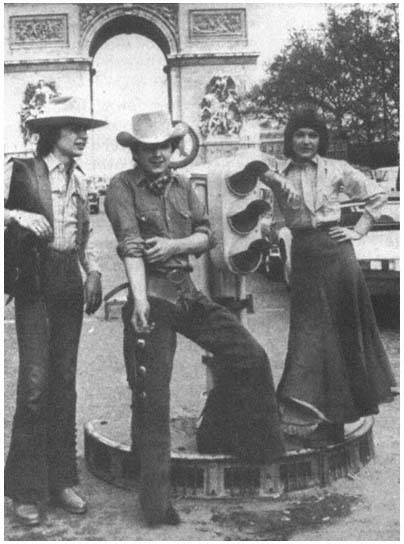
22. French cowgirls. (Courtesy AP/Wide World Photos)
trend away from animus; in the first post-Gaullist decade, momentum developed for the conversion that would be so complete by the 1980s that one could speak of a Gallic "American mania."
In a political sense the scaffolding for anti-Americanism began to come apart during the 1970s. Control of policy shifted from one
anti-American group on the right, the Gaullists; they also modified their position. De Gaulle resigned from the presidency in 1969 and died a year later. His successor, Georges Pompidou (1969–74), took a less aggressive stance toward Washington, though friction remained; the subsequent head of state, Valéry Giscard d'Estaing (1974–81), who was conservative but not a Gaullist, was even more pliant. A former minister under de Gaulle, Alain Peyrefitte, published Le Mal français in 1976, a best-seller attacking the nation's stifling bureaucratic centralism and urging a more open society and more competitive practices in fields like education and the economy. Peyrefitte's therapy gave some observers the impression that even the Gaullists were preaching Americanization.[1]
In international affairs during the 1970s, French preoccupation with American hegemony began to fade. Détente, or a general relaxation of tensions, came to characterize East-West relations. Washington under Presidents Nixon, Ford, and Carter pursued a less ideological and more accommodating policy toward Moscow, and their efforts brought such accomplishments as agreements on strategic arms limitations and on European security and cooperation.
Within the context of détente, French perceptions of the superpowers changed markedly from what they had been under de Gaulle, when freeing France from American tutelage took priority. Soviet misbehavior aroused growing awareness of a Soviet menace. The publication in 1974 of Aleksandr Solzhenitsyn's revelations about the Soviet labor camps, the so-called Gulag, marked the belated discovery, at least among the French left, of Soviet totalitarianism. Confidence in the Soviet model, already badly shaken by the armed invasion of Czechoslovakia in 1968, ebbed rapidly especially for those who had retained faith in the Soviets as a progressive society. Russian military intervention in Afghanistan in 1979 only confirmed suspicions that the threat to French independence lay more to the East than the West.
Events in the United States contributed to altering Western Europeans' perception of vulnerability to the Soviet superpower. Washington began to appear weak and indecisive: first came the defeat in Vietnam, then the near impeachment of President Nixon, followed by the vacillations in American policy under Presidents Ford and Carter; yet another humiliation in Iran gave the French more concern about Washington's firmness than its hegemony. American "arrogance," which had seemed so oppressive in the 1960s, faded in the diplomatic defeats and political turmoil of the 1970s. A majority of the French in 1976, for example, expressed a lack of confidence in Washington's leadership.[2]
Under Giscard, French policy appeared more Atlanticist than it had been under either of his Gaullist predecessors. He adopted a more conciliatory outlook toward the United States, made some gestures toward French reintegration into NATO, and, in general, accepted the growing détente between the superpowers. But tension persisted between Paris and Washington. There were differences over the Middle East and the economic crisis initiated by the international oil cartel (OPEC). Giscard pursued détente even after the Soviet invasion of Afghanistan and long after Washington believed the West was being duped by Moscow. If in essence Giscard continued Gaullist policy of French independence, he was perceived by some as being soft on America. He also adopted a personal political style, for example in his campaign tactics, that prompted one newspaper to call him "the first Americanized president."[3]
The old issues that had prompted anti-Americanism, however, remained alive in the 1970s. There was the envy ora superpower by a nation that had not quite fully accepted its relative decline in world affairs. And American economic and technological leadership, made apparent by the continuing influx of American-based multinationals, was a constant reminder that, no matter how they tried, the French could not catch up. Above all else was the vexing suspicion that French cultural eminence was in eclipse. More than ever, anti-Americanism focused on these threats of economic subordination and cultural degradation.
Giscard's efforts at opening the French economy to world trade stirred opposition from both right and left. Gaullists, Socialists, and Communists protested against his internationalism and urged a more protectionist stance.[4] They perceived a growing French dependence on the United States. A case in point was the end of a project initiated by de Gaulle to build a national computer industry, the Plan calcul . In 1975 the government accepted a merger with Honeywell-Bull that seemed to represent surrender to an American-run firm. Gaullists warned that American multinationals and American banks were taking control of the dynamic sectors of the French economy and relegating France to a specialized, but subordinate, place in a global economy dominated by the United States.[5] "Multinationalization" of the economy, from this perspective, was a trap. Subordination to American multinationals was only one aspect of Giscard's economic posture that roused such prominent Gaullists as former ministers Jean-Marcel Jeanneney, Michel Debré, and Michel Jobert. Jobert, who had been Pompidou's foreign minister,
denounced Giscard's liberalism as an abdication and described America's loose monetary policy as plunder and its waste of resources as profligacy.[6]
On the left a revived Socialist party under François Mitterrand sought an alliance with the Communists and remained committed to a hard-edged Marxist analysis of capitalism. The left promised, once elected, a rupture with the conservatism of the Gaullists and Giscardiens who had controlled the Fifth Republic since its birth. The Socialists denounced American imperialism and the injustices of American society, announced their sympathies with the Third World, and adopted a Jacobin (read: nationalist) posture on cultural issues. Fearing that Giscard's liberal policies risked foreign takeover of vital industrial sectors and jeopardized French social welfare accomplishments, the Socialists, like the Gaullists, sought a "reconquest" of the domestic economy. Those on the left of the party labeled their colleagues, in particular the followers of Michel Rocard who criticized this Jacobin line, as "the American left."[7] The presence of the Rocardian faction, however, indicates the party's division over an American policy.
Georges Marchais, the head of the Communist party, leveled similar protests against Giscard's alleged capitulation to American business.[8] And the PCF continued to denounce the arrogance of American imperialism. But détente between East and West served to mute the tones of this formerly shrill source of anti-Americanism. In 1972, for example, L'L'Humanité published a series of articles on America complimenting its workers on their efficiency and industry and acknowledging that the American people had the highest standard of living in the world.[9] Yet the party maintained that the quality of an American worker's life, marked by insecurity and anxiety, was no better than that of a French worker. The Communists also acknowledged that Americans enjoyed considerable personal freedom, yet claimed these freedoms were often illusory. The Communists asserted that the class struggle persisted in spite of the ideology of "Americanism" that appeared to offer opportunity and tolerance. But the message of these former Yankee-baiters was now mildly flattering and far less polemical than ever before.
The danger of cultural assimilation, like the fear of American economic and technological domination, also roused the anti-Americans during the 1970s. And this issue was available to both left and right. Jacobin tendencies among the Socialists were to lead them, once they attained power, toward an aggressive and protective nationalist cultural policy. Taking up the struggle for the right were both Gaullists and certain young intellectuals who formed the New Right. Among the
Gaullists, Michel Jobert juxtaposed the words "COBOL" and "Kabul" to strike a parallel between American and Soviet imperialism. To Jobert the computer language of COBOL was more insidious, because it went unnoticed, than was Kabul, referring to the Soviet takeover in Afghanistan.[10] Another Gaullist, Jacques Thibau, contributed a book, La France colonisée, which warned against the Americanization of the "French soul." Thibau observed that one of the most advanced forms of cultural dominance occurred when the colonized themselves shared the idea the colonizers had of them. This was happening to the French, he claimed. For now they believed the American caricature of France as a backward, provincial society. Thibau reserved special scorn for intellectuals like Michel Crozier, Raymond Aron, and Alain Peyrefitte for their advocacy of Americanization. He warned that the French might commit ethnocide —ethnic suicide—if they continued to submit to American cultural manipulation.[11] In a similar book rifled La Guerre culturelle, a professor of literature warned that if the French continued to imitate the Americans, they would become "Gallo-Ricains" (Ricains = ame-amé-ricains ) living in a "ZOA" (Zone of American Occupation). Americanization, in this view, was not the victory of one culture over another, but the invasion of a commercialized culture based on the negation of culture that mixed the arts, styles, and religions of all countries into an "undefined hamburger that was not American but simply usaïque ."[12] Another conservative academic at the Collège de France, Jean-Marie Benoist, drew a parallel between the two tyrannies of uniformity, the Soviet Gulags and the American media:
The police brutality of the Gulag, whose operation has been laid bare by Solzhenitsyn in his explanation of how the cancer spreads throughout the social organism . . . is the counterpart, albeit asymmetrical, of course, of the way the media and opinion polls are used as channels of propaganda by Atlantic imperialism in order to condition the people of Western Europe and the Mediterranean basin.[13]
On the extreme right some younger writers seized on the old theme that America's rootlessness and egalitarianism made it the enemy of Western civilization. Employing some rather tortured logic, intellectuals like Alain de Benoist argued that the United States posed a greater danger than did the Soviet Union. Western American-Aflanticism was the principal enemy because it came closer to the universalism, cosmopolitanism, and egalitarianism that destroyed all cultures. The New Right preferred "peoples" and "cultures" to the individualism of Western
democracy. Because of American civilization's Judaic and Puritan past it was, these conservatives alleged, indifferent to beauty. Americanization killed all cultures. In his anti-American fervor Alain de Benoist wrote:
It's not true that there is, on one side, a socialist, totalitarian world and, on the other, a "free world" in the shape of Disneyland, of which American society would be the natural leader. That's a fable in which the Soviet foil serves as an alibi for the introduction of a "new domestic order" equally disquieting. The truth is that there are two distinct forms of totalitarianism, very different in their effects but both formidable. The first, in the East, imprisons, persecutes, and physically bruises; but at least it leaves hope intact. The other, in the West, leads to the creation of happy robots. It air-conditions hell. It kills the soul.[14]
If forced to choose between the two evils, Benoist wrote that he would wear "the Red army cap" rather than "eat hamburgers in Brooklyn."[15] While the vocabulary may be different, the substance of this charge belongs in the mainstream of cultural anti-Americanism dating from Georges Duhamel.
At the level of popular perceptions, the Gallic stereotype of Americans survived the arrival of consumer society. If the French continued to say they liked Americans, the caricature of les grands enfants also remained. Americans were seen as optimistic, wealthy, informal, and dynamic. Opinion in the 1970s affirmed the Gallic perception that no matter what the Americans possessed in power and prosperity, the French still lived better and were more civilized. According to texts read by French schoolchildren, Americans lived in a consumer paradise yet were slaves to comfort, beholden to business, and had little culture in a European sense.[16] American society was marked by conformity, rootlessness, and violence. Polls recorded French disapproval of many aspects of America—from an alleged lack of family togetherness to a lack of fresh food.[17] An informal survey of Parisian high-school students revealed that at a manifest level the students were anti-American. But the latent content of their responses showed that these young people were deeply impregnated with American values and attitudes—including their preferences for films and clothes, their attitudes toward family traditions, and their vocabulary.[18] Anti-American posturing seemed, in this instance, to be an expression of youthful conformity or a ritualistic reflex. Similarly, apparent expressions of anti-Americanism were sometimes not what they seemed. Thus a popular song of the time whose title, "Les Ricains," suggested sarcasm, in fact told of a GI who had died for the liberation of France during the landings at Normandy.[19]
Times were changing. In 1977 Le Canard Enchaîné , the satirical political journal, proclaimed that America had become chic. Speaking English and praising the dynamism of the United States was now de rigueur among the upper classes who supposedly wanted to Americanize everyone. In a mocking tone the journal described how American television programs dominated prime time; how music companies preferred English titles to sell records; and how the newspaper Libération, with its young leftist audience, expressed itself in "French-French-américain." For all its preening about Gaullist grandeur, the country depended on America for everything from its security to its mass culture. Le Canard concluded:
To be modern is to imitate the Americans. That's the French trouble: there is no modern way of being French. France, once the "mother of arts, letters, and science," has become a little copycat. Yesterday, we were the locomotive, today, the caboose.[20]
The appearance of Gallic américanomanie in the 1980s was accompanied by a momentary defensive reaction. Yet, compared to the waves of anti-Americanism of the early 1950s and the mid-1960s, what occurred in the early 1980s was a mere ripple. This time some Socialist politicians tried to trigger the familiar reflex—but, significantly, with little success. The French, including the leftist intelligentsia, had become indifferent to such appeals.
In 1981 the Socialists and their Communist allies came to power for the first time since the birth of the Fifth Republic. Led by their new president, François Mitterrand, the Socialists launched a vigorous program of domestic renovation to bring the nation closer to a socialist future. Such a coalition and such an agenda were not well received by the conservative American government. And Mitterrand's stance on certain international issues, such as relations with the Third World, gave Washington further pause. Under its new conservative president, Ronald Reagan, the United States seemed to be taking the opposite direction in both domestic and foreign affairs. Reagan's reputation as a Hollywood actor also contributed to an initial coolness by the Socialist government and the French people toward the Republican administration.
Jack Lang, the minister of cultural affairs, ignited controversy in 1982 by denouncing an unspecified (read: American) financial and cultural imperialism that appropriated consciences, ways of thought, and ways of living.[21] Not long afterwards another Socialist minister, Jean-Pierre Chevènement, warned about the danger of cultural Americanization:
Never since the Hundred Years' War has our people known such an identity crisis. Our language is threatened with extinction for the first time in history. America has become the last horizon of our young because we have not offered them a great democratic design.[22]
This Socialist outburst led nowhere. It was not long before Lang swallowed his words and professed an interest in closer Franco-American cultural exchange. What surprised the Socialists was that there was so little response from the intellectual community to their cultural Jacobinism. A major shift had been occurring among the intellectuals that put them at odds with their hereditary allies, the Socialists. This complex story of the intelligentsia's migration away from the Soviet promised land toward America can only be sketched here.
As late as 1976, Pierre Nora wrote of an "impossible dialogue" between French and American intellectuals.[23] This incommensurability derived, according to Nora, less from French affinity for Marxism than from differing conceptions of revolution. Whereas the American revolution established a consensus and made leftism marginal, the French revolution destroyed consensus and made revolution the mater et magistra of the French intelligentsia. "Whereas in France, revolution is the eternal future of a country with a long memory, in America it is the eternal past of a nation that has no memory."[24] Stewards of the revolution, the French intellectuals remained locked in their own social stratum impervious to America.
But the "impossible dialogue" became possible not long after Nora's essay. Perhaps the best analysis of why St-Germain-des-St-Germain-des-Prés discarded its anti-Americanism belongs to Diana Pinto, who argues that anti-Americanism was linked to the historic role of revolutionary, engagé intellectuals.[25] Once the promised land of the revolution, the Soviet Union, looked more like a Gulag and once the United States lost its invincibility, the intelligentsia was cast adrift. Setting out to revise its own national past, the group discovered traces of the Gulag in its revolutionary tradition. The star of French culture, which had continued to shine so brightly through the 1960s, began to dim as the intelligentsia searched for a new cultural identity based on democratic, pluralistic, and libertarian values. Simultaneously the negative stereotype of America collapsed in the turmoil of the 1960s and French intellectuals discovered that American universities were cultural oases.[26] While Parisian intellectuals did not necessarily become Americanophiles in the late 1970s, they did become open to America. A kind of reunion with America occurred when the intelligentsia decided to place itself within the tradition of the
democratic revolutions of the eighteenth century rather than claim inspiration for the totalitarian revolution of 1917. We can round off this analysis by noting that the Parisian infatuation first with structuralism and then with deconstruction also diminished interest in such engagé subjects as American society.
Other analysts of the conversion of the postwar intelligentsia call attention to social and economic changes.[27] As the number of university graduates soared, an enlarged and diluted class of intelligentsia appeared, its tastes better served by journals like Libération than by the old leftist party publications. The professionalization of intellectual enterprise and its specialization also denied intellectuals the grand scope of earlier years. Meanwhile, television and the media changed incentives and messages. And the culture of the mass media undermined the elite's control over cultural products. Culture was being redefined at the expense of those who had traditionally monopolized it. Such changes eroded the global, universalist vocation of the intelligentsia and moved the generation of the 1980s toward greater modesty and a centrist, modernist position that was no longer anti-American.
Whatever the reasons for this so-called crisis of the intelligentsia, the results were striking. There was a disaggregation of its traditional role. Some intellectuals became academic specialists and relinquished their right to speak for humanity; others discovered a shared community of values with all of Europe, in particular Central and Eastern Europe; and still others fell silent. The Sartrian model was obsolescent. One example of this migration was the switch of onetime admirers of Maoist China, Philippe Sollers and Julia Kristeva. They turned toward America to discover alternative solutions to the European impasse over political and social injustice.[28] And a spate of books and essays about America in 1983–84 suggested the new affirmative mood.[29] What best marked this change of heart was the enthusiastic reception awarded to the publication of Raymond Aron's Mémoires in 1983. An academic who had been castigated by the left for his Atlanticism during the Cold War was now honored.
In the place of the engagés stepped the "media intellectuals" to preach the American way in the 1980s. Among the new Americanophiles were former gauchistes who, in reviews or newspapers like the Nouvel Observateur or Libération, promoted everything American either as a means of escape or as a way of enhancing social status. Another group of more pragmatic intellectuals sought to borrow American technology and remake France in the image of Silicon Valley. And a third group of more
ideological Americanophiles projected their own market beliefs on Reagan's America. Yet none of these Americanophiles, according to Pinto, tried to understand America in its complexity and contradictions. America remained, in their eyes, what it had always been—a storehouse of objects, technologies, and dreams that they would, from time to time, borrow or reject. America in 1985 still did not occupy the center of the French intellectual landscape or fill the role of a model in the way that the dream of the Soviet Union once did. In this way the "impossible dialogue" survived the new mania for America.
The eclipse of the revolutionary tradition, the redefinition of culture and its disaggregation, and the end of the intelligentsia's monopoly, combined in the 1980s to dry up a historic source of anti-Americanism. This conversion meant that for the first time the views of St-Germain-des-St-Germain-des-Prés about America and popular opinion converged. The historic split over America between much of the intellectual elite and the average population, if not closed, had at least been narrowed.
One consequence of this transformation was the indifference with which the leftist intelligentsia greeted the Socialists' attacks on American culture in the early 1980s. The former had moved away from Marxism and zealous Third Worldism toward liberal-democratic values and a new appreciation of America as a source of dynamism and freedom. When Jack Lang tried to enlist their support by attacking the cultural destruction wrought by American popular culture, the intellectuals were outraged because Lang made no reference to Soviet violations of human rights.[30] Lang's crusade against American cultural imperialism seemed ridiculous to those who were concentrating their attention on Soviet totalitarianism and the liberation of Eastern Europe. For example, Jean-Marie Domenach, who had made a career of chastising America, took exception to the government's chauvinist and defensive tone. Domenach recommended less denigration of other cultures and more attention to restoring the prestige of French culture.[31] Georges Suffert, a prominent journalist, ridiculed Lang and the Socialists for their vulgar anti-Americanism.[32] The Socialist government could not attract the intelligentsia to its cultural barricades and openly complained about the silence of the intellectuals. An era that reached back at least to the 1930s had closed.
This did not mean that the intelligentsia endorsed America or ended its attacks. Jean Baudrillard, for example, in a dyspeptic study entitled Amérique still inveighed against the falseness and artificiality of the New World and reiterated, though in a postmodernist vocabulary, con-
descending clichés about the cultural wasteland.[33] But even Baudrillard wistfully observed, "America is the original version of modernity. We are the dubbed or subtitled version."[34] Other prominent men and women of letters signed a manifesto against the Americanization of French radio and television.[35] But the intellectuals' attention was no longer riveted on the American menace.
Among the ruling Socialists there was also a historic change. Faced with economic disaster in 1982–83, the Socialists dropped their attempt to find their own way to socialism and forgot their pledge to break with capitalism. Entrepreneurship and the market were back in style. State intervention and economic planning were passé. President Mitterrand made a personal pilgrimage to Silicon Valley in 1984—reminiscent of the productivity missions of the 1950s—to discover the secret of American venture capitalism and high technology. His ministers shelved the cultural crusade against American popular culture.
At the same time as the intelligentsia and the Socialists deserted the cause, the unnatural alliance of Communists and Gaullists that had tilted French attitudes against the United States lost its political edge. The Communist party broke with the Socialists and suffered severe electoral losses. The Communists' critique, which had abated anyway, counted for less and less. Meanwhile the Gaullists became less irascible. According to a 1984 poll, of all the political parties, the Gaullists most closely aligned themselves with American positions in foreign affairs and domestic economic policy.[36] And in 1986 when the Socialist government gave way to conservatives under Prime Minister Jacques Chirac, the head of the Gaullist party, there was an even more avid courting of the American market model. Now Ronald Reagan, the "cowboy president," became a French hero because he had led the United States and the West out of a decade of "stagflation." Apparently the French confirmed the Gaullist flirtation with Reaganism since they, far more than the British or the West Germans, would have voted for Reagan's reelection in 1984.[37] Free enterprise à l'américaine was in style. As if to crown the American fad, the Chirac government completed negotiations with the Disney corporation to build its European version of the Disneyland amusement park outside Paris.
The Socialist-inspired wavelet of anti-Americanism during the early 1980s was engulfed in a flood of American mania. By the mid-1980s it was obvious to any visitor that French attitudes toward America were more friendly than ever before. Everywhere America took on the appearance of a fad. The trendiest restaurant in Paris became a grill serving
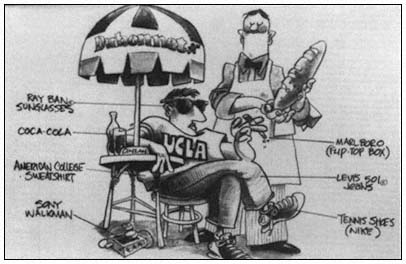
23. A trendy French youth emulates Americans, 1986. (Courtesy William T. Coulter)
California cuisine and Napa Valley wines. Fashionable youth sported American college sweatshirts, such as "University New Jersey" [sic ] (see fig. 23); the quintessential American designer, Ralph Lauren, opened a boutique on the place de la Madeleine.[38] By this time over three hundred thousand French tourists per year were traveling to the United States. And if Gallic visitors no longer found glamour in Hollywood, they continued their fascination with El Lay (L.A.).
Ordinary citizens, who had always been more or less sympathetic, now voiced almost unqualified approval. Polls taken between 1982 and 1988 suggest that only a tiny fraction of the French felt antipathy for the United States.[39] More of the French people considered themselves pro-American than did British or Germans.[40] With respect to the media, free enterprise, political institutions, and education, America now set a "good example" (though the French public believed the United States also set a "bad example" for the problem of integrating minorities).[41] Meanwhile, the Gallic stereotype of Americans remained largely intact. Americans continued to convey an image of power, dynamism, wealth, and freedom.[42] But, to a lesser extent, Americans also appeared violent, racist, nonegalitarian, and morally lax. Far fewer than ever before thought of Americans as young, generous, and naive. Thus an essential element of the stereotype, that of American immaturity, seems to have vanished.
A measure of the new affinity appeared in French attitudes toward American business and culture. In contrast to the 1960s, a slight majority now wanted to see American firms increase their investments in France.[43] With respect to American cultural influence, the French in 1988 did not find it excessive in such fields as literature, cuisine, or clothes.[44] And, pace M. Etiemble, very few were shocked by franglais. The only areas where they considered American influence excessive were television, cinema, and, to a lesser extent, music and advertising. But a majority still professed to be poorly informed about the United States.[45]
Perhaps the most important cause for this gradual realignment—besides what has already been presented about the shifting agendas of political parties, especially those of the Gaullists and the Socialists, and the transformation of the leftist intelligentsia—derives from the growing similarity of the two nations' socioeconomic orders. Economic development did effect a certain uniformity. And the move toward a consumer society, so visible in the 1960s, formed part of the French way by the 1980s. It is not without some irony that American visitors to France began to complain of a loss of Frenchness. A faculty couple from California, for example, lamented that France had become "civilized," pointing out that while Americans were rediscovering cotton handkerchiefs, grandmother's jam, homemade bread, wood stoves, and small cars, the French had been converted to frozen food, carpeted bathrooms, dishwashers, Kleenex, and shopping centers.[46] By 1984 Le Monde could proclaim, in an survey entitled "Uncle Sam's French," that anti-Americanism made little sense because France was Americanized. American ways were so much a part of France that they no longer provoked either fascination or rejection. America was banalisée or commonplace. Capping the historic turnabout, the author of the inquiry announced, "Le Monde itself seems to have given up its anti-American cult."[47]
The French themselves contributed to the dilution of anti-Americanism by adopting a more modest assessment of their nation's place in world affairs. De Gaulle had provided the needed boost to self-esteem in the 1960s, but Gaullist calls to grandeur disappeared from the agenda of more pragmatic presidents like Pompidou and Giscard as well as from Mitterrand's goals. If during the general's presidency a substantial element of public opinion believed that France was one of the world's leading powers, there had also been doubts. And without de Gaulle's leadership, aspirations adjusted to the realities of a global distribution of power that relegated France to a lesser place. By the early 1980s almost
two out of three French citizens believed France was a middle-rank power. Fewer than one-fourth still held to the notion that it was a great power.[48] One winegrower in Bordeaux insisted that his children watch the morning broadcast of an American news program to show them how little news about France was televised—demonstrating how unimportant France had become in the eyes of the rest of the world.[49] Increasingly de Gaulle's vague, but grandiose, aspirations, which had led to jousting with Washington, seemed illusory. Yet the sense of a French global vocation and a gritty determination for independence survived.
There are two final reasons for the French change of heart. It was probably no coincidence that anti-Americanism diminished as new dangers emerged. These came from immigration and from European integration. It may be impossible to prove, but it seems likely that the supposed threat to French identity posed by Arab and Islamic immigration distracted attention from America. By the early 1980s, among the most disruptive domestic political issues was how France should treat its growing cultural diversity—especially its large Arabic population. On the extreme right, a xenophobic political party whose program centered on curbing, if not expelling, Arabic immigrants quickly gained prominence by attracting sizable numbers of votes in elections. These initial electoral successes of the Front national occurred in 1983–84 precisely at the moment when anxiety about the American cultural challenge waned. Perhaps at some deep unarticulated psychological level the Arab and Islamic presence seemed to the French public equally, or even more, menacing than the American.
Finally the movement for European unity, which gathered momentum after the mid-1980s, also posed a clear and present danger. The proximate opening of economic, and even political, frontiers among the twelve nations of the European community could be construed as undermining national independence and cultural uniqueness. To right-wing nationalists, in particular, Frenchness faced external immersion in Europe as well as internal subversion from immigration. Americanization no longer had exclusive rights to the charge of endangering national identity: it had to share space in the dock with Europeanization and immigration.
By the end of the 1980s only traces of what once seemed like hereditary Gallic anti-Americanism survived. The political, ideological, social, and economic bases of the phenomenon had eroded. What remained was essentially the cultural danger, even though that was much diminished. And the mood of France was decidedly pro-American.
One should not conclude, however, that we have seen the end of anti-Americanism, because much of what caused it survives today in American geopolitical hegemony and technological-scientific leadership, prickly Gallic pride, the stereotype of les grands enfants, and French cultural snobbery. We can expect a certain ambivalence even today.
Ambivalence about America and consumer society should come as no surprise because the very language of the French expresses such ambiguity. The word affluence evokes not only "abundance" but also a "crowd"; "les heures d'affluence" refer to rush hours. Whereas Americans conceive of affluence as an indication of wealth and happiness, the French also glimpse in the term a teeming conformity. When an international group of scholars assembled in the mid-1980s to examine the recent history of French attitudes toward America, they discerned equivocation. They noted, despite a rampant mania for all things American, persistent ambivalence about America. "As model or foil," they concluded, "America has never ceased to fascinate and exasperate the French, as well as, on occasion, inspire all sorts of fantasies."[50] Appropriately the cover of their anthology depicted the Statue of Liberty against an orange sunrise swarming with helicopters reminiscent of the film Apocalypse Now .[51]
The opening of Euro Disneyland outside Paris (at Marne-la-Marne-la-Vallée) in the spring of 1992 has once again raised the issue of the American danger. This controversy reveals not only the current French attitudes toward Americanization but also confirms the analysis of this study.
Even before the opening the Walt Disney Company, like American corporations of the 1950s and 1960s, encountered trouble of all sorts. There were charges that the French government had given away land, money, and services to attract the park. Local residents complained of everything from increased traffic to noise from the nightly fireworks. Then there was the employee dress code proscribing beards and moustaches for men, and requiring natural hair color as well as "appropriate underclothing" for women. Labor unions protested that Disney's regulations about appearance were an attack on the French sense of individual liberty and dignity. One spokesperson from the Communist-controlled CGT complained that the government, by allowing the company to impose such discipline, had awarded Disney extraterritorial rights and that the region was becoming "the fifty-first American state."[52] But, above all, there was the cultural menace.
It should come as no surprise that the inauguration of the park provoked some intellectuals, especially on the left, to attack. Alain Finkielkraut said Euro Disneyland was "a terrifying giant step toward world homogenization." The Socialist deputy Max Gallo predicted Disney would "bombard France with uprooted creations that are to culture what fast food is to gastronomy." One journalist recalling "the American challenge" of the 1960s warned of the coming "Disneylandization" of French châteaux, museums, and historic sites. Unless people resisted, he argued, France would follow America toward "the industrialization of leisure."[53]Le Monde called the park a "slice of the American dream" affordable only for the well-heeled visitor. It evoked images of abundance and antiseptic happiness—which were "a long way from the real America."[54] Others criticized the park from the perspective of myth making, aesthetics, values, creativity, and spectator participation.[55] The most quoted comment was that made by theatrical director Ariane Mnouchkine, who denounced the park as "a cultural Chernobyl." Jacques Julliard, an editor for Le Nouvel Observateur, hoped a fire might destroy it![56]
But there was ambivalence and evasiveness on the left. And 1992 was not 1962. One writer for Le Nouvel Observateur, after noting that "Euro Disneyland, like hell, is paved with soft caramel," admitted that he enjoyed visiting the park, wearing Mickey Mouse ears, eating popcorn, and touring its attractions.[57] Jack Lang, the Socialist minister of culture who a decade earlier had warned against American cultural imperialism, snubbed Euro Disney—he explained that he was too busy to attend the opening. Lang expressed his regret that Euro Disneyland afforded little place for attractions representing European countries. While admiring the technical prowess of Disney (Lang visited Disneyworld in Florida and found it "quite fascinating"), he worried that Euro Disneyland might mark the beginning of an American takeover of the leisure industry in France. Yet the minister denied he was hostile to American culture and said he was one of "the principal promoters of modern American culture. I hold dear the America of bold and inventive ideas. The question is different when speaking of standardized culture. . . . This is less a question of American culture than of marketing."[58] In the name of diversity Lang called for vigilance against the massive diffusion of the "subproducts" of American culture. Thus he applauded artists like Jack Nicholson and Ella Fitzgerald but deplored those who merchandised "subproducts." Lang's distinction seems rather arbitrary, since he decorated an American actor associated with the cinema of
violence, Sylvester Stallone, with the award of chevalier of arts and letters. One spectator who observed Lang posturing before the television cameras with Stallone commented caustically, "Envy and snobbery often go together."[59]
Equally reminiscent of the past was the astonishment of the Americans at Gallic criticism. Representatives of the Disney corporation defended the park by saying, "It's not America, it's Disney." One employee responded more truculently: "Who are these Frenchmen anyway? We offer them the dream of a lifetime and lots of jobs. They treat us like invaders."[60] The president of Euro Disney, Robert Fitzpatrick, said he nearly fell off his chair when he heard about Ariane Mnouchkine's comment. After all, she had accepted his invitation to visit the California park where she had posed with Mickey Mouse. The French scrutinized the amusement center as an important cultural phenomenon while the Disney corporation defended it as mere entertainment. Fitzpatrick refuted the argument of a Parisian museum director who claimed no visitor to the museum would also tour Marne-la-Marne-la-Vallée. "Diversion is also a form of culture," Fitzpatrick responded; "the French know it well. Have they forgotten?"[61] To those like Lang, who criticized the park for not being more European, the Disney people replied that they believed Europeans wanted a real Disneyland, that is, an American park featuring attractions like Frontierland and Mainstreet U.S.A.
Given the current fascination with America, it is to be expected that the French response to Euro Disneyland would not be dominated by the critics. The cover of one newsweekly announced, "Culture: Let's not fear America." The philosopher Michel Serres said that he was indifferent to Euro Disneyland except for the fact that the park was going to make his commute to Paris more crowded since his train linked the capital with Marne-la-Marne-la-Vallée. Jean-Jean-François Revel refuted the leftist critics of America as he had twenty years earlier (in Ni Marx, ni Jésus ). "If French culture can be squashed by Mickey Mouse," he wrote, "or more exactly by simply moving Mickey geographically, it would have to be disturbingly fragile." Moreover, Revel argued, culture always circulates and, in the case of Euro Disneyland, California was merely repackaging for Europeans such European stories as Cinderella and Pinocchio. According to Revel, French culture was not being colonized and if any culture was in crisis, he contended, it was that of America with its fad for political correctness and other forms of "neoprovincialism."[62]
An American expert on popular culture put the debate about Euro Disney in perspective when he observed, "American popular culture
doesn't erase all vernacular alternatives. The new semiculture coexists with local cultures more than it replaces them." American popular culture was becoming "everyone's second culture."[63]
In the 1990s the dilemma about Americanization focuses, now more than ever, on the issue of culture. Some purists dread the inroads of American popular culture, yet the opening-day crowd at Euro Disneyland included such intellectual celebrities as Bernard Henri-Henri-Lévy. Or as one writer remarked, the French "remain fascinated by America. . . . I am convinced [the ideas of] Merleau-Ponty are still of value, but tomorrow I am going to Euro Disneyland."[64] Meanwhile thousands of French men, women, and children ignore the dangers of the cultural Chernobyl and join the daily throng at Marne-la-Marne-la-Vallée. And if the arrival of Mickey Mouse to the Paris region represents an incursion similar to those we have seen and a further step toward Americanization, this American animal has also adapted to the land—at least he speaks French.