
Observations Ashore
Now let us see what was done ashore in the physical sciences. Overtly at least, the prime purpose of Cook's first voyage was itself astronomical—participation in that vast international project, the observation of the transit of Venus on 3 June 1769, when astronomers from eight different nations traveled all over the globe, an operation as important and complex in the eighteenth century as was the International Geophysical Year in the twentieth.
Twice every 113 years, Venus passes directly between the earth and the sun and appears for a few hours silhouetted against the bright solar disk. Edmond Halley, of comet fame, pointed out in 1716 that observing such a transit could provide a method of measuring one of the fundamental units of astronomy, the distance of the earth from the sun.[8] As shown in Figure 5.11, an observer at A in the Northern Hemisphere would see Venus crossing the sun along track a to a '. An observer at B in the Southern Hemisphere would see Venus crossing the sun along track b to b '. If the angular distance PQ can be found, this will give a measure of the sun's distance, provided the geographical positions of A and B are accurately known.
Though Halley knew that he himself would not live to see the next pair of transits (in 1761 and 1769), he urged that every advantage should be taken of these opportunities and that observations should be planned for as many
different places as possible in order to mitigate against the effects of bad weather at any one place:
Therefore, I strongly urge diligent searchers of the Heavens (for whom, when I shall have ended my days, these sights are being kept in store) to bear in mind this injunction of mine and to apply themselves actively and with all their might to making the necessary observations. And I wish them luck and pray above all that they are not robbed of the hoped-for spectacle by the untimely gloom of a cloudy sky; but that at last they may gain undying glory and fame by confining the dimensions of the celestial orbits within the narrower limits.[9]
Halley's pleas did not fall on deaf ears. Many scientific expeditions were dispatched to remote parts of the world for the transits of 1761 and 1769, particularly by the British and French. Thus it was that, in 1768, Cook sailed on his first voyage to the South Sea as one of three British transit-of-Venus expeditions—the other two went to the North Cape of Norway (William Bayly and Jeremiah Dixon) and to Hudson's Bay, Canada (William Wales). In addition, the Royal Society sent Charles Mason to Northern Ireland and the Board of Longitude sent John Bradley to the Lizard in Cornwall, while the transit was observed in all European observatories (and a few in North America) where the sky was clear, including Greenwich. All were supplied with the same type of instruments, wherever possible by the same makers.
For the transit, Cook and his astronomer Charles Green set up an observatory on Point Venus at Matavai Bay on the north coast of Tahiti. The transit itself was observed—the thermometer was showing 119°F at the time—with a two-foot Gregorian reflecting telescope by James Short fitted with a micrometer for measuring small angles within the field of the telescope.
The local times of the various events during the observation—the first and last contacts of Venus with the sun's disk, for example—had to be known to the greatest possible accuracy, and all expeditions were supplied with astronomical regulator clocks by John Shelton. The clock
used by Cook in Tahiti had been used by Maskelyne in the 1761 transit of Venus in Saint Helena, had been to Barbados with him for the trials of the Harrison watch in 1763-1764, and had gone to Pennsylvania for determining the Mason-Dixon line in 1765-1767. After Cook returned, the same clock was used again by Maskelyne for his experiment for "weighing the earth" in Scotland in 1774; it went to New South Wales with Sir Thomas Brisbane in 1822-1823, to South Shields for pendulum experiments in 1854, to the top of Ben Nevis in Scotland in 1888-1904; today it is in the Royal Scottish Museum in Edinburgh. Other Shelton clocks went on Cook's last two voyages, to the Arctic with Parry and others (1818-1825), to the Antarctic with James Clark Ross (1839-1842), and to India for the Trigonometrical Survey (1865-1873); one went to its second transit of Venus with the U.S. expedition to New Zealand in 1882.[10]
The going of the clock (and of the watches on the second and third voyages) had to be checked every clear day by equal altitude observations of the sun morning and afternoon, the mean of which gave the moment of noon. This was done with an astronomical quadrant of one foot radius by John Bird. This—and I quote Cook's own words—"stood upon the head of a large cask fixed firm in the ground, and well filled with wet heavy sand" (Figure 5.12).[11]
The last requirement for the transit itself was an accurate geographical position. For latitude, the same astronomical quadrant was used to measure meridian zenith distances of the sun and stars. For longitude, lunar distances were observed with a Hadley sextant, using altitudes measured with the astronomical quadrant. And all these instruments had to be protected from the elements and the natives by one or more wood-and-canvas tent observatories and day-and-night sentries.
Cook and his astronomers used these same instruments to make other observations ashore on all the voyages, the precise times of which, when compared with the times of
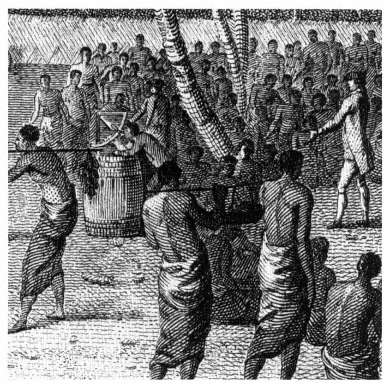
Figure 5.12.
An astronomical quadrant in use (1777). The astronomer William
Bayly can be seen taking an observation of the sun with his
quadrant, which is placed on a cask filled with wet sand. Detail from
a view at Anamooka, Friendly Islands, engraved by W. Byrne after
John Webber. (Reproduced courtesy of the National Maritime
Museum, London.)
those same phenomena at Greenwich, gave longitude determinations. These were observations of the eclipses of Jupiter's satellites, of solar and lunar eclipses, of occultations of stars passing behind the moon, and of the transit of Mercury—none of which occur very often but the Greenwich times of which were predicted in the almanac. And, of course, there might be comets; although they could not be predicted, the measurement of their position was important to astronomy.
Finally, Cook and his officers made many nonastronomical observations ashore. First there were the meteorological and magnetic observations as at sea but with the addition of observations for magnetic dip with a dip circle. Incidentally, it is an early example of international scientific cooperation that, in 1785 in an interval between wars, the British Board of Longitude lent two of the dip circles used on Cook's third voyage to La Pérouse. (These were never seen again.) Then there were the observations of the tides—how long before or after the moon crossed the meridian did high water occur, what was the magnitude of the rise and fall, and how did that magnitude vary between spring and neap tides? From the amount of clock gained or lost at Tahiti compared with its performance at Greenwich, Maskelyne found that the force of gravity at Tahiti was 99.7 percent of its amount at Greenwich. Incidentally, it was principally these ongoing gravity measurements which caused these transit-of-Venus clocks to travel the world so extensively during the next hundred years or so, all with the object of determining precisely the "figure of the earth"—the amount it is flattened at the poles.[12]