
Visions Spread by Persecution
As the dioceses of Vitoria and Pamplona moved step by step toward denunciation of the visions, it became increasingly difficult to hold sessions in public. And in any case as the audience shrank large outdoor venues were unnecessary. Those surviving became restricted, private séances, many with seers who had retreated to their hometowns or to safe havens protected by sympathetic priests.
In May 1933 the only public, outdoor vision site left was at Albiztur, and its days were numbered:
While it is true that only small, isolated, furtive groups now go to Ezkioga, and although the protagonists of this affair try to be forgotten by the authorities, one should not conclude that everything is back in order. Far from it, for now it is at home, in a little group, that the seers have their ecstasies. With their holy place ruined, they have dispersed, gone to ground,
but they have hived off. In every valley, there have thus formed little clusters of believers who keep the faith, in spite of persecution and defections. One by one the church denies them the sacraments and excommunicates pitilessly even little children.[56]
Ducrot, VU, 23 August 1933. Strictly speaking, seers and believers were not excommunicated.
Sometimes only the seer and the family held sessions, but in the years 1932 to 1936 in the cities of Bilbao, San Sebastián, and Pamplona and in the towns and villages of Astigarraga, Legazpi, Legorreta, Ordizia, Ormaiztegi, Pasaia, Urnieta, Zaldibia, and Zegama there were regular secret meetings for persons outside the immediate family.
The visions of Ezkioga aroused exceptional interest in the large rural townships to the southeast, in the mountains on the Navarrese border. Zaldibia and Zegama were devout Carlist breeding grounds for priests. Both showed early interest in the visions, and photographs of seers at Ezkioga show people from these townships as close, attentive spectators. Farm families from Zaldibia told me of rushing through the day to finish their chores early in order to be able to get to Ezkioga for the evening rosary. There was equal interest in the village center, where believers held all-night rosary sessions.
The earliest seers from Zaldibia were two teenage girls. María Luisa was a foster child on a small farm. She was not believed in her house and eventually had to take refuge elsewhere. Inés worked as a servant in Ordizia and eventually became a nun. Neither achieved the fame of the seers from Ataun. By July 1933 a married farm woman, age thirty-four, Cándida Zunzunegui, had begun to have visions, first at Ezkioga, then elsewhere, including the Echezarreta house in Legorreta, a shop in Ordizia, and her farm. I think it was to her that the schoolteacher of Zaldibia referred in La Voz de Guipúzcoa on 11 November 1933:
A NEW LOURDES OR A NEW EZQUIOGA?
The apparitions of the Virgin increase daily. Recently she seems to have begun appearing in Belgium, according to a Madrid weekly.
The Virgin is also being seen here. Here too there is a female seer who sees her. She was left unemployed at Ezquioga by church decree, but it seems she has found in her home village a place where she can continue to exercise the same "profession."
There is no lack of people. Some day we are going to wake up and find ourselves not in Zaldivia, but in a new Lourdes, among the noisy sirens of buses arriving full of people.
The teacher, apparently not a Basque, was answered a month later by the Zaldibia correspondent of El Pueblo Vasco , who wrote, "The Basques have been losing their culture ever since teachers like him have come to colonize us." In Zaldibia the visions were associated with Basqueness.[57]
Schoolteacher of Zaldibia in La Voz de Gipuzkoa, 11 November 1933; "Desde Zaldivia," PV, 5 December 1933, p. 7, and similarly 19 December, p. 9.
Zaldibia believers faced the stiffest opposition in the diocese. The parish
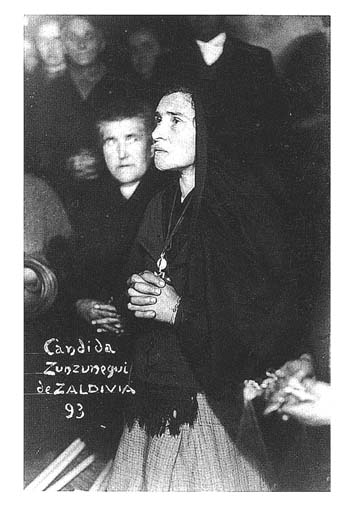
Cándida Zunzunegui of Zaldibia in
vision, 1933. Photo by Joaquín Sicart
priest Martín Elorza was the cousin of Bishop Mateo Múgica of Vitoria and he took the matter personally. In 1984 I spoke to an elderly priest in Zaldibia who knew Elorza well. On the wall was a panoramic photograph of a huge diocesan pilgrimage to Lourdes led by Múgica and including Elorza. Elorza was a stern man. His sympathies were with Hitler, whose picture he had on the wall of his study and whose ideas on racism he defended with vigor. But the day he read Pius XI's declaration on Danzig, he tore the picture in two, saying, "I have been wrong." Because he was so strict with himself, he demanded the same obedience from his parishioners and tirelessly preached against Ezkioga. The priest said Elorza lost ten years of his life because of the Ezkioguistas.
The Zaldibia believers were the most combative and stubborn of all. When the governor in 1932 and Bishop Múgica in 1933 prohibited seers from going
to the vision site, the Zaldibia followers accompanied the few seers who went, specially Cándida, Juliana Ulacia of Tolosa, and a girl from nearby Gainza. Even Burguera could not dissuade them. They told me how they would go on foot from Zaldibia in small groups of four or five and sneak in among the apple trees after the guards had passed. People whistled or laughed at them on the way. Sometime after July 1934 Elorza began to deny Communion to those who went. The believers told me that he sent a nephew and four or five Zaldibia seminarians to Ezkioga to take the names of those who turned up there.[58]
LC, 4 January 1933, listed seven seminarians from Zaldibia. One in early 1935 wrote about the stubborn devotion of many families to the apparitions: Sukia, "El Ambiente religioso," 371.
When the Zaldibia believers went to take Communion in the church Elorza would refuse to give them the host in a ritual of authority and disobedience acted out at every Sunday mass for a decade. When they stepped up to receive communion, Elorza or his assistants would say, in front of everyone,
"Do you go to Ezkioga? I say this to you before Christ."
"Yes. I go to Ezkioga to pray."
"Well, I will not give you Communion."
"Well, somebody else will."
At least a dozen persons were denied Communion in Zaldibia for up to twelve years, although not all had the courage or stubbornness to present themselves and be refused regularly.[59]
Elderly male believer, Zaldibia, 31 March 1983, pp. 5-11.
At least one Zaldibia cuadrilla was arrested. In late January 1935 Gipuzkoa was under martial law in the wake of the October Socialist uprising and all unauthorized gatherings were illegal. The military commandant announced that he would jail all those participating in "the reappearance of new activities in Ezquioga," since the diocese had explicitly forbidden them. The next month La Voz de Guipúzcoa reported, "The Civil Guard informed the governor that a clandestine religious meeting, possibly 'Ezquiogan' in nature, had been discovered in the house of the mayor of Zaldivia. The matter has passed to the jurisdiction of the military." Apparently the civil guards merely took down the names of those present. The matter cannot have troubled the military commander seriously; he set modest fines of fifty pesetas. When the Zaldibia believers asked through a seer whether they should pay the fines, the Virgin said no. The government insisted and the Zaldibia town council finally paid for them.[60]
All 1935: La Noticia, 22 January, and ED 23 January; ED and VG, 24 February; Sarasqueta, VG, 28 February.
The believers told me that during the Civil War Martín Elorza had the group arrested again. Civil guards went to the regular Sunday session at Cándida's farm and took the whole group to Zumarraga, Bergara, and finally the Ondarreta prison in San Sebastián. Legend has it that Cándida in vision was so heavy the guards could not budge her until she came to her senses. There was also a political angle. From at least 1933 the town was bitterly divided between Carlists and Basque Nationalists. The two groups competed in public piety and the result was
a kind of devotional spiral. When Franco's troops occupied Gipuzkoa, the Carlists turned in the vision group as separatists. The Carlists had been irked by seers who would stand up in town council meetings and announce what the Virgin wanted done.[61]
The son of one of those arrested gave the date of the raid as 7 January 1937. In the parliamentary elections of 1933 the Basque Nationalists received 210 votes, the Carlists 350, and the Republicans 6 (PV, 21 November 1933). These proportions held for almost all of the rural towns in Gipuzkoa with important groups of believers, with the exception of Ataun, Legazpi, and Ezkioga, which in 1933 swung to the Nationalists. The rural towns with industries had more Republican votes, but not many (see also Granja, Nacionalismo, 415-439). Zaldibia had been further polarized by the open partisanship of Elorza, who on occasion displayed the Carlist flag in church. On 5 June 1933 Carlists in Zaldibia and Ordizia clashed violently with Nationalists and Republicans (ED, 6 June). On competing piety: Sukia, "El Ambiente religioso," 367. For political arrests: son of seer, Zaldibia, 20 August 1982, p. 2; for town council: elderly priest, 10 September 1983, pp. 2-3.
The cuadrilla arrested had five women and six men, ranging in age from about thirty to about sixty. Four were relatives belonging to three farmsteads. They included a young man, unmarried, in his late twenties, his aunt and her son, and a third male cousin. In addition, there was an older male neighbor of the youth, Cándida and her husband, a man and a woman from an Ordizia store, and a man and a woman from the Zaldibia village proper. In jail, where they were held for not paying still larger fines, they felt quite out of place with the political prisoners. A farmer whose brother was jailed told me,
There they said, "But how can this be? How did you people come to be here?"
"As Catholics."
"What do you mean, Catholics? These other people are Communists, or Modern, or Anarchists. How can they denounce people for praying? Don't you have anyone on your side, anyone who will speak up for you and clear this up?"
"We have no pull anywhere."
Nine were freed when the government confiscated property to cover the fines; three others, who had no property in their own names, remained incarcerated for sixteen months until their case came up. The wife of one prisoner died while he was in prison and he was not allowed to go to the funeral. They say that when the judge released them, he said those who denounced them should have been the ones in jail.
In Zaldibia the lines between believers and nonbelievers remained drawn until the late 1940s at least, and the conflict worsened when a new seer moved in. For Martín Elorza, the seers' defiance of his authority—including back talk in front of the congregation and visions in the waiting room of the rectory—was intolerable. With the word straight from heaven seers felt no qualms about confronting the priest. And according to them, he, in his anger and rigidity, slandered them publicly and even fell into heresy, as when he said, they claimed, that in the celestial hierarchy the Virgin Mary was lower than the worst priest.
Fifty years later the older Zaldibia clergy and the old-time believers were still traumatized although generally at peace. They all agreed that Elorza's rigor had been counterproductive. A believer put it this way,
Faith, yes, it is good. But a faith that is persecuted has more strength, because love takes on more firmness. And when the enemy attacks, there is a
reaction, "Well, no; it is this way, and it has to be this way." Little by little they began to let us do what we wanted, and little by little we left off going to Ezkioga. We still go, but less.
Said the priest, "We made abundant mistakes. It has been demonstrated that in the towns and villages where there was the most repression, the believers stayed the strongest. The more we hit them, the more they resisted. By violence it could not be done, for these are delicate matters."[62]
Interviews, Zaldibia, 31 March 1983, p. 10, and 10 September 1983, p. 5.
Denied Communion in Zaldibia and Legorreta, many seers and believers went to Ordizia, where the parish priest was more lenient. Ordizia was a market center for the Urola valley farmers and was less industrial than neighboring Beasain. Rural seers and believers had two kinds of ties to Ordizia: they were clients of its merchants and they were servants. In March 1934 there were restricted vision sessions in the house of the branch bank director, whose servant was a seer from Zaldibia, and in the flat of relatives of another seer. But most frequently the believers met in a small room behind a grocery store run by a fervent believer, Juana Usabiaga; they called the room "El Rinconcito" (the nook). The secret sessions there on market day, Wednesday, were already taking place in early 1933 and went on for at least twenty years. Believers and seers attended from as far away as San Sebastián, Oñati, and the Barranca.[63]
The seers included Cándida Zunzunegui, Juliana Ulacia, Luis Irurzun, Marcelina Mendívil, and José Garmendia.
On the wall of El Rinconcito there was a picture of the Christ of Limpias taken from a box of candles. When the journalist Ducrot visited in May 1933, he was assured by the proprietress that it had bled in prayer sessions six times since the beginning of the year. Ducrot saw dried blood on the image. When he asked why it was not kept behind glass, she said that through a female seer the Virgin had forbidden it. A picture of the image was on sale at Ezkioga, and in 1982 I talked to a believer in Zaldibia who still kept fragments of the blood.[64]
VU, 23 August 1933.
People in Zaldibia described a typical vision session.
[Male believer:] In a vision you have to pray a rosary of fifteen mysteries, the stations of the cross and all those things. Then we get messages or errands, the person who has the visions explains them—you have to do this or that, and then [the divine figure] blesses the crucifixes that people bring and flowers, too. And the seer then hands out the flowers, giving explanations, to each person by name, although the seer had never seen the person before. And they passed on the messages—for the wife, for the children, for the good or the bad they had done.
[Female believer:] And those flowers would generally be good for healing. My father had bad eyes. And the seer said, "Here are some roses; sprinkle them with water from Ezkioga, and go with them to your father." It healed his eyes. We would be happy to get those flowers.
Always when the seer was in vision we lit candles or wax. When [the divine figure] began to appear, they would say that it said, "Make light for me, even if it is just matches." And so we always had candles or wax handy.[65]
Elderly male believer, Zaldibia, 31 March 1983, pp. 15-16.
An Ormaiztegi woman whose mother went regularly to Ordizia attended once herself. She remembered especially the pain of kneeling. The believers would enter at nine in the evening and leave at six in the morning. Some stayed on their knees all night.[66]
Ormaiztegi nonbeliever, 9 September 1983, pp. 3, 10.
In these sessions the divine figure, or, if you will, the seer, became a spiritual director. No longer confessing with the parish priest, these believers felt themselves to be under direct divine scrutiny, judgment, and penance. Through the seer the believer was a member of an intensely scrupulous community where every doubt about the past and the future could be answered.In 1946 Dionisio Oñatibia, doctor in Urretxu, and Juan María Galarraga, assistant priest there, went to one of these sessions out of curiosity. Oñatibia told me that about twenty-five persons were present, men and women. After a large number of rosaries and stations of the cross, two seers, a man and a woman, went into a lengthy and "photogenic" (the doctor's word) trance state and announced that Ignacio de Loyola was celebrating mass. The seers would narrate the mass, step by step, "Now he is going to read the Gospel, everybody stand up." And the seers and believers received Communion; that is, they extended their tongues as if receiving the sacrament, though he and the priest saw no host. When the seers were in trance, Oñatibia took their pulse and observed their pupils; both were normal. At a given moment their hands appeared bloody (like those of Luis Irurzun at Iraneta). Unimpressed by the blood, Oñatibia was impressed by the prayers: "They prayed tirelessly. It was remarkable. Prayer, patience, and penance, that was the watchword." When the session was ending a woman stood up and called out in Basque the motto of Saint Michael the Archangel, "Nor Kristo bezelakoa, Nor Kristo bezelakorik" (There is no one like Christ, no one else like Christ). Sometimes at the end a stuffed pigeon, as the Holy Spirit, was passed around and kissed.[67]
A composite account from three witnesses: Dionisio Oñatibia, Urretxu, 7 April 1983, pp. 2-3, 5; elderly woman, Zumarraga, 29 May 1984, p. 2; and Ormaiztegi nonbeliever, see n. 66 above. In a magazine of the Passionists of Bilbao a former believer in the visions described an Ordizia session in which Gemma Galgani appeared (see P. Beaga, "O locos o endemoniados").
The Ordizia store became a clearinghouse for messages, prophecies, and dates of the chastisement. The town also was the point of departure for the peripatetic vision sessions of Tomás Imaz which kept different cuadrillas in touch.
Tomás Imaz and the Vision Trips
Tomás Imaz Lete, a thin bald man in his early fifties, first came to the public eye when he was arrested and fined for making a scene with Marcelina Eraso on the train. By then, October 1932, he had been a leader in the vision community for at least seven months. The believers nicknamed him "Tximue" because of a certain chimpanzee-like quality to his face and ears; they heard rumors that he was connected to high church officials. Imaz was a real-estate broker based in San Sebastián. While he was not a publicist, he was very much an organizer, and he was one of the few believers to follow his convictions to their logical consequence. If indeed the world as everyone knew it was going to come to an end, and soon, with a great chastisement and a great miracle, there was no point in
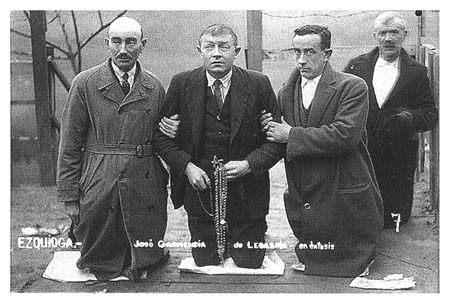
Tomás Imaz, on left, with José Garmendia in vision at
Ezkioga, winter 1931–1932. Photo by José Martinez
selling real estate. So he liquidated his assets and slowly spent his funds on the seers and the believers.
Starting in June 1932 Imaz rented buses and invited seers on pilgrimages. He took several trips to Zaragoza to speak to Hermana Naya, venerate the Rafols crucifixes, and pray for Spain to the Virgen del Pilar. The French author G. L. Boué met the seers, including José Garmendia and Benita Aguirre, on their return from a trip on 25 June 1932 in which Benita had visions of the Virgin and Gemma Galgani. José Garmendia's declarations on these expeditions would have confirmed Burguera's worst fears about uncontrolled seers and uncensored messages:
BLOOD OF THE DEVIL
Declaration and vision on this day taking place on the fifth pilgrimage organized by D. Tomás Imaz with seers of Ezquioga to the Santo Cristo Desamparado of the Venerable Madre Rafols in Zaragoza.
Zaragoza, 22 September 1932
On the way, after passing Tudela in the bus, the Most Holy Virgin made me aware that although she had forbidden the devil from bothering us pilgrims on this trip, he had come close to the bus, and Saint Michael had wounded the brazen devil with his sword on the right side of the neck, and from that wound fell two great drops of blood that stained the outside of the windshield of the bus; and when the infernal dragon returned
again later, Saint Michael hit him again, and blood spattered the hood of the bus. All these bloodstains remained very visible for two days, as all the pilgrims present have been able to confirm.
The seer José Garmendia Tomás Imaz; Jesús Imaz, priest; Rosario Gurruchaga; María Luisa; José Antonio Múgica; Juana Múgica; Martí Berrondo; José Azaldegui; Marcelina Eraso; Vicente Gurruchaga; Francisco Otaño, priest .[68]
Boué, 60, 78-79; Ducrot, VU, 23 August 1933; B 561, 711; Benita to García Cascón, 28 June 1932, in SC D 113-114. Garmendia vision in SC D 52-53 and ARB 216.
Here we have another rare glimpse of a clandestine group. Besides Garmendia there are at least five second-rank seers, the two (unrelated) Gurruchagas, María Luisa of Zaldibia, and Marcelina Eraso, Juana Múgica was a believer from Zaldibia, and José Antonio Múgica was the baker from San Sebastián detained two weeks later with Tomás Imaz and Marcelina on the train. The baker and his brother frequently accompanied Garmendia, and Marcelina stayed at their house in San Sebastián. Jesús Imaz Ayerbe had been a missionary overseas; he had moved to San Sebastián in 1928, where he was the chaplain to a community of nuns. On 18 July 1931 he had been cured of a chronic stomach ailment at Ezkioga. Otaño we know as Ramona Olazábal's spiritual director. Martín Berrondo and José Azaldegui were believers. So we have a gathering of seers and believers, priests and laypersons, urbanites and rural folk, men and women. There was a mix of class as well. The real-estate man and the retired missionary were listening intently to farm girls and barely literate factory workers. As for the blood of the devil, it is no coincidence that it was seen on a trip to see the crucifix of Madre Rafols; that crucifix was supposed to have been found with blood on it. Believers proudly showed the stains on the bus to townspeople in Ordizia.[69]
For J. Imaz, BOOV, Guía Diocesana, 1931, p. 116, and B 301. For garage, Ducrot, VU, 23 August 1933, p. 1331. The devil appeared by the bus just beyond Tudela in the Ribera, the domain of the left.
Since Tomás Imaz spoke Basque, he could connect better with the rural seers than Burguera or the Catalans could. At the vision sessions he frequently led the rosary. His special protégées in 1932 were Esperanza Aranda and Conchita Mateos, in addition to José Garmendia. He introduced Juan Bautista Ayerbe to them and accompanied him to their séances. Tomás's belief in the apocalypse made him fearless in defying the government, the church, Burguera, and social convention. Burguera concluded that Imaz was doing the work of the devil. José Garmendia eventually had a revelation that "the seers who go with I[maz] are betraying her and us."[70]
For Imaz fearlessness, Ayerbe to Cardús, 5 May 1934; Garmendia's vision against Imaz, 24 June 1933, B 639; also one of Esperanza Aranda, 20 April 1933, to halt trips to Zaragoza and Aralar, B 711, B 282 n. 1.
Imaz's trips were a way to avoid parish, diocesan, or governmental control. He took seers to places like a sympathetic convent in Alava where, with discretion, they could have visions in peace. Later he was reduced to leading pilgrimages on foot to Aralar or Urkiola. And when his last money was gone and the world had not yet come to an end, he lived on the charity of the believers.[71]
Seers also went to Limpias and Lourdes, possibly with Imaz.
The shrine of San Miguel de Aralar is near the peak of Mount Aralar between the Barranca and Gipuzkoa. For the seers and followers this isolated site was always a safe haven, and with or without Imaz they made numerous trips there, even when it was snowbound. At that time San Miguel de Aralar was the great shrine of Basque Navarra. In an annual ritual of great emotional impact its thaumaturgic image of Saint Michael was carried from town to town in the province; this veneration stitched together the fabric of Navarrese identity. In each town the image would be met with a procession and would be carried to the parish church and to the houses of invalids. In Iraneta devotion to Saint Michael was "terrible ," according to the town secretary, Pedro Balda, who described annual fiestas during which the town council went to the shrine on foot. As a youth, Balda himself carried the image down from the shrine and from Iraneta to Irurtzun. In Betelu too there was "a blind faith in the Saint Michael of the Basques." On the Gipuzkoan side of Aralar there was also devotion, if not so thoroughly programmed. The parish church of Ezkioga, dedicated to Saint Michael, has a sixteenth-century plateresque reredos with reliefs of the apparition of Saint Michael at Monte Gargano. In Ataun people made promises to the saint and used ribbon measurements from Aralar for healing. In Oñati a youth dressed as Saint Michael, complete with sword, walked in the Corpus Christi procession, as did boys in Good Friday processions in Andoain and in Azkoitia.[72]
Pedro Balda, Alkotz, 7 June 1984, p. 7; Lidia Salomé, Betelu, 7 June 1984, pp. 2-3; Barandiarán, AEF, 1924, pp. 165, 168; and Etxeberria, AEF, 1924, p. 71.
People thought of Saint Michael as a precursor of the end of time, a warrior captain against the enemies of the church. At Ezkioga the photographer Joaquín Sicart distributed a picture of the saint with these words: "This image, approved by His Holiness Pius IX in 1877, represents the Archangel Saint Michael, sent by the holy spirit to remove the obstacles to the reign of the Sacred Heart."
Saint Michael's shrine at Aralar was a symbol for all Catholics of the region. When he was bishop of Pamplona Mateo Múgica wrote a stirring pastoral letter in praise of the saint. It opened with Apocalypse 12, verses 7 and 8: "And there was a great battle in the sky: Michael and his angels fought against the dragon, and the great dragon was slain, that ancient serpent, who is called the devil." In the letter the bishop discussed the cult of angels and the apparitions of Saint Michael in Italy, in Normandy, and in Navarra. (In the year 707 the saint was said to have appeared to a noble warrior living on Mount Aralar as a hermit in penance for having slain his wife.) Bishop Múgica's predecessor had revived the shrine's brotherhood and Múgica himself had built a road, brought electricity, and planned an illuminated cross for the remote site. He had seen the thousands of Navarrese and Gipuzkoans who gathered at the shrine on May 8, September 29, the last Sunday in August, and the first Sunday in September. He concluded the pastoral letter with an intemperate attack on blasphemers, adulterers, those who work on Sundays, young libertines who attend theaters, movie houses, and dance halls, overtolerant parents, indecently dressed girls (those with bare arms and short skirts), makers of short skirts, drunkards, skinflints, thieves, exploiters
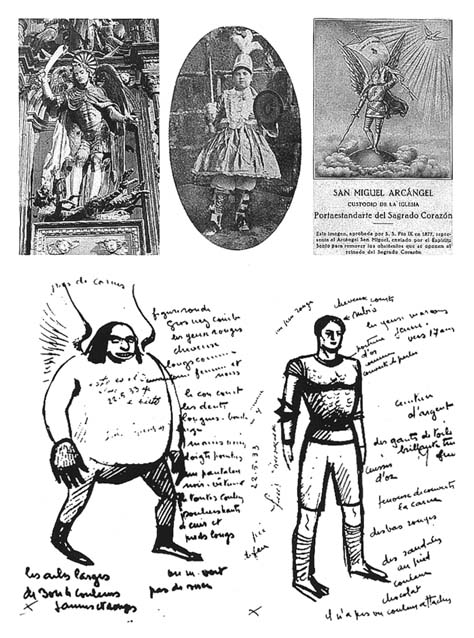
Saint Michael: top left, patron saint of Ezkioga parish church (photo
by Joaquín Sicart); top center, boy saint Michael from Good Friday
procession, Andoain, 1915 (from Anuario de Eusko-Folklore, 1924,
courtesy Fundación Barandiarán); top right, holy card sold at Ezkioga,
ca. 1932 (printed by Daniel Torrent, Barcelona); bottom, the devil and
Saint Michael as seen by Luis Irurzun and drawn by J. A. Ducrot (from VU,
30 August 1933, all rights reserved)
of workers and the poor, gossips, proud and worldly people, spiritists who worship the devil, as well as apostates, heretics, schismatics, and sectarians. On all of these he called down Saint Michael's sword.
Writing in El Pensamiento Navarro on 17 July 1931 a cathedral canon equated Michael of Aralar's struggle with the dragon and that of Catholics with the Second Republic. In doing so he anticipated by one week the visions of Patxi and others. For the canon Saint Michael of Aralar was
the shrine of our beliefs and the bastion of our traditions, whence resounds the old triumphant cry, "There is no one like God!" whose echo, rolling from peak to peak and spreading from valley to valley, has gotten the sacred militia of your brave men on their feet, ready to struggle fearlessly with the dragon until they slay it or cast it, defeated, in its cave.[73]
Múgica, "San Miguel"; Mugueta, PN, 17 July 1931.
For conservative Basque Nationalists too Aralar was a rallying point. Luis Arana Goiri, the brother of the founder of the Nationalist party, had Saint Michael named the patron saint of the party. In August 1931 party ideologue Engracio de Aranzadi wrote that the shrine was "the point of vital union of all Basques" and he warned people not to abandon "their invincible Chieftain, the Angel of Aralar, at a time when the race needs the help of all its members in order not to succumb before the number, power, and hatred of its eternal enemies." The great advantage of Michael of Aralar as party patron saint was his attraction for the Navarrese, doubtful members of a greater Euskadi.[74]
Aranzadi, EZ, 20 August 1931. At the Nationalist fiesta at Aralar on 20 August 1933 about a third of the eighteen thousand persons were from Navarra; PV, 25 August, p. 8.
The visions of Saint Michael battling dragons and devils in the sky at Ezkioga pointed to Aralar as a place of contact between the celestial and regional landscapes. Michael figured prominently in the visions of the seers from both slopes of Aralar, those from Ataun and those from the Barranca. In the visions Michael was the Virgin's great auxiliary, and when the great miracle was to occur, it was he who would explain it and later carry out the chastisement. So when vision meetings were forbidden at Ezkioga, Aralar became a logical alternative for Tomás Imaz and the seers.
There were other private vision places. In February 1933 police arrested the inhabitants of a flat in Bilbao because people were going there to see a miraculous Christ. By 1934 there were also regular meetings of believers in San Sebastián. And two male seers held sessions in the house of José María López de Lerena in Portugalete the first Fridays of every month. In Oñati women from town and farms said the rosary in a chapel of the parish church of San Miguel and embroidered a banner with the Virgin of Aranzazu and Saint Michael. Thus they prepared for the day of the great miracle, when they would come into the open and show their colors.[75]
Bilbao: "La Policía descubre un Ezquioga establecido en un quinto piso," VG, 12 February 1933, p. 5; San Sebastián: Sarasqueta, VG, 10 April 1934, refers to "a certain San Sebastián gathering-place for the pious"; Portugalete: lifetime servant of the López de Lerenas, interviewed by telephone, 7 May 1984; Juana Urcelay, Pamplona, 18 June 1984, p. 4.
In Ormaiztegi a wealthy lady held prayer sessions almost continually in her large house; she had a chapel-like prayer room with an altar and stations of the cross. Seers, two of them young women servants, would go into trance. On special holy days the dozen or so believers might hold a procession in the walled garden and sing hymns. Those attending included shopkeepers from Urretxu and Zumarraga. Persons involved in this circle describe a closed, intense world where every illness was treated with holy water from Ezkioga and every death lit by candles that had previously been lighted and blessed during visions. Some families were divided, and believers had to pray extra hard and have extra masses said so nonbelieving relatives would not go to hell. The sick offered their illness to God as sacrifices, and some who died were considered saints and intercessors in heaven. The believers contributed money and jewels for liturgical ornaments and a chalice for the shrine planned for Ezkioga. The host died in 1966.
Zegama was another center of support for the Ezkioga visions. This large township had a big new Carlist community center, complete with movie theater and bar. Relics and a statue of the Carlist general Zumalcarregui were in the parish church, where the boys in catechism class could put on the general's beret and the best one got to touch the relics. The religious activity of children was highly organized, both informally in fiestas and by the church in sodalities.[76]
The poet José Azurmendi, San Sebastián, 4 February 1986; Gorrochategui, AEF, 1922; and Gorrochategui and Aracama, AEF, 1924, pp. 108-109.
In 1924 a priest reported that only ten persons did not go to church at all, but he was alert to the railroad, the paper mill, and the alcohol factory as threats to community morality. The women were devout, but most men were indifferent. The clergy worked hard to counter the inroads of modernity: from 1918 to 1924 almost every house enthroned the Sacred Heart of Jesus. In this effort the clergy could bank on Zegama's strong Marian traditions, which included an overnight pilgrimage on Pentecost Sunday over the mountains to Our Lady of Aranzazu.[77]
Gorrochategui and Aracama, AEF, 1924, p. 103. For Aranzazu see Guridi, AEF, 1924, pp. 99-100; and Gorrochategui, AEF, 1922, p. 51.
In 1931 several of the many diocesan priests born in Zegama supported the visions. One of them, the parish priest, took down the messages of Zegama seers Marcelina Mendívil and the eight-year-old boy Martín Ayerbe. Burguera was much impressed by the boy's visions of dead children: "He gives minute details about them to their families, which is why these families and others who know about the prodigies believe him."
Martí Ayerbe had visions both in Zegama and at Ezkioga, where his picture was sold on postcards. Like the other seers, he saw not only the Virgin, but also Christ, Saint Michael, other angels, and Saint Paul (walking among the people with sword in hand, a crown on his head, in white clothes and white shoes). The parish priest was intrigued by Martín's visions of a book the Virgin was reading that the devil wanted to destroy; he assumed it was the one Burguera was writing. The boy's vision on 17 October 1931 shows one way the visions could spread among children. He told a farm girl, aged twelve, from
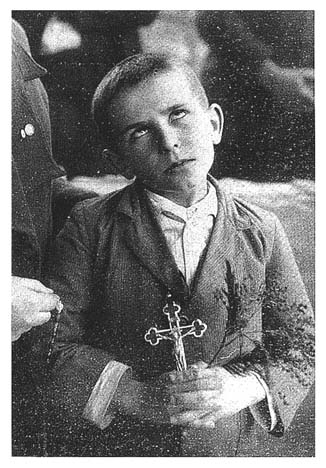
Martín Ayerbe of Zegama in vision, ca. 1932. From Nouvelle
Affaire, fig. 27. Photo by Raymond de Rigné, all rights reserved
Zumarraga that the Virgin had appeared over her head and instructed him to tell her to pray six Hail Marys on her return and to go every day to Ezkioga, where she too would see the Virgin.
In January 1933 when Martín was in vision in catechism class in a chapel, he saw a crucifix in a corner bleeding. According to Burguera, the other children and persons who came in, including two priests, saw the blood too. On Martín's advice, the parish priest notified Bishop Múgica, not yet in the diocese, instead of Echeguren, the vicar general. When the French photojournalist Ducrot went there in May 1933, other children as well were having regular visions before an altar in the chapel.[78]
For Marcelina Mendívil, Boué, 60, who cites a vision in Zegama on Easter Sunday, 1932, and R 59. Ducrot in VU, 16 August 1933, p. 1289 (photograph). For rest on Martín Ayerbe, B 624-628. Francisco Otaño, curate of Beizama, wrote Cardús from Beizama, 25 March 1933, "The priests of Cegama received orders from Vitoria prohibiting access to the place, but then a counter-order a few days later permitted access and asked that the bishop be informed of whatever occurred."
Finally there was a vision substation in the mountains of Urnieta coordinated by the town secretary, Juan Bautista Ayerbe. In 1933 and 1934 Conchita Mateos, Esperanza Aranda, the servant Asunción Balboa, and others sporadically held sessions in houses there. Gradually Ayerbe became more daring. The first news
came from the local stringer of El Pueblo Vasco on 1 December 1934, under the leader "Another Ezquioga?"
It seems that part of the stream of tourists has been diverted to this town. We are assured that several persons frequently go to a certain place between the hermitage of Azcorte and Mount Buruntza, among them several from this town, and even that some go up barefoot. The visions take place not only at this site but also in two or three houses in town.
The correspondent added details the next day, reporting that the seers were adults, that some were from San Sebastián, that people went daily from Urnieta, and that after the visions the believers gathered to talk about them at a nearby farm, where the farmer was one of the seers. Few households in Urnieta were involved actively, but the correspondent named Juan Bautista Ayerbe and "Señor Imaz" of San Sebastián. Ayerbe denied the charge, and an angry lady visited the newspaper office in San Sebastián and said in broken Spanish, "Do not mess with the apparitions. Leave us in peace. We will follow the Virgin anywhere."[79]
Kale'tar bat [a man from the street, or town center], PV, 1 and 2 December 1934.
Clearly there was more than visions at stake, for three days later an explicitly political diatribe against the correspondent appeared in La Constancia . The author, I think Ayerbe himself, admitted only that the farmer and his friends were praying the rosary and doing the stations of the cross at the chapel. With the kind of vehemence that can best be aroused in small towns, he pointed out that the Pueblo Vasco correspondent was a Basque Nationalist and attributed his derision of the devotional practices to politics. By then Basque Nationalists had become allies of the Republic, and he tried to attribute their opposition to the visions to anticlericalism.[80]J. B. Ayerbe, LC, 5 December 1934.
The correspondent replied that in Nationalist homes throughout Urnieta, rural and urban, people still prayed the rosary and that monarchists like Ayerbe did not have a corner on Catholicism. He alluded to two years of visions in Ayerbe's home and cited a brief exchange that gives a sense of how difficult it was for persons going about their daily lives to contend with others who believed that the end of time was at hand.
Not long ago an assiduous male devotee of Ezquioga went up [toward Mount Buruntza] with a lady, and when they came to a farm and saw that its inhabitants were quietly eating their afternoon meal, they snapped, "What are you doing eating? The Virgin is appearing up there."[81]
Kale'tar bat, PV, 12 December 1934.
With martial law in force, all meetings required government permission. Ayerbe recklessly continued the sessions, and civil guards surprised a group praying at the chapel of the Santa Cruz de Azkorte. Three persons were fined. When the military commandant consulted with the diocese, the archpriest of the zone asked him to ban all meetings in the chapel. At Urnieta the Republic thus
came to an understanding with the church to suppress visions, and this understanding was applied in Zaldibia.[82]
PV, 15 December 1934, p. 1 (also LC, p. 8, and ED, p. 1); PV, 16 December 1934, p. 1.
Only a week later Ayerbe reconvened his group in Tolosa, where on 23 December 1934 the poor seer Asunción Balboa talked over the crackdown with the Sorrowing Mother. The Virgin told her the Basque Nationalists were to blame and would be punished and warned that bad men would throw bombs into convents. The unusually explicit politics of this cuadrilla comes out in Balboa's conversation with Jesus, who told her that King Alfonso would soon come back to reign in Spain. She also saw Thérèse de Lisieux, Gemma Galgani, and Our Lady of Mount Carmel, who said that because of the group's prayers twenty-five souls would leave purgatory the next Saturday. There was still time for many private messages for individuals.[83]
J. B. Ayerbe, "Visión de Asunción Balboa, 23 Dicbre. 1934—En Tolosa," 2 pages, typewritten, AC 213: "No quieren que reine el Rey Alfonso pero Tú dices que ha de reinar en España ... Pero sí reinará. No tardará mucho tiempo."
Starting then in 1932 Gipuzkoa had a number of groups that maintained their own parallel Catholic rituals, firm in the knowledge that a civil war would occur and that sooner or later there would be a great chastisement. Each cuadrilla met in secret, but everyone in the zone knew that such groups existed. As far as I can tell, apart from some intransigent priests, few people felt moved to do anything about them. One exception was a potter from Zegama who stood up on the vision stage at Ezkioga and shouted, "I believe in Christ but not in this nonsense!" After all, the majority of Catholics in the Basque uplands were hopeful at first that the visions were true, and huge numbers had been devout and enthusiastic spectators. Later, instead of denouncing the seers and the believers, people either tolerated or laughed at their delusions, often with grudging admiration for their piety.[84]
For Zegama man: Francisco Ezcurdia, 10 September 1983, p. 3.
I was told stories about the believers which, true or not, demonstrate how some of their contemporaries dismissed them. Women in Zumarraga told me about a couple from Zaldibia who were convinced by visions, their own or others', to reenact the flight of Mary and Joseph to Egypt. They borrowed a child and set off walking with a donkey. When they reached Valencia and found they would have to cross an ocean, they turned back. In Legorreta, I was told, a great fear swept the town one election day when a man came down the steep mountainside above the town with a blazing pine torch, and people were convinced Saint Michael the Archangel had finally descended to separate the just from the unbelievers.[85]
For Legorreta: José María Celaya, OFM, from Legorreta, Aranzazu, 1 June 1984; his father carried the torch.
But what nonbelivers, whether indignant, mocking, or tolerant, all seemed to ignore was the zest of the believers. Paradoxically, while having visions of dire events in their closed secret cells, the believers were having a wonderful time, creating pockets of social space full of goodwill and good humor. For them their rosaries, their hymns, and their vision messages were a taste of heaven on earth. In these groups the mixing of unrelated men and women, of wealthy and poor, of merchants and farmers, of San Sebastián sophisticates and rural Basque speakers, of adults and children, led to a kind of exhilaration that comes with
the breaking of taboo and convention. Rural women were suddenly on an equal footing with educated urban men, who served as their secretaries.
These people now recall their arrests as heroic. One day in October of 1937 or 1938 Juliana Ulacia and her group were caught at Ezkioga, put in a truck, and detained in a vacant house in Zumarraga.
[Woman:] How we prayed and sang! [laughs] From morning to night!
[Brother:] From that empty house they wanted to make it to heaven! [laughs]
[Woman:] Then they brought us to testify. Even the guards had to laugh. They didn't know what to do. We did nothing but pray and sing. But they had their job to do. We spent eight days like that; then when they got tired of our praying and singing, they gave us food and said, "All right, you can go home now."[86]
Elderly Zaldibia believers, 31 March 1983, pp. 10-12.
The old-time believers, their faces alight with pleasure, remembered these groups with great fondness.