
Jesus bettelt ("Schenk mir deinen goldenen Kamm"), op. 2, no. 2
The song, Jesus bettelt pulls together various technical and expressive threads of the earlier completed Dehmel settings of 1899. It develops further the chromatic
style of Mannesbangen; it resembles Warnung in the declamatory flexibility of the vocal line and in the use of thematic transformation to shape the central section of the song; and it has something of the broad pacing, the control of the large scale, evident in Erwartung. A highly sensual appeal by Jesus to Mary Magdalene (and only slightly more chaste than the approaches of Wilde's Salome to Jokanaan), the poem is surely one of the texts of Weib und Welt viewed as bordering on blasphemy and obscenity:
Schenk mir deinen goldnen Kamm;
jeder Morgen soll dich mahnen,
daß du mir die Haare küßtest.
Schenk mir deinen seidnen Schwamm;
jeden Abend will ich ahnen,
wem du dich im Bade rüstest—
o Maria!
Schenk mir Alles, was du hast,
meine Seele ist nicht eitel,
stolz empfang'ich deinen Segen.
Schenk mir deine schwerste Last;
willst du nicht auf meinen Scheitel
auch dein Herz, dein Herz noch legen—
Magdalena?
Give me your golden comb; each morning should remind you that you
kissed my hair. Give me your silken sponge; each evening I will envision
you preparing for your bath, O Mary!
Give me everything that you have; my soul is not vain, proudly I receive
your blessing. Give me your heaviest burden; will you not also lay your
heart upon my head, Magdalene?
The formal structure of Schoenberg's song is more ambitious than that of any of the earlier settings. Rather than fashioning a modified strophic or ternary form, Schoenberg treats the second stanza (mm. 19–38) as a kind of development or expansion of the first. The first stanza consists essentially of a six-measure statement and its sequential repetition up a half-step, followed by a climactic setting of Jesus' direct address, "o Maria." The music for "o Maria" returns in the second stanza for the analogous "Magdalena," but what precedes it constitutes essentially a development of motives from the first stanza.
The opening two-and-a-half-measure theme in the piano furnishes the basic material for the song. This theme has two components (labeled x and y in ex. 4.6a), which are developed separately in the second stanza. The basic principle resembles that of Warnung, but now the two thematic ideas are handled with
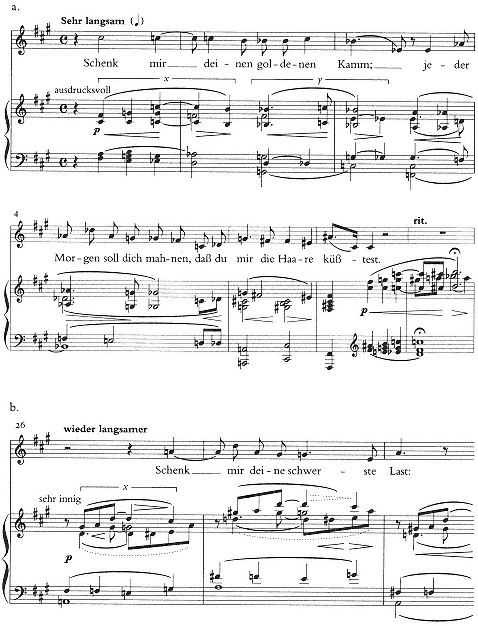
Example 4.6
Jesus bettelt ("Schenk mir"), op. 2, no. 2.
greater fluidity. The theme remains relatively intact during the first fourteen measures. (Motive x is used for the transition between the statements of the sequence.) At m. 14, y is for the first time isolated and treated sequentially, in diminution, as Schoenberg builds to a climax at "o Maria." The second stanza is dominated at first by sequential repetition of y (mm. 19–23), which then gives way to sequential diminution of x. The diminution of x is first introduced in m. 23, then retreats and reappears to dominate all of mm. 26–33 (ex. 4.6b).
The modification of x in the accompaniment at the "wieder langsamer" of m. 26 manifests the same impulse toward thematic transformation seen in the B section of Warnung. The contrast in mood is, to be sure, not as marked as that between the angry opening of Warnung and the "carnation" transformation. But in Jesus bettelt, the Stimmung has definitely changed at m. 26, from "ausdrucksvoll" to "sehr innig." And this change is accompanied or reflected by the new treatment of x.
Also more successful is Schoenberg's treatment of harmony. Two aspects are especially worthy of discussion. The first is the way Schoenberg underpins the chromatic voice-leading with strong fifth-oriented bass progressions. At the very opening (see ex. 4.6a), the bass steps down from


Strong root progression in the bass emerges again in mm. 14–19. Here the effect is even more striking than at the opening of the song because of a very basic cadential I–II–V–I succession, in which, however, the diatonic Stufen are harmonized with vagrant chords (see ex. 4.7a). This passage shows how skillfully Schoenberg can extend or delay arrival on the tonic. The first cadence in the song, at "küßtest" in m. 6, is made to the tonic major. At the parallel spot in m. 14 ("rüstest") Schoenberg wants to avoid closure to the tonic so as to lead into the climactic "o Maria." The tonic note,
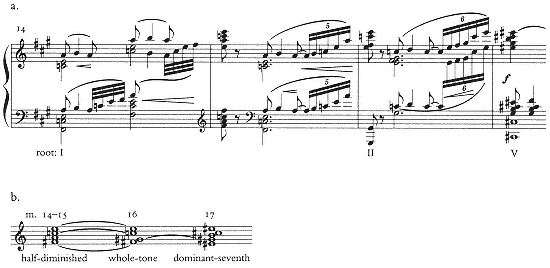
Example 4.7
Jesus bettelt, vagrant harmonies with diatonic roots (piano part only).
inution of motive y), which is sustained for two measures. This chord then gives way to another vagrant harmony, a whole-tone chord with a


The succession of chords in these measures shows Schoenberg attempting to connect vagrant harmonies by means of smooth voice-leading. As is suggested in ex. 4.7b, the first two of the three harmonies—the "Tristan" half-diminished and the whole-tone chord—differ from each other only by one half-step. Further half-step voice-leading produces the third chord, the dominant seventh. (The


Toward the end of the song, Schoenberg reworks the "o Maria" passage at the
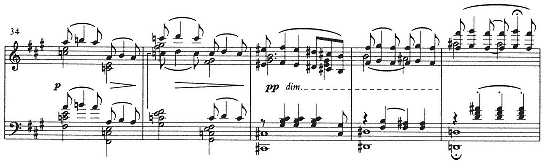
Example 4.8
Jesus bettelt, mm. 34–38 (piano part only).
parallel place in the stanza (ex. 4.8), where he manages to delay the tonic still longer. At mm. 34–36 (cf. mm. 14–17), a I–II–V supports, as before, the "Tristan" chord, the whole-tone chord, and the dominant seventh. But the dominant now resolves deceptively to a IV6 chord (which in turn moves on in the second half of the measure to a vi). This is an especially lovely moment, largely because up to this point in the song there has been no emphasis on the subdominant. Its appearance here at the conclusion fulfills, or at least begins to fulfill, the same tension-releasing function as in many classical and romantic codas. But instead of descending to

The final cadence of Jesus bettelt, as suggested above, resembles that of Mannesbangen and is motivated by similar harmonic procedures. In both cases the dominant is elided and the tonic is approached directly from what is normally a predominant chord, the French sixth in the earlier song, V/V in Jesus bettelt. The rationale for this procedure in both songs is that the dominant has in some sense exhausted its cadential powers; in Jesus bettelt, the dominant has featured strongly in the big climax at mm. 17–18 and the more restrained one at 35–36.
In Jesus bettelt, then, Schoenberg has tightened the harmonic and motivic procedures of the earlier Dehmel settings. This is accomplished above all through a more moderate and transparent accompaniment, a more focused motivic language, and a strong emphasis on stepwise connection between vagrant chords, which are here often underpinned with basic diatonic progressions.