
Ngoma Of The Land, Ngoma Of The Coast
The particularism of naming in the Sukuma ngoma setting suggests that there is much innovation and adaptation in the overall idiom. In ngoma of the Dar es Salaam Swahili coast, the proliferation of orders arises at least as much from specific spirit classes as from particular functional specializations. Whereas the ngoma association names appear to offer a particularized view of ngoma, spirit classes diagnosed
to possess afflicted individuals are generalized into two or three groups. Among the coastal Islamized peoples, spirits are called masheitani or majini, both Arabic-Swahili words. The distinction between the two is not as important, apparently, as that distinguishing spirits of the water from those of the land, with some occasionally identified with the beach or coast. Thus, Msaghiro is an ngoma for sufferers of chronic and severe headache caused by a combination of Maruhani, Subizani, and Mzuka spirits, all coastal or beach spirits. Each of these classes is subdivided. The Subizani, of whom there are ten, are beach or rock spirits; some are male, some female, who have to do with children, both making them ill and helping to raise them to health. N'anga ngoma is a manifestation of Warungu spirits of the land, hills, baobab trees, and mountains; their mode of affliction is chronic severe headaches. Frequently each spirit type will be "played" in an ngoma ritual by a particular type of instrument. Not surprisingly, it is the major inland spirits that are usually represented by the classic single membrane ngoma drums.
Emmanuel Mshiu and I. A. J. Semali of the Traditional Medicine Research Unit had arranged for me to see Botoli Laie, a healer they knew from their surveys, to work with ngoma. Botoli was a Mutumbe from coastal Kilwa who lived in the Manzese locality of southwest Dar es Salaam, not far from the main road but back in the villagelike area filled with houses surrounded by banana and palm trees and lush gardens. Botoli was home, with his two wives and children, and yes, he would gladly talk. And yes, he did work with ngoma: Manianga and Mbungi. His house was large for the area, with a raised courtyard suitable for ngoma performances and a mazimu ancestor shrine in one corner (see fig. 2).
Botoli had become an mganga (healer) in 1952 and had obtained the ngoma dimension of his work apparently without sickness having drawn him into it. I asked him whether he had suffered prior to his initiation. "No," he said, he hadn't been sick, but he was called to do ngoma Manianga and Mbungi after he was in practice. He resisted it, but then went ahead anyway.
Botoli was a vigorous man who talked in an authoritative voice. He willingly answered my questions, ready to show me the basic lines of his work with ngoma. He was a full-time healer, established with a well-built house, exuding a cohesive ambience. His children and two wives listened attentively to our conversation.
"Ngoma Manianga," he said, is used to deal with spirits of the interior of the country, that is, from Tabora and other regions across
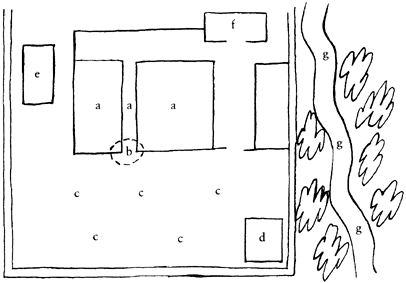
Figure 2.
Compound of Botoli Laie in Dar es Salaam; (a) house; (b) ngoma
drums kept here; (c) ngoma performance area; (d) mazimu ancestral
shrine; (e) tomb; (f) consultation and medicine room; (g) stream lined with
banana trees.
Tanzania and East Africa. These masheitani are ten in number: Makogila, Ali Laka, Akiamu, Akolokoto, Akimbunga, Amiyaka, Akitenga, Ananditi, Chipila, and Ndwebe. When people are affected with these masheitani, they have bodily weakness, loss of weight, or general bodily swelling; they get shaking of the body, headache, and loss of appetite. They need then to be treated, to be taken through the course of treatment including specific materia medica from the mkobe (medicine basket), as well as dancing.
For his work with ngoma Manianga, Botoli uses a simple costume consisting of a red blouse and matching skirt, with designs sewn on the blouse (see plate 7). His paraphernalia include a small ngoma drum (musondo , also used in puberty rites) sometimes a smaller double membrane drum, and about ten sets of gourd shakers. There were also sets of cloths in red, black, and other colors, associated with various spirits. The strings Botoli wore around his shoulders had red, white, and black bags sewn onto them, which symbolically articulated cosmological oppositions such as the domestic versus the wild and land versus water. Each of his ngoma included a medicine basket (mkobe ), in which he
kept a collection of a dozen or so small jars and tins of medicines specific to the ngoma. (This set of ritual items is strongly reminiscent of the nkobe of western Kongo.)
Ngoma Mbungi has much the same paraphernalia: drums, shakers, and mkobe . The five ngoma drums of Mbungi represent five up-country masheitani: Mchola, Matimbuna, Mbongoloni, Chenjelu, and Kimbangalugomi, each of which is roused and manipulated by its own drum. The instrumentation also includes two wooden double gongs, which Botoli demonstrated. The resemblance between this ngoma kit and those of the Southern Savanna-to-Kongo region is striking and raises questions about their common history. Further research is needed to establish the approximate historical connection in the spread of these rituals across the mid-continent. Were they products of the coast (Kilwa)-Tabora-Kigoma trade route in the nineteenth century and earlier? Or were they the product of an even earlier common framework?
Botoli said he works with five to seven other waganga (healers) in the ngoma rites when the performance is at his house and he is the leader; elsewhere the host for that event is the leader. He noted that he has had many novices and was still in touch with them through ngoma events, although he could not give their precise number.
Although Botoli owns the instruments that are part of the paraphernalia of each ngoma of which he is healer, he is not the expert drummer in the rites. For major rites he hires drummers who are noted for their skill; they need not be novices or patients. The performers who do therapeutic ngoma are thus the same as those doing secular ngoma, or ngoma for circumcision, or any other festival or ceremony. It is the context and content of the songs, then, that identifies ngoma as therapeutic.