
5
Envy, Adornment, and Words That Make the Floor Shake Pangngae and the Rhetoric of Manhood
Pua' Soja, my friends said, was already a village leader in Minanga when Dutch expeditionary patrols crossed into the Salu Mambi valley for the first time. That was in 1906. Sitting with him in 1984, reticent with wonder and disbelief, I tried to imagine what someone would have seen, heard, and endured in living through the hundred or more years since the internecine collapse of Pitu Ulunna Salu. I pitied Pua' Soja his aches, his clouded eyes and swollen joints, his being plain worn out by nothing except having to live another day. But weariness of body had yet to defeat his courage and dignity, especially during the season of pangngae and other pa'bisuan rituals when he would put on headcloth and ceremonial gear, and struggle the climb in and out of houses and up and down the village paths, to take his place with the other senior men gathered at the rites.
Among my mappurondo acquaintances, no one had firsthand experience of the precolonial order, save for a few who would have been very young children in 1906. Elder women were reluctant to say much about the past. Although their recollections of local events and family histories were every bit as sharp as men's, women left "official" history to the men. As for elder men, most discussed the ancestral past—the time prior to the fall of Pitu Ulunna Salu in 1870—as a turbulent golden age. Ambe Tibo, a grandson of Pua' Soja, was not alone, for example, in claiming that before misfortune fell upon the headwaters, village men were tall and big-boned and always lived to be 100, their bodies evidencing a greatness now gone. He himself had

Fig. 8.
Pua' Soja, 1983.
been in another village one time when someone unearthed a huge bone, said to be part of a human leg. "A span this long or more," he said, making a cutting gesture on the upper part of his extended arm. "Back then, the people here were powerful and rich. But look at what we have become." Others would give a more mixed picture of the past. Ambe Assi', the tomatuatonda' at Minanga, was proud of headwater history and mappurondo tradition. But I painfully recall a remark he made one day as he listened to several of us speaking about the corrosive effects of the Dutch colonial period. "Listen up," he said curtly. "Before the Dutch came we weren't human yet. We didn't even know how to talk."
The prospect of speaking at length with Pua' Soja about the close of the nineteenth century promised both a less gilded and a less demoralized account of local history. That was never to happen. My conversations with the old man were brief and few, and were always distracted by the company of others. He remained a remote figure. Seeing him again during the pangngae celebrations of 1985, I gently pressed Pua' Soja about the headhunting rites of the past. His fleeting remarks never made it clear whether or not heads were taken during his lifetime. In contrast, his answer to my question about the ritual's central theme was unambiguous: pangngae was all about kelondongan (the daring and audaciousness of a cockerel; cockiness), and kemuanean (manhood).
Putting manhood into action and on display in pangngae calls attention to a social poetics (Herzfeld 1985) or a social aesthetics (Brenneis 1987) in which villagers summon a select vocabulary and image of masculine conduct and being. I share with Herzfeld and Brenneis their interest in performance as the means through which sense-making, self-making, and experience coalesce as a strategized and consequential event. But because the ceremonial formulation (or evocation) of manhood in pangngae is so partial and select, and because it so animates the communal body, its basic rhetorical character deserves emphasis. Lake the Glendiot idioms described by Herzfeld (1985: 16), the rhetoric of manhood in mappurondo headhunting rites involves "being good at being a man." Yet I would argue that recourse to a Jakobsonian concept of poeticity—"the set (Einstellung ) toward the message as such, focus on the message for its own sake" (Jakohson 1960:356)—does not take us very far. "Being good at being a man" in the arena of mappurondo ceremony is a way to set specific social and political projects into motion. For that reason, the "set (Einstellung ) toward the message as such" is not enough. The deployment (Ausstellung ) of the message, and its effective expression in performance (Darstellungsgabe ) are basic to the rhetoric of manhood in the mappurondo community, and must play a part in any considered analysis of pangngae.
In previous chapters, I have tried to throw light on ritual violence from the vantage points of political history, mourning, and vowmaking. Pua' Soja's remarks, however, compel a reading of the headhunters' violence in light of ideas about manhood. Exploring the ritual discourse of manhood should also help us to understand why the demonization of the rival "other" and the cessation of mourning take place in a setting that underscores the social hierarchies predicated on seniority and gender. In the course of this chapter, I will argue that a ceremonial politics of envy and emulation animate both hierarchies. That is to say, the headhunting rites of pangngae are a turbine of social difference and mimetic desire. The rhetoric of manhood in pangngae thrives on these political currents. But as I want to show, that rhetoric is also the discursive mode for conjuring envy and emulation.
It is worth repeating that pangngae takes place under the authority of men and is considered both a village concern and a male spiritual pursuit. In a conventional sense, pangngae is not a rite of passage for males; it does not bring about a permanent change in social status. But youths must follow the trails to the sea, so to speak, if they wish to join the company of mature men. And as we have seen, those already in the ranks of men may undertake the journey for personal ends. Women of course play a fundamental if circumscribed role in the ceremonial activities associated with the headhunt. Yet taken as a group, women are not fully subject to the ritual's focal transformative operations. To use Bourdieu's (1991) terminology, pangngae is a rite of consecration and institution. That is, pangngae separates
those who have undergone it, not from those who have not yet undergone it, but from those who will not undergo it in any sense, and thereby [institutes] a lasting difference between those to whom the rite pertains and those to whom it does not pertain. . . . By treating men and women differently, the rite consecrates the difference, institutes it, while instituting man as man . . . and woman as woman. (Bourdieu 1991:117-118)
Mappurondo headhunting rites thus bring gender differences into being and impose them upon participants as their social destiny. At the same time, the ritual makes hierarchical distinctions within a community of males, distinguishing those "seniors" who have been honored as topangngae, and those who have not. The rhetoric of manhood, I would argue, takes up this double business and ties it to the project of ritual violence.
Though it is possible and perhaps necessary to describe these hierarchies in terms of "structural" differences, I think it is important to capture something of the anxiety, want, and restlessness common to the ongoing foment of social categories. Contemporary mappurondo communities are relatively egalitarian, neither producing nor tolerating dramatic differences in prestige
or power.[1] That said, differences having to do with gender and seniority are basic to local thought and conduct; they help to motivate social life and to make it intelligible. The rhetoric of pangngae, in my view, summons and plays with these differences, juxtaposing them in such a way as to spark social movement.
Although villagers show a deep practical and ideological regard for human sameness, the simple fact is that in mappurondo ritual life, not everyone can be a headhunter. That women are excluded from becoming the central actors and focal subjects of pangngae fractures human sociality and marks part of the faultline that distinguishes manhood and womanhood. Yet because the rituals of pa'bisuam baine put women centerstage, I caution against a rushed analysis that would see pangngae as an occasion for men to gain a position of lasting dominance and privilege vis-à-vis women. By instituting and consecrating a difference between men and women, pangngae declares a limit to human sameness. But it does not relax or suspend the egalitarian ideal. In fact, I would argue that the social distinctions delimited in the ritual rest upon or are carved into the bedrock of sameness. Stated more strongly still, ritual discourse puts ideas about gender difference and human sameness into productive tension and conflict. As a result, the will to sameness, confronting difference, experiences envy, and a desire to emulate. The will to differ, confronting sameness, strives for excess and the "talismans of supremacy" (to borrow a phrase from René Girard 1977). Girard (1977, 1987) would argue that the tension between sameness and difference is a source of generative violence, a violence so terrible and contagious that it must be directed out of the community. And he would likely see mappurondo headhunting ritual as an attempt to solve the problem of rebounding violence (cf. Bloch 1992). I seriously doubt that mimetic desire plays such a decided part in the political violence of pangngae. Yet it is far from absent in this ritual. For the purposes of the present discussion, I merely wish to identify mimetic desire as one of the principal rhetorical strains in pangngae and to call attention to its relevance to local ideas about manhood and womanhood.
In the rhetoric of headhunting ritual, men strive for excess and superiority, and women look on with envy. (a situation that is reversed in the grand rites of pa'bisuam baine). I should stress that women's envy does not derive from lack or absence, but from a wish for still more. That "still more" is denied to women, withheld from them as the defining secret of manhood. Here it is worth noting that the tasks deemed most significant for making men men—slaying a victim, making a tambolâ—happen outside the village and out of the gaze and earshot of women. The excess that belongs to men
is discovered on seaward trails and in the forest during the headhunters' journey downriver. Surrounding these tasks, too, are a set of tabus that put a woman at risk should she happen upon men in their secret work. Violating these tabus is no less than a transgression of the boundaries marking male and female. Thus, the breach of category erupts into somatic symbolism as physical dissolution and death. Seeing men make their tambolâ flutes, for example, is said to bring illness or death to a woman. By concealing some of their practices the way they do, mappurondo men essentially hide themselves, and something of themselves, from public view. It should be evident, then, that masculinity and femininity depend upon differences made and kept in secret as much as upon differences made visible and audible in the domains of ritual and everyday life.[2] For this reason, women cannot slake their envy during pangngae through emulation. It must remain hungry and restless until the rites of pa'bisuam baine, when women can discover excess in their own secret sources. At the same time, women are complicit—indeed, instrumental—m heaping praise and admiration upon the topangngae. Once more, then, we see the work of others as crucial to the management and representation of self. lust as the bereaved cannot remove the burdens and emblems of grief through self-effort, neither can the headhunter acquire an excess of manhood, a superabundance of being, without the help of women and the collective at large. To sum up, it falls to women to witness, to gaze at, to envy, and to desire the headhunter.
The discursive force of envy and emulation also colors the hierarchy of senior and junior males, of men and not-yet-men. Once again, the desire for difference becomes entangled with the desire for sameness. Young males see presented to them an opportunity to join the ranks of adult men, and in this sense are very much unlike women, who are precluded from achieving sameness with men through the headhunt. The figure of the headhunter is, of course, the model image of the adult male. If the mappurondo youth is to achieve peership in the company of men, and thereby make his passage into adulthood, he must make the headhunting journey of pangngae. Yet there is no need to drag the young across the threshold of maturity. The mimetic aspirations of the young are clear: they want their chance to wear the headhunter's amulets, to have their names celebrated in chant and song, to be honored with gifts of rice and meat, and to sound their tambolâ and deliver a skilled and impassioned oration to the ritual gathering. "It was great," a ToSalu friend recalled, thinking back to his first time among the topangngae in the 1950s, "Everyone was looking at me and my chest was just bursting. I was important. Besides that, I had never seen so much rice, and it was all for me."
Once a youth has proved himself a peer in the company of adult men, there are no further statuses to be pursued. The game becomes one of flexing and holding onto one's status as an adult man by marrying, raising a family, and taking part in village affairs. Yet the sameness of peership, linked as it may be to ideas of harmony and social accord, shows real instability. For example, in the sphere of a domestic politics grounded in uxorilocality, a young husband is said to "live beneath the ends of the floorbeams" of his wife's natal home. As such, a husband must subordinate himself to his parents-in-law. Trysts with married women bring shame to cuckolded husbands and threaten to steal from them both spouse and home. And a man's desire for greater wealth, influence, and reputation—the desire to be a tomakaka' (the prosperous one, who is "like an elder sibling" )—also stirs beneath or behind the politics of peership. Whether to defend himself against a loss of esteem or to enlarge his reputation and influence, a man will often return to the ceremonies of pangngae as a headhunter and once more assert his manhood and difference. These accomplished ones who seek to "enlarge their self-image" (umpokasalle kalena ) in turn can lead novices into the mystery of the headhunt.
What I describe for the mappurondo communities—tensions between ideas about social difference and ideas about sameness, tensions theorized and animated by envy and emulation—bear a decided resemblance to the social dynamics informing Ilongot headhunting (M. Rosaldo 1980, 1983; R. Rosaldo 1980, 1984, 1987). Among Ilongot youth, there is a strong desire to emulate the violent feats of their "fathers" (M. Rosaldo 1980:139), and to wear the coveted red hornbill earrings that will mark them as accomplished men (R. Rosaldo 1980, 1984, 1986). Especially striking is the intensity of the youth's envy. Ilongot youth "coming of age undergo a protracted period of personal turmoil during which they desire nothing so much as to take a head. . . . Young men weep, sing, and burst out in anger because of their intense, fierce desire to take a head" (R. Rosaldo 1984: 191). This adolescent turmoil involves a "tremendous sense of envy or rivalry," a deep "want to become like older men" (R. Rosaldo 1987:242). The emotional intensity of Ilongot men also distinguishes them from their wives and sisters. The hearts of men, according to the Ilongot, are "higher" than women's, and "exceed" them in the intensity of anger, passion, and "knowing" (M. Rosaldo 1980). But curiously, women's envy of the headhunter is missing or muted. As suggested by my discussion of grief and violence in the preceding chapter, the intensity of emotional expression among the Ilongot throws into relief the emotional restraint of the mappurondo
villager. As with anguish, so too with want. Envy and desire may not burn as brightly in the hearts of mappurondo youth as they do in the Ilongot, but their presence is immanent in the discourse of pangngae.
My immediate purpose in this chapter on manhood, then, is to explore the discourse of headhunting ritual for signs of envy and desire, and to say something about their rhetorical force and formulation. As a first step, let me turn to everyday terms for these forms of wanting. Perhaps the most common word meaning to want, like, or wish for something is maelo , which derives from the root elo and the stative verb prefix ma -. It implies a willful state of desiring something. Envy, like grief, is rendered as something that happens to a person without their being able to foresee it or control it: kaindai (from the root inda , the prefix ka -, and the transitive verb suffix -i ). Falling somewhere between the most negative form of wanting (kaindai) and the more positively valued expressions of want (like maelo), there is the term kailui (from the root ilu ), "loving" or "coveting" something. These terms, as such, do not enter the ritual discourse of pangngae as the most prevalent expression of want and envy. But they offer a vantage point from which to understand the celebration of manhood.
The Week of Adornment
A'dasan ends with the light of dawn and the cohort's noisy entrance into the hamlets. As the topangngae move from house to house letting out their shouts and blowing their tambolâ, drumming erupts throughout the village, following the warriors as they release home after home from the prohibitions of mourning. Drums (ganda , also gânda ) have long been cinched up to the rafters of any homestead that owns one, silent since the pa'bisuan ceremonies of the previous year, or since the death of an important villager. Men and youths now lower the drums, and in teams of two or three find the correct beat for the distinctive, stirring rhythms of pabuno (literally "one that kills with a spear"), the percussive emblem of headhunting ceremony. As pabuno swells through the hamlets, males break out with loud whoops, laughter, and the mua'da' shouts of "lelelele." The drumming erupts throughout the day at the whim of the village males, and it is very clear that most youths take real pleasure and pride in beating out the rhythms of pabuno with exuberance and finesse. It is only with the onset of evening and night-long tabus that the drums fall silent.
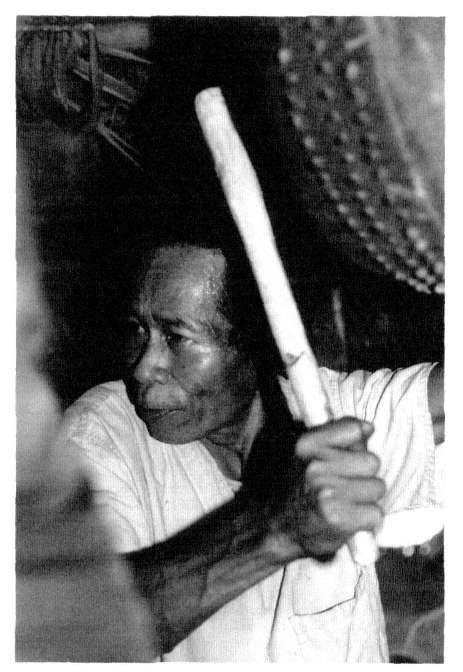
Fig. 9.
As the sun rises each morning during pangngae, village men lower drums from
the rafters of their households and unleash the exuberant rhythms of pabuno, "one who
kills with a spear." 1984.
The hamlets now belong to men, so to speak, and above all to the headhunters, who are referred to as tobarani , "the courageous," in recognition of their warriorlike bravery and feats. The tobarani carefully hang their tambolâ on the door frames or interior houseposts of their home. For the next seven days the instruments remain silent and on display, transposed into eye-catching icons of a warrior's knowledge and power. Although men and women may from time to time sing sumengo in praise of the tobarani, the drumming of pabuno dominates the musical "space" of the village, its masculine signature holding the hamlets in its grip. Indeed, in a significant sense the drumming is an enacting sign of masculine power, of irresistible social control: no one can not listen to the drumming. It is everywhere and thus consolidates the community through the senses as a listening polity, legitimating its order under masculine authority. Kept by pemali tabus from handling or playing the drums, women are constrained from subjecting themselves and others to these compelling and enlivening rhythms; women cannot find political authority over the senses through drumming. In this light, drumming is part of that masculine "excess" that provokes the envy and desire of women.
The severed head, cloaked in a rice pouch, rests in the home of the tomatuatonda' or the babalako (or topuppu). The headhunters are now free to relax at home or wander about the hamlets during the day. Throughout the community, villagers honor, even spoil, the tobarani, inviting them to share a meal or to take a gift of tobacco and betel. For the time being, the headhunters are forbidden to undertake any kind of labor, and may eat only rice, meat, fish, and eggs, the point being to avoid the "feminine" greens from women's gardens. Evenings are spent relaxing in mirthful gatherings. Youths—and especially the unmarried topangngae—find opportunities in these gatherings to flirt a bit with unmarried girls. At night, however, it is customary for the tobarani to sleep at the household of the tomatuatonda' or at the house of the cohort leader rather than at their own homes. Seven days and six nights pass in this fashion, during which time villagers ready the hamlets in anticipation of the grand closing festivities of pangngae.
A new set of objects, signs, and gestures is brought out of safekeeping. So far, the trophy head and the tambolâ have been the principal working objects of pangngae, signifying its violent destruction of mourning and the "other" downstream. Villagers now bring out rings, bracelets, beaded necklaces and sashes, headcloths, shining lime and betel-quid containers, and fine clothes. These adornments (belo-belo ) figure importantly in the principal discursive project of the ritual until its closing: glorifying the tobarani and, more generally, exalting the image of men and manhood. In spite of their
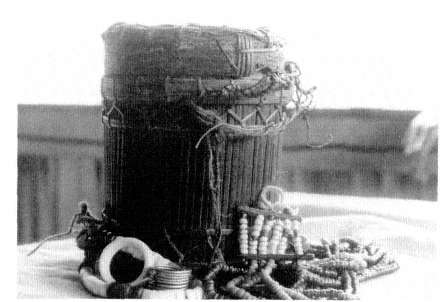
Fig. 10.
The jewelry of the headhunt, and the basket in which it is kept. The to-
barani—the courageous ones who went on the headhunting journey—wear rings
and bracelets like those to the left. Women wear necklaces similar to the one on the
right. Headhunters will sport a different kind of necklace, one usually made of
silver. 1985.
superfluousness, or rather, because of it, the adornments of the topangngae are crucial in projecting the headhunters' "excess," their possession of "something more." Worn on and around the contours and features of the body, adornment opens up a radiant and stylized surface where the strivings of self and community become fused. No mere aesthetic frill, adornment is key to the politics of envy and emulation.
The penetrating remarks of Georg Simmel's (1950:338-344) essay, "Note on Adornment," require mention here, and most of what follows below reflects his brilliant understanding of the politics of ornamentation.[3] Adornments are worn to catch and please the eye. It is by way of that pleasing that a person "desires to distinguish himself before others," seeking their envy (338). "Pleasing may thus become a means of the will to power: some . . . need those above whom they elevate themselves by life and deed, for they build their own self-feeling upon the subordinates' realization that they are subordinate" (338). Thus adornment is both self-interested and altruistic, singling out the wearer with objects designed for the pleasure of others, but signifying, too, the wearer's paradoxical dependence on those he wishes to
surpass. The style and radiance of bodily ornamentation absorb the person's individuality, enlarge it. They sensuously announce the wearer's social power and draw the gaze of others. If adornment creates a space for envy ("I have something which you do not have" [342]), it also foments desire by saying "I am here for you . . . take me." As Simmel writes, "adornment creates a highly specific synthesis of the great convergent and divergent forces of the individual and society, namely, the elevation of the ego through existing for others, and the elevation of existing for others through the emphasis and extension of the ego" (344).
I have already introduced key terms for the project of adornment in the mappurondo headhunting rites: umpokasalle kalena , "enlarging the self." Some further comments may be helpful, however Kale denotes neither an interior self (which is usually rendered as penaba , or breath), nor a person per se, but rather the image of the self, the surfaces, features, and reputation a person presents to the world. Adornments and being adorned, meanwhile, are rendered, respectively, as belo-belo and dibeloi (from the root belo ). In local tongue one could speak of decorating the self-image by using the phrase dibeloi kalena , a grammatical form that puts focus on the self-image and assigns agency to someone other than the wearer. This construction captures nicely the political dynamics Simmel so carefully ascribes to adornment.
Like the red hornbill earrings coveted by the Ilongot (M. Rosaldo 1980; R. Rosaldo 1984, 1986), the white beaded bracelets of the tobarani indicate that the wearer has been on a headhunt. In this sense, the bracelets are also the amulets of someone who knows the "secret" of a man's journey to other regions. The tobarani thus are doubly adorned, for the secret also serves as an adornment. As Simmel (1950:337) explains, "what recedes before the consciousness of others and is hidden from them, is to be emphasized in their consciousness; . . . one should appear as a particularly noteworthy person precisely through what one conceals." Further still, the bracelets and finery of the tobarani mark them as persons who have undertaken a heroic task for the collective good. Their deed, a flashing ornament itself, is both altruistic and self-interested.
The week between a'dasan and the closing ceremonies of pangngae finds the tobarani decorating their tambolâ with cascades of plaited streamers made from palm leaves of pale green and gold. On the seventh day after a'dasan, guests arrive from other villages, and hearths become heavy with smoke and noisy talk as people prepare for the evening's ceremonial songfest, called umpaningoi ulunna , "playing with the head" (in the dual sense of putting it on display and teasing it). All during the week, men have been busy preparing the house that will host the gathering. Needing room for
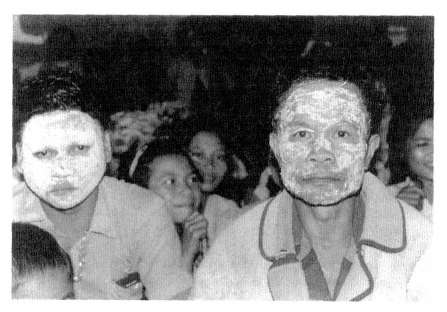
Fig. 11.
Two tobarani, their faces caked with rice paste, their bangs trimmed back.
They are being honored with an evening of song during the ceremony known as
umpaningoi ulunna, "playing with the head." 1984.
roughly 250 to 400 people, they have added floor supports, moved walls, made makeshift porches, and put in place extra ladders. Having enlarged the house, they put in final supplies of firewood, rice, and coffee. As the afternoon passes, the drumming of pabuno grows more fervent and continues without break. Sporting their bracelets and necklaces, the tobarani have their bangs cut by their mothers or sisters, and cake their faces with rice paste in order to lighten and refine their complexion (see Figure 11).
With the setting sun, people throng to the site of the ritual. As the crowd swells, women and girls from the village pack themselves in between the hearth and the downriver side of the house centerpost, which protrudes up through the floor. The beaded and white-faced headhunters begin to arrive, and after hanging their tambolâ in display, find places to sit on the floor upriver from the centerpost. Once it is dark, the drumming comes to an abrupt halt and the entourage of village elders—all men—climb up into the house and solemnly take seats beside the centerpost.
Choruses of men or women begin singing sumengo as the elders help themselves to ample amounts of betel and tobacco from plates being passed around. Some verses extol the radiance of the tobarani:
Inde lako toidandan | These there the ones all in a line |
toipasampei belo | the ones adorned with finery |
naindo allo mangngura | lit up by rays from a young sun |
Tosisarim belo | The ones wearing bracelets and beads |
naindo allo mangngura | lit up by rays of the young sun |
napomarampia-pia | making them more and more handsome |
Another set of metaphoric lyrics likens the tobarani to a kind of sugarcane known for its colorful striping. As the cane ripens and matures, its splendor grows:
Ta'bu sure' mane dadi | Striped colored cane just coming up |
mane lulangam allona | just starting to reach for the sun |
paneteanna kaloe ' | the parrots' dance along the branch |
The lyrics portray women and girls as parrots—songbirds, I should note—that "dance" back and forth along their perch straining to see the growing sugarcane.
Songs like these not only extol the radiant virtues of the tobarani but also confirm the admiring gaze of others, a gaze that looks up to the headhunters. At the same time, the song performances function as adornments in and of themselves. In a significant way, these lyrics of praise gild the headhunter's image and magnify his presence. Songs can also glorify the name of the elder who led the headhunters on their journey and made it possible for the village to hold the ritual:
Mennara ampunna londong | Who's the master of that cockerel |
tourampa' sali-sali | the one making the level rack |
napolenta pemalian | he who cut loose the offering |
Takubai-bai | I did not imagine |
ladengkam ma'kada senga ' | we'd have a chance to speak grand words |
kela da Ambena ____ | if it were not for Ambe (name) |
The splendor of the topangngae and the praise lavished on them can stir envy among the men and youths who for one reason or another did not join the headhunters on the trek downstream. Some of this envy finds its way into song, and thus to the cars of the headhunters:
Edede talinna london | E-de-de the cockerel's headcloth |
saputanganna muane | the handkerchiefs of the men there |
kikailu-kailui | we really ache for them ourselves |
Londom buri' di tanete | Speckled cockerel on the mountain |
kiula' kiperombei | we chase it, take tufts of feathers |
kipebulu kalandoi | we are taking its long plumed tail |
Coveting the headhunters' heroic glory, other men and youths vow to travel the seaward trails. The time and place are uncertain, but they will be the to-barani's equal:
Nakeallo-keallopa | Later under another sun |
na bulam umba-umbapa | and under a moon somewhere else |
anna kesulle pasuka ' | it will be replaced in measure |
The turbulent longing for self-distinction, for being above all others, must be tempered with selfless aspiration to help (or subordinate oneself) to a community of others. If a man thirsts with envy, his heirloom knife (connoting moral tradition) must ache with purposeful desire:
Mamali'mi kondo bulo | The blade of layered iron aches |
melo' lamabalinono | wanting to soon come roaring down |
battu umba sia ngei | who knows, another time and place |
As for who will be fated to make good on their pledge and then "bathe" in communal adulation:
Battu menna maki' mai | Hard to say who among us here |
to pole mendio' minna ' | is to come back and bathe in oils |
anta dambara ummoni | so that our sound can carry afar |
As these examples show, the songs of pangngae celebrate and foster an envy that is productive, rather than destructive, of social order.[4] An emulative rivalry lies at the heart of male peership and animates it, constantly cycling men through alternating positions of "the gazing" and "the gazed upon." This rebounding mimetic thrives on the bracelets and beads and the songs of praise, adornments that become the focus and incarnating objects of desire.
Women, too, may covet the headhunters' glory, but are denied it under the exclusionary tabus of pangnage. Lyric variations in two sumengo performances I recorded on separate occasions (and in different villages) suggest that women experience a mixture of anxiety and envy during the ritual; or perhaps they reveal an episodic shift in women's experience, a shift in which envy supplants anxiety as the ritual unfolds:
Sama siam malallengki | Not only our worried thinking |
sama kainda-indaki | but our restless envy as well |
tempomu messubum bamba | when you had left the village lands |
Susi siam malallengki | Not only our worried thinking |
susi kainda-indaki | but our restless envy as well |
ditetangan sulim bulo | gold bamboo flutes carried in hand |
Forestalled from taking part in the mimetic rivalries that conjoin men and youths, women look ahead to the emulative politics that separate and distinguish them from males and the masculine order. Women, too, will have their measure, vowing that no one (no grain of rice) shall be excluded from the community (metaphorized as a cup made from a coconut shell):
Battu umba sia ngei | Who knows, another time and place | |
anna kesulle pasuka ' | it will be replaced in measure | |
barra' sisangkararoan | the grains of rice all in one shell | |
Songs such as these refer in particular to the women's ritual known as malangngi '. Difficult to conduct and seldom held, malangngi' not only has a significant place in local ideas about womanhood but also figures as an op-positional or inverting complement to men's headhunting rites. I never had an opportunity to witness malangngi', but in describing the ritual to me, an elder volunteered, "Malangngi', it's the women's pangngae." With a little probing from me he continued, "In pangngae we exalt men. In malangngi' we exalt women." Others, particularly women, were careful to point out that pangngae concerns the village, whereas malangngi' concerns the home and offspring. The ritual promises such real and obvious relevance to the social relationships and practices I am trying to explore that a quick sketch would seem appropriate here.
I am told that malangngi' is set in motion when a group of women and girls gather together in secret under darkness and slip out of the hamlets, moving in an upstream direction.[5] At the edge of the village lands, they climb up next to a banyan tree and onto a platform built especially for this ritual. While beside the tree, they become possessed by debata. Said to turn into birds as they dance, the women utter the sound of female sumanga', and issue a laughing wit-wit-wit-wit . Panicked by the absence of their wives, sisters, and daughters, village men launch a search and discover them around the banyan. A few men are sent to fetch drums. Upon their return, ritual specialists play set dance rhythms for the possessed women and, after a time, "drum them down" from the banyan. Climbing onto the backs of their
husbands or fathers, the women ride back into the village and ascend into a house where they dance and display amulets and curatives obtained "up in the sky" (the meaning of the word malangngi ). A ceremony extolling the women, the debata, and the prosperity of the household lasts into the afternoon of the following day.
Little wonder, then, that women seek to journey to the sources of their own order so as to momentarily subordinate village males. As one song puts it, men will know the weight of women:
Masetopa kami' duka ' | There is a moment for us too |
kalundara-daraangki | we will still find our own chance |
lunde' tanete kiola | the peaks on which we journey will sag |
So that there is no mistaking malangngi' (and other rituals of pa'bisuam baine) for a fleeting and insignificant inversion of social hierarchy, I note that during the course of pangngae men express their envy of women. For example, there is a song in which the headhunters see women as more accomplished than themselves. As expressed in the lyrics, women come into their own (metaphorized as the task of weaving a blanket) long before men do; the headhunt is a man's first crawling effort to come into manhood:
Marre' untannunna bela | Done the wife completes her weaving |
padangki' dipangngidengam | together we were in the womb |
mane rumambokangkami ' | we're just crawling on hands and knees |
If these songs are any indication, mappurondo social order thrives on reciprocal envy within and across gender categories. The desire to distinguish oneself, to surpass others, is something relevant to the experience and interests of both men and women. The power to attract the gaze of others, to stir envy within them, then, is perhaps the most sought-for talisman of superiority and excess being. Yet the exhilaration of being powerful and desired also gets tangled up in ideas of sexual potency. An adoring lover or wife can become a talisman of the headhunter's power. That is, from the vantage point of male peerage and its internal rivalries, women and women's adoration undergo alchemical change to become gilded signs and amulets of the headhunter's elevation above others.
There is no question in my mind that the return of the headhunters marks a festive renewal of erotic discourse, something very much welcome after the long period dominated by the projects of mourning and field labor. Both men and women take part in the mirthful sexual banter. Youths come back from the headhunt feeling their most attractive—vigorous, mas-
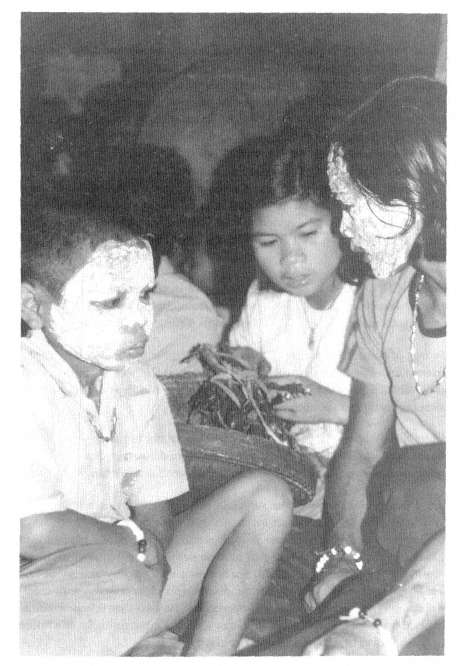
Fig. 12.
A young woman about to give betel and areca to two tobarani during the
evening ceremony of "playing with the head." 1984.
culine, and socially important—and are ready to impress and seduce young women. A young woman, too, may show a flirtatious interest in someone, perhaps making attempts to catch the eye of her favorite tobarani. Meanwhile, it is not unusual for older men to boast of their continued potency.[6] Explicit or demonstrative expressions of sexual interest toward specific persons, however, are out of place. Accordingly, villagers resort to covert or indirect gestures to signal their interest in one another. Indeed, the songs are a safe place to voice their interest in one another.
Consider, then, the cleverness of a song such as the following. On one hand, it is about the shy flirtations that might go on during ceremonies. On the other hand, it can be directed toward someone in particular; sung while giving a revealing glance to someone in the crowd turns the performance itself into a flirtation.
Diassiangki' tematin | There is just us among them all |
sipasisi' sipasillan | we both let on both glance away |
sipasalendoi mata | both of us flirting with our eyes |
By way of contrast, some lyrics can be fairly graphic in the way they depict lovemaking. For example, one song I heard sung by women captures the sweat and tangle of sex, and makes a rather obvious pun about the singing cockerel, metaphor for both headhunter and penis:
Mane belue' sitambem | Hair just beginning to tangle |
mane appu' silolonni | sweat begins trickling together |
anna ummoniram manu ' | then the cockerel must be singing |
Like the previous example, the song can be performed in such a way as to serve as a come-on to a favorite lover sitting in the crowd.
Seduction and courtship can require stealth on the man's part and, in that sense, are seen as activities that have something in common with head-hunting. A lover must be lured toward a man with flattery and sweet-talk (ussinggi '), not unlike the way the headhunter may lure a victim with magical incantations or baited charms.[7] Songs like the two that follow candidly depict the whispered sweet-talk of a man who has gone to his lover's house under the cover of darkness in order to sleep with her.
Petindoan ana' dara | The young woman's place for sleeping |
disullu' bassi ba'bana | her door is barred shut with iron |
umbam pellullabeanna | where'bouts is her shuttered window |
Umba tambim muongei | Where is the room in which you rest |
umbam pellullabeammu | where'bouts is your shuttered window |
onimmu mandang kurangngi | I can hear nothing but your voice |
Metaphoric associations that connect headhunting and courtship also prompt different "readings" of sumengo lyrics. For example, both can be likened to the felling of a tree, as in the following sumengo:
Iko barane'-barane ' | You, you banyan trees over there |
keditambako dilellen | if you are called to be cut down |
loe maiko bambaki | fall here into our village lands |
From the vantage point of intercultural relations, the song is about felling a Mandar victim. It expresses hope that the victim's head will "fall into the village" and bring prosperity to the upland community. But several ToSalu Mends—all men—also suggested that these lyrics alluded to a marriage proposal. In their view, a woman does not pass into full maturity until she is "felled" by a marriage proposal. A tree that falls into the village becomes timber; a woman who falls into the village becomes a wife.
Other song-flirtations suggest a masculine anxiety that needs to be soothed with a woman's expression of desire. In an exchange of ToIssilita' songs I recorded at Saludengen, men sang the following to a chorus of women:
Menna' lamuala | Which do you want to take |
kandean tadiampalla ' | the coarse unpolished wooden dish |
anna pindam pebajoan | or the porcelain reflecting bowl |
The lyrics pose a choice of objects, a wooden dish from the mountains, or a porcelain bowl from the coast. As icons of upland poverty and coastal wealth, the dish and the bowl are also metaphoric displacements of rival masculinities. The chorus of women responded, reassuring their husbands and lovers that they like things that come from the mountains, from "home:"
Arabopinea | Better that I just keep |
kandean tadiampalla ' | the coarse unpolished wooden dish |
anna pindam pebajoan | than the porcelain reflecting bowl |
Moments later, the men and women exchanged another question and reply:
Menna' lamuala | Which do you want to take |
labuju pettanetean | the wild cockerel from the mountains |
anna londom belo tondo ' | or the hamlet's fancy rooster |
Arabopinea | Better that I just keep |
labuju pettanetean | the wild cockerel from the mountains |
anna londom belo tondo ' | than the hamlet's fancy rooster |
In these sumengo, the men probe the feelings and attitudes of village women with the purpose of adorning themselves with words of flattery and reassurance. As one might expect in a ritual that celebrates and enlarges the image of mountain men, the choices of the women reveal a preference for things and persons less prestigious, and a faith in virtues hidden beneath humble appearances.
The oscillating rivalry between men and women is mirrored, too, in the agonistic and antiphonal play of songs and song riddles.[8] Part of the challenge can be to defeat other choruses simply by outsinging them. Some of the challenge also has to do with knowing an appropriate sequel or rejoinder to the preceding song. For example, a chorus may pose enigmatic questions and riddles in their sumengo, as when men ask:
Diattomokoka' iko | Have you ever woven something |
sumau' tadikala'i | with a warp but no thread for weft |
marra' tadisumallai | when done it was all of one piece |
Women respond with a conventionally spare answer that conceals more than it reveals:
Diattomakantekami ' | Yes, we too have woven something |
sumau' tadikala'i | with a warp but no thread for weft |
marra' tadisumallai | when done it was all of one piece |
The same holds true of the following sumengo-exchange, again between men and women:
Diattomokoka iko | You, have you ever played at it |
mogasin tandiulanni | making tops spin but without string |
muondo pitu bulanna | they whir and hum for seven moons |
Diattomakantekami ? | Yes we also have played at it |
mogasin tandiulanni | making tops spin but without string |
muondo pitu bulanna | they whir and hum for seven moons |
The women are not being evasive in these examples. By concealing or withholding answers to the riddles, the women are able to possess something secret and thereby confer upon themselves a radiant noteworthiness. Although they do not divulge it, they know that the first song refers to a braid, and
that the stringless top in the second song is a headhunter. (Just as a top may spin away for a moment and then return to hover in front of the person who cast it in motion, the headhunter goes off from the village and then comes back to celebrate for the seven nights of ceremony that make up pangngae.) Sumengo exchanges such as these make up a game of knowledge. But the game of knowledge is also a game of power: to pose questions is to exact a hold on another, and to give answers is to escape that grasp (Canetti 1978:284-290). Seen in this light, men and women are playing for power and control over one another during sumengo performance. Yet neither achieves dominance except for a few moments. The conventions of sumengo performance are such that men and women strike a balance with one another within the game of question and answer, image and counterimage, secret and countersecret.
What is perhaps already obvious is that the song-fest of umpaningoi ulunna conjures an image of women as men would like them to be, an image that obscures (and possibly denies) possibilities for a woman's own subjective presence in the social order. These are women who desire a headhunter and envy his excess of being, who offer reassuring words to their husbands, and who like playful sexual banter. If sumengo performance throws the yoke of complementarity upon men and women, it nonetheless appropriates the feminine so as to exalt and construct a manhood reflecting the prestige anxieties of men. In short, a woman's songs still trace the reach of masculine discourse during pangngae. Her voice does not speak with the free authority of her own experience but, rather, with the purpose of turning man's gaze back upon himself. In no small sense, it is man's self-absorbed gaze, displaced and mirrored back to him through women, that adorns him with such radiant effect.
Yet everyone's gaze must turn, too, to the trophy head, the troubled sign of the tobarani's astonishing violence. Led by the elders, the gathering takes part in a liturgical performance that unites the social and moral hierarchies of the headhunt. The topuppu and the entourage of men sitting beside the centerpost take up the sacred strains of the sumengo tomatua , the "sumengo of the elders":
Iamo tolena | That's it, that is just what |
naporaena debata | the spirits favor and expect |
kema'patemboki' role | when we do it again, that's it |
The topuppu then calls out to the leader of the tobisu ("the ones of quickened spirit"), as the warriors are now called, for the head to be brought. One of the tobisu fetches the head and presents it, still wrapped in a rice
pouch, to the topuppu as the gathering shouts "It stinks! It stinks!" He puts the shrouded head on the centerpost and places a headcloth on it. Calls for betel and tobacco go up, and gifts of the same go to the topuppu, the entourage of village elders, and the head. As more betel and tobacco pass through the crowd, men cry out Sanda! Sanda! ("Enough! Enough!"), in a stylized plaint of communal overindulgence and excess: the abundant hospitality (an index of hamlets' and homesteads' material prosperity) has sated and overwhelmed any desire to consume.
The gathering then quiets as the topuppu speaks to the head in ritual address (mualu uln ). Soothing the victim with gifts of tobacco and betel, the topuppu explains the headhunters' act of beneficial violence:
Talakupotere' debata | I do not want to act wrongly toward the debata |
anna talakupobusungam | and I do not want to fall dead and bloated |
Lamualu' pada sappa'ku | I want to celebrate with my being |
anna laumpatadongkom pada lesoku | and want to put it in place with my body |
Aka iko inde ampona Daeng Maressa | For you this grandchild of Daeng Maressa |
todipatadongkon dio ba'bana minaniga | the one who is seated below at the river-mouth |
Aka umbai' talatikkedu'ko | So that you will not be frightened |
anna talatirambam | nor troubled in sleep |
Aka lamengke'de' todiulunnasalu | For the ones at the headwaters stand up |
turun dokko di ba'bana minanga | and go down to the rivermouth |
Aka lanabattako mebengngi ' | For they want to cut you at sunrise, |
tamalea lindo | don't be red of face |
lanabattako karubem | they want to cut you at sundown, |
talaborro pa'todingan | don't ooze blood from your throat |
Aka lanababako kende' todiulunnasalu | For they want to carry you up |
lanapatodongkom | the ones at the headwaters they set you down |
lanapasandangko alu ' | they want to honor you with ceremony |
anna lanapagannasan sangka ' | and they want to receive you with custom |
Aka lanapokende'i todiulunnasalu | For they want to make the ones at the headwaters rise up |
lanapobakka'i todiba'banaminanga | they want to make the ones at the rivermouth flourish |
Sapo lanapokende'i lamulamungan | They even want to make the plants rise up |
anna lanapobakka'i ma'rupatau | and they want to make people flourish |
Anna mupanganni inde panganmu | So then savor your betel |
malute lindo | with a relaxed look |
umpa'sambako'i inde sambako'mu | smoke your tobacco |
sende i naba | with contented breath |
Latinanda lako ongeam bulabammu | Soon you will arrive there at your place of gold |
Anna lanapokende'i todi-ba'banaminanga | And the debata will make the ones at the rivermouth rise |
lanapobakka'i todiulunnasalu | and they will make the ones at the headwaters flourish |
Anna tanapotikannai | And they will not change |
inde toungke'desanni | these [tobisu] who stand |
Anna ladenni to takulambi'na | And if there is one I did not get |
dempi to takuissanna | and still again one that I do not know |
Anna lamesako debata bisu | Then together you debata that quicken the spirit |
laumpasitontonganna' batta kadangku | will make my words fitting and complete |
The topuppu and his entourage then erupt with the mua'da' shout and are answered by the men in the crowd. Once more, the elders lead the gathering in singing the sumengo tomatua:
Iamo tolena | That's it, that is just what |
naporaena debata | the spirits favor and expect |
kema'patemboki' role | when we do it again, that's it |
As soon as this very solemn song comes to a close, the topuppu and the elders begin the antiphonal ma'denna, taunting the head, but naming, too, each tobisu who journeyed downstream:
Denna le ' | Denna le' |
ulu petambako sau ' | head, start calling downriver |
le' ma'adendem ma'denna le ' | le' ma'adendem ma'denna le' |
Denna le ' | Denna le' |
tambai baligau'mu | call your Baligau ' |
le' ma'adendem ma'denna le ' | le' ma'adendem ma'denna le' |
Deanna le ' | Denna le' |
pasitammu ____ | have him meet [name of the cohort leader] |
le' ma'adendem ma'denna le ' | le' ma'adendem ma'denna le' |
Denna le ' | Denna le' |
nakulle eai naeba | he is able and ready to fight |
le' ma'adendem ma'denna le ' | le' ma'adendem ma'denna le' |
Denna le ' | Denna le' |
natendanni pa'pelamba ' | he bridges danger by rising steps |
le' ma'adendem ma'denna le ' | le' ma'adendem ma'denna le' |
Denna le ' | Denna le' |
ulu petambako sau ' | head, start calling downriver |
le' ma'adendem ma'denna le ' | le' ma'adendem ma'denna le' |
Denna le ' | Denna le' |
tambai pa'bitarammu | call your Pa'bitara |
le' ma'adendem ma'denna le ' | le' ma'adendem ma'denna le' |
Denna le ' | Denna le' |
pasitammu ia | have him meet [name of the younger leader] |
le' ma'adendem ma'denna le ' | le' ma'adendem ma'denna le' |
Denna le ' | Denna le' |
nakulle ai naeba | he is able and ready to fight |
le' ma'adendem ma'denna le ' | le' ma'adendem ma'denna le' |
Denna le ' | Denna le' |
natendanni kaloloam | he bridges danger by the straight path |
le' ma'adendem ma'denna le ' | le' ma'adendem ma'denna le' |
Denna le ' | Denna le' |
ulu petambako sau ' | head, start calling downriver |
le' ma'adendem ma'denna le ' | le' ma'adendem ma'denna le' |
Denna le ' | Denna le' |
tambai pangngulu tau | call your Pangngulu tau |
le' ma'adendem ma'denna le ' | le' ma'adendem ma'denna le' |
Denna le ' | Denna le' |
pasitammu i ____ | have him meet [name of the headhunter] |
le' ma'adendem ma'denna le ' | le' ma'adendem ma'denna le' |
Denna le ' | Denna le' |
nakulle ai naeba | he is able and ready to fight |
le' ma'adendem ma'denna le ' | le' ma'adendem ma'denna le' |
Denna le ' | Denna le' |
natendanni piso lambe ' | he bridges danger by the long blade |
le' ma'adendem ma'denna le ' | le' ma'adendem ma'denna le' |
(A complete example of the ma'denna is given in Chapter 3.)
In mocking the head that sits dumb and nameless on the centerpost, the ma'denna dissects and counterposes the male political bodies from upstream and downstream regions. Lyric blows of the ma'denna dismember Mandar political anatomy, while celebrating the names (not the titles) of village men. As the elders and the gathered throng sing out the names of the tobisu, they also connect their names to metaphors of moral virtue. The name of Ta'bu, for example, may be sung out in association with "the straight path"—a metaphor for dedication; that of Sa'du, with "thick iron"—the symbol of endurance. Thus the song also articulates a moral anatomy specific to the men's political order in the village.
If the ma'denna distinguishes the tobisu as virtuous individuals, spreading their names and placing them above others, the ensuing kelonoson celebrates them as a distinguished group. Once again, the entourage of elders leads a mua'da' shout and the sumengo tomatua. Then the kelonoson begins, a performance that combines song and dance to chronicle the assault on the community downriver.[9] As they sing each verse, the elders sitting beside the head move their hands and arms in a dancing gesture. After each verse, the headhunters stand up around the elders, and while repeating the verse, perform the dance of warriors (slowly skipping, and waving their arms from side to side). One performance at Salutabang went as follows:
E-e rimunni alenta | E-e gather ourselves up |
rimunni alenta | gather ourselves up |
pasanggatai angganna | give everyone weapons |
E-e narimuntoi | E-e he is joining up too |
narimuntoi | he is joining up too |
allena tomakkejoa ' | the one with followers |
E-e maua' marese | E-e go with a purpose |
maua' marese | go with a purpose |
baba toa pira tama | take along a few to join in |
E-e talao | E-e we journey |
talao | we journey |
tapamesa naba-naba | our breaths as one |
E-e marelappa bela | E-e let us confer my friend |
marelappa bela | let us confer my friend |
ammuita tomaelo ' | to see who wants to do it |
E-e tuppuppari batu | E-e unbroken stone |
tuppuppari batu | unbroken stone |
pasieso naba-naba | our hearts merge as one |
E-e olai sebali | E-e go over on that side |
olai sebali | go over on that side |
angki olai sebali | and we will take this side |
E-e sala' mennanta | E-e who among us |
sala' mennanta | who among us |
natandean debatanta | is marked by our debata |
E-e totoi | E-e cut it off |
totoi | cut it off |
ammu laja tarra' daum | so that you have protruding fronds |
E-e pettilinduanna | E-e the hiding place |
pettilinduanna | the hiding place |
tomarea' mentiroma | of the one frightened to follow |
E-e karabai dai ' | E-e charge upward |
karabai dai ' | charge upward |
bettenna allo debata | at the fated stronghold |
E-e apa i namala | E-e what does he want |
apa i namala | what does he want |
dikarabai dai' bettem | the stronghold is attacked |
E-e salamandibao | E-e it is the same below |
salamandibao | it is the same below |
tedom mandudu kananna | the carabao drinks at the sulfur spring |
E-e apa torillau ' | E-e what person is downriver |
apa torillau ' | what person is downriver |
malea di tangnga galung | red amid the grazing ground |
E-e batu sinapa | E-e bullets |
batu sinapa | bullets |
mebaju-baju sangkalla ' | shirred in black and red stripes |
E-e joa' pira sola | E-e followers of [our] few friends |
joa' pira sola | followers of [our] few friends |
joa' pambulle sinapa | they carry firearms |
E-e joa' kangkami | E-e our followers |
joa' kangkami | our followers |
joa' pakkabole-bole | carefully carry the rest |
E-e ia marea ' | E-e he who is afraid |
ia marea ' | he who is afraid |
ia ala bainena | his wife will be taken |
E-e ia barani | E-e he who is brave |
ia barani | he who is brave |
ia sapulo ka'dinna | will have ten lovers |
E-e barani kangkami ? | E-e we are brave |
barani kangkami ' | we are brave |
sapulo ka'dingki ' | we will have ten lovers |
The kelonoson portrays the bravery, comradery, and cooperation of men. But the final three verses are especially revealing of the ways in which the violent adventures downriver prefigure a game of dominance in the peer politics of village males. The closing lyrics of the kelonoson entwine threat with unsurpassed sexual bravado. Wife-stealing is a dreaded and explosive issue, for the theft of a spouse undermines a man's prestige and status as a male peer. The lyrics remind those males who did not journey on the headhunt that the sexual license and stealth of the tobarani comes at the expense of other men. At the same time, the cultish and self-admiring boasts of the headhunters persuade them that their irresistible will to dominate can awaken desire in women.
Dipandebarani: The Feast for the Valorous
The sumengo-fest of umpaningoi ulunna can last well past midnight. So long as voices remain strong and plates of betel and tobacco keep circulating, singers are happy to stay up and sing praises to the to-barani. As people drift off to their homes, the topuppu makes his rounds of
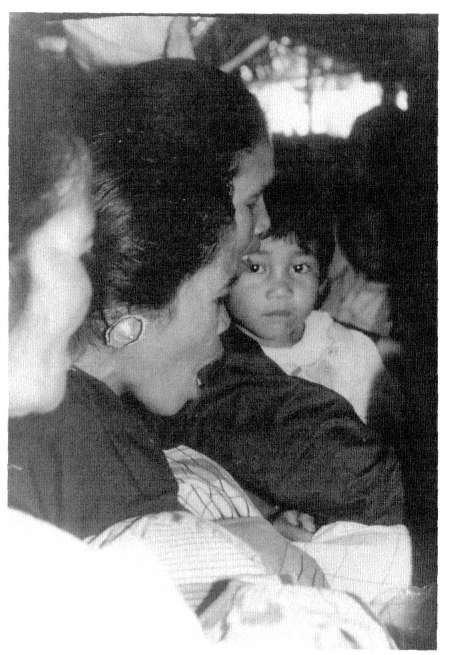
Fig. 13.
A small chorus of women singing the somengo during dipandebarani, "
feasting the valorous." 1984.
the hamlets, stopping at the home of each headhunter to make offerings to the debata bisu muane —the spirits who quicken the hearts of men. Standing in the firelight of each household's hearth, the topuppu softly chants over the gift of a chicken and seeks providential blessings for those fulfilling their vows:
Takupotere' debata | I do not act wrongly toward the debata |
Takupobusungan | I do not fall dead and bloated |
Lamulombum pudu'na tomatua | I want to join the mouths of the elders |
Lamuumpu' lengko lilana | I want to thread the moving tongues of grandparents to |
nene todiponene | those who are made grandparents |
Iko to inde ampona | You here grandchild |
bukku' bati'na belloa | dove of black descent |
toma'bulu tinggi | one with red-spotted feathers |
toma'bembe sarita | one with white ribbon |
tomuhingngi hedena allo | one who hears the sun boil |
tomulatta' tanda masia | one who understands signs of day |
Umbai tasumpu dadi mupitia | Probably not yet old enough |
Taende' gahagammu | Your deeds have not yet risen up |
Aka lamengkalaoko illan ulunna salu | For you want to go inside the headwaters |
ombo' di tipahiti'na uai | up to the springs |
Lalanunnako ma'hupatau | You want to go along |
salli'nako ma'tanda tolino | with people of this world |
Anna iko inde mane mapia bulu | And you here chicken with fine feathers |
ladikattu bata bahoko | will have a neck broken |
latida' lalam penabammu | will have a windpipe snapped |
lato'do' haha datummu | will drip blood of your lord |
tise'bo' haha ma'dikammu | will scatter blood of your regent |
Sapo talamalin illam penabammu | Still you will not be dazed in your heart |
Aka lakende'ko langan debata bisu | For you rise up to the debata that quicken spirits |
Aka Ambe ____ to inde lao ulleppa'i samajanna | For Ambe ____, this one who goes to release his vow |
lannanna napadadi | That's the reason he offers |
inde mane' mapia bulu | this chicken with fine feathers |
Aka lanatilalla'iam langan debata bisu | For he wants to fill his vow to the debata that quicken spirits |
Anna handanni lanapomasakke | And they bring him cooling health as a river bank follows the river |
Anna bihi lanapomangnguhindim | And bless him as the horizon encircles all |
Anna tanapengkabuku'i | And they won't work him to the bone |
Anna tanapengkatohoi | And they won't draw off his vigor |
Anna dondommi | And surely blessings fall |
nee' lisu pala'na toba | down into the palm |
nee' taluttu' tahunona | down onto the fingers of an outstretched hand |
allo sangngallo makkesulle | blessings equal in measure |
ampasan daunna | to the unfurled leaf |
With this sacrificial gift, the headhunter not only makes good on his oath, but exceeds it. Returning sacrificial meats and rice to the debata is a sign of the abundance that flows to and adorns the virtuous man.
At dawn, the rhythms of pabuno once more awaken the hamlets. Morning will see the mappurondo villagers gather for the final ceremony of pangngae, dipandebarani ("feeding the valorous"), the rite that honors the headhunters. Celebration reaches its peak in dipandebarani: drumming and song are at their loudest and most exuberant; decorations and finery are at their most elaborate; and food and drink are at their most abundant. Getting ready to appear before the village, the tobarani rub off the last flecks of paste from their faces, leaving a fine powder on their skin. Garbed in their finest shirts and headcloths, and adorned with bracelets, ceremonial knives, and beaded bandoliers, they take up their tambolâ and go to the ceremonial house.
If the harvest has been a good one, the gathering is sure to put up a tremendous clamor of song, drumming, talk, and laughter. The swirling sound of choruses and drums delights and overwhelms the senses. But as Plessner (1970:68) reminds us "We must not forget that sound includes the power of self-verification: one hears oneself." In this sense, the swirl of sound is an icon of the community in its vanity, exhibiting itself in unceasing festivity. Noise and music are adornments, simultaneously enlarging and engulfing the crowd that wishes to hear itself:
Ma'palisu inde tondo ' | This hamlet swirls round and around |
ma'batu lampa' banua | the dwelling's signs are cut in stone |
tamonda disapukoi | unbroken unfallen spirit |
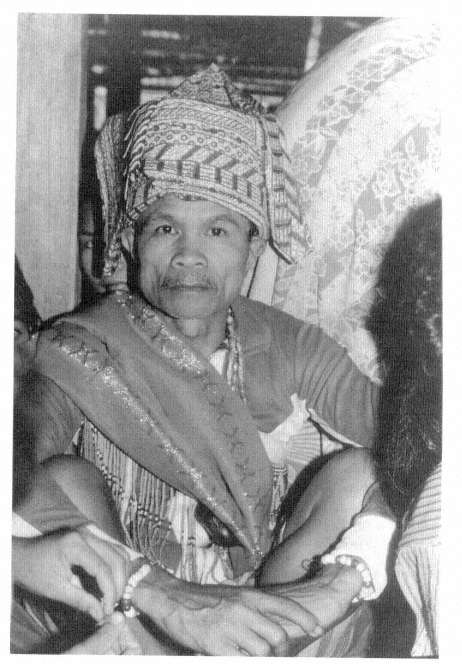
Fig. 14.
Radiant in his finery, the head of the cohort listens as villagers celebrate his
name and deeds in song. 1984.
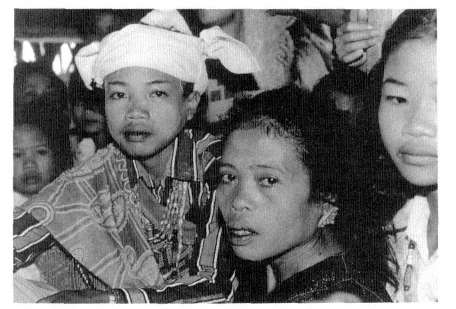
Fig. 15.
Women and girls cluster near the sons, brothers, and husbands who have
gone on the headhunt. The young headhunter pictured here has adorned himself with
headcloth, necklace, bracelets, beaded sash, and his best shirt. 1984.
Nakua oninna gandang | It is said the voice of the drum |
pebalinna sulim bulo | the echo of the golden flute |
angki tamonda iponi | that we play are never broken |
Tanete aka sambali ' | What peak lies over on that side |
buntu aka tosanganna | what mountain is it people call |
tanete diboro mani ' | the peak dressed with beaded necklace |
Tanere diboro mani ' | The peak dressed with beaded necklace |
buntu ditete bulawan | the mountain that's gilded in gold |
pangandaranna burio | the place spotted carabao dance |
The music and noise only subside when the topuppu and the entourage of elders begin to conduct the liturgical acts intended to sacralize the headhunters as tobisu and to present the debata with the head and gifts of meat and rice. The liturgical sequence for dipandebarani repeats much of that performed during a'dasan and the previous night: the sumengo tomatua, the ma'denna, and the kelonoson. To these is added mararra topangngae anna tambolâ ("anointing the headhunters and the tambolâ") and the ma'paisun (when the babalako or topuppu presents the surrogate head to the de-
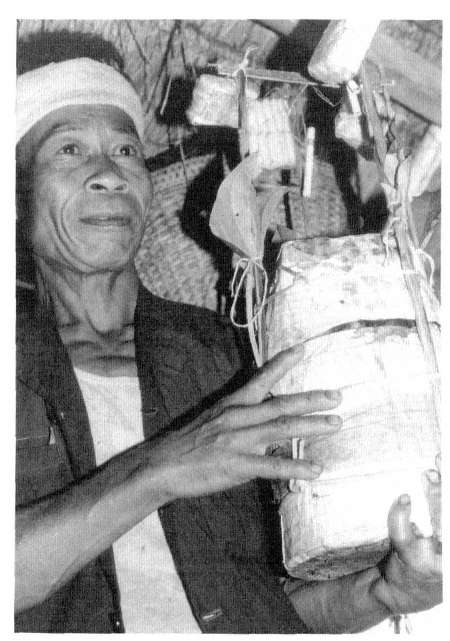
Fig. 16.
A villager brings a gift for one of the tobarani: a bundle of rice, fish, and
meat, decorated with betel leaves, clove-scented cigarettes, and small packs of sugar
cookies. 1984.
bata; see Chapter 3 and below). To start the marrara, the tomatuatonda', in his role as the political head of the community, will chant words to the bird or pig to be sacrificed:
Inde tolanaokko'i | This is what will be put in place: |
lakuraraan inde tambolâ | I will put blood on these tambolâ |
lakupasirara topangngae | I will put the same blood on the topangngae |
Anna narandanni kamasakkeam | So that health follows them like a bank to a river |
nabirim kamangngurindingan | prosperity encircles them like a horizon |
tiambu' tatibissi ' | not a seed scattered or thrown |
Dempito takuissam | If there is one I don't know |
takutula' takulambi ' | that I don't mention, that I don't remember |
tolakupokada | while speaking |
Ma'ganna lakupasola | That's why I give |
inde tombongan rumpâ | this pile of refuse too |
Aka lamulombunni takulambi'na | For you to complete what I forget |
umpondi'i takuissanna | to lessen what I don't know |
Aka iko toumpa'tulakanni | For you that speak for them |
iko tosibaba ada ' | you who together carry adat |
tosipassan isanga kabiasaam | you who haul what is called custom |
The tomatuatonda', assisted by the topuppu or babalako, then moves among the tobisu and their tambolâ, dabbing them with sacrificial blood. In contrast to the dismembering textual blows of the ma'paisun (see Chapter 3 and below), the gestural discourse of the marrara conjoins, underscoring anatomical movement and strength as the tomatuatonda' anoints each warrior on the ankle, knee, palm, elbow, throat, jaw, and forehead.
Not long after the marrara, the elders ready themselves to present the head and sacrificial foods to the debata through the liturgical act called ma'paisun ("making an offering"). The topuppu or babalako places the head, packets of meat and rice, and a bamboo vessel filled with water in the loft that faces the headwaters of the river and the rising sun, and then begins his chant to the debata:
E pun debata | E pun debata |
debata i diisunni | debata being seated |
debata i itongkonni | debata given place to dwell |
debata i itananni samba ' | debata by the planted beam |
debata i diosokki andiri | debata by the planted pillar |
debata i ipa'banuai | debata given a house |
debata i umpadadi lino | debata making the world |
debata i unnampa' rante | debata flattening the field |
debata umballa' lino | debata unrolling the world |
debata ussare tuka | debata curving the pass |
debata umbokkom buntu | debata rounding the mountain |
debata ullemo tanete | debata making peaks round as oranges |
debata umpaturun uai | debata bringing down water |
debata i laipalangngan | debata who will be raised up |
debata i laipakende ' | debata who will be placed above |
debata i tangnganna langi ' | debata in the middle of the sky |
debata iabo lisunna batara | debata above in the firmament's whirl |
debata i bisu muane | debata quickening spirits of men |
debata i laipaturun | debata who will be brought down |
debata i laipatirandu ' | debata who will be placed below |
debata i laipatirassa | debata who will be slammed down |
debata i popa'dandan | debata who will be put in rows |
debata i laipopa'tere-tere | debata who will be put in line |
debata i lanamammasan | debata that he will seek in sleep |
debata i napa'tindoan | debata that he will wait for in dreams |
debata i lanapembangonni | debata as he will awaken |
debata i lanake'desan | debata as he will stand |
debata i lanapetakingan | debata as he fastens his blade |
debata i lanaturungan lita ' | debata as he climbs down to the ground |
debata i napessubungam bamba | debata as he crosses out of the bamba |
debata i ladipalamban | debata who is brought across |
debata i ladipatekka | debata who is made to step |
debata i Lita'malea | debata at Lita'malea |
debata i Pongko ' | debata at Pongko' |
debata i Limbadengen | debata at Limbadengen |
debata i Salururu | debata at Salururu |
debata i Limbadebata | debata at Limbadebata |
debata i Salutumuka ' | debata at Salutumuka' |
debata i Rante | debata at Rante |
debata i Taneteledo | debata at Taneteledo |
debata i Salumokanan | debata at Salumokanan |
debata i Salusullu ' | debata at Salusullu' |
debata i Salukadi | debata at Salukadi |
debata i Matuju | debata at Matuju |
debata i Mehalaan | debata at Mehalaan |
debata i Salutuka ' | debata at Salutuka' |
debata i Salubombam | debata at Salubomban |
debata i Salumarante | debata at Salumarante |
debata i Botten | debata at Botteng |
debata i Passembu ' | debata at Passembu' |
debata i Dama-dama | debata at Dama'-dama' |
debata i Posi ' | debata at Posi' |
debata i Merahujo | debata at Merahujo |
debata i Matangnga | debata at Matangnga |
debata i Tabiban | debata at Tabiban |
debata i Tapua ' | debata at Tapua' |
debata i Pangngala Lemarra | debata at Pangngala' Lemarra |
debata i Katirandusan Tampa' Galung | debata at Katirandusan Tampa' Galung |
debata i Magalunna | debata at Magalunna |
debata i Marampa'na | debata at Marampa'na |
debata i Mapilli | debata at Mapilli |
debata i Andau | debata at Andau' |
debata i Umbu'pada | debata at Umbu'pada |
debata i Ta'ba'sala | debata at Ta'ba'sala |
debata i Tenggelan | debata at Tenggelan |
debata ungkela' pangngabungan | debata flipping out of ambush |
debata umpollo' pangngabungan | debata coming out from ambush |
debata untaleam pangngabungan | debata scattering grass from the ambush |
debata mamunga ' | debata landing the first blow |
debata mamola | debata flashing open the neck |
debata mamumbu ' | debata wrestling over it |
debata ma'tandean | debata lifting it up high |
debata ma'peulu | debata taking the head |
debata ma'pemata | debata taking the brain |
debata ma'peuta ' | debata taking the eyes |
debata ma'petalinga . . . . | debata taking the ears. . . . |
The chant gives way to a violent crescendo of shouts and noise from the crowd. Women and girls let loose a rain of areca nuts, pelting their favorite men, while up in the loft the topuppu flings a rain of sacral water onto the gathering below. With that, the topuppu closes the ma'paisun:
Pembasei inde uai malesomu | Wash clean with these your clear waters |
tailambanni ulunna | its headwaters never crossed |
anna taditekkai ba'ba minanganna | and the opening of its mouth never stepped over |
anna muandei inde bo'bo busammu | And you eat this white rice of yours |
sipatompo ate babimmu | with gulps of the liver of your pig |
Anna tamukamallei te inde | And you do not become dazed here |
Aka Ambe ____ inde mubaba solana | For Ambe ____ [cohort leader] carries your friend [the head] |
Dadi ianana napadadim | So that is the reason |
inde babi mapia bulu | this pig with fine hair is being done |
Aka lanarandang kamasakkeam | So that health will follow him as a bank along a river |
nabihim kamangnguhindingam | prosperity will encircle him as the horizon encircles all |
Anna dempi to talakuissanna | And if there is still one I do not know |
anna makambampi takulambi'na | and still something wide I cannot cross |
mesahangko debata bisu | together you debata bisu will |
laumpasilolonganganna' batta kadangku | straighten out my words |
After the ma'paisun, the village head and the topuppu oversee the division and presentation of the tarakan , broad trays heaped with rice, fish, meat, and eggs for the headhunters.[10] These prestige foods alone display the community's esteem for the tobarani, but their presentation also includes a gestural demonstration of excessive regard, an enacted rhetoric of over-abundance. As the two elders point out each warrior, a man enlisted to work as a carrier brings forward a large winnowing tray of food hoisted on his shoulder. Acting as if he were struggling with a load of enormous weight, he lets out a mua'da'-like shout ("yuhuhuhu "), buckles at the knees and carefully drops the tarakan tray before the headhunter. This grossly exaggerated portrayal of someone straining and collapsing under a heavy load is itself an enlargement, a stylistic icon of overindulgent excess: too much acting in presenting too much food. Whether the harvest has been meager or abundant, the tarakan always occasions this demonstrative excess. Though it never surprises, the tarakan always impresses.
As the warriors get their tarakan, a team of men pass out smaller packets of food to everyone else in the gathering. No one touches his or her food
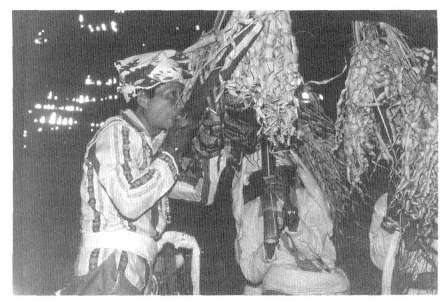
Fig. 17.
The tobarani sound their tambolâ for the final time before flinging them up
into the loft. 1985.
until all has been distributed. As the warriors sit solemnly, if a bit wide-eyed, with their trays before them, the village head designates each tarakan by calling out the name of the headhunter to whom it is being given. Referring to all the foods passed out, but calling forth, too, a hierarchy of social difference, he closes with, "This is for the men. This is for the women. This is for the guests." With that, the men in the gathering make a sudden diving leap across the room at the tarakan of the warriors, digging and tearing at the food, and shoveling a gulp or two of rice and meat into their mouths as the tobarani beneficently look on, making no effort to keep the men from their food. This violent gesture of commensality wrests away some of the headhunters' excess: it is a self-conscious and stylized effort to level hierarchical differences among village males. With it, a community of men place themselves on equal footing, all sharing in the headhunters' glory.
After taking a few mouthfuls of meat and rice, headhunters and guests alike bundle up their portions of food. Later, they will take the packets home and eat there. Singing and drumming resume until about noon. As the sun reaches its zenith, the headhunters take their flutes (which have been silent since the closing moments of a'dasan) and gather near the centerpost. Stand-
ing below the edge of the loft, they begin umbua' tambolâ "raising (or displaying) tambolâ" Urged on by the crowd, the tobarani blow a long note in unison on their instruments for roughly twenty seconds or more (the longer, the better, it is said), and then deliver their mua'da' shout three times: "Jelelelele huuui! " Twice more they sound a long blast on the tambolâ and follow it with three shouts. With their last shout, the headhunters heave their tambolâ up into the loft, where a waiting male will stack them next to the head and the paisun offerings. At the same time, drumming begins again and singers launch into the sumengo tomatua.
Words that Make the Floor Shake
As the rhythms of pabuno pour from the drum, the cohort leader, the tobisu, and any other man so moved take turns leaping up to deliver impassioned speeches at the center of the house. Villagers call this speechmaking mamose ("stomping in fury"). As a man rises, the drumming comes to an abrupt stop. Stepping forward, the speechmaker brings his foot down with a pronounced thud and then circles the floor counterclockwise as he speaks, his right hand raised and sometimes holding a kerchief-sized cloth (the symbol of the Pitu Ulunna Salu league). Delivery is especially striking at Saludengen, where the headhunter-speechmakers take bounding, floor-shaking jumps to the center of the house, and circle about with hardened faces and fiery eyes as they talk. When a speaker finishes, pabuno bursts from the drum. To the cheers and shouts of the gathering, the speechmaker circles the floor once more (sometimes carried atop the shoulders of men, sometimes simply by leaping about). Another speaker takes his place until all those who wish to give a speech have done so. In principle, any male may speak during mamose. But in practice, it usually falls to but a few elders and a headhunter or two to make these impassioned speeches.
Mamose offers a way for a man to display his political maturity and readiness, and thus his peership with other men: a skilled and daring headhunter, he is willing to risk danger out of dedication to village tradition. Capable of taking a life and defending his own with force, he is also a wise and talented speaker who knows how to stir the hearts of others. A youthful warrior, he is self-effacing and humble. Advancing in age, he is ready to counsel younger men. In my experience, young men look up to those elders who speak with wisdom and passion. In this sense, mamose speeches are coveted verbal
forms that inspire others to oratorical heights. With mamose, a man does not just desire to be like other men, but strives to be a leader, a first among equals.
Unlike the agonistic play of sumengo performances, no one tries to outdo the other in delivering a speech.[11] In fact, a good speech requires some gesture of self-effacement, of humbling oneself before others. On the surface of things, such a gesture serves as a way for a speechmaker to disclaim any interest in distinguishing himself or enlarging his reputation and image. But because this rhetorical tactic of self-effacement draws the admiration of listeners, it only increases the speechmaker's radiance and greatness. At the same time, a good speech must convey the speaker's regard for upholding tradition. So in addition to humbling oneself before others, a speaker tries to commit himself to ritual tradition and the common good.
Youthful headhunters who lack experience in speaking before the community are quick to grasp the importance of playing down the self and playing up tradition. In fact, in most cases their speeches do not go beyond well-rehearsed or memorized expressions of humility and self-sacrifice. However sincere, their efforts tend toward the formulaic and the grandiloquent. For instance, one young headhunter leapt onto center floor and opened his speech with two familiar if well-worn allusions to fate:
Umbai' sissi'na tondo ' | Maybe it's the mark of the hamlet |
batu lampa'na banua | signs cut in stone for the house |
Anna takuita tindo | And I did not see it in sleep |
takulambam pangngimpi | nor come across it in dream |
With these words, the speechmaker tells the gathering that his becoming a headhunter was unplanned. It was his unforeseen fate to take part in the ceremonial journey downstream. But here he is, a mere infant, so to speak, ready to show what manhood is all about:
Turun di langi ' | Suddenly from the sky |
ân'âsu | the child at the breast |
ussangka' bisu muane | measures the spirit of men |
If the village elders will hold fast to tradition, he will do his part for the communal good:
Sapo' maka nabela tomatua | So if the elders can make |
umpomarosom kada sarandam | the strand of words thrive |
illalam botto | in the village |
Inde mandi' ânâ ' | This mere child can be |
salli'na botto | a timber for the village |
lilli'na kada sarandam | a layer on the strand of words |
The speech is a good one, as first speeches go, for the speaker has shown modesty (to paraphrase: "fate brought me here," "I'm just a child"), and pledged himself to the social and moral order of the community ("I will follow the elders," "I will serve the village and its tradition").
After calling for the attention of the crowd, another young headhunter protested that he did not know very much or have much experience holding forth in speech:
Tanangko talingammu | Plant your ears |
anggammu tau kambam | all you in the crowd |
Palempeko sulim pa'perangngimmu | Turn your ears |
anggammu tosakombongam | all you gathered as one |
Matangku taratu | My eyes cannot see that far |
penabangku takume'de ' | my breath cannot last |
He went on to say that it is hard to make the floor shake, that is, to summon enough spirit and purpose to come before others as a headhunter. It is hard, too, to be an orphan—hard to know what to say and do when one's elders pass away.
Mandanta' sali | Pounding the floor |
maparri' isanga | is said to be tough |
maparri' bium | tough to be an orphan |
maparri' taketomatua | tough not having elders |
His words may reflect a personal loss in the recent past. They might allude, too, to some of the pain and directionlessness a community may feel at having lost an elder leader. Yet the young speaker has been moved to become a headhunter and to stand before the gathering:
Umbai' palangke-langkena | Maybe it's the celebration |
isanga tomatna illalam botto | of those called elders in the hamlet |
anna belona londom | and the finery of the cockerel |
sangka'na muanean tan | the weave of one's manhood |
Perhaps it was the pleasure of celebration and the attention showered on men that drew him forward. Or perhaps it was a moral calling, for the speech ended with an uplifting if clichéd slogan:[12]
Umbai' iandiuaam | Maybe it's that saying |
mesa kada dipotuo | "One word leads to life |
pantang kada dipomate | A shattered word leads to death" |
Combining formulaic expressions of modesty and fate, along with well-worn mottos, some speakers might deliver a more exhortatory speech, like the following:
Taia kabaraniam | Not bravery |
taia katomakakaam | not arrogance |
Sapo lamuakanniko | But what else can you do? |
sissi'na tonda ' | it's the mark of the hamlet |
batu lampa'na banua | signs cut in stone for the house |
Anna nadanta'kia' saratu ' | And he startled a hundred of us |
nadondikia' napobulo | he shook us like slender bamboo |
Sapo' maka' tabela tapeimam | So if we are able to devote ourselves to |
isanga mesa kada dipotuo | what is called "One word leads to life |
pantang kada dipomate | A shattered word leads to death" |
Umbai' mane lamupomalubu pole ' | Maybe you just want to redden |
salunna Manda ' | the Mandar rivers again |
umpomalillim | darken |
posi' mapattana le'bo ' | the lightless whirlpool of the sea |
londo-londona tanete | cockerels of the peak |
anna londo-londona kampum baru | cockerels of the new village |
The speeches of older men tend to be longer, to show more polish, and to be more reflective than the speeches given by the young headhunters. Having less need to prove their dedication to ancestral teachings, older speakers, like the one who gave the following speech, commonly urge their listeners to stay upon the path of mappurondo tradition. Like many other elders, he begins his speech with a self-effacing remark about being crippled or put together wrong:
Tamaoon ânâ sajo'na Rantepalado | Coming in again this crippled child of Rantepalado |
Sapo' lamuakanniko | But what else can you do? |
aka salli'na | For it's the timber |
anna tala-talainna peadasan | and the joy of adat ceremony |
Setongan-tonganna | In truth |
ma'banna barinni' penabangku | my breath is but a small thread |
muita isanga kita | as I look at us who are called |
toillan ada' mappurondo | "those in ada' mappurondo" |
He shows his modesty and humility, describing himself as a small thread on something greater (i.e. the woven blanket of tradition, ada' mappurondo). He continues with self-effacing comments as he exhorts others to be pious and strong-willed:
Sapo' maka' tabela mengkalao | But if we are strong-willed |
di ânâ'-ânâ' lambisan baine | going from children to women |
sule lako padangku | and coming around to me |
tomanesbum isamai' urannallo | who was just born yesterday in a rainstorm |
Taissam marea' anna ma'siri ' | We know awe and humility |
Taissam meimallako indota anna ambeta | We know respect for our mothers and fathers |
And he closes with words of praise for the radiance of mappurondo ceremonial tradition:
Aka muakatiko | For what else can you do? |
aka naillo' pemali appa' randanna | because the pemali appa' randanna flash |
anna matanna allo simba ' | brighter than the sun |
anna lindo'na bulang | brighter than the face of the moon |
Pennasai sola | Listen closely, friends |
Yet orations like these pale when compared to the improvisatory rhetoric of the most skilled speakers. The following is a mamose speech given by Tasomba (seen in Figure 18), a descendant of Pua' Soja from Minanga. It is mamose rhetoric at its finest and most elegant: Tasomba is self-effacing, inspiring, and very knowing and deft in the way he takes hold of the moment to extol local tradition.
Tangnga'i anna umpokita-kitai ânâ ' | Look in the middle and let us gather around children |
tosaladadenna tau ToMinanga-Loka ' | the crippled ones, people of Minanga-Loka' |
Fig 18.
Assuming a traditional oratorical pose, Tasomba struts across the floor and delivers
his mamose speech extolling pemali appa' randanna and mappurondo tradi-tion. 1983.
Maka lakupikki' anna lakupenahaang | If I want to think and reflect |
tamalea lindoa ' | my face won't be red |
tama di alla'na bija Pattola | going among the descendants of Pattola |
pa'todingan | I won't be embarrassed |
tama di alla'na topadolam | going among the wise ones |
Sapo' solana tala-talainna bata | For the sake of a refreshed body |
anna romboinna | and renewed prosperity |
disanga sangka' anna kabiasaang | it is called measure and custom |
nasurung | because of that |
tamalea lindoa ' | my face won't be red |
tama di alla'na | going among |
angganna indo' todipoindo ' | all the mothers made mothers |
anna angganna ambe todipoambe ' | and all the fathers made fathers |
lambi' angganna bija Pattola | and all those descendants of Pattola |
Then Tasomba invokes the memory of Ambe Ma'dose, whose recent death not only saddened the community, but also took away one of its most prominent leaders. In this village, his death was a blow to mappurondo tradition itself.
Anna mane kamaduai | And then second |
solana sadekem buaku | for I am stirred |
aka maka lakupikki' sama allona | when I think of the past |
kua rato ada ' | I could say adat sank |
umbai' lalumme sangka ' | maybe tradition flows slowly |
matena Ambena Ma'dose | after the death of Ambena Ma'dose |
mennapi launtegerangngi | who is going to awaken |
sangka' anna kabiasaang | tradition and custom |
illalang botto lira'ta . | in our village lands |
Sapo' solana moka | But for the sake of |
nene' todiponene ' | ancestors who are made ancestors |
manurunna inde pa'tadongkongang | founders of this dwelling place |
poajona tomatua todipomatua | the ghost of elders made elders |
Moka talaombo ' | It will not wither |
ada' simemangangia lita ' | the adat of this ground |
anna ada' sulibanna inde lita ' | and the adat beyond this ground |
aka tau dalakona | since long ago |
ma'tanda anna ma'tari-tariang | there were signs and decisions |
sirrapang napadeengangki | like we were given |
gamba' dehata batta | pictures by the debata |
diua contoh mala | it is said |
diua sadloam rupanna | it is said the ones we rely on |
angganna bija Pattola | all the descendants of Pattola |
molindo sanda lindona angganna | all of them meeting together face to face |
Next, Tasomba began to address my being in Minanga for pangngae. Elders in the past told of a stranger who would come, but who had given it any thought?
Mala kuua kua tatabai-bai | I can say we didn't think |
akanna kende'i | how it would happen |
nasanga kada tomatua tosuleko'na | according to the words of the elders |
manangnga | a person from far away |
lasule launtadongkonniki ' | would come to be present with us |
Lamaala bajam-bajanna battu | Wanting to take the images |
diua gambaranna sangka ' | or pictures of the weaving |
simemanganna ada ' | that measures adat |
anna ada' sirettenna pa'tadongkongan | and the adat that always adorns our dwelling place |
As Tasomba saw it, I was drawn to Minanga and ada' mappurondo by the ghosts of their ancestors. My being there was also reason to be glad and to hold fast to tradition:
Mane dengngi taknbai-bai | And so I did not think about it |
anna takuita tindo | and I didn't see in dreams |
lanarenden bombona nene ' | pulled by the ghosts of the ancestors |
sule ânâ' banuanta | comes a child belonging to our house |
mala kua mesa sule | I can only say one came |
ampo kusanga la'bi sasa'bu | but I consider him more than a thousand |
Aka mui anna diua | Although it is said |
manangngako rupa tan kemokapi | some persons worry that it doesn't accord with |
manurunna lita ' | the founders of the land |
manurunna ada ' | the founders of adat |
manurunna todiponene ' | the founders who are made ancestor |
launtibeki' sambu'na lita ' | we will spread out the blanket of the land |
anna bajunna pa'tadongkongang moka talakende ' | and will hold up the shirts of the village |
Tasomba now reached the point where he would urge the gathering to hold firm to the virtues of manhood and womanhood and to tradition itself.
Ampo maka tabela takambi | So if we are strong-willed enough |
baine lasanda manuru ' | to lead women to truly |
untokei memanna ada ' | hold firm with the ways of adat |
untobe manda' kabaineang | hold firm with the honor of woman- hood |
muane lanntokei memanna kemuaneang | men holding firm with the honor of manhood |
Talamupadondo kada nuku-nuku | Don't put down words that cause restlessness |
talaumpakende' kada bissa ' | and don't bring up false words |
illalandi pa'tadongkongang | inside the village |
muakatiko | for that reason |
natapaela'i mengkara naua tomatua | work slowly, said the elders |
naua taia pasarra'na | they said not to rush |
kekato'longangki di ada ' | if we have blessings from adat |
kato'longangki di lita' tadongkongang | we will have blessings in the land of our village |
Ready to close his speech, Tasomba says that his are not the words of someone who is past his prime, but rather, of someone who is still young and virile, of someone who is still a man:
Aka moi kao ade' lamangnguraa ' | Because after all I am still young |
sule ke nabelai baine nakamasaeia ' | if a woman comes and is sweet toward me |
kao duka' ta' naua saladadi | she won't say I'm put together wrong |
Tangnga'tangnga'i anna mupokita-kitai | Look in the middle and let us gather around |
As may be clear from the speeches of Tasomba and the others, the principal idea behind mamose is to animate the community such that it will follow the moral path of mappurondo tradition. Put somewhat differently, the speechmakers not only call for moral and ideological solidarity on the part of the gathering, but try to spark emulative action as well. Those making speeches thus put themselves forward as moral actors who are to be emulated, as daring and audacious headhunters, as self-effacing speechmakers, but above all, as ones who are animated by tradition. But being animated by tradition is to have given oneself over to the mimetic interests of reenactment. In bringing himself before the gathering, the speechmaker presents the image of someone who follows the village ancestors and elders, who accepts their authority and their authoritative understanding of tradition, and who is ready to perform once more the sacred acts and ceremonies of ada' mappurondo.
The rhetoric of manhood, then, includes a portrayal of man as a rhetorician . That is to say, being good at being a man requires both the valor and violence of the headhunter and the virtuosity and authority of a mamose orator. With respect to pangngae, the violent and the verbal mark the extremes of ceremonial performance, to be reckoned not only as polarities of masculine discourse but as the beginning and end of the ritual's drama as well. In light of these extremes, the rite may be seen as a ceremonial transfiguration of manhood in which speech displaces violence. Successive modulations of
vocal sound trace a path across the social and moral boundaries that distinguish upstream and downstream regions. From the noise of violent ambush downriver, and up through the mua'da' shout at hamlet's edge, emerges a stirring and eloquent speaker. Yet the displacement of violence is never complete. Virtuosity in taking a victim and in giving a speech is likened to felling a tree—a task that falls to men. Cut correctly, the tree "falls into the village" (loe tama ri bamba ) and so can be used and enjoyed. Cut incorrectly, the tree "falls into the river" (loe tama ri uai ) and is washed away. Within the metaphoric discourse of masculine virtuosity, felling a speech and felling a victim are potential transformations and transcodings of one another, and recalling the sumengo performances that connect headtaking and courtship, so too is felling a wife.
Women's Coda
When the last of the mamose speeches comes to an end, drummers beat out the rhythms of pabuno for a final time. As the drum plays, a chorus of women may begin to sing the sumengo tomatua, a song that throughout pangngae has belonged to choruses headed by men. At this time, it is common for a married woman to go into trance possession and begin a lively but silent dance under the influence of the debata bisu baine —the quickening spirit of women. Her brief dance marks the close of pangngae and the onset of a different ritual order, pa'bisuam baine, an order dominated by possessed women and entrancing spirits. In a sense, the currents of envy in pangngae culminate here in the counter-emulative discourse of women. Under the consecrating exclusions of pangngae, women desired to be like the tobisu muane—the enraptured warrior-speakers—but were prevented from sharing their splendor. With the end of pangngae behind them, women are free to seek splendor and to explore the boundaries of otherness on their own terms. They will not be like men; they will be like themselves.
The head and the tambolâ already rest in the attic loft. Men now hoist up the ceremonial drum, cinching it to the rafters. With that, the festivity of pangngae is put away. In the discourse of song, the sense of ending brings with it sadness and regret. For example, women might have sung the following sumengo a little bit earlier in the day:
Fig. 19.
A woman's coda to pangngae: a lively but silent dance under the influence of
debata bisu baine—the quickening spirit of women. 1983.
Mara'mo kami' sengoki | Oh it's too bad for us our song |
dipasampe langal loko | put up above in the rice barn |
dianna tama talukun | put away inside the rice bin |
The song looks ahead to the ritual's closing, when women will put aside their festivity, their songs put away for safekeeping in places associated with mothers, daughters, and sisters. Equally bittersweet is the song exchange of male and female choruses facing the close of headhunting festivities:
Aka latakua | What will all of us say |
kekipasampe langammi | when we men put it up above |
tipandal lolom maroa ' | the mirth and noise put back in place |
Uai mata mandaram | A ring of tears just that alone |
ma'lisu-lisu di ampa ' | swirling round on the woven mat |
tipurirri' di allongam | whirling about on the pillow |
And so, the coda to pangngae belongs to women—perhaps it is more accurate to say that the coda offers an image or verbal icon of women—who
give themselves over to weeping and trance, their crying and dancing a somatic capitulation to unanswerable forces.
Felling a coastal rival from the past and shouting away grief are projects that give moral warrant to celebrations of manhood and the ceremonial politics of envy and emulation. Yet in my view, it is the rhetoric of manhood and the interplay of envy and emulation, rather than a will to violence and catharsis, that do the most to motivate mappurondo men and youths to pledge themselves to the headhunt. In this fairly egalitarian community of men, pangngae serves as a ladder by which youths ascend upward toward male adulthood. By no local account did anyone have to take a head if they wished to marry or to hold forth in deliberations with other men. But pangngae is a time for youthful males and elders alike to put their manhood on display and to assert ceremonially their peership with other men. In no small sense, then, being on display, being the focus for the envied gaze of others, is a part of what mappurondo manhood is all about.
In local thinking, ukusam muane (the rites of men) are synonymous with ukusam botto (the rites of the village). The liturgical chants of pangngae occasion the exercise of male authority over collective interests; they are authorized performances in which men hold a monopoly on the establishment of community and the maintenance of communal prosperity. But the authority of men, and the authoritativeness of the elders' liturgical speech (especially that of the topuppu and the tomatuatonda'), in part are grounded in and indeed surrounded by the aggrandizing discourse of praise and song. It is within this exuberant singing that the collaborative assent of the community, including its women, is manifest and recognized.
I do not know if Pua' Soja was ever a "real" headhunter. Maybe he, too, was a weaponless youth when lionized as warrior and orator. The idealized images of manhood that the songs of pangngae conjure up perhaps belong less to the present than to a time Pua' Soja glimpsed in adolescence. Unearthed from memory each year, the sumengo are the remnant bones of men who are remembered as powerful and large, who continue to stir awe, but whose memory stirs nostalgia as well. Although mappurondo understandings of masculinity and tradition still hinge on these images, anxiety and uncertainty color ceremonial practice. The civil order in Sulawesi today holds no place for mappurondo practice, and Christians and administrators more often than not show a lack of sympathy, and even contempt, for ancestral religion. As increasing numbers are lured away from the sacred path of the ancestors, the mappurondo community faces the grave problem of sustain-
ing itself and the practices it claims as tradition. In the past, there were no doubt fewer and less powerful ideological challenges to the mappurondo community. Still, I have little sense of the impassioned eloquence of mamose speeches from the precolonial past—a past, it will be remembered, that Ambe Assi' once despondently described as not fully human and intelligible. Yet listening to the exhortations of contemporary speeches, I cannot help hearing speakers trying to keep others from abandoning the mappurondo fold, from giving up on mappurondo tradition altogether.