
The Sacraments of Genre:
Coppola, DePalma, Scorsese
Leo Braudy
Vol. 39, no. 3 (Spring 1986): 17–28.
"An aesthetic of reality," André Bazin called the Italian neorealist films of the immediate postwar period, and the description has stuck. Whatever the changes in style and approach that directors like Rossellini, DeSica, Antonioni, and Fellini made later in their careers, there is still a critical tendency to root them in a film-making that stayed close to the stuff of everyday life. By respecting the integrity of the actors and objects within its gaze, it sought not to turn them into something thematic or symbolic, but to maintain their separateness and their unalloyed reality—if we take "reality" to mean that which is constantly evading our final interpretation and our subordination of it to our interpretive systems.
The now-aging younger generation of Italian-American film-makers—in which I include Francis Ford Coppola, Brian DePalma, and Martin Scorsese—at first glance could hardly be more different from the generation of neorealists in their style and preoccupations. Most striking is their commitment to genre formats in plot and style, an indication of their rootedness in an American rather than a European tradition of film-making. Genre has always been the prime seedbed of American films. The neorealists and the European school in general, with the great exceptions of the early works of the French New Wave and the more recent New German cinema, have usually treated the individual film as a work situated in the history of art, or in the eternity of nature, while even in the most ambitious as well as the most perfunctory American films it is the pressure of the history of film displayed in genre form that has been the most crucial factor. Neorealism particularly, at least in Bazin's account of it, is explicitly presented as a statement of freedom against the stylization associated with expressionist film (as part of an attack on German politics and Nazism as well). This kind of film, Bazin virtually argues, exhibits the "true" aesthetic of the medium, while the stylized sets, directorial control, broad-gesture acting, and melodramatic plots of film expressionism are a falsification of its essential nature.[1]
This essay is dedicated to the memory of Dennis Turner
In such an argument, the films of Coppola, DePalma, and Scorsese, with exceptions I'll note later, almost entirely wind up on the side of the tradition that Bazin believes neorealism is attacking. They are fascinated with artifice—with genre plots, characters, and motifs that delve into the roots of popular forms—as well as with stylized sets, lighting, and an expressionist use of color that convey the emotions of the characters and the situations rather than the "reality" of the objects. In contrast to the neorealist and Soviet use of nonprofessional actors to energize the film with a "realistic" sense of character, these directors focus on both the self-stylized character and the character whose psyche film and popular culture has taken over—characters for whom all experience must be mediated by the shapes of film artifice. Instead of imitating the dynamic reticence of the ideal neorealist director, who lets reality unfold before his camera, these directors are drawn to the implications of directorial imposition and tyranny: the director as aesthetic master of his material, shaping it to his will. Rather than Renoir or Rossellini, Antonioni or DeSica, their heroes are the great independent stylists: Welles for Coppola, Hitchcock for DePalma, while Scorsese invokes the eccentric combination of Michael Powell and Sam Fuller.
Yet of course the neorealist ideal against which I am measuring the deviations of this trio of Italian-American directors who have become so prominent in the seventies and eighties is itself a myth. If there ever was a neorealist consensus, it was in the eye of the wishful-thinking observer Bazin. The operatic structures of Visconti and the directorial flamboyance of Fellini obviously also play paterfamilias to The Godfather and New York, New York , where realism is heightened rather than negated. Similarly, Bazin's too easy equation of neorealism and liberation on the one hand and totalitarianism and expressionist distortion on the other is belied by the fact that so many of the directors who came to prominence after World War II received their technical training and a certain amount of their aesthetic underpinning in Mussolini's documentary film office.[2] In fact, the neorealist commitment to "an aesthetic of reality" was never so wholeheartedly polemical as Bazin argues. Rossellini is of course considered to be the one who strayed least from the fold, descending into neither Felliniesque bravura, Viscontian theatricality, nor Antonionian modernism. But from the first Rossellini himself problematized the "reality" he was observing with calculatedly stylized effects. I mention just one example here: the torture scene in Open City , set in a room that, with total spatial illogic and psychic logic, is right next door to the main office of the Nazi chief as well as to the clubroom of his dissipated pleasures. Such a juxtaposition creates a rift in the documentary discourse (with its assumption that what is observed is truly happening) and makes us aware instead of the perceptual variations on "reality" through which the film is constructed. It is an incantatory moment, a mode of suprarealistic perception that I would like to call a sacra-
mentalizing of the real, not so that it be worshipped but so that its spiritual essence, whether diabolical or holy, inflect what is otherwise a discrete collection of objects in space. Such a moment in Rossellini's early films connects them with preoccupations that appear with more elaboration later, for example, in his analysis of the signs of material status in The Rise of Louis XIV , or the signs of personal self-definition in such seemingly different films as The Little Flowers of St. Francis and General Della Rovere . The commerce between such moments of psychological or expressionist eruption and their surrounding documentary format can suggest as well a closer lineage between, say, Rossellini's generation of neorealists and the mingling of documentary and expressionism in Scorsese (Raging Bull, King of Comedy ) as well as the historical melodrama of Coppola's Godfather .
But my purpose here is less to argue (except by suggestion) the links to an older generation of Italian film-makers than to explore the different ways Coppola, DePalma, and Scorsese adapt to the special situation of the American film what I would like metaphorically to call a Catholic way of regarding the visible world. In varying biographical degrees, they come to film, I would argue, with a specially honed sense of (1) the importance of ritual narratives, (2) the significance of ritual objects, and (3) the conferral of ritual status. Unlike the Protestant (and often Jewish) denigration of visual materiality in favor of verbal mystery, such directors mine the transcendental potential within the visual world. Objects, people, places, and stories are irradiated by the meaning from within, which as directors they seek to unlock. Sometimes the meaning, as in the work of another Catholic director, Hitchcock, is beyond the visual. But it is still linked to an effort to make visual style a mode of moral exploration, an almost priestly urge to reeducate the audience in the timelessness of ritual stories, along with the attitudes necessary for their reinterpretations.
This process takes place, as I have said, within an American film context that has always stressed the armature of genre and of film history as the presupposition of every film. It is an aesthetic approach enhanced of course by the long-lived existence of a studio system. But even with the end of the studio system (or especially with its end), we find professed anti-Hollywoodians like Coppola and DePalma seeking to set up their own version of Hollywood and in essence beating Hollywood at its own genre game. All three of them, along with most other American film-makers of their generation, received their technical training at the same time that the auteur theory of film was a force of radical upending of the official system of value. "No more European films of the grand style and no more Hollywood films of pretension" was the battlecry. The great American director would be defined instead as a man of personal style and vision, often working in the lowliest ranks of the studio, turning out masterpieces of tension between studio demands and personal urge. "Art" here was not the
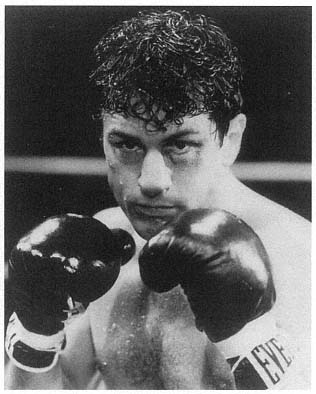
Documentary expressionism: Raging Bull
grand assertion of the European artist with his tradition of craft and guild connection on the one side and masterpieces and originality on the other. Auteur "art" came instead from a subversive use of the paraphernalia of studio complacency to articulate a personal vision.
All three of these directors did some or a good deal of their journeyman work with that institutionalized representative of the Hollywood anti-system, Roger Corman, whose stock-in-trade was taking marginal film genres like horror or the biker films and mixing them into an almost surreal concoction of flash and action. In the midst of Hollywood, Corman represented a knowing "bad taste" that simultaneously mocked Hollywood's own upscale liberal pieties even while it studiously learned all its techniques. Corman produced Coppola's first film, Dementia 13 , Scorsese's first substantial feature, Boxcar Bertha , and released DePalma's Sisters; he also offered a place where talented film-school graduates like George Lucas, Steven Spielberg, and Jonathan Demme could learn their craft at low pay. The previous Hollywood generations of directors had come from live television (Lumet, Frankenheimer, Penn) or filmed television (Altman, Pollack) with its symbiotic relation to
New York theater (especially in the days of the blacklist). This new generation came out of the film schools—USC, UCLA, and NYU. If the California contingent of Lucas, Spielberg, and Coppola were more oriented to Hollywood genres and studio expertise, it came in part naturally from the prejudices of their instruction, which stressed the need to fit in, if not with the Hollywood system, then with the Hollywood way of doing things—melodramatic plots and technically advanced visual style. If the New York contingent of DePalma and Scorsese was more dubious about the ultimate uses of technical expertise and often included a questioning of their own precedures, it came naturally from their nurturing in the cinéma vérité documentary world of New York in the fifties and sixties, with its constant arguments over the nature of cinematic truth and its New Wave city-film ambience of street-theater strutting.
But I must return from this entire generation of new directors to Coppola, DePalma, and Scorsese in particular because I believe their Catholic upbringing, literally or metaphorically, makes them the most salient film-makers of that group, heightening a self-consciousness about all aspects of film-making that is already inherent in the historical-aesthetic moment in which these young directors began to work. Each of the three emphasizes a different aspect of film self-consciousness as his own. In Coppola it is the sense of genre, which for him is attached to a feeling for family situations and family betrayals, much as the latest genre examples turn against the past in the name of bringing that past to some higher perfection. Genre for Coppola is like the rituals of religion. But in the family context those rituals are poisoned by the shadows of death and ambition, just as the christening of Michael Corleone's child in Godfather II is intercut with the bloodbath wave of assassinations he has ordered. The old must die so that the young can move into their places, as Brando, sinking into the garden while making faces, gives way to Pacino and DeNiro, his inheritors and his younger selves. Fred Astaire in Coppola's Finian's Rainbow may still spryly head off across the fields, but his day is clearly over, and like Martin Sheen contemplating Brando's Kurtz in Apocalypse Now , it seems easier to kill him off than to fathom his meaning. In Godfather II Michael the inheritor is a cold avenger, whose sword turns finally upon those he has vowed to preserve. Hymie Roth, the old Jewish gangster, may be defeated, but by the end the family has disappeared as well and Michael sits alone, while the lost voices of Sonny and Fredo and Kay echo in the empty room.
I have been recounting those elements in Coppola's films that lend themselves to an allegorical reading of his own relation to Hollywood and his past masters: a deep homage along with a simultaneous effort to replace them with his own aesthetic family—his father the composer, his sister the actress, and of course all
his friends and coworkers at the (now defunct) American Zoetrope. Always there is a dream of camaraderie, and invariably that dream turns sour, often with a sentimental heaviness, for example in The Outsiders , where the bad boy Matt Dillon maintains his friendship with the younger boys to the point of sacrificing himself in a needless theatrical gesture. Much more than either Scorsese or DePalma, Coppola is committed to storytelling and narrative of an older sort, in accord with his commitment to genre and family ritual as structures of feeling that he wishes would still retain their ability to compel belief. But Coppola's commitment is undermined by his general unwillingness to question his own role as the director and Wunderkind who will pull all this together and make it work. Orson Welles is his progenitor and Wellesian control is really his ideal. But he lacks Welles's self-critical fascination with theatrical windbags and greedy fakes. In Godfather II Michael Corleone has clearly lost all the vitality of the past even as he has superseded it in efficiency and ruthlessness. Like Coppola's own grand projects that never quite work out—Apocalypse Now and One From the Heart —the recreation of past stories in order to squeeze them of all their possible meaning never quite gets to the core that gives them life. Too often they remain only stories, and even at his best Coppola is more a virtuoso stager of their gestures than an expounder of their meanings. Finian's Rainbow effectively ends one major musical tradition in film; Godfather II systematically dismembers and calls into question every feeling and value that animated Godfather I ; Apocalypse Now attempts to say the final word on the whole history of European and American colonialism; The Outsiders will be the ultimate "bad kids are really good kids" movie, etc., etc. Instead of being energized by his self-consciousness, Coppola too often is swamped by it. His detachment from his tradition leads not to analysis so much as to compendium.
The only film that Coppola made for the short-lived Director's Company (made up of himself, Peter Bogdanovich, and William Friedkin) is The Conversation , a smaller film than most of his, and one that intriguingly situates Coppola in relation to the earlier generation of Italian directors, as well as to Brian DePalma. Even though, as it has often been noted, The Conversation owes an enormous amount to the editing and constructive skills of Walter Murch, I will treat it as connected to Coppola's own interests because, as Michael Pye and Linda Myles point out, it proceeds directly out of an intellectual context at Zoetrope where Antonioni's Blow-up was constantly being discussed as a key to all the most intriguing questions about the film-making process and the meaning of film that the young film-makers were setting about to explore.[3]
Blow-up was more appealing to the self-conscious young film-makers than any of Antonioni's earlier films because its theme is specifically the problematics of vision, particularly as seeing is mediated by the camera. Within a mystery plot featuring a Hitchcock-style innocent bystander who catches a glimpse
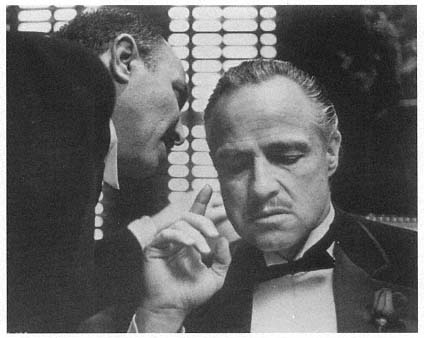
Marlon Brando as the Godfather
of a crime, Antonioni explores similarly Hitchcockian themes of moral entrapment, in which the bystander becomes culpable through his particular way of seeing and interpreting the world. Like those of Jeff in Rear Window , the flaws of Antonioni's Thomas come specifically from the impulses that animate his career as a photographer. Moodily alienated from fashion photography, in which he is clearly the master over fawning, posturing women, he seeks some moral exoneration by frequenting flophouses and surreptitiously taking pictures of the bums and outcasts who are their inhabitants. By this ambiguous penance he delves into what he considers to be the "truth" of life. And he shows the photos to his agent as part of plans for a new book that will supposedly allow him to be seen as a "serious" photographer.
With his unquestioned commitment to the morality of his own perspective and style of vision, Thomas is fair game for the events that follow. By accident, he photographs what seems to be a crime and then continues to blow up his photograph in search of the elusive, consummating detail that will reveal the truth—a detail needless to say that becomes more evanescent the closer he comes to it. In Rear Window the newspaper photographer Jeff is drawn into the lives of the people he thinks he observes with detachment. The crucial emblem of his involvement is his discovery that he has witnessed a murder without knowing it. But there is no problem of sight for Hitchcock except for its moral valence. You
have to pay for seeing; you can't be detached. In Blow-up , on the other hand, seeing is itself called into question, along with the minute amassing of facts that purport to lead to a solution. Unlike Hitchcock's, Antonioni's narrative does not follow even a pseudo-causal unfolding. Its story is more like a collage, a cubistic refocusing on the protagonist, who, like characters in Antonioni's earlier films, only sporadically follows his first goal. Hitchcock minimized the lost, strayed, or stolen object that was the pretext for so many of his plots by calling it the MacGuffin. But it nevertheless existed. In Blow-up the photographer tries to turn the pretext into a text and fails miserably.
Yet, although Antonioni goes beyond Hitchcock in questioning the sufficient reality of the visible world, he shares Hitchcock's final unwillingness to demystify the visual image and the director's privilege of presenting it. Thomas the photographer is not, I think, a surrogate for the director because Blow-up specifically characterizes the photograph as a still picture and so necessarily inferior to the cinematic way of seeing the world. By satirizing the fashion photographer's pictures of the down-and-out in a mockery of the naive neorealism that dwells only on the surfaces of reality, Blow-up especially implies that the photographic fetishizing of the visible is less "insightful" than that of film. Antonioni's perspective—as director —resembles a modernism of the Flaubertian and Joycean sort; God pares his fingernails while his characters squirm in their limited universe of immediacy. It keeps intact one of the most basic assumptions of film: that the directorial perspective is privileged, unquestioned, and almost by definition unquestionable. Hitchcock varies this assumption by making the audience, like himself and his characters, complicit in the strange goings on because of their own personal darknesses. But still it is the director who retains the edge of authority sufficient to demonstrate to us our moral lapses and epistemological blindnesses.
To return to Coppola and The Conversation , however, there the crime is real and the mystery can be solved—if one interprets the data properly. But Harry Caul, the sound man, who thinks that his equipment allows him to control and understand events, is in fact manipulated by his own belief in his godlike detachment. Much more than the photographer in Blow-up , he is a figure of the director, especially the director whose technical mastery has been his passport to success. The crucial sentence Caul has recorded he has also misheard, misread, and he had thereby totally mistaken who are the murderers and who are the victims—encouraged by his own outsider's desire to believe that the wealthy prey tyrannically on the innocent. His moral preconceptions, his belief in himself as a controlling intelligence through his expertise, and his manipulation of his technical skills themselves all turn into the agents of his failure.[4]
Yet, despite its critique of the director's technological detachment, the fact that Coppola gave up effective creation of The Conversation to Murch indi-
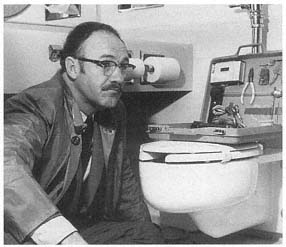
The Conversation
cates that there is some sense in which he has himself tried to escape unscathed from the film's mea culpa . One wonders if the maker of One From the Heart , with its elaborate paeans to the technology of emotion, has really watched The Conversation with the attention it deserves. The similarly divided aims of Apocalypse Now , with its simultaneous satire of American technological warfare and its exploration of dark spiritual forces in the Vietnamese jungles, follows The Conversation in replicating Coppola's own division between the desire to control through technique and create through imagination.[5]
I have called this interplay between the technological future and the mythic past in Coppola's films a tension, a dialectic, a Jekyll-and-Hyde split in his commitments as filmmaker and moral story-teller. But in the films of Brian DePalma, it becomes a prime theme on its own. Coppola is the genre story-teller, big daddy director, studio magnate. DePalma believes in the myth of Hollywood with a capital H and, according to all his interviews, loathes it. Yet he has become very successful making films that raise the ante in horror violence beyond even the Corman level, while mixing them with an irony about his own position as the outlaw little kid director now armed with all the technical resources and a good deal of the money of the big guys. Although brought up as a Presbyterian, DePalma acknowledges a strong Catholic cultural background. Of the three directors he is the most fascinated with significant objects, especially the knives and other instruments of cutting so favored by Hitchcock, which take their places in the rituals of the deranged. Neither Coppola nor Scorsese lavishes the attention DePalma does on a table or desk top with its array of objects that create a mood or express a personality. Objects for DePalma are close to icons, and one central icon in his films may
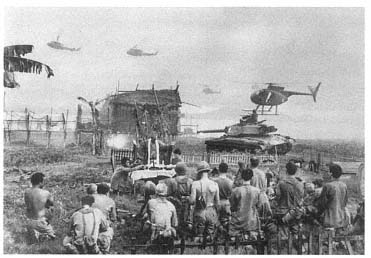
Holy communion in Apocalypse Now
be the statue of St. Sebastian in Carrie's closet (not present in Stephen King's novel Carrie ), the Saint pierced by arrows just as Carrie will by the powers of her own mind later skewer her mother with every kitchen gadget available, murdering and sanctifying her at the same time.[6]
In both Carrie and The Fury , as well as Sisters , DePalma celebrates the power of the mind and the imagination to move the otherwise inert objects of the world and thereby create its own reality. Telekinesis plays the same role in DePalma's films that genre references do in Coppola's and allusions to film history in Scorsese's: it invests the normal and the repetitive with the transcendent spirituality of ritual power. And DePalma particularly vests that imaginative power and strength of mind in a human being, a character, and invariably a young character at that. The young, in Coppola, can never reach the greatness of the past. They succeed primarily in turning it into a machine-like efficiency. The young in Scorsese are burdened immeasurably by their own desires for recognition and justification as dictated by movie stances and gestures from the past. But the young in DePalma have a kind of almost Wordsworthian energy that the adult world is bent on corrupting, not sexually so much as by its superior knowingness and its institutional absorption of their vitality for its own ends. The teen-age computer whiz in Dressed to Kill is going to use his own command of film technology to find out who killed his mother. The sound technician in Blow-Out is going to face down the entire police department and city government with his revelation of the criminality of a public figure. Carrie, the schlumpy teenager, falls into experience with her first menstrual period and becomes the butt of the more knowing girls around her. When she is
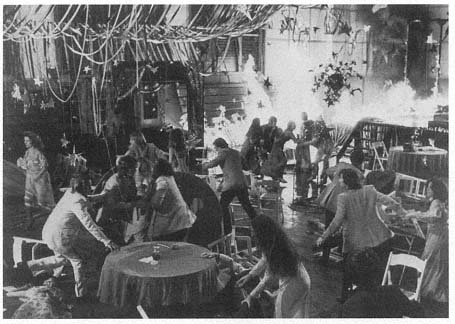
Non-selective destruction: Carrie
humiliated at the prom, she destroys everything in her path; there is no time for small distinctions about who was nice to her and who wasn't. It is personal power without an adult moral monitor, but also without the adult willingness to conciliate and beg off.
But whereas Carrie's natural magic and that of the young boy and girl in The Fury cause disaster to the evil (as well as a few of the good), the technical magic of the computer whiz in Dressed to Kill , and even more so that of the sound technician played by John Travolta in Blow-Out , really doesn't work. Both are more personally involved in the crime than either the photographer in Blow-up or the professional eavesdropper in The Conversation; neither has any illusions about the detachment their technology allows; both are using that technology for highly moral ends—to solve a murder or to reveal corruption. But both find their technical command to be fallible. The kid in Dressed to Kill , for all his minute tracking of the psychiatrist's patients, fails to understand that the killer walked out of the office rather than into it; his expertise is undermined by his youthful inability to imagine the adult depravity of the schizoid psychiatrist. The sound man in Blow-Out , even though he has witnessed the crime and has
it on tape, is powerless to prevent the killer's erasure of his taped collection of the world's most significant sounds, just as he is powerless to prevent the murder of the prostitute who has helped him and believed in him. All he can do finally is use her scream in a horror movie—her naturalness, youth, and energy swallowed up by his own now adult and affect-less purposes. The difference here is that DePalma himself—unlike Hitchcock, unlike Antonioni, and unlike Coppola—is not left out of the indictment. The prostitute is played, in perhaps a Godardian nod, by his own wife, Nancy Allen. And there is more empathy between himself and John Travolta's sound technician than there is dissociation. Antonioni at the end of Blow-up makes David Hemmings disappear, blanking him out of the frame to imply his own more inclusive perspective. But Travolta at the end of Blow-Out resembles DePalma, sitting in the studio, opportunistically putting together a film from everything at hand.[7]
There are truths inaccessible to technique, the ending of Blow-Out seems to imply, and unmimeable by the seemingly lifelike creations of a spiritless technology. In DePalma, as in some Hitchcock, there is a sense that film technique, film style, the film way of seeing, can never penetrate to the real truth, which in essence is invisible. At best we have only symbols, significant objects, details, gestures, that at the crucial juncture reveal their emptiness as ways of explanation and modes of power. As Coppola hankers after the charisma of a Brando that abides technical firepower, so DePalma celebrates the psychic power from within, which technical mastery seems to corrupt or at least to stifle and to warp. He places the Hitchcockian distinction between moral control and aesthetic control further into doubt by bringing (again a bit like Godard) the film-making process itself in for some severe questioning—even of course as he glories in his manipulation of the audience as God-director.[8] In a sense DePalma's aesthetic and moral vision is closer to that of Paul Schrader, the Dutch Calvinist, than to those of Coppola and Scorsese. But his sense of sin includes neither Schrader's moral reversal of established norms nor his puritanical preoccupation with the body and its messes. Instead it is illegitimate authority, aesthetic even more than political, that is the sin for DePalma—and at his best he does not exempt his own.
Every director solves the problem of authority, on the set and in the film, in a different way. And in the unwinding of that way is his or her sense of what constitutes a coherent story. I have been characterizing the approach of Coppola as filled with an anxiety about his own authority, drawn to genre and family rituals as gardens of nostalgia amid decline; and the approach of DePalma as mocking its own authority, especially its derivation from technical mastery, even while he celebrates a psychic energy that ideally makes an otherwise inert technology actually work. In this array, Martin Scorsese is the director who most thematizes his own authority even while he explores the
final and perhaps most pervasive aspect of the intersection of film with Catholicism—not ritual or significant objects, but the structure of sainthood. These distinctions are of course not hard and fast, and DePalma especially is fascinated by saint-like figures, especially the natural freak-marvels, while Coppola casts his melodrama of the generations with iconic stars like Brando. But Scorsese much more concertedly places the performer/saint/devil at the center of his films. As the first lines of Mean Streets insist, "You don't make up for your sins in church: you do it in the streets; you do it at home. The rest is bullshit and you know it." Like the saint in the church, the saint in the streets of Scorsese's films, so often incarnated by Robert DeNiro, makes the institutional forms into a personal order with an almost monastic fervor.
Scorsese's sense of film relies on film history and especially on the ways the film version of reality warps the consciousness of those without sufficient detachment. Saint-like in their self-sufficient isolation from the normal world, characters like Travis Bickle in Taxi Driver or Rupert Pupkin in King of Comedy dictate their own actions and responses by a world of film melodrama. They are enlarged versions of the uncle in Mean Streets , who is watching Fritz Lang's The Big Heat almost for hints on how to be a gangster, while Johnny Boy, the DeNiro character, is outside being shot. Less willing even than Rossellini to separate the natural world from his perception of it, Scorsese places his characters at the center of his films, and the look of the film radiates out from them, just as their moral conceptions of reality and their self-constructions come from the films they have already seen. Like Rossellini, Scorsese is interested in the figure of the saint as a character who moves beyond "realistic" norms, transfiguring his marginality into a kind of transcendence. The extraordinary calm of the Franciscan emissary in The Little Flowers of St. Francis while he is being brutalized by the bandits embodies a divine spirituality that can subsume earthly violence. In the much more pervasively violent films of Scorsese (who first wanted to be a priest because his asthma prevented him from being a gangster), the stylization of the visual form becomes a kind of skin over the eruptions within, as if to demonstrate how much chaos the rituals of seeing and story-telling can actually subdue. In a certain sense, one can thus place Scorsese in a European line that stretches from de Sade to Pasolini, in which the stories of violence and death paradoxically point to the patterns of the form that contains them and the rituals by which they are distanced and turned into meaning. Like the Neapolitan paintings of Caravaggio and others, with their incessant heads of John the Baptist and Holofernes, their pin-cushion Sebastians, and their massacred Innocents, such works disrupt in order to re-establish, breach in order to heal and re-authorize.
But Scorsese, more than Coppola or DePalma (or de Sade and Pasolini, I would say), considers the formal self-questioning of his own authority and
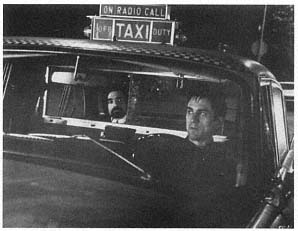
Taxi Driver
complicity to be part of the story he tells. Perhaps, in delivering the sacrament, the individual priest has been made eternal in his role. But Scorsese, with a modern's sense of the ersatz sainthood conferred by the media, cannot stop there. In contrast with DePalma and Coppola, and even more sharply with the blithe, control-celebrating Lucas and the director-worshipping Spielberg, Scorsese continually characterizes himself in his films as an inciting force. In Mean Streets he is the killer who shoots DeNiro at the end; in Taxi Driver he is the murderous misogynist whose appearance triggers off Travis Bickle's breakdown; in Raging Bull he is the barely offscreen make-up man who is preparing Jake La Motta for his stage appearance reading Shakespeare; and in King of Comedy , he is the a.d. who mockingly tells Rupert to ask the director if he really wants to know what's going on.
Interestingly enough, in the successive interplay between Scorsese and DeNiro, there is also a gradual emptying of the main character's moral pretensions and physical courage. With each step he turns more and more into a media figure, hungering for his place in the public eye. In the contemplation of the Italian-American director, there is some irony to be mined from the fact that in the year of Taxi Driver , Sylvester Stallone appeared in Rocky . Stallone/Travolta are an intriguing contrast with Scorsese/DeNiro: the mainstream vs. the outsider Italians, the middlebrow vs. the highbrow film-makers. The most relevant contrast to draw here is the unproblematic quality both of Stallone's thematizing of success and his celebration of winning through the self-conscious creation of a great body. True, Stallone admits that success has its pitfalls, and bodies age. But somehow those problems will be overcome. Scorsese's vision of both fame and physical fitness is much darker. In each of his films there is a progressive defacement of DeNiro—the mohawk haircut in
Taxi Driver , the bloated weight-gaining to play La Motta in Raging Bull , and the odd shot of hands wiping across a window-reflected face in King of Comedy , the implied and actual mutilations in After Hours —introducing a film that explores the tangle of recognition and personal identity. Raging Bull particularly seems to be a direct response to Rocky , similarly contemplating the boxer as a figure in working-class and lower-middle-class Italian-American culture. In contrast to the sweet color melodrama of Rocky , it is shot in a lusciously harsh black-and-white neorealist documentary style. Unlike Stallone, Scorsese does not blandly approve the benediction of visible success. In the figures of Bickle, La Motta, and Pupkin there resides instead a sense of the gaping uncertainties of public appearance and the desire for personal fame, along with a raging iconoclasm toward the performer—as if Scorsese wanted to undermine his own inclination to trust too much in the substantiality of images.
All such characters in Scorsese's films are saints of a sort, but saints as heroes manqués . In a way they are reminiscent of Rossellini's false General Della Rovere, the common man who becomes a hero because others think he is. But Scorsese's saints have an urge to be different and to make a difference that has been totally warped by the culture of visual media in which they try to find themselves. In Rupert Pupkin's fantasy wedding, television has become the church. As Scorsese has said of Travis Bickle's more malevolent version of this urge, he's "somewhere between Charles Manson and Saint Paul. . . . He's going to help people so much he's going to kill them." Scorsese's exploration of such upside-down spirituality is part of his own particular inclination toward the performer as the key to a social and cinematic vision. But it is the performer not in the sense of Coppola's ritually murdered Brando, but the performer as the lightning rod for all the crazy pressures on the effort to construct a self in America today. Johnny Boy and Jake La Motta are specifically Italian; Travis Bickle and Rupert Pupkin are not. But all four, like Alice in Alice Doesn't Live Here Anymore , as well as many minor characters in Scorsese's films, are infused with the desire to be somebody. That desire, as perhaps it must be in film, is predicated specifically on being seen and paid attention to by an audience. Johnny Boy dies among friends. But Jake La Motta leaves the film to greet a waiting audience, his career now revived, while Travis Bickle's insane shooting spree is turned by the newspapers into a heroic vendetta, and Rupert Pupkin emerges from prison for kidnapping the talkshow host to discover that he has become a celebrity, and Paul Hackett in After Hours is finally turned into an absurd art object himself. In Taxi Driver and King of Comedy especially, such endings are presented as part real, part fantasy, like the ending of Murnau's The Last Laugh , the director's salvation of characters he has otherwise presented as doomed by their own obsessive despairs. The transcendences in Taxi Driver and King of Comedy , though, are specifically examples of a media grace, as false and as true as the spotlight for
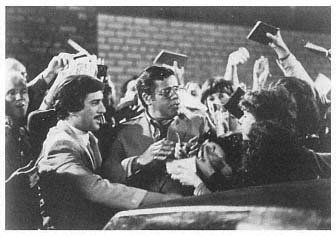
Jerry Lewis as media saint: The King of Comedy
which the protagonists in such different ways always longed. In Taxi Driver the saint has become the scourge; in King of Comedy he is a stand-in for all those in the audience who want to be celebrated merely for being themselves.
What I have been arguing here may perhaps be extended and deepened by a consideration of the role of actual ethnicity in the works of these directors. But I'm not sure. In many of these films the ideology is not ethnicity or religion per se so much as it is the way in which those social and psychological forces are mediated by and even subordinated to visual style.[9] The crucial issue is not ethnicity but the representation of ethnicity by members of minority groups whose particular angle on the world has been nurtured by the world of films that they now choose to influence in their turn. In a sense, these directors and their films may therefore signal some final stage of actual ethnicity in the interplay between a specifically Italian-Catholic sensibility and the general cultural system of American film history. Instead of taking a more sociological view of evolving ethnicity, I have chosen instead to explore the possibility that the three most prominent young American directors of Italian background have a common set of aesthetic preoccupations (and therefore thematic ideology) that may be at least metaphorically considered to invoke traditionally Catholic attitudes towards the visible world. The neorealists in great part wished to step away from a cinema of stylization and control that Bazin, Rossellini, and others identified with political tyranny. They sought to create films closer to nature and thereby to natural truth. Even in their moments of stylization and artifice, they attempted to preserve the connection of their people, places, and things to a world without mediation (or at least without the mediation of the past). But the past for these young directors cannot be avoided. There is no liberation and little resistance. In this way they are simi-
lar to other directors of aspiration ever since the New Wave. The American directors especially are bound up in both the pressure of contemporary media and the need to come to terms with a film past. There is no question of being freed from history, only how to gain control of it (Coppola), mock it (DePalma), or meditate upon it and revise it (Scorsese). Thus Coppola, like Lucas, gives aid and comfort to the greats of the past (Welles, Kurosawa), Scorsese busies himself with committees to discover ways of preserving film stock and color dyes, and DePalma gives interviews denouncing Hollywood.
At the pure moment of neorealism described and idealized by Bazin, the God of nature was appealed as an escape from the devil of History. But history is now less God or devil than it is an accumulation whose compulsions can be deflected but not avoided. The only final authority is therefore not outside but within the work. Again unlike the so-called "invisible" style of the neorealists, style here is the necessary signal of personal vision. But each of these directors, in contrast with Lucas and his northern California lack of an ethnic self distinct from movie myths, has a fruitful guilty conscience about the assertion of style and the usurpation of divine or parental authority it implies. It is just that guilty conscience—that sense of the gap between secular metaphors of ritual, sainthood, authority, and their religious counterparts—that generates so much of the aesthetic and ideological richness of their films. Like so many other artists these days, Coppola, DePalma, and Scorsese are more entrepreneurs and explorers of entrapment than of freedom. But from their very best works we nevertheless emerge to puzzle out endlessly what key it was that so lavishly allowed our release.