
Made in God's Image: Adam
The Forming of Adam (Fig. 8) is remarkable in its depiction of a single male human, because the singular form again contrasts with the mostly paired creatures who came before him. It also offers a clarifying visual gloss to a historically ambiguous section of the Vulgate, which describes a paired, two-sexed creature: "So God created a human in his own image, in the image of God he created him; male and female he created them." This famous "first" Creation of Genesis 1:27, by the P author, is ambiguous in Latin but clearer in the Hebrew and has been discussed at length by rabbis, theologians, and scholars for more than two thousand years. This is not the place to reproduce those many arguments, but to note two facts about the text. First, both the Hebrew and Latin texts for Genesis 1:27 use a term indicating a singular human creature, with no reference to sex (adam and homo ), but then immediately refer in the plural to a male and a female. Second, whether this creature is singular or plural, without sex or bisexual, it is what is made in the image of the Deity, and this is never said about the creatures in the second Genesis Creation.[22]
The mosaicists of San Marco, faced with the problem of a missing folio in their model and an ambiguous text, avoided depicting either an unsexed human or a two-sexed creature, even while using an abbreviated inscription from Genesis 1:27 above their mosaic. This titulus omits any reference to difference ("male and female"), stressing instead the unity between the Deity and the creature: "FACIAMVS HOMINEM AD IMAGINEM ET SIMILITVDINEM NOSTRAM " (Let us make a human in our image and likeness). For their visual model, they turned to a later folio in the Cotton Genesis, for, like many artists before and after them, they chose to envision the less ambiguous text of the J Creation of Genesis 2:7 and 2:22, which they
Image has been removed. No rights.
Figure 8.
Forming of Adam, detail of the Creation cupola,
San Marco, Venice.
interpreted as indicating a male figure made first, from clay, followed by the separation of a woman from his side.[23] Thus the mosaicists, retaining the text and narrative location of Genesis 1:27, chose to ignore any sexual ambiguity implied in either account of Creation and insisted that the figure made in the image of the Deity was a single male figure formed from the clay of the earth.
The scene of Adam's forming is barren, for according to the second Genesis account, the body is made from clay prior to the planting of Eden in the east. The Genesis text includes no speech by God preceded by the dixit or ait formula, and so the Creator here does not gesture to speak but instead works with two hands to form the right arm of Adam. This is the first time we have seen the Deity as physically active, working by material action rather than by verbal command. This may explain why the Creator is seated on a golden, jeweled throne: the action of forming Adam from clay is so mundane and humble—in Hebrew, the verb used is a potter's
Image has been removed. No rights.
Figure 9.
Blessing of the Seventh Day, detail of the
Creation cupola, San Marco, Venice.
term; in Latin, the simple formavit —that the artists feel the need to reassure the viewer that this is still the regal Lord God of Heaven.
Seemingly out of place, but textually in sequence following the Genesis 1:27 account of Creation, the Blessing of the Seventh Day interposes itself between the forming and the animation of Adam (see Plate 1; Fig. 9). Lacking the dixit or ait formula, the Creator does not speak with his right hand but lays it on the head of the personified seventh day, blessing it before the other six. Again the Creator is enthroned, but this time the composition is governed by a hierarchical style and is symmetrical, static, and frozen in time. The Cotton Genesis miniature did not follow this format,[24] but the thirteenth-century artist, sensitive to the meaning of the scene, recalls that God's resting on the seventh day was the cause of the blessing and evokes this "resting" compositionally. However, this is no human in repose—he is not limp or obviously tired—but a Deity majestically enthroned. Once again, the visual syntax tells us how to read the
scenes, for, for the first time since Creation began, the viewer is not rushed along from left to right but stops before the centralized and frontal Deity, as though finally a punctuational period were depicted in the visual text.
The Animation of Adam (see Plate 6), where God gives to Adam his animus or soul in the form of a psyche, awkwardly rekindles the narrative by placing Adam in the first position in the composition and reverses the figure of the Deity in the second position, to the picture's left. Composition-ally this is one of the most remarkable scenes in the series, because it abruptly interrupts and then redirects the narrative flow, causing it now to move from the viewer's right to left. At the same moment that the Genesis text suddenly shifts to the J section, seemingly repeating itself with a second account of Creation, so do the mosaicists reverse the flow, returning the viewer to the earlier forming and speeding up the tempo.[25] The reversed position of this unusually active and energetic Deity (he again does not speak) encourages our eyes to run back across the symmetrical Blessing to the Forming of Adam , and then return to the Animation . We are reminded emphatically that only when Adam receives his soul has he become fully "like" God. The phrase "in the image" was certainly understood in the Middle Ages as a reference, not to Adam's physicality—even though images express this idea in physical likeness—but to Adam's rational soul.[26] No longer clay-colored and small, he now stands erect and in the position usually occupied by the Creator. The mosaicists have substituted a dualist, two-stage creation for the original four scenes of Adam's creation in the Cotton Genesis,[27] thus highlighting only two events—the making first of Adam's body and then of his soul. The reversal of the latter composition signals that we are to review this section of the narrative, for the moments of God's forming of Adam's body and his gift of a soul are high points of God's Creation.
The mosaicists' consistent use of a visual syntax clarifies the ambiguity of the Genesis 1:27 text by demonstrating Adam's similarity to God. Of Adam's fifteen appearances in the cycle, he stands four times in the active-agent pose at the picture's right; two other times he parallels the Creator in God's typical pose and appears next to him, second in the scene, and still at the picture's right; another two times, in compositions where the Creator is frontal and centralized, Adam is again at the picture's (and God's) honored right side; and an additional two times Adam appears at the center, closer than Eve to the Creator at the picture's right. In only
Image has been removed. No rights.
Figure 10.
Introduction of Adam into Paradise, detail of the
Creation cupola, San Marco, Venice.
three scenes is he distinctly at the picture's left: at the fateful moment when he first meets Eve and calls her "Woman" (see Fig. 19); when he takes the fruit from Eve and sins (see Fig. 20); and when he labors after his Fall (see Plate 2). Eve's postures, as we will see, are so unlike the Creator's that the mosaicists' visual answer to the textually generated question, "Who was made in the image of God?" is clear from the very beginning: Adam, but certainly not Eve.
The second register ends with another gift from God to the first man, his introduction into the bucolic Garden of Paradise (Fig. 10). With his right hand, God pulls Adam through the clearly labeled Porta Paradisi into his lush Garden and, with his left, gestures toward the two prominent trees. Adam is again granted the honored first position in the composition, but God acts as his guide, eagerly leading him forward, their two figures moving parallel to each other. The trees are those of Life and of Knowledge, located
at the center of Paradise, and the four personifications of the Rivers of Paradise appropriately lie beneath them.
The first tree is certainly the Tree of Life.[28] Honored by its compositionally more central position and proximity to the Deity, this tree remains consistent in form throughout the mosaics (compare Plates 2 and 7 and Fig. 24). It is ironic, but not unusual in medieval art, that the form of the more dangerous tree, the one that needed above all else to be identified by our first parents, changes throughout the cycle. It is first alluded to by the two apple trees in the upper register's Creation of the Plants (see Fig. 5); it reappears three times in later scenes with striking blue foliage, although each time varying slightly (see Plates 7 and 11 and Fig. 24); and when Eve finally plucks the fruit, it is botanically identifiable as a fig tree (see Fig. 20). Here, in Adam's introduction into Eden, it is a relatively undistinguished green tree. Yet its sinister quality is suggested by the mosaicists' prominent inclusion of left-handed gestures. In an almost certain thirteenth-century alteration of the model, the four river personifications raise their left hands and point toward the Tree of Knowledge.[29] More remarkable, however, is God's gesture with his left hand. If, as Weitzmann believes, this is a conflation of two scenes in the Cotton Genesis, the Introduction and God's Admonition to Adam , then this could be interpreted as a speech gesture referring to Genesis 2:16, where God commands Adam not to eat, for he will die.[30] If so, it is the only time in the Genesis mosaics that God speaks with his left hand. Although the narrative has once again picked up and moves comfortably from left to right, the five gesturing left hands cause the viewer to anticipate well in advance the point in the narrative when that tree will play a sinister role in human destiny. Viewers standing below the cupola are once again encouraged to look for proximities created by the registration of the dome (Fig. 11). Directly above Adam's introduction into Paradise and the admonition is the Creation of the Plants , including the first reference to a garden and the Tree of Knowledge, while directly below is the Expulsion , where Adam and Eve are finally expelled from that same garden.
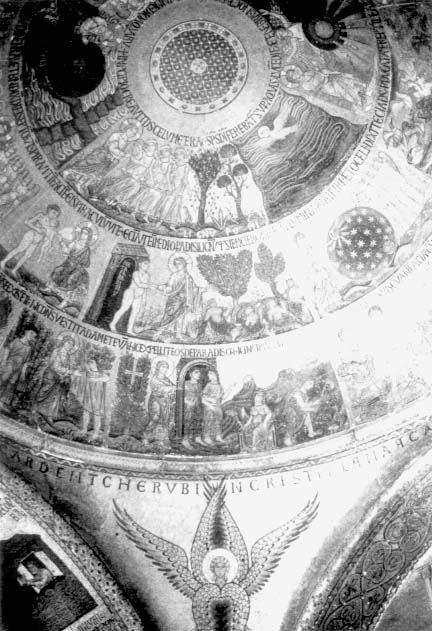
Figure 11.
Northeast corner of the Creation cupola, showing vertical alignment of scenes,
San Marco, Venice.