
4
The Pictures—Scene by Scene
This chapter compares selected depictions of the same event. My choice of incidents to illustrate my points is no less arbitrary than that of the scribes and chitrakaras to illustrate theirs. From the appendices and the following chapter, the reader will discover that there is no universally shared list of major incidents, and that what one might easily take to be a critical point in the plot may not have been depicted by a particular artist. My own choice has been guided in large part by interest in scenes that are more emphatically illustrated in Orissa than elsewhere or that are given a unique twist there. I am also attracted to episodes where we can put our finger on the derivation of artistic imagery This leads to the inclusion of some events that may seem trivial or idiosyncratic and to the omission of what might be considered more important episodes in the story. Some reasons for various choices of emphasis will appear in the final chapter.
Risyasringa's[*] Seduction And Dasaratha's Sacrifice
In Valmiki's Ramayana[*] , the story of the young ascetic Risyasringa[*] ("Antelope horn") is interpolated as a prelude to his performance of the sacrifice for sons that produces the divine food distributed to Dasaratha's queens, which in turns leads to the birth of Rama.[1] Even Valmiki's relatively restrained account of Risyasringa's[*] seduction by courtesans who entice him from the forest was abbreviated in some later versions of the epic—such as the Adhyatma Ramayana[*] (where the ascetic is simply brought),[2] ç or Tulsi Das's Hindi (where he does not appear at all).
But in many vernacular texts, the full legend is retained or even expanded, as in Orissa.[3] Thus in Upendra Bhañja's Vaidehisa Vilasa[*] one entire canto (of fifty-two) is devoted to the ascetic's seduction by the courtesans (vesyas ), led by the intelligent and charming Jarata, who were enlisted by King Lomapada to relieve the drought in his kingdom. Their first visit to the forest typifies the double entendres for which Upendra is known. Risyasringa[*] , who grew up without any women, asks,
"Oh sages, tell me what spells you chant.
Do you worship Visnu[*] or Siva?"
Giggling and flirting, the amiable women
Replied with spirit, their nostrils flaring,
"You dwell in the forest [vana ], we in a grove [vani ];
So you are called recluse [vanoka ] and we are women [vanita ].
We say the same spell to Rama as you,
But instead of Ra we substitute Ka [i.e. Kama, Love].
Because Siva is our god, we bear him over our heart."
Then quickly they revealed pairs of breasts.
(4.14-18)
The image of the young ascetic seeing women's breasts for the first time under the illusion that they were liñgas might make the sternest Freudian smile. Subsequently Risyasringa[*] disobeys his father, follows the courtesans to their boat, and is carried away blissfully to Lomapada's kingdom, where he brings rain. Dasaratha in turn offers his beautiful daughter Santa[4] in marriage and takes the sage to Ayodhya to perform a sacrifice for sons, producing the divine food (payasa ) that impregnates the queens.
Why is the Risyasringa[*] episode expanded in this account? On the one hand, the role of the vesya in conferring religious status upon the king is broadly visible in Orissa, as the anthropologist Frederique[*] Marglin has argued.[5] The sexuality of such women, while arguably impure, is associated with water, agricultural fertility, and the king's right to rule. The institution of the devadasi , or temple courtesan, provided a ritual mechanism for this connection, which endured until very recently in Puri. On the other hand, this episode is certainly grist for Upendra Bhañja's literary mill, eliciting the erotic passages and humorous wordplay for which he is noted. Whereas Valmiki's Ramayana[*] is built around the pathetic sentiment (karuña rasa ), the Vaidehisa Vilasa[*] gives equal play to the romantic (sringara[*] ) and at times the comic sentiment (hasya ). The fourth canto, devoted to the Risyasringa[*] episode, develops these moods with ingenuity and elegance.
In the earliest paintings of the chitrakaras , the wall paintings of Buguda, Risyasringa[*] initiates the action by performing a sacrifice and handing the religious food to Dasaratha, but his seduction is absent (Figure 201, lower right). Subsequently, since at least 1954, the sage appears surrounded by courtesans in a boat in the repertoire of the chitrakaras (Figure 223).[6] Inclusion of the seduction is not surprising in view of the broad popularity of this episode in most Oriya texts. The boat scene in particular may be understood as a sub-episode that alludes to the particularly Orissan association of the courtesans with water and hence fertility in a generalized sense.[7] ç The wooden wedding box made in the 1970s by Bhagavata Maharana of Bhubaneswar includes the same scene as one of four events selected from the entire epic, suggesting its importance (Figure 258). The chitrakara views this event in a more regular and static way than most of the palm-leaf illustrators to be considered.
Even in Orissa not all texts include this sequence. In Oriya translations of the Adhyatma Ramayana[*] , as in the Sanskrit original, Risyasringa[*] is abruptly and
briefly introduced in connection. with Dasaratha's sacrifice for sons. Hence it is no surprise that the seduction does not feature in any illustrated version of that text (Appendix 1). Likewise we have no scenes of this episode in the Durga and Hanumana Stutis or the Brahma Ramayana[*] .
Upendra Bhañja's Vaidehisa Vilasa[*] , whose ample account of the episode has been summarized above, invited copious illustrations. Those of the Baripada manuscript made by the karana[*] Satrughna are difficult to piece together with precision, but at least nine leaves seem to have been devoted to events between the courtesans' departure and Dasaratha's sacrifice. The illustrations, characteristically overlapping several folios, show a small, hieratic Risyasringa[*] accompanied by larger women, depicted as conventional dancers (Figure 89). By contrast, Michha Patajoshi's courtesans have a housewifely quality, and he captures the fun, if not the literary punning, of the verses quoted above (Figure 125). His pictures follow the text fairly closely, two per side of most leaves, increasing in number in his latest work.[8] The landing of the courtesans' boat (from which Risyasringa[*] disembarks, bringing an end to Lomapada's drought) illustrates the way this artist repeats a general composition but not every detail (Figures 102, 113, and 126).
In Upendra Bhañja's Lavanyavati[*] , the Ramayana[*] synopsis begins with Lomapada's drought and Jarata, the chief courtesan, embracing Risyasringa[*] , events that are illustrated in three of our versions. The Round Manuscript shows the sage seated apart from two women in the boat and then performing sacrifices for the two kings, focusing lucidly on his role in the main plot sequence (Figures 1, 2). Raghunath Prusti depicts the amorous situation in the boat, the court of Lomapada, the sage's farewell to Jarata, and Dasaratha's sacrifice (Figures 175, 176), in closer correspondence with the generally risqué character of Upendra Bhañja's text. Balabhadra Pathy's version is as usual most expansive, including characters not mentioned in either of Upendra's poems and weaving all parts of the sage's progress to the courts of Lomapada and Dasaratha across six pages (Figure 157). It is interesting that all three artists include the courtesans' boat, not mentioned in the Lavanyavati[*] itself, although no doubt familiar from various Oriya accounts; only Prusti enumerates the charms of this vessel, as did the poet in the Vaidehisa Vilasa[*] .
The Dispersed Lavanyavati[*] begins its account of the Ramayana[*] with a characteristic ellipsis. The caption on the left half of Figure 141 mentions the magician's performance and also king Lomapada. Yet the illustration jumps to Santa, presented by her father to the ascetic. This event is consummated on the right with their marriage, attended by Lomapada as well as Dasaratha. Rain is ingeniously worked in to form what might seem to be a tasseled canopy, did it not descend from a dark corner of sky. In short, from Upendra's verse 20, the artist has selected and condensed his elements to give particular dignity to Risyasringa[*] , who goes on to function dramatically on the reverse, paired with Visvamitra in Dasaratha's sacrifice (Figure 142). It is Risyasringa[*] who turns his head to focus on Valmiki (identified in the label), who hands the porridge to Dasaratha at the very middle of the folio, the string-hole underscoring this momentous act. This is a unique version of this event, giving the ur-narrator Valmiki a pivotal role in this episode as 'well as demonstrating the daring and artistry of this anonymous artist. Ellipsis and flashback (the rain) serve to clarify yet enrich the images.
I have deliberately omitted mention so far of the widely varying manner in which Risyasringa[*] himself is depicted. Here the Oriya texts that were actually illustrated give no guidelines: he is described merely by his name "Antelope horn," Earlier versions of the story from other parts of India explain that his mother was an antelope, and it has been suggested that the ultimate prototype is the European unicorn.[9] Indeed, the unicorn model is that of Buguda (Figure 201). This depiction of the youthful ascetic with a single horn perpendicular to the crown of his head, along with the spiky sacrificial fire, may have influenced Raghunath Prusti (Figure 176). The suggestion that this careful artist, working only 30 kilometers from Buguda, should have appreciated such models is plausible, despite his having chosen (with some help from Upendra Bhañja) to give his narrative a different twist. By contrast, the single-horned Risyasringa[*] of the Round and the Dispersed Lavanyavati[*] is an older ascetic (Figures 2, 141). Balabhadra Pathy adopted a very distinctive ascetic type, with no concern for Risyasringa's[*] youth and with no horns distinguishable among the many pointed locks of hair (Figure 157).
Despite the historical assumption that a single horn is appropriate, the authoritative Oriya Ramayana[*] of Balarama[*] Dasa says explicitly that the sage had two.[10] That is how Michha Patajoshi depicted him, possibly without visual models (Figure 125). And more recently chitrakaras have adopted this version, with long twig-like horns (Figures 223, 258). Most distinctive of all was the solution of the ingenious scribe Satrughna, who endowed the sage with the entire head of a blue deer (Figure 89). This representation in fact corresponds to the description in Sarala Dasa's Mahabharata : "The body of a man and the head of a deer."[11] ç In all these depictions of Risyasringa[*] surely we must see independent efforts by each artist, guided by little sense of shared visual traditions except in the case of an unusually scrupulous craftsman like Raghunath Prusti, who drew selectively upon the model of nearby Buguda.
Tadaki[*] , Ahalya, and the Boatman
Rama's encounters with Tadaki[*] , Ahalya, and the Boatman form a closely linked sequence in Orissa in several texts, performances, and, particularly, pictures. Tadaki[*] was the principal scourge against whom the sage Visvamitra enlisted the aid of the young prince, and Rama's success in felling her provides a preview of his subsequent success at demon slaying. In both the Adhyatma Ramayana[*] and the Vaidehisa Vilasa[*] , two works radically different in literary character, a beautiful woman emerges from Tadaki's[*] huge corpse, released from a curse.[12] Then, minimizing other demons, these versions move on immediately to another tale of an accursed woman, Ahalya.[13] ç This luckless beauty had committed adultery with Indra. Her husband, the sage Gautama, cursed the god to bear a thousand wombs (hence Indra's thousand eyes), and he turned his own wife to stone until she should be liberated by the touch of Rama's foot. In the Adhyatma Ramayana[*] this release ushers in Ahalya's long devotional hymn to the pervasive power (maya ) of Rama. Here and in Upendra Bhañja's versions, the event is juxtaposed with the story of the boatman, who insists on washing Rama's feet before he steps aboard the boat lest the boat that he needs to make his living turn into a woman (who would also be expensive to support). This brief episode is both a humorous hu-
man touch, catching the simple man's naïveté, and a profoundly moving statement of the devotional theme that links this entire sequence of events.[14] In the Dasapalla Ramalila[*] , the second night is regularly devoted to these three episodes alone. Tadaki's[*] frenzied fight culminates in her deathbed worship of Rama. Ahalya emerges from a mysterious papier-mâché rock to pray while her story is recited. The boatman appears in a simple boat, a plain sari stretched over an oblong flame, and his washing of Rama's feet concludes the evening with humble reverence.
Several of these events are commonly depicted not only recently in Orissa but also in earlier sculpture of other regions.[15] At Buguda the three incidents follow in sequence, although the scene of the boatman (Figure 201, third tier, left) is separated from Ahalya. The figure of Tadaki[*] is badly abraded, but it is mainly her size and the tree with which she threatens Rama that indicate the fear she inspired (Figure 201, second tier, right). Her pose and general configuration resemble those of the small, meek Ahalya to the right, as if Tadaki[*] and Ahalya were the same figure transformed.
In this depiction of the demoness, later pata[*] painting is no less obviously heir to Buguda than are some manuscripts. In Jagannath Mahapatra's set, Tadaki[*] takes the form of a standard raksasi[*] —naked, disheveled, with blue skin and a grotesque face. Yet she, like Ahalya in the next scene, rises from a hill of rounded lobes, which lends continuity to the two events (Figures 224, 225). His straightforward version of the boatman scene appears fairly commonly on separate small patas[*] , reflecting the popular appeal of this devotional theme (Figure 226).
Among manuscripts, even the Brahma Ramayana's[*] cursory narrative includes Tadaki[*] and Ahalya (Figures 195, 196). The two occur on opposite sides of the same leaf, and the arrow-filled fight on one side does not necessarily invite comparison with the sedate, hieratic composition on the other. Tadaki[*] has fangs and a hooked nose like demons in many palm-leaf illustrations, although other details are unusual.[16] The skillful artist of this manuscript uses a dark rectangle to define Ahalya's rock, a vivid device unique in Orissan images, quite possibly of his own devising.[17] ç
In the Adhyatma Ramayana[*] we have a text that juxtaposes the three incidents in question as examples; of Rama's maya . While Sarathi Madala Patnaik illustrated Ahalya's devotional hymn (replacing Rama with Visnu[*] ) in three of his four preserved versions of this favorite text, in none did he include all three incidents (Appendix 1). His two quite unrelated versions of Ahalya's release (Figures 50, 56) demonstrate his freedom from any visual formula. This freedom, the diversity of incidents selected, and the unfinished drawing of the figure of Visvamitra to the right in Figure 50 may all indicate a lack of deliberation on the part of Sarathi Madala. It is worth underscoring as we search for conscious or unconscious programs in illustration that some artists worked too haphazardly to meet our expectations.
In the case of the Vaidehisa Vilasa[*] , the Baripada master Satrughna included Tadaki[*] in the form of a black animal-headed monster spread over five folios (Plate 3), and he also depicted the boatman (Figure 90), but this manuscript is too jumbled to reveal the original effect of the sequence. From the same artist's other, probably earlier, copy of the same text we have the Ahalya episode pre-
served in a distinctive form (Figure 99).[18] Above the rock, letters are decoratively arranged to read,
Offering
lotus flowers,
Ahalya worshipped
Rama, son of
Kausalya
with
great
pleasure.
This seems to be a case of Satrughna's vaunted ingenuity in welding together image and text.[19]
Michha Patajoshi meticulously depicted each turn of events, spelling out Tadaki's[*] apotheosis (Figure 103). He included amusing details from Upendra Bhañja's poem such as Indra's slinking past the irate Gautama in the guise of a cat (Figure 105).[20] As usual, this artist follows his own compositional formulas, such as the rounded rock from which Ahalya rises, without repeating every detail (Figures 104, 114, 127). From this point on, one example of his depiction of a single subject will suffice.
The abbreviated text of the Lavanyavati[*] in general grants great freedom to its illustrators. Balabhadra Pathy draws the clearest parallel between Tadaki[*] and Ahalya, for the two figures occur on successive leaves and would be viewed together (Figures 158, 159). The sequence of Visvamitra, Laksmana[*] , Rama, and a woman in a thicket is identical in the two. Thus differences stand out—the arrows released in the first and Tadaki's[*] rapacious form. Pathy, in his element here, uses the spreading plants to underscore Tadaki's[*] frenzy, as opposed to Ahalya's modest pose, echoed by drooping branches. This is one of the few Ramayana[*] sequences in Orissa that omits the boatman, although the incident is mentioned in the text of this very poem.
The Round Lavanyavati[*] organizes these events similarly on successive pages, but the two compositions attract less immediate comparison (Figures 6, 8). Tadaki[*] here combines some attributes of an attractive woman with demonic face, hair, and dugs. Rama strides from Ahalya's rock to the boatman with identical pose, displaying a clarity of action that is the forte of this manuscript.
In the Dispersed Lavanyavati[*] , Tadaki[*] and Ahalya occur at opposite ends of successive leaves (Figures 143, 145). There is a dramatic continuity between Rama, who grows from a baby to a heroic adult before our very eyes, striding from the role of executioner to that of savior and ultimately of divinity. Again this anonymous artist uses ellipsis effectively. Ample surrounding space and subtle scenery serve to emphasize Rama's heroism in these three scenes, following the import of Upendra Bhañja's longer poem, or for that matter the Adhyatma Ramayana[*] .
In Raghunath Prusti's version Ahalya follows Tadaki[*] on the reverse of the same leaf, which makes direct comparison impossible for the viewer of the manu-
script (Figures 177, 178). Yet the general similarity of the main actors conveys some relationship. The demoness is distinguished only by her hooked nose, in which this artist may again have been influenced by the Buguda wall paintings, although he does not follow their composition. One unique element is the inclusion of Bharata (as identified by label, second from the left in Figure 177). I know of no Oriya text or other illustration that included him in this expedition, although it is conceivable that some oral version did.[21] Even if Prusti had such a basis, one must credit him with originality in introducing a character not included at Buguda or in the Lavanyavati[*] itself. The neat interlocking of Ahalya and the boatman and the elegant structure of the page, with the dark river in the center, are characteristic of his pictorial skill.
In general, one might argue that the parallels presented between the release of the two cursed women in many manuscripts and in the chitrakaras' tradition represent no more than the use of stock figures, common in both literary and visual traditions. In the texts, the emphasis upon the two female characters, at the expense of the male demons who play a larger role in Valmiki, strengthens the comparison, which in turn befits the later authors' concern with Rama's transforming maya .[22] On the whole I am most convinced of a similar intent in pictures when added details enhance the similarity and when Tadaki[*] is not presented in her predictable demonic form. Certainly this linkage is more appropriate to visual images, where similarity can be grasped at a glance, than to words, where repetition must be remembered or pointed out.
Bharata's Visit
After major turning points in the plot, such as marriage and exile, Rama settles with Sita and Laksmana[*] on Mount Chitrakuta[*] . When Dasaratha dies, Bharata brings his entire court, hoping in vain to bring Rama back to rule in Ayodhya. This visit of Bharata forms a significant and long sequence in Valmiki and many other Indian versions of the tale. It has been suggested that Rama's moral advice to his brother constituted a deliberate counterpart to Krisna's[*] famous sermon, the Bhagavadgita .[23] This episode is treated with the same weight and sententious tone in the Adhyatma Ramayana[*] . In Balarama[*] Dasa's Jagamohana Ramayana[*] , however, Dasaratha's death is followed by a description of the idyllic life of the exiles, including tender moments when Rama makes a red mark on Sita's brow as befits a married woman, using ocher earth as a substitute for luxurious pigment. He protects his wife from a marauding crow by shooting its eyes. These events originate in the northern recension of Valmiki, and one can trace their expansion in Orissa at the expense of Bharata's visit.[24] ç Thus Upendra Bhañja reduces the visit to twenty verses in the Vaidehisa Vilasa[*] whereas the entire following canto of forty verses of elaborate puns treats love sports on Mount Chitrakuta[*] and includes the incidents of the ocher mark and the crow.[25] ç The list of events in the same author's Lavanyavati[*] follows this emphasis, although only the charming Chitrakuta[*] and the crow are mentioned, and these precede Bharata's visit. This general sequence reveals the interplay between high moral tone and delight in the sensual that often characterizes the Indian tradition.
The top of the first wall devoted to the Ramayana[*] at Buguda includes a much
damaged painting of a hill with three figures, probably Rama, Sita, and Laksmana[*] on Mount Chitrakuta[*] (cut off in Figure 201). A similar scene with Rama touching Sita's brow also appears on wall E in large form, along with Bharata's visit to the right (Figures 205, 206). I would infer that the planners intended to treat the mandatory visit in separate iconic form and hence did not include it among the initial narrative scenes. Possibly they only subsequently decided to add the separate depiction of Rama applying ocher to Sita to make a balanced wall with two scenes set on the same hill.[26] This decision might also reflect the guidance of Oriya literature, such as the Vaidehisa Vilasa[*] , to be expected in view of its composition by a family member of the temple's patron, although that poem is not followed literally throughout those paintings. At any rate, if there is a duplication of Mount Chitrakuta[*] here and on the first wall, it suggests extemporaneous planning of the kind mentioned in Chapter 2 in connection with directionality at Buguda.
These large, clear, and rich scenes seem to have had considerable impact upon later pata[*] painting. Jagannath Mahapatra's version of Bharata's visit is a simplified mirror image of the general composition, reducing Bharata to a humbler position (Figure 227). His text here, as in general, opts for moral homily over human detail and thus omits scenes of Chitrakuta[*] aside from Rama's meeting with Valmiki. The artist Bhagavata Maharana, acknowledging his admiration for the Buguda murals, created variations upon this version of Bharata's visit on the wedding box in Figure 260 as well as in separate patas[*] (Figure 256). Although similar in general configuration to the wall paintings, his versions are far from direct copies. Bhagavata Maharana seemed to enjoy adding landscape details, which are somewhat more clichéd than those of the original—two peacocks and a pond with ducks. The poignant group of the three pale widowed queens to the right at Buguda is reduced to two stereotypic women at the bottom of the pata[*] . Yet Bhagavata Maharana excelled in meticulous (saru ) work valued by the chitrakaras themselves, for example in the border with two serpents' heads neatly worked in at the center of the top.
In manuscripts of the Adhyatma Ramayana[*] , the textual concern with Bharata's devotion to Rama invites ample illustration of the visit. Sarathi Madala Patnaik, as one might expect, devoted about four scenes to this sequence in his complete manuscripts.[27] Unusual for him is the repetition of a single formula for the final, weighty event, Bharata's worship of Rama's sandals or footprints (Figure 57). The appearance of a lotiform emblem with the auspicious footprints in the center in other illustrators' Adhyatma Ramayanas[*] as well (Figures 75, 78) suggests that this image was peculiarly linked to this text. The obvious explanation would lie in the artists' copying from other illustrated manuscripts, although it is also possible that the worship of a stone icon of this type took place at a shrine particularly influential in the dispersal of this text.
In the Vaidehisa Vilasa[*] , Michha Patajoshi likewise faithfully follows his text, devoting one page to the visit and two or more to events on Mount Chitrakuta[*] . The visit concludes, not with the emblem favored by the artist's neighbor and immediate predecessor, Sarathi Madala, but rather with a scene of Bharata bending to touch Rama's feet (Figure 115), like the tradition of Buguda, but not necessarily following that visual model.[28] In both of Satrughna's versions of this same text, the shooting of the crow survives (Figure 91).[29] ç
The Lavanyavati[*] of Raghunath Prusti is; particularly indebted to the Buguda murals in this section, beginning with the taut image of the royal brothers tying up their hair as ascetics (Figure 183; cf. Figure 201, fourth tier from bottom, to the right).[30] Prusti incorporated the Buguda composition, which had originally been viewed from right to left; Upendra Bhañja's second text presents the events in reverse order, so that the folio in fact can be read from left to right. Ascetics are ingeniously worked into Mount Chitrakuta[*] , as described in other texts, and the shooting of the crow occurs just above Bharata's entourage. Here one can see the skillful illustrator spreading out his composition to fill the palm leaf and adapting parts of the model to include, for example, several of his distinctive Maratha-costumed courtiers, who. are absent at Buguda.
The Round Lavanyavati[*] likewise includes the incident of the ocher mark, although it is not mentioned in this text, following it with the blinding of the crow and the visit of Bharata—devoid of all retinue (Figures 13-15). These images are different enough from Buguda and Prusti's to suggest that they are independently derived. As usual, this artist illustrates the story simply and directly, in a slightly choppy, episodic manner.
Balabhadra Pathy, on the other hand, works against the text of the Lavanyavati[*] , making this story as much Bharata's as Rama's. Thus three pages depict the visiting party richly, if repetitiously, introducing the sight of Rama's footprints on the road from Ayodhya (Figure 160, far right). There is less of the charms of Mount Chitrakuta[*] . Finally Bharata is shown worshiping the sandals back in the village of Nandigram (Figure 161).
The Dispersed Lavanyavati[*] makes as bold a jump in the selection of incidents, as does my selection in this chapter, for one page moves from the encounter with Parasurama after Rama's marriage to the meeting with Bharata (Plate 9, Figure 147). Both the entire mechanism of the exile and the charms of Chitrakuta[*] are omitted: the reverse of this page proceeds to the killing of the demon Viradha (Figure 148). While the use of a hill for the visit may suggest comparison with Buguda and Prusti, the subtle emotional effect here differs. Sita sits modestly in the center, and Bharata bows his head alone, delicately inducing the mood of compassion and suggesting the theatrical stage rather than the anecdotal storytelling of many manuscripts.
On the whole, depictions of this sequence of episodes are shaped by two different lineages of interpretation: the devotional tradition, clearest in the Adhyatma Ramayana[*] but also informing Balabhadra Pathy's version of the Lavanyavati[*] , which takes Bharata's worship of the divine foot emblem as the crux; and the human response to exile, which the Buguda artists and many palm-leaf illustrators develop.
The Illusory Deer And Sita's Abduction
The basic plotline of this section, critical in causal terms, follows Valmiki in most versions: Laksmana[*] denoses Surpanakha[*] ; her demonic brothers unsuccessfully attempt to avenge this insult; Ravana[*] enlists Maricha to take the form of a golden deer, which Rama hunts; Sita is kidnapped. by Ravana[*] in the guise of an ascetic; arid Jatayu[*] tries to prevent their escape, in which the bird is mortally wounded.
Rama, upon discovering his loss, grieves, rages, and encounters both the accursed Kabandha and a Sabari, a forest woman, who point him on his way.
Whereas in Valmiki, Maricha argues at length with Ravana[*] about the whole undertaking, in the Adhyatma Ramayana[*] (and other late Sanskrit versions) he accedes quickly, realizing that he will benefit from being slain by Rama. Here, in keeping with bhakti sentiments that require an entirely pure Sita and in conformity with this text's particular concern with maya , Rama orders his wife to place an illusory form of herself outside the hut to be kidnapped and to hide her true self in the fire, where she remains for the rest of the story. This Maya Sita also appears in most Oriya versions from Balarama[*] Dasa onward.
In the Vaidehisa Vilasa[*] , Ravana[*] approaches Maricha for assistance more ingratiatingly. That demon is in mourning for the loss of a family member, so Ravana[*] bathes in the ocean as if he were a brother of Maricha performing ritual purification. Maricha obliges with alacrity.[31] As one might expect, Upendra Bhañja heightens Surpanakha's[*] sexual provocation of the brothers.[32] ç Rama writes a note to Laksmana[*] , which includes one of the poet's most widely quoted puns, a verse that can be translated in either of two ways:
You should take this woman and embrace her, the source of heavenly
pleasure, in the forest.
or
Cut off this woman's nose and ears, and don't touch her.
(23.58)
The raksasi[*] continues to imagine that Laksmana[*] is engaging in a violent style of love play as he prepares to mutilate her. In this account, after the abduction Jatayu[*] swallows Ravana's[*] chariot but spits it out to save Sita, an incident found in some Bengali folk versions also.[33] Finally, Upendra Bhañja, like many Oriya authors, follows Rama's grief with not only the slaying of the long-armed demon, Kabandha, but also with two incidents that may seem anticlimactic to us, although they increase the sense of popular devotion to the bereft hero. One is the story of rude cowherds, only one of whom offers the brothers milk; Rama grants him the boon of being born as Krisna's[*] adoptive father, Nanda.[34] ç A second incident concerns the forest woman, a Sabari who appears as a simple ascetic in Valmiki. Oriya versions emphasize her tribal identity, for she gives Rama a mango she has tasted to ensure that it is sweet, which he accepts gratefully although this acceptance might horrify a purity-conscious Hindu, loath to eat something bitten by one of lower caste.[35] ç As throughout, Upendra Bhañja's poem, while shorter than Valmiki's, embroiders the epic's urgent sense of tragedy with a variety of other moods.
At Buguda this portion of the story is not particularly vivid or clear (Figure 202), perhaps partly because these paintings are damaged. Yet with their placement in a dark space under the eaves, roughly five feet above eye level, they could never have been as prominent as, for example, the episode of Kabandha. This sequence was apparently determined by the conclusion of wall A with Surpanakha[*] at the top, although the eye was not led immediately to the first scene of wall B.[36] Moreover, the scene of Rama and Laksmana[*] carrying the deer's body on a pole, while not placed anachronically (it occurs simultaneously with the
abduction), breaks up the sequence of action and is not described at this point in any text I know. In short, direct storytelling may not have been uppermost in the mind of these artists. What they did do well was to cover the wall in a balanced manner with arresting, elegant images.
Later pata[*] paintings do not follow the model of Buguda for this sequence. One incident popular for inclusion in large depictions of the Purl Temple as well as for independent illustration—Rama shooting at the illusory deer—does not occur at Buguda, for the top of Figure 202 shows a figure turning away from the deer.[37] The prevalence of a composition moving to the right, with the deer atop a hill (Figure 230), suggests some common lineage—whether oral tradition, a painting in the Jagannatha Temple (Appendix 4), or sketchbooks (although none of this subject have come to my attention) perpetuated this form among the chitrakaras . It has become an emblem, but not on the basis of the Virañchi Narayana[*] wall paintings. The subsequent events in Jagannath Mahapatra's set differ individually from those at Buguda, although both versions show Jatayu[*] in the form of a bird that is not particularly a vulture.
In his various manuscripts of the Adhyatma Ramayana[*] , Sarathi Madala Patnaik at least twice depicts the creation of Maya Sita, an event central to this text (Figure 59).[38] He as usual illustrates the episode a bit carelessly and seems more concerned with the physical event than with the idea.[39] ç This artist depicts the deer in a variety of ways, albeit always with two heads. In January 1891 it was endowed with a second upper body and the two sets of horns crossed (Figure 60). In December 1891 the long necks and small heads looked almost like those of serpents (Figure 68). It is interesting that Sarathi Madala included this creature twice in the Durga Stuti , perhaps his most naturalistic version, which differs again slightly in showing the rear head below (Figure 82). The charming ungulate also occurs in other artists' illustrations of the Adhyatma Ramayana[*] consistently with two heads (Figure 76). Other scenes in this section are not radically different from those of pata[*] painting, except that Jatayu[*] always has the body of a man, perhaps on the model of Garuda[*] , his father. The Sabari is included in all copies, indicating that this incident was taken particularly seriously in Orissa.[40] ç
The unique illustrated Ramalila[*] of Krishna Chandra Rajendra includes one unusual textual detail faithfully followed in the text. It is the fantastic form of Krisna[*] known as Navaguñjara, pitted against Ravana[*] after the abduction (Figure 87). This substitution for the pan-Indian Jatayu[*] may reflect the popularity of the enigmatic creature in Orissa, which goes back to Sarala Dasa's Mahabharata .[41] For us, the interest is in its. demonstration of the way an illustrator may follow his idiosyncratic text despite the resemblance: of his other pictures to those of the Adhyatma Ramayana[*] .
The two artists who specialized in the Vaidehisa Vilasa[*] were even more clearly, if in different ways, concerned with their own distinctive text. The scribe Satrughna locates his illusory deer in a rich forest, emphasizing the chase it led Rama (Plate 4, Figure 93). It is clearly Maya Sita who confronts Ravana[*] the beggar, for her true form lurks in the fire (Plate 5, Figure 92). The incident of the cowherd becomes a bucolic scene within a circle, suggesting a Raslila[*] or other image of Krisna[*] , who is alluded to in Rama's boon (Figure 94).[42] Here we can clearly see this ingenious artist capturing some of the intellectual flavor of the poet.
Plates
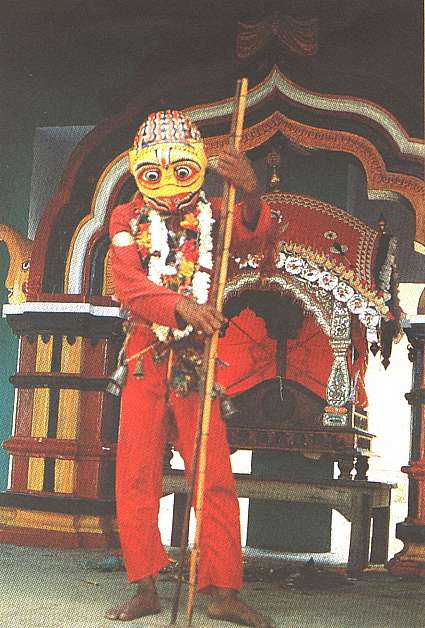
Plate 1.
Asureshvar. Danda[*] Jatra. Devotee as Hanumana.
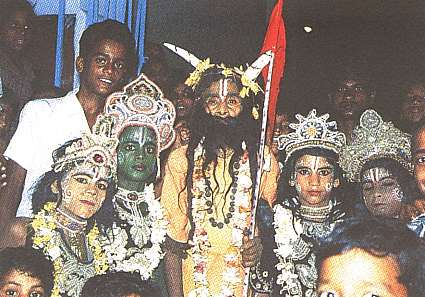
Plate 2.
Puri. Sahi Jatra. Risyasringa[*] and four princes.
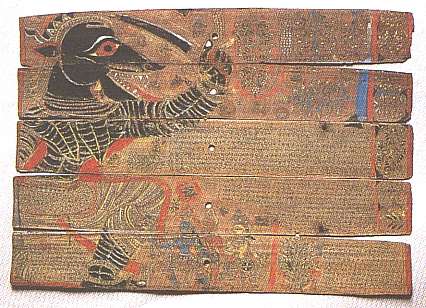
Plate 3.
Satrughna, Vaidehisa Vilasa[*] (courtesy Jubel Library, Baripada, dated
1833). Tadaki[*] and Rama.
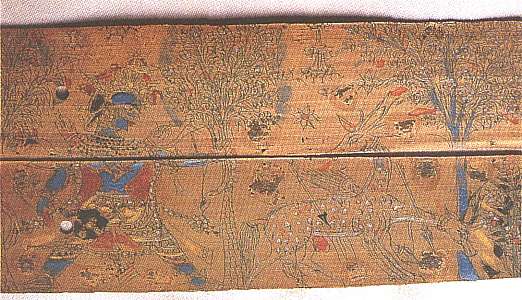
Plate 4.
Satrughna, Vaidehisa Vilasa[*] (Baripada, 1833). Rama hunts the magic
deer (detail of Figure 93).
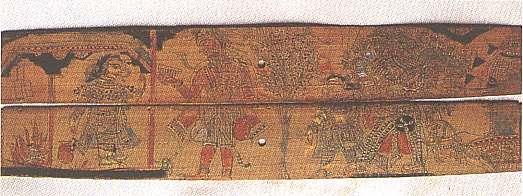
Plate 5.
Satrughna, Vaidehisa Vilasa[*] (Baripada, 1833). Sita in fire, kidnap of
Maya Sita.
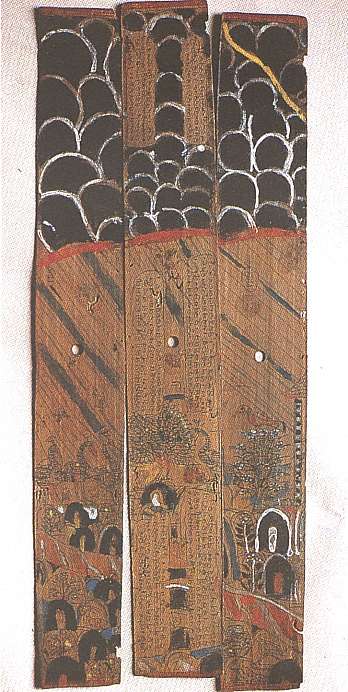
Plate 6.
Satrughna, Vaidehisa Vilasa[*] (Baripada, 1833).
Rainy season on Mount Malyavan.
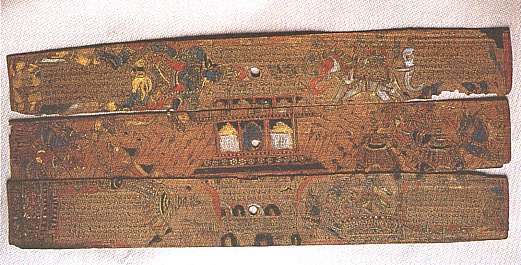
Plate 7.
Satrughna, Vaidehisa Vilasa[*] (Baripada, 1833). Battle scene.
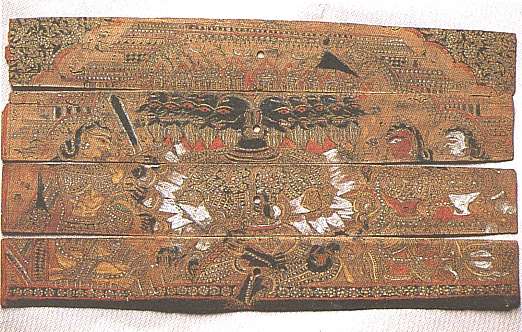
Plate 8.
Satrughna, Vaidehisa Vilasa[*] (Baripada, 1833). Ravana[*] and his wives.
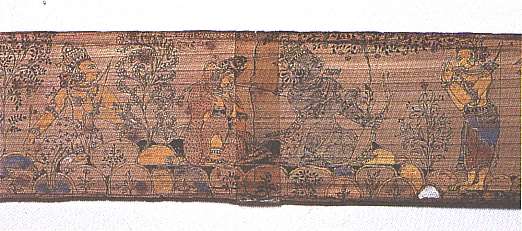
Plate 9.
Dispersed Lavanyavati[*] (Jean and Francis Marshall Collection, San
Francisco). Bharata's visit.
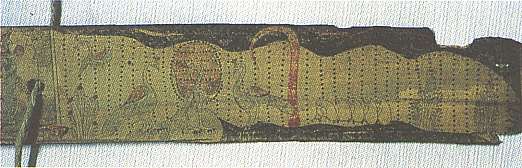
Plate 10.
Lavanyavati[*] illustrated by Balabhadra Pathy (courtesy National
Museum of Indian Art, New Delhi). Rainy season on Mount Malyavan, f. 173.
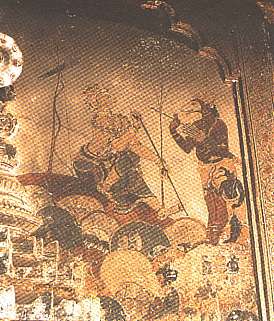
Plate 11.
Buguda, Virañchi Narayana[*] Temple, wall F.
Laksmana[*] straightening his arrow.
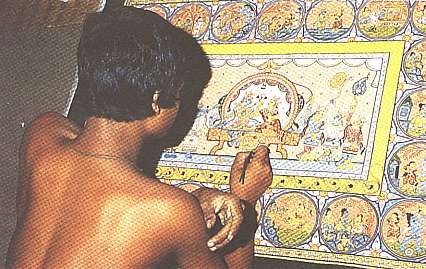
Plate 12.
Apprentice at work on Ramayana[*] pata[*] in Jagannath Mahapatra's
house, Raghurajpur (cf. Figure 289A).
There is no reason to think that Michha Patajoshi knew the work of Satrughna, produced seventy years earlier, yet his copious and literal illustrations of this section include similar themes, along with an amusing whimsy Ravana's[*] bath, taken to win over Maricha, is scrupulously shown in all three major manuscripts of this artist (Figure 108). Michha Patajoshi's deer is our most winsome version of this subject, disporting itself playfully in the forest (Figure 116). Maya Sita is again appropriately indicated by the presence of the true Sita in a fire while the illusory one is kidnapped (Figure 109). Jatayu[*] , a somewhat comic bird, swallows and then spits out Ravana's[*] chariot, which incidentally has the same form, with a giant head below, as that of Buguda (Figure 117).[43] The swallowing is depicted in the contemporary, conceivably influential pats , or pictorial scrolls, that were carried around south Bengal by itinerant storytellers; but their composition consistently differs from Michha Patajoshi's.[44] ç I would therefore conclude that what may have been known in Orissa was the theme but not the Bengali images. Two scenes of the cowherds in each manuscript become an occasion for rural details. Thus the brothers chug their milk with gusto in Figure 129, and the Sabari offers them a mango with wide-eyed enthusiasm in Figure 118.[45] ç
In the brief account of the Lavanyavati[*] , Raghunath Prusti's prolongation of these events is striking. Illustration of the last couplet of verse 24 occupies folios 77v and 78r (Figures 186, 187), a space generally devoted to two or three couplets. Thus Prusti seems as charmed as Sita was by the frolicking deer, which he depicts twice with animation and accuracy, neatly graduating the size of spots on its extremities. Folio 78r places the main event in the center (Laksmana's[*] departure, leaving Sita to Ravana[*] ) and the two simultaneous offshoots on either side. The same three episodes occur side by side at Buguda but in the order in which most texts describe them—first on the right the hut, then the brothers with the deer, then Jatayu's[*] battle with Ravana[*] (Figure 202). Prusti seems to have deliberately rearranged them according to the logic of place (movement in relation to the hut) rather than a logic of time. His version of the brothers emphasizes the deer, and Sita stands more starkly alone in his depiction of the hut as an elegant cage. The telling device of the empty hut in the next scene seems to be Prusti's own invention,[46] effectively balancing Sita's sorrow in the crowded asoka grove with Rama's stark loneliness (Figure 188). The single missing leaf that follows must have illustrated a total of four couplets, whose more succinctly depicted events might have set off this emphatic sequence.
By contrast, the careful artist of the Round Lavanyavati[*] tells his story with the regularity of clockwork, each line occupying one-quarter or one-third of the space in every frame (Figures 17-20). In the case of the Sabari's gift of a mango, her extended arm serves to emphasize the difference in status between her and Rama (Figure 23) but lacks the simple sense of devotion found in Michha Patajoshi's version (Figure 118).
In the case of the Dispersed Lavanyavati[*] , a missing folio makes it impossible to assess this sequence as a whole. On the next folio that does survive, it is clear that this artist once again took great liberties with the plot sequence (Figure 149). Either this page must be read from right to left (an order virtually unknown in palm-leaf manuscripts, whose writing runs from left to right), or the order of the kidnap and the Sabari's gift has been reversed. This lady has little of the tribal
about her, and the impact of both scenes, with their delicate tracery of leaves, is courtly and elegant. Here prolepsis may underscore the parallel between feminine generosity in the two cases, establishing for the viewer that Sita did no wrong in giving alms to this stranger.
Balabhadra Pathy's Lavanyavati[*] is no more expansive for this portion than for the Ramayana[*] in general. Some scenes are particularly vivid, such as the denosing of the scampering, bug-eyed Surpanakha[*] (Figure 162). The fact that Ravana's[*] discussion with Maricha takes place by the ocean suggests that Pathy had in mind the Vaidehisa Vilasa[*] , where bathing is part of enlisting assistance. The illusory deer, a fanciful creature, more like an antelope than those of other versions, is shown repeatedly—cavorting in a narrow clearing, bounding through a thicket with magical ease while Rama struggles after it, and looking ruefully at the arrow shot through its neck with horizontal insistency (Figures 164, 165).[47] The ten-headed Ravana[*] and the cowherd's cows (Figures 166, 167) produce variety within the often mannered tracery of Pathy's work.
This manuscript is the only one I know in which the deer has a single head, although that is the case in about 40 percent of the recent pata[*] paintings. Certainly the two-headed type prevailed in Orissa in the nineteenth and early twentieth centuries, although it was never mandatory; witness a pata[*] from before 1814, now in the British Museum.[48] Neither chronology nor region seems to explain its adoption. In fact, while the two-headed form of the illusory deer is more common in Orissa than elsewhere, it does occur with some frequency in western India from the fifteenth century on.[49] ç
I know of no three-headed version of the deer in this particular episode, although India is rife with multiheaded animals and the two-headed motif is part of that broad spectrum. One example of a three-headed deer occurs in an Orissan palm-leaf manuscript of the Adhyatma Ramayana[*] as an unexplained space-filler at a later point when the surrounding text concerns Rama's adventures in Kiskindha[*] (Figure 79)[50]
If we search for a textual explanation for the two-headed form, none of the works explicitly illustrated in Orissa describes this detail. Yet it is mentioned in at least two other texts, one the prestigious early fifteenth-century Mahabharata of Sarala Dasa.[51] The second is one of numerous Ramalila[*] texts, that of Vaisya Sadasiva, composed in the eighteenth century.[52] ç These may represent, not a conclusive source for the motif, but rather indications that this image was widespread, particularly in the context of popular theater. In the Ramalilas[*] still performed in central Orissa, the deer is frequently represented by a two-headed wooden model pulled on wheels (Figure 44, Frontispiece).[53] ç Neither performance nor images suggest unanimity about the form of the deer, but the two-headed version was widely accepted in both theater and art. Popular performance might at least have reinforced the artists' tradition or choice.
The question remains, what do the two heads mean? In Gujarat, a straightforward explanation has been adduced: the deer moved fleetingly, one moment grazing, the next looking back.[54] This is to understand the motif as an extreme example of simultaneous narration, exceptional both in western India and in Orissa. I asked repeatedly about the meaning in Orissa and never received that answer, which is not to rule out the possibility that the image may also at times suggest
darting movement. Yet two-headed form is neither necessary nor sufficient for that interpretation. On the one hand, Pathy's slender single-headed deer creates a similar effect, demonstrating that this motif is not required to create a sense of motion. On the other hand, the dead body of the deer regularly retains two heads whenever it is shown, and in that situation motion is surely not intended (Figures 20, 88, 187, 215—the skin on which Rama sits—and 265).
In fact, both the chitrakaras and the public were generally stumped at first for an explanation. One might conclude that the real meaning has been lost. Given the variety of forms, I wonder if there ever was a single real meaning. The eminent Oriya scholar S. N. Rajguru supplied a precise and elegant interpretation, that the two heads correspond to the two sides of Maricha's nature, both good and bad. Others, however, concluded that it was simply the essence of illusion: the deer should be odd. Whether we opt for the specific, intellectual allegory or for the more generalized, popular interpretation may have more to do with our own ideological proclivities than with reasoned argument. Both rest on a respect for illusion, for ambiguity, for double entendre, and for divine power at work in confusion that is central to several texts we have been considering. This entire sequence of action becomes significant less as simple crux of plot than as the epitome of illusion. When Maya Sita confronts the Maya Mriga[*] and is kidnapped by Maya-Ravana[*] , the entire story rises to a level of complex relativism that dizzies even the postmodernist. I would like to argue that the very open-endedness of the symbolism of the two-headed deer best explains its tenacity in Orissa.
The Seven Trees and the Death of Valin
In the fourth book of Valmiki, the Kiskindha[*] Kanda[*] , when Rama meets Hanumana and allies himself with the monkey king Sugriva, we are led deeper into the jungle of fantasy. Sugriva's exile is explained by the story of his elder brother, Valin, who was assumed to have been killed by a demon but subsequently reappeared to reclaim the kingdom abruptly, usurping Sugriva's wife, Ruma. When Rama promised to defend Sugriva, to assure his new allies of his strength he kicked the skeleton of the demon Dundubhi, whom Valin had killed earlier, and he shot through seven sal trees to equal another exploit of Valin's.[55] Reassured, Sugriva challenged his brother to a fight, in the first round of which Rama could not tell the two monkeys apart. Therefore he gave his ally a garland and in the second round shot Valin from behind a tree. The dying monkey reproached him for duplicity but came to understand that his own untoward behavior to Sugriva and Ruma justified the action. After much grieving by Valin's own wife, Tara, Sugriva was crowned and Valin's son Añgada became heir apparent. Rama spent the rainy season on Mount Malyavan, lamenting Sita's absence. Finally Laksmana[*] returned to Kiskindha[*] to rouse Sugriva from a drunken stupor. Thus we return to the quest for Sita. The Adhyatma Ramayana[*] gives a much abbreviated version of this section, with some difference of detail (Dundubhi's head rather than his skeleton is kicked by Rama), that also minimizes any censure of Rama by Valin, as one might expect in this deeply devout text.
Oriya literature alters this story in details, one of which is given a weighty local interpretation. Shooting through the seven trees becomes more than a simple
proof that Rama's strength equals Valin's. Thus in Balarama[*] Dasa's Jagamohana Ramayana[*] , part of the monkey's strength is said to be located in the sal trees, which had to be cut for him to die.[56] Moreover, the trees bent in different directions and Rama had to bring them into a single line; hence he stepped on the tail of a snake under the trees, and the snake became rigidly straight in fright. For Upendra Bhañja, the serpent was part of the initial problem:
The trees are huge and hard as adamant, leafy as lotus plants.
They are neatly arranged in a knot, firmly borne by a serpent.
Although loaded with fine new leaves, because of the venom they have no
birds.
At the touch of Rama's lotus feet, the snake with the seven trees was
humbled.
(Vaidehisa Vilasa[*] 28.30-33)
These verses are inscribed in the form of a bandha , or rebus puzzle, within the knotted body of the serpent itself (Figures 95, 100, 110, 130); the reader figuratively straightens it out by deciphering it, just as Rama straightens it out literally by compelling the serpent to uncoil.
The inclusion of a snake in this episode is by no means limited to Oriya literature, although it may be more common in Oriya than in other vernaculars. In Sanskrit it goes back at least to the tenth-century Mahanataka[*] and occurs in the widely popular fifteenth-century Ananda Ramayana[*] .[57] Moreover, reliefs of the Hoysala period from twelfth- and thirteenth-century Karnataka depict a snake beneath the seven trees, suggesting that other versions were known in the south.[58] ç A mythographer might be most interested in the migration of this motif and its general meaning as an emblem imbuing the arboreal forms with animal life. The student of Orissan literature is struck by the way Upendra Bhañja combined the relatively straightforward element of plot with a local tradition of challenging imagery. Chitra-kavya , or picture-poetry involving sets of rebuses (bandhas ), was a popular genre in Orissa that appealed to Upendra's particular poetic virtuosity.[59] ç This is "visual poetry," a twentieth-century phenomenon in the West, in which the physical act of reading the image enters into the meaning of the poem.
A second local twist to this part of the story is that Tara in the Vaidehisa Vilasa[*] ultimately curses Rama: "He who has caused the death of my husband will not fully enjoy his own wife" (28.153). The curse reminds us of the problematic nature of the entire episode: Rama, in killing Valin by means of a ruse, from behind, is himself open to criticism. Much has been made of this moral problem in Sanskrit; in a general way we can see the adjustment of the story to minimize Rama's guilt as he becomes progressively more and more a divinity. In the highly devotional Hindi version of Tulsi Das, Valin hardly rebukes Rama at all from his deathbed, and Tara's deluded grief is easily-dispersed. But Upendra Bhañja admits an element of blame. This ultimately leads to the tragic final chapter of the entire story, which sets this portion of the Orissan tradition somewhat apart within broader Indian religious developments.[60]
The Buguda painters illustrate this portion of the story in an increasingly succinct way, moving from a discursive to an iconic approach (Figure 203). Thus each of the first four scenes occupies an entire register. The shooting of the seven
sal trees, the best preserved section of this wall, is an emblematic composition that could almost be borrowed from sculpture, and one whose textual source could be any Oriya Ramayana[*] in which a serpent supports the trees from Balarama[*] Dasa onward.[61] The entire wall seems deliberately composed to move downward from a hilly forest scene (cut off in Figure 203) to one framed by two trees, to the massed sals, to the intense enclosure in which Rama shoots Valin. Dundubhi's corpse, an element lying outside standard artistic vocabulary, becomes an eerie, anatomically unrecognizable combination of bones and wrinkled skin.
Laksmana[*] straightening his arrow is the most surprising narrative selection at Buguda (Plate 11). This event can be reconciled with various textual sources, which credit the loyal brother with considerable anger that the monkeys did not readily come to Rama's aid. In Balarama[*] Dasa's Jagamohana Ramayana[*] and in Visvanatha Khuntia's[*]Vichitra Ramayana[*] , at the end of the rainy season Rama himself sent Laksmana[*] off with the very arrow that had killed Valin as a warning to Sugriva that this arrow might be used on him too. In the Dasapalla Ramalila[*] , Laksmana[*] , put off by the doorkeeper at Kiskindha[*] , shoots at the palace, a loud firecracker conveying the force of his anger. The stone window screen from Vishnupur (Figure 285) indicates that some version of this incident was current in the fourteenth century. The location of the scene on a hill, like the four great tableaux in Buguda, opens up the possibility that a visual tradition may have guided the painters as much as the story per se.
Nonetheless all these precedents do not fully explain the selection of this scene for such prominence at Buguda, or the inclusion of Jambavan the bear as an assistant while Laksmana[*] straightens out the quill of the old arrow. Here, as with ancient sculpture, we are at a loss to decide whether the scene represents some lost tradition—possibly oral, possibly visual—or whether the artist devised it to balance the remaining three scenes that are "sanctioned" by actual texts. The only other similar version of this episode I have discovered is in the Lavanyavati[*] of Raghunath Prusti, where its placement makes it yet more puzzling (Figure 191, bottom). The rareness of the subject suggests that it is idiosyncratic, either in story or in form, and hence not widely acceptable to later artists.
Within this sequence in general, Buguda does not fully "explain" the narrative choices of recent pata[*] painting. Jagannath Mahapatra's set of illustrations focuses on Hanumana and Sugriva as models of devotion, omitting Dundubhi's bones, the seven trees, and Laksmana's[*] approach to Kiskindha[*] . In the poem that accompanies them, Valin is made the villain, and it is understandable that his death should be neglected in favor of his righteous brother's coronation. In all of this, the chitrakaras seem to work in tune with the pan-Indian currents of Tulsi Das. Perhaps non-Oriya patronage for their work has reinforced this tendency.
In illustrated manuscripts of the Adhyatma Ramayana[*] , the most interesting incident in this section is the shooting of the seven trees. Sugriva addresses Rama:
"See,Raghava, seven sal trees; Valin can shake the leaves from each one.
If you can shoot them with one arrow, I trust your strength."
Rama acceded, took his bow, and shot through them and the hill behind.
The arrow returned to Rama's quiver, and Sugriva was delighted.
(4.1.72-75)
To this simple account, Sarathi Madala Patnaik adds a serpent in the form of a knot (Figures 61, 69).[62] Both examples follow the configuration used for the bandha in the Vaidehisa Vilasa[*] , but without any text inscribed on the body In December 1891 Sarathi Madala placed the snake beyond the trees, as if equating it with the hill (Figure 69). In January of the same year he had placed the seven trees at the corners of the knot in the pattern associated with Upendra Bhañja, with Dundubhi's head on the far side (Figure 61). Both this head and the massed foliage of the trees suggest that the artist was following details specific to the Adhyatma Ramayana[*] . Yet the serpent suggests that this unpredictable artist was generally familiar with the Vaidehisa Vilasa[*] and chose to interpolate an element from that. Neither version of this same text by another artist includes the serpent; in fact the manuscript National Museum Adhyatma Ramayana[*] by another artist gives an extremely literal treatment of the event, including the hill beyond the trees (Figure 77). Comparison with other versions underlines Sarathi Madala's more playful treatment of his text.
The Vaidehisa Vilasa[*] account summarized above seems almost tailor-made for the palm-leaf illustrators, who follow it with fidelity Our two very different artists show precisely the same configuration for the snake, determined by the need to make the verses cross on the same syllables. Satrughna's first version reads succinctly from the text on the right to the left (Figure 100). His second composition is reversed and more hieratic, with the serpent bandha dominating the scene (Figure 95). All of Michha Patajoshi's versions are more relaxed and filled with narrative verve, spreading over two full pages the scenes of the knot, the shooting of the trees in a row, and the subsequent invocation of Visnu[*] in the form of a wheel (Figures 110, 111). Characteristically Michha creates similar but not identical compositions: the trees shown as standing in 1902 (Figure 110) in later manuscripts topple over, their trunks severed (Figures 119, 130). That the serpent's head touches Rama's foot and that its body weaves among the trees distinguish this version from the somewhat similar configuration at Buguda.
For the fight between Valin and Sugriva, Satrughna again places the main event centrally, emphasizing the monkeys by scale over Tara to the left and Rama's party to the right (Figure 96). Michha Patajoshi, on the other hand, separates out each turn of the plot episodically and with equal weight (Figures 131-33). The beautiful Tara is made fully human by both artists, and her curse is explicitly and emphatically depicted by Michha (Figure 133).[63] Satrughna goes on to develop the scene of Rama's grief in the rainy season vividly, with one of the first extended sections of the manuscript that is depicted at right angles to the palm fronds themselves (Plate 6). Painted black and outlined with white, the lobes of Mount Malyavan resemble the clouds above. Diagonal gusts of rain convey emotional tension.
Among illustrated manuscripts of the Lavanyavati[*] , Raghunath Prusti's unfortunately lacks the folio that would presumably have included the seven trees. When we can follow his version, with the death of Valin, we find one of Prusti's complex compositions, forming a subunit that balances the building of the bridge at the opposite end of the same leaf (Figure 189). Prusti interweaves Rama's shot at the pair of fighting monkeys with Valin's collapse in the middle, breaking the tyranny of chronological sequence. The central scene, in which Rama and Laks-[*]
mana[*] seated on Mount Malyavan address two monkeys, takes us well beyond the incidents we have been considering.[64] But possibly the inclusion of the standing Jambavan indicates that this is Prusti's reinterpretation of the unfamiliar scene of Laksmana[*] straightening his arrow at Buguda (Plate 11), given this artist's other references to those nearby wall paintings.
The unknown illustrator of the Dispersed Lavanyavati[*] moves with his characteristic selectiveness through this portion of the story.[65] Thus Dundubhi's bone, a single stark tibia, rests between Rama and his target, in a continuous composition that gathers momentum to the left (Figure 151). The delicate pattern of the seven trees is embroidered with various animals, including birds, which indicate that this artist was not guided by the statement in the Vaidehisa Vilasa[*] that the serpent had frightened away birds. On the reverse of the same leaf, the usual fight between the monkeys is absent; instead, Rama leans over the dying Valin (Figure 152). Hanumana holding a hill both reflects the canonical role of the subsequent Gandhamadana incident, discussed below, and evokes by a flash-forward the fact that Valin's death was the price paid for the heroes' later safety. Finally to the right we find the same combination of incidents—the cock, the rainy season, and Rama's news of Sita—that we saw in Prusti's crowded drama, although the effect here is more lyrical.
The artist of the Round Lavanyavati[*] neatly reduces each scene to the essentials and presents them with fidelity to the abbreviated list of this text (Figures 26, 27). For example, because the sal trees are mentioned before Dundubhi's bones (a limp skeleton here), they appear first. The rains become a fringed dark corner of the sky And the crowning of the cock is as prominent as Valin's death.
Balabhadra Pathy, on the other hand, emancipated himself from his text in order and in detail. Dundubhi's bones, an odd scaly mass to the left in Figure 168, precede the seven trees, which, while clearly labeled sala[*] , are shown with the fan-shaped leaves of the tala[*] palm. Pathy chose to emphasize the death of the monkey king, shown shot, reproaching the heroes, mourned by his wives, and finally cremated (Figure 169). This artist was in his element with Rama's reaction to the rainy season, where dotted lines suggest both teardrops and tense energy (Plate 10, Figures 170, 171). Birds, frogs, and the lowering sky evoke the sounds of a storm, one of the most emotionally compelling images of this master dramatist.[66]
The brevity of this sequence in the Lavanyavati[*] itself permits some of the differences just indicated. At the same time, it is worth underlining the similarity in the three surviving images of what is only mentioned as "splitting the trees." Despite their diversity of detail, there are obviously seven in every case, and all rest on the back of a serpent. This image had become firmly fixed in the mind of most Oriya illustrators, whatever their prescribed text.
Hanumana In Lanka[*]
The fifth book of the Ramayana[*] in Valmiki's Sanskrit centers on the grief of Sita, captive in the asoka grove, and thus directly evokes the emotion of pity (karuña rasa ) around which the entire epic is built. The plot here includes Hanumana's great leap to Lanka[*] ,[67] his dialogue with Sita, his confrontation with the raksasas[*]
in which he is captured by Indrajita (who uses an enigmatic device identified only as a "Brahma-weapon"), the setting fire to his tail bound with oil-soaked rags, and his ultimate use of this blazing tail as a torch, with which he burns Lanka[*] . This last event is emphasized in performances such as the Ramalila[*] of Bisipada and the Lanka[*] Podi[*] festival of Sonepur, in both of which this event constitutes the destruction of Lanka[*] . Various factors may be at work here: local associations of the story; the theatrical possibilities of this event; bhakti currents, for which Hanumana is a model. At any rate, we note repeatedly, if not universally, in Orissa an emphasis upon the monkeys as central heroes.
In Balarama[*] Dasa's influential Jagamohana Ramayana[*] , some parts of Hanumana's exploits are further embroidered. He is challenged by the local goddess Lankesvari[*] at the gates of the town, he assumes other animal forms such as that of a bee, and he proves his bona fides to Sita by recounting minor events known only to her and Rama. The Vaidehisa Vilasa[*] includes most of these details and acids particulars congruent with Upendra Bhañja's own intellectual taste.[68]
At the same time, in a few later texts we see a reduction of Hanumana's entire visit to Lanka[*] , which may also have multiple explanations: the competing development of the subsequent Book of Battle, Yuddha Kanda[*] , or perhaps a certain weariness on the part of the author that leads to haphazard selection. At any rate, even in the Adhyatma Ramayana[*] , the Sundara Kanda[*] is relatively brief and simply retains most elements from Valmiki. Upendra Bhañja's Lavanyavati[*] reduces this entire episode to a single elliptical phrase about Rama: "To get news of his wife he sent a messenger." Thus Orissan tradition by the nineteenth century lacked consensus on the weight given to this part of the story, and a single poet might vary greatly in his emphasis.
No illustrations of the Sundara Kanda[*] are preserved at Buguda.[69] In extended recent cycles in the pata[*] form, however, scenes of Hanumana with Sita and of the burning of Lanka[*] are common (Figures 234, 235; Appendix 5). The actual pictures of the city on fire are fairly diverse, some including a form of linear perspective in the diagonal walls and illusionism in the painting of the flames. The artist of the Parlakhemundi playing cards develops the chthonic form of the flaming tail, omitting rectilinear architecture, as is appropriate to his circular format (Figure 267). From this diversity I would infer that what is at work is the idea of this scene rather than any visual model, hence the ready acceptance of elements not in the Orissan tradition to illustrate it.
In illustrating the Adhyatma Ramayana[*] , Sarathi Madala Patnaik did not neglect this portion of the story, despite its abbreviated place in the text.[70] In a single copy we see Indrajita shooting Hanumana with his Brahma-weapon in the form of a serpent knot (Figure 70) of the kind the artist also added to the shooting of the seven trees (Figure 69), perhaps once again conflating the Vaidehisa Vilasa[*] , which mentions a Nagapasa, with this text, which does not. Sarathi Madala's own lack of consistency in illustrating this entire sequence is characteristic of him.
Michha Patajoshi illustrates the three cantos of the Vaidehisa Vilasa[*] devoted to Hanumana's visit to Lanka[*] with his usual enthusiasm.[71] For the final burning, it is clear that this artist is at his best in depicting the human situation—the glee of the raksasas[*] as they light the tail, Hanumana's equally eager escape, the conster-
nation of the women of Lanka[*] fleeing with their children (Figure 135). On the other hand, his version of the burning city, its roofs lit by tiny flames, is not particularly vivid, whereas Sarathi Madala Patnaik dramatically juxtaposes bold spikes of fire with empty space (Figure 52).
The scant mention of this sequence in the Lavanyavati[*] makes its omission in most illustrated manuscripts no surprise. What is unexpected, and in fact constitutes a major reason for dwelling on this episode, is that one manuscript goes overboard in depicting this section despite its absence in the text. This is the work of Balabhadra Pathy from Jalantara, who devoted twenty-four folios to illustrating Hanumana's visit to Lanka[*] . Nor does his text interpolate any verses here. In fact this is the end of what we have of this copy of the Lavanyavati[*] . While subsequent folios may be missing, it is conceivable, because of the discrepancy between text and images, that either Pathy or his patron lost interest in the project.[72] The images of Hanumana's exploits show a vigor that relieves Pathy's sometimes mannered compositions (Figures 172, 173). And two of his most effective scenes depict the burning of the city, compositions that put other illustrators in the shade (Figure 174). Long colonnades licked by seething pink flames set off Hanumana's ebullience and the multiple limbs of Ravana[*] , heightening the drama of the conflagration. It is again remarkable that Pathy devoted almost fifty images to a sequence of events mentioned in less than a line of the text he himself copied.
Building The Bridge
The sequence of episodes in which Rama defies the Ocean, the monkey Nala directs his cohorts in building a causeway (setu ), and the entire army crosses over to Lanka[*] is a favorite one for illustration in sculpture. The sequence includes Rama's heroism, Nala's skill as an engineer, and the community effort of the monkeys and leads into the final victory over Ravana[*] . Thus this episode was the principal subject of the Prakrit poem Setubandha , where description surpasses narrative action.[73]
In later texts in general, two kinds of additions are made to this episode. First, the bridge itself was embellished with a Siva liñga , for example in the Sanskrit Adhyatma Ramayana[*] , where the Saivite frame for the entire story makes this element understandable.[74] In the Oriya translation of that work, however, yet a further invocation of Jagannatha was added before the building of the bridge, reflecting local religious priorities.[75] ç A second addition in various vernacular and folk versions is the story of the squirrel. This humble creature helps in building the bridge by shaking off the sand that sticks to his fur. Rama rewards him with the sacred stripes on his back that characterize the Indian squirrel.[76] ç Both incidents are present in Balarama[*] Dasa's Jagamohana Ramayana[*] and are common in other Oriya versions.
The Vaidehisa Vilasa[*] gives a particularly charming account of this episode, beginning with the curse that made anything Nala dropped into water float; here the setu is clearly conceived as a bridge rather than as a solid causeway, as in Valmiki.[77] The great mountains such as Mount Meru are caught off guard by the monkeys coming to rob them of the peaks.
Rama had them smooth sand on the top,
So that the various fine mountains became one.
It was a wonder of the world.
Crocodiles swam delightfully below.
Lovely flocks of birds came and went.
From the bank its height was alarming.[78]
The fine race of squirrels played in the water.
The lord touched them, and his great boon is well known.
(40.46-49)
In the last verse Upendra Bhañja alludes to the folk motif of the squirrel without explicitly recounting the event.
The wall paintings of Buguda depict the building of the bridge prominently (Figure 206, bottom), if on a smaller scale than the scenes of hills that surmount the major eastern wall, D and E. Sequence in this entire section of the murals is hard to explain. Perhaps a contributing element in the decision is the visual analogy between the large hills above, such as Chitrakuta[*] in this case, and the small lumps with similar lobes that the monkeys hold. Here they trip across a horizontal line that rises slightly to the left; the ocean below is filled with fish.
In later pata[*] cycles, this scene is frequently depicted (Appendix 5) and appears in a form close to that of Buguda (Figures 218, 221, 236). Minor differences between the three versions of Jagannath Mahapatra's set have been discussed in Chapter 2. In all patas[*] I have seen, the moment depicted is not the construction of the bridge but rather the crossing, with Rama and Laksmana[*] on the monkeys' shoulders. Nonetheless, the low diagonal composition is so similar that I find it hard not to see these patas[*] as variations upon the scene of building the bridge depicted at Buguda.
In this sequence, Sarathi Madala Patnaik is, as usual, somewhat inconsistent. The whole event seems not to have been depicted in his first manuscript of the Adhyatma Ramayana[*] . In his second, that of January 1891, he devoted one full folio to the shrine of Jagannatha, who is invoked at the beginning of the Yuddha Kanda[*] , and the next folio to a shrine of Siva (Figures 62, 63). Such full-page compositions comprising architecture rendered flatly in profile are unusual in this artist's work. In his fourth Adhyatma Ramayana[*] , that of 1892, the same invocation of Jagannatha is depicted as one might expect, with a large image set in a simple, formulaic architectural frame (Figure 72). As for the bridge itself, in three later manuscripts it forms a straight line surmounting the ocean, with an abbreviated shrine to Siva at one end (Figures 64, 71, 73). The monkeys stand on the completed bridge holding rocks in their paws and on their heads, turned in both directions, perhaps passing rocks along in a variation on the bucket brigade. The sense of their activity is effective if illogical.
In the Baripada manuscript of the Vaidehisa Vilasa[*] , Satrughna illustrates the building of the bridge on a single leaf, woven between cartouches of text, so that the episode does not particularly stand out (Figure 97). Nor does he emphasize the effort of the enterprise, which in fact moves slightly downhill to the right. In this he differs from the Buguda (and pata[*] ) tradition, as we might expect in view of his distance and claim of ingenuity. He does apparently pick up Upendra
Bhañja's reference to the squirrel, with a large quadruped toward the left end of the bridge.
Michha Patajoshi's illustrations of the Vaidehisa Vilasa[*] regularly devote one or more long scenes to this event, conveying both the size of the bridge and the scale of the monkeys' effort (Figure 120). At the left end, the squirrel is worked into the repetitious series of figures holding rocks, as allusive as the reference in the poem. At the same time, obviously not every word of Upendra Bhañja is caught in the picture. For example the ocean does not appear, which suggests that Michha Patajoshi conceived this causeway as solid, ignoring the discussion of Nala's ability to make stones float. In short, he used selectively, whether by conscious or unconscious choice, those elements that seemed to form an effective picture.
Upendra Bhañja's terse phrase in the Lavanyavati[*] —"The noted Nala built a bridge across the sea"—elicits an image in all our manuscripts, aside from Balabhadra Pathy's, for which everything after the burning of Lanka[*] is missing. Raghunath Prusti balances this scene against the death of Valin in his page centered on Mount Malyavan, which economically serves also as Mahendragiri, the mountain that flanks the straits to Lanka[*] (Figure 189). The way in which the monkeys bound across the bridge, the ocean below filled with fish, is reminiscent of the same subject at Buguda (Figure 206, bottom). Prusti once again seems to have adapted the clearly wrought model of the nearby wall paintings to the particular needs of his manuscript.
The artists of the Dispersed and the Round Lavanyavati[*] (Figures 153, 29) both pair the bridge with a rigidly separate scene of Lanka[*] on the same folio. Both include the squirrel on the bridge, showing the wide currency of that motif not explicitly mentioned in this particular text. In Figure 29 we have a narrow bridge over the sea, with the monkeys passing stones to the left, something like Sarathi Madala's version in Figure 71, except that the actual progress of the work is more rationally presented. The dispersed manuscript is unique in showing the monkeys working from the land, with the bridge in the middle of the water. One is struck again by this artist's general tendency to limit the cast of his drama, developing the setting in its own right without concern for scale.
Many manuscript versions of this scene as well as all the pata[*] paintings proceed from right to left, counter to the direction of writing.[79] Here perhaps the model of Buguda, when movement in this direction was appropriate for the viewer circumambulating the temple, lay behind the compositions of even the manuscripts. At the same time, they show considerable latitude in adapting the details, as if this scene also existed independently in the scribes' imaginations.
Prelude To Battle
In Valmiki's Sanskrit, the Yuddha Kanda[*] moves gradually from the crossing of the monkey army to various events that set the stage for the great battle. Ravana[*] sends spies to the enemy camp. He deceives Sita with the illusion that Rama has been killed.[80] Rama climbs the nearby Suvela Hill and watches Sugriva's first fight with Ravana[*] . Valin's son Añgada goes on a final, unsuccessful, mission of peace before the forces finally join. In texts such as the Mahanataka[*] the monkey embassy is developed. To this general sequence, some later accounts, including the Adhyatma
Ramayana[*] , add an initial confrontation, when Rama cuts off the thousand umbrellas and the crown of Ravana[*] ,[81] whereas the subsequent mission of Añgada is dropped.
Oriya versions generally develop both these incidents. Vipra Laksmidhar[*] Dasa's Añgada Padi recounts the entire tale of Rama as told by the monkey ambassador. In Sarala Dasa and Balarama[*] Dasa and in Upendra Bhañja's Vaidehisa Vilasa[*] , the demon host seats the ambassador at his feet, but the monkey avoids ignominy by coiling his tail to raise himself above Ravana[*] . In the Jagamohana Ramayana[*] , Hanumana follows Añgada as a messenger, and the incident of the coiled tail is attributed to him.[82] Balarama[*] Dasa also describes the cutting of Ravana's[*] umbrellas in detail, including a variant apparently from folklore, that the fallen umbrellas take root in the ground and become mushrooms.[83] ç In the Vaidehisa Vilasa[*] mushrooms do not appear, but the umbrellas whirling in the sky are compared to geese.[84] ç The Ramalila[*] of Dasapalla presents this episode vividly; umbrellas, represented by pieces of cloth attached to the Puspaka[*] Vimana crane, are released by a string when Rama shoots his arrow.
This last, seemingly minor, event plays a prominent role in the chitrakaras' tradition. Thus at Buguda, we see Rama seated on Suvela Hill, with the vanaras in attendance and Vibhisana[*] pointing to the chariot from which umbrellas fall at various angles in the upper left (Figure 207, top). In this case, the placement of the event upon a large hill (like Chitrakuta[*] and Malyavan, which precede) may have recommended this incident for inclusion here.
The same event figures widely in other work by the chitrakaras . The Chikiti painter Apanna Mahapatra's versions follow the Buguda composition, although illusionistic details work against the miraculous effect of the cut umbrellas (Figure 271). In the Purl area the composition is usually reversed and Rama actually shoots his bow, whereas at Buguda he merely holds an arrow. In the small Jagannatha shrine on Manikarnika Sahi in Purl, this scene alone from the epic occupies an entire wall, showing Rama seated upon a deer skin with two heads, re-evoking the Maya Mriga[*] (Figure 215). In many elaborate patachitras[*] depicting the Purl temple, this scene appears on the upper right to balance the distinctively Orissan subject of Kanchi-Kaveri on the left.[85] Bhagavata Maharana selected this event as one of four to occupy the sides of a wedding box, his version of the umbrellas suggesting Upendra Bhañja's metaphor of geese rather than mushrooms (Figure 261). All these depictions may represent variants on a broadly shared visual type, passed on by practice and by hypothetical sketchbooks.
The extended narrative sequences associated with Jagannath Mahapatra, surprisingly, do not include this event (Appendix 5). There, however, Añgada's embassy is regularly represented, with the distinctive detail of the coiled tail serving as an elevated seat (Figure 237). The same visual motif is used on the Parlakhemundi playing cards from the early twentieth century to depict Hanumana brought before Ravana[*] , as the label tells us (Figure 266).[86] Likewise in somewhat earlier manuscript illustration from the adjoining region of Andhra, as well as in ancient sculpture of Chalukyan Karnataka, further to the south, the incident of the coiled tail is associated with Hanumana.[87] ç Here we face an image that probably corresponds to a widespread oral tale, one variant of which surfaces in the Mahanataka[*] and in later Oriya texts.
In all the manuscripts of the Adhyatma Ramayana[*] I have examined, the cutting of the umbrellas, although mentioned in the text, is not illustrated, and in general there are few pictures in the later portions of the text. The Vaidehisa Vilasa[*] briefly mentions both the cutting of the umbrellas and Añgada's embassy. These events appear, as we might expect, in Michha Patajoshi's literal illustrations. His version of the chariot, with a large head on its body and scattered umbrellas to the sides, in a general way resembles the chitrakaras' images, cited above, although he chose to show Rama standing rather than seated (Figure 121). Michha Patajoshi also shows Añgada's tail coiled in a simple spiral (Figure 136) rather than the high stool-like form of Jagannath Mahapatra. Since the seating problem is not mentioned in this text at all, this artist may have had in mind other familiar versions of the story such as the influential Jagamohana Ramayana[*] or some oral tale.[88]
Finally, the Lavanyavati[*] does not mention these two incidents, and hence it is no surprise that both should be omitted from illustration. Yet here again we see the willingness of one scribe, Raghunath Prusti, to rework scenes from the nearby beloved wall paintings of Buguda. One entire folio of his manuscript seems to represent an elaboration of walls F and G of the Virañchi Narayana[*] murals, reading left to right from the chariot and topsy-turvy umbrellas (indeed resembling birds) to what may be Suvela Hill, on which Rama sits holding an arrow while Vibhisana[*] points over his shoulder (Figure 190). To the right are Laksmana[*] with an arrow and Jambavan, along with four seated monkeys. This can hardly represent the threatening of the inebriated Sugriva, which occurs before the building of the bridge on the reverse. I remain puzzled by the intent of the illustrator here, which may in fact reflect his own puzzlement at the vivid but enigmatic story told at Buguda.
Hanumana and the Medicinal Herbs
Hanumana's miraculous rescue of Laksmana[*] has gripped the Indian popular imagination. The appeal of this exploit may be attributed to the role of the monkey's devotion, or bhakti , which enables him to overcome all difficulties with heroic feats. It is also a case in which a narrative image has become an iconic form that transcends its original narrative context. The story in Valmiki's Sanskrit begins when Indrajita, son of Ravana[*] , mesmerizes the two brothers with his snake-arrow (sarpa-bandha ), from which Garuda[*] , the enemy of serpents, liberates them.[89] Then, after the death of his giant uncle, Kumbhakarna[*] , Indrajita uses his Brahma-weapon and, himself invisible, makes the heroes unconscious. Jambavan, the bear, directs Hanumana to bring medicinal herbs from Mount Gandhamadana in the Himalayas. The mighty monkey flies off and, when he cannot find the right herbs because the plants have made themselves invisible, brings back the entire mountain peak, enabling the brothers to be cured.
In the Adhyatma Ramayana[*] , Indrajita's first attack fells the monkeys, and Rama orders Hanumana to bring the mountain of herbs to revive them, a clear borrowing from the second incident in Valmiki. Later it is Ravana[*] who knocks Laksmana[*] unconscious but is unable to carry off the body, which becomes miraculously heavy. At this point Rama again dispatches Hanumana for the medicine,
and here, as in other late versions, the monkey is detained on the way by the demon Kalanemi, a master of disguise, who offers him water from a pond inhabited by a crocodile that attempts to devour him. Hanumana kills the beast, again brings back the entire mountain, and rescues Laksmana[*] .[90] Balarama[*] Dasa and Upendra Bhañja (in his Vaidehisa Vilasa[*] ) ascribe the first rescue to Garuda[*] and make both Rama and Laksmana[*] victims of Indrajita in the second case. They also include the Kalanemi episode with the crocodile. Subsequently in both accounts Bharata sees Hanumana flying back with the mountain and shoots at him by mistake, an incident that the two keep secret.[91] ç In general, Oriya (and other vernacular) authors depart considerably from Valmiki in the Yuddha Kanda[*] , introducing complex episodes such as the story of the raksasa[*] Mahiravana[*] , which in turn involves the goddess Durga as protector of the heroes.[92] ç It would seem that the chaos of seesawing battles on the one hand gave the teller fewer guidelines for the plot and on the other hand made the intrusion of local concerns appropriate.
At Buguda, two long panels under the eaves (hence hard to see and today abraded) as well as the entire prominent south wall are devoted to the melee (Figures 212, 213). Amid flying arrows, the large figures of the heroes and Indrajita, Kumbhakarna[*] , and finally Ravana[*] are visible. On the lower wall at the viewer's level, beneath the first battle, stands the isolated figure of Hanumana holding the mountain (Figure 211), paired with Garuda[*] with a snake on his head (Figure 210).[93] The juxtaposition of these two isolated profile images and the two virtually identical figures of Visnu[*] , seen frontally, that flank the second battle in the same way, suggests a departure from the narrative context, in which both Hanumana and Garuda[*] take part in the fighting. While appropriate to the battle, they also evoke the iconic form in which both may have been commonly worshiped in rural Orissa. In the case of Hanumana, images smeared with red lead, such as that in the Gauri compound (Figure 284), provide a generic model, cast in elegant form by the Buguda painter.
Among the isolated pata[*] paintings produced today, the same image is popular, as one might expect. What is unexpected is the frequent depiction of Bharata shooting Hanumana (Figure 255). Perhaps this minor incident, seemingly peculiar to eastern India, appealed as an illustration of the confusion of alignments during the fighting, which led Bharata and Hanumana themselves to hush up their confrontation as putting them both in a bad light.
In the chitrakaras' longer cyclical treatments of the story, the first incident with the snake-weapon is common, but Jagannath Mahapatra is alone in introducing the second felling of Laksmana[*] by Ravana[*] (as in the Adhyatma Ramayana[*] ) and Hanumana's return with the herbs (Figure 238). In fact a monkey appears flying with a small hill and/or a tree in the two pictures preceding his rescue (and in Figure 242 as well), indicating the centrality of this event to Hanumana's identity. He has become eternally the bearer of the mountain. Jagannath Mahapatra also unexpectedly follows this event with the Mahiravana[*] episode (Figures 239-41), which is limited to two textual sources in Oriya discussed in Chapter 1. Here he may well have been influenced by the prominence of Mahiravana[*] in the Sahi Jatra performances of Purl (Figure 45). In recent years his son-in-law, Sridhar Mahapatra, has acted the role of Durga in the Sahi Jatra, and the particular connection of the Raghurajpur painter community with that celebration can be documented.
This connection may be limited to the past three decades, but it is significant because it suggests how personal ties might lead to the inclusion of a distinctive version of the story
In 1875 Sarathi Madala Patnaik amply illustrated this sequence in the Adhyatma Ramayana[*] with three images of the Kalanemi episode as well as Hanumana carrying Mount Gandhamadana (Figure 53). In both manuscripts made in 1891 he eliminated the mountain-bearing form of the monkey altogether and reduced the story to Ravana's[*] attempt to lift Laksmana[*] and one scene with Kalanemi (Figures 65, 66). By 1902 there were no images of this section at all. While this artist had consistently been unpredictable in his narrative choices, it does seem that in his later copies of this text the number of pictures progressively decreases, as if he had lost interest.
His 1899 Durga Stuti and Hanumana Stuti concern this portion of the Ramayana[*] , albeit from a different angle. Here Indrajita's serpent-weapon is illustrated by the same serpent bandha that Sarathi Madala inserted in the Adhyatma Ramayana[*] , as well as by separate, more naturalistic, serpents in the air (Figures 83, 84). Durga precedes Garuda[*] as deliverer. In the Hanumana Stuti , the monkey carries a small token hill (Figure 85). In several scenes here, his tail is depicted as ending in the head of a snake (Figure 86). Valmiki compares his tail to a snake,[94] and this stuti itself praises Hanumana—"You who have Nagaraja in your tail, the earth at your feet, Brahma in your navel."
Michha Patajoshi illustrated this portion of the Vaidehisa Vilasa[*] with inventive detail. No flagging spirits for him, unlike Sarathi Madala Patnaik. Thus he continued to add details to the visit to Kalanemi's ashram as late as his 1926 manuscript (Figure 137). While Hanumana holds the mountain aloft, his pose varies and is rooted in specific situations, suggesting that Michha Patajoshi was not particularly guided by the popular icon type (Figure 112). Nor was Satrughna in the Baripada Vaidehisa Vilasa[*] , where amid many large iconic groups spread over multiple folios, a small Hanumana with the mountain is unobtrusively tucked away on a single leaf.
The Lavanyavati[*] , brief as its account is, mentions a number of sequential details: the serpent-arrow was checked by Garuda[*] ; Indrajita used his Brahma-weapon, Hanumana brought Mount Gandhamadana, Bharata saw him, and Laksmana[*] was saved. These details are clearly rendered by the artist of the Round Lavanyavati[*] , along with the intervening death of Kumbhakarna[*] (Figures 30-33). The artist of the Dispersed Lavanyavati[*] , on the other hand, willfully conflates these episodes, so that Rama and Laksmana[*] both lie bound with serpents, and then we see one of the heroes, presumably Rama, battling raksasas[*] , while a tiny Hanumana flies through the air with tree and mountain (Figure 154).[95] The contrast between the prostrate heroes and the active scene to the right is effective, and the imagery seems almost deliberately ambiguous and open to plural interpretations.
Finally, Raghunath Prusti also handled his given text with freedom, in part borrowing from Buguda, in part altering that model. His folio 81 includes the two battles with Kumbhakarna[*] and Indrajita, each with a dense rain of arrows, as in the wall paintings (Figures 212, 213); but they occur on opposite sides of the leaf so that each balances a scene constructed with very different texture (Figures 191, 192). Garuda[*] and the serpent-arrow are omitted altogether. The fallen Laksmana[*]
is accompanied by and his allies. Then Hanumana flies with the mountain and stands, confronting Rama again in a clear selective version of this episode. The resemblance between the mountain and the rocks held by monkeys building the bridge on the previous page might be understood as a convention, although the accomplished Prusti, able to depict hills with many variations, seems also to develop a deliberate continuity in the devoted activity that the monkeys undertake. His repetition of Hanumana in two successive images evokes the bridge scene and also enables him to include the generic flying icon alongside the neatly balanced dialogue between Rama and his devotee. The subsequent scene labeled "monkeys attacking Lanka[*] " with Mandodari seated inside is unexplained by this or other versions of the story, although not inappropriate. Again Prusti seems motivated by desire for visual drama rather than by a given narrative agenda.
The Conclusion
What is the conclusion to the Ramayana[*] ? The most pressing question raised by the final illustrations is not a matter of variant versions of the story, upon which I shall not dwell, but of selection and emphasis among broadly agreed-upon events. Valmiki's plotline for the fighting leads up to Rama's shooting of Ravana[*] . After various lamentations in Lanka[*] , Vibhisana[*] is crowned. Sita must undergo an ordeal by fire to prove that her virtue did not suffer during her abduction. Rama is installed as king of Ayodhya. Then follows the seventh book, the Uttara Kanda[*] , in which Sita is banished because of the mere rumor of her infidelity with Ravana[*] . Her banishment leads to the meeting of the twin sons, born when she is sheltered by Valmiki in the forest, with Rama's forces, and ultimately to her final vindication and return to her mother, the Earth. The Uttara Kanda[*] includes other topics, such as an elaborated version of the previous history of Ravana[*] , but it is the arguably unjust treatment of Sita that has garnered literary comment and has led to the general omission of this entire book from depiction in sculpture.[96]
These events are largely present in late Sanskrit versions such as the Adhyatma Ramayana[*] . The fire ordeal becomes an occasion for the exchange of the real Sita for the illusory one who has taken her place since the abduction. In the Uttara Kanda[*] the banishment of Sita is again explained as an illusion that enables her to escape from this world and to be joined eventually with Rama in Vaikuntha[*] , or heaven; in this version there is no direct conflict between father and sons, born in exile. Balarama[*] Dasa's Jagamohana Ramayana[*] is broadly similar, as is Upendra Bhañja's Vaidehisa Vilasa[*] which, however, omits the events of the Uttara Kanda[*] altogether. Likewise the Ramalilas[*] as they are actually performed conclude with Rama's coronation at the end of the Yuddha Kanda[*] .[97]
In the pata[*] tradition, there is some diversity as to where the story ends, although the coronation of Rama is often presented climactically. The last identifiable scene at Buguda is the great battle between Rama and Ravana[*] on the south wall; the detail illustrated in Figure 213 conveys the dense texture of the melee. Among the damaged portions whose subject is unclear here and on wall L there is no large, hieratic group that seems a likely candidate for the coronation. Yet that event is singled out for depiction in the murals of the Gangamata Matha[*] in Puri, which may go back to the nineteenth century (Figure 214).[98] The coronation
also figures prominently in narrative patas[*] both of the Purl area (Appendix 5) and the far southern school of Chikiti (Figure 270). In both areas it is standard that Rama sits with Sita to the right, that Hanumana rubs his foot in devotion and that Laksmana[*] is included as an attendant. This is precisely the form that this event takes in the wood carving of Dharakot (Figure 286), whose style in general seems close to that of the Buguda paintings. In central Orissa, the coronation has also become a standard part of rural wedding pictures, painted above the door by members of the same community who produce patas[*] (Figure 262).[99] This common usage may have reinforced the role of this event in patas[*] also.
What meaning did the coronation of Rama hold? A connection between a current ruler and Rama enthroned as king may go back to the carving of Konarak mentioned in Chapter 3. This scene is also prominent as a conclusion and epitome of the Ramayana[*] in south India, where political significance contributes to its selection in the context of a temple. Rama-raj signifies the return of the righteous ruler. In the context of wedding paintings, the event may evoke the happy reunion of the couple more than the consecration of Rama as king, although that is indeed depicted. In folk theater, including the Ramalilas[*] in which action prevails over such static scenes, the coronation is often presented as a jhanki[*] , or tableau, in which the audience prays to the actors as the gods incarnate. On the whole, this scene is fully auspicious at a macrocosmic (political) and a microcosmic (personal, emotional) level.
On the other hand, an exceptional, if influential, lineage of the chitrakaras' work, Jagannath Mahapatra's set of seventy-five pictures, does not stop with or particularly emphasize the coronation.[100] Here thirteen images are devoted to the subsequent Uttara Kanda[*] , emphasizing an Oedipal conflict between the two young sons and Rama's forces (Figures 245-52, Appendix 5). Nor is there any slackening of the artist's skill and enthusiasm in this section; witness the clever treatment of flying monkeys who carry rocks not only in their hands (the old image of Hanumana with Mount Gandhamadana), but also wrapped in the tail (Figure 248).[101] ç The final two scenes are unique, to my knowledge, aside from later copies of them. Sita disappears pathetically, if oddly, into the cracked earth (Figure 251). And Rama ascends to heaven atop a large lotus, with the small figure of what may be a celestial apsaras in the center (Figure 252).[102] ç Both demonstrate that within this tradition there was freedom to improvise new images (albeit in both cases colored by the model of the coronation), which in turn entailed some risk of incomprehensibility.
In his illustrations for the end of the Adhyatma Ramayana[*] , Sarathi Madala Patnaik is, once again, inconsistent. For example, the treatment of even so straightforward a detail as the way Ravana's[*] twenty arms are attached to his body might lead one to question whether various works with his name in the colophon are indeed by one hand.[103] His versions of Sita's ordeal do not place her in the fire, but rather seat her to the side or in what seems to be a sacrificial pit, or kunda[*] (Figure 67). In all his manuscripts the Uttara Kanda[*] is included and the illustrations become increasingly sparing and depict static dialogues between a few figures. His 1875 manuscript follows the Uttara Kanda[*] with a large coronation on three joined folios, accompanied by a single Sanskrit sloka (Figure 55).
What survives of yet one more copy of the Adhyatma Ramayana[*] is the Uttara
Kanda[*] alone. Its artist selected different scenes but the effect is as static as that of Sarathi Madala's version.[104] The difference between the two somewhat amateurish but inventive styles is visible in a comparison of their final images. Sarathi Madala frames a conventional coronation of Rama with stiff, standing attendants (Figure 55). The second artist weaves a pattern of concentric wavy lines around his squat figures, which is hard to, read but does suggest the celestial realm (Figure 81). In the five surviving images from this work we see a selection of those portions of the Uttara Kanda[*] that have nothing to do with Sita's sad story.
The two illustrators of the Vaidehisa Vilasa[*] predictably give different twists to the end of the poem. Satrughna, with his penchant for large formal scenes overlapping several folios, provides several striking renditions of the coronation in both his manuscripts (Figure 101). Variants on the same scene seem devised as excuses for elaborate architecture and decorative touches. Michha Patajoshi, on the other hand, takes more interest in individual events, such as the way Ravana's[*] body is transported (Figure 138). Sita's form, during her ordeal, appears hauntingly within the fire (Figure 122); in visual as well as thematic form it recalls the creation of Maya Sita halfway through the epic (Figure 109), and hence leads back to the realm of reality. The final pictures show the coronation, less as a static emblem than as an event accompanied by processions and festivities, spread across the horizontal format of the folio (Figure 123).[105] Even Puspaka[*] Vimana, carrying the happy couple, may be shown on its side, an exceptional expedient for the straightforward Michha that does justice to the rich form of the chariot (Figure 139).
The Lavanyavati[*] text refers to the following incidents: Rama hits Ravana's[*] navel; Vibhisana[*] is crowned; Sita is purified; and they return to Ayodhya, where Rama becomes king. The final illustrations of this section are missing in two of our manuscripts, the works of Balabhadra Pathy and of Raghunath Prusti. The artist of the Round Lavanyavati[*] illustrates all five incidents—devoting a full page to the vividly isolated death of Ravana[*] and uncharacteristically reversing the sequence of Vibhisana's[*] coronation and Sita's test (Figures 34-40). The latter event is shown as dramatically as in any version, with Sita rising above the flames and extending a Michelangelesque gesture toward the sage who performs the ceremony.
In the Dispersed Lavanyavati[*] , a full page is devoted to the test, with Sita enclosed but not hidden by the flames in a delicate image, while Rama and his followers await the results (Figure 155).[106] The reverse bears his coronation, spread out horizontally to emphasize the relatively large Hanumana, who holds Rama's foot (Figure 156) This is less an iconic group, as in the pata[*] tradition, than a chain of linked figures, emphasizing the central relationship between Hanumana and Rama, whose glances connect poignantly across a void.
In both these Lavanyavati[*] manuscripts, and apparently in Prusti's as well, the entire Ramayana[*] sequence is clearly embedded within the framework of the larger poem. The story constitutes a kind of Ramalila[*] , performed by a magician, in which Lavanyavati[*] is led to identify herself with Sita, giving her love for Chandrabhanu, whom she sees in Rama, both a literary and a religious cachet. While a missing page prevents our full appreciation of Prusti's treatment, we do have his unique scene (not found in the other manuscripts) of the princess rewarding the enter-
tainers, who throw their scarves in the air, demonstrating the theatrical status of the preceding ten pages (Figure 193). In the dispersed manuscript, Lavanyavati[*] sits watching the coronation of Rama, framing that as a performance (Figure 156). The round manuscript follows this same pattern, repeating the actual coronation three times as if to spell out the relationship between its actors and the characters in the main story (Figures 38-40).
On the whole, the four illustrators of this text considered here take the entire Ramayana[*] sequence seriously, more than the poet's own attention to it might require. It is to be underscored that this is not the case with all illustrated copies of the Lavanyavati[*] . Thus in the brightly colored National Museum manuscript, the coronation alone stands for the whole story, and this scene is not emphasized above others such as the immediately preceding illustration of the framing story (Figure 140). The images of the four manuscripts that do elaborate the Ramayana[*] performance within this tale represent diverse responses to the plot and to other traditions of depiction of these religiously weighted events. At the same time, each grants the sequence a kind of hallucinatory status, which is in keeping not only with Upendra Bhañja's poem but also with the broader meaning of the Ramayana[*] in Orissa.