
Two
"The Moral Map of the World"
American Tourists and Underground Rome
From the 1830s on, American Protestants were challenged not just by internal dissension and Catholic immigration, but by the surprising aesthetic attractions of Catholic Europe, made possible by steamship travel. "Americans," declared the North American Review , "have a special call to travel. It is the peculiar privilege of their birth in the New World, that the Old World is left them to visit."[1] Travel itself was both a cultural activity necessary to the continued formulation of national identity and a spiritual enterprise. But increasing contact with Catholic Europe on the part of monied New Englanders complicated the construction of a coherent historical account of national development and of the character of "Antichrist." These ideological constructs of clerical and nativist rhetoric had abruptly to include a constellation of stunning visual elements: European cathedrals, museums, and public architecture frequently overwhelmed admiring American tourists with their astonishing display of human genius and the expansive potential of the senses. Those who at home expressed confidence in the genteel or apocalyptic defeat of Antichrist were often those who, once abroad, found themselves embarked on a disturbing exploration of the repudiated Catholic world, an experience frequently described as an uncanny, potentially guilty return to the cast-off, specifically maternal, parent culture.
Americans who returned thus as travelers to Europe were often aware of reversing New England's legendary separation from Old World corruptions. With mounting and increasingly reverential exposure to the Catholic artworks and architecture of Italy, in particular, the American Protestant victory over popery no longer seemed as complete as previously claimed. If Puritan America was to accomplish the destruction of Antichrist, by the mid-nineteenth century many Protestant Americans
found themselves visiting the home of Antichrist, studying it with fascination, and purchasing reproductions of Italian or Spanish art and souvenirs to decorate their parlors back home. The "Grand Staircase of Burgos Cathedral" (Fig. 1), engraved for American readers of the Illustrated Magazine of Art , offers for scrutiny one such intriguingly elaborate religious space, in which the "dim light impart[s] an air of mystery to the intricate workmanship of the decorations."[2]
In contrast to the destinarian promises of Protestant or, more narrowly, "Teutonic" victory (arguments that would become increasingly racialist and often frankly racist by the 1850s), personal encounters with Catholic culture, specifically with architecture and liturgical rites, created a nexus of troubled sensations that argued against Protestant doctrinal supremacy while confirming Americans of northern European descent in their ethnic superiority. The complexities of a Catholic "past," both suddenly available and carefully arranged by the new tourism, competed against the triumphant abstraction of "history" in contemporary magazine writing. Travel narratives of the period contradictorily advertised the triumph of Protestant history over the visible evidence of contemporary Italy's pagan ruins and allegedly Vatican-induced poverty while acknowledging the overwhelming force of the visual encounter with classical and papal Rome. If Rome, as Leslie Fiedler long ago observed, provided the site for Americans to encounter themselves, to discuss troublesome questions of self and national identity in a safely foreign and leisured environment, the visual experience of Catholic Rome insinuated itself into these ideological ruminations and often disturbed their conclusions. While the staircase of Burgos cathedral astonished by its scale, Catholicism also offered mysteries of a powerfully compressed, populated, and hidden interiority. Inside a "huge black den hung with broken stalactites," the young tourist Francis Parkman was led by a priest toward the shrine of Santa Rosalia. What the future historian finally discerned in the darkened light impressed him deeply.
The priest kneeled before a grating beneath the altar, and motioned me to look in between the bars. Two or three lamps were burning there, but for some time, I could discern nothing else. At length, I could distinguish a beautiful female figure, sculptured in marble, and clothed in a robe of gold, lying with a crucifix in her hand and a scull [sic ] beside her. The white transparency of the marble showed beautifully in the light of the lamps.[3]
Parkman's gradual discovery of the "beautiful" female form hidden within an interior that strangely combines golden riches and bones in the
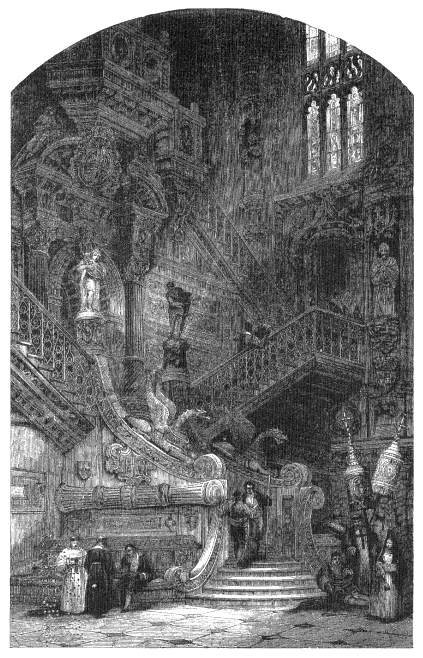
Fig. 1.
"Grand Staircase of Burgos Cathedral."
Illustrated Magazine of Art, 1853
lambent features of marble disrupts customary viewing relations, inviting him into a privatized and novel aesthetic in which artificiality testifies to authenticity, morbidity to feminine beauty. Whether encoded in famous travel novels like Nathaniel Hawthorne's Marble Faun (1860), George Hillard's best-selling My Six Months in Italy (1850), or the brief sketches that appeared frequently in the major magazines, travel to Rome challenged Americans to absorb the defamiliarizing power of such images. While many, like Parkman, recorded astonishment at the Italian religious aesthetic, some found their faith disabled or reconfirmed by these often spectacular images.
While repudiating the Roman church's self-proclaimed vision of a single global Christian church, Protestant tourists abroad could not help reading their European Catholic past ambivalently, witnessing Italian culture through the revisionist lens of Protestant history. That perspective divided historical time into the apostolic, the papal, and the reformed eras and further organized the nineteenth century into a lingering Catholic past existing behind or beneath a vital Protestant present that yet remained ambiguously attached to it. As American tourist rhetoric continually implied, such Protestant attachment was preoccupied with issues of psychological and cultural loss, the loss of a mighty, avowedly maternal, Rome whose comforts of the spirit included those of semantic certitude—one born, however, of the image rather than the text.
Antebellum Americans who possessed a spiritual past in Scripture but felt the lack of a sufficient national heritage selectively, if awkwardly, appropriated a cultural ancestry from their tourist experiences in Catholic Europe.[4] This tourist "discovery" was kept in guarded relation to the present back home, available for middle-class tourists and readers but strenuously dissociated from contemporary theological and political domestic issues. In several respects tourist literature resolved the dilemma of a nation hungering for a past yet fearful of the burdens such a past might entail. The American republic could neither originate from a European past, frequently figured as a tainted maternal origin, nor derive from the New World, whose native cultures also threatened to contaminate a fledgling democratic selfhood.[5] Struggling to create an undefiled, self-originating identity, antebellum Protestants maintained at home a tense proximity to both sites of suspect origin. The advocates of democracy—in sermon, history, travel sketch, or novel—poised the country, like Hawthorne's Donatello, midway between "savagery" and
"civilization," somehow meant to grow without growing older, to develop without risk of decay.
But as Hawthorne suggested in The Marble Faun , many affluent American tourists experienced an ardent, even dependent, attraction to this decayed Catholic Europe—a Europe whose offerings to the American ambiguously shifted between the spiritual and the aesthetic and in so doing called into question the reality of any strict division between the two regions and, more disturbingly, between the two religions. While American travels to Europe in the nineteenth century were shaped by the eighteenth-century tradition of the Grand Tour, American travelers themselves showed an additional and marked religious preoccupation that lent a sectarian edge to conventional pursuits of the picturesque and the sublime. In numerous travel sketches, the tourist experience of moving through and looking on Catholic Europe emerges as a valuable aesthetic acquisition that can offset the losses resulting variously from the disruptive forces of disestablishment, immigration, and urbanization back home. "I would be free even to declare, that, in the light which played between those lips and lids," an American clergyman wrote of the Dresden Madonna, "was Christianity itself,—Christianity in miniature for the smallness of the space I might incline to express it, but that I should query in what larger presentment I had ever beheld Christianity so great."[6] It was a delicate task, however, to remain distant from Romanism and close to Rome's splendors—a balance necessary to the spiritual and aesthetic enterprise of national identity formation. Beneath the triumph proclaimed by Protestant ideology lay an uneasiness that threatened not the defeat but the embrace of the enemy—an embrace that led not so much to religious conversion as to an aesthetic and emotional appropriation of the enemy's powers. If Harriet Beecher Stowe's Puritan heroine, Mary, of The Minister's Wooing (1859) is too modestly circumstanced to tour abroad, the ocean waves themselves bring her a da Vinci "Madonna" to hang on her bedroom wall, "a picture which to Mary had a mysterious interest, from the fact of its having been cast on shore after a furious storm, and found like a waif lying in the seaweed."[7] Mary's discovery on the Newport beach is meant to be extraordinary, the logic of realism discreetly ruffled by the contravening interests of evangelical sentiment to demonstrate the heroine's transcendent status. Mary's serendipitous art acquisition keeps her safe from the contamination of travel, the dross of contemporary Italy through which American tourists looked to the ideal region behind. Although one's first impressions of Italy would undoubtedly be mundane and ugly, let the traveler "bide his time," counseled the most popular travel writer of the
1850s. "The Rome of the mind is not built in a day . . . the unsightly and commonplace appendages will disappear, and only the beautiful and the tragic will remain."[8]
Italian travels inevitably reminded American Protestants of their Reformation roots, the poverty of the Italian populace and the opulence of the Vatican returning them imaginatively to the heroic age of Lutheran and Calvinist reform. If class divisions back home were becoming uncomfortably apparent with industrialization and immigration, that domestic menace receded before Italy's extremes of deprivation and wealth. "They draw life," wrote Parkman of priests he observed in Messina, "and sustenance from these dregs of humanity—just as tall pig-weed flourishes on a dunghill."[9] Italian travel presented New England tourists, in particular, with a heroic Catholic past that not only diminished the disturbing impressions of the Catholic present but also embellished the dreary realities of the Protestant present. If Americans generally expressed confidence in their national future, they had no such simple emotions toward their present or past. Like English and European neomedievalists who invented a past of benevolent authoritarianism and organic communitarian values to compensate for the gross disruptions of the Industrial Revolution, some Americans found in Europe the pleasures of a recovered Catholic medievalism, especially as imaginatively projected by Walter Scott, Thomas Carlyle, and William Cobbett. But a culturally pervasive romancing of the Middle Ages did not characterize American culture until after the Civil War, at which point medievalism served as one rallying cry against the manifold psychic deprivations of modernization.[10] For the vast majority of antebellum tourists to Italy theology and aesthetics were crucial, not, as in neomedievalism, psychology and aesthetics.
Tourism to famed sites of European Catholic art relinked what ideology and geographical distance had severed; having returned from Italy and the Holy Land, Melville, in the formulaic tones of the lyceum, expressed what was quickly becoming a conventionalized sense of re-connection to the Old World: "On entering Rome itself, the visitor is greeted by thousands of statues, who, as representatives of the mighty past, hold out their hands to the present, and make the connecting link of centuries."[11] The Protestant Word and the words of accusation and self-defense it generated were surprisingly vulnerable to this "connection" experienced by American tourists in Rome. Archbishop Spalding in his History of the Protestant Reformation (1860) somewhat uncharitably decided that his Protestant historian colleagues were necessarily baffled by history because they had abjured Christ's promise to protect
his Church, a promise that was the "thread of Ariadne, which would have conducted them with security from the tortuous windings of the labyrinth of history, in which they appear to have been lost."[12] Protestant historians largely denied such confusion, but Protestant tourists frankly expressed their amazement and religious disequilibrium in the labyrinthine Italian streets and catacombs. Reconnection with a repudiated past and the disorientation of foreign travel coalesced to produce a sense of uncanniness for American visitors to Rome. The first recorded use of the term sight-seeing , in 1847, indicated the spread of a new, touristic, form of seeing but one that was still not carefully distinguished from sacramental vision, the looking on the raised Host. Antebellum sightseers in Rome struggled constantly to convert sacred sights (and sites) into touristic ones while yet pondering with genuine theological intensity not only what they saw but also whether (and how) they believed in what they saw.[13]
While journals back home declared their confidence in the Protestant principle of "private judgment," American tourists and artists abroad wandered psychologically between the conflicting worlds of two faiths. The North American Review assured its readers that "it is wonderful to see how one of those principles of the gospel, when received in the living letter, illuminates every region of the soul, and casts light so broad and far on the way of life, that no one can wander, if the heart is only true." But it was no easy task to maintain a true heart once outside a society rife with evangelical certainty about the "living letter." The reassuring "spirit of preciseness" that even Unitarians claimed for the Bible, in contrast to the antiscriptural mysteries of the Catholic church, began to blur before Rome's imprecise but powerful collections of images.[14] As a context that undermined Protestant Scripture, the Eternal City burdened visitors with its novel, elusive, or simply excessive meanings. So condensed were Rome's significations that they reminded Hawthorne of the epistolary cross-writing popular in the pre-Civil War era in which letter writers—to save paper, to preserve privacy, to create a disguised intimacy of two—superimposed vertical onto horizontal script. Displayed before Hawthorne's weary and intimidated gaze, Rome appeared like the "broadest page of history, crowded so full with memorable events that one obliterates another; as if Time had crossed and re-crossed his own records till they grew illegible."[15]
Confusion before this Roman world was aggravated by two rival Protestant versions of the past: those encountered in written histories and religious polemics and those personally encountered in travel. This division of American time into a moribund Catholic past (encountered in
travel) and a dynamic history (connoting beneficent change and denying the sad workings of time and human evil) was reinforced by the habitual splitting of the Western world into Old and New.[16] According to Nicholas Murray, all one had to do was look at the "moral map of the world" to see the division.[17] What many anti-Catholic Americans saw was a globe divided between New World industry and Old World indolence, the "one portion of the earth's surface reminding us of the powerful, ever-advancing Gulf-Stream,—the other of the weedy, motionless Sargasso Sea."[18] Such a moralized geography dictated that history—as the study of change—was a Protestant possession; the stagnant terrain of the past belonged to Catholics. The New Testament, Protestant history, and America's Manifest Destiny moved jointly forward; Catholicism, divorced from time and Scripture, stood still.[19]
Supposedly left to eternal stagnation, Roman Catholicism emerged as vitally, even shockingly, alive to antebellum tourists. Cast as ritual antagonist rather than historical force, the Roman church had long enjoyed a certain borrowed power from the sheer force of Protestant invective. And having declared that Romanism was dead, Protestant tourists in particular found themselves not so much rid of popery as faced with palpable images of an elaborate morbidity, an excess largely constituted by their own religious preoccupation with self-regulation and the cultivation of the perfectionist powers of voice and text over the recalcitrance of the body. Disease, death, and decomposition were frequently identified with a faith continually pathologized as dead. "The taste of Roman Catholics for the morbidly horrible in death's doings is strangely general," declared Harper's New Monthly Magazine in 1854.[20] As increasing numbers of Americans descended on Italy, this same opinion became strangely general among them. The Catholic past and present, graphically displayed in bone reliquaries and sarcophagi, loomed as an uncanny challenge to Protestantism's anticorporeal aspirations and increasing efforts to sentimentalize death as an antiseptic transition into resurrection.
In one of her typically exasperated dialogues with the Presbyterian Oswald, the Catholic heroine of Mme de Staël's best-selling novel Corinne; or, Italy (1804) insists that Rome is "not simply an assemblage of dwellings, it is the history of the world."[21] While tourists throughout the nineteenth century responded to this melancholy universality of Roman ruin, American visitors were notably occupied with the physically morbid aspects of the Eternal City. At home Walt Whitman saluted the past as a "corpse . . . slowly borne from the eating and sleeping rooms of the house," a corpse that seemed to end up in Rome where Americans
visited it with troubled curiosity.[22] Travelers repeatedly singled out from the plethora of visual novelties the presence of the Italian dead, buried in catacombs, lying on biers, their bones seemingly displayed everywhere for veneration or, worse yet, decoration. At its most literal and grotesque, this "past" exposed itself with an indecent, even erotic, energy before American viewers. The dreamy nostalgia perfected by Washington Irving as he wandered discreetly through Westminster Abbey's "wilderness of tombs" was frankly inadequate in Rome, where graveyard romanticism often gave way to hysteria at this bone-filled world.[23]
Catholic churches appeared stuffed with death, "full of bones and skulls, and coffins," repositories of biological decay that seemingly ignored any hygienic or moral etiquette.[24] Or rather, that etiquette was a foreign and vulgar one that violated American Protestant notions of propriety and aesthetic organization. Young Parkman, himself in revolt against conservative Unitarian proprieties, uncomfortably noted in his Italian journal that the dead virgins of the Capuchin convent catacombs "all wear crowns of silver paper, from beneath which they grin and gape in a most alluring fashion."[25] Traveling to recover the health he had professedly lost through excessive physical exercise, Parkman confronted the crowned female skeletons with a sexual unease apparent in many tourist accounts. That these females were virgins only exacerbated the anxiety; their vows of celibacy, their rejection of sexual experience, irritated Parkman's developing preoccupation with virility even as their display of asceticism intrigued him. Parkman was hardly eccentric in his dismissive but carefully detailed reports of "alluring" Catholic skeletons. Having proclaimed their freedom from Old World bonds, tourists often felt compelled to reenter a specialized experience of deathly enclosure once overseas—a surrender not only of the eye but of the body as it roamed through a variety of novel, and at times conspicuously morbid, architectural interiors. Accounts of being captivated by the Italian experience include familiar emotions proper to the sublime and the picturesque; but conventional enchantment could easily resolve into disgust or even panic before relics or skeletons. Such temporary experiences of aesthetic discomfort were in turn conventionalized as a false "literary" captivity that frankly imitated the titillating details of the Gothic. And like Gothic narratives, American tourist accounts wavered between simulated and authentic terror.
In particular, the descent into Rome's catacombs elicited fears of incarceration, even live entombment. Descending from the New World to Rome's literal underworld, American explorers of Roman catacombs experienced a psychological captivity that strikingly contrasted with the
vastness and perceived emptiness of their still largely rural landscapes back home[26] If the symbolic terrain of American Protestantism figured itself as clean, empty, and magically capable of change without decay, that of Catholicism was clogged with the filth of bodies. Emptied of Catholic artifacts, New England and Virginia churches presented studiously cleansed interiors to subordinate the distractable eye to the aural experience of the Word. Such interior emptiness, architecturally speaking, facilitated the Protestant's unmediated relation to the Holy Spirit; but the ideological affection for emptiness also influenced the perception of the American landscape as empty of inhabitants and hence available for settlement. John O'Sullivan's seminal 1845 essay in the Democratic Review explained that America's "Manifest Destiny" was to construct a national interior from an "empty" wilderness. When American Whigs and Democrats stood in the catacombs and dusted the powder of bones from their hands, they hesitantly acknowledged an altogether different destiny that tied them to earth and bones, holding them captive to neither Jehovah nor American Indians but to biology. In the Roman catacombs such tourists experienced a confused merging of the literal and the metaphoric, of corpses and the past. That combination produced a pleasing metaphysical shiver, a carefully measured dose of romantic melancholy that, once conveyed in nationally printed travel essays back home, offered a safe alternative to the fiction of elite writers like Hawthorne and Melville, whose visions of America's past and future recorded the more subversive anxiety that led Melville to declare of the Galapagos Islands that it "is but fit that like those old monastic institutions of Europe, whose inmates go not out of their own walls to be inurned, but are entombed there where they die; the Encantadas too should bury their own dead, even as the great general monastery of earth does hers."[27]
Roman monastic practices of burying the dead beneath the living horrified yet pleased American visitors. If back home they prided themselves on orderly cemeteries discreetly positioned in churchyards or, increasingly, in separate areas on town perimeters, they consciously sought out the horror of European burial pits; visiting the famous Naples cemetery, the "traveller invariably gave the guard a small tip to lift one of the stone slabs so that he could look within, and he invariably reported the most horrible sight of decaying forms that he had ever seen."[28] Such burial pits luridly challenged the theological optimism of liberal American Protestantism, which increasingly figured heaven as an extension of the middle-class home and promised to close the distance between God and person originally insisted on by Calvin, who argued that in heaven "our glory will not be as perfect as to allow our vision to comprehend
the Lord completely . . . there will be a wide distance between Him and ourselves." Properly organized cemeteries in the antebellum decades now ideally functioned as "nurseries of piety for an everlasting home"; one sat or walked through a collection of the dead, each safely, separately, encased and textualized beneath commemorative stones. The developing suburban American cemetery extended the design principles of sentimental, genteel domesticity that stressed purification, ventilation, and the studied arrangement of household furnishings to inspire pious character development.[29] Increasingly distanced from the dead at home by these habits of sentimental commemoration (memorably satirized by Mark Twain in his portrait of Emmeline Grangerford in Adventures of Huckleberry Finn ), the American tourist's proximity to corpses in Rome enabled the recovery of an illicit but finally safe authenticity. The dead, after all, were not their own and were not from their class, religion, or ethnic group. Italian burial pits presented grisly subterranean interiors that starkly contrasted to cemetery parks; the pits substituted the pleasures of visceral astonishment for those of contemplation, the threat of engulfment for the "upward" pull of sorrow. Liberal, genteel Protestants who meditated in graveyards back home found that in Italy funerary text was boldly displaced by shocking image, the meditative tempo of reading by the instantaneousness of bodily spectacle.[30]
Rome's distinctive geography, then, confirmed Protestant convictions of Catholic morbidity, whose crowdedness pressed upon the tourist with an eerie but consoling pressure. The American George Greene, who begged permission to accompany a Jesuit archaeologist on his inspection of the catacombs, afterward wrote that he "never walked the streets of Rome again without feeling that with every footfall I was awakening an echo in the caverns of death."[31] Rome's deathly underground competed against its romantic ruins for tourist attention; the ruins above ground provided access to the favored experience of European romanticism, involving a textually scripted imitation of an anterior European self, either fictional (Corinne) or historical (the historian Gibbon sitting in the Coliseum). Such identification with English or European characters' experience of the Italian sublime was undermined by the vernacular Roman sights of catacomb and burial pit that pulled the tourist down from the sublime to the "lower" sensual Gothic world, where terror was born of titillation and disgust. Rome's juxtaposition of sublime art (and ruins) to contagious "malarial" soil legitimated the vulgar desire to detect the rottenness at the heart of the sublime or, in the inflammatory misogynist rhetoric of anti-Catholicism, to expose the Whore of Babylon at the heart of Mother Church.
This change in "genre" registered by tourists' descent from the sublime into Rome's contagious soil also figured as a partial loss of control, specifically the control enjoyed by the traveler gazing discreetly on the foreign. The fascination with walking atop the pagan and Catholic dead derived in part from being able to establish both contact with them and dominion over them. Indeed tourist accounts of descending into the catacombs nervously monitor the level of aesthetic and psychological intimacy by trivializing or frankly mocking the terrors of the site. A catacomb anecdote related by Greene points to this careful positioning of the American Protestant tourist before the Catholic dead. An interpolated vignette recounts how an eighteenth-century artist lost his way in the catacombs, having let go of his guiding thread. Minutes of panicked searching for the lost thread produced only a sickening realization of loss and impending death in the clammy, dark labyrinth. But just as he began to faint in panic, his hand fell on the thread and, grabbing hold, the artist made his way back to daylight, experiencing a hysterical glee. This artist of a century back offers a fantasy of resurrection for the antebellum narrator and his readers, the tourist who shares this tale providing the Gothic pleasure of both incarceration and euphoric exit. As these doubled eighteenth- and nineteenth-century narratives of escape suggest, fleeing the catacombs and the surrounding morbidities of papal Italy was fraught with difficulties that pointed less to Roman wickedness than to the imperatives of their Protestant manufacture.
Like the anecdote of the lost thread, other magazine accounts of escape from Italian interiors sound a similarly contrived, hastily evasive note: if the psychic challenges of international encounter imbued with ethnic and religious prejudice were confronted by tourists in Rome's underground, they were scarcely resolved. Rediscovery of the lost thread abruptly, if unconvincingly, enables an otherwise unseemly flight. In a long essay entitled "A Reminiscence of Rome," an American tourist recounts his descent, with a companion, into monastic burial vaults. Initially the two men seek to disguise the discomfort born of intense religious ambivalence by cataloguing the anatomical features of their macabre surroundings. Minimizing the mystery of the monastery vault interior by satire, the narrator crumples the supernatural significance of the skeletal displays beneath the biological, reducing Catholicism to the gruesome absurdity of the dismembered human body—a strategy that assuages doctrinal hostility by heightening a generalized religious anxiety. "The acanthus-shaped sacrum and os coccygis formed a rich cornice for the walls and arches, while ribs, fingers, toes and disconnected vertebrae served for the mouldings of the curiously wrought panel-work of
the ceilings."[32] The foreign religion and the intimacy of the body's promise to decompose are jointly repulsive. Like Ishmael's ponderings on the enormousness of the whale skeleton in Melville's Moby-Dick , the bony interior of this narrative prompts uneasy, finally frenzied reflections on the relation of the bony bodily "inside" to the invisible cultural "outside"—a relation imagined as a Catholic interior detected and pathologized by Protestant observers. Amid the skeletal decor, the visitors regress, not to originary, childlike selves, but rather toward a desiccated masculinity as they try to sketch and eventually dance with one of the skeletons, their monastic skeletal partner pointing to their own future decomposition and the exposure of their bony interiors. Released from the individual bodily boundaries they enjoyed in life, the various skeleton parts of deceased monks display a queasy democracy where hierarchy is replaced by what the two tourists report to be a promiscuous mingling of the "bodies," which submit to such jumblings to meet the vulgar demands of a grisly Catholic aesthetic. When the tourist pair seek to master this interior decor by asking permission to sketch it, they unwittingly forfeit their fragile superiority, for the attempt to draw the lurid enclosure precipitates nervous collapse. Left alone in his "voluntary entombment" while his companion goes to retrieve his sketching equipment, the solitary amateur artist, "locked in with silence and death," becomes hysterical. While he sings and dances with the skeletons, his horrified companion listens outside, certain the hellish fiends are carrying off his friend. But once back inside the walls, he finds to his bewilderment that his hysterical friend has been, in his word, the "aggressor" (745).
That these masculine visitors should not only disturb but frankly assault the dead imitates the syncopated tempo of aggression and haphazard self-control that typifies female Gothic narrative. As Harriet Beecher Stowe revises Gothic conventions of female vulnerability in Uncle Tom's Cabin , positioning the fugitive slave Cassy as a living ghost who haunts Legree, so "A Reminiscence of Rome" recounts a hostile American haunting of the tyrannous Italian dead. In so doing, this particular essay offers a rare glimpse into the violence of the American tourist-interloper, whose dance with the skeletons desecrates the foreign interior. The tourist's frenzy emanates not just from hostility to death but, more particularly, from the materiality and plurality of these monastic bodies whose various parts he forcibly removes from their sacred design to the secular (but hardly less troubling) intimacies of the dance. The American tourist's "minuet" with the Italian skeleton is a memorable instance of a foreign bodily contact that forbids genuine communication. Appearing in the genteel pages of Harper's New Monthly
Magazine , "A Reminiscence of Rome" even finally evades the very audience courted by its Gothic excitement; frankly refusing further dialogue with his readers, the narrator concludes that the events gave him "an insight into the mysteries of psychology; but upon this subject I do not wish to be confidential with everyone" (745). Thus does the narrative encase its own hostility to the materiality of the Catholic body—both its fragility and the obtrusiveness of its lingering presence. In a replication of this cultural distancing, the narrator thwarts his readers, refusing confessional disclosure to preserve the enclosure, the psychological privacies, of his Protestant subjectivity.
The narrative's retreat into secrecy is a coy maneuver that reduces the possibility of any ecumenical or interethnic communication to the insignificance of flirtation. Neither the Roman dead nor the author's "mysteries" overcome these tourists (or implicitly their readers); indeed, enough of their sketches survive to illustrate the essay quite elaborately and, in so doing, guide its reception (Fig. 2). Surrounded by engravings of skeletons, the magazine text replicates the vault experience of bony encirclement, its prose closed in upon by the grinning monks. Such typographic claustrophobia further invites the reader into the American touristic experience while simultaneously reducing it to the manageable level of the decorative. In this latter sense, the article's illustrations perform an evasion similar to that of the narrative voice that refuses further disclosures under the presumed necessity for privacy. The article's graphic presentation thus registers the successful assertion of American identity against the foreign, for, having regained control of themselves in the burial vault to the extent that they can sketch what has made them hysterical, the tourists further advertise their management of the Catholic menace by the commercial display of their encounter.
Both celebratory accounts of the catacombs and the accounts of other American tourists who attempted to claim rather than repudiate this Catholicized terrain of the dead contrast to such derisive portraits of unseemly Catholic intimacy. Instead of relegating the foreign religion to a prehistory of bone-ridden archives, some visitors tried to insert parts of Catholicism into Protestant time—tried, in other words, to convert elements of Italy's troubling, morbid "past" into America's mainstream "history." A principal site for this reappropriation was the catacombs. Turning from the artificial ruins fashionable in the late eighteenth century, nineteenth-century American visitors exploited Rome's ruins for
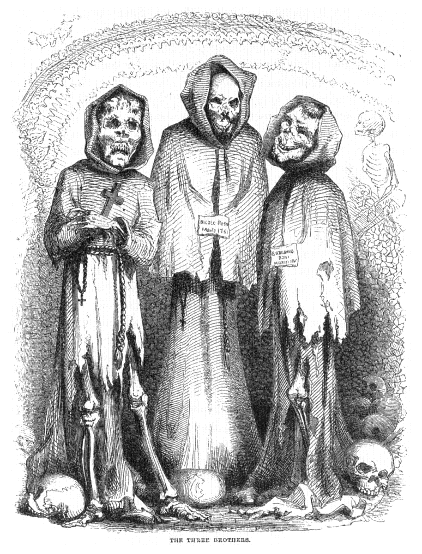
Fig. 2.
"The hideous mummies leered at me from beneath their moth-eaten
cowls; their eyeless sockets seemed to gleam with fiendish intelligence,
and their idiotic grinning put on a devilish motive and character." "The
Three Brothers," from "A Reminiscence of Rome,"
Harper's New Monthly Magazine, 1857.
ammunition in their contemporary religious disputes.[33] According to this revisionism, the skeletal remains and decorated sarcophagi of the catacombs were not instances of a vulgar Catholic morbidity but rather a "rebuke to the Papal Rome above"—the indisputable evidence of a primitive Christianity ennobled by persecution and free from contaminating relations to the state.[34] The very earthiness of such newly opened archaeological sites reassured the more skeptically inclined, who, having denied the papacy's supernatural sanctions, were casting about for alternative authorities and empirical guidelines to support their "private judgment." Americans easily extended the Reformation rhetoric of "restorationism" (the attribution of Protestantism to the early days of the Church) to include the silent catacombs recently discovered beneath Rome. Viewed from this perspective, the dead harbored in the catacombs were seen as free from the objectionable exhibitionism of monastery burial vaults; they became virtual Protestants for some American tourists and thus their spiritual parents, ancestors who exerted a magnetic authority over a modern progeny who were confessedly suffering the discomforts of theological uncertainty and a consequent fascination with violent (and violated) religious conviction. Such an "American" Roman past supported domestic Protestant polemics against American Catholic claims of the church's unbroken allegiance to the apostolic era. The catacombs that provided this much-needed Protestant antiquity with a vision of an extensive and pure history that could compete with the vast but contaminated past of Rome did so, importantly, without threatening to mingle with the American present; as "ruins" they were not only overseas but also underground. Doubly distant, they enjoyed tremendous appeal.
Such appreciation for early Christian martyrs, then, effectively converted a portion of the Catholic "past" into mainstream American Protestant "history," enabling American tourists to subversively imagine their national origin in the Roman catacombs. Rome's past became America's future in the dual sense that catacomb martyrs pointed to the English Puritan exodus to America while themselves epitomizing an ideal Protestantism for antebellum American emulation. In preserving America's ancestors, the catacombs pointed to a redeemed future for an ailing Protestantism; containing the "exhibition and the promise of a purer Christianity," they served as both origin and destination for the providential vision of New World onlookers.[35] From the liberal New England perspective, the catacombs, as underground church, belied the contemporary pagan Christianity above. Indeed, the persecuted catacomb dead collapsed classical and papal Rome aboveground into a single text of
dangerous, if dazzling, corruption. Discussing Charles Maitland's Church in the Catacombs (London, 1846) and the anonymous Rome, Pagan and Papal by an English Resident (London, 1846), one Unitarian underscored the religious obligation of American tourists to detect this underground truth. While "old Pagan Rome seems to have risen from her ashes and still to live in the prevailing rites and usages of the 'eternal city,' " a Protestant past lies encapsuled beneath, waiting to be deciphered by tourists of sufficient spiritual insight.[36] To look on the skeletons of these early Christians offered a vicarious experience of grace; N. P. Willis, writing of the "humble traces of the personal followers of Christ" in the catacombs of St. Sebastian, suggested the excitement of this return to apostolic times. "We saw the skeleton as it had fallen from the flesh in decay, untouched, perhaps, since the time of Christ."[37]
New World tourists in Rome positioned this recovered Old World ancestry in the horizontal (if intermittent) sequence of earthly history, rather than in a vertical, thoroughly mediated, Catholic continuum from earth to heaven. The catacombs were proof positive, serving as archives from which tourist-explorers, as New World Protestants, reconfirmed their temporal history of persecution, martyrdom, flight, and perseverance. The historical continuity produced by these tourist experiences of Protestant ancestral bonding was distinct from the traditional Roman Catholic vision of a cosmos in which the sainted dead lived on in anxious heavenly supervision of the earth's struggling souls. For American Catholics, the dead lived eternally, not historically. Affirming the link between the earthly and heavenly cities (and implicitly disputing the Protestant focus on Rome's supposed morbidity), the American Catholic journal the Metropolitan declared: "Nowhere in this world, we believe, is there a more living, real, exultant life than in old Rome; and who are more living than those whom we call the dead?"[38] Challenging the American tourist's preoccupation with Catholic Rome's political and erotic deathliness, with an antiquated institutional papacy atop and mingled monastic bodies beneath, American Catholics appealed to New Testament promises of life-in-death to defend Rome, whose ruins and skeletons were precisely the evidence for eternal vitality.
Like C. Auguste Dupin of Edgar Allan Poe's detective narratives, Protestant tourists searched the catacombs for clues to their religious identity by constructing narratives of ecclesiastical crime from a disorderly collection of mute details. The accounts they fashioned conscientiously opposed the distrusted conventions and imagery of Italian Catholic art. Trying to imagine the early saints afresh, one such amateur historian-detective revealingly wrote that it is "from the catacombs that
we must seek all that is left to enable us to construct the image that we desire."[39] As the Vatican had allegedly conspired to suppress the Bible, so these detective-tourists unburied it, citing their discoveries as further contributions to American biblicism. Although they assured readers of their "faithful and honest exploration" (33), what they discovered rather naturally confirmed their reading of church history. Denizens of the catacombs turned out to be model believers whose faith had little need of institutional support.
In those first days there was little thought of relics to be carried away,—little thought of material suggestions to the dull imagination, and pricks to the failing memory. The eternal truths of their religion were too real to them; their faith was too sincere; their belief in the actual union of heaven and earth, and of the presence of God with them in the world, too absolute to allow them to feel the need of that lower order of incitements which are the resort of superstition, ignorance and conventionalism in religion. (519)
The early Christians emerge in this idealized portrait as ancestors to their modern day Protestant celebrants; together they disdain Rome's "superstition, ignorance and conventionalism." But they also emerge as rivals to their visiting modern Protestant progeny, for it was not only Catholics who needed the material dimension but also Protestants, who were carrying away relics and for whom the "eternal truths" were decreasingly persuasive.
Shaped by such a nostalgic and self-deprecating revision, the dark, twisting catacombs ironically emerged as symbol for devotional clarity and straightforwardness. Their labyrinthine interiors opposed the obfuscations of the papacy, the quandaries of liberal Protestantism hoping to illuminate what church tyranny had disguised and what modern subjectivity could not find. Representing an era when the "mystery of the mass and the puzzles of transubstantiation had not yet been introduced among the believers" (521), the early martyrs sanctioned a bumptious "scientific" hubris on the part of these Americans; archaeological efforts to bring corpses to light and to reconstruct the history they mutely evoked imitated God in his acts of revelation. Thus the "Cuvier-like" archaeologist De Rossi was credited for discovering the remains of St. Cecilia by an "inductive process of archaeological reasoning" (683)just as the "Lord discovereth deep things out of darkness, and bringeth out to light the shadow of death" (685). In a final irony, such an appropriation of divine power for the developing science of archaeology sig-
naled the secularization of the catacombs, a process that rapidly converted them from sacred mausoleum to museum and tourist attraction. As underground Rome was recovered and organized, its mortality, initially so overwhelming to American visitors, was gradually transformed by the light of science into purified historical evidence against papal fictions. What remained above ground represented for many of these tourists the true city of the dead, a degenerate conglomeration of pagans and popes whose tombs possessed little of the redemptive, revelatory power of the catacomb dwellers.
Thus, in Protestantizing Christian antiquity, American tourists obtained partial control over a Catholic past whose dead (along with the funerary art and architecture devoted to their memory) initially overwhelmed them. Disputing the Catholic dogma of Apostolic Succession, one antebellum nativist insisted that the Holy Spirit had escaped the corruptions of a priest-ridden civilization in full accord with the Book of Revelation. "They say it is the first form of Christianity. That is a mistake. It is the second . The first appeared for a while, then 'fled into the wilderness, where she had a place prepared of God,' and re-appeared at the Reformation."[40] For many antebellum tourists, the catacombs had become that wilderness refuge.