
Chapter Seven—
Mapping a Paradigm's Demise:
The View from a Symbolic Reward System
Established professions, academic disciplines, and other organized forms of cultural production periodically bestow honors and distinctions upon some of their members. These annual events represent more than just rituals that call the attention of specialist audiences and the interested public to the names of distinguished individuals. They are exercises of autonomous authority, by which the symbolic gatekeepers of each specialized field try to preempt the judgment of outsiders with their own.
Even in the most insulated fields, producers of culture seldom hold the ultimate "purse strings." Symbolic rewards are therefore easier for them to control than material ones. If, as is often assumed, lack of control over material resources compromises creative freedom, symbolic rewards administered by creators themselves should, in contrast, encourage innovation. However, symbolic gatekeepers have their own personal standing and ideological positions to defend.
How the elites of a field deal with innovation may test their objectivity, but the autonomy of symbolic rewards systems resides elsewhere. Organized producers of culture affirm the superiority of their judgments by striving to establish a "feedback link" between that which they do control and that which they do not. The symbolic rewards that elites grant to their colleagues are intended to impress the elites' judgments on relevant outsiders and to make the acquisition of material rewards more likely. In turn, achievements that bring fortune and public fame are reinterpreted in terms of a field's specialized discourse so as to bring more symbolic recognition.
Both strands in this feedback link reinforce the elite position of the symbolic gatekeepers.
If the qualities that experts choose to reward appear indifferent or undesirable to the outsiders who hold the purse strings, the feedback link obviously fails, and failure is endemic in architecture because the profession's attachment to aesthetic values is often at odds with what clients want most—service and commodity. The symbolic rewards that the profession autonomously grants to itself matter only to special kinds of clients. Thom Mayne of Morphosis, a much-awarded Los Angeles firm, thinks that the clients who plan to use the building themselves are the only ones who care. "With the somewhat shaky clients who are not all that secure . . . they have already spent much too much time and too much money, all this investment on a young architect that nobody knows. . . . You bring them the AIA award, the chapter, the national, PA , all the awards, and they feel they have made the right choice and they might make it again." From the point of view of business, awards and recognition by user groups (such as hospitals or school boards) or specialized user-oriented publications (for instance, Health Facilities Management ) are just as important. In fact, they are more likely to bring new commissions.
Yet, for the design elite constituted by official recognition, the profession's own symbolic rewards are obviously important, and they are also important to any architect who aspires to participate in the making of architectural discourse.[1] Both elites and followers share the feeling that no one understands architecture, or no one cares. The symbolic rewards administered by the profession thereby acquire the aspect of consolation prizes: Like other specialists engaged in esoteric pursuits, architects distribute them to one another to reaffirm the importance of what they do.
Regardless of how outsiders view them, symbolic rewards express the internal dynamics of specialized fields. In a process in which specialists address other specialists, honors and awards embody the models and standards that the field's elites (legitimizing their judgment by their position) want to encourage or uphold. But as standards change, so do the honors and awards that are administered. The evolution of symbolic rewards reflects what constitutes good work, legitimate innovation, and acceptable challenges to cultural authority in the eyes of the symbolic gatekeepers.
Thus, professional awards are both an official badge of approval and a significant indicator of change in a profession's discourse. But we must not forget that awards—like the slick architectural magazines that publish them and other noted buildings—mystify both the collaborative aspects of architectural work and its harshly competitive reality.[2] Design awards help to
perpetuate not only the profession's attachment to its artistic identity but also the charismatic ideology of single authorship.
This chapter and the next examine a system of adjudication for symbolic rewards in American architecture over the years 1966–85. In a period that saw the rise and the normalization of postmodern revisionism, the judges' responses to the work of their peers represented deliberate attempts to influence the evolution of architectural discourse. These responses are the data on which I base my interpretation of the shift in architecture.
The Annual Design Awards of Progressive Architecture
The source of my data is the annual awards program for architectural design of a professional magazine, Progressive Architecture (PA , in the profession's lingo). It is a fertile source for a number of reasons.
First, the program's declared intention is to identify the major trends in design for the year ahead. The January awards issue is an obvious boost for the journal's wide readership.[3] According to the editor, it is "eagerly awaited by the American architectural community. Even the cynics . . . pounce upon a copy to see who among their colleagues was premiated, to comment upon and to criticize the choices, to examine them (or scoff at them) for indication of current trends."[4] Predictably, the editors believe in the program's efficacy, but so do many others in the profession. In 1967, for instance, at the beginning of postmodernism's ascendance, one judge worried in this way about the three design awards (out of nineteen) given to Venturi and Rauch: "This magazine is going to be coming out in January and every kid is going to be turning the pages and saying, 'Wow! this is it this year!' You'll see half-moons swinging all over the place!"[5]
Second, the program has become a professional institution in its own right. In the thirty-five years since it started, 224 renowned judges "have reviewed some 26,000 submissions and chosen 849 for recognition."[6] In 1980, the medal of the American Institute of Architects recognized PA 's design awards as "the catalyzer of the best talent and work in this country for years, producing a lively contest between—and a valid platform for—both young and older professionals to test their ideas."[7]
Being a judge is an honor that the most famous architects are eager to list on their résumés. Ceasar Pelli, former dean of the Yale School of Architecture and twice a juror in the period under study, sees the design awards as "the only continuing program of architectural criticism . . . done by top level architects of the selected work of their peers."[8]
Every year brings numerous submissions that are easily recognized as those from the most prestigious names in architecture. Rob Quigley, who was a judge in 1987, describes the screening process:
There are 700 projects in front of you [in fact, 790 for that year in Architectural Design alone], and the quality level is incredibly high. In the first ten minutes projects by famous architects go on the floor . . . literally on the floor because you have them all on a big table and you start discarding and you know you are throwing Philip Johnson's and Michael Graves's work on the floor. . . . Of course they all submit; they see a PA award as enormously prestigious; they all want that sanction from the community of architects. Michael Graves submitted seven projects for one award.
Third, the PA awards program illustrates one profession's effort to establish a feedback link between symbolic and material rewards; its goal is "to recognize the most promising architecture before construction, thus supporting forward-looking schemes when they are most vulnerable to compromise."[9] The juries give awards to "paper architecture" (schemes, renderings, plans, and sometimes models with accompanying text). Yet the submissions must be for real clients, even if still in the project stage. The candidates are supposedly close enough to a real commission to have developed fairly complete schemes for their probable client. The program transforms this probability into a symbolic reward, by which it seeks to insure both the commission and the integrity of the design.
Finally, and most important from my point of view, PA is the only journal that accompanies iconographic presentations with excerpts of the judges' debates. Caring not to offend anyone, the sanitized transcripts do not reproduce either the most heated exchanges or the actual dynamics of the jury. Still, they tell us a great deal. The excerpts convey the editorial staff's opinion of what was important in the discussions, which judges dominated the proceedings, and what trends are represented in the awarded projects. PA 's Annual Design Awards Program can therefore be seen as a complex set of messages that professional elites send to their peers and followers with the important mediation of the magazine's editorial staff.
The awards may be pooh-poohed as irrelevant by the designers who do not get them and even by those who get many, like Steven Holl, who says "an award may give you a little push, but it doesn't make a client find the money if he doesn't have it." But Thom Mayne, whose firm first received national attention through PA 's awards, is emphatic in his support:
The first four years . . . we were working out of my own home. Mike [Rotondi, his partner] was working for someone else, I was teaching . . . and the PA awards can be seen as a competition. It is a way of motivating yourself, you know. . . .
Publication is the termination of a project. . . . PA is an incredibly useful program, an opportunity for people who are not gentlemen architects, like we certainly are not, to be there, to establish some sort of presence. . . . For our firm [the awards] did that: they established our presence, period. It's the only way that you get some kind of recognition, that you become known within the profession . (emphasis added)
PA 's editor, John Morris Dixon, who has been making a second career in architect selection committees, invokes the insider's knowledge he has gained to argue that awards influence from within the development of professional careers:
The word of an award seeps through a network. The influence is not direct . . . it wouldn't get you this or that commission; it makes you more likely to appear on a list of possible . . . anything: possible jurors in a competition, possible participants in an invited competition, possible architects for a job. In a committee for architect selection, everyone is asked to write a list of who should be contacted, and then the list is brushed over and boiled down and everyone is asked for qualifications. When [architects] submit qualifications for a job, all those awards are in there. They never leave them out. If they've been on our jury that's never left out either.[10]
Progressive Architecture's Juries
American architectural magazines do not have the authority of some of their European counterparts or the institutional aura of the American Institute of Architects. The juries and the selection process must give legitimacy to the sponsor rather than the other way around. PA , therefore, chooses its judges for their eminence and their representative positions in the field.
In addition, the editorial staff must hold on to the magazine's readership. Balancing the juries is therefore an important concern: If one year's decisions have been controversial, the editors tend to load the next year's jury in the opposite (or in a different) direction. The authority of the jurors is to some extent on the line, and they tend to respond self-consciously to what they perceive as bias in the previous year's awards. This double balancing may impart a pendular movement in style and type to both the awards and the entries. The contestants, knowing the judges' names through the program's announcement in June, often tailor their submissions to what they assume to be the jury's preferences.
Thus, in a time of growing eclecticism, the choices of both PA jurors and editors may tacitly induce a yearly pattern of action and reaction. Yet,
as we shall see, the turning points in the PA awards juries correspond faithfully to turning points in the profession's discourse.
The editors' concerns with readership and with professional legitimacy command the basic composition of the juries, while the magazine's "trendiness" means that the editors will try hard to represent the leading edge of architectural discourse. John Morris Dixon says that the only selection rules are serious reputation and regional balance. Yet a former member of the editorial staff insists that the magazine adopted parameters that are not merely geographic, but stylistic and technical as well: no more than two "avant-garde" designers, as long as they were well known, and always one juror to represent concern with social issues, user needs, or technical solutions. Geographic spread used "to mean a West Coast architect, until the Californians became too 'avant-garde.'" Then balance had to be sought elsewhere, and such questions as "Does anyone know somebody in Arizona?" started popping up at editorial board meetings.[11]
The expert in technology is often an engineer, as if in recognition that few architects are competent to judge complex technological issues on their own. Similarly, it was acknowledged after 1971 that architecture and planning have taken separate paths; a team of two specialists was invited thereafter to judge the entries in urban design and planning. Since 1974, the eight-member jury has consisted of three teams: four judges in the most numerous category of architectural design, two each in urban design and in the new category of "research." After a first day of screening, the jury comes together in the last day to discuss each team's nominees. Architectural design invariably elicits the most disagreement.
The juries' debates provide a direct insight into the making of architectural discourse. The choice of jurors, the jurors' choice of winners, and the editorial staff's choice of comments worth recording give us, over the years, a microcosmic view of the recent history of American architecture, built or unbuilt. Although the entries give substance to the symbolic gatekeepers' reflections and delimit their range of choices, the rejected entries (which would be the architectural historian's choice object of study) are unfortunately not available for analysis. For the sociologist, the juries themselves, in their capacity as symbolic gatekeepers, are the real protagonists of the awards rituals.
Analysis of their debates confirms, first of all, one theoretical assumption: Judgments of architectural quality are inseparable from normative conceptions of the architect's social role and from realistic concerns with practice. From 1966 to 1985, one revisionist tendency emphasized archi-
tectural aesthetics abstracted from program and function. Yet even that exclusive emphasis on the autonomous evolution of form may be construed as a strategic response to the practical circumstances of the profession (see Appendix).
The years 1966–85 may be considered a period when one paradigm was destroyed but no other rose to take its place. My analysis starts in 1966, the year that Robert Venturi published Complexity and Contradiction in Architecture , his call to reject a frozen and reductive modernism. I look at this beginning in the first section. In the second, I explain the importance of the private house in the juries' debates. I use it, in the third, as a tool for mapping the emergence of different revisionist trends.
The Onset of Revisionism
When the awards program started in 1954, the hegemony of the International Style seemed assured. In the early years, the juries "talked a lot about 'good design' and 'work that could be truly called progressive,' but they rarely spelled out exactly what they meant; it was assumed that anyone would know what was meant and that any explanation or justification of the jury's choices would be superfluous."[12] The first PA First Award went to the Back Bay Center in Boston, a multiuse development by an "all star" team that included Walter Gropius's Architects Collaborative, Pietro Belluschi, Carl Koch, and Hugh Stubbins; the project itself was a megalithic expression of urban-renewal modernism. Yet, even then, jurors of impeccable modernist credentials found the ensemble of submissions poor in "gaiety, excitement, fancy."
Three years later, Thomas Creighton, then the editor of PA , noted "an obvious, restless search on the part of many talented people in many parts of the country, for plasticity and an expression which has an emotional, rather than a withdrawn intellectual impact."[13] Among other "new but backward-thinking movements," he detected a trend (which was to dominate the PA contest during the years 1958–63) toward neoclassical forms and symmetrical compositions.
Even through the lens of a symbolic reward system, even "on paper," modernist hegemony seemed fragile. No sooner was it recognized by the incipient program than it began to be challenged by judges who partook in the "restless search" of the late 1950s. The dissatisfaction of the elites betrayed the profession's seeping discontent with its own interpretation of an imported style.
Ten years later, aesthetics were subsumed under a larger challenge. For John Morris Dixon, PA 's editor since 1972, intellectual and political questioning, which aimed at the core of the profession's identity, rushed an always partial stylistic consensus to its demise. "Good or progressive design is no longer the sole criterion for premiation; in fact, in recent years some juries have seriously questioned whether design, as it is traditionally understood, should even be a criterion for judgment. . . . Now the jury questions even the program, and asks whether a building should happen at all."[14]
The 1960s and 1970s were years of ferment for much more than just American architecture. Politics energized American culture; multiform attacks spread outward from many centers against all that was taken for granted. The men and women who came of professional age in those years, especially if their own youth or their ties to the university kept them in contact with the student movement, were not likely to remain untouched. On PA 's juries, the men and, since 1974, the women placed among them in response to the feminist movement, also could not ignore what was happening.
Frank Lloyd Wright had died in 1959 and Le Corbusier in 1965; Mies van der Rohe and Walter Gropius were to die in 1969; despite the important presence of Louis Kahn, there was no successor in sight. In 1966, architecture as a cultural force was without leaders and seemingly without direction. In his editorial for the 1966 PA awards issue, Jan Rowan commented: "Dissatisfaction with much of the work currently being done is increasing each year. . . . Different jurors, with different backgrounds, experiences, attitudes and aims make remarks that are becoming repetitively similar; the only change is the increasing intensity of dissatisfaction." For Rowan, the problem was the frustration of architects subjected to "lack of vision and direction on the part of those whom they serve—individual clients, corporate clients, institutional clients, and society at large."[15] But the 1966 judges diagnosed a different, endogenous disease: "overdesign," the exaggerated display of architectural skill.
Only Charles Bassett, partner in the San Francisco office of Skidmore Owings and Merrill, represented unalloyed International Style aesthetics on the jury. Kevin Roche was the collaborator and successor of Eero Saarinen, known among architects as an early advocate of "a style for each project." Vincent Scully, Yale's charismatic architectural historian, was an early critic of corporate modernism and a supporter of both Louis Kahn's and Venturi's departures from the canon. William Conklin, the designer of the new town of Reston in Virginia, had a strong reputation for sensitivity to context and an early commitment to preservation. Even the jury's engi-
neer, August Komendant, had been for years Louis Kahn's consultant and collaborator.
The reaction against buildings that tried "to knock your eye out" became this jury's consensual criterion, as singled out by Scully: "These winners probably represent on the part of the jury a tendency toward selecting the most modest project , toward urban renewal, toward the working out of a few simple problems. . . . What we're really having here is a movement out of the '50s when monumentality developed."[16] Kevin Roche, an architect not noted for inconspicuous design, complained that every project was "based on an exercise considerably beyond the needs of the problem," and Bassett joined him in deploring the immaturity of the submissions ("You give a guy a box of sand, and by noon he's got a mountain!"). August Komendant, on his side, implied that "art" is to blame for design without principles: "Architects . . . think architecture is art, but it isn't. There must be guiding principles behind it. So many of these designs are too rich, too soft, without principles. . . . How much Lou Kahn there is, but done so badly!"[17]
The judges' condemnation of overdesign conveyed their sense of being at the end of an architectural era. Lamenting the exhaustion of inventiveness that marred the submissions, Scully implied that there had been better sorts of monumentality: "When you look at this group . . . the general effect is not sculptural at all, but is a kind of weakening out . . . of gentling out of a lot of the forms that were around a few years ago. . . . We are representing a kind of disgust with [monumentality's] last and sick phases."[18]
Their preference for modesty, however, did not extend to the designer's role. The charismatic conception of the architect as artist lurks in this unattributed exchange about the Second Award, an alternate urban-renewal scheme designed by Troy West for a Pittsburgh citizen group:
—It has the passion of one man's image.
—A very strong scheme, and therefore gratifying in the abstract sense to the architect. I'm reacting to it as a great building and huge, empty spaces.
—The steps go up, but the building they're going toward goes down, which is really a sensational thing. It's such a great ruin .
—The resultant form has nothing to do with what's going on. It's preconceived from.
—All art is form, and form is the meaning of any work of art. In architecture, all conceptions, all attitudes, all studies in the end are form. . . . You have the embodiment here of a tremendous force, of a terrific and . . . tragic vision of the character of life. It's not a good solution or a bad one. It's a tremendous and moving and stupendous sense of what it is like to be here in the vast city.[19]
The jury's call to abandon heroic aesthetics appears to proceed from a tightening of formal standards, not from a revision of professional identity. To the five different judges on the jury, architecture seemed to have veered so far toward sculptural grandiloquence and surface innovation that they rejected all formal experiments as trite. Still, they bestowed their First and Second awards to grand and ambitious projects: In Cesar Pelli's and Anthony Lumsden's First Award for a new urban nucleus in the Santa Monica mountains ("the first time I have seen a city which is a building, where the whole community is a building," as one judge put it), the governing ideal is still the total control of the built environment, the creation of whole public spaces through the design of single buildings.
To Scully, a veteran of the battles against the destruction of New Haven by urban renewal, the rejection of modernist planning was political. It was practical for Conklin, who had realized an alternative in Reston. The logical response to isolated monuments was the concern for the urban context apparent in Scully's vague exhortations to "design . . . for the way the street ought to be."[20] Five years after Jane Jacobs's epoch-making Death and Life of Great American Cities , this group of designers did not have an alternative sense of urban public space to propose against the comprehensive planning derived from the Modern Movement, other than to respect streets that were still there.
The call for restraint in the design of single buildings appears as a moral as much as an architectural plea. Yet caution and restraint did not count for much in the jury's conception of the architect's authority. From 1966 to 1985, the tension between a utopian (or perhaps even a critical) vision of architects' social role and a realistic assessment of their modest capacity for social intervention underlies the debates of PA juries.
The design entries considered by PA 's judges feature different building types. In discussing them, the juries implicitly assign different values to different kinds of architectural practices. This is nowhere clearer than in their responses to the single-family house, which, throughout this period, is a focus of implicit confrontation between the ideology and the practice of architecture.
The House As Double Metaphor
"There are only four cases where an individual house is not embarrassing," Vincent Scully declared in 1966: "(1) if it is a specially useful prototype of a mass urbanistic development; (2) if it does something really important on a street or a square, to teach us something about urban design; (3) if it
represents a breakthrough in plastic imagination, even if it might not be justifiable in terms of a house; or (4) if it is ironic, and thus expresses the human condition."[21] Scully does not say anything specific about how the single-family house could meet common needs and be beautiful or about technological and economic efficiency. Underlying his criterion of architectural legitimacy, we find, in the following order, references to (1) the classic Deutsche Werkbund concern with Typisierung , the elaboration of standardized prototypes appropriate for mass production;[22] (2) the emergent emphasis on adjusting single interventions to the urban context; and (3) the architect as creative artist, for whom the private house is a field of experimentation or the medium for an existential statement.
Scully's prescriptions for the architecturally valid house avoid the tension between professional service and art characteristic of the architect's idealized identity. He makes no reference to the profession's obligation to serve a client and a site well but gives equal weight to the potential for affecting the environment on a large scale and the creation of formal or symbolic values. He thus transforms the difficult tension between "commodity" and "delight" into the difference between large-scale problem solving and artistic expression, which may come in any scale.
In deeds and words, Scully had expressed his conviction that the foremost duty of architects is to struggle for the humanization of redevelopment plans, if necessary by working directly for the government.[23] The implications are different when architects with corporate clients (architects such as Bassett and Roche) deny the architectural legitimacy of the private house. By dismissing small-scale practice from the domain of "important architecture," they restrict the latter to projects that are no less privately owned yet become "public" by their sheer size.
We shall see next how the recognized and the ignored architectural functions of the house fared in the juries' debates. In brief, Scully's emphasis on Typisierung did not seem utopian in the mid-1960s, despite the intensification of the Vietnam War and the domestic consequences it portended; the Housing Act of 1970, for instance, was still ahead. The waning of government support for public housing and the eclipse of large-scale work during the recession of the 1970s would change the juries' notions of what was possible. But it was not economic realism alone that compelled them to readmit the single-family house, on its own merits, as part of "Architecture." Inside the profession, revisionism mounted a multipronged attack against what the elites identified with modernism considered exemplary.
Architectural critics responded, on the one hand, to urban protest, for which stopping urban redevelopment often was an immediate objective. On the other hand, a major revisionist strain asserted the primacy of design and of meaning, for which any building type could be the vehicle. This was a strain identified with theorists (notably, Peter Eisenman at the Institute for Architecture and Urban Affairs) and young architects with strong ideas and small practices.
To illustrate how the house becomes a sign for all the divisions of architecture, let us skip forward to an exchange among the divided judges of 1977:[24]
Dinkeloo: We have too many houses. If this is architecture, let's forget it.
Hodgetts: The houses have content; at least they have ideas.
Dinkeloo: The individual house has no place in American culture any more.
Hodgetts: Rather than 'no place,' it has a rare place.
Gwathmey: The house has always been a critical reference point in design. It is a complex building. Architects learn by doing them.
Hodgetts: An expensive house can afford to be an important benchmark. They should be as idiosyncratic as possible.
Gwathmey: We are tending to make value judgments about houses that we don't make about other building types.[25]
So why does this particular building type serve as lightning rod for the different values held by divided professional elites?
A preliminary consideration is that the majority of PA 's architectural entries almost always consists of private houses. Because residential commissions represent a good part of the practice of small and beginning firms, the private house is a good symbol of the artisan side of architectural work.[26] In the juries' debates the single-family house becomes a metaphor for each side in the antinomies of professional practice. In this sense, the house is an ideological proxy for the opposition between the rationalization of professional work in large firms and large projects, on the one hand, and the practice of architecture as a craft and perhaps an art, on the other hand. As a symbol for the organization of architectural work, the house metaphorically sums up a chain of implicit oppositions. These extend from the substantive opposition between "corporate" and "artisan" forms of practice to much larger ideological antinomies: art and business, traditional and modern organization of production, fantasy and discipline, frivolity and seriousness. This is not all, however.
Expensive private houses are an obvious symbol of the architect's dependence on wealthy individuals. Taken as metaphor for a subordinate
and trivial professional role, the house governs a different set of ideological oppositions, best summed up by the contrast between house and housing. This set counterposes the socially inconsequential design of single objects to the comprehensive shaping of built environments; individualistic self-expression to collective responsibilities; the private to the public dimension of architecture; architecture as art to architecture as service to society; and luxury to need.
As a metaphor for both actual practice and ideal social role, the house generates two different sets of semantic oppositions. The judges must evaluate program , which embodies the clients' mandate, and design , in which architects manifest their competence and imagination. Their evaluations entangle the two semantic sets. Displacing terms and meanings from one large metaphor to the other, the judges' emphasis moves back and forth from program to design, according, no doubt, to the relative quality of different types of submissions but also to the ideological position the judges defend.
By keeping the building type constant, my focus on the single-family house allows a clearer view of the contending positions in a self-transforming professional discourse. The juries start with a technocratic notion of social responsibility, expressed in a modernist bias toward large-scale work. While they do not critique urban-renewal projects directly (in part because exemplars seldom reach PA 's contest), their critique appears indirectly in the revaluation of the private house. It proceeds from two main sources: One is the priority accorded to design over program, thus overriding the service aspects and the social function of architecture; the other is a concern with preservation, opposed by definition to the wholesale demolition of the existing stock of buildings. In both cases, as one critic notes, architectural discourse tends to confuse "disalienated" objects (buildings that have been saved from the ordinary fate of for-profit construction—ugliness or sterile functionality—by either inventive design or preservation and reuse) with the utopian disalienation of the social relations housed in these buildings.[27]
The Private House As a Barometer of Change
In the first years of the period 1966–85, few juries were interested in private houses. Then, in the 1967 PA awards, postmodernism made a strong appearance in Robert Venturi's "architecture of allusion" and in the presence of Charles Moore, another leader of the movement, among the judges. Musing over Venturi and Rauch's four submissions, the planner
David Crane summed up (with unwarranted optimism) this jury's ecumenicism: "I am interested in the fact that in the next twenty years we are going to build as many cities as we have already built. Someone like Venturi is not interested in that; he is interested in individual, particular, special things. But I agree . . . that architecture really is bigger than either my architecture or Venturi's; it's a more inclusive thing ."[28] The inclusive line thus reconciled the design of single architectural objects with that of whole environments. In 1968, the judges' twelve awards (among which were one house, a church, a chapel, and a high school addition) appeared to continue the same line. And yet, though much had happened between the lines in 1968, the judges contradicted the professional diversity recognized by the awards by their unanimous endorsement of large-scale projects as architecturally superior.
Lawrence Anderson, dean of Architecture and Planning at M.I.T., identified large projects with progress. Since the future of materials development resided in industrialized construction, the individual house was not important to him, "not on the technical end, anyway." For the planner Richard Dober, "a multi-client aspect" explained the higher quality of large-scale work, and SOM's engineer Fazlur Kahn, the brilliant designer of the type of structure that supported the tallest buildings in the world, concurred: "The large projects seem almost always to be more rational . . . . One of the reasons . . . is because large projects involve more people and bring in other disciplines as a total team." The architect Gunnar Birkerts, known for his industrial, corporate, and institutional practice, underlined that the new and challenging problems posed by large-scale projects were "really purifying for our profession." Finally, Romualdo Giurgola, the noted architect and educator who had come from Rome to study with Louis Kahn, began by observing that the issue was not size but meeting "the real needs of today," yet he immediately corrected himself. Because architects could not take large design projects as "a personal exercise," the greater discipline required by these projects made them architecturally superior: "A more genuine architectural language has always been set by projects of a comprehensive nature that have influenced the character of smaller ones."[29]
The 1968 jury had many large institutional projects and two remarkably innovative experiments in low-cost housing from which to choose. Their bias, which can easily be stretched to include corporate modernism, appears not in the nature of the awards but in the slippage in the emphasis of architectural meaning: from socially responsible large projects to the virtues of large scale per se. This slippage associates design discipline with
"multiclient" and "multispecialist" teams, emphasizing both technical innovations that require economies of scale and aesthetics that can be generalized across building sizes. Conversely, the small-scale projects are denounced—in Birkerts' words, for extreme "form-consciousness" that leads to the fashionable monotony of sloped roofs and diagonal lines. "The older guys [meaning more established architects] did not go for it, because they have a chance to play around with the real stuff, and big things too."[30]
The attribution of intrinsic superiority to large-scale work reproduces the notions of architectural significance reflected in the established professional hierarchy and in accepted career patterns. The 1968 judges did insist that the individual house should be a "laboratory for experimentation," but this seems no more than a cliché, belied by the notion that large-scale work (and, indirectly, the program) is the primary generator of innovation. In successive years, as the PA editors begin to include the revisionist representatives of small "idea firms," the inclusion of what might be called "boutique architecture" becomes less of a token gesture.
In 1970, two architects of equivalent though antithetical fame—Robert Venturi and Bruce Graham of SOM-Chicago, the architect of the Hancock and Sears skyscrapers—pick up the issue of the single-family house. Venturi places it neatly on the artisan side of architectural practice:
On one level, this kind of house is insignificant and is not responding to the social crisis. But in a funny kind of way you solve problems by indirect routes, and who can say that the little house for the rich man is not one of them. Architects don't get many research grants as yet and especially for a young man who is lucky enough to have a rich uncle, it's a fine opportunity for experimenting. . . . I think the architect is essentially a craftsman who can do what the society allows him to do . . . . Thank goodness there's an opportunity for the young architect who does not want to go immediately into an organization to do his individualistic thing!
Graham's response mixes and displaces meanings from the two metaphorical sets:
You could use [a house] as an experiment with the technical tools. For instance, if someone has designed an expensive prefabricated house, it would be very relevant. It also gives you the opportunity to create new spaces, a kind of poetry, an experiment with a new way of life. A lot of people resent this since it implies that their present way of living isn't so good. . . . I am not really interested in anyone's love affairs, therefore I'm not interested in a house that becomes too personal—then it's not really for others to discuss. I think it has always been true that great houses have had social impact . . . . Breuer's early houses . . . were all related to one another so that they became a sequential group of art forms, and for this reason . . . they were very important.[31]
Starting with technology (as a good modernist should), Graham moves quickly to embrace its "opposite," architecture as art. Endowing art with the capacity to change life, as did the European modernists, he nods in passing to the criticism of architects who impose their own preferences on the users. Then, in a sarcastic tone, he opposes the personal dimension of a small-scale design and the collective responsibility of architecture. But he refers to the architect's social role only to confuse it, as he equates "social impact" with great art in a specific reference to the Bauhaus architect Marcel Breuer.
This is still an ambiguous and reluctant endorsement of the designer's ability to transcend even inconsequential programs. Art transcends service if it acquires a direct social function. The ambiguity disappears in later juries with the affirmation of the tendency that Richard Pommer has aptly called "architectural supremacism."[32]
"Supremacism" appears in Peter Eisenman's 1975 pronouncement that the architectural potential of the house lies precisely in the fact that its program is well known, conventional, and insignificant: "Most other types of buildings differ from houses precisely because the functions are so explicit; consequently they have no room for any kind of statement about iconography, meaning or intention; the ideas are subsumed in the program."[33] Eisenman's tribute to the house relies on the building's potential as a metaphor for the architect's ideal role but reverses the positive values, from social responsibility and service to self-expression and art. Yet the preeminence of design over program is an ideological position that corresponds to specific conditions of practice. Supremacism is therefore still addressing, even if silently, the antinomies of practice evoked by the first house metaphor.
This was 1975, two years into the worst recession since the end of World War II. The New York Five had just been created by the Museum of Modern Art and the press. Peter Eisenman had been at the helm of New York's Institute for Architecture and Urban Affairs since 1967. His architectural record consisted of unbuilt projects and a few houses, as did that of Michael Graves, Eisenman's former colleague at Princeton and fellow member of the New York Five. Seven years later, during the shorter recession of 1981–83, Graves had won the Portland and Humana competitions and left small-scale work behind. Nevertheless, in the PA jury of 1982 he still traced a mixed connection, romantic and realistic, between design talent, the private house, and the architect's practice.
In that jury, the planner and feminist historian Dolores Hayden complained about the award conferred to Ralph Lerner, a young man on the
Princeton faculty: "This mountain-top palace for a Brazilian tycoon seems to come out of the far distant past, when one thinks about architecture as a service for the very rich and the very remote." Graves rushed to his colleague's defense: "I would be quite delighted to have this architect design a city hall or a children's home or almost any other kind of project involving the public at large because of the incredible sensitivity to . . . [our] size and proportion . . . as we occupy the rooms . . . [and] as we identify collectively."[34] While Graves sees talent as an inalienable asset that the individual transfers from project to project, the hidden reference to the constraints of practice is unmistakable: Young architects demonstrate their talent in whatever way they can. Viewing residential commissions with favor and asserting the primacy of design thus merge in defense of the potential of architects who do small-scale work.
In fact, the ideological "art" element present in both semantic sets is what joins the individualistic, artistic side of the house as metaphor for the architect's social role to the "artisan" side of the house as metaphor for architectural practice. This joining, however, is not only ideological: it involves a realistic assessment of the work available to architects—young and not so young—in hard times. Recessions, we could fairly say, make realism compulsory.
In 1976, one year after Eisenman's proclamation of design, the entries were reduced to an all-time low of 462; nothing seemed to deserve a First Award for architectural design, but four out of ten citations went to private houses. The architect Arthur Cotton Moore voiced the jury's regret that good multifamily housing projects and planned developments had been as absent as good commercial buildings: "The major thing that's going to happen in cities is commercial and speculative investment development [a prescient statement, as we know]. . . . The few submissions we had were inept, obviously indicating that the architects had no actual power or causal role in these things . They were absolutely just fluff. . . . In the end we have to fight like demons to keep from picking all single-family houses."[35] Raquel Ramati, juror for planning and urban design, noted that even in the very competent plans she had seen, the architect's influence was missing. Nor were architects involved "in the design of suburbia or of mobile homes, where most people really are affected." Stating the obvious, she confirmed Moore's interpretation: Architects' concentration on the house was a strategic but forced retreat "into an ever smaller realm where [they] can operate."[36]
To conclude this point: The revisionists' reappraisal of the single-family house proceeds from an ideological view of "pure" design that reflects the
practice of architects with nothing better (or bigger) than single-family houses to do.
Concurrently with the rise of "architectural supremacism," a complex revaluation of the house was emerging from the critique of large urban complexes and from the preservation movement. The preservation movement's historical beginning may be traced in the accounts of the East Coast architects I interviewed. John Morris Dixon remembers "about 1960 marching to save Penn Station," the grandiose 1910 building by McKim Mead and White, replaced by the drab anonymity of Madison Square Garden Center at the end of the 1960s. The preservation movement, Dixon believes, reversed more than a decade of academically induced, doctrinaire contempt for historic architecture:
I think our generation [he graduated from M.I.T. in 1955] had a kind of aversion to recognizing the value of historical structures. . . . But as soon as these things began to happen, you had to think of what it was about these buildings that made them worth preserving. I had had very little exposure . . . only one course, in my senior year, at M.I.T. Seeing them as I did, working on the AIA Guide for New York, I began to learn to identify and distinguish historic styles.
Preservation and contextualism compose what I call a principle of "environmental nondisturbance." In a blanket reaction to modernist urban renewal, it induces a revaluation of the house as a potential art object, not despite its program but for its nonobtrusive program. Let us examine the steps involved in this reassessment.
Disdain for the single-family house is a logical complement of the "large-scale bias" that transforms the undeniable public impact of large projects into a significant public good. This bias is aligned on the public, collective side of the house metaphor, bespeaking the architects' ambition to play a significant social role. But significance is a contested notion, as is the role of architects in large urban complexes that rarely satisfy the users' conception of what is good. The ambition to have a positive effect on collective welfare reflects long-standing utopian aspirations. But the exclusion of the users from the planning and design of public projects almost inevitably gives a technocratic slant to professional ambitions. In contrast, the single-family house can be revalued as an antidote to the invasive and technocratic implications of large buildings. Both the preservation movement and the emphasis on craftmanship are pivotal in this new set of attitudes toward the urban house.
Preservation appeared in the 1960s as a middle and upper-middle class response to the destructive invasion of cities by urban renewal. The juries' taste for different architectural vocabularies shifted various ways during
the period under study. Yet preservation and reuse became the focus of a movement that outlasted, for instance, the concern with energy-saving design following the 1973 oil crisis. The PA awards began to reflect this crucial change of attitudes in 1969. The award given to James Polshek for the headquarters of the New York State Bar Association—three old townhouses renovated and connected by a multilevel terrace to a new building in back—was hailed by Roger Montgomery "as possibly the most portentous of all the projects that we finally selected," a sign of modern architects' "coming of age . . . in terms of their leadership of responsible preservation efforts."[37]
Preservation obviously influenced the architecture of historicist and vernacular allusion that architects call "postmodernism," although architects express regard for the past in different ways. One way is image, which emphasizes fitting single buildings into their environments by choosing appropriate proportions, vocabulary, and ornament for their facades. Urban contextualism preserves the preexistent architectural order by "writing in" new components, as it were, in a compatible design language.[38]
Contextual and sympathetic design applies to all building types, but the house comes in through the preservation movement's essential concern with program—more exactly, with making preservation and reuse a premise of all new programs. Thus, with its simple, conventional, and flexible program, the relatively nonintrusive town house becomes a favorite object of the urban "nondisturbance principle." At the same time, its constructional complexity redirects the designer's attention from formal innovation to craftsmanship, another facet of the house as metaphor for antitechnocratic architecture.
The potential for successful collaboration between architects and users is more likely to be realized in a small and manageable project, especially one as dear to its occupants as the private home, than in any other kind. Thus, as the metaphor for practice, the house may come to represent a "publicness" more subtle than what either large size or collective ownership imply: In the process of applying expert knowledge, diminishing the distance between the professional and the layperson is a way of opening the process and increasing the client's access to knowledge. However, gentrification and other types of residential reuse in cities most often limit the reduction of distance to relatively affluent clients. The antitechnocratic potential thus remains circumscribed within the relations of good craftsmanship.
The craftsman does not look to change the canon of his or her métier but to produce a lasting object, adequate to its functions, its circumstances,
and its users. In architecture, attention to the program predisposes the craftsman to respect the environmental considerations imposed by the site. Although the concentration on doing a task well for its own sake can apply to all projects, it is compromised by the complex division of labor (and by industrialized construction) in the largest ones. Small scale makes it possible for the professional to practice architecture as service, design, and construction.
A craftsman tends to respect traditional type-forms—conventional cultural notions of what an office building, a factory, a school, a church are supposed to look like. Despite its merits, this respect for type-forms appears conventional by contrast with loftier architectural aspirations. Craftsmanship and propriety tend to be prime criteria of evaluation when the juries, having withdrawn from technocratic ambitions, also become critical of an abstracted notion of "Art." In a period of paradigmatic demise, these criteria are insufficient to reconstruct a consensus.
The conflict of standards was strikingly illustrated in 1978, when the presence of Natalie de Blois on the jury subtly infused gender into the debate. She resisted giving a First Award to a large suburban residence and was outvoted by Charles Moore, Richard Meier (the most prominent of the New York Five, known for uncompromising aesthetic purism and allegiance to Le Corbusier), and Edward Bain, partner in a first-rank Seattle firm. The implicit ideal of a well-crafted, adequate solution runs through her objections to equating overdesign with art:
Richard likes it because of the form, I dislike it because of the form. The forms and the spaces inside are so confused, the whole thing is so arbitrary that the resulting spaces are small and cramped. . . . It is tedious to approach the building on the long walkway. There is no service entrance for the kitchen, for bringing in groceries, removing garbage. . . . An enormous amount of space is used for circulation . . . [and given] to closets, to toilets. There has been an awful lot of effort to create a jungle gym on the outside.
Charles Moore's rebuttal is remarkable: "Given the incredible and altogether gratuitous task that he has taken on, . . . [he] does manage to bring it off with power, verve and a sense of danger." He responds to a casual question by de Blois that such a house could not have been designed by a woman: "It has a kind of aggression that one has associated with males. With all my strong reservations about it and my sense that it is just on the verge of collapse and chaos, I'm strongly attracted to it and I want to give it some really fancy prize."[39] While the three men took the large family house as "the appropriate setting for an experimentation process," it is difficult to imagine a woman endorsing power, a sense of danger, and male
aggression in a house . Craftsmanship informs de Blois's sense that a house should serve the client's purpose with propriety and within conventions, the opposite of an "incredible and gratuitous" task. It also restrains her from encouraging originality.
The house, as building type and metaphor, has held program constant, letting the emphasis on design per se fluctuate according to the jury's position. The contending positions are now in place, but they are not permanent: modernist dogmatism is definitely on the wane. Yet there is not one clear successor. For this reason, eclecticism must be tolerated. The architectural supremacists' emphasis on design admits historicism for single buildings and contextual "blending in" as much as daring, idiosyncratic, theoretical new departures from modernist abstract geometries. While the concern with preservation and "nondisturbance" nourish both historicism and a return to the craft of building, the connection with art and theoretical developments remains more closely wedded to audacious formal invention. On both counts, the notion of the architect's social and public role appears to be either suspended or drastically revised.
We may proceed now to analyze the chronological transformation of architectural discourse during the period 1966–85. This period encompasses two declines of construction during the 1960s, the severe recession of 1973–76, and Reagan's recession in 1981–83. At its center, there is a professional crisis. The juries' debates increasingly reveal the double toll taken by the economic recessions and the internal crisis of meaning. Architectural supremacism, which makes a clear entry into the jury's debates in 1975, is a turning point. I take the priority accorded to design as an attempt to find a symbolic resolution for the internal crisis. This ideological reordering cannot resolve (even symbolically) the real crisis of the profession, but it still becomes a principal axis of the postmodern transformation.
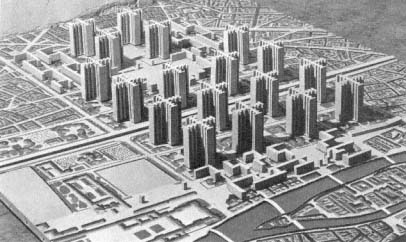
1.
Le Corbusier. Plan Voisin for the rebuilding of Paris. Model.
1925. Courtesy of the Museum of Modern Art, New York.
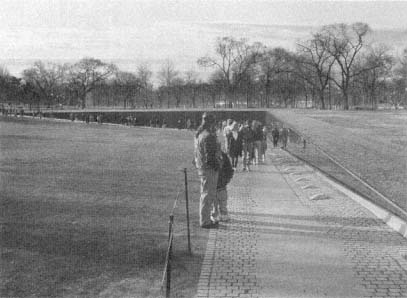
2.
Maya Lin. The Vietnam Veterans Memorial,
Washington, D.C. 1982. Photo: Charles Larson.
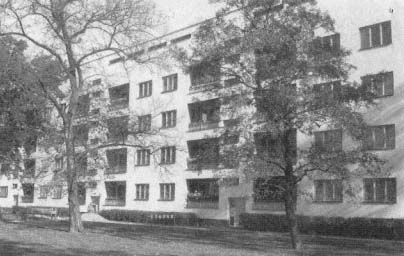
3.
Walter Gropius. Apartments at Siemenstadt,
Berlin. 1929–31. Photo: Roland Schevsky.
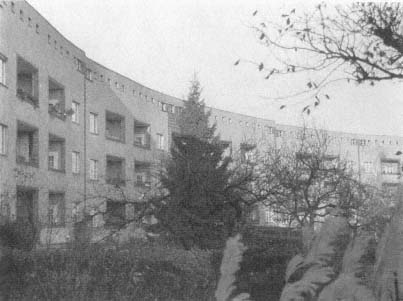
4.
Bruno Taut. Hufheiser Siedlung, Britz, Berlin. 1925–31. Photo: Roland Schevsky.
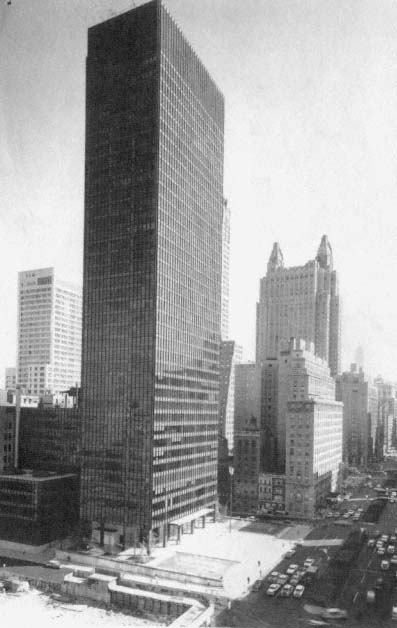
5.
Ludwig Mies van der Rohe with Philip Johnson. Seagram building, New York.
1956–58. Photo: Ezra Stoller. Courtesy of Joseph E. Seagram and Sons, Inc.
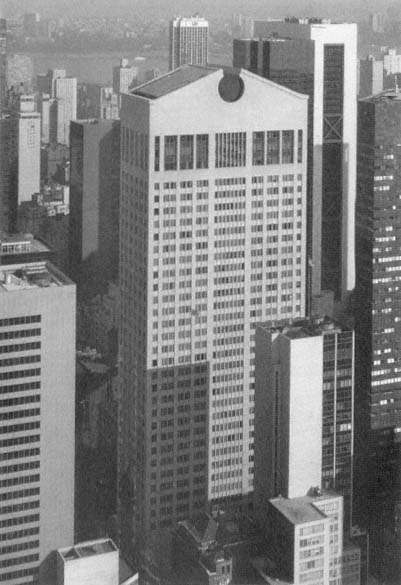
6.
Philip Johnson John Burgee. AT&T World
Headquarters, New York. 1984. Photo: Richard Payne.
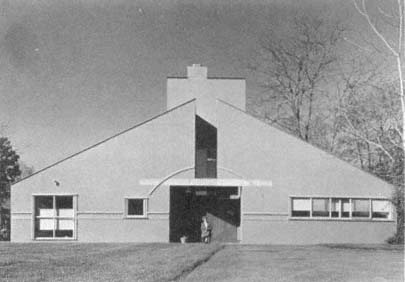
7.
Venturi and Rauch. Vanna Venturi's house, Philadelphia. 1962. Photo:
Rollin la France. Courtesy of Venturi Scott Brown and Associates.
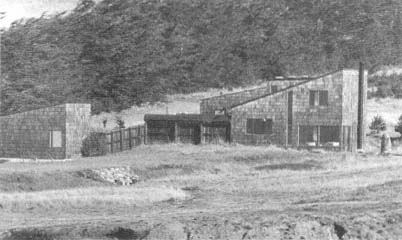
8.
Joseph Esherick and Associates. Sea Ranch, Calif. 1965.
Photo: Peter Dodge. Courtesy of Esherick Homsey Dodge Davis.
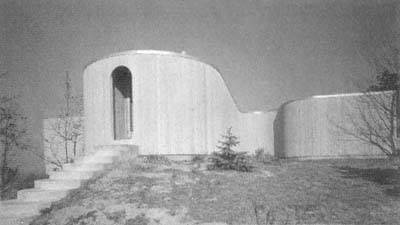
9.
Stanley Tigerman. Daisy House, Porter, Ind. 1976–78.
Photo: Howard N. Kaplan. Courtesy of Tigerman McCurry.
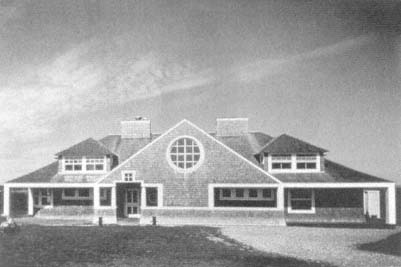
10.
Robert A. M. Stern. Residence at Chilmark, Martha's Vineyard, Mass.
1983. Photo: Wayne Fuji. Courtesy of Robert A. M. Stern, Architects.
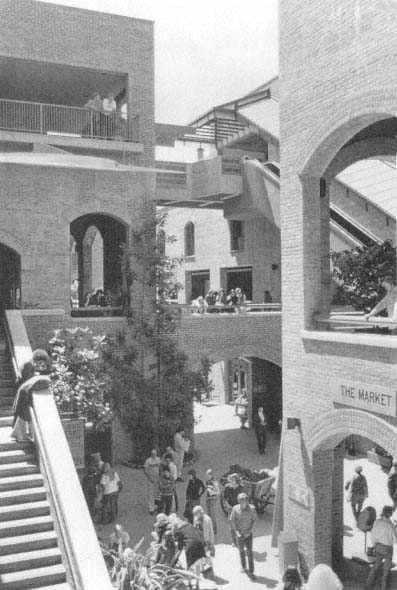
11.
Esherick Homsey Dodge Davis. An early example of urban reuse: shops
at the Cannery, San Francisco. 1966. Courtesy of Esherick Homsey Dodge Davis.
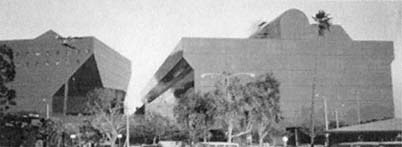
12.
Cesar Pelli. Pacific Design Center, Los Angeles. 1971–75. Photo: author.
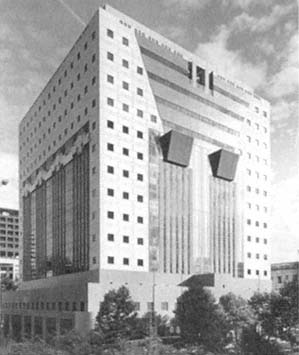
13.
Michael Graves. Municipal Services Building, Portland, Oreg. 1980.
Photo: Paschall/Taylor. Courtesy of Michael Graves, Architects.
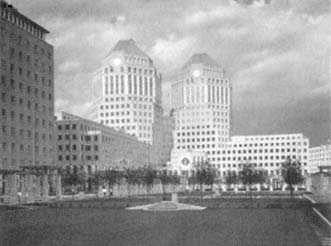
14.
Kohn Pedersen Fox with Perkins Will. Procter and Gamble Headquarters,
Cincinnati. 1985. Photo: Jack Pottle/ESTO. Courtesy of Kohn Pedersen Fox.
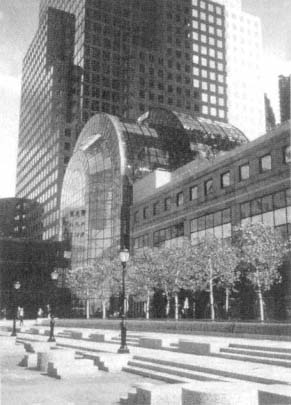
15.
Cesar Pelli and Associates. World Financial Center, New
York. 1981–87. Photo: Cesar Pelli. Courtesy of Cesar Pelli
and Associates.
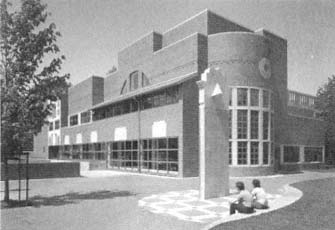
16.
Venturi Rauch Scott Brown. Gordon Wu Hall, Princeton
University. 1980. Courtesy of Venturi Scott Brown and Associates.
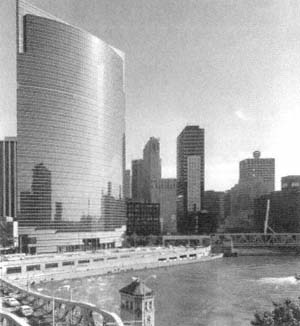
17.
Kohn Pedersen Fox. 333 Wacker Drive, Chicago. 1979–83.
Photo: Barbara Karant. Courtesy of Kohn Pedersen Fox.
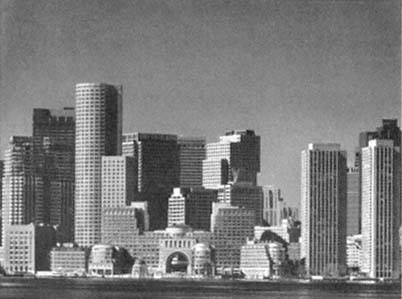
18.
Adrian Smith/SOM. Rowes Wharf, Boston. 1987–88. Photo © 1987
Nick Wheeler/Wheeler Photographics. Courtesy of SOM.
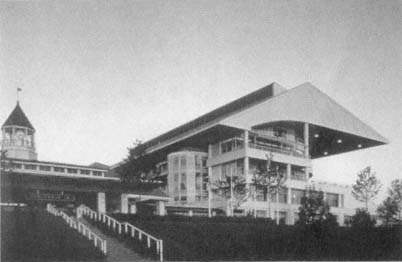
19.
Diane Legge/SOM. Race track. Arlington, Ill. 1989.
Photo: Hedrich-Blessing. Courtesy of SOM.
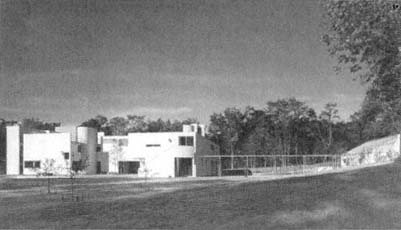
20.
Gwathmey Siegel. Taft residence, Cincinnati. 1977. Photo: Richard Payne.
Courtesy of Gwathmey Siegel and Associates and Richard Payne.
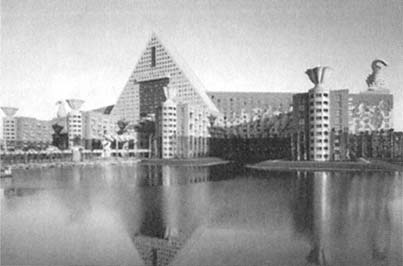
21.
Michael Graves with Alan Lapidus. Disney World Dolphin Hotel, Lake Buena
Vista, Fla. 1990. Photo: Steven Brooke. Courtesy of Michael Graves, Architects.
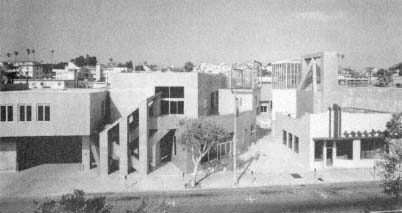
22.
Frank Gehry. Edgemar Center, Santa Monica, Calif, 1984–88. Photo: Tom Bonner.
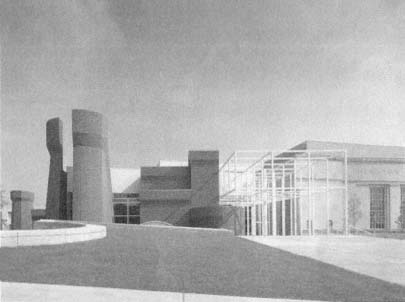
23.
Peter Eisenman with Richard Trott. Wexner Center for the Arts, Ohio
State University, Columbus. 1989. Photo © Jeff Goldberg/Esto.
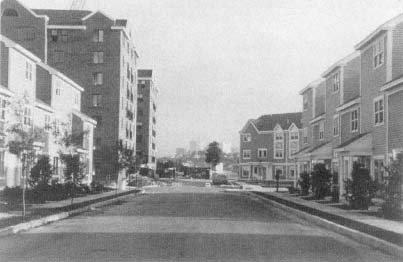
24.
Joan Goody. Renovation of Harbor Point, Boston. 1989. Photo:
Anton Grassl. Courtesy of Goody Clancy and Associates.
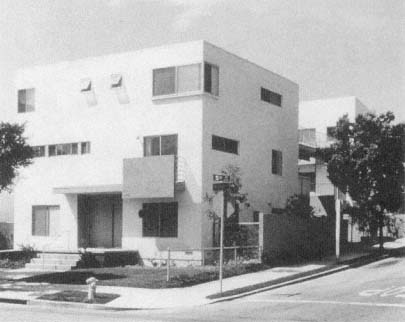
25.
Koning, Eizenberg. Affordable housing, 5th Street, Santa Monica,
Calif. 1988. Photo: Grant Mudford. Courtesy of Koning Eizenberg.
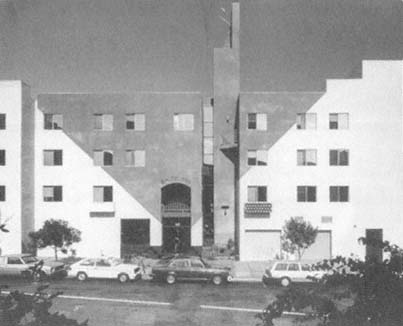
26.
Rob Quigley. Baltic Inn, San Diego, Calif. 1987. Courtesy of Rob W. Quigley.